Category: News

  • Introducing the first Symbian^3 device, Nokia N8

    By Tim Conneally, Betanews

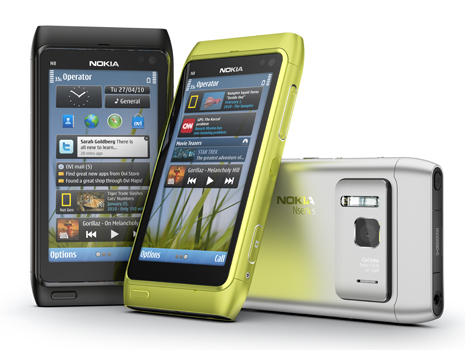
    Nokia N8

    The Symbian Foundation’s 100% open source mobile operating system Symbian^3 has officially made its debut today on the new Nokia N8 handset.

    Unlike Google’s Android, which launched on a mid-range smartphone in late 2008, Symbian^3 is being ushered into the market on a device with cutting-edge equipment.

    The N8 is built from a single piece of anodized aluminum and has a 3.5″ (640 x 360) OLED touchscreen. It has a 12 megapixel camera with 28mm wide-angle Karl Zeiss optics, a xenon flash, and the ability to capture 720p HD (16:9, 25 fps H.264/MPEG-4) video. There is also a forward-facing VGA camera for video calling.

    It has 16 GB of internal memory, and a MicroSD slot with support for cards up to 32 GB in size.
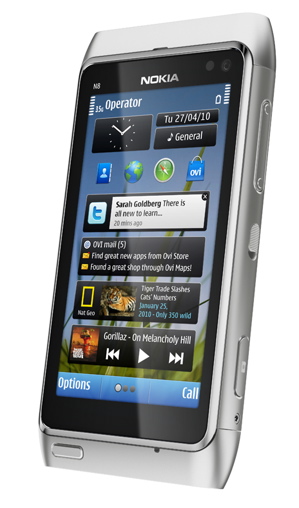
    Nokia N8

    In terms of wireless standards, the Nokia N8 supports quad-band GSM and WCDMA 850/900/1700/1900/2100, Wi-Fi with support for 802.11n, Bluetooth 3.0, GPS and A-GPS receivers, and an FM radio/transmitter.

    Physical I/O on the device includes Micro USB with support for USB on-the-go (a.k.a., phone-to-phone connections) HDMI, and a 3.5mm AV jack. It also includes an accelerometer, proximity sensor, ambient light detector, and magnetic compass.

    Despite all of the top-notch accessories, the N8 is reportedly based on a 680 MHz TI OMAP processor with 256 MB of RAM. It’s by no means a weak foundation for Symbian^3, but it’s not quite up to the latest gigahertz-level ARM processors being employed by other high-end smartphone manufacturers. We’ve contacted Nokia this morning to find out exactly which chip the device is based upon, and we’ll let you know what we find out.

    The N8 will be available for €370 in the third quarter of this year, reflecting Nokia CEO Olli-Pekka Kallasvuo’s statements last week that the company “will not ship [Symbian^3] before the quality meets the end user’s needs and demands.”

    However, Nokia’s video preview today shows a bit of what users can expect from Symbian^3 when the N8 is released later this year, including a three-screen home screen layout with drag-and-drop personalization, multitouch, 3D gaming and a unified social networking and Ovi service interface.

    Copyright Betanews, Inc. 2010


    Add to digg
    Add to Google
    Add to Slashdot
    Add to Twitter
    Add to del.icio.us
    Add to Facebook
    Add to Technorati


  • Children Received Geodon Overdose During Pfizer Drug Trials, FDA Says

    The drug maker Pfizer gave at least 13 children overdoses of its antipsychotic drug Geodon during clinical trials, according to federal investigators. 

    The FDA issued a warning letter to Pfizer earlier this month, accusing the company of failing to properly monitor a clinical trial that resulted in “widespread overdosing” of children with the powerful antipsychotic drug. The children suffered tremors and restless legs, but have not suffered any apparent long-term injuries as a result of the overdoses, investigators say.

    Late last week, Pfizer responded to the charges, with a statement on its clinical trial procedures. The company has promised to provide an outline of processes aimed at preventing similar problems from occurring during its clinical trials in the future.

    The agency blasted the company in its warning letter for failing to correct or detect Geodon overdoses being given to children in a timely manner. According to the letter, adults and children alike received significant drug overdoses daily on consecutive days, with some being subjected to overdoses of the drugs for 16 consecutive days. One subject received 30 days of total overdosing and experienced sleep problems, facial tics and chemical imbalances.

    “The final Clinical Study Report submitted to the FDA lists 40 total subjects reported to have had a protocol deviation related to dosing error, including 20 subjects who exceeded the maximum protocol dose,” the warning letter states. Nine site visits by a Pfizer data management team failed to detect the overdoses, the FDA found.

    Geodon (ziprasidone) was approved by FDA in 2001 for the treatment of bipolar disorder and schizophrenia in adults. It is an atypical antipsychotic. The clinical trials, which took place in 2006 and 2007, were part of an ongoing effort by Pfizer to gain approval to market Geodon for use by children.

    FDA staff members have said that the side effects of Seroquel, Geodon and other antipsychotics need to be further studied due to the possible weight gain and diabetes effects on children.

    Last year, Pfizer plead guilty to charges that it illegally promoted Geodon and several other drugs for off-label uses not approved by FDA. Pfizer paid $2.3 billion to the U.S. Department of Justice in a settlement that included a corporate integrity agreement.

  • Emanuel says he doesn’t want mayor remark to disrupt Daley

    Posted by John Byrne at 10:20 a.m.; updated at 11:00 a.m.

    Rahm Emanuel said today during an appearance in Chicago that he doesn’t "want to be disruptive" to Mayor Richard Daley, a week after the White House chief of staff mentioned that he’d like to be Chicago mayor.

    "It’s great to be back in Chicago, and I don’t want to be disruptive to what the mayor’s doing here," Emanuel told a throng of reporters crowded around him as he tried to leave a panel discussion at the University of Illinois-Chicago. "It’s great to be home. As you know, we have our home here. And we can’t wait — at some in the future, don’t over-interpret anything, don’t everybody get excited — at some point we will come back, which was always our goal, which was why we rented (our North Side) house."

    Emanuel drew a wave of attention last week after he said during a TV interview that he’d like to run for Chicago mayor if Daley doesn’t seek re-election and that he’s always aspired to the job.

    Responding to a reporter’s question, Emanuel also said he has not been subpoenaed by the defense team for ex-Gov. Rod Blagojevich in his upcoming federal corruption trial.

    Before he left, Emanuel stopped to talk with Mayor Daley, who was sitting in the front row with wife Maggie, brothers Bill and John, and other family members. The event was the Richard J. Daley Global Cities Forum, named after the family patriarch.

    During the panel discussion, Emanuel took some gentle ribbing about his mayoral aspirations.


    While introducing Emanuel during a discussion panel about promoting innovation in local government, moderator Judy Woodruff of PBS detailed Emanuel’s list of prominent public positions, from the Clinton administration to North Side congressman to President Barack Obama’s chief of staff.

    Then Woodruff noted Emanuel recently said he would like to be mayor of Chicago. "But the consensus is, before that happens, he has to get some real experience," Woodruff said.

    "I’m smiling," Emanuel said, and let out a laugh.

    "I have two brothers, so ribbing’s fine," Emanuel said afterward when asked about Woodruff’s introduction. "I’m used to ribbing."


    Emanuel told the audience that cities need to stretch resources by partnering with private companies and making regional deals with suburban governments.


    "We need to end the traditional divisions between cities and suburbs," Emanuel said.


    He also pointed to the "re-invention of public housing in Chicago," using federal money, as an innovative way to leverage federal subsidies to handle a local problem.


    Public housing residents were understandably cynical about the process, Emanuel said. But by bringing them into the process, the city was able to make them partners.

  • First genuine BlackBerry OS 6.0 info shows new media player, browser

    By Scott M. Fulton, III, Betanews

    Research In Motion could deliver sixteen completely new smartphones with built-in telekinesis amplifiers, but it would not satisfy the legions of BlackBerry users who depend on its reliable messaging ability, who need a real Web browser that shows real Web pages, and who would appreciate a media player that doesn’t look ported from a Commodore 64.

    Why RIM officials can’t just deliver the news to WES conference attendees directly is puzzling, but during this second day of the three-day event, the Day 2 keynote offers RIM users a two-minute quick-cut video of BlackBerry OS 6.0, alongside a parade of new enterprise apps. Granted, enterprise apps are important, but what BlackBerry has been lacking this past year is a proper platform for them.

    In an either ingenious or perverted scheme, the two-minute video released today only shows the new BB OS 6 environment in a semi-transparent frame, floating freely in front of the torso of someone who, to paraphrase the show’s name, thinks he or she can dance. We’ve cleaned up some of the images and straightened them out as best we can, and what we find are many of the now-basic smartphone features that BB users have been screaming for, presented in a classy, but tasteful motif complete with BlackBerry’s typical lack of useless frills or adornment.

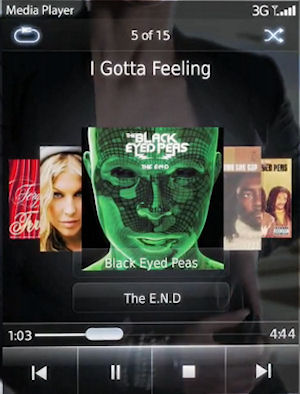
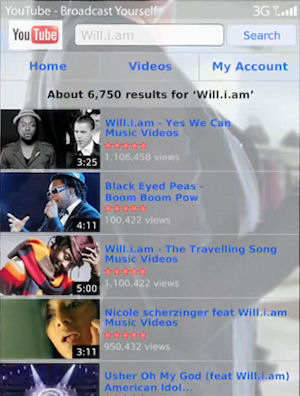
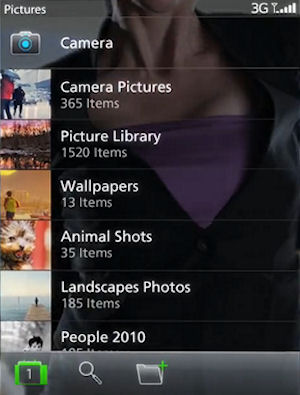
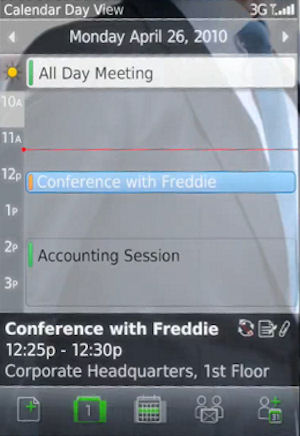
    We’ve tried as best we can to normalize the images from the “BlackBerry 6 Sneak Peak” [sic] video (the dancers still appear behind them…trust me, they’re not included). Users of other smartphones may snicker a bit as BlackBerry users (including myself) rejoice at the inclusion of the following built-in features, for the first time:

    BlackBerry OS 6.0 preview pic (cleaned up from YouTube video)BlackBerry OS 6.0 preview pic (cleaned up from YouTube video)

    • A media player with downloadable album covers and categorical media library.
    • A YouTube app with searchable video.

    BlackBerry OS 6.0 preview pic (cleaned up from YouTube video)

    • The ability to play back said video in landscape mode and stereo sound.

    BlackBerry OS 6.0 preview pic (cleaned up from YouTube video)BlackBerry OS 6.0 preview pic (cleaned up from YouTube video)

    • A categorical, searchable library for photographs.
    • A calendar with usable meeting data that appears to sync not just the data, but the connections (who’s invited, where’s the location), very likely (though not officially confirmed) with Microsoft Outlook. Yes, BlackBerry does already have a reliable manual sync function, and enterprise users can deploy ActiveSync over the air. But Outlook 2010 expands users’ capabilities to organize meetings, and it’s important that this extra level of functionality be added to synchronization as well.
    • BlackBerry OS 6.0 preview pic (cleaned up from YouTube video)

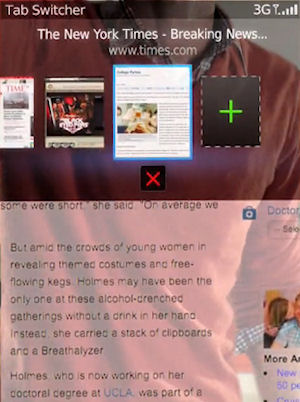
    • A tabbed Web browser. No, not Opera Mini, but something that has fluid scrolling and that’s plainly legible at a distance of 18 inches. A RIM spokesperson did confirm to Betanews this morning that the new browser does use the WebKit engine (also found in Safari for iPhone), and that for multitouch-capable models, pinch-to-zoom will be supported here and throughout the system.

    BlackBerry OS 6.0 preview pic (cleaned up from YouTube video)BlackBerry OS 6.0 preview pic (cleaned up from YouTube video)

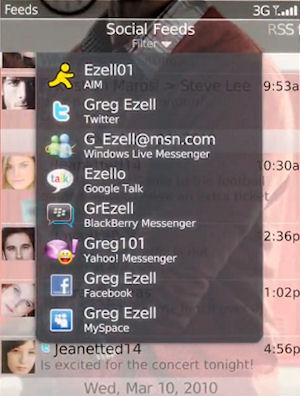
    • A single application for maintaining multiple social network feeds, including Facebook, Twitter, MySpace, Google Talk, AIM, Windows Live Messenger, Yahoo Messenger, and BlackBerry Messenger. We don’t know at present whether this list is extensible with add-ons, to support other services such as LinkedIn and Plaxo.
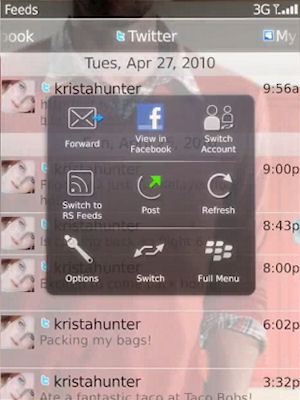
    • Individual apps for social network services including Twitter. This particular picture (above right) is important because it also demonstrates how BB OS 6 replaces the PC-style popup context menu with this graphical, more touchable, easier to interpret version.

    Though we have no official confirmation of this yet, much of the BB buzz is centering on the platform’s apparent new use of “flick gesturing” or “gesture flicking.” Here, models that include the new mini-trackpad (for instance, the Pearl 9100 and Bold 9650, introduced yesterday) should interpret flick movements as commands. The video showed dancers trying to demonstrate this kind of jerky, flicky motion, though it’s possible some viewers mistook those motions for choreography.

    The running live blog of this morning’s keynote event where the video premiered, on the forums of CrackBerry.com, indicate that very little new information about the platform itself was revealed today. RIM’s platform VP is scheduled to speak tomorrow, and hopefully he doesn’t dance.

    Copyright Betanews, Inc. 2010


    Add to digg
    Add to Google
    Add to Slashdot
    Add to Twitter
    Add to del.icio.us
    Add to Facebook
    Add to Technorati


  • 183 Heavenly HDR Wallpapers [Photography]

    There’s no going wrong with HDR photography. At its most sensitive, the technique allows for color/tone gradients rarely appreciated by anything but the naked eye. At its most aggressive, HDR’s a hyperreal spectacle. This week’s Shooting Challenge celebrate both schools: More »


  • All Aboard the Beef Train–Amtrak Debuts a Train Running on Beef Biofuel | Discoblog

    If you thought a cow was good only for its milk and meat, then we’d have you know that somewhere between Oklahoma City and Fort Worth, Texas, there is an Amtrak train chugging along on moo-power. Amtrak is currently running its Heartland Flyer train on a mix of traditional diesel fuel and biodiesel produced from cow products, in an experiment that Amtrak argues could make railroads more eco-friendly. The Heartland Flyer uses about 100,000 gallons of diesel fuel each year to move 84,000 people. For this one-year test run, Amtrak will replace 20 percent of that fuel with biodiesel, produced from tallow from Texas cows. The fat from the cattle, which is normally used to make animal feed and soap, will now instead help power a train. According to Fast Company:
    Amtrak says that the cow tallow (read: rendered fat from cattle) fuel reduces hydrocarbon and carbon monoxide emissions by 10%, cuts down on particulates by 15%, and reduces sulfates by 20% compared to standard diesel.
    But if the idea of whizzing across the heartland in a cow-powered train makes you uneasy, then you’re not alone. The animal rights organization PETA isn’t too hot on the idea either, with PETA spokesman Bruce Friedrich telling Fast …


  • Goldman Is Not a God

    Carl Levin is asking the same silly question that I’ve heard over and over:  shouldn’t Goldman have told buyers that it was short?

    The presumption is that Goldman has some sort of godlike knowledge that it was concealing from its customers.  It’s not Goldman’s responsibility to tell its customers what they should want to buy (or at least, not on the trading/ABS side), or what Goldman wants to buy.  It’s Goldman’s responsibility to make sure that its clients have all the relevant details about the securities.  Clients buy stuff from Goldman all the time that some part of Goldman is short; differences of opinion are what make marriages and markets. 

    It is true that clients would like to know what Goldman is doing, but it’s also true that the seller of the house I just bid on would like to know what my reservation price is.  That doesn’t mean that I have some obligation to disclose this information.  These are large securities firms that are presumed to know how to evaluate a security; if they can’t, they should turn in their charter and disband.

    Goldman was making a bet.  That bet could have gone wrong  (not in this case, but in many similar).  Other firms had different opinions of the market.  Goldman was under no obligation to disabuse them of their opinions.  They’re not investment advisers; they’re securities issuers.

    (Nav Image Credit: Mike52ad/flickr)


    Email this Article
    Add to digg
    Add to Reddit
    Add to Twitter
    Add to del.icio.us
    Add to StumbleUpon
    Add to Facebook


  • Vodafone 845 ultra-small Android 2.1 phone gets official

    Vodafone have come clean with their latest Android handset, the super-small Vodafone 845 first spotted in the wild a couple of weeks back.  Measuring a scant 100 x 55 x 13 mm, the 845 has a 2.8-inch touchscreen, Android 2.1 Eclair and a 3-megapixel camera.

    There’s also Vodafone 360, together with access to the Android Market, along with WiFi.  Previous rumors tipped it to have Bluetooth 2.1, triband GSM/GPRS/EDGE and dualband UMTS/HSPA, as well.

    According to Vodafone, the 845 will initially arrive in 12 different markets, including the UK, though it hasn’t yet confirmed pricing or specific availability.  Still, last we heard the Vodafone 845 should be arriving sometime this quarter.

    [via the::unwired]

  • Reid Slams Republicans, Sets Another Cloture Vote

    This morning, Senate Majority Leader Harry Reid (D-Nev.) came out swinging against Senate Republicans’ obstruction of debate on Sen. Chris Dodd’s (D-Conn.) financial regulatory reform bill. In a press release, he argues:

    The American people also demand that their leaders discuss these details and improve on these ideas.  They have two simple requests: One, that their leaders look out for their economic security; and two, that their legislators legislate.  In other words, they want us to look out for their jobs and they want us to do our own.

    Right now, Senate Republicans are refusing to do either. Yesterday they stood together, en bloc, to block us from moving this bill to the floor.  They didn’t even want the Senate to talk about legislation as part of the normal legislative process.

    More than two years after the financial collapse that sparked a worldwide recession, Senate Republicans are claiming we’re moving too fast. They are claiming that only a fully negotiated and agreed-upon bill can come up for debate.  They want all the details to be worked out beforehand, behind closed doors and out of view from the public. That is unprecedented in the 220 years of the United States Senate.  As we all learned in civics class, that’s not how the legislative process works.

    The letter does not mention Sen. Ben Nelson (D-Neb.), who surprisingly sided with the Republicans last evening in refusing to vote to start formal debate on the bill. (Reid switched his final vote to no for procedural reasons.)

    And Reid has called another cloture vote for 4:30 p.m. this evening. As of this morning, none of the likely crossover voters — such as Sen. Olympia Snowe (R-Maine) — have publicly indicated that they are willing to side with the Democrats or that their requests have been met.

  • Executive producer talks about Madden NFL 11 Game Flow

    By changing a lot of gameplay mechanics in Madden NFL 11, EA Sports promises that the game will be “simpler, quicker, deeper”. Those looking to continue playing the series will have to say goodbye to picking plays

  • Opera 10.5 Mac Released — Still the Fastest Browser on Earth?

    Opera Software today released the Mac version of Opera 10.5. It’s a release I’ve been waiting for ever since the launch of Opera 10.5 for Windows — itself an extremely impressive browser. I downloaded it this morning (confusingly, the version number is 10.52) and put it through its paces, benchmarking it against the latest versions of Firefox, Safari and Chrome, the browsers I use most frequently on my MacBook — it’s blisteringly fast.

    As usual, I used WebKit’s SunSpider benchmark test, which runs the browser through a series of JavaScript-intensive tasks and measuring how long it takes to complete them.

    The chart shows SunSpider scores in milliseconds; the lower the score, the better. As with the Windows tests, Opera was the fastest, narrowly beating Chrome. The margin between Opera and Chrome was even more slender on the Mac test, though — Opera scored 395.6ms, while Chrome scored 400.8ms. Still, Opera was slightly faster — perhaps just enough to continue to justify Opera’s claim of being the “fastest browser on Earth,” although I doubt you’d notice any difference between them in real-world usage. Safari was also pretty darn quick at around 500 ms, while Firefox lagged behind the pack at 1000ms. (Note that you can’t directly compare the scores from my Windows and Mac browser benchmarks, as they were carried out on different machines).

    JavaScript performance is important because we’re all increasingly reliant on JavaScript-intensive web apps — the better our browser is at handling them, the more productive we’ll be. Raw speed isn’t everything, of course, but Opera’s lightning-fast speed, coupled with an attractive UI, support for the latest web standards like CSS3 and HTML5 video, and a slew of useful features like multitouch trackpad gestures, “speed dial” and “turbo mode,” make it a very compelling option — it may even become my primary work browser. You can download Opera 10.5 Mac for free at opera.com.

    Let us know what you think of Opera 10.5 Mac in the comments.

    Related GigaOM Pro content (sub. req.): What Does the Future Hold For Browsers?

  • Trident urges you to chew on two dudes’ wacky Web adventures

    Prepare to be mildly amused. Trident is launching a star-studded Web series produced by CJP Media called "The Webventures of Justin and Alden" that looks like an updated version of Bill & Ted’s Excellent Adventure or maybe Harold & Kumar Go to White Castle. I say mildly amused because the trailer contains no LOL moments, but there’s a chance that in their strenuous attempts to entertain you, Upright Citizens Brigade members Justin Tyler and Alden Ford may at times succeed. There’s George Washington and vampires, for example, and the moment when Tyler breaks the fourth wall is somewhat risible. (He looks like a cross between the Ferris Bueller-era Matthew Broderick and Matt LeBlanc.) "This will be the greatest Web series Web show that’s ever been on the Web computer!" Tyler says, sounding like Joey and Ferris rolled into one. There are lots of cameos, too, including Shannen Doherty, Illeana Douglas and Mark Gantt (who I thought was Christian Slater.) The effort, launched on behalf of its Layers gum, underscores Trident’s Skittles-like focus on absurdist humor hinted at in previous commercials. If Samuel Beckett were alive today, he’d no doubt be making candy ads. UPDATE: Check out the first actual episode here.

    —Posted by Todd Wasserman

  • Goldman, Bernanke Testimonies Released

    Washington is buzzing with the various testimonies and commissions ongoing today. Watch Fed Chairman Ben Bernanke and other speakers at the National Commission on Fiscal Responsibility and Reform, the president’s deficit commission, live here. And watch Sen. Carl Levin’s (D-Mich.) Senate Permanent Subcommittee on Investigations interrogate Goldman Sachs executives live here.

    Both the debt commission and Levin commission have released prepared remarks as well.

    In today’s prepared testimony, Ben Bernanke argues that the government needs to fix its tax code and cut entitlements, or else face fiscal doom:

    [The] federal budget appears set to remain on an unsustainable path….Unfortunately, we cannot grow our way out of this problem. No credible forecast suggests that future rates of growth of the U.S. economy will be sufficient to close these deficits without significant changes to our fiscal policies….

    The commission will have the difficult job of weighing the economic, social, and other benefits of these [entitlement] programs and comparing the implications of cuts in these areas against other means of closing the fiscal gap. Choices regarding Medicare, Social Security, and other spending programs cannot be made in a vacuum but must be combined with decisions about how much revenue the government will raise and how it will raise it. No laws are more basic than the laws of arithmetic: For fiscal sustainability, whatever level of spending is chosen, revenues must be sufficient to sustain that spending in the long run.

    And here are the Goldman testimonies. On the first panel are Daniel Sparks, former head of the mortgages department, Joshua Birnbaum, former managing director in structured products, Michael Swenson, managing director in structured products, and Fabrice Tourre, indicted in the Securities and Exchange Commission civil fraud case against Goldman Sachs and executive director in structured products. On the second panel are David Viniar, Goldman’s chief financial officer, and Craig Broderick, the chief risk officer. And on the third and final panel is Lloyd Blankfein, chief executive officer.

    Tourre argues, “I deny — categorically — the SEC’s allegation. And I will defend myself in court against this false claim,” and goes on to detail that he made full disclosures about the structure of the mortgage-backed securities deal to the client who took the losing half of the bet.

    And Blankfein’s testimony is largely conciliatory, though he says that Goldman has done nothing illegal or unethical with its mortgage products: “While we strongly disagree with the SEC’s complaint, I also recognize how such a complicated transaction may look to many people. To them, it is confirmation of how out of control they believe Wall Street has become, no matter how sophisticated the parties or what disclosures were made. We have to do a better job of striking the balance between what an informed client believes is important to his or her investing goals and what the public believes is overly complex and risky.”

  • Supreme Court rules Vioxx fraud suit may proceed

    [JURIST] The US Supreme Court on Tuesday allowed a suit to proceed against drug maker Merck & Co. over the safety record of its painkiller Vioxx. The court ruled unanimously in Merck & Co. v. Reynolds that the statute of limitations in a securities fraud lawsuit begins to run once the plaintiff actually discovered or a reasonably diligent plaintiff would have discovered the violation – whichever comes first. Investors brought the class action suit against Merck in 2003, alleging that it had deliberately concealed information about Vioxx. The case was dismissed by a federal judge in April 2007 after he determined that investors were on “inquiry notice” of the alleged fraud in September 2001 when the Food and Drug Administration (FDA) released a warning letter about the painkiller. The US Court of Appeals for the Third Circuit reinstated the case in September 2008, finding that the district judge had “acted prematurely in finding as a matter of law that were on inquiry notice of the alleged fraud.” In affirming the decision below, Justice Stephen Breyer wrote:
    Construing this limitations statute for the first time, we hold that a cause of action accrues (1) when the plaintiff did in fact discover, or (2) when a reasonably diligent plaintiff would have discovered, “the facts constituting the violation” – whichever comes first. We also hold that the “facts constituting the violation” include the fact of scienter, “a mental state embracing intent to deceive, manipulate, or defraud,”Justice John Paul Stevens filed a concurring opinion. Justice Antonin Scalia filed a separate concurring opinion, joined by Justice Clarence Thomas.Under 28 USC § 1658(b), a plaintiff has two years to file a claim alleging violation of the Securities Exchange Act of 1934. The first fraud complaint against the company was filed in November of 2003. Merck pulled Vioxx from the market in September 2004 after a study showed that it could double the risk of heart attack or stroke if taken for more than 18 months.

  • AdMob numbers show Android overtaking iPhone requests in the U.S.

    U.S. Smartphone OS usage - AdMob

    AdMob, which serves up many (for 18,000 sites and apps, it says) of those little ads you see in Android applications, has released its March findings. The bullet points:

    • Of smartphones in the United States, Android overtook iPhone usage, 46 percent to 39 percent. (In the UK there’s much greater disparity, with the iPhone leading 70 percent ot 13 percent.)
    • The HTC Dream (G1) and Magic (myTouch) made up 96 percent of traffic in September 2009. Seven months later, 11 Android phones make up 96 perecent of AdMob’s traffic.
    • In March, traffic was divided between Android 1.5 (38 percent) Android 2.0/2.1 (35 percent) and Android 1.6 (26 percent).
    • Motorola scored 44 percent of AdMob’s traffic with the Droid and Cliq. HTC had 43 percent of requests; Samsung had 9 percent.
    • AdMob requests from Android phones grew at a compounded rate of 32 percent a month, from 72 million requests in March 2009 to 2 billion in March 2010.

    Handset by handset, the Motorola Droid continues to rock with 32 percent of AdMob’s traffic. The Google Nexus One had 2 percent as of March. Not greatly surprising, given the reasons we’ve stated over and over.

    While the Droid, G1 and Moto Cliq lead in the U.S., the HTC Hero, Dream (G1) and Magic (myTouch) lead in Europe.

    Do note that AdMob is (still) in the process of being purchased by Google. And these numbers are representative of the ads AdMob serves, and not necessarily of actual smartphone usage. So it’s a good ballpark figure, but not necessarily gospel. You can read the entire report for yourself here. (pdf)

  • Found on the Moon: A Soviet Laser Reflector That Was Lost for 40 Years | 80beats

    SovietRoverFour decades ago, the Soviet Union put a reflector on the moon able to bounce laser signals back to the Earth. There was just one problem: They lost it.

    But now the marooned reflector has been found, thanks to the determined hunting of University of California, San Diego researchers. NASA’s Lunar Reconnaissance Orbiter, in orbit around the moon, photographed the landing area where the USSR’s Luna 17 mission dropped off the missing reflector, Lunokhod 1, in 1970. The photos turned up a faint reflective dot, and the team thought that was it.

    With an idea now where to point their own laser, the researchers received a stronger signal back from Lunokhod 1 than they ever had in years of studying its sister craft, Lunokhod 2. “The best signal we’ve seen from Lunokhod 2 in several years of effort is 750 return photons, but we got about 2,000 photons from Lunokhod 1 on our first try,” said Murphy. “It’s got a lot to say after almost 40 years of silence” [UPI].

    After landing near the Mare Imbrium, Lunokhod 1 stayed in touch with Soviet ground controllers for no less than 11 months, prowling the moon even as the US astronauts of Apollo 14 and 15 were driving about elsewhere in their manned moon buggies. However the robot crawler eventually ceased communications, and the project was officially terminated on October 4, 1971 [The Register]. The Soviet scientists lost the location of the reflector, and because it doesn’t reflect enough light from the sun for us to see it from Earth, they never found it again. Firing the laser to look for a signal only works if you know the reflector’s general location, and thus wasn’t possible until the LRO spotted Lunokhod 1 this year.

    The American team had used Lunokhod 2 along with three reflectors left behind by Apollo missions to keeps tabs on our natural satellite and track its position and orbit as it ever-so-slowly moves away from us. And the researchers say that the re-discovered Russian reflector is particularly useful for studying the moon’s liquid core and testing ideas about gravity [Scientific American].

    Related Content:
    DISCOVER: The Bloc on the Block, old Soviet space gear for sale
    DISCOVER: The Moon Makes a Splash
    Bad Astronomy: NASA Spies on USSR Hardware
    Bad Astronomy: Apollo Landing Sites Imaged by LRO!
    Bad Astronomy: LRO First Light Images of the Moon!

    Image: NASA


  • Acidente Bizarro na última volta da Nascar Nationwide

    Algumas pessoas dizem o seguinte a respeito do futebol: “É uma caixinha de surpresas”. Concordo, mas não somente no futebol as surpresas podem acontecer, e impressionar. No automobilismo também isso acontece muito mais do que se imagina.

    Por exemplo, o que aconteceu nesse último domingo na Nascar Nationwide Series, impressionou todos na última volta da corrida, que aconteceu no circuito de Talladega. A grande confusão começou com um pequeno toque em Jamie McMurray. O que acontece em seguida é uma sequência de batidas, algo parecido com um “efeito dominó”.

    O mais azarado desse momento foi o piloto Dennis Setzer, que teve seu carro colidindo com a grade e se transformou em uma bola de fogo. A vitória da prova ficou com Brad Keselowski, que não foi atingido pelo caos que estava atrás de si e recebeu o primeiro lugar.

    Via | Motorpasion


  • The Goldman Hearing Begins

    The statements from the Senators make it clear that they are not holding this hearing in order to find out what happened; that’s the SEC’s job.  They’re holding this hearing in order to be televised yelling at investment bankers.  Claire McCaskill’s rant was particularly irrelevant to the actual question at hand, but all of them are mostly trying to express outrage, not make any coherent assessment of the strengths of the SEC’s case.

    And what is the strength?  It boils down to the question of what a material fact is.  If you define a material fact as something that would have changed the actual performance of the security, then probably Goldman didn’t fail in its duty. The garbage ACA picked on its own was allegedly no better than the garbage that Paulson chose.  I’m not aware of any investors who were skilled enough to pick high-performing securities based on subprime mortgages. 

    And certainly, ACA’s claimed motives seem more than a bit dim.  They didn’t know that Paulson was a housing bear?  Or they thought he’d found the one set of securities he believed was going to outperform?  Really?  You know, I have a used car I could offload if you’ll get the ACA guys down here to take a look at it . . .

    But one can argue that a material fact should be defined as anything that might have made the investor think twice.  Just as it is still murder to shoot someone who has just jumped out of a ten story window, it is still not right to conceal details from customers, even if you know that they’re still bent on a destructive course.  I find this argument pretty convincing.

    That doesn’t mean that a court will.  There’s quite a bit of case law surrounding what constitutes a material fact, and the judge is going to work off of that, not my neat philosophy-experiment intuitions.  A lot of very smart people who know a lot about securities law seem to think that the SEC is pushing its luck on the law, if not the merits.


    Email this Article
    Add to digg
    Add to Reddit
    Add to Twitter
    Add to del.icio.us
    Add to StumbleUpon
    Add to Facebook


  • IAS18 : Alert Station for the protection of drinking water resources

    HOCER IS (HOCER Group), the European Leader in the field of online detection of micropollutions (pesticides, hydrocarbons..) presents the IAS18, an integrative solution to detect micropollutions in the water.

    This unit (18 m²) integrates several analyzer is order to cover all type of pollution in the water from the pH to hydrocarbons and pesticides (µg/L)

    This solution is communly used in France to protect captures of drinking water plants and to protect rivers against pollutions (Alert Networks)

  • RIV300: hydropneumatic tool for speed rivets

    The hydropneumatic tool RIV300 has been projected for placing speed rivets in cartridge and it’s ideal to obtain quick and repeating riveting.
    This tool ensures a significant reduction in assembly times and a good flexibility in processes, because it can easily be included in automatic assembly lines.
    RIV300 is equipped with proper spare parts according to the type and diameter of the rivet to be placed.
    The fittings selection has to be done as follows:
    • head according to rivet diameter;
    • mandrel according to rivet diameter, and head;
    • spring according to mandrel.
    Rivets in cartridge are mostly used in automotive, electronics, electro mechanics, furnishing and illuminating engineering.
    We underline that all Rivit tools, RIV300 included, are according to Machinery Directive 06/42/EC and following modifications.

    Technical data

    Air pressure (min/max): 5 – 7bar
    Air volume required (5,1bar): 2,6lt
    Stroke: 30mm
    Pull force (5,1bar): 3890N
    Cycle time:~ 1 sec.
    Weight (pistol only): 1,08Kg