Category: News

  • Exclusive video: Sir Richard Branson on the Carbon War Room, peak oil, and why dyslexia has made him a better communicator – “Fuel prices could easily go through $200 a barrel” in the near future

    Late last year, Sir Richard Branson founded a new nonprofit, the Carbon War Room.  The objective of CWR is to “bring together successful entrepreneurs in collaboration with the most respected institutions, scientists, national security experts, and business leaders to implement the change required to avoid catastrophic climate change.”

    The Virgin Group founder told Time in December, “There are some of us who believe that the problem of warming is as bad as the First and Second World Wars combined.  It’s that serious, and you know the key is carbon, [but] there’s no war room coordinating the attack on carbon.”

    I interviewed the British billionaire at the CWR’s “Creating Climate Wealth” conference last week.  He had some fascinating comments on peak oil, specific measures he is pursuing in his airline business to reduce emissions, and one unexpected ‘benefit’ of his dyslexia:


    For the record, he seems like a genuinely sincere guy.  And given the diminishing prospects for federal action — and hence diminishing prospects for global deal — we will need as many hard-core entrepreneurs working as hard as possible to get us off of our current emissions path and jumpstart the transition to a clean energy economy.

    For more on what they are doing in the shipping industry, see “The Carbon War Room starts to bust barriers in shipping,” which has my interview with Jigar Shah, the clean energy financing guru who now heads the CWR.

  • Attack on Asthma

    In elementary school I played on a traveling soccer team. Before every game we would pack our bags. We were careful not to forget our uniform, shin guards, socks, and cleats. However, there was another item that was crucial to some of the members of the team: their inhalers. My best friend played on the same team that I did and before we would leave for our games her parents would always remind her to grab her inhaler. I remember having to get her inhaler for her during some of her asthma attacks, and it wasn’t always on the soccer field. Sometimes it was at school or in our homes.

    Asthma has proven to be one of the most common serious chronic diseases of childhood. Schools and homes can harbor triggers that can lead to trouble breathing and asthma attacks.

    Exposures that can trigger asthma attacks include:
    ·    Secondhand smoke
    ·    Dust mites
    ·    Mold
    ·    Cockroaches
    ·    Pet dander
    ·    Ozone and particle pollution

    While most of these are exposures that you can look for indoors, there is also a way to become more aware of the quality of the outdoor air in your area. The Air Quality Index (AQI) , shown during your local weather report, can be a useful tool to provide information on the potential health risks of the air in your area.

    Some children with asthma can have difficulty playing outside when there are high levels of pollutants in the air. Even small amounts of outdoor physical activity, such as walking, can trigger an asthma attack when the air quality is poor.

    Some measures that can be made to help manage asthma include:

    • Eliminate smoking around children or the areas in which they live, learn, and play.
    • Use integrated pest management (IPM) to help prevent pest problems.
    • Fix leaks and moisture problems indoors.
    • Dust and vacuum regularly in areas that kids will be.
    • Locate animals away from sensitive children and ventilation systems.

    About the author: Nicole Reising is an intern at the Office of Children’s Health Protection. She is a sophomore studying non-profit management at Indiana University.

  • AdMob: Android passes iPhone in U.S. traffic

    We saw this one coming, but I did not think it would happen so soon. In AdMob’s latest March report, Android has surpassed the iPhone and accounts for a greater share of smartphone requests in the United States. AdMob does not represent the traditional view of market share (based on the number of handsets sold), but their reports still provide some insightful data.

    Android now accounts for 46% of AdMob's U.S. traffic.

    Android now accounts for 46% of U.S. smartphone share, while iPhone OS slid to 39%. A greater percentage of Android apps are offered for free so more developers have turned to ads in order to monetize their work.

    Google recently acquired AdMob, but the deal is far from done. The FTC is still negotiating with Google, but it looks like our government will try to block the proposed acquisition.

    Android highlights from the report include:

    • Two Android devices, the HTC Dream and HTC Magic, collectively represented 96% of Android traffic in September 2009. Seven months later, 11 devices represented 96% of Android traffic in the AdMob network.
    • In March 2010, Android traffic share on the AdMob network was divided relatively evenly between the three primary versions of the Android OS: Android 1.5 (38%), Android 2.0 / 2.1 (35%) and Android 1.6 (26%).
    • Motorola was the leading Android manufacturer with 44% share of traffic in March 2010 due to the success of the Droid and CLIQ. HTC was a close second with 43% of requests, followed by Samsung with 9%.
    • The Android platform has experienced significant growth in monthly traffic over the past year. Android traffic has grown at a compounded monthly growth rate of 32% per month, going from 72 million requests in March 2009 to 2.0 billion in March 2010.
    • Two Android devices, the HTC Dream and HTC Magic, collectively represented 96% of Android traffic in September 2009. Seven months later, 11 devices represented 96% of Android traffic in the AdMob network.
    • The Motorola Droid was the leading Android handset in March 2010 and generated 32% of worldwide Android traffic. The Google Nexus One only generated 2% of Android traffic in March 2010.
    • The top Android devices vary by country. The top three devices in the US were the Motorola Droid, HTC Dream and Motorola CLIQ. In comparison, the top three Android devices in the UK were the HTC Hero, HTC Dream and HTC Magic.

    Related Posts

  • Android apps pass 50,000 mark

     The number of new applications being added each month should broach 10,000 soon source: A...

    Android Market is the online software store for Android devices – it’s Google’s answer to Apple’s Appstore on iTunes and for much of its short life (born 22 October 2008), it has been but a pale imitation of the all-conquering iPhone’s biggest strength. Just 12 months ago Android Market held less than 3000 apps compared to the AppStore’s 35,000 but the marketplace is now beginning to roll, and developers are responding, and with 8,000 + apps added in each of the last two months, the Android Market now holds 50,000 apps and should pass 100,000 by the end of the year…
    Continue Reading Android apps pass 50,000 mark

    Tags: ,
    ,
    ,
    ,
    ,
    ,
    ,
    ,

    Related Articles:


  • Report: Ford earns $2.1B profit in Q1

    Filed under: ,

    According to The Detroit News, Ford has officially announced its fourth straight profitable quarter in a row. The company managed to make $2.1 billion in profits over the first three months of 2010, thanks largely to a rapid increase in sales during the first part of the year. The company saw North American sales increase by around 39 percent compared to a year ago. At the same time, business is booming in China, where the Blue Oval managed to move around 84 percent more vehicles.

    All of this is good news for stock holders, as the company was trading at $14.57 per share on Monday – its highest price in a year. As a result, Ford is planning on upping production in our neck of the woods. Dearborn would like to crank out 625,000 vehicles in the second quarter – a nine percent increase over the first three months of the year – though it isn’t ready to say whether or not that means adding any more workers.

    Despite the boom, Ford is careful to point out that the rest of the year probably won’t look as sharp as the first quarter. Though the Fiesta is scheduled to hit the market soon, the threat of higher interest rates is looming on the horizon and Ford still has a heady $34.3 billion in debt to deal with. The company hasn’t said what its plans are concerning paying off the rest of its debt load.

    [Source: The Detroit News | Image: Bill Pugliano/Getty]

    Report: Ford earns $2.1B profit in Q1 originally appeared on Autoblog on Tue, 27 Apr 2010 09:27:00 EST. Please see our terms for use of feeds.

    Permalink | Email this | Comments

  • Indonesia opens first prison for corruption crimes

    [JURIST] Indonesia’s justice minister announced Tuesday the opening of a prison wing intended to confine individuals convicted of corruption. The new wing, part of Cipinang Penitentiary in East Jakarta, is designed to hold up to 256 inmates, although only 10 people are currently incarcerated there. The country’s Corruption Eradication Commission (KPK) is responsible for sentencing inmates to prison terms in the new facility. The wing was added to alleviate overcrowding in the Indonesian prison system and was also in response to criticism that wealthy prisoners are permitted to live in luxury. Anti-corruption reform has been one of the primary concerns of President Susilo Bambang Yudhoyono, and the opening of the prison wing highlights corruption concerns in the civilian and military branches of the government.
    Last week, Human Rights Watch (HRW) wrote to the Indonesian parliament urging the passage of a bill that would allow civilian officials to prosecute soldiers who commit crimes against civilians. Also last week, the independent, non-governmental organization International Crisis Group (ICG) released a report stating that “corruption continues to be a major lubricant for terrorist activities in Indonesia.” In February, the prosecution of Antasari Azhar, former chief of the KPK, again raised corruption concerns in the country. In January, Indonesian protesters took to the streets in response to corruption scandals in Yudhoyono’s administration. Last year, two senior law enforcement officials resigned after being linked to an alleged plot to weaken the KPK.

  • Salón del Automóvil de Vigo 2010

    19_salon_automovil_vigo

    Como cada año, y ya van 19 ediciones, del próximo día 1 de mayo hasta el 9 de mayo se celebrará en Vigo el XIX Salón del Automóvil donde podremos ver las últimas novedades del mercado, en concreto con modelos como el Mercedes SLS o el nuevo Alfa Romeo Giulieta que acaba de ser presentado.

    Esta cita cobra más importancia aun, sobretodo por la ausencia del Salón de Madrid que será una cita ecológica no tan orientada a producto como la cita gallega. Otras de las novedades que también podremos ver en Vigo serán el nuevo Mercedes Clase E Cabrio, el Mitsubishi ASX o incluso el buque insignia de Audi, el nuevo A8.

    Como actividad paralela se celebrará el sábado día 1 de mayo el Racing Show donde podremos disfrutar del espectáculo sobre cuatro ruedas, y nosotros estaremos allí para contaros en primera persona las impresiones de las novedades que veremos en el Salón.


  • Pre Plus and Pixi Plus now available through SFR’s website, 79€ and 29€ respectively

    Palm Pre Plus and Pixi Plus now available on SFR

    If you’ve been clamoring to get your hands on the first AZERTY webOS devices (and you happen to live in France, which would make sense), now is your time. The Palm Pre Plus and Pixi Plus have both appeared on SFR’s website as promised, and they’re available for fairly reasonable going rates. The Pre Plus is available starting at 79€ (after a 50€ mail-in-rebate), and the Pixi Plus can be had for as little as 39€, no rebate required. And if that whole contract thing isn’t your, well, thing, you can get the phones without, for 479€ and 349€, respectively. If you’re wondering how that transfers into Yankee coin, you’d be paying as little as US$105 for a Pre Plus (US$637 off-contract) or a paltry US$52 for the Pixi Plus (US$464 off-contract). Not too shabby.

    Thanks to akitayo and alchesson for the tips!

  • Ford Fiesta S1600: Versão esportiva para o Reino Unido

    Ford Fiesta S1600

    A Ford apresentou para a imprensa o Fiesta S1600, uma versão esportiva e limitada designada para o Reino Unido. O veiculo terá um produção limitada em apenas 650 unidades e virá com motorizações movidas a diesel e a gasolina mais potentes e com mais equipamentos de série.

    O Ford Fiesta S1600 contará com o motor a gasolina Ti-VCT Duratec de 1.6 litros com uma potencia de 120 cavalos, enquanto que a diesel o modelo receberá o motor Duratorq DCTi também de 1.6L e com 95 cavalos de potencia. Contudo, a companhia oferecerá um kit como opcional no qual acrescenta mais 20 cavalos de potencia em seu motor a gasolina, possibilitando ao Ford Fiesta S1600 fazer de 0 a 100 km/h em 7,9 segundos.

    A esportividade do exterior do hatch foi realçado com a introdução de um kit que inclui novos para-choques, saias laterais, spoiler e difusor traseiro, além de um jogo de rodas brancas de 17 polegadas na versão a gasolina e de 16 polegadas na movida a diesel. O modelo terá a disposição as cores Frozen White (branco) ou Performance Blue (azul) personalizadas com duas faixas verticais “cortando” a sua carroceria.

    Além disso seu interior também foi incrementado com revestimento de couro nos bancos, volante e na alavanca do freio de mão, além de airbags laterais e bancos esportivos. Comercializado apenas no Reino Unido, o Ford Fiesta S1600 custará a partir de 16.665 libras, que convertido pra nossa moeda custaria 44.800 reais.

    Ford Fiesta S1600
    Ford Fiesta S1600Ford Fiesta S1600Ford Fiesta S1600Ford Fiesta S1600

    Ford Fiesta S1600
    Ford Fiesta S1600Ford Fiesta S1600Ford Fiesta S1600Ford Fiesta S1600Ford Fiesta S1600Ford Fiesta S1600

    Fonte: AutomobileReviews


  • Wilton Twist’n Measure

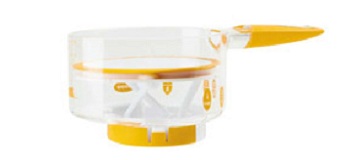
    Wilton Twist’n Measure

    There are all kind of ways to save space in the kitchen. The most common is to use nesting cups and bowls, minimizing the space required for a set by allowing them to nestle inside one another. Wilton Twist’n Measure takes this concept a step further by eliminating the stack and getting you down to just one cup for most of your measuring needs. The Twist’n Measure is a measuring cup with an adjustable base that can go from 1/8th of a cup all the way up to a whole cup, simply by twisting the base. The sliding base locks into place for each measurement, and can easily be reset when the cup is empty so that you can start again for the next ingredient. It is definitely a space saver, and it can also be a time saver since you won’t need to scout around for a missing 1/3 cup measure the next time you realize you need one. The scoop is plastic and disassembles easily to that it can be washed, and it’s machine washable, too.

  • UT Science Forum: Lenhart Works to Improve CPR

    KNOXVILLE — As the final installment of the Science Forum, Suzanne Lenhart, professor of mathematics at the University of Tennessee, Knoxville, will explain how mathematical theory can be applied to both improve CPR and slow the spread of rabies in raccoons.

    Her talk — “The Power of Optimal Control: From Confining Rabies to Improving CPR”– will begin at noon on Friday, April 30, in Thompson-Boling Arena Dining Room C-D. The program is free and open to the public; attendees are welcome to bring their lunches or purchase lunch at the Café at the Arena.

    The UT Science Forum is a weekly event where leading science researchers share their discoveries and discuss the frontiers of their fields in a way that the general public can understand. The UT Science Forum is sponsored by the UT Office of Research.

    Lenhart will talk about “optimal control theory” and how it can be used to make decisions in these applications.

    “The goal is to design external chest and abdomen pressure patterns to improve the blood flow in the heart in standard CPR procedure,” Lenhart said. “The second example is an epidemic model for rabies in raccoons on a spatial grid. The goal is to find the optimal distribution pattern for vaccine baits to slow the spread of the disease.”

    For questions about the UT Science Forum, contact Mark Littmann, [email protected] or 974-8156, or Mike Clark, [email protected] or 974-6006.

    C O N T A C T :

    Bridget Hardy (865-974-2225, [email protected])

  • Big Oil is awash in big profits — while Gulf of Mexico is awash in spilled oil – Oil company profits underscore need for reform

    BP just announced first quarter profits of $5.6 billion, a 135% increase over the first quarter of 2009.   This profit was 50% higher than predicted by the Financial Times.

    BP owns the oil rig that sunk in the Gulf of Mexico last week, with 11 employees still unaccounted for and presumed dead.  It is also leaking 42,000 gallons of oil per day.  This growing oil slick is expected to hit Louisiana’s fragile coast on Saturday.

    CAP’s Daniel J. Weiss and Susan Lyon have the whole story on Big Oil’s big profits in this repost.

    The big five oil companies—BP, Chevron, ConocoPhillips, ExxonMobil, and Shell—are poised to report their first quarter profits this week. And it should surprise no one that rising oil and gasoline prices will lead to higher profits compared to 2009. A research note from Citigroup determined that, “The year-on-year increase largely reflects the strength of crude oil prices.” The Telegraph made the same assessment, saying, “energy companies are benefiting from higher oil prices.”

    Gasoline prices increased by nearly 3 percent during the first quarter, while gasoline consumption was up 4 percent. American consumers spent $65 million more on gasoline during the last week of the quarter compared to the first week. This is a 6 percent increase in total spending between the first and last week. Rising prices and demand bring little surprise to the expected announcements that oil company profits are on the rise.

    Oil company profits

    Oil company

    Estimated net income

    Financial Times profit predictions

    Other profit predictions

    BP $4.8 billion Up 85 percent (FT) Almost doubled Q1 2009 earnings (Telegraph)
    Chevron $3.7 billion Roughly doubled (FT)
    Conoco $2.0 billion More than doubled (FT) Up 62 percent (BloggingStocks)
    Exxon $6.8 billion Net income roughly doubled (FT) $6.56 projected, up 44 percent (Reuters)
    Shell $4.0 billion Up about 30 percent (FT) Up 35 percent (Reuters)

    This increase in consumer costs and oil company profits is relevant to the upcoming debate on bipartisan, comprehensive clean energy and global warming legislation. Opponents of reform will claim that such legislation would increase prices. But the reality is that the status quo policies have already harmed American families. An analysis of household energy spending between 2002 and 2007—the nonrecession years—found that the average household spent $1,130 more on energy in 2007. Nearly 85 percent of this increase was due to the rise in gasoline prices.

    The first quarter oil company profits and consumption data suggest that profits will continue to rise absent bipartisan, comprehensive clean energy legislation that reduces oil dependence, creates jobs, and cuts pollution. This data is another reminder that it is imperative for the Senate act to change the status quo.

    Update:

    Conoco and Shell will release their numbers Wednesday, Exxon on Thursday, and Chevron on Friday.

  • Gov signs Minnesota broadband bill

    The message is short, but sweet…

    The Minnesota Broadband Bill was signed into law Monday (April 26, 2010) by Governor Pawlenty.

    And just for the archive, here is the text that was presented to the Governor according to the Minnesota Session Law site

    CHAPTER 277–H.F.No. 2907
    An act relating to communications; setting state goals for the deployment and speed of high-speed broadband; proposing coding for new law in Minnesota Statutes, chapter 237.
    BE IT ENACTED BY THE LEGISLATURE OF THE STATE OF MINNESOTA:

    Section 1. [237.012] BROADBAND GOALS.
    Subdivision 1. Universal access and high-speed goal. It is a state goal that as soon as possible, but no later than 2015, all state residents and businesses have access to high-speed broadband that provides  minimum download speeds of ten to 20 megabits per second and minimum upload speeds of five to ten megabits per second. Subd. 2. State broadband leadership position. It is a goal of the state that by
    2015 and thereafter, the state be in:
    (1) the top five states of the United States for broadband speed universally accessible to residents and businesses;
    (2) the top five states for broadband access; and
    (3) the top 15 when compared to countries globally for broadband penetration.
    Subd. 3. Annual reports. The commissioner of commerce must annually by February 10 report on the achievement of the goals under subdivisions 1 and 2 to the chairs and ranking minority members of the legislative committees with primary jurisdiction over telecommunication issues. The report on goals under subdivision 1 must be made through 2015.

  • Fisioterapia en la tercera edad: Patologías

    Que dicen amigos… como les va? Antes que nada tengo que pedir perdón ya que esta entrada la había prometido para la semana pasada pero dado el poco tiempo que he tenido recien la publico hoy. Me puso muy contento por las críticas que recibí la semana pasada con respecto al tema de la tercera edad, algo que dejo de ser materia pendiente en mi blog. Agradezco a Sandra por su mail: te cuento que lo recibi con mucha alegría y es tu mail como así también de cualquier lector los que me motivan a seguir con esto. Como te dije en dicho mail Sandra, mi blog esta a tu disposición y cuando necesites algo podés contar conmigo, tanto vos como todos mis lectores. En lo que pueda ayudarles sobre la carrera, sin duda lo haré.

    Bueno basta ya de introducción y vamos al grano, tal como cite la entrada anterior, hoy voy a desarrollar las diferentes patologías que se pueden presentar en esta etapa de vida la cual denominamos TERCERA EDAD.

    PATOLOGÍAS OSTEOARTICULARES

    ARTRITIS REUMATOIDEA: Esta patología en edades avanzadas tiene una particularidad debido a que se presenta de forma ásimetrica tanto en las articulaciones proximales (hombro, cadera) como también en articulaciones distales (mano generalmente con deformidades). En su rehabilitación podemos distinguir dos fases para su tratamiento:

    Fase aguda: En esta fase es esencial el resposo en cama, siempre y cuando èste sea el correcto, en una posición cómoda y lo mas ideal posible, teniendo sumamente cuidado con las escaras y otras precauciones que pueden surgir en el momento. Lo acompañamos con movilizaciones para evitar la atrofia muscular que se puede presentar en días prolongados de reposo.

    Fase crónica: En esta fase es bueno agregar a las movilizaciones actividades físicas sin que estas sean de alta exigencia, es muy díficil encontrar ese equilibrio entre el reposo y la actividad en la tercera edad, tengamos en cuenta que la inactividad es una seria enemiga, porque la atrofia gana terreno muy rapidamente a esa altura de la vida. La hidroterapia puede ser nuestro gran amigo en el tratamiento, ésta ciencia nos ayudará a ejercitar como así también vencer la rigidez que puede padecer nuestro paciente.

    ARTROSIS: Nuestro tratamiento se va a basar en dos puntos fundamentales, disminuir el dolor y aumentar los rangos articulares afectados. Para esto vamos a valernos de movilizaciones, utensilios de fisioterapia como ultrasonido, tens, masajes relajantes, termoterapia y estiramientos analiticos.

    OSTEOPOROSIS: En el anciano existe una perdida de masa ósea (en las mujeres en período de menopausia se hace mas notable) lo cual hace menos resistente el hueso y por ende lo hace mas vulnerable ante fuerzas de presión. En esta enfermedad no hay fórmula mágica, se basa más en la higiene postural acompañandolo de ejercicios físicos. Algunos consejos son:

    • Levantar objetos del piso flexionando rodillas y cadera, evitando cargar toda la presión y fuerza en la columna lumbar.
    • Cuando cargamos distintas cosas, lo debemos hacer con las dos manos, evitando el trabajo excesivo. En objetos pesados es mejor empujarlos que llevarlos a cuesta.
    • Para corrección de postura: en bipedestación vascular la pelvis y en sedestación emplear sillas rectas, no excesivamente bajas ni tampoco altas.

    Si nuestro paciente tiene una osteoporosis muy avanzada, entonces tendremos que trabajar sobre su metabolismo aumentándolo para que suba la llegada de nutrientes y oxígeno al hueso. Nos valemos de movilizaciones, magnetoterapia para la reconstrucción ósea, podemos emplear masajes para crear efectos de vasodilatación; en fin; tenemos armamento para atacar con buen arsenal esta patología.

    PATOLOGIAS RESPIRATORIAS

    Desde este punto de vista nuestro paciente sufre una serie de cambios fisiológicos los cuales tenemos que frenar su avance para que estos poco a poco pasen a ser patológicos. En esta etapa de vida empiezan a disminuir todos los vólumenes pulmonares y se ve afectado por ende el intercambio gaseoso.

    Esto se traduce a que nosotros como su profesional de confianza tenemos que hacer una profilaxis y una fisioterapia respiratoria adecuada.

    En la prófilaxis tenemos que tener cuidados posturales, mantener la permeabilidad de las vías aéreas, una ventilación adecuada, verificar su hidratación y tener cuidado con el medio ambiente que lo rodea.

    Si hablamos de fisioterapia respiratoria va a a ser clave los drenajes posturales acompañado con una correcta educación del mecanismo de la tos para eliminar secreciones y evitar infecciones.

    PATOLOGÍAS TRAUMATOLÓGICAS

    Fractura de Cadera: Mucho cuidado con este tipo de fractura que tiene una alta incidencia en estas edades y posee una alta mortalidad. En su fisioterapia hay que trabajar con mucho cuidado, fortaleciendo primero la musculatura que interviene directa e indirectamente en dicha articulación, para eso va a ser muy importante el uso de cadenas musculares; para luego una vez cumplido esto, una reeducacion lenta, gradual y progresiva de la marcha, utilizando elementos complementarios para el caso en concreto previo trabajo en paralelas.

    Fractura de Colles: Fractura que también se da en los jovenes, no difiere mucho su tratamiento a una u otra edad pero con los cuidados pertinentes que en edades avanzadas se requiere. La fatiga en los ejercicios y entender que ya la fisiologia articular no es la misma que hace 40 años atrás, es clave para saberse manejar en el tratamiento.

    Sindrome Post-Caida: Ya que las caídas en esta etapa de la vida son a veces muy traumáticas para nuestro paciente, es muy importante trabajar de a poco los movimientos, no apurarse, tener paciencia y por sobre toda escuchar a nuestro paciente y ser una especie de psicologo en cada ejercicio para saber que grado de miedo pueda llegar a tener en cada actividad para poder comprenderlo y emprender un tratamiento adaptado a sus miedos y necesidades. PACIENTE QUE EN LA FISIOTERAPIA SE SIENTE MAL, CON MIEDO, APURADO, ES PACIENTE QUE SEGURAMENTE NO VUELVE MÁS AL CABO DE UN TIEMPO PRUDENCIAL.

    PIE GERIÁTRICO

    Las alteraciones de la marcha que se sufren con el paso del tiempo, las diferentes zonas de presión, y los problemas vasculares que acompañan hacen de esto un combo que puede derivar a infecciones o patologías de diversa índole los cuales nosotros como kinesiologos podemos evitar. Tenemos que empezar brindando a nuestro paciente consejos adecuadados para el cuidado de su pie tales como :

    • El calzado tiene que ser cómodo, no puede quedar apretado
    • Lavado correcto y secado minucioso interdigital para evitar micosis
    • El cortado de uñas dede ser estricto, no dejarlas tan largas ni tampoco tan cortas, limpiarlas adecuadamente
    • El calcetín tiene que permitir la transpiración
    • Ejercicios siempre y cuando se pueda son bienvenidos, caminar en puntas de pie y de talón 2 a 3 veces por día para ejercitar musculatura del pie.

    Una vez instaurada la patología, ALGO A LO QUE NO DEBEMOS LLEGAR!!!, no nos queda otra que iniciar el tratamiento fisioterapeutico del pie geriatrico que puede incluir:

    • Ejercicios respiratorias
    • Reeducación de la marcha
    • Utilización de órtesis si es necesario
    • Ejercicios de la musculatura vecina del pie como también del pie en concreto

    Bueno espero que esta breve introducción les haya servido y sea de gran utilidad para sus pacientes, tengan paciencia en su tratamiento, los efectos no se ven de un día para otro, llevan su proceso. En esta etapa todo es a paso lento, es por eso, que no tenemos que desenfocar. Creo que a mi entender es una de las especialidades donde más se cumple la regla de oro de los kinesiolgos, la regla del “LENTO, GRADUAL Y PROGRESIVO”

    • The unimportance of product names

      Don’t waste too much time on picking a perfect name for your product. It doesn’t matter very much.

      One thing we learned early on talking to Basecamp customers: Many of them didn’t even know that the app was called Basecamp. They called it “GroupHub” or “ProjectPath” because that was their project URL. Didn’t stop them from using it (or paying for it) though.

      And what about picking a name that’s available as a domain? HighriseHQ.com and Backpackit.com have worked fine for us. Search is the way most people wind up finding us anyhow.

      Obsessing over a name is an easy time trap to fall into when you should be focused on more important obstacles (i.e. building something that people truly want to use).

    • Does the Web Turn Us Into Partisans?

      The Internet provides an infinity of stuff, but it’s all too easy to siphon off oneself in a cozy, ideologically uniform echo chamber of information — or disinformation. You might expect that the searchable, personalized architecture of the Internet might guarantee that we find the information we’re looking for rather than the information that we need to know. 

      But a fascinating new paper from NBER says that’s not exactly how the Internet works. The authors find that online news consumption is much less ideologically segregating than face-to-face interactions, but more segregating than offline news consumption. Ryan Avent concludes “The internet, if anything, provides a counter to the more ideologically homogeneous circles of friends, families, and colleagues in which we operate daily.”
      There’s a more pessimistic way to interpret the findings. Imagine online news consumption, from newish e-magazines (eg Slate) to blogs like at The Atlantic and Economist, as a halfway mark between offline news consumption and face-to-face interactions. Many of them are, as Andrew Sullivan likes to say, a broadcast of the writer’s opinions rather than an iterative publication. A good broadcast is powerful, but also personal and emotional. In that light, online news takes the offline news model and slow-walks it toward the ideological homogeneity of social circles. Avent’s right. We’re not there yet. But it’s a slow-walk.
      The Web might not be turning us into partisans. But it gives our partisanship the chance to marinate in partisan news — a lot of it, accessible from anywhere. Newspapers have been somewhat partisan for centuries. Magazines even more so. But even if Web readers are merely consuming the news we’ve always read, but pixelated rather than printed, it is a little disappointing that having been offered a universe of content, readers are probably sticking to their ideological solar systems.


      Email this Article
      Add to digg
      Add to Reddit
      Add to Twitter
      Add to del.icio.us
      Add to StumbleUpon
      Add to Facebook


    • Ground Truth Raises $7M More; CEO Sterling Wilson Talks Company Culture, Global Expansion

      Ground Truth
      Gregory T. Huang wrote:

      Seattle-based Ground Truth, a mobile measurement and intelligence startup, is announcing a new $7 million Series B funding round today, led by new investor Emergence Capital. OpenAir Ventures, another new investor, also participated, as did existing backers Voyager Capital and Steamboat Ventures.

      Ground Truth CEO and co-founder Sterling Wilson calls the deal “great confirmation of what we’re doing.” The startup came out of stealth mode in January. It provides data and analysis on how consumers use the Internet on mobile devices—things like traffic estimates for a large number of sites, how long people visit those sites, and what other sites they visit. The basic idea is to help advertisers, publishers, mobile operators, and media companies make more money on the mobile Internet.

      What Ground Truth has going for it is strong relationships with wireless carriers and other partners who have access to mobile data, and patent-pending technology for processing all that data. Big players like comScore, Nielsen, Hitwise, Google, and Quantcast have lots of data on the traditional Web, but don’t yet have the equivalent information on mobile Web use.

      Those advantages have helped Ground Truth amass raw data from about 3 million mobile subscribers, and update it weekly instead of every month or two like other services. (Some recent trends Ground Truth has unearthed: social networking is really exploding on mobile devices, and mobile-centric sites make up the majority of website visits on mobile devices.) Wilson says the company has “dozens” of customers and data partners, but declined to be more specific, other than to say its strategy has been “more of the same” in terms of signing up “infrastructure providers and wireless operators.” The company’s revenue model is based on paid subscriptions, not advertising.

      One connection that helped seal the VC deal announced today is that Emergence Capital co-founder Jason Green had previously invested in Seattle-based aQuantive together with Voyager Capital; Emergence also has collaborated with Steamboat Ventures on investments. Meanwhile, OpenAir brings to the table strong expertise in the mobile industry and has worked with Emergence as well. (Also, $7 million is a pretty healthy amount, and it sounds like the company got it at a decent step-up in valuation compared to its $2.6 million Series A funding last year.)

      The new money will be used “to expand the product offering throughout the year,” Wilson says. Part of that means going global. Ground Truth will identify countries that have a lot of mobile …Next Page »

      UNDERWRITERS AND PARTNERS


    • New Type of Flying Yacht Develops 85-Mile Speed (Jan, 1929)

      New Type of Flying Yacht Develops 85-Mile Speed

      AN UNUSUAL type of surf plane powered with a reclaimed wartime rotary airplane motor has been designed by Sol Messina, of New York. He expects his novel craft to develop a top speed of 85 miles an hour.

      As the above photo shows, the surf plane is of light but sturdy construction. Pontoons and cabin are made from tin, the former being made watertight to support the weight of the ship. A cloth rudder at the rear serves to steer the craft. The rotary engine was salvaged at a cost of $50, affording a cheap but dependable power plant. An unusual feature is the mounting of the engine at the rear of the boat, where it pushes rather than pulls the plane. Cabin and engine are supported by steel tubing of the type used in building airplane fuselages. The photograph shows the surf plane in New York harbor, where tests are being conducted.


    • Soon to Come STEREO SOUND FROM YOUR TV (Mar, 1982)

      Soon to Come STEREO SOUND FROM YOUR TV

      By Arthur J. Zuckerman

      CRITICS of commercial television have been calling it a wasteland for years. This cultural condemnation has been leveled at commercial-network offerings since the demise of The Golden Age of TV in the 1950s, and many viewers have seen considerable reason to agree with it.

      But even as criticism was heating up, alternatives, both in fare and technology, were beginning to surface. First there was educational television, which proceeded to blossom into public television. Cable systems developed into a source of alternative programming.

      At the same time came the video-cassette recorder, complete with commercially prepared tapes to supplement off-the-air recordings of VCR owners. And now we have the videodisc, the visual version of the phonograph record.

      But television has remained pretty much a wasteland where sound quality is concerned. Despite the fact that television sound is FM, its quality from the very beginning has been sad. Manufacturers were understandably preoccupied with de- livering the best possible picture, and the sets they produced were so loaded with video circuitry that their audio amplifiers and speakers seemed almost an afterthought. Usually they were no better than what you could get in a portable AM radio.

      Now this, too, is changing, and the era of good-quality video sound and, yes, even stereo video, is upon us. Perhaps it shouldn’t be too much of a surprise that many of the very forces that brought us alternative programming have also been leading to high-quality stereo sound for video.

      At the head of the parade is public television. Public TV stations began getting together with public FM-stereo radio stations for simulcast broadcasting of concerts and operas years ago. They’re still at it. You can watch such a show on your TV screen while listening to a glorious FM stereo rendition of the sound through your high-fidelity system.

      If your speakers flank your screen, you’ve got a perfect arrangement. Even if they don’t, headphones plugged into your receiver or amplifier will do the job— at least for solo viewing—as long as the receiver isn’t too far away from the TV.

      At least one cable service is getting into the stereo act, too. Last summer Warner/Amex inaugurated Music Television (MTV), a 24-hour rock-TV music network that transmits its sound in Dolby stereo via an FM multiplex signal. The stereo can be received by using an inexpensive signal splitter to attach the cable to both a television receiver and an FM tuner’s antenna terminals.

      Another boost to stereo video has come from the Philips videodisc sys- tem, now being marketed as Magnavox Magnavision and Pioneer LaserDisc. These systems carry their program information in the form of pits on the reflective surface of a disc. The length and spacing of the pits carry the encoded information, which is scanned by a laser optical system. This system has enough capacity to carry stereo sound, and most of the programs being offered on disc do have such stereo sound tracks. The players have audio output jacks that permit hookup to your regular home stereo receiver.

      The most recent booster of stereo video has been the appearance of stereo in videocassette recorders. Last summer Akai introduced a portable VCR with stereo sound-recording capability. It can record the picture portion of a simulcast from a companion tuner-timer unit and the sound portion from an FM stereo receiver.

      Like most home VCRs, the Akai recorder has a frequency range limited to 10,000 Hz, substantially short of the 15,000-Hz top limit of FM broadcasting. But it does offer Dolby noise reduction for the cleanest possible sound and most of the content of the average musical performance falls within the 10,000-Hz range.

      Actually, a number of videocassette recorders with stereo sound are available today in Japan. This isn’t too surprising because Japan also has enjoyed television broadcasting with stereo sound for several years. Two audio channels are provided by Japanese telecasters in much the same way that we receive FM stereo in the United States. The second channel is encoded on a subcarrier which modulates the main audio carrier. This piggyback arrangement is called a multiplex system.

      The two resulting audio channels are used by the Japanese in two different ways. Music programs are usually broadcast in stereo. But Japanese telecasters also offer dual-language programming, with Japanese on one channel and English on the other. (English is a mandatory subject in Japanese schools.) Home viewers can select the language they want to hear by using a switch on their receivers.

      Last fall, broadcasters in West Germany also began to offer stereo telecasts. The German approach to stereo TV is simpler than the Japanese. Because their video band-widths are relatively broad, the Germans simply employ two discrete audio channels with each of their video channels.

      During the past year many domestic and foreign television manufacturers finally have begun to pay attention to sound quality in their offerings for the American market, at least in their higher-priced models. If you’re in the market for a new, better-quality color set, a number of approaches to better audio are now available to you.

      One is simply improved amplifiers and speakers, including two-way speaker systems. Another is pseudo stereo, employing electronic trickery to give the illusion of two-channel sound. There are also nongimmicked, monophonic television receivers that have their own stereo sound systems and inputs for playing material fed from external stereo sources.

      This approach is becoming tied into the growing trend to projection television with its large screen, for which stereo sound is particularly effective. Typical are General Electric’s rear-projection Widescreen 4000, which has a 10-watt-per-chan-nel stereo amplifier driving a pair of speakers with 2-inch tweeters and 8-inch woofers. Magnavox’s 50-inch rear-projection offering is similar. It has an 8-watt-per-channel amplifier, and its speakers have 3-inch tweeters and 8-inch woofers. These projection units can accept stereo sound from simulcasts, videodiscs or videotapes.

      Both the GE and Magnavox lines also include more conventional television consoles that play stereo sound from external sources through their own stereo amplifiers and speaker systems. They also can feed sound to external speakers or even to external stereo amplifiers.

      Mitsubishi Electric has gone a step further to make simulcast stereo oven easier to enjoy. Its Model 2582 television receiver actually has an FM stereo tuner built in, and it provides for simultaneous reception of an FM broadcast with a telecast.

      Although Panasonic has not yet joined the stereo television ranks in its American market, it does offer a couple of receivers with dual, two-way speaker systems for richer monophonic sound. One is a 25-inch console with two sets of woofers and tweeters flanking the screen. Another is a 45-inch rear-projection system with a similar audio arrangement.

      True stereo from external sources is provided for by RCA in its front-projection TV offering. Its built-in speaker system consists of a pair of 2-inch tweeters and two 5-inch woofers. There is also provision for driving external speakers from the set’s stereo amplifier.

      But RCA’s most innovative offering is its Dual Dimension Sound, which employs phase shifting and the separation of certain frequencies within the tonal spectrum to give the illusion of true stereo sound. Consoles with this feature have dual speaker systems and stereo amplifiers that also accept true stereo from external sources. Several table models, which are equipped with only one speaker, have stereo outputs through which they can feed Dual Dimension Sound to an externally-located stereo system.

      One of the newest developments in video lends itself particularly well to stereo sound—component television. This concept is being pursued by Sony with its Profeel line. Sony offers Profeel monitors with either 19-inch or 25-inch screens. A separate tuner has auxiliary audio and video inputs that accept signals from videotape recorders, videodisc players, home computers, video games or other sources. Also offered is a choice of two speaker systems, both two-way. A small model is designed to mount on the sides of either Profeel screen; the other consists of much larger, freestanding units. Sony says its Profeel components can be adapted to receive stereo and multichannel telecasts when they become available in the United States.

      Such broadcasting may become reality here sooner than you might think. The Electronic Industries Association has recently conducted a series of stereo tests over Chicago’s WTTW-TV after regular broadcast hours. Under study were three systems. One of these is a modified version of the Japanese system, as represented by Sony on behalf of the Electronic Industries Association of Japan.

      The other two systems tested are entries by Telesonics Inc. and by Zenith.

      The Electronic Industries Association has set considerably more stringent requirements than are asked of broadcasters in Japan. Instead of stereo or bilingual service, EIA wants stereo and bilingual service. Naturally, the stereo service must be compatible with monophonic telecasting, and the bilingual service cannot create any interference by leaking into the English service. EIA also wants an administrative channel for sending technical instructions through a network.

      But EIA can only offer its results and make recommendations to the Federal Communications Commission. It is this federal agency that has the last word, making the rules by which American broadcasters must operate.

      But when EIA’s work has been carefully reviewed by the people in Washington, we may find that the era of stereo television broadcasting in the United States won’t be far off.


    • LIVE DRAMA (May, 1962)

      LIVE DRAMA is all you’ll see on this big screen. This is a new plastic house being built in Leningrad. Hot air fans heat it.