 |
Fewer than 12 hours after two bombs exploded at the tail end of the Boston Marathon, killing three and injured dozens of others in what may be the latest attack on the U.S. homeland by an international terrorist group, President Obama, according to his former top advisor… |
Category: News
-
Defense Secretary Hagel admits U.S. is engaged in terrorism world wide
-
Synthetic vitamin C, or ascorbic acid, kills beneficial probiotic bacteria in the gut and cannot confer vitamin activity in the body

Most people nowadays are well informed about the numerous health benefits of vitamin C, and find ways to incorporate it in their diets, either by taking supplements or eating more foods that contain the vitamin. While the many benefits of vitamin C are well-documented… -
Ten civilization-shaping trends for 2013 that are driving us into social and spiritual crisis

Most people feel that a time of great change is upon us. But what kind of change is unfolding, exactly? To answer that question, we must examine current trends and attempt to understand where they are headed. Here’s my look at ten of the most sociologically-charged… -
Teen abuse of prescription drugs up 33 percent, includes Ritalin, Adderall

A new national survey has been released, highlighting startling new trends in teen prescription drug abuse. The Partnership at Drugfree.org and MetLife Foundation are confirming that one in four teens now abuse or misuse a prescription drug at least once in their lifetime… -
GM wheat could permanently damage human genetics by silencing hundreds of genes throughout the body

It is one of the only major food crops left without a genetically-modified (GM) counterpart, but this could soon change if the Australian government gets its way in approving a GM wheat variety developed by the Commonwealth Scientific and Industrial Research Organization… -
Texas fertilizer plant that exploded filed lawsuit against Monsanto in 2007

New information has surfaced in the West, Texas, explosion case that could alter the course of the ongoing investigation into what caused the disaster. As it turns out, West Fertilizer Co., which used to be known as Texas Grain Storage Inc., filed a lawsuit under its… -
Tell the FDA to keep hidden aspartame out of dairy products

The conventional dairy lobby is currently pressing for some major regulatory changes that would further deceive the public into buying unhealthy, processed foods laced with hidden artificial sweetening chemicals. And the public only has until May 21 to prevent this assault… -
Stress – The modern poison that is making us fat, bald, crazy and extremely unhealthy

The term stress is tossed around freely in this modern age and has become a casual buzzword for just about any predicament that we find unpleasant. Yet how it truly effects health and well-being in substantial ways is rarely acknowledged. Linked with a range of degenerative… -
Following a ‘Western-style’ diet will cause you to age faster, die younger: Research

The food choices you make today will have a direct impact on how gracefully you age and how long you live. These are the findings of a comprehensive new research study published in The American Journal of Medicine, which found that people who stick primarily to a “Western… -
Cayenne pepper is a lot more than just a hot herb

Cayenne pepper may not be overwhelmingly used in America but it certainly deserves to be given a lot more attention considering the many health benefits associated to eating it. This very spicy herb has many advantages such as helping the cardiovascular system; preventing… -
FatBatt maximizes the life of your PC’s battery
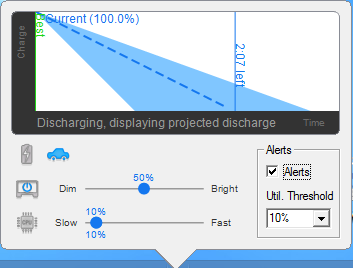 Using your laptop on the move can mean having to dart from one power source to another. Whether you have a new laptop with a brand new battery, or an aging system with a battery that has seen better days, the amount of time you can use your computer without plugging in is of paramount importance. There are steps you can take to maximize the life of your battery, and it is also something that FatBatt can help you with.
There are several facets to the app. Firstly, it aims to give you an accurate estimate of how long your battery is going to last before you need to charge it up. This enables you to make informed decisions about how to use the time available to you, and how to manage your next charging session.
But more than this, FatBatt provides you with tools that can be used to help maximize the life of your battery. If there are any applications that are draining resources, you will be alerted to them so you can close them down. One of the easiest ways to increase battery life is to reduce screen brightness and processor speed.
With FatBatt this is reduced to a single click process so you can switch between home and away modes very quickly. It is also possible to adjust these settings based on where you are. This is achieved by network identity. When you are at home or in the office, for example, you’re probably going to be able to plug your laptop in whenever you need to, so there is no need for aggressive powersaving. But when you’re out and about, perhaps connected to a network in a particular coffee shop. more hardcore settings can be put in place so you can go for longer between charges.
FatBatt is available for laptops running Windows 7 and Windows 8. The software costs $14.99, but you can download a free trial from the review page to see how you get on with it first.
-
Coursera makes first foray into K-12 education with online courses for teachers
Coursera, one of the driving forces behind the MOOC (massive open online course) movement reshaping higher education, is bringing its disruption to K-12 schools. But its target audience isn’t the students; it’s the teachers.
On Wednesday, the startup said it had partnered with several schools of education and other institutions and museums, including schools of education at Johns Hopkins University and the University of Virginia, the American Museum of Natural History and the Museum of Modern Art, to bring free professional development courses to teachers via the web.
“We looked at our technology and realized that for 7-year-old kids, streaming university content for them wasn’t going [to be effective]. But the lever for that 7-year-old kid may be to help them get a better teacher,” said Coursera co-founder Andrew Ng.
Most school districts don’t have the resources to offer quality professional development programs that match the interests and needs of individual teachers, he said. Typically, teachers are pulled out of their classrooms for a few days a year (disrupting instruction for their students) and are required to follow the same program, regardless of the subjects they teach or their strengths and weaknesses.
With its new courses, Coursera said teachers can focus on the topics, areas of expertise and pedagogies that are most relevant for them. For example, early courses will cover topics including content development, the common core curriculum, character education and implementing flipped classroom and blended learning strategies.
The courses will follow the same format as other MOOCs on Coursera and will adopt the startup’s peer-grading approach. For example, teachers could write a lesson plan or videotape themselves teaching and then receive feedback from other members of the course.
Teachers, educators and even parents can take the new courses for free but, as with other Coursera classes, they can pay $30 to $100 for the “Signature Track” option, in which their identity is verified and they receive a certificate at the end of the course. Coursera’s hope is that, in time, school superintendents will award teachers continuing education credit for the courses. But Ng said that, so far, they’ve only had informal conversations with superintendents about the possibility.
Given the attention MOOCs have received in the last year, it’s not so surprising that the phenomenon is spreading to K-12 education. Conversations are underway about adapting the MOOC format for K-12 students and other educational organizations are offering one-off MOOCs for teachers and administrators. But Coursera is the first of the major MOOC providers to make a foray into K-12 education and given the debate it and its rivals Udacity and edX have stirred among colleges and universities, it will be interesting to see how it is received by K-12 educators.

Related research and analysis from GigaOM Pro:
Subscriber content. Sign up for a free trial.- GigaOM Research highs and lows from CES 2013
- How HR can make the case for workforce analytics
- The 2013 task management tools market


-
In latest bid to evade copyright cops, The Pirate Bay moves domain to tiny Caribbean island

-
Microsoft releases Switch to Windows Phone, but you won’t want to
 Well, it’s May 1 somewhere, which perhaps explains why Switch to Windows Phone popped up on Google Play tonight with the date. The concept is simple: Microsoft tries to ease the transition between platforms, or at least help evaluate if such move is workable. But the app-matcher comes up short and can’t resolve something more fundamental: People with money invested in apps won’t be quick to rebuy them elsewhere.
StWF is easy enough to use once installed; letting it scan and match on my Nexus claims to match 85 percent of the Android apps. But like most of the people reviewing the app, there’s no way I see to view the list. Could it be the app posted early and the supporting services aren’t switched on, or did Microsoft simply muck up?
According to the FAQ: “Your app match list will be saved to a private Windows Azure cloud service that’s just for the Switch to Windows Phone app. Your matched app list can only be accessed using the Switch to Windows Phone app along with your Microsoft Account email and password”. There’s no option I see on Android, and I couldn’t find a Windows Phone version on Microsoft’s mobile store. Surely people want to know which apps match before committing to a new platform.
The reviews are scathing, and few in number as I write since the app is live for a short time. Out of 48 reviews, 37 are one star, giving awe-inspiring 1.7 stars.
Brandon Hull calls the app “garbage. People want to know which apps with work with Windows Phone 8. A simple percentage is useless unless users are told which apps can also be found on Windows Phone 8”.
“Worthless”, Joel Sacco blames. “It basically gives you an arbitrary percentage of apps which are compatible based on your installed apps. Doesn’t actually give you a list or show any useful information past that. If you really wanted me to switch to WP8, you might want to make the data you provide a little more informative”.
Eric Weiss: “Can you imagine the meeting where this was pitched and approved? ‘How can we get people to switch to Windows Phone’. ‘An Android app that lies to them?’ ‘That’s perfect!’ Give that guy a raise!”
Luis Escobedo calls Switch to Windows Phone “downright embarrassing”.
For the record, I used the app four times, each instance getting an 85 percent but not being presented (that I could find) with option to see which ones. Again, I wonder if something isn’t working yet. That’s best case scenario, a simple screw-up releasing StWP before the Azure service is on. Otherwise, yeah, this is a helluva cock-up and makes Microsoft look stupid. Too bad, because “The Wedding” commercial airing yesterday makes the company look so smart.
-
Samsung, Intel invest in speech analysis company to boost voice command apps

-
Craigslist’s hacking, copyright claims against rival PadMapper hold up — for now
A federal court has sided with Craigslist in the early stages of a bitter dispute over whether upstart data and apartment listing sites can draw on information posted by the classified giant to offer rival services.
In a ruling handed down Monday in San Francisco, US District Judge Charles Breyer refused the request of PadMapper, 3 Taps and other defendants to throw out a laundry list of claims by Craigslist, which is accusing the defendants of hacking, copyright infringement and more.
In the view of Craigslist, the newer companies are plundering data which it has collected and compiled at great effort. The defendants, meanwhile, say Craigslist is monopolizing data that belongs to users while offering an ugly, out-dated service. The lawsuit broke out last summer.
In a key part of Tuesday’s highly-technical decision, the judge examined whether Craigslist’s terms of service meant that users had given the site permission to use their ads as the basis for copyright lawsuits. The judge said Craigslist didn’t obtain such permission, except for a short period in the summer of 2012 when the site changed its terms of service — before backing down in the face of a popular backlash.
What this means is that Craigslist can rely on users’ ads to go forward with its copyright lawsuit, but only those ads written between July 16 and August 8, 2012. The judge also said said that Craigslist may have its own copyright over the way it has compiled the ads, though it will still have to prove that this compilation is an “original” artistic work.
The hacking portion of the decision, which is based on the federal Computer Fraud and Abuse Act and a similar law in California, is also nuanced. The judge wrote that the companies’ attempts to access Craigslist data after receiving cease-and-desist letters might be “unauthorized access” under the laws, but implicitly suggested that the laws are out of date.
The judge also gave Craigslist a minor victory by agreeing to shelve counter-claims from Padmapper and 3Taps over the monopoly issue. The defendants won their own minor victory when the judge threw out Craigslist’s conspiracy claims.
So what does all this mean? Monday’s decision is very preliminary and was about what can stay in the case — the real action will start at the summary judgment stage, likely later this year, where each side can try to win on a matter of law.
In the bigger picture, the case is important because it is helping to set the rules over the degree to which companies can treat data controlled by other firms as a public good.
This is just a short summary of a complex decision. If you want to get further into the weeds, here is a marked-up copy of the ruling itself:
<p style=” margin: 12px auto 6px auto; font-family: Helvetica,Arial,Sans-serif; font-style: normal; font-variant: normal; font-weight: normal; font-size: 14px; line-height: normal; font-size-adjust: none; font-stretch: normal; -x-system-font: none; display: block;”> <a title=”View Craigslist PadMapper on Scribd” href=”http://www.scribd.com/doc/138806124/Craigslist-PadMapper” style=”text-decoration: underline;” >Craigslist PadMapper</a></p>

Related research and analysis from GigaOM Pro:
Subscriber content. Sign up for a free trial.- Flash analysis: Collaborative consumption – a first look at the new web-sharing economy
- Social media in Q1: commerce and discovery dominated
- Controversy, courtrooms and the cloud in Q1

-
Microsoft embeds Skype directly into Outlook.com inbox [video]

-
Not taking your medication, or taking waaay too much? The data knows …
While cost tends to dominate discussions about prescriptions drugs and health care policy, lawmakers probably shouldn’t overlook the economic problems caused by abuse and misuse. According to prescription-management specialist Express Scripts, people selling or obtaining prescription drugs illegally or not taking them according to the directions combine for more than $500 billion in wasted health care spending each year. But, armed with a boatload of data, Express Scripts is trying to get those problems under control.
If Express Scripts’ numbers are correct, the abuse and misuse (which the company calls “nonadherence”) of prescription drugs can have a pretty staggering effect on the health care market. Nonadherence, the company claims, results in expenditures of $317.4 billion a year treating conditions that could have been avoided had people just taken their prescriptions as directed. Every dollar spent on potentially abused drugs results in an additional $41 spent on associated claims, and the health care system loses between 3 and 10 percent of every dollar — or about $224 billion — to fraud and abuse every year.
Express Scripts’ strategy for solving the problem is all about data. Because it manages 1.4 billion prescriptions each year covering about 100 million Americans and 65,000 pharmacies, the company is able to identify patterns that signal potential problems. But it’s also using data to try solving some cases before it ever has to spot them. Here’s how Express Scripts does what it does.
No one needs 20,000 pills
When it comes to fighting fraud and abuse, there’s not a whole lot anyone can do to stem the tide of issues that cause those behaviors, but data analysis can certainly help flag problems and eliminate them from the system. Having such a large dataset to analyze helps Express Scripts easily spot outliers in patient behavior, explained Michael Klein, a senior manager in the company’s program integrity division. Prescriptions for narcotics, for example, often include limitations on the amount that any given pharmacy can dispense in a month, so individuals addicted to those drugs might seek multiple prescriptions from multiple physicians and try filling them at multiple pharmacies, often geographically distant from one another.

In one instance, Express Scripts’ models helped Klein and his team identify a husband-and-wife team that had obtained approximately 7,000 pills — worth about $150,000 in total — by using 17 doctors and pharmacies in different cities. They had actually signed multiple exclusivity contracts with doctors, stating they would only get narcotics prescriptions from those doctors. In another case, an Express Scripts flagged an individual who had received 808 days’ worth of narcotics in one year, with the pills spread across 21 pharmacies, 19 doctors and multiple schedule 2 controlled substances.
And where there’s addiction, there will always be people trying to make a buck by feeding it. Although the number of individuals abusing prescription drugs or trying to defraud the system to make money is a difficult problem to tackle in terms of sheer scale, Klein noted, there’s an equally important problem around what he calls “pill mills.” As the name term implies, these are essentially doctors who overprescribe medication. “A line of people … go into their office and they just write those prescriptions,” Klein explained.
Express Scripts uses its models to track doctors’ prescription activity across its entire network of pharmacies and patients, but a sheer quantity of prescriptions or even dosage doesn’t necessarily prove there’s anything insiduous going on. Rather, Klein said, the company also looks at things such as the types of medications they’re prescribing and even what people are saying about doctors online. If a doctor’s behavior raises a red flag, there’s a chance — surprisingly high, in fact — that he or she has been mentioned on an online forum as a good person to see if you need drugs.
Jo-Ellen Abou Nader, a senior director for program integrity at Express Scripts, noted that, much like with other criminal networks, identifying one member in a pill mill scheme can help uncover a much bigger picture. One particularly high-profile case involved a single doctor prescribing an average of 55 pills per day to 30 patients over the course of a year — that’s an average of 20,000 apiece and more than 600,000 in total. That’s more than anyone could ever take, she said, and just flagging one of those recipients could be enough to expose the entire operation.
However, not everyone prescribing too much medication is trying to profit from the system, and not everyone trying to profit from the system is involved with dealing drugs. Abou Nader explained that Express Scripts has models to flag Medicare Part D fraud, in which people sell Medicare IDs to pharmacies that then issue claims for pills they never dispensed, as well as plain old waste. The latter, which the company defines as “overfilling,” can look like small-scale fraud, she said, only doctors or pharmacies are unintentionally doling out too much medication.
We have (or will have) ways to make you follow directions
As big of a problem as waste, fraud and abuse combine to be, nonadherence is an even bigger problem in terms of extra costs. According to Bob Nease, chief scientist at Express Scripts, people who don’t properly take their prescriptions make up a more-expensive medical condition than heart disease, cancer and diabetes combined. “Those are the statistics we tell to scare people,” he said.
What might be even scarier for Express Scripts’ clients, however, is that the problem is still very difficult to prevent. Human beings just aren’t wired to remember to take pills at the same time every day, Nease explained, and there’s an instrumentation problem when it comes to spotting missed medication times as they’re happening. “Right now,” he said, “the only way we know someone isn’t taking their prescriptions as prescribed … is looking at refill patterns.”

This is somewhat problematic because it can be difficult to tell the difference between someone who takes their pills regularly but just forgot to refill on time and someone who consistently skips days altogether. So what Nease would really like to see is a way to incorporate sensors into the prescription process, perhaps like a Bluetooth-enabled cap could that communicate with a person’s smartphone to alert him if he hasn’t opened the bottle today or that it’s time to take medicine (GlowCaps are probably a good starting point). Sensors that measure weight or volume could give people like Nease a better sense of when people are taking medicine and how much they’re taking.
It’s this latter type of information — how actual medication-taking behavior relates to improvements or deteriorations in health — that Nease really wants to know. Express Scripts uses the FDA definition of “adherence,” which means taking medication as prescribed 80 percent of the time, but Nease says no one really knows the difference between someone moving from 50 percent to 60 percent adherence or from 70 percent to 80 percent. For some conditions, he posited, small improvements might actually be medically significant even if the patient never approaches that 80 percent threshold.
But for now, Express Scripts relies pretty heavily on models that Nease said are more than 90 percent accurate at predicting whether someone will get lax on following directions.
Most people who are nonadherent will naturally become more adherent over time (and vice versa), Nease said, with rates waning and waxing by about 20 percent. Using simple methods such as beepers that go off when it’s time to take a medication or bottles that remind someone whether or not they’ve taken their medication, people who Express Scripts predict have a mid-range probability of nonadherence see their adherence rates rise an additional 14 percent on average.
“It’s not earth shattering,” Nease admits, “but it’s better than anything else we’ve got.”
Those models turn out to be pretty interesting, however, taking into account some 400 variables including classic demographic information, the types and numbers of prescriptions someone is getting, and even whether people respond to Express Scripts’ letters and phone calls.
The most surprising variable, one that Nease says is material to every nonadherence model Express Scripts builds, might be how a person rates as a consumer. The company buys data from a consumer marketing agency that categorizes people as belonging to 1 of 66 separate microsegments such as “young digerati,” which is how the university-area-living, cord-cutting, high-speed-internet-having and fifty-something Nease is categorized. “It turns out these general consumer behaviors tend to bleed over into these health behaviors,” Nease said, “but not in a consistent fashion.”
And although no single variable has too big an effect on its own, how they interact with each other turns out to be rather important. For example, Nease explained, the patient’s gender and doctor’s gender can be relatively telling depending on the patient’s ZIP code. Male patients living in lower-income areas and seeing female doctors tend to have higher nonadherence rates than do otherwise similar patients in higher-income areas.
Of course, he added, “It really doesn’t matter to us whether someone is high-risk or low-risk unless we can do something about it.”
Feature image courtesy of Shutterstock user pogonici.

Related research and analysis from GigaOM Pro:
Subscriber content. Sign up for a free trial.- What’s driving the next phase of the e-commerce evolution
- GigaOM Research highs and lows from CES 2013
- How HR can make the case for workforce analytics

-
iPad mini reportedly accounted for 64% of all iPads shipped last quarter

-
Belkin’s internet of things dreams extend to energy and water management
Belkin, the maker of myriad Apple accessories, USB widgets and even the WeMo connected outlets, has a big business in industrial products as well. And today it announced a series of sensors aimed at helping commercial companies and utilities better manage electricity and water usage.
It has a pilot project with the Department of Defense related to the electric sensor technology as well as an exclusive partnership on the water side with HydroPoint Data Systems, a company that helps companies analyze and monitor water usage. The Belkin sensors are one of 22 projects that the DoD selected to pilot, and those 22 were selected from 468 proposals.
To learn more about these sensors, branded Echo Water and Echo Electricity, I spoke with Kevin Ashton, the general manager, global product management for Belkin Business, and the guy who says he coined the term “internet of things.” Ashton joined Belkin when it acquired his startup, Zensi, three years ago. Now he’s excited to share the last three years of his work with the world.
There are two elements to the Echo sensors: a water management platform and an electricity management platform. Customers deploy sensors in buildings or on pipes to measure electricity by tracking voltage and a few other elements to determine what’s sucking power and how it’s behaving, and then the sensors send that data to the cloud. On the water side, sensors located under a sink detect pressure and vibration to understand water usage, and sends that information to a cloud-based service.
Once the data is collected, Belkin runs algorithms to figure out if things are behaving properly, where energy savings might be had and general patterns around usage that might help companies or homeowners optimize their appliances or even behaviors. At Zensi, the original plan for the voltage-reading technology was to create an itemized electric bill for different apartments or even different gadgets inside the home.
Now, Ashton said the system is still as precise, but the use case is still evolving. He said that the plan is to open this data up to utilities and other services eventually, but right now the focus is on getting this deployed and in use in different buildings. Ashton said that so far partners and Belkin are fielding calls from commercial customers but also new homebuilders, who see this as a good way to help “green” new homes for high-end clients.
Of course, the real power for these sensors — the algorithms, data and insights they produce — is linking them to other gadgets, perhaps enabling a true demand-response system between a customer and utility or even helping a homeowner set devices to react to the cost of power. Aston realizes this, which is why he’s a proponent of open standards and making it easy for people to switch out devices and talk to management systems. “We hope to let the magic happen with well implemented open standards,” Ashton said in an interview. “The value in this system may be in places we don’t expect.”
I’m pretty confident that the value is in the algorithms that Belkin’s Echo sensors use to glean insights, but I’m glad Belkin’s planning to let others build on those smarts to make the overall information exchange even better.

Related research and analysis from GigaOM Pro:
Subscriber content. Sign up for a free trial.- How to Make Cloud Computing Greener
- The Internet of Things: What It Is, Why It Matters
- Smart Algorithms: The Future of the Energy Industry


