Category: News

  • Path doesn’t have a registered user problem, it has a trust problem

    If you’ve read anything about the social network Path over the last year or so, you’d know that it’s an attractive app with some interesting social and design features, but one that has been struggling for years now to get enough users to move it into the big leagues of social networks. Path needs more people using its app. And clearly, the company got the message.

    Path announced this week that it hit 10 million users, hoping to reinforce that the company is on a growth track. But just as soon as Path announced that number, stories that hint at less-than-ideal user-acquisition strategies came out, highlighting yet again that attracting new users doesn’t mean much if those new users feel that they can’t trust you.

    As many people have already written, the concept of “registered users” is essentially a meaningless metric. A registered user could be someone who downloads your app once and never opens it again — hardly a valuable customer to have. There are also a variety of shady ways companies can acquire new downloads.

    On Tuesday, The Verge reported that several users had done just that — downloaded the app, tried it out, and then uninstalled when they found they didn’t like it or need it. However, those users then reported that Path had then sent a message to all of the contacts in their address book, urging them to check out photos that the user had shared on Path — even after the user had uninstalled the app — which in order to see the photos requires one to download the app and sign up. This is also an issue that commenters on Reddit have complained about before.

    When I spoke to the company about those complaints Tuesday, a representative explained that when a user signs up to download Path, that user can choose whether to grant Path access to their contacts and Facebook friends. So presumably, if you unselect your friends and contacts from the suggested lists when you sign up, you’re set.

    But in regards to today’s story of the user’s contacts getting messaged after he uninstalled the app, Path VP of Marketing Nate Johnson said the company is investigating how that happened, and the current guess is that there was a delay in sending messages to the person’s contacts after he signed up, that went out after he’d uninstalled the app.

    “That’s something we’re investigating very closely,” Johnson said. “We’re not going to do anything without your knowledge, that’s not the Path way.”

    Maybe contacting your Facebook friends is fair game on Path’s part if the user doesn’t realize he needs to uncheck some boxes, but if I uninstalled an app and then discovered it had spammed all my contacts after that app was gone from my phone? I would would be livid, and I certainly wouldn’t recommend the app to any of my friends.

    It’s not an uncommon strategy in Silicon Valley for companies to take first and ask later when it comes to user privacy and sharing — Facebook, where Path founder Dave Morin played an integral role, practically pioneered the strategy.

    But for Path, it’s a much more dangerous road to travel than it is for Facebook, and not just because Path doesn’t have the 1 billion strong user base to serve as a buffer. Path already had to settle with the FTC and pay an $800,000 fine for acquiring the numbers of minors, and back in its earlier days it made headlines when the company apologized for storing user address book data on its servers.

    So yes, Path absolutely needs to acquire new users to remain relevant, and there are several ways the company could achieve this. That road to users and revenue could come with the company’s new messaging and stickers (which I was just using this weekend, and are stupidly, addictively entertaining.)

    But if that growth comes from violating user trust and spamming their address books to effectively cold-call a user’s friends? That’s a surefire way to alienate both existing users and deter any future ones.

    Related research and analysis from GigaOM Pro:
    Subscriber content. Sign up for a free trial.


  • One designer’s quest to make a better Netflix iPad app

    How would Netflix’s iPad app look like if you scrapped everything and restarted from scratch? That’s exactly what Joel Grenier, director of UX for the Ottawa-based design agency YOU i Labs did.

    “Now that I use Netflix every day and love the service on many levels, I find myself frustrated with the current state of the application experience and design,” he wrote in a blog post earlier this month. That’s why he came up with a very different approach.

    01_ScreensInDevice_Logins_B

    Grenier’s prototype comes complete with a sign-in option for personalized profiles — which Netflix is set to roll out in the coming months — custom artwork for movies and TV show pages, the ability to drag and drop titles for custom watch lists and more. And everything is tied together with some very smooth animations.

    Grenier even mocked up some second-screen functionality for the Netflix iPad app, allowing users to tweet about titles they’re currently watching and even buy things related to a movie or a show.

    10_ScreensInDevice_SecondScreen

    It’s unlikely that the Netflix iPad app would ever get such a radical overhaul — Netflix famously A/B-tests each and every potential new feature and only implements features that notably lead to higher engagement — and some features don’t actually make all that much sense. For example, one could argue that a pure on-demand service doesn’t really need a live Twitter stream, as the viewing experience is largely asynchronous.

    But Grenier’s app mockup is nonetheless food for thought — and proof that there is still a lot media services can experiment with on mobile devices.

    Related research and analysis from GigaOM Pro:
    Subscriber content. Sign up for a free trial.


  • Workspot Raises $1.9M From Kleiner, Norwest, Redpoint, Others

    Workspot said it raised $1.9 million of seed funding from Kleiner Perkins Caufield & Byers, Norwest Venture Partners, Redpoint Ventures, and angel investors, including Peter Wagner and Gaurav Garg. The company also launched a bring-your-own-mobile-device service for IT administrators, Workspot Control, and a mobile application for IPads, called Workspot.

    PRESS RELEASE

    Workspot Launches New Bring-Your-Own-Device Solution for IT Departments and End Users; Reveals Founding Team and Announces Seed Funding

    Kleiner Perkins Caufield & Byers backed startup to Present at TechCrunch Disrupt NY

    TechCrunch Disrupt, New York, NY and Menlo Park, CA – April 30, 2013 – Workspot launched a new bring-your-own-device solution for the mobile workplace.  Workspot has created both a SaaS service for IT administrators, Workspot Control, and a mobile application for IPads called Workspot.  Workspot also announced that it has raised $1.9 million in seed funding from Kleiner Perkins, Norwest, Redpoint, and angel investors including Peter Wagner and Gaurav Garg.

    Workspot is a single app and secure mobile workplace that helps end-users and IT departments conveniently separate work-related content and personal information stored on the device. End-users can flip between applications inside Workspot with ease, in a single, contained workspace including Intranet, SharePoint, Email, and Microsoft Office documents.  Collaboration with co-workers is possible through applications that reside behind their organization’s firewall making full use of SaaS applications.

    Workspot was founded by a trio of experienced San Francisco Bay Area technologists including CEO Amitabh Sinha, formerly of Citrix; CTO Puneet Chawla, formerly of VMWare; and Vice President Ty Wang, formerly of Oracle and Twilio.  Its team also includes experienced engineers from companies including Juniper Networks, Dell, F5, and Microsoft.

    “Workspot is a cloud-based, BYOD solution that provides a secure, ‘no new infrastructure or server software’ implementation for IT Network professionals, and delights their end users who require a seamless, easy-to-use solution,” said Amitabh Sinha, CEO, Workspot.  “Our approach stands apart because IT departments can get critical business applications to their end-users typically in less than 30 minutes.”

    The new app, also called Workspot, underwent pre-launch testing as part of Spiceworks’ SpicePanel program, an initiative that connects start-up and established technology companies with more than 2.4 million IT professionals. Workspot is comprised of Workspot Control, a software-as-a-service (SaaS) interface for BYOD configuration and analytics, and the Workspot mobile application for Apple iPad devices. Workspot intelligently connects to customers’ existing security infrastructure, embracing and extending the authentication schemes IT professionals have already implemented with SSL-VPN appliances. No credentials are stored in the cloud, and all authentication is done directly against existing security appliances.

    “The small-to-midsize business market represents an enormous opportunity for technology brands who can move quickly to address a specific need or pain point, such as BYOD management,” said Jay Hallberg, co-founder and VP of Marketing at Spiceworks. “Early access to the latest technologies, like Workspot, provides the Spiceworks Community with the opportunity to shape the products and services they purchase to do their jobs.”

    “In the face of the BYOD explosion, this is a great method of helping users while still meeting compliance.” Scott Chille, IT Director, Mason City Clinic.  “My users are glad to have access to clinic applications and information on their iPads.  Before, they were hiking their laptops around with them and wouldn’t bring it into a meeting – now they can multitask.”
    Workspot will be competing in TechCrunch Disrupt’s Startup Battlefield in New York City  Tuesday, April 30, as part of the ‘Mobile First’ category.

    About Workspot
    Workspot is a bring-your-own-device solution for the mobile workplace. It was created by a team of experienced San Francisco, Bay Area technologists with backgrounds from Citrix, Oracle, Juniper Networks, VMware, Symantec, Microsoft, and Cisco.  Workspot received a seed round of funding Summer of 2012 from Kleiner Perkins, Norwest, Redpoint, and angel investors.  Workspot is now available in the Apple App Store. To learn more, visit www.workspot.com or follow us on Twitter (@workspotinc).

    The post Workspot Raises $1.9M From Kleiner, Norwest, Redpoint, Others appeared first on peHUB.

  • Long a cloud kingpin, Amazon now fighting back against AWS competition

    Amazon Web Services Senior Vice President Andy Jassy didn’t refer to any competitor by name when he pointed out AWS’ advantages before a crowd of around 4,000 at the AWS Summit in San Francisco on Tuesday. But it’s not hard to take a guess on who he was talking about. With Microsoft hyping its Windows Azure Infrastructure as a Service (IaaS), Amazon is trying to persuade people — Amazon faithful or not — that Azure just doesn’t compare.

    The Amazon experience

    Amazon has a fair amount of experience in the public-cloud realm, having launched AWS in 2006 and, Jassy said, having envisioned it a decade ago. Since then, Amazon’s S3 offering has grown to encompass 2 trillion objects stored on behalf of third-party developers who can’t necessarily afford to run their own infrastructure or don’t want the management hassles.

    As for Microsoft, it made Windows Azure generally available as an IaaS cloud earlier this month. As my colleague Barb Darrow reported, Microsoft initially went for Platform as a Service (PaaS) instead of IaaS, and developers kept moving toward AWS for all of its standard services. But that’s a different story.

    Amazon doesn’t want to rest on its history: Jassy talked up the smorgasbord of AWS technologies and services, from the Elastic MapReduce Hadoop implementation to the Redshift data warehouse. “What (customers) don’t want to settle for is an AWS 2009 type of platform,” Jassy said. “As a lot of other companies are just launching their solutions, we have much better technology than anybody else. We are iterating and innovating at a very fast clip.” Since the beginning of 2013, Jassy said, AWS has introduced 71 services and features. Compare that with, say, 82 new services and features Amazon rolled out in the entirety of 2011.

    The virtuous price cycle

    Jassy also talked up the “virtuous cycle” of adding AWS customers, increasing usage, creating economics of scale and, in turn, getting new customers. Through its Trusted Advisor feature, the company can suggest to customers that they scale down compute instances if they’re sitting idle, and at the same time AWS keeps lowering prices again and again — 31 times since 2006, Jassy said. In other words, Amazon’s pitch is that AWS can be good at a low price. (To be fair, other cloud providers can outperform Amazon’s EC2 computing service in certain instances when it comes to running an application and serving up the result.)

    Conference attendees walk the exhibition floor at the AWS Summit 2013 in San Francisco on April 30.

    Conference attendees walk the exhibition floor at the AWS Summit 2013 in San Francisco, April 30, 2013

    On top of those traits, AWS already has built up an ecosystem of customers, from startups such as Mailbox to enterprises such as Shell. A marketplace has sprung up for products that customers can run on top of AWS. And with operations in nine regions, AWS is global, permitting its customers to become global, too.

    Is public better?

    Jassy took a minute to talk about how “old-guard tech companies” are pitching private clouds as secure, even though private clouds might not be able to match the benefits of sharing Amazon infrastructure. But he did say he understands that some companies need to keep certain operations on premise, and in that case companies should consider services such as Direct Connect to bridge the divide between an AWS deployment and a local data center.

    How did all of this play with conference attendees? Many people I spoke with said Amazon was ready when people needed elastic compute and storage services and now, even if Google, Microsoft, Rackspace and others can match up, they’ve already committed to Amazon, at least for core features such as S3 and EC2, and are looking at paying for other services. One entrepreneur working at a startup said he relies on AWS to run his applications, and his fallback is to deploy in a second AWS region. Only if that doesn’t work would he look at other public-cloud providers.

    Of course, this is an Amazon event, so it’s not surprising to hear such things. But perhaps as Google, Microsoft and Rackspace get their own virtuous cycles going, the story will be different in a year or so.

    Related research and analysis from GigaOM Pro:
    Subscriber content. Sign up for a free trial.


  • Samsung promises PC-like performance from new mobile RAM

    Samsung mobile RAM performance
    Samsung on Tuesday announced its new mobile memory that promises to deliver PC-like performance for multimedia-intensive features on smartphones and tablets. The 20-nanometer class low power DDR3 mobile RAM is equipped with 4GB of memory and is capable of transmitting data at up to 2,133 Mbps per pin. Samsung says at those speeds, three full HD videos could be transmitted in one second in a mobile device.

    Continue reading…

  • Digg reader beta app arrives in June, survey results revealed today

    Digg hopes to capitalize on Google Reader’s unceremonious execution, scheduled for July 1, and no last-minute reprieve from the governor appears to be coming. Today the social-sharing site released more details about its plans, including a timeframe for the beta and results from its survey of RSS users.

    The new Digg reader app will arrive in June, at least in beta form. However, the company promises that this is only the start of the work. “Our beta release in June will be just the beginning, a product built with experimentation in mind by a team eager to work with you to build something you love”, Digg says in an announcement today.

    The company also reveals some results from the survey seeking out what customers want in an RSS reader. For instance, more people share stories via email than any other method. This is followed by Facebook, with Twitter close behind. In contrast, personal social service Path barely registered a blip on the radar.

    More than one-third of respondents do not use a “read it later” service, but those who do prefer Pocket. A sparse 17 percent of Google Reader customers used the social features and a surprising 40 percent of customers say they would be willing to pay for an RSS service.

    Digg is still soliciting feedback to perfect its app and users can sign up to help by visiting digg.com/reader. Google Reader will be going away soon, and alternatives still jockey for the position of being your replacement of choice. Digg seems to be making all of the right moves in an effort to be the winner, but it will be an uphill battle against existing and established services like Feedly, The Old Reader and others.

    Photo Credit:  jörg röse-oberreich/Shutterstock

  • Escape from Brainstorm Island


    Thomas Wedell-Wedellsborg, coauthor of Innovation as Usual, explains how to drive innovation on a daily basis.

  • KISI Launches Its Keyless Home Access Management Platform On Indiegogo

    OpenDoor

    Munich-based startup and TechCrunch Disrupt NY Battlefield contestant KISI Systems is launching its Indiegogo campaign today. KISI and KISIBox together comprise a keyless entry solution that lets users provide timed, revokable access to their own apartments on an as-needed basis. It’s the perfect complement to collaborative consumption services like Airbnb and TaskRabbit and in general a very useful addition to any household.

    KISI takes its cues from enterprise-grade tools that allow businesses to control who can and can’t gain access to a facility – co-founder Bernhard Mehl explained that he and his co-founders decided it was an idea that would make perfect sense when applied to a consumer setting, too.

    The KISI system is a combination of hardware and software, with a set price of $479 up front when it hits retail. Initially, backers can get it for $249 for the first Indiegogo supporters, and the best part is that the service is included with the hardware purchase, so this isn’t something that you end up necessarily paying for on a continual basis. There is a SaaS model planned as well, for people who’d like access to premium features, but Mehl says that in general, they aren’t interested in making homeowners feel like they’re renting the locks on their doors.

    “We stripped an enterprise product down to a consumer-friendly version, and provide very easy-to-use key-management tools, so we have a web app and you can manage or see who accessed your apartment, or who currently has access on their smartphones,” Mehl says. “It’s a more decentralized or democratized access, so that it’s not the house owner who controls all the keys, but the resident themselves.”

    KISI is designed for apartment tenants primarily, and can be made to integrated with your intercom system to provide complete building access from a web-based dashboard. Mehl says that where in the past this has been accomplished through sharing of hardware keys, that’s a dramatically outdated prospect, since it involves granting a type of access you can’t easily revoke, at least not without changing your locks. The platform is why KISI isn’t just another Lockitron, providing things like integration with an intercom system, and a record of when keyholders have accessed your apartment, and for how long.

    The big opportunity for KISI is to take advantage of the rise of services like Airbnb, Exec and TaskRabbit, and collaborate with those companies to help provide temporary access to service pros who might only need it for a few minutes, a week or an afternoon.

    “All the hardware parts are installed in your apartment, and you can open even the front door of the house with your smartphone, and yet nothing changes for anyone else who has physical key access” he said. “Up to now, you had to change the whole system to get automated access, but the cool thing is that we’ve managed to accomplish that without requiring a complete overhaul.”

    KISI has already impressed enough to win an entrepreneurial startup grant from the German government, and they’ve won various prizes, including from the NYCEDC, which provided them with $25,000 for the “Next Idea” award.

    KISI will launch in New York City and Munich first, and will then expand to other markets after that. It doesn’t replace existing standards like Z-Wave, but works with them, and can also be used in combination with existing devices like Lockitron, so there’s opportunity for it to grow into existing home automation systems.


  • HP may be working on a quad-core 10-inch Android tablet

    HP 10-inch Android tablet
    In the wake of grim PC sales, HP may be preparing to release a high-end Android tablet in the coming months. A listing on the AnTuTu benchmark network, per TabTech, revealed a new tablet known as the HP SlateBook 10 X2. The slate is equipped with a 10.1-inch display, a new quad-core Tegra 4 processor clocked at 1.8GHz and Android 4.2.2 Jelly Bean. HP recently entered the Android tablet market with the mid-range Slate 7 that’s selling for only $169.99. The affordable tablet is equipped with a 7-inch 1024 x 600 pixel resolution display, a 1.6GHz dual-core processor, 8GB of internal storage, 1GB of RAM, Beats Audio, a microSD card and a 3-megapixel rear camera.

  • White House Finally Responds To CISPA Petition, Says Cybersecurity Legislation Must Respect Privacy

    CISPA is all but dead once again, and the Senate is moving ahead with its own cybersecurity legislation. That doesn’t mean the fight is over though. In fact, the Senate might just propose a bill that’s worse, but the White House says that it won’t let that happen.

    In an official response to the “Stop CISPA” petition on the We The People Web site, the White House says that any new cybersecurity legislation “must not violate Americans’ right to privacy.” The administration says that’s the reason why it issued a veto threat against CISPA earlier this month. That veto threat may led to CISPA’s death, but the White House says it’s still open to working with everybody to pass cybersecurity legislation.

    To that end, the White House says that cybersecurity legislation is a must to counter the “constant threat of cyber crime, espionage, and attacks.” The administration, unlike the House, does admit there are already tools in place, however, to facilitate cooperation between the government and private companies to share threat information. It just feels that the current tools in place aren’t enough:

    But you might ask, “Isn’t this collaboration already happening?” The simple answer is yes, but inefficiently. When it comes to information sharing, we need clearer rules to promote collaboration and protect privacy. Right now, each company has to work out an individual arrangement with the government and other companies on what information to share about cyberthreats. This ambiguity can lead to harmful delays.

    There is broad consensus on the need for more threat-related information sharing — including among the leading privacy advocates we regularly engage on the issue. The essential question on which people across the spectrum disagree isn’t if we can share cybersecurity information and preserve the principles of privacy and liberty that make the United States a free and open society — but how.

    The White House has admirable goals, but we’ve heard all of this before from the House. We were promised that CISPA would respect privacy and civil liberties, but that obviously wasn’t the case in the end.

    To allieve the concerns of citizens, the White House says that it will only support cybersecurity legislation that adheres to these three principles:

    It’s important that any information shared under a new cybersecurity law must be limited to what’s relevant and necessary for cybersecurity purposes. That also means minimizing information that can be used to identify specific individuals. For example, if a utility company is looking for government assistance to respond to a cyber attack, it is unlikely that it needs to share the personal information of its customers, like contact information or energy-use history, with the government.

    Cybersecurity legislation needs to preserve the traditional roles for civilian and intelligence agencies that we all understand. Specifically, if legislation authorizes new information sharing between the private sector and the government, then that new information should enter the government through a civilian department rather than an intelligence agency. That doesn’t mean breaking the existing mechanisms that already work. For example, victims of cyber crime ought to continue to report those violations to federal law enforcement agencies and public-private information-sharing relationships that already exist should be preserved.

    Any new legislation ought to provide legal clarity for companies that follow the rules and appropriately share data with the government. But it should not provide broad immunity for businesses and organizations that act in ways likely to cause damage to third parties or result in the unwarranted disclosure of personal information.

    In short, the above takes care of pretty much every complaint privacy advocates had with the original CISPA. The White House says it will continue to apply the above principles in its on-going discussions with those in the Senate currently crafting cybersecurity legislation.

    CISPA may be dead, but the issue of cybersecurity is far from over. We’ll continue to follow the Senate’s efforts as it works on its own cybersecurity legislation.

  • Dove Real Beauty Parody Proves Men Need a Similar Confidence Boost

    Dove’s Campaign for Real Beauty worldwide marketing campaign is nearly a decade old, and in that time the company has spent millions on telling women that their natural beauty is just that – real beauty. Their latest viral campaign with that message, Dove Real Beauty Sketches, went viral earlier this month.

    You may recall the video, which featured an artist comparing women’s perceptions of their physical appearance to descriptions from other people. In the end, it showed that people sell themselves short. You are most likely a lot more beautiful than you think you are. Great message. Well, men need that sort of confidence boost from time to time. Especially when it involves their balls. I don’t think that I have to explain that this excellent parody video is a little bit NFSW (some ball drawings):

    [via AdhocVids]

  • Here’s Google’s New ‘Getting Started’ Video For Glass

    It seems like only yesterday that Google was showing us the concept video for Glass, and now here we are with the “getting started” video showing people how to use it, because it exists.

    While still not available to consumers (just the lucky chosen few), there are plenty of the devices out in the wild, and developers are working hard building apps.

    Here’s a quick tutorial for how to basically use Glass that you could enjoy if you had the privilege of having one.

    [via The Verge]

  • Google+ Sign-In tempts developers with better search reach

    Some days, I look at Google and my mind’s eye sees Microsoft. This is one of them. Developers adopting Google+ Sign-In will get a big benefit in search results. The tie-in — to monopoly search — feels oh-so like Microsoft tactics to woo and keep developers on Windows during the 1980s and 90s. Yeah, I feel déjà vu right about now.

    In February, the search and information giant added Google+ Sign-In as an option developers can include with their apps. In my news analysis then, I called the authentication service “bold and disruptive” and a “Facebook killer“. The direct search tie-in makes my early sentiment a gross understatement. Google gives developers every reason to prefer its authentication mechanism, which hugely benefits the social network. The monopoly product is used to extend reach into an adjacent market. Say, didn’t trustbusters on two continents prosecute Microsoft for tying together Windows and browser?

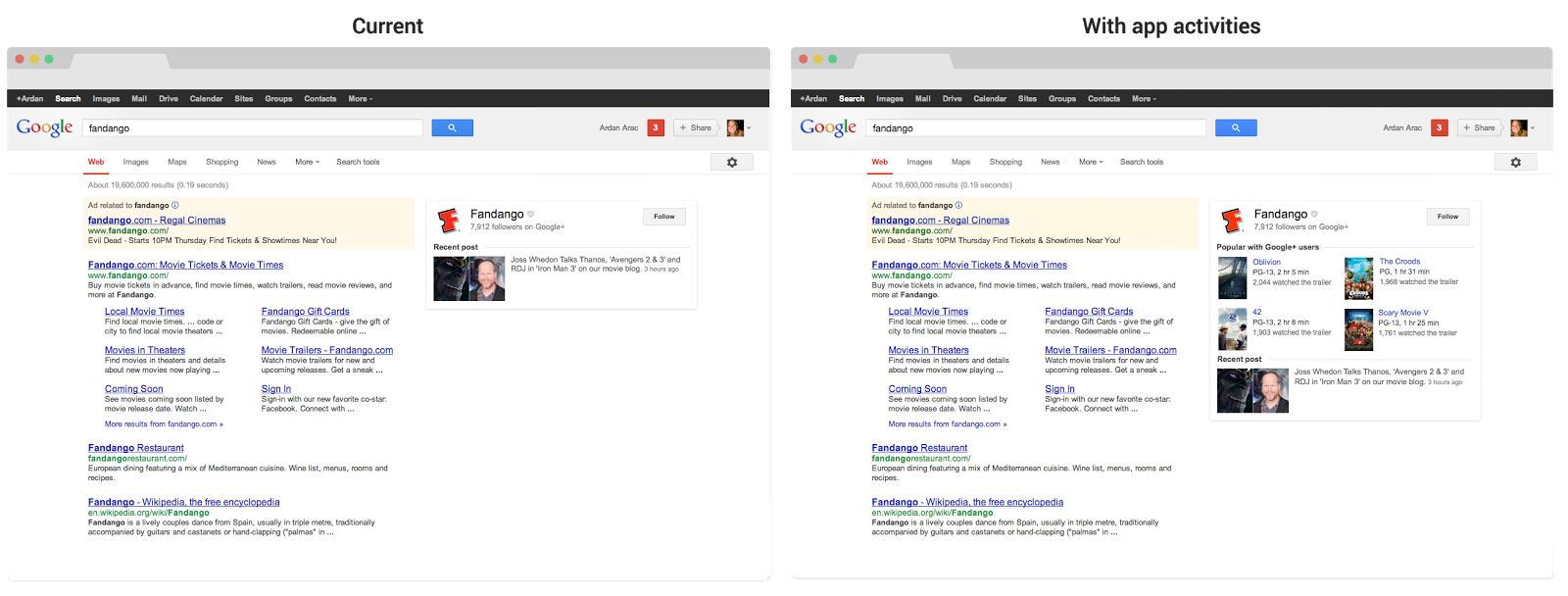
    The potential benefits to developers are indisputable. “Soon, if you search for a site or app on Google.com (and that app has integrated with Google+ Sign-In app activities), you’ll see popular and aggregate user activity to the right of search results”, Seth Sternberg, director of Google+ product marketing, explains. “Searching for Fandango, for example, will show the top movies among Google users. And when you click on a movie, you’ll go directly to its page on Fandango”.

    Google will roll out the search changes over the next couple weeks. Among the first developers: Deezer, Fandango, Flixster, Slacker Radio, Songza, SoundCloud and TuneIn. Other developers adopting Google+ Sign-In will follow.

    In many markets, Google search share exceeds 70 percent — in some, reaches 90 percent. Google’s U.S. share was 67.1 percent in March, according to comScore. However, when including all products “powered by Google”, search share was 69.2 percent. The point: Google is the place to be, and developers can improve their visibility, if they support Google+ Sign-In.

    Microsoft got in trouble for integrating Internet Explorer into Windows, a tactic government trustbusters viewed as leveraging monopoly to squash a rival platform. Microsoft developers had no choice. IE was there. Likewise, while agreed somewhat different circumstances, Google requires one thing for another. To get that extra search edge, developers must support Google+ Sign-In.

    The approach personifies Google’s core business and product strategy since Larry Page returned as CEO in April 2011. There is tighter product and service cross-integration everywhere, particularly search leveraged to boost adoption of other things. Look at how much the Google search page has changed, too — the company’s other services are far more visible.

    Google+ is by far one of the biggest beneficiaries, and increasingly, as the company ties more other stuff to the social network. Chrome, Maps and YouTube are the other three major beneficiaries, but they’re not alone. Drive, Gmail, News and Play are others.

    The question to ask: Google and developers benefit, but do you? Please answer up in comments below.

    Image Credit: Google

  • Kristen Cavallari Wants Her Marriage To Last

    Kristen Cavallari recently spoke about being both a wife and mother and a working gal, and says she’s willing to put her personal projects on hold in order to spend time with her family.

    “It’s easy to get wrapped up in your career and have that be your only focus, and I want my marriage to work and last – and family comes first,” she said.

    Between design projects, a jewelry line, and a shoe line, Cavallari–who got her start on the MTV “reality” show “The Hills” as Lauren Conrad’s mortal enemy–is a busy lady. The 26-year old and Chicago Bears quarterback Jay Cutler became parents to baby Camden eight months ago, and are planning a wedding very soon. Cavallari says the two of them make a good team.

    “Having Jay is really helpful,” she said. “It’s important to talk about parenting philosophies before having a child. You want to go in knowing how to raise them to avoid the arguments that can ensue. Being good parents is our top priority.”

  • Female DNA on Bomb: Source Undetermined

    Since the death of Tamerlan Tsarnaev and the capture of Dzhokar Tsarnaev, the American public has been able to stop holding its breath, confident that authorities have found those responsible for the Boston Marathon bombing and that justice will be served. Now, a DNA test on some of the bomb material found at the scene has uncovered female DNA, leading to authorities taking a harder look at the Tsarnaev’s female associates and family members.

    A Wall Street Journal report on the revelation cites unnamed “U.S. officials” as stating the source of the DNA has not been determined. In fact, those same officials have said that the DNA may have come from many different sources, including store clerks or even bombing victims.

    Soon after Tamerlan Tsarnaev was killed in a shootout with police, his life in the U.S. began to be revealed, including his wife, Katherine Russell, and his 3-year-old daughter. According to the Journal report, FBI agents this week took a DNA sample from Russell to see if it matches the DNA found on the bomb material. Russell has been staying with her parents since the bombing, and is being guarded by the FBI.

    Visit NBCNews.com for breaking news, world news, and news about the economy

  • Fierce competition in 7-inch tablet range is destroying profits

    7-inch Tablet Competition
    Apple was criticized by a number of pundits when it finally unveiled the iPad mini last November. While the device itself was well received by reviewers and consumers alike, some industry watchers felt Apple wasn’t doing enough to compete on price. Starting at $329, the iPad mini is far more expensive than devices like the Kindle Fire or Nexus 7. If Apple’s recent earnings beat showed us anything, however, it’s that squeezing as much profit as possible out of the iPad mini was definitely the right move — iPad sales hit a new March-quarter record in 2013 and margins were sustained enough to help deliver $9.5 billion in profit. Not everyone has adopted Apple’s strategy though, and a new report suggests the race to the bottom in the 7-inch tablet segment is squeezing profits across the board.

    Continue reading…

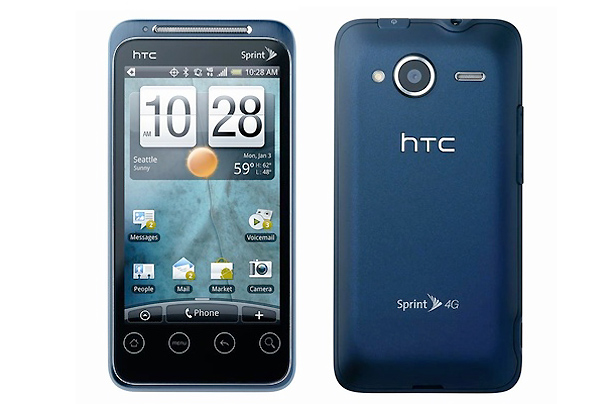
  • Overheating HTC Evo Shift Burns Owner

    gTMGDQ4

    A Columbus, Ohio woman found that her HTC Evo Shift had branded her after overheating while it was under her waistband. The woman, Jennifer Grago, reported that she was using the phone’s FM radio while she did yard work.

    “I didn’t have pockets so I just put the phone in the band of my sweats. Seemed like an alright option… I felt my phone getting warm so I moved it and trucked on. Figured sweatpants and 70 some degrees was a factor. Went to move it again and it hurt like a #%&@! and skin with it. I swear to god I almost passed out,” she wrote.

    Best Buy, where she purchased the phone, told her that phones need “correct ventilation” and should be placed in form-fitting casing.

    The phone left a clear outline of the casing on her skin. Phones, which are in essence compact radios, can easily overheat for various reasons but for a device to overheat so egregiously is frightening. The phone is two years old and is currently available for free with contract on Sprint’s network.

  • Big Data News: Actian Acquires ParAccel

    Here’s our review of some of this week’s noteworthy links for big data:

    Actian acquires ParAccel.  Big data management company Actian announced it has acquired high-performance analytics company ParAccel. ”ParAccel is being used by many of the world’s leading companies including Amazon, The Royal Bank of Scotland, OfficeMax and MicroStrategy to set them apart from their competition through analytics,” said Chuck Berger, CEO of ParAccel. “With Actian, they have immediate access to a broader portfolio of solutions to turn their data into value.” The acquisition furthers Actian’s mission in building an innovative end-to-end database, integration and analytics solution. Joint customers of Actian and ParAccel already experience the value of the combined solution set. “As a provider of right-time business intelligence as a service to innovative automotive manufacturers and dealerships, Autometrics aggregates data from 150 sites totaling millions of records per day, which must be deduplicated, loaded, analyzed and validated in shorter and shorter timeframes to drive clients’ critical business decisions,” said Stephen Shaw, Autometrics’ CEO. “With the myriad of data integration capabilities from Actian and the ParAccel Analytic Database, we are able to give automotive manufacturers rapid measures of lower funnel demand to optimize their marketing initiatives, sales incentives and inventory management.”

    Teradata launches SAS Analytics Model 720.  At the SAS Global Forum 2013 Teradata (TDC) announced the availability of the Teradata Appliance for SAS High-Performance Analytics Model 720. The appliance was designed with SAS and supports the newly announced SAS High-Performance Analytics offerings and SAS Visual Analytics. SAS Visual Analytics on Teradata quickly uncovers patterns and trends from massive volumes of data and presents these insights rapidly in graphical form throughout the enterprise, including via mobile devices. The speed and integration offered by the Teradata 720 Appliance results from its seamless integration of in-memory analytics within the Teradata warehouse environment. “I find the extreme performance of the Teradata 720 for SAS exciting, and believe it opens many new opportunities for companies on the cutting edge, improving data governance and unifying data and analytics in an integrated environment,” said Manuel Sevilla, Chief Technology Officer for Business Information Management at Capgemini. “In addition, the pairing of SAS and Teradata is a great value proposition for faster time-to-value while reducing the latency from the capture and provision of new data to the output of analytic intelligence.” Teradata also recently announced large data warehouse customer wins from the largest local bank in Southwest China, and the Bank of Ningbo in China.

    Qubole closes Series A funding.  Quobole announced the completion of a Series A funding round. This brings the total investment to $7 million from Charles River Ventures and Lightspeed Ventures as well as angel investment from Venky Harinarayan and Anand Rajaram. Based on Hadoop and founded by the creators of Apache Hive and Facebook’s analytics platform, Quobole Data Service is heavily optimized for the Cloud and is focused on making analytics easy and accessible to businesses of all sizes. Its data engine takes data from multiple sources – on premise, cloud structured and unstructured – and provides instant access through analytic tools like Tableau, Excel and R. Additionally, its self-service user interface and the library of connectors to SQL sources, NoSQL sources, and MPP platforms make it easy for analysts and data teams to combine, correlate, and create actionable insights from their data sets. “We have reached a critical poitn where our model has been validated by customers and investors alike,” said Quoble CEO Ashish Thusoo. “A half petabyte of data processed demonstrates Quobole’s growth and viability and we are very excited to raise the bar again as we continue to innovate on behalf of our users.”

  • Coming Home: Pathways to Success for Service Members and Veterans

    With more than a million veterans returning home to our nation’s shores over the next five years, we have an unprecedented opportunity – and a civic obligation – to strengthen their pathways to success. To prepare for their return home and their transition back to civilian life, the Obama Administration sought – early on– to bring diverse government partners to the table, calling for an interagency planning effort to support Service members’ career readiness. 

    In response to President Obama’s call to action for a career-ready military in August 2011, the Veterans Employment Initiative Task Force was launched, under the leadership of the Departments of Defense and Veterans Affairs. This interagency effort has brought together a collaboration of federal agencies – including Education, the Small Business Administration, Labor, Homeland Security and the Office of Personnel Management, as well as our military services and National Guard and Reserves –  as partners, working together on the first major redesign of the military’s Transition Assistance Program in over twenty years to develop a comprehensive, outcome-based re-entry program now called Transition Goals, Plans, Success (Transition GPS).

    Each of the partner federal agencies is contributing leadership and resources to activate the implementation of Transition GPS, in accordance with the VOW to Hire Heroes Act signed into law November 21, 2011. Key to this work has been the development of a core 3-day curriculum, career readiness standards, three optional tracks for transition (Higher Education, Technical Training, and Entrepreneurship), as well as options for learning in brick-and-mortar classrooms and online. Throughout their participation, Service members will receive individualized counseling and support in the preparation of a transition plan. The program also provides Service members who are exiting active duty with an education transcript, resume, access to labor market information, employment and housing opportunities, benefits information, mentoring resources, and other support services.

    read more

  • 3DLT Launches The First Store For Printable 3D Objects

    eHAYnIZ1jKpAW7JHXxU6dVlOzi7nIGFPgPl8fVzWRbY

    Cincinnati, Ohio is best known for the Bengals, Bootsy Collins, and Skyline Chili but it’s about to become famous as one of the first cities with a true market for 3D printable designs. 3DLT, a small company based in Cincy and founded by a team of programmers, is bringing the free-for-all world of 3D modellers into line and essentially making an Etsy for ABS.

    The team consists of Pablo Arellano, John Hauer, Colin Klayer, and Tim Maggart and has raised $10,000 in personal investment thus far. Today they’ve announced a plan to give away $10 million in free 3D object credit. They are also going to build a network of 3D printers across the country to allow users to connect with printers who can build their purchases on demand.

    “We’re big fans of Graphic River, iStockPhoto and other content marketplaces,” said Arellano. “We felt that when 3D printing became viable, a market for 3D printable content would be needed.”

    “We are disruptive in two ways: We will accelerate the adoption of 3D printed products by the everyday consumer by offering a wide selection of well-organized, curated designs across multiple categories. We also make it easy for consumers – from your grandmother to your grandson – to purchase 3D designs they can print at home, online, or at a local 3D print shop,” he said.

    They also aim to commoditize 3D printing and make it more “financially accessible” by partnering with 3D print providers.

    The company launched on stage today at Disrupt in New York.

    “3D printing is already being used extensively in the $23 billion prototyping market and quickly gaining traction in automotive, fashion, toys and many other areas. In the near future, everyday items, from frames to furniture, sneakers to stilettos, will be 3D printed. 3DLT is what the industry needs to cause a tipping point,” said Arellano.