Category: News

  • Your weekend reading: The wrong kind of Caucasian, the graduate school question, and how the Internet ruined everything

    A weekly round-up of interesting, weird and useful reads from around the interwebs.

    In “The wrong kind of Caucasian,” Sarah Kendzior critiques the media for its tendency to demonize an entire country based on the violent acts of a few individuals. [Al Jazeera]

    “The Internet: A Warning from History,” or how the Internet ruined everything. Just watch it. [The Poke]

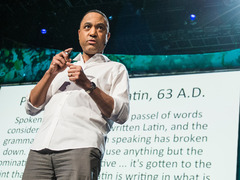
    John McWhorter: Txtng is killing language. JK!!!John McWhorter: Txtng is killing language. JK!!!

    Just what are the kids typing and texting these days? How the oblique stroke / became the written word “slash.” [Lingua Franca] To find out more about the new grammar of texting, watch John McWhorter’s talk, “Txtng is killing language. JK!!!” »

    Ah, the glory of academia, the life of reading and luxury. Or, the horrors of a life of anxiety and uncertainty? A great read about the impossible question of graduate school. [New Yorker Blog]

    Scripps Research Institute scientists accidentally find a way to turn bone marrow stem cells into brain cells. … whoops? [Sci Tech Daily]

    Sheryl Sandberg: Why we have too few women leadersSheryl Sandberg: Why we have too few women leaders

    Emily Bell responds to Dylan Byers’ criticism of NYTimes Executive Editor Jill Abramson, calling the narrative sexist and a double standard. [Guardian] Watch Sheryl Sandberg’s talk on women leaders »

    An independent company hopes to support Kickstarter’s mission by aggregating all the T-shirts listed in Kickstarter rewards, turning the site into a shirt shop. A weekend hack by web company P’unk Avenue. [Kick shirts]

    UCLA professor Peter Nonacs taught his students game theory by letting them cheat on an exam. [Pop Sci]

    Hyeonseo Lee: My escape from North KoreaHyeonseo Lee: My escape from North Korea

    Kim Hyun-hui was a North Korean spy who blew up a South Korean airliner with an accomplice in 1987, killing 115 people. She gives a rare interview. [BBC] For a very different escape from North Korea, watch Hyeonseo Lee’s talk from TED2013 »

    Finally, let Harvard guess your age based on a series of red dots. [Huffington Post]

  • Qualcomm’s Snapdragon 800 to enter mass production next month

    Qualcomm Snapdragon 800 processor production
    Vendors such as Samsung, HTC and LG have turned to Qualcomm’s Snapdragon 600 processor to power their flagship devices. The chipset has been praised for its high-end performance and efficient power consumption, and Qualcomm is promising an even better user experience with its Snapdragon 800 processor. The company’s upcoming chip is similar to the 600 version with its four cores that are clocked asynchronously, however it can maintain a clock speed of up to 2.3GHz and includes a new Adreno 330 graphics processor that is capable of supporting 4K resolution playback at 30 frames-per-second.

    Continue reading…

  • Newly formed UCLA center to tackle problems of poverty and health in Latin America

    UCLA has formed the UCLA Blum Center on Poverty and Health in Latin America, where faculty and students from multiple disciplines will work with other institutions to conduct research, develop training programs and promote innovative policy solutions aimed at addressing key social and health-related issues in the region. 
     
    “As a public university, UCLA has a duty to address the world’s challenges, and our cross-disciplinary strengths in medicine, public health, humanities, social sciences, research and public policy position us to make a difference,” said UCLA Executive Vice Chancellor and Provost Scott Waugh. “We have strong ties to Latin America and welcome the opportunity to strengthen our collaborations with other academic institutions, nonprofit groups and nongovernmental organizations in the region. The UCLA Blum Center is a team effort that draws faculty and students from across campus who are committed to redressing issues of poverty and health in Latin America.”     
     
    Dr. Michael Rodriguez, professor and vice chair of research in the department of family medicine at the David Geffen School of Medicine at UCLA, will serve as the center’s director. 
     
    “The programs of this new center reflect our mission to work collaboratively with a wide range of UCLA disciplines, as well as Latin American partnering institutions, to identify and promote solutions in health policy and practice,” Rodriguez said. “We expect to build the center into a preeminent authority in our three focus areas — research, policy and training on the social determinants contributing to health inequalities in Latin American populations.” 
     
    The center’s inaugural event, a symposium titled “Informing Responses to Reduce Poverty and Improve Health in Latin America,” will be held on campus on Wednesday, May 1. The symposium will feature speakers and panels examining the social and economic factors that contribute to stratification and subsequent health inequalities; differences in approaches to
     
    these inequalities; innovative policy and programmatic solutions to reduce poverty and health inequalities; and potential areas for government investments in public health expenditures. 
     
    Symposium details and registration information are available on the UCLA Blum Center website
     
    The center’s educational programs — a core component of its mission — to date include the UCLA Freshman Cluster Program “Poverty and Health in Latin America,” which enrolled more than 70 undergraduates for its three-quarter series that began last fall, and the UCLA Blum Center Summer Intern Scholar Program, which offers eight-week internships for both undergraduate and graduate students, who participate in Los Angeles–based and Latin American–based field experiences. Researchers with the Blum Center are continuing to develop and refine its research programs and policy efforts. 
     
    The new center is named for Richard Blum, a University of California regent whose generosity also made possible the Blum Center for Developing Economies at both UC Berkeley and at UC Davis. Blum provided $1 million to start the UCLA center. 
     
    The UCLA Blum Center on Poverty and Health in Latin America takes an interdisciplinary approach toward analyzing the key factors that influence poverty and the social determinants of health in Latin America, including: government practices and policies, community action, social justice, human rights, race, ethnicity, socioeconomic status, religion, foreign policies and more. The center draws on the expertise of professional schools and academic units across campus, including the divisions of social sciences and humanities in the College of Letters and Science, the David Geffen School of Medicine, the Fielding School of Public Health, the Graduate School of Education and Information Studies, the Luskin School of Public Affairs, the School of Dentistry, the School of Law, the School of Nursing and many others. 
     
    For more news, visit the UCLA Newsroom and follow us on Twitter.

  • Weekly Wrap Up: “What You Do Matters”

    Watch the West Wing Week here.

    White House Science Fair: On Tuesday, President Obama welcomed our country’s youngest scientists and innovators for the 3rd Annual White House Science Fair. More than 100 students from more than 40 states joined the President for the all-day celebration. The President toured the fair and even hopped on a bicycle-powered, emergency water-sanitation station developed by high-school students Payton Karr and Kiona Elliott of Oakland Park, Florida.

    The President launched the White House Science Fair in 2009 as way to help encourage science, technology, engineering and math (STEM) education.  In December of 2012 the Administration announced a goal of one million new STEM graduates in the next decade, and the President’s plan works for educational opportunities and support for women and underrepresented minorities.

    read more

  • How data is changing the car game for Ford

    When most people think about how cars are built, they probably think about assembly lines, manufacturing robots, and batteries of safety and performance simulations on massive supercomputers. But at Ford, big data is having a significant impact on the parts and features of those cars before they’re ever part of a design file. From the cars in stock at the dealership to the performance of the engine in a rainstorm, big data is infiltrating nearly every aspect of the Ford experience and the company itself.

    Obviously, data is nothing new to the automotive industry — companies have been trying to optimize supply chains and analyze sales numbers for decades — but the advent of big data, as well as related technlogies such as sensors and smartphones, is changing how companies are thinking about data. Ford isn’t alone in its quest to take advantage of these new technologies, either. For example, General Motors collects data from its OnStar system to help lower drivers’ insurance premiums, and also collects lots of data on its Chevrolet Volt electric car that it feeds to drivers via a mobile app. We recently noted how a luxury automobile company used big data software from Aster Data Systems to determine the relationships between malfunctions so it could provide a more thorough and beneficial service-department experience.

    But in an industry notoriously unwilling to talk about information technology, Ford’s experiences might shed a lot on what other companies are thinking and doing, as well.

    Building a better experience through data

    According to John Ginder, manager for systems analytics with Ford Research & Innovation, the company has been doing advanced business modeling for about 20 years, but big data is something else. Today’s technologies are allowing Ford to handle larger, more-diverse datasets than ever before possible, and its efforts are already beginning to bear fruit in numerous places — including in the cars themselves.

    The most obvious example of data influencing the driving experience might be the types of data car companies are actually giving back to drivers. At Ford, its Energi line of plug-in hybrid cars generate 25 gigabytes of data per hour that’s then processed and given back to drivers via a mobile app. It tells them about battery life, the nearest charging stations and other data about the vehicle’s performance.

    The MyFord mobile app architecture.

    The MyFord mobile app architecture.

    Ginder said all that data is the result of a “convergence of need and opportunity.” The opportunity is a way to experiment with collecting and presenting vehicle data on a group of early adopters that’s probably more interested in this type of advanced technology. The need has to do with what Ginder calls “range anxiety” — when drivers are getting used to electric vehicles, they need reassurance they’re not going to run out juice.

    However, Ginder said, the company is just scratching the surface of what’s possible, because there aren’t that many of the electric vehicles on the road yet. The goal is to better understand how drivers are using the vehicles and use that information to continuously improve the vehicles and the overall experience. Ford’s Super Duty line of pickup trucks also offers a “crew chief” package that lets bosses monitor the fuel consumption, engine performance and other data about their fleets of vehicles.

    Mike Cavaretta, technical leader for predictive analytics and data mining with Ford Research & Innovation, added that Ford is really interested in collecting more data from more vehicles, but noted there’s also a privacy concern that could come into play. The potential of someone knowing where and how you’re driving might not appeal to the mainstream just yet (just look at all that data Tesla collects about its cars and can present if it really wants to), but as with the Energi, data does present some opportunities to improve the customer experience.

    The test cars in Ford’s research labs are collecting about 250 gigabytes of data per hour from high-resolution cameras and an array of sensors, Cavaretta noted, and the company is trying to find out what data is most useful and how it might be rolled into production vehicles.

    Building betters cars through data

    Of course, sometimes the best data isn’t the stuff you see, but the stuff that just makes your car better. Cavaretta said Ford analyzes a lot of social media and other external data in order to figure out, for example, what customers are saying about their vehicles compared with other makes and what problems they’re having.

    Opens with the touch of a foot. Source: Ford

    Opens with the touch of a foot. Source: Ford

    In one recent case, the product development team was curious as to whether the Ford Escape sport-utility vehicle should have a standard liftgate (i.e., it opens manually and the rear window can flip open) or a power liftgate in which the glass and the gate are one piece. In the latter option, the gate opens automatically by tapping under the rear bumper with your foot, but the window doesn’t open at all. Regular surveys hadn’t addressed the question, so Cavaretta and his team took to social media, where people were actually talking about it quite a bit and seemed to heavily favor the power liftgate in most cases. It’s now a feature.

    Back in 2004, Ford built a self-learning neural network system for its Aston Martin luxury brand that maintains proper engine function by recognizing engine misfires and particular driving conditions and adjusting warnings and performance accordingly.

    Ginder said his team has been improving on that technology ever since and actually expanded its use into a system, called Smart Inventory Management System, that lets dealers ensure they have the optimal stock of vehicles and features on their lots. Historically, he said, some dealers were very sophisticated about inventory management, while others were more reactionary (“They just sold a red Mustang,” he joked, “so they think they need to go order another red Mustang.”) With SIMS, all sorts of data about vehicle sales and other locally relevant data from across the country is aggregated in Ford’s big data platform, and the neural network algorithms learn the current patterns so Ford can make better recommendations — whether or not dealers choose to heed the advice.

    Selling big data internally

    Cavaretta characterizes the division in which he and Ginder work as “an Ernst & Young, but just for Ford,” an internal consultancy (as opposed to Ford’s more-traditional research and development division) in charge of solving business problems via analytics. About 80 percent of those problems come directly from those lines of business, while about 20 percent are the research division’s own ideas. However, although he’s excited about how big data can help his team answer these questions in novel ways, it’s not always an easy sell with other parts of the company.

    Mashing up data sources such as social and sales in order to find insights is a pretty easy sell, Cavaretta explained, but getting people to put sensors in everything and collect data every second or with every transaction can still be a bit challenging. In part, this is just a lingering effect of the constraints that legacy technologies imposed on the company. It wasn’t possible to store all this data, so people just got accustomed to the status quo of summarizing data hourly, for example.

    Source: Ford

    Source: Ford

    Now, however, he’s pushing them to “dial it down” and collect data at the lowest level possible and as often as possible. In manufacturing alone, he explained, there are between 20,000 and 25,000 parts in any given vehicle, and there’s a supply chain that spans from parts suppliers all the way up to dealerships. Getting a complete view of this process could help drive serious efficiencies and, Cavaretta said, “We don’t see anything but big data technologies that can get us there.”

    Other areas where Ford is collecting, or wants to collect, more real-time data is from websites, call centers and the company’s credit-processing arm, he added.

    Building big data internally

    In order to accomplish their lofty goals, the Research & Innovation analytics team relies heavily on open source technologies, most prominently Hadoop. However, Cavaretta said, they’ve been experimenting with a variety of natural-language processing tools, too, and even did a proof-of-concept with SAP’s HANA in-memory analytic database. The NLP tools were first turned on text analysis of internal surveys and dealer network documents, but now are used pretty heavily on social media and other web data.

    Their team has some systems numbering in the dozens of nodes in its own building, but on weekends it’s able to borrow high-performance computing cycles from Ford’s Numerically Intensive Computing Center next door in order to model recommendation engines and other tasks that demand serious computing power.

    But as a part of a specialized research division, the work that Ginder, Cavaretta and their team do on everything from Hadoop to visualization with tools like Tableau isn’t automatically ready for primetime. In fact, Cavaretta said, it looks at “what’s the art of the possible” and tries to show the value of it. It’s like a vanguard, he added, going out and seeing what’s ahead and then reporting back.

    At that point, projects are often handed off to Ford’s central IT team that actually puts the technologies into production. A system that took the research team weeks to deploy and start deriving insights from might take IT months to make production-ready. However, Ginder added, his team can’t just throw stuff over the wall and abandon it — it has to collaborate with the IT team and individual departments throughout the project’s lifecycle.

    An important part of this cross-company relationship — and something many CIOs have likely heard before — is having data scientists on board that can see the world through the eyes of both technologists and businesspeople, two groups that often have different concerns and goals in mind. “We look for people who can bridge those worlds,” Ginder said. “It’s hard to find these people, but they’re hugely important to organizations.”

    Feature image courtesy of Shutterstock user PhotoSmart.

    Related research and analysis from GigaOM Pro:
    Subscriber content. Sign up for a free trial.


  • More Google Glass Specs Revealed As Android Tinkerers Look For Ways To Root It

    glasscloseup

    Google felt it appropriate to highlight some of Glass’ specs earlier this week, but there’s much more to the company’s wearable display than just the 5 megapixel camera and its 16GB of internal storage. In case you were hankering for a taste of what else makes Google Glass tick, Android developer (and Glass Explorer) Jay Lee spent some time tinkering with his preview unit and managed to figure out what kind of hardware it has under the hood.

    Lee managed to confirm that Glass runs Android 4.0.4 Ice Cream Sandwich (CEO Larry Page noted during Google’s most recent earnings call that Glass “obviously” runs on Android), and also determined that it has a Texas Instruments OMAP 4430 chipset. In case you haven’t been keeping abreast of developments in the mobile chipset market, the OMAP 4430 was used in devices like the original Motorola Droid RAZR and Samsung’s 7-inch Galaxy Tab 2.0 — solid devices during their prime, but the chipset that powered them is far from new.

    Sadly, some of the particulars are still shrouded in mystery — Lee wasn’t able to figure out the processor’s clock speed (the 4430 CPU can be clocked between 1 and 1.2 GHz), and the device only reports that it has 682MB of RAM, but Lee suspects the total is actually 1GB. Still, that’s not too shabby a spec sheet for a device that essentially lives on your face, and some recent reports reveal that the ambitious headset may be surprisingly too simple to root to. Liam McLoughin, an intern for Google’s Chrome team, recently tweeted to note that gaining root access to the search giant’s curious head-mounted display seemed simple in theory, a development that prompted Lee to go digging in the first place.

    Meanwhile, Cydia founder and administrator Jay Freeman revealed on Twitter that he too had made progress in gaining access to the device, and even posted a picture to show off how far he’d managed to go. At this point we’ve already seen some companies embrace the Glass platform (Path and the New York Times immediately spring to mind) and others like Evernote are known to be crafting experiences for Glass, but some moderately powerful hardware and seemingly easy rootability could make Glass an even bigger hit for Android tinkerers.

  • Supervalu Adds Two Board Members

    Supervalu has elected two new members to its board: John Standley, Rite Aid’s chairman president and CEO and Mark Neporent, Cerberus Capital’s COO and general counsel. They are directors. In January, Supervalu agreed to sell five of its retail grocery chains to an investor group led by Cerberus Capital Management LP.

    PRESS RELEASE

    SUPERVALU (NYSE: SVU) today announced the election of two new members to its Board of Directors: John Standley, chairman, president and CEO of Rite Aid Corporation and Mark A. Neporent, chief operating officer and general counsel, Cerberus Capital Management, L.P. (“Cerberus”), as directors.

    “I am very pleased that John and Mark have accepted positions on our Board,” said Bob Miller, SUPERVALU’s non-executive chairman. “It is important that we have a strong Board of Directors with a mix of industry, financial and professional experience to draw upon. John and Mark provide tremendous knowledge and a strong understanding of the guidance and direction this Board should offer SUPERVALU during its rebuilding process.”

    Mr. Standley has spent the past 20 years in executive leadership roles in the grocery and pharmacy retail business. He became Rite Aid Corporation’s president and chief operating officer in September 2008, was appointed to the Rite Aid Board of Directors in 2009 and was named CEO in June 2010. He was elected chairman of Rite Aid’s Board of Directors in June 2012. Mr. Standley had previously served as Rite Aid’s chief financial officer, chief administrative officer and senior executive vice president from 1999 to 2005. Rite Aid Corporation (NYSE: RAD) is one of the nation’s leading drugstore chains with more than 4,600 stores in 31 states and the District of Columbia and fiscal 2013 annual revenues of $25.4 billion. In addition to his tenure at Rite Aid, Mr. Standley served as CEO and a member of the Board of Directors of Pathmark Stores, a northeast regional supermarket chain from 2005-2007. He also worked with The Yucaipa Companies from 1994 to 1999 in a variety of senior leadership positions at several grocery companies that were consolidated into Fred Meyer Inc. Mr. Standley is currently vice chairman of the National Association of Chain Drug Stores (NACDS) and is a graduate of Pepperdine University.

    Mr. Neporent is a designee of Symphony Investors, a Cerberus affiliate. He has served as COO and general counsel of Cerberus since 1998. Cerberus, one of the world’s leading private investment firms, has more than $20 billion under management invested in four primary strategies: distressed securities & assets; control and non-control private equity; commercial mid-market lending and real estate-related investments. Mr. Neporent is responsible for the day-to-day management of Cerberus and serves on many of the Firm’s committees, including the Investment Committee, Valuation Committee and Risk/Compliance Committee, among others. Prior to joining Cerberus, Mr. Neporent was a partner in the Business Reorganization and Finance Group at Schulte Roth & Zabel LLP, where he practiced from 1986 until he joined Cerberus. He also practiced from 1982 to 1986 at the firm of Otterbourg Steindler Houston & Rosen, P.C. Mr. Neporent is a graduate of Lehigh University and Syracuse University College of Law, where he was the lead articles editor for the Syracuse Law Review.

    The nine-person board resulting from today’s appointments will have five members who are independent directors under the New York Stock Exchange listing standards. The board will continue the search process for one additional independent director. Upon the selection and appointment of this director, Mr. Sam Duncan, SUPERVALU’s president and chief executive officer will be added, increasing the final size of the Board to 11 directors.

    About SUPERVALU INC.
    SUPERVALU Inc. is one of the largest grocery wholesalers and retailers in the U.S. with annual sales of approximately $17 billion. SUPERVALU serves customers across the United States through a network of approximately 3,420 stores composed of 1,900 independent stores serviced primarily by the Company’s food distribution business, 1,331 Save-A-Lot stores, of which 950 are operated by licensee owners; and 191 traditional retail grocery stores. Headquartered in Minnesota, SUPERVALU has approximately 35,000 employees. For more information about SUPERVALU visit www.supervalu.com.

    CAUTIONARY STATEMENTS RELEVANT TO FORWARD-LOOKING INFORMATION FOR THE PURPOSE OF “SAFE HARBOR” PROVISIONS OF THE PRIVATE SECURITIES LITIGATION REFORM ACT OF 1995.

    Except for the historical and factual information contained herein, the matters set forth in this news release, particularly those pertaining to SUPERVALU’s expectations, guidance, or future operating results, and other statements identified by words such as “estimates,” “expects,” “projects,” “plans,” and similar expressions are forward-looking statements within the meaning of the “safe harbor” provisions of the Private Securities Litigation Reform Act of 1995. These forward-looking statements are subject to risks and uncertainties that may cause actual results to differ materially, including competition, ability to execute initiatives, substantial indebtedness, impact of economic conditions, labor relations issues, escalating costs of providing employee benefits, regulatory matters, food and drug safety issues, self-insurance, legal and administrative proceedings, information technology, severe weather, natural disasters and adverse climate changes, the continuing review of goodwill and other intangible assets, accounting matters, the effect of the sale of the New Albertsons banners and other risk factors relating to our business or industry as detailed from time to time in SUPERVALU’s reports filed with the SEC. You should not place undue reliance on these forward-looking statements, which speak only as of the date of this news release. Unless legally required, SUPERVALU undertakes no obligation to update or revise publicly any forward-looking statements, whether as a result of new information, future events or otherwise.

    The post Supervalu Adds Two Board Members appeared first on peHUB.

  • President Obama Meets with King Abdullah II

    President Obama Meets with King Abdullah II in the Oval Office, April 26, 2013

    President Barack Obama and King Abdullah II of Jordan make statements to the press prior to a bilateral meeting, in the Oval Office, April 26, 2013.

    (Official White House Photo by Pete Souza)

    President Obama today welcomed His Majesty King Abdullah II of Jordan to the White House, where the two leaders once again discussed the very urgent issues impacting that country, and the rest of the world.

    President Obama met with the Jordanian leader last month on his trip to the Middle East, and this afternoon he thanked the King for his "extraordinary" hospitality, and praised his efforts to foster democratization, entrepreneurship and economic development inside Jordan. In remarks to the press before their bilateral meeting, the President said that he believes Jordan can be an "extraordinary model for effective governance in the region."

    read more

  • Now there’s an app to help you dodge bullets

    Some researchers from Vanderbilt have developed a new app and hardware module that will help you find the direction of gunfire. The research team used the sonic signatures associated with firing to pinpoint its location, and put this on an Android smartphone map.

    Originally developed for the Department of Defense, acoustic shockwave bearing estimation was designed to help soldiers locate snipers. The technology takes advantage of the properties associated with gunfire – the initial flash of the muzzle blast and the shockwaves that follow. The supersonic speeds and whizzes of bullets can be tracked with microphones and a really precise clock hooked up to a microprocessor. These sensor nodes communicate with smartphones via Bluetooth; data from a few differently placed sensor nodes are required to triangulate the location of the gunshots.

    The sniper location system was built into combat helmets, but the research team has now updated it for smartphones with funding from DARPA. Some nodes are still required, so civilian use may not be practical. But the researchers think security details or police squad cars could make use of the smartphone version.

    Related research and analysis from GigaOM Pro:
    Subscriber content. Sign up for a free trial.


  • Sony reportedly prepping water-resistant Xperia phone with 720p display

    Sony Xperia ZL Specs
    Sony is reportedly preparing to launch a new flagship Xperia smartphone in the near future. According to the Xperia Blog, the Xperia ZR will be equipped with a 4.6-inch display, either a 1.5GHz quad-core Snapdragon S4 Pro or a Snapdragon 600 chipset and a 13-megapixel rear camera. The handset will also reportedly include 2GB RAM, 8GB of internal storage, a microSD slot and a 2,300 mAh battery, and will be capable of sitting in more than 5 feet of water for up to 30 minutes without being damaged. Unlike similar high-end devices, however, Sony’s new smartphone won’t include a full HD display and will instead reportedly feature a 720p panel.

  • Facebook Friends Are Worth $174.17 To Brands [Report]

    A study from Syncapse is generating some attention in the marketing world. Surveying over 2,000 Facebook users, it has determined that a Facebook Page like is worth $174.17.

    Feel free to keep a grain of salt handy, but the abstract says, “Brand marketers are sobering up and asking hard questions around the ROI of social marketing. Perhaps no question is asked more often than ‘What is the value of a Facebook brand Fan?’ According to new Syncapse empirical research, the average value of brand Fans in key consumer categories has increased 28% to $174.17. Not only do they tend to be brand users first, they spend more, engage more, advocate more, and are more loyal. The significant and increasing value of a Facebook brand Fan affirms past social marketing investment and mandates deeper commitment and accountability in the future.”

    You can download the whole thing here.

    This isn’t anywhere close to the first time we’ve seen attempts to attach specific values to Facebook likes. Here’s one from 2011, for example.

    [via CIO]

  • Google Glass Specs Have Begun to Surface

    Google Glass may still be a year away from hitting store shelves, but developers who shelled out $1,500 at last year’s Google I/O to pre-order the device have begun to get their prototype models.

    As industrious hackers begin getting units, every inch of the device will no doubt be cataloged soon enough. For now, consumers will have to settle for a few of the initial specs from the developer version of the gadget.

    Jay Lee, a software developer for Google Apps reseller Dito, got his Glass unit this week and has been geeking-out over the device on Google+. He has begun toying around with the device’s debug mode and listed some key specs for the Glass, including the processor and memory included:

    Jay Lee

    I realize that with innovative products like Glass, the experience is more important than the hardware specs. And the experience is pretty incredible! Having said that, it's Friday, I'm a geek and it's still awesome to nerd out on the guts. +Liam McLoughlin (Hexxeh) also found the USB debugging setting and got ADB working (looks like it was broken on my primary machine). Once I got it working I pulled up some details about Glass. Key points are:

    * It's running Android 4.0.4 – Ice Cream Sandwich – just as Larry Page said
    * It's an OMAP 4430 CPU – Dual Core? – Having trouble finding exact mhz
    * There's 682mb of RAM (678052kb reported in /proc/meminfo). Kernel messages lead me to believe it's actually 1gb but some is being used for other hardware purposes(?)

    https://drive.google.com/#folders/0B0YvUuHHn3MnV0FacEJiMG1GNW8

    If you know Android pretty well and have additional questions on the Hardware or Glass OS you'd like answered (and know the commands that will answer them), feel free to post in the comments and I'll see what I can do.

    To put some of the info in context, the OMAP 4430 CPU has been used in mobile devices such as Samsung’s Galaxy S II and the Kindle Fire. Previous reports have shown that Glass has a 640 x 360 display and a 5-megapixel camera. In other words, Glass won’t match up to this year’s (or last year’s) cutting-edge smartphones in terms of power, though it’s still plenty powerful for a wearable computer.

    (via BGR)

  • Character Customization Coming To Star Wars: The Old Republic

    Star Wars: The Old Republic was the subject of countless jokes and TORtantic memes last year after the game started to bleed subscribers. The MMO went free-to-play less than a year after launch, and now EA has to retain players while attracting new players to the game.

    In April, the team at BioWare Austin added a number of features and items to the game. Some were microtransactions meant to give players more options in customization, but the real treat will be coming next month in the form of new character customization options. Players will soon be able to change their physical appearance and even their race.

    The guys at BioWare are not in an enviable position right now. They have to keep EA and the new overlords at Disney happy. Both companies are currently in the process of killing off studios and games. “>The Old Republic may be next on the chopping block if it doesn’t pick up some steam.

  • N.J. Girls’ Murder Video Surfaces, Charges Possible

    Two New Jersey girls are in serious trouble after a 20-minute video surfaced online of them talking about several teachers and classmates they wanted to kill.

    The 12-year old girls can be heard talking about being assassins and threatening several people after one of them read a note aloud at school that contained a “hit list” of sorts. Though they’re laughing most of the time in the video, it’s a haunting depiction of youth to the parents of those who were named.

    “My daughter, she woke up about four times last night, to lock the doors. She woke up with nightmares,” said parent Angelica Marrero.

    The video has been taken down off YouTube and the girls have been pulled from school as police perform an investigation, but they say they don’t believe there was ever any real threat to students or faculty. However, charges might be brought against them, and most parents believe that would be a good thing.

  • Vermont gets a gigabit network. And it only costs residents $35 a month

    The telephone company that provided the copper service that in 1923 allowed Calvin Coolidge to be sworn in as United States President, at Plymouth Notch in Vermont, is trading its storied copper for fiber. VTel, a telephone company providing service to 21 Vermont communities is upgrading its network to an all-fiber, gigabit-capable network.

    So far, it’s offering about 500 residents gigabit speeds for $35 a month and plans to cover its 17,500 customers by the middle of 2014. That’s about the same time Google plans to start offering gigabit service to its first Austin residents, and means VTel will be hooking up 200 homes to the network each week. So when we counted gigabit homes earlier this week, Vermont likely supplied a few.

    VTel’s transition from POTS (plain old telephone) to photons was made possible in part from the broadband bucks the federal government allocated as part of the American Reinvestment and Recovery Act in 2009. Thanks to ARRA grants totaling $94 million, plus matching grants from the local utility that wanted to use the planned network for smart grid deployments and its own investments, VTel has spent over $150 million building out more than 1,200 miles of fiber.

    VTel uses Alcatel 100 gigabit routers at each of its 14 rural central offices serving its GigE customer base

    VTel uses Alcatel 100 gigabit routers at each of its 14 rural central offices serving its GigE customer base

    VTel also operates a 100 gigabit per second backbone in the North East with peering points in New York City, Boston and Montreal, which supports the network and provides redundancy via alternate routes. Inside the home Vtel has to upgrade the equipment it offers consumers to match the gigabit speeds coming into the house. It purchased Actiontec routers for inside the homes, and now its customers are typically experiencing speeds of 925 Mbps to 950 Mbps.

    VTel CEO Michel Guité, told the Wall Street Journal that the growth of Google Fiber helps him get approvals for the federal grants to upgrade the network. From the article:

    That comes as Google’s Fiber project, which began in Kansas City and is now extending to cities in Utah and Texas, has raised the profile of gigabit broadband and has captured the fancy of many city governments around the country.
    “Google has really given us more encouragement,” Mr. Guité said. Mr. Guité said he was denied federal money for his upgrades the first time he applied, but won it the second time around–after Google had announced plans to build out Fiber.

    Most tellingly however, was Guité’s quote to the Journal where he says it remains to be seen if this is a “sustainable model.” Selling broadband access for $35 may be possible if much of your deployment costs were covered by federal grants, especially in a rural area where homes are spread out. Generally the more dense a population, the lower the broadband deployment costs, which generally translates in higher monthly bills for customers. But since customers aren’t sure why they need a gigabit yet, getting too far ahead of demand can mean VTel spends money to upgrade before customers want to pay money for the product.

    VTel is scheduling community meetings to educate people about the benefits of having a a gigabit network as part of a drive to get customers to sign up. However, for those that are leery about living so far in the future, VTel still offers customers dial up access for $21.95 a month. Now, that makes for a digital divide.

    Related research and analysis from GigaOM Pro:
    Subscriber content. Sign up for a free trial.


  • This Week On The TechCrunch Gadgets Podcast: The Q10 Vs. The One And The Fitbit Flex

    podcast

    This week on the TechCrunch Gadgets Podcast we talk about the Blackberry Q10, The HTC One, and the Fitbit Flex. This time we’re joined by Matt Burns, Darrell Etherington, Chris Velazco, and a tiny thinger that won’t fit into the bracelet. Enjoy!

    We invite you to enjoy our weekly podcasts every Friday at 3pm Eastern and noon Pacific.

    Click here to download an MP3 of this show.
    You can subscribe to the show via RSS.
    Subscribe in iTunes

    Intro Music by Rick Barr.

  • Ultra HD TV might not flop after all

    Ultra HD TV Shipments 2013
    “Ultra HD” TVs from companies like Samsung and LG made a big showing at this past Consumer Electronics Show in January, but even the lead analyst at the Consumer Electronics Association — the group that organizes CES each year — thought ultra HD would be a flop. As it turns out, however, that may not be the case. CEA’s Steve Koenig believed ultra HD TV sales would climb to just 1.6 million units three years from now in 2016, but new data from Digitimes’ unnamed industry sources suggests that shipments of TV panels with “ultra HD” 4K resolution will already fall between 3.5 million and 4 million units in 2013. The report claims top panel OEMs Innolux, AU Optronics and China Star Optoelectronics are all increasing production, and Innolux alone is expected to ship between 2 million and 3 million ultra HD TV displays this year.

  • LivingSocial Hacked: 50M+ Emails & Passwords, but No Credit Card Info

    Daily deals site LivingSocial is the latest major tech company to fall victim to hackers. According to the Washington D.C.-based company, the hack exposed over 50 million users’ email addresses, passwords, birthdates, and more – but no financial information.

    All Things D obtained an internal memo that explains the nature of the attack:

    We recently experienced a cyber-attack on our computer systems that resulted in unauthorized access to some customer data from our servers. We are actively working with law enforcement to investigate this issue.The information accessed includes names, email addresses, date of birth for some users, and encrypted passwords – technically ‘hashed’ and ‘salted’ passwords. We never store passwords in plain text.

    and…

    The database that stores customer credit card information was not affected or accessed. The database that stores merchants’ financial and banking information was not affected or accessed.

    If your LivingSocial account was affected, you’ll likely be receiving an email soon notifying you of the hack. It’ll ask you to create a new password and “consider changing password(s) on any other sites on which you use the same or similar password(s)”

    Here’s the full email that’s being sent out to customers:

    Subject: An important update on your LivingSocial.com account

    LivingSocial recently experienced a cyber-attack on our computer systems that resulted in unauthorized access to some customer data from our servers. We are actively working with law enforcement to investigate this issue.

    The information accessed includes names, email addresses, date of birth for some users, and encrypted passwords – technically ‘hashed’ and ‘salted’ passwords. We never store passwords in plain text.

    The database that stores customer credit card information was not affected or accessed.

    Although your LivingSocial password would be difficult to decode, we want to take every precaution to ensure that your account is secure, so we are expiring your old password and requesting that you create a new one.

    For your security, please create a new password for your < > account by following the instructions below.

    1. Visit LivingSocial.com

    2. Click on the “Create a New Password” button (top right corner of the homepage)

    3. Follow the steps to finish

    We also encourage you, for your own personal data security, to consider changing password(s) on any other sites on which you use the same or similar password(s).

    The security of your information is our priority. We always strive to ensure the security of our customer information, and we are redoubling efforts to prevent any issues in the future.

    Please note that LivingSocial will never ask you directly for personal or account information in an email. We will always direct you to the LivingSocial website — and require you to login — before making any changes to your account. Please disregard any emails claiming to be from LivingSocial that request such information or direct you to a different website that asks for such information.

    If you have additional questions about this process, the “Create a New Password” button on LivingSocial.com will direct you to a page that has instructions on creating a new password and answers to frequently asked questions.

    We are sorry this incident occurred, and we look forward to continuing to introduce you to new and exciting things to do in your community.

    Tim O’Shaughnessy

    CEO, LivingSocial

  • Rick Camp Dies: Braves Pitcher Was 60 Years Old

    Rick Camp, who pitched for the Atlanta Braves from 1976-1985, has died of natural causes. He was 60 years old.

    A small-town hero from Trion, Georgia, Camp excelled at sports in school and had the support of the entire community when he went on to play for the major leagues in ’76.

    “He was our one guy, the local boy who made it big,” said Greg Baker, a former Trion resident. “He was our T-ball coach, the volunteer PE teacher; everybody’s cousin, hometown hero. Every kid in Trion would fight to wear his number 37. We followed every move he made with the Braves — the highs and lows both on, and later, off the field.”

    Camp was mostly a low-key player for the Braves, but he had a shining moment when he was called in to pinch-hit during the 18th inning of a game against the Mets. There, he hit the only home run of his career and tied up the game. And despite not being a big name in sports, he is greatly missed and fondly remembered today by those who knew him, on and off the field.

  • Free Pretzels Today (That’s Right. It’s National Pretzel Day.)

    For pretzel lovers, today is a really big deal. All across the U.S. pretzel vendors are celebrating National Pretzel Day and giving away free pretzels.

    Still, you may want to check with your pretzel vendor of choice before you make the trip. It’s entirely possible that they’re still trying to make money today.

    Google’s Zagat has provided a slideshow of 11 places to eat soft pretzels today (it helps if you live in Philadelphia). Zagat’s Danya Henninger writes, “According to the Philly Pretzel Factory, Philadelphians consume 12 times the national average of pretzels per year – 18 pounds per person. It makes sense, since this is where German immigrants first brought the ancient snack to American shores. For National Pretzel Day, PPF is giving away a free soft pretzel to each and every customer at all locations.”

    The beloved pretzel brand Snyder’s of Hanover appears to be dominating the Twitter conversation. Here’s the a snapshot of that:

    Regardless of whether or not your’re getting your pretzels for free today, might I suggest a pretzel dog. Bucky knows what I’m talking about: