At its annual Collaboration Summit in San Francisco, the Linux Foundation and Citrix (CTXS) announced that the Xen Project is becoming a Linux Foundation Collaborative Project. Started ten years ago, Xen Project open source virtualization platform has led to Citrix XenServer becoming a powerful cloud platform. The project has seen contributions from organizations such as Amazon, AMD, Cambridge University, Citrix, Fujitsu, Intel, National Security Agency (NSA), Oracle and SUSE.
“Linux Foundation Collaborative Projects have at least one thing in common and that is they all use collaborative development to advance and accelerate technology innovation,” said Jim Zemlin, executive director at The Linux Foundation. “The Xen Project is an important open source community project that provides valuable technology to the entire Linux and open source ecosystem. It’s a natural move for us to help nurture collaboration to advance this technology.”
The Linux Foundation will provide infrastructure, guidance and a collaborative network. The neutral, member-led community will help accelerate cross-industry innovation around the Xen Project hypervisor, bringing guidance and contributions from a more diverse group of technology leaders. The following technology leaders are aligned in advancing the Xen Project initiative in the Cloud Era: Amazon Web Services, AMD, Bromium, Calxeda, CA Technologies, Cisco, Citrix, Google, Intel, Oracle, Samsung and Verizon.
“Industry interest in Xen has been growing rapidly over the past few years, thriving on strong industry support and commitment from the project’s founding members,” said Peder Ulander, VP, Open Source Solutions at Citrix. “By widening the scope of collaboration under The Linux Foundation, the Xen Project community can set the bar even higher for innovation. Citrix remains committed to the project and advancing the technology for Xen Project-based products across the industry, including its own Citrix XenServer.”
Citrix believes that the open source community will play a vital role in the Cloud Era, leading the way for proprietary innovations rather than following them. The Linux Foundation recently announced the OpenDaylight project, a community-led and industry-supported open source framework that will accelerate adoption, foster new innovation and create a more open and transparent approach to Software-Defined Networking (SDN).
Indiana Jones, the great (fictional) archaeologist, used his own brains and creativity to tackle the toughest intellectual puzzles in his quest for the Holy Grail. Indy’s self-reliance represents the dominant approach to tough problems, i.e. individuals and organizations look to themselves for the solution. Today, this self-reliance is giving way to a new approach: globally dispersed crowds, often numbering in the thousands, are being engaged to help solve problems at a scale, speed, and scope that dwarfs traditional efforts. (Our recent article on the subject examines how crowds can be used as innovation partners.)
Consider the case of Dr. Albert Yu-Min Lin, Research Scientist at University of California San Diego and a National Geographic Society Emerging Explorer. He turned the field of archaeology on its head by engaging more than 28,000 individuals around the world to help him solve one of the most enigmatic problems in history — locating the tomb of Genghis Khan.
In the early 13th Century, Khan and his army swept across the steppes of Mongolia to conquer northern China and Central Asia, forming the Mongolian Empire, which continued after his death to become the largest contiguous empire in human history, stretching from as far east as the Sea of Japan and as far west as parts of Europe.
However, the Khan’s death is shrouded in mystery and he requested that he buried in an unmarked grave. Legend has it that he was buried in a place so secret that the funeral party killed everyone they encountered on their way to the site and were in turn massacred by another army to keep his burial grounds a secret. Over the centuries, innumerable archeologists from across the globe have tried–and failed–to find Khan’s tomb.
Dr. Lin, enthralled by the mystery, took on the challenge. An engineering PhD, he theorized that machine-learning algorithms could be deployed on high resolution satellite imagery of Mongolia to help identify Khan’s burial ground. However, he quickly ran into a problem. Mongolia is a large country, with a diverse terrain and poor maps; to get the data for his algorithms, he’d have to process hundreds of thousands of images and make sure they were accurately labeled. But there was an even bigger problem: with no consensus on what Khan’s burial ground actually looks like, Lin’s machines would simply be guessing, no matter how smart the algorithm they used. He’d need the help of an expert to identify promising sites.
Frustrated, Lin turned the problem on its head. As a computer scientist, he had experienced the power of open-source communities not only to solve mundane technical help problems but also to create complex software systems, one micro-task at a time. Lin realized that if he could somehow harness a crowd to go through the entire image databank, one square kilometer at a time, label every single image and also note any ancient sites of interests, he might zero in on the burial ground. Rather than engage the one expert who could help with labeling and identification, he would instead aggregate the crowd’s responses so that areas of convergence amongst independent participants would lead to accurate assessments. Hence he used the crowd both to cost effectively distribute the labor needed to label all the images but also to distribute the cognitive task of identifying ancient sites.
In cooperation with the National Geographic Society, Dr. Lin set up the mapping Mongolia initiative. Participants were provided one of the 84,183 high resolution image tiles (covering 6,000 square kilometers) and asked to label the image for the following features “roads.” “rivers,” “modern structure,” “ancient structure,” and “other.” Once they completed the labeling, they were then shown the labels of other participants and they had the option to readjust their mental image of the tomb for the next randomly presented image tile. The initiative launched in June 2010 and within six months more than 10,000 individuals had created more than 2.3 million image tags. When observing an area of high tag density, Lin observed the convergence of parallel agreement from hundreds of randomly selected participants. This is how he was able to, as he puts it “pool human perception” at a broad scale. The project is still live and more than 28,000 individuals have contributed image analysis data.
Dr. Lin’s team then used these images to identify 100 plausible ancient structures, and then traveled to the sites, just as Indy Jones would have, through rough terrain on foot and horseback to take a closer look. Of the surveyed locations, fifty five archaeologically and culturally significant sites were positively identified including Bronze Age “khirigsuur” burial mounds, “deer stone” megaliths, and ancient city fortifications. Currently Dr. Lin’s team is conducting advanced archaeological studies at these sites to ascertain the likelihood that one may be great Khan’s tomb. Preliminary results look very promising.
Think your blog posts on Tumblr are pretty good? Just talk to the people who’ve turned those posts into book deals.
Speaking at PaidContent Live in New York on Wednesday, Tumblr CEO David Karp described the site as a creative platform where users are free to grow an audience and develop talent that has the potential to see success elsewhere, such as the 70 users who turned their blogging skills into book deals. Karp said the company saw three book deals for users last month alone, but the company isn’t viewing that as the only metric of success.
“What’s even more interesting to me than people going through traditional paths are people who are using those new emerging platforms,” he said. “What’s so exciting to me about Tumblr as a media network today is this new generation of creative commercialization tools that are being built on top of these other networks. People who don’t have to go to Harpers to publish the book deal, they can self-publish on Kickstarter instead.”
Karp’s focus on creativity is an idea that extends into the way the company is rolling out advertising. The company recently started rolling out mobile advertising, and is working on making that advertising fit within the existing Tumblr network.
“We focused on higher up in the funnel, the type of advertising that creates intent,” Karp said. “It gives room for the most creative advertisers to create their best work. I think we’ve started to prove it, and see really good examples of it.”
But Karp noted that Tumblr isn’t profitable yet — although he expects it eventually will be — and he noted he has supportive investors for the company, which most recently raised $85 million in venture funding back in 2011. The company gained notoriety recently when it shut down Storyboard, the experimental project in which it hired an editorial staff to highlight and aggregate the best content on Tumblr.
“It’s not a knock on that team at all. We hired a really brilliant team to do really good work. We gave it a shot, we gave it a year. And after a year, we decided it wasn’t the right tool for our toolbox,” Karp said. “It was working in some regards, but not in the we wanted to see it look.”
Tumblr isn’t that focused on the number of pageviews the site is getting, Karp said, although users create 90 million new Tumblr posts per day. Instead, Karp said the focus has moved to time spent on Tumblr — now at 14 minutes per day — and figuring out how to monetize that content as well as helping new users discover interesting content without picking favorites among the blogs.
“We want to give you the stuff you’re going to love on Tumblr, but we don’t want to say what great stuff on Tumblr is. We don’t want to say what great content is, or these are our favorite blogs. We don’t wan to color it too much or scare anybody off.”
Up until two days ago, heartbreak at the Boston marathon was confined to a hill in Newton. It was heartbreak of a glorious kind, a half-mile ascent 20 miles into the course where fatigue transforms effort into epic.
For runners, ‘heartbreak hill’ is a legendary stretch of asphalt, an Olympus for the best among the rest of us, who never made the Olympics but remain devoted to the open road.
The hill is a challenge and a privilege. You need to earn your chance to suffer through it. (Qualifying to run the Boston marathon is a major athletic accomplishment in itself.)
Out there, effort shatters the fictional divide between mind and body and strips off pretenses, leaving you alone with your self yet deeply connected with fellow runners and people come to cheer friends and strangers alike.
“It nearly killed me,” racers will say afterwards, meaning it made them feel alive.
If only all heartbreak could be like that. Chosen, planned for, limited, communal, revealing, full of meaning. With infinite potential, once past, to become a cherished memory that enriches its owner’s unique story.
Oh so different from that other kind.
The kind we never choose or expect but are forced to endure. The kind whose memory we’d rather do without but keeps us trapped in a perpetual present until we make at least some sense of it. The heartbreak of trauma. The kind that suddenly clogs the coronaries of a city on a festive Monday afternoon leaving it gasping for meaning, in pain and fear.
I was online when the explosions happened. In the first video I saw, runners were crossing the finish line. The clock timed them at just over 4 hours. The time it took my wife to run the London marathon, I thought. A second after the detonation, many were running the other way, towards the blast site to help — perhaps at the risk of their own lives. I wondered if I would have such courage. Both thoughts were more bearable expressions, I suspect, of a simpler feeling.
This could be us.
We spent a year in Boston recently. It was a city I had always liked, but it was running through it that let me fall in love. I often ran on my own, but I was never alone. Whenever I went out, whatever the weather, there was always another runner out there — if not a crowd of them. The spirit of the marathon, welcoming runners’ convivial solitude, lingered year-round on the banks of the Charles.
If pure meritocracy does not exist in the real world, the marathon is at least a close approximation. You need little fortune, facilities and gear to run far, fast. The rest is talent, focus and hard work. It is more than a hopeful existential metaphor, a marathon. More than a celebration. It is a strenuous affirmation of human determination, endurance and community.
The talk of senseless tragedy will soon give way to the cobbling together of reasons. As if such barbaric gestures are ever anything but the absence, the hatred, of reason — and of love.
We’ll mourn the victims in public and private ways, and celebrate the heroes. Debates about appropriate responses will mark the return of familiar politics. We’ll praise or condemn leaders’ reactions and draw lessons for corporate crises.
Some may call those responses rehearsed, even futile. They are anything but. We’ll do all that and more because we need to. We need it to begin restoring faith that tragedy and death are not always maybe just an inch away, hidden from sight only by good fortune and the fabric of illusions.
It is our willingness to seek the glorious heartbreak of challenging our limits that makes us stronger. It is our ability to work through the heartbreak of trauma that makes us more resilient. Both take courage and make us who we are.
On our last day in the city, we entered the 10K race organized by the Boston Athletic Association, the same group that puts on the Boston marathon. It was, in comparison, a small event with its 6,000 runners. The course ran parallel to the marathon’s last miles, two blocks north. It was a glorious morning, the best possible goodbye.
The children asked their babysitter to take them to watch. I can still see them cheering from the roadside a hundred yards or so from the finish line, hear them giggle emptying water bottles on my head as I sat on the pavement recovering.
We watched Jennifer finish and took pictures and played and stretched and feasted on free snacks. Without having to think even for a moment how big and tenuous a blessing it is to be together, safe.
Sure us average folk won’t be enjoying a pair of Google Glasses anytime soon, but it appears that certain individuals may get their chance to grab their sweaty mitts on one— that is, if you’re ballin’. A casual seller on online marketplace eBay claims to have in his possession a prized developer model that is now up for sale. As of now, there are a mere 38 bids— but the auction price is currently placed at a whopping $95,000. Sheesh.
Google probably won’t let this particular auction go too far considering the developer versions of the device were not intended for sale. But hey— here’s hoping the lucky winner will end up getting the glasses and being able to be just a little bit cooler than all of his or her friends for the time being.
Sports broadcaster Pat Summerall has died at the age of 82.
According to an Associated Press report, Summerall died at the University of Texas Southwestern Medical Center on Tuesday following a heart attack.
Summerall played in the NFL from 1952 until 1961. After retiring from his playing career, Summerall joined CBS sports as a commentator. He began as a color commentator for NFL games, though he would later cover other sports, such as NBA basketball, US Open tennis, and PGA Tour golf.
In 1981 Summerall was paired with John Madden to provide NFL commentary. The pair would go on to become the most well-known broadcasting team in NFL history. Their collaboration lasted for 22 seasons, including five Super Bowl games.
“Pat was my broadcasting partner for a long time, but more than that he was my friend for all of these years,” said Madden in a statement. “We never had one argument, and that was because of Pat. He was a great broadcaster and a great man. He always had a joke. Pat never complained and we never had an unhappy moment. He was something very special. Pat Summerall is the voice of football and always will be.”
This is part of the White House’s series of fireside hangouts. Biden will discuss reducing gun violence with mayors from across the country. Specifically, he’ll be joined by Karen Freeman-Wilson from Gary, Indiana, Stephanie Rawlings-Blake from Baltimore, Maryland, R.T. Rybak from Minneapolis, Minnesota, and Steve Scaffidi from Oak Cree, Wisconsin.
You can watch it live here. It starts at 2:45 PM Eastern.
Enjoy these cartoons from the May issue of HBR, and test your management wit in the HBR Cartoon Caption Contest at the bottom of this post. If we choose your caption as the winner, you will be featured in next month’s magazine and win a free Harvard Business Review Press book.
“Don’t think of it as your being fired. Think of it as our failure to retain talent.”
PC Vey
Teresa Burns Parkhurst
“Now can you explain that with a parable?”
Paul Kales
“And that, in a nutshell, is why I’m on the penny.”
Bob Eckstein
And congratulations to our April caption contest winner, Connor Barclay of Claremont, California. Here’s his winning caption:
“Next time you cry wolf, there better be an actual problem.”
Cartoonist: Paul Kales
NEW CAPTION CONTEST Enter your own caption for this cartoon in the comments field below — you could be featured in next month’s magazine and win a free book.
As part of its prepaid lineup, Verizon may be bringing the LG Optimus L3 back as the LG Optimus Zone. At least that’s the information we are seeing from evleaks, which has a pretty reliable track record. The smartphone will feature an 800MHz processor, 3.2-inch QVGA display, 800MHz processor, 3.15-megapixel camera and Gingerbread 2.3. Not the most interesting specs really, but with this being an older phone, I would venture to guess that this is probably going to happen. We don’t have anymore information then this, but rest assured as we hear it so will you.
Windows 8 hasn’t exactly been the huge boost PC vendors were looking for to reinvigorate the slumping PC market. In fact, a few reports suggest it’s actually having the opposite effect on sales. While some users seem to really enjoy the new tile-based user interface found on the Start screen, it’s also mentioned in nearly every complaint about Windows 8 we have seen — many people would like to bypass it and boot directly to the Desktop. The lack of a Start button is also a big problem for a number of users, but both of these issues are rumored to be addressed in Microsoft’s upcoming Windows 8.1 update. Of course, as we’ve discussed before here on BGR, there’s no reason to wait: You can boot directly to the Desktop and get the Start button back in Windows 8 right now with one simple, free app.
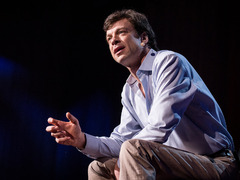
Joshua Prager uses his journalistic eye to tell his own story at TED2013. Photo: James Duncan Davidson
Almost twenty-three years ago, Joshua Prager experienced a moment that could only be described as “a great hinge in my life,” one that divided it “like the spine of an open book.” Just 19 years old then, Prager was in Israel for a year after high school. He was sitting in the backseat of a minibus bound for Jerusalem when a truck behind him lost control and slammed into the corner where he sat. His neck broke and, in a second, he went from an athletic teen to a hemiplegic. It would be weeks before he could breathe on his own, four months before he would leave the hospital. For the next four years, he navigated the world in a wheelchair, then a cane and braces – and embarked on a career as a journalist for The Wall Street Journal.
“[He was] a man I never met, but who had changed my life,” says Prager in this wrenching talk. “So on an overcast morning in January, I headed north in a silver Chevy to find a man – and some peace.”
Prager had returned to live in Jerusalem once before, after college. While there, he’d read Abed’s testimony from the morning after the accident and felt an intense wave of emotion.
“It was the first time I’d felt anger toward this man and it came from magical thinking. On this Xeroxed sheet of paper the crash had not yet happened,” says Prager. “Abed could still turn his wheel left so I would see him whoosh by out my window … and I would remain whole.”
He contacted Abed on that trip, but the two didn’t meet. It was only last year — as Prager wrote a book about his experience — that he realized he needed to meet Abed face-to face. “Finally I understood why,” says Prager. “To hear this man say two words: I’m sorry.”
To hear how Prager found Abed, watch this talk. In it, he shares the unexpected trajectories this meeting took — and the lessons this unpredictable encounter taught him about human nature and the core of our identities.
Of course, Prager was only able to tell a sliver of his story in an18-minute talk. He shares much, much more in his book Half-Life: Reflections from Jerusalem on a Broken Neck. Below, two excerpts from this recently released book – one from the prologue and one short selection from later.
Through the faded blue metal frame of my open window, I watch the morning light approach. It crests the skinny cypress trees atop the hill just over the valley, rolls down the bone rooftops of Jabal Mukabbir, rises to ripen the red-yellow nectarines on my sill three stories above Naomi Street. My floor, tiles of salmon and olive, brightens, and my glass tabletop reflects the worn copy of The Diving Bell and the Butterfly upon it.
The light reminds me that I have just come back to Jerusalem and I smile at a thought: “I will walk before the Lord in the land of the living.” I appropriated the sentence long ago from the Psalmist and I slide my left foot into my plastic brace, calf-high and erect in an empty brown shoe. I take hold of my wooden cane and walk to the staircase. There is no handrail on my right so I descend the three flights slowly, right forearm pressed against the powdery concrete wall, left hand unable to grasp the banister available to it, left leg — hard to bend–preceding the right down each of 55 steps.
I turn right on Naomi Street, right again on Hebron. My left foot is closer to the street than my right. Sidewalks the world over slant down toward the gutter and I am careful to give the extra smidgeon of clearance the slope affords to the half of me that swings forward from the hip. I have now done so for half my life.
Before May 16, 1990, I had not noticed the slant underfoot. Nor, as I ran over rise and fall, had I contemplated much what made me me, or that unfairness has theological implications, or that life might end each and every day.
But right now, because my neck broke, I am carrying a question to a windmill aware not only of the topography of the stone molars below but also, as every day, of these higher burdens.
And yet, I am lucky. Twenty-two years ago, at the base of the hill that rises to Jerusalem, a careless truck driver almost killed me as I sat in the back of a minibus. He would have but for the machines and people and tubes that saw to it that my body breathed and fed and pissed. A medical jet flew me home to New York where at age 19, I quietly observed the goings-on; I could not speak or move or feel anything below my neck save one well placed prick of a needle.
Improbably, the swelling in my neck receded. I would walk in the land of the living! But imbalanced. My right side moved freely. My left, restrained by spasticity, a neurological tightness of sorts, did not; it furled and shook. A doctor explained that I was further divided: I had Brown-Séquard syndrome which roughly meant that one half of me could move better, the other half feel.
I told myself to work now and think later. And so I pushed myself, learned to eat and dress and steady a suppository in spastic fingers, to sit and stand and walk. Walking, however gratifying, was at any real length an impractical exhaustion, and I used a wheelchair for four years until, back in Israel after college, I put in another year of exercise and rose from the chair for good. I returned to New York and became a journalist, walking through six continents with an ankle brace and cane, typing articles and a book with one finger.
I tried to write of the crash but failed. Instead, for a decade, I wrote of secrets. There was the reclusive boy who inherited the royalties to the classic children’s book Goodnight Moon. There was the hidden scheme that led to baseball’s most famous moment, The Shot Heard Round the World. There was the only-ever anonymous recipient of a Pulitzer Prize, a photographer in Iran. There were the unknown suicides of the parents of the most famous missing person in World War II.
It took a friend to point out to me the obvious: all of these stories mirrored my own, each centering on a life that changed in an instant — owing if not to a crash than to an inheritance, a swing of a bat, a click of a shutter, an arrest. Each of us had a before and an after. I had been working through my lot after all.
A second friend helped me to see that I was, in effect, forcing my subjects — one solved secret at a time — to live with their altering moment just as I did: openly. Whereas a depressed person can choose to conceal her disability, to meet me is to see that I use a cane.
But as I continue now on my walk and turn left onto King David, I am less sure of what I, not others, see in me and my broken neck.
I have returned to Jerusalem to find this out, to become again whole where I was once divided.
I cross to the right side of the street so that my left leg is to the curb and I see the windmill ahead amidst cypress and carob and olive trees. It is beautiful, a narrowing white stone cylinder with an iron cap and sail. A wealthy Brit named Moses Montefiore had it built in 1857 to encourage Jews to leave the safe but confined walled city just over the valley and support themselves milling flour. Though a community rooted about the mill, the mill was not used for long.
I turn into the park, step onto its stone path and walk between puffs of rosemary toward the windmill. I have walked a mile and my back is tight–all that swinging of a leg–and I put my right hand on my hip and lean back quickly at the waist. I hear the familiar crack deep in my back, my left leg stiffens and kicks forward, my left arm bends and shakes in spastic confusion. I balance flamingo-like a few seconds on my right leg, then sit.
I reach the windmill and look up. And then I, who once ran about it, asks my question: with no wind and no mill, are you still a windmill?
***
I am standing on a rooftop in the old walled city of Jerusalem when at 4:04 on a Friday afternoon a siren sounds as it does here every week. It stops and the Sabbath, silent, begins. And I remember another silence that followed another great sound not far away. For the crash blew out my eardrum and for a time, I heard nothing.
And then the world was full of noise — beeps and alarms and intercoms and voices — and I was silent. And the absence of my voice was audible. So I listened and heard what I had not before — the wee squeak of a first sneeze, the echo of smacked lips, the soft click of my thumb pressing a blue square button embossed with the white silhouette of a nurse.
In the quiet of my first night at Sinai, I heard a scream. It was a sustained, bloodcurdling scream, a woman in a horror film. My body jerked. The scream stopped, then returned, words articulated but incomprehensible. Then more screams descending into a frantic cough.
Then I saw her — a girl, maybe 16, skinny and tall, with half her head shaved and long dark scraggly hair falling from the other. She looked like a demon and ran screaming from my door.
My heart pounded. I began to sweat. My call bell was clipped to the railing on the right of my bed and I put my thumb on it and pressed. No one came. The screaming continued. Sweat wet my face and I pressed the button repeatedly. Where was help?! I felt dizzy. It occurred to me that perhaps there had been a mistake: I had been sent to a mental institution! Minutes passed. I was dizzy, drenched and bewildered when the nurse entered my room and told me that the girl had been in a car accident and could not speak.
I calmed. I listened. I thought of the girl. Wrote William Carlos Williams: “The poem springs from the half-spoken words of such patients….”
Time passed and I readied for bed one night when a man I could not see began to moan. Minutes passed and still he moaned and then an hour passed and I was exhausted and began to count the moans and time the moans, their metronomic parabolic rise and fall. The nurses did not make the moans stop and the moans continued for nights until the man was gone and I did not care to where.
There was more noise too. Margaret was loud. Tufts of black and white hair did not conceal a scar on her scalp and she blurted out unpleasant words and glowered at all. And one Saturday night as my father recited a prayer to mark the end of the Sabbath and I held a forbidden candle, middle-aged Margaret pushed open my door with her foot and wheeled in.
My father stopped. We closed the door. Margaret looked at the flame and we looked at Margaret. Her expression contorted. “You can’t have fire,” she said.
“Hi Margaret,” I said.
“Hi sunshine.”
I explained that this was a special candle and the fire was a secret. Margaret listened as my father resumed the prayer. She left and never told.
Years passed and I thought of Margaret and the moaning man and the screaming girl and their half-spoken words and my own words that were whole. And I appreciated the words I spoke more for having once not been able to speak them. Wrote Melville: “Truly to enjoy bodily warmth, some small part of you must be cold, for there is no quality in this world that is not what it is merely by contrast.”
Contrast. It is the short sentence that stands out in contradistinction to the long, the sound to the silence. You are mindful of what you do not have and so are truly mindful of what you do have. And if the gods are kind, you truly enjoy what you have. That is the one singular gift you may receive when you live in a hospital or break your neck or are sick or lose someone you love or suffer in any existential way. You know death and so may wake each morning pulsing with ruddy life. Some part of you is cold and so another part may truly enjoy what it is to be warm. And even to be cold. When one winter morning years after the crash, I stepped onto a tile floor and the underside of my left foot felt a flash of cold stone, nerves at last awake, it was exhilarating, a gust of snow.
So how did Prager come to TED? He spoke at the New York stop of our worldwide talent search. There he gave a shorter talk, about reaching his “half-life” – the exact moment when he had lived as long after the crash as he had before. Below, hear what he spent this moment, which calls “a looming uber-anniversary.”
It’s not necessarily broadband related – but I think it’s a good sign for a community that can make good use of broadband. According to Movoto (a real estate site), Minneapolis makes the Top Ten Nerdiest City list.
Here’s the full list:
Atlanta, GA
Portland, OR
Seattle, WA
Sacramento, CA
Minneapolis, MN
Boston, MA
Las Vegas, NV
Miami, FL
San Jose, CA
Denver, CO
And the criteria for nerdiness…
Number of annual comic book, video game, anime, and sci-fi / fantasy conventions
People per comic book store
People per video game store
People per traditional gaming store
People per computer store
People per bookstore
People per LARPing group (live action role-playing)
Pivot Data Centresannounced the construction of an 80,000 square feet data center in the greater Calgary area. The facility will be undergoing Uptime Institute’s Tier 3 certification process for design and construction. When complete later this year the expansion will have 450 racks, with capacity for over 1,000 total.
“This is a very exciting day for Pivot Data Centres and we are proud to be announcing the construction of this state-of-the-art colocation data centre, the largest and most advanced of its kind in Alberta,” said Michael Koury, Chief Executive Officer. “Beyond local interest, we are seeing a strong uptick from companies across Canada and internationally, who are looking for a data centre presence in Western Canada.”
The new data center will include features such as indirect outside air cooling capability, biometric security systems, redundant power and advanced fire detection and suppression systems, as well as 7×24 on-site security and technical support teams. The data center will also house a fully-equipped business resumption center for its customers and will be SSAE 16 PCI compliant.
Pivot’s six month old 40,000 square foot data center in Edmonton is more than 50 percent occupied and the company has added a full megawatt of power to its Calgary data center. Pivot’s 30 percent year-over-year growth is reflected in its capacity, which has tripled in the last two years, and the company continues to have strong financial support to achieve its growth objectives.
The Zopo C2 smartphone is officially official and on its way to the Chinese markets folks. The device comes jam-packed with features like a MediaTek MT6589 quad-core processor, 1GB of RAM,a 5-inch 1080p display, a 2,000mAh battery and a nifty 13MP camera (with an astounding 5MP camera on the front). While there is certainly a sense of “here we go again”, the Zopo does feature something that most other smartphones don’t— the Aliyun OS running the show. Yep, that’s right— the C2 features the same OS featured on another smartphone that was abruptly cancelled at the last minute thanks to the heavy hand of Google.
No word on when the device will hit store shelves just yet, but it appears the C2 will run customers ¥1,399 (about $230 USD).
Remember the HAPIfork? It’s a smart fork of sorts that can track how much and how fast you eat. The thinking behind it is that most of our weight gain comes from eating too much and too quickly. This smart fork would help you control both leading to a better diet and weight loss.
It’s been four months since the fork’s introduction at CES, and now the developers at HAPILABS are ready to bring its smart fork to market. They’re going to need your help though. That’s why the team has taken the idea to Kickstarter asking for $100,000 to turn their smart fork into a reality.
The HAPIfork will retail for $99, but HAPILABS is offering 2,500 smart forks at $10 off via Kickstarter. After the first $2,500 are sold out, then you will have to get the $99 version. These forks will ship in September. If you want to get your smart fork earlier, you’ll have to fork down $300 to become a beta tester. Those forks will be arriving in July.
Despite a slow uptake of Microsoft Windows RT, Dell appears committed to the platform. The company has “future generations” of its Dell XPS 10 tablet in the works, according to Neil Hand, vice president at Dell. Speaking to Computerworld, Hand says the new slates will be both lighter and faster, alluding to improved ARM-based chips that can run Windows RT.
I suspect this another Dell attempt at relevancy in the mobile market. And it’s not the first. Dell had a line of Axim PDAs, offered smartphones and was actually developed a precursor to the big-screened phone with its 5-inch Dell Streak handset running Android.
But each of these products has come and gone, without Dell becoming a big player in mobile. And at this point, where else can Dell turn to maintain relevancy? It could offer another Android device but that’s a crowded market. It’s easier to take a bet on Windows RT becoming a success and standing out from today’s crowd.
Unfortunately, that’s not a smart bet. While I like the Windows RT hardware and experience in general, the same can be had with an Intel Atom tablet with similar weight and battery life. Plus, at roughly the same price point, users gain the full Windows 8 platform with legacy app support. Think of these as Windows 8 in a Windows RT form factor and price. Where’s the value add of Windows RT, given the situation?
Even worse: Intel suggests that future Windows 8 tablets could cost as little as $200, or about 40 percent of what they cost now. If Intel’s new Bay Trail chips help that happen, Windows RT won’t stand a chance unless devices that support it drop in price; as much as if not more than Windows 8 tablets. It’s always fun — and potentially profitable — to place a high-odds bet, but this time, I think Dell is backing the wrong horse.
A 6.6 magnitude earthquake has hit Papua new Guinea. This is the second large earthquake to hit around the world in as many days.
The U.S. Geological Survey, (USGS) is reporting that the 6.6 magnitude earthquake was centered 18 km to the Southeast of Aitape, Papua New Guinea. Aitape is a small town on the northern coast of Papua New Guinea with a population of around 8,000.
The National Weather Service’s Pacific Tsunami Warning Center has not issued a warning for a Pacific-wide tsunami and doesn’t expect a tsunami to threaten Hawaii.
This earthquake comes just one day after a massive 7.8 magnitude earthquake hit Iran and Pakistan. Though that quake was centered in a mostly rural area, buildings and houses in the area were still destroyed. Reports have stated as many as 40 Pakistanis may have died.
The earthquake in Iran caused little damage relative to its 7.8 Richter scale reading due to its depth, which was recorded by the USGS as being 82 km deep. The Papua New Guinea quake was much more shallow, being measured at 13 km deep.
Australia’s foreign office has stated to AFP that there have been no reports of serious damage or injury.
Verdesian Life Sciences, which is backed by Paine & Partners, has acquired all of the assets of Plant Syence Ltd and its affiliates. Financial terms weren’t announced. Plant Syence, of the U.K., supplies plant nutritional solutions to the agriculture and horticulture markets.
PRESS RELEASE
Verdesian Life Sciences, LLC (“Verdesian”), a Paine & Partners, LLC (“Paine & Partners”) company, today announced that it has acquired all of the assets of Plant Syence Ltd and its affiliates (“Plant Syence”). Plant Syence is an East Yorkshire-based company which has served as a manufacturer’s representative for Verdesian in the United Kingdom and continental Europe for the last 11 years. Financial terms of the transaction were not disclosed.
“Verdesian is committed to product development and enhancing our portfolio through acquisition of companies and technologies. The acquisition of Plant Syence is an important step in Verdesian’s growth strategy,” said JJ Grow, Chief Executive Officer of Verdesian Life Sciences. “We have had a successful and long-term relationship with Plant Syence. They’ve developed strong local relationships and have offered keen insight into local markets that has led to the continued development of Verdesian products. We welcome Plant Syence to the Verdesian family and look forward to creating a global plant health company together.”
“We firmly believe that this development will benefit the company and our customers,” said John Haywood, CEO Plant Syence. “Increased investment from our new parent company will allow us to be more responsive to the needs of our customers and provide more support to those using our products. Our team will remain the same, as will the quality of our products, and with this extra support we plan to develop more innovative products.”
Plant Syence will immediately begin conducting business as Verdesian Life Sciences Europe, Ltd. Haywood will assume the Managing Director position of Verdesian Life Science Europe and will report to JJ Grow.
About Plant Syence
Founded in 2002, Plant Syence is a supplier of plant nutritional solutions to the agriculture and horticulture markets. Plant Syence has worked with leading research institutes to help develop technologies and ideas for the European market to provide a full independently verified local support package.
About Verdesian Life Sciences, LLC
Verdesian focuses on investments in plant health and nutrition. Established in September 2012 by Paine & Partners, a global private equity investment firm that specializes in the food and agribusiness industry, Verdesian acquired Biagro Western Sales, LLC, a leader in protected technologies for developing plant health and plant nutrition products, in September 2012, and Northwest Agricultural Products, a world-class provider of specialty agriculture products, in February 2013. Further information about Verdesian is available at www.VLSci.com.
About Paine & Partners, LLC
Paine & Partners provides equity capital for management buyouts, going private transactions, and company expansion and growth programs. Paine & Partners engages exclusively in friendly transactions developed in cooperation with a company’s management, board of directors and shareholders. The firm currently makes investments through its $1.2 billion fund, Paine & Partners Capital Fund III, L. P. and related entities.
Paine & Partners focuses on the food and agribusiness industry globally, and its principals, through a predecessor fund, have made successful strategic investments in Seminis, then the world’s leading global developer, producer and marketer of vegetable and fruit seeds; and Advanta Netherlands Holdings BV, at the time, the largest independent agronomic seed company in the world. Paine & Partners also invested in Icicle Seafoods, a leading producer, harvester and processer of salmon, pollock, halibut, cod, crab and other seafood products with operations in North and South America and sales globally. Paine & Partners’ most recent investments include Sunrise Growers~Frozsun Foods, a leading value-added frozen fruit processor and marketer; Eurodrip, a global manufacturer and supplier of drip irrigation solutions; Verdesian Life Sciences, a U.S.-based plant health and nutrition investment platform; Scanbio Marine Group, a leading Norwegian producer of fish protein concentrate, fish meal, and fish oil; and Costa Group, Australia’s largest integrated grower, packer and marketer of fresh fruits and vegetables. The complex investment opportunities in today’s rapidly evolving agribusiness environment play to the strengths of Paine & Partners’ differentiated approach. For further information, see www.painepartners.com.
Apple is under scrutiny again by the Chinese government, but not for poor customer service: it’s for pornography.
The Wall Street Journal reported Wednesday that an ongoing investigation is underway, which has caught up with Apple and other other small companies for providing ways to access pornographic content. According to the report:
A government regulator named Apple Inc.’s app store as a source of “obscene pornographic” content late last month and ordered it to remove the content, submit a report about the violation, and take measures to prevent future violations.
Apple did not immediately respond to a request for comment on the matter.
The accusation is somewhat ironic considering Apple’s attitude toward porn. Steve Jobs is well-known for his stated belief that Apple has “moral responsibility to keep porn off the iPhone” and other devices with access to the App Store. It’s true that Apple has a difficult time being super consistent about policing its enormous App Store for that kind of content, but it certainly tries.
While it’s the Chinese government that’s undertaking a campaign against “obscene” content, the WSJ notes that the Chinese press — which is basically an extension of the government — is taking a more subdued tone with the case so far. That lies in contrast with China Central TV and several newspapers’ attempts to steamroll Apple over iPhone warranty and customer service issues last month.
It’s hard to tell where this is headed. If Apple moves to improve the filters on App Store content in China, will the government be satisfied? Or will it require another dutiful apology from the CEO?
As many will note, these pair of incidents seems awfully similar to the road China went down with Google. The same accusation of helping to distribute pornographic content was made against the company in 2009, and it was ordered to remove certain search results. Following hacking attacks from within China and continual disagreement with the government, Google just took its search business out of China and over to Hong Kong.
It’s hard to see Apple taking its business out of China; the country is massively important to Apple’s future. But Apple isn’t used to being pushed around by governments, so the big question will be how far Apple is willing to go to comply with China’s rules in order to do business there.


 Joshua Prager: In search of the man who broke my neck


