 |
Abdominal bloat. It can come immediately following a meal, a few hours after a meal, or even seemingly out of the blue. But one thing is for sure — bloat is not normal, and it can negatively affect your energy levels, your mood, and even your ability to effectively… |
Category: News
-
Six common causes of bloating and how to fix them
-
Indoor urban vertical farming; the next gardening venture for survival and the new agriculture

Certain forward-thinking folks are reinventing farming as we know it. Indoor, organic urban farms growing food vertically using hydroponic and aquaponic principles, are sprouting around the country. The push for alternative methods of raising food follow in part, on… -
Top 10 excuses for Obama signing the Monsanto Protection Act
(NaturalNews)Yes, he signed HR 993. It was a bill funding the federal government. There was a rider in it. A Monsanto and biotech rider. The gist of the rider is: a dangerous ghoulish GMO food crop can’t be stopped by a court order. That crop can still be grown, harvested, and…
-
Six crucial lifestyle and diet changes to help conquer PMS

Sara Avant Stover, founder of The Way of the Happy Woman, has this to say about Premenstrual Syndrome: “PMS … -
HTC One first smartphone to receive iFixit’s lowest possible repair score

The HTC One looks to be a fantastic device, but if you buy electronics based on how easy they are to repair, you’re probably going to want to pass on this one. According to iFixit, the One is pretty much impossible to repair, scoring a 1 out of 10. Unfortunately for HTC, that’s the lowest score ever given to a smartphone in iFixit’s ratings.
According to the rate, opening the the rear case without damaging it is nearly impossible, and it is impossible to replace the screen without removing the rear case. On top of that, there’s a sheet of copper inside the phone that protects the guts, and it’s easy to wrinkle and distort, which makes the whole process that much more difficult.
The One is a gorgeous device, and I’m sure it’s going to sell extremely well, despite component delays. But if you do decide to pick one up, make sure to grab insurance, too.
source: iFixit
Come comment on this article: HTC One first smartphone to receive iFixit’s lowest possible repair score
Visit TalkAndroid for Android news, Android guides, and much more! -
TalkAndroid Daily Dose for March 28, 2013

With hectic schedules, it can be hard to keep track of everything in your news feed. That’s why we created the TalkAndroid Daily Dose. This is where we recap the day’s hottest stories so you can get yourself up to speed in quick fashion. Happy reading!!
Reviews
Guides
How to automatically receive MMS picture messages
Accessories
Image of Samsung Galaxy S 4 wireless charging accessory
Apps
Tasker’s New Holo Redesign Graduates to the Play Store, Brings It to Android 4.0+
Carriers
EE Turns On 4G In 13 New Locations, Now Covers 50% Of The UK
Google
Google’s Takes ‘OPN Pledge’ to Protect Open Source and Patents
Phones
Did Google and LG quietly update the Nexus 4 design? It sure appears to be the case
4.2.2 Verizon Galaxy Nexus and 4.2.1 Sprint Galaxy Nexus Factory Images Posted
Rendered Image Leak of Meizu MX3 Confirms Previous Design Spec Rumors
Leaks & Rumors about Motorola’s X and Upcoming Nexus Smartphones
AT&T announces pricing, pre-order schedule for Samsung Galaxy S 4
Sony prepping entry-level smartphone with 5-inch display for Q3
Tablets
Miscellaneous
Samsung continues to strenghten their ecosystem with launch of the ‘Content & Services’ app store
Toshiba Launching Thinnest Ever 13 Megapixel Camera Sensor
Nearly half of all commuters admit to texting and driving
Samsung Stores find their way into Best Buy, just in time for Samsung Galaxy S 4 launch
Texas Instruments Develops New Chips That Cut Battery Recharge Time In Half
Facebook to unveil “new home on Android” April 4th
Come comment on this article: TalkAndroid Daily Dose for March 28, 2013
Visit TalkAndroid for Android news, Android guides, and much more! -
Rendered Image Leak of Meizu MX3 Confirms Previous Design Spec Rumors

China’s mobile smartphone manufacturer, Meizu, is at it again. They have improved on their original MX2, with their latest and greatest handset, dubbed cleverly enough as the MX3. The device was previously rumored to contain a 5.1-inch full HD display, Exynos 5410 Octa processor, and a narrower bezel.
Although the leaked rendered image above does suggest that the MX3′s screen will be at least 5.1, with a narrow bezel, there is still nothing firm from our sources to confirm the Exynos 5410 processor, but since the rest of the rumors appear to be holding true, this may not be too far of a stretch from reality.
You will recall that the Exynos 5410 is the same latest generation 8-core processor the Samsung Galaxy S 4 is flaunting, which is very impressive indeed. The image, if legitimate, reveals that the MX3 will resemble HTC’s flagship handset, the “One”, in many ways. If we were to speculate on the design specs based on what we know thus far, we could come to the conclusion that we may also see the following specs on the new device:
- Android Jelly Bean
- 8 MP Rear-facing Camera/2 GB Front-facing Camera
- 2GB of RAM
- Several Internal Storage Options
- MicroSD Card Support
- ~$400 price range
We are still speculating as to the product launch date, but all signs point to sometime in the summer. I think Meizu is really going to have to bring it hard if they want to be competitive with their latest handset right out the gate. With more and more handsets launching with high-end specs at lower prices, it is going to be difficult for the underdogs to stay afloat for sure. And with the recent imposition of US Technology Restrictions on China’s tech merchandise, it is going to be that much harder for China’s vendors to turn a profit in the US.
Via: Unwired View
Source: China MobileCome comment on this article: Rendered Image Leak of Meizu MX3 Confirms Previous Design Spec Rumors
Visit TalkAndroid for Android news, Android guides, and much more! -
Facebook to unveil “new home on Android” April 4th

Facebook is planning something pretty big for a large unveiling on April 4th, according to their latest press invitation. What big thing, you may ask? Their “new home on Android.” What exactly does that mean? We don’t know, but we can make some pretty good guesses.
Facebook has recently been testing the waters with updates through their app outside of Google Play, so it makes sense that they may be launching something, like a phone that’s been in the rumor mill for ages. We’ve heard all kinds of rumors leak about the “Facebook phone,” and with Amazon’s success with their Kindle lineup, it wouldn’t be too hard to imagine Facebook taking another stab at the phone market, despite their first attempt not doing so well.
While all the signs point towards a Facebook phone announcement on April 4th, it’s important to remember they are still rumors. Facebook could just announce more changes to their Android application, or anything else. When the 4th rolls around, though, we’ll be sure to let you know.
source: The Verge
Come comment on this article: Facebook to unveil “new home on Android” April 4th
Visit TalkAndroid for Android news, Android guides, and much more! -
West Wing Week: 03/29/13 or “Where Peace Begins”
This week, the President wrapped up an historic trip to the Middle East with stops in Israel, the West Bank, and Jordan, and then returned home for a naturalization ceremony, visits with the LA Galaxy and Kings, African Leaders, young Ambassadors and Spanish Television. He wrapped up the week by pressing for commonsense action to protect children from gun violence.
Friday, March 22nd
- The President was halfway through a four-day trip to Israel, the West Bank, and Jordan. West Wing Week caught up with Deputy National Security Advisor Ben Rhodes, to fill us in on the trip so far for the latest installment of "From the Rhodes."
- Friday saw wreath laying at Herzl and Rabin's gravesites, and then at the Hall of Remembrance at Yad Vashem, Israel's official memorial to the Jewish victims of the Holocaust.
- The President crossed into the West Bank again, this time to the Palestinian city of Bethlehem where he visited the Church of the Nativity.
- Then, it was on to his last stop on his trip, to the Hashemite Kingdom of Jordan, where King Abdullah II honored the President's arrival with a ceremony fit for a King. The two leaders then adjourned for a bilateral meeting and a joint press conference.
Saturday, March 23rd
- The President made his way to the ancient city of Petra, a UNESCO World Heritage Site, and his last stop on his tour of the Middle East.
Monday, March 25th
- Back in Washington, the President began his week at home by hosting a naturalization ceremony to welcome 28 active duty service members and civilians to American citizenship, and to call for reforms that will help harness the talent and ingenuity of all those who want to work hard and find a place in America.
Tuesday, March 26th
- The President congratulated two LA teams- the Kings and the Galaxy- on their MLS and NHL championship victories.
- The President met with the 11 Cesar Chavez Champions of Change who embody the spirit of Cesar Chavez's legacy and commit themselves to working in their communities to advocate for, and organize around comprehensive immigration reform.
- Then he met with the March of Dimes Ambassador, second grader Nina Centofanti and her family.
Wednesday, March 27th
- Wednesday marked the annual tradition of the Presidential signing of the ERP, the Economic Report of the President, where the President took the time to thank the entire staff of the Council of Economic Advisors who wrote the report.
- Then the President sat down to talk with Lourdes Meluza of Univision and then Lori Montenegro of Telemundo on some of the issues of the day including the need for comprehensive immigration reform.
- The President hosted the swearing-in ceremony of Julia Pierson as the Director of the United States Secret Service.
Thursday, March 28th
- The President stood with mothers, law enforcement officials, and victims of gun violence to urge Congress to take action on commonsense measures to protect children from gun violence.
- Then he congratulated the 2012 Kavli Prize winners, welcoming them into the Oval Office and honoring their pioneering contributions in the fields of Astrophysics, Nanoscience, and Neuroscience.
- The President then met with a group of African Leaders representing Sierra Leone, Senegal, Malawi, and Cape Verde, where he spoke of his support for the impressive work being done by these leaders.
-
Google’s Takes ‘OPN Pledge’ to Protect Open Source and Patents

Following in the footsteps of Open Source pioneers IBM and Red Hat, Google has taken a giant leap forward in preserving the purity of Open Source and Patents in the world of technology. In a recent blog post on Google’s “Open Source Blog”, Senior Patent Counsel, Duane Valz, makes a less-than-obvious attack on patent and money hungry technology companies (like the one named after that one fruit that Eve took a bite out of that started this whole mess). He states the importance of protecting this purity to ensure continued innovation in the world of computer software, and continued advancement in cloud computing, the mobile web, and the internet in general.
Today, Google announced its “Open Patent Non-Assertion (OPN) Pledge“. In it they pledge “NOT to sue any user, distributor or developer of open-source software on specified patents…unless first attacked.“ Gotta love that last part! Google, in their infinite wisdom, has included an Apple escape clause (Oops! Just came right out and said it that time).
At this point Google has only identified 10 patents relating to MapReduce in their initial pledge list, but vow to expand on that list, adding “past, present or future” open-source software that might rely on pledge patents. Good for you Google!
Google, a member of the Open Invention Network, hopes to complement their efforts on cooperative licensing with this new pledge. They are working with “like-minded” companies to develop patent agreements that would cut down on lawsuits.
They claim that they will “continue to support patent reforms that would improve patent quality and reduce excessive litigation“. The ultimate goal is to reduce the number of companies “required to defensively acquire ever more patents“, and to remain committed to an open internet. The pledge includes, but is not limited to upholding the following ideals:
- Transparency. Patent holders determine exactly which patents and related technologies they wish to pledge, offering developers and the public transparency around patent rights.
- Breadth. Protections under the OPN Pledge are not confined to a specific project or open- source copyright license. (Google contributes a lot of code under such licenses, like the Apache or GNU GPL licenses, but their patent protections are limited.) The OPN Pledge, by contrast, applies to any open-source software—past, present or future—that might rely on the pledged patents.
- Defensive protection. The Pledge may be terminated, but only if a party brings a patent suit against Google products or services, or is directly profiting from such litigation.
- Durability. The Pledge remains in force for the life of the patents, even if we transfer them.
With this new OPN Pledge Google hopes to mentor other companies to “put their own patents into the service of open-source software” which they believe will “continue to enable amazing innovation“.
Source: Google Open Source Blog
Come comment on this article: Google’s Takes ‘OPN Pledge’ to Protect Open Source and Patents
Visit TalkAndroid for Android news, Android guides, and much more! -
Come April 4, Facebook gets a “new home on Android”
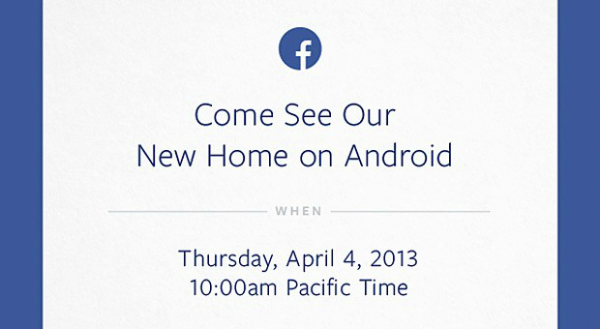
They say April showers bring May flowers. What will Facebook’s April 4 event bring? Late today the social network reportedly invited blogs and the news media to “come see our new home on Android”. I’m not on the social network’s guest list and can only report that based on those who got the invite, everything looks legit and tantalizing.
That’s because no one can resist speculating or claiming that some unnamed source — sorry, your buddy in the next bathroom shouldn’t count — promises debut of the long-rumored, oft-denied, ever-elusive and Google-gauging Facebook phone. Running Android! My God, the irony, the rumor wide-eyed profess. Hey, dudes, what if the new home is a tablet? Like Amazon does with Kindle. Or there’s no phone at all?
Oh, but the force of meme-will is the social smartphone. It’s what everyone will believe by the time Easter Monday passes, unless there is some snarky April Fool’s joke meantime, like: “Today Facebook agreed to acquire Microsoft, and Bill Gates-wannabe Mark Zuckerberg promised to fire Steve Ballmer as his first official act”.
For now the rumor rabble runs wild at the mouth, citing the not-to-be-named-and-shamed guy cleaning the toilet as source Facebook will launch an Android phone made by HTC. Ha! Could this be the real reason for the HTC One’s delay. The HTC Facebook One?
Tongues will wag, and it’s anyone’s guess, and lots of people will. I’ll wrap with none but wonder about April Facebook showers — raining down on competitors — bringing a May device, if any. Rumormongers cried wolf so many times, I’m ever the skeptic.
Thanks to Engadget, from which I lifted the invite above.
-
Sony reveals new details about PlayStation 4 controller

-
Leaks & Rumors about Motorola’s X and Upcoming Nexus Smartphones

Ladies and gentlemen, get ready for some interesting news from the rumor mill. We have been seeing a hint here and another one there indicating what Google & Motorola has planned for its upcoming X smartphone. And although there have been rumors and speculation floating around for a while now, we have in fact, began to see more and more leaks about Motorola’s upcoming X phone. As if you all haven’t had enough yet, we now have more rumors to share with you courtesy of our friends from Android and Me. These leaks and rumors seem to come from a “confirmed source” of proven reliability…so hang on to your seats as we break down the latest and greatest!
New Rumor #1: “The target launch date for the Moto X has slipped from June to July due to manufacturing issues.“
Bottom Line Up Front (BLUF): Sources originally leaked a launch date of June 2013, so a shift to the right by a month doesn’t seem like such a far stretch. The source report also eludes to some type of “exclusive” launch sometime in July followed by a “broader” launch around the Thanksgiving time-frame. Which means we may be looking at an “internet only” initial launch followed be a carrier launch a few months later. If this launch date holds true, then we can expect to hear an announcement of the release at Google I/O in May. We shall see…
New Rumor #2: “X phone customization will be limited to the ‘design of the phone (to include color combinations, and material for the outer casing, like plastic, metal, or carbon fiber)’, ‘internal storage’, and ‘personalized software settings’.“
BLUF: Original leaks led us to believe the customization would be endless, causing readers to infer that they would have complete customization control right down to the amount of RAM to be used. Although a little disappointing, this new rumor further validates the original customization rumors, while adding an additional layer of believability to the rumor by placing restrictions on the types of customizations that can be done. I know I had a hard time believing the original reports, as it was hard for me to wrap my head around the production process and how Motorola would be able to afford the many changes they would have to make throughout the production cycle to make endless combustibility an affordable and worthwhile reality.
I have to admit, the idea of software customization, as we have seen made possible through HTC’s “Get Started”, would be nice. I have to admit, being able to logon to an online dashboard using my Google account prior to the arrival of my ordered device to customize the desktop, wallpaper, ringtones, preinstalled apps, and the like, would be a welcomed feature. Something like this would save me hours of customization when I first jump on my new handset.
New Rumor #3: “The specs of the first Motorola X phone will be comparable to the HTC One, but will not be an iPhone or Galaxy S 4 killer.“
BLUF: Initial reports were that the Moto X phone line of devices would be marketed with an emphasis on customization capabilities, with additional options for expansion through connected devices like Google Glass and the upcoming SmartWatch. Basically, OEMs feel the specs are irrelevant due to the focus shift from hardware specs, which lets face it, have far outgrown software capabilities, to app, services, and experiences that the devices can deliver. I mean, to be honest, even the Galaxy S 4 would be just another high-end smartphone if Samsung didn’t pack it full of their “life companion” innovations, right?
Besides, if Motorola focused strictly on hardware advancements with the Moto X line, then they wouldn’t be able to keep their promise of “heavily subsidized retail pricing”, like we have seen with the affordable Moto RAZR line of devices, would they?
New Rumor #4: “The Moto X will feature a Motorola logo on the back of the device that acts as a touch sensitive button that allows you to launch commands.“
BLUF: This rumor holds true at this point in time. No changes here, other than Motorola may give users the power to control what the new logo button launches when pressed.
New Rumor #5: “Motorola will still release several more Droid phones this year.“
BLUF: Google has admittedly inherited an 18 month production pipeline, which means this rumor is more than likely accurate.
New Rumor #6: “Motorola will release a Nexus phone at the end of the year, that is not associated with the Moto X line.“
BLUF: Although the rumor mill is running rampant with whispers of another LG Nexus phone, we should not discount this one. There is nothing to suggest that Motorola won’t release its own Nexus handset. If the past is any indicator, than the release of both ASUS and Samsung Nexus tablets last year shows us that it is completely plausible that this can, and may, happen with LG and Motorola’s handsets.
If Motorola did decide to release both lines in parallel, this could pose a significant financial burden. The amount of money they would have to dish out in advertising alone would be a significant financial blow, one that smartphone sales alone may not be able to soften. Which means Motorola (Google) would have to pull resources from other markets to cover cost. Not sure if the initial losses would justify the overall gains, but I am no financial guru, so I will let the bean counters worry about this one.
If they were to release the two handsets, then the Nexus would probably end up as the “stock” option, leaving the Moto X line the dominant of the two as the only “customizable” option. If both smartphones are in the manufacturing pipeline, then this might explain why design spec leaks are all over the map and we are having a hard time narrowing down these leaks a rumors to a more specific list.
New Rumor #7: “Google Watch will be announced and sold at the same time as the Moto X.“
BLUF: All rumors up to this point in time indicate the release of a “Google Watch” being released sometime this summer. There have been no rumors to indicate otherwise at this point, so we are going to have to put some stock in these rumors for now. For all we know, these “Google Watches” may be released as companion accessories under the Motorola brand name, so for all intents and purposes, I wouldn’t put too much stock in the rumored name of the device just yet.
BLUF:
As far as we can tell, the “customizable RAM” rumor may be the only one debunked with this newly released information, leading us to believe everything else previously reported has a strong potential to be true! Great news for those of us who are diehard Motorola fans. I am excited to see what surprises Google will unveil at the upcoming 15-17 May I/O conference.
Source: Android and Me
Come comment on this article: Leaks & Rumors about Motorola’s X and Upcoming Nexus Smartphones
Visit TalkAndroid for Android news, Android guides, and much more! -
4.2.2 Verizon Galaxy Nexus and 4.2.1 Sprint Galaxy Nexus Factory Images Posted

For those of you that own a Verizon version of the Samsung Galaxy Nexus and are running a custom ROM then I have good news for you. Google updated its Developers site with the 4.2.2 factory image. So if you botch your phone or have to return it to Big Red you can bring it back to a stock state. Those of you on Sprint and happen to own that version of the Galaxy Nexus will be happy to know that the 4.2.1 image was also uploaded. So head on over to the source link below and find your respective image. Happy flashing!
source: Google Developers
Come comment on this article: 4.2.2 Verizon Galaxy Nexus and 4.2.1 Sprint Galaxy Nexus Factory Images Posted
Visit TalkAndroid for Android news, Android guides, and much more! -
Microsoft’s WorldWide Telescope Maps The Universe With NASA’s Data

The Microsoft Research team is building an epic map of the universe using data and photographs collected from the many telescopes around the world, including NASA’s Hubble Space Telescope. They call it The WorldWide Telescope.
There are roughly 300 billion stars in the Milky Way Galaxy, and about the same number of galaxies in our universe (give or take a couple). With the WorldWide Telescope, scientists and developers have pieced together a detailed 3D view of the universe that lets a user do a fly by of any planet, star or galaxy known to man. You can even view the entire universe in a single frame, which makes us all seem insanely insignificant.
But the WorldWide Telescope is more than just a neat exploration tool for astronomy and physics nerds. Program Director Dan Fay hopes NASA can use it as a research tool and that students from the elementary to graduate levels can use it as an educational resource. The Microsoft Research team has made it simple to manipulate data on a touch surface or desktop. With the touch of a couple of buttons and pinch to zoom, you’re off and flying through the universe. The team plans to bring this magic to mobile devices soon.
Microsoft has also released an API to allow developers to build custom tours and lessons. I was fortunate enough to be given a tour of the nebula of the Milky Way Galaxy, and admittedly it was beautiful. The lessons can be as simple as a fly by of every planet in our solar system, or as complicated as analyzing photographs of the deepest known space objects. The map also lets you look at any part of the sky in a number of light wavelengths, including infrared and X-ray.
After the demo, I took a tour of a scale model of the James Webb Space Telescope, which is due to launch in 2018. The telescope is about 100 times more powerful than Hubble and about seven times as big. It includes a 21-foot reflective mirror and a slew of instruments to study the sky.
NASA hopes to look through dust clouds surrounding the formation of stars using the onboard infrared instruments to finally see how stars are born and to look far enough through the universe that they will get a better sense of how all of this madness is shaped. It will also be able to detect water vapor in atmospheres outside our solar system, and where there is water, there’s a significant chance at life.
(mind = blown).
-
How you know Samsung has hit it big: Best Buy is giving it its own in-location ‘store’

-
Tasker’s New Holo Redesign Graduates to the Play Store, Brings It to Android 4.0+

Back in January we told you about an automation app that looked to redesign itself with the Holo look in mind. That app, Tasker, has graduated from its beta phase and is now available with the new theme in tow. The kicker however, is that it’s only available for devices running Ice Cream Sandwich or higher. Those of you running anything below that will see the same interface as before, but you’ll at least get various bug fixes. Here’s what’s new:
v4.0
* UI updated for holo look-and-feel with selectable light and dark themes
* 200 built-in icons each in holo light and dark
* internal cleanup of deprecated APIs
* several new states, events and actions
* many incremental improvements and bugfixes
v1.6
* various incremental improvements and bugfixes
More: http://tasker.dinglisch.net/changes.htmlIf you’re looking for a great automation app that automates almost everything, and one that looks great in the process, then you can’t do wrong with Tasker. Hit the break below to get your QR code and download link. We also included a gallery of the app’s nice, new look. Enjoy!


Come comment on this article: Tasker’s New Holo Redesign Graduates to the Play Store, Brings It to Android 4.0+
Visit TalkAndroid for Android news, Android guides, and much more! -
Amazon acquires Goodreads
 I guess reviews just aren’t enough. Social matters more. Late today Amazon and Goodreads reached a merger agreement, in a deal expected to close second quarter. The companies did not publicly disclose terms.
Goodreads is a recommendation service with social sharing capabilities. Founded in 2007, the the company claims 16 million members and 23 million reviews, but the magic comes from the social aspect. If you ever wanted to snoop in a friend’s bookshelf, Goodreads lets you do something just like that — recognizing reading recommendations from people you know can be more influential than professional reviewers and other strangers.
“Amazon and Goodreads share a passion for reinventing reading” Russ Grandinetti, Amazon vice president of Kindle Content, says. “Goodreads has helped change how we discover and discuss books and, with Kindle, Amazon has helped expand reading around the world. In addition, both Amazon and Goodreads have helped thousands of authors reach a wider audience and make a better living at their craft. Together we intend to build many new ways to delight readers and authors alike”.
Together is the key word. Goodreads is a potentially good fit for Amazon, depending, of course, on execution and puts the retail giant ahead of major competitors. Google has a big social network, which could be leveraged for selling ebooks from the Play store — but an asset for now largely wasted. Apple and Barnes & Noble have got what? Nothing really.
“Books, and the stories and ideas captured inside them, are part of our social fabric”, Goodreads CEO Otis Chandler, asserts. “People love to talk about ideas and share their passion for the stories they read”.
Amazon’s reach is, ah, good for Goodreads, and Chandler acknowledges this. “I’m incredibly excited about the opportunity to partner with Amazon and Kindle. We’re now going to be able to move faster in bringing the Goodreads experience to millions of readers around the world”.
We’ll see if he survives the transition, which often isn’t the case for CEOs of acquired companies. That said, Goodreads will remain in San Francisco rather than relocate to Seattle. So who knows about anyone’s future.
This has been a surprisingly busy few weeks for social recommendation acquisitions. On March 20, Yahoo announced plans to acquire Jybe, a startup specializing in personalized local entertainment recommendations — for books, restaurants, movies and such. Same day, Pinterest snatched up Livestar, another local recommendation startup.
-
When there’s no such thing as anonymous data, does privacy just mean security?
Anonymous data is one of the staples of the big data movement, but there’s a dark side.
In theory, data from mobile phones lets us do things like map traffic patterns, while web-behavior data can be a boon to researchers and others trying to make sense of how people conduct their online lives. The thing is, it’s damn hard to keep that data anonymous. Perhaps all we can hope for is to keep potentially sensitive data out of the wrong hands.
The latest proof of how hard it is to anonymize data came earlier this week, when a group of MIT researchers published a paper based on their analysis of 1.5 million cell phone traces over 15 months inside a “small European country.” A press release highlighting the paper’s publication nicely sums up the findings, which are somewhat startling:
“Researchers … found that just four points of reference, with fairly low spatial and temporal resolution, was enough to uniquely identify 95 percent of them.
“In other words, to extract the complete location information for a single person from an ‘anonymized’ data set of more than a million people, all you would need to do is place him or her within a couple of hundred yards of a cellphone transmitter, sometime over the course of an hour, four times in one year. A few Twitter posts would probably provide all the information you needed, if they contained specific information about the person’s whereabouts.”
And assuming you’re concerned about protecting privacy, it gets worse:
“[T]he probability of identifying someone goes down if the resolution of the measurements decreases, but less than you might think. Reporting the time of each measurement as imprecisely as sometime within a 15-hour span, or location as imprecisely as somewhere amid 15 adjacent cell towers, would still enable the unique identification of half the people in the sample data set.”
All it takes to get started is a few pieces of data against which to compare the anonymized mobile data. “For re-identification purposes,” the authors write in the paper, titled Unique in the Crowd: The Privacy Bounds of Human Mobility, “outside observations could come from any publicly available information, such as an individual’s home address, workplace address, or geo-localized tweets or pictures.”

Have data, can track. Source: Nature Scientific Reports
We’ve been down this road before

From the Netflix paper. Source: University of Texas
This news might ring a bell to anyone who follows the world of web data. After releasing anonymous user data as part of its Netflix Prize competition in 2007, researchers were able to de-anonymize it using publicly available movie reviews from IMDB. In 2006, AOL released a bounty of supposedly anonymous search data for research purposes, but it was quickly mirrored onto public web sites and people began picking individual searchers out of the sea of anonymous identification numbers.
There are plenty of non-digital examples, too. The Unique in the Crowd authors point to one case where a medical database was analyzed against a voter list to discover a governor’s health records. In a 2007 post for Wired, security expert Bruce Schneier cited a couple of analyses of census data, including one using 1990 census data and proving that 87 percent of Americans could be identified using just their ZIP code, sex and date of birth.
And then there are those fitness-tracking devices. At out Structure: Data conference last week, Central Intelligence Agency CTO Ira “Gus” Hunt gave the audience — the whole world, really — a scare by noting that it’s possible to identify someone based solely on his gait. That kind of information might not get people lining up for web-connected pedometers and other fitness devices.
Any type of de-anonymization is only exacerbated in an era of social media. The University of Texas researchers who decoded the Netflix data were able to speculate on individuals’ political positions, sexual orientation and other characteristics, but we now give that information away for free on sites like Facebook, Twitter, Foursquare, you name it. If you’re inclined to stalk someone, steal identities or engage in any other malicious undertaking, access to names, photos, interests, location, checkins and other information makes for a hearty personal-data stew, and it just takes one piece to get the rest.
A choice between privacy and a better world?
However, if we can get past the inherent privacy concerns, these types of anonymous, aggregate data sets can be incredibly valuable. Companies such as Google, Apple and INRIX are using smartphones and in-vehicle devices to map traffic patterns and how people move throughout cities in efforts to improve both commute times and urban planning. Social scientists accessing data from companies such as Google and Facebook could learn a lot about the intricacies of online behavior. And predictive analytics platforms such as Kaggle present an opportunity optimize everything from business processes to health care.

Source: INRIX
The holy grail of anonymous data lies in genomics and the hope that lots and lots of quality data will help researchers discover cures for diseases like cancer. Because of the relative uniqueness of each individual cancer case, researchers hope a massive pool of data on sequenced genomes will help them spot patterns and commonalities that no amount of traditional lab work will uncover.
Further complicating things is the fact that the companies delivering our favorite web services rely on our personal data to make money. Whether we like it or not, targeted advertising pays the bills for free services, and doing targeted advertising well requires a lot of personal data. One could argue that a major focus of the data science movement that has taken the world by storm is stitching together various pieces of anonymous data from across the web in order to create holistic images of consumers.
In fact, web companies have gotten so good at de-anonymizing data that the Federal Trade Commission has all but abandoned the term “personally identifiable information.” In a 2010 report on online privacy, the agency wrote that any guidelines it proposes will likely apply
“to those commercial entities that collect data that can be reasonably linked to a specific consumer, computer, or other device. This concept is supported by a wide cross-section of roundtable participants who stated that the traditional distinction between PII and non-PII continues to lose significance due to changes in technology and the ability to re-identify consumers from supposedly anonymous data.”
“Going forward,” the Unique in the Crowd authors conclude, “the importance of location data will only increase and knowing the bounds of individual’s privacy will be crucial in the design of both future policies and information technologies.” This rings equally true for every other type of personal data, especially given the relative ease with which they can be analyzed against each other to create a sum that greater than the whole of its parts.
One has to wonder, though, what types of policies and technologies will come about to keep data anonymous and available to the people who need it while still maintaining its utility. Privacy is important, but is it worth the opportunity costs of not trying to solve the types of problems that large, anonymous data sets are ideal for solving? If true anonymization is really that difficult, perhaps the best bet is just to double down on security and try to ensure that valuable data — anonymous or not — doesn’t get into the wrong hands.

Related research and analysis from GigaOM Pro:
Subscriber content. Sign up for a free trial.- Connected world: the consumer technology revolution
- Dissecting the data: 5 issues for our digital future
- NewNet Q4: Platform mania and social commerce shakeout


-
Google aims to eliminate trips to the mall with same-day delivery shopping service


