
Category: News
-
Samsung reportedly in talks to sell eReader display panel unit to Amazon
-
America’s top copyright cop wants to make it a felony to stream songs without permission

-
Verizon announces iMessaging clone for Android, iOS and Web [video]

-
Microsoft working to bring improved voice recognition to its mobile Bing app [video]

-
LG will reportedly build a smartwatch to compete with Apple, Samsung and Google

-
The Wirecutter and other sites may have infected your PC

The Wirecutter, a popular gadget site run by former Gizmodo head Brian Lam, was under attack on March 19 and 20 from a source that should have been trusted. The advertising agency that handles that site and many others like The Awl, The Hairpin, The Splitsider and more, came under attack thanks to an exploited flaw in the code.
The Wirecutter reports that “the cause was an exploit on an OpenX advertising server run by the guys who handle ads for The Wirecutter”. The attack reportedly lasted for 10 hours and allowed for the insertion of malicious code onto an advertising server that could be inserted into the ads displayed on The Awl network.
The site is warning its users that this means “that, if you visited an Awl network site (including The Wirecutter) Tuesday or Wednesday, you may have been exposed to malware”. The site goes on to explain that to fix the problem “We nuked our existing ad server and are moving to a different ad serving platform entirely in the near future”.
The site’s Kevin Purdy, formerly of Lifehacker, wrote a question and answer section included in the announcement and intended to help users understand what happened and what the risks are — and most importantly, what to do if you visited the site during the affected time frame.
For those who were using Google’s Chrome, the web browser was actually blocking access to the site during this period so, unless you bypassed the warning, you should have no worries. The editor was left with nothing much that he could say other than “I apologize for putting you and your computer at risk”.
Photo Credit: Photosani/Shutterstock
-
5 ways big data is going to blow your mind and change your world
Some people say big data is wallowing in the trough of disillusionment, but that’s a limited worldview. If you only look at it like an IT issue it might be easy to see big data as little more than business intelligence on steroids. If you only see data science as a means to serving better ads, it might be easy to ask yourself what all the fuss is about.
If you’re like me, though, all you see are the bright lights ahead. They might be some sort of data nirvana, or they might be a privacy-destroying 18-wheeler bearing down on us. They might be both. But we’re going to find out, and we’re we’re going to find out sooner rather than later.
This is because there are small pockets of technologists who are letting their imaginations lead the way. In a suddenly cliché way of saying it, they’re aiming for 10x improvement rather than 10 percent improvement. They can do that because they now have a base set of analytic technologies and techniques that are well positioned to solve, with relatively little effort, whatever data problems are thrown their way.
Here are some themes from our just-concluded Structure: Data conference that I think highlight the promise of data, but also the challenges that lie ahead.
Man and machine unite
Machine learning is already infiltrating nearly every aspect of our digital lives, but its ultimate promise will only be realized when it becomes more human. That doesn’t necessarily mean making machines think like human brains (although, granted, that’s a vision currently driving billions of research dollars), but just letting people better interact with the systems and models trying to discover the hidden patterns in everything around us.
Whatever shape it takes, the results will be revolutionary. We’ll treat diseases once thought untreatable, tackle difficult socio-economic and cultural issues, and learn to experience the world around in entirely new ways. Maybe that consumer-experience scourge known as advertising might actually become helpful rather than annoying.
That would really be something.
Data science, or data intelligence?
I’m not sure there needs to be a distinction between data science and data intelligence, but the latter does connote a grander goal. It’s about trying to solve meaningful problems rather than just serving ads; about trying to understand why things happen just as well as when they’ll happen. This means learning to work with smaller, messier data than we might like — certainly smaller and messier than the data sets underneath most of the massive web-company data science undertakings.
But just think about being able to go beyond predictive models and into a world of preventative — or even professorial — models. If you know what I like, where I go and who my friends are, it might be fairly easy to predict what I want to buy. Figuring out how my decision to buy something might affect my overall well-being and then telling me why? That’s a little more difficult and a lot more beneficial.
Telling stories with data
Have you ever looked at a chart and wondered what the heck it was supposed to be telling you? Or downloaded a report of your Facebook activity only to ask yourself if all the disparate data points come together to paint a bigger picture? Or tried — and failed — to stop a terrorist before his movement to recruit an army of followers gained critical mass?
A big problem with a lot data analysis right now is that it still treats data points as entities unto themselves, largely disconnected from those around them. However, data needs context in order to be really useful; it’s context that turns disparate data points into a story. Don’t just tell me how many steps I took today or the time of day I’m most active on Facebook, but tell me how that relates to the rest of my life.
And don’t just tell me that someone said he wants to kill Americans. Rather, tell me a story about how much more frequently he’s saying it and how much more inciteful his words are becoming.
The internet of things knows all
The mobile phone in your pocket is tracking your every movement and can also monitor the sounds that are surrounding you. That fitness tracker you’re wearing is identifying you by how you walk. Your smart meter data shows when you’re home, when you’re away and when you’re in the shower. Sensors in everything from toothbrushes to cars are quantifying every aspect of our lives.
This volume of data can still be a lot to deal with in terms of its volume, velocity and variety, and we’re still not quite sure what to do with it even if the right tools were in place. But all sorts of entrepreneurs, powerful institutions and intelligence agents have ideas. The technological pieces are coming along nicely, too. Just sayin’ …
This semantic life
The semantic web lives on; only it’s spreading well beyond our search engines and even our web browsers. Soon enough, we’ll be able to surface relevant content and people simply by highlighting passage of text in whatever we’re reading — web page or not — on any type of device. When we speak to our devices, they’ll not only know what we’re saying, but also what we really want even without the help of specific commands or keywords.
That’s a powerful proposition in a world where we increasingly expect our interactions to be hands-free and our answers to come as fast as our questions. Of course, what’s powerful in the hands of consumers driving in their cars or sitting on their couches is even more powerful in the hands of doctors trying to diagnose difficult diseases or aid workers trying lend a helping hand in places where they don’t know the customs or even speak the language.
Feature image courtesy of Shutterstock user GrandeDuc.

Related research and analysis from GigaOM Pro:
Subscriber content. Sign up for a free trial.- Connected world: the consumer technology revolution
- A near-term outlook for big data
- NewNet Q4: Platform mania and social commerce shakeout


-
Next-generation Galaxy Tab rumored to include 8-core processor and full HD display

-
Rating the legacy of outgoing FCC Chairman Julius Genachowski
After almost four years in the role, FCC Chairman Julius Genachowski said Friday that he was stepping down.During his four years as the head of the FCC, he failed to stop a stunning loss of regulatory authority as a result of a court case started by his predecessor, and made minuscule strides in boosting broadband competition. To top it off he also oversaw regulations that may further diminish the FCC’s authority as we head into the IP age.
He did however, forge better connections between the tech industry and the FCC and managed to stop a merger that would have certainly hurt consumers. He also tried to make more wireless spectrum available — taking on the powerful broadcast industry to do so. But instead of listing his achievements and capitulations, I dug up a list that my colleague Om Malik and I wrote back in 2009 when he was named to the role.
In the post we told him what he needed to focus on during his tenure. Now, it’s time to look back and see what he has accomplished.

FCC Chairman Julis Genachowski
An internet bill of rights: While Genachowski did manage to pass a version of network neutrality regulations in 2010, he did so in a way that leaves those rules in doubt before a lawsuit that has been filed by Verizon and MetroPCS. Instead of addressing the idea that the FCC has no power to regulate things that occur on information services (basically anything that’s delivered via the internet) which surfaced after a court ruling in 2010, Genachowski’s FCC did nothing to try to strengthen its authority before passing those rules. Now, the case is before the same court of appeals that decided against it the first time around. Grade: C
A focus on one key metric for all FCC decisions — namely returning the U.S. to the global forefront of Internet and mobile technology: On the mobile side, the chairman focused on LTE deployments and getting more airwaves for mobile broadband. And U.S. carriers have already deployed LTE networks ahead of many other countries. On the wireline side, it’s a bit mixed. Broadband caps and a lack of wide scale fiber to the home projects are keeping the U.S. far from the top in international rankings. According to the most recent (June 2012) OECD reports, the U.S. isn’t tops in terms of average or median advertised speeds. We were No. 1 in terms of connections, however. Grade: C+
An emphasis on future technologies (mostly wireless) that boost marketplace competition: Here the FCC has done a lot, despite political and unexpected technical hindrances. Genachowski’s FCC attempted to create a wholesale 4G network using satellite airwaves only to see that idea flail as interference with GPS spectrum was discovered. He also stopped a merger between AT&T and T-Mobile that was not in consumers’ best interests while also pushing for more spectrum and setting in motion an incentive auction that could provide airwaves for the carriers as well as for unlicensed broadband. Grade: B

Special incentives to attract new players (and not older companies) that bring broadband to the masses : Genachowski hasn’t done much here except issue press releases, but others have stepped up including Google and Gigabit Squared to bring gigabit fiber broadband to a few cities. Grade: B-
Tax credits for widespread deployment of broadband speeds of upwards of 20 Mbps down and 10 Mbps up for less than $50 a month without caps: That’s not happening. Grade: F
Better and more connectivity to office buildings, especially from newer players: While companies like Webpass or Sonic.net continue to deploy faster services in more places, business broadband wasn’t an issue the FCC has touched. Grade: F
An IP-centric, rather than voice-centric, approach to reforming the Universal Service Fund: This is a thankless task, but the FCC has started on the road to an all-IP world first with universal service fund reforms as well as a current debate on how to make the transition to an all-IP world, as well as what rules the agency should enforce. Grade: B

FCC Chairman Julius Genachowski.
Policies that bring quality of service into the wireless agenda: Om envisioned this as something like penalties for dropped calls, but I’ll expand it to issues like Verizon’s phantom data charges and the fights between app makers, phone companies and carriers that tended to catch consumers in the middle. The FCC was actually pretty vocal in these cases, even if it only managed to draw attention to bad behavior. Grade: A
An understanding that Google, and other web companies, are not the consumer’s friend, so their agenda shouldn’t automatically be trusted: Politics is a sport for big boys and Genachowski’s FCC was pretty transparent in pitting Google and other tech companies against the cable guys and the telcos and assuming that the resulting middle ground was an okay place for consumers. Grade: D
Final summary
All in all, Genachowski spent a lot of time on wireless, believing that to be an area where the FCC had room and regulatory authority to add capacity and improve competition. He was utterly neglectful on the wireline side, not doing much to strengthen competition, or even address issues such as caps and the virtual standstill on investment in rural areas. He also exits an agency that is weaker on the regulatory front than when he started and may end up weakening it further depending on the rulings in the network neutrality case.
He did start the arduous process of reforming the telecommunications regulatory regime to reflect the IP-based future and tackled universal service fund reform. Without a successor named yet, it’s hard to say what the next priorities will be for the FCC, but bringing off a successful auction of airwaves taken from the broadcast industry will be on the agenda as will the issue of how to regulate (and transition to) an all-IP telecommunications network.
Meanwhile, consumer issues such as the high cost of broadband, data caps and the eventual fate of network neutrality are all issues that may or may not change regardless of the new chair. The more things change, the more things still manage to stay the same.

Related research and analysis from GigaOM Pro:
Subscriber content. Sign up for a free trial.- A look back at mobile in Q1
- U.S. Wireless Data Market: Q4 and Year-End 2008
- Netflix may suffer from limited mobility

-
On Third Day of Middle East Trip, President Obama Visits Jewish and Christian Landmarks

President Barack Obama pauses after adjusting a wreath placed in the Hall of Remembrance during his visit to the Yad Vashem Holocaust Museum in Jerusalem, March 22, 2013. Standing behind the President, from left, are: Rabbi Yisrael Meir Lau; Israeli President Shimon Peres; Israeli Prime Minster Benjamin Netanyahu; and Avner Shalev, Chairman of the Yad Vashem Directorate.
(Official White House Photo by Chuck Kennedy)
President Obama began the third day of his historic visit to the Middle East with a visit to Mount Herzl, Israel's national cemetery, where he honored the significant contributions of two Jewish heroes, Theodor Herzl, the founder of Zionism and former Israeli Prime Minister Yitzhak Rabin. The President laid a stone from the Martin Luther King Jr. memorial in Washington on Mr. Rabin’s grave, highlighting the slain leader’s work to bring peace to the region.
Next up was a tour of Yad Vashem Holocaust Memorial Complex, where President Obama honored the memory of Holocaust victims by laying a wreath and rekindling the eternal flame in the Hall of Remembrance. He also joined Israeli President Shimon Peres and Prime Minister Netanyahu on a tour that included the Hall of Names, a circular chamber that houses the original testimony documenting every Holocaust victim ever identified, and the art museum where the President heard the story of Charlotte Salomon, a Holocaust victim who was murdered in 1944 in Auschwitz, but whose memory is preserved in the autobiographical artwork she painted while in hiding from the Nazis. The President ended the poignant visit with a walk through the Children’s Memorial, which memorializes the 1.5 million Jewish children who perished during the Holocaust with candles reflected in a series of mirrors.
-
Lockheed Martin wants to use a quantum computer to develop radar, aircraft systems
Lockheed Martin is looking at several challenging applications for the quantum-computing hardware it has purchased from from D-Wave Systems, the New York Times reported Friday. The use of quantum computing is a big deal because as we depend more on computing, we’re going to need different types of processors. Lockheed’s commercial use suggests that the probabilistic problem-solving approach and breakneck speed of quantum computing could be more widely adopted in the near future.
For the record, D-Wave and Lockheed formed their commercial relationship a couple of years ago, although at the time the defense contractor apparently didn’t discuss possible applications. Now there are some specifics on how Lockheed could employ its D-Wave computer, following projections on other types of applications.
Lockheed Martin will use its D-Wave computer “to create and test complex radar, space and aircraft systems,” the Times’ Quentin Hardy wrote. “It could be possible, for example, to tell instantly how the millions of lines of software running a network satellites would react to a solar burst or a pulse from a nuclear explosion — something that can now take weeks, if ever, to determine.”
Rather than working with binary yes-or-no questions — ones and zeros — quantum computing is more probabilistic, also allowing a combination of zero and one to simultaneously answer many questions with quantum bits of information, or qubits, and tell users more about the likelihood of a situation. It’s not necessarily useful for all kinds of computing, but it could solve problems that current computers can’t.
It’s also a great way forward for computing to keep following the spirit of Moore’s Law, in the sense that it could permit more powerful computing than what’s possible today. The question is how soon it will become commercially viable. The quantum computer cost Lockheed $10 million, according to one report, so it will take some time and more commercial interest before the price can come down.
Commercial applications of quantum computing are a long time coming. In a 2010 GigaOM Research report on quantum computing (subscription required), my colleague Stacey Higginbotham wrote that commercial viability could take decades, not years.
Feature image courtesy of Shutterstock user R.T. Wohlstadter.

Related research and analysis from GigaOM Pro:
Subscriber content. Sign up for a free trial.- Analyzing the wearable computing market
- A near-term outlook for big data
- Dissecting the data: 5 issues for our digital future

-
Sprint thanks Genachowski for blocking the AT&T-T-Mobile merger

-
Nationwide Google Fiber is a lofty ‘pipe dream’

Many people considered this company irrelevant and dead years ago. Yet with nearly three million paying Internet service subscribers still, this provider is anything but dried up — yet. Internet access, among other subscription services, makes up a clear majority of its continuing sales and its greatest chunk of profits as a whole. Subscriber growth peaked off back in 2002, but for this aging Internet heirloom, at this point they will no doubt take what they can get. Who the heck am I referring to?
Don’t choke on your coffee, but it’s none other than AOL. Namely, their dialup Internet service division. It’s hard to believe that in the year 2013 any company has more than a trickle of subscribers left on dial up, but this attests to the sad state of broadband adoption in the United States. Of the estimated 74 percent of Americans who have internet access in their homes (2010 figures), a full 6 percent of those are still on dial-up service. There are a myriad of issues affecting broadband adoption, including things such as lack of access, pricing, reluctance to switch, etc.
A full 19 million Americans sadly don’t have access to any form of broadband. And in a comparison of adoption rate per capita, our country ranks a miserable 15th globally — behind United Kingdom and South Korea, to name just a few. Much of the Internet is abuzz about Kansas City’s recently completed rollout of Google Fiber, with its near gigabit speeds delivered directly to the home.
Even with slow expansion into other small markets, like the recently announced Olathe, KS, the excitement over Google Fiber is premature by all reasonable measures. One giant (Google) is getting into the fiber game while another (Verizon) is slowly exiting after making similar market promises of “fiber to all” just a half decade ago.
While I’m all for nationwide fiber like the rest of us, as an IT consultant by day, I know the tough realities of broadband penetration in our diverse urban & rural mix that is the USA. Here are some of the roadblocks that the pure optimists continue to overlook.
Verizon’s Lesson with Fiber: a Messy, Messy Game to be in
Simple economics can explain much of the problem with fast-paced fiber rollout stateside. In many ways, Google could (and should) use Verizon’s failed attempt to take FiOS nationwide as a cue to what it can expect in its own forthcoming efforts. It was reported that as of mid last year, FiOS held a nominal subscription base of roughly 5.1 million households. In comparison, the largest cable (coax) broadband provider in the USA, Comcast, holds somewhere between 17-19 million subscribers right now. No wonder Wall Street held Verizon’s feet to the fire, and ultimately forced its arm on exiting this ‘wild west’ of a service buildout.
Most people clamoring for Google to expand Fiber don’t know the half of what goes into a fiber network build. Before Google or Verizon can even start taking pre-orders for such service from households, there is a nightmarish mix of legal, financial, and technical boundaries that need to be overcome. Franchise agreements generally have to be negotiated with each and every municipality that is up for consideration. If other providers have exclusivity contracts in a given area, let the legal wrangling begin. And the mess only continues, as a myriad of permits are generally needed to install fresh lines in a small urban area — including state and local permits, as needed, depending on which roadways and areas are controlled by a given authority.
No better example is needed than the delays that Kansas City, Missouri is running into with rolling out its promised Google Fiber. Local cable providers there are up in arms over Google’s preferred treatment by local authorities. More importantly, there is a big rift on how these new fiber lines are to be installed in the community. The preferred, and cheapest, method happens to be utilizing existing cable-ways via electric poles, but this requires using (very) specially trained crews that are quite costly to hire. The current status page for the city shows the first neighborhoods to get service start this month, but that timeline can already be taken with a grain of salt in light of the lack of news on progress there.
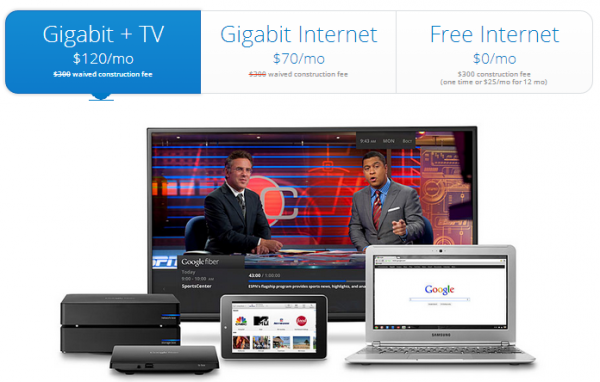
Google Fiber promises gigabit speeds at lower prices than even high speed coax cable providers. But is Google the savior to reign in nationwide fiber for all? Possibly, but due to numerous challenges, I doubt it.
The level of paperwork and overhead required in fiber rollout pales in comparison to the cost complexities with actual installations. As seen above, while running fiber on electrical poles is ideal and logical, it is often met with fierce kickback from local municipal higher ups alongside the many others who share these infrastructure pathways — from electrical companies themselves, to cable providers, and telephone companies, to name a few.
Another option, and one which is less susceptible to weather and the elements, happens to be underground fiber, but this has numerous drawbacks of its own. Digging permits, existing utility lines, and costs related to reconstruction after installation all dog these endeavors to the point where rollout either slows down indefinitely or gets abandoned altogether.
Sprawling suburban areas like my own backyard of Park Ridge, IL provide enough headache for companies like Wide Open West engaging in limited fiber expansion for key areas. I can only imagine what would happen if Google had to install underground fiber in the center of our next-door monster neighbor, Chicago.
Rural America is always an Afterthought
Over 14.5 million Americans, all located in rural areas, still have zero access to any form of broadband. Troubling indeed, and definitely the reason why AOL can still lay claim to nearly three million subscribers. But if you had to pinpoint one reason why broadband penetration in the sticks was so poor, there wouldn’t be a single culprit to point fingers at.
Cities and towns blame lack of provider willingness to expand; providers blame staggering costs to build out oodles of infrastructure for a scattering of residents; and rural Americans refuse to pay boatloads for sub-standard broadband when dial up is still relatively dirt cheap. In simple words, the entire situation has been anything but a win-win for any side.
The realities of expanding access in the vast heartland of America is mind boggling. Many small towns sit dozens, if not hundreds, of miles apart from one another and the cabling, manpower, and future upkeep for relatively limited return on investment is what keeps many providers from stretching their reach. The numbers just don’t make sense any way they look at it. Even if a small rural town was connected with full fiber access to each neighborhood, the provider would have to outlay nearly all of the capital expenditures necessary to get this in place.
Surely, Google could charge new customers for a fair share of their homes’ installation fees, but in order for customers to bite, the price would have to be right. There’s no way that Google’s fee schedule for Kansas City would hold true for any regular rural community. As opposed to larger urban and suburban centers that take advantage of the economies of scale that come with such locales, rural America would be forced to foot a larger sliver of the installation bill — or expect Google to do so. If Verizon’s FiOS is any lesson for us on fiber rollout, don’t expect the latter to hold true in the long term.
While the 2010 initiative under the moniker of the National Broadband Plan was devised to solve these dilemmas, the program has raised more questions then it has solved. Wild cost estimates have still to be hammered out (with some guesses putting such expansion at close to $350 billion USD) and numerous voices of opposition are claiming the NBP will only stifle innovation, growth, and ultimately lead to higher prices for rural areas. A federally backed plan to address broadband is definitely desirable, but in its current form, the NBP is not living up to expectations.
The Chicken or the Egg Dilemma: Subscribers or Penetration First?
This is probably the trickiest aspect to any proposed fiber rollout. Does there have to be a minimum number of potential subscribers in a given area before a provider will promise a fiber expansion? Or does the provider take an educated gamble and just build out blindly? The real answer is one buried in a little bit of both angles to this reality.
ISPs (like Google) of course want to have a solid commitment from a given percentage of customers in a community. But most Americans won’t jump on the fiber bandwagon without letting the service(s) mature a bit and outgrow their first iteration bugs. This natural hesitation scares the likes of any potential fiber provider, as their success lays directly with pulling in as many first-generation customers as possible to sustain continued service growth.
Verizon’s CFO made it pretty clear last year that the company was opting to raise prices in the face of limited adoption by customers. What choice did Verizon have? They have spent admirably since 2005 to get FiOS rolling in numerous markets (primarily situated on or near the East coast) and while they don’t have any new plans for fresh expansion, they do have existing market commitments to uphold.
Fiber isn’t something you can roll up and change in relatively short order, such as wireless cell networks moving from WiMAX and HSPA+ to LTE, for example. Fiber is a huge up front expense not unlike our crumbling copper telco network — once it’s here, someone needs to support it one way or another, high prices or not. Those who made the early move either bite the higher pricing, or switch off to older technologies they presumably left for the very same reason. Go figure.
Much of the opposition to fiber adoption could indirectly come from regular citizens who have no intention of switching service providers at all. Even in my broadband-plastered suburb of Park Ridge, our company FireLogic still has customers on dial up service who refuse to upgrade. They are under the illusion that “it just works” and they don’t need anything better.
In many cases, the service is either on par or cheaper than the lowest tiers of broadband, so the case against dial up becomes even harder for these individuals. The same goes for customers on sub-standard DSL who will not consider faster options like cable. To many, what they have is what they intend to have for the long term. Fiber won’t change their minds unless extreme price hikes made moving a necessity. A path of least resistance keeps services like AOL operating for a sizable minority of its subscriber base.
But if raising prices is Verizon’s way of battling limited uptake, doesn’t this defeat the goal of cheap fiber for the masses? It most definitely does. Subsequently, it further allows market pricing for competitive providers of cable and DSL service to stay artificially high. As if cable monsters like Comcast needed any more reason to keep prices inching upward. Premature “harvesting” of customers, as analysts are calling Verizon’s FiOS moves, is not the solution to establish and keep fiber expansion growing nationwide.
No one knows if Google will be forced into similar corners with its Google Fiber service if adoption doesn’t meet expected levels. But if so, those clamoring for the search giant to bring its Fiber service nationwide could start to rethink their wishes.
Google Fiber for All? Lofty, but unlikely
In a perfect world, Google Fiber would blanket America. But if the above roadblocks (and Verizon’s own troubles in fiber) are any indication, we need to tone down our expectations quite a bit. Even if Google had the motivation and financial backing to take the service across the USA, it would hit major urban markets first and then crawl outwards into the suburbs at a slow, painstaking pace. Our nation’s biggest coax providers started their cable buildouts in the 1960s, and today we are still struggling to extend those networks past suburban areas. History tells an obvious lesson — infrastructure growth in the United States is a tough-as-hell endeavor, and not for the faint of heart.
The most likely scenario for Google Fiber is a staggered introduction into new markets every few years. The biggest cities would act as the incubators, providing subscriber padding to back capital expenditures and to gauge capacity and upkeep needs for the longer term. Suburbs would then receive service capability once their neighboring saturated urban cities were solidly covered, and those out in rural America would likely be left out in the cold indefinitely.
Unless government subsidies make it financially feasible to bring above-ground fiber to these rural areas, I can foresee Google handling these customers just like Verizon is itching towards doing; cutting off fiber expansion at some point and merely pushing high speed cell coverage through some fashion of partnerships with the likes of Sprint, ATT, Verizon or T-Mobile.
So while it’s great to stay optimistic about Google’s Fiber plans for the rest of America, let’s keep our expectations in check. This entire discussion about nationwide fiber is a topic that feels more like a “been there, done that” style debate when it comes to American infrastructure. Everyone wants it, yet no one knows how to both pay for it and keep it sustainable for the long run. Here’s hoping that Google can pull off a miracle, but like many, I’ll believe it when I see it.
 Derrick Wlodarz is an IT Specialist that owns Park Ridge, IL (USA) based technology consulting & service company FireLogic, with over 8+ years of IT experience in the private and public sectors. He holds numerous technical credentials from Microsoft, Google, and CompTIA and specializes in consulting customers on growing hot technologies such as Office 365, Google Apps, cloud hosted VoIP, among others. Derrick is an active member of CompTIA’s Subject Matter Expert Technical Advisory Council that shapes the future of CompTIA exams across the world. You can reach him at derrick at wlodarz dot net.
 -
Samsung Galaxy S4 Mini Photos Leaked

Not too far behind its larger sibling, photos of the Samsung Galaxy S4 Mini GT-I9190 have been leaked thanks to Twitter user Ermek Kubanychbekov. Ermek shared several photos of the Mini and even snapped a shot of it alongside the Galaxy S4 and Galaxy S III (pictured above). As far as specs, we’re currently hearing a 4.3-inch Super AMOLED qHD display at 256ppi, 1.6GHz dual-core processor, and running Android 4.2.2 Jelly Bean. The Galaxy S4 Mini looks pretty much identical to the Galaxy S4 so there’s a good chance this is the real deal. With a release in June or July, we’ll be learning more and you can check out the leaked photos below.


Source: SamMobile
Come comment on this article: Samsung Galaxy S4 Mini Photos Leaked
Visit TalkAndroid for Android news, Android guides, and much more! -
Behold, the new TED Talk preroll
You know when you start to play a TED Talk in the office, only, you forget to plug in your headphones? The music can certainly be a giveaway.
But no longer! Today, we are rolling out a new preroll — that short clip that precedes each talk — on our newest offerings. Created by Psyop, with the generous support of Autodesk, this new preroll evokes what happens when an idea ripples out into the world.
“TED and Psyop wanted to convey, ‘What happens when you free an idea from its silo and release it into the world?’” explains TED’s Director of Film + Video Michael Glass. “We hope that the sequence after the explosion evokes all sorts of TED-ish themes — neurons, subatomic particles, the internet, developmental systems, outer space and so on. We wanted the video to share the experience of seeing an idea take on a life of its own as it’s shared from one person to another to another to another.”
Here, the credits for the video:
- Director: Psyop
- Creative Directors: Laurent Barthelemy, Jonathan Saunders, Borja Pena
- Executive Producer: Michael Neithardt
- Producer: Ryan Mack
- Design: Jonathan Saunders, Sam Ballardini
- 3D Lead: Christian Bach
- 3D Artists: Fabio Piparo, Todd Akita, Jonah Friedman, Jonathan Lee, Chris Wilson, Bradley Gabe
- 2D Composition: Tobey Lindback, Robert Henry

-
Apple security hole allows unauthorized access to iCloud account

-
AP wins big: Why a court said clipping content is not fair use
A federal court has sided with the Associated Press and the New York Times in a closely-watched case involving a company that scraped news content from the internet without paying for it.
The case has important implications for the news industry and for the ongoing debate about counts as “fair use” under copyright law. Here’s a plain English explanation of what the case is all about and what it means for content creators and free speech.
Fair use or a free ride? The facts of the case
The defendant in the case is Norway-based Meltwater, a service that monitors the internet for news about its clients. Its clients, which include companies and governments, pay thousands of dollars a year to receive news alerts and to search Meltwater’s database.
Meltwater sends its alerts to client in the form of newsletters than include stories from AP and other sources. Meltwater’s reports include headlines, the first part of the story known as the “lede,” and the sentence in the story in which a relevant keyword first appears. The Associated Press demanded Meltwater buy a license to distribute the story excerpts and, when the service refused, the AP sued it for copyright infringement.
Meltwater responded by saying it can use the stories under copyright’s “fair use” rules, which creates an exception for certain activities. Specifically, Meltwater said its activities are akin to a search engine — in the same way that it’s fair use for Google to show headlines and snippets of text in its search results, Meltwater said it’s fair use to clip and display news stories.
The case has divided the tech and publishing communities. The influential Electronic Frontier Foundation filed in support of Meltwater, arguing that AP could inhibit innovation and free expression if it succeeds with the copyright claim. On the other side, the New York Times and other news outlets filed to support the AP; they claim Meltwater was simply free-riding and that the company is undermining the ability to create the sort of journalism on which a free society depends.
A clean win for the AP
In a decision published Thursday in New York, U.S. District Judge Denise Cote shot down Meltwater in blunt language. While much of the 90-page ruling covers procedural issues and other defenses put forth by Meltwater, the heart of the decision is about fair use.
To decide if something is fair use, courts apply a four-part test that turns in large part on whether the defendant is using the copyrighted work for something new or unrelated to its original purpose. Famous examples of fair use include a parody rap song of “Pretty Woman” and Google’s display of thumb-size pictures in its image search. In the AP case, however, Meltwater’s fair use defense failed.
Judge Cote rejected the fair use claim in large part because she didn’t buy Meltwater’s claim that it’s a “search engine” that makes transformative use of the AP’s content. Instead, Cote concluded that Meltwater is more like a business rival to AP: “Instead of driving subscribers to third-party websites, Meltwater News acts as a substitute for news sites operated or licensed by AP.”
Cote’s rejection of Meltwater’s search engine argument was based in part on the “click-through” rate of its stories. Whereas Google News users clicked through to 56 percent of excerpted stories, the equivalent rate for Meltwater was 0.08 percent, according to figures cited in the judgment. Cote’s point was that Meltwater’s service doesn’t provide people with a means to discover the AP’s stories (like a search engine) — but instead is a way to replace them.
The judgement also points to the amount of content that Meltwater replicated. Whereas fair use allows anyone to reproduce a headline and snippets, Cote suggested Meltwater took “the heart” of the copyrighted work by also reproducing the “lede” and other sentences:
“A lede is a sentence that takes significant journalistic skill to craft. [It shows] the creativity and therefore protected expression involved with writing a lede and the skill required to tweak a reader’s interest.”
The ruling added that Meltwater had taken more of the story than was necessary for a search engine and that its economic harm to AP also weighed against finding fair use. And, in a line that likely had news agencies clicking their heels, the judge wrote:
Paraphrasing James Madison, the world is indebted to the press for triumphs which have been gained by reason and humanity over error and oppression […] Permitting Meltwater to take the fruit of AP’s labor for its own profit, without compensating AP, injures AP’s ability to perform this essential function of democracy.
These are what I regard as just some of the most important points of a very long decision. You can read it for yourself below; I have underlined key passages.
Common sense or a chill on free expression?
The decision has already caused concern on the part of internet freedom advocates. Techdirt’s Mike Masnick, for instance, says the ruling has “a ton of problems” and that Cote misapplied the four-part fair use test.
Meanwhile, the company has vowed to appeal and and its CEO claims to be “especially troubled by the implications of this decision for other search engines and services that have long relied on the fair use principles for which Meltwater is fighting.”
Meltwater is likely to face an uphill battle on appeal, however. Cote’s ruling is exhaustive and the Second Circuit Court of Appeals is regarded by many lawyers as sympathetic to the hometown publishing community.
The impact of the ruling, however, will be determined by how far it ripples beyond Meltwater. As all of the companies’ competitors have already paid AP for a license, the impact could be insignificant for everyone but Meltwater while, at the same time, boosting the AP’s resources for gathering news.
On the other hand, the ruling could embolden the AP and other news outlets to file more lawsuits. While this could bring more licensing revenue for journalism, it may also produce a phenomenon like what is occurring in France and Germany where publishers are treating copyright like a tax to protect outdated industries — and chilling online innovation in the process.
(Image by Pixelbliss via Shutterstock)

Related research and analysis from GigaOM Pro:
Subscriber content. Sign up for a free trial.- Pinterest reawakens Napster-style debate over copyright
- Will Automated Rights Management Take Down Fair Use?
- Social media in Q1: commerce and discovery dominated

-
A doctor’s office of the future? Google Ventures leads $30M investment in One Medical Group
Startups offer all sorts of digital health products and services but One Medical Group is using health technology to power an entire health care practice. On Friday, the company said it had raised $30 million in a Series F round that brings its total amount raised to $77 million.
Google Ventures led the round and previous investors, Benchmark Capital, DAG Ventures, Oak Investment Partners and Maverick Capital, also participated.
 Founded in 2005 by MD-turned-MBA, Dr. Tom Lee, One Medical Group aims to bring “concierge”-style medicine to the masses. In addition to more personalized care and same-day visits, patients can book appointments, renew prescriptions, check lab results and see their medical records online, as well as exchange email with their doctors.
“We’re trying to make health care work and we think we can do that by building a stronger system… and using technology that lets doctors interact thoughtfully with patients to manage their health,” said Lee.
More health technology companies are beginning to provide these kinds of solutions to doctors: ZocDoc enables online appointment booking and checkins and Ringadoc supports on-demand video and phone calls with doctors. But One Medical Group provides a holistic view of what the future doctor’s office could look like.
In line with recent health care reform legislation, the company is focused on improving patient outcomes with a model that enables more face time with physicians, as well as the ability to communicate with them digitally. Helped by technology, the company says it has cut administrative support from 4 people per office to 1.5, meaning it has extra money to put towards supporting the patient-doctor relationship. At a typical primary care office, doctors see 25 to 30 patients a day, for 5 to 7 minutes each, but One Medical Group said its doctors see 16 patients a day for an average of 20 minutes each.
Since launching, the company has relied on venture funding and declined to share information on its membership and profitability. But in addition to expanding into new markets (it now has 23 locations in San Francisco, New York, Boston, Washington, DC and Chicago), it’s beginning to explore an additional business model. To date, it has added patients directly — it accepts most insurance plans but patients pay $150 to $200 for an annual membership — but Lee said they’re in final discussions with several employers to offer One Medical Group as a full benefit or as one of other options.
With the new funding, he said, the company will invest in new markets, improvements to its technology and relationships with employers and health plans.

Related research and analysis from GigaOM Pro:
Subscriber content. Sign up for a free trial.- Crowdfunding’s rapid growth and future opportunity
- Facebook’s IPO filing: ideas and implications
- Connected world: the consumer technology revolution

-
In short: A drone with claws, a giant envelope of air, some congratulations
Here, some staff picks of smart, funny, bizarre and cool stuff on the interwebs this week. First, happy (late) World Poetry Day! Celebrate the occasion with 8 talks from spoken-word poets.
 Vijay Kumar: Robots that fly … and cooperate
Just when you thought Vijay Kumar’s robots that fly and cooperate were creepy enough, he and his team have developed a drone that can pick up objects at high speed using a bird-like claw. [The Verge]A piece by Ed Yong takes an in-depth look at new findings on the mechanics of swarming, a phenomenon that has baffled scientists. Awesome quote: “Cannibalism, not cooperation, was aligning the swarm.” [Wired]
Beautiful photos from Christo’s “Big Air Package” — which is being called the “largest indoor sculpture in history” — being installed at the Gasometer Oberhausen, due to premiere in December 2013. [This is colossal]
 Ed Boyden: A light switch for neurons
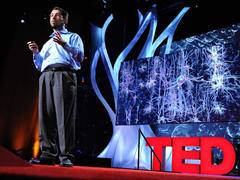
Congrats to Ed Boyden, who was named one of the winners of the 2013 Grete Lundbeck European Brain Research Prize earlier this week for his work on optogenetics. Watch Boyden’s 2011 talk, about using fiber-optic implants to control specific neurons in the brain. [MIT news]What is it like growing up in a futurist household? Veronique Greenwood’s mother, a technology consultant, was touting the rise of mobile social networking years before the iPhone had come out and before Facebook had a “Like” button; she had pens printed with the slogan “Remember when we could only hear each other?” a decade before Skype. [Aeon magazine]
 Stewart Brand: The dawn of de-extinction. Are you ready?
More Ed Yong? Yes. Yong takes a look at the pros and cons of de-extinction (a big topic in these parts after Stewart Brand’s TED2013 talk). [National Geographic]
Congratulations to TED Fellow Durreen Shahnaz, whose company, Impact Investment Exchange, has been nominated for the Rockefeller Foundation Centennial Innovation Award.
Timo Arnall’s thoughtful critique of the growing trend to encourage “invisible” interaction design. [Elastic space]
 Jehane Noujaim wishes for a global day of film
More congrats are in order, to 2006 TED Prize winner Jehane Noujaim, who just completed a Kickstarter to raise money for postproduction on her Sundance Award-winning documentary The Square. [Kickstarter] Read more about The Square.
A father overhears his son talking about coming out of the closet to his mother and him, then leaves him this note. [Twitter] More details from Gawker.
A cute hello from the Axosoft TED Live event from TED2013. Watch for some tasty-looking carrots. [YouTube]

-
Nilofer Merchant Talks At Google
Nilofer Merchant, author of the bestselling 11 Rules for Creating Value in the #SocialEra (published by Harvard Business Review Press), recently did an @Google Talk, and the company posted the video today.
Google explains, “In this talk, Merchant argues that ‘social’ is much more than ‘media.’ Smart companies are letting social become the backbone of their business models, increasing their speed and flexibility by pursuing openness and fluidity. Her thesis doesn’t just apply to companies but also people. Individuals connected together can now create in ways that once only organizations could. Today’s successful leaders don’t operate like the powerful ’800-pound gorillas’ of yesteryear – but instead act more like a herd of 800 gazelles, moving together across a savannah, outrunning the competition.”
Enjoy.


