
Category: News
-
Galaxy S4 mini leaks in official Samsung app store
-
N.Y.: 3 Feet Of Snow Blankets Northern Part Of State
It’s rare to see snow in May, but New York received 3 feet of snow over the Memorial Day weekend.
The AP reports that Whiteface Moutain, a ski mountain on the New York border with Vermont, was hit with 3 feet of snow over the weekend. All the snow has forced the authorities to close the highway that leads up to the mountain.
Now, 3 feet of snow is not going to break any records, but it does came very late in the season. It’s said that the 13.2 inches that fell on Sunday was the first time that more than a foot of snow has fallen this late in the season.
Once the roads clear up, Whiteface Moutain will open again to its summer activities in June. The gondola rides open on June 14.
[Image: Whiteface Moutain/flickr]
-
Adrian Peterson On Gay Marriage: “I’m Not With That”
Adrian Peterson of Minnesota Vikings recently gave his opinion on gay marriage during a radio interview.
Fox News reports that Peterson was on a Sirius XM radio interview when the hosts asked what he thought about gay marriage. In short, he personally doesn’t believe in gay marriage, but he’s not going to stand in the way either. He also says that he has no ill will towards gays as some people in his family identify as such. He says that he loves them all the same:
“To each his own, (but) I’m not with it. I have relatives that are gay. I’m not bias towards them. I still treat them the same. I love them. But, again, I’m not with that. That’s not something I believe in. But to each his own.”
The question originally came up in response to former Vikings teammate Chris Kluwe’s outspoken views on gay marriage. Kluwe is adamantly for gay marriage and made his opinion vocally known via numerous media outlets. He was later let go from the Vikings and many thought his political views were the reason. The official stance is that Kluwe wasn’t let go for his political views, and Peterson confirms that as well. He did say, however, that he was sad to see him go even if they had radically different political views.
-
Samsung to unveil new Android, Windows devices at June 20th press conference

-
6 Dead In Chicago Shootings Over The Weekend
Chicago police are reporting that 6 people are dead as a result of shootings over the weekend.
The AP reports that 6 people were killed and another 11 wounded in a string of gun violence that took place over the weekend in Chicago. On Friday, a 17-year-old and a 22-year-old were both killed in separate shootings. Then an 18-year-old and a 29-year-old were killed as a result of gun violence.
After two days of gun violence resulting in deaths, Chicago still couldn’t breathe easy. On Sunday morning, a 42-year-old man was shot in the head after a vehicle crash. The woman in his vehicle was taken to a hospital. In a separate event, a man in his late 20s was shot in the armpit and later pronounced dead at a hospital.
It should be noted that none of these deaths are likely related. If anything, Chicago found itself with an incredibly violent weekend. Unfortunately, it’s not anything new for residents of Chicago as people are sometimes killed by stray bullets from gang wars. The most recent being a 6-month-old child that was shot and killed by such a stray bullet.
-
Companies Should Help Veterans Get Skills to Work

There are an estimated 600,000 open advanced manufacturing jobs across America, and the White House recently announced that 34,000 troops are returning from Afghanistan over the next year. While these two facts are seemingly unrelated, an innovative program connects them in a meaningful way.
Led by GE, along with partners such as Alcoa and Lockheed Martin, the new Get Skills to Work (GSTW) program convenes manufacturers and educators to prepare and place veterans in long-term careers in advanced manufacturing. Thirty-five military veterans recently completed the GSTW training program. I was one of them.
Like many returning veterans, I struggled to translate my military skills and experience to civilian employment. Today, I hope to offer my story as a word of encouragement to my peers in the veteran community.
Any business, large or small, that has hired veterans knows that they are often ideal employees. Veterans are driven and mission-focused and most are looking for new opportunities to lead productive lives and contribute to society. But in order to do this, veterans often need help and support transitioning from the military to the civilian workforce. While it’s not always easy, I’d like to think that this group of potential, future employees is worth the investment.
A Cincinnati native, I entered the Navy after graduation and received aviation electrical training. For several years, I worked on military aircraft and high-grade machinery, serving on various bases and deployment in Afghanistan. Although I had basic skillsets related to manufacturing, I came back from service to find that I lacked the formal job training and certification to apply my know-how in civilian workplaces. I drifted from job to job, working as a line technician on everything from machinery to solar panels, but had no job security or a long-term career prospects.
I joined the inaugural class of the GSTW program at Cincinnati State Technical and Community College in February 2013, where I, along with ten fellow veterans, received accelerated skills training in core manufacturing skillsets.
Manufacturing certifications include many more skillsets than I initially expected, spanning safety, quality, process and production, and maintenance across various areas like machining, welding, and automation. I expected the GSTW training to be basic, but was surprised by how rigorous and in-depth the program was.
It’s an intense, four-week program, designed with one goal in mind: getting the skills needed for a career in advanced manufacturing. To ensure that the skills training actually met the immediate needs of local employers, GSTW partners worked with local businesses to develop the curriculum, which included classes on quality audits, production group communication, blueprint reading and work area safety, among other topics.
Every week, we were tasked with learning different lessons and training modules around ergonomics, fishbone diagrams, electrical resistance, work area permits, and hazmat labeling systems, for example. We were tested every Friday, making memorization and perseverance key. It wasn’t easy, but — just as in the military — we relied on each other to get through it.
If I had to change one thing about the program, I would extend the program to six weeks so that I could take advantage of the networking opportunities presented to us. So often, I was too focused on studying and memorization for the weekly, Friday exams that I could not fully engage with the local employers who met with us to discuss employment and career opportunities.
While the program was difficult and demanding, I was up for the challenge. To those of you that haven’t been deployed to Iraq, Afghanistan or other war zones, it’s hard to imagine what we’ve been through. And too few can relate to what we’re going through when looking for jobs and careers when we return back home. I urge fellow veterans not to give up hope, to keep trying, and to keep going after the career that you truly want.
Although six out of the eleven veterans in my inaugural class have been hired since completing the GSTW program five weeks ago, there’s still plenty of work to be done. On behalf of my fellow veterans, I urge employers from around the country to join the GSTW program and its mission to train and match 100,000 veterans by 2015.
-
Registry Key Jumper lets you quickly access any registry key
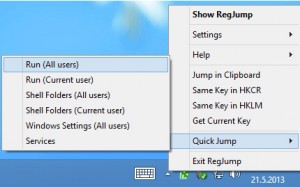 When troubleshooting technical PC problems then it’s likely you’ll often come across references to Registry keys, some of which you’ll want to check out. And usually this means you’ll have to manually launch REGEDIT, before browsing multiple levels until you find the key you need.
Registry Key Jumper, however, offers a simpler route. Once the program is running in the background, you can just select the text of any Registry key, press Ctrl+Alt+X, and REGEDIT will open automatically at the appropriate location.
You can use the program to maintain a list of your most-accessed Registry keys, which can then be accessed with a click. (REGEDIT already has its own Favorites list, of course, but Registry Key Jumper is portable: you can run it, and access your Registry list on whatever PC you happen to be using.)
And the program also has an option to create desktop shortcuts which will launch REGEDIT at any specified key.
Whatever you ask it to do, Registry Key Jumper does its best to help. You can specify your root hive in either the long (HKEY_LOCAL_MACHINE) or short (HKLM) forms, for instance, and the program will understand. And if, say, you’ve selected HKLM\SOFTWARE\CyberLink\PowerDVD13\KoanBox, but there’s no PowerDVD13 key on this system, Registry Key Jumper will still get you as close as it can (HKLM\SOFTWARE\CyberLink).
In another helpful touch, you can choose your preferred system hotkey from a lengthy selection.
The program isn’t restricted to working with REGEDIT; if you prefer some other tool, then you can point Registry Key Jumper at that, instead.
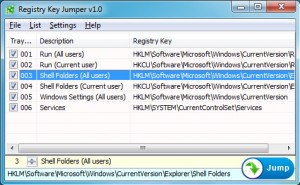 And there are assorted other options which might come in useful. So you can set up the program window to remain on top of others, say, for easier access. And your Registry favorites can easily be exported, including in HTML, convenient when you need to share them with others.
Despite this, if you only access the Registry occasionally, or you always revisit the same few keys, then there’s no real need to download Registry Key Jumper; the REGEDIT Favorites menu is likely to provide all the functionality you need.
If you regularly spend time troubleshooting other people’s PCs, though, it’s a slightly different story. The program allows you to carry around your own Registry Favorites, share them with others, and access just about any key you like with the absolute minimum of hassle. Check it out.
-
Mailbox on iOS is a major improvement over the official Gmail client
 The default Mail app for the iPhone and iPad is capable enough, but sometimes you find yourself craving more. Google Mail users could opt for the official Gmail app, but despite some improvements over Mail, there’s still a bit of clunkiness in there, particularly when it comes to handling larger mailboxes. But there’s another alternative, one that has just been updated to run natively on the iPad as well as the iPhone. That app is also free, and it’s called Mailbox 1.3.
Mailbox takes a different approach to handling your email, providing you with five separate zones in which to work. Mail lands in your inbox and you simply swipe it in the direction of a specific zone to deal with it in a particular way. It allows you to quickly and easily bring order to even the most disorganized mailbox.
When it comes to swiping your messages to deal with them, here are the obvious choices: mark it as read, archive it or go the whole hog and delete it completely. You can also quickly organize messages into lists, but the most intriguing option of all is “snooze”. If you’re too busy to deal with an email right now, you can “snooze” individual messages, setting a more convenient time when you’d like them to reappear in your mailbox.
The focus of the app is very much on letting you power through your messages, hence the use of single swipe gestures rather than the usual select-and-tap approach of other clients. So a quick, short swipe to the right archives your messages (look for the green tick) while a slower, longer swipe to the right produces the red cross that will delete your message if you complete it (just swipe back to undo unwanted actions).
Similarly, a quick swipe to the left places the message in the Snooze list. You’ll be given a choice of how long to hide the message for, from later in the day or the evening to a month’s time or the vague “Someday”. You can also pick a specific date, but we’re a little disappointed that you can set up a custom time of your choosing too. Something for a future update perhaps? In the meantime, snoozed messages are easily available should you find the time to deal with them — just tap the clock icon, which is basically a shortcut to a special “Later” folder created by Mailbox where these messages are stored.
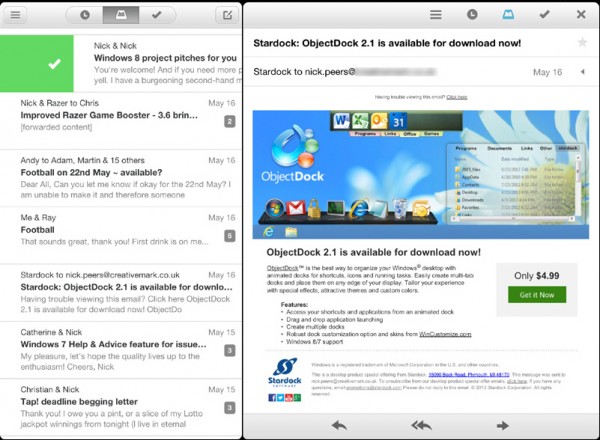
When it comes to arranging your mailbox into lists, a long swipe to the left will bring up the options you need — by default, three are set up (to buy, to read, to watch), but you can add your own. These lists are again accessible from other Gmail clients or your web browser via the specially created Lists folder.
We found these controls simple and easy to use, and powered through a disorganized mailbox with over 400 messages in minutes, finally getting a job done we’d put off for ages. But Mailbox is more than just a tool for organizing your mail, it’s a fully featured mail client in its own right, and we particularly love the way messages are automatically grouped into conversation view, making it easy to keep track of where you are in a particular chat. With the elegant design beautifully upscaled to take full advantage of the iPad’s extra real-estate, we think Mailbox could be a winner, which is why — for now at least — it’s replaced Gmail as our mail client of choice.
Mailbox 1.3 is available now for free for iPhone, iPod touch and iPad.
Photo credit: Gina Sanders/Shutterstock
-
United States Remains the Best Place to Build a Data Center

Compared to other nations around the globe. the safest and lowest risk place to locate a data center is the United States, and there’s an abundance of potential in several secondary and maturing markets, according to a report from Cushman & Wakefield, hurleypalmerflatt and Source8.
The United States has the lowest risks likely to effect the operation of data center facilities, the group determined in its evaluation of the 30 most important global markets. Additionally, tenant activity is showing renewed vigor in 2013, with San Francisco Bay Area and Northern Virginia highlighted. The report, titled “Data Center Risk Index 2013 Edition” was released last week.
The United Kingdom held second position. The nation’s high scores relating to international internet bandwidth and ease of doing business helped maintain its place above all other locations surveyed in Europe. Scandinavian country Sweden, with its cool climate and stable power grid, took third place this year, jumping from the eighth spot last year.
The aim of the report is to help companies make informed investment decisions about where to locate data centers, as well as to develop strategies to mitigate anticipated risk. Factors such as energy and labor costs, internet connectivity, ease of doing business, natural disaster potential, and political instability are all taken into consideration and weighed to reflect different risk levels.
What Variables Were Considered?
The United States has long been on top of the list when it comes to best served country in terms of Information and Communication Technology (ICT) infrastructure and general connectivity, according to the report.
“In the United States, factors such as robust internet bandwidth capacity and connectivity and stable power costs contribute to its top ranking,” said Jeff West, Director of Cushman & Wakefield’s Data Center Research in the Americas. “Throughout the Americas, secondary and maturing markets hold an abundance of potential. Despite ranking last on the Index, Brazil’s dynamic economy and strong demand ahead of the World Cup and Olympic Games is fueling a swell of new submarine fiber-optic cable and infrastructure construction, while Canada’s solid mix of strong market fundamentals and low risk is sure to continue to attract investment from the U.S. and Europe.”
The rapid adoption of technology and its impact on data center real estate shows no signs of slowing and underlying market fundamentals will continue to trend positive, according to the report. The U.S. construction pipeline continues to be robust with most established data center markets seeing variable levels of new supply as demand moves from the sidelines into decision making and outsourcing becomes more popular.
Other Countries to Note
Canada, which is sometimes called “America’s Hat,” (I’m originally from Canada so I can say that) took fifth place. The Greater Toronto Area makes up the majority of the Canadian market, but all metros remain strong in terms of demand.
Other interesting areas of the world include South America, and most notably Brazil, its major data center market, as well as the Nordics and the appeal of the hydroelectricity they can offer.
In Asia, Hong Kong held the least amount of risk at sixth place. With natural disasters and a shaky economy, Japan dropped the most out of all countries surveyed, from 20th to 26th.
-
Europe’s quiet Apple antitrust probe takes on 4G dimension, report suggests
Back in March, some carriers complained to the EU competition authorities over Apple’s channel tactics, such as its alleged use of excessively high sales quotas to make sure carriers’ marketing budgets go disproportionately in the direction of iPhones and iPads. Two months on, and it seems the authorities are quietly probing the issue.
First off, it’s important to realise that no formal complaints have been made and the European Commission has not launched a formal investigation. However, according to a Financial Times report on Sunday, the Commission has sent a questionnaire to several European carriers, asking them to clarify what Apple asks them to do.
The article claims the questionnaire asks whether operating groups are forced to buy a certain quota of iPhones, whether Apple dictates how marketing budgets should be allocated, and whether the U.S. firm demands subsidies and sales terms that are at least as favorable as those offered to other manufacturers. Interestingly, it also says the Commission is looking into potential “technical or contractual restrictions on the iPhone 5 that mean it cannot be used on high-speed 4G networks in Europe.”
The 4G factor
As I explained in March, there’s a lot standing between where we are now and a full-blown antitrust case – for a start, Apple does not actually dominate the smartphone market in Europe (it has around 25 percent share), making it less likely to be the target of an antitrust crackdown. Simply put: it’s not that hard to jump the iOS ship for Android or some other alternative.
That said, the questionnaire’s mention of restrictions on the iPhone 5′s 4G capabilities is intriguing.
The European (GSM) version of the iPhone 5 does have natural limitations as to which LTE networks it can run on, due to the bands it physically supports – it will run on Deutsche Telekom’s 1800MHz spectrum in Germany, for example, but it doesn’t support 800MHz or 2.6GHz LTE, so Vodafone has to sell the iPhone 5 as a 3G device that country.
However, there have been reports suggesting that Apple’s restrictions extend beyond the strictly necessary. The company apparently heavily vets the LTE networks it will support — even an unlocked iPhone 5 will not run on an unapproved LTE network. The question now is whether this is entirely a technical matter, or whether commercial reasons also come into play.
Market definition
I’m waiting for the Commission’s antitrust office to get back to me (my guess at this point is that they’ll say the questionnaire forms part of its regular market-monitoring activities), but, as I have said before, I’m skeptical that this will evolve into a formal investigation. The only basis on which I can see that happening would be the definition of Apple’s platform as a market in its own right, independent of the wider picture that also includes the actually-more-dominant Android.
If that were to happen, it would be a game-changer — Apple might be forced to allow alternative app marketplaces, for example. But let’s wait and see what happens before we speculate too far down that path.

Related research and analysis from GigaOM Pro:
Subscriber content. Sign up for a free trial. -
DNSQuerySniffer shows all the DNS traffic on your system
 NirSoft has announced the public availability of DNSQuerySniffer, a tiny (130KB, including a Help file) network sniffer which detects and displays your DNS traffic.
If you think this sounds just a little technical, then you’re right, but the program does have some interesting applications. Malware will often use DNS traffic to communicate with its operators, for instance, and so taking a closer look at your own system may reveal the signs of an infection (a large number of failed lookups to domains you don’t recognize, say).
And more generally, DNSQuerySniffer helps to reveal which of your applications is trying to go online, and maybe what they’re trying to do.
The data capture itself can be done via WinPcap and Microsoft Network Monitor. But if you’d rather not install anything else, the program also supports Raw Sockets capture, and this may produce acceptable results (the documentation provided with DNSQuerySniffer explains more).
Any queries intercepted are displayed in full, with all the details you’d expect: Host Name, Port Number, Query ID, Request Type, Request Time, Response Time, Duration, Response Code, Records Count, and the returned records.
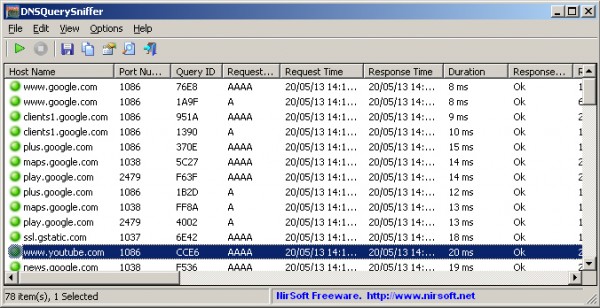
All of this data is displayed in a sortable table, and can be exported as a report in TXT, CSV, HTML and more.
And as usual with NirSoft tools, while it’s not something you’ll use every day, DNSQuerySniffer is still a welcome complement to the more regular TCP/IP connection monitors, and you should probably grab a copy for your networking and security toolkit.
Photo Credit: Yuriy Boyko/Shutterstock
-
BT, Ciena Light 800 Gigabit Super-Channel
Here’s a roundup of some of this week’s headlines from the network sector:
Ciena and BT light 800G Super-Channel. Ciena (CIEN) and BT announced a series of pioneering trials over BT’s UK optical core network infrastructure. The successful trials in March 2013 included the transmission of 100, 200, and 400G, as well as an “800G super-channel,” the last of which equates to the simultaneous transmission of seven High Definition DVDs in a single second. The trials were performed on a high Polarization Mode Dispersion (PMD) fibre link between BT’s Adastral Park Research and Development Centre in Ipswich and the iconic BT Tower in Central London. “These high capacity transmission demonstrations illustrate the value of Ciena and BT’s long-standing strategic relationship,” said François Locoh-Donou, senior vice president, global products at Ciena. “BT’s future-proof network will enable it to stay ahead of the competition and continue to offer customers cutting-edge services, while minimising its overall cost-base and carbon footprint. With this collaboration agreement, we can further deepen our relationship and work together to build service-enabling and highly-programmable networks, leveraging Ciena’s entire product portfolio to jointly develop ground-breaking services and applications for BT’s customers.” Ciena also announced that the Russian carrier RASCOM is deploying its 6500 Packet-Optical Platform to support the 100G upgrade and network expansion of a route connecting Russia to Western Europe.
Cisco selected by Chinese cable operator Zhejiang Wasu. Cisco (CSCO) announced that Zhejiang Wasu Cable TV Network Co., Ltd. (Wasu), one of the leading cable operators in China, has successfully deployed a new 100G Internet Protocol and Dense Wave Division Multiplexing (IP+DWDM) backbone network to better support cloud-based video and data services. Wasu’s new cloud computing platforms will rely on the Cisco ASR 9000 Aggregation Services Router and coherent DWDM line cards on the Cisco ONS 15454 Multiservice Transport Platform (MSTP). ”The broadcasting industry is undergoing tremendous changes and transformations,” said Cisco vice president, Hanh Tu. “Taking advantage of our leading network and video technologies, Cisco strives to provide the most comprehensive network and video solutions for China’s operators, to help them maximize their business value. We are honored to help Wasu deploy its new network, so that it can provide new video experiences and services for its subscribers.”
Level 3 to broadcast Fox UEFA Soccer. Level 3 Communications (LVLT) announced it is providing video broadcast services to enable FOX Network to deliver the live feed of the Union of European Football Associations’ (UEFA) annual championship soccer final to viewers across the U.S. Level 3′s global fiber network is directly connected to Wembley Stadium, which allows Level 3 to deploy its Vyvx Solutions to provide an end-to-end video broadcast solution to FOX. Level 3 will take the feed from the game in London and deliver it to FOX Network, FOX Soccer Channel and FOX Deportes in Los Angeles for distribution to U.S. viewers. ”The quality of a broadcast can help make or break a viewing experience for sports fans, so it’s critical that FOX ensures its ability to deliver its content in a seamless, efficient and secure manner,” said Mark Taylor, vice president of Media and IP Services at Level 3. “Level 3 is proud to provide FOX Network, FOX Soccer Channel and FOX Deportes, with a comprehensive suite of broadcast services that ensures viewers will be able to enjoy every moment of the UEFA Champions League final.” Level 3 also announced it is providing content delivery network (CDN), high-speed IP (HSIP) and colocation services for Metaboli, a leading European distributor of Internet-based video games.
-
Evernote Reminders are a welcome addition

Over the course of the past week, Evernote Corporation has been updating its flagship Evernote client across all supported platforms. As with most Evernote updates, however, the changes implemented have not been equal, with users of Evernote for Mac 5.1.1 and Evernote for iPhone and iPad 5.2.3 getting the best deal.
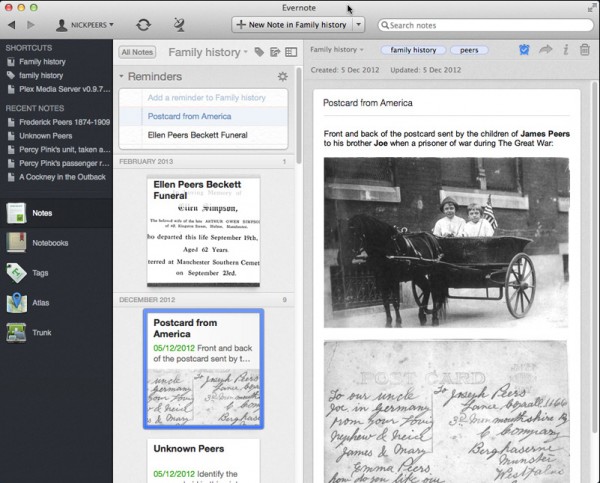
The big news for Evernote users is the addition of support for reminders — initially on Mac, iOS and the web-based platform. These can be triggered as email or in-app alarms, and are easily set via the small timer button at the top of a note.
Once the small timer button has been clicked, users are prompted that the reminder has been added. Once a reminder has been set, the note is automatically pinned at the top of the user’s list in a new Reminders section, and notes can be repositioned in the Reminders list simply by drag and drop.
Users can also configure a reminder with a date and time, leading to an in-app alarm of email reminding the user of a deadline attached to the note in question, which can now also be marked as “Done” when completed.
Reminders are associated with notebooks, allowing them to be shared with other users too, making it possible to create a hierarchical series of notes for highlighting important entries over others. Shared users can also take advantage of the alarms feature, subscribing to be notified when notes become due.
While the feature has been universally welcomed, improvements have already been suggested, such as adding scheduled alarms for recurring deadlines. The Evernote team have also confirmed that the feature should be migrating to Windows and Android platforms “soon” (it’s already being tested in a version 5.1 beta for Android devices).
Other changes to the Mac build include a redesigned vertical list to show more notes on-screen, next superscript and subscript text styles and the ability to edit saved searches.
Windows users got a minor update last week — Evernote 4.6.6 promised nothing more than unspecified bug fixes. Also updated was Evernote for Android 5.0.5, again a minor update consisting mainly of bug fixes and improvements to the Page Camera mode, which allows Android users to digitize photos of documents and pages. It did add support for the new Evernote Smart Notebook by Moleskine, however.
Evernote for Mac 5.1.1, Evernote for iPhone and iPad 5.2.3, Evernote for Windows 4.6.6 and Evernote for Android 5.0.5 are all available as a freeware downloads. Users require a free or Premium Evernote account to use them.
-
Turn The Raspberry Pi Microcomputer Into A Low-Cost Laptop With This Atrix Dock Hack

The $35/$25 Raspberry Pi microcomputer is being used by hardware hackers to power all sorts of creative projects. Including, in the above instance, a Raspberry Pi powered laptop, created by developer Eric Chou — principally by tying in the Motorola Atrix laptop dock. Which surely must be the coolest use of that piece of kit to date.
The smartphone that the dock was intended to be hooked up to has since been discontinued but as Adafruit Industries points out in the below ‘how to’ video, the laptop dock can still be picked up via various online outlets. Its Micro USB and Micro HDMI jacks offer a neat, relatively straightfoward way to turn a Pi into a laptop. Adafruit’s video shows which connectors to get and how to splice them together to plug in the Pi and get the DIY laptop working.
Chou, meanwhile, has costed out his version of the Pi laptop hack — including an optional Airlink WiFi module. In total the components costs around $125, plus the cost of the Pi — making it cheaper overall than the build costs of the XO ‘One laptop per child’ laptop (the XO apparently costs around $200 to make). It’s also a lot more accessible to individuals and small groups, being as the latter machine has to be ordered by the thousand so is generally restricted to government-backed mass education projects. Go the Pi-powered DIY route and so long as you’re willing to roll up your sleeves and do a little hacking, much smaller batches of low cost laptops can be put together and put to work where they’re really needed.
The Raspberry Pi’s potential as a low cost computing platform for developing countries is pretty exciting. Pis are already being used to power a school computing lab in rural Cameroon, thanks to a Belgian volunteer project which involved a suitcase full of the microcomputers being taken out to Africa and set up with monitors and keyboards acquired locally. It’s a great fixed-location learning solution, but couple in a bit of kit like the Atrix dock and portability could really extend the usefulness of the device.
A Pi-powered laptop wouldn’t need to be tethered to a classroom location, but could be taken home by kids so they can carry on learning (the dock also contains a battery so even without any electricity at home it would offer some hours of use). The not-for-profit Raspberry Pi Foundation, which created the Pi with the hope of getting more U.K. kids learning to code, has said it is keen to look for ways to get more Pis out to developing countries this year, where the need for a low cost computing solution is even greater.
-
Binge-viewing Arrested Development Season 4: Patience required
According to Mitch Hurwitz, I’ve made a huge mistake.
Yesterday, in proud binge-viewing tradition, I made good on a long-ago promise and consumed the return of Arrested Development on Netflix: 15 episodes, coming in at an average of 35 minutes or so — it took about 12 hours.
This was counter to advice given by Hurwitz, the show’s creator, in an interview with Vulture:
“You’ll get tired!” says Hurwitz. “One of the producers came by when I was in post-production recently, and he said, ‘Can I see some of them?’ and I said, ‘Yeah, we’ve got seven episodes.’ ‘Great.’ And I heard him in the other room laughing and laughing, and then I heard him laughing a little less, and then a little less, and then later I saw him getting a drink of water and I said, ‘What do you think?’ He goes, ‘I’m just getting a little tired. I love it, it’s great, but you can’t really laugh the whole time. You have to take a break. There’s so much material.’”
However, I wanted the experience of consuming the whole thing at once, because everything that’d been said about the way Hurwitz and his team approached creating the season seemed like it would lend itself well to binge-viewing.
And in fact, the series does in fact function as a complete narrative, one that’s full of surprises.
Some observations:
- This is as complex and dense a thing as I’ve ever seen, and really does peel back like an onion — conversations stretch across episodes and many reveals are pushed off until nearly the end of the season.
- The vast majority of your old friends and references are back — often in surprising ways. (No spoilers, except to say that there was an awful lot more of Liza Minelli than I was expecting.)
- There is plenty of new stuff, though, and new cast members including Terry Crews, Chris Diamantopoulos, Maria Bamford, Seth Rogan, Isla Fisher and Kristen Wiig.
- The structure is loosely tied to a few key events which bring together all the stories; if things are unclear the first time you see a party or show, don’t worry — it’s by design. (To quote the show: It’s like it gets off on being withholding.)
- This demands a great deal of patience from the viewers, especially when it takes a surprisingly long time for certain characters to get their time in the spotlight. Like, George-Michael doesn’t get his full episode until Episode 13.
- Because of said complexity, there are no shortage of flashbacks and plenty of exposition used to hook things together.
- This is actually openly mocked at a couple of points, by both Ron Howard in his capacity as narrator and the characters on screen.
- That said, there is still an awful lot of all that. Drinking game suggestion — anytime an entire episode’s worth of plot is condensed down to a quick narrated montage, drink. (And then maybe don’t drive anywhere.)
- One touch I really liked that serves the binge-viewing experience well — the opening credits for each episode are altered to reflect which character is the focus of that episode (the music is slightly different as well each time). When watching 15 episodes of a thing, that kind of variation goes a long way towards diffusing the repetition.
The approach has been compared to a novel, though it’s a novel that is constantly jumping around in time, challenging you to keep up.
I enjoyed the challenge, and the in-jokes — I didn’t so much enjoy the pacing, as the show, freed from network requirements of episode length, did drag here or there. So far, the reaction I’ve seen online has been relatively mixed, but it was unlike anything I’ve ever seen before, and it’ll be fascinating to see how Season 4 ages with time. For there’s plenty to unpack and discover; I’m looking forward to rewatching Season 4. Maybe a little more slowly, though, next time.

Related research and analysis from GigaOM Pro:
Subscriber content. Sign up for a free trial.- Connected consumer first-quarter 2013: Analysis and outlook
- Smart TV forecast: gigabit Wi-Fi in the living room
- How consumer media will change in 2013
-
Working out as we age
(NaturalNews)Ever since I was a kid growing up in Newark I centered on sports. It started with playing all kinds of running games, then punch ball, then stick ball, then varsity sports in high school (football, swimming and track) and college (freestyle, butterfly and individual…
-
The wonders of herbal teas

Drinking tea isn’t just something you do at lunchtime. The British have been drinking it religiously for hundreds of years, people in the Far East even longer. But tea is not just any other liquid to help quench your thirst. Many herbal teas are known to have far-reaching… -
Use meth to fight the flu, say scientists

The determination with which the mainstream scientific community continues to vindictively reject natural cures has reached a new point of absurdity, as researchers from Taiwan are now touting methamphetamine drugs as a potential new cure for influenza. Yes, you read… -
Study finds Western diet leads to advanced aging and premature death – Are you slowly killing yourself?

Nutritional researchers have repeatedly demonstrated that what we eat directly determines genetic expression and can predict chronic disease risk, rate of aging, quality of life and mortality. A diet predominated by processed foods and laden with sugars, hydrogenated… -
Health basics: The 10 trickiest ‘food stuff’ products

America is the land of the free. You are free to choose to consume any products you want to, whether they are toxic or whether they are organic. Most people, if given the choice, would like to avoid cancer, heart disease, strokes, diabetes, arthritis, osteoporosis and…