Category: News

  • Nasdaq on the virtues of the public cloud

    The financial services industry needs to store a lot of data, and the folks at NASDAQ want to use it to help build new products. But they also have to keep an eye on costs. Ann Neidenbach, an SVP at the NASDAQ OMX Group, explained how the exchange made the decision to use the Amazon public cloud for storage Thursday at the Structure:Data 2013 conference in New York.

    “The economics of the clouds are just phenomenal,” says Neidenbach. She and Ron Bodkin, the founder and CEO of Think Big Analytics, noted that the exchanges have regulatory requirements to keep petabytes of old data associated with trading, and that adds up. She says the exchange has 10 petabytes of trade data and 3.5 petabytes of data that’s just backups. “We’re not even talking about email or even instant messaging,” said Neidenbach. “It’s a tremendous amount and that’s why we went into this partnership with AWS.

    “We have to leverage the public cloud where storage is so much cheaper per gigabyte,” she added.

    The exchange did have to spend time making sure the public cloud was secure enough for their data, but also for their customers’ data and that’s a journey that is just beginning. But she certainly implied that given the costs of storage in the public cloud and the amount of data financial institutions must keep, that the journey and eventual public cloud destination was inevitable.

    And the end result of having all this data stored in one public place might yield new products. Neidenbach expects that combining trade data with social media might result in new opportunities for trading and research. You had the feeling that the sky might be the limit.

    Check out the rest of our Structure:Data 2013 live coverage here, and a video embed of the session follows below:


    Related research and analysis from GigaOM Pro:
    Subscriber content. Sign up for a free trial.

  • It’s time for HTC to start fighting dirty

    HTC One Marketing
    HTC (2498) has been on quite a journey in its short history as a company. HTC was founded in 1997 as a notebook computer vendor and then began developing Widows Mobile handsets in the early 2000s and launched one of the first touchscreen smartphones in the world. As the mobile industry continued to evolve, so did HTC. The company would later be among the earliest Android adopters and it produced the first Google (GOOG)-powered smartphone, the HTC Dream. HTC’s EVO 4G was the first 4G smartphone to be released in the U.S. and the Thunderbolt was the country’s first LTE phone. HTC peaked as shares of the company’s stock rose to all time highs in the spring of 2011, however things took a turn toward the end of 2011 and the company still hasn’t recovered.

    Continue reading…

  • Apple’s Podcasts app gets playlist creation, iCloud syncing and custom stations

    When Apple broke out Podcasts as a separate iOS app from iTunes last year, a rather glaring omission was the ability to create playlists. Six months later, Apple has added that feature along with several other improvements to the app in an update released Thursday.

    Podcasts 1.2 updateNew features in the Podcasts 1.2 update include: playlists synced from iTunes now appear in the app; the ability to create automatically updating stations featuring preferred podcasts; customized stations that are stored in iCloud and automatically synced across your iCloud-enabled devices; a choice to start playing either the newest or oldest episode; and the ability to add any podcast episodes to On the Go playlists.

    Apple has also toned down some of the corny design to make it look more like the iTunes app and less like an old tapedeck — perhaps related to Jony Ive’s elevation to head of software and hardware design at Apple — and a playback bug has been fixed.

    Apple’s Podcasts app has been lambasted by users since its introduction last fall (see the ratings and reviews in the App Store). The updated design and functionality should be welcome news to those frustrated with the iOS Podcasts experience; that is unless they’ve moved on to any number of third-party podcast apps that have moved in to fill the void.

    Related research and analysis from GigaOM Pro:
    Subscriber content. Sign up for a free trial.

  • Personalizing health online: where can you go for medical information that matches you?

    If you go online to look for health information – as about a third of Americans do – chances are the information targets a general audience, not someone with your specific medical history, risk profile or needs. But if you’re looking up diabetes complications, for example, it makes a difference if you’re an older man juggling different medications or a pregnant young woman with no other health conditions.

    The larger promise of personalized medicine that considers genomic data on top of medical history and clinical data is still on the verge of reality. But, in the meantime, a few companies are at least beginning to bring a new level of personalization in health care to the web.

    On Thursday, Palo Alto-based HealthTap, which lets people ask anonymous questions of a network of 35,000 doctors online, released a new feature that prompts them to tag questions with relevant personal characteristics, including age, gender, prior conditions and medications. (Previously, users had the option to tag questions, but now it’s more front and center and they can add personal characteristics across more variables.) The new addition enables that particular user to receive a tailored reply and also means that, as other users searching the site add information about themselves, they’ll see the content most specific to them.

    “Amazon optimizes for your taste, Facebook optimizes for your social graph. We’re doing it for your social graph,” said HealthTap cofounder and CEO Ron Gutman.

    HealthTap has long offered tools that enable users to store detailed personal health information with the goal of personalizing content but, as the demise of Google Health showed, consumer personal health records are a tough nut to crack.  People don’t care enough to take the time to fill out online forms if they don’t see the reasons for using them, or they’re concerned about privacy implications. HealthTap, which is HIPAA-compliant, is trying to meet people where they are, hoping that if they can see the benefits of providing a little bit of personal information, they’ll be incentivized to provide more.

    Now that the site has received provided more than half a billion answers (since launching in 2010), Gutman said it’s reached the critical mass for tagged answers to provide meaningful personalization.

    Hoping to personalize digital content with data provided by personal health tracking devices, earlier this month, WebMD announced a partnership with Qualcomm Life’s 2net platform  to create a cloud-based health hub for consumers. Once users connect their tracking devices to the platform, WebMD said it would be able to aggregate data from those devices and use it customize searches so that, instead of just getting generic diabetes information, users could receive content specific to their needs. The companies haven’t yet released anything yet but say they’d roll out their first product later this year. While consumers may see value in personalized information and insights, they could also be reticent to store their data in aggregate with a company known more for content than health services.

    Smaller startups are also taking a stab at personalization with sites meant to take aim at “Dr. Google.” Symcat analyzes patient-provided symptoms and personal characteristics against disease prevalence data from the Centers for Disease Control (CDC) and other public sources to provide people with likely possible diagnoses. And Meddik goes beyond symptoms to help people access online articles, general resources and answers to questions provided by people in their “health networks” (or who share their condition profiles and symptoms). On both sites, as users participate online, they develop profiles that are used to customize future content they receive.

    Related research and analysis from GigaOM Pro:
    Subscriber content. Sign up for a free trial.

  • Search and Remove Duplicate Files Quickly and Free

    With today’s tendency to hoard files on the hard disk, it should come as no surprise that the same file may be located in more than one place, thus chipping the free space you would otherwise use for storing more relevant data.

    Although there are plenty of utilities that can clean up the computer of unnecessary files and thus claim free space, only some of the… (read more)

  • Apple’s Ive pushing for simpler ‘flat design’ for iOS

    Apple iOS Design
    We’ve known for a while that Apple (AAPL) design guru Jonathan Ive would look to put his own distinct stamp on iOS and now unnamed sources have told The Wall Street Journal that Ive may go with a “flat design” for the next version of the operating system that will be “starker and simpler” than the current version. The Journal’s report follows a New York Times report from last year that claimed Ive would waste no time overhauling the design of iOS to make it fit in more with his own minimalist hardware designs. The Times’ report similarly indicated that Ive’s iOS makeover will incorporate “clean edges, flat surfaces” to “replace the textures that are all over the place right now.”

  • This week’s best questions, ideas and debates from TED Conversations — with a map!

    Location of TED Conversations started in the past 30 days, based on member profiles.

    Location of TED Conversations started in the past 30 days, based on member profiles.

    TED Conversations is a unique space where any member of the TED.com community can get feedback on an idea, pose an interesting question, or start a fascinating debate with fellow TEDizens from around the globe.  We’ve seen participants from Columbia to Palestine, Sudan to Nepal—a total of 114 countries in just the past 30 days.  See just where above. And below, a sampling of the discussions happening in this global community:

    Seigi Karasaki, from Tokyo, Japan, asks: Do people deserve to know the truth, even if it isn’t in their best interest?

    Is truth always the best choice of action? In “On the Decay of the Art of Lying,” Mark Twain argues:

    “Lying is universal–we all do it; we all must do it. Therefore, the wise thing is for us diligently to train ourselves to lie thoughtfully, judiciously; to lie with a good object, and not an evil one; to lie for others’ advantage, and not our own; to lie healingly, charitably, humanely, not cruelly, hurtfully, maliciously; to lie gracefully and graciously, not awkwardly and clumsily; to lie firmly, frankly, squarely, with head erect, not haltingly, tortuously, with pusillanimous mien, as being ashamed of our high calling. Then shall we be rid of the rank and pestilent truth that is rotting the land; then shall we be great and good and beautiful, and worthy dwellers in a world where even benign Nature habitually lies, except when she promises execrable weather.”

    What are your thoughts?

    From Kamloops, Canada, David Johnson responds to Stewart Brand’s provocative de-extinction talk: Science is developing the tools towards de-extinction of species on the planet that have become extinct. The question becomes; Should we?

    Stewart Brand: The dawn of de-extinction. Are you ready?Stewart Brand: The dawn of de-extinction. Are you ready?Stewart Brand and his colleagues are at the biotech precipice of reviving extinct species. The Revive and Restore project plans to not only bring species back but restore them to the wild, as well as protect currently endangered species.

    I don’t think any of us will have a problem with the latter, this discussion is focused on the primary goal; reintroduction of extinct species. We are not talking about dinosaurs, but the Passenger Pigeon, Carolina Parakeet, Heath Hen, Bucardo, the Taz Tiger, etc.

    Up for debate here: Should we?

    And Pabitra Mukhopadhyay, from Kolkata, India, invites us to consider a thought-provoking linguistics question: He, she or s/he? Should languages be made gender neutral or be left on their own to preserve literary integrity?

    Feminists have long argued that sexist language can have real world consequences for gender relations and the relative status of men and women, and recent research suggests that grammatical gender can shape how people interpret the world around them along gender lines.

    But language is as much a communication tool as literature. Some argue that steward and stewardess are distinct but equal terms and dropping one for another takes away the beauty of literary expression.

    Interestingly there are a number of genderless languages—they have no grammatical gender but have specific words to recognize gender. There are also natural gender languages which have evolved through a constant process on conscious neutralization of grammatical genders.

    Things start to get serious when studies of Jennifer L. Prewitt-Freilino, T. Andrew Caswell and Emmi K. Laakso on the gendering of languages come to fore. After investigating 111 languages of the world, their findings suggest that countries where gendered languages are spoken show less gender equality compared to countries with other grammatical gender systems. Furthermore, countries where natural gender languages are spoken demonstrate greater gender equality, which may be due to the ease of creating gender symmetric revisions to instances of sexist language. Norway and Sweden show Global Gender Gap Indices of .82 and .81 (1 being ideally gender equal) and both these countries have natural gender languages. Yemen scores a GGG index of .46 with a gendered language.

    Do you agree with this co-relation?

    With 237 open discussion topics, join us in tackling more big ideas, questions, and debates on TED Conversations»

  • What The Industry Thinks About Google Reader’s Demise

    Google recently dropped the bombshell that it is closing down Google Reader, much to the chagrin of its loyal user base. I’ve done my share of ranting about it, and discussed why some businesses may want to be more strongly thinking about their email strategies. We’ve since reached out to a handful of prominent bloggers and industry professionals for some additional perspectives on what the closing of Google Reader means for blogs and publishers.

    “I think it’s net positive that Google is shutting down its reader,” Automattic/WordPress founder Matt Mullenweg tells WebProNews. “It encourages people [to try] the great new experiences that have been developed over the past few years, including the WordPress.com reader.”

    According to Mullenweg, the open source WordPress software is used by 16% of the web.

    And trying new experiences we are. Feedly, for one, is getting a great deal of attention since Google’s announcement. Two days later, Feedly announced it had already seen 500,000 new users coming from Google Reader. At times they’ve had trouble keeping up with the demand.

    “I think that Google Reader is a standalone technology and not indicative of whether the world will shift away from RSS,” says Human Business Works CEO and all around popular social media guy Chris Brogan. “The notion that social networks and human sharing has replaced RSS is like saying that fireplaces have replaced central heating. Quaint, but not effective.”

    Not everyone quite agrees with that sentiment, however.

    Jeremy Schoemaker, author of the popular ShoeMoney blog, says he has about 70,000 RSS readers but that the amount of traffic from them has dropped significantly.

    “For me Social Media has become the new RSS,” he says. “I use a free service called Twitter Feed, that automatically posts my new posts to Twitter and my Facebook personal and fan page. I see far more traffic from that then any news reader. I haven’t thought of it until now but I haven’t logged into my Google Reader account for years. I don’t ever think RSS will die, but it will used more as an API like tool to interact with websites than a reader.”

    Long-time blogger and EVP/Global Strategy and Insights for Edelman, Steve Rubel, tells us, “The majority of large sites won’t see an impact. Most of their traffic now comes from Twitter and Facebook. In addition Google (search) is a large source of traffic. The smaller sites, however, will be impacted. Their more dedicated readers are using Google Reader. These sites will need to gravitate to other forms of distribution such email newsletters and other vehicles.”

    “It’s hard to say,” says Search Engine Land and Daggle blogger Danny Sullivan about the impact of Reader’s demise. “Technically, all those readers can easily continue to be readers by taking their feeds elsewhere. In practice, some might not make the effort. I expect that some blogs that see traffic from RSS are about to take a hit, though it might not be anywhere near as bad as they fear. We have, of course, been through this before after the decline of Bloglines.”

    TopRank Online Marketing CEO Lee Odden tells us, “It’s a disappointment and a little puzzling that Google would shut down reader. What’s next, FeedBurner? Probably. Google is a data-driven company, so clearly they have their reasons. The cost must now outweigh the goodwill created by offering a free and useful service like reader. Still, I have to wonder if there isn’t useful usage data with reader that Google could use?”

    “For content marketers, the main consideration is the impact on reach of content,” he adds. “If a substantial portion of a blog’s readers are using Google Reader, it’s a big deal. The blog would do well to point those readers to another service like Feedly.”

    Zee Kane, CEO of The Next Web, says, “I think older blogs, perhaps primarily ‘tech blogs’, might experience a degree of negative impact as many (ourselves included) have hundreds of thousands of RSS subscribers. Many of our readers our early adopters and geeks who consume (technology) news as though their life depended on it, Google Reader is/was an undoubtedly brilliant way of doing so. With Google Reader disappearing, we’ll see an even heavier focus on social as a means to distribute stories, as a way to rank stories and as a means to increase readership.”

    This is, of course, a small sampling of industry opinion, but it’s interesting to hear people’s different takes on the effects. Really, we won’t know what impact it truly has until Google Reader is finally gone. In the meantime, other services will pop up, and existing alternatives will strive to improve and outdo their peers.

    There for a while it was starting to look like Google was really pushing for an end to the RSS format, as even its RSS Subscriptions Chrome extension disappeared from the Chrome Web Store. Thankfully, that was said to be a mistake, and it came back. Meanwhile, Google is phasing out links to Google Reader from its other properties. We’re still waiting to find out if Google will keep the RSS option alive in Google Alerts, which seems to be experiencing its own negligence from the company. Interestingly, Google is giving advice on how to build news readers for Android.

    RSS.com is currently on sale with a $200 million asking price.

  • Pinterest for iOS Updated with Better Pin Discovery, Profile Editing

    Pinterest has just launched an update to their iOS app that brings two important functional features to the app and one minor, but fun cosmetic improvement to the iPad.

    With today’s update, you can now edit your profile inside the app – something that was a long time coming.

    Individual pin pages have also received a tuneup to help promote discovery. Scroll down to the bottom of a pin page to see the new “people who pinned this also pinned” section.

    This “people who pinned this also pinned” feature is the same one that Pinterest recently rolled out on desktop. It was part of a larger rollout of their brand new UI redesign that they said was all about discovery. Individual pin pages on desktop now feature pins from the same board and pins from the same source alongside “people who pinned this also pinned.”

    The desktop redesign also brought bigger pins, better browsing, and more.

    You can get a more detailed (close-up) look at your pins with the new iOS app as well, but only on iPad.

    You can grab the new Pinterest app from iTunes today.

  • Kindle Is Now Available On BlackBerry 10

    Amazon Kindle was one of the first high-profile apps to launch on Windows 8 late last year. Now the app has made its way to BlackBerry World a day before BlackBerry 10′s launch in the U.S.

    BlackBerry announced that Amazon Kindle is now available on BlackBerry 10. It’s part of a larger collection of apps that will be hitting BlackBerry World as it crosses 100,000 app threshold.

    Kindle for BlackBerry 10 won’t be adding any new features, like Pandora for Windows Phone 8, but it does have all of its usual features intact:

  • Personalize – Adjust the text size, change the screen’s brightness, choose your background color, and read in either portrait or landscape mode.
  • Look Up Words – Tap and hold any word in a book to view the word’s definition with the built-in dictionary or use the Google or Wikipedia links to get more information.
  • Sample Books Before Buying – Easily shop for ebooks and read the first chapter for free before you decide to buy.
  • Bi-Lingual – Kindle is available in English and French.
  • Getting Kindle on BlackBerry 10 is obviously a pretty big deal, especially for a platform that has thus far missed out on other high-profile apps. It’s just a little unfortunate that BlackBerry 10 is not yet available on the BlackBerry Playbook as eBooks are not very user friendly on smartphones.

    If you already have a BlackBerry 10 device, you can grab the Kindle app from BlackBerry World. While you’re at it, you can check out the other new apps hitting BlackBerry 10 today – OpenTable and The Wall Street Journal.

  • Ted Danson to Return to CSI in Season 14

    CBS Entertainment today announced that CSI: Crime Scene Investigation has been renewed for its 14th season, which will air in 2013 and 2014. The hit show has been airing on CBS since 2000.

    The studio also announced that star Ted Danson will be returning to the show. The Cheers actor has signed on for two more years with the network show. Actress Elisabeth Shue will also return for the show’s 14th season.

    “CSI is synonymous with CBS, and we are so proud of the series’ creative and commercial legacy and its continued success on our Network,” said Nina Tassler, president of CBS Entertainment. “The writers and producers have done an amazing job evolving CSI, reinventing the show around an incredible leading man in Ted Danson, the acclaimed Elisabeth Shue and our beloved and talented core of original cast members.”

    Danson has played the character D.B. Russel on the crime mystery show for the past two seasons. Other returning cast members include George Eads, Jorja Fox, Eric Szmanda, Paul Guilfoyle, Robert David Hall, Wallace Langham, Elisabeth Harnois, David Berman and Jon Wellner.

    (Image courtesy BankingBurn/Wikimedia Commons)

  • Featured Android App Review: XnRetro [Photography]

    XnRetro_Splash_Banner

    People are taking more pictures than ever thanks to the growing popularity of smartphones, but it has also gotten quite popular to add effects to your shots. There are a number of apps that will give you this ability, but XnRetro is one that keeps things simple. All effects are based on making your images appear vintage-like. I don’t know about you, but vintage effects are my favorite. It has a certain class about it.

    With XnRetro, you simply open the app and either take a new picture to work with or select a picture that’s stored on your phone or tablet. From there, you can either work with the entire picture or crop it. They give you predefined shapes such as a square and rectangle that you can resize. The next step will be to add the effect, and you will see various options at the bottom. I will start from the left. The first option allows you to fine tune the brightness, contrast, and saturation. The next option lets you select from up to 20 different Retro styles to apply to your picture. You can tap on each one to see how it will affect your picture. The third option lets you choose how much vignetting you want. As you increase it, the border of your picture will become more faded.The fourth option gives you another 15 effects to apply to your photo such as bokeh, glass, leak, and light. Last but not least, is the fifth option, which lets you add a frame. There are 26 frames to choose from including a couple that resemble older instant cameras.

    After you are satisfied with how your picture looks, it’s time to save it. You can tap the disc icon at the top right and you will get 3 options for sizes: small (512px max), medium (1024px max), and large (2048px max). The large size comes out to about 2-megapixels. A little smaller than I would like, but for sharing on social sites, it should get the job done. You can also share you image directly to any of your apps that are within your “share via” menu such as Dropbox, Facebook, GMail, Google+, Picasa, Twitter, and so on.

    If you want to add a little pizzazz to your photos and you like the vintage look, than definitely try XnRetro. It’s absolutely free in the Play Store so you have nothing to lose. Check out my hands on video below, and hit one of the download links to get started. Let me know what you think.

    Features

    • 20 color effects
    • 26 frame borders
    • Contrast, brightness and saturation adjustement
    • Vignetting
    • Save or share the result
    • No registration is required, and there are NO ADS, no watermarks, no limitations.

    XnRetro_01
    XnRetro_02
    XnRetro_03
    XnRetro_06
    XnRetro_05
    XnRetro_04

    Click here to view the embedded video.

    QR Code generator

    Play Store Download Link

    Come comment on this article: Featured Android App Review: XnRetro [Photography]

    Visit TalkAndroid for Android news, Android guides, and much more!

  • Microsoft exploring enhanced touch capabilities in Windows Blue

    Microsoft Windows Blue Details
    Microsoft’s (MSFT) chief technical strategy officer, Eric Rudder, revealed new details about the next version of Windows at the company’s TechFest earlier this month. The executive hinted that Microsoft is considering across-the-board improvements to Windows’ touch capabilities. According to MSFTKitchen, Rudder said the company is looking to “extend touch in even more dramatic fashion” in its upcoming operating system, code-named Windows Blue. Earlier reports have suggested that the latest version of Windows will launch in mid-2013 and include various UI changes to the platform. Microsoft is also said to be considering offering Windows Blue at a low cost or even free to ensure users upgrade.

  • President Obama Drops by a Meeting with Small Business Leaders

    A $6 million manufacturer, a five-person carbon capture start-up, and a 70-person medical device company. On Monday, the President met with the leaders of these small businesses and 100 more like them to discuss the economy and the President’s commitment to small business success.

    Organized by the National Small Business Association (NSBA), the group at the White House flew in from over 20 states and represented a broad cross-section of industries. The typical small business owner in the room employed 50 people, generating around $10 million in annual revenue.

    As Alan Krueger, the Chairman of the Council of Economic Advisers, wrapped up his remarks on the state of the economy, the President stopped by for a surprise visit.

    According to Todd McCracken, President and CEO of NSBA, the small business leaders were “delighted with the event and the President’s visit. He had a great deal of comfort with a broad range of issues that affect small businesses, from economic and tax issues to the specifics about things such as patent policy and small business innovation funds.”

    read more

  • Facebook Adds Weather Info to Events

    Do you like information? Do you like actually useful information inside Facebook? If so, you’re going to love a new feature that Facebook is beginning to roll out.

    One of the most important things to consider when planning an event or deciding on whether or not to attend an event is the weather. Sure, that bonfire sounds like a blast, but if it’s going to be 39 degree and drizzling you’re probably going to choose to do your drinking at a bar.

    Now, Facebook is making that decision easier by adding weather information to events.

    The weather data will reside right under the date and time on any event page, right above the map and the event description. It’s provided by Weather Underground.

    You’ll also see the weather info when creating an event, so that you can either change the date or at least throw in a description. “Hey, it’s supposed to rain, so bring an umbrella!”

    The weather info is also coming to place pages (ones that aren’t owned pages). It will be visible on mobile as well.

    We’re not seeing the weather info inside events or unclaimed places yet, and we’ve reached out to Facebook to determine how fast their rolling it out.

    [via TechCrunch]

  • Sprint Wants Your Business: Save $100 on the Galaxy S3 When Switching

    There are more cell phones in America than there are people, according to CTIA. That means big things for manufacturers of cell phones, accessories, and apps. It also means big things for service providers, but it’s a bit different a game for them. After all, once they’ve exhausted their supply of new customers, how are they going to increase their subscriber totals?

    The answer is by pulling subscribers from other carriers. According to this graph, the titans in the industry are doing this well, while the smaller players are basically flat. Chances are, after all, that Sprint customers are more likely to trade up to AT&T or Verizon than they are to trade down to T-Mobile.

    The key for smaller carriers is to incentivize customers to switch. Sprint is currently playing this game heavily with their truly unlimited data promotion. While AT&T and Verizon put strict limits on usage, Sprint allows you to use whatever you want. Now they’re offering another promotion: a discount for switching.

    SprintGalaxy3

    The problem with switching providers is that you have to buy a new handset. Your current handset is locked to your provider, and chances are you can’t just up and take it to another one. You need to buy a new one. It’s a big reason why people stay with their current carriers.

    With Sprint’s promotion, though, you can get the Samsung Galaxy S3 for just $100, half off its normal price. It might seem like poor timing, given that Sprint will have the Galaxy S4 soon enough. But you know what? The S3 is still the best Android on the market, and it will be simply relegated to second when the S4 comes out. The second best smartphone on the market for $100? That deal doesn’t come along often.

    It’s incentives like these that will make it easier for people to make the switch. You can head to Sprint and get the Galaxy S3 for $99.99 if you’re porting your number.

    The post Sprint Wants Your Business: Save $100 on the Galaxy S3 When Switching appeared first on MobileMoo.

  • New Material Brings More Flexibility To 3D Printing

    Most 3D printed objects are made out of hard plastic. While its great for some projects, others require a material with more elasticity. There’s already a few flexible materials on the market, but one 3D printing company thinks it has the best flexible material yet.

    Materialise announced last week the launch of a new material called TPU 92A-1. The material is extremely flexible and can be used to create a variety of innovate objects:

    Besides offering excellent elasticity, TPU 92A-1 also offers high tear resistance, high resistance to dynamic loading, high abrasive resistance, snappy response and a temperature range of -20°C to 80°C.

    So, what kind of things is this material most well-suited for. Materialise says that engineers, medical professionals and consumers can use TPU 92A-1 to make:

  • Small series of seals and gaskets
  • Complex tubes, hoses and manifolds
  • Elastic lightweight structures
  • Components for the shoe, fashion and leisure industry
  • Cushioning and shock absorption
  • Rapid Prototypes of elastic components
  • The material’s application in fashion has already been explored as Materialise made a dress out of TPU 92A-1 earlier this year:

    It will be interesting to see what designers do with all the new materials, including TPU 92A-1, being made available to them.

    [h/t: Fabbaloo]

  • Have you noticed more ads on your Mac?

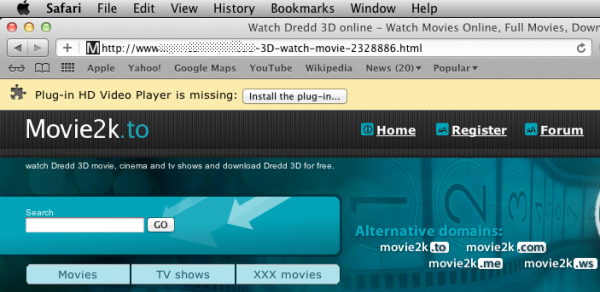
    If you are on a Mac and using either the Apple-supplied Safari browser, or one of the popular alternatives like Firefox or Chrome, then you may have begun noticing some unexpected ads in the browser lately. Hopefully not, because it spells bad news for you, and that news is Trojan.yontoo.1.

    Security firm Doctor Web is credited with the discovery of this latest attack on the Apple ecosystem. Like many Trojans though, it requires the user to make mistakes in order to get a foothold on the system. In fact, the cardinal mistake, clicking on a pop-up plugin message, is the culprit.

    In order to pull this off, Doctor Web reports that “criminals crafted movie trailer pages that prompt users to install a browser plugin. In fact, the prompt only imitates a common dialogue displayed when a plugin needs to be installed or additional configuration is necessary. After clicking on ‘Install the plug-in’, the user is redirected to another site from which Trojan.Yontoo.1 is downloaded”. In addition, the Trojan is also now being spread by downloads of a media player, a video quality enhancement program or a download accelerator.

    Once infected, computer’s browsers begin display fake ads on many websites, including the Apple.com. The Trojan then injects ads into those pages using third-party code. This allows the attackers to collect unauthorized ad views on nearly any website they want.

    While all of us on Windows have grown accustomed to all of this, it remains new for those customers who opt for Apple hardware and software. However, there has been a growing number of attacks on OS X, including the recent, and rather embarrassing Java exploit, that hit Apple back in February.

    Screenshot: Doctor Web

  • Everyplay wants you to share videos of your mobile game wins

    Finish a mobile game level in record time? They why not share a video of your accomplishment will all your friends? That’s the idea behind Everyplay, a new service that wants to bring video capturing and sharing to mobile gaming. “You can’t spell video game without video,” punned Applifier CEO Jussi Laakkonen, whose company is behind Everyplay, when he gave me a demo of the technology at our San Francisco office Wednesday.

    At its core, Everyplay is taking the idea behind game video sites like Twitch.tv to mobile, casual gaming, with an interesting twist: Instead of getting users to record their games with dedicated capturing software, Everyplay partners with iOS game developers to add its SDK to their games.

    NimbleBit's Nimble Quest hasn't even been released yet, but recordings of some scenes already rack up five-digit view counts on Everyplay.

    NimbleBit’s Nimble Quest hasn’t even been released yet, but recordings of some scenes already rack up five-digit view counts on Everyplay.

    20 games with Everyplay are already available on the iTunes app store. Some of them allow instant replay and sharing of key scenes, while others just continuously record a video of everything you do, ready to share at any time. Users can share these videos on Everyplay’s own website put them on Facebook, Twitter and YouTube. There’s also some basic social networking functionality built into Everyplay itself.

    Everyplay’s SDK is currently just available for iOS, but Laakkonen told me that his team is actively working on an Android version, which should be available soon. He also showed me a demo of an upcoming version of the SDK, which makes it possible to record the player with the phone’s front-facing camera in a kind of picture-in-picture style, which could lead to all sorts of neat meta-commentary about games.

    Interesting about all of this is Amplifier’s business model for Everyplay: The company is making the SDK available free of charge, and will even provide free links to each game on Everyplay.com, allowing users to click through and install the game after they watched a video recording of it. Laakkonen stressed that this would be a great, free way to promote games, and pointed to the Paper Planes creators NimbleBit, whose videos of their upcoming Nimble Quest game have already clocked thousands of views on Everyplay.

    So how will Everyplay make money? That’s where the company’s core business comes in: Finland-based Applifier started out as a Facebook game developer all the way back in 2008. Then Facebook deemphasized games in people’s stream, and the company shifted towards cross-promotion of games. That evolved into a full-blown game advertising network. Adding ads to Everyplay, which launched late last year, will be the next step. But Laakkonen said that he’s in no rush. First, he wants to build an audience for the service, and he’s already talking to some large publisher to come on board.

    In the end, Laakkonen said, Everyplay is about getting back to Applifier’s roots to produce things for gamers that also help developers. Something that gets individuals excited, and doesn’t reduce them to being a data point in someone’s plan to move a lot of referral traffic. Said Laakkonen: “I am not traffic. I can’t tell you how much I hate that term.”

    Related research and analysis from GigaOM Pro:
    Subscriber content. Sign up for a free trial.

  • At Eventbrite, the challenge is with realtime data

    Eventbrite has become one of the leading ticket sales platforms, facilitating events across the world from concerts to festivals to meet-ups. But beneath the exterior site, there’s a lot of data flowing through the company’s platform, and it’s not easy keeping up with the realtime data challenges that come with the company’s growth.

    Vipul Sharma, director of data engineering for Eventbrite, spoke at GigaOM’s Structure:Data conference in New York on Thursday about the data challenges facing his company, which fields customers and data from across the globe. By June 2012 the company had crossed $1 billion in ticket sales, and Sharma said Eventbrite has hosted more than a million events so far.

    Sharma,who has worked as an engineer since 2010 after leaving Digg, where he worked on data mining and machine learning, said one of the biggest data challenges Eventbrite deals with is the speed of the flow of information:

    “So basically what I’m trying to tell you is that the challenge in solving realtime is two-fold. One is the data flow, or how do I transfer the data I have in realtime to my downstream applications,” he said. “And the second part is processing, or how do I process this significant amount of data in realtime. To process in realtime you really need a distributed processing system.”

    Check out the rest of our Structure:Data 2013 live coverage here, and a video embed of the session follows below:


    Related research and analysis from GigaOM Pro:
    Subscriber content. Sign up for a free trial.