Category: News

  • Apple does the two-step: new layer of security added to Apple ID, iCloud

    Apple is giving its users more security over their Apple accounts and remotely stored data with a new option of two-step security authentication. Users can add two forms of verification on their Apple ID — the identity used to sign into iTunes, the App Store, FaceTime, iMessage and more — and their iCloud account.

    Apple updated its two-step verification FAQ page on Thursday. By turning it on, users will have to enter a four-digit passcode in addition to their Apple ID or iCloud password. Apple supplies the verification passcode, and it can be saved to each device that is used regularly. The four-digit passcode will replace the need for a security question, according to Apple’s documentation.

    Apple two-factor authentication Apple ID

    Considering how widely the Apple ID is used across a host of Apple services and devices, it’s somewhat surprising this wasn’t previously an option for Apple users. Apple’s account security procedures were found to have several cracks in them in light of the awful hacking attack on Wired writer Mat Honan last summer. His personal accounts with Google, Amazon and Apple were broken into by a hacker who played the companies’ security measures off of each other.

    At the time, Apple suspended the ability to let users reset their Apple IDs over the phone with an account representative. Two-step verification looks to be the company closing the loop on its earlier promise to improve its security measures.

    Related research and analysis from GigaOM Pro:
    Subscriber content. Sign up for a free trial.

  • New low-end iPhone expected to cost half as much as iPhone 5, margins seen at 38%

    Low-cost iPhone Margins
    Apple (AAPL) is expected to switch things up this year and launch not one but two new iPhone models. Industry watchers believe one will be an incremental update to the current iPhone 5, dubbed “iPhone 5S,” that will feature the same design with an updated camera and processor. The second will reportedly be a brand new low-end iPhone that may help Apple gain share in emerging markets. Regarding the latter, Credit Suisse analysts said in a recent research note picked up by ValueWalk that the new cheaper iPhone will likely achieve an average selling price of $329. Apple’s current iPhone 5 starts at $649, so it’s understandable that investors are concerned over crunched margins. According to Credit Suisse’s analysis, however, Apple should be able to pull off 38% gross margins with the entry-level iPhone, suggesting the new handset might not be as much of a burden on Apple’s sliding margins as anticipated.

  • Girl Scout Cookies: Mother Fired For Selling to Customers

    Parents who pressure co-workers to buy fundraiser products for their child’s sports team or school band can make things awkward around the break room, but Girl Scout cookies are generally the welcome exception. Even so, one woman went a step further by offering the snacks to customers and has now been fired for the offense.

    The local Fox affiliate in Washington D.C. is reporting that Tracy Lewis, an employee for a food service company at American University has been fired for selling Girl Scout cookies at work.

    Her former employer accuses her of selling Girl Scout cookies over-the-counter to customers. Lewis admitted to Fox that she kept the cookies “on a cart” and would sell them if customers asked, but she also stated that she did not solicit customers to buy them. She said that she had been doing this for three years.

    Fox reported that Lewis had been working for various food service companies at American University for 28 years.

  • Channel Intelligence Execs On Why This Was The Right Acquisition For Google

    Last month, Google signed an agreement to acquire Channel Intelligence to improve Google Shopping. At the time, a Google spokesperson told WebProNews, “We want to help consumers save time and money by improving the online shopping experience. We think Channel Intelligence will help create a better shopping experience for users and help merchants increase sales across the web.”

    Earlier this month, the deal was finalized. We had a Q&A with Channel Intelligence CEO Doug Alexander and co-founder Rob Wight about why this was a good pick up by Google, and how search-based ecommerce is evolving.

    Neither will be working for Google. Wight will continue the role he began two years ago, as founder and CEO of myList, and Doug Alexander will support him in this role while he continues as President of ICG, the company Google bought CI from. myList was spun off from Channel Intelligence in 2012, and it has operated, and will continue to operate as a separate entity.

    “[Brand visibility in ecommerce] is important for the same reason that it’s important to be on a shelf in a store,” Alexander tells WebProNews. “It is how you get into the consumer’s decision set when they are ready to purchase. And just like in a store, brands that do a better job of merchandising and a better job of giving the customer the complete and accurate information they need to make a purchase (correct pricing, sizes, availability, etc.) will be the brands that customers choose to buy.”

    “[Google’s new paid inclusion model for Google Shopping] gives Google an opportunity to create better shopping experiences for consumers,” he says. “Now that it is paid, retailers will focus on presenting the very best offering to win the consumer’s attention. When it was free, it was easier for retailers to treat this channel more casually.”

    “For over ten years, CI has focused on making it easy for consumers to find and buy products online, whether the buying process initiates on a brand’s website or on a shopping platform,” he says, on why this was the right acquisition for Google. “Our expertise with product data optimization and our deep relationships with retailers, manufacturers, publishers and agencies makes CI a natural fit with Google’s ongoing innovation to create outstanding consumer shopping experiences.”

    “It should help all businesses, regardless of size, be more successful in reaching consumers with their products within Google Product Search,” he adds. “What will it mean for consumers? It should mean that consumers will have an even easier time finding, researching, and buying products online.”

    Wight thinks search-based ecommerce is evolving into a more social media based experience.

    “One of the places people naturally go when they’re thinking of making a purchase is to their friends,” he says. “You’ve seen the studies – Nielsen reported a year ago that 92% of people say they trust recommendations from people they know … which is well over the 47% who said they trust ads on TV or in magazines. Social media enables this discovery process to happen online, and people are already trading information – lots of information – there about the products and services they trust. It’s just still in a really fractured kind of way, with one-off conversations and, generally speaking, incomplete information, which is inefficient. So it’s not a matter, necessarily, of people changing anything they’re doing on Google. It’s more a matter of making what they’re already doing in offline conversations and within social media a lot more effective, and hopefully a lot more fun.”

    “A friend of mine posted a really cool GPS tracking watch the other night,” says Wight. “He was raving about it. I was really intrigued, and pretty sure I wanted one too, but I didn’t want to leave where I was to go search for the price, colors, retailers, and all of that, so I just kept scrolling. If the picture my friend had shared has included the important product info, had shown me that 5 other of my friends already also had the watch, and had a simple link to buy it, I’m pretty sure I’d have made the order right there.”

    “There are a lot of ‘disembodied heads’ of products floating around in social media,” he adds. “Just pictures, with a comment or a like. They’re just begging to be gathered up into one complete representation of the product, along with the rest of the kind of merchandising they’d get in a store, or that the brand would put on their product page on the brand site.”

    Wight also sees another opportunity in social for brands to be able to act with more knowledge.

    “This is good for consumers, for the brands, and for the social platform,” he says. “Ads are spam when they’re irrelevant, but [when] they’re relevant, they’re welcome. Google has done a great job with this: when I search for, say, a wetsuit, Google shows me ads for wetsuits. Helpful. I love that. I’ve told Facebook that I like triathlons, but up until now, there hasn’t been a way for me to signal when I’m in the market for a triathlon bike. If I’m talking about them, posting pictures of them to friends, pulling together a list of ones I might want to buy, that’s hugely useful for the brand to know, right? What brand wouldn’t advertise to me on Facebook if they knew I was actively interested? And as a consumer, these advertisements would be welcome, not an intrusion, because they’d be relevant … meaning I’d value the ads more, the platform more … a win for everyone.”

    Google acquired CI for $125 million.

  • Pursuing big data utopia: What realtime interactive analytics could mean to you

    With Hadoop and HDFS and related big data technologies, we’ve pretty much licked the scale problem of handling petabyte upon petabyte of data. Next up: solving the speed problem.

    Right now running interactive queries across data sets spread among a thousand nodes is no mean feat. As a rule of thumb, you can run fast queries on old data (in a data warehouse) but running fast, interactive queries on massive distributed data sets is still the problem, according to speakers at a Structure:Data 2013 session today that honed in on what problems real-time data analytics — when possible — could attack.

    “Interactive analytics is a complex problem. You have on one end a business users asking ‘what if we did things a little different?’” said Silvius Rus, director of big data platforms for Quantcast. They may have 10 ideas on how to change something and 9 are bad, but one is good. They need to be to iterate queries and get the answer back in minutes not a day, he added.

    On day one of the show, Paul Maritz, the head of the new EMC-VMware Pivotal Initiative, talked about how companies need to have faster, more nimble feedback loops from their massive data stores. Telephone companies know they have dropped calls but they don’t know who’s call they dropped, and it can take days or even weeks to find out.

    That’s the sort of problem that this new world of fast, big data analytics can solve. In that world, the phone company “at the very least, could text you an apology,” he noted.

    Panel moderator Michael Driscoll, CEO of Metamarkets, really wanted to hear about what this “big data utopia” — where the system could ingest, transform and spit out answers to questions in real time — could mean. The applications that could start coming out within months could be impressive,  according to Ashok Srivastava,  chief data scientist for Verizon. There are the obvious things like real-time or near-real-time response to customer problems (see the dropped call issue above) and requests but he also foresees breakthroughs in cybersecurity. He cited earlier talks at Structure:Data about how systems can increasingly understand the motion and movement of people around the globe and the movements of concepts through society.

    And he thinks real-time big data capabilities will play out in citizen science research. “Imagine taking your cell phone pictures and combining them with multiple millions of other cell phone pictures. That’s something that can be used by scientists,” he noted.

    In health and medicine, the ability to query the most up-to-date personal health data along with historical data might enable real-time predictions about a person’s health or the status of machine health, he added.

    Check out the rest of our Structure:Data 2013 live coverage here, and a video embed of the session follows below:


    Related research and analysis from GigaOM Pro:
    Subscriber content. Sign up for a free trial.

  • The updated voice of TED-Ed

    As the one-year anniversary of the TED-Ed website nears, the TED-Ed team created a new video to walk users through the features on the site, like the ability to add questions, upload “dig deeper” materials and start discussion chains relating to any video. (This newest feature makes the website even more interactive for any type of learner.) But rather than get a traditional narrator for this video, the group had a crazy idea: what if the voice of TED-Ed were computer-generated?

    TED-Ed director Logan Smalley explains, “Practically speaking, it is way easier to re-record and edit. But more than that, we wanted to establish a character. This voice is naturally egoless, and future proofed — in future videos, the voice could become female or speak in another language. And our animators could potentially develop the character down the line.”

    See the 10 most-watched TED-Ed videos so far »

    Find out five ways you can help build TED-ED, from nominating an educator to volunteering to be a BETA tester »

    And find out how to track learning progress through the TED-Ed site »

  • Lose something on you PC? Recent Files Scanner has your back

    You’ve lost that important document you were working on yesterday; you’re wondering which files a program is accessing; or maybe you’d just like to know what someone else has been doing on your PC. There are many reasons why you might want to know which files have been created, modified or accessed on your PC — and Recent Files Scanner is just the tool to help.

    To get a feel for how the program works, just launch it and click the green Scan button. By default it will scan your Documents folder and any subfolders, and you’ll quickly be looking at a report listing everything you’ve modified recently.

    Click Settings and you can customise your scan, setting details like the folder to check, and the search depth (the folder only, 1 level, 10 and so on).

    There’s an option to set the range of dates that interests you. This is initially set to the last week, but you can change this to the last day, three days, 5 days around last Christmas, whatever you like.

    And elsewhere there are include and exclude filters; you can specify content which the file must include; you’re able to decide which file date to check (created, modified or accessed), and more. Click the Start button again to try the new settings.

    The report you’ll produce from this isn’t just a text list. Right-click any file and you’ll find options to open it, view its containing folder, check the file’s properties, view a preview (for images) and more.

    And if this still isn’t enough, click the binoculars icon and the program will monitor whatever folders you’ve specified, displaying newly created, changed or modified files in real time.

    There are some oddities here. In particular, the program didn’t always work as we expected, either intermittently refusing to scan the path C:\ and replacing this with its own Program Files folder. We couldn’t figure out why, though — other root folder scans worked fine, as did monitoring subfolders — so this might be a specific issue with our test system.

    Recent Files Scanner has some issues, then, but if you can live with its quirks (or perhaps avoid them entirely) then you’ll find a capable tool, very useful for monitoring file-related activity.

    Photo Credit: megainarmy/Shutterstock

  • KAPOOYA! Woman Describing Hailstorm Is Your Next Big Meme

    There was a pretty significant hailstorm in Brookshire, Texas on Wednesday morning. And when it hit, it sounded like KAPOOYA KAPOOYA!

  • The monetization dilemma for media: Paywalls on one side, advertising on the other

    In its recent analysis of the state of the media industry, the Pew Center noted how large numbers of newspaper publishers had put up paywalls or subscription barriers around their content — a group that will soon include one prominent former holdout, the Washington Post, which announced that it is launching a paywall this year. At the same time, the report also described how many publishers are experimenting with new forms of advertising such as sponsored content and “native” advertising.

    The driving force behind both of these phenomena should be fairly obvious: the media industry is desperate to find new sources of revenue.

    That the Washington Post has finally seen fit to erect a paywall — albeit a very leaky one, as my colleague Jeff Roberts has pointed out — makes this point better than almost any other, since the newspaper’s chairman and CEO Don Graham has been vocal in the past about his opposition to such an idea, and so has the paper’s publisher, his niece Katharine Weymouth. As the Columbia Journalism Review has noted, however, the Post’s business is disintegrating fairly rapidly, giving it relatively few options.

    Everyone is searching for new revenue options

    This isn’t unique to the Washington Post, by any means. It’s a dilemma that almost every media entity, large or small — both digital and non-digital — is struggling with, as advertising continues to decline and no new source of revenue has emerged to take its place. And that’s one of the key questions were are going to be discussing at paidContent Live in New York on April 17, through a variety of panels. What is the best way (if there is a single best way) for publishers to monetize their content?

    Is it better to erect a paywall and base your future on a reader-driven subscription model, as many newspapers are doing — and as some individuals such as Andrew Sullivan are also doing? Or should publishers rely on what has always been the core of their business model, namely advertising, and find new ways of delivering that value to brands?

    Advertising

    Newer digital-native publishers such as BuzzFeed are pinning their revenue hopes on sponsored content and other forms of “native” advertising, in which the site creates content that is indistinguishable from its regular content (apart from the name of the brand sponsoring it). While this seems to work well for an entertainment-focused site like BuzzFeed — which is introducing its own sponsored-content advertising network for other sites, according to a report in Ad Week — it has been a somewhat rockier road for more traditional publishers such as The Atlantic.

    On one of our panels at paidContent Live, we have News Corp. executive Raju Narisetti — who not only works for the owner of one of the premier examples of a paywall in action, the Wall Street Journal, but previously worked for the Washington Post, and has also spoken in the past about his enthusiasm for what he calls a “reverse paywall” approach, in which loyal readers are given rewards for their loyalty instead of being asked to pay more for the privilege, which is the way that most paywalls typically work.

    What is the best monetization method?

    We also have Justin Smith, president of Atlantic Media, which publishes a magazine with a 160-year history, but has also been at the forefront of experimentation with new revenue models online — including real-world events, as well as sponsored content. A recent episode involving a sponsored piece about Scientology, however, led to a firestorm of criticism, including a comment from widely-followed media theorist Clay Shirky that “we don’t trust The Atlantic as much as we used to.” The company later changed its policies around how it handles such content as a result of the uproar.

    Major League Baseball CEO Bob Bowman will also be joining us, since the MLB is a company that has become a powerful content producer in its own right — and in fact was earlier to the digital evolution of content than many content companies — and has used a paywall and mobile apps to great success as a way of monetizing that content. Are there lessons baseball can teach other content companies? We’re going to find out.

    No one can claim to have all the answers to the future of the media business — not the largest traditional media player, nor the smallest and most innovative startup. All we really have are some very interesting questions, and we hope some of you can join us in that discussion on April 17 in New York. You can find more details about paidContent Live, including a link to register, on our event page.

    Images courtesy of Shutterstock / Eldorado3D

    Related research and analysis from GigaOM Pro:
    Subscriber content. Sign up for a free trial.

  • Gamers Have Pledged Over $100 Million To Games On Kickstarter

    It’s no secret that games are popular on Kickstarter. Games of both the video and tabletop variety have taken to Kickstarter to seek funding for their insanely creative ideas. After a stellar 2012, and a promising 2013 ahead of us, Kickstarter has shared that the games category has reached a new high on the crowdfunding site.

    Kickstarter announced that games have pulled in over $100 million over the past four years. All that money was supplied by 633,242 gamers as they pledged support to 1,476 successful projects. 2012 was the banner year for gaming on Kickstarter as the company says nearly 1,000 projects were submitted last year as many developers and game makers tried to emulate the success of the Double Fine Adventure.

    Speaking of Double Fine Adventure, that particular project really kicked off the frenzy of gamers throwing money at games they wanted to see become reality. Gamers broke $1 million in total funds pledged in 2011 with $3.8 million pledged over the course of the year, but the year of the Double Fine Adventure saw that number skyrocket with gamers pledging a total of $83.1 million over the course of the year.

    This year is looking even better for gamers as gaming projects have already raised over $22.4 million in the first three months of the year alone. If it keeps at this pace, games could easily break $100 million this year alone.

    Kickstarter will be at PAX East this weekend with the Kickstarter Arcade showing off video and board games that have been successfully funded and brought to fruition thanks to the crowdfunding platform. Some of the games at the event will include God of Blades, Strike Suit Zero and Cards Against Humanity.

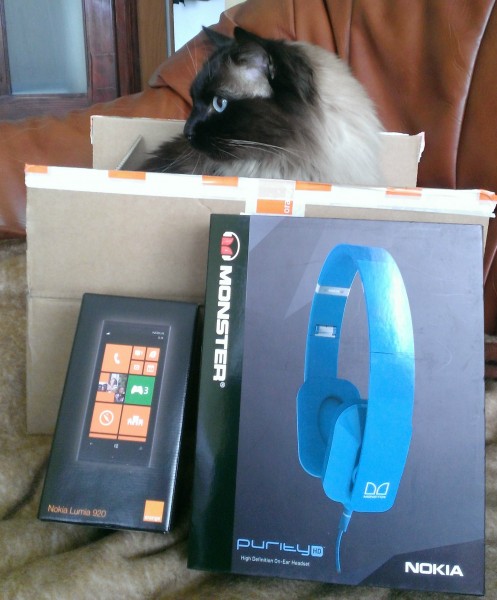
  • Nokia Lumia 920 arrived and I’m thrilled

    Not even during my time as a child opening up presents from under the Christmas tree have I ever been so thrilled and pleased about a new toy as I am today. Some of you may call me a fool for trying to mend a close-to-broken relationship, but I gave Windows Phone 8 another try and purchased a Nokia Lumia 920. And, oh boy, do I feel like a fool for buying the HTC Windows Phone 8X two months ago.

    At its core, the Nokia Lumia 920 is still a Windows Phone 8-based smartphone but the overall experience that exudes from using it is totally different compared to what I am used to. The Lumia is bulkier, heavier and better built than most smartphones on the market today, all while telling a different software story than the Windows Phone 8X, which now feels agricultural. Depending on where your preference lies that may either be a desirable trait or big no-no.

    Aesthetics matter, they matter a lot to me because when I pay serious coin to get a device that I will use for a long time to come and especially extended periods of time (calling, browsing, etc.). I want that device to feel special. And the Lumia 920 does feel special. Place it alongside any other smartphone on the market right now, and even in the boring shade of black, this Nokia still stands out.

    The button placement, even though still not ideal, is good. The camera, power and volume keys (which have a ceramic finish) are on the right side of the Lumia 920, within reach to make one-handed use possible (unlike the Windows Phone 8X). The polycarbonate shell feels great in the hand and does not creak under pressure.

    The display, which comes with the PureMotion HD+ and ClearBlack technology, makes colors pop but for AMOLED fans there may be too much bleeding at high brightness (meaning black is not as deep). There’s also more saturation, which makes the display feel closer to AMOLED settings because of the warmer rather than colder color reproduction.

    At a first glance the camera is pretty good, although I’m not convinced just by snapping a few pics here and there (my cat loves to pose) and will reserve the final judgement for a in-depth review. Nokia’s approach to camera (photo and video) settings is also different and embodies a less-is-more approach by delivering fewer customizable options compared to the software on the Windows Phone 8X, so that’s another aspect to consider for customization freaks.

    The Nokia collection inside the app store is the opposite of HTC’s equivalent. There are 58 apps available from the Finnish manufacturer, whereas the Taiwanese counterpart only offers a freaking six. A simple math calculus reveals a difference of 52 apps between the two. For now, I leave you with these numbers and I will come back to them in a future and more comprehensive story comparing the Windows Phone 8X to the Lumia 920.

    There are two things that I’m not a big fan of right now. First is the carrier branding (I ordered the Lumia 920 through a local mobile operator) which even though is subtle, I can’t help but notice that it’s there. Maybe it’s my OCD in keeping things as close to stock as possible, but I want that branding gone. And, second, is that 4G LTE is disabled on my unit likely until Nokia releases an updated firmware to enable the functionality.

    I’m convinced that as time goes by and the initial rush and excitement slowly settles down to the normal parameters I shall find more faults to pick with the Lumia 920, but so far I think that it may just be my last smartphone this year. Of course, I also had the same thought a couple of times before and look where I am now.

    Photo Credit: Mihaita Bamburic

  • What’s Going on with Google Now for iOS?

    So, what the hell is happening with Google Now for iOS? According to conflicting reports from people on each end, it’s stuck in some sort of non-existent approval limbo.

    Speaking at the Big Tent Summit in India earlier, Google Executive Chairman Eric Schmidt made a sort of off-handed remark about Google Now and whether we’ll be seeing it pop up for iOS in the near future.

    “You’ll need to discuss that with Apple,” Schmidt said. “Apple has a policy of approving or disapproving apps that are submitted into its store, and some of them they approve and some of them they don’t.”

    Not exactly crystal in its clarity, but it suggests that Google Now for iOS’ fate currently rests in the hands of Apple.

    Now, Apple is denying this. According to CNET, Apple told them that Google Now has not even been submitted to the App Store for approval. Apparently, Schmidt is misinformed, at best.

    Nearly a year ago, Google Now launched at an Android-exclusive product. It may be coming to Chrome pretty soon, but it looks like its fate on iOS, if it exists, is up in the air.

    Last week, a video “leaked” (or surfaced, depending on whether not not you feel it’s legitimate) showing Google Now for iOS. It looks official enough, and it led many to believe that Google Now would be heading to iPhone and iPad sooner than later.

  • Why Guavus analyzes lots of telecommunications data before storing it all

    It’s not unusual to think that if data scientists want to analyze data, the first step is to collect it and spend a lot of time looking at it — asking questions, refining data sets and then getting some possible answers. But at Guavus, the emphasis is on analyzing petabytes of data as soon as it comes in to deliver real-time results, Anukool Lakhina, the company’s founder and CEO, told attendees at GigaOM’s Structure:Data conference on Thursday.

    A decade ago, when Lakhina worked at Sprint Labs, Sprint employed deep-packet-inspection probes to collect information about how subscribers were using the telecommunications company’s services. It was a good idea — “if we knew how they were interacting, we’d be invisible, we’d know everything about our business,” Lakhina said. But the data couldn’t really be harnessed quickly. FedEx trucks drove around and picked up quickly-filled storage arrays sitting next to the probes around the Sprint network. Engineers jokingly referred to the process as the “package-switch network,” rather than a packet-switch network, Lakhina said. Once the data was collected, researchers reviewed roughly day-old data and matched it with other data. They reported their findings and were roundly turned away, because the data was, well, dated.

    Guavus, founded in 2006, automates the FedEx model, so telcos can derive insights from data immediately. Guavus offers its customers customizable dashboards with the self-service simplicity of a consumer application.

    The change in thinking from store first to compute first has led to a lot of clear return on investment, at least as Guavus has applied it. One service provider using Guavus discovered that some cab drivers were supposed to be using the network for credit card transactions but were actually carrying live video streams. The use violated the end users’ contract terms and resulted in renegotiations. Another Guavus customer used the product to respond during customer-care calls and explain why end users were getting charged extra for large data use. Data from Guavus can also let customers pass down intelligent information to end users through self-service portals.

    These are $100 million problems, Lakhina said. “And you don’t need to do a lot of hunting around to discover these big use cases,” he said.

    Check out the rest of our Structure:Data 2013 live coverage here, and a video embed of the session follows below:


    Related research and analysis from GigaOM Pro:
    Subscriber content. Sign up for a free trial.

  • BlackBerry Z10 said to have ‘disappointing’ preorder volumes in the U.S.

    BlackBerry Z10 U.S. Preorders
    BlackBerry (BBRY) is in need of a hit in the United States, but it seems that early preorder volumes for the BlackBerry Z10 on American wireless carriers have been below expectations so far. Barron’s points us to a new note from Detwiler Fenton & Co. analyst Jeff Johnston, who says that preorders for the Z10 “have been light and well below expectations” on carriers he’s checked in with so far. Johnston says that Z10 faces a consumer awareness problem in the U.S., which has only been exacerbated by other recent high-profile launches such as the recent Galaxy S 4 and the HTC (2498) One.

    Continue reading…

  • Apple now powering its cloud with solar panels, fuel cells (photos)

    Apple has turned on the first halves of both its massive solar panel farm and adjacent fuel cell farm, and is using the systems to provide power for its $1 billion, 500,000 square-foot data center in Maiden, North Carolina. The clean power projects are some of the largest non-utility owned systems in the world, and they’re part of Apple’s plan to use 100 percent clean power for its data centers. Apple revealed the information in a new environmental report on Thursday.

    Bloom Energy

    The Maiden data center was built partly to power its iCloud services and is part of Apple’s overall plan to increasingly provide music, media and other applications from its cloud computing infrastructure. So think about it this way — when you backup your new Rihanna album, the servers that are powering it could (probably indirectly) be using fuel cell or solar power.

    The fuel cell farm (pictured above) was developed by Silicon Valley startup Bloom Energy, and the live system is currently at 4.8 MW. Apple has decided to double the size of the fuel cell farm and will be installing more fuel cells shortly to make the farm 10 MW. An Apple spokesperson tells me that those new fuel cells will be live very soon.

    Apple Solar Farm

    Apple’s live 20 MW solar farm uses solar panels from San Jose’s SunPower. Apple has also decided to double the size of the solar panel farm and is building another 20 MW solar panel farm next to this current one. Apple says in its new environmental report that its second solar farm will be completed by the end of the calendar year, and when that is finished and live Apple will have an installed annual capacity of 167 million kWh from local Apple-owned clean power projects.

    Apple Solar Farm

    Apple is producing enough clean power at the Maiden facility to provide 60 percent of the total energy for the data center. Remember it’s a big facility and servers are energy hogs (even if Apple’s facility is very energy efficient). Apple gets the rest of the power from the local grid, where Duke is the utility. While North Carolina largely gets its power from coal and nuclear, Apple is buying renewable energy credits to offset the rest of the grid-power used.

    Apple is using this combination of direct clean power generation, buying clean power from providers and buying renewable energy credits to reach 100 percent clean power for all of its data centers. Apple is building large data centers in Prineville, Oregon and Reno, Nevada and is using this approach in those locations, too.

    Apple says in its new report across all of its buildings — both data centers and corporate offices — 75 percent of its energy usage comes from clean power. That’s up from 35 percent in 2010.

    Clean energy generation on the scale that Apple is doing for its data center is new, so the infrastructure is a mix of some complex and sometimes indirect methods. State incentives and laws are also different in each state, so that changes the strategy per state. For example, in California Apple can buy clean power through a program called Direct Access, but in North Carolina Apple decided building actual power plants was a better option.

    In Maiden, Apple is selling the power from the fuel cells to the local utility, so it won’t necessarily be using the fuel cell energy onsite to power the data center. The fuel cells will use biogas, and Apple can earn money by selling the power and associated Renewable Energy Credits to Duke. The biogas used will come from landfills, and will be “directed biogas” which means it will be injected into natural gas pipelines and not used directly in the actual fuel cells at the site.

    Check out my previous series on this data center:

    Here’s some more background reading on these projects:

    Related research and analysis from GigaOM Pro:
    Subscriber content. Sign up for a free trial.

  • Wall Street Journal App for BlackBerry 10 Available Now

    Proud owners of the new BlackBerry Z10 can now get on the go access to the Wall Street Journal’s award winning coverage on the go. The Wall Street Journal App for BlackBerry 10 is available for download in the BlackBerry World storefront. Readers will enjoy News, Opinion, Marketplace, Greater New York and more.

    Beth Buehler, Head of Business Development for Dow Jones & Company, said in a statement: “The debut of The Wall Street Journal’s app for BlackBerry 10 is the latest evolution in our ‘WSJ Everywhere’ digital strategy to meet new audiences through new digital platforms.” The global reach of the BlackBerry platform allows us to continue expanding upon our own international growth, particularly in Asia, Europe and South America.”

    As a blogger, I’m always looking for some of the best ways to get my news fix, and the Wall Street Journal app for BlackBerry 10 looks fantastic. Here’s just some of what subscribers can look forward to:

    • Articles from Today’s Paper
    • Updated news from Business, Tech, Life and Culture and more throughout the day
    • Article sharing via email, Facebook and Twitter
    • Photos of the day, video-on-demand and podcasts

    This time the news follows you. Download the WSJ app on your BlackBerry 10 smartphone for award-winning content anytime, anywhere. BlackBerry 10 launched with more than 70,000 apps and we’re continuing to bring new apps to BlackBerry World every day. Already have your hands on a BlackBerry Z10? Let us know some of your favorite apps in the comments below.

  • Adblock Plus Not Discouraged By Play Store Ban, Creates Easy Workaround

    Adblock Plus

    Google has made it very clear they won’t allow ad-blocking apps in the Play Store and one such app recently removed was Adblock Plus. The desktop version continues to move right along with almost 25 million users on Chrome and Firefox combined. Although Adblock Plus can no longer be installed through Google Play, they’ve made it available for any Android user to manually install. By going to “Settings, “Security” and selecting “Unknown Sources”, you can install the app on your phone or tablet. Automatic updates have been added to the latest version of Adblock Plus so users won’t have to deal with manually installing a new version every time one is released. How do you feel about ad-blockers? Should they be allowed in Google Play?

    Source: Adblock Plus

    Come comment on this article: Adblock Plus Not Discouraged By Play Store Ban, Creates Easy Workaround

  • Google Axes Frommer’s Print Travel Guides [Report]

    According to a report from travel news site Skift, Google has quietly killed Frommer’s print travel guidebooks.

    News that Google acquired Frommer’s came out back in August. Google would be buying the brand from John Wiley & Sons. Terms of the deal were not disclosed, but according to All Things D, the deal wasn’t “a huge one”. Frommer’s would be incorporated into Zagat.

    Google said at the time, “The Frommer’s team and the quality and scope of their content will be a great addition to the Zagat team. We can’t wait to start working with them on our goal to provide a review for every relevant place in the world.”

    As TechCrunch’s Sarah Perez noted, “No definitive decision has been made on the Frommer’s printed guides, but the deal is supposed to enable users discover reviews across Google, which means online.”

    Skift’s Jason Clampet reports today:

    The last two Frommer’s books to roll off the presses were guides in the all-color Day-by-Day series devoted to Napa and Sonoma and Banff and the Rockies, and went on sale in early February. The last book in the traditional complete guide series was Frommer’s Florida in late December.

    Starting with Frommer’s New York City With Kids, which can still be found on Amazon, Barnes & Noble, and in other bookstore inventories and was supposed to publish on February 19, the entire future list of Frommer’s titles will not see the light of day. Many of the authors attached to these 29 titles told Skift that they were informed by editors now working at Google that the books would not publish. Some authors were told that the books would merely be delayed before new contracts were signed. None of the authors contacted reported that their titles would appear in print.

    Greg Sterling speculates that Google will ultimately kill the Frommer’s brand, suggesting that it can’t survive without the print guidebooks, though the Frommer’s site is so far still alive and well.

    We’ve reached out to Google for comment, and will update if we hear back.

  • Amazon Kindle Now Available for BlackBerry 10

    Amazon Kindle for BlackBerry 10

    Millions of books are now available on BlackBerry 10 via the World’s most popular e-reading platform – Amazon Kindle. This got me thinking – what do you call a bookworm for the digital age? Morris. Geek humor aside, this is one app launch that we’re particularly excited for.

    I love to read and I’m thrilled that I can now carry all my books with me in the palm of my hand with my BlackBerry Z10. I can buy a book once and can read it anywhere. Plus with technology like Whispersync my bookmarks, notes and highlights sync across my account. The app also supports newspapers and magazines.

    On top of that, here are some other features that make Kindle on BlackBerry 10 so handy:

    • Personalize – Adjust the text size, change the screen’s brightness, choose your background color, and read in either portrait or landscape mode.
    • Look Up Words – Tap and hold any word in a book to view the word’s definition with the built-in dictionary or use the Google or Wikipedia links to get more information.
    • Sample Books Before Buying – Easily shop for ebooks and read the first chapter for free before you decide to buy.
    • Bi-Lingual – Kindle is available in English and French.

    The Amazon Kindle app for BlackBerry 10 is available in the BlackBerry World storefront as a free download. Let us know what ebook you’ll be curling up with tonight in the comments.


    Please note the app may take up to 24 hours to appear in the BlackBerry World Storefront.

    Still haven’t figured out the Book Worm joke?

  • Google Introduces Interactive Chrome DevTools Training Course

    Developing Web apps can be made easier by using Chrome DevTools, but not everybody knows how to use them. To remedy that, Google is now offering a free interactive course on how to get the most out of the development toolset.

    Google announced today the launch of Discover DevTools, an interactive Code School training course that teach developers “how to take advantage of Chrome DevTool’s powerful suite of resources and speed up the development and debugging of your Web apps.”

    The course will be split into seven chapters with each one covering a specific set of features in Chrome DevTools. Each chapter will feature a video tutorial that’s followed up by a set of challenges that will test what you’ve just learned. The Chrome DevTools will be integrated into the challenges themselves so developers will get a feel for how to use them while learning.

    While the course is intended for those new to Chrome DevTools, Google says that veteran developers may want to take the course to brush up on their skills. The company says that developers may even “find some lesser-known features from this course that can really boost productivity.”

    Here’s some of the things you can expect to learn from the courses:

    You’ll learn a debugging workflow to go from an uncaught exception to a live fix without ever refreshing your app. In addition, the course will share time-saving tricks to improve your efficiency while debugging CSS, improving reflow issues, and interpreting your network and JavaScript bottlenecks. You’ll also uncover the DOM bottlenecks that are blocking you from delivering a slick 60 FPS experience.

    You can check out the first video tutorial below. While you’re at it, hit up the course Web site to start learning about Chrome DevTools.