
Category: News
-
Galaxy S IV to feature same GPU technology used in iPhone 5
-
Don’t touch that dial: How YouTube is bringing adaptive streaming to mobile, TVs
Have you ever played with the settings of a YouTube video to make it look better? YouTube Mobile and TV engineering head Andy Berkheimer would like you stop doing that.

Don’t touch that dial: YouTube’s adaptive bitrate streaming makes manual adjustments unnecessary.
Berkheimer headed a project last year that brought adaptive bitrate streaming to the YouTube desktop player, enabling the player to automatically switch between different video quality settings based on your internet connection speed, among other factors.
Now he is bringing the same technology to mobile devices and TVs. “We are making it work just as it should,” Berkheimer told me during an interview this week.
From 240p to 4K
That may sound simple, but optimizing video playback has been a long journey for the Google-owned video site. Berkheimer joined YouTube six years ago, when there was just one default video quality — 320×240, also known as 240p. “That was really, really grainy video,” recalled Berkheimer.

Berkheimer joined YouTube when every video still looked grainy.
His team used Google’s cloud infrastructure to allow for additional codecs, bringing HD and eventually even 4k to the site. But with higher bitrates, buffering also became more of a problem.
The solution? Adaptive bitrate streaming, which is industry-speak for switching the quality of a video in midstream, without the need to re-buffer and start over. YouTube started switching from progressive downloads to adaptive bitrate streaming in its desktop player a year ago, and completed the process late last year.
The new player is keeping close eyes on the speed and health of your internet connection, explained Berkheimer: “It’s continuously monitoring the bandwidth and the throughput it is seeing,” he said, adding that it also keeps tabs on the size of your player. Are you watching a video in full screen? Then you can expect YouTube to send you more bits, as long as your connection is fast enough.
YouTube’s take on adaptive streaming
Adaptive streaming isn’t new: Companies like Netflix and Hulu have used the technology for some time to optimize their streaming experience. But YouTube had some unique challenges to solve when it rolled out its own implementation. For example, Netflix often starts with a lower-bitrate stream and then slowly scales up, which is why it can take a minute or so before full HD quality sets in.
That approach doesn’t really work for YouTube videos that only last a minute or two. YouTube tends to be more aggressive in sending out higher-quality video, and then scales down the video if necessary, Berkheimer explained. The site also makes use of the fact that you often watch more than one YouTube video in a row, and optimizes your bit rate across an entire session.
The results of these efforts have been encouraging. YouTube has seen buffering reduced by 20 percent since it launched adaptive streaming for its desktop player. That’s why the company is now taking the technology to TVs and mobile devices.
Next up: mobile and TVs

YouTube on TV: Buffering is much more noticeable on the big screen.
Of course, TVs require a lot more HD video, and buffering becomes even more obvious when you compare it to the nonstop experience of a traditional broadcast. Berkheimer told me that YouTube is working with the majority of the TV industry to bring adaptive streaming to TV sets, and that virtually all models introduced at CES this year already support the technology. The company is also working to bring adaptive streaming of YouTube videos to game consoles.
Mobile, on the other hand, comes with different challenges, as people move in and out of the reach of cell towers while they get their video fix on public transport.
And then there is this: “One of the biggest challenges we have is the global nature of YouTube,” said Berkheimer. Average mobile internet speeds are much slower in India and Brazil than in the U.S. and Europe, but videos still have to play without long and tiresome buffering. Broadband in Canada on the other hand is fast, but tightly rationed, with major ISPs charging their customers extra if they go over their caps.
That’s also one reason that those settings that allow you to manually change the bitrate of a YouTube video haven’t disappeared from the player yet — even though Berkheimer would very much like them gone. He told me that there have been some passionate discussions within the company about these manual settings. The result? For now, they’re staying.
But Berkheimer and his team are still working hard so that you can completely ignore them. “The most rewarding thing is that users don’t have to think about it,” he said.

Related research and analysis from GigaOM Pro:
Subscriber content. Sign up for a free trial.- Report: A Mobile Video Market Overview
- How consumer media will change in 2013
- What the shift to the cloud means for the future EPG


-
Amazon Kindle Fire HD 8.9-inch model price cut

Amazon announced today that it was cutting the price on both versions of its largest Kindle device, the Kindle Fire HD 8.9. The WiFi only version of the tablet was priced at $299 in the U.S. and will see its price drop to $269. The price cut for the 4G enabled version is more dramatic, going from $499 down to $399. According to Amazon, they sell their Kindle devices at cost. With the impending release of the device to several new markets including the U.K., Germany, France, Italy, Spain and Japan, Amazon claims they have achieved some new economies of scale as they ramp up production to meet the expected demand from the new markets.
Amazon sells their devices at cost as part of a strategy to make their profit selling content for the devices, whether it is books, movies, magazines, games or other digital products. A small amount of profit is also made selling accessories for the devices. This strategy depends on Amazon selling a lot of units, something some analysts don’t think is happening. Chad Bartley with Pacific Crest Securities cites sources in the supply chain who have told him demand is weak. Others, like BGC Partners’ Colin Gillis, think the price drop is part of the normal sales cycle that slows down during the first part of the year.
If you have been eyeing a Kindle Fire HD 8.9, now may be the time to make your move.
source: Reuters
Come comment on this article: Amazon Kindle Fire HD 8.9-inch model price cut
Visit TalkAndroid for Android news, Android guides, and much more! -
On eve of Galaxy S4 launch, Apple exec dumps on Android
Apple doesn’t engage in much public discussion involving anything besides its own products, or maybe its retail stores. So it’s extremely interesting — and rare — that Apple SVP of Worldwide Marketing Phil Schiller went on the record the night before the most anticipated Samsung phone launch to date, the Galaxy S4, to go negative on Android.
In a brief interview with the Wall Street Journal on Wednesday, Schiller ticked off reasons why he thinks iOS is better than Android: it’s not fragmented (“Android users are often running old operating systems”), the hardware and software for Android phones are made by separate companies, and the devices aren’t high quality (“Android is often given a free replacement for a feature phone”).
These are not new complaints; especially for those used to interacting with Apple, these talking points will seem familiar. And Apple’s not above slamming the competition in advertisements: witness the successful multiyear run of its Mac vs. PC ads.
Schiller did share a nugget we haven’t previously heard before — that “four times as many iPhone users switched from Android than to Android during the fourth quarter.” The number is supposedly from Apple’s own internal research. Obviously it should be taken with a grain of salt, but it’s also true that Apple sold 48 million iPhones in the fourth quarter and the device was the best-selling smartphone in the fourth quarter of 2012 in the U.S.
Whether Apple initiated the interview or the WSJ did, the rarity of a high-level Apple executive commenting on a rival’s looming product launch — something normally assumed to be beneath the company — will come off as somewhat defensive. But it could be yet another subtle signal that under CEO Tim Cook, the company is becoming a bit more open to traditional notions of competitive public relations.

Related research and analysis from GigaOM Pro:
Subscriber content. Sign up for a free trial.- Tablets wars: Apple is from Venus, Amazon is from Mars
- The future of mobile: a segment analysis by GigaOM Pro
- The connected planet: Smartphones aren’t the only player

-
Verizon will start building LTE network No. 2 this year
Now that Verizon has closed its blockbuster spectrum deal with the cable operators it’s ready to break ground on its second 4G network. In an interview with FierceWireless, Verizon Wireless CTO Nicola Palmer said Verizon would deploy 5,000 LTE cellsites this year in the Advanced Wireless Service (AWS) band, layering mobile data capacity onto the 4G network it’s already built in the 700 MHz band.
In 2014, Palmer added, Verizon will start building a much broader footprint in the new band. What’s more, Palmer said that Verizon would start selling its first AWS compatible devices in the next few months.
“You can’t have the network without compatible devices,” Palmer told Fierce’s Sue Marek. “We have already given the OEMs guidance on that strategy. The first half of this year we will see AWS-compatible devices in our lineup so when the network comes online in the second half, we will take advantage of that.”
There are some major implications in Verizon’s move:
- Verizon is now ready to start focusing on capacity instead of coverage. Palmer said Verizon’s 700 MHz LTE network will cover 90 percent of the U.S. population this year, meaning there will be few populated places where Verizon customers can’t get a 4G signal. It has enough AWS spectrum to double its LTE capacity nationwide, and almost everywhere east of the Mississippi it can triple it. That means it will be able to support more 4G subscribers and more 4G devices and eventually it will be able to boost 4G speeds.
- The AWS band uses 1700 MHz and 2100 MHz frequencies, which make it an ideal spectrum for urban deployments. The lower the frequency, the further radio waves propagate, so while 700 MHz was perfect for Verizon’s coverage network, you can expect Verizon to be more selective about where it builds the second network. It will likely target cities and other high-traffic areas and it may even USE AWS for its first indoor and outdoor small cells.
- By moving to AWS, Verizon will actually have a 4G band in common with other North American carriers. T-Mobile’ and the Canadian operator use the band. AT&T owns AWS licenses as well and is already sells devices that support those frequencies (the iPhone 5 is one of them). Network fragmentation has been a huge problem in the U.S., requiring handset vendors to make different variants of their devices for different carriers. With the operators coalescing around AWS, we could get a step closer to a smartphones that work across all carriers’ networks.
Other operators have plans to launch LTE over a second band as well: AT&T will make use of its newly minted 4G band in the 2.3 GHz frequencies, while Sprint will refarm the 800 MHz airwaves currently occupied by its Nextel network for LTE. Both operators are still at least a year away from making those plans reality.
 By putting LTE into a second band, Verizon could also become the first U.S. operator to start down the path toward the next-generation of mobile technology called LTE-Advanced. The first LTE-Advanced technique we’re likely to see is called carrier aggregation, which bonds two disparate spectrum bands together to create a single super-fast air link. Verizon could choose to merge its two LTE networks, effectively doubling the uplink and downlink speeds available to its customers.
Several U.S. operators — from Sprint and T-Mobile to Clearwire and Dish Network — have talked a big game about LTE-Advanced, abusing the term to make their networks seem more sophisticated than they are. Ironically, Verizon has never made any boasts about LTE-Advanced, but it might well be the first U.S. operator that commercially implements the first LTE-Advanced technique.

Related research and analysis from GigaOM Pro:
Subscriber content. Sign up for a free trial.- 2012: Data, spectrum and the race to LTE
- 12 tech leaders’ resolutions for 2012
- The future of mobile: a segment analysis by GigaOM Pro

-
IER’s Daniel Simmons to Testify on U.S. Energy Security
WASHINGTON D.C. — IER Director of Regulatory and State Affairs Daniel Simmons will testify on Thursday, March 14, 2013 at 9:30AM ET before the House Foreign Affairs Subcommittee on the Western Hemisphere, chaired by Rep. Matt Salmon (R-AZ). The …
-
Unannounced Motorola smartphone leaks, but it’s not Google’s X Phone [video]

-
MakieLab’s iPad App For 3D-Printing Your Own Dolls Has 70K Designed In First Week

Growing up, I pretty much had the standard dolls and toys everyone did — Trolls, Barbies and Teenage Mutant Ninja Turtles action figures.
But with the advent of 3D printing, kids today have access to something truly special: their very own custom-made toys.
A U.K.-based startup called MakieLab is making a bet that the rise of smartphones and tablets coupled with the decline of traditional retailers is making the iPad the right place to sell the toys of the future. And custom 3D printing will let kids have products that no one else does — toys they design themselves.
The startup launched a Makies Doll Factory app last week that lets you design your own unique doll with special hair, facial features and custom clothing. You can then have it 3D printed and sent to you at a price that starts around 59 pounds ($88), excluding shipping. The app has seen about 70,000 dolls designed so far in the first week. (These are dolls designed, not ordered. MakieLab isn’t sharing stats on orders yet.)
“People love the fact that these toys are on demand,” said co-founder Alice Taylor. “Because the child or adult has made the toy themselves, they’ve got a precious relationship with it. The doll has a heirloom aspect to it.”
MakieLab has been running a web-based version of the store for about a year, but this is the first time they’ve transitioned to mobile platforms. Ultimately, they hope their business will offer a mix of real-world and virtual goods. You can design dolls to buy in real-life or eventually there will be options to dress them up with virtual accessories. Like the rest of the gaming world, Taylor says there is a “power curve” dynamic with a small minority of customers being very aggressive with purchases. One had even bought everything in the store twice, she said.
The startup, which raised $1.4 million last year from seed investors, has been working hard to bring down the costs of manufacturing the dolls. At the beginning, it was about 99 pounds ($148). Now the most basic doll (sans hair) will be about 59 pounds, and then probably 20 pounds more if you want a simple outfit and a hairstyle.
“This is a journey we’re on,” Taylor said. “The material costs are quite high with the type of plastic we have.” MakieLab has printers in the U.K. and Amsterdam and ship globally. Right now, about 10 percent of sales are coming from the U.S., and the majority of people who order a physical doll also buy accessories.
“Eventually, we’ll expand it to be like a distributed manufacturing network, rather than having a centralized factory model,” she said. Finding printers has been a “trial-by-fire” effort, she said. “But we’re getting a ton of support. The suppliers and manufacturers want to see this happen.”
The company isn’t profitable yet and margins on each doll are about 20 percent, compared to the 50 percent level you’d see with standard toys and dolls. But Taylor thinks that a Moore’s Law-type effect is starting to kick in for 3D printing. Costs are coming down fast enough, that the MakieLab model will work over the long-run, she says.
The company also has other products in the works that will be more targeted toward boys or other demographics. That could help them reach the scale they need to raise margins.
“What you see now is 20 percent of our vision,” she said. “We want so much to happen faster, and it will happen over time.”
-
Reddit ‘Ask Me Anything’ with Economic Advisor Gene Sperling
This afternoon, Gene Sperling, Director of the National Economic Council, turned to Reddit to answer some questions about the President’s plan to reduce the deficit. During the 'Ask Me Anything', Sperling responded to questions on a range of topics, including the President's proposal to raise the minimum wage and how the "The West Wing" (television show) compares to the actual West Wing.
You can see all of the responses on Reddit, or check out the questions and responses below.

Gene Sperling, Director of the National Economic Council and Assistant to President Obama for Economic Policy, answers questions during an ‘Ask Me Anything’ on Reddit.
March 13, 2013.
-
‘Game of Thrones’ Gets the Mid-90s Sitcom Treatment
Last week, we showed you the incredible re-imagining of AMC’s hit series Breaking Bad as a mid-90s sitcom. At that time, I told you of my fondness for these types of things.
So it should come as no surprise that I’m equally as excited about this VHS-era reworking of HBO’s Game of Thrones, inspired by the Breaking Bad video.
Terrific work. Please keep it up, internet.
-
Android and iOS are neck-and-neck in two-horse tablet platform race

In December, I warned: “You can’t trust IDC’s 2016 tablet forecast, or any other“. That’s because the analysts revise predictions every couple months. Well, lookyloo. The firm dropped a new forecast late yesterday, and like every other Android gives iOS another beating. I say, “Perhaps”.
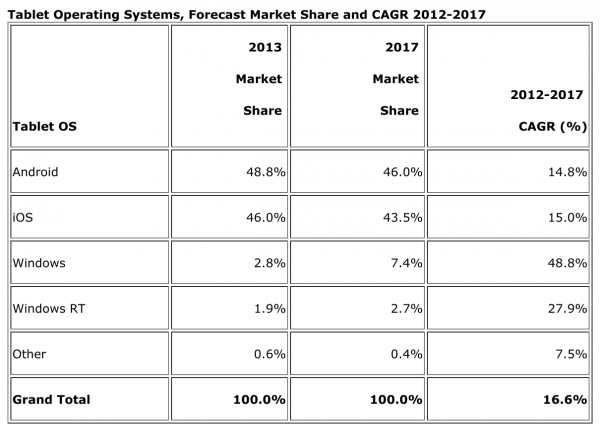
The great soothsayers now see Android tablet shipment share rising above iOS for all 2013, a feat already claimed individually for third and fourth quarters. IDC sees the green robot at 48.8 percent share to 46 percent for the fruit-logo. Don’t believe it. The market is too volatile and IDC, along with all its competitors, has yet to make accurate predictions. Anything can happen, including an unexpected surge of Windows tablets.
Let’s look at the track record for 2012. In June, IDC forecast iOS tablet share of 62.5 percent, but revised downward to 59.7 percent in September and in early December to 53.8 percent. Meanwhile, IDC forecast Android share of 38.8 percent in June, lowered to 35.3 percent in September and raised to 42.7 percent in December. With just three weeks left in the year, the analyst firm couldn’t get projections right. Final numbers: 51.3 percent for iOS and 46.3 percent for Android. Statistically, the margins of error here are huge. Just ask NASA sending spacecraft to Mars.
Let’s use a different measure. Between March and December last year, IDC raised its tablet forecast for 2012 by 15.3 percent and 2016 by 42.6 percent. This kind of change is huge, taking place during the course of a single calendar year.
A new year means another forecast (through 2017) and more revisions. The analyst firm raised full-year shipment projections to 190.9 million from 172.4 million. That’s an 11-percent change, which IDC applies throughout the forecast period. Projection for 2017: 350 million. Don’t believe it. The actual number will be considerably more.
That’s because smaller slates, which sales potential most analyst dismissed two years ago, are gangbusters. “One in every two tablets shipped this quarter was below 8 inches in screen size — and in terms of shipments, we expect smaller tablets to continue growing in 2013 and beyond”, Jitesh Ubrani, IDC research analyst, says. Geez Louise. NPD DisplaySearch predicts models with 7-7.9-inch screens will account for 45 percent of all tablet shipments in 2013.
Oh, and keeping with the “you can’t trust anyone’s forecast” theme, DisplaySearch estimates 240 million tablets, or 67.6 million more than IDC projections.
I do expect smaller slates to outsell larger ones, since they double so well as ebook readers (which forecast IDC lowers) and cost so much less. “Vendors are moving quickly to compete in this space as consumers realize that these small devices are often more ideal than larger tablets for their daily consumption habits”, Ubrani says. Yes, there are.
Perhaps it’s no coincidence that less than 24 hours after IDC released the forecast, Amazon cut prices by as much as $100 on Kindle Fire HD 8.9″.
The tablet, from the maker of Kindle Reader, is good segue to ebook readers, to which IDC says smaller slates are “damaging”. The analyst firm cut projections by 14 percent average through 2016.
Photo Credit: Cheryl Ann Quigley/Shutterstock
-
Nintendo Bringing Flipnote Studio 3D To 3DS This Year
One of the more popular apps on the Nintendo DSi was Flipnote Studio. It allowed artists to create frame-by-frame animation on the handheld device, and share the animations with the world via the Web. Now Nintendo is bringing an updated version of the software to the Nintendo 3DS.
During a Nintendo Direct Mini posted today, the company announced that Flipnote Studio 3D is currently being developed for the Nintendo 3DS. The software still allows artists to create short animations, but the animations can now be rendered in 3D on three separate planes. Artists also now have access to six colors per animation instead of the two available in the original software.
Flipnote 3D will be available for free this summer.
Check out the announcement, and Iwata’s creepy floating head, below:
-
Paltrow Elimination Diet Book Cuts Out Meat, Wheat, and Sugar
Gwyneth Paltrow may be most famous for her acting abilities, but the oscar-winning actress would really like you to know just how meticulously she plans her diet. The star and co-writer Julia Turshen will soon release a cookbook filled with recipes from Paltrow’s “elimination diet.”
According to the publisher’s book description, Paltrow was once diagnosed as anemic and vitamin D deficient. She was placed on an “elimination diet” the star maintains helped her from feeling fatigued. Paltrow supposedly uses the diet when she needs to “feel more energetic” or “lose weight,” which seems suspicious since the actress has never been considered overweight (other than when wearing a fatsuit in the movie Shallow Hal).
Elimination diets are based on the idea that certain foods should be avoided altogether, due to food allergies or some other reason. In Paltrow’s case, this meant she cut out coffee, alcohol, dairy, eggs, sugar, shellfish, deep-water fish, wheat, meat, soy, or anything processed.
That wouldn’t seem to leave much to eat, but the new book manages to come up with 185 different recipes that don’t have any of those things. Highlights include huevos rancheros and salmon burgers, but the “power brownies” and “banana ‘ice cream’” mentioned probably won’t live up to their sugary namesakes.
The book, titled It’s All Good, will be out starting April 2.
Those who don’t particularly care what Paltrow eats on a daily basis may be happy to learn that she won’t be giving up her day job to become a cooking author just yet. Paltrow will reprise her role as Tony Stark lover Pepper Potts in this summer’s upcoming Iron Man 3 and has been cast as artist Dora Maar in an upcoming Pablo Picasso biopic.
-
Samsung said to be locked into Android, no plans to stray with Tizen

-
Hardware Startups: Spots Are Filling Up For Hardware Alley At Disrupt NYC

I love hardware. That’s why I want you guys to bring some of the coolest hardware projects imaginable to Disrupt NY this year. That’s why I want you guys in our Hardware Alley and spots are almost full.
Hardware Alley is a one-day celebration of hardware startups both young and old. The goal has always been to show off amazing hardware that we have written about over the past few months, as well as a few surprises. Last Disrupt we featured the guys from Thermovape, Makerbot, and Lit Motors. This year we want to fill Disrupt NY with more amazing companies.
For more details on Disrupt head over here. We’re looking for new or even unlaunched products, as well as potential Kickstarter projects. Prototypes are fine as long as they’re amazing.
You can see the previous Hardware Alley participants here. You can sign up here. Bootstrappers can contact me directly at [email protected] if you need a break on price. Hope to see you in the alley… the Hardware Alley.
Our sponsors help make Disrupt happen. If you are interested in learning more about sponsorship opportunities, please contact our amazing sponsorship team here [email protected].
-
Adobe Phasing Out Boxed Retail Copies Of CS6
Do you still purchases boxed retail versions of software? If so, you might want to grab a boxed copy of Adobe’s Creative Suite 6 as the company is beginning to phase out its retail offerings.
Adobe told multiple outlets today that it will be discontinuing its retail offerings of Creative Suite 6 and Acrobat. An Adobe spokesperson provided the the following comment to TechHive:
“As Adobe continues to focus on delivering world-class innovation through Creative Cloud and digital fulfillment, we will be phasing out shrink-wrapped, boxed versions of Creative Suite and Acrobat products. Electronic downloads for Creative Suite and Acrobat products will continue to be available—as they are today—from both Adobe.com, as well as reseller and retail partners. We are in the process of notifying our channel partners and customers, as plans solidify in each region.”
Since last year, Adobe has put considerable marketing muscle behind its Creative Cloud subscription service. For $49.99 a month, subscribers get access to all the software included in CS6 alongside development tools for games and Web pages.
Phasing out its retail presence makes perfect sense as Adobe pushes for more subscribers. After all, a few hundred thousand subscribers paying $50 a month for years to come will make them far more money than single time purchases of CS6.
So, what if you really want to own a boxed retail copy of CS6? TechHive says that stores will carry boxed copies of CS6 until April 30. After that, you’ll either have to buy digital copies or sign up for a Creative Cloud subscription.
-
More Galaxy S IV case designs leak

We’re just one day away from being shown the most anticipated device of the year, but that’s definitely not going to slow the rumors down. Today, we’re getting an early look at some cases that may fit the S IV’s design shape. These cases look like they’d fit the latest leak we saw just yesterday, so this very well could be the final shape of Samsung’s newest superphone. The biggest difference from the S III is the LED flash placement and speaker placement; the LED flash has moved below the camera, and the speaker has moved to the bottom of the phone, similar to the Note II. Aside from that, USB and headphone jack placement are identical. (That’s great news if you’ve invested in a dock of any kind. The S IV should be compatible with at least some of them.)
With the popularity that is almost guaranteed to follow this phone, we should expect to see some great accessory support. These cases come in nearly every color you could want, and should hopefully be available around the phone’s actual release date. Are you excited yet?
source: MobileFun
via: Unwired View
Come comment on this article: More Galaxy S IV case designs leak
Visit TalkAndroid for Android news, Android guides, and much more! -
The Economic Case for Commonsense Immigration Reform
America’s immigration system is broken. Too many employers game the system by hiring undocumented workers and there are 11 million people living in the shadows. Neither is good for the economy or the country. We must come together on a plan that requires responsibility from everyone —both from the workers who came here illegally and those who hire them—and guarantees that everyone is playing by the same rules.
Together we can build a fair, effective and common-sense immigration system that strengthens our economy and the middle class. As the President has made clear, any effort must include continuing to strengthen border security, creating an earned path to citizenship, holding employers accountable, and streamlining legal immigration.
Folks on both side of the aisle agree that we need to work together to bring millions of undocumented individuals out of the shadow economy and provide U.S. businesses with a stronger, legal workforce so we can better compete in the 21st century global economy.
It’s clear commonsense immigration reform is good for the economy as a whole. Don’t take our word for it – study after study has shown that commonsense immigration reform will strengthen the economy, spur innovation and increase US trade and exports.
-
UCLA-led study finds devices no better than meds in recovery from clot-caused strokes
When someone has a stroke, time equals brain. The longer a stroke is left untreated, the more brain tissue is lost. Since the only proven treatment — a clot-busting drug — works in less than half of patients, stroke physicians had high hopes for a mechanical device that could travel through the blocked blood vessel to retrieve or break up the clot, restoring blood flow to the brain.But in a recently completed multi-site trial in which UCLA served as the clinical coordinating center, researchers found there was no overall recovery benefit to patients treated with clot-removal (embolectomy) devices, compared with standard post-stroke care, which includes monitoring blood pressure and ensuring the brain is receiving oxygen.The study also found that using brain scans to identify which patients might be the best candidates for embolectomy did not lead to better outcomes for those patients.The study was sponsored by the National Institutes of Health, and the results appeared in the March 7 edition of the New England Journal of Medicine.Treating an acute stroke is always a race against the clock, and the first step is to immediately determine, through the use of a CT or MRI brain scan, whether the stroke is a hemorrhagic stroke, caused by a burst blood vessel, or the much more common ischemic stroke, caused by a clot blocking the flow of blood in a blood vessel.With an ischemic stroke, the clot-dissolving drug called tissue plasminogen activator, or tPA, is approved for use within three hours of the onset of stroke symptoms. But most stroke victims don’t arrive at the hospital within that time frame, and even then, tPA may simply not work. Patients who don’t respond to tPA then receive standard post-stroke care, or they may be considered for an embolectomy.The MR RESCUE (Mechanical Retrieval and REcanalization of Stroke Clots Using Embolectomy) trial sought to determine if imaging the brain to see how much stroke damage has already occurred could identify which patients might be the best candidate for this procedure.The trial, which began in 2004 and involved 22 sites in the U.S., included 118 patients (average age 65.5) who were treated within eight hours of experiencing an ischemic stroke. All the patients underwent a CT or MRI brain-imaging scan before treatment.Drawing on information from the scans, the investigators divided the patients into two groups. Patients with a favorable treatment pattern had only a small area of infarct (dead tissue) and a large area of threatened but salvageable brain tissue (called penumbral tissue). Patients with an unfavorable pattern already had a large area of infarct or a small area of penumbral tissue.Patients from both of these groups were randomly assigned either to receive the standard medical treatment or to have their clot removed by the MERCI Retriever (a tiny corkscrew-like device developed at UCLA that “grabs” clots) or the Penumbra System (a device that sucks clots out). Both devices work by inserting a catheter through the patient’s groin to the blocked brain artery.The hope was that by quickly removing the clot, blood would be restored to the penumbral tissue, thereby saving it. But the results showed that the level of disability 90 days after suffering a stroke was no different between those patients who underwent the clot-removal procedure and those who received standard care. Rates of death and bleeding in the brain were also the same. In addition, there was no difference between the group in which brain scans showed significant amounts of salvageable brain tissue and those with only a small area of penumbral tissue.“We found no data showing that imaging could help select patients for treatment, nor did we show an overall benefit of performing an intervention to physically remove the clot,” said Dr. Reza Jahan, co-principal investigator for the trial, an associate professor of interventional neuroradiology and a member of the UCLA Stroke Center. “So that was disappointing. On the other hand, there are new devices that open up vessels better and faster, and with fewer complications, than the first-generation devices used in our trial.”Last March, the U.S. Food and Drug Administration approved the use of the next-generation mechanical device. Developed for ischemic stroke, in part by Jahan, the SOLITAIRE Flow Restoration Device dramatically outperformed the Merci Receiver. SOLITARE has a self-expanding, stent-like design, and once inserted into a blocked artery using a thin catheter tube, it compresses and traps the clot. The clot is then removed by withdrawing the device, reopening the blocked blood vessel.Results of the SOLITARE study showed that the device opened blocked vessels without causing symptomatic bleeding in or around the brain in 61 percent of patients. By comparison, the older MERCI Retriever was effective in 24 percent of cases.Jahan believes, then, that it would be premature to dismiss the value of endovascular therapy.“The new devices do work better,” he said. “Whether that will translate into improvement in outcomes is not known, and the only way to test efficacy is by doing a controlled trial.”There were multiple authors on the study, including UCLA’s Jeffrey Gornbein, Jeffry R. Alger, Val Nenov and senior author Jeffrey Saver, director of the UCLA Stroke Center and a professor of neurology. Please see the paper for other authors and conflict-of-interest statements.The UCLA Stroke Center, recognized as one of the world’s leading centers for the management of cerebral vascular disease, treats simple and complex vascular disorders by incorporating recent developments in emergency medicine, stroke neurology, microneurosurgery, interventional neuroradiology, stereotactic radiology, neurointensive care, neuroanesthesiology and rehabilitation neurology. The program is unique in its ability to integrate clinical and research activities across multiple disciplines and departments. Founded in 1994, the UCLA Stroke Center is designated as a certified Primary Stroke Center by the national Joint Commission on Accreditation of Healthcare Organizations.For more news, visit the UCLA Newsroom and follow us on Twitter. -
Meet Homo Erectus Connectus — or, if you prefer, Wearable Man (infographic)
If wearable technology wants to break into the mainstream, it has to overcome the geek factor. And that may be tough when King of the Nerds Sergey Brin is touting Google Glass on New York’s subways.
Some companies are actually opting for prominent devices as a way to show off your connectedness, or at least not lose your gadget in the wash. But as batteries get smaller, wearables could become less of a fashion statement and more about a new wave of immersive computing.
Either way, there will be a lot of competition. ABI Research predicts that the global market for wearable computing devices in health and fitness could reach 170 million devices by 2017.
At the end of the day, the design of the wearable and how it feels on your body is only half the battle. Wearable makers are hard at work making sure their gadgets can collect the right data and deliver a service to users that makes the data important and useful in their daily lives. If the body data isn’t helpful, then really, what’s the point?
We created this “bare-bones” infographic of wearable devices that are currently available and that fit the mold for what we see as the future of the connected you: data-driven services, and unobtrusive design. Which ones do you own or want to own? Click on each body section to read more about the companies and devices available.

Google Glass

Google’s “augmented reality” glasses allow you to do anything you’d normally do on your phone or laptop — record video, find directions, message your friends — but without your hands. It’s currently available only to select “creative individuals” in colors Charcoal, Tangerine, Shale, Cotton and Sky and perhaps soon in more attractive styles. ($1,500)
Watches

A number of companies including Motorola, Pebble and Basis Science have all thrown their hats in the connected watch arena. Adding new purpose to a time-warn accessory, these smart watches read texts out loud, play music, and track your exercise and health — in addition to telling time. Apple is even working on a watch that could run iOS. ($115-$300)
Bracelets

Companies like Jawbone and Fitbit are marrying data and design for a wearable computing experience that’s seamless and attractive. Their wristbands and bracelets are being used to track fitness, sleep and calories but look like a simple accessory. ($99-$129)
Jewelry

Sensors are the essential part of all wearable devices. Companies like Misfit and its Shine device use sensors that can also function as jewelry for a seamless way to track your activity. A recent Apple filing shows the company might have even broader ambitions for wearable sensors, too. ($59-$99)
Shoes

Thinkstock
From connected shoes to connected clips and inserts, feet are often the preferred place for activity trackers that show where and how far you’ve run. ($ price varies on technology)
Disclosure: Fitbit is backed by True Ventures, a venture capital firm that is an investor in the parent company of this blog, Giga Omni Media. Om Malik, founder of Giga Omni Media, is also a venture partner at True.

Related research and analysis from GigaOM Pro:
Subscriber content. Sign up for a free trial.- Analyzing the wearable computing market
- Connected world: the consumer technology revolution
- The quantified self: hacking the body for better health


