Category: News

  • The Green Grid’s New Metric Tackles IT Recycling

    biggreen-earthday

    The Green Grid continues to broaden its scope. After expanding from data center energy to broader resource metrics, it is now tackling the current state of IT recycling.

    The industry group is proposing an electronics disposal metric for commercial end-users of IT equipment, and believes that its new Electronics Disposal Efficiency (EDE) metric will boost recycling and influence change on a global scale. The Green Grid intends for this metric to be used as a way for organizations to measure themselves and improve over time, rather than as a score to be compared with other entities. We’re looking at you, PUE.

    EDE has been developed as a simple, easy-to-use metric for understanding the disposition of IT assets. The new metric was introduced last week at The Green Grid’s 2013 Forum in Santa Clara. The goal is to provide a way for organizations to measure the responsible management of IT EEE (Electronics and Electrical Equipment) that reaches EOCU (end of current use) or EOL (end of life and reuse, recycling, and disposal), through providing guidance and maintaining standards.

    The EDE describes the percentage of all decommissioned IT assets that are known to have entered a material stream where they will be handled with responsible disposition guidelines. The basic formula is  ”Weight of equipment responsibly disposed” divided by “Total Weight disposed” to arrive at the EDE. So in all cases, EDE is less than or equal to 100 percent.

    Data for Different Disposal Streams

    However, EDE doesn’t stop there. There are also calculations to track the channels and disposal streams. The ultimate goal is efficiency, with proper disposal, reuse or recycling when applicable – so tracking a company’s efficiency when it comes to this metric isn’t cut and dry.

    The EDE metric complements the Data Center Maturity Model (DCMM), which contains clear goals and direction for improving energy efficiency and sustainability throughout a data center.

    The Green Grid believes the two sides of Green IT are converging: Content (materials/end of life) and resources (energy/emissions/water), and data center (servers storage networking) and the office (desktop laptop workstations). Its metrics continue to address this evolution. Over the past few years, The Green Grid has developed a series of metrics to evaluate and improve data center operations. This includes Power Usage Effectiveness (PUE), Data Center Energy Productivity (DCeP), energy reuse effectiveness (ERE), data center compute efficiency (DCcE), and others.

    The Green Grid delves far deeper into this in a white paper that also discusses considerations, the development of the metric, goals for EDE, considerations and recommendations.

  • Apple Adds Built-In VESA Mount Adapter Option To iMacs For $40

    Screen Shot 2013-03-14 at 7.50.40 AM

    Apple quietly updated its iMac options to include versions with a built-in VESA mount adapter today (via AppleInsider), available on both 21.5-inch and 27-inch models for a $40 additional fee. The option will come as a relief to users who were saddened by the lack of any VESA-mounting option on the new iMac design.

    The VESA Mount variety of iMac is a separate line from the standard version, so buyers will have to choose at the outset whether they want VESA or stand-mounted all-in-one computers. The VESA mount version includes just the iMac itself, with stand and wall mount hardware sold separately, along with the power cord, wireless keyboard and wireless Magic Mouse included with the standard versions of the iMac.

    To get the VESA Mount iMacs, you have to hunt a bit: there’s a link under the standard configuration options in the iMac section of the store. As mentioned, they carry a $40 premium over their non-VESA counterparts, but offer the same customization and upgrade options. Shipping estimates currently stand at 7-10 days for the new variety of iMacs.

    When I reviewed Apple’s newest iMac, which features a dramatically thinner design, the lack of a VESA mounting option was the one thing that I regretted Apple getting rid of in the newer models. Apple said in earlier communications with a customer that it was taking customer feedback “into consideration” for customers who were disappointed about the lack of any kind of VESA mounting option, and it looks like the company was good to its word.

    Apple offers buyers of the new Macs the option to buy one of two desktop mounting solutions available direct from the Apple Store at check out. Both are from Bretford, and one carries an additional mount arm that allows you to place a MacBook or mount a second display/iMac on the same stand. The mounting hardware built-in to the iMacs will work with any third-party mounts, of course.

    Apple has actually improved things for those seeking a VESA mount versus previous generations, since it now offers the smaller 21.5-inch model in a VESA-compatible configuration, which it hadn’t before. True, it’d be nice if you still had the built-in stand option, too, but I’m sure third-parties will design accessories for those looking for a stand option pretty quickly.

  • Apple’s next-gen iPhones to usher in new manufacturing split

    Apple iPhone 5S Manufacturing
    Apple (AAPL) has historically relied on one Eastern manufacturing giant to assemble its iPhone lineup, but the next generation of Apple handsets will reportedly see that change. According to well-connected KGI Securities analyst Ming-Chi Kuo, Apple plans to diversify its iPhone manufacturing plans and split orders between Foxconn and Pegatron. While Foxconn has historically assembled all iPhone models, Pegatron will reportedly build 75% of the FDD-LTE version of Apple’s upcoming entry-level iPhone model and 55% of legacy iPhone 4S and iPhone 4 models. In his research note, which was picked up by AppleInsider, Ming-Chi also estimates that Apple will ship 35.8 million iPhone 5S handsets in 2013 and 53.4 million new entry-level iPhones.

    Continue reading…

  • Apple Patents Induction Charging Smart Covers For iPad And A Mobile Camera With Optical Zoom

    induction-smart-cover

    Apple has a couple of new interesting glimpses into possible new future tech published by the USPTO today, including a patent application for an iPad Smart Cover with a built-in battery and induction charging, and a mobile camera design that offers true optical zoom, instead of the low-quality digital zoom we’re all used to in current devices.

    The induction charging patent application (via AppleInsider) makes the Smart Cover about a thousand times more useful than it is in its current form. It adds an inductive charging coil to the Smart Cover, which can transmit to a receiving end within the iPad itself. The Smart Cover would also contain a battery within its segmented padded divisions, which would make it possible to charge up the iPad when the Smart Cover is covering the iPad’s screen and lined up properly via the existing built-in magnets, or when folded behind the iPad to prop it up for viewing.

    The Smart Cover itself would need to be plugged in to charge, or alternatively could be fitted with solar panels to pick up extra juice from ambient light. But the big news for the larger ecosystem would be that the iPad itself would have to be outfitted with wireless charging equipment. So long as Apple stuck with an accepted standard like Qi for that tech, it would open the door for plenty of new opportunities from third-party accessory makers: you can basically taste the fresh batch of new Kickstarter projects.

    In a second application published today (via UnwiredView), Apple describes a new type of digital camera for inclusion in mobile devices, which would enable optical zooming in a module that’s still small enough to fit inside of an iPhone 5′s case. Basically, the camera would bounce incoming light off of an internal mirror at a 90-degree angle, meaning it could use the entire width of the phone to build a lens and optical zoom element rather than just being limited by the thickness of the device’s body from front to back.

    The patent also describes using a light splitter cube to break up incoming light into separate red, blue and green frequencies, which makes it possible to use camera sensors that are more color-accurate, and take in much more light in the same environment vs. sensors that have light-splitting features built in. Once again, this is made possible thanks to the added room for camera elements Apple would be able to use by changing the orientation of the camera components to lengthwise across the device via the mirror behind the lens on the back of the camera.

    Both of these patents are significant, because they provide avenues Apple can explore to add truly new and useful features to the iPad and iPhone. Induction charging has been rumored as a possible feature of the iPhone 5, the iPhone 5S and the iPhone 6, but so far it hasn’t come to pass. Apple generally waits on wireless tech for it to prove its value with consumers before adding it to their products, however. The camera design modification, however, is something it could easily implement ahead of anyone else, since Apple tends to focus special attention on camera improvements in the iPhone, especially when making otherwise iterative improvements (as in the leap between the iPhone 4 and 4S, for instance).

    Dramatic changes to product hardware would go a long way toward helping Apple address criticism that it’s ‘falling behind’ rivals like Samsung in the innovation department, and these in particular would be impressive by avoiding the specs race in favor of more interesting changes with real relevance to users. Still, Apple’s patents are never a good indicator of immediate product development strategies, so don’t hold your breath for these features in Apple’s next generation of devices.

  • Think your broadband is too expensive? It costs $1,753 a month in Cuba

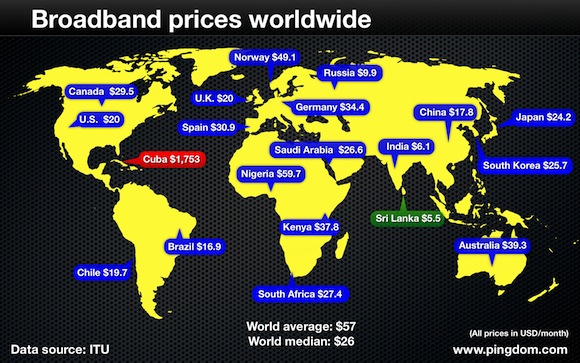
    Uptime monitoring firm Pingdom analyzed the latest report from the International Telecommunication Union (ITU) to discover how much the world is paying for its broadband, and its findings show some incredible variations in global broadband costs.

    While broadband in most of the world’s countries is generally available for between $5 and $60 per month, in Cuba it’s an eye watering $1,753 (the country additionally has no mobile-broadband services available). In Swaziland, the next most expensive country in the list, it’s a lot cheaper, but still comes in at a very hefty $875 per month.

    On the other side of the coin, if you’re looking for cheap broadband your best bet (albeit a rather extreme option) would be to move to Sri Lanka, where fixed broadband costs just $5.50 per month. It’s $6.10 in India, and a further ten other nations pay under $10 a month.

    The low cost of broadband in countries like India and the Russian Federation is mostly down to a high level of competition among the suppliers and the wish of the governments to keep the prices down.

    Pingdom is keen to point out that the prices listed by the ITU do “not necessarily reflect what a customer in the respective country would be paying for their broadband service. It’s instead a value intended to make comparisons between countries easier”. ITU’s figures are based on an entry-level broadband service.

    In the US and the UK, the price of broadband is $20, while in Canada and Australia it’s $29.50 and $39.30 respectively.

  • Electric Imp aims to make the Internet of Things devilishly simple

    We constantly hear that to make the internet of things popular, we’re going to need to make connecting devices to the web and to each other easier. Electric Imp is hoping to handle both problems, according to CEO Hugo Fiennes. He discusses how his experience at Apple helped him build an easy-to-implement card that let’s people and manufacturers add connectivity to everything.

    In the podcast he and I talk about how various startups are tackling the connectivity problem and where each fits in, why Wi-Fi is the best technology for the internet of things, despite its expense, and ponders the idea of our future devices having a slot where consumers can add an Electric Imp card if they see value in connecting it to the web.

    (download this episode)

    Subscribe to RSS

    iTunes

    Stitcher Radio

    Show notes:
    Host: Stacey Higginbotham

    • How to make Wi-Fi the de facto standard for the internet of things
    • How other IoT players differ and where they fit into the ecosystem
    • How to connect herds of cows and mangrove swamps
    • Will everything have an “IoT slot,” and will consumers get to choose what they will add connectivity to after they buy it?

    SELECT PREVIOUS EPISODES:
    Call-In: Galaxy S 4 predictions, Chromebook Pixel cloud storage

    Podcast: Facebook’s feedin’; Lean In’s meanin’; and everyone’s Hadoop-in

    IoT podcast: When devices can talk, will they conspire against you?

    Call in podcast: Galaxy S 4 predictions and Chromebook Pixel cloud storage

    Call-in show: Why the “I’m leaving iPhone” trend?

    Internet of things Podcast – Almond+’s nutty idea: Making sensor connectivity a snap

    Yahoo’s WFH Boo-Boo

    Podcast: Why the internet of things is cool and how Mobiplug is helping make it happen

    Podcast: Ballmer’s in the Dell, do tweets ruin TV? And how ISPs are not like gas pumps

    Podcast: Kabam founder on scaling globally and designing for different platforms

    Related research and analysis from GigaOM Pro:
    Subscriber content. Sign up for a free trial.

  • Weekly Radar: Dollar building steam?

    FOMC/FRANCO-GERMAN SUMMIT/GERMAN-FRENCH-SPAIN AUCTIONS/GLOBAL FLASH PMIS FOR MARCH/UK BUDGET-JOBS-CPI-BOE MINS/ICC HEARING ON KENYATTA/SAFRICA RATES

           The revved-up U.S. dollar – whose trade-weighted index is now up almost 5 percent in just six weeks – could well develop into one of the financial market stories of the year as the cyclical jump the United States has over the rest of G10 combines with growing attention being paid to the country’s potential “re-industrialisation”. As with all things FX, there’s a zillion ‘ifs’ and ‘buts’ to the argument. Chief among them is many people’s assumption the Fed will be printing greenbacks well after this expansion takes hold as it targets a much lower jobless rate. Others doubt the much-vaunted return of the US Inc. back down the value chain into metal-bashing and manufacturing, while some feel the cheaper energy from the shale revolution and the lower structural trade deficits that promises will be short-lived as others catch up. However, with the dollar already super competitive (it’s down 30-40 percent on the Fed’s inflation-adjusted index over the past 10 years) the first set of arguments are more tempting. Even if you see the merits in both sides, the bull case clearly has not yet been discounted and may have further to go just to match the balance of risks.  With Fed printing presses still on full throttle, this has been a slow burner to date and it may be a while yet before it gets up a head of steam — many feel it’s still more of a 2nd half of 2013 story and the dollar index needs to get above last year’s highs to get people excited. But if it does keep motoring, it has a potentially dramatic impact on the investment landscape and not necessarily a benign one, even if shifting correlations and the broader macro landscape show this is not the ‘stress trade’ of the short-lived dollar bounces of the past five years.

    Commodities priced in dollars could well feel the heat from a steady dollar uptrend. And if gold’s spiral higher over the past six years has been in part due to the “dollar debasement” trade, then its recent sharp retreat may be less puzzling . Emerging market currencies pegged to the dollar will also feel the pressure as well as countries and companies who’ve borrowed heavily in greenbacks. The prospect of a higher dollar also has a major impact on domestic US investors willingness to go overseas, casting questions on countries with big current account gaps. As the dominant world reserve currency, a rising dollar effectively tightens financial conditions for everyone else and we’ve been used to a weakening one for a very long time.

    Back to moment, stock markets around the world have continued to nudge new highs over the past week, with the upbeat US employment data underlining a still broadly positive global growth tilt even if Chinese data was more equivocal and Europe still looks dour. That said, at least the euro FX rate is going in the right direction for a change to help address the regional funk.

    To keep a tally, global stocks are up almost 6 percent as the first quarter enters its final fortnight.

    Next week, it will be hard to get beyond the FOMC and a heavy US data slate, though flash global PMIs for March will be critical in seeing whether the wobble in world business sentiment last month was a blip or a trend. The Franco-German summit in Berlin on Monday will be interesting to parse any new direction in euro policy and cooperation, with German/French and Spanish debt auctions throughout the week. Otherwise, it’s big five days for the UK economy with the government’s 2013 budget as well as jobless/inflation/retail/govt borrowing reports and BoE minutes . An ICC hearing on Kenyan election victor Kenyatta in the Hague on Monday will also need watching, with the latest South African rate decision on Wednesday a big moment next week in regional markets there.


    Events and data to watch next week:

    China annual parliament meeting ends Sun

    Merkel/Hollande summit Berlin Mon

    ICC hearing on Kenya’s Kenyatta, The Hague Mon

    EZ Jan trade Mon

    UK Feb inflation Tues

    German March ZEW Tues

    US Feb housing starts/permits Tues

    German 10-yr bund auction Weds

    UK Feb jobless Weds

    EZ March consumer confidence Weds

    UK 2013 budget Weds

    BoE minutes Weds

    EU’s Rehn at EU Parliament Committe Weds

    FOMC decision/presser Weds

    Obama visits Israel Weds

    SAfrica/Iceland rate decisions Weds

    Japan Feb trade Thurs

    Global flash March PMIs Thurs

    UK Feb retail sales/govt borrowing Thurs

    French/Spanish bond auctions Thurs

    US/UK index-linked bond auctions Thurs

    Egypt rate decision Thurs

    US March Philly Fed index/Feb existing home sales Thursday

    German March Ifo/French March biz climate Fri

  • NVM Private Equity Exits Interlube Systems

    NVM Private Equity has sold Interlube Systems, to a subsidiary of US-based The Timken Company. The sale represents a money multiple of 3.0x on NVM’s original investment.

    PRESS RELEASE

    NVM Private Equity (NVM) has successfully sold one of its long-standing investments, Interlube Systems, to a subsidiary of US based The Timken Company (Timken). The sale represents a money multiple of 3.0x on NVM’s original investment.
    Interlube is based in Plymouth, UK, and manufactures and markets automated lubrication products for use in commercial vehicles, cranes, quarries and heavy-duty production lines. Timken is based in Ohio, USA, and engineers, manufactures and markets mechanical components and high-performance steel. Timken has been steadily adding to its portfolio of businesses and sees Interlube as highly compatible to its core product lines and power transmission acquisitions.
    NVM invested in the management buy-out/buy-in of Interlube over 12 years ago. Since then Mike Cusack, Interlube’s Managing Director, and his team have expanded the company’s manufacturing and assembly capability across the globe. With 2012 sales of £8.5 million and 90 employees, the company has successfully increased its market share by making strategic acquisitions and using its long established distributor network and experienced worldwide sales force to create a focused approach to its market. Interlube is now a world leader in lubrication solutions; helping customers to extend up-time and reduce maintenance costs. The company operates from facilities located in the UK and USA.
    Mike Cusack, Managing Director of Interlube Systems comments: “I have been managing Interlube since the MBO/MBI and have enjoyed being a part of the company’s successful growth story. The sale to Timken is the obvious next step and Interlube will prosper under the ownership of a multinational. NVM have demonstrated their faith in the management team, through some very difficult economic times. It has been a pleasure working with them to build the business and we are all grateful for their support over the last 12 years.”
    Martin Green, Managing Director of NVM Private Equity: “Interlube has performed well in some challenging markets over the life of NVM’s investment, so this is a very positive story for the British manufacturing industry. Mike Cusack and his team have a wealth of experience in this sector and have established strong customer relationships and loyalty. I am pleased that the sale to Timken will allow Interlube to continue to flourish as part of a larger organisation and expand into new markets. We have thoroughly enjoyed working with such a dedicated management team and wish them the best of luck for the future.”
    -ENDS-
    NOTES TO EDITORS
    Advisers:
    PwC LLP (Corporate finance advisers) – Gary Partridge, Colin Davis
    Michelmores LLP (Legal advisers) – Richard Cobb, Henry Taylor, Harry Trick
    Inclusions: Interlube imagery
    Interlube Systems Limited is recognised for its quality, reliable service and workmanship in designing, manufacturing and installing lubrication delivery systems and components; and providing installation services. Based in Plymouth, UK, Interlube provides lubrication delivery solutions to commercial vehicle, mining, construction, manufacturing and other heavy industrial customers. www.interlubesystems.co.uk
    The Timken Company
    The Timken Company (NYSE: TKR; www.timken.com), a global industrial technology leader, applies its deep knowledge of materials, friction management and power transmission to improve the reliability and efficiency of machinery and equipment all around the world. The company engineers, manufactures and markets mechanical components and high-performance steel. Timken® bearings, engineered steel bars and tubes — as well as transmissions, gearboxes, chain, related products and services — support diversified markets worldwide. With sales of $5.0 billion in 2012 and approximately 20,000 people operating from 30 countries, Timken makes the world more productive and keeps industry in motion. www.timken.com
    NVM Private Equity Limited (NVM) is independently owned with over 28 years’ experience of investing in unquoted UK businesses. NVM is a generalist investor, managing £220 million of funds, and is differentiated by having executives living and working in regional business communities throughout the UK. NVM seeks investment opportunities in UK businesses which have the right mix of growth potential and market vision. They may be looking to grow organically, acquire another business or secure a management buy-out. Typically, NVM looks to invest between £2 million and £10 million in each transaction.
    For further information please contact:
    Liberty Bollen (NVM: PR & Marketing) – 0118 951 7017 [email protected]
    Martin Green (NVM: Managing Director) – 0118 951 7000 [email protected]

    The post NVM Private Equity Exits Interlube Systems appeared first on peHUB.

  • TPG Capital wins bid for Australia’s Ingham poultry business

    Private equity firm TPG Capital has purchased the highly sought after assets of Australian poultry firm Ingham Enterprises, Bob Ingham confirmed in a statement, writes Reuters. Ingham wouldn’t confirm the deal valued Australia’s largest poultry producer at around A$1 billion ($1.02 billion) and that TPG paid more than A$850 million, including a small cash earn-out, as reported by the Australian newspaper.

    Reuters – Private equity firm TPG Capital has purchased the highly sought after assets of Australian poultry firm Ingham Enterprises, Bob Ingham confirmed in a statement on Saturday.

    Ingham wouldn’t confirm the deal valued Australia’s largest poultry producer at around A$1 billion ($1.02 billion) and that TPG paid more than A$850 million, including a small cash earn-out, as reported by the Australian newspaper on Saturday.

    TPG beat several other bidders in the auction to acquire the prized Ingham assets, with U.S. private equity firm the Blackstone Group LP believed to have been a leading contender.

    As part of the deal, the Ingham family are retaining ownership of their racing business as well as a substantial property portfolio.

    Bob Ingham, sole shareholder of the company which owns the Ingham Chicken brand, put the poultry producer up for sale in July last year.

    Australian food manufacturers have been highly sought after by private equity and other Asian buyers in the past two years due to resilient sales and solid cashflows.

    Ingham Enterprises was advised by Investec Bank and TPG was advised by Macquarie Capital. Representatives from both banks were not immediately available for comment.

    It will be business as usual at the 95-year-old chicken business under the new owners, Ingham said.

    “An important part of the decision for me was finding a buyer who would ensure that our customers will continue to receive the highest level of service and our employees would be well looked after,” Bob Ingham said. (Reporting by Morag MacKinnon; Editing by Michael Perry)

    The post TPG Capital wins bid for Australia’s Ingham poultry business appeared first on peHUB.

  • Use YouTube Ratings Preview to find the best videos on YouTube

    While YouTube’s vast choice of clips means there’s always something good to watch, tracking down the best videos can take a while. Especially if you’re clicking each clip in turn, checking the ratings, then returning to your search results to try something else.

    Install YouTube Ratings Preview, though, and you don’t have to worry about that any more. This smart Firefox extension (also available for Chrome) highlights the best-rated videos immediately so you can spot them at a glance.

    Once installed, a Likes/ Dislikes bar under every video thumbnail provides a general idea of its popularity (more green is good, more red really isn’t).

    And if you need precise figures, just hover your mouse cursor over the bar (and it needs to be the bar, not just the thumbnail) to see the percentage of likes and dislikes, the total number of votes, and the overall rating.

    YouTube Ratings Preview has some useful configuration settings, too.

    Enable the Highlight option and the best videos on the page will have a blue box drawn around them, so you don’t even have to bother with looking at individual bars.

    And while those bars are very narrow — only 4 pixels, by default — you’re able to increase them up to 7 pixels, if that’s an issue on your device.

  • Highland Capital Names New Director

    Highland Capital Management has appointed Nikki Aquino Gill as director of business development and David Lyon as director of client services. Both report to Clay Shumway, managing director, head of business development and are based in the firm’s Dallas office.

    PRESS RELEASE

    Highland Capital Management, L.P. (“Highland”), a Dallas-based investment management firm, which together with its affiliates has approximately $18 billion in assets under management, today announced the appointments of Nikki Aquino Gill as Director of Business Development and David Lyon as Director of Client Services.

    Both Gill and Lyon report to Clay Shumway, Managing Director, Head of Business Development and are based in the firm’s Dallas office. Mrs. Gill is responsible for developing and executing the firm’s global growth initiatives related to new products, fund formation, strategic growth and asset gathering. Mr. Lyon is responsible for the guidance of prospective investors through due diligence and funding processes and overseeing ongoing client service and communication.

    Prior to Highland, Mrs. Gill was a Director in Global Markets at Bank of America Merrill Lynch, where she focused on Asian institutional sales and managing mutual fund and hedge fund client relationships. Before that, she was a Senior Investment Analyst at William M. Mercer Investment Consulting. She received her MBA in Finance and Accounting from the University of Chicago Booth School of Business and her BS in Economics and Mathematics from Tulane University. Mrs. Gill is a Chartered Financial Analyst.

    Before joining Highland, Mr. Lyon was Director at TPG Capital where he maintained and reviewed internal and external performance reporting. Prior to that, he was a hedge fund accountant at Maverick Capital. Before Maverick, Mr. Lyon was a senior audit associate for Ernst & Young. He received his MS in Accountancy from the University of Notre Dame and his MBA in Finance and BBA in Marketing from Texas Tech University.

    “These hires illustrate our continued commitment to strengthen and enhance our business development and client service capabilities,” said Jim Dondero, President and Co-Founder.

    About Highland Capital Management, L.P.

    Highland Capital Management is an SEC-registered investment adviser which, together with its affiliates, has approximately $18 billion of assets under management. Founded in 1993 by Jim Dondero and Mark Okada, Highland is one of the largest and most experienced global alternative credit managers. Highland’s strategies include collateralized loan obligations (CLOs), high yield bonds, distressed credit, public and private equities, structured products and natural resources.

    SOURCE Highland Capital Management, L.P.

    Copyright (C) 2013 PR Newswire. All rights reserved

    The post Highland Capital Names New Director appeared first on peHUB.

  • CERN: We’re sure this is a Higgs boson, but we’re not sure which one it is

    Last July physics researchers at CERN said they thought they had found evidence of the Higgs boson, a theoretical but essential component of our standard model of physics, and the raison d’être of the enormous Large Hadron Collider (LHC). Now they’ve come back with further analysis of their data, and they’re surer than ever that what they found is the real deal.

    How sure? Well, these are scientists so there’s still a note of caution, but Joe Incandela, a spokesman for one of the LHC experiments, went on-record with a pretty confident statement: “The preliminary results with the full 2012 data set are magnificent and to me it is clear that we are dealing with a Higgs boson.”

    However, they’re still not sure what kind of Higgs boson they’re looking at. From today’s statement:

    “Having analysed two and a half times more data than was available for the discovery announcement in July, they find that the new particle is looking more and more like a Higgs boson, the particle linked to the mechanism that gives mass to elementary particles. It remains an open question, however, whether this is the Higgs boson of the Standard Model of particle physics, or possibly the lightest of several bosons predicted in some theories that go beyond the Standard Model. Finding the answer to this question will take time.”

    It’s not surprising that this task takes time. CERN said a month ago that its storage systems were holding 100 petabytes of data.

    The research organization has been working closely with companies such as Yandex to sift through that information in search of unusual events, and in Thursday’s statement CERN pointed out that finding one event means looking through around a trillion proton-proton collisions.

    “To characterize all of the decay modes will require much more data from the LHC,” the statement read. For now, the LHC is turned off – it will come back online next year.

    Related research and analysis from GigaOM Pro:
    Subscriber content. Sign up for a free trial.

  • Redbox Instant ready to open its doors to the public

    Redbox Instant by Verizon may be ready to launch its public beta test as early as Thursday, GigaOM has learned from an industry insider. The joint-venture between Verizon and Redbox launched its private beta test in December, offering subscribers Redbox rentals as well as a Netflix-like streaming service with a focus on movies.

    Redbox Instant CEO Shawn Strickland told reporters at a CES event in January that the service would launch publicly before the end of the first quarter. A Redbox Instant spokesperson confirmed earlier this week that this is still the case, but didn’t provide any further details.

    The video service offers subscribers four DVD rentals as well as unlimited streaming of number of movies for $8 a month. The catalog is notably smaller than Netflix’s offering, but Redbox Instant hopes to make up for that by offering access to titles on DVD that aren’t available for streaming yet. Customers can also opt to supplement their subscription plan with transactional video on demand titles, also known as rentals.

    Redbox Instant hasn’t done much publicity yet, but one shouldn’t be too surprised to see both companies market the service more aggressively to their customers in the coming months. Strickland told me in January that up to 50 percent of all Redbox customers already subscribe to a service like Netflix. The company now wants to steal away some of those customers from its competitor.

    Related research and analysis from GigaOM Pro:
    Subscriber content. Sign up for a free trial.

  • OCZ Technology Secures Credit Facility With Hercules

    OCZ Technology Group, a provider of high-performance solid-state drives for computing devices has entered into a $30 million loan and security agreement with Hercules Technology Growth Capital. The loan agreement consists of a $15 million term loan and a $15 million revolving loan facility.

    PRESS RELEASE

    OCZ Technology Group, Inc. OCZ -0.48% , a leading provider of high-performance solid-state drives (SSDs) for computing devices and systems, today announced that it has entered into a $30 million loan and security agreement (“loan agreement”) with Hercules Technology Growth Capital, Inc. (“Hercules”). This loan agreement consists of a $15 million term loan and a $15 million revolving loan facility.

    “Obtaining this new credit facility is the first step in providing OCZ with a complete capital structure going forward. This capital will be used to strengthen the business, fund future growth, and support emerging enterprise opportunities,” said Ralph Schmitt, CEO of OCZ Technology. “I am pleased with the operational improvements our team is making as we continue building a profitable OCZ which is focused on designing innovative, best-in-class Solid State Storage solutions for our valued customers.”

    The Company had reduced its use of the Wells Fargo Capital Finance credit facility and had no debt outstanding on it as of February 28, 2013. That facility has been terminated as part of the closing of the Hercules loan agreement. The first $10 million of the term loan was drawn at closing with repayments due in thirty monthly installments beginning in November 2013. The remaining $5 million of the term loan is contingent upon the Company being current in its SEC filings and achieving certain revenue levels for two consecutive quarters. Pursuant to the loan agreement, the Company issued Hercules a warrant to purchase 688,073 shares of OCZ Technology common stock at an exercise price of $2.18 per share. In addition to the term loan, the Company has access to a $10 million revolving loan facility which shall be repaid in full in April 2016. An additional $5 million of revolving loan facility will be available to the Company upon achieving certain financing covenants. Further information with respect to the loan agreement with Hercules will be contained in a Current Report on Form 8-K to be filed by OCZ Technology with the Securities and Exchange Commission.

    About Hercules Technology Growth Capital, Inc.

    Hercules Technology Growth Capital, Inc. HTGC -0.08% (“Hercules”) is the leading specialty finance company focused on providing senior secured loans to venture capital-backed companies in technology-related markets, including technology, biotechnology, life science and cleantech industries at all stages of development. Since inception (December 2003), Hercules has committed more than $3.4 billion to over 220 companies and is the lender of choice for entrepreneurs and venture capital firms seeking growth capital financing.

    Hercules’ common stock trades on the New York Stock Exchange (NYSE) under the ticker symbol “HTGC.”

    In addition, Hercules has two outstanding bond issuances of 7.00% Senior Notes due 2019 — the April 2019 Notes and September 2019 Notes — which trade on the NYSE under the symbols “HTGZ” and “HTGY,” respectively. Companies interested in learning more about financing opportunities should contact [email protected], or call 650.289.3060.

    About OCZ Technology Group, Inc.

    Founded in 2002, San Jose, CA-based OCZ Technology Group, Inc. (OCZ) is a global leader in the design, manufacturing, and distribution of high-performance solid-state storage solutions and premium computer components. Offering a complete spectrum of solid-state drives (SSDs), OCZ provides SSDs in a variety of form factors and interfaces (i.e. PCIe, SAS and SATA) to address a wide range of client and enterprise applications. Having developed firmware and controller platforms, to virtualization and endurance extending technologies, the company delivers vertically integrated solutions enabling transformational approaches to how digital data is captured, stored, accessed, analyzed and leveraged by customers. For more information, please visit: www.ocztechnology.com.

    Forward Looking Statements

    Certain statements in this release relate to future events and expectations and as such constitute forward-looking statements involving known and unknown factors that may cause actual results of OCZ Technology Group, Inc. to be different from those expressed or implied in the forward-looking statements. In this context, words such as “will,” “would,” “expect,” “anticipate,” “should” or other similar words and phrases often identify forward-looking statements made on behalf of OCZ. It is important to note that actual results of OCZ may differ materially from those described or implied in such forward-looking statements based on a number of factors and uncertainties, including, but not limited to, the risk that additional information may arise from the oversight of the audit committee; the risk that the process of preparing and auditing the financial statements or other subsequent events would require OCZ to make additional adjustments; the time and effort required to complete the restatement of the financial reports; the ramifications of OCZ’s potential inability to timely file required reports; including potential delisting of OCZ’s common stock on NASDAQ; the risk of litigation or governmental investigations or proceedings relating to such matters; the risk that OCZ may not be able to successful negotiate an amendment to its credit facility; market acceptance of OCZ’s products and OCZ’s ability to continually develop enhanced products; adverse changes both in the general macro-economic environment as well as in the industries OCZ serves, including computer manufacturing, traditional and online retailers, information storage, internet search and content providers and computer system integrators; OCZ’s ability to efficiently manage material and inventory, including integrated circuit chip costs and freight costs; and OCZ’s ability to generate cash from operations, secure external funding for its operations and manage its liquidity needs. Other general economic, business and financing conditions and factors are described in more detail in “Item 1A — Risk Factors” in Part I in OCZ’s Annual Report on Form 10-K filed with the SEC on May 14, 2012, and statements made in other subsequent filings. The filing is available both at www.sec.gov as well as via OCZ’s website at www.ocztechnology.com. OCZ does not undertake to update its forward-looking statements.

    All trademarks or brand names referred to herein are the property of their respective owners.

    The post OCZ Technology Secures Credit Facility With Hercules appeared first on peHUB.

  • Endgame Closes Series B Led by Paladin Capital

    Endgame, a provider of battle-tested cyber security solutions, has closed a $23 million Series B equity financing. Led by new investor Paladin Capital Group, the Series B includes participation from existing investors Bessemer Venture Partners, Columbia Capital, Kleiner Perkins Caulfield & Byers and TechOperators.

    PRESS RELEASE

    Endgame, Inc., a leading provider of battle-tested cyber security solutions, announced today that it has closed a $23 million Series B equity financing to fund growth in its existing federal customer base as well as expansion into the commercial market.
    Led by new investor Paladin Capital Group, a multi-stage private equity firm providing capital and strategic guidance to growing companies, the Series B includes participation from existing investors Bessemer Venture Partners, Columbia Capital, Kleiner Perkins Caulfield & Byers and TechOperators. Lt. General (Ret) Kenneth A. Minihan, former Director of the National Security Agency and Managing Director at Paladin, will join the Endgame Board of Directors.
    “The cyber domain will be increasingly important across all dimensions of national power – military, economic, and informational,” said Lt. General Minihan. “Endgame’s revolutionary technology allows its customers to use intelligence seamlessly to gain situational awareness and support their end-to-end network operations.”

    As part of its expansion, Endgame has recruited several new executives to the company’s management team, including: Nathaniel Fick, who joined as CEO in November, replacing Chris Rouland who remains a Founder and board member of the company; Niloofar Howe, who joined as Chief Strategy Officer to lead the company’s efforts in market and product strategy, as well as business and corporate development; and Matt Georgy, who joined Endgame as CTO after a decorated career as a senior executive at the Department of Defense supporting all aspects of computer network operations. Endgame’s new Chairman of the Board, Christopher Darby, has deep expertise in the intelligence space as the current President and CEO of In-Q-Tel, the independent strategic investment firm supporting the missions of the U.S. Intelligence Community.

    “The cyber needs of federal and commercial entities are converging as states look beyond targeting other states to target private companies, and national security thinking must increasingly account for private infrastructure,” said Nate Fick, CEO of Endgame. “I’m excited about leveraging the solutions and technology that our mission partners depend on to help businesses with comprehensive command and control of their network operations.”

    About Endgame
    Endgame’s cyber operations platform provides real-time command and control, analytics, data visualization and knowledge discovery capabilities that support safety and security in cyberspace by revolutionizing the detection and mitigation of cyber-threats. Founded in 2008, Endgame is backed by Bessemer Venture Partners, Kleiner Perkins Caulfield & Byers, Columbia Capital and Paladin Capital Group. The company has offices in Northern Virginia, Maryland, San Antonio, and Atlanta. For more information, please visit http://www.endgame.com.
    About Paladin Capital Group

    Paladin Capital Group is a leading multi-stage private equity firm providing capital and strategic guidance to growing companies in the IT, telecommunications and alternative energy sectors. The firm focuses on companies with products and services that are “dual use” in nature, serving both commercial and government customers. Paladin has over $950 million dollars of committed capital across multiple funds and has invested in over 50 portfolio companies. For more information, please visit http://www.paladincapgroup.com.
    ###
    Contact:
    Deepti Rohatgi,
    Director of Product Marketing
    [email protected]
    404-941-3900

    The post Endgame Closes Series B Led by Paladin Capital appeared first on peHUB.

  • Reuters – PayPal Buys Duff Research

    PayPal has acquired mobile app developer Duff Research, part of an effort by the online payment payment processor to become more technology focused, writes Reuters. PayPal, owned by e-commerce company eBay, did not disclose a purchase price.

    Reuters – PayPal said on Wednesday that it acquired mobile app developer Duff Research, part of an effort by the online payment giant to become more nimble and technology focused.

    PayPal, owned by e-commerce company eBay Inc, did not disclose a purchase price.

    Duff Research has built about 40 mobile apps for companies that include TiVo Inc and Adidas AG. The firm’s 18 employees, including co-founder Geoff Chatterton, will join PayPal, the companies said.

    PayPal is battling a host of start-ups, such as Square Inc, that are trying to chip away at its lead in online and mobile payments.

    PayPal has a reputation as slow and less innovative than some other technology companies and under new President David Marcus it is trying to change that.

    “What we’re really after with this deal is the innovators and experience,” said James Barrese, chief technology officer at PayPal. “We are reinventing our organization to be more technology led.”

    The Duff Research team will remain together at PayPal and work on projects aimed at making PayPal’s main digital wallet product easier to use for consumers and merchants, Barrese said.

    (Reporting by Alistair Barr; Editing by Dan Grebler)

    The post Reuters – PayPal Buys Duff Research appeared first on peHUB.

  • Reuters – Cinven Reaches Target for Buyout Fund

    European private equity firm Cinven has reached its 5 billion euro ($6.5 billion) target for its latest buyout fund, writes Reuters. Cinven counts cable operator Ziggo and aircraft leasing company Avolon among its investments.

    Reuters – European private equity firm Cinven has reached its 5 billion euro ($6.5 billion) target for its latest buyout fund, a source familiar with the fundraising said.

    Cinven, which counts cable operator Ziggo and aircraft leasing company Avolon among its investments, has been asking investors to put money into its fifth fund amid a tough fundraising climate for private equity firms.

    Cinven declined to comment.

    The post Reuters – Cinven Reaches Target for Buyout Fund appeared first on peHUB.

  • SafeRoad CEO Resigns

    Jon Erik Engeset, president and CEO of SafeRoad, has resigned. Saferoad is a Nordic Capital portfolio company. Engeset will leave SafeRoad with effect from July 1st 2013.

    PRESS RELEASE

    SafeRoad has over the last years made several add-on acquisitions abroad, which have led to a subsequent build-up of head office functions in Oslo. Following this, Jon Erik Engeset, the President and CEO of SafeRoad, has had to commute between Ørsta and Oslo on a weekly basis. For private reasons, he has now decided to seek new opportunities closer to his home.
    Engeset was appointed CEO of Ørsta Group in 2002, which was merged with Euroskilt Group and renamed SafeRoad in 2007. Under his management, the group has experienced strong growth and organizational development, and SafeRoad is today the leading company in Europe within its field.
    Jon Erik Engeset will leave SafeRoad with effect from July 1st 2013. A process to recruit his successor has been initiated.
    “On behalf of the Board I thank Jon Erik for his efforts and contributions over the last 11 years and wish him all the best for the future”, says Johan Ek, Chairman of the Board, SafeRoad Group
    For further information, please contact:
    Johan Ek
    Chairman of the Board, SafeRoad Group
    tel: +46-70-515 94 77
    e-mail:[email protected]

    The post SafeRoad CEO Resigns appeared first on peHUB.

  • Morning Advantage: The Job Interview You Don’t Know You’re Having

    A San Francisco start-up called Gild has created a program that evaluates and scores software developers on the work they’ve publicly released on the web, Technology Review reports. It’s happening unbeknownst to the programmers and without their permission. This is a boon to recruiters, clearly, who can see if top-tier degrees and LinkedIn recommendations jibe with this Guild score. Or, they can perhaps find some résumé-less college student who’s been building apps since she was 16.

    Of course, how useful the score is depends on how accurately the algorithm works and how easily it can be gamed. That question looms large as Gild CEO Sheeroy Dasai envisions developing similar tests for other professionals whose work appears online — like, say, a teacher’s online courses, a scientist’s research, or a journalist’s articles.

    WHATEVER

    How Moods Shape Your Moral Reasoning (Scientific American)

    Would you throw a man under a bus to keep it from mowing down five pedestrians directly in its path? Clever research sheds new light on how mood affects your response to this classic moral conundrum. Subjects induced through music into a good or a bad mood and confronted with this Hobson’s choice were asked either “Do you think it is appropriate to be active and push the man?” or “Do you think it is appropriate to be passive and not push the man?” Turns out the mellow people tended to answer “yes” while the sour people tended to answer “no,” no matter which option was presented. In other words, the researchers suggest, your mood makes you feel better or worse about the choice at hand, rather than affecting your view of what choice to make.

    WORTH THE BIG BUCKS

    Should Solar Roads Be the Future of Transportation? (Fast Company)

    Rather than driverless cars, Glen Hiemstra suggests, we should be paying more attention to the roads themselves, if we want to think expansively about the future of transportation. It’s not that hard to seal solar cells between layers of glass and construct a roadway that can turn sunlight into power while it’s just sitting there all day long. The tricky part is developing a glass clear enough to allow sunlight, opaque enough not to create too much glare, and durable enough to last for years. But the payoff would be enormous: Operating at just 15% efficiency, such a U.S. road system would generate all the electricity the whole world currently uses. Companies like Solar Roadways are on the case; the Idaho-based startup plans plan to test its first road panels in a parking lot this spring.

    BONUS BITS:

    Unintended Consequences

    Is the Running Industry Slowing Marathoners Down? (The Guardian)
    America’s Dirtiest Air Is Not Where You Think (Smithsonian)

    Why Google Is Wooing Small Businesses in India (Business Today)

  • Blackbird Ventures Australian Internet Fund

    Blackbird Ventures has reached a first close of its $30 million venture capital fund. The fund will invest in Australian Internet startups. Blackbird brings together Startmate, Southern Cross Venture Partners, and prominent founders of highly successful local companies including Atlassian, Campaign Monitor and Aconex.

    PRESS RELEASE

    Blackbird Ventures today announced the formation and first close of its $30 million venture capital fund. The fund will invest in Australian Internet startups and help them succeed on a global stage. Blackbird brings together Startmate, Southern Cross Venture Partners, and prominent founders of highly successful local companies including Atlassian, Campaign Monitor and Aconex.
    The majority of the Fund’s capital has been raised in a first close focused on industry insiders, including over 35 successful Australian tech founders and Silicon Valley venture capitalists like Bill Tai and Dave McClure, all of whom are investing not only their money but also their time to help Australian startups succeed. Other investors will have the opportunity to participate before the Fund’s final close later in the year.
    Blending experience and a passion for entrepreneurship, the local management team consists of Niki Scevak, founder of Australian accelerator Startmate; Rick Baker who ran venture investing at MLC and Bill Bartee, co-founder of Southern Cross Venture Partners. They are assisted in Silicon Valley by Southern Cross partner, John Scull, who sits on the Investment Committee.
    Blackbird co-founder Niki Scevak said “The essential ingredients of Blackbird are successful founders helping the next wave of Australian startups. We’re bringing the same experience we have seen work at Startmate in the initial months of a startup’s life to more developed companies at the next stage.”
    “Today is a huge day for the Australian technology industry and I’m excited to be involved with Blackbird because it represents a truly founder-led effort in helping startups,” said Mike Cannon-Brookes, co-founder of Atlassian. Cannon-Brookes, while also being a major investor in the fund, will join as a venture partner and advise the firm and investee companies.
    “Being an investor in the Blackbird fund gives me an opportunity to support and be an active participant in the Australian technology industry,” said Bardia Housman, whose last company, Business Catalyst, sold to Adobe. “It’s made up of a wide array of successful industry people and entrepreneurs spanning both Australia and Silicon Valley. We will be able to add tremendous value to aspiring Australian entrepreneurs who want to build global businesses,”
    Blackbird also has strong links to Silicon Valley. “We have a strong focus on businesses that we can help inject into the Silicon Valley ecosystem to connect them with expertise, customers and sources of finance,” said Rick Baker, co- founder of Blackbird. “The combination of our partnership with Sydney-Palo Alto based Southern Cross Ventures and our strong network of Silicon Valley advisors and venture capitalists means we’re in an excellent position to do this.”
    Well known Silicon Valley investor, Bill Tai, a partner at CRV and angel investor said, “Blackbird Ventures has placed itself in the vortex of the tech scene in Australia through its founder community, LPs and startup network from past investments. As more capital looks to fuel the growing number of world class startups from Australia, Blackbird is positioned to be the trusted investment partner for the US VC ecosystem as they have become for me.”
    Blackbird co-founder and partner at Southern Cross Venture Partners, Bill Bartee, said, “Southern Cross is thrilled to be teaming up to form Blackbird Ventures, which is set up specifically to invest in fast growing, capital light models in the Internet, software and mobile spaces”. The management team believes there is a real gap in the Australian venture capital market: while there is funding for small angel rounds, there are very few professional investors focussing on the next stage where Blackbird will predominately play.
    Blackbird’s first investments include Canva and Ninja Blocks. It expects to make around 25 investments from the fund.
    For more information contact:
    Rick Baker Niki Scevak Bill Bartee
    [email protected] [email protected] [email protected]
    0408 662 422 0400 321 551 0405 136 866

    The post Blackbird Ventures Australian Internet Fund appeared first on peHUB.