Category: News

  • Zap Some Neon Life Into Your Old Photographs [Photography]

    The Kirlian Photography Device uses high voltage discharges to capture beautiful, luminescent images directly from ordinary film. It is not a machine I’d recommend using in the darkroom.

    Kirlian photography, also known as electrography, isn’t anything new—we’ve looked at the technique before—but the Kirlian Photography Device wraps up all the necessary components into one machine. You just put your film on the discharge plate and the device zaps vibrant new life into your photographs.

    If you’ve made the jump to digital, an optional transparent discharge plate lets you use the technique with any regular, printed photograph. The Kirlian Photography Device is available now, for $299, for those interested in experimenting with the high voltage technique. [Scientifics Online via Oh Gizmo]


  • Garden Tasks for January

    January is typically a slower garden month however there are some garden tasks you should be completing.

    winter garden tasks

    • If you had a living Christmas tree it’s time to move it outside and replant it. Leaving a living tree inside for too long can damage the tree’s health.
    • 2010 seed and plant garden catalogs have arrived or will be arriving soon. Order your faborite seeds and plants soon after getting your catalogs since popular varieties may sell out.
    • Jot down your garden plans for spring 2010 and make sure you work in some crop rotation.
    • If you’re planting evergreen shrubs (like azalea or early rhododendrons) shop now.
    • If you haven’t yet, snag a 2010 garden calendar. I got the Fresh Picked calendar this year, which is pretty but not full of gardening tips. If you’re looking for a more tip based calendar check out Farmer’s Almanac for some great options for 2010.
    • Some cold weather annuals are still available such as  snapdragon, sweet pea, iceland poppy, pansy, candytuft, and more.
    • Bare root plants can be planted – think artichokes, blueberries, roses, vines, grapes, plums, asparagus, rhubarb and the like.
    • Don’t ignore your holiday gift plants.  Plants such as amaryllis should be indoors but in an area that’s well-lighted and water regularly. water regularly. After blooms fade azaleas, cyclamen and other hardy plants can be set outside in a protected area.
    • Prune dormant shrubs, fruit trees and roses. Do not overly prune citrus trees though. Some experts suggest not pruning citrus at all because they need the dense leaves to shade fruit from the sun. On the flip side, other experts agree that some citrus tree pruning (pdf) is perfectly safe and necessary. Citrus is a type of tree I have zero experience growing and tending so the best advice I have on the prune or not to prune debate is to speak with your local extension office and see what other people in your area do for healthy citrus trees.
    • Here in Oregon we’ve had some bizarre alternate freezing and warm days. If this happens too much your perennials may push out of the ground due to freeze-thaw-freeze-thaw issues. If you see this happening, push your perennials carefully back into the soil so the exposed roots stay protected.

      If you’ve completed all your garden tasks why not try a fun winter garden project?

      [image via stock.xchng]

      Post from: Blisstree

      Garden Tasks for January

    • The dome illusion

      Rome, Italy | Optical Oddities

      The Jesuit church of Saint Ignazio was supposed to have a glorious dome, but when the money ran out in 1642, the plans were scrapped. Instead of foregoing the dome entirely, painter and Jesuit brother Andrea Pozzo proposed that he paint a life-sized illusion of a dome that would fool the eyes of visitors (as long as thy looked up from the proper angle).

      His masterpiece still fools the eye today. Painted between 1685 and 1694, it is a remarkable piece of perspective work.

      Pozzo painted another illusion for the barrel-vaunted ceiling of Saint Ignazio. The huge painting depicting the life and works of Saint Ignatius lifts and expands the simple building skyward, with forced perspectives of figures retreating into the heights. The technique is known as quadratura, a mixture of geometrically accurate architecture in forced perspective, and elements of fantasy, like cherubs and floating saints. Pozzo wrote a book on the subject called Perspectiva Pictorum and Architectorum, which was very influential for other Baroque painters.

      Both the dome and the central illustration are painted on one 17 meter canvas. His work on the illusions was so well received that he was granted the commission for the rest of the artwork in the church.

      In April of 1891 an enormous powder magazine explosion just outside the city rocked Rome and damaged the ceiling artwork (it also collapsed part of the roof of the Parliament building and sent the city into a general panic). A restoration in 1961 repaired the illusion.

      The best way to view the illusion is to enter the church, keeping eyes low until you reach the circular marble marker that indicated the ideal vantage point for the dome illusion. A second marker on the floor indicates the ideal viewing spot for the rest of the ceiling.

      In 1703 he repeated his dome illusion in Vienna, in a Jesuit church now called the University Church and at the Church of the Gesù in Frascati, Italy.

    • De Maas (Boompjes), Rotterdam

      Gegevens
      Naam: De Maas
      Hoogte: 76 Meter
      Plaats: Rotterdam, Boompjes
      Oplevering: 1988
      Website: http://www.skylinecity.info/rotterda…e_maas_rec.htm
      Functie: Kantoren Rijkstwaterstaat
      Architect: Architectenbureau Koldewijn & Drexhage

      — – – – – – – —– – – — – – – – – – – – —–


      (http://www.skylinecity.info)


      (http://www.skylinecity.info)


      (http://www.skylinecity.info)

    • BENGUERIR | La Ville Verte Mohammed VI | #U-C

      "La Ville Verte Mohammed VI" mise sur une certification internationale"

      Le projet "Ville Verte Mohammed VI", dont la réalisation est prévue à Benguérir, mise sur l’obtention de la plus prestigieuse certification internationale en matière d’environnement, a affirmé M. Mustapha Terrab, président directeur-général de l’Office Chérifien des Phosphates (OCP).

      Premier projet de cette nature sur le continent africain, ce futur pôle urbain "obéit aux exigences du développement durable selon un cahier des charges visant la certification de niveau international LEED ND", a précisé M. Terrab, jeudi à Benguérir, dans un exposé de présentation du projet devant SM le Roi Mohammed VI.

      Selon le PDG de l’OCP, ce chantier d’envergure, qui sera réalisé en trois phases sur une période d’une dizaine d’années, sera à l’avant-garde en matière environnementale dans la maîtrise des émissions de CO2 pour les transports (pistes cyclables, bus électriques…).
      Pour satisfaire au cahier des charges, la Ville Verte intégrera également les normes d’une gestion responsable de l’eau (double circuit : eau potable-eaux grises, stockage des eaux de pluie, recyclage des eaux usées).

      S’étendant sur une superficie de 650 hectares, la future cité prévoit l’usage des techniques de valorisation des déchets par les filières appropriées et le recours aux énergies renouvelables et propres (éolienne, solaire, biomasse), a encore indiqué M. Terrab.
      Au coeur de ce projet, a-t-il relevé, l’université Mohammed VI polytechnique constituera un fleuron national fonctionnant selon une démarche privilégiant la recherche-développement autour de pô les d’excellence et tissant des partenariats avec les universités nationales et étrangères les plus prestigieuses.

      La ville Verte Mohammed VI, construite autour d’une coulée verte s’intégrant au tissu urbain de la ville de Benguérir, comprendra en outre une cité sportive, un complexe hospitalier, des ensembles résidentiels, des équipements publics et abritera diverses activités novatrices et créatrices d’emplois donnant à la région une vocation dans les métiers de services et de logistique.

      Le projet sera réalisé selon un schéma institutionnel garantissant sa pérennité à la faveur de partenariats public-privé, faisant intervenir les collectivités locales, la Fondation Rhamna pour le développement durable, l’OCP et autres investisseurs publics et privés.

      MAP : 01.01.2010 – 10:02:00

    • The Essential Startup Reader: 10 Lessons in Entrepreneurship

      As a blogger, I spend most of my time writing. But it’s time spent reading that’s most satisfying. Here’s a short (and by no means a complete) list of 10 articles that encapsulate the art of the startup. Most were published during 2009, and I found them educational and full of practical tips that we’ve applied to our business. They’ve also helped me think differently about startups and entrepreneurship. Hope you enjoy reading them as much as I did.

      1. “What Startups Are Really Like” by Paul Graham: This has to be the single best essay I read during 2009. Every entrepreneur should begin the startup journey with this essay. It bottles every essence of entrepreneurship and startups, and is chock-full of practical advise and tips that are applicable to anyone who dares to dream.

      2. “Milestones to Startup Success” by Sean Ellis: Ellis explains the need for minimum viable product, aka MVP, and then outlines how startups can go up his startup pyramid to find success.

      3. Myth: Entrepreneurship Will Make You Rich” by Eric Ries: “One of the unfortunate side effects of all the publicity and hype surrounding startups is the idea that entrepreneurship is a guaranteed path to fame and riches. It isn’t,” Ries writes in this no-holds-barred essay about the challenges and pitfalls of being a startup founder.

      4. “What Is the Minimum Viable Product?” by Venture Hacks: A great audio conversation on the Venturehacks blog including a slide show.

      5. “The Power of Continuous Improvement” by Mike Speiser: In a guest post for us, Mike talks about the importance of metrics, feedback and how they can drive continuous improvement. Mike’s rules have found eager takers among our team.

      6. “Getting Comfortable With People Who Make You Uncomfortable” by Mike Speiser: In this article, Mike addresses the need for people who challenge conventional wisdom and make everyone around them uncomfortable — which is why every company needs them.

      7. “The Funnel Principle: Software & Making Money” by Tony Wright: It’s good to build great products, but in order to build great companies one needs to have more — a clear path of monetization, an attention magnet, and in general excellence at things beyond product development.

      8. “Does Every Startup Need a Steve Jobs?” by Andrew Chen: A dissection of how insanely great products are built by combining desirability, feasibility and viability. Read this post after reading Wright’s “Funnel Principle.”

      9. “Designing for Social Traction” by Josh Porter

      10: “Startup Killer: The Cost of Customer Acquisition” by David Skok: A definitive essay on startup business models, the perils of overoptimism, and the importance of cost of customer acquisitions. Skok is a 3-time entrepreneur with a lifetime of experience.

      Bonus links:


      GridRouter by SmartSynch: The communications hub for the Smart Grid

    • [Polska] Żegluga śródlądowa

      [Polska] Żegluga śródlądowa

      Gdzie mozna znalezc dane o tym:

      1. ktore rzeki w Polsce sa zdatne do zeglugi śródlądowej
      2. ktore rzeki sa przygotowane do transportu barkami
      3. ile jednostek (barek, statkow turystycznych itd.) jest w Polsce w eksploatacji

      Moze uda nam sie stworzyc takie zestawienie?

    • Shake to Send comes to Windows Mobile

      Some devices, like the iPhone, have pretty deficient Bluetooth stacks, and have had to come up with pretty creative ways to share files.  One app which allowed this is called Bump, which paired devices which were shaken at the same time.

      Shake_to_Send_201012224222 Jaxbot over at XDA-Dev has implemented the idea as seen on this video.  The software uses the G-sensor to detect the shakes, but can also be used manually on devices without, and uses a data connection for the pairing and sharing process.  Jaxbot intends to implement photo sharing also, and to improve the already nice looking UI.

      Read more about the app at XDA-Developers here, and download the app here, or using this Microsoft Tag (gettag.mobi) (links to mobile download page).

      Share/Bookmark

    • Elecont Weather 1.0.1029 and YouTube Video Review

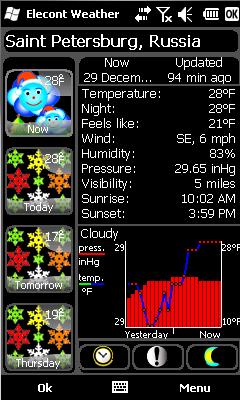
      Elecont Weather 1.0.1029 has been released with a new Windows Mobile 6.5 oriented gesture interface, new themes, and new colors.

      “Elecont Weather” is more than weather station for your Pocket PC or Smartphone. It produces accurate 10-day and hourly forecasts, warns you in case of high solar activity and severe weather (event of a severe thunderstorm, tornado, blizzard, hurricane, or other natural disasters). The most interesting feature is Barometer – a diagram showing the pressure changes during the past 24 hours. Now you always know the cause of headache if it is linked with changes in the air pressure. When Barometer detects pressure changes then it signals with a red color. “Elecont Weather” displays 10-day forecast with text descriptions separately for day and night time. You may find a lot of useful of weather parameters: “feels like” temperatures, chance of precipitation, humidity, visibility and much more. “Elecont Weather” has a global coverage (more than 51,000 locations). The data is provided by “WSI Corp.” (the world’s leading provider of weather-driven business solutions).

      You may find more and download “Elecont Weather” from our software store and receive the 30% discount.

      This post was submitted by elecont.

      Share/Bookmark

    • Promoting Racial Profiling

      A New York lawmaker’s plan to introduce legislation this month legitimizing racial profiling in an attempt to prevent terrorist attacks is more than just offensive. It’s counter-productive and dangerous, too.

      NY Assemblyman Dov Hikind says law enforcement officers and other government agents should consider race when considering who to stop in security checks, just like they evaluate luggage, demeanor and itinerary.

      “Since September 11, if you look at those who have been convicted of acts of terrorism, if you look at all the individuals that are facing trial, the reality is that they are of Middle Eastern or Southeast Asian background, Muslim young men. That is the reality,” he says. “I’m against the concept of profiling, but we’re in a war on terror…We need to use the kind of tools we ordinarily won’t use.”

      The arrest of Umar Farouk Abdulmutallab on Christmas Day in a failed attempt to detonate a bomb aboard a Northwest Airlines flight has renewed calls for the use of racial profiling in security screening, but the suggestions is an overreaction to the threat of terrorism, and it isn’t based on any proof that racial profiling works.

      (more…)

    • LA CUNA DEL SOL “JUTIAPA”

      Jutiapa departamento de Guatemala, ubicado al oriente del país, es bastante montañoso con hermosas playas al sur. Su clima es entre cálido y templado. Cuenta con una población de 389.085 habitantes. Jutiapa tiene extracciónes Europeas. la mayoria del pueblo es de raza ladino (mestizo). Su extensión territorial es de 3.219 km2
      Este departamento como ya fue mencionado antes, está ubicado al oriente la República de Guatemala, colinda al norte con los departamentos del Jalapa y Chiquimula, al Oeste con el departamento de Santa Rosa; al Sur con el Océano Pacífico; al este con la república de El Salvador. Está situado a una altura media de 906 msnm.
      En la cuna del sol [editar]En el extremo suroriental del país, en donde la cordillera volcánica termina su recorrido por tierras guatemaltecas, se estira entre los montes y el mar, el departamento de Jutiapa. Su posición, apretada contra la línea de levante, le otorga el privilegio de recibir al sol naciente; por eso es llamado: “la cuna del Sol”.

      La cadena orográfica del sur de Guatemala, la cordillera volcánica, que se extiende a todo lo ancho, forma un monumental espinazo de conos. Es un verdadero eje de fuego. Pero es en Jutiapa en donde la preeminencia de la condición volcánica se manifiesta con excepcional vigor y agradable diversidad. Ahí, los conos volcánicos no sólo se encuentran por montones; están, también, asociados a multitud de lagunas y lagunetas.

      Los orígenes de esta superficie deben buscarse en tiempos remotos, entre 3 y 8 millones de años, durante los períodos que los geólogos llaman Mioceno y Plioceno, de la época Terciaria, y otra parte en tiempos más recientes, de menos de dos millones de años, durante la época Cuaternaria. El potente vulcanismo de las edades Terciarias se distingue, ahora, por la intensa erosión del terreno.

      El poderoso vulcanismo no sólo formó edificios volcánicos, también despedazó muchos de ellos. Esto, debido a que el fragor fue de inusitada intensidad, porque hubo explosiones catastróficas que hicieron reventar cierto número de conos y hasta la superficie misma del suelo. De esa manera, los campos se llenaron de cráteres explosivos y de grandes depresiones circulares que los geógrafos llaman calderas. Paulatinamente, muchas de estas oquedades capturaron significativas cantidades de agua, formando así lagos, lagunas y lagunetas.

      En nuestros días, el paisaje de Jutiapa resulta particular. Debido a que forma el final guatemalteco de la cordillera volcánica, que desciende del poniente a la parte oriental. Sus tierras se ubican a altitudes medias entre 500 y 900 metros, mientras que en el extremo opuesto lo están entre 2,000 y 3,700. Los escenarios están plagados de pequeños conos alineados, de montes cónicos, de cráteres y calderas de filiación volcánica

      La cabecera departamental de Jutiapa (la cual es la ciudad que lleva el mismo nombre), dista de la ciudad de Guatemala 118 km

      Posee gran actividad comercial y tiene excelentes accesos viales. Está en camino a la frontera con el Salvador, hacia el oriente de Guatemala.

      Su clima es en promedio, cálido, pero es frecuente encontrar lagunas y lagunetas en su territorio.

      Su paisaje es montañoso aunque de poca altura, la cual en promedio es de 905 metros sobre el nivel del mar. Su zona costera se estrecha por las montañas.

      Es famoso por la calidad de sus quesos, leche y crema. También por sus hermosas mujeres.

      Comparte con Chiquimula, el acceso de ascenso al volcán de Ipala vía "Chaparroncito".

      Aca les dejo algunas imagenes de la playa que fui a conocer ayer 01/01/2010 (estas fotos las descarguè de internet), es una playa grandìsima, bella, con gente super amable, ademàs ahi desemboca el Rio Paz. Para a mediados de Enero tenemos planeado volver a esta hermosa playa.

      Manglares

      Playa La Barrona

      Hermosas playas que tiene nuestro Hermano Pais de Guatemala

      Saludos

    • 5,335 at all Prem FA Cup game

      Wigan VS Hull may not be a clash of the galacticos but it is an all Premier League 3rd round FA Cup game in a competition representing both clubs only trophy winning chance. Barely over 5,000 at it.

      Decent attendances at everton adn Spurs but huge gaps in the stands watching Boro VS Man City.

      Time to either give the 4th CL place to the Cup winners or merge it with the Youth Cup.

    • Schadau Castle | Thun, Switzerland

      years of construction: 1847 – 1854

      Website: www.schloss-schadau.ch

    • Voando pela futura cidade olímpica

      Saia para dar um passeio voando pelo Rio:

      Não sei por video direto aqui =/

      http://www.youtube.com/watch?v=S9gSp…eature=related

    • КАСИМОВ

      Каси́мов — город, административный центр Касимовского района Рязанской области России.

      Расположен на левом берегу реки Оки.

      Население 34,5 тыс. чел. (2006).

      Основание города относят к 1152 году, когда в летописях упоминается Городец Мещерский (располагался несколько ниже по течению Оки от современного Касимова[источник не указан 221 день], при впадении речки Бабенки в Оку). По повелению князя Юрия Долгорукого Городец Мещерский был превращен в пограничную крепость Владимиро-Суздальского княжества. В 1376 году город был полностью сожжен и разорён в результате монголо-татарского набега, однако вскоре недалеко от прежнего места возник новый город, который до 1471 года назывался Новый Низовой Город. Проживали в нем русские и давние обитатели здешних мест – представители финно-угорских племен: мещера, мордва, мурома. Они соседствовали, роднились, перемешивая бытовые обряды и обычаи.

      В XV веке в жизни Городца произошла неожиданная и весьма значительная перемена. В борьбе за московский престол великому князю Василию Темному большую помощь оказали татарские царевичи Касим и Якуб. В 1446 году они ушли из Казани на Русь, спасаясь от преследований своего брата Махмутека, который, убив отца и одного из родичей, захватил власть. За верность и важные услуги князь Василий пожаловал Касиму Низовой Городец. Было это в 1452 году. Так по княжьему указу в глубине мещерских лесов возникло Касимовское царство, просуществовавшее с 1452 по 1681 годы. В состав царства входили уезды Рязанской и Тамбовской губерний (Касимовский, Шацкий, Елатомский, Темниковский).

      После завоевания Казани Иваном Грозным в Касимов была сослана последняя правительница Казанского ханства – Сююмбике, которая спустя несколько лет и скончалась в этом городе.

      От периода касимовского царства в городе сохранилось несколько интересных строений: минарет времен царевича Касима, мечеть, два мавзолея (текии), в мавзолеях погребали татарских царей.

      В XVII веке Касимов разделялся на 3 части: удел касимовских ханов и беков (Татарская слобода и Старый Посад); Ямская слобода (находилась в непосредственном подчинении Москвы), остальная часть города (в том числе Марфина слобода) управлялась касимовским воеводой.

      В 1773 году Касимов стал уездным городом Рязанского наместничества. В 1778 город стал центром Касимовского уезда Рязанской губернии.

      Касимов.
      Текие (мавзолей) касимовского хана Шах-Али-Хана и его жены, непокорной красавицы Сиюм Беке, 16 в.

    • New Year’s Bullets Hit Kids

      Something that happens every year, however every time New Year’s Eve comes around there always seems to be yet another idiot that decides it would be cool to break in the New Year by shooting off a round in the

      IMG: Sxc.hu

      IMG: Sxc.hu

      sky. Once again a bullet went stray and hit a kid, this year I read that two different kids got hit on New Year’s Eve.

      One boy, 4-year-old Marquel Peters, got hit by a stray bullet while in a church service. Yes, he was in church when he got struck and died from the wound.

      Down in Miami, yet another child was struck, this time in the stomach by a stray bullet but currently he is still alive. This child was actually having a late dinner at 1 am with family at Mai Tardi restaurant when the bullet shot through.

      Police are searching who shot those bullets, one in Atlanta, the other down in Miami. Course chances are no one will come forward. People need to realize that shooting bullets on new year’s eve is stupid, those that do it need to be shot themselves instead injuring or killing innocent people.  If  they must shoot off something let it be blanks. I know many cities have done away with allowing fire arms to go off and will be fined or put in jail for the night if they do shoot them off.

      Post from: Blisstree

      New Year’s Bullets Hit Kids

    • New at the Original Record

      The following databases have been added at The Original Record in the last week:

      theoriginalrecord 1766-1769 – Board of Stamps Apprenticeship Books: Country Collectors’ Returns
      Apprenticeship indentures and clerks’ articles were subject to a 6d or 12d per pound stamp duty: the registers of the payments usually give the master’s trade, address, and occupation, and the apprentice’s name, as well as details of the date and length of the apprenticeship. There are central registers for collections of the stamp duty in London, as well as returns from collectors in the provinces. These collectors generally received duty just from their own county, but sometimes from further afield. The indentures themselves can date from a year or two earlier than this return. There are returns from Abergavenny, Aylesbury, Bedford, Berkshire, Brecon, Bridgwater, Bristol, Buckinghamshire, Cambridge, Chester, Chichester, Colchester, Cornwall, Cowbridge, Denbigh, Derby, Devizes, Devon, Dover, Durham, Edinburgh, Essex, Exeter, Glamorgan, Gloucester, Huntingdon, Leicester, Lewes, Lichfield, Lincoln, Liverpool, Ludlow, Lynn, Monmouth, Norfolk, Northampton, Norwich, Nottingham, N
      ewcastle-upon-Tyne, Oxford, Pembroke, Plymouth, Reading, Salop, Scotland, Shaftesbury, Shropshire, Somerset, Southampton, Sudbury, Suffolk, Surrey, Sussex, Tiverton, Westmorland, Winchester, Woodbridge, Worcester, Yarmouth, and York, each of which has been indexed separately. IR 1/56

      1883-1884 – The Law Times
      Volume 76 of The Law Times, ‘The Journal of The Law and The Lawyers’, a weekly publication, runs from 3 November 1883 to 26 April 1884. Much of the journal is taken up with law reports, leading articles, &c., and the ‘Solicitors’ Department’ contains several regular features of great interest. The court lists enable us to follow the progress of cases scheduled to be heard in the high courts. Many of these cases never actually came to be heard, litigation ceasing whilst in preparation, or being resolved ‘at the door of the court’. In almost all cases the parties are referred to by surname only. The Court of Appeal heard appeals from the Chancery Division, the Probate, Divorce and Admiralty Division (Probate and Divorce), and the County Palatine and Stannaries Courts; from the Queen’s Bench and Probate, Divorce, and Admiralty (Admiralty) Divisions; from the Probate, Divorce and Admiralty Division (Admiralty cases); and from the London Bankruptcy Court. The very extensive lists of cases pending for trial or hearing in the Chancery Division are arranged by the justice appointed, and then sub-divided into categories such as ‘Casuses for Trial with Witnesses’, ‘Further Consideration’, ‘Demurrer’, ‘Non-witness Causes, Adjourned Summonses, and Special Cases.’ Cases in the Queen’s Bench Division are sub-divided into ‘New Trial Paper’, ‘Special Paper’ and ‘Crown Paper’. Cases in the Probate, Divorce, and Admiralty Division are sub-divided into those for probate and matrimonial causes. Lists of bankrupts, liquidations by arrangement, dividends and orders of discharge extracted from the London Gazette were published each week, and these have been indexed both for the principals and their solicitors. Lists entitled ‘Creditors under 22 & 23 Vict. c. 35′ – a piece of legislation introduced to protect executors and administrators from litigation (whether from kin or from creditors) after the assets of the deceased had been distributed, by allowing the publication of notices stipulating a Last Day of Claim, absolving the estate from later demands – are therefore effectively those of the recently deceased whose affairs were in the process of being wound up; ‘Creditors under Estates in Chancery’, announces the last date by which proofs of claim had to be submitted. Indexed for principal parties and solicitors. ‘Heirs at Law and Next of Kin’ summarizes announcements from solicitors or the courts appealing for heirs to undistributed bequests or estates. There is a weekly list of Unclaimed Stock and Dividends in the Bank of England transferred to the Commissioners for the Reduction of the National Debt, and which would be paid to the claimants named within three months, unless some other claimants sooner appeared. The publication includes examination results and lists of new barristers called to the bar of the inns of court. The examination pass lists include the general examinations of students of the Inns of Court, held at Lincoln’s Inn Hall 16 to 19 October 1883, 20, 21, 27, 28, 29 and 31 December, and 1 to 4 April 1884; the intermediate examination 17 January 1884; and the final examination held 15 and 16 January 1884. For student solicitors there are the Incorporated Law Society examinations for honours of candidates for admission on the roll of solicitors of the Supreme Court, in November 1883 and January 1884; preliminary examinations held 24-25 October 1883 and 8 May 1884; and the intermediate examination held 8 November 1883. There are also lists of passes in the Intermediate Examination in Laws, LL. B. and LL. D. of the University of London. Each issue listed details of professional law partnerships recently dissolved, abstracted and summarized from the London Gazette; and promotions and appointments within the profession. There is also a section of Birth, Marriage and Death announcements, and Edward Walford, M. A., provided in each issue a Legal Obituary, giving biographical notices (dwelling
      particularly upon the legal careers) of recently deceased members of the profession.

      1918 – Barristers
      The Law List for 1918 includes this ‘List of Counsel, Special Pleaders, and Conveyancers at the Bar’. Each name is given in full, surname first; then the name of the Inn of Court as an abbreviation (G., Gray’s Inn; I., Inner Temple; L., Lincoln’s Inn; M., Middle Temple; and D. C. for Doctors’ Commons) and date at which called to the bar. Barristers in practice are usually furnished with an address, and there are some abbreviated references to judicial awards and appointments. An asterisk signifies an Equity Draughtsman and Conveyancer.

      1934 – Residents of Poole, Longfleet and Parkstone
      Kelly’s Directory of Bournemooth, Poole, Parkstone, Etc. includes this list of private residents in Poole, Longfleet and Parkstone (inclusive of Branksome). An asterisk before a name indicates a Parkstone postal address; a dagger, Bournemouth.

      1940 – University of Ireland Members of Convocation
      The University of Ireland was established by royal charter in 1908, with three constituent colleges – University College, Dublin; University College, Cork; and University College, Galway. The university calendar for 1940 includes this complete list of Members of Convocation. It is similar to the general list of graduates of the university, but not exactly the same, for it includes academic staff of the university not necessarily graduates of the same, and not all graduates registered for membership of convocation. The list gives full names (surname first), degree and year of graduation, and, importantly, full address as in 1940 – information not given in the general list. Where the current full address was not known, the last known address was given, the entry being in italics.

      The Original Record now have over 9.1 million entries directly available online., with afree unlimited search. All records are hand-indexed (no OCR). You amy purchase sets of scans, or buy open access to the surname(s) of your choice, including variants. See: www.theoriginalrecord.com

    • How many emails before you ask someone out?

      For those using online dating sites, after emailing the other person, how many emails do you think is acceptable before you ask them out on a date?
    • Carbon Offsets: The New Medieval Pardoning System? – Ethical Travel News (blog)

      Carbon Offsets: The New Medieval Pardoning System?
      Ethical Travel News (blog)
      Over the past few years carbon offsets have become a popular tool for combating global warming, but recently ethical