Category: News

  • Google: Page Speed May Become a Ranking Factor in 2010

    Over the course of 2009, a consistent theme that Google has been involved with is that of speed. In announcement after announcement, Google has talked about the importance of speed on the web, and how the company wants to do everything it can to make the web a faster place. Has it occurred to you that how fast your page loads may have a direct effect on how your site ranks in Google?

    Don’t worry, it hasn’t had an impact…yet. In an interview with WebProNews, Google’s Matt Cutts told us that speed may soon be a ranking factor.

    "Historically, we haven’t had to use it in our search rankings, but a lot of people within Google think that the web should be fast," says Cutts. "It should be a good experience, and so it’s sort of fair to say that if you’re a fast site, maybe you should get a little bit of a bonus. If you really have an awfully slow site, then maybe users don’t want that as much."

    >> Site speed ranking comments starts at the 02:35 point in the video…

    "I think a lot of people in 2010 are going to be thinking more about ‘how do I have my site be fast,’ how do I have it be rich without writing a bunch of custom javascript?’" he says.

    I would say that based on Matt’s comments it is probably fair to assume that Google will indeed begin taking page speed into consideration as a ranking factor, although he doesn’t come right out and say that they definitely will. That said, making your site faster is going to benefit your users and possibly your sales anyway, so you might as well start optimizing it for speed anyway. Then if Google really does start using this as a ranking factor, you will have a head start on boosting your rankings.

    Google has generally been pretty good at providing webmasters with tools they can use to help optimize their sites and potentially boost rankings and conversions. Google recently announced a Site Speed site, which provides webmasters with even more resources specifically aimed at speeding up their pages. Some of these, such as Page Speed and Closure tools come from Google itself. But there are a number of tools Google points you to from other developers as well.

    If you’re serious about wanting your site to perform better in search engines, and you haven’t given much thought to load times and such, it’s time to readjust your way of thinking. Caffeine increases the speed at which Google can index content. Wouldn’t it make sense if your site helped the process along?

    Have you given much thought to site speed? Is your site up to snuff? Discuss here.

    Related Articles:

    Google Wants the Web to Function Like a Magazine

    Google Provides Tool for Speeding Up Web Pages

    Google Lets Businesses Speed Up Videos

  • YouTube, Univision Announce Partnership

    YouTube’s struck another content-sharing partnership, and it’s a big one.  Univision, which is the top Spanish-language broadcast network in America, has agreed to supply the video-sharing site with both short clips and full shows.

    On the YouTube Blog, Strategic Partner Development Manager Laura Lee explained the importance of this arrangement by noting that the size of YouTube’s Hispanic audience has increased by 80 percent in the last year.  She also stated that this deal counts as "one of YouTube’s most comprehensive partnerships for full-length content to date."

    Lee then continued, "Expect to see programs from Univision’s three networks – Univision, TeleFutura and Galavision – as well as unique footage from celebrity interviews and special events such as next year’s ‘Premio Lo Nuestro a la Musica Latina’ (Lo Nuestro Latin Music Awards)."

    So as soon as Univision’s content makes it to YouTube (and this may take a few months), the site is likely to become much more popular with native Spanish speakers.  And it’s not hard to imagine that many people who are trying to learn Spanish will appreciate the new content, too.

    As for the partnership’s financial details, nothing was disclosed, but Univision will take advantage of YouTube’s Content ID system, meaning it should receive at least a little bit of money.

    Related Articles:

    > YouTube On Verge Of Supporting 1080p Video

    > YouTube Talks Up Social Side

    > Has YouTube Found The Right Ad Solution?

  • Abortion-Rights Groups Mobilizing Against House Health Bill Restrictions

    Abortions-Rights advocates are pressing lawmakers through new ad campaigns to keep a provision restricting abortion coverage in the House-passed health bill — the so-called Stupak amendment — out of the Senate health care bill, CBS News reports. “The Center for Reproductive Rights is launching an ad campaign today to emphasize that, if the Stupak amendment were to pass in the final health care bill, millions of women could potentially lose the coverage for abortions they currently have in their health care plans.” The group is running the ad online and on TV in Washington. In addition, “NARAL Pro-Choice America today delivered a petition with 97,218 signatures to Senate Majority Leader Harry Reid, asking that he leave the Stupak amendment out of the Senate bill. Working with state affiliates and other progressive partners, NARAL collected the signatures in 72 hours.” In addition, Planned Parenthood is “planning a national ‘day of action’ for December 2” (Condon, 11/16).

  • Coinstar: Get $10 bonus retail credit when you change in $40 or more

    coinstar

    You guys use them newfangled corn star machines? Oh, Coinstar – that make more sense. I know I do, and I know longtime CrunchGear reader Johnal does because he sent in this tip.

    When you dump in more than $40 worth of change between now and December 6th and you opt to receive your payout in the form of store credit at one of Coinstar’s participating retail partners, you’ll receive a $10 bonus gift card by mail.

    If you’ve never used a Coinstar doodad before, they’re basically big machines found in grocery stores. You bring in your bucket of spare change and feed it into the machine, which then spits out a receipt that you can use to pay for your groceries or trade in for cash at the store’s customer service window. Coinstar takes a 7.5% cut of your earnings, though, unless you opt to either donate everything or turn it into retail credit.

    Get $10 More When You Change $40 [Coinstar.com]

    Thanks for sending this in, Johnal…


  • IAB Releases Ad Unit Guidelines Update

    The Interactive Advertising Bureau (IAB) released the 2009 update to its ad unit guidelines today. For the first time, the IAB is bringing in creative agencies for input on ad unit recommendations. Historically, these have only come from media agencies and publishers.

    Randall Rothenberg "By bringing agencies into the process of developing standard ad units, we have taken a step towards improving the creative output and branding potential for interactive media," says Randall Rothenberg, President and CEO of the IAB. "Our next order of business is to drive towards adoption of revised standards that we believe will spur increased investment in interactive advertising—we’ve already proven that there is no medium more accountable—now we have to bring all of its capabilities together to tell great stories to consumers—that’s what advertising is all about."

    "Being a part of this process gave voice to the creative challenges that agencies faced with the existing standards, ad units, and technologies, and I believe we’ve found a solid way forward in overcoming those challenges," said Jim Russell, Partner, EVP, Director of Digital Strategy, McKinney. "Our goal was to simplify the existing list and I think we’ve developed a long-term strategy for doing this on behalf of the industry."

    The working group created by the combination of creative agencies, media agencies, and publishers is called the Reimagining Interactive Advertising Task Force. The group has updated the criteria for standard ad units. It did so by looking at industry-wide impression count reports, ad unit availability, agency-side effectiveness reviews, and creative preferences. Two recommendations they made are:

    – In order to be considered a standard, an ad unit must be commonly bought and offered throughout the marketplace; only seven of the eighteen ad units currently on the list meet the new criteria.

    – Ad units will not be removed from the standard list in 2009, but must meet the criteria by the end of 2010

    The whole IAB Ad Unit Guidelines update can be found here. Next year, the Task Force will release the first list of ad units.


    Related Articles:

    > Marketing Best Practices for Long Form Video

    > 7 Behavioral Targeting Privacy Principles

    > IAB Announces Guidelines for In-Game Ad Standards

    > IAB Releases Social Advertising Best Practices

    > IAB Rolls Out Click Measurement Guidelines

    > IAB Releases Definitions for Social Media Ad Metrics

    > IAB Releases Video Ad Guidelines


  • Murdoch On Blocking Search Engines: “I Think We Will”

    There’s a chance that the content produced by the Wall Street Journal, the New York Post, and a number of other important organizations will soon become impossible to find using Google.  Rupert Murdoch indicated in a recent interview that News Corp. may block search engines.

    News Corp. is the world’s second largest media group.  It owns enough stuff that even hitting the highlights would take far too much time.  (Wikipedia has an 861-word entry titled "List of assets owned by News Corporation" if you’re feeling adventurous.)

    Murdoch’s interview with Sky News editor David Speers could be of huge significance, then.  In it (the relevant part of the conversation starts around the 3:10 mark), Murdoch said, "We’d rather have fewer people coming to our website, but paying."  In reference to "search people," he next added, "They don’t suddenly become loyal readers of our content."

    Finally, in response to a question regarding why News Corp. doesn’t just block search engines, Murdoch said, "Well, I think we will . . ."

    But here’s the tricky part: Murdoch cited the Wall Street Journal’s current approach to pay walls and subscriptions as an example of what he’d like to implement on a larger scale, and it’s actually possible to access WSJ stories using Google.  It’s only when clicking around within the WSJ that you run into truncated articles.

    So we – and a lot of industry decision-makers – will see what happens.  Whichever way Murdoch leans, he definitely has the power to start a trend.

    UPDATE: Danny Sullivan has pointed out a sort of middle ground at which Murdoch might arrive: "Publishers can have Google News index the entire text of their articles but NOT show the full story to visitors who come from Google (for Google’s web search, that’s not an option – but you can provide summary pages).  They can also, if they choose, have only a small summary of their content indexed."

    That would allow News Corp.’s properties to by and large stick to the WSJ model without sacrificing loads of search traffic and becoming less visible to potential ad-clickers and paying customers.  A smart compromise, perhaps.

    As for when a change might go through, Jon Miller, News Corp.’s Chief Digital Officer, gave a rough deadline by talking about "months and quarters – not weeks" at a conference yesterday.  But according to Emma Barnett, he also indicated that News Corp. wouldn’t do anything drastic on its own, which may either be a polite way of contradicting Murdoch’s statements or a hint that the industry really is about to change. 

    Related Articles:

    MySpace To Miss $100 Million From Google Search Deal

    > Murdoch Says Newspapers Must Charge For Online Content

    > News Corp. Posts Disappointing Financial Results

  • Last Call For Techdirt DMCA Takedown Shirt

    Just a final reminder that if you want the Techdirt DMCA Takedown T-shirt, today is the last day to order them, either alone or with my Approaching Infinity book. And, remember, we also have the regular Techdirt logo t-shirt (and again, the logo t-shirt with the book) and the Techdirt logo hoodie, all of whose sales end tonight at midnight PT. The DMCA t-shirt has proven to be incredibly popular (sales have far outstripped our last t-shirt), so if you want in on the fun, make sure to order one in the next few hours. We’re thrilled so many people like the shirt so much…

    Permalink | Comments | Email This Story


  • Sync Your Computer’s Firefox with Your Phone’s

    Update 2: Mozilla has now announced the release of Weave Sync Version 1.0 Beta 1.

    Update: Mozilla has now released Weave Version 0.6.

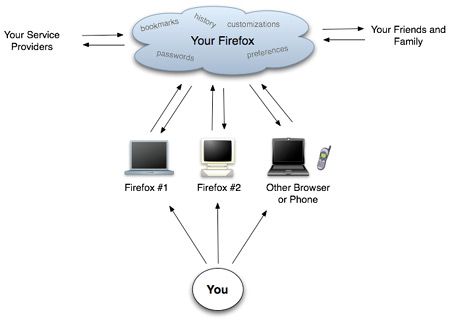
    Original Article: A couple years ago, Mozilla launched Weave, which is a Mozilla Labs project aimed at letting Firefox users sync their personal preferences with Firefox browsers on other computers or on their phones. Now, Mozilla has announced a new version of Weave Sync in Weave 0.5.

    What Can You Do with It?

    – Get the same results on the Smart Location Bar on each of your Firefox browsers.

    – Open any tab that is open in any of your other FF browsers

    – Keep the same list of bookmarks throughout multiple FF browsers

    – Easily sign in to all of your favorites sites using saved passwords

    – It is all secure as Weave Sync encrypts user data before uploading it to Mozilla’s servers

    Weave Sync

    The new version includes additional improvements including a major upgrade in performance when uploading and downloading. Sync waits until you’re not actively using the browser, and support for bookmark tags and smart folders has been improved.

    Support has also been added for changing passwords, and there is better error handling and reporting. Weave Sync now supports Fennec on Windows Mobile and Firefox on x86 OpenSolaris now as well.

    More information is available about Weave here, and it can be downloaded here. It requires Firefox 3.5 or higher.

  • Fear of Flu: Shifting the Goalposts

    If any public health message has alarmed Americans in recent weeks, it is the repeated claim in the media that healthy young people are dying of 2009 H1N1, or swine flu. A recent 60 Minutes report focused on the “unusual number” of otherwise robust children who’ve fallen ill and died from swine flu. USA Today’s headline on October 17 was, “Swine Flu Linked to 11 More Child Deaths.” The response has been predictable: frantic parents clogging waiting rooms in pediatricians’ offices, lining up for hours to get their kids vaccinated, and rushing to fill prescriptions for anti-viral drugs before the local pharmacy runs out.

    While the death of a child is always a tragedy, is the panic justified? Let’s look at the statistics.

    First up, while it’s happening earlier, is the 2009 H1N1 more dangerous than garden variety seasonal flu, for healthy kids compared to kids with underlying illnesses? According to a paper published last month in the New England Journal of Medicine, probably not. The authors found that 60 percent of children who died of swine flu had underlying illnesses. In years past, only 31 to 43 percent of children who died of seasonal flu had similar underlying illnesses – meaning that the rate at which 2009 H1N1 kills healthy children is lower than with seasonal flu.

    We found much the same picture when we looked at the actual reports of the first 36 pediatric flu deaths this year from around the country posted by the Centers for Disease Control and Prevention (CDC). The majority of those children (70 percent) had multiple, severe underlying conditions, such as congenital heart and lung disease, for instance, or cerebral palsy. And that’s not counting morbid obesity, which many flu experts believe should be considered a risk factor.

    Certainly it appears as if there have been proportionately more deaths among young people than the elderly compared with seasonal flu years, but that’s largely because fewer old people are dying than usual. They may have some residual immunity from being exposed to related viruses in the past, but whatever the reason, the proportion of deaths among younger people is automatically larger this year.

    According to the CDC’s most recent update, there have been 156 laboratory-confirmed 2009 H1N1 flu deaths in the U.S. among children and teens 17 years old and younger. Last week, the CDC extrapolated from those numbers to estimate about 540 pediatric deaths. (The estimate is derived by taking the number of laboratory-confirmed flu deaths and running it through a complicated formula and computer model.)

    It sounds like a lot of kids dying, but we don’t really know how the death rate compares to previous years. During last year’s regular flu season, for example, there were 115 laboratory confirmed flu deaths reported among this same age group.

    An additional complicating factor: It turns out that the number of reported pediatric flu deaths has been steadily rising each year since 2005 (and possibly earlier). During the 2005-2006 flu season, 46 pediatric lab-confirmed deaths were reported. In 2006-2007 the number rose to 78. By 2007-2008, there were 88 deaths, followed by 115 last year.

    Although the number of this year’s deaths will probably rise in coming months, it’s important to compare apples to apples. To date, the number of laboratory-confirmed pediatric deaths is only marginally greater than last year’s – and a disproportionate number of those children have underlying illnesses.

    No one knows for sure why flu deaths among children are going up, but the CDC told us that doctors are probably “doing a better job of reporting.” Better book-keeping, in other words, not more virulent viruses, is responsible for at least part of the apparent increase in pediatric deaths in recent years. Based on this trend alone, we would expect that the number of pediatric deaths would be higher this year than last.

    What’s more, additional changes in book-keeping may exaggerate the total number of swine flu deaths reported among all age groups. This year, the CDC liberalized the definition of what it counts as a flu death for people over age 18. Until now, only deaths in which the patient had laboratory-confirmed influenza were used to estimate the annual mortality statistics for seasonal flu, which the CDC says causes about 36,000 deaths a year in the U.S., according to their mathematical modeling projections.

    As of August 31, however, the CDC said that anyone 18 years or older who dies with a syndrome known as influenza-like illness, or ILI, can be included in the count. The CDC has no requirement for uniform reporting of flu deaths by the states. Twenty-eight states, according to the agency, report only laboratory-confirmed flu deaths, while the others are now reporting deaths that look to doctors like they might be the result of flu.

    That decision could dramatically inflate the numbers of reported flu deaths this year. By the CDC’s weekly estimate, when doctors think a patient has the flu, they are wrong between 46 and 82 percent of the time. This isn’t a criticism of doctors; it is virtually impossible to distinguish flu from illnesses caused by germs like coronavirus and many others. However, it does mean that once the CDC extrapolates its estimates for the entire population, swine flu mortality could appear to be as much as an order of magnitude greater than seasonal flu, whether or not there is any real increase in deaths.

    Why should any of this matter? In part, because statistics, when filtered by the popular media, can scare the daylights out of the public and feed pandemic worries that may not be justified. The numbers also matter to public policy. As reported deaths rise, the CDC tends to enlarge its recommendation for who should be vaccinated, and who should receive anti-viral drugs. For example, based on rising pediatric deaths, the CDC issued new recommendations in 2009 that all children from 6 months to 18 years should get the flu vaccine each year. Previously, the vaccine was recommended only for high-risk children.

    That’s not to say that we all shouldn’t exercise caution this flu season, or that the U.S. government is deliberately fanning fear by changing its definition of what counts as a flu death. But at a time when we are worrying about rising health care costs, there’s an argument for basing multi-billion-dollar investments in vaccine campaigns and stockpiling antiviral drugs on solid numbers.

  • UV wand kills H1N1 dead — dead I tell you

    78326B There’s no shame in wanting to punch a medical epidemic right in its adam’s apple. Punch sickness, not people. That’s what I always say. If your white-hot hatred of Swine Flu still hasn’t tapered off, though, it’s gonna take a lot more than a little virus punching to get you the satisfaction you deserve. Might I suggest — and hear me out – murder? Yes, murder.

    Murder via this ultraviolet light wand that looks like a cross between an oversized Wii remote and some sort of sick, twisted adult novelty item that Biggs has yet to review.

    The $70 “H1N1 Destroying UV Wand” from Hammacher Schlemmer promises to choke the life out of “99.98% of the H1N1 virus after a five-second exposure when held 3/4″ above the contaminated surface.” And if you think there won’t be any collateral damage, think again. According to the product page:

    “Also capable of killing MRSA, mold, and dust mites, the UV-C light penetrates viral and bacterial membranes and destroys their DNA, rendering the microorganisms incapable of reproduction and survival. Unlike liquid disinfectants, UV-C light can sanitize keyboards, upholstered furniture, cell phones, or any delicate surface that harbors germs.”

    Yes, that’s right, it destroys DNA. The building blocks of all life, obliterated. Take that Swine Flu. You take that to hell and you don’t come back.

    The H1N1 Destroying UV Wand [Hammacher Schlemmer]


  • ePUB Upgrade For Your PRS-500 Reader


    prs500

    It is very rarely I would say that a company like Sony may feel so generous and offer a firmware upgrade to a product that has been discontinued years ago. And this is pretty much what they are  offering for current owners of the US Reader PRS-500 model that captured a lot of heart’s of the reading population here in the US and prompted lots of imports to Europe and other continents because it was not available there back then. Since newer and shinier Sony Readers are happy reading this ePUB format, PRS-500 was left behind like many other older Sony products that would be so happy if were upgraded to live on. I’d love for Sony to keep up and offer new updates/developments for such products as VAIO Accessories (VAIO Digital Frame VGF-CP1 saw a new update in Japan, but left behind everywhere else…VAIO Server VGF-HS1 – same story (WHY??); Sony Entertainment Server HES-V1000 has a network and Internet ability, but has never seen the light of BD-Live Upgrade; even certain older gen Bravias, how great it would be if those Internet widgets were added to the XMB via firmware upgrade? I am sure customers would be happy enough to see Sony being proactive in this case and not forget to bring new features to their beloved products, which in its turn boost customer’s confidence in Sony as a brand.

    Anyways, I am happy for current PRS-500 customers as they have an option to do just that and have a new breath of life added to the device. Sony is even offering a trade in option, if you are willing to part with your Reader and get a fresh new one, like the Touch edition! More info on this subject matter can be located here.

  • All About an HCV-Related Condition: Lichen Planus

    Lichen planus, a recurring skin condition that often manifests with Hepatitis C infection, can cause intense itching and pain. Learn about the skin disease’s characteristics and commonly affected regions – as well as six strategies that may help reduce your risk of lichen planus from returning.

    by Nicole Cutler, L.Ac.

    Affecting between one and two percent of the world’s population, lichen planus is a relatively common dermatological disease. A recurring, chronic, non-allergic, non-infectious, non-contagious disease of the skin, lichen planus has a tendency to relapse after months or years. In between episodes, practicing preventative measures may be able to stop the recurrence of this frustrating condition.

    The exact cause of lichen planus is unknown, but it seems to be triggered by stress, genetics, viral infection and allergic reactions to medicines. Although it can be associated with many different health conditions, lichen planus is a common manifestation of Hepatitis C infection. Studies have found that up to 60 percent of people with lichen planus have a history of Hepatitis C. For this reason, it has been recommended that people with lichen planus (especially with elevated liver enzymes) should be tested for the Hepatitis C virus.

    About Lichen Planus
    Arriving in episodes lasting months to years, lichen planus may begin gradually or quickly. Although no specific cause can be singled out, many possible sources have been implicated in its evolution. Found to occur more frequently in people with a liver dysfunction, lichen planus is now recognized as an extra-hepatic manifestation of the Hepatitis C virus.

    Often times, a physician must perform a biopsy of affected tissue to confirm a diagnosis of lichen planus. Unfortunately, several biopsies may be needed at various times, along with blood tests. Clinicians seem to agree that it is common for a yeast infection to be present with lichen planus. In such cases, treating the yeast infection first often improves the severity of lichen planus.

    Below are eight characteristics of lichen planus:

    1. Appearing as shiny, flat-topped bumps typically with an angular shape, the bumps of lichen planus have a reddish-purplish color and a shiny cast.

    2. Even though it favors the inside of the wrists and ankles, the lower legs, back and neck, lichen planus can surface anywhere on the skin.

    3. The mouth, genital region, hair and nails may be lichen planus targets in some individuals.

    4. Thick patches may occur, especially on the shins.

    5. Blisters rarely occur.

    6. Bumps typically appear in areas of trauma.

    7. About 20 percent of the time, lichen planus of the skin causes minimal symptoms and needs no treatment.

    8. In many cases, the itching of lichen planus can be constant and intense.

    There is no known cure for skin lichen planus, but treatment is often effective in relieving itching and improving the appearance of the rash until it goes away. Since every case of lichen planus is different, no one treatment is sufficient. Physicians may prescribe oral or topical corticosteroids, antihistamines, retinoid drugs or photo-chemotherapy light treatment (PUVA).

    Other Locations
    Commonly seen with Hepatitis C infection, lichen planus affects other regions of the body such as the mouth, scalp and nails:

    · Lichen Planus of the Mouth – Lichen planus lesions can be found on the inside of the cheeks, gums and tongue. Called oral lichen planus, this variety can be more difficult to treat and typically lasts longer than skin lichen planus. About one-third of all people who have oral lichen planus also have skin lichen planus. Typically appearing as patches of fine white lines and dots, oral lichen planus rarely causes symptoms. However, severe forms of oral lichen planus can cause painful sores and ulcers in the mouth.

    · Lichen Planus of the Nails – Reported in about 10 percent of lichen planus cases, nails can also be affected by this condition. The majority of toenail or fingernail changes results from damage to the nail matrix, or nail root. Nail changes associated with lichen planus include longitudinal ridging, grooving, splitting, nail thinning and nail loss. In severe cases, the nail may be temporarily or permanently destroyed. Lichen planus of the nails is often resistant to treatment.

    · Lichen Planus of the Scalp – Lichen Planopilaris is the specific name given to lichen planus on the scalp, which causes permanent scarring alopecia with inflammation around affected hair follicles. Mostly affecting middle-aged adults as distinct patches of hair loss, treatment includes oral and topical steroids.

    Relapse Prevention
    Besides avoiding potentially aggravating medications, most clinicians woefully report that there is no surefire way to prevent the recurrence of lichen planus. However, the growing understanding that this skin disorder is an extension of an immune system deficiency offers some clues. In addition, the fact that treating a yeast infection is beneficial for lichen planus, gives us even more useful information.

    By keeping your body – both the physical and emotional extensions – as healthy as possible, your risk of a severe lichen planus outbreak is reduced. On top of controlling any possible lichen planus triggers, six suggestions for accomplishing this include:

    1. Do whatever is necessary to minimize stress.

    2. Avoid alcohol and tobacco.

    3. Prioritize getting a full night of restful sleep.

    4. Choose foods that are digestive system friendly, such as whole grains, vegetables, fruits, high-fiber and items low in saturated fat.

    5. Reduce peppermint, cinnamon and citrus foods (as these may aggravate lichen planus).

    6. Fight yeast accumulation with probiotics. According to Israeli researchers, probiotics are immune system modulators. In addition to strengthening the digestive system to combat yeast, probiotics have also demonstrated an improved ratio of immune cell factors.

    This potentially frustrating skin disease can really be a challenge, especially while trying to manage chronic Hepatitis C. Since Hepatitis C and lichen planus commonly appear together, looking for solutions to benefit both ailments is the best choice. In addition to working with your physician to minimize any lichen planus triggers, evaluate what you are doing to keep your emotional, digestive and immune systems healthy. Even if you are struggling with an outbreak, instituting the above listed six suggestions will pay off in the long run – by reducing the risk of future lichen planus episodes and by improving your overall physical health.

    To learn about Fatigue Relief Plus, a nutritional supplement that combines liver support with probiotics, click here.

    References:

    Amital H., et al., Probiotic Supplementation with Lactobacillus casei (Actimel) Induces a Th1 Response in an Animal Model of Antiphospholipid Syndrome, Annals of the New York Academy of Sciences, September 2007.

    http://autoimmune-skin-disorders.suite101.com, Lichen Planus: A Common Skin Rash in Autoimmune Disorders, Elaine Moore, April 2007.

    http://hcvadvocate.org, Extrahepatic Manifestations: Lichen Planus, Alan Franciscus, Hepatitis C Support Project, 2007.

    Prabhu Smitha, Pavithran K, Sobhanadevi G, Lichen planus and hepatitis c virus (HCV) – Is there an association? A serological study of 65 cases, Indian Journal of Dermatology, Venereology and Leprology, 2002.

    www.aafp.org, Lichen Planus, Rajani Katta, MD, American Family Physician, 2007.

    www.aocd.org, Lichen Planus, American Osteopathic College of Dermatology, 2007.

    www.lichenplanus.com, What you Need to Know About Lichen Planus, Dr. Rajesh Shah, 2007.

  • How Will We Keep Supercomputing Super?

    jaguar500Cray’s Jaguar supercomputer is the fastest machine on the planet, according to the Top 500 list of supercomputers published today by four researchers in the computing industry. It marks the first time that Jaguar beat out IBM’s Roadrunner on a performance basis, achieving 2.3 petaflops, or about 2 million billion calculations a second. However, a deeper look at the list shows that the trend in supercomputing is not only one of faster machines, but a steady erosion of how super supercomputing actually is, as exemplified by dedicated vendors such as SiCortex being shut down and venerable players like SGI filing for bankruptcy before then getting acquired.

    Increasingly, many of the parts that make up a supercomputer — from the types of processors used to the networking cables — are the same as those used in everyday corporate computing. As the chart makes clear, the number of different processors used to build supercomputers has been shrinking. This is partly due to Moore’s Law, which enables the x86 architecture (the same type of chips inside your computer) to make steady performance gains, but is also a function of how cheap mass-produced chips are. And because most supercomputers are built for the government, getting as many flops for the dollar is essential. Even on the networking side, Ethernet is making strides when compared to more expensive, proprietary networking technologies such as Infiniband.

    superarchitecture

    However as the search for faster computers continues (the goal is to build an exascale machine by 2018), cramming millions of x86 chips into a giant system isn’t going to cut it on either the power consumption or the real estate front. That’s why when it comes to chips in supercomputers, expect to see more graphics processors, which offer screaming performance for certain tasks at a price that’s relatively cheap thanks to the fact that GPUs are found in most consumer computers. For example, the fifth-most powerful system on the Top 500 list is a Chinese supercomputer that uses GPUs from AMD.

    As I explain in a GigaOM Pro piece about the quest for the exascale grail (sub. req’d.), building a supercomputer that can deliver a billion billion  (or quintillion) calculations per second is going to force designers to change the way they think about putting these supercomputers together. GPUs are the first step in that process, although more esoteric technologies may emerge.

    But for now, as supercomputers and high-performance computers use more mainstream and commodity parts, it makes it that much harder to distinguish the specialty high-performance computing vendors from those offering corporate computing products. Rackable, which purchased SGI and took the SGI name, builds its products with a corporate buyer in mind, for example. And as the underlying hardware for high-performance computing becomes more like the hardware used in corporate data centers, firms like Microsoft are trying to take advantage of the familiar architectures (as well as the ever-increasing need for higher-performance computers at the corporate level), with the Redmond giant today releasing products that will allow folks to run Microsoft Office Excel 2010 on a distributed HPC cluster as well as a version of Windows HPC Server 2008 designed to run on large clusters.

    So as supercomputers have become less super, they have also become more accessible for corporate computing. Microsoft, Intel, SGI/Rackable and others are trying to take advantage of this. However, as the industry strives to build machines that can achieve exascale performance, it’s unclear if these commodity and common architectures can scale out linearly without consuming incredible amounts of power and taking up huge amounts of space. So we may see supercomputing become more super and less mainstream once again.


  • Motorola DROID giveaway!

    Motorola-DROID-giveaway-2

    Uh oh… we’re not sure if you’re ready for this, guys. Since we were the first ones to take you up close with the Motorola DROID, we thought it would be fitting if we ran the hands down best Motorola DROID giveaway — we’ll be giving away (5) brand new Motorola DROID handsets for Verizon Wireless. Motorola doesn’t answer our emails and Verizon declined (nicely), so we paid for these out of our own pockets. We’re going to make the contests fun and exciting but don’t worry, you won’t have to jump through hoops. Plus, there is word in the BGR BlackBerry Messenger group that we’ll be giving away some BlackBerry 9700s shortly? Stay tuned!

    UPDATE: Just to be super, super clear… dropping a comment here doesn’t enter you into any of the giveaways. It does, however, tell us how excited you guys are about them, and we’ll have more information shortly.

  • Gift Guide 2009: Pocket Camcorders

    Intro

    Pocket-sized camcorders continue to grow in popularity thanks to falling prices, shrinking form factors, and enhanced video quality. While there are plenty on the market to choose from right now, this guide will focus on models selling for less than $150. That seems to be a good price ceiling that allows you to get plenty of features without spending too much.

    Flip Minoflipmino

    Flip Mino: $149.99 (TheFlip.com)

    Flip’s line of compact digital camcorders arguably broadened the mass appeal of such devices thanks to simplified controls, pocket-friendly form factors and, perhaps above all, easy-to-use built-in software and streamlined YouTube uploading. While many of its competitors now offer similar features at lower price points, Flip cameras are still wildly popular.

    Features:

    • Storage: 2GB (not expandable)
    • Resolution: 640×480
    • LCD Size: 1.5 inches
    • Zoom: 2x digital
    • Battery: Rechargeable lithium-ion (not replaceable)
    • TV Output: Composite AV

    PROS: Stylish, customizable, super easy to use, tiny form factor, built-in software

    CONS: Expensive, no way to add storage, no way to replace battery

    Product Page

    Creative VadoVADO

    Creative Vado: $99.99 (Creative.com)

    Taking its cues from the aforementioned Flip Mino, the Creative Vado matches it almost spec for spec while featuring a larger LCD and smaller price tag. Sure, it may not come in as many colors and designs but if you’re looking for Flip’s portability and ease of use at a much lower price, the Vado is a good place to start.

    Features:

    • Storage: 2GB (not expandable)
    • Resolution: 640×480
    • LCD Size: 2 inches
    • Zoom: 2x digital
    • Battery: Rechargeable lithium-ion (replaceable)
    • TV Output: Composite AV

    PROS: Flip Mino features for $50 less, replaceable battery, relatively big 2-inch LCD

    CONS: No way to add storage, bland color options

    Product Page

    Kodak Zx1Zx1

    Kodak Zx1: $149.95 (Kodak.com)

    Kodak’s newest addition to the world of pocket camcorders is the Zx1, capable of recording 720p video at up to 60 frames per second. The camcorder comes with two AA rechargeable batteries, which means it can use standard AA batteries in a pinch. You can even purchase Kodak’s rechargeable lithium-ion battery pack to use instead.

    Features:

    • Storage: 128MB (expandable via SD/SDHC)
    • Resolution: 1280×720
    • LCD Size: 2 inches
    • Zoom: 2x digital
    • Battery: Rechargeable lithium-ion (replaceable)
    • TV Output: Composite AV and HDMI

    PROS: 60 FPS HD video on the cheap, multiple battery options, dual video outputs

    CONS: Not much built-in storage, ships with nickel-metal hydride batteries

    Product Page

    Sony Webbie HDWebbie

    Sony Webbie HD: $149.99 (SonyStyle.com)

    Sony’s Webbie HD pocket camcorder features a cool swiveling lens, individual movie and still photo buttons, and more-than-720p-but-not-quite-1080p resolution. Initially priced at $169.99, the Webbie HD line has now been discounted to $149.99 for the holidays.

    Features:

    • Storage: None (expandable via Sony Memory Stick PRO/PRO Duo)
    • Resolution: 1440×1080
    • LCD Size: 1.8 inches
    • Zoom: 4x digital
    • Battery: Rechargeable lithium-ion (replaceable)
    • TV Output: Composite AV and Component AV

    PROS: Swivel lens for self portraits, separate still photo and video recording buttons

    CONS: No built-in storage, uses proprietary Memory Stick format, odd resolution

    Product Page

    Insigniainsignia

    Insignia NS-DV1080P: $149.99 (InsigniaProducts.com)

    Best Buy’s house-brand, Insignia, has managed to put together a portable camcorder that shoots full 1080p video and sports a big 3-inch flip-out LCD – all for $149.99. You also get a front-mounted video light, although I can’t make any claims as to how useful it actually is.

    Features:

    • Storage: 90MB (expandable via SD/SDHC)
    • Resolution: 1920×1080
    • LCD Size: 3 inches
    • Zoom: 4x digital (in 720p mode)
    • Battery: Rechargeable lithium-ion (replaceable)
    • TV Output: HDMI

    PROS: Full 1080p HD video for $149.99, big LCD screen, video light

    CONS: 4x digital zoom only works at 720p resolution

    Product Page

    CompareComparison Chart:

    CAMCORDER

    FLIP

    CREATIVE

    KODAK

    SONY

    INSIGNIA

    PRICE

    $149.99

    $99.99

    $149.95

    $149.99

    $149.99

    STORAGE

    2GB

    2GB

    128MB

    None

    90MB

    EXPANDABLE

    No

    No

    SD/SDHC

    Memory Stick

    SD/SDHC

    RESOLUTION

    640×480

    640×480

    1280×720

    1440×1080

    1920×1080

    LCD SIZE

    1.5”

    2”

    2”

    1.8”

    3”

    ZOOM

    2x Digital

    2x Digital

    2x Digital

    4x Digital

    4x Digital

    BATTERY

    Lithium-ion

    Lithium-ion

    Rechargeable Ni-MH AA

    Lithium-ion

    Lithium-ion

    TV OUTPUT

    Composite

    Composite

    Composite and HDMI

    Composite and Component

    HDMI

    MODEL

    Mino

    Vado

    Zx1

    Webbie HD

    NS-DV1080P


  • litl – very little between you and content

    litl

    “The idea for Litl really came watching my family use computers around the house,” says CEO John Chuang, a serial entrepreneur best known for founding and selling Aquent (aka MacTemps). People aren’t after hardware; they’re after content, and that content lives on the web. The best home computer, therefore, is one that comes closest to completely disappearing. Based upon that insight, Chuang took almost three years to develop the Litl, which begins shipping this week for $699.

    Your typical computer is performance oriented–when’s the last time you saw Dell or HP advertising a computer’s user interface (which is ruled by Microsoft anyhow), rather than the processor speed or screen inches? The Litl is designed around how people actually use their computers in the home. As such, it’s not really a laptop or a netbook or even a smart TV. It’s a hybrid unto itself.

    The computer they produced has no hard-drive–the idea is that you don’t need one, since your average at-home computer user just needs web access for getting at their content. The OS, therefore, is dead simple, and utterly devoid of clutter–web pages each get a “card,” which you can click on to enlarge. The case, meanwhile, is suited to calling up content, and then sitting back to consume it: There’s a traditional laptop mode, and then it flips over to an “easel” mode, suited to passive viewing. If you need a bigger screen, the device has an HDMI jack, for connecting to your TV.

    On paper, the Litl may not look like much–your typical netbook is similarly powered, works offline, has a hard drive, and is $200 cheaper. But Litl isn’t selling hardware specs; they’re selling a stone-cold brilliant design. And to appreciate it, you have to be able to play with the device.

    But for now, Litl is only being sold online. And therein lies the problem. Without handling it, you’ll never appreciate the thoroughness of the design language–the scroll wheel on the laptop, echoed in the scroll wheel of the remote; the perfectly weighted hinge which doubles as a handle and hides the battery; the sturdiness of the case; the brightness of the screen; the way the packaging and branding looks domestic but not quite feminine; or even the fact that when the power pack is plugged in, a tiny, embedded LED illuminates the dot of the ‘”i” in “Litl”.

    Litl

    The computer really does disappear in easel mode–you can barely see the keyboard behind, because of the black and white color contrasts of the case. All while occupying a tiny footprint, meaning that you can set it down on a nightstand, a couch, or a kitchen counter.

    Litl

    It all amounts to a massive gamble: Sure, computers should be better suited to how we actually use them. Litl shows they can be. But will people really appreciate the problems it solves? Or are they content with making due? The venture is self-funded. Chuang hasn’t brought in venture capitalists. He wants the company to be able to tolerate risk in a way that investors would not.

    As for sales, Chuang argues that if users finally get their hands on the Litl, they’ll appreciate what lies behind the premium price. Meanwhile, the company is also backing up the device with a two-year money-back guarantee, on the idea that seeing is believing. And if that still doesn’t convince people? James Gardner, Litl’s chief marketer, offers the hard sell: “How much is it worth to you, to never have to fix your mother-in-law’s computer?”

    Litl

    via fastcompany.com

    Watching this video you realize how many vestigial elements persist on our hardware: caps lock, function keys…to name a couple. This little gem is an Intriguing concept, but not without its marketing challenges.

    BTW, here is the web site for the litl: http://litl.com/

    How someone can write a story like this and NOT include a URL to the product is astounding to me.

    After looking at about 12 pages on the site, I came upon this page. It’s a very thought-provoking piece about the decisions that the developers of litl made regarding the OS, hardware and business—and why they made them. The best part of the site for would-be Rev developers, designers and entrepreneurs.

    Permalink

    | Leave a comment  »

  • American Airlines Fires Designer Who Reached Out To Disgruntled Customer

    A few years back, I remember seeing a fascinating study that showed that how a company responds to a problem or a mistake is more important to customer loyalty than not making any mistakes at all. That is, customers felt more loyal to companies that screwed up, but handled it well, than companies that never screw up at all. If you think about this, it makes a fair amount of sense. At some point or another everyone screws up. Everyone makes a mistake. Customers recognize this. But if a company never makes a mistake, then customers may still wonder how they’ll be treated when that future mistake comes. However, if the mistake has been made, and the response was good, the customer is confident that future mistakes will be handled well also.

    Of course, the converse situation is true as well. If a company screws up and then screws up the response as well, it causes tremendous harm to a brand — often in ways that cannot easily be redeemed (if at all). Brendan writes points us to a story of American Airlines seeming to go out of its way to respond poorly to a situation — after someone from the company had first responded well. It started with a blog post written by Dustin Curtis, complaining about the poor user interface design of American Airlines website (including a suggested redesign). He didn’t expect much of a response, but actually received a nice and detailed email from a user design person at American Airlines explaining why it was often tricky to good design at large companies, due to all of the different interests, but says that some good stuff is coming, even if it may take some time.

    Now, that’s a good response. It’s human. It explains the situation without PR/marketing speak that a recipient would know was bogus. It is the type of response that makes someone feel good about American Airlines (mostly). So, how did AA respond?

    It fired the guy.

    Apparently, higher level folks at American Airlines didn’t like the fact that an employee was actually being open and honest with a customer, took the text from Dustin’s post (he hadn’t named the designer), searched through the email system, identified the guy… and fired him… and threatened to sue the guy if he spoke to Dustin again. As Dustin notes:


    When I first learned about this, I was horrified. Mr. X is actually a good UX designer, and his email had me thinking there was hope for American Airlines. The guy clearly cared about his work and about the user experience at the company as a whole. But AA fired Mr. X because he cared. They fired him because he cared enough to reach out to a dissatisfied customer and help clear the company’s name in the best way he could.

    The guy’s original response was an example of an excellent interaction with a disgruntled customer. It was honest. It responded to his concerns. It was real. It was human. It made Dustin actually reconsider his view of the company. Then, in firing the guy, American Airlines didn’t just wipe out that goodwill, it pushed negative feelings well beyond where things had been before. It made it clear that American Airlines does not value honesty. It showed that American Airlines did not value actually engaging with disgruntled customers. It showed that American Airlines did not value trying to make disgruntled customers happy. And, as such, it’s also probably giving a lot of people very good reasons not to be customers of American Airlines at all.

    Permalink | Comments | Email This Story


  • After Unsuccessful Execution, Ohio to Change its Lethal Injection Protocol

    Ohio is poised to become the first state in the country to change to a single-drug lethal injection. The new protocol comes in the wake of several botched executions, including the state’s unsuccessful attempt to execute Rommell Broom in September.

    read more

  • Egypt Applies For First International Domain Name

    Egypt said Monday it is applying to use Arabic characters for the first time in its entire Internet domain name.

    The move by Egypt comes as the Internet Corporation for Assigned Names and Numbers (ICANN) formally opens the process allowing countries to apply for "internationalized" domain names or IDNs, where scripts such as Arabic or Chinese will be used in the last part of an address name.

    Representatives of Saudi Arabia and Russia also announced at the Egypt Internet Governance Forum that they have also applied for IDNs under the "ccTLD Fast Track" process.

    "The Internet now speaks Arabic," said Egypt’s Minister of Communication and Information Technology. During a news conference earlier today he announced his country’s IDN application, saying, "This proves that ICANN is interested in the multilingual development process of the Internet and we’re thankful to be one of the first to apply for an Arabic IDN."

    Today’s launch of the IDN application process follows ICANNs announcement a few weeks ago, at its meeting in South Korea, that it has agreed to the gradual introduction of Internationalized Domain Names.

    Initially, IDNs will only be allowed on a limited basis involving country codes, which are designators at the end of an address name. Those countries can now apply to use IDNs in their own language scripts for those "country code" top-level domains (ccTLDs). Eventually, the use of IDNs will be expanded to all types of Internet address names.
    Rod-Beckstrom.jpg
    "The opening of the IDN application process today will go down in history as a major step in Internationalizing the Internet," said Rod Beckstrom, ICANN’s President and CEO.

    "More than half of the world’s Internet users do not use a Latin-based script for their native language, so this marks the beginning of a process that will make the Internet more accessible to millions of those online users today and potentially billions tomorrow

    Related Articles:

    >ICANN Approves International Domains

    >Respected Security Expert Becomes ICANN CEO

    >ICANN Becomes More Independent


  • Here are your 3 Tekken art book winners!

    tekken1

    Greetings, everyone. Our little contest for one of three Tekken art books ended today at noon EST. So, presenting our winners!

    Kyle

    Paul G

    Mario

    I ran the comments though random.org’s random number generator and your comments showed up.

    So if the winners could e-mail me their address at nicholas at crunchgear dot com I’ll have the art book mailed out this week.

    Godspeed, everyone!