Category: News

  • This Is Your Phone Calling: Get to the Doctor

    camera4Could your smartphone one day notify you that you are in the early stages of a life-threatening disease — long before a doctor does? Strong signs indicate that mobile phones will become capable of that and many more types of medical diagnostic tasks. The race is on at UCLA, UC Berkeley and other organizations to imbue cell phones with imaging and microscope-like functionality that could turn them into lifesavers on a grand scale. Commercial companies offering $10 hardware parts aimed at these applications and more are starting to take shape. Here are more details on the escalating and exciting development of the pocket doctor.

    Mobile phones could have a bright future in simple but powerful medical applications aimed at poverty- and disease-stricken parts of the world, as well as at average Joes and Janes. For example, researchers at UCLA have developed a phone-based imaging technology called LUCAS (Lensless Ultra-wide-field Cell monitoring Array platform based on Shadow imaging) that has the potential to monitor the condition of people with HIV and malaria. Phones with LUCAS onboard can capture an image of a blood or saliva sample then illuminate it with short wavelength blue light in such a way that a remote doctor can make a diagnosis.

    camProfessor Aydogan Ozcan at UCLA is behind LUCAS and is one of the leading researchers working on imaging applications for mobile phones. You can visit his research group’s web site here. Just last week, Ozcan and his team made waves with a $10 part for mobile phones that can act like a microscope, without a lens (see the photo here). The hope is that the technology will allow early disease detection and that it could be built into most cell phones. Ozcan has formed a commercial company, Microskia, to spread the technology, as The New York Times recently reported.

    camera2Ozcan isn’t the only researcher who foresees mobile phones notifying us that we are sick as soon as the earliest signs of disease appear. Berkeley researchers have developed a cell phone microscope, CellScope, that is aimed at making on-the-go diagnoses. Berkeley researchers also foresee cell phones becoming capable of imaging early stage tumors directly on the phones, as seen in the simulation of a breast cancer tumor at left (and as discussed in the video below).

    camera3Emerging open-source apps also are aimed at mobile phone-based medical applications. EpiSurveyor is an ambitious, open-source, database-driven platform for gathering and sharing medical data using mobile phones. It’s widely used in Africa and Indonesia, and its developer, Dr. Joel Selanikio, has won prestigious awards for it. He developed it because he noticed that cell phones are in use even in the poorest parts of the world.

    Among the huge drivers for innovation surrounding medical diagnostic and data collection tools for mobile phones are the sheer ubiquity of the devices, and how they are always with us. It’s entirely likely that, over time, mobile phones will become the most commonly used tools for medical diagnostics — our pocket doctors.


  • IT Risks vs. Information Risks

    As an Information Security professional I think it is increasingly important to understand the difference between IT Risk and Information Risks. You should also understand the advantages in enabling business strategies by ensuring that you brand each one of these risks accordingly.

    Here are my high level definitions:

    • IT Risks – The probability that a vulnerability of an information technology solution or asset will be exploited and the likely damage from the exploitation.
    • Information Risks – The probability that information/data can be exploited and the likely damage from the exploitation.

    While these may seem similar to the layman, they should clearly be viewed and positioned differently by the Information Security professional. Here’s why:

    • IT Risks should have a focus on technology, while
    • Information Risks should not have a focus on technology


    By clearly positioning the two as different, it is easier to delineate responsibilities when partnering with the business on managing risks. Knowing who owns what always increases your chances of being successful. IT risks given their technology orientation, will rightfully so land more on the plate of IT professionals plate to manage vs. the business. Information Risks should accordingly land more so on the business side. When I say “land” from a responsibility standpoint, I mean from a custodianship standpoint, not who is ultimately (final review /approval) accountable. The business is always ultimately accountable for managing risks.

    By leveraging these two definitions, not only are you able to better delineate responsibility, it ensures that vulnerabilities in non-technology related areas are more effectively addressed through the lens of “Information Risk”. For example, if one solely focuses on IT Risks related to privacy breach you can too often over look the many vulnerabilities related to privacy risk on things like supervisors approving inappropriate access to personal information or poor physical security to offices containing personal information.

    You may encounter different terminology for the above two risks. Don’t get hung up in terminology. You can call these two things anything you want. Some call IT Risks -(Technology Risks), some call Information Risks – (Data Risks), some even call Information Risks – (IT Risks). Just know that one of these deals with the risk associated with technology being exploited, which of course can have an impact on information, but also on a lot of other things. The other is focused solely on the information and data, and should not be solely tied to technology factors.

    This is a guest post by Mark Brooks, a consultant and leader in the field of global information risk, security, and compliance.

    The original text is published on IT Security Blog. Mitigating Risks. Enabling Business Strategies

    Related Posts

    Role of Information Security Manager
    Template – Corporate Information Security Policy
    Risk Assessment with Microsoft Threat Assessment & Modeling
    Example Risk Assessment of Exchange 2007 with MS TAM

  • HELP Committee Chairman: Senate Will Work Weekends On Health Bill

    Sen. Tom Harkin, D-Iowa, chairman of the Health, Education, Labor and Pensions Committee, said Monday that the Senate will work weekends in December to try to pass a health care reform bill, The Hill reports. During an interview on the Bill Press Radio Show, he also predicted “that the Senate will have the 60 votes needed to call up the healthcare bill this week.” Harkin added that Senate Democrats are expecting Republicans to try to read the whole bill on the floor and that Democratic leadership will likely keep the Senate in session this weekend to let them read through the bill 24 hours a day (O’Brien, 11/16).

    USA Today On Politics blog: Also during the radio program, Harkin said the Senate’s vote “to allow the debate to start likely will take place this Friday, but it won’t be until after Thanksgiving that the Senate will entertain amendments. … ‘That’s when it will all begin,’ he said of Nov. 30.”  Harkin said he expects a vote on the bill “shortly before Christmas.” A House-Senate conference committee would then begin their work on crafting a final bill in early January “with the goal of getting it to the president by mid-January.” Harkin also reiterated that Senate Democrats are awaiting a revised cost estimate from the Congressional Budget Office that combines elements from both the Senate Finance and Senate HELP bills (Kiely, 11/16).

    Bloomberg: But Senate Majority Leader Harry Reid’s Spokesman Jim Manley said Monday that there will be no Congressional Budget Office score of a Senate health care reform bill today, “although it may come tomorrow or Wednesday, Manley said.” He also said Reid hopes to bring the legislation to the floor “as soon as possible” after receiving the score (Jensen and Litvan, 11/16).

    In the meantime, Senate Democratic press secretaries are circulating talking points on health care reform labeling Republicans as “defenders of the status quo,” Hotline On Call reports. The talking points say “GOPers and opponents of the bill are showing ‘panic and desperation’ as momentum for the measure builds, and Dems will say their foes are siding with an insurance industry that is actively mobilizing to defeat the measure” (Wilson, 11/16).

  • PDC 2009 Day 0: Vista is through

    By Scott M. Fulton, III, Betanews

    The architects who redeveloped the thread scheduling system for Windows 7 and Windows Server 2008 R2 realized that during the Vista era, they made some design decisions in favor of simplicity, especially for developers. But that simplicity came with a performance hit, especially from processes running in multicore processors — the more the cores, the bigger the hit.

    We all saw that with Vista. In overcoming these deficiencies, it’s apparent from listening to the architects themselves, speaking on “Day 0” of PDC 2009 in Los Angeles (the day before the big keynotes), that they had come to loathe Vista’s problems just as much as everyday users.

    During a full but not overflowing all-day session beginning this morning, key architects including Microsoft’s Arun Kishan unveiled changes made to multithreaded scheduling, including to systems such as hyperthreading (SMT), introduced some years ago by Intel. Hyperthreading added some performance to the earliest single- and multicore processors, by creating two logical processors (LPs) per core. But as threads accumulated, latencies increased.

    So the architects leveraged concepts originally created for the Windows Server 2008 core (not R2), including core parking. Here, a new scheduling algorithm determines when logical processors aren’t being used, and can “park” those LPs, leaving one open. LPs can also be moved to working cores for better efficiency.

    Then the timing system was improved so that more of these processes from collected, gathered together threads on LPs can be executed during a system tick. Only core 0 gets the tick now, saving situations where tick messages flood multicore systems; the new scheduling algorithm can manage efficiency without burdening cores above #0 with the time.

    The dispatching thread in Vista has been scuttled entirely, replaced by a two-phase algorithm that brilliantly manages to maintain interoperability and compatibility.

    The lectures are ongoing as I write, so stay with us on Betanews for more complete details as this week at PDC 2009 gets under way.

    Copyright Betanews, Inc. 2009


    Add to digg
    Add to Google
    Add to Slashdot
    Add to Twitter
    Add to del.icio.us
    Add to Facebook
    Add to Technorati


  • 80% of Consumers Would Not Pay For Content

    As you’ve more than likely heard by now, News Corp. CEO Rupert Murdoch in an interview last week talked about the possibility of blocking search engines from indexing News Corp. publications’ content. While this may or may not actually happen, it is one of the latest (and biggest) examples of a publisher taking the position of search engines hurting them rather than helping them.

    In an informative piece at Search Engine Land, Danny Sullivan interviews Google News business product manager Josh Cohen about how Google handles paywalls. "For me, I find it puzzling publishers believe they have to make a choice," says Sullivan. "They can have their paywall AND Google traffic combined, via Google’s First Click Free program. Are there many publishers who simply aren’t aware of this program?"

    "First Click Free is only one example of the ways that publishers can make subscription content available," says Cohen. "They can do previews, they can block it in different ways. I think there are a lot of those questions about the nuts and bolts of how you can work with us, subscriptions just being one of them."

    Sullivan highlights the following ways in which Google handles free and paid news content. They boil down to four basic scenarios: free content, first click free, subscription, and preview. First Click Free puts content behind a paywall, but Google indexes it and makes it searchable, and users can get to it from Google and read the entire article for free, but can’t access other stories from the site without paying, unless they go back to Google and start over.  The subscription option puts the content behind a paywall, and Google indexes the whole article and makes it searchable, but people can only read the whole thing if they pay. The preview option puts the content behind a paywall, and Google does not index the entire story, but only a preview. People can then pay to read the whole thing.

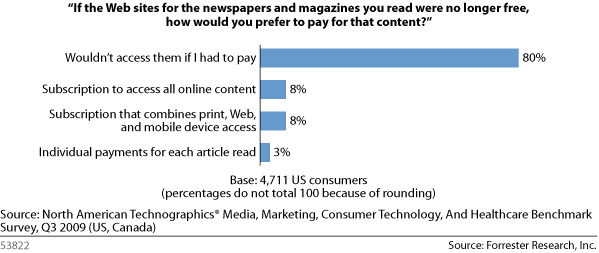
    There are many talking points on these options, and Sullivan does a wonderful job of going through them with Cohen. The real question, however, is whether or not it is worth it to even have a paywall. If the latest research from Forrester is any indication, offering only paid content is not the wisest decision, because 80% of consumers wouldn’t access news sites if they had to pay.

    Forrester - Would You Pay for Content?

    Forrester’s Sarah Rotman Epps says the data suggests two things:

    1. Publishers should continue to offer free, ad-supported products to the 80% of consumers who won’t pay for content online; and

    2. Publishers should offer consumers a choice of multichannel subscriptions, single-channel subscriptions, and micropayments for premium product access.

    As she says, consumers want choice. "The need for a multichannel product and pricing strategy is further reinforced by the ‘what if’ scenario of print being discontinued," says Epps. "When we asked consumers, ‘If the publications you read were no longer available in print, how would you prefer to access that content?’ we found that no single channel dominated responses."

    37% of US consumers said they’d prefer to access content via a web site, 14% said by mobile phone, 11% said by laptops and netbooks, and 3% said by eReaders. 10% said by PDF by email.


    Related Articles:

    Obvious: People Don’t Want to Pay for Online News

    > Murdoch On Blocking Search Engines: "I Think We Will"

    > Google Okay With Blocking News Corp.

  • Windows Marketplace for Mobile launches on WinMo 6.0 and 6.1

    By Tim Conneally, Betanews

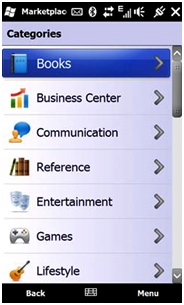
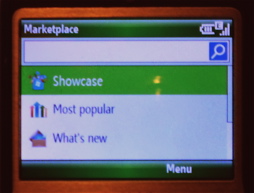
    Windows Marketplace for Mobile launched exclusively with Windows Mobile 6.5 in October, and unified the vast Windows Mobile application ecosystem under a single umbrella.

    Windows Mobile Marketplace...now with Business Center!

    Prior to launch, Microsoft announced that users running Windows Mobile 6.0 and 6.1 would eventually have access to the new app marketplace, but did not provide a specific date.

    That date, it would appear, is today.

    Following up on last week’s addition of the Web-based Marketplace, the Windows Mobile team has unveiled support for all Windows Mobile 6.0+ devices. To get the Marketplace app, users can point their mobile browser to mp.windowsphone.com to start downloading.

    We’re in the process of checking it out now, and we’ll let you know how it goes. If you’ve already gotten your hands on it, let us know what you think!

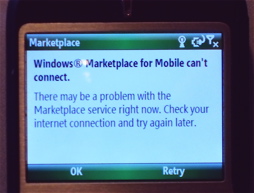
    Cannot connect to Windows Marketplace for Mobile (Wi-Fi only WinMo 6.0 device)

    Windows Marketplace for Mobile...on Windows Mobile 6.0

    Current Status: Up and running, initial selection for Windows Mobile 6.0 devices is decent (I only count 84 apps), app profile pages port nicely down to the smaller screen.

    Copyright Betanews, Inc. 2009


    Add to digg
    Add to Google
    Add to Slashdot
    Add to Twitter
    Add to del.icio.us
    Add to Facebook
    Add to Technorati


  • Samsung announces 3G-equipped ‘Go’ netbook for AT&T

    go-open-620

    The nation’s “fastest” (and often most frustrating) 3G network (i.e. AT&T) is adding another netbook to its lineup of 3G portable devices, the Samsung Go. So what exactly is said Go? Well, according to Sammy, it’s “a compact and lightweight netbook with instant access to broadband speeds powered by the nation’s fastest 3G network and the Microsoft Windows 7 Starter Edition operating system.”

    Don’t you just love the redundancy – “compact and lightweight netbook.” Ahem, isn’t a netbook compact and lightweight by definition?! Anyhoo, the creatively named Go weighs in at 2.8 lbs. and features a handsome midnight blue “soft texture” design, complete with rounded corners and a pebble-style keyboard.

    Not to be confused with those old-school netbooks of yesteryear, the Go comes with a LED-backlit, borderless glass display that is purportedly “scratch resistant and provides users with photo-like image quality, greater viewing angles and better text legibility, reducing eye strain and boosting productivity.”

    Here are the rest of the Samsung Go’s specs:

    • Operating System: Microsoft Windows 7 Starter Edition
    • Processor: Intel® Atom™ processor N270
    • Webcam: 1.3 MP
    • Storage: 1GB of system memory, 160 GB HDD
    • Battery: 4-cell (4000 mAh) – up to 4 hours on a single battery charge
    • I/O Ports: 3 USB 2.0 ports, external VGA port, headphone/speaker/line-out port, microphone-in jack
    • Communication: WWAN: Option GTM382W module (based on Qualcomm MSN 7225) / HSPA (7.2/5.1 Mbps): 850/1900/2100 MHz / GSM/GPRS/EDGE: 850/900/1800/1900 MHz / SIM lock (device locked to AT&T network)
    • WLAN: 802.11 b/g WiFi
    • Other: Ethernet (10/100 Mbps)
    • Display: 10.1” 1024 x 600 pixel resolution
    • Dimensions: 10.3” x 7.3” x 1.1”

    But enough about the sexy Go for the moment…how ’bout we take a look at the AT&T side of things. With regards to data plans, AT&T offers two DataConnect plans for netbooks: a 200MB plan option for $35 / month OR a 5GB plan for $60 / month. Like the rest of AT&T’s DataConnect plans, Go owners will also get free access to AT&T’s more than 20,000 Wi-Fi hot spots nationwide.

    Finally, the info you’ve all been waiting for: The Samsung Go will be available starting November 22 through AT&T retail or online at www.att.com/netbooks for $199 (after MIR and purchase of a 2-year AT&T DataConnect service agreement – prices start at $35 per month).


  • Review: Razer Naga MMOG Laser Gaming Mouse

    naga10

    Short version: A comfortable mouse whose main gimmick will take hours upon hours of dedication on your part to fully exploit.

    Like a dork, I looked up the word “naga” in Wikipedia, and it turns out that it refers to “a deity or class of entity or being, taking the form of a very great snake—specifically the King Cobra, found in Hinduism and Buddhism.” That would explain the snake-like logo of the Razer Naga ($80, available now), a new mouse that’s aimed at people who play MMOs, specifically World of Warcraft and Warhammer Online. The biggest feature: 12 buttons on the left-hand side of the mouse.

    Unlike last year’s SteelSeries World of Warcraft Gaming Mouse, the Razer Naga doesn’t come with the full Blizzard licensing. If that matters to you you’re a fool. And also unlike said SteelSeries mouse, the buttons here don’t stick like an old Sega Genesis controller after using it for a few hours.

    It works, out of the box, with both Windows (tested on Windows 7) and Mac OS X (tested on Snow Leopard). Thank you, Razer. No need for my fellow Mac users to spring for a third-party driver just to use the mouse!

    So let’s do this. I tested the mouse using World of Warcraft over a period of two weeks. That may seem excessive, but this mouse absolutely has a learning curve. The documentation that comes with the mouse—I actually read the instruction manual!—says to expect up to 18 hours to get used to the mouse. Yes, 18 hours. As Doug said in our chatroom, you might as well learn Russian.

    The mouse’s raison d’être is the 12 buttons on the left-hand side, where your thumb would normally rest. The 12 buttons are designed to replace any number of keyboard keys that you’d use to play the game. You know, 1 is regular attack, then 2 through whatever for your spells and whatnot.

    My latest character, an Affliction Blood Elf Warlock, has the following key-mapping:

    1: Shoot

    2: Shadow Bolt

    3: Immolate

    4: Corruption

    5: Curse of Agony

    6: Life Tap

    7: Drain Life

    8: Health Funnel

    9: Drain Soul

    0: Rain of Fire

    -: Fear

    =: Howl of Terror

    These spells and abilities are mapped over to the 1-12 buttons on the mouse.

    Razer has created an AddOn for both games that rearranges your on-screen icons, à la Bartender, to better visually correlate the 12 mouse buttons to your spells and abilities. (Here’s a screenshot of the interface AddOn. It’s the squares on the right-hand side.)

    As I said, using the 12 buttons effectively will absolutely take you several hours, especially if you’ve been playing the game for a long time. It’s like trying to write your name with your left hand when you’re a righty.

    I had gotten used to running close to a mob, then taking taking my middle finger off the “W” key, then hitting 4, 5, 6, 3, and 1 till the mob died. (See the above key-mapping for what those numbers translate to.) Now all of a sudden your left hand stays on the WASD keys, while your right thumb has to navigate the little button patch on the mouse.

    After about of week with the new playing scheme, I had more or less acclimated myself. I now quest with the 12 buttons just fine, but I still find myself going back to the ol’ keyboard when PVPing. I find that the frantic nature of PVP doesn’t really lend itself to the 12 buttons. Practice makes perfect, of course, and you may be more patient than I am, but I couldn’t get used to PVPing with the 12 buttons even after several days.

    And to allay a fear I read somewhere, no, I really didn’t find that pushing one of the 12 buttons would cause the mouse to move a great deal, if at all. It’s not as if you need to exact an incredible amount of force on the buttons to get them to click.

    So it’s a fine mouse, yes, but you really do need to be prepared to fully re-train yourself on how to play the game.

    Is it any better than using the plain on’ keyboard keys? Meh, I wouldn’t say so, and I expect that many of you are already used to your current setup. Still, it’s a fine mouse in its own right, and its use to you is 100 percent dependent on your willingness to learn how to effectively use it.

    Product Page


  • MACTA & NTIA/RUS RFI on broadband stimulus programs

    The National Association of Telecommunications Officers and Advisors (NATOA) is preparing comments to send to the NTIA/RUS on how best to administer the second round of funding for the programs in order to improve the applicant experience and maximize the ability of the programs to meet Recovery Act objectives. (As you may recall, the NTIA/RUS requested such comments.)

    Jodie Miller, MACTA Legislative co-chair and NATOA board member, is inviting folks in Minnesota to send feedback to her to help inform the NATOA comments to the NTIA/RUS. The goal is to incorporate as many Minnesota perspectives as possible. If you have a comment, please send it to her before November 20 [email protected].

  • Mainstream Press Waking Up To The News That Musicians Are Making More Money

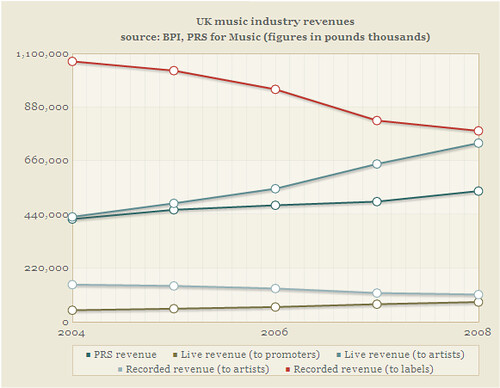
    I believe that we were the first publication to report on the study released by PRS in the UK, way back in July, indicating that overall music revenue was up, even as the sale of recorded music was dropping. It showed how live revenue was making up a good part of the difference, and other aspects of the business were making up more than the rest. While we’ve pointed to that study numerous times in the meantime, we’ve been quite surprised that no mainstream press picked up on this seemingly remarkable news — as it went against the prevailing favored narrative (as pushed by the RIAA) that the music industry was in trouble. Especially when combined with the recent Harvard study by Felix Oberholzer-Gee and Koleman Strumpf, that also showed that revenue in the overall music ecosystem was significantly higher today than in the past, it really was quite amazing that the press (and politicians) continued to spread the lie that the music industry was in some sort of trouble. It’s not. It’s only the business of selling plastic discs that’s in trouble.

    The good news is that the mainstream press seems to finally be waking up to this. As a bunch of you sent in, the Times Online in the UK has published a nice study highlighting the PRS numbers, complete with some very nice charts, showing that musicians themselves are making more than ever. The other interesting part: for all the talk about how recorded music sales losses are hurting artists, the chart proves the point we’ve made over and over again: musicians see such a tiny part of recorded music sales that this has had almost no impact on their revenue at all. The amount of money musicians make from recorded revenue has remained just about constant.


    Source: Times Online Labs blog


    It’s great that the press is finally starting to dig into this — and the Times Online even admits that perhaps it should not have let Lily Allen claim in its own pages how much “harm” was being done to artists due to file sharing, because the numbers simply don’t support it (of course, we pointed this out when the whole Allen mess was going on…).

    Now, some people have raised some concerns over the numbers — specifically, there have been some claims that the “live” numbers are distorted due to so-called “heritage” acts and legacy acts, who have been around forever and still pack large stadiums with increasingly higher ticket prices. And, indeed, that almost certainly has some impact on the numbers. It would be nice to see a similar report that starts to break out some of the details — and we’ve been talking to a few people who are trying to dig deeper into the amount of “live” and “alternative” revenue streams to better understand where the money is going. Hopefully we’ll have more complete data soon, but the initial things I’ve seen suggest that the original point remains true. Artists across the entire spectrum of the industry are making more in live revenues than they have in the past — and, in part, the increase in live revenue is due to file sharing. In talking to different musicians, we’ve been hearing plenty of stories about how they’re strategically pushing free versions of their songs on local audiences before embarking on tours or even individual shows — and they’re seeing larger turnouts than in the past because of it.

    Hopefully, with more mainstream publications finally picking up on this, both the press and politicians will begin to recognize that the only real “crisis” in the music industry is for those who have stupidly relied on selling plastic discs for way too long. There are plenty of revenue opportunities for musicians, and because of that (in combination with better and cheaper tools for music creation), the actual music industry is thriving at levels never seen before.

    Permalink | Comments | Email This Story


  • Apple Set to Release “Concierge” App to Make Scheduling Appointments Easier

    retail-reservationsScheduling a Genius Bar or One to One training session appointment has never been that difficult. Just go to Apple’s web site, enter some information, and you’re done. But a new rumor over at AppleInsider suggests that it’s about to become even easier, thanks to a new in-house developed iPhone app that could be forthcoming soon from Apple.

    News of the app comes via a “source that has proven reliable in the past,” though no further information is given. The app is said to be able to create appointments for both Genius Bar and One to One, and to view membership details for programs that require a subscription. No word yet on a street date for the app.

    Presumably the app would allow users to make any kind of reservation currently only available online, including a personal shopping appointment. Although the web site system currently employed is easy enough to understand and use, I imagine a dedicated iPhone app designed by Apple would make the process so easy and intuitive that I’d probably actually use it far more than I currently do, particularly for personal shopping when new products launch.

    MacRumors corroborates the report via separate sources, so it seems likely that the Concierge app will be forthcoming. I’d expect it to appear before the holidays, so that shoppers can take advantage of it pre-gift giving, and people on the receiving end of Apple products can use it after the holidays to schedule appointments.

    The Concierge app would be the latest move in a series of efforts focused on improving Apple’s retail performance, including in-store pickup for holiday shoppers, more and improved stores, and the new EasyPay touch system.


  • So EA Sports was right: Manny beats Miguel

    mannywins

    Short and to the point: Manny Pacquiao beat Miguel Cotto in round 12 on Saturday night via TKO. So EA Sports’ prediction was right in that Pacquiao won the fight.

    And where was EA Sports’ UFC prediction? Oh, that’s right: it told Dana White to take a hike when he approached them about making a UFC video game back in the day. Smart move, EA.


  • What if OnLive Came to the iPhone?

    iphone_onlive

    OnLive made a lot of noise when it first appeared on the scene way back in March at the Game Developer’s Conference of 2009. It’s a service that’s said to be able to make a gaming machine out of any computer that can run the latest browsers, which would effectively end the madness that is PC gaming hardware upgrades. And now, it looks like it might be able to work on the iPhone, too.

    What OnLive does is bypass the normal hardware barriers involved in PC gaming by streaming the game live to a user’s browser window from a server farm located nearby. The server farm deals with the game’s performance demands, and all the end user needs is a good enough connection to stream the content smoothly.

    It’s a setup that sounds too good to be true, and many remain skeptical about whether or not OnLive will be able to deliver what it has promised. There was supposed to be an external beta this past summer, but that’s been delayed, which doesn’t exactly inspire confidence.

    Still, if the service works, it will revolutionize the way gaming is done. The system has strong support from game publishers, which makes sense because without the hardware barriers, they stand to broaden their audience considerably. If that audience were to also include iPhone users, you can imagine that even more game companies would fall in line behind OnLive.

    The company recently demoed an iPhone app that allows users to play full games alongside users of the PC OnLive service, or players using the company’s MicroConsole, a standalone device which connects to a display or TV — yes, even without the modern convenience of buttons, joysticks and bumpers. Presumably, onscreen controls allow you to manipulate the in-game action, although a report at Engadget Mobile doesn’t go into detail about how exactly it works, nor does a blog post at OnLive. Needless to say, your PC gaming friend will probably be able to school you at Modern Warfare 2 unless you’re some kind of touch control prodigy.

    When the app does see release, which won’t be for a while, OnLive CEO Steve Perlman says it won’t allow you to game right away. Initial versions will allow you to monitor gaming stats and spectate, so you can watch live gameplay without taking part. Interactivity is planned down the road, but control kinks and other issues have to be addressed before it goes live to the masses.

    What do you think? Would you take advantage of full-version gaming on your iPhone if you had the ability to? I foresee a very limited catalog of titles that this sort of thing would work with, but if it does become a reality, and it becomes popular, developers might design custom gaming experiences for people who access games via OnLive on their iPhones.


  • Belichick was Right (and Personal Finance Links)

    Do we have any football fans in the house? If you aren’t a fan, just skip down to the links. If you are a fan, hopefully you caught the Patriots-Colts’ “Rivalry of the Decade” game. Whenever these teams get together it’s always comes down to the wire. As a Patriots fan, losing a game with a 17 point fourth lead is pretty harsh. There are a lot of reasons why it happened, but everyone wants to talk about the controversial call by Bill Belichick to go for it on 4th-down in an attempt to run out the clock.

    Before I get to that, there were two previous plays that should get attention. They simply are being overshadowed by that call. The Patriots had the ball at the Colts 1or 2 yard line when Lawrence Maroney fumbled and the Colt recovered. That’s the kind of play you look back on in a 1-point loss. The other play was a 36 yard pass interference call – on a very late flag. I thought it was straight up defense with little or no contact. Two ESPN analysts said it was a “dicey” call and Deion Sanders of NFL Network said it was “a questionable call”. The Colts went on to score a touchdown in the next couple of plays. Patriots fans everywhere remember the phantom pass interference that proved to be the difference in the 2006 AFC Championship game that got the Colts into the Super Bowl over the Patriots. The heavily favored Colts ran away with the game.

    The play everyone is talking about is the Patriots’ decision to go for it on 4th down from their own 28-yard line. The Patriots didn’t get the necessary two yards (though replays show it was pretty close with the receiver’s foot over the 30 yard line after securing the ball) and the Colts got the ball back with a short field. Deion Sanders later said it was a bad spot by the referee. The Patriots couldn’t challenge the spot because they had used up their timeouts.

    The alternative was to punt the ball away. On a SportsCenter.com 58% of the people say there is no excuse for the call, 27% say it was somewhat understandable giving the flow of the game, and 15% say it was right call.

    Tedy Bruschi, a former Patriots defensive player who could become the mayor of Boston if he wanted to, said that . Bruschi said that the decision didn’t give the Patriots’ defense the chance to win the game and wrote that Belichick dissed his defense. With all due respect to Bruschi, I don’t believe the defense was a large thought in Belichick’s mind. I think Belichick had a couple thoughts in his head:

    • We have a great QB and offense – The strength of the Patriots is the offense. It still has the key players that made it the highest scoring offense in the history of the NFL in 2007. The defense has a lot of young players drafted in the last 2-3 years on it.
    • They have a great QB and offense – Peyton Manning has already secured himself a spot in the Hall of Fame and some can argue he is the best QB of all time. Punting the ball gives him more than 2 minutes (plenty of time) and four downs on every set (the Colts wouldn’t punt or kick a field goal down by 6). It is always a smart move to keep the ball out of Manning’s hands – even if you have the 1985 Chicago Bears defense.

    Another way to look at it is this. Since 2001 (Tom Brady era), the Patriots get a first down on 4th and 2 or less 76.4% of the time. That’s a 76.4% chance that you’ll be able to run out almost all the clock, virtually guaranteeing the win. An average punt typically nets 38 yards of field position… very close to the 36 yards that can be erased on a dicey pass interference call. Advanced NFL Stats broke down the probabilities of going for it on 4th down vs. punting and found that an average team had a 9% better chance at winning (79% vs. 70%) if they go for it. However, if you plug in the Patriots’ 76.4% on 4th and 2 or less, it goes up to 95% win probability in the Patriots favor. Of course that 76.4% may be artificially high since he it likely includes a lot of easier to convert 4th an inches.

    In the end, analysts seem to be starting to realize that Belichick made the right decision to go for the win. The difficulty that some people are having is that it so unconventional to go for it on fourth down on your own side of the field with a lead. This is a case where the conventional wisdom is simply wrong.

    Money Writers:

    Top Personal Finance Posts:

    Related posts:

    1. Financial Football Teaches Students about Personal Finance When New England Patriot wide receiver Wes Welker isn’t busy…
    2. NFL Draft (And Some Personal Finance Links) This was a big weekend in Boston sports. With the…
    3. Personal Finance Links (Football is Back Edition) It feels good to have the NFL back in gear….
    4. Super Bowl Pick (and Personal Finance Links) The Super Bowl starts in some 45 minutes as I…
    5. Personal Finance Links (Our Marley, McGruber) This weekend, my wife introduced me Marley and Me (the…


  • BlackBerry 8520 and LG Shine II to hit AT&T in coming weeks

    att-8520-shine-ii

    Looks like AT&T is adding a few new handsets to its lineup for the holiday buying season as today, Ma’ Bell announced it will be carrying the BlackBerry 8520 and the new LG Shine II, all now added to its “best in the world smartphone lineup.” The Shine II is a 3G slider phone with a 2.2″ screen, stereo Bluetooth, Java 2.0, and a November 22nd release date. The Shine Part Deux will also set you back $119 with a 2-year commitment. Switching gears, the more familiar BlackBerry 8520 will boast the now-standard specs of: WiFi, a 320×240 display, 512 MHz processor, 256 MB of memory, and a 2 megapixel camera capable of video recording. The exact release date of the updated Curve was not specified but rather listed as within “the next few weeks.” Any takers?

    Read 8520

    Read Shine II

  • Review: Rogue Warrior Red Cell Watch

    IMG_0201

    It’s not every day you find a watch that can feasibly kill a man. The Rogue Warrior Red Cell is just such a watch.

    The watch, designed by Richard “Dick” Marcinko AKA the Rogue Warrior, chairman of Red Cell International Corp., a security consulting firm. Mr. Marcinko (you call this guy “Mister” and “Sir”) has a Silver Star, Bronze Star with Combat, and founded SEAL Team SIX, the Navy’s counter terrorist command and Red Cell, a group that could… heck. I’ll just paste this from his website:

    Marcinko later was named commanding officer and founder of a second counter-terrorism unit, Red Cell. Commanding Red Cell, Marcinko was directed to use his team to test the Navy’s anti-terrorist capabilities. As a result he was able to infiltrate seemingly impenetrable, highly-secured bases, nuclear submarines, ships and other purported “secure areas”, including the U.S. Presidential plane Air Force One. In doing so he reportedly embarrassed several superior officers, whom he accuses of involvement in his subsequent conviction for misappropriation of funds and resources under his command.

    Homeboy could sneak on board Air Force One. That is badass.

    So what does a man who can throttle enemies in their sleep wear on his wrist? The Rogue Warrior Red Cell. This is one of the best quartz GMTs I’ve seen in years. It’s made of brushed steel and contains Krypton gas to ensure luminance and reduces internal condensation. It uses a Japanese GMT movement with separate date, second time zone, and time setting functions and also includes something called d3o. D3o is a non-Newtonian liquid that goes from soft to rigid in seconds on impact. The entire movement is contained in d3o ensures that your movement won’t break when you, say, are attacked by a team of zombie terrorists.

    The style is purely functional. The two bars protect the crystal and the bezel is bolted down. The crown screws down for water-fastness and the watch comes with a leather or steel band along with a nylon strap and, get this, a night ops cover for the watch to ensure you aren’t seen while infiltrating the corner bodega for a late-night box of Crunch ‘n’ Munch and sixes of Miller Lite.

    The back of the watch has a freaking gun on it.

    The watch comes in two styles, matte black and brushed silver (they also have a chrono model called the Avenger) and, best of all, they cost $400 on a leather or rubber band and $550 for a steel band. That’s right: this thing is much less than a nicer Swatch and it can seriously do some damage.

    As I said before I’m not a quartz guy but I’ve worn this for a few days straight and I’m in love with it. The company wanted to create a watch anyone could feasibly service so they went quartz. $400 for a monster like this, even in quartz, isn’t that much.

    I would say this piece is on par with the Chase-Durer Special Forces 1000XL piece that was popular a few years ago in terms of styling and is definitely more noticeable than a Fossil. Plus it was made by a guy who can feasibly sneak up behind you, Solid Snake style, and rip out your throat. Always a plus.

    Product Page


  • Transcript: Health On The Hill – November 16

    Jackie Judd, of the Kaiser Family Foundation, and Mary Agnes Carey and Eric Pianin of KHN, discuss this week’s activities on the Hill. Watch the video or listen to the audio version (.mp3). A transcript of the interview is below.

    Transcript:

    JACKIE JUDD: Good day. I am Jackie Judd with Health on the Hill, a conversation about efforts to overhaul the healthcare system. Joining me, as always, Mary Agnes Carey of Kaiser Health News, and also Eric Pianin with Kaiser Health News. Welcome to you both. In the past few weeks, there has been a lull in Senate activity, what is the status in that Chamber?

    MARY AGNES CAREY: Harry Reid, who is the majority leader, is hoping that this week the Senate can begin discussion on a motion to proceed to a Health Bill. This requires 60 votes. It would allow the Chamber to start discussion. Many moderate Democrats may have some qualms about voting for the Bill, up or down, even though we haven’t seen the Bill, have said that they will be with Senator Reid to get the 60 votes and to proceed to have that debate but it may take longer than this week and we may head into Thanksgiving week, so members may have to spend a little time in Washington Thanksgiving week.

    JACKIE JUDD: He is holding out that threat again, into the holiday.

    MARY AGNES CAREY: Absolutely.

    JACKIE JUDD: Eric, the majority leader, Harry Reid, has spent a lot of time sending portions of Bills over to the Congressional Budget Office to score it, to figure out what it will cost. What is behind this?

    ERIC PIANIN: Well part of it is just the jigsaw puzzle demands of putting together legislation that could attract 60 votes in the Senate. This is a very difficult task. The Bill that Harry Reid is trying to put together is very different from what the House passed just a week ago, but also in doing this he is sort of moving from policy making to politics. And this is not a pure exercise in trying to craft the best health care reform policy the Democrats can come up with, but it’s trying to figure out what you can do to hold together factions and attract others.

    For example, there has been a lot of resistance from labor unions and liberal Democrats to the notion of slapping a tax on high end insurance policies to help pay for the health care reforms. Now, Reid is looking at some other alternatives including possibly raising the payroll tax for Medicare to offset some of the lost revenues of abandoning the other approach.

    So what I think is going on is there is sort of a constant dialogue between the Senate Majority Leader’s office and CBO in which Reid is saying well, okay if that doesn’t work, how about this? And see what your number crunchers come up with, with this latest scenario.

    JACKIE JUDD: So, while there is no full puzzle yet, are there certain threshold issues that we will see when there is a Senate Bill?

    MARY AGNES CAREY: The public option, for example. Senator Reid has said he wants an option that would allow states to opt out. We will have to see if that’s where he comes out. Eric mentioned the tax on some of the highest cost health insurance plans. Will those thresholds be raised? How will he deal with the individual mandate? There is a lot of concern that the Senate Finance Committee deliberations weaken the individual mandate and it wouldn’t be strong enough.

    Will he toughen that? How will he deal with the level of subsidies, the financial assistance for people who need help to get health insurance? So those will be some of the points of concern and I think people will be focused on.

    JACKIE JUDD: Okay, let’s move over the House side now. There has been some troubling news of late for House Democrats. A Republican member of the House asked CMS, the Center for Medicare and Medicaid Services, to analyze the Bill that was passed there. Not all the news was good as far as the Democrats are concerned. Fill us in.

    ERIC PIANIN: Well I think that is right and Dave Camp, a Republican leader in the House, requested this analysis of the Bill that the House passed a week ago and what they came up with in this fairly densely stated report are a number of troubling things for the Democrats.

    One, it suggests that the $500 billion in proposed cuts in Medicare and Medicare Advantage will drive up costs for some seniors and result in reduced services. There is also a big concern that with this huge expansion in the number of Americans insured under this plan that the network of doctors and hospitals may just not be able to absorb and handle all of this, especially the millions and millions who would be brought in under Medicaid and there are a number of other kind of troubling concerns about efforts at cost savings.

    If in fact the plan was to work and to slow the growth of spending for Medicare, Medicare spending per beneficiary would have to be cut to a rate maybe half of what the historic rate has been over the last 10 or 15 years. So there are a lot of questions raised about what the House did and the report is proving a lot of ammunition to Republican leaders to say you know what, the President and the Democrats are moving far too quickly on this very complicated, highly expensive plan. Let’s slow down and take a closer look at it and maybe rethink it.

    JACKIE JUDD: And the Democrats are trying to discount what the report says by saying that the Bill wasn’t looked at in a full way, it didn’t consider revenue raising for example, that it wasn’t an apples to apples comparison.

    ERIC PIANIN: I think that is true and you hear these debates back and forth over reports when the insurance industry came out with its study claiming that health care reform was going to drive up premiums and all that. The Democrats said well, wait a minute. You left out all sorts of important elements and mitigating circumstances, and I think the Democrats are doing the same with this CMS report, but the point is that the longer this process takes, the more time the opponents of health care reform have to husband their resources, you know, marshall their studies and reports. Apparently the Chamber of Commerce now is shopping around for an economist to do a study of the health care reform to reach the conclusion that it would kill jobs and hurt the economy.

    JACKIE JUDD: And this is exactly the scenario that the administration has always been worried about and why the Obama White House wanted health care reform wrapped up this summer.

    MARY AGNES CAREY: Right and they are still saying they want it done by the end of the year, but it looks like an incredibly heavy lift. The Senate, here we are almost at Thanksgiving, the Senate has not yet begun its debate on health reform.

    JACKIE JUDD: And there is the abortion issue.

    MARY AGNES CAREY: There is the abortion issue. The House adopted language that many abortion rights proponents want to get out of the Bill, it would say that if you receive a subsidy you couldn’t have a plan, a health insurance plan, in the exchange that would cover abortion services.

    They feel this is incredibly restrictive, that it goes beyond current law, and in the Senate you have abortion rights proponents who say that they can stop this particular provision that it won’t get 60 votes, but this is going to be a battle point as Congress continues to look at health reform.

    JACKIE JUDD: Okay, thank you both as always, Eric Pianin, Mary Agnes Carey. Thank you for joining us. I’m Jackie Judd.

  • Stress Test: How long can the BlackBerry Bold 9700 play music?

    BlackBerry_bold_9700

    UPDATE: It’s dead! The BlackBerry Bold actually exceeded the marketing materials and died just short of the 39 hour benchmark.

    UPDATE: It’s 1:12. There is 8% battery left and I used some extra juice to take a screenshot. Regardless, the BlackBerry Bold 9700 has been on for 36 hours and it seems like it will hit the 38 hour mark, as advertised, dead on. BlackBerry Cool reader Durbin007 deserves a hat tip.

    UPDATE: 21:52. About 1/5th of the battery power left. The BlackBerry Bold 9700 has been playing music for 33 hours.

    UPDATE: We are now almost 27 hours into the test and we still have 2/5 battery power.

    UPDATE: We’re coming up to the 24hr mark and I have to say, this test is driving me slightly mental. If I were to design a new torture method, it would involve leaving loud music playing from headphones in the same room as someone for hours on end.

    UPDATE: At 09:06 we’re about 21 hours into the test and the Bold 9700 is showing just a little over half battery. At this rate, it could be upwards of 45 hours to drain the battery completely.

    UPDATE: It’s 20:32 EST, about 8 hours since we started and not even a single bar down. At this rate I won’t need to update until tomorrow.

    UPDATE: It is 16:57 EST, a little more than 4 hours into it and we still haven’t gone through a full bar. Going to give it a while longer before another update.

    UPDATE (14:26 EST): It has been 2 hours and we’re still running on full battery. This could take a long, long time.

    So here’s the deal: The BlackBerry Bold 9700 has some battery optimizations that make it last so long it makes the Energizer Bunny look impotent. That, combined with some OS optimizations specifically tailored to the music player, means the Bold 9700 can play music for a long time.

    But just how long can it play music on a single charge? Well I’m going to put this thing to the test. The test will involve 2 parts. The first part, will be playing music with the radio off and playing it directly from the SD Card. This will give us an idea of how long the battery will last, solely playing music without being interrupted by calls, emails and network searching. The second part of the experiment, will be playing the music from Slacker, to test the 9700’s ability to stream music while on the network. This will be an incredible strain on the battery but I have a feeling the Bold 9700 will surprise us.

    So lets get started with Part 1 of How Long Will the Bold 9700 play music for?

    Comment your predictions! Remember, the following conditions:

    • Radio is off.
    • Full battery charge.
    • Full volume with headphones.
    • No audio boost.
    • No headset equalizer.
    • Songs on continuous play so it won’t have any interruption.


    © Kyle for BlackBerry Cool, 2009


  • Full Video and Photos: The President's Town Hall in Shanghai

    It was around midnight in Washington, D.C., and early afternoon in Shanghai when the President began an historic town hall in China.  Taking tough and straightforward questions from Chinese students, and solicted from across China via the internet, the President discussed everything from Taiwan to the role of women in society to open government.   Read through all of the exchanges in the full transcript.

    In his extensive and probing opening remarks, the President related America’s history, triumphing over tragedy and difficulty, to China’s own story:

    Of course, the story of our nation is not without its difficult chapters.  In many ways — over many years — we have struggled to advance the promise of these principles to all of our people, and to forge a more perfect union.  We fought a very painful civil war, and freed a portion of our population from slavery.  It took time for women to be extended the right to vote, workers to win the right to organize, and for immigrants from different corners of the globe to be fully embraced.  Even after they were freed, African Americans persevered through conditions that were separate and not equal, before winning full and equal rights.

    None of this was easy.  But we made progress because of our belief in those core principles, which have served as our compass through the darkest of storms.  That is why Lincoln could stand up in the midst of civil war and declare it a struggle to see whether any nation, conceived in liberty, and "dedicated to the proposition that all men are created equal" could long endure. That is why Dr. Martin Luther King could stand on the steps of the Lincoln Memorial and ask that our nation live out the true meaning of its creed.  That’s why immigrants from China to Kenya could find a home on our shores; why opportunity is available to all who would work for it; and why someone like me, who less than 50 years ago would have had trouble voting in some parts of America, is now able to serve as its President.

    And that is why America will always speak out for these core principles around the world.   We do not seek to impose any system of government on any other nation, but we also don’t believe that the principles that we stand for are unique to our nation.  These freedoms of expression and worship — of access to information and political participation — we believe are universal rights.  They should be available to all people, including ethnic and religious minorities — whether they are in the United States, China, or any nation.  Indeed, it is that respect for universal rights that guides America’s openness to other countries; our respect for different cultures; our commitment to international law; and our faith in the future.

    These are all things that you should know about America.  I also know that we have much to learn about China.  Looking around at this magnificent city — and looking around this room — I do believe that our nations hold something important in common, and that is a belief in the future.  Neither the United States nor China is content to rest on our achievements.  For while China is an ancient nation, you are also clearly looking ahead with confidence, ambition, and a commitment to see that tomorrow’s generation can do better than today’s.

    In addition to your growing economy, we admire China’s extraordinary commitment to science and research — a commitment borne out in everything from the infrastructure you build to the technology you use.  China is now the world’s largest Internet user — which is why we were so pleased to include the Internet as a part of today’s event.  This country now has the world’s largest mobile phone network, and it is investing in the new forms of energy that can both sustain growth and combat climate change — and I’m looking forward to deepening the partnership between the United States and China in this critical area tomorrow.  But above all, I see China’s future in you — young people whose talent and dedication and dreams will do so much to help shape the 21st century.

    I’ve said many times that I believe that our world is now fundamentally interconnected.  The jobs we do, the prosperity we build, the environment we protect, the security that we seek — all of these things are shared.  And given that interconnection, power in the 21st century is no longer a zero-sum game; one country’s success need not come at the expense of another.  And that is why the United States insists we do not seek to contain China’s rise.  On the contrary, we welcome China as a strong and prosperous and successful member of the community of nations — a China that draws on the rights, strengths, and creativity of individual Chinese like you.

    To return to the proverb — consider the past.  We know that more is to be gained when great powers cooperate than when they collide.  That is a lesson that human beings have learned time and again, and that is the example of the history between our nations.  And I believe strongly that cooperation must go beyond our government.  It must be rooted in our people — in the studies we share, the business that we do, the knowledge that we gain, and even in the sports that we play.  And these bridges must be built by young men and women just like you and your counterparts in America.

    President Barack Obama listens to a question at the town hall meeting with future Chinese leaders

    President Barack Obama listens to a question at the town hall meeting with future Chinese leaders at the Shanghai Science and Technology Museum in Shanghai, China, Nov. 16, 2009. (Official White House Photo by Lawrence Jackson)

    Posters commemorating President Barack Obama's appearance at the Shanghai Science and Technology Museum

    Posters commemorating President Barack Obama’s appearance at the Shanghai Science and Technology Museum are handed out following his town hall meeting there in Shanghai, China, Nov. 16, 2009. (Official White House Photo by Lawrence Jackson)


  • BlackBerry Developer Conference Highlights

    BlackBerry Developer Conference
    Last week, Research In Motion (RIM) hosted the 2nd annual BlackBerry® Developer Conference in San Francisco, CA. Don’t worry if you think you missed all the fun. I spent the entire week blogging the action for our Inside BlackBerry sister site, the BlackBerry Developer’s Blog. Check out these links to the highlights below:


    If you’re really hungry for the 2009 BlackBerry Developer Conference experience, you can watch the entire keynote at the link below: