Category: News

  • “Time Spent Online” Report Puts Microsoft Way Ahead

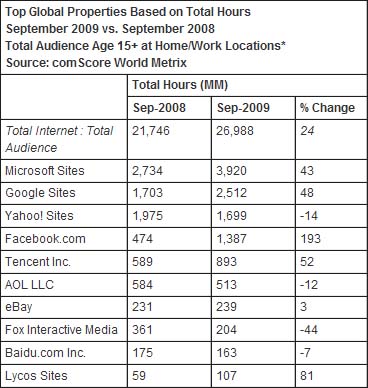
    Despite all the gains other companies (Google, Facebook) have made, it’s still Microsoft’s world, according to new statistics from comScore.  comScore found that, in terms of time spent on sites, the Redmond-based corporation continues to maintain a huge lead over its competitors.

    People spent about 3.920 billion hours on Microsoft’s sites in September, which equates to about 14.5 percent of the total time spent online.  Meanwhile, people only spent about 2.512 hours on Google-owned sites, which works out to 9.3 percent of the total.  And Google barely logged more growth than Microsoft (48 percent versus 44 percent).

    Things looked even more depressing for Yahoo, as the chart below shows.  The real surprise, though, relates to Facebook, the social network that doesn’t "do" much of anything compared to three companies that offer search engines, email, maps, and all other sorts of stuff.

    comScore determined that individuals spent about 5.1 percent of their online time on Facebook in September, and that represents an impressive 2.9 percent year-over-year increase.  If Facebook can sustain this rate of growth, it might not be long before Yahoo’s forced to eat its dust.

    Oddly, Lycos sites experienced a lot of growth in the last year, too, so they may bear watching.

    Related Articles:

    > Google Top Search Engine In The Asia-Pacific Region

    > U.K. Social Networking Accounts For 25% Of Display Ads

    > Bing Gains Ground In August

  • Thanko’s USB powered, Dinosaur foot-shaped slipper keeps your feet warm

    thanko_dinosaur

    OK, now the USB gadget craze gets really silly. Tokyo-based crap USB accessory maker Thanko has been selling USB-powered slippers and gloves that are supposed to keep you warm in the past, but the new model, Dinosaur foot-shaped slipper(s) [JP] (of all things), is probably the silliest.

    thanko_dinosaur_2

    The thing isn’t only suitable for your feet, but can apparently serve as a warm bed for your pets, too (as Thanko shows in their official promo pics – see below). There’s a heater placed in the slipper, which is powered by USB, meaning the thing is even more useless without a PC in the vicinity.

    thanko_dinosaur_3

    Thanko is selling the Dinosaur foot slipper in their Japanese online store now. If you live outside Japan, head over to Geek Stuff 4 U and get them for $31.64 plus shipping.


  • Energy vs. Financials, FINAL RESULTS

    Many of you may be familiar with this sectoral strategy that I have presented, which was due to the unusually wide extreme to which these two sectors had diverged from each other as of April 22, 2008. To review :


    On April 22, 2008, I decided to go short on Energy (XLE) and long on Financials (XLF).


    Then, on May 20, 2009, I decided to cover the Energy short, and use the proceeds to double down on Financials.  Up till that point, the trade had earned a loss of -5.36%, vs. a loss of -32.20% for the S&P500.


    Now, it is time to sell the Financials position, and assess the final performance over the entire 18-month period, against the S&P 500.


    Enerfin


    The purple line indicates the May 20, 2009 transition from being short XLE to covering that short and using the full proceeds to double down on XLF.  Note that the short of XLE was profitable, so that the amount that was redeployed to XLF was more than the existing value of the XLF position. 


    Therefore, the final results are (with all dividends reinvested) :


    Enerfin2 
    This strategy yielded a gain of 21.92% vs. a loss of -17.19% for the S&P500.  This is a huge gap of almost 40 points, and means that $10,000 deployed to this strategy would have yielded $12,192, vs. just $8,281 if placed in the S&P500 over this period.  Also note how the gap widened from what it was on May 20, 2009. 


    This continues our track record here at The Futurist of collectively beating the market by a wide margin, with portfolios that beat the market greatly exceeding the deficit of those that do not.  Of course, these trades are for entertainment purposes only, and should not be taken as professional advice. 


    Related :


    A History of Stock Market Bottoms   

  • Romance Publishing Giant Offering Ebooks Without DRM; Reporter Upset By This

    Kevin Cummings writes in with the news that romance novel publishing giant Harlequin is setting up a new ebook division to offer digital books directly from the company’s own websites, as well as via various online retailers. That, by itself, isn’t a huge surprise these days, but the article does note that the publisher decided to go without DRM on the books. Now, that seems like a smart, consumer-friendly move that should be applauded. However, the reporter who covered the announcement claims this move is “troubling,” which seems like an odd statement. How could treating customers with respect be “troubling”?

    Permalink | Comments | Email This Story


  • Isken Sugözü 1320 MWe Thermal Power Plant

    Dear Energy Professional, Dear Colleagues,

    On 7th November 2009 Saturday morning, your writer visited Adana Sugözü ISKEN Thermal power plant premises together with Energy Working Group members of Chamber of Turkish Mechanical Engineers. We had the opportunity to listen/ learn/ visualize important technical and commercial presentations of the host company.

    The Plant is first-of its kind imported coal fired power plant which is built and operated by private sector in Turkey since 2003. It has operated in compliance with international technical standards and the competitiveness of the plant is secured by efficient design (>40%) and high availability (>8000 hours per year).

    Thus, it provides reliable and efficient power to the grid (9 billion kWh electrical energy per year) in addition to supplying reliable, efficient and competitive power to the national grid, with high concern over environmental protection. Here are the milestones of the plant,

    – 1320- megawatt (2 X 660) installed capacity with Siemens Steam Turbine Generator,
    – 524.3 kg/s HP Superheated steam generation at 185 bar/541 Celsius in each of total two Benson type Once through forced circulation 3-pressure steam generators,
    – Hard coal with high quality as a fuel from South Africa and Columbia under long term purchase agreements (6000 or more kcal per kg LHV)
    – USD 1,5 billion foreign direct investment with Contribution to the regional economy
    – Reliable and environmental friendly energy program as well as Environmental monitoring and management program


    We then passed nearby recultivated fields with new trees planted on. It was an extraordinary application of recultivation on already depleted fields.

    Thermal Power plant is owned by German Evonik Steag (51%) and Turkish Oyak group (49%). It is a brand new plant, clean, fully equipped with sufficient capacity flue gas desulphurization systems, with high capacity flue gas dust collecting electrostatic precipitators.

    Under the Turkish Environmental laws and regulations, Turkish Power Plants on the Mediterranean shores are to be cooled with only 1 to 3 degree Celsius seawater temperature increase. We are advised that imported coal firing SUGOZU 1320 -megawatt Thermal Power plant in Yumurtalik meets that environmental condition. They have deep sea return water injection from 4 different points with a temperature increase in a small range not to exceed 0.5 degree Celsius.

    We have been advised that there is a new ongoing investment under a different commercial identity for a new 800 –megawatt electricity output capacity imported coal firing thermal power investment next to the existing plant. The new plant is expected to be with higher technology design with latest additions for higher efficiency (>45%) and availability, an almost close replica of Evonik Steag plant design in Duisburg Germany. New plant is estimated to cost over 1 billion US Dollars in direct investment.

    New plant soil excavation works were witnessed at site. Site construction is expected to start in year 2011. We are told that the site construction subcontractor is not selected yet. There is high concern in the local engineering societies for expectation of maximized employment of local engineering and manpower.

    Those companies who are ignorant of local workforce employment expectations, and neglecting local engineering contribution, will surely be deserving the highest local resistance in legal platforms. Hence they will surely be having to much headache during project execution.

    We are also told that the company is also planning wind and solar investments in the region for new future. We are pleased to visualize the application and operation of such a big investment on our shores, and wish to have similar state-of-art technologies with high concern over nearby environment, and preferably firing our own local lignite.

    Once again we would like to congratulate the Plant Management and the Creditors who put money which made the project realized, and to the engineers/ employees who make the plant to run smoothly, efficiently at maximum availability, high efficiency, with high concern over nearby environment. Your comments are always welcome.

    Haluk Direskeneli, Ankara based Energy Analyst

  • The motherboard as art: The Mona Lisa

    motherboard_mona_lisaWell, I think we finally know what Asus does when they get a dead motherboard. They take it apart, and turn it into a picture! Behold the loveliness that is the Motherboard Mona Lisa, a model of PCI and AGP slot beauty and mystery.

    This Mona Lisa isn’t on display in the Louvre, but rather the lobby of Asus’ corporate headquarters.

    [via Technabob]


  • Join reader action to educate the Associated Press about natural remedies, alternative medicine

    (NaturalNews) The Associated Press continues its assault on alternative medicine, led by writer Marilynn Marchione who writes attack pieces on everything under the sun (including the sun itself) related to alternative medicine and natural therapies. The Associated Press continues to publish stories carrying this highly-opinionated (and provably false) header:

    EDITOR’S NOTE: Ten years and $2.5 billion in research have found no cures from alternative medicine. Yet these mostly unproven treatments are now mainstream and used by more than a third of all Americans. This is one in an occasional Associated Press series on their use and potential risks.

    As NaturalNews previously reported, it’s all part of the AP’s assault on natural medicine, nutrition, medicinal herbs and naturopathic therapies (http://www.naturalnews.com/027424_medicine_alternative_Associated_Press.html). The AP, it seems, has decided to ally itself with pharmaceutical medicine and spend its time and money hiring writers who promote drugs and discredit anything natural. A recent story by Marchione, for example, claims that statin drugs help prevent swine flu!

    It’s quite clear that AP is following a specific agenda to destroy the reputation of natural medicine while boosting public perception of pharmaceuticals. And yet, in reality, it is Big Pharma that has delivered no cures. But the sick-care industry has delivered America into financial bankruptcy and helped our nation become the most diseased population in the history of human civilization. AP feels no need to report on that inconvenient truth. Rather, it sees its job as encouraging yet more pharmaceutical use in America while destroying the credibility of far safer and more effective natural therapies that could help turn around America’s health.

    The Associated Press is sadly misinformed about natural medicine, and yet their stories are syndicated across thousands of newspapers and millions of web pages each day.

    We need your help in educating AP editors about natural medicine.

    Take action now to educate the Associated Press
    NaturalNews is asking readers to contact AP and express both your displeasure with their outright bias against natural medicine and their lack of information about the safety and effectiveness of natural, “alternative” therapies.

    AP’s contact information is here:

    http://www.ap.org/pages/contact/contact.html

    Their general email address is [email protected]

    Their main phone number is (212) 621-1500.

    You can also find phone numbers for their various local bureaus at the web page link provided above.

    Call or email the AP today and tell them their stories by Marilynn Marchione are a disgrace to the AP’s own reputation as an “objective” news source. Share with them why you’d like to see more balanced coverage of alternative medicine.

    Rules of engagement: Be polite. Do not scream or use profanity when contacting the AP. Be professional but firm. The way in which you interact with AP will shape the way they see perceive people from the alternative health community.

    You may wish to share a success story of how alternative medicine has helped you overcome a disease, or you might express how much you dislike the obvious pro-pharma bias found in Marchione’s articles.

    If you’d like to take this even further, call your local paper that’s using AP stories and complain about the quality of the biased stories being published. Tell your local newspaper editor that AP has become a biased news organization operating with an agenda to attack and discredit alternative medicine, and that if your paper continues to run such biased AP stories, you will cancel your subscription or stop buying the paper.

    You have no idea how much power you have as a news consumer willing to pick up the phone and make your voice heard. Your comments will make huge waves across the newspaper industry, and your effort can help correct the AP’s misguided assault on alternative medicine, hopefully returning it to a more objective and balanced news provider.

    So please join NaturalNews readers from all across the world in calling and emailing the Associated Press today to object to their biased, highly-opinionated attacks on alternative medicine.

    Here’s the contact page, once again:
    http://www.ap.org/pages/contact/contact.html

    Share this story everywhere
    Share this story on Facebook, MySpace, Twitter and other social networks. Use the power of the internet to get this story out to as many people as possible, and encourage them to join in this effort to help educate the Associated Press about the many benefits of alternative medicine.

    This is important. The AP is syndicated across thousands of news publishers. Because of their position, they have a special responsibility to be objective in their coverage of alternative medicine. Each day that they publish distorted stories attacking alternative medicine is another day that potentially millions of readers around the world are deceived into thinking natural medicine is worthless. (This is, of course, the whole purpose of the AP’s agenda.)

    My own letter to the Associated Press
    Dear Associated Press,

    As the editor of NaturalNews.com, I am appalled at the highly-opinionated, agenda-driven news stories your organization continues to publish. Written by Marilynn Marchione, these stories carry a header “editor’s note” that essentially declares alternative medicine to be utterly worthless. Each of these stories then proceeds to attack alternative medicine in a blatantly biased, opinionated manner that has absolutely no journalistic credibility.

    With each one of these stories you publish, your organization is losing more of its journalistic integrity. While “AP” once stood for objective, honest journalism, these attacks on alternative medicine are now earning you a reputation for agenda-driven reporting, fueled by the financial interests of the pharmaceutical companies that provide tens of millions of dollars in advertising revenue each year to the newspapers that carry your stories.

    Word is already spreading across the ‘net: The Associated Press has lost its street cred. The news you publish is “shaped” to appease corporate interests. Rather than seeking to report the facts, the Associated Press is now engaged in a campaign to intentionally misinform readers and destroy alternative medicine.

    If this highly opinionated, biased reporting continues to be published by AP, NaturalNews and other independent media sites across the ‘net will announce an “AP boycott” that seeks to encourage newspapers and websites to drop AP services altogether. We will bring together millions of readers who find tremendous value in alternative medicine and natural therapies, and we will make our voices heard with local and national newspapers that subscribe to AP services.

    Due to declining revenues, many newspapers are right now reevaluating their contracts with AP. Some have already announced plans to drop your services. Should you continue to publish such biased and defamatory articles attacking alternative medicine, we will seek to rally millions of alternative medicine supporters to contact their local papers and complain about the lack of journalistic integrity in AP stories.

    There’s nothing wrong with publishing objective stories pointing out both the strengths and weaknesses of various alternative medicine therapies, but to publish an AP story with the pretext that alternative medicine is worthless is simply inexcusable. It’s also inaccurate. In fact, it turns out that conventional (pharmaceutical) medicine is the branch of medicine that has offered no cures for degenerative disease. Alternative medicine provides many cures, including affordable, readily-available cures for diabetes, heart disease and cancer. If you are not aware of these cures, perhaps your writers need to familiarize themselves with more of what’s really happening across America: The raw foods movement, juicing, healing and rejuvenation centers, chelation therapy, herbal medicine, superfoods and energy medicine (to name just a few).

    Years ago, when I followed conventional medicine, I was nearly obese, diabetes, depressed and diseased. Today, after adhering to “alternative” (natural) therapies, I remain in perfect health. I haven’t been sick in years and no longer carry any health insurance because I take responsibility for my own health. My risk of cancer is near-zero, and even if I developed cancer, I know precisely how to reverse it using natural therapies.

    This is the kind of information your readers deserve to know. But instead of educating your readers, you are isolating them from the very information that could save their lives. In this way, the AP is not merely violating journalist integrity, it is also violating the laws of morality and common human decency. You have a responsibility to use your influence to help bring real health solutions to consumers, but sadly, you have chosen to use your organization to keep the People ignorant of natural health solutions while promoting the corporate agenda of the pharmaceutical companies.

    The People have the right to know the truth about the healing potential of safe, natural healing therapies, and you have a journalistic responsibility to cover these stories objectively and honestly. By continuing to publish your opinionated and distorted stories attacking alternative medicine, you only destroy your own reputation as a once-trusted news organization that has now sold out its reputation to Big Pharma.

    End your assault on alternative medicine and you will restore credibility to the AP.

    Regards,
    – Mike Adams
    Editor, NaturalNews.com
  • When Antibiotics Fail, Nurses Turn to Maggots And Manuka Honey to Beat Superbugs

    (NaturalNews) Faced with a growing prevalence of antibiotic-resistant bacteria, hospitals in the United Kingdom are adopting traditional medicinal techniques to fight infection, such as maggots and honey.

    Methicillin-resistant staphylococcus aureus (MRSA) and other drug-resistant infections kill or hasten the death of 8,000 British patients per year, while MRSA now kills more people in the United States annually than AIDS.

    At the Royal United Hospital in Bath, England, many wounds are now being disinfected with Manuka honey rather than pharmaceutical antibiotics.

    “Honey has been used in healing for centuries, but now new products have overcome the problems associated with using conventional honey and bring it into a modern healthcare setting,” said the hospital’s Kate Purser.

    Honey is one of the oldest forms of medicine known, and was employed both as food and antibiotic by the ancient Egyptians and, more recently, by German doctors during World War I. Its high sugar content means that the water in honey is almost chemically inert, making it unavailable for the growth of bacteria, fungi or viruses. A naturally occurring enzyme known as glucose oxidase also makes honey acidic enough to create a hostile environment for most bacteria.

    The honey used by Royal United Hospital is not the same as the honey found on supermarket shelves, however. The honey is a variety known as Manuka honey, which is produced from the manuka plant, native to New Zealand. This honey is then irradiated to kill any trace bacterial spores.

    According to Manuka honey products company Honeymark, the honey has proven effective at killing MRSA in scientific trials. While honey already contains a variety of chemicals that can be beneficial to the body — such as the antioxidant pinocembrin, which only occurs in honey — Honeymark claims that Manuka honey contains even more of these beneficial compounds, which are derived from the manuka flower.

    “These medicinal compounds, in most cases, outperform many pharmaceuticals and traditional forms of medicine,” the company said in a press release.

    Honeymark claims that Manuka honey can be use both topically and internally to treat conditions caused by bacteria, viruses or fungi, including infected wounds, acne, eczema, stomach ulcers or other gastrointestinal conditions, ringworm and upper respiratory infections. No side effects have been reported, and in contrast to pharmaceutical antibiotics, bacteria appear unable to develop resistance to Manuka honey.

    Manuka has a further benefit over pharmaceuticals, according to Honeymark.

    “Antibiotics are indiscriminate killers. When taken orally, antibiotics kill all bacteria, both good and bad,” the company said. “For reasons that are currently unknown, Manuka Honey does not effect good bacteria in the body and only destroys harmful, infectious bacteria. This is something that pharmaceuticals have not been able to accomplish.”

    Dorothy Yeo of Bath said that honey dressings led to drastic improvement in her ulcer. “I felt I wasn’t getting anywhere and the pain made it hard to sleep,” she said. “But now I’m able to sleep without tablets, and new skin is forming over my ulcer. I’m very pleased and I’d recommend it to anyone.”

    While honey can kill the bacteria that cause infection, sometimes other measures are required to remove the dead tissue left by infection or injury. At Royal United Hospital, one such technique is the application of sterilized greenbottle fly larvae, more commonly known as maggots.

    “We may use maggots when conventional dressings have not been successful or if a wound needs a more rapid form of treatment,” Purser said. “There is something of the ‘yuck’ factor, but once the maggots are applied some people may feel a tickling sensation while most don’t feel a thing.”

    Maggots consume rotting flesh while ignoring healthy tissue, thereby both cleaning out and disinfecting necrotic wounds.

    “Someone explained the maggots were bred for this purpose only and I felt reassured,” said Jack Foster of Keynsham, England. “After one treatment, there has already been some improvement and my second starts tomorrow.”

    Sources for this story include: www.dailymail.co.uk; www.bignews.biz.

  • Antioxidant in Ginkgo may protect cells from radiation damage

    (NaturalNews) According to the National Center for Complementary and Alternative Medicine (NCCAM), the Ginkgo biloba (G. biloba) is one of the oldest types of trees in the world. Ginkgo herbal treatments have been used in traditional Chinese medicine for thousands of years to treat a host of ills including asthma, bronchitis, fatigue, and tinnitus (ringing or roaring sounds in the ears). Now 21st century scientists may have discovered yet another Ginkgo-based therapy.

    According to a study just published in the International Journal of Low Radiation, antioxidant extracts of the leaves of the G. biloba tree may protect cells in the human body from radiation damage. The discovery could offer a way to protect cancer patients from side effects produced by radiotherapy. G. biloba might also offer protection from medical tests that involve radiation, such as X-rays.

    Chang-Mo Kang of the Korea Institute of Radiological and Medical Sciences in Taegu and colleagues have been investigating well-known herbal remedies to see what actual medicinal effects they may have. They specifically decided to study extracts made from G. biloba leaves because these substances are known to contain several antioxidant compounds, called ginkgolides and bilobalides, that are thought to protect cells in the body from damage caused by free radicals and other reactive oxidizing species. Free radicals are generated by the body’s normal metabolism and are also produced in excess as a result of certain diseases and from exposure to pollution or radiation. If left unchecked, they can damage proteins and DNA and even kill cells.

    Dr. Kang and his research team collected human white blood cells, known as lymphocytes, from healthy volunteers between the ages of 18 and 50. Then they treated half of these cells in the lab with a G. biloba extract. The other half of the cells were used as a control group and exposed to only a salt solution. Next, both sets of white blood cells were treated with gamma radiation from radioactive cesium.

    The scientists used a light microscope to measure how many lymphocytes were undergoing programmed cell death, known as apoptosis, caused by the exposure to radiation. They found a significant increase in apoptosis in the untreated cells but the lymphocytes treated with G. biloba extract tended to be protected from the radiation. In all, about a third of the untreated cells underwent apoptosis compared with only one in twenty of the Ginkgo treated cells.

    In a statement to the media, the researchers noted that other studies using laboratory mice have also demonstrated a similar protective effect when Ginkgo was used to shield the animals against radiation poisoning. The results of the latest research suggest that the G. biloba extracts actually neutralize the free radicals and oxidizing agents produced in the cells by radiation — and that appears to prevent the cells from undergoing apoptosis.

    As NaturalNews reported recently, other research has found evidence Ginkgo biloba extract may reduce brain damage after a stroke by about 50 percent (http://www.naturalnews.com/025981.html) and it may also be a natural memory booster (http://www.naturalnews.com/025722_disease_dementia_health.html). NCCAM is currently funding numerous studies on Ginkgo for asthma, symptoms of multiple sclerosis, vascular function (intermittent claudication), cognitive decline, sexual dysfunction due to antidepressants, and insulin resistance.

    Reference:
    “Protective effect of Ginkgo biloba against radiation-induced cellular damage in human peripheral lymphocytes and murine spleen cells”, International Journal of Low Radiation, 2009, 6, 209-218.

    For more information:
    http://www.ingentaconnect.com/content/ind/ijlr/2009/00000006/00000003/art00004
    http://nccam.nih.gov/health/ginkgo/

  • Virginia teen athlete in wheel chair after H1N1 vaccine shot

    (NaturalNews) A teenage Virginia athlete is in a wheel chair now after suffering Guillain-Barre Syndrome within hours after receiving an H1N1 swine flu vaccine shot. 14-year-old Jordan McFarland developed severe headaches, muscle spasms and weakness in his legs after being injected. He will need “extensive physical therapy” to recovery, reports MSNBC. Plus, he’ll need the help of a walker for four to six weeks.

    Guillain-Barre Syndrome (GBS) is the name given to anyone who exhibits a particular set of neurological symptoms including muscle weakness and muscle spasms. GBS is now increasingly occurring following H1N1 vaccine injections. It was diagnosed in thousands of patients following the 1976 swine flu vaccine scare, and it appears to be recurring here in 2009 as the swine flu vaccine makes it into more widespread distribution.

    Health authorities, however, remain adamant that H1N1 vaccines are never the cause of GBS, and that such diagnoses are “pure coincidence.” This blatantly unscientific P.R. tactic is designed to dismiss any and all concerns over the neurological side effects of H1N1 vaccines by simply denying they exist. To date, the CDC has received reports of five additional people being diagnosed with GBS following swine flu vaccinations, but it dismisses them all as coincidence. “It’s much less than we’d expect,” says CDC official Dr. Claudia J. Vellozzi. (Which is sort of interesting all by itself, because it reveals that the CDC expects a lot more people to get GBS following vaccine injections…)

    At the same time, part of the reason the CDC isn’t receiving many reports on neurological disorders caused by H1N1 vaccines is because they participated in a massive media brainwashing event that prepped the population to dismiss all side effects by pre-announcing the bizarre idea that “side effects experienced after vaccine injections are not related to vaccines.”

    This was an organized, nationwide media brainwashing campaign engineered by the CDC, FDA and drug companies. It sought to pre-program health consumers to automatically dismiss serious side effects that appeared in the hours after receiving swine flu vaccine injections.

    The campaign worked. In fact, even the GBS of this young man, Jordan McFarland, wasn’t submitted to the CDC. It only came to light when his step-mother submitted details to MSNBC.com’s reader reporting tool. In other words, this was citizen journalism at work, where a parent submitted information directly to the media.

    For this to occur is exceedingly rare. Most parents would simply wait for their doctor to submit such information to health authorities, not knowing that submitting reports of vaccine-related side effects remains voluntary in modern medicine.

    No requirement to report vaccine side effects
    You read that right: There is no requirement that doctors send reports of vaccine side effects to any health authority at all. And that raises the question: So how do they really know how many people are suffering neurological side effects from the H1N1 vaccines?

    The answer? They don’t. Nobody knows.

    And that’s the way the drug companies (and the CDC) would like to keep it. Because reports of neurological disorders tend to (understandably) freak people out and make them more cautious about receiving swine flu vaccines — especially given how mild swine flu is in the first place. As drug companies well know, the best way to sell more vaccines is to pretend the side effects don’t exist at all. That has become the standard operating procedure of the vaccine industry: Deny, deny, deny. Bury the truth and pretend it doesn’t exist. Keep the vaccines flowing and keep consumers guessing. Declare all vaccines to be perfectly safe with zero side effects, and widen the target consumer base to include children and pregnant women. This is the mantra of the vaccine industry.

    Consider this: If teen boys wound up in the hospital after taking a dietary supplement, the FDA and media would have gone crazy over the report. The FDA would have issued public warnings and perhaps even confiscated the products from the supplement manufacturer. Or if these kinds of symptoms were being reported after people take medicinal herbs, you’d see a similar media frenzy as accusations of the dangers of the herbs appeared all over the ‘net. But somehow when the medicine is a vaccine — a vaccine that has NEVER been tested in a scientific clinical trial — the drug industry gets a free pass! All side effects are dismissed. All the people hospitalized, paralyzed or killed are simply forgotten and written off as unimportant.

    This is the state of the vaccine industry today: It is corrupt, highly dishonest industry that poses a clear and present danger to the health of the People. And yet absolutely nothing is being done to protect the people from unsafe vaccines. No clinical trials are being done. No cautions are being advised. All concerns are simply dismissed out of hand, with absolutely no intelligent scrutiny or investigation.

    No questions allowed
    That’s really what the vaccine industry has become today: A cabal of “untouchables.” You can’t question vaccines without being derided as a quack. You can’t demand vaccine clinical trials without being labeled a “non-believer.” Vaccines have become the cult of modern medicine. You’re supposed to simply line up, drink your Kool-Aid take your vaccine shot, obey all directives (do what you’re told) and above all stop asking questions!

    But here at NaturalNews, we refuse to stop asking questions. In fact, we have more questions all the time, like why is a healthy young boy suddenly in a wheel chair within hours after receiving a swine flu vaccine shot?

    Why have no placebo-controlled clinical trials ever been conducted on ANY flu vaccine?

    Why do we even need a shot for H1N1 when the epidemic is so mild that it has only killed a fraction of the number of people who normally die from seasonal flu?

    Why did the FDA grant approval for four H1N1 vaccines all on the same day, without any scientific testing at all?

    Why are people so easily brainwashed / scared into taking vaccine shots when all they really need is vitamin D?

    And for that matter, why does there continue to be a media blackout on the use of vitamin D to prevent swine flu infections?

    These are the questions we should be asking, but these are the questions considered “off limits” by health authorities and the complicit mainstream media. At least MSNBC had the guts to print this story about 14-year-old Jordan McFarland. Most media outlets would have simply canned the story right from the start.

    Sources for this story include:

    MSNBC
    http://www.msnbc.msn.com/id/33845867/ns/health-cold_and_flu/

    Prison Planet
    http://www.prisonplanet.com/teen-diagnosed-with-guillain-barre-syndrome-after-swine-flu-shot.html

  • Dr. Caldwell Esselstyn explains how to reverse heart disease on the NaturalNews Talk Hour

    (NaturalNews) This week’s NaturalNews Talk Hour features Dr. Caldwell Esselstyn, M.D., discussing “Making Yourself Heart Attack Proof”. Discover Dr. Esselstyn’s groundbreaking program backed by the irrefutable results from a 20-year study proving that changes in diet and nutrition can actually cure heart disease.

    This NaturalNews Talk Houw runs this Thursday evening at 6pm Pacific / 9pm Eastern, and registration is free. Simply enter your email address in the registration form on the right column of this page. You’ll be emailed the call-in number to listen to this broadcast on Thursday.

    The NaturalNews Talk Hour runs each Thursday evening and features top-notch guests like Drs. Julian Whitaker, Bernie Siegel, T. Colin Campbell plus many other notable experts on healthy living.

    Reader feedback about the talk hour has been extremely positive. One listener sent us this testimonial about the show:

    One of the highlights of our week is the NaturalNews Talk Hour. The various topics discussed are extremely informative and important for everyone’s well being. Thank you NaturalNews! – Betty and Lenny T.

    The weekly show, which is sponsored by the NaturalNews Moxxor Team, features many of the top natural health experts in the world. To receive each week’s unique call-in number, simply register by entering your email address in the form on the right.

    This week’s guest: Dr. Caldwell Esselstyn, M.D.
    Dr. Caldwell Esselstyn, M.D. , Making Yourself Heart Attack Proof
    Thu. Nov. 12th

    Dr. Caldwell Esselstyn has directed pioneering research demonstrating that the progression of even severe coronary heart disease can often be reversed by making comprehensive change in diet and lifestyle.

    –Dean Ornish, M.D, Founder, President and Director of Preventive Medicine Research Institute and author of Dr. Dean Ornish’s Program for Reversing Heart Disease

    Caldwell B. Esselstyn, Jr., received his B.A. from Yale University and his M.D. from Western Reserve University. In 1956, pulling the No. 6 oar as a member of the victorious United States rowing team, he was awarded a gold medal at the Olympic Games. He was trained as a surgeon at the Cleveland Clinic and at St. George’s Hospital in London. In 1968, as an Army surgeon in Vietnam, he was awarded the Bronze Star.

    Dr. Esselstyn has been associated with the Cleveland Clinic since 1968. During that time, he has served as President of the Staff and as a member of the Board of Governors. He chaired the Clinic’s Breast Cancer Task Force and headed its Section of Thyroid and Parathyroid Surgery.

    In 1991, Dr. Esselstyn served as President of the American Association of Endocrine Surgeons, That same year he organized the first National Conference on the Elimination of Coronary Artery Disease, which was held in Tucson, Arizona. In 1997, he chaired a follow-up conference, the Summit on Cholesterol and Coronary Disease, which brought together more than 500 physicians and health-care workers in Lake Buena Vista, Florida. In April, 2005, Dr. Esselstyn became the first recipient of the Benjamin Spock Award for Compassion in Medicine.

    In 1995, he published his bench mark long-term nutritional research arresting and reversing coronary artery disease in severely ill patients. That same study was updated at 12 years making it one of the longest longitudinal studies of its type. It is most compelling, as no compliant patients have sustained disease progression. Today, 20 years later compliant patients continue to thrive.

    Tune in and discover a groundbreaking program backed by the irrefutable results from Dr. Esselstyn’s 20-year study proving changes in diet and nutrition can actually cure heart disease. You’ll learn a wealth of information as he presents his most recent findings on the NaturalNews Talk Hour this Thursday.

    Register now using the email form in the right column, and you will be emailed the call-in number before the show.

  • Five-Steps IT Strategy Formulation

    1. Business strategy
    Business Strategy is a document that should be the primary foundation rests in the manufacture of I / T strategy as mentioned in the document’s vision and mission and performance targets of each function in the organizational structure. Within this document also emphasized the role of information technology in accordance with corporate strategy (remember that for every kind of enterprise, information technology positions may be different), so the philosophy used in the development of I / T strategy should be in accordance with it.

    2. Business Trend
    Business Trends is everything related to the tendency of business patterns that will occur in the future in relation to a particular industry. For example in the financial industry such as banking, insurance, and securities. There is a tendency that in the future, the three business entities will be used to separate merged into a financial company in which multi-functional products and services provided may vary. Another example is the tourism industry involving transportation companies (land, sea, and air), hotels, tourist sites, amusement parks and so forth. Currently, each company is in line its own business, but with the advancement in information technology and the phenomenon of the formation of strategic partnerships (strategic alliances) among several firms, the trend in the future will form a type of service company which combines the services usually done in companies the tourism industry.

    3. Competitor Analysis
    Competitor Analysis is an activity that must be remembered that the strategy was basically created because of the competition. The purpose of the development of information technology is to improve the performance of companies that can produce a product or service cheaper, better, and faster than the products or services produced by competitors. Thus clear that the purpose of holding the competition analysis of the business is to see how cheap, how well and how quickly the products and services offered by other companies so that it can be the benchmark targets.

    4. I / T Trend
    Destination studied the I / T trend is to avoid mistakes in choosing the technology applied and developed in the company. Not all products classified as information technology well. With so many products on offer, more of us fail to survive in the market than successful.
    Companies must be able to do the sorting of any technology that is still in experimental stages or introduction (Infancy / emerging), the development (growth), stable (mature), and starting left (facing out).
    In addition to the above-mentioned objectives, see the trend in the development of information technology means that learning opportunities (opportunities) that can only enhance the company’s performance in the future, both in increased revenue, decreased costs, or the possibility of new business development.

    5. (Existing I / T).
    The main reason is because in essence the development of information technology in the future is built on the infrastructure owned by the current (baseline), rather than create something completely new (at least if it was decided to not use the existing infrastructure, it still needed a strategy for facing out).

    (by: Fernando Sitindaon)


  • Yamauchi: Bikes in GT series? Why not?

    Polyphony Digital boss Kasunori Yamauchi is said to to be toying with the idea of putting in more toys for the big boys in the Gran Turismo series. T…

  • Let all other flashlights kneel before the mPower Emergency Illuminator

    mpowerLEDs have really changed the flashlight market. It used to be that a Maglight was the pinnacle of illumination technology. Not any more.

    Now, the LED flashlight is king. Lower energy requirements, higher lumens, less heat; the LED really makes a difference. At first, there were problems with focusing the beam, however nowadays it’s not an issue. Most LED flashlights are quite functional, durable (try dropping an incandescent bulb light from 6 feet up) and if you’ll pardon the pun, the future is quite bright.

    Enter the mPower. Designed to be used as an emergency flashlight, it’s main power source is a CR123 (photocell) battery, along with a special reserve battery. The reserve battery (which is technology that the builder mPhase specializes in) has a shelf life of 20 years.

    In addition to this special power source, the mPower has a built in USB port for emergency charging your cell phone, as well as any other device. The best part: if the CR123 battery is dead, the backup cell will charge your device for you. We don’t know yet how many lumens or any of the other information that really matters to flashlight geeks like myself, unfortunately.

    Expect to be released into the wild in March of 2010, the mPower flashlight will set you back somewhere between $250 and $300. Ouch.

    [via CNET]


  • The Death Rattle For Non-Innovators: Asking ‘Who Else Is Doing It?’

    Taking risks can be scary, because they can fail. But if no one takes risks, then it’s pretty hard to innovate — and that’s the situation many newspapers find themselves in. Jay Rosen points us to Alan Mutter’s musings on how so many innovative ideas for newspapers have been killed off by the simple phrase “who else is doing it?” Very few people want to be the first. That’s why so many newspaper execs have talked about putting up paywalls, but few do (not that I think paywalls are innovative, but it does show why there’s so much talk, and so little action). That’s not the only thing, of course, but it does highlight that newspapers have been around for centuries without having to do much innovation at all. So, perhaps it’s understandable (even if unfortunate) that they’ve been so slow to embrace the internet in a reasonable way.

    Permalink | Comments | Email This Story


  • With Video Conferencing Deals, Polycom in Sharp Focus

    robert_c_hagerty.jpgFirst Cisco Systems decided to buy Norwegian video conferencing equipment maker Tandberg for about $3 billion. This week, Logitech, a Swiss computer peripherals maker, acquired LifeSize, an Austin, Texas-based private company, for about $405 million in cash. The two deals have brought the fast-growing but often-overlooked video conferencing market into sharp focus. And that is good news for Polycom, a Pleasanton, Calif.-based conferencing equipment maker, CEO Bob Hagerty boasts. Here is why:

    Hagerty said he thinks his company’s independent status will make it a preferred partner for giants such as Microsoft, IBM, Avaya and Hewlett-Packard, as they duke it out with Cisco and Logitech. The stock market seems to agree with him: Polycom stock is up 9 percent this month and up 77 percent for the year to date. When I asked Hagerty if this makes him takeover bait, he predictably dodged my question.

    The simultaneous growth of pervasive broadband, improved compression codecs, distributed work forces, and shrinking travel budgets are brewing a perfect storm for the video conferencing market. “Bandwidth today is adequate, and we will soon be able to make HD video calls on a 500kbps connection,” he said. Hagerty believes that is going to help the use of video conferencing explode.

    For a company like Polycom, the future might involve offering cloud-based services that could handle video originating from multiple locations using a central service. From low-cost end points to high-end telepresence systems, video-based collaboration is going to be a standard, he argued. And this is good news, not just for him but also for his rivals.

    Hagerty didn’t pull any punches in his comments about Cisco. “Cisco [uses] a lot of words, but [there] is not much clarity on what products they will focus on,” he said in an interview. While Tandberg’s offerings are more standards-based, Cisco’s flagship telepresence products are proprietary in nature, Hagerty said.

    “In the collaboration space, we are a great brand,” he said. “Frankly, it is great to be us…We are the last standing independent company of scale.” He is betting his close relationships with Avaya, Microsoft and others such as IBM — all enemies of Cisco — are going to help his company. In addition, Polycom thinks working with service providers, including phone companies, is a good way to make video conferencing available as a service.

    Despite his bravado, Hagerty needs to worry about both Cisco and Logitech. These are two companies with deep pockets and deeper sales forces. They are desperate to make a splash in this market and are going to aggressively compete with Polycom. As I am one of those folks who always expects the worst — it must be my age — I believe that when there are multiple parties competing for domination of the same market, someone is left bleeding. Polycom is betting that the company’s friends will prevent it from being laid out on the mat.

    This article also appeared on BusinessWeek.com.

  • Bully sequel in the works?

    Shawn Lee of Rockstar has dropped a hint in an interview that a second installment of Bully just might be on its way.The relevant portion of the inter…

  • Molasses & Cranberry Cinnamon Rolls

    cinnamon-roll-bite

    There is nothing quite like a warm cinnamon roll and a hot mug of tea on a cool Saturday morning. We love them – especially my husband and my son who crave them with a passion – but we could do without the mounds of refined flour, hydrogenated fats and white sugar that plague breakfast plates; rather, these cinnamon rolls are mildly sweet and offer a decidedly rustic texture of sprouted grain flour.  Dried cranberries with their tart flavor add interest and complement the inclusion of molasses and cinnamon.  Like all cinnamon rolls, these are relatively labor intensive so save them for a special occasion: Christmas or Thanksgiving morning, perhaps.

    I truly enjoy baking with sprouted grain flours – they have such a beautiful character and lovely, full flavor that we use them to the exclusion of other flours.  Initially, I assumed that any sprouted grain baked good would have that sour flavor and dense, chewy texture that you find in commercially available sprouted grain breads like Ezekial.

    I was wrong.

    Now, don’t misunderstand me.  I can appreciate those dense, chewy sour loaves as much as anyone else; however, the versatility of sprouted grain flours far exceeded my initial expectations.  Sprouted grain flour is remarkably well-suited to a variety of baked goods – not just bread, but also in cakes, cookies and pastries like these molasses cranberry cinnamon rolls. Aside from its sweet, nutty flavor and charming rustic texture, sprouted grain flour is more nutrient-dense than other flours.   Because grains are soaked as part of the sprouting process, sprouted grain flour is well suited to quick breads and other recipes where souring or fermenting dough would be unsuitable.

    I chose to omit white sugar in this recipe largely because you simply cannot find it in our home, but also because natural sweeteners such as date sugar and molasses enjoy a richer and more well-rounded flavor than white sugar.  Not only are nutrients removed during the processing of refined sugar, but also much of its natural flavors and those nuances of flavor, subtle as they are, can really add up – imparting a fuller flavor to the end dish.

    Molasses Cranberry Cinnamon Rolls

    We enjoy these cinnamon rolls with a pot of hot rooibos tea for brunch on the weekends.  This recipe prepares approximately 1 dozen rolls.  They keep well, if covered properly.  Surprisingly, these cinnamon rolls a lovely golden-orange, not the deep brown I expected to see with the inclusion of molasses in the dough.

    A Weekend Breakfast

    • Rooibos Tea with Cream and Honey
    • Molasses Cranberry Cinnamon Rolls
    • Poached Eggs with Classic Hollandaise Sauce
    • Lox with Capers and Shallots

    Molasses Cranberry Cinnamon Rolls: Ingredients

    • 5 Cups Sprouted Grain Flour (see sources)
    • 1 Package Yeast
    • ¼ Cup Molasses
    • ½ Teaspoon Unrefined Sea Salt
    • 2 Pastured Eggs, Beaten
    • 1 Cup Whole Milk from Grass-fed Cows
    • 3 Tablespoons Cinnamon
    • ¼ Cup Date Sugar
    • ½ Cup Butter from Grass-fed Cows (see sources)
    • ½ Cup Dried Cranberries (Unsweetened or Sweetened with Unrefined Cane Sugar)

    Molasses Cranberry Cinnamon Rolls: Ingredients

    1. Mix flour, yeast and salt together.
    2. In a saucepan over low heat, gently combine ¼ cup butter, 1 cup whole milk and ¼ cup molasses until well-blended and heated to blood temperature.
    3. Combine flour mixture with liquid until well blended.
    4. Knead for 10 minutes or until the dough is smooth and elastic, adding more flour as necessary to prevent sticking.
    5. Allow the dough to rise until double in bulk.  I use an Excalibur dehydrator (see sources) set to approximately 110° F to encourage an even and easy rise.
    6. When the dough has risen, punch it down and roll it out to a thickness of approximately ½-inch or slightly less.
    7. Meanwhile, preheat your oven to 375° F and prepare the filling by melting the remaining ¼ cup butter with cinnamon and date sugar.*
    8. Once the butter has melted and the cinnamon and date sugar are well-combined, gently spread the filling onto the surface of the dough.
    9. Sprinkle on cranberries.
    10. Gently roll the dough into a tube-like shape.
    11. Cut the roll into 1-inch pieces.  You may use a sharp knife for this, but I find that cutting the rolls with a string is more effective and results in a cleaner cut.
    12. To cut the rolls with string, simply slide a stretch of lightweight string beneath the roll to the approximate place that you wish to make the cut. Next pull up on the string, crossing the ends at the top and pulling.  This will slice the roll straight through without mashing it.
    13. Bake until golden-orange*.
    14. Serve with a coconut-honey glaze (see recipe at the bottom of this post).

    *NOTE: I live at an elevation of close to 10,000 ft above sea level.  For this reason, I have omitted baking times as altitude plays a significant role in how long any pastry or bread should bake.  Use your judgment: fragrance and color will let you know when your rolls are finished.  Moreover, due to altitude differences you may also wish to adjust the temperature at which these and other baked goods on this site bake.  High altitude bakers like myself usually have to increase oven temperature, so you may wish to decrease temperature.  Don’t worry, baking is much more forgiving than it seems.


    More from Nourished Kitchen

    Looking for grass-finished beef or wild-caught fish? What about that exotic sourdough starter you’ve been after? Or water kefir grains? Check out the Nourished Kitchen Where to Buy List that outlines great companies that sell or support real and traditional foods.

    Don’t forget: I’m not a doctor, I’m a mom who loves preparing wholesome, natural foods for her family and I enjoy sharing our reasons in choosing these nourishing foods. Read the disclaimer and advertising/link policy and the privacy policy.

    © Jenny for The Nourished Kitchen, 2009. |
    Permalink |
    9 comments |
    Add to
    del.icio.us

    Post tags:

  • Website claims to have hacked Modern Warfare 2 PC, charges US 20

    In a total “Stick It To The Man” attitude, website Call of Duty Hacks is claiming that the much-hated IWNET system for Modern Warfare 2 (PC, PS3 and X…

  • Thou shalt not look: Activision slaps a Cease & Desist on MW2 aimbot hack

    mw2-pulledHope you peeped that youtube video when we told you about it earlier, because Activition has fired off a cease and desist order on the video of the aimbot and wallhack being used. They claim it’s a copyright infringement, but there’s a whole lot more video out there that they are just ignoring. Sounds like someone is trying to hide their dirty laundry.