Category: News

  • Eleven Countries that Comprise The Climate Vulnerable Forum Announce they Will Voluntarily Commit to Achieving Carbon Neutrality 2009

    800px-Bandosisland

    2009Nov10: The 11 countries that comprise The Climate Vulnerable Forum announce that they will voluntarily commit to achieving carbon-neutrality. They also call on wealthy countries to give 1.5% of their GDP for climate action in the developing world. Bangladesh, Barbados, Costa Rica, East Timor, Ethiopia, Ghana, Grenada, Guyana, Kenya, Kiribati, Lesotho, Maldives, Nepal, Philippines, Rwanda, Vanuatu, and Vietnam comprised the group of 11 (ENS).

    Reference: Environment News Service http://www.ens-newswire.com/ens/nov2009/2009-11-10-01.asp

    Image Description: Illa de Bandos, North Male Atholl, Maldives; foto feta per J. Ollé el juiol del 2006. Image Location: Wikimedia Commons http://commons.wikimedia.org/wiki/File:Bandosisland.jpg Image Permission: This file is licensed under the Creative Commons Attribution ShareAlike 3.0 License. In short: you are free to share and make derivative works of the file under the conditions that you appropriately attribute it, and that you distribute it only under a license identical to this one.

  • Compare And Contrast: How GPL Enforces Violations vs. How RIAA/MPAA/BSA Enforce Violations

    While we’ve discussed how extreme views in the open source community can, at times, rival the way the entertainment industry acts towards those who violate licenses, reader Nick Coghlan writes in to point to an article that highlights how different they are in many cases, with Bradley Kuhn, the technical director of the Software Freedom Law Center (SFLC), putting forth new guidelines that encourage people not to jump to conclusions when they see potential violations, and to give the benefit of the doubt to anyone they suspect of violating the license. Compare that to the tens of thousands of threat letters sent out by the RIAA, at times with little real evidence.

    Permalink | Comments | Email This Story


  • Nokia’s N900 gets its marching orders

    N900

    Nokia smartphone loyalists that feel S60 is a bit long in the tooth and are looking for something new should be all smiles today, as earlier Nokia announced that the Maemo 5-powered N900 smartphone has begun shipping out after a series of delays. To officially retail for around 500€ ($749 USD), the N900 has been spotted on various US-based websites for well under $600. And that’s a darn good deal, too, because you’re not going to find many phones at that price that offer up the following:

    • Maemo 5 OS
    • 3.5-inch WVGA (800 x 480) resistive touchscreen display
    • 110.9 × 59.8 × 18mm, 181g
    • Portrait-orientation sliding QWERTY
    • Mozilla-based browser, full Adobe Flash support
    • ARM cortex A8 processor
    • 32GB internal memory
    • 5.0 MP Carl Zeiss camera with dual-LED flash, auto-focus and sliding cover
    • MicroSDHC support up to 16GB
    • FM transmitter
    • Quadband GSM/GPRS/EDGE, WCDMA 900/1700/2100, Wi-Fi, Bluetooth with A2DP
    • GPS
    • 1320 mAh battery

    One word of caution: as it currently stands, the N900 will not play nice with the new SIMs from 3 in the UK, Ireland, Sweden, Denmark and Austria, although a software update to resolve this comparability issue is due out before the end of the year. A launch video from Nokia is lying in wait after the jump.

    Read

  • Logitech Takes on Cisco, to Buy LifeSize for $405M

    LifeSize_logoLogitech, a Swiss maker of peripherals for computers and digital consumer devices, is buying 6-year-old Austin, Texas-based video conferencing device maker LifeSize Communications for $405 million in cash. LifeSize has raised $80 million in funding from Norwest, Austin Ventures, Norwest Venture Partners, Redpoint Ventures, Sutter Hill Ventures and Pinnacle Ventures. It makes high-definition video conferencing systems that use standard broadband connections and IP technologies to connect distributed offices and locations. The deal will put Logitech in direct competition with Cisco Systems in the hotly contested video conferencing equipment market.

    LifeSize is a competitor to Cisco Systems and Tandberg, a Norwegian video conferencing company that Cisco wants to buy for some $3 billion. LifeSize currently has over 9,000 customers and is sold across the world. In a previous post, Stacey pointed out that Cisco’s Telepresence gear “provides an immersive HD experience, is expensive, and is aimed squarely at the high end of the market, where it competes with services such as HP’s Halo. Tandberg gear, on the other hand, is cheaper and aimed at the middle market.”

    Tandberg’s biggest competitor is LifeSize. Logitech also owns SightSpeed, a software-based video conferencing product that works with most PC cameras. While SightSpeed and Skype are good for low-end, free video conferencing, most companies want something larger, but don’t want to spend millions. LifeSize fits into that sweet spot, which is why I liked them in the first place.

    I first wrote about LifeSize in 2005, when the company was being incubated inside the offices of Norwest Venture Partners, LifeSize’s biggest investor. Norwest partner Vab Goel is a co-founder of the company that’s spearheaded by Craig Malloy. As part of the deal, Malloy will stay at the helm of LifeSize, which will in turn become a division of Logitech.

    I was impressed by the company and what it had been able to do. “Using off-the-shelf components, and adding some magical software sauce, these guys have worked out a way to stream HD signals over a one-megabit-per-second connection. I think these are the types of applications which are going to push the demand for broadband,” is what I wrote at the time.

    The video conferencing market has exploded since then. Cisco in particular has been touting its vision of telepresence. In his column for GigaOM, Cisco CEO John Chambers said: “High-speed networking enables new human collaboration at a profound level, and such collaboration will radically change the way we think.” Video is part of that change, which is why he spending billions of dollars trying to buy Tandberg.

  • A real beta process at work: Mozilla fires up Firefox 3.6 Beta 2

    By Scott M. Fulton, III, Betanews


    Download Mozilla Firefox 3.6 Beta 2 for Windows from Fileforum now.


    After several weeks of delay for the release of Firefox 3.6 Beta 1, you might say the Mozilla team had some ground to make up. Flying squarely in the face of any commercial company that says it gets bogged down with so much user feedback, the organization accelerated the release of the public Beta 2, in response to 190 major issues with Beta 1 detected and reported by a multitude of users.

    Betanews has only had the public Beta 2 up for the last hour, so we can’t draw too many conclusions just yet. What we are noticing is that the browser’s general responsiveness to the user seems smoother and snappier than the current stable version 3.5.4 (our tests on 3.5.5 are pending). While any 3.5 version is worlds more reliable than version 3.0, running ordinary tasks in Google Chrome appears noticeably faster, if not to a stopwatch than to our eyes. Firefox 3.6 Beta 1 appeared to have more of its game face on, and Beta 2 would appear to have its pants zipped up and its shirt tucked in.

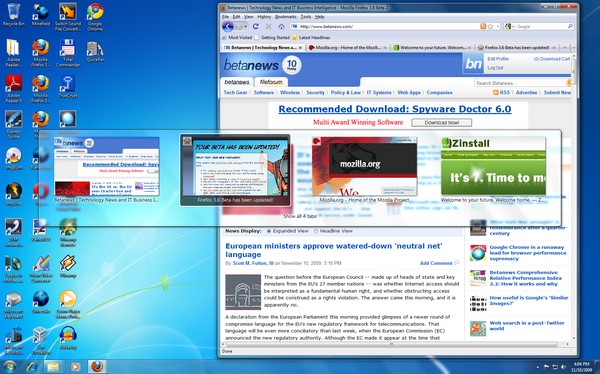
    For reasons we never quite discovered (and that we’d be willing to accept had more to do with Betanews.com than Firefox), the new Ctrl+Tab thumbnail preview feature had difficulty rendering the Betanews front page in Beta 1. That problem seems to have disappeared in Beta 2, so our thumbnail now shows up in miniature in the Windows 7 taskbar and in the new Ctrl+Tab selection pane.

    Beta 2 of Firefox 3.6 renders Betanews among its Ctrl Tab previews!

    We haven’t yet run Beta 2 through every benchmark test on every platform, but we’ve just completed an early round of tests on Windows 7. So far, Beta 2 is the best performing Firefox we’ve ever tested, overall. On our new CRPI 2.2 scoring system, it registered a score of 14.63, compared to a 24.63 score for our most recent test of the stable Google Chrome 3 (not a typo there, the difference is exactly 10 points). Our last test of stable version 3.5.4 scored 13.88 on Win7 (we’ll test stable 3.5.5 soon).

    But not everything is faster with Beta 2; there are certain elements of its execution profile that are somewhat faster, and others that are somewhat slower. For example, our tests show that Beta 2 is faster at loading pages, and at accessing that first element of the page, but not necessarily at getting that critical onLoad() JavaScript event fired. That event has been a secret to Apple Safari’s success. The faster that event loads, the faster the browser can start executing code even while the remainder of the page is still downloading and being rendered. Beta 2 scored an 8.69 in our CSS rendering test on Windows 7 versus 3.5.4’s 10.48, which may be an indicator of the effect of bug fixes — maybe more stable, but slower. But Beta 2 scored a 4.38 on loading everyday pages versus 3.5.4’s 2.96; and Beta 2 scored 5.81 on rendering old-style HTML tables versus 3.5.4’s 4.27.

    Mozilla looks like it’s concentrating on improving those elements that everyday users see and feel without a stopwatch (or without Betanews calculating everything to the n-th degree), and it’s making headway there.

    There are obvious changes to the calculation profile, suggesting changes in the JavaScript engine, perhaps for reliability and security. If you look at the speed of individual methods and instructions unto themselves, it’s improved nicely: 43.50 in Windows 7 on the TestWorld instructions test versus a Firefox 3.5.4 score of 41.92. However, put those instructions to work with algorithms, and those faster instructions don’t scale up the same way: Beta 2 scored a low 7.46 on the new JSBenchmark classic algorithmic test battery, while 3.5.4 scored a 9.14.

    Still, the overall score for Beta 2 is a few tenths of a point higher than for Beta 1, suggesting that Mozilla’s making the right tradeoffs. The organization has not publicly announced Beta 2’s availability at the time of this writing, though a confirmed public Beta 2 build was downloadable from Mozilla’s servers. Yes, we tested to make certain this wasn’t a Release Candidate masquerading as a public beta (it’s happened before). “Private” preview builds of 3.6 Beta 3 are already available.

    Copyright Betanews, Inc. 2009


    Add to digg
    Add to Google
    Add to Slashdot
    Add to Twitter
    Add to del.icio.us
    Add to Facebook
    Add to Technorati


  • CrunchDeals: $20 off $100 BestBuy.com purchase with PayPal

    bbuypaypal

    Damn you, Best Buy and double damn you, PayPal. Why must you tempt me so?

    If you have a PayPal account and you use it to make a purchase of $100 or more at BestBuy.com, you’ll get $20 loaded back into your PayPal account “2-3 weeks after the end of the promotion.” Think of it as a lazy man’s rebate. The promotion ends next Monday, November 16th.

    So long, money. I hardly knew ye.

    Use PayPal at BestBuy.com and get $20 cash back on a purchase of $100 or more [BestBuy.com]


  • MySpace To Host Exclusive Stream Of “New Moon” Red Carpet

    Don’t be surprised if MySpace experiences a big traffic spike on Monday, November 16th.  The social network intends to host a live stream of red carpet arrivals at the world premiere of The Twilight Saga: New Moon.

    In one sense, this could have been something of a cheap trick; it’s a good bet that boatloads of young girls would tune in even if they could only catch a glimpse of Robert Pattinson and listen to a random correspondent babble.  MySpace is demonstrating its influence and taking things quite a bit further, though, offering fans an exclusive experience.

    According to an official statement emailed to WebProNews, "Viewers will . . . be able to take part by posting comments or questions to The Twilight Saga: New Moon Premiere MySpace page that may then be presented to the celebrities during the broadcast."

    What’s more, "Anya Marina, writer and performer of ‘Satellite Heart’ on The Twilight Saga: New Moon Original Motion Picture Soundtrack, will co-host the broadcast."


    The Twilight Saga: New Moon Trailer and Premiere Announcement

    New Moon Premiere | MySpace Video

    So consider passing word of the event along to any relatives or friends who are Twilight fans.  And with respect to what sort of traffic numbers MySpace might see, it should interest even the franchise’s biggest detractors to know that the New Moon trailer received a whopping 4.2 million views within 24 hours of its debut on MySpace.

    Related Articles:

    > Paramount Follows Up "Paranormal" Marketing With More Social Fun

    > Facebook, MySpace May Share Content

    > MySpace Introduces New Music Features

  • Razer’s new Abyssus mouse ain’t fancy, but you wouldn’t guess that from the price

    abyssus
    Don’t get me wrong. I love Razer stuff. But this Abyssus mouse hearkens back to their earlier days when they were hocking two-button, ambidextrous ball mice for premium prices and only a few people took them really seriously. Now, obviously, for some, this super-basic mouse might be a good thing, but really, for $50 you can get a Death Adder (recently upgraded), G500, or any number of premium mice that are probably just as comfortable, and far more capable, than this one.
    http://www.razerzone.com/gaming-mice/razer-abyssus/
    The real problem is that their sensitivities are in hardware switches on the bottom; that can be good, but one of the strengths of Razer mice is their on-the-fly sensitivity, which allows you to dynamically adjust the software sensitivity at any time, to a high degree of precision. That’s not present here. If you really need a stripped-down mouse, there are plenty out there, and I’m sure the Abyssus is great, but for your money, there are better options.


  • Adobe Laying Off 680 Employees

    It’s official — following several tweets today from Adobe employees, a company spokesperson confirmed for us that Adobe “filed an 8-K this afternoon [that]  reports a company restructuring which will result in a 9 percent reduction in the company’s work force (approximately 680 employees).” You can read the filing here.

    “Adobe is restructuring its business to align costs with its fiscal 2010 operating plan and budget, the company’s three-year strategic priorities and the realities of the business environment, as well as to ensure its ability to continue investing in long-term growth opportunities,” the spokesperson continued. The advisory we received also noted that at the close of its acquisition of Omniture, Adobe reduced the Web analytics firm’s work force by 9 percent.

    These are tough times for some folks in the software industry. Adobe’s announcement comes right on the heels of Microsoft laying off 800 employees.

  • More Important Saving Lives From Swine Flu Or Protecting Roche’s Monopoly?

    In other parts of the world, it’s become acceptable for governments to simply ignore drug patents in order to produce more of necessary drugs in times of health scares. However, the US has mostly shied away from doing that, as the myth of patents as some great encouragement for innovation remains deeply rooted (and, oh yeah, pharmas are big campaign funders). However, with growing concern over the lack of supply for swine flu vaccines, there is some talk over whether or not the US will consider importing generic Tamiflu, even though the drug is still under patent in the US. There are approved generics, which are chemically identical, that are made elsewhere, such as India. However, importing it into the US, while it could save lives, is bound to be massively controversial. However, again, if we’re going to have a moral discussion about intellectual property, can someone please explain the moral argument for not being able to use generic drugs in this instance?

    Permalink | Comments | Email This Story


  • Hacking Ring Indicted For $9 Million Fraud

    A federal grand jury in Atlanta has indicted eight East Europeans on charges of hacking into a computer network operated by the credit card processing company RBS WorldPay, the U.S. Department of Justice said today.

    The 16-count indictment alleges the group used sophisticated hacking techniques to compromise data encryption used by RBS WorldPay to protect customer data on payroll debit cards. Payroll debit cards are used by some companies to pay their employees.

    The hacking ring allegedly raised the account limits on compromised accounts, and then provided a network of "cashers" with 44 counterfeit payroll debit cards, which were used to withdraw more than $9 million from more than 2,100 ATMs in at least 289 cites worldwide, including cities in the U.S., Russia, Ukraine, Estonia, Italy, Hong Kong, Japan and Canada. The $9 million loss occurred within less than 12 hours.

    The hackers then attempted to destroy data on the card processing network to hide their hacking activity. The indictment alleges that the "cashers" were allowed to keep 30 to 50 percent of the money, but sent the rest back to the leaders of the hacking ring.

    Lanny-Breuer "The charges brought against this highly sophisticated international hacking ring were possible only because of unprecedented international cooperation with our law enforcement partners, particularly between the United States and Estonia," said Assistant Attorney General of the Criminal Division Lanny A. Breuer.

    "Through our close cooperation, both nations have demonstrated our commitment to identifying sophisticated attacks on U.S. financial networks that are directed and operated from overseas and our commitment to bringing the perpetrators to justice."

    Some of the hackers if convicted in the U.S. could be sentenced to up to 20 years in prison.
     

    Related Articles:

    >Site Hacking Facebook Accounts For $100 A Pop

    >PartyGaming Founder To Give U.S. $300 Million

    >New Zealand Teen Hacker Escapes Charges


  • It’s very easy to win a Tekken art book from us!

    tekken1

    Remember a few days ago when I hinted at some exciting Tekken news? No? Well, today I can reveal what I was talking about: thanks to the fine folks at Namco Bandai (its publicists, to be exact) we now have three Tekken art books to give away. You can win one! This will be a very easy contest, believe me.

    What do you have to do to win the art book? Just leave a comment right here in this post. I’m running this contest, so I’m not going to make you do anything ridiculous. The contest will run through the weekend, and I’ll announce the winners on Monday.

    So to recap:

    • You can win one of three Tekken art books. That means three people will win. Each book contains drawings, sketches, etc. of the game’s characters. You know, an art book.

    • Leave a comment IN THIS POST to be considered. I’ll run the comments through a random number generator on Monday (comment number one is 1, comment number two is 2, etc.) to select the winners. Presumably we’ll have more than three entrants.

    • The contest runs till Monday, November 16 at noon EST.

    • You need to be a U.S. resident. I’m not paying $8 million dollars to ship this stuff to Manila or Curitiba. Sorry.

    tekken2

    I hope I’ve made this clear.

    Good luck~!


  • Check out a Food Justice Project Youtube Video!!

    Click the link below to see an awesome video slideshow that highlights our two current projects, the Teach Out! site visits and Our Food, Our Right: Recipes for Food Justice – activist guide and recipe book. Great job to Molly Woodring and Laura Brady for working on this together!
     
    Make sure you turn your sound up!
     
    YouTube – Food Justice Project – Community Alliance for Global Justice
    Nov 10, 2009  The Community Alliance for Global Justice (CAGJ) is a grassroots, membership- based organization that works for a just local and global 
  • Kindle for PC opens in beta, underwhelms

    By Tim Conneally, Betanews


    Download Amazon Kindle for PC 1.0.25338.0 Beta for Windows from Fileforum now.


    Actual Beta News feature bannerAmazon today opened the beta of Kindle for PC, a free application which can act as a PC-based companion to your Kindle e-reading device or as standalone e-reading software.

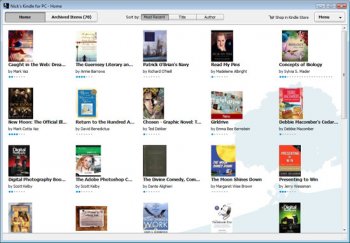
    While this is the same application that Amazon showed off at the Windows 7 premiere last month, so far it displays Amazon’s Whispersync technology and little else. When you start the program up, books you have already purchased in the Kindle Shop appear under a button called “Archived items,” and they can then be downloaded to Kindle for PC’s home menu. The books can be read and kept in sync with your Kindle with highlights and bookmarks appearing just as they would on the e-reader. It’s very similar to the Kindle iPhone application.

    Kindle for PC

    But it seems like the missing features actually exceed those present.

    You do not have access to content you converted for consumption on the Kindle or directly uploaded via USB, and you do not have access to your newspaper, magazine, blog subscriptions, or clippings. You can shop in the Kindle Store or manage your Kindle account, but neither of those actions take place within the application, and instead launch in your default browser.

    Covers and color text show up in full color, and font sizes can be adjusted; and there is touch recognition for Windows 7 users, so Kindle for PC ends up behaving even more like the iPhone app when it’s run in Windows 7.

    System requirements for the software are extremely modest: XP SP2, Vista, or Windows 7, at least a 500 MHz AMD/Intel processor and 128 MB of RAM, (800 x 600) screen resolution, and 100 MB storage. Conceivably, if it supported Linux-based operating systems or WinCE, such a lightweight app could actually run agreeably on recycled hardware; providing the foundation for a DIY Kindle actually running Kindle software.

    But as far as e-book management, conversion, and acquisition, this beta really has a long way to go before it can perform as well as cross-platform software such as Calibre.

    Copyright Betanews, Inc. 2009


    Add to digg
    Add to Google
    Add to Slashdot
    Add to Twitter
    Add to del.icio.us
    Add to Facebook
    Add to Technorati


  • Top Secret: “Green Jobs” Would Not Exist Without Massive Taxpayer Subsidies, Corporate Handouts

    Unsustainable, taxpayer-funded “green jobs” focus of Senate Finance hearing today

    Washington, DC – As part of the ongoing efforts in the US Senate to enact sweeping, energy-rationing legislation, the Senate Finance Committee held a hearing today entitled “Climate Change Legislation: Considerations for Future Jobs.” Following the hearing, Thomas J. Pyle, president of the non-partisan, market-oriented Institute for Energy Research (IER), issued this statement:

    “There is perhaps nothing more misleading surrounding the ongoing global warming debate than claims that cap-and-trade legislation will be a jobs boon and will spur economic activity. Look no further than the DeSoto Solar Center in Florida – a Florida Power and Light installation. On his recent visit, President Obama touted the center as the ‘largest solar field in the United States.’ However, the president failed to mention that the panels and other items were all manufactured abroad. The solar cells came from the Philippines; the steel mountings from Canada; the electric boxes from Germany. And how many ‘green jobs’ have been created there? Two full-time employees, six part-time groundskeepers that will work one week a month during the rainy season.

    “Cap and trade backers often cite European countries, like Spain and Germany, as a model for the US follow. Yet both of these nations have failed miserably at delivering affordable and reliable energy and creating jobs. Spain’s government has committed more than $753,000 per ‘green job’ over the past 9 years. And in Germany, per worker annual taxpayer subsidies have reached $240,000. Beware of the politician promising you a green job in one hand because he is pick-pocketing you with the other.

    “Washington must craft comprehensive energy policies that do not empower Congress or bureaucrats to determine which energy forms win or lose in the market. Cap and trade aims to increase the cost of our most affordable, abundant and reliable energy forms, including coal, oil and natural gas. With unemployment now at a 26-year high, raising energy costs across the board and making it more difficult for us to compete in the global economy is not the right solution to help put Americans back to work.”

    READ MORE: Key experts from a recent Washington Post article entitled “Painting a street green hasn’t stimulated one new job”:

    In Baltimore, the 300 block of East 23 1/2 Street is getting patched up in time for winter. One economic stimulus program is paying to insulate 11 rental rowhouses, another is paying for furnaces and a third is covering the cost for reflective roofs to be installed by prison inmates in a job-training program.

    The block is part of one of the biggest initiatives ever undertaken by the federal government, a nationwide push to improve the energy efficiency of buildings. But as the national unemployment rate crosses into the double digits and Republicans question the stimulus program’s impact, the work on East 23 1/2 — even with all of its activity — has so far not produced a single job.

    For additional information, please contact Patrick Creighton, 202-621-2947, or Laura Henderson, 202-621-2951.

    #####

  • Droid’s Opening Weekend Solid, But Not in iPhone Territory

    Unless you’ve been hiding under a rock for the past several weeks, you’ve no doubt been bombarded with the heavy marketing surrounding the new Droid smartphone. Today, TheAppleBlog has a good analysis of the first weekend of sales for the Droid — in which 100,000 units moved — compared with the weekend openings of the iPhone, the iPhone 3G, the iPhone 3GS, and the Palm Pre. In short, the Droid did well, but nowhere near the iPhone releases. The numbers are collected in the chart below. Check Stacey’s thoughts from earlier today as well as TheAppleBlog’s analysis here.

    chart

  • How The House Abortion Restrictions Would Work

    The House-passed health bill bars insurers from selling policies that cover abortion to anyone who gets a federal subsidy. But it does allow insurers to offer optional abortion coverage that consumers could purchase with their own money. Based on some states’ experiences, it’s unlikely insurers would sell such coverage.

    The abortion debate rivals the controversy over the public-option – the proposal to offer consumers in the new insurance exchanges a government-run insurance plan. The fight now moves to the Senate, where Majority Leader Harry Reid, D-Nev., is trying to meld two committees’ bills.

    Laurie Rubiner, vice president for policy at Planned Parenthood, says she is optimistic about blocking a similar amendment in the Senate. “This is a very broad, middle-class abortion ban in the exchange and once people really understand that I just don’t think there’s going to be the support for it.”

    The U.S. Conference of Bishops, which led the lobbying fight in the House for the amendment by Reps. Bart Stupak, D-Mich., and Joe Pitts, R-Pa., is just as determined. “The Conference will remain vigilant and involved throughout this entire process to assure that these essential provisions are maintained and included in the final legislation,” the organization’s president, Cardinal Francis George of Chicago, said in a written statement.

    Here’s basic information about the House amendment and private insurance coverage of abortion:

    Q: Do the House restrictions apply to all insurance?

    A: No. They apply only to policies sold to people who qualify for federal subsidies to purchase insurance through the exchanges. Most job-based insurance, which is how the majority of insured Americans currently get their coverage, would not be affected.

    Q: Who can buy through the health insurance exchanges?

    A: Initially, the exchanges will be open to the uninsured, people who buy their own coverage and some small businesses. Two years after the exchanges open, Congress could decide whether to allow larger employers to purchase coverage there.

    Q: Could consumers using the exchanges buy policies that offer abortion coverage if they use their own money, rather than federal subsidies?

    A: Only if insurers decide to offer two types of policies in the exchange: ones made available to subsidy-eligible people that don’t cover abortion, and another set, sold only to those who don’t get federal subsidies, that would cover it. Insurers may have little incentive to offer both, as the vast majority of the exchange marketplace is expected to be subsidy-eligible people.

    Q: Are there other options for people to get abortion coverage?

    A: Yes, insurers could opt to create “abortion riders,” separate add-on coverage that consumers could purchase with their own funds.

    Q: Do such policies exist?

    A: Five states – Idaho, Kentucky, Missouri, North Dakota and Oklahoma – prohibit insurers from covering abortions except to save the life of the mother or in cases of rape or incest, but allow insurers to sell separate abortion riders. Insurance departments in Idaho, Kentucky and Missouri say they don’t track such riders, so it isn’t clear if any are offered. North Dakota and Oklahoma say insurers there don’t offer abortion riders to individuals. In Oklahoma, however, one insurer has filed for a rider to offer abortion coverage to small groups. And in Idaho, one of the state’s major insurers offers abortion coverage to small groups if they pay an additional premium charge.

    Q: How many people currently have abortion coverage in their health plans?

    A: A survey by the Kaiser Family Foundation in 2003 found that 46 percent of workers had insurance that covered abortion. (KHN is part of the foundation.) Experts say most people use their own funds to pay for abortion. According to the Guttmacher Institute, which studies reproductive issues, about 13 percent of abortions are directly billed to insurers.

    Q: Are there other restrictions on federal funding of abortion coverage?

    A: Yes. The 1976 Hyde Amendment bars the use of federal funds to pay for abortions, except to save the life of the mother or in cases of rape or incest. Thirty-two state Medicaid programs, the joint federal-state programs for low-income people, limit abortion funding to those cases, according to the Guttmacher Institute. One, South Dakota, pays for Medicaid abortions only to save the life of the mother. And 17 use state funds to more widely offer abortions through their Medicaid programs. Restrictions on payment for abortion coverage are also in place for federal employees, women serving overseas in the U.S. military and women in federal prisons.

    Q: How much do abortions cost?

    A: First-trimester abortions can cost between $300 and $900, according to Planned Parenthood. Later-term abortions or abortions where women may face a higher risk of complications are more expensive, running several thousand dollars if hospital care is required.

  • TiE Entrepreneur Week

    TiE Entrepreneur Week will be held over a four-day period from Monday, Nov. 16 to Thursday, Nov. 19. Entrepreneur Week will consist of four intensive one-day sessions, each of which will focus on one segment: wireless, software, cleantech and Internet. The week will conclude with a wrap-up session to bring all of the participants together with the broader TiE audience. Each one-day session during Entrepreneur Week will bring together a group of TiE Charter Members, members, and other entrepreneurs with interest and experience around their chosen industry segment. Much like the sessions held at TiEcon 2009, each day will have a more intimate “PowerConnect” gathering around a specific topic of interest, as well as a panel of industry luminaries who will discuss and debate trends and issues that are relevant to the audience. Event hosts for E-Week are Visa, Sybase, and the San Jose Redevelopment Agency. Register now.

  • First review of New Super Mario Bros. Wii gives the game a 9.2 (and guess from who that number’s from!)

    nsmbw

    Super Mario Bros. Wii doesn’t come out here in North America for another five days, but, for whatever reason, it comes out in Australia in two days! That explains why you can find the world’s first review (nearest I can tell) on IGN Australia. The Web site gave the game a 9.2 (I swear, these decimal point reviews are 100 percent absurd), but I think it’s safe to conclude that the game is, indeed, fun, which is really all you can ask for.

    As is customary from my “oh here’s a review!” posts, I’ll merely highlight the nut graph, which is the wrong phrase to use here but whatever, but I’ll also encourage you to read the whole thing. It’s only two pages (you’ll recall that IGN’s GTA IV review was seven pages long) so get to it.

    Whether or not this is the best Mario game to date is purely a matter of personal tastes; it’s certainly the most humble on outward appearances. The red game case – a bold and loud statement of fun – is the first indicator that there’s something special under the hood in this one. Still sorting the men from the boys after 20 years, Mario and Luigi’s new adventure is not important because it’s the continuation of a franchise we know and love – rather, it’s because New Super Mario Bros. Wii demonstrates one more time why Nintendo are masters of the all-ages gaming market; relevant and refreshing but at all times reverent and above all, incredible fun.

    I can only add that I played the game for, oh, 15 minutes about a month ago, and it struck like Smash Bros does: it’s fun on its own merits, yes, but the more people you play with, the better.

    Or, simply, if you own a Wii, you’ll probably want this under your Christmas tree (or whatever) this year.


  • Info Group Attracts Bidders

    NEW YORK (Reuters) – Info Group (IUSA.O), a business-to-business marketing firm, attracted first round bids from companies including rivals and private equity firms, two sources familiar with the matter said.

    Info Group said in December 2008 it retained boutique advisory firm Evercore (EVR.N) to help evaluate its options. That was prompted by its former CEO and chairman, Vinod Gupta, requesting the company explore its strategic alternatives, including a sale of the company.

    Preliminary bids were put in last week, said the two sources and other sources familiar with the situation. Interest came from both private equity firms and rival companies of Info Group, the sources said, who declined to be named because the talks are not public.

    The sources said that information companies including Dun & Bradstreet (DNB.N) and private equity firm Carlyle [CYL.UL] also put in a bid.

    The sources also said that Acxiom Corp (ACXM.O) had also submitted a bid, although the company denied that.

    “We have not made a bid,” a spokesman for the company told Reuters.

    One of the two sources and a separate source said that it was possible the business could be sold in parts, rather than as a whole. The two sources said it was unclear whether the company had decided that selling parts of the business is an option.

    One of the original two sources cautioned that the company could decide not to sell itself if it wasn’t satisfied with the prices offered. It was unclear what the price of the bids were, but one source said at least one bid wasn’t at much of a premium to the company’s recent stock price.

    Shares, which closed at $7.96 on Monday, have more than doubled since December 2008. Shares rose more than 12 percent following news of the bids on Tuesday, and were up 41 cents at $8.37 by early afternoon.

    Info Group had a market capitalization of around $450 million at the close of trading on Monday.

    Omaha, Nebraska-based Info Group changed its name from infoUSA in June 2008, after expanding internationally.

    Evercore also advised Info Group on its $155 million sale of research services firm Macro International in April.

    Info Group lists 19 different businesses on its website, which provide various marketing, research and database services.

    D&B and Carlyle declined comment; Info Group did not return calls made Monday for comment.

    By Megan Davies and Jui Chakravorty
    (Editing by Steve Orlofsky, Bernard Orr)

    ShareThis