Shortly after their acquisition of Playfish, Electronic Arts is set to streamline operations, sacking 1,500 employees from different levels, and can…
Category: News
-
Jonathan Silver Leaves Venture Capital for DoE
Jonathan Silver has been named executive director of the Department of Energy’s loan program. He had been a co-founding managing director of Core Capital Partners, before leaving in 2008.
PRESS RELEASE
Underscoring his commitment to strengthen and streamline the Department of Energy’s operations, Secretary Steven Chu today named Jonathan Silver Executive Director of the Department’s loan program office. In this role, Silver will oversee the Department’s Loan Guarantee Program as well as the Advanced Technology Vehicles Manufacturing (ATVM) loan program.
Silver will report directly to Secretary Chu, helping accelerate the application review process for both programs. As Executive Director, Silver will be responsible for staffing the programs and leading origination, analysis, and negotiation, as well as managing the full range of the Department’s alternative energy investments.
“The loan programs at DOE play a critical role in spurring investment in a clean energy economy, creating new jobs, and fighting carbon pollution,” said Secretary Chu. “Jonathan’s background and expertise will help us dramatically expand our efforts and capitalize on the many significant opportunities we have in front of us.”
President Obama’s American Recovery and Reinvestment Act created a new Section 1705 under Title XVII of the Energy Policy Act of 2005 for the rapid deployment of renewable energy projects and related manufacturing facilities, electric power transmission projects and leading edge biofuels projects that commence construction before September 30, 2011. Within 60 days of taking over at the Department, Secretary Chu announced the first loan guarantee to Solyndra, Inc. to support the company’s construction of a commercial-scale manufacturing plant for its proprietary cylindrical solar photovoltaic panels. Since then, DOE has made additional conditional commitments to Beacon Power and Nordic Windpower and issued advanced technology vehicle loans to Nissan, Ford, Tesla, Fisker and Tenneco.
The ATVM program has $7.5 billion in appropriations to support up to $25 billion in loans. The Recovery Act provided $4 billion in appropriations to support up to $32 billion in loan guarantees. Those credit subsidies complement more than $50 billion in additional loan guarantee authority the Department has to advance nuclear, clean coal, and advanced renewables and energy efficiency technologies.
Prior to his appointment, Silver was a venture capitalist and the Managing General Partner of Core Capital Partners, an early-stage investor in alternative energy, advanced manufacturing, telecommunications and software. Earlier, Silver was a Managing Director, and the Chief Operating Officer, of Tiger Management. He began his career at McKinsey and Company.
Silver has extensive public sector experience as well, having served as a policy advisor to the Secretaries of Commerce, Interior and Treasury in the 1990s. During this time, Silver was also a member of the team that negotiated the first clean car agreement with the nation’s auto manufacturers. He has also served on numerous non-profit boards, including, for many years serving as Chairman of the board of American Forests.
Silver is a graduate of Harvard University and did graduate work at the Institute of Political Studies in Paris and the Graduate Institute of International Studies in Geneva. He has received both Fulbright and Rotary Graduate Fellowships.
-
Test Driving The World’s Fastest Golf Cart
 Last week Tesla asked me if I’d like to take the new Tesla Roadster Sport for a day to see what I thought. This is the newer Tesla Roadster that shaves 2/10 of a second off the 0-60 time, and the car is a couple of inches bigger than the original (making it possible for me to fit my 6′4 frame into into it comfortably).
I agreed immediately. The only rules were that only I could drive it (some nonsense about insurance), and I had to have it back by 6 pm. I did return the vehicle on time, but as you can see from the video just about everyone from the office and most of my friends came by to take it for a spin, too.
I’ve been in a Tesla before but this is the first time i’ve driven one. With no gears and a silent motor, the experience is like driving a golf cart. At least it would be if golf carts could hit 100 mph on the freeway on ramp and hugged the road like it was glued there.
Thanks Tesla. Sorry about that scratch in the bumper.
Video is below:
-
NASA wants everyone to know the world will not end in 2012, m’kay?

Listen, I don’t care if you heard it from John Cusack that the world will explode from a global apocalypse on December 21, 2012. He’s wrong and a bad actor. NASA, home of the smartest government employees, is going out of its way to inform everyone that they will still have to pay off those credit card bills in 2013. Sorry.Q: What is the origin of the prediction that the world will end in 2012?
A: The story started with claims that Nibiru, a supposed planet discovered by the Sumerians, is headed toward Earth. This catastrophe was initially predicted for May 2003, but when nothing happened the doomsday date was moved forward to December 2012. Then these two fables were linked to the end of one of the cycles in the ancient Mayan calendar at the winter solstice in 2012 — hence the predicted doomsday date of December 21, 2012.Add this to the previous reports by noted scientists claiming that the whole thing is just an Internet hoax. Kind of like bonsai kittens except with a lot more death and destruction.
Serious gaming bling: 24k gold PS3 Slim
White, black, and silver – those colors will have nothing against this PS3. Nothing says gaming bling quite like a PS3 Slim, lavishly covered in 24k…
Does Bluebeat Actually Have A Legal Basis For Its Claim Of Copyright Over Beatles’ Songs?
Folks on pretty much all sides of the copyright debate have been in pretty much universal agreement that Bluebeat’s claim that its “psycho-acoustic simulation” lets it recreate songs and claim an entirely new copyright on the files is ridiculous to the extreme. However, an anonymous commenter on the site (no idea if they’re connected to Bluebeat, but wouldn’t surprise me) claims that if you look closely at US copyright law, there actually is a basis for this. Specifically, the commenter points to 17 U.S.C. section 114 (b) which reads, in part:
The exclusive rights of the owner of copyright in a sound recording under clauses (1) and (2) of section 106 do not extend to the making or duplication of another sound recording that consists entirely of an independent fixation of other sounds, even though such sounds imitate or simulate those in the copyrighted sound recording.
The argument is that an MP3 file is a duplication of another sound recording, but is done as an entirely independent fixation of other sounds. In case you’re playing along in the home game, clauses (1) and (2) of section 106 of copyright law pertains to reproducing copyrighted works or preparing derivative works. Now, whether or not an MP3 is actually an independent fixation that simulates the original or a direct copy is an open question which I’ll let you argue about in the comments. Of course, if we were actually paying attention to what the copyright law actually says, people might have noticed (as at least a few lawyers have) that section 101 limits the use of the term “copies” to material objects — and does not cover pure digital files. But, it’s not like we should let what the law actually says get in the way of how we interpret it.
Permalink | Comments | Email This Story

What the N900 Means to Nokia
 Nokia is hoping to recapture some of its lost glory in the smartphone space with the N900, the flagship device that began shipping today. The long-awaited handset runs Nokia’s new Maemo 5 operating system and boasts some pretty impressive features, including 32GB on onboard memory, multitasking functionality, and a 5-megapixel camera with video capability.
While the N900 may not be the iPhone-killer Nokia would love to produce — as Om opined last month — it has received positive reviews, thanks largely to Maemo 5’s web browser. Maemo-based Internet tablets have fared poorly in the U.S., but with Symbian gathering dust — and losing customers — Maemo increasingly appears to be Nokia’s best hope for catching up to its rivals in the superphone era. As Fjord’s Christian Lindholm told Om last week (see the clip below), a typical mobile operating system has a shelf life of about 10 years, and building a mobile OS from scratch is a daunting task. If Nokia can find much of an audience with its N900 and Maemo 5, it may be a first step in reversing its fortunes.
While its Symbian platform remains atop the smartphone space in terms of market share, Nokia is in desperate need of a high-end, web-friendly handset that can compete with the iPhone. The manufacturer continues to lose ground in the vital U.S. market and has watched its dominance erode in its home market of Western Europe as Apple, Research In Motion and others close the gap. And Nokia will surely lose substantial ground to Android in the next few months as Google’s mobile OS gains traction in North America and Europe. The Finnish manufacturer must continue to support its massive base of Symbian customers, of course, but Nokia’s best hope for the long-term appears to be Maemo 5.

4 Scenarios for Android, Minus the Phones
 When the Mobile World Congress conference happened at the beginning of this year, Fabrizio Capobianco, CEO of Funambol, a mobile application company, described the Android operating system as “a shocking no-show.” Hardly any smartphones there were based on it. That, of course, has radically changed as we approach the end of the year. There is, in fact, so much action surrounding Android on smartphones (GigaOM Pro, subscription required) that its non-phone prospects are being overshadowed. Android has the potential to be disruptive on many types of hardware platforms, and here are four scenarios for what the OS might do beyond phones.
 Usher in Next-Gen Navigation Devices. I recently asked Chris DiBona, Open Source Program Manager at Google and one of the overseers of Android, what he thought of the new Droid phone during a casual, non-interview conversation. He immediately answered that he really liked the new, free Google Maps Navigation for Android 2.0 features, and made some citations that let me know for sure he wasn’t just feeding me a press release. He especially appreciates the fact that you can just pop your Droid into a cradle in your car and it will go straight into the navigation and mapping environment. jkOnTheRun has given the navigation features rave reviews, too, and suggested that they make break new ground for Android in the overall GPS space.
 Become the Most Flexible e-Book Platform. The looming battle between Amazon’s Kindle eBook device and Barnes & Noble’s Nook could “portend the next wave of Android disruption,” Joel West recently noted, hitting the nail on the head. Having Android on the Nook opens the device up to the fast-growing ecosystem of Android applications — potentially a major advantage over the Kindle. It’s puzzling, though, why Barnes & Noble hasn’t included a browser on the Nook device, which would make it even more flexible.
 Bring Intelligence to Digital Entertainment Devices. MIPS Technologies, which provides processors and architectures for home entertainment, portable multimedia, and communications devices, is moving ahead with a number of initiatives focused on the Android operating system. It has its own Android port that it has open sourced for players in the digital entertainment space to work with. Blu-ray players, set-top boxes, and digital TVs are just some of the hardware devices that MIPS is targeting with its Android port, as EETimes has reported. MIPS has already demonstrated Android running on a home media player and other devices. Archos also has its Archos 5 — a slick video player based on Android, and possibly a hot seller over the holidays. It’s shown at left.
 Biggest Non-Phone Prospects Arrive From Japan. The Open Embedded Software Foundation (OESF) doesn’t get a lot of press in the U.S. and Europe, but it is extremely focused on bringing Android to non-phone platforms, as OStatic covered here. Many heavy-hitting companies are working with Japan’s OESF to take Android to non-phone devices, including ARM, KDDI, Japan Cable Laboratories, Alpine Electronics and Fujitsu Software Technologies. OESF working groups are also collaborating with MIPS on its non-phone Android plans.
It’s hard to believe that as recently as April of this year, many observers were wondering if Android had already failed. Fast-forward to today, and we’re seeing approximately 20 Android handsets arrive before year’s end — and numerous promising prospects for the OS on non-phone platforms.

Panda Cloud Antivirus Goes Final
 Panda Cloud Antivirus was released as a public beta in April 2009. Almost seven months later, boasting millions of downloads and with the developer taking advantage of thousands of lines of user feedback, the application has reached its first final stage and is now released to home users. The reason behind all the user interest is that Panda Security broke the traditional antivirus pattern in terms of looks, form of protection (cloud-based scans) as well as costs to the user (it is free of charge for home users).
Among the fixes that have been operated in the latest edition of Panda Cloud Antivirus, we note repairs to scan process, Internet connectivity problem messages, no slowdown of the PC after installing the product, background scan has been improved, as well as management of quarantine and restoration of disinfected files.
The minimalist interface the developer started off with is maintained and, from this point of view alone, compared to the Beta 3 looks, there is absolutely no change. Settings, Scan, Reports and Status tabs are in the same place as always and their functions have not changed one bit.
Unlike other antivirus programs that feature a plethora of settings with terminology you have to look up in the dictionary, Panda Cloud Antivirus keeps all the configuration to enabling the automatic… (read more)
Opening Weekend: iPhone vs. Pre vs. Droid
After heavy promotion, including a little negative advertising, Verizon launched the Droid over the weekend, and two days later the first sales estimates are in: 100,000.

Speaking with Bloomberg, Analyst Mark McKechnie of Broadpoint AmTech thinks that’s pretty good. Noting that Verizon had 200,000 Droids on the shelves for launch, he said most stores sold at least half their inventory.
“I see the first few days as encouraging,” McKechnie said. “There seems to be pretty good demand — they’ve taken the right steps and picked a good partner with Google on the Android side.”
While that may be true, comparing the Droid to the iPhone and the Palm Pre during their launch weekends paints a different picture…or chart.
According to Apple, both the iPhone 3G and iPhone 3GS sold more than a million units during their first weekend. Some might argue that’s an unfair comparison, in that both iPhones were available in multiple countries. Both also benefited from the App Store, though that was far more of an advantage for the 3GS. When the iPhone 3G went on sale, there were only 500 apps available, compared to more than 10,000 for the Droid now.
Still, a more fair comparison might be found with the original iPhone, as it too was sold in the U.S. on a single network. However, it should also be pointed out that Verizon has more customers than AT&T, and that the original iPhone was not a 3G device, and that the 8GB model cost $599.
Nonetheless, Verizon’s 100,000 Droids looks pretty good next to Apple’s 270,000 iPhones, except for one thing. That number does not include Sunday sales, which fell on July 1 and were part of a new quarter. It’s very possible Apple sold as many as 400,000 iPhones during that first weekend of lines around the block.
Of course, lines aren’t everything. As Verizon spokesperson David Samberg said to CNET regarding Friday’s Droid launch, “long lines forming outside are flashy,” but the goal is a “a steady stream of people” over days and weeks. Perhaps the Droid would be better compared to Palm’s smartphone, which is estimated to have sold around 50,000 units during its launch weekend.
It’s looks like Verizon may have a “Pre killer” in the Droid.


Fiscally Responsible Health Reform Redux
Every two weeks or so, there seems to be a story ringing the alarm bells over the fiscal dimension of health reform.
As I’ve said time and again, the President is committed to signing a health reform bill that is deficit neutral in the first decade – and deficit reducing thereafter. The legislation under consideration in the Senate and the bill passed Saturday by the House both meet these tests.
But health reform effort must go beyond simply being deficit neutral over the first decade and deficit reducing thereafter; it must also begin the process of transforming the health care system so that it delivers better care, not just more care. Building the health care system of the future requires information technology; cutting-edge research into what works and what doesn’t; incentives for doctors and hospitals to focus on the quality of care; prevention and wellness; and a process that allows policy to adapt flexibly to changes in the health care marketplace over time.
The House and Senate versions of reform share a variety of measures that will help create this health care system of the future, which will help to contain health care cost growth while also providing Americans with higher quality care. In addition to historic investments in health information technology, research into what works and what doesn’t, and prevention and wellness investments that were included in the Recovery Act, some of the key provisions under consideration in the health reform bills include:
Changing the way we pay hospitals, to discourage mistakes and unnecessary readmissions.
Creating incentives in the payment system to reward quality of care rather than just the quantity of procedures.
Giving physicians incentives to collaborate in the coordination of patient care.
Investing in research into what works and what doesn’t in health care.
Reducing hospital-acquired infections and other avoidable health-center acquired conditions through rigorous reporting and transparency.
Imposing a fee on insurance companies offering high-premium plans — which would create a strong incentive for more efficient plans that would help reduce the growth of premiums.
Establishing a Medicare commission — which would develop and submit proposals to Congress aimed at extending the solvency of Medicare, slowing Medicare cost growth, and improving the quality of care delivered to Medicare beneficiaries.
As we approach the final stages of this health reform process, we have on the table a robust set of options that represent some of the most auspicious reforms we can take to transform our health care system and rein in health care cost growth. But don’t take my word for it. A bipartisan group of experts recently wrote that health reform legislation under discussion "offers many promising ideas to improve the overall performance of the U.S. health care system. In addition to steps that would reduce the number of Americans without insurance coverage, the plan includes ways to slow long-term spending growth while building the high-value health care system our nation urgently needs." Or read what a group of some of the most prominent health care and budget experts wrote in an open letter (pdf) released last week.
As we go through the rest of the process, the Administration will remain focused on ensuring that reform is fiscally responsible and helps to build the health care system of the future.
Peter Orszag Is Director of the Office of Management and Budget
Introducing the $1,500 Intel e-book reader

The Amazon Kindle costs $260. The Barnes and Noble Nook costs $260. The Sony reader is $300. Clearly there’s an established price point for what we call an e-book reader. Jumping into the e-book fray comes the Intel Reader, for fifteen hundred U.S. dollars. No WiFi, no associated book store, but it does include a 5 megapixel camera, and a host of features designed to make it the best choice for vision impaired people.
From the VentureBeat review:
The paperback-sized device is aimed at 55 million people in the U.S. who have eyesight problems and don’t want to be dependent on others for the pleasure of reading a novel, looking at a restaurant menu, or reading web site pages. It comes with a 5-megapixel digital camera that can be used to snap pictures of book pages. Foss said he was able to scan a 262-page book in a half hour and listen to the first chapter of the book while he was doing it. The device can read text in the DAISY format, plain text, as well as MP3 music files.
Can the Kindle or Nook help a vision-impaired individual order from the menu at a restaurant? I think not. The ability to scan and read custom text makes the Intel Reader something very different from the current offerings of e-book readers. This is clearly a multi-purpose device designed to enrich the life of its user, not just be a portal to selling electronic books. The Reader can speak the menus aloud to the user, and the instruction manual comes as an audio CD, making this extremely friendly to visually impaired individuals.
An optional book scanning system, the Intel Portable Capture Station, can be purchased, to allow home users to digitize books with ease. A lot of time and effort has gone into researching the ergonomics of the Reader and its accessories, since the target audience isn’t your normal fully-abled young-to-middle aged person.
The Intel Reader boasts some custom made parts, but is otherwise fairly run-of-the-mill in terms of capacity and performance:
The device has an Intel Atom microprocessor and two gigabytes of flash memory storage. It runs Linux software and some third-party software for scanning and reading aloud. With a fully charged battery, the device can read aloud for four hours. It can last for days on standby power. It can store about 500,000 pages of text or 600 pages of scanned book pages.
Here’s a video of the Intel Reader in action:
I think this is a terrific use of technology, and it demonstrates an impressive commitment from Intel in terms of research spending. I think this will create a lot of opportunities for the people who can afford to purchase it, and Intel deserves a lot of praise for cooking this thing up.
But I think that we, the general Internet population, can do a lot more. Listening to books read aloud by crappy digitized computer voices doesn’t really do justice to a lot of printed materials — especially novels. When I read a book, I hear in my mind’s ear distinct voices for each character. I read faster during tense or exciting scenes. I experience the story in a way that the monotonous drone of a computer voice can never reproduce.
Something like Project LibriVox can breathe real life into stories. We, the general Internet population, can donate a couple of hours of our leisure time to read a chapter — or a complete work — of a book so that others can enjoy the story in the dramatic manner in which it was intended. It’s a lot of work, I know: I recorded Thuvia, Maid of Mars by Edgar Rice Burroughs. But it’s also a lot of fun, and a very rewarding experience.
VESA Issues Mini DisplayPort Standard
 Earlier this year (right at the beginning, in fact), we brought news that the Video Electronics Standard Association (VESA) might potentially make the Mini DisplayPort standard, meaning that manufacturers outside of Apple can now use it in their products without Apple’s approval, including rival computer makers, among others.
The Mini DisplayPort (mDP) standard is described as a smaller form factor of the DisplayPort connector itself. The smaller connector is aimed at devices like thin portable computes and add-in cards that need to support multiple display interfaces. Hopefully, display and display accessory makers will adopt the standard, reducing the need to purchase expensive Apple-branded adapters.
The new mDP is for Version 1, Revision 1a of the standard, though DisplayPort 1.2 including mDP is in the works, which will double the available bandwidth of the cable tech to 21.6 Gb/second. That would mean that multi-monitor support via a single cable would be feasible, as well as higher resolutions and improved color depth and refresh rates. 3-D displays necessary for demanding graphical applications could also be supported with the new version of the standard.
As a result of this new standard creation by VESA, we could see a flood of mDP-toting computing devices, or we could see very little change at all. As with FireWire, many computer makers might opt to skip mDP or DP in favor of more established technologies like DVI and VGA, since they are more widely available and don’t necessitate a change to manufacturing processes. The one thing mDP has going for it is its size, and makers of MacBook Air competitors will probably be the first to bite, if anyone does.


Bing Maps Gets an Upgrade
Microsoft announced that it has made some changes to Bing Maps. Changes include the color of the navigation bar, draggble routes, zoom bar changes, command parsing, embedding, dynamic computing, new navigation, speed, and Bing Maps will no longer stop at the international date line, but will wrap around the world continuously.
Draggable routes is arguably the most significant change to Bing Maps. "This is a great (and much requested) feature added to Bing Maps allowing you to generate a route, then in the case that you need to change the route, you can simply grab any part of it and drag it to where you want the route to actually go," says Microsoft’s Chris Pendleton. "To use draggable routes, click the directions link in the welcome pane or the car icon near the bottom of the welcome pane. Enter a start and end, generate a route, then grab anywhere on the route to move the route line. The route will regenerate for you."
With the zoom bar, you can now jump to specific zoom levels rather than just zooming in and out, and if you want driving directions or traffic info, you can enter specific commands in the search box like "Bellevue, WA to Space Needle" or "Seattle Traffic."
You can now embed maps onto blogs or sites by clicking the share button when the map is where you want it to be. You can then copy the code or click the "customize view" link to bring up the embeddable map customizer.
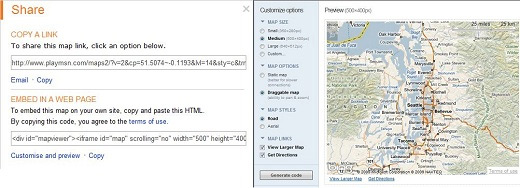
As far as navigation, there is a new selection of features on the button bar with the following:
– "Welcome" loads the welcome pane
– "Car" loads driving directions
– "Star" loads My Places, formerly called Collections
– "Envelop" loads the ability to share the map with someone via email, copy a URL or embed the map into a web page
– "Printer" is for printing
– "Traffic light" will load the traffic overlay

"We’ve moved the processing power closer to the user," says Pendleton. "Using Microsoft’s ECN, we now have Bing Maps running in data centers in 7 locations around the world. This means wherever you are around the world, you will access Bing Maps from the closest geographic node to where you are physically located."
In addition to that, the default Bing Maps home page dropped from 678kb to 484kb and Pendleton says it "zips through the pipes" much faster now.
Related Articles:
> National Geographic, Weather.com Befriend Bing
> Google Makes Biggest Design Changes to Maps Yet
> Google Updates Maps with New Dataset
Role of Information Security Manager
As the Information Security Manager you will take responsibility for developing, maintaining monitoring compliance of all information security policy and procedures.
The successful Information Security Manager will perform
- security risk analysis and risk management,
- perform security tests
- manage internal audits on information security processes, controls and systems.
You will take responsibility for developing and maintaining the organization’s project disaster recovery and business continuity plans for information systems and monitors changes in legislation and accreditation standards that affect information security.

You will provide guidance and consultation on projects for IT Security related risks and issues.
The successful Information Security Manager must be qualified to Degree level in a numerate subject (e.g. Computer Science, maths, engineering) and possess professional level Information Security Certification such as CISA/CISM/CISSP/SSCP. Will possess a minimum of 5 years experience in Information Security Management and be well versed with ISO 27001 accreditation.
This is a guest post by Venu Potumudi, an Information Security Manager. The orignal text is published on Making of ISM

Quick Egg Scrambles: Pancetta and Asparagus

Last night we were running home late, and on the drive home I was thinking about what I would make for dinner that could be on the table in about 5 minutes. I remembered the fresh asparagus I’d picked up from Trader Joe’s as well as the container of pancetta, cubed and ready to use. Why not combine them in a hearty egg scramble – no reason to have egg dishes limited to breakfast and brunch. The crisp-tender asparagus and the pancetta were a winning combination with the moist scrambled eggs. Some fresh multigrain bread went perfectly on the side but I think that even garlic bread would also go really well with this Italian-themed creation.
Here, I used Trader Joe’s pancetta which is conveniently diced into tiny little mini-cubes. Pancetta is a cured Italian bacon but without the smoky flavor. It’s terrific in egg scrambles or omelettes and it’s so nice not to mess with the cutting and dicing. If you like pasta, it’s a perfect (and authentic) fit with Spaghetti Alla Carbonara.
Few dishes are simpler to make than an egg scramble, and it’s a great way to make use of any vegetables or leftovers you have in the fridge or freezer. Add sundried tomatoes, olives, and goat cheese, with some fresh basil sprinkled on top. Or scramble up a Mexican version with diced chorizo and red bell pepper, with salsa and cheese added on top. In the same way a pizza is limitless in creative possibilities, so are eggs.
The poor egg has been vilified in years past, mostly because of misconceptions about how blood cholesterol is affected by cholesterol in foods. Nowadays, eggs have redeemed themselves and are considered an important part of a healthy diet, in moderation. They’re high in protein (just the whites have 4g of protein and only 16 calories!) They contain healthy unsaturated fats and are high in choline, which has been linked with preserving memory, and lutein and zeaxanthin, which may protect against vision loss. If you do have special considerations regarding cholesterol (such as diabetes), you can use less yolks or just the whites in many recipes. Here’s just a sampling of some other egg-cellent recipe ideas. Eggs have the starring role in quiche (check out our Leek and Parmesan Quiche or our SImply Quiche recipes), Huevos Rancheros, sweet and savory Summer Squash Strada, or the easy Egg Muffin Breakfast Sandwich. If you have a little more time, take a look at our favorite Egg Salad (great in pita sandwiches) or Spinach Timbales (straight out of the 1950’s). And if you like your eggs in the shape of Hello Kitty (no, we’re not kidding) you might want to learn about Japanese Molded Eggs, which are very popular with our kids!
Pancetta and Asparagus Scramble
The trick to cooking moist eggs is to cook them slowly over low or medium heat. Cooking them quickly over high heat is really only good for creating a chewy futuristic polymer – it makes eggs very rubbery. I didn’t add salt to this dish because the pancetta has plenty for me, but you may want to check the seasonings and adjust to your tastes. Serve with bread or plate over a bed of greens such as spinach or a spring mix.
8 eggs
1 (4-oz) container Pancetta minicubes
A dozen slender stalks of asparagus, cut into 1-2 inch lengths
Black pepper to taste
1/4 cup shredded Parmesan to sprinkle on top, optional
1.) In a medium bowl, add the eggs and whisk until combined. Set aside.
2.) In a skillet or omelette pan over high heat, add a drizzle of olive oil and the pancetta cubes, and give a stir. Very little oil is necessary as the pancetta will provide some. Add the asparagus and continue sauteeing for a couple of minutes until the pancetta begins to look crisp.
3.) Reduce the heat to low and pour in the eggs slowly. Move the eggs around until they are just cooked, moist, creamy, and tender. I usually remove the pan from the burner near the end and let the residual heat of the pan finish the cooking. Add pepper to taste.
Serves 4
Review: Archos 5 Internet Tablet with Android

Short Version: After a handful of rapid-fire firmware updates, the Android-infused Archos 5 Internet Tablet has turned out to be quite a compelling device. The snappy web browser, marathon battery life, and nearly endless list of features and functions make Archos’ latest couch companion a worthwhile option if you’re shopping for portables. If you’re drawn to the Archos 5 Internet Tablet purely based on the fact that it’s running Android, though, you’ll likely come away disappointed as there’s no access to the popular Android Market.
Features:
- Screen: 4.8-inch 800×480 touchscreen
- Storage: 32GB flash memory
- Connectivity: 802.11b/g/n wireless, Bluetooth, GPS
- Codec Support: MP4, WMV, MPEG-2, H.264, MP3, FLAC, OGG, AAC, WMA
- Promised Battery Life: 22 hours audio, 7 hours video
- Expansion: microSD
- Other: Android OS, web browser, downloadable apps, FM receiver, optional DVR
- Dimensions: 5.63” x 3.1” x 0.4” and 6.4 ounces
- MSRP of $379.99
Pros:
- Jack-of-all-trades device handles audio, video, web surfing, radio, e-mail, GPS, media streaming, digital video recording, games, photos, and more
- Impressive battery life — especially for audio and video playback
- High-resolution screen works well for web sites and videos
Cons:
- The $380 starting price is compounded by having to pay to unlock extras like MPEG-2/WMVHD video playback, GPS subscription, and DVR functionality
- Built-in Archos-branded app store is severely limited, and there’s no access to the more popular Android Market
Review:
I’ve been playing with the Archos 5 Internet Tablet for about a month now. I have the 32GB flash version, which is a gorgeous slab of electronics sized small enough to fit in a roomy pocket but large enough to keep next to your favorite armchair in lieu of a full size laptop.
While the aesthetic appeal of previous Archos devices has traditionally been the subject of great debate, most would agree that this new one looks pretty nice inside and out.

To say that the first couple weeks I spent with the device were worrisome would be putting it lightly. The UI was slow and clunky, the battery drained even when the tablet was in standby mode, and the web browser crashed out to the main screen during periods of moderate use.
Then came a firmware update. Then another. And another. And suddenly everything worked.

I’m now happy to report that the tablet is much more stable, the battery life has greatly improved, and surfing the web and navigating the interface is sufficiently slick. I’m using firmware version 1.2.15 (Android 1.5) at the time of this review.
The Archos 5 Internet Tablet does many things and, as with most portable media players, the big question is whether or not it can do each one of those things well.
Basic Audio and Video Playback
For audio and video playback, the device handles everything with ease. Videos look great on the crisp 4.8-inch screen and the 800×480 resolution renders downscaled HD videos and standard-definition videos phenomenally. Archos has really nailed down the core functionality of its portable media players. Music and videos come first, everything else comes second.
I was skeptical of Archos’ claim of 7-hour battery life for video playback, so I set a playlist up to repeat indefinitely at 25% brightness and 25% volume just to see how close we’d get to that number. To my surprise, the tablet hit 6 hours and 15 minutes before petering out. That’s not too bad at all, especially considering I left the Wi-Fi connected the entire time.
Audio playback is handled via a simple interface that displays album artwork. I found the built-in speaker to be too tinny to listen to anything other than spoken-word podcasts – playing actual music sounds much better through a pair of decent headphones. Battery life for music playback is pegged at 22 hours and, again, those claims held up pretty well. I managed about 20 hours and 30 minutes with volume at 25% and Wi-Fi turned on.
And finally, just for good measure, here’s where I complain about Archos charging people $40 to unlock 720p WMV and MP4 playback. That functionality should always be included at no extra charge but Archos has been charging people for it for a long time now, so I give up.

Web Browsing
The built-in web browser is quick and responsive, thanks in large part to the 800MHz ARM Cortex A8 CPU that powers the tablet. The 800×480 screen renders full versions of web sites relatively faithfully, although the browser will default to the mobile version of most sites if there’s one available.
Trying to use the Archos 5 Internet Tablet for web videos is, unfortunately, too hit-or-miss right now if one of your big goals is to watch YouTube videos all day. YouTube apparently tweaked their API recently, which caused videos handed off from the browser to Archos’ built-in video player to just freeze the tablet, requiring a reboot.

There’s a standalone Dailymotion player included, and I’m currently having trouble getting those videos to work as well. There’s loose talk of a Flash 10 update coming to the device sometime but until then, browser-based Flash video is still pretty rough around the edges.
Not to say that YouTube videos never worked on the device – they used to, at least. They even played back in HD (see this post on ArchosFans.com for proof).
So if you’re planning on using the web browser for basic, straightforward stuff then you’ll like it just fine. It’s quick, the keyboard works great, and pages render nicely on the 4.8-inch LCD.
Battery life is pretty solid as well. Under heavy testing (a website auto-refreshing every minute and a different site simultaneously scrolling through RSS feeds like a news ticker), the tablet managed to stay alive for five hours.
Software
And now for the Archos 5 Internet Tablet’s Achilles heel: software. Part of the allure of an Android device is access to the thousands of great free and for-pay applications found in the Android Market. Unfortunately, though, the Archos 5 Internet Tablet’s 800×480 screen resolution and lack of dedicated Home and Back hardware buttons place it outside the list of compatible devices for the current version of Android (1.5) that it’s running.
That’s not to say that you’re completely out of luck. Archos has built its own app store into the device, called AppsLib. It’s a pretty clunky, slow-loading (sometimes freezing), repository with a mere handful of available applications (listed here) – a far cry from what’s available in the Android Market. There’s no Google Maps here, no Qik, no SportsTap, none of that stuff.

That’s not entirely Archos’ fault and it’s possible that a future update might load Android 2.0 onto the device someday (which includes compatibility for 800×480 screens) but as of now, your options for new apps are very limited and the interface that’s used to deliver them is frustrating at best.
What you’re left with is a mish-mash of pre-installed applications that range from quasi-useful to downright unrecognizable. Archos is a French company, so some of the stuff (like Dailymotion and Deezer for instance) will be of little to no interest to U.S. consumers.

Here’s a list of what you get:
- GPS (called NDrive): Actually works pretty well. Free 7-day trial and then $39 one-time unlock fee thereafter. There’s 3D navigation, turn-by-turn directions, quick satellite lock – turns the Archos 5 Internet Tablet into a serviceable GPS system for the car.
- Quickpedia: Wikipedia front-end. Also includes location-based searches via GPS
- Dailymotion: YouTube-like video portal from France
- Browser, E-mail, Contacts
- Craigsphone: Craigslist front-end
- Twidroid: Twitter
- AppsLib: Archos’ app store
- High Paying Jobs: Guess!
- Deezer: French streaming music site
- eBuddy: Universal instant messaging client
- DVB-T: Digital TV front-end that requires Archos’ “TV Snap-On” accessory (I don’t think it’s even available in the U.S., though)
- DroidIn-Lite: LinkedIn front-end
- ThinkFree Mobile: Microsoft Office file viewer
- Moov: Application launcher
- Yellowbook: Phonebook
- Video: File playback, network streaming, and schedule TV recordings (with one of the required $80 or $140 DVR accessories)
- Music: File playback, network streaming, FM radio
- Photo: View local image files or grab them over a network
- Games: 8 Flash games available, 13 “Playin TV” games available – additional 4-packs can be purchased from Archos for $10 apiece.
- Media Club: Web TV (streaming weather/public TV stations, video podcast directory), Web Radio (streaming radio stations, podcast directory), Music (links to Jamendo web service), Archos Store (premium Media Club services)
Conclusion
Are you interested in an attractive, lightweight portable media player with great battery life that you can use mainly to consume audio and video files that have been directly downloaded or streamed across a local network? If so, you’ll like the Archos 5 Internet Tablet. You’ll get what you’re looking for along with the added bonus of a great web browser, pretty good GPS navigator, and a handful of somewhat useful software.
If, however, you’re interested in an Android device with a large, high-resolution screen that you can use to watch YouTube videos, download cool applications, and surf complex websites in an attempt to replace your laptop or netbook, you’ll likely be disappointed. As with most jack-of-all-trades devices, it’s common to be a master-of-none. I’d say that Archos has sufficiently mastered the multimedia end of the portable spectrum, but there’s still plenty of work left to be done when it comes to the company’s Android initiative.
This is Archos’ first stab at an Android device, and early adopters will likely be willing to put up with various shortcomings along the way. And, again, those looking for video and music features first and foremost won’t have too much to complain about here. But Android fans looking for a killer tablet for Android’s sake would be better off waiting to see what’s next.
Achos 5 Internet Tablet [Archos.com]
Orange UK smashes single day sales record with the iPhone

Here’s a bit of an odd one. The iPhone has been on sale in the UK since November 2007 when O2 began exclusively offering the original iPhone. But it was only today the record for single day sales for a sole handset was shattered as Orange began selling the iPhone 3G and iPhone 3GS. The specific number sold has yet to come out as the day is not yet done, but as of 4pm local time, nationwide sales surpassed 30,000 units. Why is this? Orange thinks it is all to do with its network which it says offers far greater coverage and reach than its competitors and is the focus of a new multi-million pound ad campaign entitled “You’re Covered,” as well as its Orange Wednesdays app which offers perks like 2-for-1 movie coupons. Of course we’re still waiting for Vodafone to start selling the iPhone as it announced it would in September, so we’re quite interested to see how long this record last. One more thing for UK iPhone users. As of today, O2 will legitimately unlock your phone provided that you adhere to the following conditions: Pay Monthly users can unlock at any time but must continue to pay until O2 for services until their term is up while Pay Go subs must have had their iPhone for 12 months and pay a £15 fee. If anyone is interested in this, just visit http://shop.o2.co.uk/update/unlockmyiphone.html to get this process started.
Google Launches Commerce Search to Boost Your Conversion Rates
Google has launched a new product that online retailers may find incredibly useful for improving the product search on their site, and potentially increasing sales and reducing bounce rates. It’s called simply Google Commerce Search. Think Google Site Search, specifically tailored to e-commerce and product sites. Google couldn’t have timed such a release any better with the holiday shopping season arriving.
Do you think your sales could be improved with a better search feature? Discuss here.
"Search quality is a big factor in changing visitors to buyers online, and in making customers happy too," Google says. "Visitors spend an average of just eight seconds before deciding whether or not to remain on a website, so having a good search tool is important for turning visitors into buyers. Google Commerce Search is hosted by and uses Google search technology to make online retail searching both fast and customizable — visitors to your online store can sort by category, price, brand or any other attribute."
"E-store administrators can highlight special products or connect related ones so searching is easier for their customers," the company continues. "Google Commerce Search includes a built-in spellchecker and synonyms so if visitors can’t remember exactly how to spell the particular toy or perfume or anything else they’re hunting for, Google Commerce Search will make some suggestions. Choosing the right one is up to them, though."
This clip will give you a good idea of how it works:
Customization Features
When a user searches for a product, results can be returned in a user-friendly e-commerce-style product page, where they can simply click the item they want and add it to their cart. The site owner has control over how it looks. You can filter results through parameters like category, brand, or price, and you can sort search results by any attribute.
Results can be viewed in either a list view, which is more like a classic search results page, or grid view, which is more like the product page-style. You can control which product categories are promoted at the top or sent to the bottom of results.
Promoting Specific Items
 The product also comes with a promotions feature, which lets you easily promote certain items, and cross-sell related products if you choose. It also comes with automatic spellcheck, stemming, and synonyms, so that if a user doesn’t get their query exactly right, it will help guide them to what they’re looking for. I probably don’t have to tell you that any minutia that you can control in guiding customers through the checkout process can be huge for improving sales and decreasing bounce rate. Speaking of that, you can link Google Commerce Search to Google Analytics, making it easy to track various metrics.
Getting it and Keeping it Running
Google says the product can be deployed in days, and that because it is hosted on the Google platform, retailers can scale to meet their higher-demand periods, like holidays, without having to worry about slowdowns or traffic spikes.
"The hosted factor is a key feature in making GSC easy for administrators to use," Google says. "Because there’s no hardware (or software, servers, operating systems, cables, or any other equipment), admins can upload product information to Google Merchant Center and provide a few extra customization parameters – and Google Commerce Search utilizes that product feed to power their website store search."
The same feed you use for Google Product Search can be used for Google Commerce Search. This can cut down on time and tech costs, as the company points out.
Do you think Google Commerce Search boost your web sales? Tell us what you think.
Related Articles:
> Google Answers Bounce Rate Questions
> Is Bounce Rate a Google Ranking Factor?
> Google Talking Bounce Rate Again
The Clear Dilemma
 Clearwire, as expected, said today that it’s managed to cajole $1.56 billion out of most of its previous investors to continue its buildout of the Clear WiMAX network. However, those doubling down on WiMAX (see chart) as the ideal fourth-generation wireless technology are likely throwing good money after bad. Even if we ignore the incredible writedowns these companies have had to make related to their first bet on Clearwire and WiMAX, the potential for return on the latest investment is still low. Why? Because Clearwire’s Clear service is stuck between a rock and hard place.
| Who Chipped In: |
|---|
| Sprint Nextel for $1.176 billion |
| Comcast for $196 million |
| Time Warner Cable for $103 million |
| Intel for $50 million |
| Eagle River for $20 million |
| Bright House Networks for $19 million |
The Rock
Knowing that mobile broadband demand will continue to skyrocket, both Sprint and Clearwire elected to build out WiMAX-based networks under the assumption that they could roll out nationwide mobile broadband before the cellular carriers could. But given that Verizon plans to cover 100 million people with a 4G Long Term Evolution network by the end of 2010 with AT&T to follow two years later, the WiMAX experience for many will be weighed against the cellular experience. And Clearwire can’t provide LTE for two more years, even it if wanted to. To compete, Clearwire, the cable providers reselling the service, and Sprint will have to create compelling packages and services that the cellular providers aren’t offering.
People can debate the propagation qualities of the WiMAX spectrum, but for the average person choosing a mobile broadband provider, the services and the devices will be the selling point, not the network. Right now, Clearwire and crew are selling basic broadband with relatively few devices. And the larger strategy of providing connectivity to devices like e-readers is pretty risky given that WiMAX isn’t available nationwide. Sprint even lost out on providing mobile broadband for the Amazon Kindle recently when the e-reader went international. Amazon is instead using AT&T, which has a GSM network and arrangements to ensure the e-reader works around the world. When it comes to device connectivity, global standards and large coverage areas win.
The Hard Place
With Clearwire fighting the cellular carriers to provide true mobile broadband connectivity for consumer data plans and for M2M deals, some believe it has an opportunity to provide local mobile broadband for folks who want to travel in their towns, but aren’t real road warriors going from city to city. This is a fairly compelling case as it doesn’t require total nationwide coverage, and Comcast, which has begun to offer WiMAX subscriptions as part of its service bundles, has seen strong interest from consumers. But Clearwire faces strong competition in this market from Wi-Fi.
Both AT&T and Verizon offer their customers free Wi-Fi for subscribers of their high-speed Internet services. Those with cable subscriptions may also have access to free Wi-Fi, and for those that don’t, there are plenty of sponsored hotspots and just a few hoops to jump through at places like your local Starbucks. If you’re going to be lugging your laptop around (and so far, that’s what most WiMAX modems are aimed at), you might as well find a place with Wi-Fi.
Of course, for some people, WiMAX will be a credible option, possibly as a replacement for wired access (although I’m not excited about that opportunity). My husband, for example, is eager to see how well it works in Austin (coming in mid-November) as he can’t get DSL or cable service at his office, and existing cellular speeds are lousy. Clearwire is also part of an agreement attempting to use WiMAX as the network for utilities’ smart grids, although how Clearwire would monetize that is uncertain. However, given the billions it’s costing Clearwire and its backers to build out its network, I’m not sure the space between the rock and the hard place is large enough for a multibillion-dollar company to thrive.
