Category: News

  • "With Gratitude for the Lives They Led"

    Today the President and the First Lady travelled to Killeen, Texas. They met with families of the fallen and with wounded soldiers and their families at III Corps Headquarters, Fort Hood.

    Afterwards, the President spoke to the entire Fort Hood community during a memorial service for the soldiers and civilians killed on November 5th:

    We come together filled with sorrow for the thirteen Americans that we have lost; with gratitude for the lives that they led; and with a determination to honor them through the work we carry on.

    This is a time of war. And yet these Americans did not die on a foreign field of battle. They were killed here, on American soil, in the heart of this great American community. It is this fact that makes the tragedy even more painful and even more incomprehensible.

    For those families who have lost a loved one, no words can fill the void that has been left. We knew these men and women as soldiers and caregivers. You knew them as mothers and fathers; sons and daughters; sisters and brothers.

    But here is what you must also know: your loved ones endure through the life of our nation. Their memory will be honored in the places they lived and by the people they touched. Their life’s work is our security, and the freedom that we too often take for granted. Every evening that the sun sets on a tranquil town; every dawn that a flag is unfurled; every moment that an American enjoys life, liberty and the pursuit of happiness – that is their legacy.

    Neither this country – nor the values that we were founded upon – could exist without men and women like these thirteen Americans. And that is why we must pay tribute to their stories. 

    Read the rest of the President’s remarks as he honors them individually.

    Fort Hood Hands on the Heart

    From left; Fort Hood commander U.S. Army Lt. General Robert Cone, First Lady Michelle Obama, President Barack Obama, and Texas Gov. Rick Perry attend the attend a memorial service at Fort Hood, Texas, for the victims of the Fort Hood shootings, Nov. 10, 2009. (Official White House Photo by Pete Souza)

    Fort Hood Photos

    President Obama and First Lady Michelle Obama pay their respects at the memorial service for victims of the Fort Hood shootings, Nov. 10, 2009, at Fort Hood, Texas. (Official White House Photo by Pete Souza)

    Fort Hood Soldiers Console Each Other

    Soldiers comfort each other at a memorial service for victims of the Fort Hood shootings, Nov. 10, 2009, at Fort Hood, Texas. (Official White House Photo by Chuck Kennedy)


  • Spam is Getting More Malicious

    Symantec has released two new reports for the month of November – the State of Spam, and the State of Phishing (both PDFs). The reports highlight a dramatic increase in spam that contains malware. On top of that, junk and malicious email now accounts for close to 9 out of 10 email messages.

    The security firm says that a new generation of "Spam Princes" are rising, and that the Asia Pacific region, Japan, and South America have surpassed North America, with regards to where spam is originating from.

    "Rising spam levels originating from South America, Asia Pacific and Japan are not altogether surprising when you consider the massive growth of internet connections in these regions," says Amanda Grady, Principal Analyst, Symantec. "Meanwhile, the increased threats to social networking websites is interesting because it shows spammers are hiding behind the reputation and brand trust built by legitimate companies. Social networking sites that have a large user base will continue to be targets of malicious and phishing emails."

    Virus DetectedSymantec shares the following findings:

    – In October, an average of 1.9% of all spam messages contained malware. This equates to a 0.6% increase from September, when the number of messages containing malware hit a maximum of 4.5% of all spam

    – Symantec observed a 17% increase from the previous month in all phishing attacks
     
    – 30% of phishing URLs were generated using phishing toolkits; an increase of 24% from the previous month

    –  Symantec observed a 45% increase from September in non-English phishing sites
     
    – More than 97 Web hosting services were used, which accounted for 8% of all phishing attacks; a decrease of 19% in total Web host URLs when compared to the previous month

    Symantec’s report of an increase of malware-infected spam is made even more unsettling as news reports surface of computer viruses infecting unknowing victims’ machines with child porn.

    Related Articles: 

    > Stealth Phishing Attack Looks Like Internal Email

    > Symantec Urges Windows Users to Patch Systems

    > Beware Holiday Emails

  • Buyers Who Purchased Modern Warfare 2 Via Steam Discover DRM Puts Them 2 Days Behind Everyone Else

    When talking about video games, we sometimes hear that Valve’s Steam is one of the few examples of “DRM that works,” but that’s hard to accept when you hear ridiculous stories like this one. Apparently people who downloaded Modern Warfare 2 via Steam, expecting to be able to play the game today (along with everyone else who bought it in a store today) have discovered that the DRM has been setup so you can’t actually play the game until Thursday. Ouch. It’s yet another example suggesting that Infinity Ward really does not care at all about PC gamers. The game will likely sell millions of copies anyway, but it’s really amazing to see how badly the company treats its PC gamer fans.

    Permalink | Comments | Email This Story


  • Google Street View Hits Hawaii, Mexico

    Attention all Street View fans: another update’s been announced, and this one could be considered especially significant.  Images of Hawaii were released, meaning Street View now has coverage of all 50 U.S. states.

    Street View’s come a long way since its early days of functioning as a fun little distraction/curiosity.  It’s now a useful resource for travelers, an advertising aid for businesses, and even a friend of some tourist agencies (the Hawaii Visitors and Conventions Bureau worked with Google on this latest update).

    Street View remains a nifty way to glimpse cool locations, too, of course.  Waimea Bay, which you can see below, is one such spot.  On the Official Google Blog, Laura Melahn also recommended Iolani Palace.

    And the new Street View update actually includes images originating from a place other than Hawaii; Mexico, our neighbor to the south, was covered for the first time.  Shots of Cancun, Cozumel, Guadalajara, Mexico City, Monterrey, Playa del Carmen, Puebla, and Puerto Vallarta are all available now.

    So if you’re more a fan of warm temperatures and sea breezes than snow-covered pine trees, this is definitely the update for you.  Have fun exploring from your office chair.

    Related Articles:

    > Street View Coverage Of Two More Countries Goes Live

    > Street View: Soon With More Blurriness

    > Google Now Identifying Businesses In Street View


  • Social Media Will Not Replace Search

    Nielsen has shared some interesting findings from its research on how Internet users discover content. The research mainly focused on how content is found through search, portals, and through social media.

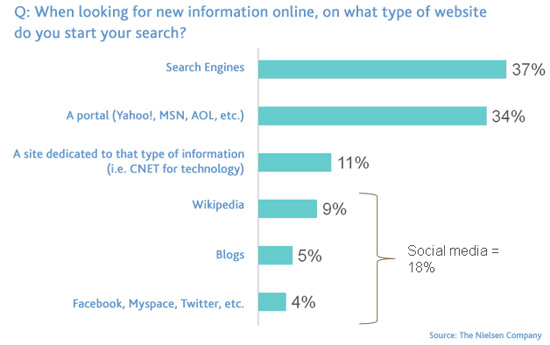
    "In a nutshell, there is a segment of the online population that uses social media as a core navigation and information discovery tool — roughly 18 percent of users see it as core to finding new information. While still a smaller percentage than those who use search engines or portals like Yahoo! or MSN, it is a significant figure," says Nielsen. "And as social media usage continues to increase (unique visitors to Twitter.com increased 959% YOY in August) I can only expect this figure to grow."

    If you were still questioning the possibilities of getting traffic from social networks like Facebook, MySpace, Twitter, etc., perhaps this information will help ease your doubts. While the traffic may not always be as significant as what comes from search, additional traffic is additional traffic, and the viral potential offered by social networks shouldn’t be ignored.

    The following graph from Nielsen shows how big of a role sites besides search engines play in actual searches for new information online.

    Nielsen - Where do you start your search?

    "At the root of the changing nature of content discovery is the sheer amount of information that is available on the Web," says Nielsen. "If you want to learn more about the latest smartphone released into the market, your favorite search engine is sure to provide you with hundreds, if not thousands, of articles about the device. But with the increasing number of resources available, it’s difficult to know what you should believe or take at face value."

    According to the firm’s findings, 26% of "socializers" or those who spend over 10% or more of their online time on social media, feel that there is too much information online. Nielsen says, "So are social networks replacing portals or search engines? Perhaps. Regardless, if we don’t understand and address people feeling increasingly alienated by the amount of information on the Internet, and the need for a human guide, yes, your favorite social network (or something like it) will become the next great content gateway."

    Of course the search engines are built on a cross between human and mechanical elements. Google’s search quality team has been discussing this very process. Personally, I’m all for social media, but I don’t usually have too much trouble finding the information I seek using search. If anything, I think the information overload simply stresses the need for the continued improvement in search quality.

    Your friends may not have all the answers you seek. Furthermore, if you are asking people you don’t know, why would you trust them any more than search results?

    Search and social media are not completely separate entities. Social networks have search functionality and search engines search through social networks. It’s all intertwined.

    Do you think social media could ever replace search? Share your thoughts.

  • Rupert Murdoch and Google Part 2

    Im going to simplify this as much as possible. I probably should have just included this in the first post. Here are the best and worst cases of Newscorp opting out of the Google Index

    1. Best Case: They opt out and see an increase in revenues and commitment to their sites because people choose to go directly to their sites. For those sites behind a paywall, they generate more revenue than when the site was free.   Other sites notice their success and copy Newscorp, choosing to opt out of the Google index. The opt out choice turns out to be the better business move for any and all sites looking to increase revenues. Google’s position as the leading search engine is called into question.  The Search business becomes competitive again. Content companies now understand how to best monetize their content efforts.

    Far fetched ? Maybe. But not totally inconceivable.

    2. Worst Case: They opt out of Google’s Index. Their traffic drops 99pct. No one buys their pay offerings. They all feel like idiots. Then the last idiot left in the office gets out the text editor and changes the robots.txt file or completely deletes it.  They turn off the paywalls. Make the content free again.  Life as they knew it before they opted out and started charging for content returns to normal as quickly as Google can reindex the Newscorp sites.

    The upside of Option 1 is far more impactful than the downside is bad. There is no reason not to take the chance.

  • Thank you, Columbus, Ohio!

    johnbiggs
    If you weren’t at the Surly Girl Saloon last night for the Columbus CrunchGear meetup, then you were somewhere else! You missed John sporting a new pair of Onion Goggles. You missed a nerd-a-thon comparing the Droid, HD2, iPhone, Dream, and whatever other handhelds folks could dig out of their pockets. And you missed an opportunity to put your grubby paws on not only the TwitterPeek but also the Nokia Booklet!

    When the TwitterPeek’s battery ran out, John became very sad:
    IMG_8455

    Nerd-a-thon! That guy was doing live speed tests of the phones in front of him.
    IMG_8447

    We had a great time meeting everyone, and we hope those that joined us had as much fun as we did. Let’s do it again soon, Columbus!


  • Clinton Gives Senate Dems A Reform Pep Talk

    The Associated Press reports on Former President Bill Clinton’s pep talk to Senate Democrats today. Stressing what he said was “an economic imperative,” he told “anxious Senate Democrats … to pass a health care bill soon because the U.S. economy can’t resist the toxic combination of exorbitant medical costs and nearly 50 million uninsured for much longer.” He also spoke to them about the bill’s complexities and the lawmakers’ own concerns, but said “there is no perfect bill — you’ll always have unintended consequences. There will be amendments to this next year” (Alonso-Zaldivar, 11/10).

    USA Today on Clinton’s take home message to senators: “‘It’s important to act now, to start the ball rolling,’ Clinton told reporters afterward. ‘The worst thing to do is nothing.’”

    “Clinton was the last president to try and fail to enact a sweeping health care reform bill,” an outcome “widely credited with the Democrats’ losing control of the House and Senate the following year. Some Democrats said Clinton’s experience made him the perfect messenger as Democrats face what are likely to be tough votes on a controversial bill. ‘He told us we are on the edge of history and to get the job done,’ said Sen. Paul Kirk, D-Mass” (Keily, 11/10).

    Roll Call: “Clinton apparently spent little time explicitly reminding Senators” of his own reform history, instead focusing on why action is necessary. “‘He made the case, first and foremost, on policy, that this is critical to the country both on economic context as well as the health care context,’ Democratic Senatorial Campaign Committee Chairman Bob Menendez (N.J.) said.” Menendez also said Clinton reminded the Democrats that failure to accomplish this task would have a “significant political result” (Pierce and Drucker, 11/10).  

    Also on Tuesday, “Democratic Senate leader Harry Reid and his No. 2, Dick Durbin, said they hoped to bring the Senate’s healthcare bill to the floor next week and to have the first procedural vote on whether to open debate,” Reuters reports. However, Durbin acknowledged that the calendar could make it difficult to meet the president’s deadline to sign a health care reform bill by the year’s end. “‘I hope so, but just count the days,’” Durbin told reporters in response to question’s about the President’s deadline. Durbin also offered “a new target” for action in the Senate. “‘Our goal is to make sure it is out of the Senate this year,’ Durbin said.” Following that timeline could allow “negotiations to reconcile the House and Senate versions” to take place in January. After that, each chamber would have to pass the agreed upon bill “before Obama could sign it into law” (Whitesides and Ferraro, 11/10).

    Bloomberg: “Reid told reporters … he believes the Senate can pass the measure by the end of the year. Asked whether he had the 60 votes needed to begin debate, he said, ‘I hope so’” (Rowley and Jensen, 11/10).

  • OverClocked ReMix working on DKC2 soundtrack

    The musical virtuosos at OverClocked ReMix are up to some monkey business. Serious Monkey Business, in fact. That’s the name of their latest project s…

  • Carbon Harvest Energy

    Carbon Harvest Energy’s proposal to turn old landfills into no-waste energy producers has been in the news lately, with stories both in the Burlington Free Press and on Vermont Public Radio. Carbon Harvest Energy will be taking a defunct landfill-based methane facility in Brattleboro and turning it into an active, zero-waste, energy-producing facility. According to the Free Press article, the electricity, heat and carbon dioxide produced by the methane-fueled generator will all be utilized. The former landfill will be able to sell the electricity, heat a greenhouse and a fish tank, and use the carbon dioxide as a contribution to an algae farm. The Vermont Food Bank will be the main recipient of the food and fish raised in the facility, and the University of Vermont’s Rubenstein School of the Environment and Natural Resources is partnering with Carbon Harvest to study the algae produced.

  • Rumor: IO Interactive has a new game that’s “unlike anything else”

    It seems IO Interactive is keeping quite busy these days. They already got two games in the pipeline — Hitman 5 and Kane & Lynch 2 — and now rep…

  • Senator Dodd Introduces Financial Reform BillSubmitted by: Ted Allen, Publications

    U.S. Senator Christopher Dodd today introduced a long-awaited financial regulatory reform bill that includes a variety of significant corporate governance provisions, including proxy access, “say on pay,” and majority voting.

    Dodd, Senator Charles Schumer, and seven other Senate Democrats introduced the 1,136-page bill, which also would create a single bank regulator, provide for self-funding the SEC, and establish a new consumer financial protection agency.
    “It is the job of this Congress to restore responsibility and accountability in our financial system to give Americans confidence that there is a system in place that works for and protects them,” Dodd said at a press conference. “We must create a sound foundation to grow the economy and create jobs.”

    The bill would require public companies to hold advisory votes on compensation at shareholder meetings held more than one year after the law is enacted, which means that the first mandatory votes most likely would not occur until 2011. The bill also directs the SEC to issue rules within a year of the enactment date.

    The bill directs the SEC to issue a rule on proxy access within 180 days, but does not set minimum standards. The bill directs the SEC to work with the stock exchanges to require majority voting provisions as a listing requirement, but authorizes the SEC to exempt certain firms. Under the bill, companies would have to obtain investor consent to have staggered board terms; firms with existing classified boards would be required to seek approval at their next annual meeting. Issuers also would be required to adopt “claw back” policies. Companies also would have to provide disclosure on their selection of their board leadership structures.

  • Only One More Chance to Ask Uncle Sam for Broadband Bucks

    The two government agencies responsible for distributing the $7.2 billion in broadband stimulus grants said today that they’ve consolidated the two remaining funding rounds into one, and have asked for more input to improve the application process. The stimulus program, which closed the first round of applications in August, and will distribute the $4 billion in initial funds a little later than planned, has so far been a hit with about 2,200 applicants asking for more than $28 billion. However, the process of scoring applications and getting the money out the door has been slow, so the agencies, under a Sept. 10, 2010 deadline to get the full $7.2 billion deployed, are streamlining the process.

  • An AppleScript trick turns any NAS device into a Time Machine drive

    genius
    You can turn any network attached storage device into a Time Machine back-up drive with one simple step.

    Simply download this app package and drag your drive onto it. The script adds the drive as a Time Machine capable device and then you can simply add it under Time Machine System Preferences.

    The full script is right here if you want to roll your own:

    on open names
    set volumeName to names as text
    set macAddress to (do shell script "ifconfig en0 | grep ether | tr -d '\\011' | sed s/ether// | sed 's/ //g' | sed s/://g")
    set hostName to (do shell script "hostname -fs")
    tell application "Finder"
    set theSize to round (((capacity of startup disk) / 1024 / 1024) / 1024)
    end tell

    do shell script "defaults write com.apple.systempreferences TMShowUnsupportedNetworkVolumes 1" with administrator privileges

    do shell script "sudo hdiutil create -size " & theSize & " -type SPARSEBUNDLE -nospotlight -volname \"Backup of " & hostName & "\" -fs \"Journaled HFS+\" ~/" & hostName & "_" & macAddress & ".sparsebundle" with administrator privileges
    do shell script "mv ~/" & hostName & "_" & macAddress & ".sparsebundle /Volumes/" & volumeName & "/" with administrator privileges

    tell application "Finder" to eject volumeName

    tell application "System Preferences"
    activate
    end tell

    tell application "System Events"
    tell application process "System Preferences"
    set frontmost to true
    click menu item "Time Machine" of menu "View" of menu bar 1
    end tell
    end tell

    end open

    via MacOSXHints


  • Democrats Face Backlash Over House Abortion Limits

    Democrats have been showing a fresh determination to make Republicans’ near-unanimous opposition to a national health care overhaul — and its implications for women — the GOP’s Achilles heel during next year’s midterm elections.

    Democrats have produced a hit list of 32 House Republicans from districts that voted for President Obama last year. And they’re touting a video of Republican men repeatedly interrupting Democratic women during Saturday’s House floor debate on health care.

    But that tactic just got a lot more complicated.

    There is growing outrage among the Democrats’ own activist base over new and far-reaching abortion restrictions contained in the historic health care bill approved Saturday by the Democratic-controlled House.

    And some of the party’s staunchest supporters are suggesting that Democrats will have their own problems with health care — and women voters — come 2010 because of the proposed abortion limits and the Catholic Church’s pivotal role in ensuring that restrictions would make it into the bill.

    “This has already hurt the Democrats,” says Terry O’Neill, president of the National Organization for Women, which has now turned its attention to the Senate, where members are considering their own health care legislation.

    When and if the Senate passes a health care bill, it will be melded with the House version and sent back to both chambers for a vote. Few are predicting that the abortion limits will survive.

    But the party still has to engage in some immediate damage control.

    “It really breaks my heart when your supposed friends pass a health care bill for 49 percent of the population, and a partial health bill for the other 51 percent of the population,” said O’Neill. “We’re furious at the Democrats, and dismayed about what’s going on.”

    In an interview Monday with ABC, President Obama acknowledged the growing backlash among the Democrats’ liberal base, saying “there are strong feelings on both sides” of the abortion amendment issue. “And what that tells me,” the president said, “is that there needs to be some more work before we get to the point where we’re not changing the status quo.”

    “I laid out a very simple principle, which is this is a health care bill, not an abortion bill,” he said.

    “And we’re not looking to change what is the principle that has been in place for a very long time, which is federal dollars are not used to subsidize abortions.”

    Will Language Survive?

    The so-called Stupak amendment included in the House bill would prevent women eligible for government tax credits for health insurance from using that money to enroll in any plan that covers abortion. Of 258 House Democrats, 64 voted for the amendment, along with 176 Republicans, guaranteeing its passage.

    The U.S. Conference of Catholic Bishops actively lobbied for the amendment, offered by Democrat Bart Stupak of Michigan and Republican Joe Pitts of Pennsylvania. The Catholic Church, though opposed to abortion funding, has long advocated for universal health care as a fundamental human right and essential to the common good. Stupak was among 19 Democrats who in midsummer vowed to oppose any health overhaul plan that didn’t specifically prevent taxpayer money from being used for abortions.

    The Senate is far less likely to impose such restrictions. And though both pro-choice and anti-abortion activists say they don’t expect the abortion language to be in a final bill hammered out between House and Senate leaders, the Catholic Church isn’t going away. Its leaders have pronounced unacceptable two bills now under consideration in the Senate.

    Barry Lynn, who heads Americans United for Separation of Church and State, said he’s been “horrified” by the church’s influence on the sweeping health care bill.

    “What we saw over the weekend was an act of unparalleled arrogance on the part of church officials,” he said. “Basically, they were claiming they would kill health care for the sick and the poor if the Democrats didn’t give them the votes to impose religious doctrine into law.”

    “It’s scandalous that this religious group has such extraordinary control over the fate of women’s lives in this country,” Lynn said.

    Backlash Among Liberal Lawmakers

    By late Monday, Democratic Rep. Diana DeGette of Colorado had collected more than 40 signatures from fellow members who vowed they would not vote for a combined House-Senate health care bill if it contains language “that restricts women’s right to choose any further than current law.”

    And Florida Rep. Debbie Wasserman-Schultz, in a Monday interview with MSNBC, said that she is confident the abortion language will be stripped.

    “We’re all going to be working very hard — particularly the pro-choice members — to make sure that’s the case,” she said.

    And there’s no question that they’ll have some vigorous prodding from their base.

    “We were outraged that these people — all these people who voted for the Stupak amendment — were willing to just ignore the needs of women,” said Judy Waxman of the National Women’s Law Center.

    Ted Miller, communications director for NARAL Pro-Choice America, echoed the sentiment. “We will hold those lawmakers who voted for this measure accountable for abandoning women and capitulating to extreme factions of the anti-choice movement,” he said.

    “Our focus now is defeating any attempt to add the Stupak abortion ban to the Senate bill,” he said.

    Waxman characterized the health care debate as a “perfect storm” for the Catholic Church because of the narrow margin of passage for the overall bill.

    “We are hopeful we will not have this amendment,” Waxman said. “In fact, we will make sure this amendment is not in the Senate version.”

    The Democratic strategists who are cooking up ways to get out the vote next year may be trying to make sure of the same — so that health care ends up being a negative next year not for them, but for their erstwhile opponents.


    Related stories:

    KHN: How The House Abortion Restrictions Would Work

    NPR: What Would The Stupak Amendment Do?


  • Want a burger from BGR?

    burgerjoint

    New location just opened, and if you mention this post you get 0% off. Stop having a boring life.

    Thanks, to everyone that sent this one in!

    Read

  • Blink-182’s Tom Delonge: Time To Adapt, Give Music Away For Free, Monetize Other Things

    This one’s from a couple months back, but I missed it at the time. Reader Amber Walker sends in this fantastic video interview with Tom Delonge of the band Blink-182 from the Guitar Center blog, where he makes many of the points that we discuss here, noting how technology has made it cheaper to make, promote and distribute music, and he thinks the big opportunity is in giving your music away for free, and recognizing that there are other things to sell, such as merchandise, but also subscriptions and other types of events.


    Some quotes:

    The one thing I’ve learned is that, like any other type of art, it evolves. So if you’re a business that supports a type of art, you need to evolve with the art. Now, a lot of things have happened that have made creating art a lot easier with the computer. And it’s also made the distribution of art a lot easier…. What I have chosen to believe is that if you look at your band with a modern filter, your band has so much potential to have all these different elements about it. You can create all this really cool merchandise and concert/live experiences. You can create a really cool portal on your website. You can mix all these elements together and I always believe that if the tools are available, you can monetize all these other elements, and not really worry about selling the record. In fact, I believe that, you should take down every barrier and put as much music out there for free…

    In my mind, the way the music industry is changing is that music is easier to make and it’s easier to give away for free. And that will enable the band and the music and the art and everything to be bigger than it’s ever been. It’s just how do you collect that and how do you build your business…

    I think the internet’s a funny thing, because anything… that cuts through the noise on the internet will get found. The beautiful thing about the Western world is that all good art will get found no matter what. It just might take a little bit more time for some than others…. To try to really make a presence known, a band needs to capitvate people online first, no matter what — it can be with a video or a film. It can be a song or a live broadcast. It needs to be something that’s really clever. To do that, you should study the campaigns that work….


    Of course, he notes that at the core of this is still good music. He says that you don’t remember a band years later just for the marketing, but you need that to get attention, and then you need the music to live for itself, which leads to an interesting mantra:


    The true art is not just creating the music. The true art is seeing how many people that music can touch in various ways. That’s the art. Because you can be as artistic as you want and no one hears it and no one likes it. The true art is trying to break through the noise and getting millions of people to notice.

    Sounds quite a bit like the difference between invention and innovation that we talk about, doesn’t it? Nice to see yet another artist who has this all figured out.

    Permalink | Comments | Email This Story


  • European ministers approve watered-down ‘neutral net’ language

    By Scott M. Fulton, III, Betanews

    eu parliament sketchThe question before the European Council — made up of heads of state and key ministers from the EU’s 27 member nations — was whether Internet access should be interpreted as a fundamental human right, and whether obstructing access could be construed as a rights violation. The answer came this morning, and it is apparently no.

    A declaration from the European Parliament this morning provided glimpses of a newer round of compromise language for the EU’s new regulatory framework for telecommunications. That language will be even more conciliatory than last week, when the European Commission (EC) announced the new regulatory authority. Although the EC made it appear at the time that adoption of its new framework was merely a formality at that point, that wasn’t actually the case.

    As the Parliamentary communiqué acknowledged, the Council (which oversees high-level legislation) made a long debate out of how best to implement the “neutral net” provision that Comm. Viviane Reding proclaimed last week was as good as adopted. That provision was already a reworded form of the original Amendment 138 to the telecom framework, which would have proclaimed that “no restriction may be imposed on the fundamental rights and freedoms of end-users, without a prior ruling by the judicial authorities, notably in accordance with Article 11 of the Charter of Fundamental Rights of the European Union on freedom of expression and information.” That original language would have implied that Internet use was a fundamental human right; in which case, restricting access rights for prisoners would have been on a level with restricting food.

    That’s how Council members viewed the situation, as they rejected that language twice, triggering what Parliament termed a conciliation session. There, members of Parliament joined with the Council to rearrange the text, which prior to this morning had read as follows: “A prior fair and impartial procedure shall be guaranteed, including the right to be heard of the person or persons concerned subject to the need for appropriate conditions and procedural arrangements in duly substantiated cases of urgency in conformity with European Convention for the Protection of Human Rights and Fundamental Freedoms. The right to an effective and timely judicial review shall be guaranteed.”

    That text has apparently been tweaked once again, and the full Parliament is scheduled to vote on that text later this month. A revised draft has yet to be released.

    At issue was whether France would be able to continue prosecuting its HADOPI “three strikes” law, which would restrict Internet service to individuals after three instances of complaints of copyright violation. After having been struck down by the French high court, a revised version of the law was passed last month guaranteeing judicial review of any final access rights suspension.

    It’s that “judicial review” that was maintained in the latest version of the telecoms framework, which may finally reconcile the new framework with French law.

    When the EC approved the November 5 version of the framework, it was either a tremendous victory or an historic defeat for Internet users’ rights, depending upon whom you asked. In the UK, Green Party leader Caroline Lucas proclaimed, “The message from this EU legislation is clear: Access to the Internet is a fundamental right and proper procedures must be followed when challenging internet users on alleged copyright infringement. It is now up to national governments to respect this.”

    A close read of the text may prove otherwise: Although the European Convention is cited, it’s only with respect to granting due process for a hearing into whether access suspension violates the citizen’s existing rights to free expression — it doesn’t add Internet access as a fundamental right. In fact, that’s perhaps the primary reason for the clarification in the first place.

    But the existence of the clarification was called out by French activist group La Quadrature du Net. Upon first reading the amended amendment, group leader Philipe Aigrain argued that the new language would reduce existing freedoms guaranteed by human rights conventions — adopting the stance of European countries other than France where lawmakers have argued existing free speech rights extend to the Internet, such that access rights are free speech rights. Thus the watering down of the proposal, stated the group, “amounts to legitimizing an Orwellian surveillance of the Net.”

    Copyright Betanews, Inc. 2009


    Add to digg
    Add to Google
    Add to Slashdot
    Add to Twitter
    Add to del.icio.us
    Add to Facebook
    Add to Technorati


  • Apple Shoots Past Nokia As World’s Most Profitable Handset Vendor

    Apple became the world’s most profitable handset vendor in the third quarter of this year, reports Strategy Analytics. “We estimate Apple’s operating profit for its iPhone handset division stood at $1.6 billion in the third quarter of 2009,” wrote analyst Alex Spektor. That means Apple overtook Nokia, whose operating profit came in at just $1.1 billion. As Spektor noted, “With strong volumes, high wholesale prices and tight cost controls, the PC vendor has successfully broken into the mobile phone market in just two years.”

    Well I don’t know if Apple can accurately be described as a “PC vendor,” but I do know that it’s seen unprecedented success with its App Store, that Nokia’s share of the smartphone market continues to slide, and that, going forward, Google’s Android may represent the real competition for Apple.

    The iPhone’s success has everything to do with the huge and healthy ecosystem of great applications available for it. Strategy Analytics’ estimates only highlight how many ways Nokia, by comparison, has dropped the ball. For example, the company announced plans to focus on a new, open-source version of the Symbian operating system more than a year ago.

    Fast-forward to today, and the Symbian Foundation has only recently open sourced the operating system’s microkernel. Meanwhile, Nokia reported terrible financial results for its latest quarter, capped by a 31 percent decline in North American sales. If the Finnish handset maker had a more fleet-footed, organized operating system and application strategy, it might have avoided having its lunch eaten by Apple.

    Both the Windows Mobile and BlackBerry line of devices are being forced to confront the power of Android, and the  open source operating system is likely to provide some significant competition for the iPhone as well. As Stacey pointed out this morning, Verizon and Motorola moved more than 100,000 Droid phones this weekend.

    It’s especially worth noting the comment made by Motorola’s Sanjay Jha analyst Mark McKechnie with Broadpoint AmTech, quoted in Stacey’s post, who said: “We estimate each Android unit contributes 4x the gross profit of a feature phone unit and that 10 million Android units will contribute nearly half of the gross profits in MOT’s handset division.” Indeed, from a profitability standpoint, Apple and the Android-based handset players are becoming the ones to watch.

  • Things to do today that have nothing to do with Modern Warfare 2

    sunrisemw2

    I know that there’s a certain of percentage of people who want nothing to do with Modern Warfare 2. It’s all meatheads and explosions, right? I’m inclined to agree to a degree—Opie and Anthony were talking about the game this morning, and a real life member of the military called in and complained, “If you want to play war, why not join the Army?”—but no matter. There’s plenty of things to do today that have nothing to do with the game. Let’s take a look!

    • Real Madrid attempt to overcome a 5-0 deficit against Segunda Dvivisión B team Alcorcón in the Copa del Rey. It airs this afternoon on GolTV and your friendly neighborhood Internet stream.

    • Maybe you want to see a good movie? Star-Trek is now out on Blu-ray, and you can find—wink, wink!—a Blu-ray rip of Public Enemies online. Pretty good movie, and it totally makes you want to rob a bank. That was the point, right? Also keep your eyes peeled for the movie Moon, which has a very Solyaris feel to it.

    • Do you read books still, either of the paper variety or using one of those new-fangled e-book devices? I’ll go ahead and recommend Viral Loop by my old professor Adam Penenberg. It’s about how businesses grow on the Internet. If you read TechCrunch for pleasure then you’ll probably like it. If you’re into sports at all, you may want to track down a copy of Brett Hart’s autobiography, My Life Inside The Cartoon World of Wrestling. The paperback version came out a few days ago, and I’m waiting for the UPS man to deliver it. I’m very excited.

    • Sort of on the same topic of books, download the game Fatale for $7. It’s an interactive version of Oscar Wilde’s play Salome.

    • Start making appointments for CES. Oh, wait, that’s us~!

    • Download and watch every single Fedor Emelianenko fight from Usenet. (Thank God for alt.binaries.mma!) I recommend his fights with Antônio Rodrigo Noguiera and Mirko Cro Cop. Oh, Pride, how I miss thee.

    • Fire up Silent Hill 2 and lament to yourself, “Why hasn’t a game been able to convey sheer and utter hopelessness like this game did eight years ago?”

    • Download Microsoft COFEE for the sole reason of saying to your friends, “Dude, I just downloaded Microsoft COFEE. I have no idea what it does, and I have no idea how to use it, but it’s so great.”

    • Download the Sirius XM App for the iPhone (and iPod touch), then leave it on channel 202 The Virus. Let’s face it: Opie & Anthony and Ron & Fez are the only reason to pay for Sirius XM these days.

    • Take the push-up challenge, and become a reasonable facsimile of a fit person.

    • Do some Christmas ( or whatever holiday you celebrate) shopping. Only a couple of weeks left!

    • Write my Razer Naga review for me, so I can concentrate on farming for Honor in Arathi Basin. (I think I won six matches last night. It rocked.)

    • Read the latest issue of Figure 4 Weekly, or read an exciting back issue of the Wrestling Observer Newsletter.

    See, there’s plenty of stuff to do today if you want nothing to do with Modern Warfare 2. It’s a big world out there, tiger, and it’s up to you to make the most of it. Unlike me~!