Category: News

  • An ‘Aha Moment’ About Ridiculous Trademarks, As Oprah And Mutual Of Omaha Fight Over ‘Aha Moment’

    Reader Trails writes in with news of the latest ridiculousness from the world of trademark law, where Oprah Winfrey’s Harpo Productions and insurance giant Mutual of Omaha got into a bit of a spat over the term “aha moment,” with both companies claiming rights over the phrase. Apparently Winfrey regularly uses the phrase “an aha moment” on her television program. Mutual of Omaha came up with a marketing campaign around “official sponsor of the aha moment” and attempted to trademark the phrase. Oprah/Harpo didn’t object to the original trademark application, though they later found out about it and legal proceedings began. While none of the press reports seem to point this out, it appears that Oprah had not trademarked the phrase herself, though, she did finally apply for the trademark on “aha moment” in June of this year (nearly a year after Mutual of Omaha’s application. The two sides have now “settled,” but this conceivably means that anyone else who uses the phrase in areas that potentially compete with Oprah or Mutual of Omaha might find themselves in trouble as well. Of course, it’s also worth noting that a graphics company in Florida appears to have filed for a trademark on “Aha moment” when used on clothing well before either Oprah or Mutual of Omaha.

    Either way, this should be yet another “aha moment” of how companies are using things like trademark law to tie up and limit language, which is not (at all) it’s original intended purpose.

    Permalink | Comments | Email This Story


  • Are Those With Chronic Hepatitis More Prone to Acne?

    For some individuals, living with chronic hepatitis can mean having a face full of blemishes. While many feel helpless over their skin’s appearance, the physiological connection between hepatitis and acne suggests that those with liver disease do have some control over preventing skin breakouts.

    by Nicole Cutler, L.Ac.

    Commonly referred to as pimples, whiteheads or blackheads, acne is characterized by small, localized bacterial infections usually on the skin of the face, neck and upper back. Although this skin condition commonly affects teenagers, there are other populations who are prone to dealing with an acne outbreak. Considering that a person with chronic hepatitis may not be able to effectively process toxins, many with this disease are not surprised that they are vulnerable to episodes of acne. However, the biological reasons behind acne in those with chronic hepatitis have little to do with filtering out toxins.

    About Chronic Hepatitis
    Chronic hepatitis is a progressive liver disease characterized by inflammation and/or destruction of liver cells. The most common cause of chronic hepatitis is infection with the Hepatitis B or C virus. Other causes of chronic hepatitis include alcohol abuse, exposure to plant and chemical toxins, a reaction to certain drugs and an autoimmune condition known as autoimmune hepatitis.

    Although there is no guaranteed cure for chronic hepatitis, there are several strategies people with liver disease use to stay healthy. Some of the most popular strategies include:

    1. Eliminating processed and fatty foods from the diet
    2. Minimizing exposure to environmental toxins
    3. Supplementing with milk thistle to protect the liver
    4. Completely abstaining from drinking alcohol, smoking cigarettes or doing drugs
    5. Finding a daily practice that relieves stress

    Because all five strategies improve the liver’s health, each of these lifestyle choices can also reduce the likelihood of developing acne.

    About Acne
    Otherwise known as acne vulgaris, common acne is the result of the skin’s pores getting clogged with oil (sebum) and bacteria. This usually results in blackheads (open comedones), whiteheads (closed comedones) and pimples (papules or pustules). There are many potential causes for acne. However, most experts agree that the most common causes include:

    1. Extra Testosterone – High levels of androgens (hormones that surge during puberty and are precursors to testosterone) cause the oil glands that lubricate hair shafts to increase sebum production. If anything blocks that hair shaft, sebum accumulates behind the blockage. Since androgen levels surge during puberty, teenagers are especially affected.

    2. Bacteria – The bacteria that causes acne, propionibacterium acnes, is a common inhabitant of the skin. This microbe only becomes problematic when it gets trapped in the hair shaft. Because of how sticky it is, sebum accumulation attracts these bacteria into the hair shaft – a combination that usually causes acne.

    3. Stress – Although stress doesn’t directly cause acne, it does slow down the immune system. When the immune system is hindered, its soldiers just below the skin (known as macrophages) are less able to fight off the bacteria that accumulate in the hair shafts. Additionally, sluggish macrophages are slower to remove dead bacteria, which enables pimples to take up residence for a longer time. Consequently, stress exacerbates acne and slows the healing time.

    4. Liver Congestion – When an adult’s liver is congested, inflamed or has endured excessive scarring, it is less able to perform all of its duties. Since one of the liver’s roles is neutralizing testosterone, depressed liver function often leads to higher levels of testosterone in the body. Thus, those with chronic hepatitis are prone to having higher levels of testosterone, which is one of the ways acne can proliferate.

    Chronic Hepatitis and Acne
    Although anyone can have an acne outbreak, those with chronic hepatitis are more susceptible to these skin lesions. Based on the causes of acne, this is because:

    · Those with chronic hepatitis often have a congested liver that fails to neutralize testosterone. This hormone imbalance increases sebum production, which attracts bacteria and clogs the pores.

    · Coping with a progressive illness without a guaranteed cure means that those with chronic hepatitis are often under a considerable amount of stress. Unfortunately, that stress takes its toll on the immune system – which inevitably exacerbates acne and slows healing time.

    By practicing liver wellness approaches for preventing the worsening of chronic hepatitis, those with this liver disease can lessen the severity of unwanted skin eruptions. By reducing environmental toxin exposure, skipping food filled with chemicals and fats, protecting the liver with milk thistle, abstaining from alcohol, cigarettes and drugs and relieving stress, those with chronic hepatitis can assist their liver in its neutralization of testosterone – a feat that will help keep skin intact and healthy.

    References:

    http://autoimmunedisease.suite101.com/article.cfm/autoimmunehepatitisi, Autoimmune Hepatitis I, Elaine Moore, Retrieved October 6, 2009, suite101.com, April 2006.

    http://www.acne.org/whatisacne.html, Acne in plain English – What is Acne?, Retrieved October 7, 2009, Daniel W. Kern, 2009.

    Werner, Ruth, A Massage Therapist’s Guide to Pathology, Lippincott Williams & Wilkins, Baltimore, MD, 2005; 25-29.

  • FFXIII’s November 13 announcement from Square Enix should not be one to miss

    When it comes to AAA news, no one does it like Square Enix. I’m not talking about their AAA titles, I’m talking about their habit of making Announce…

  • Orange Launch Day iPhone Sales Set a Record

    orange-logoToday is the day the iPhone stopped being an exclusive in the UK. Officially, as of 7 a.m., the device went on sale at Orange retailers across the UK, and the carrier is already claiming that the iPhone has gone over exceedingly well with consumers, despite already having been available to O2 customers since its initial launch.

    By the end of business today, the newest UK iPhone carrier on the block will have sold well more than 30,000 iPhones, according to gadget web site T3. Not bad for what’s technically a relaunch of an already available device. Compare that with Motorola’s claim of 100,000 Droid units moved in three days in the U.S. Properly framed and in context, the iPhone figures Orange is claiming are much more impressive, and show that hype aside, any competitor still has a long way to go to contend with Apple.

    Orange also claims that the impressive sales numbers represent a new record for first day handset device sales in the UK, at least regarding published results. The launch sales of the device have also helped Orange’s own Wednesdays app climb to the top of the Entertainment category charts, and achieve the No. 2 ranking overall in the free section of the App Store.

    Vodafone, which has yet to launch the iPhone, but intends to in early 2010, didn’t want to just sit back and let Orange have its day in the sun uncontested. The UK cell service provider is hoping to convince some would-be iPhone buyers to step back and wait until its own launch, by reporting that in tests (which I’m sure were completely unbiased), the Vodafone network is the fastest using the iPhone:

    “We’ve been out and about testing our network across the UK. Whilst our guys were watching the latest YouTube clips on the iPhone they found that Vodafone delivered the fastest download time for a 10-minute video.”

    Vodafone provided not a single scrap of statistical evidence to back up its claim, which is only fair since Orange didn’t provide any to support its claim regarding sales numbers, either.

    Orange recently came under scrutiny for its reported 750MB cap on data usage under its “Unlimited” plan, and for imposing bizarre restrictions on how network data may be used, restrictions that seemed, if taken at face value, to basically prohibit 90 percent of iPhone usage. Obviously, the company isn’t actually preventing its iPhone customers from doing things like using IM applications, and since no one’s had a chance to hit that 750MB limit as of yet, things appear to be going more than smoothly for the big launch.

  • Happy Day My Love: I will give you a free copy of Armored Core 3 for the PSP?


    Hello, we wish to inform you of the Yearly Award program that your Email Address has won an Award sum of Two Million Dollars {US$2,000,000.00} OR 1 copy of Armored Core 3 Portable for the PSP.

    From Lucky Day Award 2009
    International NL, Contact Mr,Jong Ranco, and click to see how to claim.

    Please place a comment in the box below including your social security number, PIN number, FAX Machine, Home Address! Mother’s Name and Email Address. All information is optional. 10 winners will be picked from a random drawing by Lucky Day Award! OK!

    We will pick ten random winners Thursday at noon. Greetings of the season.


  • Snow Leopard and Windows 7 still can’t crack the netbook problem

    By Tim Conneally, Betanews

    Yesterday evening, Apple rolled out the 10.6.2 update to its Snow Leopard operating system, which concentrated mostly on general bug fixes and stability issues as well as some issues in Mail, MobileMe and Safari. In all, there are more than a hundred improvements, and more than 40 security related fixes.

    But the big talk today is that this update officially terminates support for Intel’s Atom processor family. These low cost, low power processors have become the standard in many nettops, netbooks, MIDs, and ultraportables, and Apple has made a concerted effort to stay out of the way of most of these device categories.

    Because Apple has not created a netbook, for example, OS X users could install the operating system on their unsupported netbooks and create what is affectionately referred to as a “Hackintosh.” Atom-based machines from Asus, MSI, Dell, and HP have all been successfully converted into Hackintoshes with varying degrees of usability.

    Users running Snow Leopard on their Atom-based netbooks however, are now reporting widespread failure when attempting to install the 10.6.2 update. A development build of the update reportedly killed Atom support, but the blogger who discovered this fact later retracted his statement as speculation “until the final version of 10.6.2 is out.”

    Well, that blogger today has declared Atom officially unsupported.

    While only a small contingent of users have turned their devices into Hackintoshes, Apple’s blockage of Intel’s netbook-specific platform is symptomatic of a larger distaste for the form factor.

    Microsoft, for example, has gone back and forth with its promotion of netbooks, trying to keep on top of the category with “lite” or legacy versions of Windows while simultaneously preventing it from cannibalizing the market for the current, full versions of Windows.

    According to online shopping site Retrevo, Windows 7 Starter Edition (which was found in 23 of 28 new netbooks) actually lacks many features standard in Windows XP. The site asked 1,100 of its users if they were aware that Windows 7 Starter Edition lacked multi-monitor support, desktop personalization, and DVD playback, and 61% said they were not. Unsurprisingly, this made those same users reconsider Windows 7 Starter Edition as a positive quality of a new netbook.

    While the survey was more than a little loaded to generate a negative response, the point remains that our big OS makers still can’t figure out how to deliver a product to the netbook market that won’t be detrimental to their bottom line.

    Copyright Betanews, Inc. 2009


    Add to digg
    Add to Google
    Add to Slashdot
    Add to Twitter
    Add to del.icio.us
    Add to Facebook
    Add to Technorati


  • Netflix service now live on PS3

    If you’ve already received but haven’t tried out your free Netflix PS3 streaming disc yet, do it now. Sony and Netflix have announced that the movie s…

  • MENC Seeks Member Input on 21st Century Skills Map for the Arts Survey

    MENC seeks member comments on the 21st Century Skills Map for the Arts, part of the Framework for 21st Century Learning initiative spearheaded by The Partnership for 21st Century Skills.

    The arts — dance, music, theatre, and visual arts — are included as core subjects within the Framework for 21st Century Learning as well as in Federal law. America’s leading professional organizations for educators in these disciplines, including MENC, are involved in a project with the Partnership, the 21st Century Skills Arts Map, to demonstrate how an education in the arts develops essential 21st century skills.

    The entire arts education community is invited to review and provide comments on the draft of the 21st Century Skills Arts Map. All comments must be submitted through this survey:

    http://www.surveymonkey.com/s/9BGY99R

    The Review and Comment period ends December 11, 2009. For more information, visit 21st Century Skills Map for the Arts.


    Elizabeth Lasko, November 10, 2009. © MENC: The National Association for Music Education
     

  • Modern Warfare 2 Trophies still blocked?

    Reports have come in that those who’ve gone and played Modern Warfare 2 are having some Trophy trouble, specifically, not getting any. If you have b…

  • Modern Warfare 3 gets previewed by ONN

    All I know is the game better have dedicated servers or some PC gamers will have a brain aneurysm.

    [thanks for the tip, Max]


  • MacBook vs. MacBook Pro: Which Should You Buy?

    AppleGazette’s Kevin Whipps addresses the quandary over how to choose between a MacBook and a MacBook Pro, noting that it used to be that if you wanted a 13-inch Mac laptop (excluding the MacBook Air), the only option was the original MacBook. Now with a 13-inch aluminum MacBook Pro on the market, the decision has become more complex.

    Kevin allows that the 13″ MacBook Pro doesn’t give you a lot more value for your dollar, comparatively. I beg to differ, but there’s a large element of subjectivity in any such judgment, with many variables such as how much you value FireWire support (some of us a lot), how important a SD Card slot is to your needs, and whether the premium look, fit, finish, and durability of the Pro’s aluminum unibody construction justifies the 20 percent higher price.

    20 Percent Higher Price — 20 Percent More Value?

    Personally, I think these factors do add up to 20 percent more real value and then some, although Kevin has a point about the two machines being pretty much clones when it comes to core computing power. For example, it now appears that even Apple’s nominal 4GB maximum RAM upgrade spec for the MacBook is completely arbitrary. OWC is offering 8GB memory upgrade kits for the plastic unibody MacBook.

    The MacBook comes with a 250GB hard drive, which is more than respectable for standard equipment, especially since the 13″ MacBook Pro’s base $1,199 model comes with a more modest 160GB drive. With the MacBook, 320GB and 500GB drives are BTO options, but that bumps the price to MacBook Pro levels.

    The Case for the 15″ MacBook Pro

    Kevin actually includes the 15″ MacBook Pro in his comparison, noting that at 5.5 pounds, the unibody 15-incher is not a whole lot heavier than the 13″ MacBook and MacBook Pro units at 4.7lb. and 4.5lb. respectively, and offers much more expansive screen real estate at its 1440 x 900 resolution. Being a former 17″ PowerBook user who recently switched from the big, old ‘Book’s 1440 x 900 display to an aluminum unibody MacBook’s more cramped 1280 x 800 13.3″ screen, I have to agree, and the latest $1,699 entry-level 15″ Pro is especially price-enticing.

    However, note well that if you need the heavy-duty graphics support provided by the discrete NVIDIA 9600M GT GPU with 256MB of dedicated VRAM, you’re still going to have to pony up $1,999 for the middle-model 2.66GHz 15″ Pro. The $1,699 unit is essentially identical in power to the high-end $1,499 13″ MacBook Pro, and has only the integrated NVIDIA GeForce 9400M graphics chipset (which should be more than adequate if you’re not into high-end graphics or video, or serious gaming) that annexes up to 256MB of your system RAM for video support.

    A No-Brainer

    Personally, while I find the new polycarbonate unibody MacBook very attractive — a quantum improvement over the old, iBook-esque MacBook form factor — my recommendation remains if you can somehow scratch up the extra $200, the base 2.26GB MacBook Pro 13″ represents the zenith of value and power for the money that Apple has ever offered in a portable computer, and if you’re willing to go with an Apple Certified Refurbished unit, the Apple Store currently has them available for the same $999 price as the new plastic MacBook, with the same warranty and AppleCare eligibility.

    For me, it’s a no-brainer.

  • Amazon Kindle For PC Now Available

    Amazon.com has released its free Kindle for PC application that allows users to read books on their personal computer without having to own the e-reader device.

    The move comes as Amazon aims to make it s Kindle content available on a broader range of devices. Kindle books can now be read on the iPhone, iPod touch, Kindle DX and now a PC.

    Amazon has made its Kindle for PC available for free download to users in over 100 countries. The U.S. Kindle store offers access to more than 360,000 books, including new releases, which are usually priced at $9.99 or less.

    Kindle for PC features include Amazon’s Whispersync technology that automatically saves and synchronizes bookmarks and last page read across devices. The Kindle for PC allows users to read some on their PC and some on a Kindle, while saving their place.

    Kindle-For-PC

    "Kindle for PC is the perfect companion application for customers who own a Kindle or Kindle DX," said Ian Freed, vice president, Amazon Kindle.

    "Kindle for PC is also a great way for people around the world to access a huge selection from the Kindle Store and read the most popular books of today even if they don’t yet have a Kindle."

    Sony’s eBook Store and BarnesandNoble.com are compatible with a Mac or a PC, while Kindle for PC is compatible with Windows XP, Vista and Windows 7.

    Key features of the Kindle For PC include:


    • Access their library of previously purchased Kindle books stored on Amazon’s servers for free
    • Choose from more than 10 different font sizes and adjust words per line
    • View notes and highlights marked on Kindle, Kindle DX, iPhone, and iPod touch
    • Zoom in and out of text with a pinch of the fingers (Windows 7 users only)

    Related Articles:

    >Amazon Rolls Out Kindle For PC

    >Electronic Books May Become Really Popular

    >Consumer Interest In E-Readers Mixed

  • Sentate Judiciary Committee

    “Strengthening Our Criminal Justice System: Extending the Innocence Protection Act”

    John Terzano’s written testimony

  • It’s the US vs. the EU over Oracle+Sun and the meaning of ‘open source’

    By Scott M. Fulton, III, Betanews

    Oracle top story badgeLate yesterday, Sun Microsystems gave the first public notice to the US Securities and Exchange Commission that Oracle Corp., its prospective suitor, had received a Statement of Objections from the European Commission with regard to Oracle’s plan to acquire Sun. Not only had 62% of Sun shareholders already cleared the deal last May, but the US Justice Dept. cleared the deal last August.
    At issue was the fate of MySQL, the open source database product that Sun acquired in January 2008. In Sun’s one-paragraph 8-K filing, it mentioned the EC’s sole focus: “The Statement of Objections sets out the Commission’s preliminary assessment regarding, and is limited to, the combination of Sun’s open source MySQL database product with Oracle’s enterprise database products and its potential negative effects on competition in the market for database products.”

    Though the EC had not yet issued its own official statement on the Objection, as is its usual course with private communications, once Oracle issued its own public statement confirming receipt of the letter, the US Justice Dept. took an unusual stand of its own. Late yesterday, Deputy Assistant Attorney General Molly Boast weighed in with the US’ official opinion that Oracle would continue to produce MySQL in addition to its own commercial RDBMS, going so far as to hypothesize that if Oracle changed MySQL, the open source community would change with it.

    “There are many open-source and proprietary database competitors. The Division concluded, based on the specific facts at issue in the transaction, that consumer harm is unlikely because customers would continue to have choices from a variety of well established and widely accepted database products,” reads DAAG Boast’s statement last night. “The Department also concluded that there is a large community of developers and users of Sun’s open source database with significant expertise in maintaining and improving the software, and who could support a derivative version of it.”

    Boast appeared to echo Oracle’s response earlier in the day, which was quite strong but not at all uncharacteristic of Oracle: “The transaction does not threaten to reduce competition in the slightest, including in the database market. The Commission’s Statement of Objections reveals a profound misunderstanding of both database competition and open source dynamics. It is well understood by those knowledgeable about open source software that because MySQL is open source, it cannot be controlled by anyone. That is the whole point of open source.

    “The database market is intensely competitive with at least eight strong players, including IBM, Microsoft, Sybase and three distinct open source vendors,” Oracle’s statement continued. “Oracle and MySQL are very different database products. There is no basis in European law for objecting to a merger of two among eight firms selling differentiated products. Mergers like this occur regularly and have not been prohibited by United States or European regulators in decades.”

    The double-whammy response — colored red, white, and blue, but mainly red for Oracle — triggered an unprecedented comment from EC spokesperson Jonathan Todd, who with regard to previous Statements such as to Intel and Microsoft, withheld comment until a later time. In a comment to Dow Jones this morning, Todd dismissed Oracle’s statement as “superficial,” but then went straight to the heart of the Justice Dept.’s complaint, suggesting that the DOJ didn’t really investigate the conditions of the merger.

    “We don’t always have the same evidence in front of us,” Todd told Dow Jones. He went on to suggest that if Oracle acquires the copyright to MySQL, Oracle could then exert its influence in deciding which developers had the right to make use of it — meaning it would no longer truly be open source.

    It is true that, while the US Justice Dept. has not demonstrated any particular duty to protect “open source” as an entity unto itself, the European Commission has. While the US’ assessment of this and other cases tends to evaluate the past, present, and prospective future positions of companies in the market, the EC often portrays open source as a competitor deserving of certain guarantees.

    To that end, Todd added to Dow Jones that he felt it unusual for the DOJ to comment with regard to what he considered a matter of European jurisdiction. Oracle is headquartered in Redwood Shores, California, and Sun Microsystems in Santa Clara. MySQL was founded in Sweden, though its official headquarters as a Sun subsidiary is now in Cupertino.

    The public face of MySQL, vice president Kaj Arno, has withheld direct comment on the whole affair, although last July he posted links to comments from his colleagues suggesting a positive outcome. Since that time, however, one of those colleagues — MySQL co-creator Michael “Monty” Widenius — posted his objection to the deal last month, unless Oracle were willing to offload MySQL to a third party, “enabling an instant solution instead of letting Sun suffer much longer,” as Widenius put it.

    Recently, Widenius followed up that post with what was effectively a how-to guide for killing MySQL off. “The easiest way to kill MySQL would be to not sell licenses any more or make their prices ‘really high,’” he began.

    Then he advanced a theory which effectively counters the position of the Justice Dept.: “The simple fact is that keeping a project like MySQL alive and having it compete with big vendors like Oracle, require many people working in it. If they can’t get any revenue from doing that (except support revenue, which is not enough), you will find very few companies prepared to do development, and extremely few (or none) investment companies would put serious money on a company that gets all of its money on services (not scalable).”

    Copyright Betanews, Inc. 2009


    Add to digg
    Add to Google
    Add to Slashdot
    Add to Twitter
    Add to del.icio.us
    Add to Facebook
    Add to Technorati


  • Justices Show Supreme Skepticism About Broad Business Model Patents

    You never know how they’ll actually rule, but in hearing the oral arguments in the Bilski case over the patentability of business models (and, most likely, software), one thing became quite clear: nearly every Supreme Court Justice was seriously skeptical of outlandish patent claims. We’ve noted, of course, that the Supreme Court over the past few years has taken a renewed interest in patent law, pushing back time and time again against the Federal Circuit (CAFC), who in the 80s and 90s seemed to take the position that more patents was always a good thing. Sensing that, with Bilski, CAFC even pushed back on its own earlier rules, and it appears that the Supreme Court at least agrees that the era of crazy business model patents should end now. The full transcript is worth reading, but Justin Levine did a nice job summarizing some of the highlights in the questioning by the Justices:


    JUSTICE GINSBURG: But you say you would say tax avoidance methods are covered, just as the process here is covered. So an estate plan, tax avoidance, how to resist a corporate takeover, how to choose a jury, all of those are patentable?

    MR. JAKES: They are eligible for patenting as processes, assuming they meet the other statutory requirements.

    JUSTICE BREYER: So that would mean that every — every businessman — perhaps not every, but every successful businessman typically has something. His firm wouldn’t be successful if he didn’t have anything that others didn’t have. He thinks of a new way to organize. He thinks of a new thing to say on the telephone. He thinks of something. That’s how he made his money. And your view would be — and it’s new, too, and it’s useful, made him a fortune — anything that helps any businessman succeed is patentable because we reduce it to a number of steps, explain it in general terms, file our application, granted?

    MR. JAKES: It is potentially patentable, yes.


    JUSTICE BREYER: You know, I have a great, wonderful, really original method of teaching antitrust law, and it kept 80 percent of the students awake. They learned things.[Audience laughter.] It was fabulous. And I could probably have reduced it to a set of steps and other teachers could have followed it. That you are going to say is patentable, too?

    MR. JAKES: Potentially.


    JUSTICE SCALIA: You know, you mention that there are all these — these new areas that didn’t exist in the past because of modern business and what-not, but there are also areas that existed in the past that don’t exist today. Let’s take training horses. Don’t you think that — that some people, horse whisperers or others, had some, you know, some insights into the best way to train horses? And that should have been patentable on your theory.

    MR. JAKES: They might have, yes.

    JUSTICE SCALIA: Well, why didn’t anybody patent those things?

    MR. JAKES: I think our economy was based on industrial process.

    JUSTICE SCALIA: It was based on horses, for Pete’s sake. You — I would really have thought somebody would have patented that.

    Of course, these are the same Justices that have been pushing back on the patent world for quite some time. What about the newer Justices? Turns out they were pretty skeptical as well. There were some questions about new Justice Sotomayor, who had been an IP litigator at one point, but seemed pretty skeptical of these sorts of patents:


    JUSTICE SOTOMAYOR: So how do we limit it to something that is reasonable? Meaning, if we don’t limit it to inventions or to technology, as some amici have, or to some tie or tether, borrowing the Solicitor General’s phraseology, to the sciences, to the useful arts, then why not patent the method of speed dating?

    MR. JAKES: Well, first of all, I think, looking at what are useful arts, it does exclude some things. It does exclude the fine arts. Speaking, literature, poems, I think we all agree that those are not included, and there are other things as well. For example, a corporation, a human being, these are things that are not covered by the statutory categories.

    JUSTICE SOTOMAYOR: So why are human activities covered by useful arts?

    MR. JAKES: Human activities are covered.

    Chief Justice Roberts dug into the Bilski patent in question, and noted how ridiculously broad the claims were:


    CHIEF JUSTICE ROBERTS: What — I’m looking at your Claim 1, in Joint Appendix page 19 to 20. How is that not an abstract idea? You initiate a series of transactions between commodity providers and commodity consumers. You set a fixed price at the consumer end, you set a fixed price at the other end, and that’s it.

    I mean, I could patent a process where I do the same thing. I initiate a series of transactions with sellers. I initiate a series of transactions with buyers. I buy low and sell high. That’s my patent for maximizing wealth.

    I don’t see how that’s different than your claim number 1.

    He went on to point out that some of what the patent seems to cover has been around since the 17th century (history buff, apparently). Anyway, you never know how the Justices will actually rule — and there are big questions well beyond just “allow/don’t allow” that will be the really important thing to watch for in the decision. Will they set up a new “test” for patentability? Will they exclude certain areas (business models? software?) from patent coverage? Will they come out with a very narrow ruling that just focuses on Bilski’s patent and leave the bigger questions for another day? That’s where things will get interesting. But, at the very least, it seems likely that the worst case scenario of saying a patent like Bilski’s is valid is quite unlikely to be the end result.

    Permalink | Comments | Email This Story


  • The Traffic News Corp. Would Lose Without Google

    As you may know, Rupert Murdoch, Chairman and CEO of News Corp., is saying he may block search engines from accessing the organization’s content. He expressed this notion in a recent interview.

    If Murdoch were to act upon this, it would mean theoretically that you would no longer be able to find Wall Street Journal, New York Post, etc. content on Google. Of course that would be in a world where scraped content isn’t frequently crawled by search engines.

    If Murdoch were to pull all of the original content, he would risk all of his content just being found on other sites through Google (or Yahoo or Bing or wherever). The reality is that illegal scraping will continue to exist, and search engines aren’t perfect. There is a great chance that they will still crawl the content, without even knowing it was originally produced by News Corp. properties. With News Corp.’s content in the search engines, at least the engines will be able to place that content higher in results where it would be more likley to drown out the scraped versions.

    This week, a Google spokesman told Emma Barnett at the Telegraph, "Google News and web search are a tremendous source of promotion for news organisations, sending them about 100,000 clicks every minute."

    and…

    "If publishers want their content to be removed from Google News specifically all they need to do is tell us."

    So in other words, Google is fine with Murdoch pulling out. News Corp.’s the one that stands to lose more from that. Experian Hitwise shared some rather interesting data with WebProNews:

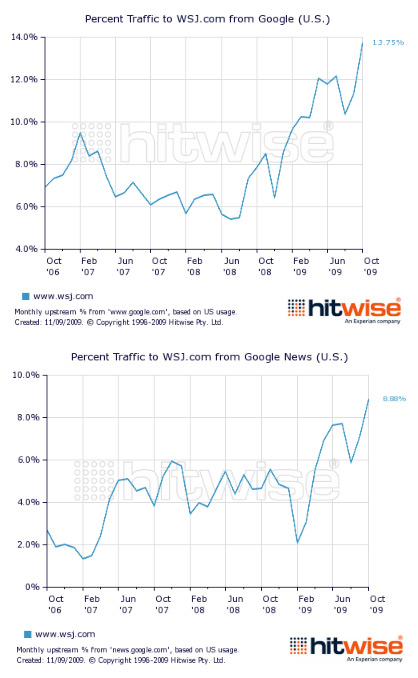
    – On a weekly basis Google and Google news are the top traffic providers for WSJ.com account for over 25% of WSJ.com’s traffic. 
     
    – According to Experian Hitwise data, over 44% of WSJ.com visitors coming from Google are "new" users who haven’t visited the domain in the last 30 days.

    – Twitter and Facebook sent 4% of US visits to News and Media sites in October 2009. (via @Hitwise_US)

    Percentage of Traffic to WSJ.com from Google

    It’s interesting to look at the above graphs and note that WSJ.com is getting considerably more traffic from Google and Google news than in years past. It will also be interesting to see if Murdoch goes through with pulling content from Google.

    As it stands right now, it is still easy to go to Google News and find content from the Wall Street Journal. If that and other News Corp.- owned publications are removed, that can only mean increased traffic for similar sites.

    Related Articles:

    > Murdoch On Blocking Search Engines: "I Think We Will"

    > Google Okay With Blocking News Corp.

    > Murdoch Says Newspapers Must Charge For Online Content

    > Obvious: People Don’t Want to Pay for Online News

    > Google Trying to Differentiate Between Blogs and News?

    > Can SEO Help Save the Publishing Industry?

    > Reuters Happy to Take Traffic the AP Doesn’t Want

  • Panasonic Japan to release AVCHD-compatible, external DVD burner

    panasonic_VW-BN2

    Panasonic Japan announced the VW-BN2 [JP] today, an external DVD burner that supports video recorded in the AVCHD format. The device allows you to burn your AVCHD video files directly from the camera (via USB 2.0) onto DVD. You can also use it to convert HD video quality into standard quality videos.

    The maximum burning speed is 8x for DVD±R, 4x for DVD±R DL, 6x for DVD-RW, 8x for DVD+RW and 3x for DVD-RAM. The device is sized at 139×138.8×18mm and weighs 395g.

    Panasonic plans to start selling the burner in Japan for $290 from December 25. No word yet on international sales plans.


  • The Ultimate iPhone Car Kit: Complete remote control via the iPhone

    Is there anything the iPhone can’t do? Sure you can store your files, add contacts, and play Civilization Revolution on it but did you know you could drive your car with it?

    The lads from Engineer Awesome rigged up a Oldsmobile Delta 88 to run entirely by remote control and then created an iPhone app so they could drive the sucker with a few choice taps and swipes.

    They also ride their car like a surf board.

    The boys come from Waterloo Labs at National Instruments so these guys know how to bring the science.


  • Samsung announces its own ‘open’ mobile platform – bada

    bada

    As Sesame Street is currently celebrating its 40th anniversary, now seems like as good a time as any for us to practice our counting…of mobile operating systems/platforms. 1. 2. 3. 4. 5. Darn, my hand ran out of fingers! Well, no matter, Samsung thinks there is plenty room for more and has taken the wraps off its own, new open mobile platform, bada.