Category: News

  • How-to: Create Services for Quick Search Box

    QSB_icon

    I’ve been playing around with Google Quick Search Box lately and am especially enjoying this services plugin from Martin Kuhl which lets you activate and pass input to OS X services right from within QSB.

    One snag though has been that services created through the new Automator template included in Snow Leopard leave out some vital bits that limit integration. Luckily, a handy application from Waffle Software called ThisService makes creating proper services that integrate seamlessly with QSB a lot easier than you might think.

    Being able to extend the functionality of QSB with OS X services really opens up a lot of possibilities. Grab text or files in QSB and pass them on to your services to do whatever you want with them, like creating a new To Do item in iCal. I’ve been focused recently on replicating functionality that I lost when I made the switch over from Quicksilver and I think that this improved service integration will get me about 90 percent of the way there.

    The bad news is that this means I need to whip up a bunch of custom services for myself. The good news is that ThisService makes that task very easy. Just give it a script (AppleScript will do, but if you’re more comfortable with other scripting languages you can use those), define the type and name of your service and click Create Service. ThisService handles all the fiddly Cocoa bits and spits out a completed service into your ~/Library/Services directory where QSB will see it and serve it up as an available action when appropriate.
    ThisService
    Actually writing your AppleScript will likely be the most complicated part, which is why ThisServices comes bundled with some handy starter scripts to put you on the right path. They also make a number of example scripts and services available for download from their site. The scripts don’t need to be complicated. For example, here is the one I use for adding To Do items in iCal:

    on process(input)
    tell application "iCal"
    tell calendar "work"
    make new todo at end with properties {summary:input}
    end tell
    end tell
    end process
    

    If you wanted to get fancy you could pass additional properties like the due date, priority, etc., but just getting a new item into the list is all I need.

    Once you have your service setup accessing them through Quick Search Box is as easy as can be. Because showing seems to be more useful than describing, below is a quick little video clip of the To Do service in action. What kind of services would you like to have? Share your thoughts in the comments.


  • Shirt features playable guitar, flames

    c498_electronic_rock_guitar_shirt_closeup

    The future, ladies and gentlemen. ThinkGeek has invented a tee shirt with a built-in playable guitar that uses a magnetic pick and included miniature amp to belt out any and all major cords. There’s a drum shirt, too, in case you’re more into rhythm.

    So it’s up to you: a $30 tee shirt with a built-in guitar or this $95 tee shirt from J.Crew that looks like it was made by a glue-huffing toddler. Seems like a pretty easy choice.

    Here’s a video just in case you’re still not convinced:

    Electronic Rock Guitar Shirt [ThinkGeek]


  • Greenhill To Exit Merchant Banking Biz

    (Reuters) – Greenhill & Co Inc (GHL.N) said it agreed to sell the right to launch successor funds to its three merchant banking funds for about $25 million, to focus entirely on its advisory business.

    The sale price is payable principally in Greenhill common stock, which will be retired, it said.

    The company, which expects to complete the deal in the current quarter, said the purchaser will be an entity formed by Robert Niehaus, chairman of Greenhill Capital Partners.

    Greenhill said it will retain its portfolio of Principal Investments, which had a fair market value of $178.5 million as of Sept. 30.

    It intends to use the proceeds of the portfolio, as and when realized, to fund share repurchases and dividends as well as to reduce its modest outstanding debt.

    The scale of the opportunity in the advisory business merits its undivided attention, it said in a statement.

    Greenhill said capital needs and other differences between the two businesses inevitably become more pronounced as they each grow and it is easier to run them under separate ownership. (Reporting by Abhinav Sharma in Bangalore; Editing by Gopakumar Warrier)

    ShareThis


  • Blackstone COO Sees Capital Shift Away From the U.S.

    NEW YORK (Reuters) – Blackstone Group’s COO Tony James said on Wednesday he foresees a gradual shift in the coming years of capital pools away from the United States to Asia, the Middle East and other areas of the globe.

    Speaking at a Financial Times conference in New York, he noted the dollar’s decline and said the United States may have to deal with a “much more level playing field where the dollar’s supremacy … is not taken for granted.”

    “I think we’re on a verge of a shift, which will be gradual — not overnight or two years from now — where the big capital pools shift away from America, to Asia, the Middle East, Australia and even Latin America,” James said.

    He is also concerned that the U.S. response to the financial crisis could harm America’s competitiveness and limit business.

    “I personally think we’re on track to do a lot of things which won’t stop a recurrence any more than Sarbanes-Oxley stopped this crisis; but will impose a lot of cost and limitations on our global competitiveness,” he said.

    Blackstone, one of the world’s most powerful private equity firms, has about $29 billion to invest, according to second-quarter figures it gave in August. It has investments in companies across the globe, including Hilton hotels and casino firm Harrah’s Entertainment.

    “America has had its issues in the last 18 months — but it also has had one hell of a ten-year run in productivity,” said James. “We’re a little bit in danger of throwing the baby out with the bathwater and damaging our long-term competitiveness in reaction to a short-term crisis.”

    The Obama administration and congressional Democrats are cracking down on the banks and Wall Street, aiming to prevent a repeat of the 2008-2009 financial crisis.

    James defended the role of private equity during the financial crisis, saying “no one can point to it as a cause” of the meltdown.

    He added that he thinks asset prices are too high, but still sees a lot of investment opportunities for Blackstone.

    Speaking at the same conference, Laurence Fink, chief executive officer of BlackRock, one of the world’s largest publicly traded investment management firms, said U.S. financial markets are still healing.

    “We’re not seeing any increase in leverage,” said Fink. He added that asset prices like equities and fixed-income securities are rising on factors other than the use of leverage.

    Fink was alluding to the stimulus packages of the Treasury Department and Federal Reserve aimed at jump-starting financial markets and economic growth.
    By Megan Davies and Jennifer Ablan
    (Additional reporting by Kevin Drawbaugh in D.C.; Editing by Gary Hill)

    ShareThis


  • Miyamoto loves Star Fox, disappointed in series’ declining sales

    Shigeru Miyamoto has an impressive record when it comes to successful games. The Mario franchise alone is as big a cash cow as a game franchise can ge…

  • In Health Debate, Both Sides Vie For Seniors’ Support

    Nearly all seniors already have health insurance through the Medicare program, but they are among the most sought-after groups in the political struggle to pass or kill a health overhaul bill.

    Democrats have stuffed their bills with sweeteners intended to woo the over-65 crowd. “The House health insurance reform bill will strengthen and improve Medicare and its benefits for older Americans, and help eliminate waste, fraud and inefficiency from Medicare,” said Rep. James Clyburn of South Carolina, the House’s No. 3 Democrat.

    Related Audio

    Morning Edition

    Among those sweeteners is a gradual closing of the “doughnut hole,” the quirk in the Medicare drug benefit that requires patients to continue to pay premiums even while paying the full cost of their medicines. The bills would also eliminate copayments on preventive care. And the Senate Finance bill would pay for annual “wellness” checkups for every Medicare patient. Currently, the program only pays for a single physical when a senior first enrolls in the program.

    Republicans, however, have been hammering for months the fact that much of the bill would be financed by cutting future Medicare spending.

    “It will slash Medicare for seniors by about a half a trillion dollars over the next 10 years,” Senate Minority Leader Mitch McConnell (R-KY) said last week on the Senate floor. “These are major cuts with serious consequences.”

    Targeting The Senior Vote

    It’s no secret why both sides are so actively aiming their messages at seniors, says Robert Blendon, a public opinion and health expert at the Harvard School of Public Health. “Seniors are incredibly important politically,” he says.

    In fact, in off-year elections, like the one coming up next year, says Blendon, seniors “tend to turn out at much higher proportions than other age groups, and when it comes to voting, it turns out that health care is incredibly important to their vote, much more so than younger voters.”

    So far, says Blendon, seniors are more negative toward the health overhaul effort than most other age groups. He says that’s in part because of Republican efforts to paint the Medicare cuts as potentially damaging to benefits, even though Democrats say the reductions will only target waste and inefficient spending.

    “I think what has been going on is that seniors have read about large-scale cuts, and that’s the way you’ve seen it in the newspapers or on talk radio shows. And they perceive that their care could deteriorate as a result of this,” he says.

    Selling The Bill

    But Blendon also says Democrats simply haven’t done a very good job letting seniors know that there are benefits aimed at them in the bills: “They’re not at all seeing the potential benefits that the Congress has tried to provide in this legislation for them.”

    That helps explain why in recent weeks Democrats have held a series of events to publicize the new benefits — and even improved some of them. For example, the drug benefit doughnut hole will now be closed faster — over 10 years, rather than the original 15.

    “The first bill was good. This is much better,” said House Speaker Nancy Pelosi about the change.

    But whether it will be good enough to change seniors’ so-far negative view of the bills remains an open question.

  • JVC drops the ball, releases a $200 BD Profile 1.1 Blu-ray player

    jvc-xv-bp11Last year I made a habit of calling out manufacturers that released Blu-ray players that didn’t have the latest Profile 2.0 spec. That was last year. But for some odd reason, JVC has introduced a brand new Blu-ray player that confirms to the old Profile 1.1 spec and therefore doesn’t have an Ethernet port or can playback any of the BD-Live features. Oh and this player has an MSRP of $200.

    Besides that little failure, the XV-BP11 seems like a fine player with HDMI x.v.Color/Deep Color, Dobly TrueHD and DTS-HD decoding. But that really doesn’t matter though. You can snag countless Profile 2.0 players for less than the starting price of the new JVC. Move along.

    JVC Announces Popularly-Priced Blu-ray Player

    New XV-BP11 player offers AVCHD file playback.

    WAYNE, NJ, October 28, 2009 – JVC today announced the availability of a new entry-level Blu-ray player. The new JVC XV-BP11 is a truly versatile high definition player, offering playback of high definition Blu-ray discs, plus playback of the AVCHD format, the high definition format widely used for HD camcorders, including the JVC HD Everio line.

    JVC XV-BP11 Features
    Playable Discs: BD-Rom, BD-R/RE, DVD-Video, DVD-R/RW, DVD+R/RW, Audio CD, CD-R/RW
    Playable Formats: AVCHD, WMV, JPEG, MP3, WMA, Dolby Digital, Dolby Digital plus, Dolby True HD, DTS, DTS HD Master Audio/Essential
    Connections:
    o Video: HDMI V1.3, composite
    o Audio: Analog L/R, coaxial, HDMI V1.3
    o USB Host (front panel)
    Convenience Features: Quick loading, cinema zoom (x16), parental lock, slim design

    The new JVC XV-BP11 Blu-ray player is available immediately for $199.95.


  • What Startups Need to Know About the VC Upheaval

    iStock_000003690791SmallTwo gloomy reports were released yesterday that may have some startups questioning their fundraising chances over the near term. The National Venture Capital Association issued returns data showing lousy results and said the industry should expect more of the same over the next few quarters due to a crummy exit environment and a shrinking pool of funds. Topping it all off was the news that angel investing was down for the first half of the year. Angels put $9.1 billion into companies, a decrease of 27 percent from the same period year before, but invested in the same number of deals, meaning that the same number of financing occurred, but they were for smaller amounts.

    Over at GigaOM Pro (sub. required), I’ve taken a look at what the overall capital trends might be in the venture market and laid out how that may affect startups as they seek funds. I discuss everything from the fact that less capital is going into startups to how the increasing emergence of small funds might affect them, using information taken from a paper by Industry Ventures, a secondary firm (Disclosure: Industry Ventures is an investor in True Ventures, which backs our parent company, Giga Omni Media. Om Malik, founder of Giga Omni Media, is also a venture partner at True.).

    Some other key takeaways for dealing with the new environment include how startups need to be realistic about their exit opportunities and seek appropriate amounts of funding for them. Another suggestion is to aim at a market that can be reached using limited funds. Big money will still be there, but it won’t be as readily available. But rather than end on a down note, here instead are some words of encouragement from the report:

    First, it’s going to be harder to get funding, but as Paul Kedrosky said via email, “All of this is conspiring to make venture capital harder to come by, which will likely only mean it’s as hard to come by as it was in the mid-1990s, when it wasn’t really that hard to come by at all, historically speaking.”

    See, for companies that are realistic about their prospects, have a clear plan and don’t need too much capital, it won’t be so bad. A revenue model may not even be necessary.


  • Hitwise Weighs Potential Impact Of Google Music

    Rumor has it that a new Google Music service will launch today, and the excitement is almost palpable as the announcement window provided by normal business hours narrows.  Or not.  Anyway, Hitwise took a look at Google’s relationship with music sites.

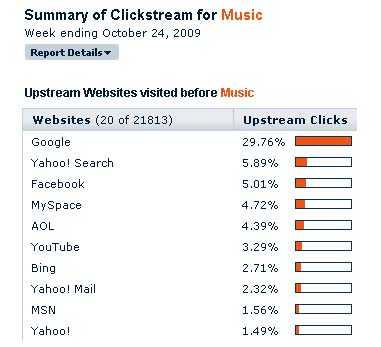
    As you might expect, Google’s a significant provider of traffic to music sites.  Heather Dougherty wrote, "Google was the top referral website to the Music category accounting for nearly 30% of the total traffic to the category last week, 5x more than 2nd ranked Yahoo! Search and 6.3x more than MySpace."


    If Google tries to take away what it’s given, things could get interesting, then.  A number of sites stand to lose a lot of traffic, chief among them Wikipedia, Yahoo Music, and MySpace.  Facebook and MTV Music make Hitwise’s top ten list, too.

    Still, in the grand scheme of things, Google’s music service may not mean a ton to the search giant.  Dougherty found, "Last week, Google sent 1.48% of their total visits to the Music category and of those visits," so it’s not like half or more of Google users are dying to hear more about bands.

    We’ll see what happens if/when the launch occurs.

    Related Articles:

    > Google Phone And Music Service Both On The Way?

    > Facebook, MySpace May Share Content

    > MySpace Introduces New Music Features

  • Are Kids Not Going Into Computer Science Because Their Parents Want Them To Be Sports Stars?

    There’s been some talk lately about how come not as many students are taking computer science in school, and someone over at Information Management online is suggesting that it’s all your parents fault for encouraging you to be a baseball star or a CEO or the next American Idol. This seems to be based on nothing more than a hunch, and the whole thing makes no sense to me. My guess is that most people who don’t go into computer science don’t do it because they’re not interested in it. I don’t think the answer is to tell your little slugger to put down the baseball bat and spend more time learning BASIC.

    Permalink | Comments | Email This Story


  • Customer Satisfaction With ISPs Rises

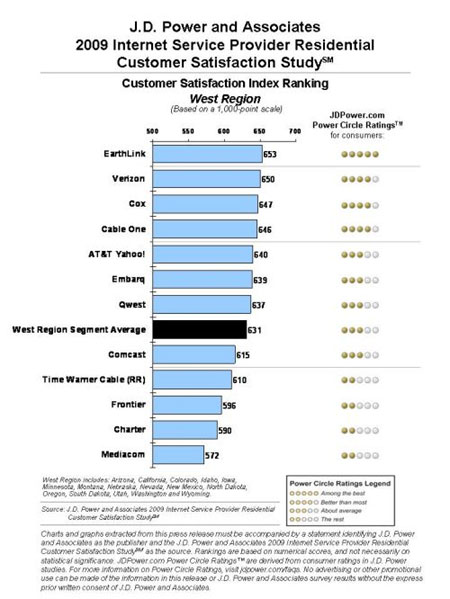
    Overall consumer satisfaction with high-speed Internet service providers (ISPs) has increased from 2008, mainly due to improvements in performance and reliability, according to a new report by J.D. Power and Associates.

    The study measures customer satisfaction with high-speed Internet service based on five factors: performance and reliability; cost of service; customer service; billing; and offerings and promotions.

    The study found that overall satisfaction with high-speed Internet service is 639 on a 1,000-point scale-an increase of 22 index points compared with 2008.

    "In many instances a household’s Internet connection acts as the backbone of its voice, video and information services, making the provider’s ability to provide a fast, reliable connection particularly critical," said Frank Perazzini, director of telecommunications at J.D. Power and Associates.

    ISP-Satisfaction
    ISP-Satisfaction

    "As households become more dependent on services provided via the Internet, eliminating outages and providing consistent connection speeds will become necessities in Internet service providers’ business models."

    Among customers who bundle services from their ISP, the most popular option is a combination of video and Internet services, selected by one-third of customers. The percentage of customers who bundle voice, video and data services has increased from 16 percent in 2008 to 19 percent in 2009.

    In addition, the proportion of customers who indicate they "probably will" or "definitely will" bundle their Internet service with other voice or video services in the next year has increased to 52 percent in 2009 from 43 percent in 2008.

    Other highlights from the report include:


    •     The proportion of high-speed Internet service customers who indicate they are loyal to their provider has increased by two percentage points from 2008, to 32 percent in 2009. Additionally, 66 percent of customers state they "definitely will" or "probably will" recommend their provider to others in 2009-an increase of four percentage points, compared with 2008.
    •  Among customers who contacted their service provider to resolve a problem or question, average hold times have decreased by nearly 30 seconds in 2009, compared with 2008.

    "Internet service may be considered the lynchpin of the bundled offering, serving to drive both customer loyalty and incremental sales opportunities," said Perazzini.
     

    "As competition for new customers increases among Internet service providers, retaining the existing customer base while promoting additional voice and video will continue to be critical."

    > Internet’s Possible Future In The US Gets Ready To Be Decided

    >ICANN Becomes More Independent

    > Domain Registrars Lose Accreditation


  • Google Voice

    Google launched Google Voice n March 2009 to help Internet users better manage their voice communications.  Initially, Google Voice was available to existing users of GrandCentral, a service Google acquired in July, 2007.  So, I have been waiting patiently for the past few months and was finally invited to try out the Google Voice Beta a month ago.

    Google Voice can be a useful service to simplify your phone communications. You can set various preferences–for example, calls from your colleagues get a custom answering message; calls from your parents don’t ring your work number; and calls from your spouse are answered directly when you pick up the phone rather than run through the Google Voice options such as answering the call, sending it to voice mail, or listening in on the voice mail.  Also, Google Voice allows you to get a single phone number that rings all your phones; screen callers before picking your phone; join several people for a conference call; record phone calls and store them online; read voicemail messages via email or SMS; forward, embed, or download voicemails; receive transcripts of your voicemail; send, receive and store SMS messages online; customize voicemail greetings for different callers; and block unwanted callers.  Furthermore, you can use the Google Voice to make international calls (paid service but quite inexpensive) and access Goog-411 directory assistance.  Specifically, I like to access my voicemail online and read the voicemail messages via email or SMS. I think it is easy to check e-mail for voice messages than traditional voicemail particularly when I am out of town.

    Until few days ago, you were required to select a new Google phone number when you first created a Google Voice account. But starting this week, you can get Google Voice with a Google number or with your existing mobile phone number. However, you will not get some features (like call screening, call recording, and call blocking) if you choose to use Google Voice with your existing number.

    If you want to try out Google Voice, you can request an invitation from Google or ask someone with a Google Voice account to invite you.  Also, you may check out the following videos before making the decision.


    Overall, I found Google Voice to be potentially useful even though the text-to-speech conversion is imperfect.  It would be great if Google allows forwarding Google Voice calls to an international phone number.  This is my wishful thinking.

    Posted in Telecommunications Tagged: communication, Google, phone, voice

  • Google to Give People More AdSense Filtering Options

    Back in August, Google gave AdSense publishers more control over what ads appear on their sites by launching an upgrading the category fitlering feature and extending the feature’s beta to the US and the UK.

    So in essence, if you don’t want certain kinds of sites showing up in ads on your site, you could block them. Google shows how the different ad categories contribute to your income, so you can take that into consideration.

    Today Google announced that it will be providing users with more ad filtering options. Soon, the option for 3 more filter categories will be added for a total of 8 different categories. These will be coming in the next few weeks.

    "To get started with category filtering, sign in to AdSense and visit the Ad Review Center, located under the AdSense Setup tab," says Google’s Arlene Lee. "You can choose from the listed categories, which include religion, politics, and dating, and your selections will be applied to ads in English no matter how they’re targeted."

    Ad Review Center

    "Please keep in mind that filtering ad categories may affect your AdSense revenue — we recommend first reviewing the percentages displayed in your account to understand the amount of revenue you may be blocking," she reminds users.

    Google says its continuing to work on additional filtering capabilities as well, but does not get into specifics. They are of course encouraging feedback.

  • Attention: Plex for Mac now plays well with Snow Leopard

    plexplex

    It’s been some time since I’ve written about Plex, the Mac-specific fork of XBMC that, well, is fantastic. It seems Snow Leopard somewhat borked the application, but the latest release is all fixed up. Have a peach.

    So the latest version, 0.8.3, fixes an issue that plagued the Apple remote control. Apparently the driver was such that it didn’t totally disable the OS X hooks. Like, you hit play on the remote from within Plex and then iTunes would start playing. That’s a giant pain, yes. But it’s fixed so there.

    There was also some sort of issue with non-5.1 audio sounding like garbage. Fixed, too.

    Hello exactly!

    via Lifehacker


  • Technology, Policy, Law, and Ethics Regarding U.S. Acquisition and Use of Cyberattack Capabilities

    Cover imageThe United States is increasingly dependent on information and information technology for both civilian and military purposes, as are many other nations. Although there is a substantial literature on the potential impact of a cyberattack on the societal infrastructure of the United States, little has been written about the use of cyberattack as an instrument of U.S. policy.
    Cyberattacks–actions intended to damage adversary computer systems or networks–can be used for a variety of military purposes. But they also have application to certain missions of the intelligence community, such as covert action. They may be useful for certain domestic law enforcement purposes, and some analysts believe that they might be useful for certain private sector entities who are themselves under cyberattack. This report considers all of these applications from an integrated perspective that ties together technology, policy, legal, and ethical issues.
    Focusing on the use of cyberattack as an instrument of U.S. national policy, Technology, Policy, Law and Ethics Regarding U.S. Acquisition and Use of Cyberattack Capabilities explores important characteristics of cyberattack. It describes the current international and domestic legal structure as it might apply to cyberattack, and considers analogies to other domains of conflict to develop relevant insights. Of special interest to the military, intelligence, law enforcement, and homeland security communities, this report is also an essential point of departure for nongovernmental researchers interested in this rarely discussed topic.

  • Carrot Juice and Sunburn

    I was corresponding with JoAnn Farb who told me something interesting she has noticed about carrot juice protecting against sunburn:

    “I discovered on several occasions that drinking large amounts of carrot juice and/or to a lesser extent — simply eating huge amounts of raw greens, reduces any observable changes in skin color (burning or tanning) when exposed to sun.

    “I first noticed this on a canoe trip — years ago — I should have burned — was not using sunscreen and everyone else who didn’t use it did burn badly. But I had been drinking lots of carrot juice every day before hand. Then again in Australia, in January, in Sydney on the beach, Sarina [her daughter] was one year old at the time and pretty much nursing for all her calories. Each day over the noon hour I took her to the beach and let her crawl around naked — and I was in a swim suit. At first I just did ten minutes and then we put full clothing on. Each day I saw no burn and no tan. I increased the time more — until we were fully exposed for well over an hour and saw absolutely no reactions on our skin. There were juice bars everywhere; I was drinking two to three large glasses of fresh carrot juice every day.

    “I have certainly had my share of sunburns at other times, from much less exposure, but have tested this repeatedly. Not only will carrot juice protect me and my family from sunburns, but if we have not been drinking carrot juice and do happen to burn, we will drink large amounts right away and the burn fades quickly.”

    I have long known about the orange tint that people who drink a lot of carrot juice can get, but I was not aware of any sunburn protection. I checked it out and found research showing that beta-carotene does protect against sunburn:

    Köpcke W, Krutmann J. Protection from sunburn with beta-Carotene — a meta-analysis. Photochem Photobiol. 2008 Mar-Apr;84(2):284-8. Epub 2007 Dec 15.

    The study found that taking beta-carotene for 10 weeks, in amounts of about 57 mg per day, protected against sunburn. One cup of carrot juice has about 22 mg of beta-carotene.

    The researchers said the SPF of beta-carotene was about 4. They thought the benefit from beta-carotene could be due to its antioxidant potential or interference in other parts of the biochemical pathways leading to sunburn.

    JoAnn went on to ask:

    “I have always wondered, since Michael Hollick mentions the pinking of the skin as a way to get an indication of how much vitamin D one is potentially making, does consuming all this carrot juice in some way inhibit vitamin D production? Or is the pinking of the skin merely a general way to gauge melanin amounts but otherwise not really related to biosynthesis of D?”

    I’m afraid I do not know the answer to this and I could not find any research on it. I did, however, find one study in which higher intakes of beta-carotene were associated with less bone mineral loss in the elderly:

    Sahni S, Hannan MT, Blumberg J, Cupples LA, Kiel DP, Tucker KL. Inverse association of carotenoid intakes with 4-y change in bone mineral density in elderly men and women: the Framingham osteoporosis Study. Am J Clin Nutr. 2009 Jan;89(1):416-24. Epub 2008 Dec 3.

    It appears that in this case, beta-carotene was not noticeably interfering with any vitamin D formation in these people, though this is a very indirect way to try to answer that question.

  • Did Droid Just KO the BlackBerry Storm2?

    storm2-horizontalI just got off the phone with jkOnTheRun’s Kevin Tofel, and like every other geek, we were talking about Droid and its impact on the market. We were both wondering if Motorola’s release today of its Verizon-focused Droid handset killed the BlackBerry Storm2, the new version of the touchscreen device which also launched today. My argument is that Droid and other Android-based devices are much closer to the BlackBerry and, thus, are a bigger threat to the Canadian giant than they are to Apple. One of our commenters thought so as well.

    viz

    RIM has sent us its latest device for review. I think it’s very brave to do that, because I have not necessarily been shy about my view of Storm and its touchscreen. I am going to play around with this and give you my first-hand impressions. What are your thoughts? Do you think Google’s Droid leaves RIM hurting?

    Hat tip to Ronak for the Storm vs Android chart link on Google Trends.


  • Bad Vista-to-Windows 7 upgrade experiences #2: No TV in Media Center

    By Scott M. Fulton, III, Betanews

    Typically when you upgrade a computer from one operating system to the very next level up, you don’t want the new system replacing or deleting anything without your knowledge and approval. Windows 7 thus far seems to be quite good on this score. But perhaps it’s too good in the case of its new and somewhat enhanced Windows Media Center, whose new reliance on an upstream recording prevention mechanism that’s part of its PlayReady scheme, among other things, renders obsolete Vista’s media settings.

    As a result, if you have a TV tuner in your Vista-based PC, and you follow all the instructions for migrating to Win7, the new Media Center could insist you don’t have a TV there at all. Betanews was able to reconstruct the conditions of a situation some upgraders are reporting where their built-in tuners disappear. Luckily, we also have a solution to the problem that worked for us, and that may hopefully work for you if you’re in similar circumstances.
    But let’s concede right off the bat, it’s not an easy or intuitive solution, so don’t blame yourself thinking there’s something you missed.

    Betanews recreated the problem using a Vista-based dual-core Intel PC, and a Hauppage WinTV PVR-350 tuner card. This is an older card that takes in analog signals in SD, not HD, from cable or antenna, although we found some TV tuner card users had other models. Device Manager clearly recognizes the tuner card for what it is. But after switching on Media Center for the first time, the program complained that it could not find the TV tuner.

    It’s a problem that was reported as early as last May by a Windows 7 tester, who reported to Microsoft at the time: “I upgraded to the RC of Win7 and everything went beautifully. Even stressed the install by ‘having’ a four-year-old turn off the machine in the middle! When I got to the end, I was checking out how stuff was working and went into Media Center. When trying to play live TV, I get a message that it can’t find the tuner card. No update for the driver thru [Windows Update].”

    More recently, there was this from the SageTV Community: “I had installed Win 7 the first time with the [Hauppage] PVR-350 installed in the machine, so I thought the driver install was messed up so I removed the card and did a fresh install of Windows 7 without it and then installed the card but same outcome. The Device Manager shows Video Capture Device as not installed and when I try to update the driver it fails to install.”

    Microsoft MVPs suggested to many individuals that they try installing an older version of the WinTV drivers, preferably one intended for XP, using Compatibility Mode during the installation. We found no evidence of anyone attempting this and succeeding. Then we tried this ourselves with no success either. As we discovered, this method is actually guaranteed to fail.
    Other willing assistants from Microsoft and elsewhere have offered what seems like sound enough advice at any time: Find and install the latest available drivers. But here is where folks were running into problems too: Microsoft established its Windows 7 Compatibility Center to direct individuals to the drivers and support software they need for their components and software to run in the new OS. But Microsoft doesn’t actually host the files itself — that would be a Herculean task. So it directs users to the manufacturers’ Web pages where the files should be found.
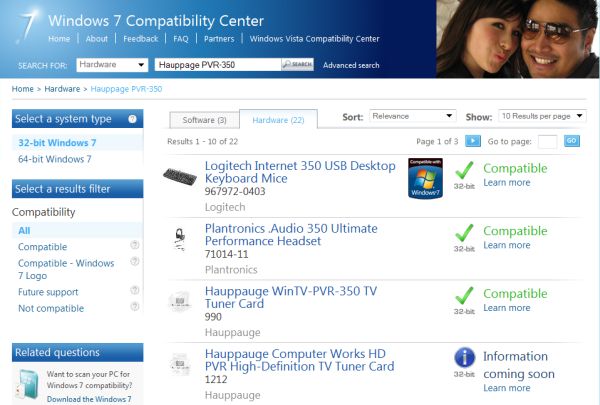
    Hauppage PVR-350 TV tuner card shows up in Microsoft's Windows 7 Compatibility Center.

    At the time of our test, the Compatibility Center notified us that the PVR-350 is compatible with Windows 7. (This turns out to be quite correct.) But the download link takes us to Hauppage’s US Web site, where the same “Compatible with Windows 7” badge appears as shown on Microsoft’s site. However, Hauppage reports, “WinTV-PVR is not certified for use with Windows 7, though it will work in many systems with Windows 7 32-bit version.”

    This is somewhat ominous sounding for folks who remember the experience with “Vista Ready” and “Certified for Vista,” the distinctions between which customers were expected to determine intuitively. In any event, the Hauppage US site then leads customers to a download page, where the most recent drivers appear to be for Vista.

    Installing these drivers will also ensure the tuner card does not work with Windows 7. Realizing that Hauppage was a UK-based company, we tried the same route on the British site. There we located the absolute latest version of the driver, which we would later discover will work with Windows 7, without the need for any Compatibility Mode.
    Once you’ve downloaded the proper driver for whatever TV tuner card you have, there’s a proper order for getting everything set up properly. Here’s the method that worked for us:

    1. Uninstall the current tuner card driver. Make sure Media Center is exited when you do.

    2. Clean any instance of the driver files from your computer. You don’t want Windows 7 automatically re-installing the drivers you just uninstalled after you reboot. With the Hauppage driver kit, there’s an .EXE file for doing just this, called HCWCLEAR.EXE. Then reboot the PC.

    3. Let Windows 7 try to reinstall the driver automatically and fail. It will create an entry for “Multimedia Device” in your Device Manager, and put a little exclamation mark icon next to it. Let that happen, but do not use Device Manager to try to reinstall the newer driver — in other words, avoid any temptation to right-click on this entry and “Update Driver.”

    4. Install the latest driver using the TV tuner card manufacturer’s setup file. Hauppage offers its driver packages in two forms, one of which contains the WinTV program; we’ve noted that WinTV and Media Center are typically incompatible with one another anyway. So if you happen to have the larger package that contains WinTV, skip the on-screen step that asks you to install WinTV.

    5. Reboot the PC again. But don’t start Media Center, not yet.

    6. Open a command line with administrator privileges. I keep a link to CMD.EXE on the Start Menu, then right-click on it and select Open as Administrator.

    7. Navigate to the Media Center directory. (Yes, you’re using the old cd command.) Typically you’ll find this in a folder under your Windows home directory, usually \windows\ehome
    8. Run the following command: mcupdate -MediaCenterRecoveryTask You won’t get an on-screen response, so don’t worry when you see nothing happen.

    9. Launch Windows Media Center. At this point, you will have erased the setup that should have been erased during the Windows 7 upgrade process — the setup that only pertains to Vista anyway. Yes, you have to start from scratch and re-introduce Media Center to your TV tuner. But hey — it’s there! And in a few minutes, you’ll be able to watch — and more importantly for your setup, record — live TV.

    On a related note: XP and Vista users had discovered they were able to network their set-top boxes to their PCs using a Firewire connection, and with the aid of some remarkable drivers called ExDeus created by a private citizen, record HD digital shows using Media Center. Unfortunately, many of these users are now reporting that these private drivers (nor their predecessor, another private effort called FireSTB) are not working in Windows 7. So for the meantime, some folks are sticking with Vista until either someone takes the time to rewrite the drivers, or another relatively reasonable digital recording solution makes itself available.

    Copyright Betanews, Inc. 2009


    Add to digg
    Add to Google
    Add to Slashdot
    Add to Twitter
    Add to del.icio.us
    Add to Facebook
    Add to Technorati


  • Booq’s new rigid laptop case is ready for deployment

    VR-BLK3l
    It seems like when you watch movies where there are scientists out in the field, they inevitably have a hard-case laptop bag that they just set on a rock and open up. Boom, laptop! Well, those big ol’ chrome suitcases may look cool, but they’re a bit unwieldy. Better to get something a little smaller and softer, yet robust enough to withstand a few kicks. The Viper from Booq (not to be confused with the harder Vyper) seems to fit the bill.

    I’ll be checking one of these out soon, which will be a big change from my usual shoulder-bag tendencies. Personally, I’m just excited to get out in the wilderness or something, and suddenly set this thing down on a log and open it up — no thanks guys, I’m just going to play Megaman 2 for a while without taking the laptop out of the bag, you go on ahead without me.

    booq1

    The Viper is available now, in sizes that fit both 15″ and 17″ laptops.


  • Pandora Tunes In To Facebook, Twitter

    An extremely popular Internet radio service has finally acknowledged two of the top social media sites.  Thanks to a new feature, Pandora users can now easily spread the word (or note, as it were) about good music to their Facebook friends and Twitter contacts.

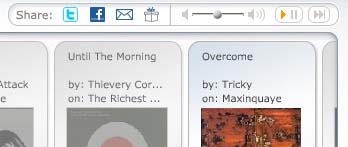
    A post on Pandora’s official blog explained, "[W]e’ve added a sharing toolbar above the player so you’re always just a click away from sharing a song or a station with your friends on Facebook and Twitter.  The first time you share on one of these networks, you’ll have to go through a series of pages that will connect your Pandora account with your Twitter or Facebook account.  After that, it’s a just a simple click to share."

    As for what’ll happen next, the paragraph then continued, "When you post songs to Facebook your friends will be able to listen to samples right in their news feed.  On Twitter we’ll post a shortened link to a page featuring just the song or station you shared."

    This feature is likely to get a lot of use, given the overlap in the Pandora-Facebook-Twitter user base.  It’s almost sure to result in people spending more time on all three sites, too.

    What’s interesting to think about (even as the Pandora blog post mentioned MySpace widgets) is if the sharing toolbar’s existence might affect the Facebook-MySpace content-sharing negotiations that are supposed to be taking place.
     

    Related Articles:

    > Facebook, MySpace May Share Content

    Twitter Adds New Exec Talent

    > MySpace Introduces New Music Features