Category: News

  • Digital Contents Expo Tokyo: Giant squid robot Ikabo (video)

    ikabo_robot

    The Future University (cool name) in Hakodate, Northern Japan, presented the Ikabo, a giant squid robot at the Digital Contents Expo in Tokyo (that ended on Sunday). Not only is the robot tall (2.2m), cute and pretty heavy (weight: 200kg), but it also mimics your hand movements via Wii motion controllers.

    Ikabo is based on an air servo system, and you can also move his head and even his eyes with the Wii controllers. It makes noises to scare potential alien invaders away (the robot was actually part of a promotional campaign that used this scenario to boost the numbers of tourists in Hakodate). Ikabo has a total of 12 joints that make him move like a real squid (well, kind of).

    Here’s a short video I took at the expo that shows how Ikabo works:


  • The Greening of Apple: Is It Important To You?

    apple_environment

    Apple is putting a lot of emphasis on its “green” initiatives lately. But is it the real deal?

    For example, Apple’s new energy efficiency page says that because 53 percent of Apple’s greenhouse gas emissions are a result of the power its products consume, it’s designing these products to be as energy efficient as possible employing three strategies to reduce energy consumption: more efficient power supplies, components that require less power, and power management software. Every new Mac is claimed to meet the strict low-power requirements of the Energy Star specification.

    However, the operative questions are how much does “green computing” matter to consumers, and whether corporate marketing of “green” IT devices amounts to more image-spinning than substance.

    Only the Bare Minimum?

    Some critics, such as MacNewsWorld’s Rob Enderle accuse Apple of doing the “barest minimum necessary” to justify its “green” claims — indeed less than its major competitors, but viewed pragmatically that’s a sensible approach because based on his research into the matter, in Enderle’s view Apple’s customers mostly don’t care. Is that an accurate assessment, or exaggeratedly jaundiced? After all, environmentalist poster boy Al Gore sits on Apple’s board of directors.

    Enderle claims that Apple tried to ignore green computing entirely until the eco-activist organization Greenpeace began relentlessly slagging the company as an environmental foot-dragger and laggard.

    Addressing Apple’s Environmental Footprint

    Apple’s website highlights several key areas in which it’s addressing its environmental footprint, citing engineering innovations such as the unibody MacBooks, whose light, fully recyclable housing is sculpted from a single billet of aluminum, and the lightness of the current iMacs which contain less than 20 pounds of materials.

    Apple also claims to be at the industry forefront in eliminating toxic chemicals, such as arsenic, brominated flame retardants (BFRs), mercury, phthalates, and polyvinyl chloride (PVC) from its products.

    Cupertino has reduced packaging bulk, and, somewhat questionably in my view, bundles fewer peripherals with its systems, which arguably has some minimal environmental benefit, but also saves Apple a fair bit of money while diminishing value to the consumer of what is a premium-priced product.

    Diminishing Value for Minimal Environmental Benefit

    For example, the new WallStreet PowerBook I bought in 1999 came with video, Ethernet, and modem cables and a decent hard copy manual. To connect the unibody MacBook I bought this year to an external monitor I need one of several varieties of Mini DisplayPort adapters, have to supply my own Ethernet cable, was obliged to buy a USB modem, and documentation amounted to a quick start pamphlet. Environmental sensibilities notwithstanding, I don’t perceive this as progress.

    Apple’s claims of cleaning up its environmental footprint act do have substance in terms of operational energy consumption. One reason using laptops has long appealed to me is that because they must be able to operate on battery power, they’re engineered for energy efficiency. However, even Apple’s mass market desktops have very decent energy consumption profiles these days, with iMacs reportedly using about as much energy as a 60-watt lightbulb, and Mac minis substantially less than that.

    How Much Does the Average Mac-buyer Care?

    But how much does the average Mac-buyer care? I’ve been almost exclusively a laptop user for the past 13 years, but even back when I used desktops, I almost always shut them down if I would be away from the keyboard for a half-hour or more. My observation was that most people were inclined to just leave their computers up and running all day, and even in many instances all night as well.

    My inference, not only in the context of personal computers and other IT devices, is that while people like to think of themselves as being “green” and environmentally conscientious, their resolve tends to flag quickly when reducing their personal environmental footprint begins to involve more than minimal inconvenience and/or significantly increased cost, so that for many a commitment to “greenness” is heavier on politically correct rhetoric and feel-good exercises that let one imagine they’re “doing something” virtuous to save the planet with empty symbolic gestures rather than substantive behavior changes, like, say, taking fewer showers or washing clothes less often, or shutting off (or sleeping) their computer when not using it.

    A Pew Research study found the average North American’s definition of what constitutes “necessity” these days includes a car (91 percent), washer (90 percent), dryer (83 percent), home air conditioning (83 percent), microwave (68 percent), TV (64 percent), car air conditioning (59 percent), and home computers (51 percent). Substantial minorities also included cell phone (49 percent), dishwasher (35 percent), cable or satellite TV (33 percent), and high-speed Internet (29 percent), and a few even considered a flat screen TV (5 percent) and an iPod (3 percent) “necessities.”

    Am I being overly cynical? How much do Apple’s and the other computer-makers’ green efforts impact your buying intentions and user behavior?


  • Meet BlackBerry Storm2 Product Manager Yasser Mirza

    Yasser Mirza
    Touch screen BlackBerry® smartphone fans will soon have a new family member to welcome with the announcement of the BlackBerry® Storm2™ smartphone. While there are great resources on BlackBerry.com to learn more about the new BlackBerry Storm2 smartphone, I thought you would be interested to get some information straight from the source: Yasser Mirza, Product Manager for the BlackBerry Storm2 smartphone.

    Who are you and what do you do?

    I’m a CDMA Handhelds Product Manager, which means it’s my job to work with the various engineering, marketing, and business groups to help identify, plan and bring to market new BlackBerry smartphone solutions for the CDMA network standard. 
    When you were first named Product Manager for the BlackBerry Storm2 smartphone, what went through your mind?
     
    I was definitely a little nervous given the magnitude of the project, but also very excited and pumped to hit the ground running managing the development of such a key product. My ambition was to deliver the best possible touch screen phone experience. As a group, we wanted to be sure the BlackBerry Storm2 smartphone was seen as a significant evolution of the BlackBerry touch screen platform.

    blackberry storm2
    What was your vision for the BlackBerry Storm2 smartphone? What were some of the key product features you focused on during development? 
    Deliver the best touch- screen BlackBerry smartphone experience! Seriously though, there were three product features we focused on the most:
    • Typing – Providing an easy and enjoyable typing experience is a key pillar of the BlackBerry smartphone experience, so we wanted to make sure we met those expectations.
    • User experience – we wanted to make sure the user experience would be fast and responsive out of the gate. There are hundreds of enhancements in this product – both hardware and software – that have really come together in the BlackBerry Storm2 smartphone to provide the BlackBerry experience that people expect. 
    • “Eye-candy” factor – a consumer focused touch- screen smartphone needs to ‘press the right buttons’ with customers, if you know what I mean. =D  We wanted to keep the existing industrial design but give it a sleeker look with cleaner lines.   
    What was the biggest challenge you faced while developing the BlackBerry Storm2 smartphone? How did you overcome it?
    The biggest challenge was ensuring the enhanced SurePress™ technology worked and worked well.  It’s the SurePress technology that makes the BlackBerry Storm2 smartphone touch screen ‘clickable’ and unique in the market for touch screen smartphones. There were two primary issues of focus for us:
    1. Getting the touch screen click to feel ‘just right’. 
    2. Integrating the navigation keys as part of the screen to function with the new SurePress technology. This provided a host of new challenges!
    How did we overcome these issues? Iterate. Test. Repeat. =D

    BlackBerry Storm2
    What part of being Product Manager for the BlackBerry Storm2 smartphone are you most proud of?
    I think I’m most proud of pushing the engineering teams to the limit to create an amazing typing experience for the end user with the enhanced SurePress technology. We didn’t settle. Many times we would try the latest version built to specification and it still didn’t feel ‘right’; so back to the drawing board. As I said: iterate, test, and repeat!  I have to give credit to our engineering teams – they’ve really hit a home run with this!
    How fast can you type on the BlackBerry Storm2 smartphone? Ever timed yourself?
    I can actually type faster than a QWERTY keypad BlackBerry smartphone. No joke! I’ve clocked in typing “the quick brown fox jumps over the lazy dog” at 10 seconds, which is 60wpm.
    (Ed. Note: Research In Motion (RIM) employees often engage in typing speed trials – it’s kind of our thing. While not every BlackBerry smartphone user will be able to match Yasser’s speed – he made the smartphone! – post your best time below and show everyone how fast can you type on your BlackBerry smartphone.)

    Lightning round question: Are you a touch screen or QWERTY keypad BlackBerry smartphone user? Has it always been this way? Be honest.
    I was a QWERTY keypad BlackBerry smartphone user and heavy texter so I didn’t use the BlackBerry Storm smartphone much, but I can honestly say that I love typing on the BlackBerry Storm2 smartphone. The new BlackBerry® Device Software 5.0 features provided on the smartphone, such as auto correct, roll over typing, and optimized click pressure all help make the typing experience feel natural. The BlackBerry Storm2 smartphone is now my primary work device and provides me a large screen with multimedia features for play.
    Will you accept my challenge to a type-off? I bet I can beat your time.
    You’re on.
     
    Learn more about the new BlackBerry Storm2 smartphone.

  • Copyright Dispute Leads To NFL Not Scouting College Juniors

    Brooks writes “For once it looks like the NFL isn’t the bad guy in an intellectual property dispute, and actually are the ones trying to explain some of the issues with copyright maximalism to colleges. The problem is that the company who records scouting tapes for eight major conferences has convinced colleges that the NFL should pay for the right to use those tapes to scout players, in particular juniors who are trying to decide whether to enter the draft.

    From the NFL’s point of view, the junior scouting program exists to help keep kids in school if they’re unlikely to succeed in the draft in their junior year (it’s certainly in the NFL’s interest to have those kids continue to develop their talent for one more year). The colleges, of course, see the “value” the tapes bring to the NFL and want a piece of that pie. So far, the NFL seems to be sticking to its guns and basically saying “fine, we just won’t scout your players.” The dispute has escalated to the point where some colleges aren’t even letting NFL scouts look at tape on campus.

    There’s a bit of a sweet good-for-the-gander element to the story, since the NFL has been on the other side of the content value argument pretty much forever. It does kind of suck, though, that some college juniors will be entering the draft based on overoptimistic expectations. And it can’t be good for a college’s football program if it becomes known that it doesn’t allow NFL scouting.”

    Yes, you read that right. It seems that the in this era of copyright maximalism, a company is trying to claim copyright on scouting tapes that are helpful to everyone (teams get better scouting info to make decisions, players are more accurately ranked, etc.). A friend who follows minor league baseball mentioned this week that Major League Baseball just took down its own scouting videos that had been online, so I’m wondering if baseball is now facing a similar problem as well.

    Permalink | Comments | Email This Story


  • Longest Tekken 6 winning streak set at London MCM expo

    It’s only been a day since Tekken 6 hit retail (officially, at least), and already it’s making its way into the record books – the Guinness Book of …

  • Verizon Wireless to take over Times Square with the Motorola DROID

    droid-times-square

    We’ve been told that in conjunction with the DROID launch, Verizon is going to be creating a “first-of-its-kind” interactive experience in New York City. What’s the name of it? “DROID Does Times Square.” Our connect says that this experience will let people control two of Times Square’s largest digital billboards — the NASDAQ and Reuters signs — using only voice commands. What you see above is a “sneak peak” of what it’s going to look like.

  • Decision Time: Does the Nation Need TV or Mobile Broadband?

    whitespaceThe Federal Communications Commission has its eye on television broadcast spectrum, an analyst group has confirmed. At stake is about 300 MHz of spectrum currently delivering the nation’s NBC, CBS, ABC and other broadcast channels over the airwaves. Just months after forcing broadcasters to go through the process of switching spectrum through the digital television transition, the FCC wants to take part of the broadcasters’ new home back so carriers can deliver mobile broadband. They should.

    As we treat our wireless devices like mobile computers (and even access the web on our laptops via cellular connections) data use is going up exponentially. Cisco estimates a 66-fold growth between 2008 and 2013 on mobile networks.

    data-demand

    Based on Cisco’s findings that global average broadband consumption on wired networks was 11.4GB per month, the U.S. would need at least 120 MHz per carrier to fulfill that demand on the current generation wireless networks, Peter Rysavy, a wireless consultant with Rysavy Research, told me in an email a few days ago. Currently most carriers in large markets have about 100 MHz. The U.S. has about 50 MHz in the pipeline and 409.5 MHz of spectrum currently assigned for commercial wireless use, according to the CTIA. The CTIA filed a report with the FCC on Friday asking for it to release a total of 800 MHz for mobile broadband.

    With this mobile demand doomsday scenario in mind, the FCC has approached a reluctant broadcast industry about auctioning off some of that spectrum to carriers and sharing the proceeds of that auction. (A CES study issued last Friday put the value of that spectrum at $62 billion.) Given that unlike the carriers, broadcasters have never paid for their spectrum, some people think this plan is kind of like paying squatters to get off useful land. However, Stifel analysts think any effort to get the spectrum released would require an act of Congress and a considerable legislative fight. Given recent history, I think the Stifel guys are right.

    The broadcasters have 6 MHz of spectrum to use in order to deliver their programming. An HD stream conservatively requires between 2 MHz and 3 MHz to broadcast, so the FCC is interested in appropriating the other 3 MHz or 4 MHz. Some broadcasters are keen to use the excess to deliver over-the-air mobile television through a standard proposed by the Open Mobile Video Coalition. Here’s most of the chunk of spectrum we’re talking about:

    spectrum

    In a perfect world, where everyone had fat broadband pipes, this wouldn’t even have to be up for much debate, because television, even broadcast TV, could be delivered via home broadband connections, as is the case with services like FiOS TV and U-verse. However, folks have to pay for that service rather than just buy a television capable of receiving digital signals, and since 10 percent of the population don’t have a pay TV subscription, that’s a lot of people who would be forced to buy a previously free service. The government has bent over backwards for those people before.

    Plus, even the cable guys and telcos get their broadcast signals over-the-air and then packetize them and send them to subscribers, although this could change. So in a way, the idea of allocating more spectrum for broadband at the expense of TV is an example of an older technology being forced to make way for a newer one. I don’t think that’s what the FCC plans to do here, since broadcasters do hold more spectrum than they can currently use to deliver shows like “30 Rock” or “CSI,” but I expect the broadcast industry to hold onto their megahertz as tightly as they can.


  • A Practical Reform: Indian Country As The 51st State

    Health care reform will be high on the list of topics for President Barack Obama’s meeting next Thursday with representatives of the nation’s 564 federally recognized tribes. The president said he looks forward to talks with tribal leaders about ways to “improve their lives and the lives of their peoples.”
    The president will be looking for political support from Indian Country for his broader reform proposals, while tribal leaders will be seeking improvements in the health care system for American Indians and Alaskan Natives.

    The U.S. Indian Health Service is the closest thing this country has to a single-payer system, serving nearly two million American Indians and Alaskan Natives in 36 states. The agency represents the promise of health care for American Indians made through treaties and other laws and is a full health care delivery system. The IHS operates hospitals and clinics, funds tribal and urban facilities and manages programs ranging from sanitation to diabetes care.

    But virtually everyone recognizes the IHS is seriously under-funded.

    “Putting all the legal aspects aside, I think the trust responsibility can be summed up by saying that something is owed to American Indians for the lands that were both voluntarily given to the United States and forcefully taken, as well as the atrocities that were committed against their peoples,” said Democratic Rep. Frank Pallone Jr. of New Jersey at an Oct. 20 hearing about Indian health care. “But the federal government has consistently failed to live up to this responsibility in almost every respect.”

    The Indian Health Service, in fact, doesn’t even count as an acceptable insurance plan under any reform bill. This is ironic because those same health proposals exempt American Indians from the individual mandate to purchase health insurance because of that IHS promise. But unless funding improves, health care reform will guarantee a permanent disparity in just about every Native American health statistic.
    At a meeting of the National Congress of American Indians last month tribal leaders said they would ask the president for at least a “no harm” statement protecting the “already strained” Indian Health Service from future cuts.

    Yet no one is asking the president for full IHS funding — at least directly.

    One idea is to improve the IHS’ ability to tap Medicare, Medicaid and the Children’s Health Insurance Program. The Indian Health Service was left out of the original Medicare and Medicaid legislation and was not added until the Indian Health Care Improvement Act in 1976. It now receives about $650 million a year from Medicare and Medicaid, a figure still considerably less than it could be because entitlements promise money for every eligible person. However, the IHS is funded by annual appropriation.

    These days Medicare is considered a nearly universal system for America’s elders, There is a 20-fold difference in the actual number of Native elders 65 years of age and older not covered by Medicare than and the U.S. general population (or 15% versus 0.7%). Native elders do not have enough quarters of work to qualify for Medicare, but do qualify for Medicaid.

    Enrolling more Native Americans in Medicaid is complicated by the partnership between federal and state governments. States write the rules, under broad guidelines, while the federal government pays for nearly all of the cost for Indian health programs. The Government Accountability Office found that the range of Medicaid reimbursements at IHS facilities ranged from 2 to 49 percent and not surprisingly, “the facilities with higher reimbursements had additional funds to hire staff and purchase equipment and supplies.”

    The practical problem for Medicaid is its administration by state governments, which have uneven relationships with tribes and Indian organizations. Even if those states work well with tribes, imagine the complexity for tribes with members living on their home reservation, but in different states. For example the Navajo Nation program managers must help clients navigate the eligibility process under specific rules for Medicaid programs in Arizona, New Mexico and Utah.

    This is a way to save money by cutting waste. Instead of sending federal dollars to state Medicaid (and Children’s Health Insurance Program) offices, there ought to be a way to transfer money directly to IHS. There could be a new set of flexible rules written for Native Americans with far less administrative overhead than the 36 different systems. The federal government could treat Indian Country, at least for health programs, as the 51st state. This seems to me a practical application of the nation-to-nation relationship.

    Mark Trahant is the former editor of the editorial page for the Seattle Post-Intelligencer. He was recently named a Kaiser Media Fellow and will spend the next year examining the Indian Health Service and its relevance to the national health reform debate. He is a member of Idaho’s Shoshone-Bannock Tribes.

  • Up-close with Watchismo, one of the most eclectic watch collectors I know

    While I’m not quite down with a lot of Watchismo’s aesthetic choices, you gotta respect his drive. This guy loves Swiss quartz, crazy designs, and even goes nuts over Hamilton Electrics, watches that are so odd that only one person in the world can fix them.

    Dudes like Watchismo and ABlogToRead really took up the watch coverage torch and they’re doing some of the freshest watch reporting out there. Good on ‘em.

    via Coolhunting


  • Government condemns bomb attacks

    Smoke rises from a bombed UN guesthouse in Kabul; PA copyrightThe Government has condemned today’s bomb attacks in Afghanistan and Pakistan which left dozens of people dead, including United Nations staff.

    The Prime Minister told the House of Commons that he had sent a message to UN Secretary General Ban Ki-moon to express his condolences following the explosion in Afghanistan.

    At least five UN workers were killed when Taliban suicide bombers attacked a guesthouse in the capital Kabul.

    The PM said:

    “On behalf of the British people, this morning I have sent a message to the UN Secretary General offering our condolences and support following the Taliban attack on the UN in Kabul this morning.”

    About 100 people were killed and 200 injured when a car bomb went off in a market in Peshawar, Pakistan.

    During a phone call to Ban Ki Moon later in the day, Mr Brown passed on his deep condolences for the deaths of the UN staff in Kabul, saying the atrocity should strengthen further the resolve to see the job through in Afghanistan.

    Read Foreign Secretary David Miliband’s comments on the attack in Peshawar

  • Mytrus Raising New Round

    Mytrus, a stealth-mode provider of clinical trials for pharmaceutical customers, has secured $1 million of a $3 million funding round, according to a regulatory filing. No investor information was disclosed by the Mill Valley, Calif.-based company.

    ShareThis


  • Nodality Raising New Round

    Nodality Inc. of South San Francisco has secured $3.5 million of a $10 million funding round, according to a regulatory filing. Past backers have included Kleiner Perkins Caufield & Byers, Maverick Capital and TPG Biotech Partners. According to the TPG website, Nodality focuses on “personal diagnostics targeting cell-signaling pathway “nodes” detected in well defined cellular sub-populations from individual patients.” www.nodalityinc.com

    ShareThis


  • Godengo Raises $2 Million

    Godengo, an Emeryville, Calif.-based provider of a Web publishing solution for local and regional magazines, has raised around $2.16 million in new funding, according to a regulatory filing. No investor information was disclosed. www.godengo.com

    ShareThis


  • CorNova Adds $3 Million

    CorNova Inc., a Burlington, Mass.-based coronary stent maker, has raised $3 million in new VC funding, according to a regulatory filing. Past backers have included Siemens Venture Capital, CardioTech International Inc. and Implant Sciences Corp. www.cornova.com

    ShareThis


  • Federal Agencies Enter an Agreement Regarding Transmission Siting on Federal Lands

    Today, Obama Administration officials released a Memorandum of Understanding (MOU) signed by nine Federal Departments and Agencies to make it faster and simpler to build transmission lines on Federal lands. The goal of the agreement is to speed approval of new transmission lines, reduce expense and uncertainty in the process, generate cost savings, increase accessibility to renewable energy and jump start job creation.

    The MOU has been signed by the U.S. Department of Agriculture, Department of Commerce, Department of Defense, Department of Energy, Environmental Protection Agency, the Council on Environmental Quality, the Federal Energy Regulatory Commission, the Advisory Council on Historic Preservation, and Department of the Interior.

    The agreement will cut approval time off the normal Federal permit process and help break down the barriers to siting new transmission lines by:

    Designating a single Federal point-of-contact for all Federal authorizations;
    Facilitating coordination and unified environmental documentation among project applicants, Federal Agencies, states, and tribes involved in the siting and permitting process;
    Establishing clear timelines for agency review and coordination; and
    Establishing a single consolidated environmental review and administrative record.

    Instead of applicants going to multiple agencies, a single lead agency will coordinate all permits and approvals.  The new process will keep applications on track by requiring agencies to set and meet clear deadline and improve transparency by creating a single record to be posted on line. The MOU does not alter the authority of any participating agencies, and all existing environmental reviews and safeguards are maintained fully. 

    Read the Memorandum of Understanding

  • Free GTA IV multiplayer this weekend on Xbox Live

    gtaweekend

    Good news, everyone. (I hope people understand that reference.) Grand Theft Auto: Episodes From Liberty City comes out tomorrow, and to help grease the wheels a little bit, this weekend will be a free-play weekend on Xbox Live for GTA IV. That is, if you have GTA IV but don’t subscribe to Xbox Live Gold, you’ll be able to play online multiplayer this weekend.

    The deal goes from Friday to Sunday, and works for all the various GTA IV releases (The Lost and Damned and The Ballad of Gay Tony).

    A couple of Rockstar people will be playing all night Saturday night, and their Gamertags are GwRockstar1 through GwRockstar16. Presumably there will be much trash talking and exploding cars.

    Also, on Sunday, from 1pm to 3pm ET, you’ll be able to play with Henry Santos Jeter, who’s a singer in the band Aventura. So that’s neat, a successful musician taking time out of his day to run rampant throughout Liberty City with y’all.


  • PM welcomes Indian President to Number 10

    PM greets President Patil of India at Downing Street; Crown copyright

    The Prime Minister has met President Pratibha Patil of India in Downing Street as part of a three-day state visit to the UK.

    President Patil and Gordon Brown discussed topics such as business, investment and education, climate change, terrorism and global poverty during their meeting this afternoon.

    Last night, Gordon Brown and his wife Sarah attended a banquet for the Indian President hosted by the Queen at Windsor Castle.

    During the remainder of her visit, President Patil will speak at the UK-India Business Council’s Annual Summit and co-launch The Queen’s Baton relay ahead of the 2010 Commonwealth Games in Delhi.

  • Internet Hating Sony Pictures CEO Insists Piracy Is Killing Movie Business; But Facts Show Otherwise

    Ah, remember Michael Lynton? The Sony Pictures CEO who earlier this year insisted that nothing good had come from the internet at all. When everyone started mocking him for this statement, rather than back off, he doubled down and insisted it was true, using examples that were easily debunked. Apparently, he hasn’t learned his lesson. He’s back at it, pushing for the UK (and others) to pass laws kicking people off the internet (so-called “three strikes” laws) while insisting that due to piracy there’s less money to make movies and fewer movies being made. Of course, those are things that can be fact checked, and the folks over at TorrentFreak did exactly that, pointing out that more movies are coming out each year and more money is being made. Oops.

    The way Lynton tries to get around this is by not actually talking about how many movies are coming out, but just counting the number of movies that came out of “the leading studios.” I find this quite amusing, because in the podcast we discussed last week involving Paramount’s Scott Martin, part of his argument was that while the big studios were fine, the independents were all suffering and fewer movies were coming out because of it — and, as a “fan” of independent movies, he found that sad. I didn’t bother to check the numbers, but it appears that Martin was simply wrong. More movies are being made, and it looks like an increasing percentage of them are coming from smaller independent shops.

    The problem, again, seems to be that the folks at the movie studios (just like those at the record labels) only like to count the big hits as successes — rather than the smaller projects that actually make money and make up the majority of the actual market. It’s the same sort of thinking that makes movie studio people insist that we need to explain to them how they can keep making $200 million movies. That’s the wrong question. The question is how do you make profitable movies. The technology has advanced such that it’s cheaper and cheaper to make movies (which is why we have more of them). But notice that the studios never focus on ways to make movies in a more economical way, but how can they keep spending. Perhaps that’s a bigger problem than “online piracy.”

    Permalink | Comments | Email This Story


  • China: The Looming Giant

    While China’s Gross Domestic Product is currently less than half of the United States, China’s economy is expected to exceed the U.S.’s in just 15 years. Unlike the United States, China’s is working to dramatically increase its access to energy, both domestically and abroad. While the Obama Administration pulls back oil and gas leases,[1] halts a program to allow commercial oil shale leasing,[2] keeps new offshore energy exploration under lock and key,[3] and pushes for an energy tax under the name of cap-and-trade,[4] China is securing and expanding its energy resources around the world and at home.

    China’s Coal Consumption

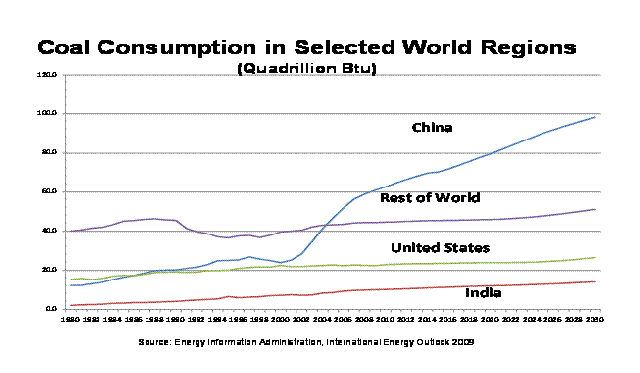
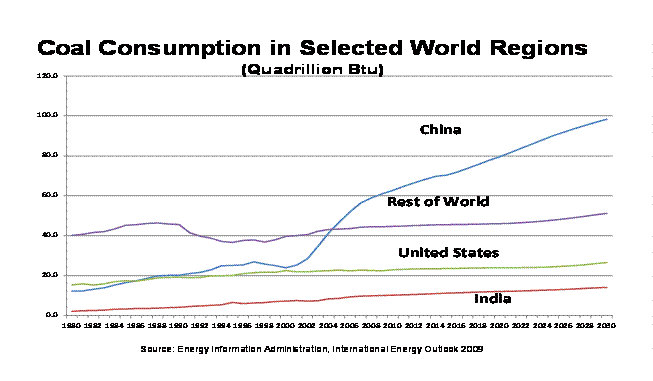
    China already consumes more than twice the amount of coal as the U.S., but by 2025, its coal consumption is expected to be 3.7 times larger than ours[I1] . Reports suggest that China is building two coal-fired electric generating plants a week,[5] while the U.S.’s coal-based generating construction program is stymied by EPA reviews, re-reviews and legal delays. Forecasters have shown that under the climate change legislation currently working its way through Congress, U.S. coal consumption will be severely reduced and replaced by nuclear and renewable generating technologies, which are more costly forms of energy. And while China has professed that it will meet renewable generation goals, it will not partake in meeting targets for greenhouse gas reductions that will hurt its projected economic growth and its future status as a major world power.[6] Instead, China is willing to make reductions in greenhouse gas intensity (greenhouse gas emissions per unit of GDP), a measure proposed by the U.S. almost a decade ago, that allows for both economic growth and lower emissions per unit of GDP from improved efficiency and technology.[7]
    clip_image002

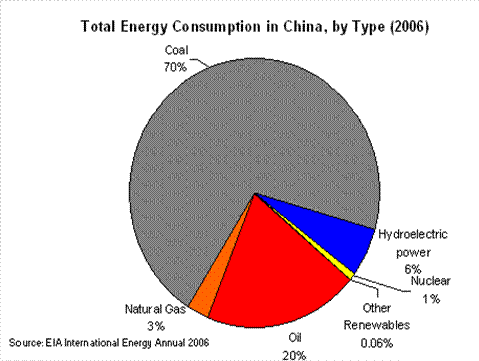
    Let’s compare energy consumption in China and the U.S. today to each country’s projected consumption in 2025. Data for 2006 is taken from the Energy Information Administration’s (EIA) International Energy Annual (IEA)[8] and the forecasts are taken from EIA’s International Energy Outlook (IEO)[9] for 2009. [10]clip_image004
    China’s Renewable Energy Production

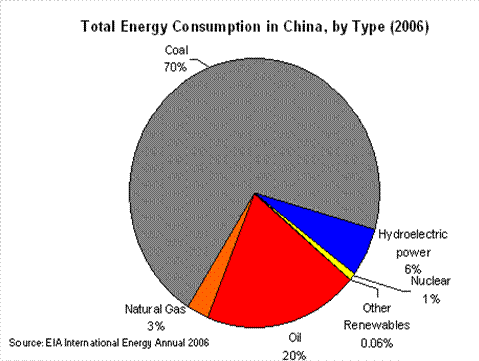
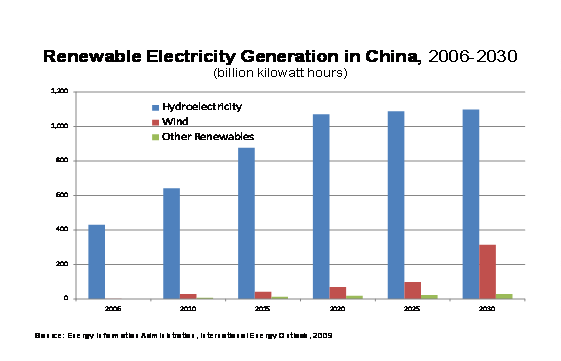
    China’s energy consumption today is dominated by coal, which supplies 70 percent of its demand, followed by oil, which supplies 20 percent. Renewable energy in China is largely hydroelectric power, particularly from the 18,200-megawatt Three Gorges Dam project, whose final generator went on line in October 2008. This project is the largest hydroelectric undertaking in the world. China has other hydroelectric projects planned, totaling an additional 57,720 megawatts of new capacity that will come on line in 2009. China has established a 30,000-megawatt target for installed wind capacity by 2020 (15 percent of its energy needs), and is currently installing wind power at a rate of at least 3,000 megawatts a year.

    However, wind growth in China isn’t without its problems. The Wall Street Journal reports that China’s transmission network currently can’t absorb such high rates of growth in renewable energy. Last year, as much as 30 percent of China’s wind power capacity wasn’t connected to the grid.[11] As a result, more coal is being burned in existing plants and new coal plants are being built as backup to wind energy. Wind resources do not conform to the normal hours of peak demand and require flexibility in the transmission and distribution system to take down other generators when the wind blows. Unfortunately, coal-fired capacity was not designed to be quickly taken on and offline as the electricity from wind fluctuates. clip_image006
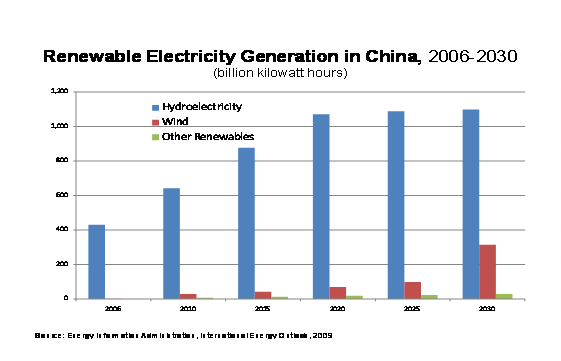
    China’s electric generating sector today relies on coal for 79 percent of its generation and EIA only expects that figure to drop to 75 percent by 2030. China’s generating sector is also investing in nuclear power. Generation from nuclear power is expected to increase by 570 percent by 2025, according to the EIA. That increase is equivalent to an additional 40 gigawatts of new nuclear generating capacity—a lower forecast than some, who are reporting 60 gigawatts of nuclear power in China by 2020.[12]

    China’s Liquid Fuels Consumption

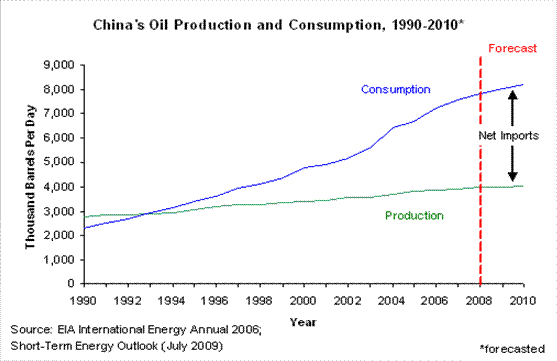
    China’s liquid fuel consumption is currently 7.2 million barrels per day, a rate of about a third of the United States. However, its projected growth far exceeds the U.S.; China is expected to increase its liquid consumption by 6.6 million barrels per day by 2025 (the largest growth of any country). At that time, China will consume about two-thirds of the U.S. level of liquids consumption. Unlike its vast coal reserves, China is not endowed with a lot of oil resources. Its oil reserves totaled 16 billion barrels in January 2009.[13] As a result, China has actively worked with other oil-producing countries (e.g. Venezuela, Angola). China has widely exchanged financial incentives for future access to oil supplies [14] including in U.S. waters in Gulf of Mexico.[15] China became the world’s second largest vehicle market in 2006, when sales exceeded those of Japan. In 2007, China produced nearly 8.9 million motor vehicles, an increase of 22 percent in production over 2006. China is the world’s third largest vehicle producer after the U.S. and Japan. The economic downturn reduced the growth in China’s vehicle sales to less than seven percent in 2008 and a lower rate is expected for 2009. Part of China’s economic stimulus package is expected to be used for infrastructure improvements in the transportation and electric power sectors.
    clip_image008

    China’s Natural Gas Consumption

    While China’s use of natural gas today is only at three percent, it is expected to triple its usage by 2025. Since China is not home to much of the World’s natural gas reserves (only 1.3 percent)[16], it will rely on imports to meet much of its natural gas demand. In 2030, EIA expects imports to make up more than one-third of China’s total natural gas consumption. To meet this growing need, China opened its first liquefied natural gas facility in 2006 and is expected to have a natural gas pipeline built by 2011 from Turkmenistan via Kazakhstan. Recently, Qatar has decided to divert around 10 percent of its liquefied natural gas exports to China from the United States because China is willing to pay more for the product.[17] It is a good thing that hydraulic fracturing has helped immensely to increase domestic U.S. supplies of natural gas, although the technology is currently being threatened by federal politicians, who are looking to restrict its use.[18]

    China’s Carbon Dioxide Emissions

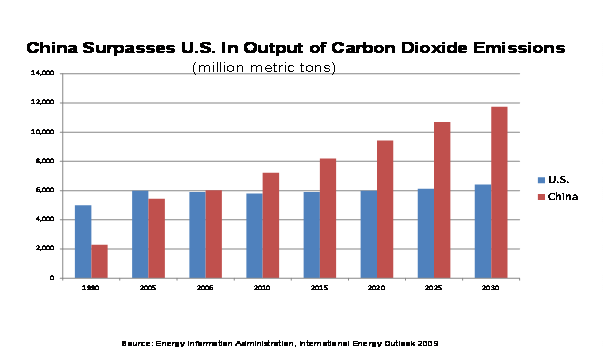
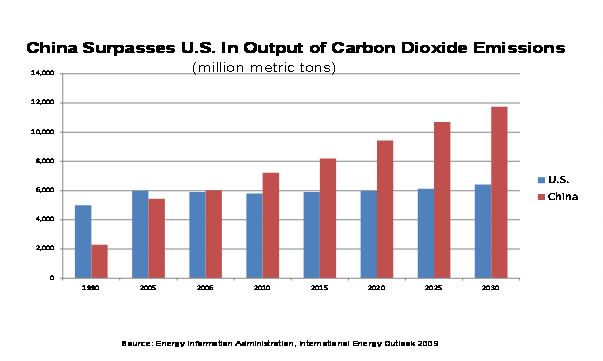
    As fossil fuels represent 93 percent of China’s current energy demand, it is not surprising that China ranks first in carbon dioxide emissions in the world, with 6,018 million metric tons released in 2006. By 2025, that number is expected to increase to 10, 707 metric tons, an increase of 78 percent from its 2006 value and 75 percent higher than expected carbon dioxide emissions in the U.S. in 2025.
    clip_image010

    Bottom Line

    China wants to become the world’s largest economic power, and China’s leaders understand the fundamental reality that abundant supplies of affordable, reliable energy are essential to economic growth. This is in stark contrast to the U.S. government’s actions to severely limit access to our domestic energy resources and the current proposals to tax carbon dioxide emissions from about 85 percent of our energy (oil, coal, and natural gas) through cap-and-trade. Unlike the United States, China is ambitiously pursuing energy policies to make sure its people have enough energy to grow their economy and make their lives better.


    [1] Paul Foy, Interior Secretary Sued for Revoking Utah Leases, ABC News, http://abcnews.go.com/Business/wireStory?id=7592093.

    [2] Daniel Whitten, Salazar to rewrite Bush oil-shale plan, Bloomberg News, http://www.chron.com/disp/story.mpl/headline/biz/6280852.html.

    [3] Jim Tankersley, Salazar puts expanded offshore drilling on hold, L.A. Times, http://articles.latimes.com/2009/feb/11/nation/na-offshore-drilling11.

    [4] Institute for Energy Research, President Obama’s Budget includes $1.6 trillion in new taxes—the largest tax increase in history, http://www.instituteforenergyresearch.org/2009/02/26/president-obama-budget-includes-16-trillion-in-new-taxesthe-largest-tax-increase-in-history/.

    [5] Roger Harrabin, China building more power plants, BBC News, http://news.bbc.co.uk/2/hi/6769743.stm.

    [6] Institute for Energy Research, Lost in Translation, http://www.instituteforenergyresearch.org/2009/07/28/lost-in-translation/.

    [7]http://online.wsj.com/article/SB125409730711245037.html

    [8] http://www.eia.doe.gov/iea/

    [9] http://www.eia.doe.gov/oiaf/ieo/index.html

    [10] EIA is an independent statistical agency within the U.S. Department of Energy that forecasts future energy outlooks for the U.S. and the world.

    [11]http://online.wsj.com/article/SB125409730711245037.html

    [12] http://www.eenews.net/Greenwire/2008/12/23/

    [13] “Worldwide Look at reserves and Production,” Oil and Gas Journal, Vol. 106, No. 48 (December 22, 2008), pp23-24.

    [14]Venezuela signed a $16 billion investment deal with China over three years. The deal could raise oil output by several hundred thousand barrels a day. http://www.eenews.net/Greenwire/2009/09/18/

    China National Petroleum Corp. received a $30 billion low-interest loan from a state-run bank to finance overseas acquisitions, Beijing’s latest bid to secure mineral resources to fuel the country’s burgeoning economy. http://www.eenews.net/Greenwire/2009/09/09/

    CNOOC and Sinopec have agreed to buy a 20 percent stake in an oil field off the coast of Angola for $1.3 billion, the latest in a series of Chinese acquisitions of overseas energy and mining assets. http://www.eenews.net/Greenwire/2009/07/20/

    [15] David Pierson, China’s push for oil in the Gulf of Mexico puts U.S. in awkward spot, L.A. Times, http://www.latimes.com/business/la-fi-china-oil22-2009oct22,0,2776603.story?track=rss.

    [16] “Worldwide look at Reserves and Production,” Oil and Gas Journal, Vol. 106, No. 48 (December 22, 2008), pp. 22-23.

    [17] Reuters, “Qatar diverts LNG to higher-paying China from U.S.”{, October 27, 2009, www.reuters.com/article/companyNews AndPR/idUSLR15622520091027

    [18] “States to U.S. Congress: Hands Off Hydraulic Fracturing”, May 19, 2009, www.energyindepth.org/2009/05/1005/


  • RIM and Apple top U.S. Smartphone market share

    Apple_RIM_Marketshare

    Who’s ready for some statistics? This September ChangeWave Research conducted a poll of smartphone users in an attempt to gauge the market share impact (if any) of new and announced devices from Apple, Palm, and RIM. We’ve combed over the article and picked out some juicy tidbits for your reading pleasure. According to ChangeWave, 39% of people polled currently own a smartphone. Of that sample, 77% own either an Apple, Palm, or RIM branded device (I know, we’re curious about the other 23% as well). RIM polled the largest portion of U.S. market share with 40% followed by Apple at 30% and Palm with a measly 7%. Apple did top the customer satisfaction poll as 74% of iPhone users described themselves as “very satisfied” with their purchase; compare that with RIM at 48% and Palm at 33%. The iPhone also ranked first in future purchases plans of those polled who did not currently own a smartphone, but plan to purchase one in the next 90 days. Also 36% indicated a preference towards the iPhone, 27% towards the BlackBerry, and 8% towards Palm. Any BGR peeps out there with plans to upgrade to a smartphone in the near future? What are you leaning towards? D-D-D-DROID?

    [Via The iPhone Blog]

    Read