Category: News

  • House Democrats Prepare For Thursday Release Of Health Bill

    The Associated Press: House Speaker Nancy Pelosi is making plans to release on Thursday morning the House version of sweeping health reform legislation, depending on the outcome of a Wednesday afternoon meeting with House leaders.  “The rollout would cap months of arduous negotiations to bridge differences between liberal and moderate Democrats and blend health care overhaul bills passed by three separate committees over the summer. The developments in the House came as Senate Majority Leader Harry Reid tried to round up support among moderate Democrats for his bill, which includes a modified government insurance option that states could opt out of.”

    The House’s final product includes “new requirements for employers to offer insurance to their workers or face penalties, fines on Americans who don’t purchase coverage and subsidies to help lower-income people do so. Insurance companies would face new prohibitions against charging much more to older people or denying coverage to people with health conditions.” It’s price tag, which exceeds $1 trillion over 10 years, “would be paid for by taxing high-income people and cutting some $500 billion in payments to Medicare providers. The legislation would extend health coverage to around 95 percent of Americans.” House leaders would like to begin debate on the measure next week with an eye on finishing before Veteran’s Day.

    “In the end, Pelosi, D-Calif., and other House leaders were unable to round up the necessary votes for their preferred version of the government insurance plan — one that would base payment rates to providers on rates paid by Medicare. Instead, the Health and Human Services secretary would negotiate rates with providers, the approach preferred by moderates and the one that will be featured in the Senate’s version (Werner, 10/28).

    MSNBC  is also reporting that House Democrats will hold an event tomorrow morning to announce “the outline” of the health bill they plan to move to the floor. “And it looks like the “robust” public option is a bust: The measure is not expected to include the reimbursement rate to medical professions based on Medicare, plus 5%. Instead, it will include a public option based on rates negotiated region by region (Viqueira, 10/28).

    The Hill: “Majority Whip James Clyburn’s (D-S.C.) office has acknowledged that the liberal public option does not have the votes to pass, and an internal whip list that was leaked on Tuesday night put the tally of robust public option ‘no’ votes at 47, nine more than Democrats can afford to lose” (Allen and Soraghan, 10/28).

  • Google Sued Over Patents On Open Source Code

    We’ve discussed in the past how reporters often contribute to misconceptions about the patent system and patent disputes. They commonly report that those sued for infringement are accused of “copying” or “taking” an invention from another company, when it’s much more common for infringement lawsuits to involve independent invention. Now we’ve got another example. Red Bend Software is the latest in a long list of companies suing Google for patent infringement, claiming that Google violates its patent 6,546,552 on “difference extraction between two versions of data-tables containing intra-references.”

    Specifically, Red Bend claims that Google’s Chrome browser violates this patent by including an algorithm, called Courgette, that lets Google push compressed software updates. Of course, plenty of companies have come up with various ways to push compressed software updates over the years, so I’m at a loss as to why it requires a patent… but that’s a different issue. The problem here is the reporting on this lawsuit by Mass High Tech and reporter Galen Moore. First, he claims that this lawsuit suggests Google’s “open-source Chrome browser isn’t so open source after all.” Huh? I’ve read that sentence over and over again and I can’t figure out how a patent dispute would mean that Chrome isn’t open source. This kind of reporting suggests that a patent simply wipes out the type of license covering a software.

    The second questionable bit is in talking about how Red Bend (like plenty of patent holders putting forth lawsuits) is claiming willful infringement, which gives a company triple damages if found to be true. So what’s the evidence of “willful infringement.” A claim that “Google has known about the conflicting patent since September 7.” September 7th? That’s a month and a half ago. The patent was issued in 2003. And Courgette was first used in July. It’s difficult to see how anyone could claim with a straight face willful infringement when you just informed them of your patent, and that happened after the software was already in use. You don’t even need to know much about patents to at least point these facts out.

    But, of course, you wouldn’t know any of that from the article. Instead, your average reader would likely read this, thinking that Google somehow “took” this invention from Red Bend and that somehow negates Google’s “open source” license on Chrome.

    Permalink | Comments | Email This Story


  • Camtasia vs. ScreenFlow: Creating Your First Screencast

    camtasia_vs_screenflow

    If you have need to visually demonstrate your product, and you have the resources, then it just makes sense to produce a screencast. With the release of ScreenFlow 2.0, I thought it’d be useful to perform a real-world comparison review of the screencast heavyweight champ versus the relative newcomer (at least to the Mac), Camtasia.

    Getting Started

    I started this comparison by creating the same video in both Camtasia and ScreenFlow. Both applications are very straightforward to setup and get going in creating the screencast. Camtasia gets a little bit of an edge for configuration because, unlike ScreenFlow, you do not have to install a separate audio driver.

    However, once you get started recording, both applications provide you with a simple countdown prior to recording. As a primer, try to write your script prior to recording. This way, you will have a consistent experience for your customer once you complete production.

    Please note, I did not try to record a screencast across multiple displays or using an external microphone. I used what most of us have — a MacBook (or a desktop) and the built-in microphone.

    Basic Editing

    After I recorded the basic screencast, I was presented with the Editor window within each program:

    ScreenFlow main screen

    Screenflow Main Window

    Camtasia

    Camtasia Main Window

    Both programs have very similar editing experiences using a timeline. ScreenFlow has the added advantage of separating out the audio from the video portions of the recording. This is a great experience, because you can also add another voiceover quite easily. In contrast, Camtasia merges the audio and video. It wasn’t easily discoverable how to add or change the existing audio recording. With my limited skills, being able to re-record the audio as a separate track was very handy.

    Enhancing Your Screencast Recording

    Each has a plethora of features to modify your recording.

    • Cropping: Remove extra portions of the video that you don’t need.
    • Trimming: Remove any extra (or bad) audio/video from the timeline.
    • Playback tools: Play, reverse, fast-forward.
    • Import Media: Additional audio, video or images.
    • And a whole lot more…

    What’s nice is that as you begin to explore more in ScreenFlow and Camtasia, they both provide simple video tutorials to show you how to use the features. For someone new to creating screencasts, this is very helpful.

    Here are a few glimpses of the app once I inserted some text, graphics and transitions.

    ScreenFlow - Inserts

    ScreenFlow: with additional text box and transitions

    Camtasia - InsertsCamtasia: with additional graphics, text and transitions

    I did perform a little trimming (Camtasia calls this Delete or Ripple Delete) at the end of each video so that you can’t see me click/end the recordings (there is no way to avoid this, although it would be nice if both tools had this as an option). Both tools make this really easy to do.

    Both applications have advanced audio capabilities. ScreenFlow has true audio ducking, or the ability to decrease the volume of one recording while another audio volume is increased. Camtasia offers audio transition effects, which offers some flexibility, but not anywhere near as rich as ScreenFlow.

    Unfortunately, neither application has great iLife integration, so I can’t directly insert audio clips from GarageBand. I think this is a missed opportunity for both Camtasia and ScreenFlow.

    The Victor

    This is a tough call. However, I give the slight edge to ScreenFlow because of its ability to edit audio separately as well as its UI for editing different properties of a recording. I happen to prefer the overall Camtasia UI over ScreenFlow’s as it seems more like iMovie ‘09 to me.

    Ultimately, you have to decide which items are more important to you:

    • Features/Functionality
    • User Experience
    • Price

    ScreenFlow 2.0 is priced at $99 (or $29 for an upgrade). Similarly, Camtasia 1.0.1 is currently priced at $99 (this is a promotional price, the web site shows the full retail for $149).

    If you have limited funds, there is the screen recording capability in QuickTime X, a component of Snow Leopard. If you’ve already upgraded to Snow Leopard, then you have this option available. Otherwise, the Snow Leopard upgrade is $29. Please note that QuickTime X is nowhere in the same league as ScreenFlow or Camtasia. However, if you have a new Mac that includes Snow Leopard and iLife ‘09 (which includes iMovie ‘09), you can make some very simple Screencasts, excluding the fancier features available from either ScreenFlow or Camtasia.

    The Videos

    Don’t laugh, they’re horrible.

    Camtasia

    ScreenFlow


  • Celebrate Halloween at the Euro Home

    The European PlayStation Home is throwing a party, guess what, and you’re all invited! crowd cheers And wherever there’s a Halloween party, there’…

  • NYT have an intelligent conversation about crop technology

    Put Aside Prejudices
     
    Paul Collier is a professor of economics at Oxford University and the director of the Center for the Study of African Economies. He is the author of “The Bottom Billion: Why the Poorest Countries Are Failing and What Can Be Done About It.”
     

    Opponents talk darkly of risks but provide no scientific basis for their amorphous expressions of concern. Meanwhile the true risks are mounting. Over the past decade global food demand has risen more rapidly than expected. Supply may not keep pace with demand, inducing rising prices and periodic spikes. If this happens there is a risk that the children of the urban poor will suffer prolonged bouts of malnutrition.
    African governments are now recognizing that by imitating the European ban on genetic modification they have not reduced the risks facing their societies but increased them. Thirteen years, during which there could have been research on African crops, have been wasted. Africa has been in thrall to Europe, and Europe has been in thrall to populism.
    Genetic modification alone will not solve the food problem: like climate change, there is no single solution. But continuing refusal to use it is making a difficult problem yet more daunting.

  • Ontario law bans the use of portable gadgets while driving

    wiggum

    A new law in Ontario, Canada has banned the use of handheld devices while driving. This includes cellphones, GPS devices, MP3 players, etc. Slight problem: the law is broad enough that you can construe it to include doing things like changing the radio station or reaching for a cup of coffee.

    Someone caught breaking the law faces up to a C$500 fine. And this isn’t 15 years ago: C$500 is about $460 right now. Pretty serious money to lose because you need to text your friend WTF.

    As for that cup of coffee gimmick that Slashdot originally brought up, I sincerely doubt a police officer is going to waste his time and pull you over for sipping a cup of coffee at the traffic light. Unless, of course, Canadian cops are like their American counterparts and have unofficial quotas to meet at the end of the month.

    That’s it, really. Don’t text and drive, friends. It’s not safe, no sir.

    via Slashdot


  • Word from the White House: Strengthening Medicare through Health Insurance Reform

    It’s no secret that institutions of all stripes focus their communications on certain messages day to day. We thought it would all be a little more open and transparent if we went ahead and published what our focus will be for the day, along with any related articles, documents, or reports.

    Supporting video: "What’s Good About Health Care Reform for Seniors? A new series of videos addresses how health care reform would safeguard Medicare," AARP

    Talking Points: Strengthening Medicare through Health Insurance Reform

    President Obama is committed to protecting and strengthening Medicare for America’s seniors – anyone who tells you different is trying to scare and deliberately mislead you.  Health insurance reform will not cut Medicare benefits.  Period.
     
    Medicare is a sacred trust with America’s seniors and the President’s health insurance reform plan will ensure that trust is never broken.
     
    Not a dime of the Medicare trust fund will be used to pay for reform. 
     
    Instead it eliminates waste to strengthen the financial health of the program.

    It will end wasteful overpayments to insurance companies through Medicare Advantage. There is no evidence these overpayments improve the quality of care for seniors, yet they contribute to higher premiums for all Medicare beneficiaries.
    Eliminating these overpayments adds years to the Medicare trust fund.
     

    Reform will make care more affordable for seniors.

    It will substantially reduce the cost of prescription drugs for seniors who fall into that gap in coverage known as the Donut Hole.  And the President is committed to closing that donut hole altogether. 
    It will make preventive services free.
    And it will aggressively attack fraud and abuse that raise Medicare costs for all seniors and taxpayers.
     

    Reform will also improve care for Seniors.

    It will move Medicare toward a system that rewards high-quality care and invest in innovations in primary care.
    It will result in better coordination of care and an end to the duplicate tests and bureaucracy.
    It will make long-term care services more affordable.
    And it will eliminate the imminent physician payment cut that threatens to constrict doctor choices for seniors.


  • Yahoo Provides Homepage Overhaul Stats

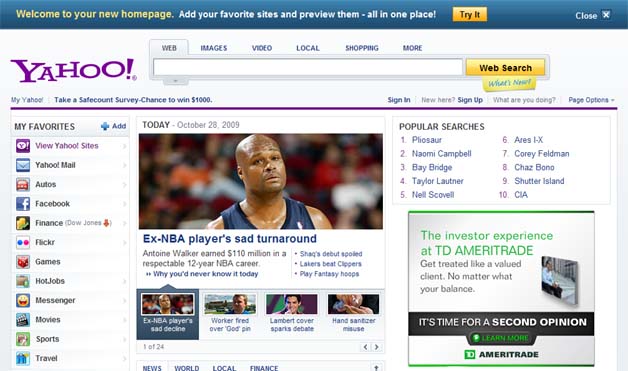
    The current top article on Yahoo’s homepage may be about a former NBA player’s "sad turnaround," but the story of the homepage’s recent overhaul is a happy one, according to Tapan Bhat.  Bhat shared some impressive statistics at Yahoo’s Analyst Day Meeting.

    Bhat is a senior vice president at Yahoo, in charge of both "Integrated Consumer Experience" and "Front Doors, Community, and Network Services," so the redesign was very much under his purview.  We wouldn’t be surprised if he’s given more power, too, on the basis of the following stats.

    Joseph Tartakoff wrote, "SVP Tapan Bhat said . . . that so far page views were up nine percent and time spent on Yahoo.com was up 20 percent."  Also, "The new page includes third-party ‘apps’ that users can add to the home page to get quick access to services from Yahoo and third-party sites – and Bhat said that 40 percent of new home page users were using between 6 and 11 of them."

    Then here’s one more interesting point: "As for monetization, Bhat said that the click-through rates on the main ad on Yahoo.com were up 10 percent."

    All in all, this represents an important success story for Yahoo; the company’s effectively demonstrated that it isn’t just running on autopilot until Microsoft swoops in.

    Related Articles:

    > Yahoo May Pursue Real-Time Search With OneRiot

    > Compete: Yahoo Stumbled In September

    > Yahoo Undergoes Another Exec Shuffle

  • Kojima Productions staff itching to work on the next ZOE

    When Hideo Kojima wrote on his blog, promising that he’ll work on the next installment to Zone of the Enders, interests piqued by the news were not …

  • Panic: UK file-sharers may well be disconnected from ISPs starting in 2011

    toweroflondon

    The ban hammer is about to smash UK file-sharers. Legislation there is set to take effect in April that would, as a last resort, kick illegal file-sharers off the Internet. Very exciting~!

    The deal is that the Government, ISPs, and intellectual property owners will work together to kindly remind you that not all forms of file-sharing are on the up and up. If they find you sharing something that you shouldn’t be, you’ll be sent a letter saying, essentially, “please stop.”

    You’ll recall this was a hot-button issue during that Digital Britain debate.

    That’s phase one. Authorities will check back one year later to see if the letters were effective in stopping illegal file-sharing. If it’s determined that the letters haven’t cut the piracy rate by 70 percent (man, set a high bar much?) then out comes the ban hammer.

    You’ll then receive up to two “please stop” letters before you’re disconnected from your ISP.

    All well and good, but wait till Brussels hears about this. Appeal, appeal, delay, appeal.


  • What If Microsoft Had Developed Twitter? (Continued)

    I got several good laughs out of Tsahi Levent-Levi’s speculative post “What If Microsoft Developed Twitter?” In it, he conjures up a Redmond-enhanced version of the microblogging platform that would look and work a little, er, differently from the one we’re using now. “You would have to sign a EULA for each tweet you send out,” he imagines. “You would have to reset your Twitter client every day,” he adds, and “you would have to get used to the blue tweet of death.” Here are four more attributes that we might expect from a Microsoft version of Twitter.

    An unabridged eBook version of “War and Peace” would pop up as you load the  necessary software libraries and security patches in preparation for your first tweet of the day:

    You would have the terms “Cancer” and “Hippie GPL Rubbish” emblazoned as watermarks on any tweet you send out on the topic of open source software:

    As daily software updates arrived, you would have two, and only two options: “Install” and “Remind Me Later:”

    Any attempts to use words such as “bang” or “bong” in tweets would be replaced with Bing:

    What other enhancements would Microsoft’s version of Twitter have?


  • As Expected, Mandelson To Introduce Plan To Kick File Sharers Off The Internet

    This should come as no surprise — as it was pretty clearly a foregone conclusion after his dinner with David Geffen, but UK Business Secretary Peter Mandelson (who prior to that dinner didn’t seem to care about this issue at all) has decided to totally ignore the Digital Britain report, as well as the widespread outcry from individuals and ISPs, and will implement a plan to kick file sharers offline using a “three strikes” system. While he says there will be an appeals process, there’s no indication that there will be a due process system that allows for innocence before guilt. Instead, it sounds like the other way around. It’s pretty clear, of course, that Mandelson was simply blowing smoke when he claimed he was merely asking for feedback around such an idea, rather than definitely endorsing it.

    In defending the new proposal, Mandelson continues to state things that just don’t make sense. He claims that he was “shocked” to learn that only one in twenty downloads were authorized, but fails to note that stat has little basis in reality. Meanwhile, he again insists that downloading is “economically unsustainable,” ignoring two recent studies (one from Harvard and one from the UK’s own PRS) showing that the overall music industry is growing. How is that economically unsustainable?

    But, honestly, the biggest issue is that he fails to address the huge question that I keep asking, and which no one wants to answer:

    How will kicking people off the internet get them to buy more product?

    That’s because there is no answer. Will it make some people participate less in file sharing? Perhaps — though, it’s likely to just drive more people further underground. But just because they stop file sharing it doesn’t mean that people will buy any more. In fact, continuing this war on music fans is only going to make people less interested in buying. This is exactly the opposite of what the music industry needs right now. Taking the war against consumers up a notch only ensures that they’re even less interested in giving any money to the entertainment industry. Instead, they’ll find those who treat them right and actually give them a reason to buy (rather than trying to limit them) to give their money to.

    Permalink | Comments | Email This Story


  • NASDAQ Launches Social Networking Site

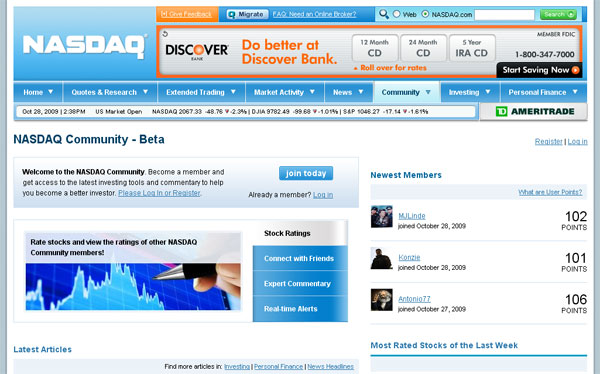
    NASDAQ, the world’s largest exchange company, has launched its own social networking site called NASDAQ Community, aimed at people in the financial sector.

    "NASDAQ Community promotes market transparency and investor education through active engagement among people with shared interests," said John Jacobs, Executive Vice 

    NASDAQ-Community
    NASDAQ-Community

    "With rich content and powerful tools, NASDAQ Community empowers investors — from sophisticated to novice — and enables them to interact in a variety of ways and become better investors. NASDAQ OMX is pleased to bring more innovation and greater transparency to the markets."

    Features of NASDAQ Community include:

        *   Create a profile and add friends;
        *   Rate stocks and connect with other members to
        *    view their stock picks and interests;
        *   Go beyond the data and gain investment insights with commentary from experts
        *   Find the latest news and community events;
        *   Follow favorite authors; and
        *   Ask other Community members questions about financial needs.
     

    >Social Networks Blamed For $2.25B In Lost Productivity

    > Making Money With Social Media Marketing

    > Using Facebook Traffic To Drive Brand Loyalty

  • CEOs Criticize Public Plan As Lawmakers Finalize Bills

    Several CEOs at large U.S. companies criticized the public insurance option as Congressional Democrats push to figure out which version should be included in their version of health reform legislation.

    Reuters: “Some of the nation’s largest companies pushed back against U.S. Democrats’ plans to deliver a government-run insurance option in a healthcare overhaul, decrying it as a step backward that would drive up costs for employers and their workers. … The Business Roundtable, comprised of chief executives at Verizon Communications (VN.N), JPMorgan (JPM.N), General Electric (GE.N), Wal-Mart (WMT.N) and other companies that together employ more than 12 million people, said the federal government is inefficient and would underpay providers. That would result in providers boosting prices for private insurers and employers, the group said on Wednesday” (Heavey, 10/28).

    The Hill: “Although the health insurance industry’s opposition to the public option has received the most attention, business and healthcare groups are practically unanimous in their opposition and have been since the beginning of the debate. Now that Congress is inching closer to final action, business groups are stepping up their messaging campaigns. The business community has become increasingly anxious as the prospects for the public option have improved on Capitol Hill. … Unlike the U.S. Chamber of Commerce, which is rolling out television ads to fight the public option, the Business Roundtable plans no so campaign” (10/28).

  • God of War III demo hitching a ride on District 9’s Blu-ray release

    It seems Sony is pulling out all the stops in order to get the God of War III demo out and into peoples’ PS3s. Those who don’t want to spring for…

  • Penyakit berbahaya atau bukan ?

    DOK, APAKAH PENYAKIT SAYA BERBAHAYA ?

    tidak_berbahaya Ketika seseorang sakit atau mengalami gangguan kesehatan, adakalanya ia bertanya-tanya dalam hati: “ bahaya atau tidak ? “ Pertanyaan senada kadang ditanyakan langsung kepada dokter yang memeriksanya di saat  berobat. Namun tak jarang ada yang menanyakan bahaya tidaknya penyakit melalui email atau melalui forum tanya jawab di internet seiring dengan makin berkembangnya informasi interaktif masalah kesehatan di internet. Pertanyaan ini sangat wajar. Siapa sih yang mau dihinggapi penyakit berbahaya ?

    Dalam  pelayanan medis dan komunikasi dokter-pasien, seorang pasien berhak mengetahui informasi tentang penyakit dan kondisi yang dialaminya, sedangkan seorang dokter berkewajiban memberikan informasi kepada pasiennya dengan cara yang “bijak”.

    Pada keadaan tertentu seorang dokter mungkin tidak sulit untuk memberi tahu kepada pasiennya bahwa penyakit yang diderita si pasien tidak berbahaya. Sebaliknya di saat yang lain, dimana kondisi pasien sudah pada fase terminal, bisa jadi seorang dokter merasa kesulitan untuk memberi tahu kondisi pasien dengan cara apa adanya. Menghadapi situasi semacam ini biasanya seorang dokter memilih jalan tengah, yakni memberi tahu keluarga dekat si pasien dengan cara yang “bijak” sembari memberi support untuk tetap berikhtiar.

    Ditinjau dari sudut pandang pasien, istilah “bahaya” barangkali bukan hanya berbahaya terhadap jiwa, langsung maupun tidak langsung, tapi mungkin dapat bermakna lain bergantung pada penyakit dan maksud penderita itu sendiri.

    Sebagai contoh, ketika seorang pria dewasa menderita Disfungsi Ereksi lantas menanyakan bahaya atau tidak terkait penyakitnya, tentu istilah “bahaya” yang ditanyakannya tidak berhubungan dengan keselamatan jiwa. Pada kasus ini, istilah “bahaya” mungkin dimaksudkan apakah nantinya “cucakrowo” masih mampu berkicau sambil mengepakkan sayap atau lunglai selamanya. Makna lain mungkin dimaksudkan apakah ia nantinya mampu memuaskan pasangannya dan memberikan keturunan atau tidak.

    Demikian pula misalnya ketika seorang gadis menanyakan bahaya tidaknya bekas cacar air di wajahnya. Pada contoh ini, istilah bahaya sangat mungkin berhubungan dengan “penampilan”.

    Lain lagi manakala seorang penderita Herpes zoster menanyakan bahaya tidaknya penyakit yang sedang dideritanya. Secara umum, pertanyaan “bahaya” mungkin dikaitkan dengan rasa nyeri yang ditimbulkan oleh Herpes zoster. Sedangkan secara khusus, bila Hepers zoster menyerang area wajah, khususnya area mata, pertanyaan “bahaya” barangkali berhubungan dengan efek terhadap fungsi penglihatan.

    Tatkala seorang ibu diberitahu bahwa anaknya menderita infeksi amandel (tonsilitis), boleh jadi istilah “bahaya” yang ada di benaknya dikaitkan dengan operasi atau tidak. *membahayakan isi dompet* :)

    Beberapa contoh kecil  di atas menunjukkan bahwa istilah “bahaya” yang digunakan seseorang terkait dengan penyakit yang sedang dideritanya, tidak selalu berhubungan dengan keselamatan jiwa. Istilah “bahaya” tersebut memiliki makna lebih luas, lebih bervariasi, bahkan adakalanya bersifat individual bergantung pada pelbagai faktor yang menyertainya.

    Menilik beragamnya maksud pertanyaan “bahaya” dari masing-masing pasien berkenaan dengan penyakitnya, seorang dokter dituntut untuk lebih “mengenal” para pasiennya agar informasi yang diberikan tidak meruntuhkan mental pasien. Jika tidak, “maksud baik” seorang dokter untuk memberitahu pasien dengan tujuan agar mengetahui penyakitnya, bukan tidak mungkin justru akan membuat pasien makin menderita sepulang dari ruang pemeriksaan dokter.

    Di media online, pertanyaan tentang “bahaya” tidaknya penyakit kerap diajukan oleh pengunjung. Hal ini sangat wajar mengingat begitu banyaknya informasi penyakit dan kesehatan bertebaran diinternet.

    Kadang seseorang merasa sangat khawatir hanya gara-gara membaca kalimat yang beraroma “menakutkan”, seperti: waspadaijangan remehkannol koma sekian persen berakhir dengan kematian … dan kata-kata bombastis sejenis yang bagi sebagian orang mengakibatkan tak dapat tidur semalaman.

    Salahkah ? Tidak. Keduanya tidak salah. Penulis artikel mungkin ingin mengajak pembaca untuk berhati-hati, sedangkan pembaca yang ketakutan juga tidak bersalah atas rasa takutnya.

    Lantas bagaimana jalan keluarnya ? Yang diperlukan menurut saya adalah dibukanya pintu dialog online, melalui email atau halaman tanya jawab (konsultasi atau apapun namanya) secara berkesinambungan agar dapat saling bertukar informasi secara “bijak”.

    Dibanding di ruang pemeriksaan dokter atau di praktek, dialog online bisa dibilang lebih sulit lantaran komunikasi antara pengunjung dan dokter dilakukan dengan “tidak saling berhadapan”. Berbeda dengan di ruang periksa, dimana seorang dokter sedikit banyak dapat menilai pasien sehingga lebih mudah memilih kalimat yang tepat dalam memberikan informasi.

    Bagimana pendapat pembaca ?

    Silahkan berbagi … :)

    :: :: :: posting menggunakan WLW :: :: ::

    Posted in Artikel, Health, Informasi, Kesehatan, Umum Tagged: Health, Informasi, Kesehatan, Komunikasi, Penyakit

  • Catan comes to iPhone

    catan One of my favorite games of all time, Catan, is now available as a $5 download for the iPhone and iPod touch. As board games go, The Settlers of Catan is a psycho-erotic thriller capable of hooking even the most un-hookable of gamers.

    Maybe “psycho-erotic thriller” isn’t the most accurate phrase. It’s a fun game, let’s leave it at that.

    Those of you who have never played Catan before may very easily pass this one by but those of you who are into the game and own an iPhone or iPod touch will have little reason not to purchase it for $5.

    It’s not without its drawbacks – there’s no Wi-Fi or internet-based multiplayer and the game board is downright tiny on the iPhone’s screen – but for five bucks, it provides a nice quick fix for Catan addicts in between real-life or Xbox Live rounds.

    Here’s a quick hands-on showcasing the interface and whatnot:

    Catan [iTunes via Pocket-lint]


  • 2010 National Arbor Day Poster Contest

    2010arborday
    2010 Contest Guidebook

    Deadline: March 11, 2010

    http://www.arborday.org/kids/postercontest/index.cfm


    Pennsylvania’s 2009 Arbor Day Winners:

    1st Place Winner: Nancy Duong, Henry A. Brown School

    2nd Place Winner: Gabby Wright, New Bloomfield Elementary School


  • MENC, Department of Education Make Plans to Spotlight Music in DC

    As part of continuing efforts to raise awareness of the need to support school music programs, MENC is working with Department of Education officials to launch a series of student performances on the plaza in front of the Department of Education building in Washington, DC.

    On October 16, MENC Executive Director John Mahlmann (right) and Education Secretary Arne Duncan attended the Principal’s Institute and Awards Banquet in Washington, DC, sponsored by the National Association of Secondary School Principals to honor the Principals of the Year. At the event, the two discussed developing plans for student performances at the Department of Education.

    The student performance initiative is supported by the SupportMusic coaliton, of which MENC and NAMM, the International Music Products Association are major sponsors.

    Elizabeth Lasko, October 28, 2009. © MENC: The National Association for Music Education

  • YouTube Launches Promoted Videos In Australia, Japan

    YouTube’s Promoted Videos program has spread again.  In addition to Canada, France, Germany, Italy, the Netherlands, Spain, the U.K., and the U.S., promoted videos are now available in Australia and Japan.

    If you’re not familiar with the Promoted Videos program, the following video does a pretty good job of explaining its purpose (odd motorcycle accident metaphor aside):

    As for what the effect of the expansion will be, a post on the YouTube Biz Blog explained, "This is great for content creators in Japan and Australia — who will now be able to drive views of their videos in-country — but it also makes it possible for our existing Promoted Videos advertisers to get their content in front of a truly global audience.  Anyone who runs a Promoted Videos campaign can choose to have their video promoted in any (or all) of these ten countries."

    And it’s reasonable to bet that the number of countries will soon increase.  The inclusion of nine nations (Promoted Videos launched in the U.S.) in two weeks’ time established quite a pace, after all, and with the holiday season almost here, YouTube has a special reason not to slack off now.

    Related Articles:

    > YouTube Videos In AdSense Could Drive Clicks

    > 35 Ways To Improve Your Online Video Performance

    > YouTube Strikes Deal With UK Broadcaster