Category: News

  • Quick Look: Creating and Using Site Specific Browsers

    ssb-intro

    The advent of the cloud over the past few years has meant that a lot of the tasks that we were used to doing on our Mac have now moved to the web. This brings with it a host of issues, from data ownership to reliability of services (see recent Sidekick fiasco) and whether the web can deliver a Mac-like experience.

    Putting all that aside, however, a more mundane problem is managing all of those sites and getting to them quickly and easily. Individual apps conveniently come with their own icon on your dock, web apps do not, forcing you to dig through the myriad of open tabs in your browser to find the app you need.If you’ve truly made the jump to cloud computing there is, thankfully, a better way: site specific browsers (SSBs). The basic idea is simple: Create a separate web browser, complete with its own icon on the dock, to browse to a single site. We’ve covered an excellent example of a site specific browser here on TAB in the past, Mailplane, which is used to access Gmail’s online interface.

    The beauty of an SSB is not only do you get the bonus of neatly having your own icon for a single web application, but it also allows that site to integrate with OS X more completely. For example you can have things like address book access and dock badges, all things that Mailplane does for Gmail.

    That’s great if you use Gmail, but what about all the other great web-based applications out there? Although there are not specific SSBs for things like Twitter, Google Calendar, Remember The Milk and other web services, there are two different programs that will let you take any web site and turn it into a site specific browser: Fluid and Prism. The major difference between the two is that Fluid uses Webkit to power its SSBs, while Prism uses the Gecko browser base that runs Firefox.

    fluid_screen

    Aside from these underlying technologies, the two programs offer remarkably similar functionality. Simply enter a web address, choose an icon (or just use the site favicon), and voila, a new program based on that site will be created for you. What’s more, each browser can accept various scripts to add functionality like a dock icon and even Growl notifications. You can even make an SSB your default email or RSS program.

    In many ways SSBs may represent the future of computing. Just look at Google’s upcoming Chrome OS, where the browser is the operating system. In such a situation it makes no sense to continue using the outdated system of web pages and browser bookmarks. When a website is a program unto itself you can argue that it deserves to be treated as one at the operating system level.


  • Spooky sounds from your Telecaster

    Do not adjust your computer because Bill Ruppert has put together a nice set of sound effects using only EHX pedals and some creativity. I love how he makes a clock sound with just the pick-up switch and then adds in some bells for spooky effect.

    You can see all of Bill’s gear here but I doubt we’ll be able to recreate his sweet tones without years of practice and fifty full listens to the Chilling, Thrilling Sounds of the Haunted House, an album that I used to own.


  • Hands on with the Motorola Droid: Sexy

    scaled.IMG_0140

    Here you are, friends and Romans, the Motorola Droid from Verizon, the phone you’ve been salivating over for the past few months. It’s now sitting quietly on the desk next to me, wondering where you are. The Droid wants you.

    After working with the Motorola Cliq and MotoBlur, Motorola’s own operating system, I had high to middling hopes for this phone. Looking at it now I’m happy to report that Verizon finally has an Android phone worth a second look.

    I need a little more time with the phone to offer my full level of adulation/excoriation, but so far I’ve noticed a few things:

  • Google Nagivation is an incredible addition to the Android family and looks great. The standalone Nav app guys need to worry.
  • The hardware is quite nice. The keyboard is spacious and easy to slide open.
  • There are none of the widgets that MotoBlur featured prominently including the Twitter widget that threatened to crash the phone.
  • The phone is very polished but the base of installed applications seems very sparse. After working with the Hero and the Cliq, you sort of expect all sorts of silly clocks and social networking apps. This has none of that.
  • It has the best start-up sound in the whole world.


  • More pics and facts about the new DROID by Motorola

    DROID by Motorola Dyn L Horiz

    Today is the International Day of the DROID. Well, not really, but Verizon did follow through and officially announced its new flagship Motorola Android device – DROID.

    Along with the official presser, Motorola was also kind enough to provide some glistening press shots of the DROID, “A no-compromise supergenius” as they like to call it, along with an official DROID by Motorola Fact Sheet (all after the jump).


  • Bad Vista-to-Windows 7 upgrade experiences #1: ‘Hosed’ Intel SSDs

    By Scott M. Fulton, III, Betanews

    Although we had good reason to expect that most folks’ experiences with Windows 7 upgrades this past week would be, as we put it, “without the crap,” the exceptions are starting to show up. One of the more serious cases involves Intel, which has withdrawn its latest solid-state drive firmware update after multiple reports from disgruntled users of complete storage system failure following their Windows 7 upgrades.

    The new firmware, along with Windows 7, was supposed to support a new internal file management methodology called TRIM. Its purpose was to compensate for a problem typical of memory-based storage, as opposed to traditional magnetic disks: Since memory systems must keep track of their contents even some of those contents aren’t really in use, over time, SSDs’ performance can lag. While traditional disks don’t have to retain a memory of the contents of sectors pointing to “deleted” files, SSDs do…and they can’t wipe the contents of those sectors individually. Instead, they have to wait until entire blocks become disused — which happens less and less often as drives become more and more fragmented. TRIM was supposed to overcome that deficiency with a kind of self-optimizing mechanism, letting SSDs wipe blocks more often, thus overcoming lags and keeping performance levels high over time.

    The trouble appears to be that something in the Windows 7 RTM distribution wasn’t ready for TRIM after all. Though Windows 7 appeared to work fine just after installation, soon afterwards, Intel SSD owners were finding they couldn’t sustain a reboot.

    “I removed the drive and put it in an external case and went to the desktop. Guess what, the partition was raw!” reported one contributor to Intel’s support forum early this morning. “Deleted the partitions and reinstalled Windows, and that seemed to do the trick. After an hour or two, a message came up and said that my drive was about to fail and S.M.A.R.T. reported it bad!”

    That contributor was joined by a flood of similar reports all over the major hardware forums. On HardForum Monday, there was this: “I’ve scared myself off of SSDs for a few years and would probably never touch an Intel SSD again. I’ll gladly take a 5% real-world performance hit for a drive that doesn’t have a history of bricking itself when a firmware update is applied.”

    The firmware update was part of a comprehensive SSD Toolkit from Intel released just last Monday, which had promised to boost write speeds by as much as 40%. As company marketing director Pete Hazen said at the time, “We are encouraging our 34nm customers to download the new firmware update today. Not only will Windows 7 users receive the performance enhancements of the Trim command, but so will our Windows XP and Vista users.”

    Reviewers of the TRIM firmware appeared to confirm that figure and did not report problems. One of those positive reviewers was Anandtech, which was also first to update its TRIM review with Intel’s comment that it was pulling the firmware update due to problems. Up to that point, commenters’ complaints had focused on Intel’s lack of willingness to extend TRIM support to owners of older SSD models, which cost much more in the early going than they do now. As one contributor noted, “I don’t think that you should lose the wiper and TRIM support for being an early adapter, it does not make sense.”

    PC Perspective’s Allyn Malventano believes the drive-hosing issue must not be widespread, noting it did not happen to him during his review, which involved an Asus P6T motherboard with an Intel Core i7 920 CPU.

    Copyright Betanews, Inc. 2009


    Add to digg
    Add to Google
    Add to Slashdot
    Add to Twitter
    Add to del.icio.us
    Add to Facebook
    Add to Technorati


  • Monomoy-Backed Fortis Plastics Adds On

    Monomoy Capital Partners has acquired the assets and operations of Nypro Chihuahua, a 100,000 square foot plastic molding facility located in the largest industrial corridor near the border between the United States and Mexico. No financial terms were disclosed. Nypro Chihuahua will operate as part of Fortis Plastics LLC, an acquisition platform formed by Monomoy in 2007, via acquisitions from Leggett & Platt and Atlantis Plastics.

    PRESS RELEASE
    Monomoy Capital Partners, L.P., a New York private equity fund that makes controlling investments in middle market companies, announced today that it has acquired the assets and operations of Nypro Chihuahua, S. De R. L. De C.V. from Nypro, Inc. Terms of the transaction were not disclosed.

    The Chihuahua acquisition was completed under Monomoy’s Fortis Plastics, LLC platform, a leading plastic injection and extrusion business that Monomoy formed in late 2008 through acquisitions from Leggett & Platt, Inc. and Atlantis Plastics, Inc. Fortis currently operates a resin compounder and eight regional molding facilities, including a large and growing operation in Ramos, Mexico.

    Nypro Chihuahua operates a state-of-the-art, 100,000 square foot plastic molding facility located in the largest industrial corridor near the border between the United States and Mexico. Fortis will focus on expanding the Chihuahua operation by extending its products and capabilities to Fortis’ current customer base of appliance, medical device, building products and furniture makers. The Chihuahua acquisition also provides Fortis with high-quality painting, decorating and clean room capabilities.

    “We are extremely excited about this transaction,” said Joseph Mallak, the Chief Executive Officer of Fortis. “The Chihuahua operation will increase the size of our growing Mexican platform, provide us with a great facility located in an important Mexican manufacturing zone and further differentiate Fortis in the marketplace. The acquisition will help current and future customers consolidate their supply chains and allow Fortis to continue its growth in the southern United States, Mexico and Latin America.”

    The Chihuahua transaction marks the third Monomoy acquisition for its Fortis platform over the past twelve months. “Fortis has grown its Mexico operation substantially over the past year despite a difficult economic environment for all manufacturers. The Chihuahua acquisition will allow Fortis to capitalize on this success and provide its customers with stronger options as the plastic molding industry consolidates,” said Mayank Singh, a Monomoy Vice President.

    About Monomoy Capital Partners, L.P.

    Monomoy Capital Partners, L.P. is a $280 million private equity fund that makes controlling investments in middle market companies. The Fund has completed 25 transactions in four years in the smaller end of the middle market and currently owns 10 business that collectively employ more than 5,000 people. Monomoy implements customized business improvement programs in all portfolio companies that reduce operating expenses, increase profitability and encourage meaningful growth. For additional information on Monomoy and its portfolio companies, please visit www.mcpfunds.com.

    About Fortis Plastics, LLC

    Fortis Plastics, LLC is a leading manufacturer of injection molded and extruded plastic parts for a variety of industries, ranging from appliances and power tools to furniture and medical devices. Fortis currently employs 950 team members at facilities located in Fort Smith, Arkansas, Carlyle, Illinois, Poplar Bluff, Missouri, Henderson, Kentucky, Jackson, Tennessee, South Bend, Indiana, Houston, Texas, Ramos, Mexico and Chihuahua, Mexico. Fortis provides its customers with a single solution for tooling, molding and material compounding. For additional information on Fortis, please visit www.fortisplasticsgroup.com.

    ShareThis


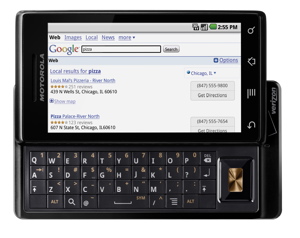
  • Motorola and Verizon unveil the Droid, Google Maps navigation

    By Tim Conneally, Betanews

    Verizon Droid by Motorola, open

    After a long period of rumors, leaks and teaser marketing campaigns, Verizon and Motorola have officially announced Droid, Verizon’s first Android smartphone, and the first Android device running Eclair. It will be available on Friday, November 6, for $199 with a two year contract and mail-in rebate.

    Motorola’s Contribution:

    In addition to pricing and availability, the complete list of specs that was leaked a bit early (and subsequently yanked) has been published by Motorola. It can now officially be said that Droid is nearly identical in size to the iPhone 3G S, with a screen 0.2″ larger, and a body only 0.02″ thicker despite having a full QWERTY keyboard.

    The slim Droid has a 3.7″ (480×854) WVGA capacitive touchscreen, and includes a 16 GB memory card which can be replaced by microSD cards up to 32 GB. Today’s announcement unfortunately does not include processor speed (listed as 550 MHz in leaks) or clarify whether it includes a discrete graphics chip as many had speculated.

    Verizon Droid by MotorolaWhat it does include is EV-DO rev. A 3G, 802.11 b/g Wi-Fi, Bluetooth 2.1 +EDR, a 5 megapixel autofocus camera with dual LED Flash and digital image stabilization and DVD-quality video recording, aGPS and standalone GPS, a 3-axis accelerometer, and 6.4 hours of talk time or 11.25 days of standby.

    Google’s Contribution:

    With yesterday’s launch of Eclair in the Android SDK, we got to see a number of the new APIs made available to developers in addition to some interface and support improvements that Droid will offer, such as HTML5 and Flash 10.

    But we kept seeing “navigation by Google Maps” in early Droid announcements, with little information as to what this represented. Today we’ve found out that Droid will launch with free navigation from the new Google Maps for Android 2.0 beta. It combines “plain English” voice command, turn-by-turn directions and its unique Street View perspective which is unlike any other GPS device currently available.

    Verizon’s Conribution

    In addition to providing the 3G Network infrastructure that Google CEO Eric Schmidt is so fond of, Verizon is equipping the Droid with Verizon Visual Voice Mail. When T-Mobile launched the G1, visual voicemail was not an option until third parties such as YouMail and Phonefusion made apps providing the functionality. It was not until considerably later that T-Mobile Visual Voicemail was an option presented to Android early adopters.

    Droid will be available exclusively at Verizon Wireless stores and through Verizon’s Web store on Friday, November 6.

    Copyright Betanews, Inc. 2009


    Add to digg
    Add to Google
    Add to Slashdot
    Add to Twitter
    Add to del.icio.us
    Add to Facebook
    Add to Technorati


  • It’s a desk! It’s a tricycle! It’s $500!

    sdesk

    I’m a simple man. I don’t ask for much, I try to do the right thing. So why must everything I want be priced at $500? Take this mobile desk, for example: part tricycle, part desk, all awesome (except the price tag, of course).

    Andrew Liszewski of OhGizmo! says that he wants this thing for his next trade show. I know exactly how he feels. I’d trade a little bike seat chaffing for swollen, blister-ridden feet at CES this January. And there’d be the added bonus of impromptu desk races every time the two of us bumped into each other on the show floor.

    There’s a two-person version available for $1000 as well, which offers a savings of zero dollars over the single version yet takes up more space. And if you have a big person and a small person trying to maneuver it around, it’d probably just keep spinning in circles due to the variation in available leg thrusting power.

    Mobile Desk [OpulentItems.com via OhGizmo!]


  • Google Delivers GPS for Android 2.0 Devices

    Google has launched Google Maps Navigation for Android 2.0 devices in beta. This acts as a GPS navigation system with 3D views, turn-by-turn voice guidance, and automatic rerouting.

    "But unlike most navigation systems, Google Maps Navigation was built from the ground up to take advantage of your phone’s Internet connection," says Google Software Engineer Keith Ito.

    Because of that Internet connection, Google provides seven features that are available:

    1. The most recent map and business data
    2. Ability to search in plain English
    3. Ability to search by voice
    4. Traffic View
    5. Ability to search along a route
    6. Satellite View
    7. Street View

    The following video demonstrates how Google Maps Navigation functions:

    GPS users may find the "search along route" feature to be particularly helpful. It is designed to let you search along your route to give you results that will keep you near your path. You can search for specific businesses by name or type and turn on popular layers such as gas stations, restaurants or parking. Since Google will provide the most recent map and business data, this is likely to be a more efficient tool than similar options from other GPS systems.

    Verizon’s Droid is the first phone to have the Google Maps Navigation and Android 2.0. Google Maps Navigation is only available in the U.S. currently. More information on the feature can be found here.

    Related Articles

    > Google Makes Biggest Design Changes to Maps Yet

    > Google Updates Maps with New Dataset

    > Google Revamps Mobile Local Search Experience

  • Commanders note security gains in southern Iraq

    The security situation in southern Iraq is stable, and American and Iraqi
    commanders said they expect security gains in the region to
    continue…

  • Mississippi Guardsmen inspects excess equipment

    In preparation for the drawdown of U.S. forces and equipment from Iraq, the
    commander of a Mississippi Army National Guard battalion conducted an excess
    property inspection here earlier this month…

  • Patriot Academy students experience extreme field trip

    High school students from the National Guard Patriot Academy recently took a
    break from the books and embarked on their first field training exercise at the
    ranges here…

  • Timing is everything when deploying

    The Department of Defense recently announced that about 3,000 Iowa Army National
    Guard Soldiers are on alert as part of an upcoming rotation to
    Afghanistan…

  • Wisconsin Guard transfers properties to Iraqi government

    With a few pen strokes, hugs and two very large keys, the Wisconsin Army National
    Guard’s 32nd Infantry Brigade Combat Team officially transferred two large
    properties inside Baghdad’s International Zone back to the Iraqi
    government…

  • Celtic Therapeutics Raises $100 Million from PPD

    Celtic Therapeutics, a private equity firm formed to acquire and invest in a diversified portfolio of 10 to 15 novel therapeutic product candidates, has received a $100 million investment commitment from PPD Inc. (Nasdaq: PPDI).

    PRESS RELEASE

    PPD, Inc. (Nasdaq: PPDI) today announced it has signed an agreement to invest $100 million in Celtic Therapeutics Holdings L.P., an investment partnership organized for the purpose of identifying, acquiring and investing in a diversified portfolio of 10 to 15 novel therapeutic product candidates. Celtic Therapeutics will focus on mid-stage drug development candidates that have progressed through human proof-of-concept studies and are targeted to address unmet medical needs, seeking to advance development of these candidates to the next key product milestone, usually the beginning or end of Phase III.

    This investment in Celtic Therapeutics is intended to set the stage for a strategic alliance between Celtic Therapeutics and PPD. Both organizations are committed to forging a new framework for timely, cost-efficient drug development. As a result, PPD believes these efficiencies will lead to higher quality data and overall markedly reduced timelines. The goal of the alliance is to bring the best products to market more quickly to meet unmet needs of patients. PPD believes it will benefit Celtic Therapeutics’ mid-to-late stage pipeline across the board.

    “Built upon the leadership and track records of Stephen Evans-Freke and Peter B. Corr, Celtic Therapeutics has a team of seasoned drug development professionals we believe is capable of building one of the most highly valued late-stage portfolios in the global biomedical industry,” said Fred Eshelman, executive chairman of PPD. “As pharmaceutical companies continue to face extraordinary regulatory and market-related challenges in creating and expanding their drug development pipelines, Celtic has developed an innovative, product-focused investment model to address these challenges.” 

    Stephen Evans-Freke, Celtic Therapeutics’ co-founder and general partner, said, “It is our great pleasure to welcome PPD as a partner. In particular, we are delighted one of the most forward-thinking clinical research organizations has chosen to join forces with us.”

    Peter B. Corr, Celtic Therapeutics’ co-founder and general partner, added, “The present approach to drug development has become too expensive and time consuming. We look forward to working innovatively with PPD on new approaches for rapid planning, decision-making and execution of our drug development programs worldwide. We are delighted Fred Eshelman and his team will be working with us in this endeavor.”

    PPD anticipates it will account for this investment under the equity method of accounting.
     
    PPD is a leading global contract research organization providing discovery, development and post-approval services as well as compound partnering programs. Our clients and partners include pharmaceutical, biotechnology, medical device, academic and government organizations. With offices in 38 countries and more than 10,000 professionals worldwide, PPD applies innovative technologies, therapeutic expertise and a commitment to quality to help its clients and partners maximize returns on their R&D investments and accelerate the delivery of safe and effective therapeutics to patients. For more information, visit our Web site at http://www.ppdi.com.

    ShareThis


  • DOE to provide bridge funding for cutting-edge research

    The Department of Energy (DOE) is awarding 37 research grants totaling $151 million for cutting-edge concepts such as bacteria that will produce gasoline, enzymes that will capture carbon dioxide to counter global warming, and batteries cheap enough to power solar energy through the night. Most of the radical proposals will probably fail, but a few could have “a transformative impact,” according to DOE Secretary Steven Chu. The money will go for projects at all stages of development, including some that exist simply as good ideas, Chu says. The grants to small businesses, educational institutions, and a few corporations may support some ideas until VCs or major companies pick them up. The effort, directed by the Advanced Research Projects Agency-Energy (ARPA-E), is modeled on the Department of Defense (DOD) program DARPA, which helped commercialize microchips and the Internet and helped develop body armor and other high-tech products. DARPA is known for quick decisions and long-shot bets — an approach seldom associated with the DOE.

    In the initial round, the grants average $4 million. One is going to researchers at the University of Minnesota who are developing one organism that uses sunlight to convert carbon dioxide into sugars and another that converts the sugars to gasoline and diesel. The two can live in a “co-culture” in a thin latex film, according to Lawrence P. Wackett, professor of biochemistry at U-Minn, although much research remains. “A venture capital group might say it’s a little early for them,” Wackett says. “It’s not all worked out, but that’s the spirit of ARPA-E.” A second grant is going to a group led by the Massachusetts Institute of Technology that is seeking to develop an all-liquid metal battery. The technology could smooth out the intermittent flow of power from sources like windmills and solar cells — displacing sources that emit heat-trapping gases like coal, oil, or gas. The DOE sifted through 3,600 preliminary proposals and selected 300 to be developed into fuller proposals before choosing those to finance in the first round. With only about 1% of the proposals receiving money, the DOE might decide to arrange a “fair” at which VCs could assess other proposals, Chu says.

    Source: The New York Times


  • Vitamin Shoppe Jumps In IPO Debut

    NEW YORK (Reuters) – Vitamin Shoppe Inc (VSI.N) shares soared in their first trading session after the health supplement retailer’s IPO priced above expectations and became the first U.S. retailer to go public in two years.

    Its shares were up 16 percent to $19.67 on the New York Stock Exchange, after rising as much as 19 percent shortly after the opening bell.

    Vitamin Shoppe sold 9.1 million shares for $17, more than the expected range of $14 to $16. The chain will get net proceeds of $121 million from the IPO which it will use for the redemption of preferred shares and paying down some of its debt.

    Vitamin Shoppe, a North Bergen, New Jersey-based operator of 434 health supplement stores in the United States, became the first brick-and-mortar retailer to go public since the Oct. 2007 IPO by beauty products chain Ulta Salon, Cosmetics & Fragrance Inc (ULTA.O).

    Vitamin Shoppe’s sales rose at an annual clip of 11.3 percent between 2005 and 2008, when they reached $601.5 million. During that time, it opened 171 new stores, according to its prospectus. The company has been profitable since 2006.

    In its prospectus, Vitamin Shoppe estimated it could eventually reach 900 stores in the United States.

    The Vitamin Shoppe IPO is being managed by JP Morgan, Bank of America Merrill Lynch and Barclays Capital. The underwriters will have the option of buying another 1.4 million shares from Vitamin Shoppe’s selling shareholders. (Reporting by Phil Wahba; Editing by Derek Caney)

    ShareThis


  • Strato Auction Down to Three, Bridgepoint In Lead

    (Reuters) – Three bidders remain in the auction of German web hosting firm Strato, which has been put up for sale by German phone company freenet AG (FNTGn.DE), two banking sources said on Wednesday.

    Freenet said in June it hopes to raise between 300 million euros ($445.1 million) and 400 million from the disposal.

    Private equity firm Bridgepoint Capital is still in the frame along with two trade buyers, the bankers said.

    German daily Financial Times Deutschland earlier reported without citing sources that Deutsche Telekom AG (DTEGn.DE), freenet shareholder United Internet AG (UTDI.DE) and Bridgepoint were among those bidding.

    A bank meeting was held earlier in October about a possible club loan financing to back a deal.

    Strato is a well known company in Germany and banks are willing to provide financing, one of the sources said.

    Freenet wants to conclude the sale this year and is aiming to sign the deal by the end of November, Freenet’s CEO Christoph Vilanek told Reuters in an interview. [ID:nLR448795]

    Strato’s earnings before interest, tax, depreciation and amortisation (EBITDA) are able to support leverage of around three times, a banking source said previously.

    Freenet became Germany’s third-largest mobile phone operator after taking over Debitel for 1.63 billion euros in April 2008, in line with a strategic focus on its mobile business. (Reporting by Alasdair Reilly & Zaida Espana; Editing by David Holmes) ($1=.6740 Euro)

    ShareThis


  • Scientists oppose UK plan to fund research according to economic value

    Hundreds of scientists, including six Nobel prize winners, are campaigning against plans in the U.K. to rate and fund university research according to its potential economic impact. The researchers say that many groundbreaking discoveries achieved in the past would not have survived the new test set in the plan, known as the Research Excellence Framework (REF), which was recommended by the Higher Education Funding Council for England. Under the plan, 25% of research funding would be awarded on the basis of economic and social impact, and the panel of 14 members who would examine research plans would include only three academics. More than 200 chemists, physicists, and other scientists say the measures will deny funding for the kind of “blue-sky thinking” that led to the discovery of DNA, X-rays, and penicillin. “The REF proposals are founded on a lack of understanding of how knowledge advances,” according to a statement signed by the scientists. “It is often difficult to predict which research will create the greatest practical impact. If implemented, these proposals risk undermining support for basic research across all disciplines and may well lead to an academic brain drain to countries such as the United States that continue to value fundamental research.” The statement adds, “We, therefore, call on the U.K. funding councils to withdraw the current REF proposals and to work with academics and researchers on creating a funding regime which supports and fosters basic research in our universities and colleges rather than discourages it.”

    Source: Times Online

  • Buyout Firms Jostle for Discount Retailer Matalan

    LONDON (Reuters) – Private equity firms are vying to get on a shortlist of potential buyers for discount retailer Matalan, which could fetch up to 1.5 billion pounds ($2.46 billion), sources familiar with the matter said.

    European buyout house CVC kicked off interest in the retail empire majority-owned by founder John Hargreaves and has since been followed by other private equity suitors, including TPG and Cinven, sources said.

    Advent International, whose investments include British budget store chain Poundland and German fashion retailer Takko, is also hoping to make it on the shortlist, another source said.

    The buyout firms and Matalan declined to comment.

    Matalan has not kicked off a formal process but has asked long-term adviser PWC to investigate a possible sale, which could see a short field of potential buyers assembled.

    “(PWC) wants to invite people into quite a tight process,” said a source, adding he expected a sale to kick off this quarter.

    Despite the flurry of interest from buyout houses, some were sceptical the business could achieve the 1.5 billion pound valuation. A source close to one of the potential bidders said the figure was too high.

    Bankers expect Blackstone (BX.N) and KKR will be interested in the business. Both firms declined to comment.

    PWC confirmed it was working on a possible sale but declined to comment on the process. (Additional reporting Victoria Howley; editing by Jon Loades-Carter) ($1=.6107 Pound)

    ShareThis