Category: News

  • Guns in the Capital City

    Tim Lynch

    During his news conference yesterday, President Obama said he was interested in more firearms research and warned that those who opposed his legislative agenda might try to “gin up fear.”  Those are interesting claims.  Let’s take a brief look at some recent history here in the District of Columbia.

    In 2007, when a federal appellate court ruled that DC’s strict gun control laws were unconstitutional, then-Mayor Adrian Fenty told reporters he was “outraged.”  The idea that DC residents could keep a gun in their home for self-defense, he feared, would bring more crime and violence.  Mayor Fenty and the city’s lawyers appealed the Heller case to the Supreme Court, but lost.

    It’s been several years since that landmark legal battle – so what happened?  

    In yesterday’s Wall Street Journal, a former DC prosecutor wrote:

    Since the gun ban was struck down, murders in the District have steadily gone down, from 186 in 2008 to 88 in 2012, the lowest number since the law was enacted in 1976. The decline resulted from a variety of factors, but losing the gun ban certainly did not produce the rise in murders that many might have expected. The urge to drastically restrict firearms after mass murders like those at Sandy Hook Elementary School last month and in Aurora, Colo., in July, is understandable. In effect, many people would like to apply the District’s legal philosophy on firearms to the entire nation. Based on what happened in Washington, I think that would be a mistake. Any sense of safety and security would be a false one.

  • NFC on BlackBerry Devices: Futuristic and Feature-rich

    NFC on BlackBerry

    Ever since the introduction of the first BlackBerry devices equipped with Near Field Communication (NFC) technology, we’ve enjoyed seeing how people are using NFC in the real world. Whether NFC is used as part of a mobile payment solution, to interact with a book, or as a security card, there is little doubt that the technology is becoming widely adopted. Even just this week our Secure Element Manager (SEM) solution for NFC payments was approved by Visa – a clear sign the industry is getting behind NFC.

    These case studies are all well and good, but I still have friends who ask me, “Why would I even need NFC on my smartphone? Does it do anything cool?” It’s a fair question. While there are more and more devices running NFC, the adoption of this or any new technology can happen gradually. Take Bluetooth for example. I remember the early days of Bluetooth, when it was (anecdotally) confusing for a lot of people I know. In the mobile and desktop space Bluetooth was a check box in the selling features category. It wasn’t until consumers and the industry really got behind it and understood how it was useful that it took off. Now you see Bluetooth everywhere; in mobile accessories, smartphones, and even cars.

    We continue to see the infrastructure pieces coming together that are making NFC solutions simpler and more viable to the mass market. Like Bluetooth before it, I predict NFC will improve the way people interact with their devices, making everything from exchanging contact information, files and making payments as simple as tapping two devices or tags together.

    Pretty cool, right? Also keep in mind that NFC is still growing as a technology so there are uses coming that we may not have even thought of yet. Where will NFC on your BlackBerry device take you?

    We’re always on the lookout for new and fun uses for NFC, so please feel free to share your NFC story or feature in the comments below.

  • Countdown to Affordable Health Insurance

    Note: This post was originally published on the HealthCare.gov blog. To see the original post, please click here.

    January is the perfect month for looking forward to new and great things around the corner.

    I’m feeling that way about the new Health Insurance Marketplace. Anticipation is building, and this month we start an important countdown, first to October 1, 2013, when open enrollment begins, and continuing on to January 1, 2014, the start of new health insurance coverage for millions of Americans. In October, many of you’ll be able to shop for health insurance that meets your needs at the new Marketplace at HealthCare.gov.

    This is an historic time for those Americans who never had health insurance, who had to go without insurance after losing a job or becoming sick, or who had been turned down because of a pre-existing condition. Because of these new marketplaces established under the Affordable Care Act, millions of Americans will have new access to affordable health insurance coverage.

    Over the last two years we’ve worked closely with states to begin building their health insurance marketplaces, also known as Exchanges, so that families and small-business owners will be able to get accurate information to make apples-to-apples comparisons of private insurance plans and, get financial help to make coverage more affordable if they’re eligible.

    That is why we are so excited about launching the newly rebuilt HealthCare.gov website, where you’ll be able to buy insurance from qualified private health plans and check if you are eligible for financial assistance — all in one place, with a single application. Many individuals and families will be eligible for a new kind of tax credit to help lower their premium costs. If your state is running its own Marketplace, HealthCare.gov will make sure you get to the right place.

    read more

  • New From NAP 2013-01-17 10:45:01

    Prepublication Now Available

    For many Americans who live at or below the poverty threshold, access to healthy foods at a reasonable price is a challenge that often places a strain on already limited resources and may compel them to make food choices that are contrary to current nutritional guidance. To help alleviate this problem, the U.S. Department of Agriculture (USDA) administers a number of nutrition assistance programs designed to improve access to healthy foods for low-income individuals and households. The largest of these programs is the Supplemental Nutrition Assistance Program (SNAP), formerly called the Food Stamp Program, which today serves more than 46 million Americans with a program cost in excess of $75 billion annually. The goals of SNAP include raising the level of nutrition among low-income households and maintaining adequate levels of nutrition by increasing the food purchasing power of low-income families.

    In response to questions about whether there are different ways to define the adequacy of SNAP allotments consistent with the program goals of improving food security and access to a healthy diet, USDA’s Food and Nutrition Service (FNS) asked the Institute of Medicine (IOM) to conduct a study to examine the feasibility of defining the adequacy of SNAP allotments, specifically: the feasibility of establishing an objective, evidence-based, science-driven definition of the adequacy of SNAP allotments consistent with the program goals of improving food security and access to a healthy diet, as well as other relevant dimensions of adequacy; and data and analyses needed to support an evidence-based assessment of the adequacy of SNAP allotments.

    Supplemental Nutrition Assistance Program: Examining the Evidence to Define Benefit Adequacy reviews the current evidence, including the peer-reviewed published literature and peer-reviewed government reports. Although not given equal weight with peer-reviewed publications, some non-peer-reviewed publications from nongovernmental organizations and stakeholder groups also were considered because they provided additional insight into the behavioral aspects of participation in nutrition assistance programs. In addition to its evidence review, the committee held a data gathering workshop that tapped a range of expertise relevant to its task.

    [Read the full report]

    Topics: Food and Nutrition

  • How NPR Lets You Know Which Political Philosophies Are Acceptable

    Michael F. Cannon

    NPR asked libertarian, vegan, author, and Whole Foods CEO John Mackey whether ObamaCare is a form of socialism. Mackey responded, thoughtfully:

    Technically speaking, it’s more like fascism. Socialism is where the government owns the means of production. In fascism, the government doesn’t own the means of production, but they do control it — and that’s what’s happening with our health care programs and these reforms.

    Mackey then discussed how Whole Foods is working with Michelle Obama to improve Americans’ diets. The story on NPR’s web site closes with this paragraph:

    So our question to you, dear readers, is this: How big a role does a business leader’s personal philosophy play in your decision to buy products from his or her company? Tell us in the comments section below.

    That’s funny. NPR didn’t ask its dear readers to comment on the politics of health insurance giant CIGNA’s CEO after he praised the Supreme Court’s decision not to strike down the law, or said, “I don’t believe focusing on repeal right now is in anybody’s best interest.” Or on Aetna’s CEO after he advocated tax increases and gobbling up as many ObamaCare subsidies as his company could. Hmm.

  • Dollars Per Vote in the Presidential Election

    David Boaz

    There’s been a lot of talk about the high cost of the 2012 election, with both major candidates spending more than a billion of dollars once affiliated groups are included. Some people find that too much. Others point out that Americans spend that much every year on potato chips, and surely deciding who will lead the United States government is at least that important.

    And of course the bigger amounts are government spending. When politicians vote to give money to students, the elderly, farmers, automobile companies, defense contractors, and other voting blocs, political considerations are certainly part of the decision-making process. When Republicans vote for $60 billion in “Hurricane Sandy recovery aid,” including money for Alaskan fisheries and activist groups, aren’t they buying votes? 

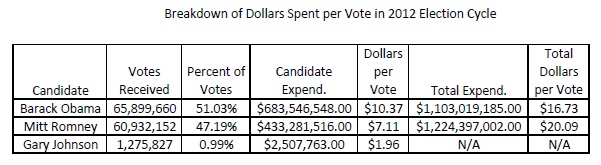
    But for the moment, let’s take a look at how much the candidates did spend, and how much they got for it. I’ve added Libertarian nominee Gary Johnson to the usual Obama-Romney comparison to get some perspective.


    The vote totals are from Wikipedia. Spending figures for the Democratic and Republican candidates and for Johnson are from OpenSecrets.org. 

    So the first thing we notice is that Obama and Romney spent respectively $10 and $7 per vote, while Johnson spent less than $2. But party and outside groups roughly doubled spending for the major candidates. More money was spent on behalf of Romney, but presumably money spent by groups other than the official campaign is less efficient, so that their total expenditures were effectively similar. And we can only wonder how much of “the libertarian vote” a Libertarian Party candidate might pick up if he had enough money to be heard.


  • A Constrained Gun Control Agenda

    Caleb O. Brown

    We didn’t get the “Andrew Shepherd moment,” a neat parallel between Obama’s gun-control newser and Michael Douglas in The American President confidently declaring that he’s going to “get the guns.” That the faux President made that pledge just moments after confidently affirming his membership in the ACLU (!) shows just how much the Second Amendment debate has changed since the Heller decision in 2010.

    The President’s proposed gun restrictions show some recongition that his agenda is constrained by the Constitution. Tim Lynch and I discuss President Obama’s gun control agenda in this short video:

    More analysis from Ilya Shapiro here. Audio-only version of the above video available here.

  • Federal Assets Above and Below Ground

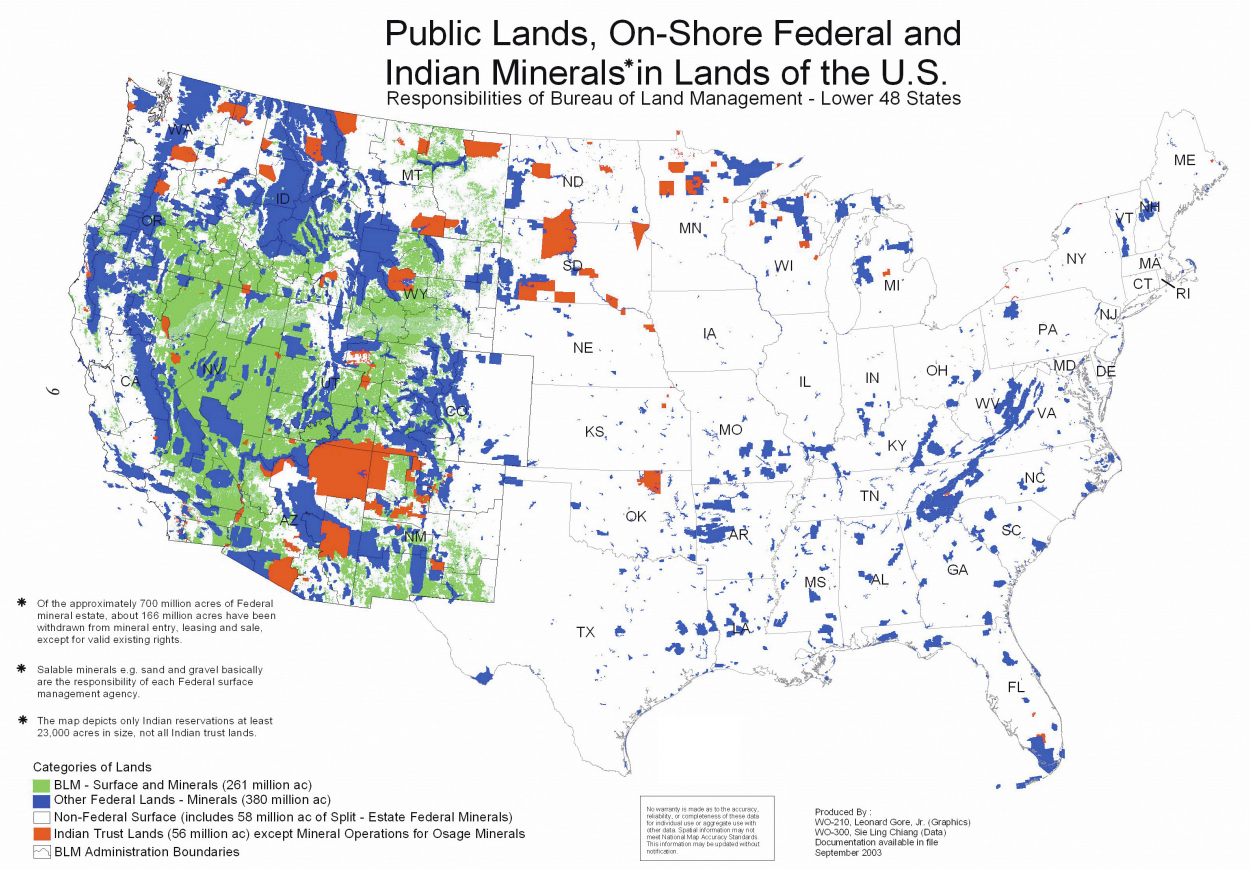
    The federal government owns a great deal of valuable assets both above and below ground. The above ground assets include buildings, lands, roads, railroad infrastructure, levees, dams, and hydroelectric generating facilities, to name just a few, many of which are underutilized. Below the ground, the federal government owns the rights to mineral and energy leases, from which they receive royalties, rents, and bonus payments.

    Federal real property totals over 900,000 assets with a combined area of over 3 billion square feet and more than 41 million acres of land. Additionally, the federal government owns over 600 million acres of lands and minerals onshore, and owns or manages a total of approximately 755 million acres of onshore subsurface mineral estate.  Offshore, the federal government owns some 1.76 billion acres of lands and mineral estate, extending out 200 nautical miles from our shores.  The federal government’s total mineral estate holdings are therefore about 2.515 billion acres of lands.  Thus, the federal government’s mineral estate land holdings surpass the total surface land area of the nation of Canada.   These holdings, as we will see, are vastly underutilized.
    Screen Shot 2013-01-16 at 5.22.33 PM

    (Click image for larger view)

    Source: Bureau of Land Management, http://www.blm.gov/public_land_statistics/pls11/pls1-3publandsmap_11.pdf

    In fiscal year 2009, federal agencies reported 45,190 underutilized buildings, an increase of 1,830 underutilized buildings from the previous fiscal year. In fiscal year 2009, these underutilized buildings accounted for $1.66 billion in annual operating costs, according to the General Accounting Office (GAO). The majority of federally owned and leased space is held by the Departments of Defense and Veterans Affairs, the U.S. Postal Service, and the General Services Administration (GSA).[i] For example, the federal government’s landlord, the GSA, owns or leases 9,600 assets with more than 362 million square feet of workspace. According to the GSA, in a 2009 report, almost 40 percent of its assets were under performing. In October 2010, a congressional study evaluated the savings that could occur based on better administration of the government’s above ground assets that totaled over several hundred billion dollars.[ii]

    IER estimated the worth of the government’s oil and gas technically recoverable resources to the economy to be $128 trillion, about 8 times our national debt. Further, the Congressional Budget Office (CBO) estimated that state and national coffers could generate almost $150 billion over a 10 year period from royalties, rents, and bonuses if these resources were immediately opened to oil and gas leasing. The CBO study estimates are considered to be conservative when compared to historical data and estimates by other analysts and do not consider the earnings from taxes paid by these industries. IER estimated the government’s coal resources in the lower 48 states to be worth $22.5 trillion for a total worth to the economy of fossil fuels on federal lands of $150.5 trillion, over 9 times our national debt. Most of the coal resources in Alaska are deemed to be federally owned and are estimated to be 60 percent higher than those in the entire lower 48 states but are not included in these estimates.

    The Federal Government’s Assets above the Ground

    As mentioned above, the GSA owns or leases 9,600 assets covering over 362 million square feet of workspace. GSA is one of nine federal agencies—Department of Defense, Veterans Administration, Department of Energy (DOE), Department of Homeland Security (DHS), Department of Interior(DOI), Department of State, National Aeronautics and Space Administration (NASA), and the U.S. Postal Service–that own or manage 93 percent of federal property.

    The average age of GSA’s real property inventory is 46 years and a third of its assets are older than the agency itself. In 2003, GSA indicated that it had 236 vacant or underused properties consisting of commercial office space, warehouses, manufacturing facilities, and special use facilities such as court houses and a shopping mall, and these still remain vacant or underutilized. According to the General Accounting Office (GAO), DOE, DHS, and NASA report about 10 percent of their facilities as excess or underutilized. If this number is extrapolated government wide, about 330 million square feet of government facilities would be excess or underutilized.

    Because of legal and regulatory requirements that agencies must meet when they dispose of government property, they are slow at taking those steps.  Government agencies are required to assess and implement corrective actions needed to meet environmental, repair and maintenance issues before a property can be disposed, as well as screening the property for other federal uses. Agencies rarely recoup the costs of these activities. Although Congress passed legislation in 2004 to bypass some of these requirements, agencies are still not readily disposing of unused assets.

    GSA now leases more property than it owns. For example, in fiscal year 2009, GSA leased 184 million rentable square feet, while owning 177 million rentable square feet. GAO found that leasing may be beneficial for small agencies or programs with short-term needs, but it is not beneficial for larger ones that need the space for 20 or 30 years.

    The Department of Transportation owns or leases about 69,500 real property assets—more than 4 million miles of roads, a heavily subsidized Amtrak, and more than $17 billion in passenger rail infrastructure. In each of these, a study found mismanagement of federal dollars to achieve goals that should have provided benefit. For example, Amtrak managed several projects to improve speed and performance but accomplished only half of the speed other countries are adopting in an area where high-speed rail could be profitable.

    The federal government also owns about 1,700 miles of levees, 650 dams, 383 major lakes and reservoirs, 12,000 miles of commercial inland channels, and 75 hydroelectric generating facilities. The study found that the Army Corps of Engineers is also underperforming, costing the government and taxpayers money because of delays in its project planning process that needs streamlining.

    While progress has been made on many fronts, including significant progress with real property data reliability and managing the condition of facilities, agencies face long-standing problems with overreliance on leasing, excess and underutilized property, and protection of federal facilities.

    Federal Government Assets below the Ground

    Federal assets below the ground are primarily mineral and energy resources, such as oil, natural gas, and coal.  For example, the United States owns millions of acres and billions of barrels of oil that can be developed on federal lands and waters. Currently, the government leases only 2 percent of federal offshore areas and less than 6 percent of federal onshore lands for oil and natural gas production. Areas that the federal government could open to oil and gas development include:

    These technically recoverable resources total 1,194 billion barrels of oil and 2,150 trillion cubic feet of natural gas that is owned by the federal taxpayer. At $100.00 per barrel of oil and $4.00 per thousand cubic feet of natural gas, the oil resources are worth $119.4 trillion and the natural gas resources are worth $8.6 trillion for a grand total of $128 trillion, or about 8 times the U.S. national debt.[iii]

    In August of this year, the Congressional Budget Office (CBO) produced a study that evaluated the potential budgetary effects of immediately opening most federal lands and waters to oil and gas leasing.[iv] In 2012, the office estimates that bonuses, royalties and rents to the government would total $10 billion, 6 times the amount the United States loses in annual operating expenses based on underutilized facilities according to GAO. Over a 10 year period, the CBO estimates that the amount from bonuses, royalties and rents would total $148.9 billion.

    While these are interesting numbers, IER has found them to be very conservative. For starters, we believe that the CBO is understating the potential for bonus bids in ANWR, which they estimate at about $5 billion for the decade of 2013 to 2022, since in FY 2008, total bonus payments were more than $10 billion.

    Further, other analysts have projected much larger receipts for federal and state governments from expanded oil and gas leasing. For example, in a February 2009 study, Joseph Mason estimated that in the long-run, expanded OCS development (not including ANWR) would yield an average of $14.3 billion in extra royalty revenue per year. He also estimated an additional $54.7 billion in federal tax revenue annually and $18.7 billion in additional state and local tax revenue that would result from expanded economic activity.[v]

    CBO is vastly restricted in its assessment of potential values that might accrue to the U.S. Treasury from oil and gas lease sales because a good portion of its work relies upon U.S. Department of Interior estimates, which are notoriously bad.  For example, DOI estimated that a February, 2008 lease sale in the Chukchi Sea off the northwest coast of Alaska would generate $67 million, but industry actually spent 40 times as much — $2.66 billion – for the right to explore for and produce oil and gas from the region.[vi]  CBO’s numbers should therefore be understood to be limited by the quality of the data it receives from the agencies who report data to it about oil and gas prospectivity of a given lease.  Clearly, those whose jobs depend upon finding and producing oil and gas arrive at different conclusions than those whose information may be much more limited and academic in nature.

    According to a multi-agency government study, the federal government owns 957 billion short tons of coal in the lower 48 states, of which about 550 billion short tons are located in the Powder River Basin in Wyoming and Montana. The study did not assess what portion of Alaska’s coal resources are federally owned, though much of them are deemed to be federally owned, due to the lack of specific data. Coal resources in Alaska are larger than those in the lower 48 states, exceeding them by about 60 percent.

    Within the Powder River Basin, less than 1 percent of the mineral estate is currently available for mining, containing less than 1 percent of the federal coal (3 billion short tons).[vii] Since the percentage is small, we evaluate the entire 957 billion short tons of federally owned lower 48 coal at an average price of $15 per ton for the subbituminous Powder River Basin coal and $35 per ton for the remainder of the federal lower 48 coal. Thus, the worth of federally owned coal in the lower 48 states to the economy is $22.5 trillion. Added to the oil and natural gas worth to the economy, we get a total fossil fuel worth of $150.5 trillion, excluding Alaskan coal.

    Conclusion

    The U.S. government owns assets both above and below the ground that could be better managed through sale or lease. The above the ground assets include underutilized buildings as well as roads, levees, rail infrastructure, and hydroelectric generating facilities to name a few. GAO estimated the cost to the taxpayer of annual expenses to underutilized buildings at $1.66 billion annually. These facilities could be sold but for onerous rules that the government has for environmental and structural issues regarding the properties.

    In contrast, the government owns an enormously large mineral estate (oil, natural gas, and coal resources) that has an estimated total worth to the economy of over $150 trillion, over 9 times the national debt. These resources could be leased under the right government policies to earn the state and national government royalties, rents, and bonus payments that CBO conservatively estimates could total almost $150 billion over 10 years for the oil and gas leases alone. That figure excludes tax payments that would be provided to state and national governments from the direct and indirect effects of unleashing tens of trillions of dollars of economic activity here in the United States and the extended benefits of more supplies on reducing the costs of energy for consumers and businesses.  It is well known that abundant, reliable and affordable energy supplies act as fertilizer for economic growth that in turn generates new revenue sources.

    It is time to better utilize government assets owned by the U.S. taxpayer, and in turn, unleash the U.S. economy’s potential.


    [i] General Accounting Office, Managing Federal Real Property, http://www.gao.gov/highrisk/risks/efficiency-effectiveness/federal_property.php

    [ii] U.S. House of Representatives, Committee on Transportation and Infrastructure, Sitting on Our Assets: The Federal Government’s Misuse of Taxpayer-Owned Assets, October 2010, http://republicans.transportation.house.gov/Media/file/111th/Sitting_On_Our_Assets_Report.pdf

    [iii] U.S. national debt was $16.2 trillion as of October 30, 2012, http://www.brillig.com/debt_clock/

    [iv] Congressional Budget Office, Potential Budgetary Effects of Immediately Opening Most Federal Lands to Oil and Gas leasing, August 2012, http://cbo.gov/sites/default/files/cbofiles/attachments/08-09-12_Oil-and-Gas_Leasing.pdf

    [v] Joseph R. Mason, The Economic Contribution of Increased Offshore Oil Exploration and Production to regional and National Economies, February 2009, http://www.americanenergyalliance.org/images/aea_offshore_updated_final.pdf and http://www.instituteforenergyresearch.org/2012/09/11/cbo-underestimates-potential/

    [vi] Oil Daily, Shell Spends Big at Record Alaska Lease Sale, February 8, 2008

    [vii] Departments of Energy, Interior, and Agriculture, Inventory of Assessed Federal Coal Resources and Restrictions to their Development, August 2007, http://www.fossil.energy.gov/epact/epact437_final_rpt.pdf

  • Weekly Radar: Market stalemate sees volatility ebb further

    Global markets have found themselves at an interesting juncture of underlying new year bullishness stalled by trepidation over several short-term headwinds (US debt debate, Q4 earnings, Italian elections etc etc) – the net result has been stalemate, something which has sunk volatility gauges even further. Not only did this week’s Merrill funds survey show investors overweight bank stocks for the first time since 2007, it also showed demand for protection against a sharp equity market drops over the next 3 months at lowest since at least 2008. The latter certainly tallies with the ever-ebbing VIX at its lowest since June 2007. Though some will of course now argue this is “cheap” – it’s a bit like comparing the cost of umbrellas even though you don’t think it’s going to rain.

    Anyway, the year’s big investment theme – the prospect of a “Great Rotation” back into equity from bonds worldwide – has now even captured the sceptical eye of one of the market’s most persistent bears. SocGen’s Albert Edwards still assumes we’ll see carnage on biblical proportions first — of course — but even he says long-term investors with 10-year views would be mad not to pick up some of the best valuations in Europe and Japan they will likely ever see. “Unambiguously cheap” was his term – and that’s saying something from the forecaster of the New Ice Age.

    For others, the very fact that Edwards has turned even mildly positive may be reason enough to get nervy! When the last bear turns bullish, and all that…

    In the meantime, we’ll just have to keep monitoring the incoming news and data for direction. The balance of risks is still on the upside over the course of the year, but there will be bumps. Year-to-date on the MSCI World is still up almost 3 percent as vol ebbs and euro peripheral debt auctions and sovereign debt prices continue to fly.

    We still have to see Q4 China GDP this week and the US earnings season is just cranking up. Judging by JPM and Goldman on Wednesday , the banks look ok so far. GE will get into the real world economy a bit more on Friday. Next week we then have the big techs like Apple and Microsoft and this is the sector making many anxious. Beyond that, the radar captures potential signals from Lower Saxony’s elections  on Sunday for September’s German parliamentary polls, we have the first eurogroup of the year on Monday and outstanding issues such as legacy bank debts, a Franco-German summit in Berlin, January’s flash PMIs worldwide and UK Q4 GDP. Israel elections jump into the mix and a South African interest rate decision too as the  drums sound again on the notorious ‘currency wars’.

    As Moscow takes up the helm of the G20 grouping this year, Russian central banker Alexei Ulyukayev said on Wednesday: “We’re on a threshold of a very serious, confrontational actions in the sphere that is known … as currency wars.”

    GLOBAL DATA/EVENTS TO WATCH

    Germany’s Lower Saxony regional elections Sun

    Euro group first meeting of 2013 Mon

    African Union summit Mon to Mon, 28th

    ECOFIN meeting Tues

    German Jan ZEW index Tues

    UK 10-yr gilt auction Tues

    UK Dec govt borrowing data Tues

    Israel national elections Tues

    France’s Hollande visits Berlin Tues

    US Q4 earnings Tues: IBM, DuPont, Google, AMD, Texas Instruments

    US Dec existing homes sales Tues

    Europe Q4 earnings Weds: Unilever, Novartis, Siemens

    French Jan business climate Weds

    EZ Jan consumer confidence Weds

    UK Dec jobless Weds

    BoE mins Weds

    Jordan national elections Weds

    Davos WEF forum Weds-Sun

    US Q4 earnings Weds: Apple, MacDonalds

    Global flash Jan manufacturing PMIs Thurs

    OECD public debt forum Paris Thurs/Fri

    Europe Q4 earnings Thurs: Nokia

    SAfrica rate decision Thurs

    US Q4 earnings Thurs: Microsoft, Amgen, Xerox, AT&T, Bristol Myers Squibb  

    U.S. 10-yr TIPS auction Thurs

    German Jan Ifo Fri

    UK Q4 GDP Fri

    US Q4 earnings Fri: Halliburton, Honeywell, Proctor & Gamble

    US Dec new home sales Fri

  • Korean exporters’ yen nightmare (corrected)

    (corrects name of hedge fund in para 3 to Symphony Financial Partners)

    Any doubt about the importance of a weaker yen in thawing the frozen Japanese economy will have been dispelled by the Nikkei’s surge to 32-month highs this week. Since early December, when it became clear an incoming Shinzo Abe administration would do its best to weaken the yen, the equity index has surged as the yen has fallen.

    Those moves are giving sleepless nights to Japan’s neighbours who are watching their own currencies appreciate versus the yen. South Korean companies, in particular, from auto to electronics manufacturers, must be especially worried. They had a fine time in recent years  as the yen’s strength since 2008 allowed them to gain market share overseas. But since mid-2012, the won has appreciated 22 percent versus the yen.  In this period, MSCI Korea has lagged the performance of MSCI Japan by 20 percent. Check out the following graphic from my colleague Vincent Flasseur (@ReutersFlasseur)

    David Baran, co-founder of Tokyo-based Symphony Financial Partners, notes the relative performance of Hyundai and Toyota (Hyundai shares have fallen 2.5 percent this year adding to 13.5 percent loss in the last quarter of 2012. Toyota on the other hand is up 5 percent so far in 2013 after gaining 31 percent in Oct-Dec last year). Baran says he has gone long the Nikkei and short the Seoul index (the Kospi) and (Hong Kong’s) Hang Seng, while taking a short position on the yen. He says:

    Dollar/yen went from 125 to 77 at the exporters’ expense and the Koreans benefited massively from this. Now, if we get a situation where the yen goes into the mid-90s or lower, Japanese corporates will be fantastically profitable and that’s what people are starting to build into equity  allocations. The feeling is that greater damage will be towards Korean exporters in favour of the Japanese.

    Analysts at Morgan Stanley predict the won may appreciate another 10 percent  against the yen by year-end. But they are less worried about the outlook for Korean exporters, telling clients this week that unless the yen/won cross depreciated another 30 percent, Korean exports would not be structurally undercut.

    The reasons? Many Korean companies have moved production overseas to countries like Thailand and India and are therefore less reliant on the won’s exchange rate. Second, Korean exports compete less with Japan’s than in the past. (“Think more Samsung v. Apple, not v. Sony,Morgan Stanley tell clients) . Lastly, the global growth cycle appears to be finally turning, they say:

    BoJ-induced currency strength…is likely to undercut Korean exporters’ earnings in the short term. However, as the pace of currency decline eases, we expect global growth to outweigh any concerns related to reduced export competitiveness vs. the Japanese.

    For now, foreign cash is headed for Japanese shares. Fund tracker EPFR Global say inflows  hit a 20-week high last week while Bank of America/Merrill Lynch’s monthly investor survey shows global equity funds went overweight Japan in January for the first time since mid-2011.

    Eventually, what this means is that the Bank of Korea — and others in Asia — will have to act to support their own export sectors. Expect more currency wars in the months ahead.

    As Moscow takes up the helm of the G20 grouping this year, Russian central banker Alexei Ulyukayev said on Wednesday: “We’re on a threshold of a very serious, confrontational actions in the sphere that is known … as currency wars.”


  • Obama’s Executive Actions on Guns Better Than His Legislative Proposals

    Ilya Shapiro

    We’re all still digesting what it is the White House’s plan on gun policy is, but here’s my initial assessment, not having gone through what technical language is available.

    President Obama’s 23 executive actions generally take positive steps towards stopping gun violence – such as improving the background check system and increasing enforcement of gun crime – though I have federalism or privacy concerns about a few of them.

    His legislative proposals, however – banning “assault weapons” and restricting magazines to 10 rounds – are feel-good measures that fail to abide by the principle that should guide any lawmaking in this area: keeping guns out of the hands of those who would do ill while protecting law-abiding citizens’ constitutional rights to armed self-defense.  The guns that the Newtown shooter used, for example, complied with Connecticut’s extremely strict “assault weapon” ban and, in any event, the vast majority of murders are committed with handguns.

    On both sets of actions, the devil will be in the details:  How will the relevant executive branch officials and agencies implement the new actions?  Will the proposed “assault weapon” restrictions ban ordinary rifles that simply come with a pistol grip or other cosmetic feature (like the New York law that Gov. Cuomo signed earlier in the week)?  And that’s before we even get to the feasibility of getting anything through Congress or whether the president is willing to negotiate to get at least some of what he wants.

    Finally, this national action isn’t the end of the story: our constitutional structure leaves to states most of the power to regulate in this area.  On that score, and befitting a federal system meant to reflect different political preferences, states have been moving in different directions – from allowing concealed-carry to increasing tort liability to posting armed guards in schools.  So long as states and local authorities don’t violate individual Second Amendment rights, the federal government ought to encourage that kind of policy innovation.

    See also Tim Lynch’s podcast on Obama’s gun control agenda.

  • BREAKING NEWS: EPA Cover-up Exposed?

    Agency Denies FOIA Request Over Keystone, Alias Issues in Doctored Letter

    WASHINGTON D.C. — The Institute for Energy Research received a doctored letter from the Environmental Protection Agency in response to a FOIA request, sent last year for documents related to Administrator Lisa Jackson’s potential use of an alias email address to avoid public scrutiny of the agency’s activities on the Keystone XL pipeline permit application. For reasons unknown, EPA officials used what appears to be white-out to alter original information on the letter.

    “The American public deserves to know how EPA officials, and particularly retiring Administrator Lisa Jackson, have been involved in the administration’s review and ultimate rejection of the Keystone XL pipeline. Not only has EPA denied a FOIA request, but they have raised further questions about the agency’s handling of transparency issues and disclosures mandated under federal law,” said Dan Simmons, IER’s director of state and regulatory affairs.

    IER is formulating a response and appeal to the agency’s actions which will be released in coming days.

    To view the original FOIA request from IER, click here.
    To view the doctored response letter from EPA, click here.
    To view a backlit copy of the doctored response letter, click here.
    To view the original electronic FOIA denial, dated Dec 26, 2012, click here.

    ###

  • Climate and Social Stress: Implications for Security Analysis

    Cover imageClimate change can reasonably be expected to increase the frequency and intensity of a variety of potentially disruptive environmental events–slowly at first, but then more quickly. It is prudent to expect to be surprised by the way in which these events may cascade, or have far-reaching effects. During the coming decade, certain climate-related events will produce consequences that exceed the capacity of the affected societies or global systems to manage; these may have global security implications. Although focused on events outside the United States, Climate and Social Stress: Implications for Security Analysis recommends a range of research and policy actions to create a whole-of-government approach to increasing understanding of complex and contingent connections between climate and security, and to inform choices about adapting to and reducing vulnerability to climate change.

  • Deals galore on Verizon Wireless smartphones

    If you’ve walked into a wireless outlet lately to shop for a phone, you understand how overwhelming the process can be. Each carrier has an enormous selection of smartphones. Many of them share similar features, and most of them hover around the same price point. So how is someone to choose? Furthermore, how is someone to save some money in the process? After all, there are always deals to be had for those who seek them.

    Verizon Wireless stores will feature high-end phones such as the Samsung Galaxy S III and the Droid RAZR Max HD. But there are plenty of other handsets that will work just as well for the average smartphone user — and won’t cost them the $200 to $300 they’ll pay for those top of the line handsets.

    Click here to check out the slate of deals on Verizon smartphones.

    The HTC Rezound, a powerful phone with a 4.3-inch screen and Android 4.0, is free with a two-year contract.

    Looking for an affordable phablet — those phones that are bigger than most phones but slightly smaller than tablets? Verizon has the LG Intuition, with a 5-inch display, for $99.99, far cheaper than the name-brand Galaxy Note II.

    lg_intuition

    Windows Phone fan? The 8X by HTC is just $99.99 with Verizon’s current deals. n

    The post Deals galore on Verizon Wireless smartphones appeared first on MobileMoo.

  • President Obama Announces New Measures to Prevent Gun Violence

    President Barack Obama signs executive orders initiating 23 executive actions on gun control, Jan 16, 2013

    President Barack Obama, with Vice President Joe Biden, signs executive orders initiating 23 separate executive actions, after delivering remarks to unveil new gun control proposals as part of the Administration’s response to the Newtown, Conn., shootings, and other tragedies, in the Eisenhower Executive Office Building, Jan. 16, 2013. Joining them on stage are children from around the country who wrote the President letters in the wake of the Newtown tragedy expressing their concerns about gun violence and school safety, and their parents.

    (Official White House Photo by Lawrence Jackson)

    President Obama today announced a series of sweeping reforms that will help curb gun violence in our nation.

    In front of a crowd that included victims of gun violence, families who lost loved ones to gun violence, elected officials, and school children who had written letters asking him to do something to prevent more senseless massacres like the one at Sandy Hook Elementary School, the President introduced a comprehensive proposal that will make it easier to keep guns out of the hands of criminals and will give law enforcement, schools, mental health professionals, and the public health community the tools they need to help reduce gun violence, and keep our children safe.  

    “This is our first task as a society,” the President said. “This is how we will be judged.  And their voices should compel us to change.”

    These actions are the result of the effort led by Vice President Joe Biden and members of the Cabinet to come up with concrete steps that we can take right now to keep our children safe, help prevent mass shootings, and reduce the broader epidemic of gun violence in this country. 

    The President acknowledged that implementing some of these changes will be difficult, but vowed to make it a priority: “I intend to use whatever weight this office holds to make them a reality. Because while there is no law or set of laws that can prevent every senseless act of violence completely, if there is even one thing we can do to reduce this violence – if even one life can be saved – we have an obligation to try.”

    read more

  • Inside HTML5 and the New BlackBerry 10 Web Browser

    Inside the HTML5 browser on BlackBerry 10

    For those who don’t know, HTML5 is the latest version of HTML, the language that acts as the digital skeleton of most web pages. Probably the coolest thing about HTML5 is that it does more than just power web pages — it also powers web apps. These apps can work both online and offline to provide an experience much like a native app, meaning mobile browsers will have to be equipped to handle HTML5 quickly and smoothly.

    This is where the BlackBerry 10 browser fits in nicely. The BlackBerry 10 browser itself is an HTML5 application, working as a gateway that serves up pages written in nearly any programming language, including HTML5. But that’s only half of the story. The BlackBerry 10 browser is also an extremely revved-up result of the BlackBerry PlayBook tablet browser (which may just have the best HTML5 score for a tablet browser in the industry). This is the browser available in new BlackBerry 10 smartphones. This allows for not only compatibility of pages designed now and in the future, but also a faster browsing experience.

    Who’s excited?


    Every BlackBerry 10 detail, update, and feature, as soon as it’s released: BlackBerry.com/BlackBerry10. Test out BlackBerry 10 features hands-on, watch exclusive video interviews with the minds behind BlackBerry 10, and receive product and carrier updates straight to your inbox. Sign up today!

  • New From NAP 2013-01-16 10:45:01

    Prepublication Now Available

    The Childhood Immunization Schedule and Safety: Stakeholder Concerns, Scientific Evidence, and Future Studies reviews scientific findings and stakeholders concerns related to the safety of the recommended childhood immunization schedule. This report also identifies potential research approaches, methodologies and study designs that could inform this question, considering strengths, weaknesses as well as ethical and financial feasibility of each approach.

    This report draws on data from existing surveillance systems, such as the Vaccine Safety Datalink, could be used and offers the best means for ongoing research efforts regarding the safety of the schedule. In recognition of this, future federal research approaches should: collect and assess evidence regarding public confidence in and concerns about the entire childhood immunization schedule, with the goal to improve communication with health care professionals, and between health care professionals and the public regarding safety; standardize definitions of key elements of the schedule, and relevant health outcomes; establish research priorities on the basis of epidemiological evidence, biological plausibility, and feasibility; and continue to fund and support the Vaccine Safety Datalink project to study the safety of the recommended immunization schedule.

    [Read the full report]

    Topics: Health and Medicine

  • 2013 Gannett Award

    Calling for nominations to honor outstanding accomplishments to the topographic mapping mission of the USGS

    If you have ever used a topographic map to find your way around a remote part of the country, or if you’ve ever noticed how geographic names reflect the history of the land and the culture of its inhabitants, you’ll appreciate the pioneering work of Henry Gannett.  Gannett, an early American geographer, is often considered to be the father of topographic mapping in the United States.

    To commemorate Gannett’s varied contributions to and passions for our nation’s geography and cartography, the U.S. Geological Survey is accepting nominations for the 2013 Henry Gannett Award.

    Eligibility: Any individual or group of individuals working as a team, contractors, citizen groups, youth, and private sector entities, non-government organizations, and representatives of Federal, State, local and tribal governments whose contributions advance the USGS’ National Geospatial Program (NGP) objectives and programs are eligible to receive this award. This award may be given to any combination of entities that meet the award criteria.

    Nomination Process: Each nomination package will be submitted in electronic form through the award website and include justification and related nomination information. Nominations are due February 26, 2013. The award will be presented at The National Map Users Conference and Community for Data Integration Workshop and Training during an award ceremony in May 2013.

    “This award commemorates the USGS’ first Chief Geographer from 1882-1914 and his (Gannett’s) tremendous contributions to topographic mapping in the United States,” said Mark DeMulder, the Director of the NGP. “This is a unique opportunity to honor significant contributions to an individual or group of individuals that have furthered USGS topographic mapping of the Nation.”

    For complete award information, nomination guidelines and history about the Gannett awards, visit the USGS Henry Gannett website.

  • 2013 NAIAS Full-Size Truck Wrap – Bright Future?

    After two days of attending the media preview days at the 2013 North America International Auto Show in Detroit, MI, here are some final thoughts. In short, differences in models are closing, gas-powered only engines is shrinking and some automakers don’t seem to care about the full-size truck market.

    2013 NAIAS Wrap-up Thoughts - Wrap Up

    Final thoughts and commentary on 2013 NAIAS show.

    Fuel
    The future of gas-only vehicles is very much in question. Every manufacture was proudly showing off some sort of electric hybrid vehicle and that included luxury vehicles as well. There were several really cool luxury electric coupes, SUVs and the X-Trux from VIA motors.

    When it comes to electric everybody was making a case for their future with the following statements:

    • Total Cost of Ownership is key to understanding cost benefit analysis. Yes, you will pay a larger car payment, yet when you add up your current expenditures on gas and maintenance, the electric vehicle is cheaper each month.
    • No Range Anxiety. Automakers were very clear in saying that people who shy away from electric hybrids due to range anxiety simply don’t know how electric vehicles will work. Yes, there are a few concepts that are all electric, however, the majority of the ones I saw were hybrids. Let me be clear, the electric hybrid is were automakers are taking us. The electric-only concepts will stay concepts.
    • To the point, consumers need to get educated. Electric vehicles are the future and fighting it is foolish.

    State of Full-Size Market
    As I stood back and looked at all the offerings at the show, it became clear that everyone had a different idea on which way to go. Some really showed off their full-size trucks while others didn’t bother showing any.

    Ford had a TON of trucks and had an impressive display. They really stressed the EcoBoost engine, reinforced frame and towing/work capabilities.

    2013 NAIAS Wrap-up Thoughts - Ford Atlas

    The Ford Atlas lowed to the Joe Louis Arena floor.

    Also, impressive was the Ford Atlas concept launch that was held in Joe Louis Arena adjacent to Cobo Center. This truck stole a lot of the spotlight from the GM twins on day 2, but didn’t diminish their spotlight at all on day 1. If Ford had really planned to do this, they would have had a day 1 unveiling.

    It seems Ford gets the truck market. In a press release they reiterated their view:

    …Ford emphasized its expanding global footprint in commercial work vehicles including medium-sized trucks, vans, pickup trucks and buses. Such vehicles are “often overlooked, but they provide strong growth potential,” Ford CEO Alan Mulally said.

    While this may sound great to truck guys, one does wonder about Ford’s long-term profitably when focusing on one part of the market. Also, they don’t seem that concerned about the drivers who buy trucks to haul around the family. Look they will probably continue to dominate fleet sales and commercial, but it is questionable how many they will sell elsewhere.

    Editor’s note: Ford’s Mike Levine (@mrlevine) tweeted at me to point out that Ford sells the SuperCrew, and very successfully. I think Tim’s point in the paragraph above was that Ford can’t overlook the importance of family trucks going forward, however, if that wasn’t his point (or if that point wasn’t clear), let it be known far and wide that Ford *does* sell trucks for families and they are concerned about that use. We just aren’t sure about the wisdom of having a focus on commercial business first.

    Dodge had a lot fewer trucks, but really played up the awards they have won. This was especially true in being named North American Truck of the Year. The Execs were visibly relieved to have won.

    Their displays were highlighted with awards and towing capacity. They also really tried to show how the bed boxes don’t take away room from the bed with a lumber display. In addition, they had a really cool “guts” display showing the truck without the cab/body.

    2013 NAIAS Wrap-up Thoughts - Dodge

    This Dodge Power Wagon sure looks bad ass, but what purpose does it serve?

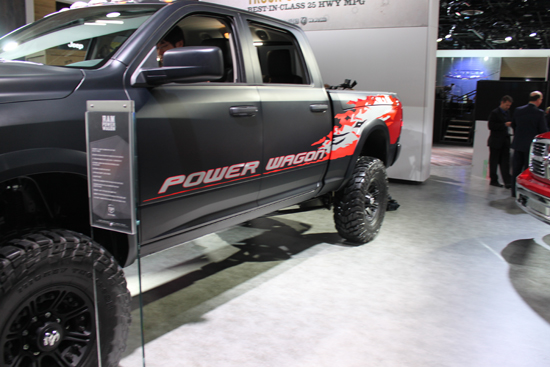
    They also brought a pretty impressive looking crew cab Power Wagon. It was a cool looking ride (albeit really hard for me to get into), but many people looking at it really questioned how useful it was. Talking with an off-roader who spends a lot of time in Michigan, he just shook his head. There is no way that truck can go down any trail, it’s only use is in a wide open area like sand dunes. His question, “Why would someone buy a stock off-road truck for only one type of trail?” The Ford Raptor has a similar critic.

    GM had several new trucks on the floor and spread out the Sierra from the Silverado. They stressed the new EcoTech motors and interior upgrades with two interior displays showing just the cab. They also had an interesting “museum-like” display of their instrument panel and doors (?). This was good, because the GM trucks were the only trucks on the floor that were locked and I couldn’t get into.

    2013 NAIAS Wrap-up Thoughts - GM Instrument Panel

    You think GM is proud of their instrument panel? Yet, it seems all these panels are starting to look the same.

    The product Reps were really talking up the engine, aerodynamic modifications of the body style and instrument panel. They shied away from any real discussion on why they didn’t do a lot to upgrade any other components. Many in the media feel like GM really just upgraded an old truck without really striving for any big improvements. While the new engines are sexy looking and completely new according to the Rep, they are really just old engines refurbished.

    Talking with the Rep about the lack of the “wow” factor, he conceded that looking at the truck, you don’t see it. His thought was that the “wow” factor would be in the details MPG, towing, weight and HP. And no, those numbers aren’t coming out anytime soon from what I heard.

    Toyota only had the Tundra that towed the space shuttle. They focused their display on concept cars and didn’t even bring a Tacoma at all. It seemed to me that they were trying to avoid all the hoopla GM and Ford were creating by waiting until Chicago to do their unveiling. Time will tell if that strategy pays off.

    Honda and Nissan didn’t even bother to bring any trucks. It was interesting to hear a Jose Munoz, senior vice president for sales and marketing at Nissan Americas, talk about trucks at a media round table.

    “We understand that it is very important” to remain in the segment, Munoz said, according to PickupTrucks.com. “Full-size is where the potential is.”

    And yet, they didn’t bring a single truck to the Auto Show. If the North American market is the supposed home to highly profitable full-size trucks and Detroit is the “largest” stage, why didn’t they bring any? Very curious.

    2013 NAIAS Full-Size Truck Wrap - VIA Motors

    We will have more on this X-Trux soon. I asked where the rocket launchers were.

    VIA Motors had a really nice demonstration of their technology and I was able to speak with their sales guy and engineer. This will be in a future article. It is an interesting idea that could push other automakers to look at their technology. However, I overheard a few guys saying VIA motors is really a niche market and will have little real-world impact.

    As the media days wrap-up, it was clear to me that the automakers aren’t focused on really improving full-size trucks. Instead, they are tweaking and expanding on similar ideas: direct injection, aerodynamics and dropping weight. Instead they are spending all their time and energy on passenger cars. Unless one of them rocks that boat, the real, low energy in the segment will leave people wanting for more.

    Related Posts:

    Search terms people used to find this page:

    • naias power wagon
    • tundra redesign 2014
    • toyota trucks
    • new toyota tundra redesign 2014
    • hilux 2013 white color
    • toyota tacoma 2014
    • when to expect redesign toyota tundra
    • full size truck reviews
    • 2014 sequoia toyota north american auto show
    • dodge power wagon at naias

    The post 2013 NAIAS Full-Size Truck Wrap – Bright Future? appeared first on Tundra Headquarters Blog.