Blog

  • World’s tallest building powered by solar energy on Green Float city

    Botanical-City-Concept-1.jpg
    Like everything else, the way cities are built and function in the future will be a whole lot different than they are today. The simple space saving and environment hugging option to ever expanding cities in the future is vertical growth, instead of spreading out horizontally and eating up land and greenery. So, our future cities will be way up there, in the skies above. The Green Float city in the sky will tower up, 1000 meters high, in the shape of a flower, and a surface area above ground of 1000 meters. Gaining inspiration from lilies floating on water, the cities are designed to accommodate 30,000 residents, above ground, and 10,000 at ground level, besides the water body surrounding the city island. The tower will also incorporate a factory that will make the city self-sufficient, providing it with food.

    Temperatures of ground level will remain a pleasant 26-28°C year round. Recycling, livestock farming, waste-to-energy conversion and other processes will be carried out in the tower factory. Countries, with these floating lily cities will crop up in the future, a great way to live in peace with our degrading environment.

    Thanks Jason!

    Botanical-City-Concept-2.jpg

    Botanical-City-Concept-3.jpg

  • Russell Brand Katy Perry Weeklong Wedding Extravaganza Oct. 2010

    Russell Brand and Katy Perry are planning a week of celebrations to commemorate their Indian wedding ceremony this October.

    After just three months of dating, last New Year’s Eve the British funnyman proposed to the “California Gurls” singer during a romantic trip to India. Perry has stated the couple is planning a “small” wedding, insisting she doesn’t want the ceremony to turn into a “drunkfest of people.” Nonetheless, the couple is rumored to be planning to return to the country for an extravagant affair that will kick off Oct. 18 and conclude with Perry and Brand tying the knot on Oct. 25.

    Katy and Russell are already sending out Save The Date cards to their friends and family, and snoops for England’s News of the World reportedly managed to get their hot little hands on the invite.

    The card, which features a picture of Indian henna tattoo, urges guests to “Save The Week for the wedding of Katy and Russell” and reminds attendees that they “will need a passport.”

    The invite also states guests “will be contacted soon with more information.”

  • Dispersants Might Be INCREASING Damage From Gulf Oil Spill

    Via Prison Planet.com » Commentary

    Washington’s Blog
    May 17, 2010

    Everyone knows that the dispersants being dumped into the Gulf oil are toxic. As I wrote Friday:

    Highly toxic dispersants have been used to try to break up the oil. See this and this. Not only are dispersants being released underwater, but the air force is also dropping dispersants on the slick from above.

    The official information for the dispersant reveals problems:

    OSHA requires companies to make Material Safety Data Sheets, or MSDSs, available for any hazardous substances used in a workplace, and the ones for these dispersants both contain versions of a disturbing statement.

    ***

    Both data sheets include the warning “human health hazards: acute.” The MSDS for Corexit 9527A [the dispersant apparently being used in the Gulf] states that “excessive exposure may cause central nervous system effects, nausea, vomiting, anesthetic or narcotic effects,” and “repeated or excessive exposure to butoxyethanol [an active ingredient] may cause injury to red blood cells (hemolysis), kidney or the liver.” It adds: “Prolonged and/or repeated exposure through inhalation or extensive skin contact with EGBE [butoxyethanol] may result in damage to the blood and kidneys.”

    Dispersants Might Be INCREASING Damage From Gulf Oil Spill 100210banner1

    Indeed, the specific dispersant being used is more toxic and less effective than other alternative dispersants, perhaps because of BP’s connections to the manufacturer.

    In addition, new questions have arisen as to whether the dispersants might actually being increasing damage from the oil itself.

    As the Christian Science Monitor notes today:

    More relevant could be the dispersant that BP is applying to the oil at the source. BP officials have hailed the process as a success, noting diminishing oil at the surface. But the dispersant breaks the oil into smaller drops, which might instead be spreading throughout the water column, instead of rising to the surface.

    It is not clear what this would mean environmentally, though past research indicates that oil can be trapped in the seabed for decades after oil on the surface is cleaned away.

    Shouldn’t the use of dispersants be stopped until scientists figure out whether they will make things better or worse?

  • Glen Beck, Meet Maurice Strong


    The best that I can determine, Maurice Strong is a world class meddler who is adept at working the media and all the right cocktail parties.  Think of him as diplomat for some self appointed cabal of pseudo intellectuals who think that they can run things differently and who are humored by those who do run things.  After all, the cocktail party might get boring for your wife without at least one polished snake oil salesman on board.

    I have been aware of this poseur’s career for over thirty years, if career it is because it is not clear who if anyone pays him.  He is yet another example of how a liberal arts education is a poor preparation for developing opinions on matters of scientific weight.

    In the meantime he has clearly been cozy in the UN global warming promotion scheme and may well have had a lot to do with it all.  If we ever need a scapegoat, he will be happy to stand in.  Having met far too many of his ilk, I am not optimistic.

    In the meantime he has attracted media attention again through Glen Beck and so continues to pursue his agenda, whatever it might be.

    Glenn Beck: Meet Maurice Strong

     By Judi McLeod  Thursday, May 13, 2010
    All that President Barack Obama is doing to transform America, Free World over to One World Government begins and ends with one Maurice Strong. Soros is merely the financier
    Great job on shining the FOX flashlight on man-behind-the-curtain Maurice Strong last night.
    You asked for people to send you information on Strong. 

    While the entire cable network world, thanks largely to The One Thing, now knows that Strong is on the Chicago Carbon Credit Exchange board of directors, it gets worse, much worse.

    It’s true that Strong explained that he had only fantasized the end of the world in his now famous interview with a Canadian reporter.  Unfortunately for the free world, the fantasy is Strong’s philosophy.

    As recently as 2006, speaking from an air conditioned boardroom somewhere in Communist China, Maurice Strong—the same man who would deny air conditioning for you to save the environment—was hatching his latest anti-American initiative. 

    “Having cashed in his Kyoto credits and having launched his ManyOne Internet project from afar, Strong is back on the international scene, ready or not.  With his latest comeback, the elusive Strong is stepping back into the limelight after his alleged links to the UN Oil-forFood scandal took him off the radar screen for more than a year.  This comeback sees Strong teaming up in the biz world with George Soros.  The deadly duo aims to flood the American market with cheap Chinese-made cars.


    “Strong’s public predictions that China would replace the United States, as world superpower is not happening fast enough.  So Strong and President George W. Bush malcontent George Soros are contemplating pouring hundreds of millions into a Communist China automaker that manufactures the “Chery”.”

    So Strong and Soros were working on anti-American schemes as far back as 2006.

    They had hoped to decimate Ford, Chrysler and GM by flooding the U.S. market with cheapo Cherys on a 2007 deadline.

    Well, we now know what happened to the American auto industry in 2009.

    But it doesn’t even begin or stop there.

    Maurice Strong has almost as much impact on average Americans as the air that they breathe.

    All that President Barack Obama is doing to transform America and the Free World over to One World Government begins and ends with one Maurice Strong. Soros is merely the financier.

    Here, in his own words, is what Strong wants for the middle class: “It is clear that current lifestyles and consumption patterns of the affluent middle class—involving high meat intake, consumption of large amounts of frozen and convenience foods, use of fossil fuels, appliances, home and work-place air-conditioning, and suburban housing—are not sustainable.  A shift is necessary towards lifestyles less geared to environmentally damaging consumption patterns.”  (1992 Rio Earth Summit 11).

    Strong’s portrayal as a Wizard Oz in a fog of ether was helped along by Canada’s state-owned, liberal and largest television network, the Canadian Broadcasting Corporation (CBC)l

    The CBC 2004 special, The Life and Times of Maurice Strong, features a visit by Strong to former Soviet leader, Mikhail Gorbachev who gives Strong a CBC-described “glass saber full of the same brandy Stalin used to send Winston Churchill every week.” 

    It was in an admiring way that CBC reporter Ann-Marie MacDonald described Strong as a sort of “cross between Rasputin and Machiavelli.”

    You could say that it’s downright Machiavellian how Strong and Gorbachev consorted back in 1997 to replace the Ten Commandments with the UN Earth Charter. 

    Although it defies belief,  their jointly authored Earth Charter is carried around in a wooden chest called the Ark of Hope. 

    The Ark of Hope is described as a “magnificent large sycamore chest, which was conceived as a visual message of peace, sustainability and concern for the Earth.” 

    Gilt-covered and lavish in the looks department, the chest carries Temenos Earth masks.  The 96” poles of the 200-lb. chest are “unicorn horns which render evil ineffective”.

    The Ark carries Gorby’s and Strong’s Earth Charter, an international peoples‘ treaty, need of which was foreseen and initiated at the Strong-led Rio Earth Summit in 1992. At last count, the Ark was being carried into New York classrooms.

    Now you know, Glenn why Strong is too busy to write novels.  Besides, it must be so much more fun rewriting history.

    Lest you think CFP is pulling your leg, this is what Gorbachev has to say about the Earth Charter: “The Ten Commandments are out of date.  They will be replaced by the 18 principles of the Earth Charter.”

    It is CFP’s belief that the way for The Messiah was cleared for Barack Obama by Maurice Strong and that Louis Farrakhan was right on the money when he said “before he was elected, he (Obama) was selected”.

    So how does Maurice Strong get away with it?

    By relying on the media-hyped conspiracy theory charges.  You know, those rednecks still waiting for the black helicopters.

    Meanwhile, when Glenn pulled the curtain back on International Man of Mystery Maurice Strong last night, he hit the motherlode.
    Judi McLeod Most recent columns
    Copyright © Canada Free Press

    Judi McLeod is an award-winning journalist with 30 years experience in the print media.

    A former Toronto Sun columnist, she also worked for the Kingston Whig Standard. Her work has appeared on Rush Limbaugh, Newsmax.com, Drudge Report, Foxnews.com, and Glenn Beck.

    Judi can be emailed at: [email protected]
  • Hydrogen powered aircrafts will feed on river water

    Hydrogen-powered-airliner-1.jpg
    The future seems bright. Bright green, with a whole lot of technological breakthroughs coming up everyday and designs for the development of these been sketched every now and then. Flying will be a greener affair in the future too. At least that’s what designer Victor Uribe hopes. He designed an aircraft that should probably take to the skies in the next 40 years that takes of vertically from the ground! And what makes this awesome aircraft so green? It’s powered up with hydrogen! Using hydrogen fuel, synthesized from water, the aircraft he chooses to call, the Airbus A350H, will have its fuel i.e. water, drawn from a river nearby.

    By the looks of it, this one sure reminds one of a supersonic jet. Maybe it’ll go that fast too!

    Hydrogen-powered-airliner-2.jpg

    Hydrogen-powered-airliner-3.jpg

    [Dvice]

  • Mayan Plumbing


    Arm chair thinkers have often argued that hydraulic engineering was difficult to somehow imagine and implement.  Yet I argue the opposite.    It is the one technology that can be modeled on a table top in clay and shown to work.  Arguing that canal locks are a major invention is a good example.  Everyone who actually needed them built them immediately.  The problem was that they were rarely needed.  They required a large flow of traffic to justify the expense of maintenance.   Until then skidding worked fine.
    In this case we have an impressive complex, possibly a palace, with a system of built in fountains.  Sounds pretty normal to me.  And yes, it was necessary to provide pressure to operate the fountains.  They found a way.
    I expect we will find much older examples in New World.
    Also the stone structure could have supported a wood tube system easily to contain pressure as needed.  Not overly lasting, but sufficient for a year’s effort at least.  We are spoiled by better solutions.
    Maya Plumbing, First Pressurized Water Feature Found In New World
    by Staff Writers

    University Park PA (SPX) May 05, 2010
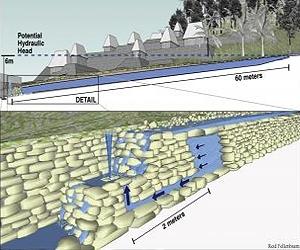
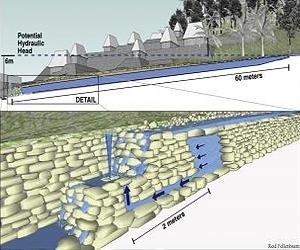
    This is a depiction of Piedras Bolas aqueduct functioning as a fountain. This illustrates one plausible explanation of how the feature used water pressure. Due to destruction of the aqueduct, exact details of the its use are unknown. Note that during the monsoon, excess runoff flows over the freature while the buried conduit continues to function. Credit: Reid Fellenbaum

    water feature found in the Maya city of Palenque, Mexico, is the earliest known example of engineered water pressure in the new world, according to a collaboration between two Penn State researchers, an archaeologist and a hydrologist. How the Maya used the pressurized water is, however, still unknown.

    “Water pressure systems were previously thought to have entered the New World with the arrival of the Spanish,” the researchers said in a recent issue of the Journal of Archaeological Science.

    “Yet, archaeological data, seasonal climate conditions, geomorphic setting and simple hydraulic theory clearly show that the Maya of Palenque in Chiapas, Mexico, had empirical knowledge of closed channel water pressure predating the arrival of Europeans.”

    The feature, first identified in 1999 during a mapping survey of the area, while similar to the aqueducts that flow beneath the plazas of the city, was also unlike them. In 2006, an archaeologist returned to Palenque with a hydrologist to examine the unusual water feature. The area of Palenque was first occupied about the year 100 but grew to its largest during the Classic Maya period 250 to 600. The city was abandoned around 800.

    “Under natural conditions it would have been difficult for the Maya to see examples of water pressure in their world,” said Christopher Duffy, professor of civil and environmental engineering. “They were apparently using engineering without knowing the tools around it. This does look like a feature that controls nature.”

    Underground water features such as aqueducts are not unusual at Palenque. Because the Maya built the city in a constricted area in a break in an escarpment, inhabitants were unable to spread out. To make as much land available for living, the Maya at Palenque routed streams beneath plazas via aqueducts.

    “They were creating urban space,” said Kirk French, lecturer in anthropology. “There are streams in the area every 300 feet or so across the whole escarpment. There is very little land to build on.”

    These spring-fed streams combined with approximately 10 feet of rain that falls during the six-month rainy season also presented a flooding hazard that the aqueducts would have at least partially controlled.

    The feature the researchers examined, Piedras Bolas Aqueduct, is a spring-fed conduit located on steep terrain. The elevation drops about 20 feet from the entrance of the tunnel to the outlet about 200 feet downhill.

    The cross section of the feature decreases from about 10 square feet near the spring to about a half square foot where water emerges form a small opening. The combination of gravity on water flowing through the feature and the sudden restriction of the conduit causes the water to flow out of the opening forcefully, under pressure.
    “The conduit could have reached a theoretical hydraulic head limit of 6 meters (about 20 feet),” said Duffy.
    At the outlet, the pressure exerted could have moved the water upwards of 20 feet.

    “The experience the Maya at Palenque had in constructing aqueducts for diversion of water and preservation of urban space may have led to the creation of useful water pressure,” said French.

    The Piedras Bolas Aqueduct is partially collapsed so very little water currently flows from the outlet. French and Duffy used simple hydraulic models to determine the potential water pressure achievable from the Aqueduct.

    They also found that Aqueduct would hold about 18,000 gallons of water if the outlet were controlled to store the water. One potential use for the artificially engineered water pressure would have been a fountain.

    The researchers modeled the aqueduct with a fountain as the outlet and found that even during flood conditions, water would flow in the aqueduct, supplying the fountain, and above ground in the channel running off the slope. Another possibility could be to use the pressure to lift water onto the adjacent residential area for use as wastewater disposal.

    “The palace has features that suggest something similar,” said French
  • “Disruptive Innovation” Author Speaks, Seattle 2.0 Awards, the Next Twiistup, & More Seattle Events

    Gregory T. Huang wrote:

    Event season is in full swing here in Seattle. I thought it’d be useful to give a quick rundown of some of the gatherings our readers might want to attend in the next few weeks. If you want to know the secret to surviving as a startup (or a big company, for that matter), or want to schmooze with the top tech entrepreneurs and investors in town, or learn about how to market your startup, check out the following events, starting today:

    —Technology Alliance’s annual “State of Technology” Luncheon in downtown Seattle today features a keynote by Clay Christensen, a professor at Harvard Business School and the author of such business books as The Innovator’s Dilemma, Disrupting Class, and The Innovator’s Prescription. One of Christensen’s big ideas is that “disruptive” strategies are about entering a market at the low end (with a cheaper and worse product) and gradually working your way up—which goes against the mindset of most startups, which try to develop a better product or service than their competition, and especially the big players. I wrote about an interesting Northwest connection to Christensen’s work on innovation strategy here.

    Seattle 2.0’s annual awards show is this Wednesday evening. If it’s anything like last year’s inaugural bash, it’ll be packed with tech entrepreneurs, software developers, angel investors, venture capitalists, and media. Jonathan Sposato, the former CEO of Picnik (recently acquired by Google), will give the keynote. Sposato and Picnik were the big winners at last year’s event.

    —Northwest Entrepreneur Network (NWEN) is hosting an event focused on “brand strategy in the digital age” on May 25. The distinguished speakers will represent the marketing agencies and brand strategy firms Spring Creek Group, Corhouse Branding, Dry Soda, and Jelvetica.

    —The Washington Biotechnology & Biomedical Association is featuring the latest installment of its series of events about how life science innovations can be applied to both domestic and global health problems. On May 25, Lisa Cohen of the Washington Global Health Alliance will moderate a panel with John Kaestle of HaloSource, Karen Hedine of Micronics, and Anne Bugge of SonoSite.

    —Twiistup is hosting its second Seattle event on June 2, around “marketing your Internet company.” Neil Patel from Crazy Egg, KISSmetrics, and KISSinsights will go over strategies for boosting your company’s Web traffic through search engine optimization. Listen to the man. Ask him questions. He knows what he’s doing.

    —Washington Technology Industry Association (WTIA) is organizing a program on smart fuels on the morning of June 3. It’s part of a series on cleantech and energy, and will feature talks from the Pacific Northwest National Laboratory, Washington State University, Blue Marble Energy, and Farm Power Northwest.

    —A bit further out, TechFlash is putting on an event around VC, entrepreneurship, and financing strategies for startups on June 15. The summit will bring together venture capitalists, angel investors, and tech entrepreneurs to debate the pros and cons of taking outside capital and to explore the future of tech startups.


  • S.Korea fires warning shots to drive away N.Korean ships

    Via Prison Planet.com » World News

    AFP
    Monday, May 17th, 2010

    South Korea’s navy fired warning shots to drive away North Korean patrol boats from the disputed inter-Korean sea border, amid tension over the sinking of a Seoul warship, officials said Sunday.

    The warning shots were fired late Saturday when two North Korean patrol boats violated the Northern Limit Line (NLL) border and strayed into South Korean waters, the South’s Joint Chiefs of Staff office said.

    A spokesman for the Joint Chiefs of Staff told AFP the North’s patrol boats retreated without responding to the fire. No casualties occurred.

    It is the first time that shots have been fired at the tense sea border since the mystery sinking of a South Korean warship on March 26.

    Full article here

    S.Korea fires warning shots to drive away N.Korean ships  150410banner7

  • The Wild Fox Firefox Fork to Bring Support for H.264

    With the open source nature of Mozilla Firefox, it was bound to happen sooner or later, a developer has started work on a fork of the popular web browser, which will include support for the H.264 codec. Dubbed Wild Fox, the project is in the very early stages and is aimed at the many countries where software patents are not recognized.
    … (read more)

  • Cameron declares himself a Liberal AND a Tory – and then adds prominent Labour pair to his team

    Via Prison Planet.com » World News

    Tim Shipman
    UK Daily Mail
    Monday, May 17th, 2010

    David Cameron declared himself a ‘Liberal Conservative’ and boasted of running a ‘progressive alliance’ yesterday as it emerged that he has recruited prominent Labour figures to advise his coalition.

    The Prime Minister took a leaf from Tony Blair’s ‘big tent’ approach by signing up Labour MP Frank Field and left-wing intellectual Will Hutton.

    Mr Field, a former welfare minister, has been sounded out about advising the Government on how to tackle poverty.

    Mr Hutton, head of the left- of-centre Work Foundation will run a ‘fair pay review’ to ensure public-sector bosses are paid no more than 20 times the amount received by their lowliest employee.

    The Tories have also asked former BP boss Lord Browne, a business ambassador for Gordon Brown, to be a Whitehall efficiency watchdog. But in creating a rainbow coalition, Mr Cameron risks alienating his party’s grass roots.

    Full article here

    Cameron declares himself a Liberal AND a Tory   and then adds prominent Labour pair to his team  150410banner1

  • How Do You Say “Gyllenhaal?” Jake Sets The Recond Straight On Pronouncing His Name


    “It’s Yillen-Hoolah-Hay….”

    Just how do you pronounce ‘Gyllenhaal?’ It’s one of those timeless potato/potato, tomato/tomato sort of quandaries, but fortunately for us, Jake’s pleased as punch to clear up the confusion for us.

    Watch the Prince of Persia star have a little fun with a British interviewer, who asks him the age-old question….

  • Should you keep your old car or buy a new one?

    Are you sure you need a new car? I’m sure you want the newest safety features and modern styling that a new car offers.

    Perhaps you need a larger vehicle to fit your growing family. You probably feel that your old car no longer fits your life. But how about cost?

    From an economic perspective, you’re better off keeping your old car. It could save you thousands of dollars. Taking better care of your current car may make much more sense in the long run.

    You’re probably thinking – those repair bills are really adding up. But the cost of repairs will never exceed the cost of a new car.

    Changing your oil, replacing brakes, belts, and hoses are nothing compared to monthly payments on a new car. Even costly repairs like rebuilding an engine makes good financial sense.

    If you’ve paid off your car, it is still in great shape and needs only a few modest repairs, there’s no need to throw it away. Enjoy your freedom from car payments. Enjoy lower annual taxes, insurance rates and license fees on your old car.

    Buying a new vehicle would mean several years more of monthly principle and interest payments on a loan.

    You can feel secure knowing that modern vehicles last longer. Not too many years ago, a vehicle’s useful life did not exceed 100,000 miles.

    Today, many vehicles can breeze right past that 100,000 mile mark with no more than a tune-up, or maybe a new timing chain or fuel pump.

    Older cars generally cost more to maintain and are more likely to break down. Repairs can be frustrating and expensive. But on the other hand they’re cheaper to own and operate. They lose most of its value in the first five years of their life. Your used vehicle won’t depreciate as much, saving you thousands.

    Unless you’re rolling in cash, I’d say keep your old clunker.
    Comfort yourself knowing that one day you’ll be able to easily afford that costly new ride.

    Source

  • 2010 Volkswagen Jetta TDI

    Canadian Auto Press

    Nobody disputes that Volkswagen comes extremely close to being included in the entry-level luxury class, if it doesn’t qualify already. The segment boasts such brands as Acura, Saab, Volvo, and I suppose Buick now that the domestic brand is finally putting out product that’s worthy of inclusion. While Volkswagen dips down a bit further in price than most of these contenders, its premium-level quality and technology is always present, and in the case of some of its models, top-tier fuel economy.

    2010 Volkswagen Jetta TDI

    2010 Volkswagen Jetta TDI

    Recently I had the chance to spend a week in VW’s Jetta TDI, and by so doing enjoyed an extremely thrifty seven days of luxury motoring. Thrift and luxury together? Yes, while feasting on the premium plastics, playing with the top-grade switchgear and fully supported in light gray leather enhanced with multi-level seat heaters, not to mention an attractive woven headliner overhead that wraps down each pillar like only premium cars do, I was feeling rather smug at my TDI’s ridiculously stingy 6.7L100km city and 4.6L100km highway fuel consumption rating. It pulled me along by VW’s stout little 2.0-litre turbo-diesel making a moderate 140 horsepower at 4,250 rpm yet a positively spirited 236 lb-ft of torque from a low 1,750 rpm up to 2,500 rpm. All that torque gets fed to the front wheels via Volkswagen’s ultra-advanced six-speed DSG dual-clutch sequential automatic transmission with manual mode.

    The TDI comes standard with a six-speed manual, while I should probably also mention that base model Jettas come with a five-speed manual connecting through to a torquey 2.5-litre five-cylinder while a zippy 2.0-litre turbocharged four-cylinder is also available. I prefer the Jetta the way Volkswagen fitted my tester, in drivetrain and trim level.

    As mentioned, my example featured leather seats and therefore Highline trim; Trendline is base and Comfortline in between. New for Jetta this year is a Wolfsburg edition, which replaces last year’s GLI model. The Wolfsburg is the sportiest iteration, and while my heart would naturally gravitate towards this model, fuel prices over a dollar per litre has my mind winning the inner battle of passion versus pragmatism. And like I mentioned earlier, with 236 lb-ft of torque on tap, it’s hardly like we’re asked to give up much for such stellar fuel economy.

    Over and above the leather upholstery, the Highline comes with a few unique features overtop the Trendline and Comfortline, such as a power sunroof, a multifunction steering wheel, iPod interface and Bluetooth connectivity, plus a digital compass, multifunction trip computer, rear seat centre armrest with pass-through, rear side airbags and also on the safety front, rear seatbelt pretensioners. Consider that these items get added onto Comfortline features, which include a leather-wrapped steering wheel, driver’s seat with power recline (ya, manual control other than the recline… odd for our market), and a premium 6-CD stereo with Sirius satellite radio, plus the base Trendline features that include air conditioning, auto up/down powered windows, powered locks with keyless entry, heated power-remote mirrors with integrated turn signals, a tilt and telescopic steering wheel, variable intermittent wipers, cruise control, auxiliary input jack for the audio system, eight-way manually-adjustable seats, and a 60/40 split-folding rear seat, it’s a pretty impressive package.

    Out on the road the Jetta TDI feels solid and secure, with a quiet interior benefiting by minimal road, wind and engine noise. The ride is good, but should be categorized on the firm Germanic side of the equation, which makes handling better than average for this class, a Volkswagen trademark. Excepting the sportier Wolfsburg, all Jettas get 16-inch wheels riding on 205/55R16 all-season tires, but the Comfortline and Highline get alloy rims. Electronic stability control, traction control, and ABS-enhanced disc brakes all-round with standard brake assist come standard on Highline.

    One of the big features that came as part of the Jetta’s fifth generation upgrade was the trunk, increased to a staggering 500 litres (17.6 cu ft)! That puts this smaller than average midsize model in the Lincoln Town Car class for luggage space, and the rear seat accommodations aren’t too shabby either.

    You luggage and more importantly occupants will be safe inside, not only thanks to the most side airbags in its class, but also because the current generation Jetta uses extensive high strength steel in its body structure, plus the laser welding of body parts went up from 5% to 35%. This resulted in double-digit increases in both dynamic and torsional rigidity. Volkswagen included other body innovations such as an impact-absorbing front bumper that yields slightly in the event of a collision with a pedestrian, reducing injury, while a new door design made it possible to remove and replace only the outer panel if damaged, rather than the entire door, reducing repair costs.

    There’s so much more to the Jetta that’s worth talking about, but when it comes right down to it what matters more to most VW buyers is Teutonic attributes built into ever model. These include simple, straightforward yet stylish design, high-quality workmanship inside and out, performance-oriented road manners and superb fuel economy, and the 2010 Jetta TDI fits the bill in every respect, backed up by a premium-like 4-year or 80,000 km comprehensive and 5-year or 100,000 powertrain warranty, plus 4-year unlimited mileage roadside assistance.

    Yes, the Jetta TDI is a premium experience for a pauper’s price, the Trendline starting at $24,475, the Comfortline for $27,175, and the top-line Highline out the door at only $30,875, plus $1,365 for freight and pre-delivery inspection. Is it an entry-level premium vehicle? It certainly feels like one, and made me ask why someone would want to spend more for premium badge.

    2010 Volkswagen Jetta TDI
    2010 Volkswagen Jetta TDI
    2010 Volkswagen Jetta TDI
    2010 Volkswagen Jetta TDI
    2010 Volkswagen Jetta TDI
    2010 Volkswagen Jetta TDI
    2010 Volkswagen Jetta TDI
    2010 Volkswagen Jetta TDI
    2010 Volkswagen Jetta TDI
    2010 Volkswagen Jetta TDI
    2010 Volkswagen Jetta TDI
    2010 Volkswagen Jetta TDI
    2010 Volkswagen Jetta TDI
    2010 Volkswagen Jetta TDI
    2010 Volkswagen Jetta TDI
    2010 Volkswagen Jetta TDI
    2010 Volkswagen Jetta TDI
    2010 Volkswagen Jetta TDI

  • Beware the bin snooper next door: Residents asked to report neighbours for putting rubbish out too early

    Via Prison Planet.com » Prison Planet

    Chris Brooke
    UK Daily Mail
    Monday, May 17th, 2010

    Residents are being asked to report neighbours for ‘environmental crimes’ such as putting their bins out too early or late.

    A council is urging householders to snoop on fellow residents and fill in ‘diary sheets’ to log incidents – the same way it tackles violent anti-social behaviour.

    Such ‘crimes’ can be committed by putting bins out at the wrong times or leaving them in the wrong place.

    Householders could face a £100 fixed penalty notice or be fined up to £1,000 in court for leaving rubbish next to a bin or blocking a path with a bin.

    The clampdown, by Hull City Council, has provoked a furious reaction, with residents insisting they won’t do officials’ ‘dirty work’ for them.

    It sent letters to residents of one street after complaints that rubbish had been dumped and wheelie bins left out for days on end.

    Full article here

    Beware the bin snooper next door: Residents asked to report neighbours for putting rubbish out too early 260310banner2

  • Massey Energy Not the Only Habitual Mine Safety Violator

    Mourners hold a vigil on April 10 for the miners who died in the Upper Big Branch explosion. (EPA/ZUMApress.com)

    Driving out of Charleston, south on Rte. 119, you can’t miss it: An enormous billboard, on the left side of the road, with a message from the Patriot Coal Corporation: “Be Proud of Where You Work.”

    Not merely self-promotional, the statement is also a thinly veiled shot at Massey Energy, Appalachia’s most dominant coal producer — and one with a reputation for putting profits above worker safety. The billboard message implies that, unlike its larger rival, Patriot’s approach to safety ensures innocuous conditions in its mines and the well-being of its workers.

    Image by: Matt Mahurin

    Image by: Matt Mahurin

    Well, not quite.

    Since April 5, when the Massey-owned Upper Big Branch mine exploded, killing 29 workers inside, Patriot’s 11 underground coal mines in Appalachia have racked up roughly 350 safety violations, according to a review of federal records by TWI. The violations include scores of citations indicating problems with ventilation systems and the accumulation of combustible materials — the very conditions thought to have caused the deadly blast at the UBB project. Of those 350 violations, 120 were deemed “significant and substantial,” indicating that they are “reasonably likely to result in a reasonably serious injury or illness.”

    Patriot’s Highland 9 Mine, in Union County, Ky., for example, has tallied 83 violations since April 6, of which 19 fall into the S&S category, according to MSHA data. In Monongalia County, W.Va., the company’s Federal No. 2 mine has been hit with 74 safety citations over the same span, including 28 deemed an immediate threat to miner safety. The list goes on.

    Patriot, based in St. Louis, did not respond to calls last week requesting comment.

    The figures are a cogent reminder that, though the spotlight might currently be on Massey in the wake of the UBB disaster, the corporate attitude of wringing the most profits from Appalachia’s coal mines — even if, at times, it means sacrificing worker safety — is hardly limited to just one company. Indeed, Maria Gunnoe, an environmental activist with the Ohio Valley Environmental Coalition, said Friday that the Massey model — an extremely successful one from a perspective of strict business — is starting to spread through out the industry, at the potential threat to the miners underground.

    “Companies see Massey getting away with things,” Gunnoe said, “so they start doing those things themselves.”

    Patriot’s track-record hasn’t been overlooked by officials at the Mine Safety and Health Administration, who are cracking down on lax mine-safety practices in the wake of the UBB tragedy. Indeed, of the 57 troubled mines that MSHA identified last month as significant or repeat safety violators, five were Patriot-owned operations in either West Virginia or Kentucky. (Only Massey had more mines on the list, with nine.)

    Yet, in at least some cases, the additional scrutiny doesn’t seem to be improving conditions. Indeed, federal officials last week forced the closing of the Harris No. 1 mine, a Patriot-owned project in Boone County, W.Va., over a faulty ventilation system — a vital tool that prevents the accumulation of toxic gasses and combustible coal dust.

    Leslie Fitzwater, spokeswoman for the West Virginia Office of Miners’ Health, Safety and Training, told Reuters that MSHA officials had warned mine operators about low oxygen levels in some parts of the Harris mine. But the company hadn’t fixed the problem when regulators reinspected the project last Tuesday.

    Meanwhile, Congress is taking a closer look at the nation’s mine-safety rules as well, with the Senate Appropriations Committee’s subpanel on labor scheduled to hold a hearing on the issue on Thursday. Massey CEO Don Blankenship is scheduled to testify. No one else representing the coal industry, however, was expected to speak.

  • Silly Apps Compendium 1.4 reviewed

    Silly Apps Compendium 1.4 offers the user a bunch of different novelty apps in one package. These Silly Apps Compendium has quite a few apps to offer and we take a look at them in this video review.

    Read more at BestWindowsMobileApps.com


  • Let Tsubaki’s Pin Oven Chain Carry Your Operations to Profit!

    Tsubaki Pin Oven Chain, featuring precision components and accurate assembly, is a sealed chain that uses special X-Rings to seal in heat resistant lubricant for reduced bending resistance and sustained smooth movement. In addition, outstanding wear resistance minimizes elongation and further reduces vibration.

    Further, accurately controlled assembly and precise component alignment ensures even contact between pin and bush. Tsubaki Pin Oven Chain is also pre-stretched, minimizing initial elongation and eliminating the need for post-installation adjustments.

    With the use of specially formulated grease between pin and bush, and a specially designed X-Ring, Tsubaki Pin Oven Chain suffers fewer jams and wrecks, which means less downtime and more profits for you. The spring loaded tip, available in nylon or high-temperature material, incorporates a tough spring that softens shock and absorbs impact load.

    With over 90 years of know-how, trust Tsubaki to carry your operations to profit!

  • Tsubaki Plastic Block Chain

    Tsubakimoto Chain Co., a leading manufacturer of power transmission and conveyor components, has redesigned its Plastic Block Chain to provide even greater user-friendliness and safer conveyance. And by expanding its innovative line-up of Tsubaki Plastic Block Chain products to include the new RSP40 chain with top plates, Tsubakimoto can better satisfy customer needs for a variety of applications in food processing, packaging, solar modules, rechargeable batteries, automotive parts, containers and pharmaceuticals.

    New Advanced Features!
    1) New Chain Link Design Enhances Safety
    Redesigned chain links result in less toppling and tipping of goods from snagging during transfer from one conveyor to another. They also reduce the potential for broken chain fragments to become intermixed with conveyed goods.

    2) D-Pin Technology Prevents Stress Cracking
    The use of D-pins for all connecting pins reduces the risk of damage to connecting areas, such as stress cracking of pin holes, brought on by cleaning solutions or other means.

    3) Smaller Back-Flex Radius Helps in Layout Design
    The back flex radius on the RSP60 single strand chain has been reduced from 450mm to 180mm, making it easier to design return way layouts.

    Other basic features also include minimal damage to products during conveyance, lightweight chain resulting in lower running costs, smooth conveyance, lube free operation, easy maintenance, and quiet operation.

    For more information please refer to the TSUBAKI PLASTIC BLOCK CHAIN catalog found in the catalog section here, or your local Tsubakimoto representative.

  • New High-Flow Stainless Steel Regulators

    Like all system accessories from Cat Pumps, the new 7375 and 7376 pressure regulators are designed to meet the demands of industrial applications where continuous-duty, dependable performance is a must. These high flow regulators set system pressure, by-pass unused liquid without interrupting system operation and protects pump from exceeding set system pressure.

    These regulators feature the same conical piston/seat design used in our popular 5-35 gpm (19-132 lpm) family of pressure regulators. The conical design lowers the minimum required by-pass flow from 10% to 5% which permits optimum system output while providing more consistent pressure control. Compared to traditional poppet style regulators, the conical shape virtually eliminates cavitation effects as the high pressure liquid is expanded across the piston and seat significantly extending service life.

    The new pressure regulators can be used with a variety of liquids including fresh water, sea water, clean oils, oilfield wastewater and chemicals.

    Typical Applications
    • Sea Water Reverse Osmosis (SWRO)
    • Large central cleaning systems
    • Off-road equipment cleaning
    • Mass transit cleaning
    • Multiple nozzle cleaning/ misting systems
    • Oil and liquid transfer systems
    • Off-shore wash down systems

    Features
    • Conical design assures consistent pressure for multiple pump, gun, or nozzle installation
    • Flow through inlet/outlet design for easy installation and compact footprint
    • Stainless steel construction with FPM elastomers for durability and chemical compatibility