The WKF 170 is suitable for a member of materials, steel, tool steel, non-ferrous metal and plastics. The Angle Adjustable Chamfering Machine for the preparation of weldseam WKF 170 makes the chamfering possible for round stock cuts, tubes and blanks with table stop collar.
Long work pieces, also for the series production, can be chamfered by the automatic stepless feed.
Bevel 0,1 mm up to 8 mm chamfer height in steel from 3 mm work piece height.
The Chamfering Machine WKF 170 is easy to handle because the guidance is given.
Blog
-
Assfalg expands the offer: CHAMFERING MACHINES for the preparation of weldseam
-
Darth Vader Gets Colorful Makeovers In This Year’s Vader Project Exhibition [Star Wars]

The fourth and final Darth Vader Project exhibition is being staged this June, where over 100 helmets have been redesigned by some of the biggest names in underground art. More »
starwars – Darth Vader – TomTom – Science Fiction – Toys -
Wait, Now I Need Security Software For My Car, Too?
Remember a few months ago when a disgruntled ex-employee from a car dealer was able to login to the dealer’s computer system and remotely disable over 100 cars? And, of course, there have been concerns over the ability to use systems like OnStar to remotely disable cars as well, with concerns about what would happen if malicious hackers were able to get their hands on the controls. Now, to add to those concerns, some researchers are reporting that modern day car computing is vulnerable to malicious hacks that could put drivers in danger.
The scientists say that they were able to remotely control braking and other functions, and that the car industry was running the risk of repeating the security mistakes of the PC industry….The researchers, financed by the National Science Foundation, tested two versions of a late-model car in both laboratory and field settings. They did not identify the maker or the brand of the car, but said they believed they were representative of the computer network control systems that have proliferated in most cars today.
The researchers asked what could happen if a hacker could gain access to the network of a car, said Tadayoshi Kohno, a University of Washington computer scientist. He said the research teams were able to demonstrate their ability to circumvent a wide variety of systems critical to the safety of drivers and passengers.
They also demonstrated what they described as “composite attacks” that showed their ability to insert malicious software and then erase any evidence of tampering after a crash.
The researchers were able to activate dozens of functions and almost all of them while the car was in motion.
Happy driving, everyone…
To be fair, the researchers admit that they did not look at what kinds of “defense” the car might have to block such attacks, but they do point out that those developing car computing systems probably don’t have as much experience or concern in the security realm. For the most part, this sounds like it’s not a problem that anyone’s going to face in the short-term. If anything, I’m guessing we’ll have a lot more moral panic stories about what will happen before any reports of something bad actually happening. However, at some point, it seems likely that these sorts of stories will pass over from the hypothetical into the real world, and at that point, I’ll be looking for a car that runs on open source software.
Permalink | Comments | Email This Story
-
Spiraling solar-powered skyscraper helps cool the environment

Eco Factor: Solar-powered eco-tower with water collection and a cooling system.
Kenneth Loh and Michelle Lim have come up with an ingenious design of an eco-tower that blends a vertical garden, mixed-use development and open space together. The new urban prototype of solar powered skyscraper incorporates many programs to make the building as green as possible. The entire façade of the spiraling hollow structure is covered with a thin membrane of solar cells that produce enough energy to meet with its interior requirements.
-
How New Rumored Chinese Tax Hikes Will Expose Cities’ Gross Over Reliance On Property

This is the bind of Beijing, and other major Chinese cities affected by China’s property boom — they need to kill off any potential bubble, but at the same time their economy has grown massively dependent on property.
For the Americans out there, this problem might sound familiar.
Yet to grasp just how dependent cities are on economic activity from property, note how, so far this year, over 50% of fixed investment in Beijing has been property-related:
China’s capital [Beijing] reported 110.37 billion yuan ($16.18 billion) in fixed-assets investment in the first four months, a growth of 32.5 percent on the same period of last year.
The total included in 55.59 billion yuan in real estate development, up 64.4 percent. Of the investment in the property sector, 25.93 billion yuan went to commercial housing projects, up 58.8 percent.
Yet they can’t let things continue forever either. Even the city’s real estate association has admitted to a property bubble and it’s also become dead obvious to others that speculation is driving prices, rather than underlying demand for living spaces.
For example, via Capital Vue, wealthy Chinese accounting for just 10% of the country’s population account for 50% of property transaction volume according to Wang Xiaoguang at the Chinese Academy of Governance. In some cities such as Shenzen, near Hong Kong, Wang Xiaoguang attributes 80-90% of activity to speculation.
Now there are fresh rumors of a property tax hike:
The State Administration of Taxation (SAT) is rumored to be enlarging the scope of property taxes, with details expected to be released by May 20, reports 21st Century Business Herald, citing sources close to the SAT.
If this happens and works too well, watch for economic activity in major Chinese cities to nose-dive. If it doesn’t work, prices will keep rising rapidly. No speculator-driven market sky-rockets and then simply stops.
Join the conversation about this story »
-
“The Nutty Professor 3″ In Pre-Production

We’re not sure moviegoers asked for a second helping of The Klumps, but we may be getting one anyway.
It’s been 10 years since Sherman Klump — the shy scientist with a waistline the size of the equator and a heart of pure gold — battled the bulge on the big screen, but funnyman star Eddie Murphy says it’s never too late for a new Nutty Professor movie.
Eddie says he’s already written a rough draft for a third installment of The Nutty Professor — which would join a franchise that spawned Klumps-themed box office blockbusters in 1996 and 2000. The original Nutty Professor — a remake of the 1963 Jerry Lewis classic of the same name — and its sequel The Nutty Professor II: The Klumps were both a hit with viewers, each earning over $120 million upon theatrical release.
“You know what, there might be another Nutty Professor. We kind of wrote something that might be kind of funny. If the studios want to do it, we’ll do it. If you don’t see it, the studio was like, ‘This isn’t funny,’” Murphy told Access Hollywood’s Shaun Robinson on Sunday.
-
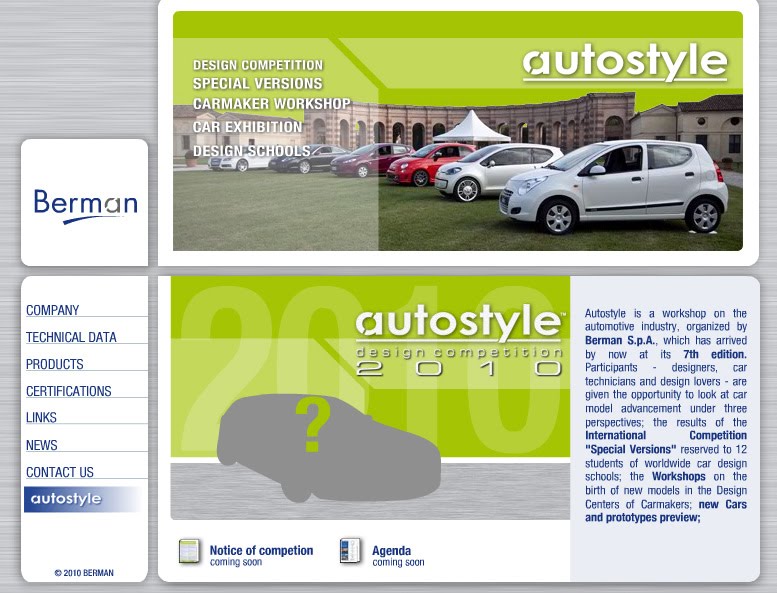
Berman Autostyle 2010

Good news! i was one of the 12 lucky students choosen for the Berman Autostyle Design Contest.Berman is a company that organizes a design contest for students all over the world, but they only select 12, so the single fact of been choosen is something to be happy about.
-
Latest WHEC. CEO Daimler: never a better time for Fuel Cell Vehicle market introduction
Dr. Dieter Zetsche, CEO of Daimler, who was awareded the IPHE Award at the opening day of the WHEC 2010 in Essen, indicated that the time for hydrogen market introduction have never been better; in the long run only hydrogen is best placed to substitute oil; battery technology is not able to resolve range issues. The Mercedes FC B-Class will be able to cover 600 km in the near future, mass production of 100.000 fuel cel cars is foreseen for 2015. The cost of 1 kg for 100 km range is still € 8, but with the German H2 Mobility Initiative will from 2013 install 1000 public hydrogen refuelling stations in Germany (today 30 stations, of which 7 public, are operational). The new Mercedes F 800 with a “sandwich” platform that can be used for battery, fuel cel and hydoride models is showing that electric powertrains are entering luxury sedan models.
-
Is Miley Cyrus The Next Lindsay Lohan?


Miley Cyrus is will on her way to replacing Lindsay Lohan as Hollywood’s proverbial unemployable, chain smokin’ trainwreck, if the predictions of Tinseltown bigwigs are to be believed.
Hollywood bosses are concerned the one-time Hannah Montana sweetheart is destroying future career prospects with a string of controversies. The most recent — a video of Cyrus giving So You Think You Can Dance choreographer Adam Shankman.
Earlier this month, Cyrus, 17, sent tongues wagging around the watercooler with her “Can’t Be Tamed” music video. Critics have suggested the vid — which features Miley scantily-clad and dancing suggestively in a cage — is too sexy for the teen star’s young fans.
“Everyone in Hollywood is worried that Miley is on the path to becoming the next Lindsay Lohan. It’s the oldest story in showbiz – when a child star grows up and loses his or her entire fan base,” whispers one unidentified Hollywood casting agent.
-
Wall-Mounted Barbecue Pops Down When The Weather’s Right [Barbecues]

Like a bed that pops out of the wall, Focus Fireplace‘s wall-mounted barbecue swings down when the time is right—when your stomach is growling for action. More »
Barbecue – Shopping – Home and Garden – Outdoor cooking – United States -
A Look Back From 2013: How The Bailout Of Greece Caused The Split Of Europe
Last night we noted an interesting paragraph in an Ambrose Evans-Pritchard piece on the Telegraph, which cited an article in the major German newspaper Frankfurter Algemeine Zeitung, which described a future euro currency of strong nations that didn’t even include france.
Thanks to a Greek reader, we’ve found the article here and thanks to Google translate we can read it.
The article is written as a history of Europe post Greek bailout written from the year 2013.
It’s a fantasy, but none of it sounds implausible, including this description of what’s going to happen next to Greece:
In 2010 all these promises were just waste paper. With the 110-billion-euro package over three years for Greece only have time for the indebted state was purchased. 2009, the Hellenic state deficit had amounted to 13.6 percent of gross domestic product (GDP), the debt ratio had increased to 115 percent. With a brutal budget rate, which had been the International Monetary Fund (IMF) designed with, the government promised to reduce the deficit in large increments of up to 4 percentage points a year. The plans were unrealistic, as was soon evident. Even the IMF had estimated the chances of success in internal analysis to be low. The Hellenic economy went completely to its knees after the government expenditure had been reduced sharply and choking off the VAT increase and rising unemployment, consumer spending.
Greece falls from recession into depression
In 2010, GDP shrank by more than 5 percent (the government had predicted 4.5 percent decrease), in the following year by another 5 percent (instead of the predicted decline to “only” 2.5 percent).”The Greeks are coming from a recession into a depression,” some economists had said earlier. They warned: “The medicine can be worse than the disease.” Thus the Greek patient was killed.As early as 2010 50.000 small and medium-sized companies were insolvent. And the bloated civil service jobs quarried masses, the unemployment rate doubled to 20 percent.
In 2011, Greek Finance Minister George Papaconstantino resigns.
By this point, the ECB goes into full-on inflation mode to save the banks that are left with worthless Greek paper.
By 2012, IMF chief Dominique Strauss-Kahn has wone the Presidency of France.
Ultimately, Europe splits in two:
Germany, Austria, the Benelux countries and Finland decided to form a domestic union. In support of its monetary policy Avantgarde, Berlin has relied on the concept of “two-speed Europe”: a centralized unit for money too different economies have caused too much tension.
The two-speed Europe went better. The new arrangement allowed more flexibility. The Hartwährungsunion on depreciated, from soft-evaluated. This made it easier to adapt to different levels of competition, imbalances in the current account balances declined. In no case was the end of the Euro, the end of Europe. Integration. On the contrary: increasing cross-border trade, free movement of capital and people led to another, from the bottom of growing integration. That’s how it could.
Hartwährungsunion = Hard currency union. Learn that word.
Join the conversation about this story »
See Also:
- Germans Fantasize About New Rich-Nation Currency Bloc That Doesn’t Even Include France
- Why Germany Is Particularly Vulnerable To A Sharp Reversal Right Now
- Germany Was Out-Voted And Forced To Bail Out Europe
-
Matthew Morrison Laughs Off Rumored Romance With “Glee” Co-Star Lea Michele


Glee star Matthew Morrison calls rumors that he is dating co-star Lea Michele “laughable.”
Last week, Morrison’s former bride-to-be — All My Children actress Chrishell Stause — allegedly told Star Magazine that she dumped the 31-year-old actor after growing suspicious that he was cheating on her. Stause’s rumored quotes set The Gossip Wire ablaze with whispers that Morrison may have been secretly hooking up with Michele, 23.
Morrison — who plays teacher Will Schuester on the TV musical — denies any romantic relationship with Lea, a Broadway alum currently involved in a steamy romance with a young theater star.
“It’s so laughable. There’s one about Lea and myself, and we were literally on set and I got a call from my publicist, and [Lea] got a call a minute later. And we looked at each other like, ‘What the f — ?’” Morrison told Parade Magazine. “And now there’s this one about my ex-fiancee going to the tabloids, which so isn’t true. I have a great relationship with her,” he explained. “I feel like I can handle this stuff because I don’t really care. I’ve never gotten into tabloids and I don’t really care about it now, but I just feel bad for other people in my life who are getting dragged into it. It just kinda sucks.”
-
Report: Toshiba developing lithium-ion batteries with multiple automakers
 With eyes set on benefitting from the rise in demand for more environment-friendly cars, Toshiba Corp. revealed that it is developing lithium-ion batteries with multiple carmakers.
Toshiba has received orders from Honda Motor to provide batteries for electric motorcycles. Toshiba also disclosed that it will supply batteries for electric cars to an unidentified automaker. This is not the first time that electronics companies are teaming up with automakers to supply battery systems for electric cars and hybrid vehicles. Toshiba said that the output of rechargeable batteries is expected to jump five-fold in the next five years. Recently, Sanyo Electric, the world’s largest maker of these battery systems, agreed to being included in Suzuki Motor’s list of automakers to which it supplies batteries. It’s interesting to note that Panasonic Corp. and Toyota Motor Corp. are making lithium-ion batteries through a joint venture.
[via autonews – sub. required]
Source: Car news, Car reviews, Spy shots
-
Navistar announces eStar, fully electric commercial truck
Navistar has officially unveiled an all-new commercial truck, known as eStar. Navistar says it is the world’s first all-electric purpose-built commercial truck to offer zero tail pipe emissions.
During a joint web conference with the Department of Energy and FedEx shipping, Navistar officially revealed the new eStar electric truck.
Navistar eStar born with help of federal government
The eStar all-electric truck first became a reality in August 2009, when President Barack Obama visited Navistar’s manufacturing plant in Elkhart county, Indiana, to announce a $39.2 million federal stimulus grant. Navistar says it has now completed all testing and validation, developed and delivered prototype vehicles and received both EPA and CARB certifications. The eStar also meets all Federal Motor Vehicles Safety Standards (FMVSS).The eStar is a Class 2c-3 electric truck – the first and only truck in the category. Navistar says it has a range of 100 miles, with a full charge possible in 6-8 hours. The eStar is capable of hauling a 4,000 pound payload, despite having only 102 horsepower, and comes with either a 14- or 16-foot cargo box. The eStar carries a price tag of $150,000, and Navistar hopes to deliver as many as 400 trucks by the end of 2010.
Although the range is limited to 100 miles, much like most electric passenger vehicles, Navistar believes the eStar will still be a viable option for many commercial applications. “We have brought the eStar to market to meet the needs of responsible customers who strive to have a positive impact on the environment through energy efficiency,” said Shane Terblanche, general manager of electric vehicles for Navistar.
FedEx goes green
FedEx is the first customer in line for the eStar, looking to add four examples of the electric truck to its fleet in Los Angeles. The delivery company says it will use the trucks for regular eight-hour delivery routes, but is limited to city streets due to its 50 mph top speed.Source: Leftlane
-
Latest WHEC 2010: Japan and Germany sign MoU on hydrogen infrastructure development and stationary applications
At the opening ceremony of the World Hydrogen Energy Conference in Essen on May 16 the Japanese minister for Research, responsible for NEDO, the Japanese New Energy and Industrial Technology Development Organisation, and Nilgun Parker representing Peter Ramsauer, Minister of Transport, Construction and Urban Development sigend an Memorandum of Understanding on future collaboration in developing the hydorgen infrastructure and in mobile and stationary applications. Mr. Ramsauer in his introductory speech on Monday called Essen the World Capital of Hydrogen. Germany has established two programmes for electric transport one for battery and one for fuel cells and hydorgen one with a total budget of € 2 bln for development till 2016 of which 1,4 for fuel cells. Minister. Gang Wan of the Chinese Ministry of Science and Technology presented 1000 hydbide, battery and fuel cell vehicles. Solar paner 1,6 MW and 1000 MW wind power Three mobile hydrogen refuelling stations using gas and coal gas are refeulling the fuel cell cars with 350 and 700 bas compressed hydrogen. Hydrogen and Fuels are included in China’s 2006-2020 National Mid to Long Term Science and Technology Plan. A National H2 Strategic Plan and Fiscal Investment in foreseen in the near future as well.
At the opening ceremony the Awards of School Student Competition of the International Partnership for Hydroge nand Fuel cells in the Econmy (formerly International Partnership for the Hydrogen Economy, IPHE). The Japanes Akita High School won the competiotion for their fuel cell racing cars. The second price was awareded to the Latvian School fo Foreign Languages. The US Student Design Competition received an award for their winning project on the design for hydrogen refuelling station. The German Jugend Forscht science competition integrated the IPHE school competition and the winning project was a hydrogen sensor project of a Stuttgart school. -
Space Is All Around You

Have you ever worn UV-blocking sunglasses or slept on a memory foam pillow? Used a Dustbuster, a wireless headset, or an ear thermometer? Clicked around a 360-degree view of a house or car online? Then thank your lucky stars! Or the U.S. space agency, NASA, to be exact. Because these and other everyday things—including acoustic guitars, kidney dialysis machines, and even NASCAR—have borrowed from—or been inspired by—technologies developed by NASA.
As a matter of fact, since humans landed on the moon, hundreds of useful items and activities that benefit life here on earth have used NASA research. Part of the agency’s mission is to partner with industry, schools, other government agencies, and national laboratories around the world. Together they develop technologies that help fields such as health, transportation, public safety, computers, food production, sports, and the environment.
The Space Shuttle program, for example, has generated more than 100 practical technologies, including:
- light-emitting diodes that treat cancerous tumors
- miniaturized heart pumps
- infrared cameras that scan for forest fires
- lighter and stronger prosthetic limbs
- rocket fuel that destroys land mines
- thermal protection for racecar drivers
In its search for life on Mars, NASA created a tiny, ultrasensitive sensor that can detect traces of pathogens in water using very little energy and no lab expertise. A company in Troy, New York, is working on developing the sensor to help reduce waterborne diseases for people around the world. The device could prevent E. coli and Salmonella outbreaks (like those in spinach and tomatoes in recent years), and help reduce cholera, which killed thousands of people in Zimbabwe in 2008.
Even the Statue of Liberty has benefited from space exploration: Miss Liberty sports a coating of primer that NASA developed for rocket supports at launch sites to protect them from heat and corrosion.
To learn more about the nifty things inspired by space research that we use everyday, that entertain us, or that protect us, visit NASA’s cool interactive world, NASA@Home and City, or read the magazine, Spinoff. For more fun, check out the Space Pup coloring book.
And in case you were wondering…Tang, Velcro, and Teflon were not invented by NASA—but NASA did use them in space.
-
Road trip: A nationwide hunt for ‘bill shock’
Here's a new Beltway term you should get used to hearing — "bill shock." You've heard about cell phone users who suddenly find themselves burdened by a $5,000 or $10,000 bill for a single month, rung up by a hyper-texting child or excessive Internet downloads. This week, the Federal Communications Commission very sensibly recommended that wireless carriers be forced to send a mid-month text message warning to any customer who suddenly rings up enormous charges.
That's one small victory for consumers, but the giant leap is still to come.
Red Tape Chronicles readers know a thing or two about "bill shock." Crazy cable bills, outrageous hotel fees, unfair overdraft charges — American consumers are under siege at historic levels. A nagging recession and high unemployment levels make examination of scams and unfair fees even more critical.
So after four years, 400 blog posts, 2 books, and 120,000 comments, Red Tape is taking to the road. Starting today, I'll be visiting a dozen cities on a 15-day fee-fighting journey. My dog Lucky will be with me, helping me sniff out scams from Washington D.C. to Seattle. He's already helped — you should see the fees some hotels charge when you are traveling with a dog! (In Pittsburgh, $25 a night extra was standard, but the Shadyside Inn wanted to charge me $90! The Red Roof Inn I'm staying at is charging less than that for both of us).
Sniffing out scams
So ride along on this trip. Along the way, we'll meet a widow who paid $1,500 for the extra security of an extended warranty, only to lose everything when the firm went out of business. We'll talk with folks who fell for credit card settlement scams and the attorney general who just pushed through the boldest new law in the land to prevent such scams. We'll meet kids trying to pay for college, adults struggling to pay off oppressive loans, consumers who have fired their banks in favor of credit unions, and plenty of Americans who are just plain fed up with unfair treatment. We'll talk over coffee, tea, beer and dog walks. We'll visit local NBC stations, book stores, and neighborhoods. Many of the stops have been planned with the help of readers who have generously volunteered their time to help organize town hall-style meetings.
You can follow the day-to-day travels by signing up as a Facebook fan (click here )
This week, I'll be in Pittsburgh; Wheeling, W.Va.; Columbus, Ohio; Chicago, and Madison, Wis. If you are along the path, check the Facebook page for updates on where I'll be on any given day. And of course, we'll be bringing you several stories on msnbc.com through the Red Tape Chronicles.
Welcome to the Red Tape on the Road Hidden Fee Tour of America. Now, on to Pittsburgh!
-
Tsubaki Palm Oil Mill Chain: Expansion Chain
As technology improves, mills of all kinds are becoming more efficient and thus requiring less operating staff. This is also a trend for the palm oil industry, where FFB conveyors, Continuous Cooker conveyors and SFB conveyors are crucial for the process of palm oil production. These conveyors must provide optimal operation, and thanks to the following reasons, Tsubaki RF706SP-R is the solution for dependable operation with minimal maintenance.
Stronger Bushes
Bush performance has been increased 30% compared to competitor’s chains.Tougher Link Plates
Precise alloy steel fabrication and expertly-controlled heat treatment ensures greater shock load under severe operating conditions.Stronger Pin
Competitor’s riveted pins have soft portions around the riveted head due to decarburization, effectively reducing the strength of the entire chain. On the other hand, Tsubaki cotter pins have stable surface hardness throughout.Easy Maintenance
Cutting and joining chain is easier, especially when removing just a few links and rejoining when chain is stretched. Grinders are always required for riveted chain. Furthermore, the T-head cotter keys are located inward of the conveyor, making it even easier to install the chain. The T-head cotter keys are optimally designed so that they face the horizontal chain pitch line, lowering the chances of them interfering with guides and casings.Options Available For Heavy Duty & Corrosive Applications
Long distance incline conveyors usually have sloppy rollers. Tsubaki RF706SP-R-D, which is a durable-type model, can increase chain life with its specially designed bush and roller. In corrosive conditions such as Sterilized Fruit Bunch conveyors. We recommend Tsubaki RF706SP-R-ST which has specially designed corrosion resistant bushes.For more information please see the corresponding pamphlet in the catalogs section here, or contact your local Tsubaki representative.
-
Superior Corrosion Resistant Roller Chain From Tsubaki
New N.E.P. roller chain from Tsubaki employs an innovative metal coating process that allows a carbon steel chain to be used in wet conditions without corroding. The multi-layer metal coating process is modified for different components of the chain balancing corrosion protection with wear resistance to outperform alternative solutions many times over. An additional stand-out feature of N.E.P. chain is that its manufacturing process and component materials comply with new RoHS guidelines on restricting the use of hazardous substances such as Chromium, materials that have until now been an essential component of all high-strength corrosion resistant chain.
Various coating methods have been used to protect the surface of carbon steel chain from corrosion when used in an environment where moisture is present. The problem with this in the past has been that some surface coatings are extremely hard, such a chromium and tend to peel-off due to surface pressure exerted by drive sprockets, or galvanisation which is softer and wears away quickly as the chain articulates, thus leaving critical components open to corrosion.
Tsubaki N.E.P chain however uses a combination of three layers of surface coating, combining a highly resistant base layer that bonds a harder wear-resistant coating onto the chain bushes where they come into contact with sprocket teeth. An additional tough external coating is then used to cover and seal all the other component surfaces with further corrosion protection.
N.E.P. chain also has a reduced impact on the environment through lower emissions during manufacture and the selection of less damaging materials in its construction. Previous corrosion resistant chains relied on the use of chromium derivatives such as
Hexavalent Chromium and Trivalent Chromium as water resistant coatings, N.E.P. chain however uses none of these materials and actually doesn’t contain any chemically hazardous substances at all. It therefore complies with current RoHS guidelines on reducing the use of hazardous materials.N.E.P. drive chain is compatible with standard sprocket dimensions and is available from stock in RF06B – RS24B simplex (7 sizes) and RF06B – RS20B duplex (6 sizes). N.E.P. attachment chain in available in a variety of common configurations including a self-lubricating Lambda version.
-
TSUBAKI: Power and Performance for the Mining Industry
Tsubakimoto Chain Co. is proud to announce the release of their newly designed industry focused brochure, TSUBAKI: Power and Performance for the Mining Industry.
The Tsubaki Group is the leading manufacturer of mining chains, cam clutches and power cylinders that are used in underground, above ground mines, preparation plants, power stations and port facility applications.
Tsubaki currently manufactures many different sizes of mine chains for several major OEMs. This relationship enables Tsubaki to design upgrades for the chain in the mining equipment to meet the ever-changing needs of the mining industry.
Tsubaki uses alloy-grade steels, heat-treated to precise specifications and assembled with the heavy press-fits required to withstand the punishment of today’s more powerful, high production mining equipment.
Tsubaki’s complete line of mining chains includes Super Shuttle Car Chain, Feeder Breaker Chain, as well as various chains that are widely used in drill rigs, rotary breakers, reclaimers, face/roof drilling, under cutters, continuous miners, prep plants, roof support machines, and continuous haulage systems.
To better service your industry, nearly all of the mining related chains are in-stock and ready for immediate shipment.The Tsubaki Group also provides a wide variety of in-house designed sprockets, which are required in all chain applications, as well as other related products such as our highly reliable and strictly tested cam clutches and power cylinders, One-Touch Inspection Door®, and others.
Furthermore, as the Tsubaki Group prides itself on its ability to answer customer’s demanding needs through innovative customization of its products, we are able to manufacture made-to-order chains and attachment configurations, sprockets, and other components for your individual requirements.