Blog

  • Printing from your iPhone, iPod touch, and iPad

    The simplest way to print from one of these mobile devices is not to print at all: it’s to do what most users probably do, which is to e-mail yourself the photo, link, or note in question and then wait until you get to a Mac or PC, retrieve the e-mail, and either access the URL or print the attached photo or the contents of the message. Though simple, this is not an especially easy or elegant solution. Its biggest merit is that it works consistently and reliably, and almost ensures you don’t lose vital information.

    Fortunately, third-party app makers have come out with a number of products designed specifically for printing from your iPhone. Some of these apps have been upgraded many times since their introduction—including new hybrid versions that run on the iPad as well as Apple’s other devices.

    via Printing from your iPhone, iPod touch, and iPad | Printers | iPhone Central | Macworld.

  • Some small changes in the latest Windows Phone 7 emulator build

    longpress phonedialer

    Microsoft has recently released an updated build of their Windows Phone 7 emulator, and Rustygrom over at XDA-Developers has noticed the following apparent changes.

      • It seems a bit more buggy. I’ve noticed some odd screen drawing issues and even jaggy lines. Maybe it’s my laptop?
      • Most apps seem slightly updated and more polished. A few quirks here and there.
      • Phone! Yup, you can see the dialer and it even fakes working.
      • Office is actually working. Looks like the apps shown in the videos they released.

    The screen shots above show a new entry on the press and hold menu to uninstall applications, the next show the dailer. On calls an unobtrusive drop down allows switching to the dailer from other apps.

    More screen shots after the break.

    calllog callstatus

    The latest emulator build, without the whole SDK, can be downloaded here.

    Via Pocketnow.com


  • Ginny Brown-Waite Announces 11th-Hour Retirement

    Rep. Ginny Brown-Waite (R-Fla.) waited until today to announce her retirement from Florida’s 5th District, giving potential successors no time to file the necessary paperwork by the state’s noon deadline. Well, except for her chosen successor, that is.

    Brown-Waite released a statement today citing medical concerns (specifically her pancreas) as the reason for her withdrawal.

    As I have prepared for my campaign, I have been troubled by persistent health problems and have come to the disappointing and sad conclusion that I cannot run for reelection.

    And she also took time to announce her heir apparent, Hernando County Sheriff Richard Nugent. “This past week Rich told me he would stand in my place for election to Congress,” Brown-Waite said in the statement.

    It doesn’t appear that this decision was long in the making. Brown-Waite’s announcement came less than a day after her campaign team announced on its website an endorsement from Maggie’s List PAC, which promotes fiscally conservative women for office.

    Jimm Phillips contributed to this story.

    H/T Swing State Project

  • Dow Off Triple Digits Ahead Of Long Weekend Filled With Oil, Goldman, And Greece (GS, BP)

    Trader

    The Dow is near its lows of the day — over 100 points — with Goldman Sachs (GS) leading the nosedive.

    This is beginning to feel like one of those Fridays, where everyone is wisely taking a little bit off the table before a big weekend.

    And this should be a big weekend.

    The oil slick won’t take the weekend off. Neither will the Greece negotiations.

    And it will be along weekend. Several foreign markets will be closed on Monday. Anything can happen over three days.

    Don’t miss: Here’s who’s getting pounded when Greece collapses >

    Join the conversation about this story »

  • Dept. of Energy Gives Out $106M in Research Grants for “Electrofuels” and Better Batteries

    In a Recovery Act cabinet meeting yesterday, US Energy Secretary Steven Chu and Vice President Biden announced a large amount of research funding for three different types of advanced projects directly related to the future of transportation. The funding comes from the Advanced Research Projects Agency — Energy (ARPA-E) stimulus funds and will go to 37 different institutions in 17 states.

    The projects will attack three goals: using microbes and electricity to directly convert materials into biofuels (“electrofuels”), developing a new generation of low-cost, ultra-high energy density batteries, and creating revolutionary new carbon capture technologies to make coal power zero emissions.

    (more…)

  • New Mortgage-Backed Security Ratings Make Case for Reform

    A few weeks ago, Citigroup and the real-estate investment firm Redwood Trust announced they had organized the sale of new mortgage-backed securities. They reported that they had picked 255 high-quality jumbo mortgages — mortgages too big to be backstopped by Fannie Mae and Freddie Mac — issued by Citigroup in California to back the financial instruments. Every borrower put down more than 20 percent in cash, and the average remaining balance on each loan was $933,000 — these borrowers, Redwood said, were rich and cash-rich. Redwood pegged the value of the Sequoia Mortgage Trust at $222.4 million and prepared to bring it to market.

    But this is the first private issuance of mortgage-backed securities in more than two years — and it has sparked a market frenzy. Redwood Trust’s Brett Nicholas proclaimed, “This transaction has broken the ice in the private mortgage securitization market, which has been essentially frozen since 2008.” Investor demand was high enough that Redwood Trust cut its yield. And citing a turnaround in the private mortgage securities market, Wells Fargo said it is rebuilding its housing finance team.

    Gearing up for the market reawakening, Redwood hired Moody’s to rate the securities — expecting a AAA rating, meaning no more of a likelihood of default than the U.S. government. Moody’s delivered. But then, its chief rival in the credit ratings business, Standard & Poors, without having been hired to assess the Redwood mortgage-backed deal, decided it had something to say. On Wednesday, it released a note saying that it did not believe the Redwood residential mortgage-backed securities met its AAA standards. These “jumbo” loans were riskier, it said. Some of the loans have periods where the mortgage-holder only pays the interest rate, and some become adjustable-rate after five years. “If mortgage rates rise, property values remain flat, and the extension of credit is limited, we believe borrowers may face difficulties refinancing,” S&P said.

    But the point of this post is not to question whether the Redwood deal is good or not, or whether the unfreezing of the private mortgage-backed securities market is good or not, or whether anyone should care about this deal or not. It is to point out the inanity of the credit ratings business. These Redwood securities have received more scrutiny than any other mortgage deal in recent memory. Investors and the press have poured over them with a fine-tooth comb. They have ginned up hundreds of inches of newspaper space, and hundreds of blog posts and a number of research reports. Presumably, the financial sophisticates buying up the Redwood securities pool have done extensive homework on everything from the risks of these precise Californian jumbo mortgages to the possibility of housing finance bills changing the marketplace down the line.

    Nobody really needed the credit ratings agencies to analyze this deal, per se. But the credit ratings agencies did analyze it and… came up with different conclusions. It is as good an argument as any for ignoring the ratings and doing one’s own due diligence. And I wonder, since the financial regulatory reform bill does little to reform the way credit ratings work, whether that might become more common — for sophisticated investors to not care about (and therefore not demand) ratings on smaller and highly transparent financial instruments.

  • The real reasons why Apple silenced Lala (and bought it, too)

    By Joe Wilcox, Betanews

    As dorky character Ned Ryerson said in movie “Groundhog Day”: “Am I right or am I right? Or am I right? Am I right?” Apple is shuttering the Lala service on May 31. While pundits galore said Apple was moving into the streaming music business, I asserted something else: That Apple bought Lala to improve music discovery and to combat Google music search.

    Apple announced the Lala acquisition in December, when I blogged “Lala could make iTunes’ Genius smarter.” As I explained then, the acquisition is about “improving iTunes music discovery and competitively combating Google search.” About two months before Apple bought Lala, Google improved its music search capabilities, which included free streams from various services, including Lala.

    I sometimes complain about how bloated iTunes has become, but Apple can’t be much faulted for music discovery. The iTunes player-store combination is simply one of the best mechanism’s for new music discovery. However, Google music search put that discovery and underlying revenue stream at risk. Googling, say, Green Day or Ke$ha leads to free Lala streams of four songs. Lala charges for streams, too — just 10 cents, which can be applied to purchase of the track.

    Or Lala did. The service has stopped taking new subscribers, according to a notice on the Website: “Lala is shutting down. The Lala service will be shut down on May 31st, 2010. Unfortunately, we are no longer accepting new users.” By buying Lala, Apple set the stage to remove a cheaper streaming alternative, with option to buy, backed by the power of Google search.

    But Apple also acquired technology it can use to improve music discovery. One option: Within iTunes, offer one full-length stream per track, instead of the 30-second sample. Streaming then wouldn’t be a separate business but means of improving the music purchase experience and even generate more sales.

    In the days and weeks that followed the Lala acquisition announcement, commentator after commentator pontificated about how Apple would move into the streaming music business, ala Lala. But that business makes no sense for Apple, which generates revenue from selling music — not giving it away or streaming it on the cheap. More importantly, streaming offers limited benefits to iPhone OS devices. Apple already sells low-margin content to generate sales of high-margin devices. Streaming doesn’t make sense, particularly when Apple has done so well with content people own — or in the case of movies, sometimes rent.

    However, a TV subscription service would make sense because of its potential to disrupt how people consume the content. Hulu shows there is demand. If Apple offered the long-rumored TV subscription service for the rumored 30 bucks a month — heck, even $50 — I’d cancel my AT&T U-verse account the same day. Cheap portable TV is the logical next stage beyond DVRs. Apple has the devices to do just that, whether the content is streamed, downloaded with DRM protection — or both.

    For Apple, a TV or other video subscription service is a more logical use of Lala technology and staff than music streaming. I would watch for TV subscriptions long before Apple would set up a music streaming service. So that makes a third major reason — and one I didn’t give in December — for Apple acquiring Lala.

    I think Apple Watchers don’t seriously enough regard how big Apple’s plans may be for Lala. In December, I explained:

    There is something about this deal that reminds me of late 2000. That summer, Apple released new iMacs missing something: CD-RW drives. Windows PC manufacturers were going CD-RW, but not Apple, which stuck with DVD drives. In August 2000, I wrote for CNET News.com: Apple misses the tune on CD-RW drives.” The Mac community flamed me. I got more than 200 e-mails (CNET didn’t have comments back then), most of which essentially called me an idiot for not understanding that Apple was about movies not music.

    Not long after my CNET News.com story posted, Apple bought SoundJam, which technology became the core of iTunes, which Apple announced in January 2001. The first iPod followed about 10 months later. My intuition is that Lala could be as big for Apple as SoundJam was — and it’s not for running a streaming music service but something much more.

    Copyright Betanews, Inc. 2010


    Add to digg
    Add to Google
    Add to Slashdot
    Add to Twitter
    Add to del.icio.us
    Add to Facebook
    Add to Technorati


  • Germany high court rules Google images do not violate copyright laws

    [JURIST] Germany’s Federal Court of Justice ruled Thursday that the use of thumbnail preview images pulled from websites by Google is not a violation of copyright law. The original lawsuit was brought against Google by an artist who had images of her work pulled from her website and displayed on Google’s image search index without her express permission. The court stated that because the plaintiff had not used adequate protections on her website to block Google from pulling the data in question, she was implicitly agreeing to the use of her images by other websites. The court also indicated that in light of last month’s ruling at the European Court of Justice (ECJ) that, even if they had found that Google’s use of the images constituted a violation of copyright law, Google would only have been liable for damages if someone posted the artist’s images without her consent. Managing counsel for Google Germany, Arnd Haller, said that with the court’s ruling “News websites on the Internet, online providers of pictures and posters, artists, photographers, designers and many more who depend on the web for their livelihoods can go on using the service as a significant distribution platform.”
    The German copyright case was one of several pending against Google. Earlier this month, several visual artist organizations in the US filed a class action suit alleging copyright infringement resulting from the company’s book scanning project. Last month, the US Department of Justice (DOJ) urged a federal court to reject the proposed class action settlements in a separate copyright suit between text authors and Google due to copyright and antitrust concerns. In February, a federal judge heard arguments on the proposed settlement but did not indicate when a ruling can be expected.

  • BBGeekcast: April 30, 2010 – Episode 114

    It’s WES week, so you know there’s plenty to talk about in the BlackBerry world. We did see two devices announces, ones that we’ve been anticipating for months. CDMA carriers will get the BlackBerry Bold 9650 next month, while GSM carriers will get the Pearls 9100 and 9105. That’s not the big topic of discussion, though. No, that would be OS 6.0.

    So click on over here to hear the BBGeekcast (10 min, 4 sec)

    And don’t forget to subscribe to the podcast so you won’t miss future episodes!

    You can also subscribe to the BBGeekcast in iTunes.

    Highlights include:
    (more…)

  • Lamentável: Ferrari F430 Spider pega fogo em Singapura


    Sempre que vemos um supercarro, daqueles que provavelmente nunca teremos em nossas vidas, se acidentar ou algo do tipo, bate uma pena tão grande no peito… Pelo menos eu sou assim. Me senti dessa forma quando vi essa Ferrari F430 Spider em chamas no meio da rua em Singapura.

    Pelo que parece, o carro estava há alguns dias atrás sendo conduzido normalmente, e não existem maiores informações sobre a causa do incêncio. Mesmo com a tentativa da Defesa Civil de Singapura para tentar salvar o veículo, o carro foi incendiado completamente, nem mesmo as placas do carro sobraram.

    Felizmente, o motorista da F430 conseguiu sair do carro a tempo, e não se feriu. Ao menos externamente. Imagino a dor que o dono de uma Ferrari de R$ 1,5 milhão, sente ao ver sua máquina se reduzir a meras ferragens carbonizadas.

    Via | Top Speed


  • Ferrari F430 Spider Catches Fire in Singapore

    Ferrari F430 Bursts into flames in Singapore 1

    As weird as it may sound (or not) a Ferrari F430 Spider was caught bursting into flames somewhere in Singapore. The exquisite Spider reportedly caught fire on April 28th at 11:56 am (local time) and until now, there are no specific details available as to how the commuter charred to ashes. Luckily there was no one injured in the mishap but despite quick efforts by the Singapore Civil Defense Force to save it from burning completely, the final result was the same. Brings tears to our eyes.


  • Blog Post:¡Arriba! ¡Arriba ¡Ándale! ¡Ándale!

    Let’s see a show of hands. How many of you know what I’m talking about? Yes, this was the call to action for Speedy Gonzales, the fastest cartoon mouse (and before the lawyers get involved, Speedy Gonzales and Looney Tunes are trademarks and or trade names of Warner Brothers. All rights reserved). A direct translation of it means: Up! Up! Go on! Go on! And he’d usually yell it out before speeding off to his next adventure. I can still hear myself reciting it when I drove my very first sports car on the freeway during the early morning hours oh so many moons ago.

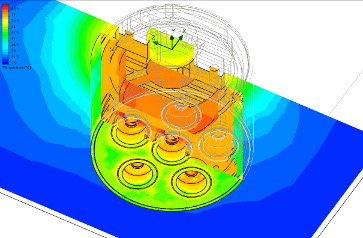
    Now I chant it under my breath when I see Concurrent CFD in action. This type of simulation software is named Concurrent because CFD is fully embedded in CAD; as a result, you can conduct fluid flow and heat transfer analysis throughout a product’s design process. When you’re ready to analyze your new model, you simply prepare it for analysis right there and then inside CAD without transferring your data to another software or person. There’s been a fair amount of press on it lately so I won’t go into too much detail here. But the reason why Concurrent CFD reminds me of Speedy is that Concurrent CFD can reduce simulation time by as much as 65 to 75 percent in compare to traditional CFD tools. ¡Ándale! ¡Ándale!

    Analysis results on an LED light. Image courtesy of Voxdale.

    Analysis results on an LED light. Image courtesy of Voxdale.

    While all markets and products are time sensitive to a certain degree, the electronics market seems to be an extremely fast moving one.  Every day we are bombarded by ads showcasing the latest/newest/shiniest mobile phone. TVs are getting bigger and thinner by the hour. In short, time is of essence for companies developing any electronic product. So it would be helpful to do thermal validation and optimize airflow as quickly as possible. If you’re involved in electronics design and are interested in how Concurrent CFD can help, then I’d like to invite you to the Concurrent CFD for Electronics Cooling Applications online presentation. During this 45-minute presentation Travis Mikajaniec will give you a bit more background information on Concurrent CFD and show you how to take advantage of it to make your life a whole lot easier. Hope to see you there.
    Until next time,
    Nazita

  • Microsoft’s Official Humor Guide: Funny Because It’s Real [Bad Ideas]

    The company that brought you the comedy gold of Jerry Seinfeld and Bill Gates gabbing about footwear has solved humor forever, the end. Meet Microsoft’s education competency guide to humor, and please remember to tip your waitress: More »


  • EIA 914 Revisions Follow Up And What to Make of that 83 Build

    natural gas(This is a guest post from an anonymous professional natural gas trader.)

    The EIA released an as-expected decline in US production, amounting to an average of -0.40 Bcf per day for the Lower 48 States series for the period Jan 2009 through Jan 2010.  If this was an underwhelming figure, the fact that the report now shows the latest month estimated, February, to be the new peak in US production, at 63.9 bcf/day, must have been frustrating.  The 1 bcf/day increase over January does support the idea presented here that a more responsive supply-estimation method would not manifest bullishly given the record increase in Baker Hughes’ gas rig count.

    Yesterday was instructive for those trying to understand production data’s place in the hierarchy of natural-gas fundamental data, for if the 914 revisions were uninspiring, the weekly storage report was
    anything but.  The build of 83 Bcf for gas-week ending Apr 23 signals a quickly loosening supply/demand balance and emphasizes the importance of storage data over lagged production data that still do
    not fit well with demand assumptions and the separately-assembled storage data.  While the production news was bearish, it took a back seat to the 297 Bcf we’ve built since we began building inventories 6
    weeks ago.  This compares to a build of 156 Bcf over the same period last year – a record then.  So, not only have we beaten last year’s record start to the injection season, we’ve doubled it.  There is no
    doubt that the weather since mid March has been very mild and greatly contributed to this storage result, but an aberrant spring is not akin to an aberrant winter or summer when talking energy demand.  The
    demand sensitivity of gas to temperature swings is not linear and from 50F to 75F is fractions of the sensitivity you see from 25F to 50F and from 75F to 100F.  On a weather-adjusted basis, yesterday’s report was actually bearish against last year’s build of 82 bcf for the same week.  This is significant, because the time period one year ago in gas was thought to be the hallmark of poor supply/demand dynamics.

    The supply/demand balance, as understood through storage, appears to be poor and appears to be worsening (this is particularly poor news for those carrying gas through time in UNG, as contango will expand in a loosening environment).  It’s prospects into May do not look bright given that we rolled the May contract this week at $4.27 – 95 cents (30%) above last year’s May expiry and 43 cents above April.  This is a level that will offer pause for many of those executing economic options between coal and natural gas for power generation and encourage any existing price-sensitive marginal production.  Price responsiveness – on both sides of the equation – has become a defining characteristic of gas in the new shale era.  May at $4.27 will likely not help to tighten the balance, but should help to highlight the importance of storage data over production data in assessing the US gas market.

    Join the conversation about this story »

  • Motorola Shadow Passes Through WiFi Alliance

    We haven’t heard any information about this phone in a long time. If you all remember this phone is rumored to be the Google branded Nexus Two. Recently a device from Motorola, the Motorola MB810, passed through the Wi-Fi Alliance. Apparently this device has the codename Shadow which will likely be changed by the time it’s released.

    Some rumored specs include, 4.3 inch capacitive touch screen display, full QWERTY keyboard, 8MP autofocus camera, and Android 2.2 and it has Wi-Fi 802.11b/g/n. there has been a few reports that this device may land on Verizon, my guess is it will be a GSM device sold by Google and will be the second in the Nexus series of superphones. Only time will tell, these next few weeks should be very exciting for Android lovers that need a powerful device with a keyboard.

    [via slashphone]

  • Painter looks at American fast food in the Middle East landscape

    McD

    It’s been 48 years since Andy Warhol demonstrated that an ordinary American food brand could be worth thinking about other than when you’re hungry. Now, Eric Robert Parnes is up to much the same thing, albeit with work that’s a bit more provocative than a can of Campbell’s Condensed Tomato Soup.

      In his paintings, Parnes, a 31-year-old Iranian American artist, portrays brands like McDonald’s, KFC and Starbucks open for business in Middle Eastern countries. Each of his canvases features a group of women in chadors, their backs turned, regarding the fast-food outlets with thoughts that are anyone’s guess. Parnes—whose far-ranging work also includes gold-leafed artillery helmets and nudes equipped with gas masks—says his intent was not to be critical of American fast food’s presence in Muslim countries but to "explore … the dynamics involving Western and Eastern cultures." And for better or worse, Western "culture" these days usually means fast food.

      "Aside from the American flag, people identify the United States via our products’ visual logos," Parnes tells BrandFreak. "These brands have become visual representations that elicit an immediate response of recognition. It really doesn’t even matter that Domino’s or Starbucks is spelled out in another language. All we need is a logo to recognize the company."

      So, good news for all you fast-food marketers out there: Your logo works just as well in Riyadh as it does in Rochester.

    —Posted by Robert Klara

    KFC

  • Sony Electronics HQ In San Diego Awarded LEED Gold Certification


    The U.S. Green Building Council Institute recently announced the newest U.S. facility to earn the prestigious – the Sony Electronics (SEL) headquarters building in San Diego. The LEED certification system is the foremost program for the design, construction and operation of high-performance green buildings.

    “When we began laying out initial plans for our headquarters, we knew we wanted green to play a major role in its construction,” said Ed Cotter, Executive Vice President, Sony Electronics. “As a major consumer electronics company, we take sustainability very seriously and seek out efforts to reduce our environmental footprint wherever possible.”

    The building design integrated a number of green elements in accordance with the Green Building Council’s LEED requirements, including 80 bicycle racks, 140 spaces reserved for vehicles opting to carpool, and 76 set aside for fuel-efficient vehicles, to promote the reduction of greenhouse gas emissions.

    “Climate change remains a big environmental problem throughout the globe,” said Rick Fedrizzi, President, CEO and Founding Chair, U.S. Green Building Council. “But innovative companies like Sony Electronics are helping address the issue through local solutions such as building sustainable facilities.”

    SEL maneuvered more than 92 percent of the building construction debris away from local landfills. In addition, open space accounts for 29 percent of the lot, with vegetation making up 52 percent more than double the requirement.

    Building materials, local resources

    Nearly 15 percent of the buildings materials are local, garnered from within 500 miles of the sites location in the Rancho Bernardo community. A minimum of 75 percent of the wood used in the framing, flooring and furniture is certified by the Forest Stewardship Council a non-profit organization that promotes the responsible management of the world s forests and 47 percent of the building materials have been manufactured using recycled materials.

    Water efficiency

    The buildings use of low-flow water fixtures ensures rates of water usage up to 47 percent lower than current codes, in conjunction with the use of condensate water from air-conditioning units. The building also captures 90 percent of storm water runoff onsite.

    Energy and atmosphere

    SEL designed its headquarters to maximize energy performance by 22.6 percent with the installation of lighting sensors throughout the building in addition to variable speed drives for A/C units.

    Solar panels are installed on the building’s parking garage to collect energy for the local utility company, a feature that offsets nearly five percent of the total energy cost. The buildings designers also optimized the use of natural lighting in its construction 75 percent of the facilities total square footage receives natural sunlight.

    This information is a press release that originally appeared on Sony Electronics News; photos by Costea Photography.

  • Is Yahoo’s CEO Really In A Position To Tell Google What It Needs To Do?

    I have to admit, I thought it was pretty amusing to see this headline in the BBC:


    Yahoo chief Carol Bartz sees trouble for Google.

    What else is she supposed to say? Of course she’s going to slag the company that totally destroyed Yahoo at its own game, but the real question is why would anyone listen? Yahoo isn’t exactly in the position of being able to say what Google should be doing, given that every single move that Yahoo has tried against Google has failed — sometimes miserably. Bartz’s comments get more amusing the further the article goes on:


    “Google is going to have a problem because Google is only known for search…”

    Well, I guess she should know. While she won’t admit it, people still tend to think of Yahoo as search as well. And Yahoo spent so much time trying to diversify that if they don’t think about Yahoo as search these days… they just think about Yahoo as being a confused jumble of sites that don’t do much. In the meantime, despite her claims, it does appear that Google has expanded well beyond search. AdSense (which is about other content sites) makes them lots of money. Pretty much everyone I know uses Gmail, Google Calendar and Google Maps rather than the Yahoo equivalents. I’m trying to think of what other areas Yahoo has expanded into that have been successful for the company.

    But the funniest statement of all:


    “Google has to grow a company the size of Yahoo every year to be interesting.”

    I don’t think that anyone judges Google based on how “interesting” they are. Is that the metric they use at Yahoo? Does that explain the $47 million she apparently made last year? Because she made Yahoo so interesting? Well, I guess it should be admitted that Yahoo is the company that is trying (and so far, failing) to patent “interestingness,” so perhaps she’s just urging Google to be interesting for the sake of a future patent fight? In the meantime, I would assume that, at Google, they judge the company based on how much money it makes — and on that front, it appears to be cleaning Yahoo’s clock on a pretty regular basis.

    As for “growing a company the size of Yahoo every year,” that becomes easier and easier as Yahoo gets smaller and smaller.

    Permalink | Comments | Email This Story


  • 2011 Chevrolet Cruze: A Safety Story [w/video]

    Filed under: , , ,

    2011 Chevrolet Cruze Crash Testing – Click above for high-res image gallery

    Over the course of Bob Lutz’ tenure at General Motors, one of his major goals was globalizing the production process. As Lutz tells it, the Pontiac GTO was the first global vehicle born of his labors, with development work being done in both Australia and North America. But the GTO, and its follow-up, the Pontiac G8/Holden Commodore, were niche products sold in limited numbers in limited markets. The real test of global product development comes when it’s applied to high-volume mainstream products.

    That’s were the Epsilon II and Delta II architectures come into play. Epsilon is GM’s mid-large platform (D/E segment) while Delta is the compact (C segment) platform. We’ve already seen the Epsilon II here in America, underpinning the Buick LaCrosse, but the Chevrolet Cruze proved to be a tougher nut to crack. One of the most difficult challenges in the global production strategy is the differing safety standards around the world, along with the guidelines imposed by non-governmental bodies like the Insurance Institute for Highway Safety (IIHS). Creating a platform that can live up to all of these standards without being absurdly heavy is a problem. Find out how GM tackled the problem and found a solution after the jump.

    Continue reading 2011 Chevrolet Cruze: A Safety Story [w/video]

    2011 Chevrolet Cruze: A Safety Story [w/video] originally appeared on Autoblog on Fri, 30 Apr 2010 11:57:00 EST. Please see our terms for use of feeds.

    Permalink | Email this | Comments

  • Spill Baby Spill or Blow Man Blow?

    This week we are seeing two starkly different uses of offshore natural resources playing out on a national stage.  In the context of emerging climate and energy legislation, its worth taking another look at the risks and costs of both as Congress and the Obama Administration deliberate on policy incentives for offshore wind and oil that are pursued through legislation or Executive Branch action.

    In Louisiana, an estimated 5,000 barrels of oil a day are leaking from BP’s Macondo well in the Gulf of Mexico after Transocean Ltd.’s Deepwater Horizon rig exploded a few days ago.  Reports are that people in Louisiana can already smell the oil.  BP is working to stop the flow of oil and experts suggest BP will need to drill a “relief well” to halt the leak.  Such a mitigation process can take upwards of 3 months.  BP is reportedly spending $6 million a day in this effort and preparation of two relief wells will cost an estimated $200 million.  (Adding in US Government support costs, Evolution Securities suggests that the “net cost to BP of the cleanup operation so far plus the drilling of two relief wells would be around $845 million.”  This figure does not necessarily address harm some experts anticipate to Louisiana coastal communities and their ecosystem services, and potential punitive damages that could emerge. The punitive damage figure for ExxonMobil as a result of the Valdez spill in Alaska was approximately $507.5 million after the Supreme Court struck down the original figure of $2.5 billion as excessive.) 


    Meanwhile, off the coast of Nantucket, the drawn out battle over the reported 420 MW offshore Cape Wind project took a positive step forward when Department of Interior Secretary Ken Salazar announced federal approval.  Reports are that the project will cost approximately $900 million to build, a remarkably similar figure to the costs of direct mitigation for BP’s Louisiana debacle noted above.  Cape Wind will also reduce annual US greenhouse gas emissions by approximately 734,000 tons and replace 113 million gallons of foreign oil; both figures on an annual basis.  According to the Massachusetts Energy Facility Siting Board, Cape Wind will help stabilize and lower consumer electricity costs in the region.  A recent report by Charles River Associates indicates that Cape Wind will reduce the wholesale price of power in New England by an annual average of $185 million, resulting in an aggregate savings of $4.6 billion over 25 years.

    It is ironic that two key offshore energy projects are in the spotlight at the same time and just as the Senate debate on climate and energy legislation heats up with consensus to pass a bill based on the right balance of incentives for fossil fuels and renewable energy.  A quick comparison of the two projects suggests it might be a better investment and policy direction to develop incentives to blow instead of drill off the coasts of the United States.  But will there be enough votes in the Senate to pass a climate bill if offshore drilling is scaled back?  Stay tuned.