Blog

  • Ouch: Spain Has 20% Unemployment

    The overall unemployment rate in the EU is about 10%, but Spain is being especially hard hit by the economy and has reached 20%. Ouch.

    The BBC says:

    Spain’s unemployment rate has hit 20% for the first time in nearly 13 years, official figures have shown.

    There were 4,612,700 people unemployed in the country at the end of March, the national statistics agency INE said.

    Spain’s jobless rate has risen sharply during the economic downturn and is the highest in the eurozone.

    S&P has downgraded Spain’s government debt based on its bleak economic outlook.

    According to WIkipedia other countries with around 20% unemployment include Bosnia and Herzegovinia, Gabon, and East Timor.

    Spain unemployment rate hits 20% [BBC]

  • MANY nurses say “yes definitely” to douching with ZONITE (Jun, 1954)

    SURVEY SHOWS MANY nurses say “yes definitely” to douching with ZONITE for feminine hygiene

    The practice of using a cleansing, deodorizing douche for feminine cleanliness, health and married happiness is prevalent among modern women. Another survey showed that of the married women asked:

    83.3% douche after monthly periods,
    86.5% at other times.

    Zonite is a perfect solution for your douche! It is recommended among nurses who know of zonite’s many advantages. In fact, no other type liquid product for the douche of all those tested is SO POWERFULLY EFFECTIVE yet so absolutely safe to body tissues as ZONITE.

    ZONITE Offers Great Hygienic Protection Zonite is a powerful antiseptic-germicide. An advantage of douching with Zonite is that it promptly washes away germs and odor-causing waste accumulations. Zonite leaves a woman with a sense of well-being and confidence— so refreshed and dainty. Zonite completely deodorizes.

    Enjoy the many benefits of Zonite. Inexpensive — only a few pennies per douche.

    ZONITE has ‘101′ uses in the home


  • Four Rotating Magnets Run Clock. (May, 1932)

    Four Rotating Magnets Run Clock.

    NO MATTER how closely you listen, you can’t hear this clock tick because four rotating magnets have replaced the old gears, making the clock “tickless.” The mechanism of this new timepiece, shown below, is made up of four magnetic fields. One rotates every second; one each minute; the third each hour; and the fourth operates the hour hand at the rate of one revolution every twelve hours.

    The new clock must be set face up on a table or support because the mechanism doesn’t function properly when hung on a wall or placed on the mantel.


  • HOW AN OFFICE BUILDING OPERATES (Jan, 1950)

    HOW AN OFFICE BUILDING OPERATES

    Prepared by the Armstrong Cork Company, makers of Industrial Insulations, in cooperation with the National Association of Building Owners and Managers

    Below ground, a modern office building is a beehive of activity. There you’ll find electrical, plumbing, and carpenter shops, employees’ locker rooms, control centers, and even a garage. Down deep in the basement, too, are the boilers and compressors that supply heat and refrigeration for the entire building.

    Delivering that heat and cold to every floor is a complex and expensive job. To cut the cost of these services and make them work more efficiently, modern office buildings depend on insulations. Many of the insulating materials they use are made and installed by the Armstrong Cork Company.

    Elevators, telephone lines, electric wiring, along with pipes carrying steam, hot and cold water, and refrigeration travel from basement to top floors through an opening called the “service core.” This core is really a vertical highway through which move all the services that make a building livable.

    Steam and hot water come from the boiler room (1), and are kept hot by 85% Magnesia insulation on the pipes that carry them. Right beside them are lines filled with a liquid refrigerant and insulated with Armstrong’s Cork Covering to keep it cold.

    This refrigerant is used for air conditioning. It is pumped from compressors 2 to machine rooms 3 spaced at intervals all the way up the building. Here the refrigerant runs through bare coils or pipes, and the air is cooled by being blown over them. Then the cooled air is carried to each office through ducts 4 covered with Armstrong’s Corkboard to hold it at the right temperature.

    Insulation works at other places, too. The boilers can generate steam with less fuel because Armstrong’s Insulating Fire Brick in their walls hold in the heat. Top floor offices are more comfortable because a layer of Armstrong’s Corkboard Roof Insulation helps keep temperatures steady.

    All through a modern office building, as in hundreds of other industries and businesses, Armstrong’s Industrial Insulations keep the cost of controlling heat and cold within practical limits. If insulation can solve a temperature problem for you, there is a trained engineer in a near-by Armstrong office who will be glad to help you.

    ARMSTRONG’S INDUSTRIAL INSULATIONS


  • The Secret Keepers (Aug, 1962)

    The Secret Keepers

    The latest methods of radio communications defy detection by any listener —friend or foe

    By KEN GILMORE

    MOST radio communications systems are like “party lines”—anyone can listen in. But electronics scientists have been working overtime to come up with the equivalents, radio-wise, for the more desirable (and costly) “private lines.” Their objective: to allow our military and government officials to transmit secret information on the air with the full assurance that it can be “received” only by those listeners it is intended for.

    Perhaps the best known gadget of this kind is President Kennedy’s “scrambler.” Thanks to this device, the transmitters in his private automobiles and airplanes take his words and turn them into a kind of electronic “hash.” Then a special receiver which is set for the right “code” unscrambles the hash and turns it into intelligent speech again. The result is that no unauthorized listener can eavesdrop on the President’s conversations.

    Electronics engineers are coming up with a number of devices to allow “private” radio communications. And some of them—already being tested by the armed services—do the job by performing a series of ingenious electronic tricks.

    RACEP. The Orlando Division of the Martin Company has come up with a system called RACEP (short for Random Access and Correlation for Extended Performance). One of the more promising schemes to insure secrecy on the airwaves, RACEP is based on a principle that is really quite simple—electronic circuits are capable of switching millions of times a second, but our ears, by comparison, are very slow.

    Therefore, suppose an electronic circuit were designed to snip tiny samples out of words being spoken. Let’s say this circuit takes 8000 such samples every second, and that each sample is one microsecond long.

    Now suppose you’re talking by radio and speak a 1-syllable word which has a fundamental frequency of 200 cycles— about average for a man’s voice. During one cycle of your voice signal, the sampling circuit will take 40 1-microsecond samples.

    The pulses generated by this sampling technique will trace out the shape of your voice waveform quite accurately. Using just these pulses, decoding equipment at the receiving end can reconstruct the original 200-cycle voice signal so well that the human ear can’t tell it from the original “unsliced” signal. Your voice, in other words, has been transmitted faithfully by a series of pulses.

    Now, to take it one step further, suppose the transmitter keeps shifting its frequency, so that each pulse is sent out on a different wavelength. A receiver, in order to pick up this tricky signal, must be set to synchronize with the pulses at the proper repetition rate. And, at the same time, the receiver must keep changing frequency exactly in step with the transmitter, so that it’s tuned in to each pulse at the right time and at the right frequency.

    Your words will be heard clearly on this special receiver, of course, but they’d be lost on any radio not set up to receive them properly. Military planners are excited about RACEP because it would be almost impossible for enemy electronics experts—even if they knew the principles involved—to analyze the waveforms and build equipment capable of intercepting and untangling the scrambled RACEP signals.

    Another big advantage: a RACEP user can call any receiver whose code he knows, simply by setting up his transmitter to broadcast its pulses in that code. Battle-field units could call each other as easily as dialing a telephone.

    Let’s say you want to call receiver 35. Just as you can call a friend on the telephone if you know his number, you could call receiver 35 by dialing its number on your transmitter. The code you dial sets up your transmitter to broadcast a series of coded pulses at a specific repetition rate. Furthermore, each of the pulses is sent out on a slightly different frequency. Each receiver, on the other hand, is set up to receive signals which are broadcast at a predetermined pulse rate and which change frequency in a predetermined pattern.

    If you transmit the pulse pattern which receiver 35 is set up to receive, its operator will hear your words as clearly as though you were speaking over a regular radio. Other receivers, not set to detect this particular combination of pulse rate and frequency changes, very likely won’t hear a thing.

    RACEP brings with it another advantage, too. Your voice is sampled only one microsecond out of every 125. The system, then, is working for one microsecond, and idle for 124. Your transmitter is on the air only 1/125 of the time you are speaking, so many other transmitters can be operating in the same frequency band at the same time without interfering with you or with each other. Even if an occasional pulse does happen to synchronize with another in both time and frequency, this slight interference would be so brief as to be unnoticeable.

    Development engineers at the Martin Company have found that scores of conversations can be going on simultaneously in a band about 4 mc. wide without seriously interfering with each other. Even in such busy systems as air-to-ground radio, each individual is using his radio only a small percentage of the time. Therefore, systems planners estimate that up to 700 receivers could be operating in one area with the RACEP system.

    Phantom. RACEP isn’t the only new communications system. General Electric researchers have come up with an entirely different approach which they call “Phantom.”

    The principle, again, is rather simple. A radio transmitter—one used by a regular commercial radio station, for example —may broadcast on a carrier frequency of 1000 kc. If it broadcasts a 5000-cycle note—about the highest frequency transmitted by most AM stations—this signal modulates the carrier so that the final output signal contains frequencies between 995 and 1005 kc. Engineers call this a bandwidth of 10 kc. (1005 – 995 = 10kc).

    Your receiver has a bandpass of about 10 kc, too. As you tune across the dial, you shift the position of this bandpass. When you tune to 1000 kc, the bandpass is centered around this frequency so that you receive all frequencies between 995 and 1005 kc and thus hear the program the station is transmitting.

    The Phantom system, however, would stretch the audio signal over an extremely wide band of frequencies—perhaps 200 kc or more. The transmitted signal, then, would cover a band of frequencies from 900 to 1100 kc. Since it is spread over such a wide area, only a tiny fraction of the signal would fall within the bandpass of an ordinary receiver.

    It wouldn’t be possible to tune in on the wide-band Phantom signal simply by having an extra-wide-band receiver, either. If you had this kind of setup, a jumble of stations broadcasting on frequencies within the band you were covering would come tumbling in. To get around this problem, Phantom designers “tag” the transmitted signal with a special waveform. The Phantom receiver lets in only signals which are identified by this waveform and rejects all others.

    You may have heard Phantom broadcasts without knowing it. General Electric has transmitted Phantom signals more than 2000 miles across the country to test the system. Because this special waveform is spread over such a wide frequency band, its amplitude in the bandpass of any normal receiver is very low—so low that you wouldn’t notice it even if you happened to be tuned in somewhere on the broad band of frequencies across which the Phantom signals go skittering. And if your receiver were sensitive enough to hear the Phantom signal, you would probably think it was just ordinary static!

    Incidentally, GE engineers who didn’t know the exact waveform tried to intercept the messages during the test transmissions, just to see whether an enemy could break the “code.” The results: they couldn’t. Said one, “It’s like a combination lock. Even if you know the principle on which it works, that doesn’t mean you can open it without knowing the combination of the particular lock you want to open.”

    Phantom systems can use literally thousands of “combinations” or special identifying waveforms, and they can also change from one to another rapidly. Thus, even if someone happened to stumble on the code accidentally—about as likely as opening a combination lock by chance—it wouldn’t do him much good. Next time he tried, the combination would have been changed.

    Vocoder. Engineers at Hughes Aircraft have come up with still another way to transmit messages secretly, although the gadget they use to do it wasn’t originally developed for that purpose. Their basic approach, as a matter of fact, isn’t even new.

    Back during the 1930’s, Bell Laboratories scientists built a gadget they called a “vocoder.” It consisted of a cabinet full of sound generators, niters, and other circuitry, and it was designed to create a reasonable facsimile of the human voice. If you turned on the right combination of circuits and did it fast enough, the vocoder produced a series of speechlike sounds.

    These electronically generated words were quite intelligible. In fact, Bell’s vocoder created a sensation at the New York World’s Fair in 1939, where an operator played it from a keyboard much like that on a piano. By pressing the right combination of keys in the right sequence, he could make the vocoder “speak” whole sentences.

    Hughes’ entry in the secrecy sweepstakes makes use of the old vocoder principle. Essentially, the spoken words to be transmitted are fed into an analyzing circuit which determines several important characteristics of the various sounds which go to make up each word—pitch, intensity, and so on. This information, electrically coded, is sent on to a receiver, which, much like the earlier Bell Labs unit, turns these signals into intelligible speech.

    The basic diagram is on page 43. The voice signal to be transmitted is applied to the inputs of a series of 12 bandpass niters. The output of each filter is determined by how much sound energy the word or syllable being spoken contains in that particular frequency region.

    Since the outputs from these circuits are rectified, the sound energy going through a particular filter shows up as a d.c. voltage. The louder the sound applied to the input of any specific filter falling within that filter’s frequency range, the higher the voltage at the output of that filter.

    A final circuit—called the pitch extractor—finds out two things. First, it determines the presence or absence of pitch. And second, if sounds with a definite pitch are present, it determines their frequency.

    By way of explanation, a vowel—an “a,” for example—is produced when our vocal cords generate a sound of a certain frequency. A consonant, on the other hand—such as an “s”—is a less specific sound (a hiss, in this case), requires no movement of the vocal cords, and is at no particular frequency.

    The pitch extractor transmits an encoded electrical signal which determines whether pitch is present, and, if so, what its frequency is. The signals from the pitch extractor and the 12 filters go to a time multiplexer which forms them into a single composite signal for transmission by radio.

    At the receiving end, a time de-multiplexer splits up all of the signals again and sends each one to its proper circuit. The signal from the pitch extractor is applied to a relay, which turns on one of two circuits. If there is no pitch pres- ent at the transmitter, the relay turns on a “hiss generator” which produces white noise. If pitch is present, the relay activates a “buzz generator” which puts out a sound rich in harmonics and similar to that produced by the human larynx. The buzz generator operates at the same fundamental frequency that the pitch extractor detected in the speech at the transmitting end.

    Now, either the hiss or the buzz (depending on which one happens to be present at any given moment) is applied to the inputs of all the bandpass filters in the receiver. Suppose, at one particular moment, that the person back at the transmitter is saying “a.” The fundamental frequency of his “a” might be 300 cycles.

    His particular voice quality—the characteristics of his voice which allow his friends to distinguish his speech from someone else’s—is determined, among other things, by the relative strengths of the various harmonics of this basic 300-cycle tone. Let’s say, for example, that the second harmonic—600 cycles— is twice as strong as the fundamental, and that the third harmonic—900 cycles —is half as strong as the fundamental.

    Again, for the sake of illustration, let’s say that bandpass filter No. 1 at the transmitter has put out a signal of 4 volts, corresponding to the intensity of the 300-cycle fundamental. Bandpass filter No. 3, carrying the second harmonic, would have put out a signal twice as large—8 volts. Filter No. 5, transmitting the third harmonic, would have produced only 2 volts.

    At the receiving end, these signals of varying strengths are applied to corresponding filters. Number 3, then, amplifies the output of the buzz filter—which, you’ll remember, is operating at the same 300-cycle fundamental—twice as much as number 1 and four times as much as number 5. The result is a sound very close to the original “a” spoken into the transmitter.

    The vocoder was originally designed to squeeze voice signals into a narrower bandwidth and make space for more messages in the crowded radio spectrum. And it does this very efficiently. The encoding vocoder generates 13 signals: one from each of the 12 filters and one from the pitch extractor. Each of these 13 signals can be squeezed into a channel just 25 cycles wide, and all 13 taken together require a total bandwidth of only 325 cycles.

    Normally, communications channels such as those used by the military, commercial airlines, and so on, are some 3000 cycles wide—about the same as a telephone channel. With the vocoder, about nine conversations can be squeezed into the band space usually taken up by only one.

    A vocoder operating as described above is said to be an analog device, that is, the voltage output of the separate circuits varies continuously as the input signals change, and these constantly changing values are transmitted continuously. But the vocoder can also be operated as a digital encoder and decoder.

    When operated digitally, a sampling circuit checks each of the individual circuit outputs some 50 times a second. The series of pulses obtained by this method is transmitted to a receiver where an unscrambler separates the various pulses. Then, it sends each to the circuit in the receiver corresponding to its counterpart in the transmitter.

    As you may have guessed, digital operation gives the vocoder several outstanding advantages. First, it can operate reliably in the presence of tremendous amounts of interference—amounts which would paralyze an analog system; consequently, a digital system is far harder to jam. Second, signals from a digital vocoder can easily be encoded— by turning them into a kind of electronic “hash” something like that used with President Kennedy’s scrambler. Then, a special unscrambler at the receiving end turns the scrambled signals back into words. To anyone listening without an unscrambler set specifically for the message being transmitted, the signal sounds like pure gibberish.

    Thus, with such tricky electronic devices as these, our military forces and government officials can have all the advantages of radio’s instant communications. And they can also have another advantage that radio has seldom offered —the assurance that their messages have traveled through the ether in such a manner that only the persons they are intended for will ever know what they were all about.


  • Elegant Engan catbox

    Materials: Engan 2 drawer 2 door, catbox, motion sensitive light

    Description: I followed the basic instructions but skipped the part about the drawers instead opting to use one of the side panels from a drawer to join the two drawer fronts together. Once attached using the 2 provided L bracket that were supplied + 1 other larger one I had bought at Ikea as well I mounted the drawer fronts to the unit.

    With all parts together I put the back on but only nailed the top part down to the middle then used a jig saw to trim off the bottom half, then jigged out the cat door oh so very carefully.

    The entry hole is protected around the edges with Ikea cable tube held on with the remaining nails from the backing. The bottom where the box is sitting on is one of the drawer bottoms.

    Last steps were to add in a motion sensitive light and I added 2 more L brackets with another drawer side to act as a brace so the box won’t shift when in use. The concern was the cat could potentially trap himself in side.

    ~ mcquarris


  • New beta unshackles Mac users from iTunes’ sync shortcomings

    By Tim Conneally, Betanews

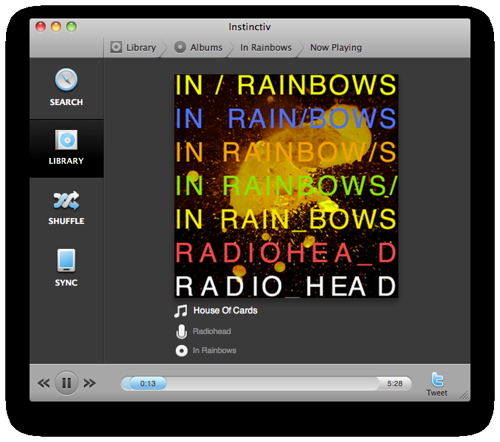
    Now Playing view on Instinctiv beta for Mac OS 10.5

    Windows users have a lot of alternatives to the “mainstream” media players (Windows Media Player and iTunes). However, Mac OS users are not so fortunate. Aside from a couple of minor exceptions, Mac OS is an iTunes-dominated platform.

    And as such, it means support for portable media players that don’t have an “i” at the beginning of their name is scarce.

    Mac users who carry a smartphone other than an iPhone or a media player other than an iPod don’t exactly have the easiest time organizing and shifting their content from their computer to their mobile device.

    It’s part of the problem I talked about last December, when I wrote about the three main issues that have prevented smartphones from completely replacing dedicated personal media players like the iPod.

    Among the three issues of limited battery life, limited storage capacity, and limited sync options, I consider sync to be the most important; and for Mac users, syncing a device other than an iPod or iPhone is really not an option.

    Today, Instinctiv launched the beta of a new media player for Mac OS which takes a serious stab at remedying this problem.

    The Instinctiv personalized media player supports portable devices that iTunes doesn’t –such as those running Android, BlackBerry, Windows Mobile, and Symbian– while supporting more than 50 file formats, including Windows Media files and those protected by Apple’s FairPlay DRM.

    This software is specifically geared toward Mac users who want to sync a device other than an iPod or iPhone.

    Actual Beta News feature banner“This market isn’t just underserved, it’s completely ignored!” Instinctiv CEO Aniq Rahman told us yesterday. “Apple has always given exclusive priority to their own products, but 85% of the international smartphone share is non-Apple devices. We’re trying to cater to everybody, so they can sync all their devices with their Macs.”
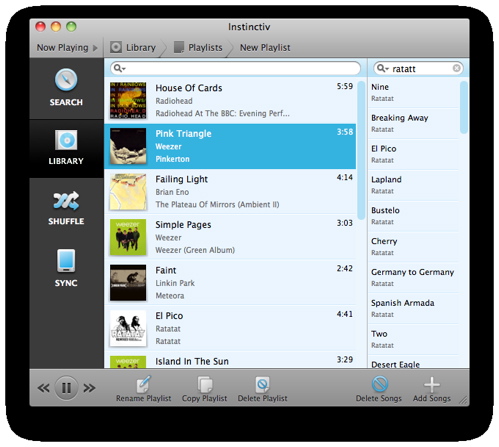
    But the software isn’t just meant to be a sync solution, it’s also a standalone player that automatically fetches missing cover art, renames misspelled or untagged songs, lets users create playlists, and analyzes the user’s listening behavior in shuffle mode with the company’s smart shuffle technology which it first debuted as an iPhone app last year.

    Create Playlist function on Instinctiv beta for Mac OS 10.5

    “Smart shuffle really eliminates the need to create playlists,” Rahman said. “With the standard, random shuffle feature of media players, users skip every 1.5 songs. With iTunes Genius-enabled shuffle, users skip once every four songs. With Instinctiv shuffle, users skip once every 31 songs.”

    Instinctiv’s smart shuffle can do a seeded shuffle which generates songs in a fashion similar to Pandora, or it can hone results as you go, based upon what you skip. For example, if you’re not in the mood to listen to the fast and loud song that comes up in shuffle, you’ll skip it and be given a song of a different mood.

    Furthermore, Instinctiv is clean, small and purpose-oriented. As iTunes continues to grow into a solution for organizing all media — music, HD video, apps, and now books — it is turning into a pretty big piece of software. If you only want to organize and consume music, Instinctiv is a streamlined solution to do so. It can act as a standalone player and manager for all of your music files or as a companion to iTunes, with automatic support for playlists created in iTunes.

    To download the beta of Instinctiv for Mac OS X 10.5+, visit Instinctiv’s download site.

    Copyright Betanews, Inc. 2010


    Add to digg
    Add to Google
    Add to Slashdot
    Add to Twitter
    Add to del.icio.us
    Add to Facebook
    Add to Technorati


  • 2010 Tesla Roadster Sport

    To the Batcave!
    Brian Armstead, Canadian Auto Press

    During a recent visit to New York to attend the 2010 New York Auto Show I was called by Michael Sexton, the sales manager for Tesla Motors’ new retail operation in Manhattan, who invited me to drive the all-electric Tesla Roadster. Now, I had previously driven the concept Model S on a special indoor course at the National Building Museum in Washington, D.C. Yes, I said indoor course, as all Tesla vehicles roll under electric only power, and thus, are emissions free. The Model S, designed by Franz von Holzhausen, the former Mazda design whiz kid, made me feel like an executive, as it was decked out in luxury, with tons of bells and whistles. Since the course was of limited length, I was not able to fully experience the car, but was impressed with the power off the line.

    2010 Tesla Roadster Sport

    2010 Tesla Roadster Sport

    My experience driving the Roadster was 180 degrees different, as this car is all about wall-to-wall performance, along with a surprising amount of comfort thrown in for good measure. When I drove the Roadster, I felt like Bruce Wayne, Batman’s alter ego. You see, the Tesla showroom is located in the arts district of Chelsea, full of lofts and galleries dedicated to painting, photography and the like. Their showroom is very hip, with Tesla cars on display, and the Tesla website is made visible on cool wide-screen Apple monitors. The floors are concrete, rock-like, just like the Bat Cave.

    So I wrench all six feet nine inches of my body into the car, riding shotgun as the six foot four Sexton made entry into the driver’s seat look pretty easy. We donned our secret identity masks (the latest designer sunglasses!) and shot out of the “Bat Cave” courtesy of 215 kW (288 horsepower) of pure electric thrust.

    “Holy Torque,” I exclaimed, having become sidekick Robin as Sexton temporarily assumed the role of Batman. I’ve driven Porsches, Ferraris, AMG Benzes and the like, but never have I felt this type of thrust experience in such a small car. This car’s acceleration is nothing short of amazing.

    As the Sun started to set, I became Batman, and my Tesla “Batmobile” headed towards Times Square. Even the Tesla logo, which somewhat resembles the Batman logo that would shine above Gotham City signaling Wayne to the Bat Cave, was displayed in the night sky over Times Square, competing with projected images from P.Diddy and Donald Trump. Of course the previous sentence and this whole scenario is fiction, but one would have thought there was a Tesla logo beaming as passersby parted the waters to let our gorgeous blue supercar go by with stares of admiration. And just for the record, one of New York City’s many nicknames is Gotham!

    Okay, back to the real world, where perhaps the most amazing thing about the Tesla Roadster is the simplicity of its operation. The motor is just that, a motor. It’s not particularly large or impressive looking like a big V12 with four cams hanging on top of the engine block. In fact, you can’t see it at all as it resides amidships under a cover. There are no dual exhaust tips at the rear, because they’re not needed. The chassis is made of bonded aluminum, and is very rigid. The motor connects to the simple single speed gearbox, which then turns two high torque capacity halfshafts to drive the rear wheels. Styling is based on the Lotus Elise. Interior accoutrements are purposeful, like heated bucket seats, great for the top off jaunts on a cool April night in Manhattan. A JVC aftermarket headunit provides a dedicated iPod connection, as well as hard drive based navigation and music storage. The only interior bow to serious high technology is the Vehicle Display System (VDS). The touch screen VDS allows you to view charge/battery status, adjust the performance parameters and access various system tools. It’s also the spot where Tesla technicians can input firmware updates to the computer control system that allow them to pinpoint any faults with your car, and also update performance software to keep your Roadster operating at its peak.

    The Roadster features a rudimentary top that requires a bit of patience to first learn to remove and install correctly. The cloth top slides across the targa like opening on suspended rods, and I’m sure this will be an area where you will see continuing upgrades to improve this operation. A slick, lightweight, one piece hardtop is optional and really changes the overall look and stance of the car in a positive way. But there is nowhere onboard to store the top, which is a drawback versus the canvas top that you can roll up and store in the Roadster’s tiny trunk. I can live with that, for obvious reasons.

    The Tesla Roadster delivers full availability of performance every moment you are in the car, even while at a stoplight. Its peak torque begins at 0 rpm and stays powerful at 14,000 rpm. This is the precise opposite of what you experience with a gasoline engine, which has very little torque at low rpm and only reaches peak torque in a narrow rev range. This forces frequent gear changes to maintain optimal torque. With the Tesla Roadster, you get great acceleration and the highest energy efficiency at the same time, all while requiring no special driving skills to enjoy it. There is no clutch pedal, because as I mentioned earlier the Roadster has a single speed gearbox. Want to go fast? Floor the go pedal! Want to reverse? Press the “R” button, and the current is reversed, making the car go backward (limited to 15 mph!). Want to brake? Take your foot of the throttle, and engine braking is immediate and slows the car rapidly (and generates power to recharge the battery cells). Of course, traditional performance brakes by Brembo will also accomplish this duty in very rapid fashion.

    2010 Tesla Roadster Sport

    2010 Tesla Roadster Sport

    The motor redline is insane, a motorcycle-like 14,000 rpm. The 288 horsepower motor also features 276 pound-feet of torque. The “base” Roadster accelerates to 60 mph in a scant 3.9 seconds, while my test car, the Roadster Sport, does the trick in just 3.7 seconds. Look up the numbers folks, these acceleration figures are in the supercar category. Top speed as you might imagine is limited, with 125 mph on tap. You can take a good guess on how quickly you would deplete the batteries if the top speed were much higher. Both models feature a four-hour charge-duration (with an optional 240 volt hookup), and a range of about 236 miles.

    The Tesla Roadster battery pack in comprised of 6,831 lithium-ion cells. The so-called Energy Storage System (ESS) has a 53 kilowatt per hour output, and weighs in at 992 pounds (450 kgs). As you probably know by experience with battery powered consumer electronics (a camcorder is a good example), batteries do not have an infinite lifespan. The charge, usage and recharge cycles eventually render the battery useless. Tesla offsets the inevitable through purposeful engineering. Tesla limits the maximum charge for each of the 6,831 cells, thereby extending the life of each. A sophisticated battery cooling system is standard, and cycles on and off even when the car is not being used to keep the ESS at its optimal operating temperature. Tesla expects full battery capacity for five years or 100,000 miles, and up to seventy percent of battery capacity after that time/mileage frame. Tesla offers a battery replacement package – more on that later.

    Driving along a parkway that abuts the Hudson River, I was very impressed with the ride quality of the car. Once you get to the speed you want (very quickly!), the Roadster is a paragon of relative comfort. The chassis is made of bonded and extruded aluminum, and is very rigid, with no flex or cowl shake evident. The Roadster body is made of lightweight, strong carbon fibre, and features replaceable panels and bumper covers.

    Standard interior accoutrements include the aforementioned JVC sound system and heated sport seats (with inflatable lumbar support), MOMO sport steering wheel, leather seats and trim, cruise control, power windows and locks, plus air conditioning. On the safety front, dual front airbags, seatbelt pretensioners and traction control are standard.

    My Roadster tester came in at a base price of $109,000 USD; with options that pushed the base price all the way up t0 $154,196. The “Sport” option alone costs $19,500 and includes the high-torque motor, adjustable suspension, and special wheels and tires. You can go bananas with various option packages that add the hardtop, more leather and carbon fibre, and multiple colour and body accessory options. Destination and delivery charges add another $1,950 USD to the price, bringing the total tester amount to $156,145 USD.

    Finally, you can purchase extended service and battery replacement plans. For $5,000, you can extend warranty coverage (three years/36,000 miles) for an additional 3/36. The battery replacement warranty costs $12,000 and provides a new ESS seven years from the agreement date. If you need the ESS earlier, you will pay a $2,000 premium for each year you exercise the agreement early. You’ll earn a $1,000 discount for each year you defer to exercise the agreement after seven years.

    Is any electric car worth $156,000? You will be the judge of that. I do urge you to stop laughing and visit your local Tesla dealer to arrange a test launch, err, make that drive. Now if you come out of the dealership wearing a flying mammal suit, you too will be sold on the supercar that is the Tesla Roadster.

    2010 Tesla Roadster Sport
    2010 Tesla Roadster Sport
    2010 Tesla Roadster Sport
    2010 Tesla Roadster Sport
    2010 Tesla Roadster Sport
    2010 Tesla Roadster Sport
    2010 Tesla Roadster Sport
    2010 Tesla Roadster Sport
    2010 Tesla Roadster Sport
    2010 Tesla Roadster Sport
    2010 Tesla Roadster Sport
    2010 Tesla Roadster Sport
    2010 Tesla Roadster Sport
    2010 Tesla Roadster Sport
    2010 Tesla Roadster Sport
    2010 Tesla Roadster Sport
    2010 Tesla Roadster Sport
    2010 Tesla Roadster Sport
    2010 Tesla Roadster Sport
    2010 Tesla Roadster Sport

  • The Future of the Internal-Combustion Engine – Feature

    Despite the green hype, internal-combustion engines will keep powering vehicles for the foreseeable future.

    Carlos Ghosn, the CEO of Nissan and Renault, has proclaimed that battery-powered vehicles will account for 10 percent of global new-car sales by 2020. Mr. Ghosn, of course, is planning to introduce at least four electric cars in the next three years. Independent analysts, however, such as Tim Urquhart of IHS Global Insight, believe that battery-powered vehicles will remain at less than one percent of the new-car mix in 2020.

    Keep Reading: The Future of the Internal-Combustion Engine – Feature

    Related posts:

    1. Engine Displacement Downsizing – Feature
    2. Mercedes Engine Transplant: Modern Diesel in a 1992 190E 2.6 – Feature
    3. The Future of In-Car Technology – Feature
  • HTC releases GPS fix for Telstra Desire

    HTC Desire

    For you folks in Australia using the HTC Desire on Telstra, know that there’s a software update available that should en your GPS woes. You can download it over the air (either WiFi or network), or directly from HTC, though doing it from the desktop will wipe the device. [HTC]

  • Boston becomes first city to approve Ford Transit Connect Taxi [w/video]

    Filed under: , , ,

    Ford Transit Connect Taxi – Click above for high-res image gallery

    The Ford Transit Connect could soon start plying the streets of America’s cities in taxi garb following the decision by Boston to approve the compact van for the new application. Ford announced the taxi package for the Transit Connect at the Chicago Auto Show in February.

    The Transit Connect is expected to start replacing traditional Crown Victoria sedans and will be a more practical alternative to the smaller Escape Hybrid. While the Escape is fuel efficient, it’s rather small for cab duty. The Transit Connect can more easily carry three passengers and plenty of luggage or other cargo. Ford has also moved the rear seat back three inches in the taxi version for extra leg room.

    The Transit Connect taxi can also be ordered with a package that preps it for conversion to either propane or natural gas fuel systems. Check out video of the Transit Connect taxi after the jump.

    [Source: Ford]

    Continue reading Boston becomes first city to approve Ford Transit Connect Taxi [w/video]

    Boston becomes first city to approve Ford Transit Connect Taxi [w/video] originally appeared on Autoblog on Fri, 30 Apr 2010 11:29:00 EST. Please see our terms for use of feeds.

    Permalink | Email this | Comments

  • One Fifth Of Goldman’s Market Cap, Gone Just Like That (GS)

    85 Broad Street Goldman Sachs

    A little more perspective on Goldman Sachs’ (GS) big fall today.

    It’s currently at 147, down from a pre-charges high of 186. That’s a fall of 21%, and also about $21 billion dollars.

    That’s a pretty serious haircut.

    Don’t miss: The full story of Goldman, Paulson, and ACA >

    Join the conversation about this story »

  • Fed to Quietly Begin Soaking Up Money Supply

    The Federal Reserve Board announced today that it approved a new Term Deposit Facility program, which would allow member banks to receive interest on certain deposits held at the central bank. Think of the program as Certificates of Deposits (CDs) for banks. Term Deposits (TDs) would act as a way for the Fed to begin draining some reserves from the banking system and reining in money supply, without much disruption to the broader economy.

    The program will start small, but could ramp up as the Fed tries to slowly remove excess credit from the financial system. This is one of the tools that it will use as a part of its exit strategy. It’s a clever program, because it will result in temporary reductions in monetary supply — so they should provide the Fed with flexibility if the recovery stutters. They would discourage banks from letting another credit bubble form between now and when the economy is healthy enough to begin more permanent monetary tightening.

    Funds held as TDs will not be a part of the required reserves that members are already obligated to hold at the Fed. They would act as another way for a bank to invest some of its capital. They would curb credit, because banks would be putting cash into TDs instead of funding more loans. Like CDs, TDs will pay interest for a certain time period while the deposits will remain at the Fed. TD maturities will likely be six months or less.

    While the Fed had announced its intention to create these TDs several months ago, it’s interesting that the FOMC failed to mention the new program in the statement from its meeting earlier this week. It almost begs the question of whether the Fed avoided saying anything about its exit strategy due to fear of spooking the market. It’s pretty hard to believe TDs wouldn’t have come up in the committee’s discussion, considering their formal approval would be announced later in the week.


    Email this Article
    Add to digg
    Add to Reddit
    Add to Twitter
    Add to del.icio.us
    Add to StumbleUpon
    Add to Facebook


  • 2010 Alfa Romeo Giulietta – First Drive Review

    This Italian compact shows the Fiat-Chrysler alliance has promise.

    We are sympathetic to the boy who cried wolf. Frankly, we’ve lost track of the number of times we have heralded the return of Alfa Romeo to the United States.

    Keep Reading: 2010 Alfa Romeo Giulietta – First Drive Review

    No related posts.

  • Stu Ellman Of RRE Ventures: The Portfolio Company I’m Most Excited About Is A Green Business Called RecycleBank

    Green startups are tricky. They are often primarily driven by good and noble intentions about saving the environment–and that often sounds like a non-profit model to customers and VCs.

    But there is one green company that has come up with a winning business model that has attracted heavyweight investors like Coca-Cola, Al Gore’s Generation IM, and Sigma, says RRE Ventures Stuart Ellman, who is backing the company.

    RecycleBank has a simple model – it pays people money to recycle. And we are not talking about cents. Households signed up with the company get about $40-$50 a month (depending on how much they recycle) for doing the right thing.

    “Everybody wants to be green. Everybody wants to do the right thing, but it’s amazing how many more people do it when you get paid,” say Ellman.

    Don’t miss…

    Our Exclusive Interview with RecycleBank CEO Ron Gonen >

    And more Green Innovation interviews:

    CAPE WIND: Wine-Sipping Hypocrites Preach Gospel Of Renewable Energy…As Long As It Doesn’t Wreck The View

    Bill Gross: Man Of A Hundred Startups Now Hellbent On Saving The World (With A Revolutionary Solar Energy Project)

    Produced By: Kamelia Angelova & William Wei

    More Videos: Click Here >

    Join the conversation about this story »


  • It’s Not Just The City: There’s A Bubble In China’s Boonies Too

    china peasants(This is a guest post from the author’s blog.)

    One of the big debates among China real estate watchers is whether the country’s apparent property bubble  – characterized by frenzied purchase prices, low occupancy rates, and slumping rents — is restricted purely to premier cities like Beijing and Shanghai, or extends to 2nd and 3rd tier cities as well.  I’ve heard experts insist that it’s purely a top-tier phenomenon, but the evidence of my eyes and ears tells me that similar market dynamics have taking hold all across China.  An article earlier this week in the Los Angeles Times provides some evidence that I’m right.

    I’m briefly quoted in the article, mentioning how dependent local governments have become on property sales as a source of revenue (up to 40%, according to one central government study), which gives them every incentive to keep markets bubbling.  But my little tidbit aside, the article is well worth reading for its account of conditions in Hefei, a 3rd tier city that serves as the capital of Anhui province.

    When the author, Beijing-based reporter David Pierson, first called me up and asked about real estate speculation in 2nd and 3rd tier cities, Hefei was one of the first names off the tip of my tongue.  Before 1949, Hefei was a small market town, and even just a couple years ago, it was a pretty dusty, unassuming place.  Anhui province belongs to what I call (in my Nine Nations of China framework) The Crossroads, a largely rural region along the middle Yangtze River that supplies many of China’s migrant workers.  I’ve spent some time in Hefei on business, and I’ve been astounded at the colossal development taking place around its airport.  While impressive in both scale and grandiosity, it just didn’t make sense to me, and was actually one of the first things that got me thinking seriously about the prospect of a property bubble in China.

    It just so happened that David had just returned from Hefei, and that the frenetic real estate market there formed the basis for his story.  Noting that average housing prices in Hefei soared 50% last year, he describes the scene:

    Taxi drivers boast of owning multiple flats for investment. Billboards hawk developments with names such as Villa Glorious and Rich Country. Frenzied crowds pack sales events with bags of cash, buying units that exist only on blueprints …

    While pricey by local standards, [prices at $120,000 per apartment are] still a fraction of what homes cost in the capital. That’s why buyers continue to pour in from across the region, accumulating apartments as a hedge against inflation in a nation where there are few investment alternatives. More residential units were sold here the first three months of 2010 than in Beijing or Shanghai — cities four times the size of Hefei . . .

    About 15% of the city’s residents are now estimated to be construction workers . . . One of the most popular radio programs here is an afternoon talk show called “Blossom Real Estate.” Some prospective buyers get half a dozen text messages a day on their cellphones from developers advertising new properties . . . “Everyone in Hefei lives with the real estate industry,” said Guo Hongbing, a marketing consultant for several developers. “You can’t escape it.”

    Note several familiar trends I’ve been mentioning all along:  people (many of them from out of town) buying multiple apartments they have no intention of occupying; funds channeled into real estate due to lack of investment alternatives; a property market that far outstrips the local economy in size and energy; reliance on construction as a source of jobs; and buyer psychology approaching obsession.  In particular, David observes the same low occupancy rates that caught my attention in the first place:

    All the properties had been sold, and Guo was interested in estimating how many were left empty by investors. His unscientific method? Looking for curtains.

    “See, less than half that building is occupied,” he said, pointing to one block with several bare windows. “These speculators want to buy as many as possible.”

     So is China’s property bubble limited to Beijing and Shanghai?  One Chinese economist weighs in:

    “The situation in Hefei is a symbol of the craziness in China’s real estate market,” said Cao Jianhai, a professor of economics at the Chinese Academy of Social Sciences, a government think tank. “Prices in second- and third-tier cities are increasing more dramatically than in the first tier. It’s very dangerous, and it puts local banks at risk.”

    For those who are interested in my take on the Chinese government’s efforts to cool down all this excitement, and whether they will prove effective or not, you may want to check out this syndicated AFP article that quoted me earlier this week.  One of the government’s main objectives, I note, is simply to signal its intent:

    “The government is sending out signals that it is not going to keep this party going and that has made people more cautious,” said Patrick Chovanec, an economics professor at Tsinghua University.

    But in a comment that didn’t make it into the article, I worried that while investors are getting jittery about prominent markets like Beijing and Shanghai, rather than exiting real estate altogether, they may just be shifting their focus to 2nd and 3rd tier cities.  As for the practical effect of some of the government’s more piecemeal measures (such as requiring higher down-payments on mortgages), I have my doubts:

    Chovanec warned the measures aimed at curbing speculative activity could miss their target because about 50 percent of residential purchases were paid for in cash.

    “Most of the people paying cash are buying their second, third, fourth or fifth unit to hold idle as a place to stash their cash,” he said.

    A holding tax on vacant properties and increased investment options for Chinese people would be more effective in curbing prices, Chovanec said.

    Join the conversation about this story »

  • In the News ~ April 30

    Below are links to news stories of interest from newspapers that came up during a search today.  These links were active at the time of this e-mail, but should you want to save a story, printing it or cutting and pasting the entire article and saving it to your computer is recommended.    

    Entire Daily Herald Series – PENSION CRISIS  Illinois teacher pension system in debate

     Part I

    Part II

    Part III

    Part IV

    Related data


    State News  

    Vouchers for CPS students advances in House
    Chicago Tribune (blog) – Jim Reed, spokesman for the Illinois Education Association, said today the bill violates the Illinois Constitution by giving state money to private schools, … 

    LeRoy teachers approve 3-year contract
    Bloomington Pantagraph – LeROY — The LeRoy Education Association has approved a three-year contract, which would go into effect on July 1 if the LeRoy school board ratifies it May 10. 

    U46 one step away from $20+ million
    Elgin Courier News – “Absolutely.” “We’re very upbeat; we’re very positive,” he continued. “This is relief.” Farnham echoed similar sentiments and added that it brings the state one step closer to reforming education funding. The Illinois State Board of Education, as well as many legislators, “wanted a global fix, but they see it as a step in that direction,” Farnham explained. 

    Is District 300 cutting too much?
    Arlington Heights Daily Herald – 300 have publicly questioned whether the district is aiming for the right target. As I’ve reported, the district is trying to trim $15 million from its 2010-11 budget. This goal is based on Gov. Pat Quinn’s budget proposal, which most see as a transparent gambit to pass a tax increase by placing a disproportionate burden of state cuts on public schools. 

    Late state payments force District 200 to borrow
    Chicago Daily Herald – With the state owing it more than $6 million, Wheaton Warrenville Unit District 200 must do something it hasn’t done in a long time: borrow money to pay its bills. District 200 school board members on Wednesday agreed to take out $6 million in tax-anticipation warrants, essentially using future revenue to pay for expenditures in the month of May. 

    Special education payments lagging behind
    Peoria Journal Star – Already struggling school districts now are being asked to foot the financial responsibilities for their special education students. Special Education Association of Peoria County, the special education cooperative that serves some 2,500 students countywide, hasn’t seen a dime from the state for mandated special education services 

    Bill would cut tuition on extra college years
    Chicago WBBM 780 Radio – A bill now on Gov. Pat Quinn’s desk would give a tuition break to students at public universities who spend a fifth or sixth year working on bachelor’s degrees. The Illinois House approved the bill 66-42 on Wednesday. 

    Des Plaines teacher wins hero award
    Chicago Tribune –  More than 9,000 people have won the Hero Award since its inception in 1904 — including, last year, Elgin High School teacher Walter “Mike” Gannon, who came to the rescue of colleague Carolyn Gilbert when she was stabbed by a student in January 2008. The Carnegie Hero Commission has distributed more than $32 million 

    High school to give students laptops
    Arlington Heights Daily Herald – balance, and using technology as an enhancement,” said U High Principal Jeff Hill. “It’s not technology for technology’s sake.” “We’re not taking away Homer’s ‘Odyssey’ or calculus. This just allows teachers to expand teaching,” said Dean. Kurz pointed to math teachers using plug-in writing tablets for student calculations; foreign language teachers using the technology to converse with students 

    Meridian considers $40 million in school improvements
    Decatur Herald and Review – school construction grant program, for which the district applied for several years ago; bonds, which could provide $1.3 million; and a referendum to cover the remaining $9 million. Decatur’s school board passed a resolution Tuesday to ask the county board to put a sales tax increase on November’s ballot. The work could be done in phases, so that selling bonds 

    Unit 5 eyes earlier school starts
    Bloomington Pantagraph –  “We’ve lived through the storm. We’ve not as late now as we were at the beginning,” said Wes Caldwell, transportation supervisor for the Normal-based district. school board President Meta Mickens-Baker said she still sees a problem, noting that children miss out on learning when they are regularly late to class. Board members asked for information on whether 

    Saluting new group of Master Teachers
    Quad Cities Dispatch Argus Leader – Added together, the 12 educators being recognized tonight as Master teachers by The Dispatch and The Rock Island Argus have taught kids for more than 226 years. It also raises the number of teachers recognized by the newspapers for educational excellence to 330. 

    Sterling School Board wants Illinois to stay in Race
    Dixon Telegraph – bid to win up to $400 million in funding in the second round of the federal government’s Race to the Top initiative. The Department of Education program provides money to improve schools, teacher evaluations and student assessments. The federal grant aims to improve students’ learning skills and prepare them for the workplace. 

    Teacher tenure a worn out tradition?
    Daily – Tenure is being pulled into question in many states as to whether it is necessary or if teachers can feel safe in their position without it. Colorado, Florida and Washington D.C. are looking to eliminate tenure for teachers. Washington, Maryland and Ohio are working to extend 

    A new dorm on the horizon for NIU
    DeKalb Daily – a “cluster” complex with an arrangement similar to the Northern View Community. Built in 2007, Northern View is for undergraduate students who are at least two years out of high school, graduate students, law students, or any student who has a dependent, partner or spouse. Northern View was also built by a private company but is managed by the university.

    Political News  

    State senate pushes for $1 per pack cigarette tax hike to pay for education
    Decatur Herald and Review – the Illinois Senate are calling on their colleagues in the House to approve a $1 per pack boost in the state cigarette tax. The move, they say, would help raise money to offset Gov. Pat Quinn’s proposed cuts to local school districts. In a statement, Senate President John Cullerton, D-Chicago, acknowledged that a cigarette tax hike would be a short-term fix for the state’s 

    House Democrats polling members on budget options
    Springfield State Journal Register – extensive emergency powers for more control over how money is spent in the next budget. With adjournment looming on May 7, Democrats also are asking where cuts should be made while sparing education funding. They also want to gauge support for a series of smaller tax hikes (like a cigarette tax increase), but not the income tax increase sought by Quinn. 

    Plan to let schools bypass voters on building projects clears the legislature
    Chicago Tribune – a bill that will make it easier for school districts to sidestep referendums and use working cash bonds for building projects. The bill had passed the House in March and now goes to Gov. Pat Quinn for his consideration. If signed into law, the bill will permit school districts to transfer working cash bond money to any school fund. Critics have said the legislation will make it easier 

    Brady: Democrats have failed Illinois  The State Journal-Register – “Do we want to continue kicking the can down the road, follow Governor Quinn’s plan to raise revenues by increasing your tax rate, building a bigger, … 

    Brady blasts Quinn over state’s fiscal woes
    Streator Times-Press – the legislative session looming and few substantial budget solutions in the works, GOP candidate for governor Bill Brady used the state’s problems to launch a series of political attacks on Gov. Pat Quinn. Talking to local Republican supporters, the Bloomington state senator said Quinn was out of touch with Illinois voters. “When you’re criticized by Gov. Quinn for not having the courage 

    Evaluation shield bill goes to governor
    Springfield State Journal Register – have a right to know about the public employees and the about the work that they do,” said Dennis DeRossett, executive director of the organization. The organization will ask Gov. Pat Quinn to veto the measure. Quinn spokeswoman Annie Thompson said the governor will review the measure, while noting he’s an advocate for open government. 

    Chipping away at law that helps the public
    Chicago Daily Southtown –  threaten to scuttle a bill that would bring Illinois millions of dollars in federal money for education if they don’t get what they want. So the Legislature says the performance evaluations of teachers, principals and school superintendents no longer are covered by the Freedom of Information law. Well, every other government employee now wants the same type of protection. 

    Senate passes FOIA changes
    Crystal Lake Northwest –  the General Assembly weeks after the new FOIA took effect, which exempted performance evaluations of teachers and school administrators so Illinois could compete for federal Race to the Top education funding. Illinois Attorney General Lisa Madigan, with the help of public watchdog and news media groups, drafted a new FOIA last year to replace one that critics long have accused of being 

    State lawmakers cloud over sunshine laws
    Arlington Heights Daily Herald – Lawmakers sent Gov. Pat Quinn a sweeping change to the state’s open records law that would keep all public sector employees’ performance evaluations secret. The vote was 45-9 with one member voting “present.” Local senators 

    They’re hiding key records from you
    Arlington Heights Daily Herald Editorial – A strong majority of Illinois senators, including many from our suburbs, sent Democratic Gov. Pat Quinn a bill Thursday that would make it much more difficult for taxpayers to evaluate the public employees whose salaries they fund. 

    Redistricting Not In The Cards For State Chicagoist –  Quinn broke party ranks on the issue, saying, “I’m not excited about that. It’s awfully complicated. I’m not sure it’s a reform or not, to be honest. … 

    Democrat remap plan fails in Ill. House
    Chicago Daily Southtown – the Legislature more power to draw the political map. Republicans say lawmakers shouldn’t draw their own districts. They want an independent commission to handle redistricting. Earlier, Gov. Pat Quinn threw cold water on the Democratic plan. At an appearance in Glenview on Thursday, the Democratic governor said he’s not sure the plan amounts to real reform. 

    House rejects Dem redistricting plan; Fair Map petition dropped
    Springfield State Journal Register –  it should be the electors choosing the legislators,” he said. House Minority Leader Tom Cross, R-Oswego, said the measure was a step backwards. Democratic Gov. Pat Quinn even said Thursday he wasn’t sure the Democratic measure was true reform. Cross said Quinn’s opposition “speaks volumes” about allowing legislators to draw their 

    Governor wants retirees to share larger burden of financial problems
    Decatur Herald and Review – wouldn’t be necessary for me – the state had me covered for health insurance. I believed what I was told and later retired with no Social Security or Medicare. Fast forward some 48 years. Governor Quinn now wants to renege on those long past promises. He now says the state can’t afford health insurance for its retirees. He also says those retirees not eligible for Medicare must start paying up 

    Blagojevich case back in court on defense motions
    Arlington Heights Daily Herald – Former Gov. Rod Blagojevich’s lawyers are headed back to court with just over a month before his corruption trial is due to get under way and a number of issues still undecided — including whether the judge will issue a subpoena for President Barack Obama. Federal Judge James Zagel who is to preside over the Blagojevich trial may have something to say about the request for the Obama subpoena 

    National News


    TIME.com Today’s Top Stories


    Worst Case Scenario: Fighting the Spreading Gulf Oil Spill

    The spreading oil spill in the Gulf of Mexico threatens major environmental and economic disaster as it moves toward shore


    Arizona Law Enforcement Split on Immigration Crackdown

    The controversial new law has divided the police as it has the rest of the population


    China’s Alarming Spate of School Knifings

    Violent crime is rare in the People’s Republic because of a ban on guns but that has not stopped a recent string of assaults on children


    Behind Crist’s Exit From the GOP: The Hand of Jeb Bush?

    The Florida governor is about to bolt the Republican Party in an effort to salvage his race for Senator. How big a role did his predecessor play?


    Chrysler and Fiat: A Marriage That’s Working?

    Though many challenges remain for the post bankruptcy Chrysler, the combination with Fiat is starting to show promise

    Crist leaves GOP in bid for Senate
    ST. PETERSBURG, FLA. — Florida Gov. Charlie Crist on Thursday declared himself a man without a party, launching a desperate bid to save his once seemingly invincible Senate campaign.
    (By Karen Tumulty, The Washington Post)

    Ariz. measure puts police in tight spot
    TUCSON — Every day, as Sgt. Russ Charlton patrols the south side of Tucson, he encounters a wide range of this city’s residents — legal, illegal, native-born, naturalized, just passing through. To him, their immigration status is largely irrelevant. “People are just people,” Charlton said.
    (By Peter Slevin, The Washington Post)

     Gulf Coast oil spill could eclipse Exxon Valdez
    VENICE, La. — An oil spill that threatened to eclipse even the Exxon Valdez disaster spread out of control with a faint sheen washing ashore along the Gulf Coast Thursday night as fishermen rushed to scoop up shrimp and crews spread floating barriers around marshes.
    (By CAIN BURDEAU and HOLBROOK MOHR, AP)

    Gulf of Mexico oil spill reaches Louisiana coast
    The worsening oil spill in the Gulf of Mexico on Thursday threatened not only the shores of five states but also President Obama’s plan to open vast stretches of U.S. coastline to oil and gas drilling.
    (By Steven Mufson and Michael D. Shear, The Washington Post)

    Goldman case sent to Justice
    The Securities and Exchange Commission has referred its investigation of Goldman Sachs to the Justice Department for possible criminal prosecution, less than two weeks after filing a civil securities fraud case against the firm, according to a source familiar with the matter.
    (By Zachary A. Goldfarb, The Washington Post)

    Paying respects to Miss Dorothy
    In the movement, there was Thurgood. There was Martin.
    (By Wil Haygood, The Washington Post)

    Poll affirms a vote for judicial know-how
    Some Senate Democrats and legal activists are advising President Obama to look beyond the “judicial monastery” to find a replacement for retiring Justice John Paul Stevens, but the public does not seem to share that view.
    (By Robert Barnes and Jennifer Agiesta, The Washington Post)

    Word of the Day for Friday, April 30, 2010

    doula \DOO-luh\, noun:

    A woman who assists during childbirth labor and provides support to the mother, her child and the family after childbirth.

  • GOP Rep: We Can Catch Grasshoppers, Why Not Undocumented Immigrants?

    Media Matter catches Rep. Ted Poe (R-Texas) on the House floor last night comparing the capture of undocumented aliens to that of exotic grasshoppers.

    Now it seems to me that if we are so advanced with technology and manpower and competence that we can capture illegal grasshoppers from Brazil, in the holds of ships that are in a little small place in Port Arthur, Texas on the Sabine River. …  If we’re able to do that as a country, how come we can’t capture the thousands of people that cross the border everyday on the southern border of the United States?

    You know they’re a little bigger than grasshoppers and they should be able to be captured easier.

    The context here creates itself.

  • Is Lindsay Lohan Facing Jail Time Over Probation Violation?

    LiLo could soon find herself trading in those late nights out on the town for yard time and an orange jumpsuit.

    If TMZ spies are to be believed, Lindsay has not fulfilled the terms of her probation agreement — which could mean jail time for the troubled actress. Lohan, who is currently on probation for 2007 drinking and drugs offenses, has been setting celeb-watchers abuzz in recent weeks with stories and pictures of her hard partying and erratic behavior. Under the terms of her court judgment, Lindsay must attend alcohol education courses once a week – but TMZ claims the star’s only shown up every 21 days.

    In February, Judge Marsha Revel said “everything looks good” with Lindsay’s program, which she is required to complete by July – a deadline extended from last year.

    Lohan’s due back in court on May 20.


  • People Shot in the Face With Cupcakes in Super Slow Motion [Slow Motion]

    The weekend officially starts with this video: Cupcakes hurled at people’s faces with a 120psi cupcake cannon, captured at 700 frames per second. Repeat: Super slow motion cupcake EXPLOSIONS. [Johnny Cupcakes] More »