Blog

  • In Ohio, Dems Rip One of Their Own Over ‘Racist’ Remarks

    The congressional race in Ohio’s second district is shaping up to be an odd one. And it’s not just because one Democratic candidate is a self-described “Reagan conservative” and another starred recently on “The Apprentice.”

    With the Democratic primary just days away, state and local party leaders are ripping into David Krikorian, one of the hopefuls to challenge GOP Rep. Jean Schmidt in November, for disparaging remarks he’s made recently about his chief primary opponent, Surya Yalamanchili.

    According to accounts given to local politicians, Krikorian has appeared at campaign events to ridicule Yalamanchili, an American of Indian descent, by dramatically pronouncing his name to emphasize its foreign nature.

    “Now do you really think that a guy with a name like that has a chance of ever being elected?” Krikorian allegedly said to members of Veterans of Foreign Wars in Clermont County.

    The comments —  which Krikorian denies – drew a quick response from local Democratic leaders, who shot off a letter to Krikorian Wednesday calling his behavior “deeply disturbing.”

    “Your comments on Surya’s name are are best insensitive and worse appear racist,” wrote Timothy M. Burke and David Lane, the Democratic chairmen in Hamilton and Clermont counties, respectively. “It is deeply disturbing to us that you would use his name, which is obviously derived from his ethnic heritage, against him in a denigrating manner, especially considering how strongly you value and celebrate your own heritage.”

    They added: “We will be voting for Surya next week, just as 18 months ago we were delighted to vote for someone else with an unusual name — Barack Obama.”

    That isn’t all. Chris Redfern, chairman of Ohio’s Democratic Party, also caught wind of Krikorian’s alleged comments, and penned his own letter of disgust, calling Krikorian’s words “destructive.”

    “We are a Party that proudly values diversity and inclusiveness,” Redfern wrote. “Your words fall short of these ideals.”

    Yalamanchili, who recently starred on “The Apprentice,” hinted this week that he’s more concerned about what the comments say about Krikorian’s take on voter attitudes around Cincinnati than he is personally offended. “What’s most disappointing is that they seem to assume a certain level of racism on the part of the people of the 2nd district,” he told local media.

    It’s not the only reason the Democrats are attacking Krikorian in the lead up to Tuesday’s primary. The Ohio businessman, while running for the same seat as an Independent in 2008, referred to himself as a “Reagan conservative,” a distinction that doesn’t exactly win points among the Democratic faithful. And during a primary debate last month, Krikorian attacked the notion that government workers should have the right to organize under unions, saying that “it puts the public at a disadvantage.”

    Still, it’s the more recent charges of denigrating Yalamanchili’s heritage that are attracting most of the attention this week. And many say there’s good reason for that.

    “They aren’t borderline racist remarks,” Cliff Schecter, an Ohio-based political consultant who is not involved in this race, told TWI Thursday. ”They are racist remarks.”

    The episode has even attracted attention on Capitol Hill, with Schmidt herself condemning Krikorian’s remarks in an April 26 letter to the Democratic hopeful.

    “Your remarks … were offensive to all that find even the hint of racism appalling,” Schmidt wrote. “You owe Mr. Yalamanchili and the Indian-American community an apology. Though I doubt one is forthcoming given your history.”

    Krikorian, for his part, has denied the charges, and says he’ll be issuing a longer statement today.

  • Obama remembers Dorothy Height at her funeral. Transcript

    THE WHITE HOUSE
    Office of the Press Secretary
    ___________________________________________________________
    For Immediate Release April 29, 2010

    REMARKS BY THE PRESIDENT
    AT FUNERAL SERVICE FOR DR. DOROTHY HEIGHT

    Washington National Cathedral
    Washington, D.C.

    10:40 A.M. EDT

    THE PRESIDENT: Please be seated. Let me begin by saying a word to Dr. Dorothy Height’s sister, Ms. Aldridge. To some, she was a mentor. To all, she was a friend. But to you, she was family, and my family offers yours our sympathy for your loss.

    We are gathered here today to celebrate the life, and mourn the passing, of Dr. Dorothy Height. It is fitting that we do so here, in our National Cathedral of Saint Peter and Saint Paul. Here, in a place of great honor. Here, in the House of God. Surrounded by the love of family and of friends. The love in this sanctuary is a testament to a life lived righteously; a life that lifted other lives; a life that changed this country for the better over the course of nearly one century here on Earth.

    Michelle and I didn’t know Dr. Height as well, or as long, as many of you. We were reminded during a previous moment in the service, when you have a nephew who’s 88 — (laughter) — you’ve lived a full life. (Applause.)

    But we did come to know her in the early days of my campaign. And we came to love her, as so many loved her. We came to love her stories. And we loved her smile. And we loved those hats — (laughter) — that she wore like a crown — regal. In the White House, she was a regular. She came by not once, not twice — 21 times she stopped by the White House. (Laughter and applause.) Took part in our discussions around health care reform in her final months.

    Last February, I was scheduled to see her and other civil rights leaders to discuss the pressing problems of unemployment — Reverend Sharpton, Ben Jealous of the NAACP, Marc Morial of the National Urban League. Then we discovered that Washington was about to be blanketed by the worst blizzard in record — two feet of snow.

    So I suggested to one of my aides, we should call Dr. Height and say we’re happy to reschedule the meeting. Certainly if the others come, she should not feel obliged. True to form, Dr. Height insisted on coming, despite the blizzard, never mind that she was in a wheelchair. She was not about to let just a bunch of men — (laughter) — in this meeting. (Applause.) It was only when the car literally could not get to her driveway that she reluctantly decided to stay home. But she still sent a message — (laughter) — about what needed to be done.

    And I tell that story partly because it brings a smile to my face, but also because it captures the quiet, dogged, dignified persistence that all of us who loved Dr. Height came to know so well — an attribute that we understand she learned early on.

    Born in the capital of the old Confederacy, brought north by her parents as part of that great migration, Dr. Height was raised in another age, in a different America, beyond the experience of many. It’s hard to imagine, I think, life in the first decades of that last century when the elderly woman that we knew was only a girl. Jim Crow ruled the South. The Klan was on the rise — a powerful political force. Lynching was all too often the penalty for the offense of black skin. Slaves had been freed within living memory, but too often, their children, their grandchildren remained captive, because they were denied justice and denied equality, denied opportunity, denied a chance to pursue their dreams.

    The progress that followed — progress that so many of you helped to achieve, progress that ultimately made it possible for Michelle and me to be here as President and First Lady — that progress came slowly. (Applause.)

    Progress came from the collective effort of multiple generations of Americans. From preachers and lawyers, and thinkers and doers, men and women like Dr. Height, who took it upon themselves — often at great risk — to change this country for the better. From men like W.E.B Du Bois and A. Philip Randolph; women like Mary McLeod Bethune and Betty Friedan — they’re Americans whose names we know. They are leaders whose legacies we teach. They are giants who fill our history books. Well, Dr. Dorothy Height deserves a place in this pantheon. She, too, deserves a place in our history books. (Applause.) She, too, deserves a place of honor in America’s memory.

    Look at her body of work. Desegregating the YWCA. Laying the groundwork for integration on Wednesdays in Mississippi. Lending pigs to poor farmers as a sustainable source of income. Strategizing with civil rights leaders, holding her own, the only woman in the room, Queen Esther to this Moses Generation — even as she led the National Council of Negro Women with vision and energy — (applause) — with vision and energy, vision and class.

    But we remember her not solely for all she did during the civil rights movement. We remember her for all she did over a lifetime, behind the scenes, to broaden the movement’s reach. To shine a light on stable families and tight-knit communities. To make us see the drive for civil rights and women’s rights not as a separate struggle, but as part of a larger movement to secure the rights of all humanity, regardless of gender, regardless of race, regardless of ethnicity.

    It’s an unambiguous record of righteous work, worthy of remembrance, worthy of recognition. And yet, one of the ironies is, is that year after year, decade in, decade out, Dr. Height went about her work quietly, without fanfare, without self-promotion. She never cared about who got the credit. She didn’t need to see her picture in the papers. She understood that the movement gathered strength from the bottom up, those unheralded men and women who don’t always make it into the history books but who steadily insisted on their dignity, on their manhood and womanhood. (Applause.) She wasn’t interested in credit. What she cared about was the cause. The cause of justice. The cause of equality. The cause of opportunity. Freedom’s cause.

    And that willingness to subsume herself, that humility and that grace, is why we honor Dr. Dorothy Height. As it is written in the Gospel of Matthew: “For whoever exalts himself will be humbled, and whoever humbles himself will be exalted.” I don’t think the author of the Gospel would mind me rephrasing: “whoever humbles herself will be exalted.” (Applause.)

    One of my favorite moments with Dr. Height — this was just a few months ago — we had decided to put up the Emancipation Proclamation in the Oval Office, and we invited some elders to share reflections of the movement. And she came and it was a inter-generational event, so we had young children there, as well as elders, and the elders were asked to share stories. And she talked about attending a dinner in the 1940s at the home of Dr. Benjamin Mays, then president of Morehouse College. And seated at the table that evening was a 15-year-old student, “a gifted child,” as she described him, filled with a sense of purpose, who was trying to decide whether to enter medicine, or law, or the ministry.

    And many years later, after that gifted child had become a gifted preacher — I’m sure he had been told to be on his best behavior — after he led a bus boycott in Montgomery, and inspired a nation with his dreams, he delivered a sermon on what he called “the drum major instinct” — a sermon that said we all have the desire to be first, we all want to be at the front of the line.

    The great test of a life, Dr. Martin Luther King Jr. said, is to harness that instinct; to redirect it towards advancing the greater good; toward changing a community and a country for the better; toward doing the Lord’s work.

    I sometimes think Dr. King must have had Dorothy Height in mind when he gave that speech. For Dorothy Height met the test. Dorothy Height embodied that instinct. Dorothy Height was a drum major for justice. A drum major for equality. A drum major for freedom. A drum major for service. And the lesson she would want us to leave with today — a lesson she lived out each and every day — is that we can all be first in service. We can all be drum majors for a righteous cause. So let us live out that lesson. Let us honor her life by changing this country for the better as long as we are blessed to live. May God bless Dr. Dorothy Height and the union that she made more perfect. (Applause.)

    END 10:54 A.M. EDT

  • Confusion Reigns at Gitmo After Khadr Is a Courtroom No-Show

    Omar Khadr and the Guantanamo Bay detention center (ZUMA, Spencer Ackerman)

    GUANTANAMO BAY — Welcome to the first courtroom logjam of what officials here call military commissions 4.2.

    Omar Khadr’s pre-trial hearing this morning experienced an unexplained hour-long delay. Court officers filtered in at 10 a.m., without a certain important individual: Omar Khadr.

    Image by: Matt Mahurin

    Image by: Matt Mahurin

    Prosecution promptly called a Marine Corps captain, Laura Bruzzese, to testify that she informed Khadr at 5:15 a.m. that there was a hearing scheduled for this morning. Khadr had a blanket over his head and complained of pain in his left eye, which has been sightless after an injury sustained during his 2002 capture in Afghanistan. She had him escorted to the infirmary, where he received an eyedrop for the pain, and in Camp Delta security officers attempted to load Khadr into a van to transport him to court. Part of that transfer involved putting what Bruzzese called “Eyes and Ears” on Khadr: blackout ski goggles and earmuffs to block out his senses while in transit.

    Only Khadr refused. When Bruzzese asked him why he wouldn’t wear the Eyes and Ears — standard operating procedure for transiting a detainee, she testified — Khadr responded, “The only purpose is to humiliate me.” Under cross-examination, she testified that the van used for transport has no windows. Khadr wouldn’t, in other words, be able to understand where he was going even without the Eyes and Ears.

    Khadr’s aggressive defense lawyer, Barry Coburn, contended that Khadr was not voluntarily absent from the hearing. “My understanding is that this has never been done before,” Coburn told Col. Patrick Parrish, the military judge, referring to the placement of the Eyes and Ears on a detainee in the van.

    Parrish didn’t appear sympathetic. “This court is not going to second-guess the security requirements” placed by military officials here for detainee transfer, he said. Parrish denied Coburn’s requests to call witnesses to testify as to the involuntary nature of Khadr’s refusal to attend.

    But then Parrish returned from a brief recess arising from an unrelated issue with new facts. Court reporters verified that the prior judge in Khadr’s case, Col. Peter Brownback, did not inform Khadr during his 2007 arraignment that a defendant has the right to attend every hearing in his case and that the proceedings will not stop if he declines to attend.

    “I don’t feel comfortable proceeding until it is clear on the record that he has been so advised,” Parrish said, preparing to bang his gavel down for a recess. “The Manual says it is so fundamental.”

    Before he did, Parrish urged defense counsel to visit Khadr at Camp Delta and “advise him of his fundamental rights.” If Khadr affirms to his lawyers that he understands and still doesn’t want to attend, Parrish said he’d accept that outcome. Alternatively, Parrish said he would “have him forcibly brought” to court to inform Khadr of his rights. (One of the most knowledgeable reporters here, Carol Rosenberg of the Miami Herald, said that judges don’t necessarily have the authority to order a detainee movement, as it’s been challenged in prior cases.)

    So thanks to an obscure procedural snafu from 2007, Coburn and his partner, Kobie Flowers, are racing to Camp Echo, where detainees meet with their lawyers, to talk to Khadr. Neither would tell me in the confusion of the courtroom which option they’d choose. But they brought along Steve Xenakis, a mental health expert, to evaluate Khadr — most likely so that if Khadr declines to attend, they could proffer an expert statement about how voluntary he considers his absence.

    “How quick can we get on the road, guys?” was the last thing I heard Coburn say before his team raced out the door.

    The court reconvenes at 1 p.m. One potential problem: Camp Echo is outside the wire of Camp 4, the facility for “compliance” detainees, where Khadr resides. Conceivably, security officers could force Khadr to put on the Eyes and Ears, even to talk to his lawyers at Echo.

  • Sony sued over Other OS removal

    The internet outrage that met Sony’s removal of the Other OS feature from the PS3 console isn’t the only problem on the company’s doorstep. Now they also have a class action lawsuit to deal with.

  • The End of Euroland?

    Like Paul Krugman, I was swayed–if not convinced–by Barry Eichengreen’s argument that leaving the euro would trigger catastrophic bank runs in any country that did so, and was therefore unlikely.  Perhaps, I thought, my earlier euroskepticism had been overdone.

    But today Krugman makes a very good point:  the countries now at risk of leaving the euro are going ahead and having the financial crisis anyway (to varying degrees).  Which may mean all bets are off.  Once Greece has to place “emergency” restrictions on bank withdrawals in order to halt runs, bolting the currency union starts to seem much more thinkable.  And allegedly, the runs have already started.  In fact, the euro is making them worse, because you can move your money to another country’s banks without taking any currency risk (to the downside, anyway.  Depositors who are sensible enough to stash their cash in Germany will get a nice boost if Greece devalues).

    I now think it’s much more likely than not that Greece will ultimately leave the euro–if not this year, then soon.  Best case scenario is that they get a big IMF/euroland bailout, default on their debt and secure a reasonable restructuring from creditors–at which point they’re still stuck with an excessively tight monetary policy and an economy that isn’t all that productive, except they also can’t borrow money at attractive euro-style rates. 

    Don’t get me wrong.  I think it’s clear that on or off the euro, Greece is going to have to get its fiscal house in order and make substantial cuts to government spending.  But it will be a lot easier with a looser monetary policy and a cheaper currency that makes tourism and agricultural exports more competitive.  Going off the euro has huge, dramatic costs.  But they probably involve fewer rioting civil servants.

    (Nav Image Credit: U-g-g-B-o-y-(-Photograp h-World-Sense-)/flickr)


    Email this Article
    Add to digg
    Add to Reddit
    Add to Twitter
    Add to del.icio.us
    Add to StumbleUpon
    Add to Facebook


  • Yellen Responds to Fed Board Nomination

    Economist and President of the Federal Reserve Bank of San Francisco Janet Yellen, whom President Obama nominated to become vice chairperson of the Federal Reserve board this morning, has responded to today’s events on her bank’s website:

    I’m honored that President Obama has asked me to serve in that capacity. If confirmed by the Senate, I am looking forward to working even more closely with Chairman Bernanke and the other governors, and continuing to collaborate with my colleagues throughout the Federal Reserve System to conduct policies that foster economic prosperity and ensure a stable financial system.

    I am strongly committed to pursuing the dual goals that Congress has assigned us: maximum employment and price stability and, if confirmed, I will work to ensure that policy promotes job creation and keeps inflation in check.

    Not to read into the statement too much, but it is interesting that Yellen names the mandate of “maximum employment” first and that she mentions jobs twice.

  • Report: Chrysler Sebring to be renamed Nassau:

    The Chrysler Sebring will reportedly get a new name later this year: Nassau.

    The midsize sedan is due for a freshening, including an updated interior, along with its Dodge sibling, the Avenger. The Detroit Free Press, citing anonymous sources, says the new name will be Nassau.

    Chrysler is not commenting on the possible name change.

    “[We] definitely don’t have anything to announce about the possible name change later this year,” spokesman Rick Deneau said.

    The Nassau moniker should ring a bell with car fans. It was the name of Hemi-powered, four-passenger luxury concept shown at the 2007 Detroit auto show. With striking looks and a prominent grille, the concept displayed a dash of panache–potentially for a future Chrysler. The concept rode on a 120-inch wheelbase and was meant to look more visually compact than a comparable Chrysler 300C, summoning the style of a shooting brake.

    Still, the Sebring refresh is more of an update, so look for the name change to be the extent of the Nassau genetics that make it onto the new sedan. The Nassau name was also used famously by Chrysler in the 1950s.

    Look for the new sedan to get Chrysler’s Pentastar V6 and with a Fiat-developed dual-clutch transmission–dramatic upgrades to the powertrain.

    Automotive News also reported in March that the Sebring name will be dropped because the updates are so extensive, according to CEO Sergio Marchionne.

    Chrysler Sebring

    Chrysler

    The Chrysler Sebring is due for updates to the engine, transmission and interior this year. Look for a new name: Nassau.

    The Sebring and the Avenger are sorely in need of updates to increase their competitiveness in a midsize segment loaded with viable entries. Toyota and Honda have long ruled the sales charts, but the Chevrolet Malibu and the Ford Fusion are showing strength in the market as well, as American buyers again consider domestic brands.

    Chrysler’s midsize products have languished as the company endured ownership changes and bankruptcy. Marchionne has made it a priority to strengthen the company’s products in that area with quick changes rather than waiting for full redesigns which could take years.

    Last week, Fiat announced that the Sebring will be built in Turin, Italy, along with the Alfa Romeo Giulia, which is also a midsize sedan.

    For more


    Chrysler Sebring

    Source: Car news, reviews and auto show stories

  • Spill, baby, spill!

    oil_slick.jpgDate of the explosion and fire onboard Transocean’s Deepwater Horizon drilling rig in the U.S. Gulf of Mexico: 4/20/2010

    Distance of the rig, which was being used by BP, from the Louisiana coast when the disaster occurred: 41 miles

    Size of the crew at the time of the blast: 126

    Number of crew members who remain missing: 11

    Date on which a lawsuit was filed by a missing worker’s wife claiming negligence on the part of Transocean, BP and Halliburton, which was cementing the well when the explosion occurred: 4/27/2010

    Number of deaths associated with offshore drilling operations in the Gulf of Mexico since 2001: 69

    Number of injuries: 1,349

    Number of reports issued by the U.S. Minerals Management Service documenting non-compliant offshore drilling operations: 150

    Time period during which MMS said it saw “no discernible improvement by industry” in terms of safety: 7 years

    Frequency with which MMS wants operators to have their safety programs audited: every 3 years

    Number of letters oil companies have sent protesting the proposed regulations, citing the expense: over 100

    Profits earned by BP in 2009: $14 billion

    Number of oil spills of over 2,100 gallons that have occurred in the Gulf over the past decade: 172

    The National Oceanic and Atmospheric Administration’s current estimate of the amount of oil being leaked from the Gulf disaster site: 5,000 barrels a day

    Factor by which that surpasses the previous estimate: 5 times

    Square miles the slick is now covering: more than 2,200

    Date on which cleanup crews conducted a “controlled burn” to help reduce risks from the oil slick: 4/28

    Date on which official forecasts say the oil slick may begin impacting the Louisiana shoreline: 4/30

    Number of Louisiana fishermen who packed a meeting this morning to help pinpoint locations for oil containment rings: nearly 200

    Rank of the threatened area among those with the largest total seafood landings in the lower 48 states: 1

    Percent of the nation’s wild shrimp crop the area produces: 50

    Number of species put in harm’s way by the spill: more than 400

    Current estimated cost of the disaster: at least $1 billion

    (Click on figure to go to the original source.)

    (Satellite radar image of the Gulf oil slick, the black blob in the lower right corner, is from the SkyTruth blog; it was taken April 26 by the European Space Agency.)

  • Facebook Is the Top Search Term on All Three Major Search Engines

    Not that there’s anyone doubting that Facebook is the biggest thing online right now, but here’s yet another sign. The number one searched query on all major search engines is now ‘facebook.’ The number three search term: ‘facebook login’ or ‘facebook.com.’ Clearly, Facebook users a… (read more)

  • How Parks and Perry Blew Stopping the DWP Rate Hike — in Their Own Words

    Thanks to John Schwada of Fox News Channel 11, we get explanations — of a sort — from Council members Bernard Parks and Jan Perry — on how they missed keeping the DWP rate hike from becoming permanent.

  • Fact Checking the ‘Too-Big-to-Fail’ FinReg Attack Ad

    I don’t watch much television, and therefore have missed most of the attack ads on financial regulatory reform. But, with Sen. Chris Dodd’s (D-Conn.) bill finally on the Senate floor for formal debate — and the open amendment process starting today — the back-and-forth will only heat up. When Sen. Jim DeMint (R-S.C.) tweeted “Let’s stop ‘too big to fail’” with a link to an ad this morning, I thought I would check it out.

    Compelling. But let’s fact check, line by line.

    When our economy crashed, small investors were left behind. Congress bailed out the Wall Street banks that caused the collapse with your money.

    So far, so good. When the economy crashed, the government did prop up the Wall Street banks with cash infusions and bailouts via Congress and the Federal Reserve. By “small investors,” I presume the ad means “small businesses,” which certainly have not benefited much from Washington’s efforts. Either way, yes, the little guy was on the hook for the big fishes’ losses.

    Now Congress is considering so-called “financial reform” that gives the government unlimited executive bailout authority – unlimited bailouts for big banks, paid for by you and me.

    I’m not sure what “unlimited executive bailout authority” means — though it is a nice, menacing turn of phrase. Dodd’s bill does not at all provide the executive branch with the authority to bail out firms willy-nilly; the whole point of the bill is to prevent the government from having to rescue the financial sector again by forcibly shutting down and breaking up dangerous firms, and creating a slew of provisions to stop them from becoming dangerous in the first place.

    The Republican counterproposal does precisely the same thing — but actually puts taxpayers on the hook first. The Dodd bill forces banks to create a $50 billion fund for the government to use in the process of “resolving” — that is, liquidating — a failing or dangerous firm. The Republican proposal makes the government liquidate the firm first and then recoup any losses.

    Who supports this phony reform? The big banks. The CEO of Goldman Sachs, a bank under investigation, says, quote, “The biggest beneficiary of reform is Wall Street itself.” And after receiving billions in taxpayer bailouts, Citigroup’s CEO says, quote, “You can count on Citigroup to support these efforts.”

    No, financial firms do not support the reform bill. Provisions such as the ban on proprietary trading and regulation of derivatives will make their businesses less lucrative. Thus, they have spent millions of dollars lobbying against the bill.

    And of course Wall Street does not announce its opposition to reform. It would hardly be politic to argue, “We would like to remain unregulated and capable of taking risks that might destroy the world economy but will certainly enrich us,” in Congressional testimony.

    When big banks line up to support phony reform, it’s like, well, you know…

    Accompanying this text is footage of oinking pigs. I guess that this implies pork, or greed, or something. I really have no idea.

    And there’s the ad, as brought to you by Consumers for Competitive Choice, an astroturf lobbying firm. For more on them, see TPM’s excellent reporting here.

  • Apple and Adobe: it depends on what your definition of “open” is

    Lynne Kiesling

    I’ve seen two interesting things today in the ongoing debate between Apple and Adobe over Apple’s refusal to allow developers for the iPod Touch, iPhone, and iPad to develop Flash-based applications. First is an open letter from Steve Jobs with an extensive discussion of Apple’s long relationship with Adobe (including an ownership share at one point). His remarks emphasize the primary reasons that I have heard offered for Apple’s decision: Flash is a proprietary application that would require Apple and developers to rely on its third-party plugins, which can be very problematic in development; Flash’s security problems (the ability to exploit those plugins) and the closed/open issue have led to development of a more flexible, updated HTML5 video open standard; and empirically, Flash is a contributing factor in a majority of operating system crashes.

    Jobs’ comments on open architecture particularly caught my attention:

    Adobe’s Flash products are 100% proprietary. They are only available from Adobe, and Adobe has sole authority as to their future enhancement, pricing, etc. While Adobe’s Flash products are widely available, this does not mean they are open, since they are controlled entirely by Adobe and available only from Adobe. By almost any definition, Flash is a closed system.

    Apple has many proprietary products too. Though the operating system for the iPhone, iPod and iPad is proprietary, we strongly believe that all standards pertaining to the web should be open. Rather than use Flash, Apple has adopted HTML5, CSS and JavaScript – all open standards. Apple’s mobile devices all ship with high performance, low power implementations of these open standards. HTML5, the new web standard that has been adopted by Apple, Google and many others, lets web developers create advanced graphics, typography, animations and transitions without relying on third party browser plug-ins (like Flash). HTML5 is completely open and controlled by a standards committee, of which Apple is a member.

    Makes sense to me, particularly in light of all of the smart grid interoperability standard work I did and how I think such interoperability at shared interfaces is crucial to the development of competitive retail markets, in electricity service as well as in other markets. However, when Steve Jobs talks about open architecture it doesn’t entirely ring true to me, and an article from Daniel Lyons in Newsweek discusses why I sense that cognitive dissonance:

    Now along comes Apple with a walled garden. Not only does it produce the iPad’s processor, its operating system, and the device itself, but Apple sells its content, via iTunes, and keeps 30 percent of the money. It also operates the App Store, the only place selling applications to run on the iPad, and it keeps a 30 percent slice there, too. This summer it will start selling ads that run inside the apps and will keep a 40 percent slice of that revenue. …

    Part of me is glad Apple is doing this, because someone needs to buck the “everything is free” trend and see what happens. But I think the company is taking things to an extreme, exerting a degree of control that may ultimately undermine its own success. If you own an iPad or an iPhone, you’re aware (and no doubt frustrated) that it won’t run videos created in Adobe’s Flash software, which accounts for half or more of all the videos on the Web. An Apple spokesman says Flash is “closed and proprietary” and that Apple supports other development tools that are “open and standard.” But banning Flash also pushes customers to buy movies and TV shows from iTunes rather than watch them on a free Web site. It pushes developers to write apps that get distributed through Apple’s App Store, rather than through a Web browser.

    Lyons then goes on to recall how Apple lost market share to Microsoft in the 1980s by following a very similar strategy. Will repeating this strategy in this dramatically different market and context lead to Apple walling itself off and limiting its market potential?

    I am more interested in, and worried about, Apple’s walled garden creating application-based walls within the Internet, while at the same time Jobs is talking about open standards in all web interfaces. In fact, this is one big reason why I don’t own an iPhone and won’t own an iPhone (the other is that I will never give AT&T my voluntary business), despite my Mac computer use and my iPod ownership.

  • The Cheonan sinking: insanity or accident?

    When Sarah Palin bloviates, the media goes mad. When a South Korean military vessel blows up, perhaps from a North Korean missile, things get very quiet.

    This is a good thing. Evidently the prospect of WW III does concentrate minds. It’s a sign that our legislators aren’t as stupid as they look.

    A recent BBC summary outlines the current public analysis…

    BBC News – Seoul’s dilemma over sunken warship

    The 26 March sinking of the Cheonan, with 40 lives lost and six men still missing, is certainly a South Korean military disaster…

    … The shattered wreck of the 1,200-tonne gunboat has now been winched to the surface, in two pieces, and is being examined at a naval dockyard.

    The investigation team includes American, Australian, Swedish and British experts, in part, to ensure that its conclusions are seen as free from South Korean political influence.

    … suspicion is mounting, with South Korean Defence Minister Kim Tae-young concluding that a torpedo attack is among the "most likely" causes.

    … "If it’s a torpedo firing then that’s about as big a thing as you can do short of rolling across the border," he told me. "Unless you have a desire to start World War III then you don’t do it…

    … If it is shown to be a torpedo that hit the Cheonan, then perhaps it can be seen as retaliation for the fact that North Korea is reported to have come off worse in the most recent naval skirmish.

    Or maybe it was an attempt to rally the military around the leadership of the ailing Kim Jong-il, reportedly trying to manage a difficult transition of power to his youngest son.

    But others have suggested that it might be the military acting alone, a sign of a dangerous shift in the balance of power inside North Korea, and a far more worrying prospect.

    So the options are …

    • North Korea’s leadership is insane
    • North Korea’s military is insane
    • It’s a freak accident with an impossibly ancient mine

    The last is unlikely, the first two are discouraging. I wonder, just based on watching humans for a while, if there isn’t a fourth explanation.

    An accident. A blunder. A screw-up.

    Remember when the US shot down Iran Air Flight 655 in 1988, killing 290 civilians? No, that wasn’t US military policy. It was a screw-up.

    We now know how crummy the Soviet military infrastructure was before the collapse of the USSR. It’s likely that North Korea’s is in much worse shape. It’s likely their submariners are desperate and ill-trained. it’s a setup for an accident, or for a crazed officer to do something very stupid.

    Would the submarine officers confess to having screwed up? In North Korea that would probably be a death sentence – or worse.

    My money is on blunder.

    Now it’s all about China, which has huge investments in North Korea. It’s all about whether China will decide that North Korea has to end, and, if so, on what terms and timeline.

  • Oil Spill in Gulf Could Wash Ashore by Friday, Officials

    The oil spill resulting from an oil rig explosion last week could be leaking oil at five times the rate previously assumed.

    The leaking BP PLC-owned rig may be spilling into the Gulf of Mexico five times faster than previously thought, the BBC reports.

    On Wednesday crews working on cleanup and damage control conducted controlled burns of the spill, said a Coast Guard spokesman, according to the New York Times. The leaks were discovered late last week after an oil rig exploded days earlier about 50 miles southeast of Venice, Louisiana.

    While it was thought that the damaged rig was leaking about 42,000 gallons of oil per day, the National Oceanic and Atmospheric Administration weather predicts the oil is spreading faster and might reach the U.S. coast by Friday night. The spill is now leaking at a record rate of 210,000 gallons per day and might.

    “Probably the only thing comparable to this is the Kuwait,” Mike Miller, head of Canadian oil well fire-fighting company Safety Boss, told the BBC. “The Exxon Valdez is going to pale in comparison to this as it goes on.” In 1989, the Exxon Valdez oil spill released approximately 11 million gallons into Alaska’s Prince William Sound.

    “If some of the weather conditions continue, the Delta area is at risk,” said Charlie Henry, scientific support coordinator for the National Oceanic and Atmospheric Administration, according to the New York Times.

    And as experts speculate what will happen, the oil slick is moving towards three million acres of Louisiana wetlands and the Mississippi Delta. Louisiana is home to about 40 percent of the United States’ wetlands, and exposure to the contamination could devastate wildlife populations in the area.

    Because BP was leasing the rig when it exploded, the U.S. government has said the corporation is responsible for costs of cleaning up the spill. Currently the company, which is the third largest global energy business, is spending $6 million per day to control the spill and looking at ways to stop the leak, including eventually sealing off the well.

    Meanwhile BP has received permission to drill a relief well in which concrete and heavy fluids could be injected to seal off the leaking well, but this process may take up to 90 days to complete.

    Sources: The New York Times and BBC

  • Actual Analysis: NPD’s Ross Rubin on the formula for making HP + Palm work

    By Scott M. Fulton, III, Betanews

    Banner: Analysis

    For the record, the connection between Hewlett-Packard and Palm, Inc. was not something most of us saw coming, and which very few reputable observers of this industry bet their reputations on.

    In retrospect, one sees now some of the obvious connections we missed then: the fact that Todd Bradley, now chief of HP’s Personal Systems Group, was Jon Rubinstein’s predecessor as CEO of Palm; the fact that HP’s smartphone market share fell last year to below one hundredth of one percent, and yet Bradley was still charged with the task of devising an instant comeback; and the fact that HP’s latest iPaq, announced last December (pictured below) bears so little distinction from a BlackBerry Curve, Samsung BlackJack, or Motorola Q that it may as well be called the “Me2.”
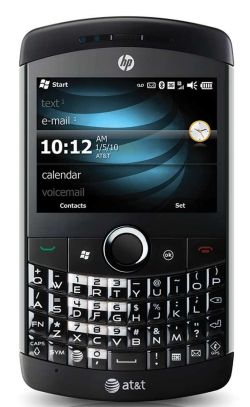
    The HP iPaq Glisten smartphoneBut waving in front of HP’s obvious red flags were several more obvious white ones:

    • Since Mark Hurd took over as CEO, the company has dramatically cut costs, with an emphasis on streamlining operations.
    • While it’s nice to experiment with product categories outside one’s typical bailiwick, HP’s last go-round — its 2006 acquisition of high-class custom computer maker VooDoo PC — resulted in that division’s productivity declining to around that of iPaq.
    • With margins falling in the one-time-goldmine printer (and printing ink) business, the company’s wrestling with a complete makeover of its second most important consumer-facing brand, possibly merging it with the Personal Systems Group (PSG) division that handles PCs.
    • HP’s growth divisions today are services and enterprise technologies, especially now that it’s acquired EDS, and now that it’s championing Dell on almost every front.
    • Finally, the cash-tight HP is already paying almost $3 billion for 3Com, the network technology pioneer that — so ironically now — became Palm’s parent company in 1997 through its acquisition of USRobotics, and then spent six years (1999 – 2005) spinning it off into a separate entity, in such a costly venture that 3Com became ripe for a buyout by HP.

    So HP buying Palm? Nah. No way.

    Anyone listening in yesterday to HP’s hastily arranged analysts’ call might have gotten the impression that just 24 hours earlier, HP execs would have said exactly the same thing — even former Palm CEO Bradley. When asked repeatedly how they plan to make this marriage work, Bradley and VP for Investor Relations Jim Burns indicated they may not actually know the answer to that for several months.

    Veteran smartphone business observer and NPD Executive Director of Industry Analysis Ross Rubin — whose insight is not only 20/20 but often 360 degrees as well — sees some of the coefficients, if not yet the entire formula, for sealing the deal. In an interview with Betanews yesterday, Rubin pointed out the synergies that could make the deal work…provided Palm transforms itself into yet another new kind of brand for an untapped market. Again.
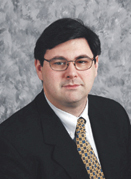
    NPD Executive Director of Industry Analysis Ross RubinIndeed, last week, Rubin was talking with us about the synergies that could make Lenovo + Palm work. “At least some of the factors that we discussed for Lenovo apply to HP,” Rubin told us late yesterday. “So there are all those opportunities to gain entrance into the carrier channel, to beef up what had been a modest smartphone portfolio business, and to gain access to an operating system that can be used on a broader range of devices, including tablets and smartbooks — which HP has either already launched or shown publicly. So all of that holds true.

    “There are some additional synergies between the two companies. Palm is doing quite a bit in terms of cloud backup and cloud services, which of course is an important business for HP. And HP has world-class R&D, global reach, and financial resources. On the conference call, Todd Bradley said that HP will invest heavily, both in the R&D and sales and marketing for Palm.”

    Usually an acquisition target does not announce a revenue shortfall on the morning that the deal is to be done. Palm did, in a move that by noon led veteran observers to believe that any deal — with Lenovo, Huawei, Wal-Mart, anyone — was off the table. Did HP really come up with a miracle solution for Palm in just minutes?

    “When you’re dealing with companies like HP, there has to be some thought given beyond the current quarter,” responded Rubin. “This is certainly an acquisition that is not income positive for HP in the short term.”

    Bradley and Burns did indicate that HP would have to spend more on R&D in the coming months than Palm is spending today. On Bradley’s side, Rubin pointed out, is his experience with just this kind of turnaround: He was credited with picking up the pieces of the otherwise disastrous HP + Compaq buyout, and making that formula work as well. But in so doing, iPaq appeared de-emphasized.

    This is where Ross Rubin perceives an opportunity for Palm to actually help out HP rather than the other way around: giving it retail prominence in markets the iPaq could not crack.

    “PCs aren’t smartphones; on the one hand, they are different channels. HP has developed great expertise in retail distribution,” he reminded us. “That may be more important for smartphones and other kinds of devices powered by webOS moving forward, but it’s certainly a different channel from the carrier channel. The Palm business gives them complementary distribution at the carriers where they haven’t seen a lot of business in the past.”

    Next: The potential of HP + Palm + Microsoft…

    The potential of HP + Palm + Microsoft

    Anyone who thinks HP hasn’t managed, or cannot manage, a software platform on its own has forgotten — or is wholly ignorant of — HP’s success as the master of HP-UX, which makes it the “Face of UNIX” for a big chunk of enterprise customers. When HP uses the single word “Scale” to describe the benefits it can offer Palm, that’s the scale it’s talking about.
    Not a lot of consumers know (or care) about HP-UX. “However, we have seen HP move to try to differentiate its products from other PCs running Windows by doing things such as developing the TouchSmart layer for its all-in-ones, and some of its touchscreen notebooks,” noted Rubin, in his talk yesterday with Betanews. “Perhaps, particularly faced with the prospect of having limited control over the user interface in Windows Phone 7, having access to webOS allows [HP] to define the customer experience a lot better than licensing another operating system might.”

    Wouldn’t HP have had that same opportunity if it had proceeded with what many expected it to do anyway: produce a line of Android phones? “Certainly Android has a lot of momentum in the marketplace right now,” Rubin responded. “There’s one liability with Android: Google has made some moves that might cause a major global company like HP to have some concerns, such as the relationship with the Chinese government, for example, or competing with its own partners as it has with the Nexus One.

    Since neither HP nor anyone else appears to know precisely what its Palm roadmap for the future looks like, it’s fair to say that, at least today, nothing precludes it from continuing to produce the same iPaq phones it was planning to produce anyway — continuing to support Windows Mobile 6.5, or maybe even making that Android phone, despite the risks. This doesn’t have to be bad news for Microsoft, which some may have prematurely perceived as having lost another smartphone partner (after Motorola) to a competitive platform.
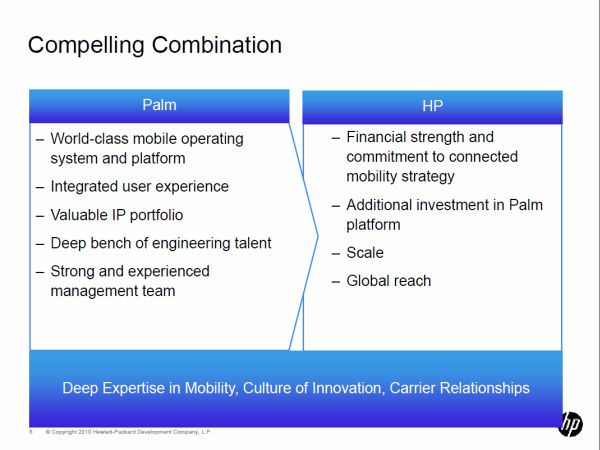
    The formula HP perceives for its synergies with Palm, from an investors presentation April 28, 2010.

    The formula HP perceives for its synergies with Palm, from an investors presentation April 28, 2010.


    This is where NPD’s Ross Rubin perceives a potential opening for Palm and Microsoft, which have partnered before — at the time, rather successfully. Although that partnership began soon after Todd Bradley left Palm, HP’s existing close ties to Microsoft certainly don’t preclude the possibility of HP’s bringing Microsoft back into the Palm picture.

    How could it do that without kicking webOS aside? As Ross Rubin reminded us, Microsoft can make deals, and has made several already, with smartphone makers without binding them to Windows Phone 7.

    “HP has a massive enterprise business, and it’s very strong in several verticals in those industries. That’s part of what is going to drive demand for some of these new kinds of devices. Todd Bradley said a lot of these devices are very product categories, and it remains to be seen how they’ll grow. But while BlackBerry certainly is very strong in the enterprise today…the Exchange group at Microsoft is willing to partner with handset makers other than those using Windows Phone 7 to compete with RIM. A great example of that is the partnership that Microsoft and Nokia have struck — obviously, Nokia not using Microsoft’s operating system in its phones, but using the Exchange ActiveSync architecture. Apple, of course, [is] using Exchange ActiveSync; and Palm today is using it. So BlackBerry very much remains in the crosshairs of Microsoft for a couple of reasons.”

    Extending Exchange ActiveSync technology to webOS would expand Microsoft’s service presence to yet another platform. And services are where platform makers cash in; typically, native platforms are mechanisms for funneling customers to native services (see: iTunes), but if other platforms provide the same funnels, that’s fine, too.

    As HP execs conceded yesterday, they hadn’t really thought about building up services for Palm — for instance, a competitor to iTunes, or to BlackBerry’s enterprise e-mail. With Microsoft’s help, it wouldn’t have to — it could fill in the gaps necessary to make Palm competitive in the enterprise, so that its device offering won’t look as limp and lifeless as the iPaq “Glisten.” If HP can deploy ActiveSync e-mail, and implement a portal to something similar to Microsoft’s Live mobile services, on the webOS cloud platform it’s acquiring from Palm, perhaps with portals to Office apps and Zune.net…everybody’s happy all of a sudden.

    …Okay, okay, maybe we should have seen this coming.

    Copyright Betanews, Inc. 2010


    Add to digg
    Add to Google
    Add to Slashdot
    Add to Twitter
    Add to del.icio.us
    Add to Facebook
    Add to Technorati


  • Mobile Ad Firm Mojiva Gets $7 Million Second VC Round


    Mobile Money Transfer

    Suddenly, there’s a flurry of mobile advertising platform activity. The latest on the pile – Mojiva has landed a $7 million second venture funding round.

    The money will go toward global expansion for its Mobile Ad Serving Technology ad serving platform and its display ad network, the company says.

    The round is led by UV Partners but also comes from Bertelsmann Digital Media Investments, the German media company’s VC wing, which stumped up the bulk of Mojiva’s £3 million first round in 2008.

    Mojiva actually spun off ad serving operations in to a separate subsidiary, mOcean, recently.

    Mojiva claims to reach more than 41 million unique users a month. The company’s main product, its “Self Service Ad Delivery Tooklit” is targeted at advertisers who want to create and manage their own mobile campaigns, and publishers who want to monetize their mobile content through ads on their websites or apps. Mojiva also provides white label versions of its toolkit to ad agencies.


  • A Discussion with Frank Sander about the Multi-Door Courthouse

    As a collaboration between UST School of Law and the Program on Negotiation at Harvard Law School, the following is the transcript of a conversation between the creator of the multi-door courthouse, Harvard Law Professor Frank E.A. Sander, and the executive director and founder of the University of St. Thomas (UST) International ADR [Alternative Dispute Resolution] Research Network, Professor Mariana Hernandez Crespo.

    The UST International ADR Research Network is a research program designed to create inclusive problem-solving models that utilize social capital and consensus-building techniques (i.e., dispute-resolution processes that include the voices of all stakeholders, especially the disenfranchised members of a community). In a pilot project in Brazil, participants examined the different options available to maximize the dispute-resolution process, including the multi-door courthouse conceived by Frank Sander. The multi-door courthouse is an innovative institution that routes incoming court cases to the most appropriate methods of dispute resolution, which saves time and money for both the courts and the participants or litigants. In our Brazilian pilot project, participants met in a virtual forum following the consensus-building methodology designed by Professor Lawrence Susskind of MIT and Harvard Law School. The project was implemented under the direction of Professor Hernandez Crespo, together with a team of Brazilians, global experts and collaborators.

    Click here to dowload the full article.

  • Verizon’s Droid Incredible commercial shows specs, doesn’t show phone

    It’s Verizon’s first commercial for the Droid Incredible. Impressive. Most impressive. [YouTube link]

  • Cape Wind is New Source of U.S. Renewable Energy

    By John Addison (4/29/10)

    The United States now has a new source of clean electricity for homes, buildings, and industrial stationary power and also for the growing use of electricity in rail and electric cars. Wind power is especially available at night when we hope to eventually charge millions of vehicles.

    Global wind energy capacity is increasing by 160% over the coming five years from 155 GW to 409 GW, according to the annual industry forecast presented by the Global Wind Energy Council (GWEC). A growing part of the renewable energy (RE) mix is off-shore wind, popular in Europe for 20 years, but stopped in the U.S. by not-in-my-backyard opposition, or more accurately “not in the view of my expensive ocean front property.”

    Secretary of the Interior Ken Salazar showed political courage on April 28 by approving the Cape Wind renewable energy project on federal submerged lands in Nantucket Sound. He will require the developer of the $1 billion wind farm to agree to additional binding measures to minimize the potential adverse impacts of construction and operation of the facility. Salazar said,” With this decision we are beginning a new direction in our Nation’s energy future, ushering in America’s first offshore wind energy facility and opening a new chapter in the history of this region.”

    The project is a big win for Siemens who will supply 130 3.6 MW towers, outbidding GE, Vestas, and other competitors. Siemens has already sold over 1,000 of these large off-shore turbines. The Cape Wind facility will generate a maximum electric output of 468 megawatts with an average anticipated output of 182 megawatts. At average expected production, Cape Wind could produce enough energy to power more than 200,000 homes in Massachusetts, or charge 200,000 electric cars.

    One-fifth of the offshore wind energy potential of the East Coast is located off the New England coast and Nantucket Sound receives strong, steady Atlantic winds year round. The project includes a 66.5-mile buried submarine transmission cable system, an electric service platform and two 115-kilovolt lines connecting to the mainland power grid. The project would create several hundred construction jobs and be one of the largest greenhouse gas reduction initiatives in the nation, cutting carbon dioxide emissions from conventional power plants by 700,000 tons annually.

    Over one GW of off-shore wind is proposed for other Eastern coastal states, eager to catch-up with the renewable energy use of Western and Central states. For example, due to California’s abundance of wind, solar, and geothermal power, my California utility does not use coal.
    To overcome years of opposition, the number of turbines at Cape Wind has been reduced from 170 to 130, minimizing the visibility of turbines from the Kennedy Compound National Historic Landmark; reconfiguring the array to move it farther away from Nantucket Island; and reducing its breadth to mitigate visibility from the Nantucket Historic District. Translation is that from shore it will take Superman vision to notice the wind turbines 5.2 miles from the mainland shoreline, 13.8 miles from Nantucket Island and 9 miles from Martha’s Vineyard.

    A number of tall structures, including broadcast towers, cellular base station towers, local public safety communications towers and towers for industrial and business uses are already located around the area. Three submarine transmission cable systems already traverse the seabed to connect mainland energy sources to Martha’s Vineyard and Nantucket Island.

    “After almost a decade of exhaustive study and analyses, I believe that this undertaking can be developed responsibly and with consideration to the historic and cultural resources in the project area,” Salazar said. “Impacts to the historic properties can and will be minimized and mitigated and we will ensure that cultural resources will not be harmed or destroyed during the construction, maintenance, and decommissioning of the project.”
    Renewable Energy Reports and Articles

    By John Addison, Publisher of the Clean Fleet Report and conference speaker.

  • Steve Jobs: Why Flash sucks

    By Tim Conneally, Betanews

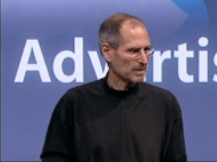
    Today, just as Adobe released a preview of Flash Player for Mac OS X that features H.264 video decoding, Apple CEO Steve Jobs released a letter called “Thoughts on Flash,” which explains the many reasons why there’s no Flash support on any of Apple’s mobile devices, and why H.264 is a better format.

    The letter is emblematic of Apple’s increasingly verbal approach to the frantically interested but highly misunderstanding public: “Adobe has characterized our decision as being primarily business driven — they say we want to protect our App Store — but in reality it is based on technology issues. Adobe claims that we are a closed system, and that Flash is open, but in fact the opposite is true. Let me explain.”

    Jobs then explains in very plain detail six different reasons why Flash is a technological weakness in Apple’s mobile realm. Those reasons may be broken down into very simple bullet points:

    • Flash is a closed, Adobe-controlled system.
    • H.264 is a “more modern format” for Web video
    • Flash would make iPhones, iPods, and iPads less reliable.
    • H.264 video consumes about half as much battery as Flash video.
    • Flash was not designed for touch interfaces.
    • Flash is cross-platform and not Apple optimized.

    Apple has made these points in the past, just not as a single list straight from the CEO’s own pen.

    Steve Jobs -- iAdJobs concludes his letter by saying, “Flash was created during the PC era — for PCs and mice. Flash is a successful business for Adobe, and we can understand why they want to push it beyond PCs. But the mobile era is about low power devices, touch interfaces and open Web standards — all areas where Flash falls short…New open standards created in the mobile era, such as HTML 5, will win on mobile devices (and PCs too). Perhaps Adobe should focus more on creating great HTML 5 tools for the future, and less on criticizing Apple for leaving the past behind.”

    Don’t be misled, this letter was written with the consumer in mind (specifically, the ones who read the New York Times interview with Google’s Andy Rubin this week.)

    In his interview with the paper, Rubin made a powerful statement about Android and Flash: “[Being open] means not being militant about the things consumers are actually enjoying.”

    Because Google’s Android operating system will offer full Flash 10.1 support in the “Froyo” (2.2) release, Rubin simply said Google is giving people what they want.

    Jobs’ letter, by contrast, is telling the public that “what they want” may not be the best for the iPhone.

    Copyright Betanews, Inc. 2010


    Add to digg
    Add to Google
    Add to Slashdot
    Add to Twitter
    Add to del.icio.us
    Add to Facebook
    Add to Technorati