Blog

  • Droid Incredible available today in Verizon stores, in your hands

    Verizon HTC Droid Incredible

    Today’s the day, folks. After a couple of long weeks, the Verizon HTC Droid Incredible finally is available. Your pre-orders (if they didn’t arrive early) should come today. You can buy one in Verizon stores for $199 after the standard contract deals. And cheaper prices are (ahem) out there on the Internet. But let’s get to the important stuff. Today’s your day.

    That’s it, folks. We want to hear from you today. Happy Incredible Thursday!

  • Ancient Tools Collected And Revealed

    This is a neat discovery simply because we have a great chance to collect a full range of tools and other goods normally carried.  It may take years but this ice is now receding and releasing possibly millennia of accumulation.
    That is more than enough time to trap just about everything sooner or later.
    I do not know if this type of trap might exist in Europe, not least because they may not have the convenient herds to follow.  Yet they should have existed at one time or the other and may well be in place somewhere.
    In the meantime, the caribou culture certainly made it happen in the Yukon and possibly in Alaska also.
    This will do a great deal to fill in our knowledge regarding the potentialities of northern stone age cultures.
    Ancient Tools Revealed by Melting Arctic Ice
    posted: 26 April 2010
    A 340-year-old bow reconstructed from several fragments found near melted patches of ice in the Mackenzie Mountains in the Northwest Territories of Canada. Credit: Tom Andrews
    Warming temperatures are melting patches of ice that have been in place for thousands of years in the mountains of the Canadian High Arctic and in turn revealing a treasure trove of ancient hunting tools.
    Ice patches result from layers of annual snow that, until recently, remained frozen all year. As Earth’s temperature has warmed in recent decades due to the accumulation of heat-trapping greenhouse gases in the atmosphere, some of the ice patches have begun to melt away, sometimes revealing ancient artifacts to the surprise of archaeologists.
    “We’re just like children opening Christmas presents. I kind of pinch myself,” said Tom Andrews, an archaeologist with the Prince of Wales Northern Heritage Centre in Yellowknife, Northern Territories, Canada, and lead researcher on the International Polar Year Ice Patch Study.
    Ice patch archeology is a recent phenomenon that began in Yukon. In 1997, sheep hunters discovered a 4,300-year-old dart shaft in caribou dung that had become exposed as the ice receded. Scientists who investigated the site found layers of caribou dung buried between annual deposits of ice. They also discovered a repository of well-preserved artifacts.
    Andrews first became aware of the importance of ice patches when word about the Yukon find started leaking out. “We began wondering if we had the same phenomenon here,” Andrews said.
    In 2000, he cobbled together funds to buy satellite imagery of specific areas in the Mackenzie Mountains, which form part of the border between the Yukon and the Northwest Territories, and began to examine ice patches in the region. Five years later, he had raised enough money to support a four-hour helicopter ride to investigate two ice patches. The trip proved fruitful.
    “Low and behold, we found a willow bow,” Andrews said.
    That discovery allowed Andrews and his team to get more funds that the team then used to explore eight ice patches in four years. The results have been extraordinary: Andrews and his team (including members of the indigenous Shutaot’ine or Mountain Dene) have found 2,400-year-old spear throwing tools, a 1000-year-old ground squirrel snare, and bows and arrowsdating back 850 years.
    “The implements are truly amazing. There are wooden arrows and dart shafts so fine you can’t believe someone sat down with a stone and made them,” Andrews said.
    Biologists involved in the project are examining dung in the area for plant remains, insect parts, pollen and caribou parasites. Others are studying DNA evidence to track the lineage and migration patterns of caribou.
    The dung and artifacts can be found at these spots because for millennia, caribou seeking relief from summer heat and insects have made their way to ice patches where they bed down until cooler temperatures prevail. Hunters noticed caribou were, in effect, marooned on these ice islands and took advantage.
    “I’m never surprised at the brilliance of ancient hunters anymore. I feel stupid that we didn’t find this sooner,” Andrews said.
    Andrews is concerned about retrieving more artifacts, because his funds have run out and two of the eight ice patches have already disappeared.
    “We realize that the ice patches are continuing to melt, and we have an ethical obligation to collect these artifacts as they are exposed,” Andrews said. If left on the ground, exposed artifacts would be trampled by caribou or dissolved by the acidic soils. “In a year or two the artifacts would be gone.” 
  • David Letterman Record Label

    Late-nite funnyman and notorious staff shagger David Letterman is dipping his toes in the music industry: The Late Show host and his Worldwide Pants Inc. production company have launched a record label called Clear Entertainment Music — and they’ve already signed their first act.

    According to Entertainment Weekly, Letterman has inked a deal with Runner Runner, a pop-punk group from Huntington Beach, California. Their self titled debut album, a partnership with Capitol and MRV, debuts this summer.

    Their first single, titled “So Obvious,” will premiere next month.


  • Accelerator’s Mirina Advances, Qliance Nabs Bezos Bucks, Spiration Adds $6.5M Debt, & More Seattle-Area Life Sciences News

    Luke Timmerman wrote:

    There was quiet before the storm this week, as Dendreon is eagerly awaiting the FDA’s decision by May 1 on whether it will clear the company’s prostate cancer drug for sale. Buckle your seat belts for that one.

    —Accelerator’s microRNA startup, Mirina, has made enough progress in its early days that it has secured an undisclosed “expansion” round of financing led by Versant Ventures. The company says its microRNA drugs are not just more potent than ones being developed by rivals, but they also have “unexpected properties” that should offer another advantage, once it pins down the necessary intellectual property.

    —If having a famous investor syndicate were the only key to success, then Qliance Medical Management would be well on its way. The Seattle-based company, which deals directly with patients and doesn’t accept health insurance for primary care medical services, nailed down a $6 million financing from Jeff Bezos, Michael Dell, Drew Carey and others. These guys, no dummies, wrote their checks AFTER President Obama signed the health care reform bill that allows direct primary care services to compete in every state with regular insurance by 2014.

    Spiration, the Redmond, WA-based maker of devices for lung diseases, has collected another $6.5 million in debt financing from a single investor, according to a regulatory filing. Spiration raised $7 million in debt back in September from its partner, Olympus Medical Systems.

    —Anybody who works in the local life sciences industry will tell you it can be hard to hold down a steady paycheck. Most drugs and devices fail in development, after all. But Chris Rivera, the president of the Washington Biotechnology & Biomedical Association, says the latest stats show 22,349 people statewide employed in life sciences work, making it the state’s fifth-biggest employer among industries.

    —Speaking of WBBA, the local trade association just added a very well-known name to its team—H. Stewart Parker. The founder and longtime CEO of Targeted Genetics is taking on a new role for the WBBA as a commercialization advisor to life sciences entrepreneurs on a part-time basis.

    UNDERWRITERS AND PARTNERS


  • Climate Change Modelling Under Attack


    Allow me to make the problem crystal clear.  Mathematics can solve a problem having two objects and one controlling nonlinear variable.  We call it the two body problem.  Until the introduction of my work in the recently accepted paper mentioned in my profile, no other exact tools properly existed.
    The climate is influenced by a number of non linear variables in a three dimensional space, not least been the daily solar cycle.  If we could get them measured properly and actually put together a convincing equation, it is possible to estimate things on a continuing basis and to hope it is meaningful.
    The problem is divergence.
    Everything about the climate predicts a self correcting system of processes that act and react to ensure that the net result is zero. We call it weather.
    This means that if you set out to prove divergence you need extraordinary proof.
    It has not been forthcoming for the CO2 hypothesis and this recognition has been postponed by suppressing the data.
    The computer models are estimation systems that will be right or wrong often depending on the bias of the observer.
    Scientists’ use of computer models to predict climate change is under attack
    Washington Post Staff Writer 

    Tuesday, April 6, 2010

    The Washington Nationals will win 74 games this year. The Democrats will lose five Senate seats in November. The high Tuesday will be 86 degrees, but it will feel like 84.

    And, depending on how much greenhouse gas emissions increase, the world’s average temperature will rise between 2 and 11.5 degrees by 2100.

    The computer models used to predict climate change are far more sophisticated than the ones that forecast the weather, elections or sporting results. They are multilayered programs in which scientists try to replicate the physics behind things such as rainfall, ocean currents and the melting of sea ice. Then, they try to estimate how emissions from smokestacks and auto tailpipes might alter those patterns in the future, as the effects of warmer temperatures echo through these complex and interrelated systems.

    To check these programs’ accuracy, scientists plug in data from previous years to see if the model’s predictions match what really happened.

    But these models still have the same caveat as other computer-generated futures. They are man-made, so their results are shaped by human judgment.

    This year, critics have harped on that fact, attacking models of climate change that have been used to illustrate what will happen if the United States and other countries do nothing to limit greenhouse gas emissions. Climate scientists have responded that their models are imperfect, but still provide invaluable glimpses of change to come.

    They have found themselves trying to persuade the public — now surrounded by computerized predictions of the future — to believe in these.

    If policymakers don’t heed the models, “you’re throwing away information. And if you throw away information, then you know less about the future than we actually do,” said Gavin Schmidt, a climate scientist at NASA’s Goddard Institute for Space Studies.

    “You can say, ‘You know what, I don’t trust the climate models, so I’m going to walk into the middle of the road with a blindfold on,’ ” Schmidt said. “But you know what, that’s not smart.”

    Climate scientists admit that some models overestimated how much the Earth would warm in the past decade. But they say this might just be natural variation in weather, not a disproof of their methods.
    As computers have become faster and cheaper, models both simple and sophisticated have proliferated across government, business and sports, appearing to offer precise answers to questions that used to be rhetorical.

    How many games will the Redskins win next season?

    The Web site Footballoutsiders.com, which uses computers to show fans hidden dimensions of pro football, uses a model with about 80 variables. It looks at a team’s third-down conversions, the experience of its coaches, even the age of its defensive backs.

    No crystal balls

    How much cleaner would the Chesapeake Bay be if it had twice as many oysters?

    The Environmental Protection Agency uses a model that divides the bay into 55,000 slices, and maps how pollution progresses through them, from upstream tributaries into the deeper waters of the Chesapeake. It could imagine thousands more oysters — which filter water as they feed — and watch cleaner water spread out via currents and tides.

    But, some of the time, these electronic futures haven’t come true.

    The Football outsiders site predicted the Redskins would win 7.8 games in 2009. The real-world team won four. The EPA’s Chesapeake Bay model has been criticized repeatedly for over-optimism, for creating a virtual bay that looked cleaner than the real one. Last month, another model’s prediction was busted: a Georgia Tech professor’s computer said Kansas would win the NCAA men’s basketball tournament. The Jayhawks lost in the second round.

    These and other models are only as smart as the scientists who build them — they rely on data that scientists have gathered about the real world, and the accuracy of estimates about how all the factors fit together (Is an experienced coach more or less important than young defensive backs?).

    They also depend on the computers running them. To accurately depict how individual clouds form and disappear, for instance, the computers that model climate change would need to be a million times faster. For now, the effects of clouds have to be estimated.

    But scientists say complexity doesn’t guarantee accuracy. The best test of a model is to check it against reality.

    “We’re never going to perfectly model reality. We would need a system as complicated as the world around us,” said Ken Fleischmann, a professor of information studies at the University of Maryland. He said scientists needed to make the uncertainties inherent in models clear: “You let people know: It’s a model. It’s not reality. We haven’t invented a crystal ball.”

    Scientists say they don’t need models to know that the world is warming: There is plenty of real-world evidence, gathered since the mid-1800s, to suggest that. “There’s no climate model in that conclusion,” said Christopher Field, of the Carnegie Institution for Science in California.

    There are more than a dozen such models running around the world: mega-computers whose job is creating a virtual Earth.

    These usually combine a weather simulation with other programs that mimic effects of rain and sun on the land, currents in the ocean, and emissions of greenhouse gases. First, these models imagine all the factors interacting within a “grid box” — an imaginary cube of land, water and sky that might be 60 miles long and 60 miles wide.

    Then, the computer imagines effects in one box spilling into the next, and so on.

    As the model runs, imaginary cold fronts sweep over virtual oceans, simulating weather at rates such as five years per day. In some cases, the models are re-run with different weather conditions, until a pattern emerges in global temperatures.

    The pattern is the point. It is man’s signature, a guide to what could happen in the real world. All the major climate models seem to show that greenhouse gases are causing warming, climate scientists say, although they don’t agree about how much. A 2007 United Nations report cited a range of estimates from 2 to 11.5 degrees over the next century.

    “It’s an educated, scientifically based guess,” said Michael Winton, an oceanographer at the National Oceanic and Atmospheric Administration. “But it’s a guess nonetheless.”

    Raining on their parade

    But Warren Meyer, a mechanical and aerospace engineer by training who blogs at www.climate-skeptic.com, said that climate models are highly flawed. He said the scientists who build them don’t know enough about solar cycles, ocean temperatures and other things that can nudge the earth’s temperature up or down. He said that because models produce results that sound impressively exact, they can give off an air of infallibility.

    But, Meyer said — if the model isn’t built correctly — its results can be both precise-sounding and wrong.

    “The hubris that can be associated with a model is amazing, because suddenly you take this sketchy understanding of a process, and you embody it in a model,” and it appears more trustworthy, Meyer said. “It’s almost like money laundering.”

    Last month, a Gallup poll provided the latest evidence of a public U-turn on climate change. Asked if the threat of global warming was “generally exaggerated,” 48 percent said yes. That was up 13 points from 2008, the highest level of skepticism since Gallup started asking the question in 1997.

    But scientists say that, during this time, they have only become more certain that their models work.

    Put in the conditions on Earth more than 20,000 years ago: they produce an Ice Age, NASA’s Schmidt said. Put in the conditions from 1991, when a volcanic eruption filled the earth’s atmosphere with a sun-shade of dust. The models produce cooling temperatures and shifts in wind patterns, Schmidt said, just like the real world did.

    If the models are as flawed as critics say, Schmidt said, “You have to ask yourself, ‘How come they work?’ “
  • Actually, Greece Would Have Been Equally Screwed If They Stuck With The Drachma

    (This is a guest post from the author’s blog.)

    Europe’s hopes of containing the crisis dimmed as Spain became the third euro-zone nation to be hit with an S&P downgrade in just two days, following steeper cuts on Portugal and Greece.

    Fears of a Greek contagion to other euro zone nations ratcheted higher on that news sparking a market selloff across the globe, sending the euro to fresh lows against the dollar, and intensified the pressure to finalize a rescue plan for Greece.

    Blaming the Euro Currency Union

    The ongoing Greek debt crisis has revived the old arguments that all national governments need monetary sovereignty. Financial Times columnist Samuel Brittan also recently suggested that if Greece has its own currency,

    “…it can issue its own money; so it can pursue a fiscal policy attuned to domestic needs, without being dependent on the international bond market.”

    All Better With The Drachma?

    So, what if Greece had stayed with the Drachma, and never switched to the euro? Would this debt crisis be averted?

    valskdcnalksdcnjklascdUnfortunately, as illustrated by the chart from the Council on Foreign Relations (CFR), in the six years before joining the euro, only 27% of Greek debt was issued in drachma. At the end of 2000, just before Greece joined the euro zone, 79% of its outstanding debt was already denominated in euros, and a mere 8% in drachmas.

    Blame It On Profligate Spending 

    This could only lead to an inescapable conclusion as noted by the CFR,

    “Even if Greece had remained outside the euro zone, its dependence on euro borrowing would only have increased. A falling drachma would merely have brought the current crisis to a head earlier by accelerating the rise in Greece’s debt-to-GDP ratio (think Iceland)….problem is excessive foreign borrowing, a problem with which Greece has struggled since the early 19th century.”

    Moral Hazard?

    Meanwhile, a Greek official said the IMF is considering increasing the Greek loans to €100 billion to €120 billion ($132.5 billion to $159 billion) over three years, from the current €45 billion, but expressed doubts about whether the boost would happen.

    The actions of the EU and IMF are sending a message to investors that it is not important that PIIGS nations have excessive and unsustainable public spending and fiscal deficits, because ultimately the countries of the euro zone who will resolve the problem.

    There doesn’t have to be a rescue plan for Greece, as long as the markets believe in “the moneylender of the last resort” (the countries of the euro zone.)

    In that sense, the debt-rescue-or-not saga of Greece could drag on for a while before some uncommon event forcing a concrete resolution out of the EU and IMF.   

    Join the conversation about this story »

  • Energy security and the role of nuclear energy in Europe

    To what extent can nuclear energy provide an alternative to fossil fuels?

    A workshop for nuclear & energy security experts, organised by the JRC Institute for Energy (IE) on 26-27 April, aimed to explore, discuss and debate the challenges and solutions for the global energy sector. While energy demand is still rising, the evidence is clear that CO2 emissions must be reduced globally. Abundant, affordable, and environmentally responsible energy must be developed to meet that demand. Nuclear power, as a secure alternative to fossil fuels, has technical risks and lack of public acceptance. How can it help Europe to solve the energy challenge?

  • Chevrolet expanding into South Korea:

    Chevrolet, the most famous and best-selling General Motors brand, will expand into South Korea in 2011, the automaker said on Wednesday.

    Enthusiasts in South Korea are in for a treat: At the Busan International Motor Show where the announcement was made, Chevy showed a Camaro, which will be one of the products offered.

    Last year, Chevy accounted for 44 percent of GM’s global sales and saw a sales increase of 21 percent over the previous year. It’s also seeing an influx of global products, such as the Cruze sedan and the Spark small car.

    Chevrolet may be the most singular American brand–baseball, hot dogs, apple pie and all. But it’s also seeing an increased global presence. Last year, 3.3 million vehicles wearing the bow tie badge were sold in 130 markets around the world.

    South Koreans are also conscious of the 99-year-old Chevy brand and its iconic logo. Research finds that half of South Koreans are aware of the brand, and more than 80 percent are familiar with the bow tie.

    “This is indicative of the positive brand image that already exists among consumers in Korea toward Chevrolet,” GM Daewoo CEO Mike Arcamone said in a statement. “We see tremendous upside with its introduction.”

    Chevrolet traces its roots to 1911 and is named after race-car driver Louis Chevrolet. There are different stories as to how the logo came to grace the sheetmetal of Chevys, but one version has it that GM founder Billy Durant saw it in a French hotel room and adapted it to represent his cars.

    For more


    Chevrolet Camaro

    Source: Car news, reviews and auto show stories

  • Arcalife.com Announces full Integration with FamilySearch.org

    The following news release was received from my friends at Arcalife.com.

    arcalife

    Arcalife.com announces full integration with FamilySearch.org. This integration further deepens the features and capabilities between the two sites and offers members arcalife.com was established as an online community where members can preserve their family history, scrapbook their memories, and securely share rich life content all in one place. arcalife has developed a wide range of tailored tools and services to allow members to capture their ‘past’ and ‘present’ life content for ‘future’ generations.

    The concept for arcalife.com was born from the most basic of human needs; to leave a lasting imprint of our lives and experiences. arcalife has developed a range of tools and services to enable members to research their family history, build a family tree, and securely share and collaborate with family members in building a ‘Digital Estate’ to pass to future generations. FamilySearch is the largest genealogy organization in the world. Millions of people use FamilySearch records, resources, and services to learn more about their family history. For over 100 years, FamilySearch has been actively gathering, preserving, and sharing genealogical records worldwide.

    Aside from access to millions of free records, the integration will bring a host of new resources to arcalife members. Furthermore, FamilySearch members are now able to use arcalife.com to do more with their records, research, and family tree- including:

    • Add rich Media Content to Trees and Events – Photos, Videos, Records, Documents, and Timelines
    • Synchronize Trees and Events Between the Two Sites
    • Make Family History Scrapbooks, Biographies, and Printed albums from memories, experiences and events
    • Print large size color Family Trees with a few clicks, up to size 36.1 in × 51.1 in 100% Secure & Encrypted, Gated Site for Storing and Sharing Family History

    “…We’re excited about this new integration as our members will now have access to a wider range of records, and FamilySearch members can do more with their existing research on our site” says Paul Taylor, arcalife.com CEO

  • Negative Index Metamaterial Designed


    This will clearly be finding its way into solar cells.  It is efficient in operation and design and even tunable.  Thus an optimum range of incoming light can be accepted.
    It seems plausible that one day we will produce a solar panel able to absorb and largely consume light over a spectrum somewhat larger that the visible portion.  This technology promises to be part of it.
    I want to see more about what graphene can do in terms of converting that energy into electron flow.  We seem to be going there.
    The materials revolution continues.
    Novel negative-index metamaterial that responds to visible light designed
    April 22, 2010
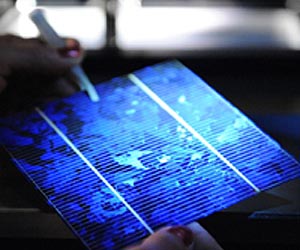
    Arrays of coupled plasmonic coaxial waveguides offer a new approach by which to realize negative-index metamaterials that are remarkably insensitive to angle of incidence and polarization in the visible range. Credit: Caltech/Stanley Burgos
    A group of scientists led by researchers from the California Institute of Technology has engineered a type of artificial optical material—a metamaterial—with a particular three-dimensional structure such that light exhibits a negative index of refraction upon entering the material. In other words, this material bends light in the “wrong” direction from what normally would be expected, irrespective of the angle of the approaching light.
    This new type of negative-index metamaterial (NIM), described in an advance online publication in the journal Nature Materials, is simpler than previous NIMs—requiring only a single functional layer—and yet more versatile, in that it can handle light with any polarization over a broad range of incident angles. And it can do all of this in the blue part of the visible spectrum, making it “the first negative index metamaterial to operate at visible frequencies,” says graduate student Stanley Burgos, a researcher at the Light-Material Interactions in Energy Conversion Energy Frontier Research Center at Caltech and the paper’s first author.
    “By engineering a metamaterial with such properties, we are opening the door to such unusual—but potentially useful—phenomena as superlensing (high-resolution imaging past the diffraction limit), invisibility cloaking, and the synthesis of materials index-matched to air, for potential enhancement of light collection in solar cells,” says Harry Atwater, Howard Hughes Professor and professor of applied physics and materials science, director of Caltech’s Resnick Institute, founding member of the Kavli Nanoscience Institute, and leader of the research team
    What makes this NIM unique, says Burgos, is its engineering. “The source of the negative-index response is fundamentally different from that of previous NIM designs,” he explains. Those previous efforts used multiple layers of “resonant elements” to refract the light in this unusual way, while this version is composed of a single layer of silver permeated with “coupled plasmonic waveguide elements.”
    Surface plasmons are light waves coupled to waves of electrons at the interface between a metal and a dielectric (a non-conducting material like air). Plasmonic waveguide elements route these coupled waves through the material. Not only is this material more feasible to fabricate than those previously used, Burgos says, it also allows for simple “tuning” of the negative-index response; by changing the materials used, or the geometry of the waveguide, the NIM can be tuned to respond to a different wavelength of light coming from nearly any angle with any polarization. “By carefully engineering the coupling between such waveguide elements, it was possible to develop a material with a nearly isotopic refractive index tuned to operate at visible frequencies.” 
    This sort of functional flexibility is critical if the material is to be used in a wide variety of ways, says Atwater. “For practical applications, it is very important for a material’s response to be insensitive to both incidence angle and polarization,” he says. “Take eyeglasses, for example. In order for them to properly focus light reflected off an object on the back of your eye, they must be able to accept and focus light coming from a broad range of angles, independent of polarization. Said another way, their response must be nearly isotropic. Our metamaterial has the same capabilities in terms of its response to incident light.”
    This means the new metamaterial is particularly well suited to use in solar cells, Atwater adds. “The fact that our NIM design is tunable means we could potentially tune its index response to better match the solar spectrum, allowing for the development of broadband wide-angle metamaterials that could enhance light collection in solar cells,” he explains. “And the fact that the metamaterial has a wide-angle response is important because it means that it can ‘accept’ light from a broad range of angles. In the case of solar cells, this means more light collection and less reflected or ‘wasted’ light.”
    “This work stands out because, through careful engineering, greater simplicity has been achieved,” says Ares Rosakis, chair of the Division of Engineering and Applied Science at Caltech and Theodore von Kármán Professor of Aeronautics and Mechanical Engineering.
    More information: “A single-layer wide-angle negative index metamaterial at visible frequencies,” Nature Materials, April 2010.

    Provided by California Institute of Technology
  • Bellwether Procter & Gamble Falling After Revenue And Outlook Light

    Major economic bellwether Procter & Gamble (PG) is falling slightly in pre-market activity after the company reported squishy earnings.

    EPS of $.83 beat by a couple of pennies, but revenue of $19.2 billion was well below estimates of $19.5 billion.

    The overall market remains up.

    Join the conversation about this story »

  • Top 5: Noah’s Top 5 Smartphones – April 29, 2010


    Hey, look, it’s a Top 5 list! I’m keeping this constrained to phones that have at least formally been launched, if not ones that are actually for sale right now. So on the one hand that opens up some grey area for devices that I’ve seen but haven’t really tested (Evo 4G, Galaxy S) but on the other hand it eliminates total vaporware (iPhone 4, whatever HP does with Palm). Got it? Good. Let’s go!

    UPDATE: A few of you are wondering how I went from being so sky high on the Nexus One to dropping it from my Top 5 completely. Good question. The answer lies in the piles of complaints and customer support issues that have mounted since N1 was launched. While I had no real issues with my loaner when I had it, too many paying customers still have unresolved problems for me to keep N1 in my fave five. Yes, I thought N1 was rad when I used it. But No, I can’t really recommend it as a purchase right now. Take that as you will, and my bad for not explaining when I first posted this list.

    Top 5 Smartphones – April 25, 2010

    1. HTC Incredible (Verizon)

    It’s not just that you can actually buy Incredible whereas the devices at #2 and #3 below are “launched” but not yet available. It’s also that Incredible managed to find a sweet spot between size, power, and pocketability that both Galaxy and Evo are in danger of missing. Incredible’s 3.7″ display is big enough to display a ton of information at once, but small enough to make for a form factor that feels deceptively small in your hand. And, oh yeah, Incredible is smooth as butter and fast as blazes. I’m not keen on the plasticky fit and finish here, but I also don’t think it’s anything to worry about, durability-wise. 

    2. Samsung Galaxy S (GSM)

    Okay, so actually if Galaxy S was for sale today and made good on the promises of its CTIA launch party, it might be up there in the Number One spot. I know, that’s a change in thinking from my Top 5 CTIA Stories, but I’m starting to think that Galaxy’s enormous 4″ display might be more consumer-friendly and, y’know, usable than Evo’s extra-enormous 4.3″ display. Also, now that it’s Spring in the Bay Area I’m getting outside more. And the more I use AMOLED phones outside in the sunshine, the more I want Galaxy S’s Super AMOLED display to be a winner. AMOLED and bright sunlight do not play well together.

    3. HTC Evo 4G (Sprint)

    I’m still really excited about Evo 4G, but a month after its launch I have a few reservations. Yes, the prototypes I saw in Vegas were smooth and sleek and sexy and screamed power. But the four in Evo 4G is giving me pause as of late. When HTC’s HD2 first came out, I was blown away by its massive 4.3″ display. Now that I’ve had the chance to live with the T-Mobile version of that device for awhile, I’m wondering if 4-plus inches of screen makes for a phone that’s just plain too big. And after having used T-Mobile’s HSDPA+ network in Vegas, I’m wondering if Sprint’s 4G WiMax network is going to wind up being more bark than bite. We’ll see. Until then, Evo stays in the Top 5, but not at the tippy top.

    4. Apple iPhone 3GS (AT&T)

    On the one hand, iPhone OS 4 gives iPhone 3GS a new lease on life in the form of multitasking and all those other new features that are equal parts, “Catching up to Android and webOS,” “Giving iPhone users what they want,” and “Some actual innovation.” On the other hand, now that the inevitable has been leaked in the form of new iPhone hardware on deck for this Summer, it’s getting harder to stay excited about a device that hasn’t really changed much in the three years since its first iteration hit the streets. Still, iPhone looks, feels, and works like a champ (certain areas of AT&T’s network performance notwithstanding).

    5. Palm Pre Plus (Verizon)

    Now that Verizon’s gone and made Mobile Hotspot free for Pre Plus users, this might just be the best value in do-it-all mobile tech. Now that HP’s gone and bought Palm, who knows what the heck the future holds for webOS. 


  • Here’s The Questions You Should Be Asking About The Gulf Of Mexico Oil Spill

    (This is a guest post from Gail the Actuary at The Oil Drum it is licensed under a Creative Commons Attribution-Share Alike 3.0 United States License)

    We have all been reading about the blowout that led to huge fire and sinking of the Deepwater Horizon drilling rig in the Gulf of Mexico. Now there is news that there is a huge oil spill coming from the underground pipe where this occurred, and there is a possibility that it will be months before it can be stopped. What does this all mean? How could this happen?


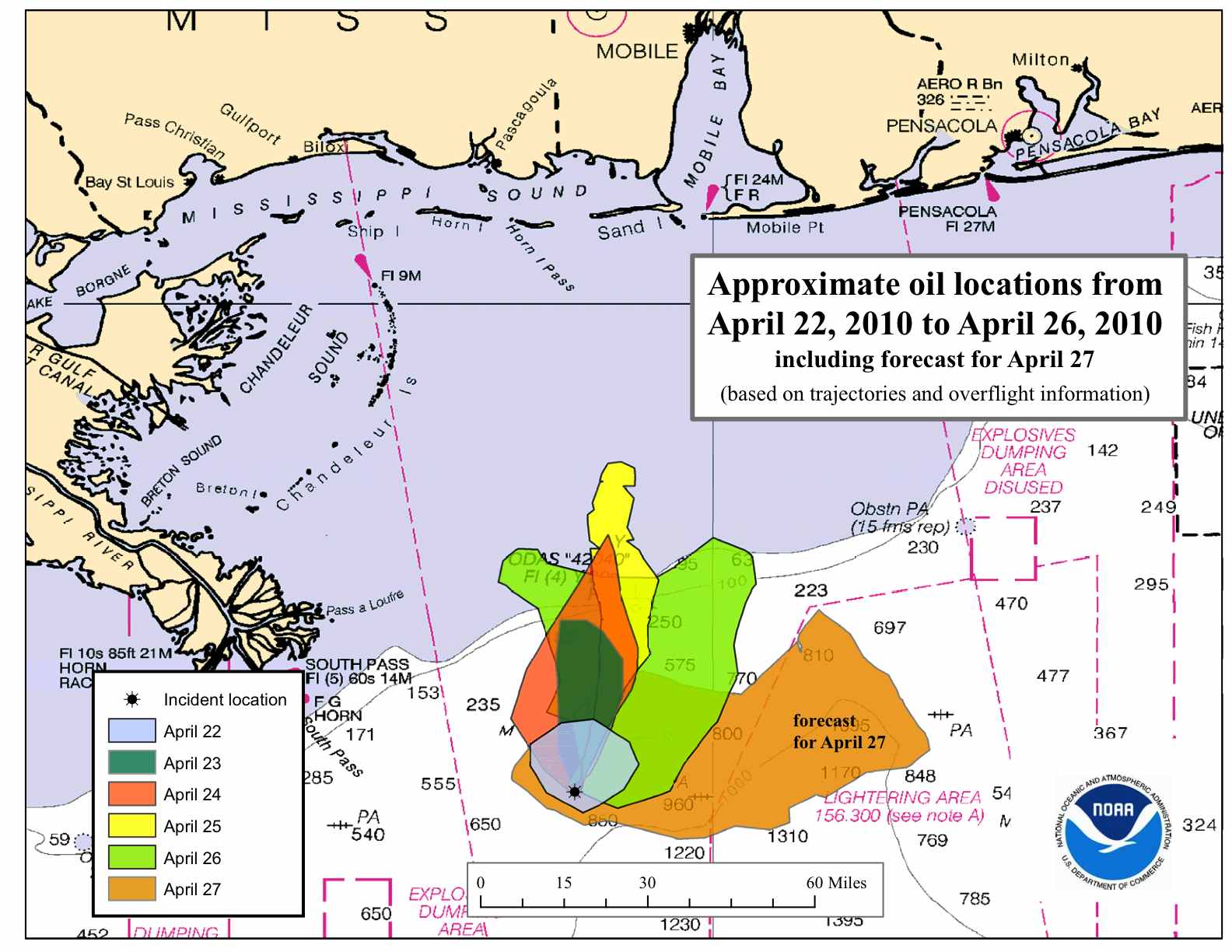
    Figure 1. Forecast area to be covered by oil slick. Image by National Oceanic and Atmospheric Administration (NOAA). Click for larger image.

    Below the fold, I will tell you the story as I understand it. It seems to me that the great depth and attendant pressures, and the learning curve that goes working within these new parameters, probably contributed to the initial leak, and is contributing to the difficulties that are now occurring in stopping the leak.

    This particular well was not an important one–one source said it had economic importance only because of its proximity to a platform which was already in the area. The issues are more the possible environmental damage and the political fallout that could come from the accident. Unfortunately, most of the “easy oil” is gone. The oil that remains all has some challenges–but the fact of the matter is that the world economy cannot run without oil. So there are no easy answers.

    1. Are these spills very common?

    Huge blowouts (explosions, followed by fire, occurring when wells are being drilled), occurring in US waters, are uncommon. The last one was the Santa Barbara Union Oil Blowout in 1969 – a little over 40 years ago. The leak lasted 11 days, and the amount of the spill was estimated to be 200,000 gallons (5,000 barrels of oil), so was less than the amount of the current spill. But it was close to shore, and the oil damaged beaches, besides affecting wildlife.

    Much more common are oil spills, typically occurring when a ship powered by oil, or a ship carrying oil, collides with another object. The biggest recent oil spill in US waters was the Exxon Valdez oil spill, which occurred in Alaska in 1989. This occurred when an oil tanker ran aground, and spilled 10.9 million gallons (250,000 barrels of oil). If the current spill is 1,000 barrels a day, the Exxon Valdez spill would be the equivalent of the spill continuing for eight months. No one expects the current spill to continue for that long.

    An analysis from NOAA shows that there have been many oil spills from ships over the years. Modern double hull oil tankers are not as susceptible to spills, but the many small ships (especially low budget, unlicensed ships) carrying goods of all types can and do run aground, causing smaller spills. The US Coast Guard has regulations to try to prevent problems of this type.

    Besides spills, there are naturally occurring underground seeps that allow hydrocarbons to enter the water. In fact, it is these seeps that led to the discoveries of many of the oil deposits found at sea. National Geographic talks about huge underwater asphalt volcanos being discovered off of California, caused by underwater eruptions of hydrocarbons. These eruptions likely caused huge oil slicks.

    2. How did the blowout occur?

    The earliest oil wells in the Gulf of Mexico were in shallow waters near the coast. But as these wells have become depleted, it has been necessary to drill in ever-deeper waters. When one drills in deeper water, the challenges are greater–the pressures are greater, the temperature of the oil is higher, and the stresses on the metals involved are greater.

    The oil industry is creating ever-more technologically advanced equipment to deal with these issues, but the fact remains that it is virtually impossible to solve every new problem that may arise through computer simulations. If one tweaks one part of the equipment to make it stronger (to deal with the higher pressures, and greater temperature differential between the hot oil and the cold water), it can cause unforeseen problems with another system that interacts with it.

    Unfortunately, there is an element of trial and error whenever technology attempts to overcome new hurdles. These issues aren’t unique to oil and gas–they are just as much challenges to any new technology, including offshore wind and carbon capture and storage technology. While one would like to move smoothly from one technology to the next, in a short time frame, one really must test equipment in the real world. This means progress tends not to be as fast as one would like: it often is punctuated by setbacks when something that looks like it would work in computer simulations, doesn’t really work, or when some unforeseen combination of events takes place.

    We don’t yet know precisely what happened to cause the blowout–there will no doubt be months of investigations. The basic idea of what happened is that Transocean, under contract with BP, was attempting to drill a new well, not too far from existing wells in a deep water area of the Gulf of Mexico. The well was almost complete–in fact, the well seemed to be far enough along that the danger of blowout appeared to be very low. The casing had been cemented, and work was being done on getting a production pipe installed.

    Apparently, a pressure surge occurred that could not be controlled. While the equipment includes all kinds of controls and alarms, and a huge 450 ton device called a blowout preventer, somehow it was still not possible to control the hydrocarbon flow. At such high pressures, some of the natural gas separated from the oil within the hydrocarbon stream and ignited causing the explosion.

    Some of our readers have provided their ideas as to what might have happened. Rockman has suggested that the strength of the pipes (to withstand the underwater pressure) might have made it impossible for the shear rams in the blowout preventer to slam shut and cut off the pipe, as they were intended to do. Westexas has suggested that perhaps metallurgical failure at such great depths may have contributed to the accident. It is possible that there was some element of human error as well. Without a thorough investigation, it is impossible to know exactly what happened, and even then, there are likely to be gaps in our knowledge.

    3. What is being done to stop the leak?

    For the last several days, BP has been trying to use sub-sea robots, operating at 5,000 feet below the surface, to engage the blowout preventer and turn off the flow, which seems to amount to about 1,000 barrels (42,000 gallons) per day. With each day that passes, the chance of this working would seem to go down. If the blow out preventer didn’t activate properly originally, and hasn’t engaged during past attempts by robots, why would a new attempt work any better?

    There are two alternative approaches BP is using to cutting off the flow. One approach is to drill a second well to intercept the first well, and inject a special heavy fluid to cut off the flow. Workers will then permanently seal the first well. This procedure is expected to take several months.

    The other approach is designing and fabricating an underwater collection device (dome) that would trap escaping oil near the sea floor and funnel it for collection. According to NOAA, this approach has been used successfully in shallower water but never at this depth (approximately 5,000 feet). NOAA reports construction of such a dome has already begun.

    Until one of these plans works, the approach is to try control the oil that rises to the surface. According to one source:

    BP is throwing all the resources it has available at the spill, so the cost to the company may be substantial. It has deployed 32 spill response ships and five aircraft to spray up to 100,000 gallons of chemical dispersant on the slick and skim oil from the surface of the water and deploy floating barriers to trap the oil.

    Another approach that is being tried is burning the oil trapped on the surface. This approach would seem to work best when seas are calm.

    Even with these approaches, there is a significant chance the spill will reach shore, perhaps by this week end. Even if it remains at sea, it can be damaging to marine life.

    4. How important are wells such as this one for oil production?

    In general, the world is running short of good places to drill for oil. There are a few places where oil still can be extracted inexpensively, but these are becoming fewer and fewer in number. What we seem to have left is expensive hard-to-extract oil, especially in this hemisphere.

    In the absence of new deep water wells in the Gulf of Mexico, Gulf oil production would likely be declining.
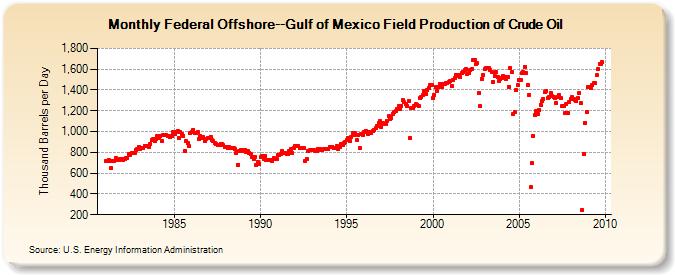

    Figure 2. Graph of Gulf of Mexico Production in Federal Offshore Region, produced by the EIA.

    It can be seen from Figure 2 that between 2003 and 2008, oil production in this region was declining, but in the last couple of years, as deep water wells have started coming on board, it has begun increasing again. If companies are successful in drilling more deep water wells, oil production in the Gulf of Mexico may grow again, perhaps to 2 or even 2.5 million barrels a day, before resuming its decline. This would not be a huge amount relative to world production of crude oil of 73 million barrels a day, but compared to the US’s crude oil production of 5.4 million barrels a day, this would be a substantial part. In the absence of deep water drilling, Gulf of Mexico production would likely continue to decline, as it did in the 2003 to 2008 period.

    Governmental agencies like to talk about “liquids” as if they were all equivalent to crude oil, but they really aren’t. On a “liquids” basis, the US is said to have 9.3 million barrels, including ethanol, and natural gas liquids, and the expansion in volume that occurs when refineries combine US natural gas with crude oil imported from overseas, as part of the refining process. (As mentioned above, crude oil production is only 5.4 million barrels a day.) Deep water oil is generally good quality oil, that can be refined to produce the products our economy needs, where these other products are of lower energy value, and generally lower price. Losing high quality oil would be much more of a blow than losing lower quality products that have been added to the reporting category, to disguise our true shortage of high-quality crude.

    The world is at this point struggling with financial difficulties. We like to think that our current order of things, in which we can depend on imports from abroad, will continue indefinitely. But I do not think this will be the case. As more and more countries (Greece, Portugal, and Spain, to start with) struggle with their debts, oil exporters will have less and less willingness to sell oil to those with questionable credit. Many in this country think that the US is immune to this problem, but if it turns out that the US has difficulties as well, we may lose even more true oil than a comparison based on overstated “liquids” would seem to suggest. In that case, we would be very happy to have some home-produced oil, at least for a short time, while it lasts.

    5. The natural order of things.

    Most of us don’t take time to think about what the true natural order of the world is. If we go back 100,000 years, there were no cars, no superhighways, and no oil wells. There were also very many fewer people, no wind turbines, and no computers. There was no problem with ocean acidification. Fish were abundant in the seas. The world was very different then.

    The natural order of things keeps changing, on its own, without our intervention. One type of animal dies out, and another replaces it. Plants undergo natural selection, so as to adapt to changes in the environment.

    In the fossil fuel world, we know their have been changes as well, and will continue to be. Where there are not cap rocks on oil supplies, hydrocarbons tend to migrate upward. When they do this, microbes in the atmosphere tend to break them down. Eventually, oil that is not under a tight cap rock tends to disappear–which is why we are having so much difficulty finding oil now.

    The oil that escapes as oil spills will also migrate upward to the water surface, just as it does when it migrates upward through oil seeps. In warm, sunny areas, like area around the Gulf of Mexico, hydrocarbons that migrate upward will biodegrade will fairly quickly–within a few years. Some residue may remain for longer. This will be sticky at first, but then turn to asphalt, before it too breaks down.

    It seems to me that as world oil supplies deplete, the world will tend back toward what I have described as the natural order of things. We won’t be able to support as many people on the earth. Highways will disappear, as governments no longer have funds to resurface them. Without roads, automobiles will no longer be useful. Cows, and pigs will decline in numbers. Fish will return to the seas. Plant and animal life will change, to fill in the gap we left. We will really have to fight to avoid this natural rearrangement, and even then, we are not likely to be very successful.

    We have a large number of people who classify themselves as environmentalists. They have a very different view of the world, and what is important for the long term. One of their concerns is that beaches not be despoiled by what looks like asphalt from oil spills. But these people seem to have little concern about the long stripes of asphalt that are being used for interstate highways. They are very concerned about the tens of thousands of birds that have been killed by oil spills, but they are not concerned (or not very much concerned ) about the billions of fish that are being removed from the oceans by fishermen every year. It seems to me that a major part of their concern is not really for the environment–it is for maintaining business as usual (BAU). Having pretty beaches, now. A nice place for their (many) children. Their plan seems to be for a light green BAU.

    6. Where should we be putting our energies now?

    If we lived in a world with plenty of energy, my vote would be with the environmentalists. If we don’t really need the oil, why not just close the industry down? No need to worry about asphalt on our beaches, or our fishermen getting big enough catches. If we need more oil, we can just use our large financial surpluses to buy more oil from abroad. With all the energy, we probably wouldn’t need to worry about enough jobs for the US population either.

    But if we are headed toward an energy-constrained world, it seems to me that we need to be thinking about our choices more clearly.

    Do we really have options for oil that are better? Can we count on world imports? Should we expect Brazil to do real-time experiments, to try to figure out how to extract its deep water oil, and then export it to us? Should we count on the Saudis, with their unaudited reserves and questionable “spare capacity” to keep up their production? Should we expect someone, somewhere, to find four or six new “Saudi Arabias” of additional oil over the next 20 years?

    If we can’t depend on imports, do we have more locally produced oil that we can ramp up? From an environmental point of view, would ramping up the oil sands in Canada be better? Or how about oil shale, out in the dry areas of the US West? Would we be willing to devote scarce water supplies in that area to ramping up oil production?

    It is easy to say that there should be more rules for the oil and gas industry, but there can be a downside to these rules as well. More rules will delay extraction, and will likely lead to a smaller amount of oil extracted, but at a higher price. There is also the question of whether the rules will really prevent oil spills. If the issue is really that new technology has to be tested live, no amount of rules will really fix the situation. There will always be accidents.

    If one is thinking about new rules, one should think about the Sarbanes-Oxley Act. It imposed substantial rules for US public companies after a number of major corporate accounting scandals. But how much good have these rules really been for preventing the financial crisis and aggressive behavior by banks? It seems to me that new rules are usually designed to prevent last year’s problem, not next year’s problem.

    If we don’t have oil, would we rather have coal, and a CO2 sequestration site underneath our homes, as technicians test to see whether their computer models are really correct with respect to how well the CO2 will stay underground? (If it doesn’t stay underground, it could form a low lying cloud and smother those in its way.)

    There are indirect implications of a loss of oil, too. A fisherman may have more fish to catch, if all oil spills are prevented. But if, in the process, the fisherman doesn’t have enough fuel for his boat, or his customers don’t have jobs and can’t buy the fish, he is not as much better off as he would seem to be.

    Given all of the environmental concerns regarding oil and gas, I can understand why many people would decide that the best decision is to err in the direction of caution regarding future oil production. But if this is the route we take (and even if it isn’t), we need to be thinking about where this puts us relative to the natural order of things. Presumably, with less oil, the downslope in the direction of the natural order of things will be even quicker. While some may not object to this, it would seem to me that it would make the urgency of adapting to the new world order even greater than it would be otherwise. This would suggest that we should be putting our efforts into energy sources that are truly renewable with only local materials–small scale wind, run of the stream hydro, and solar of the type that might be used to heat hot water a bit, but not to create electricity. These would not allow us to maintain BAU, or a world very close to BAU.

    To me, there are no easy choices.

    Join the conversation about this story »

  • AutoblogGreen for 04.29.10

    Know what you want and need, or you may not get to buy a Nissan Leaf
    “We may tell the customer, ‘Look, you’d be better off buying an Altima or a Sentra because your driving patterns are not ideal for this car.’”
    Oklahoma is newest market for natural-gas burning Honda GX
    State number four.
    Report: Tesla’s Elon Musk says new SUV model due in 2013
    More to come after that.
    Other news:

    AutoblogGreen for 04.29.10 originally appeared on Autoblog on Thu, 29 Apr 2010 06:03:00 EST. Please see our terms for use of feeds.

    Read | Permalink | Email this | Comments

  • Chrysler Sebring to be renamed Nassau, report says:

    The Chrysler Sebring will reportedly get a new name later this year: Nassau.

    The midsize sedan is due for a freshening, including an updated interior, along with its Dodge sibling, the Avenger. The Detroit Free Press, citing anonymous sources, says the new name will be Nassau.

    Chrysler is not commenting on the possible name change.

    “[We] definitely don’t have anything to announce about the possible name change later this year,” spokesman Rick Deneau said.

    The Nassau moniker should ring a bell with car fans. It was the name of Hemi-powered, four-passenger luxury concept shown at the 2007 Detroit auto show. With striking looks and a prominent grille, the concept displayed a dash of panache–potentially for a future Chrysler. The concept rode on a 120-inch wheelbase and was meant to look more visually compact than a comparable Chrysler 300C, summoning the style of a shooting brake.

    Still, the Sebring refresh is more of an update, so look for the name change to be the extent of the Nassau genetics that make it onto the new sedan. The Nassau name was also used famously by Chrysler in the 1950s.

    Look for the new sedan to get Chrysler’s Pentastar V6 and with a Fiat-developed dual-clutch transmission–dramatic upgrades to the powertrain.

    Automotive News also reported in March that the Sebring name will be dropped because the updates are so extensive, according to CEO Sergio Marchionne.

    Chrysler Sebring

    Chrysler

    The Chrysler Sebring is due for updates to the engine, transmission and interior this year. Look for a new name: Nassau.

    The Sebring and the Avenger are sorely in need of updates to increase their competitiveness in a midsize segment loaded with viable entries. Toyota and Honda have long ruled the sales charts, but the Chevrolet Malibu and the Ford Fusion are showing strength in the market as well, as American buyers again consider domestic brands.

    Chrysler’s midsize products have languished as the company endured ownership changes and bankruptcy. Marchionne has made it a priority to strengthen the company’s products in that area with quick changes rather than waiting for full redesigns which could take years.

    Last week, Fiat announced that the Sebring will be built in Turin, Italy, along with the Alfa Romeo Giulia, which is also a midsize sedan.

    For more


    Chrysler Sebring

    Source: Car news, reviews and auto show stories

  • TIME Magazine 100 Most Influential People In The World 2010

    “As Rachel Berry on the hit TV show Glee, she is inspiring young people to get involved in musical programs in schools and encouraging communities to fund them,” Aussie songbird Olivia Newton-John about actress Lea Michele, the 24-year-old Broadway baby wowing audience each week on the FOX musical Glee.

    It’s all a part of TIME Magazine’s annual list of the “100 Most Influential People In The World.” Lea joins pop culture notables like Bill Clinton, Lady Gaga, Sarah Palin, Conan O’Brien, Taylor Swift, Prince, and Elton John who were profiled by other famous people for the roundup. Time 100, on newsstands Friday, pays homage to honorees in four categories: artists, leaders, thinkers, and heroes.

    Visit TIME.com for the complete list……


  • The invention of childhood innocence

    When Robin Bernstein was a little girl, she perused textbooks belonging to her mother, who was pursuing a degree in early childhood education.

    “Of course I didn’t understand them,” said Bernstein, assistant professor of studies of women, gender, and sexuality, and of history and literature. “But I knew that she was studying a category of people, and that I was in that category. I was very aware of myself as a child. That’s how I first became interested in childhood as an area of knowledge — as a way of thinking about the world.”

    Bernstein’s new book, “Racial Innocence: Performing American Childhood in Black and White” (New York University Press), examines the weaving together of childhood, innocence, and race in the late 19th and early 20th centuries, a period that included slavery, Reconstruction, post-Reconstruction disenfranchisement of African Americans, the New Negro Movement, and the early Civil Rights Movement.

    “Three hundred years ago, there was no assumption that children were innocent,” said Bernstein. “That idea only became common sense in the United States in the early 19th century. Once the idea of childhood became laminated to the idea of innocence, children could be used strategically in political arguments. Children made these arguments appear to be apolitical, or simply evocations of truth.”

    Some people very consciously employed children to gain sympathy for their perspectives. In the influential novel “Uncle Tom’s Cabin,” Harriet Beecher Stowe places Little Eva, an angelic, white child, in a loving relationship with an adult slave.

    “The two characters are very tender with each other,” said Bernstein. “This is Stowe’s way of making Uncle Tom seem innocent and, by extension, making abolition itself seem innocent as well.”

    Other figures, Bernstein argues, unintentionally affected racial issues in the United States. In 1915, Johnny Gruelle appropriated blackface imagery to create Raggedy Ann. He deliberately chose such imagery not to make a political statement, but to tap into a source of mass appeal. Bernstein traces Raggedy Ann’s blackface minstrel roots back to the 1840s.

    “I would argue that this is part of the reason that Raggedy Ann is still popular,” she said. “Not because we consciously perceive blackface imagery, but because blackface imagery is one of the deepest aspects of American popular culture.”

    “Ever since innocence entangled with childhood, that connection has always been raced,” said Bernstein. “It was not just any childhood, it was specifically white childhood that was entangled with innocence. This entanglement was a way of excluding non-white children from innocence and from childhood. Popular culture suggested that if they weren’t innocent, then they weren’t children. If they weren’t white, they weren’t innocent.”

    In the final chapter of the book, Bernstein looks at how African Americans seized on the idea of childhood innocence and recaptured that notion for black children in the 1920s.

    “They fought back against the idea that black children were not children, were not innocent,” she explained. “They seized on this rhetoric and used it for anti-racist projects.”

    In her epilogue, Bernstein re-examines the psychological tests conducted in the 1940s by Kenneth and Mamie Clark, which were indirectly cited in the U.S. Supreme Court’s landmark Brown v. Board of Education decision against segregated schools as proof of “psychic harm” arising from societal racism. In these tests, black children were asked a series of questions about brown and pink dolls; most subjects expressed a preference for the pink dolls.

    Bernstein both acknowledges and pushes beyond the common critique of the Clark tests, that choice of dolls does not necessarily index self-esteem. The Clarks, she argues, were uncovering racism as knit through dolls for 150 years.

    “What their research shows very reliably is preferences in dolls, so I decided to put their tests into the context of the history of dolls. What you see is children having a very sophisticated understanding of standardized practices of play. You see children’s expertise in children’s culture.”

    The use of children in political arguments, Bernstein said, continues even today.

    “I’m looking at the origins of how the idea of ‘saving the children’ became useful and meaningful. My book ends in the early 20th century, but aspects of what I’m studying absolutely continue. If you want to make a political argument, just add the ‘do it for the children’ rhetoric, and it suddenly becomes a lot more persuasive.”

  • Your Mantelligence Briefing for April 29th

    Mantelligence pic 42810

    For absolutely no reason at all, here’s the world’s funniest push-up contest. (College Humor)

    We gave you the 10 Worst Cities for Bachelor Parties a few days ago.  In the interest of fairness, here are 6 of the best places to go.  (Made Man)

    Crass face tattoos + mugshots = Souvenirs of regret.  (CoEd Magazine)

    Do everything right, and one day you might get the swagger of these business magnates.  One day.  (Bro Bible)

    Buying a used car doesn’t mean you can’t afford new.  It often means you’re too smart to buy new.  Here’s how you do it.  (Art of Manliness)

    Hmmm….despite having attended an outdoor concert festival, music isn’t exactly the focus of these pictures.  Good work at Coachella, EgoTV.  (EgoTV)

    Why say no when it feels so good to say yes?  Adriana Lima in a live photo shoot.  (Made Man)

    These sexual records aren’t all they’re cracked up to be.  Except siring an army of children.  That’s pretty cool.  (Gunaxin)

    Your prayers have been answered: green, sustainable eyewear.  What?  Yes. (StyleCrave)

    And finally, I had seen a few of these in Vegas at the World Championship of Beer Pong back in January.  Traveling beer pong tables.  Not just for the pros anymore.  Here’s where you get them.  (Tasty Booze)

    Related posts:

    1. Your Mantelligence Briefing for April 8th
    2. Your Mantelligence Briefing for April 1st
    3. Your Mantelligence Briefing for April 23rd

  • Rock Festivals – Make This the Year You Don’t Just Talk about Going

    They're there.  You're in front of your computer.  Fix it.

    They’re there. You’re in front of your computer. Fix it.

    Thanks to the introduction of Lollapalooza and the like in the early-90’s, music festivals have only recently proliferated in the United States despite the historic popularity of multi-day festivals in both Europe and Australia.

    While some of the more popular festivals may not be terribly close to you, there are so many different and compelling festivals throughout the nation these days that you don’t have to make it to Coachella, Lollapalooza, Pitchfork, or ACL to see renowned acts and have a kick-ass time.

    The Space Lab does a pretty good job of running through the most pertinent and popular festivals this year, so rather than moping about missing Jay-Z at Coachella, get pro-active and go see live music.

    Related posts:

    1. Playboy Announces “Cyber Girl of the Year” 2010
    2. CNN.com Finds Six Words That Guarantee I Will Click on Their Link
    3. Guys Think About Sex 5,000 Times A Year

  • Gitmo Abuse ‘Contaminated’ Government’s Case, Attorneys Say

    A view from the recreation yard at Camp 4 of the Guantanamo Bay detention center (Photo by Spencer Ackerman)

    GUANTANAMO BAY — Making the most of their first court appearance since President Obama halted and then resumed the military commissions, attorneys for Omar Khadr, the Canadian citizen held here since he was 15 years old and charged with murder and support for terrorism, launched a forceful case Wednesday afternoon that a military judge should bar from court all statements Khadr made to his interrogators for the last eight years.

    Image by: Matt Mahurin

    Image by: Matt Mahurin

    “We will show this case was tainted by these statements from the very beginning,” Kobie Flowers, one of Khadr’s lawyers, told a packed courtroom, with Khadr himself seated just a few feet away. The physical and mental abuse that Khadr claims in an affidavit to have suffered at the hands of U.S. law enforcement, intelligence and detention personnel “contaminated” the heart of the government’s case against Khadr, he said: “The well, as it were, was poisoned.”

    A team of four prosecutors led by Jeffrey Groharing, a retired Marine major, responded that Khadr’s lawyers hadn’t met their burden for demonstrating that Khadr was abused, as Khadr — looking healthy in a white shirt and thick beard — looked on stoically. Dismissing a central aspect of the defense, Groharing bluntly stated that “no secret evidence” would be used in the government’s case against Khadr, and called to the stand an FBI special agent who testified to “non-confrontation[ally]” interrogating Khadr in October 2002 in Afghanistan. The prosecution additionally contended that Khadr’s own affidavit about his abuse should be excluded from court, since prosecutors couldn’t cross-examine the defendant — a motion that the judge in the proceeding, Army Col. Patrick Parrish, quickly rejected in the only question settled during the three-hour hearing.

    But in the hearing’s most dramatic moment, Flowers said at least one interrogator would testify to having personally taken part in Khadr’s abuse. As detailed in a motion filed by the defense in 2008, Khadr claims in his affidavit that his interrogators threatened him with rape, denied him medical treatment for gunshot and shrapnel wounds he suffered in his July 2002 capture in Afghanistan, and used him as a “human mop” to clean up his own excrement. The interrogator, referred to in the hearing only as “Interrogator #1,” will testify on behalf of the defense that he personally threatened Khadr “with rape” by threatening to render Khadr to an undisclosed Arab country where he would face the abuse.

    Asked for clarification after the hearing why the interrogator would risk incriminating himself, Flowers’ co-counsel, Barry Coburn replied, “I don’t know the answer to that.” He said he expected the interrogator to testify either late this week or early next week.

    Flowers and Coburn further alleged that the government has impaired its ability to investigate Khadr’s case and accordingly hindered their ability to defend their client. They said that at least 31 different law enforcement and intelligence agents had interrogated Khadr, but that the government had only provided them access to three — and that one of them, known only to the court as “Interrogator #3,” may have falsified a report of Khadr’s interrogation — something they learned only after reviewing an extensive report from the Justice Department into FBI knowledge of abuse at Bagram Airfield in Afghanistan and Guantanamo Bay.

    In response, the hearing’s only witness thus far, FBI Special Agent Robert Fuller, testified to interrogating Khadr six times in Bagram during a two-week period in October 2002, shortly before Khadr’s arrival in Guantanamo Bay. Fuller, a ten-year FBI veteran with the Joint Terrorism Task Force in New York City and before that a New York police officer, called Khadr’s treatment “comfortable, reasonable” and “conversational, non-confrontational,” leading Khadr to confess to throwing a grenade that killed a U.S. Army Special Forces sergeant, Christopher Speer.
    The FBI agent further said Khadr never once complained to him of any abuse the detainee experienced and that his interrogation sessions would feature “snacks” and bottles of water brought for Khadr — although he also said that guards brought Khadr into the interrogation room with a full hood over his head.
    Consistent with his behavior for the entire hearing, Khadr did not have any distinct reaction to Fuller’s testimony. The detainee, now approximately 23 years old, showed only the slightest of responses during the three-hour hearing, occasionally shifting in his chair, resting his chin on his fist to listen to the proceedings, or grinning understatedly at the few dozen observers lining the maroon-carpeted courtroom. After the hearing adjourned around 4:15 p.m. — so Khadr could pray — one of his Canadian lawyers, Nathan Whitling, told reporters, “he’s pretty uncomfortable in there.”

    That wasn’t the only uncomfortable moment in the hearing. Parrish cancelled the entire morning session, scheduled to begin at 9 a.m., so officers of the court could read 280 pages worth of rules of evidence and procedure issued only the previous evening. Coburn said he didn’t even receive the so-called Manual for military commissions until 9:20 a.m., and he was back in court by 1 p.m., citing rules in the Manual that he later called “extremely marginal improvements” over an earlier edition that was overridden after Congress and the Obama administration passed a law last year restructuring the military commissions.
    Some of those provisions, contained in what the Manual calls Rule 304, speak to the suppression of coerced evidence that Khadr’s attorneys seek. It bars statements produced by torture or coercion. But it allows the entrance into evidence of statements a defendant makes if a judge finds “the totality of the circumstances renders the statement reliable” and that the statement was “voluntarily given.” Additionally, lawyers can use statements of other detainees “allegedly produced by coercion” if a judge finds them to be torture-free, reliable, and if “the interests of justice would best be served by admission of the statement into evidence.”
    Other aspects of the Manual appear incomplete. Several rules are listed as blank — an implicit recognition of the rush with which Pentagon officials completed the Manual barely in time for Khadr’s pre-trial hearing, as even former commission officials expressed surprise that the Pentagon could move forward with the hearing without rules of evidence and procedure in place.
    Additionally, as first reported by The Miami Herald’s Carol Rosenberg, the Manual strips judges of the ability to factor into sentencing the years detainees have already served at Guantanamo Bay, and it doesn’t resolve a long-standing question vexing the commissions: Whether a detainee can plead guilty to a judge in a war-crime hearing that carries a death sentence.

    The Manual can’t resolve more fundamental disputes concerning the military commissions. Several times throughout Wednesday’s hearing, Khadr’s lawyers referred the detainee’s “Constitutional rights,” only to face objections from the prosecution that the Constitution doesn’t apply to the Guantanamo population. Parrish, seeking to streamline the issues he must adjudicate, instructed counsel to table the debate.