Dario Gasparini holds up original plans for the state-of-the-art structures lab
The Department of Civil Engineering‘s new state-of-the-art structures lab, on the east side of the Bingham Building, can mimic the worst mother nature can throw at the built environment while enabling researchers to learn why everything from deep sea structures to soaring towers fail, and how to make them safer and sounder.
The Richard ’39 and Opal Vanderhoof Infrastructure Research and Education Facility was recently unveiled: 2,400-square-feet of hardy concrete, steel and hydraulics married to high-tech computer controls and sensor systems.
The Vanderhoofs provided a gift of $2 million to build the new facility, with the Case Alumni Association leading this major fundraising initiative.
“It’s a gift from the past – civil engineering alumni – to future and present civil engineering students,” said Dario Gasparini, professor of civil engineering. He has shepherded the project, and talked about the effort to a crowd of more than 50 alumni, university administrators, students and other guests.
In attendance were two representatives of the Vanderhoofs; Frank E. Gerace Case Institute of Technology ’48, whose name adorns the L-shaped strong wall; and others who donated time and money to create a facility that now puts the university in competition for large-scale academic, industrial and governmental research and testing.
Arthur A. Huckelbridge Jr., professor of civil engineering, showed the audience his current project: stressing and straining components of a base similar to that used on some wind turbines in Europe. The bases have proven a weakness in the design.
“I barely remember this space before: it was dark, dirty, unused and crowded with junk stored here,” said Chad Fusco, a master’s student and one of the first students to use the new lab.
“Now it’s beautiful and usable,” said Janette Siu, a master’s student who, with Fusco, demonstrated a system that stabilizes buildings in high winds and earthquakes. “The new lab is a boon to faculty and students.”
For more information contact Kevin Mayhood, 216.368.4442.
Summer tuition is due on Thursday, April 29 by 7 p.m. Please pay in full or have a payment plan set up by 7 p.m. If you have any questions plese call the Business Office at 847.925.6880 or stop by the Business Office in the Student Center, Building A, Room 214.
Sigh. Nokia may be selling phones like hotcakes to the developing world and my father-in-law in Poland, but they can’t make a popular phone to save their life. The new N8, leaked and reviewed on Electronista is little more than a rehash of Symbian circa 2000.
Mobile-Review’s Eldar Murtazin goes so far as to jokingly accuse Nokia employees of sabotaging the company’s brand from the inside, else it might be “impossible to explain” why the N8 exists at all.
Ha! Oh, Nokia! Silly silly Nokia. Anyway, the N8 takes some nice pictures and supports HDMI, because that’s one of the things people have been looking for for in a phone.
What’s better than giving away a Verizon HTC Droid Incredible? Giving away two Verizon HTC Droid Incredibles. That’s right, we’re upping the ante in advance of this week’s launch. Here’s the deal:
Our original contest is still on. Hit up the forums if you haven’t entered yet.
For a second chance at winning a Droid Incredible, hit up this forum thread and tell us about the sorry old phone you’re currently using. We’ll pick one answer at random to win the second Incredible.
We’ll pick both winners Wednesday morning and contact by e-mail, so keep close to your inboxes, and ship ’em out so you’ll have them on Thursday, launch day. Good luck, everyone!
WASHINGTON – A California law banning the sale of violent video games to minors that lower courts deemed too broad and in violation of the First Amendment will get another look by the Supreme Court, the justices announced Monday.
The Court’s decision could ultimately lead to a ruling reinstating the law, passed in 2005, that prohibited the sale or rental of certain violent video games to children younger than 18 years old.
So far, video game makers have successfully challenged the law saying it violates their freedom of expression.
Earlier this year, the Ninth Circuit U.S. Court of Appeals expressed sympathy with California lawmakers who were attempting to protect children from the potentially harmful effects of exposure to violent video games, but nonetheless ruled against the law.
A unanimous three judge panel concluded the law was too broad and that the state didn’t sufficiently link the video games to a concern that minors exposed to the games will be more likely to commit violent crimes. It further held that even if the state were able to make such a link, there are other measures the state could have taken that wouldn’t threaten First Amendment protections.
In its petition to the Court, California argues the justices should expand a late 1960’s ruling that prohibits of sale of sexual material to minors to include violent video games. It also says the current industry imposed labeling standards for video games is ineffective.
A final ruling by the Court, which will not come until next year, will likely impact the handful of other states that have similar laws.
About 13,000 Lexus GX 460 vehicles are being recalled by Toyota Motor Corp. due to a high risk that the SUVs may rollover going around sharp turns.
The Lexus recall was announced last week shortly after Consumer Reports gave the vehicle a “Don’t Buy” recommendation for safety reasons. Test drivers at Consumer Reports say that under certain conditions, the rear of the vehicle may slide going around turns, increasing the chances of a Lexus rollover accident.
The Lexus GX 460 recall affects the 2010 model year, including 9.400 vehicles in the United States and about 3,600 more vehicles worldwide.
Problems with the Lexus GX 460 are known as trailing throttle or lift-throttle oversteer. According to test drivers at Consumer Reports, if the driver takes his foot off the gas while the vehicle is driving through a sharp turn, the rear end of the vehicle may begin to slide. On most vehicles, the electronic stability control system would detect the slide and stop it from happening, but it does not seem to be responsive enough to the problem on the Lexus SUV.
Test drivers said that it is a common maneuver for drivers, which may occur when they take an off-ramp too fast, or realize they are in a sharper turn than they expected. Testers at Consumer Reports said they wouldn’t allow their families to ride or drive in the vehicles in their current condition. Consumer Reports said that the problem could cause a driver to lose control and pose a risk of serious personal injury or death.
The last time Consumer Reports issued a “Don’t Buy” warning was 2001, for the 2001 Mitsubishi Montero Limited.
The low rating came at a sensitive time for Toyota, which is still reeling from accusations that they covered up problems with sudden acceleration in many different Toyota and Lexus vehicles. Toyota has recalled about 8 million vehicles due to the gas pedal problems and has paid a fine of $16.4 million to the U.S. Department of Transportation.
Toyota quickly halted sales of the Lexus GC 460 following the negative recommendation by Consumer Reports. Now officials in Toyota’s Lexus division said that they have developed a fix that requires an update of the SUV’s Vehicle Stability Control (VSC) system. All Lexus dealers will have the updated software by the end of April, according to the press release on the Lexus recall (pdf).
Toyota officials urged owners of the vehicles to return them to their dealers to get the update, which should not take much longer than an hour, depending on the dealer’s schedule. Owners of affected vehicles will begin receiving letters in early May alerting them to the problem and the fix.
The Maldives. I would like to go back there, become a dive instructor, and live a simple happy life. And I want this to be my house, five meters below the surface, off the coast of Rangali Island. More »
Coal mining is dangerous business and the people of the Appalachian coalfields, from Tennessee to West Virginia to Pennsylvania, have come
to expect disasters out of the mining industry. Mining is a job that’s
full of risks and packed with hard work. Miners have come to be proud
of the work that they do which truly has had a great role in powering
the United States for more than the last century. It’s been work that’s
populated Appalachia with amazing people but has kicked up a lot of
coal dust in the process all over our great state of West Virginia.
After 9/11, where I was less than 10 miles from the Pentagon and
remember hearing fighter jets and helicopters flying over my house
throughout that tense night. I never thought I would feel that tragic
emotion that brought anger, anticipation, fear, mourning, and pride
together into one horrendous stomach ache again. Then came the disaster
at Massey’s Upper Big Branch Mine.
I could not work all week. I could not stop refreshing the WSAZ news page
and the Coal Tattoo
Blog for updates. I could not get my mind off the basic question of
whether there is good in the world where 29 hardworking men are killed
because of Massey Energy’s disregard for miner safety. I could not get
off the phone talking with students I work with and my own family
members who were grieving like I was for these men and holding out hope
that the four missing miners would be found alive. They were not.
And we continue to mourn through the weekend.
Both my great-grandfather and grandfather helped to pull 11 bodies
out of the Nellis mine which is a hair under 33 miles away from the
Montcoal mine. On November 8th, 1943, which was a Monday, his family
was watching a movie in Whitesville and they were rushed out of the
theatre to Nellis. His mother and sisters were sent home to pray for
survival, his father hurried down in the mine to search for life and my
grandfather stood sentry at the mouth of the mine with not much to do
but hope to see those men walk out of the mine. He was 13 at the time
and he saw those 11 bodies come out of the mine in a railcar without a
breath among them.
He is now the ripe age of 80, and once again mourning, this time for
the 29 miners that were killed in the Upper Big Branch mine. He and no
one in the coalfields should have to witness a disaster like this and be
reminded of a disaster they lived through 67 years ago. We have the
means and technology to make these kind of massive disasters a thing of
the past that exists only in our memories and history books.
Worker deaths should not happen, and we should be pushing to prevent
them whenever possible. The debate becomes about what is the safest
method of mining coal, since we will be mining coal for a long time
coming. Even if we quickly transition from burning coal for
electricity, there are a ton of uses for coal (including using metallurgical coal for
the production of steel, which is needed for wind turbines) which
will keep it as part of Appalachia’s economy. For a point of
information, the Upper Big Branch mine was mostly a metallurgical coal
mine and the coal mined is used for steel-making rather than
electricity production. Massey is known to export their metallurgical
coal overseas, so the 29 miners probably lost their lives not to power
the re-industrialization of the United States with renewable energy, but
to power the industrialization of countries like China and India. So,
even if we run a completely renewable energy economy, we need to keep a
focus on how we can mine coal in the way that’s most beneficial to the
communities under the safest possible conditions.
Flying in the face of these horrible realities, there has been the
disturbing development that mountaintop removal proponents have been
coming out with recently. From supporters of Massey CEO Don Blankenship to Congresswoman
Shelley Moore Capito, there has been an effort to use this horrible
mining disaster to spread support for strip mining and mountaintop
removal.
Countering this opportunistic assertion is the main point of this
piece.
Never mind the horrible leveraging of this disaster to increase
support for the form of mining that employs
the least number of people and
causes the most damage to Appalachia. While there is truth in the
statement that surface mining is safer for workers than underground
mining, the Blankenships and Capitos of the world would have you believe
that everything is hunky-dory and safe as grandma’s apple pie on a
strip mine.
The way that the Blankenships of the world make the argument is that
we could simply shift from underground mining to strip mining is a total
oversimplification of the realities of mining. The Upper Big Branch
mine was more than a thousand feet
underground. To get that coal, it takes underground mining, plain and simple. So we need to
talk about what the safest ways of mining are and what makes the biggest
impact on increasing worker safety.
As I’ve heard more of the pro-mountaintop removal opinion getting out
there, I became more interested in knowing the facts. I’ve been
hearing that strip mining was dangerous work, but I’ve never really
known just how dangerous. I came to the point of wanting to counter the
claim that the Blankenships of the world were making, but I didn’t know
the facts. So, I started crunching some numbers, making Excel
spreadsheets and asking friends for help. What I found didn’t really
surprise me, but it gave a sense of concreteness to talk about how
important unions are to worker safety.
What I found was that union strip mining was the safest for miners
and that non-union underground mining was the most dangerous. That
said, there is little way that we can or should be using that as a
justification for more strip mining. Seeing as how coal that’s mined a
certain way is generally mined that way for whole host of reasons, the
Blankenships of the world are oversimplifying it. If we look at the two
forms of mining independent of each other, because strip vs. underground
mining is generally not interchangeable, we can easily see that whether
a mine is union or non-union is incredibly important to worker safety.
Here are the stats that I developed using statistics from 2002-2008
(it’s pretty obvious what the stats would be for 2010 with the Upper
Big Branch disaster, but it’s too early in the year for good statistics
to be out there). The following chart summarizes the comparisons that I
wrote about earlier.
So, what you can see is that in each form of mining, union mining
clearly makes for safer mining than non-union mining. Underground
non-union mining is the most dangerous forms for five out of the six
measured years. Underground union mining is about even with non-union
strip mining in terms of worker safety — with non-union strip mining
having a higher worker death rate than union underground mining.
The most important thing is for unions to be able to organize mines,
whether they be strip mines or underground mines. In almost every case,
union mines are safer than non-union mines. Worker safety depends on
the unionization of the workplace, not on a largely fictitious choice
between strip & underground mining.
The United Mine Workers of America
have been longstanding leaders for coal miner safety. One of the most
important things that the media is missing in covering this disaster has
been the discussion about the UMWA. The UMWA had three different attempts to unionize
this mine and Don Blankenship personally visited this mine to break
the union drive. One drive in particular had more than two out of three
workers signed onto a union card, but the official vote failed. If we
had the Employee
Free Choice Act as law, the Upper Big Branch mine would be a union
mine as 2/3 of the workers supported a union before they were
intimidated. We need to see this law passed so we can see safer mining
through a unionized workplace.
When workers knew Blankenship would have them fired if they voted for
the union, they stepped back from voting it in. Workers need a united
voice in the workplace. We can have the best regulations in the world
on the books but if workers are not organized to be able to speak up —
those regulations are worthless. As far as I’m concerned, miner
unionization is the best possible solution to preventing disasters like
this in the future.
We’ll be mining coal for a while and we need to be real about what
makes the biggest impact on worker safety in the mines. We don’t need
another Monongah (1907, WV, 362 killed), Farmington (1968, WV, 78
killed), Sago (2006, WV, 12 killed), Crandall Canyon (2007, UT, 9
killed), or Montcoal (2010, WV, 29 killed).
I hope the
words that Former Secretary of the Interior Stewart Udall issued in
1968, “let me assure you, the people of this country no longer will
accept the disgraceful health and safety record that has characterized
this major industry,” and the
words of President Barack Obama 42 years later, “I refuse to
accept any number of miner deaths as simply the cost of doing
business” will one day ring true and we can at least, today, have an
honest discussion about what the safest ways to mine coal are.
(In the official White House photo by Pete Souza, President Obama walks with Linda Davis, the grandmother of deceased Upper Big Branch miner Cory Davis.)
Desperate for work, Charlie Sheen’s unemployed uncle has offered to replace the troubled actor if he decides to leave the CBS hit sitcom Two And A Half Men at the end of the season.
Can you say “Bottomfeeder”
Sheen — who is battling his umpteenth trip to rehab and criminal charges for allegedly threatening wife Brooke Mueller with a knife on Christmas Day — is seriously considering ditching his role as hedonistic bachelor/ writer Charlie Harper on the Jon Cryer-assisted comedy.
In swoops his uncle Joe Estevez to save the day. The younger brother of actor Martin Sheen dished to TMZ.com that he’s now contemplating approaching the show’s creator, Chuck Lorre, about appearing as the program’s newest star.
Our client is a successful consultancy who has a long standing track record in delivering environmental solutions both on and offshore. They have an in-depth knowledge of the operational processes and regulations that apply to our clients’ businesses.
Our client supplies a comprehensive range of environmental consultancy services. Their skilled team provide a unique blend of skills in environmental and marine science, capacity development, environmental development, engineering, chemistry and toxicology.
Our client works in the energy sectors, their major market sectors are oil and gas sector, the larger energy sectors, renewable energy, marine and coastal environmental management, the maritime sector, the industrial and commercial sector, local and national governments and international agencies.
They are looking to recruit a Senior Environmental Consultant for their Aberdeen office. It is essential that candidates have either a background in Oil and Gas projects OR Renewable Energy projects. In-depth knowledge of marine mammals or benthic ecology/biology would be of particular interest.
Our client is a well known consultancy, working within the UK and international energy, industrial, chemicals and development sectors, they have offices across the UK and worldwide.
They currently have a vacancy for a Senior Consultant with a core specialty in environmental consultancy for the offshore oil and gas industry and/or the marine renewable energy sector.
This full-time role involves client management, work-winning, project management, hands-on project work, and the application of commercial and technical skills and knowledge. The appointee will join a team providing environmental impact assessment and other support for clients’ facilities and projects. The post will be based in Aberdeen, but may involve offshore and overseas work.
Skills/Experience:
• Proven track record in environmental consultancy
• Good academic background (preferably in a marine environmental discipline)
• Experience in the offshore oil gas and/or marine renewables sectors
• Motivated self-starter
• Strong team worker
• Well developed communication skills
• Project management
• Proposal and report writing skills
• In-depth knowledge of marine mammals or benthic biology would be advantageous
Contact
Please email your CV to apply or all applications are treated in confidence, 2M Careers offers the services of an employment agency for permanent work.
Please note that we never send CVs anywhere without your prior consent.
When I first heard that researchers were developing for a way for water and sand to produce hydrogen, it gave me pause. If it were this easy, wouldn’t all of the beaches of the world be producing massive amounts of hydrogen?
But, of course, it’s not quite this simple. A company called Isis Innovation has discovered that grinding sand (silica) into nano scale powder is the key to achieving a reaction to split water into hydrogen and oxygen at temperatures of 158 – 194 F.
The reaction stops quickly once an oxide layer is formed. The scientists have even discovered a material to encapsulate the nano-scale silica so that it won’t react with moisture in the air to create hydrogen.
One of the biggest advantages of the sand and water method for creating hydrogen is that the source materials are abundant and cheap (low grade sand can be used). The only byproduct of the new process is the oxidized sand which can be recycled.
The inventors of this hydrogen on demand system see many uses from powering laptops to powering fuel cell cars and other vehicles. For powering cars, the hydrogen can be produced locally, so large transportation systems for compressed hydrogen gas will not be needed.
Two interesting polls from Gallup show why a few ticks in the unemployment rate here and there are really besides the point. (Thanks to Jim Geraghty of NR.) This downturn has scarred the American psyche. The first chart shows how worried workers are about finding a comparable job if they ever lose their current one. The second chart shows that they are still pretty worried about losing their existing job.
The world of outsourced drug research and development might get a lot smaller. Charles River Laboratories International is aiming to buy the Chinese R&D services firm WuXi PharmaTech for a whopping $1.6 billion, the companies announced this morning.
Wilmington, MA-based Charles River (NYSE:CRL) reported that it plans to gobble up Shanghai-based WuXi in a deal that values WuXi (NYSE:WX) at $21.25 per share, a 28-percent premium on the firm’s closing stock price on April 23. Charles River is offering to buy WuXi for a combination of cash and its common stock. The deal requires shareholder approval and is slated to close in the fourth quarter of this year, according to the companies.
The buyout would significantly expand Charles River’s global presence in the outsourced R&D market both in the U.S. and China. WuXi has more than 1.8 million square feet of drug R&D space in China, as well as three sizable research and manufacturing centers in Atlanta, Philadelphia, and St. Paul, MN, according to its website.
“This transaction revolutionizes the contract research landscape by creating the only global contract research organization, or CRO, to offer fully integrated research and drug development services from molecule creation to first-in-human testing,” said James Foster, Charles River’s chairman and CEO, in a statement. Under the terms of the merger deal, Foster would be chief executive of the combined entity, and WuXi’s CEO, Ge Li, would be a corporate executive vice president and be president of the company’s operations in China.
WuXi is one of the fastest-growing competitors in the outsourced drug R&D world, fueled by China’s growing population of Ph.D.s and scientists, the Wall Street Journal reported yesterday. (The Journal article, published yesterday, gives a decent overview of both companies’ capabilities.) Drug companies are expected to increase their use of CROs as they continue to trim the size of their own R&D organizations to reduce expenses and focus more resources on the marketing end of the pharmaceutical business.
CableLabs, the standard-setting organization for the cable industry, is pondering a next-generation cable broadband technology that could deliver up to 5 gigabits per second down, according to Multichannel News. Not only are the speed gains significant, but the standard would be more efficient by doing away with the current way cable companies parse out their spectrum. However, it would require them to invest in new gear, both in their plants and for installation in consumers’ homes, as well as to switch to an all-IP infrastructure.
The proposal is being floated in the cable community, but may never make it all the way to the standards process — or consumers’ homes. However, if implemented, it could solve a problem for the cable industry and perhaps enable cable companies to forestall putting in fiber to the home.
Currently cable companies divide their spectrum into 6MHz channels, each of which delivers about 38 Mbps, the equivalent of two HD channels. The DOCSIS 3.0 standard bonds those channels together to create faster broadband speeds. The proposed new standard would eliminate the 6 MHz channels altogether, which could give cable companies more flexibility in how they manage their assets. It’s the difference between trying to cram blocks into a container Tetris-style and pouring sand in it. With the sand, you use the empty space more effectively.
Such a level of efficiency is something the cable companies will have to deliver as consumers expect both faster broadband speeds but an infinite array of HD (maybe 3-D) content personalized just for them. So far, many of the larger cable companies haven’t committed to true IPTV, but most recognize that it’s merely a matter of time. Changing the network architecture like this would be a first step, although it would mean we’ll still have two different styles of networks in the U.S. for a long time to come.
[JURIST] The US Supreme Court on Monday granted certiorari in two cases. In Schwarzenegger v. Entertainment Merchants Association, the court will decide whether the First Amendment permits any limits on offensive content in violent video games sold to minors, and whether a state regulation for displaying offensive, harmful images to children is invalid if it fails to satisfy the exacting “strict scrutiny” standard of review. California Civil Code sections 1746-1746.5 prohibit the sale of violent video games to minors under 18 where a reasonable person would find that the violent content appeals to a deviant or morbid interest of minors, is patently offensive to prevailing community standards as to what is suitable for minors, and causes the game as a whole to lack serious literary, artistic, political, or scientific value for minors. The US Court of Appeals for the Ninth Circuit affirmed the district court’s judgment permanently enjoining enforcement of the prohibition.
In Ortiz v. Jordan, the court will decide whether a party may appeal an order denying summary judgment after a full trial on the merits if the party chose not to appeal the order before trial. The US Court of Appeals for the Sixth Circuit ruled that, “although courts normally do not review the denial of a summary judgment motion after a trial on the merits, denial of summary judgment based on qualified immunity is an exception to this rule.” There is a circuit split on this issue.Also Monday, the court decided not to allow Michigan to reopen a longstanding controversy with the state of Illinois seeking to close two waterways that allow invasive Asian carp to reach the Great Lakes. The court also refused to allow Michigan to open a new case on the issue.
Numa parceria entre o estúdio de design Zagato Milano e a Alfa Romeo, as companhias criaram o bólido para as pistas Corsa TZ3, em comemoração aos 100 anos de corridas. O modelo foi revelado no concurso de design “Concorso d’Eleganza Villa d’Este” na cidade de Cernobbio, Itália.
Ao olhar para as suas fotos, não se engane pelo seu jeitão de carro conceito, pois ele realmente será produzido pela Alfa Romeo. Apesar de a companhia italiana não ter revelado maiores detalhes do modelo, sabemos que ele terá uma produção limitadíssima e exclusiva para poucos felizardos clientes da Alfa Romeo.
O modelo terá como característica seu baixo peso, obtido através da utilização de um chassi de fibra de carbono e sua estrutura tubular feita de alumínio, maximizando a potência de seu motor, que provavelmente seja o mesmo V8 do Alfa Romeo Competizione de 4.6 litros com 450 cavalos de potencia e 47,9 kgfm de torque, que será acoplado a uma caixa de marchas de seis velocidades.
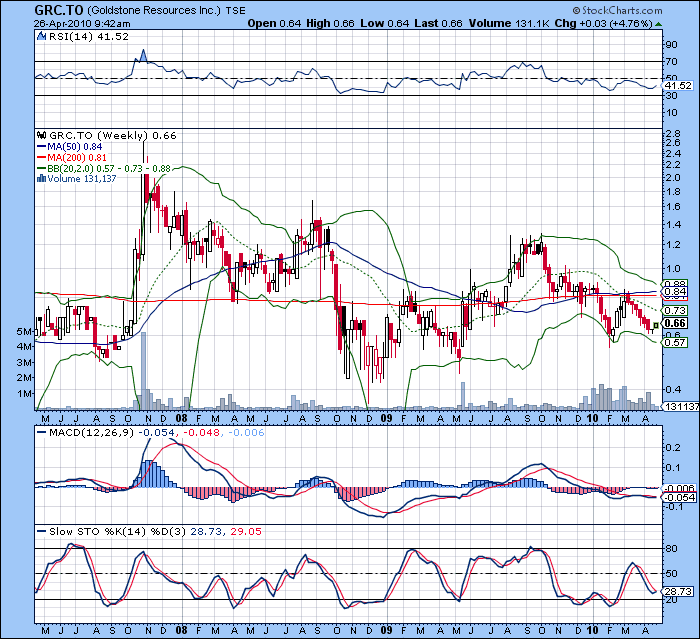
Premier Gold delivers another set of very impressive results in this Canadian Gold discovery play. Resources will have a nice boost later this year with this kind of intercepts! Stock is due to rebound on the technicals above.
April 26 /CNW/ – PREMIER GOLD MINES LIMITED (TSX:PG – News) is pleased to announce that drilling continues to expand near-surface mineralization at the Hardrock Project in Northwestern Ontario. Current drilling is targeting both open pit and underground style zones with the 2010 program aimed at increasing the current gold resource. Recent expansion drilling in the NN Zone has returned some of the best intersections to-date in this horizon including: – 22.97 grams per tonne gold (g/t Au) across 24.8 metres (m) (0.67 oz/ton across 81.4 feet) contained within 43.3 m grading 13.42 g/t Au (0.39 oz/ton across 143.0 feet) in hole MM117
– 7.87 g/t Au across 19.8 m (or 0.23 oz/ton across 65.0 feet) in hole MM105
– 2.20 g/t Au across 41.4 m (0.06 oz/ton across 135.8 feet) in hole MM113
– 2.25 g/t Au across 24.5 m (0.07 oz/ton across 80.4 feet) in hole MM099
– High Grade intercepts up to 164.36 g/t Au across 3.3 m (4.80 oz/ton across 10.8 feet)
Drilling in the NN Zone continues to expand mineralization up-dip,down-dip and along strike. Mineralization in the main pit area, which includestheNN and EP Zones, has now been defined over a strike length of some 1.4kilometres and remains open to the west. The NN Zone has the potential to hostsignificant open-pit and underground style resources as further demonstratedby previously released intersections that include 6.42g/t Au across 22.4m(0.24 oz/ton across 73.5 feet) in hole MM040, 39.15g/t Au across 3.6m (1.14oz/ton across 11.8 feet) in hole MM048 and 6.91 g/t Au across 18.7 m (0.20oz/ton across 61.4 feet) in hole MM074. “Drilling in the NN Zone continues to intersect some of the highest grade near-surface mineralization on the Property that could be mined by open pit methods in the early stages of potential operations at Hardrock,” stated Ewan Downie, President of Premier. “These results bolster the significant resources already defined on the Property and demonstrate the excellent potential to materially increase resources in 2010”. The NN Zone is one of several potential open pit zones that comprise the “Main Area” at Hardrock that was subject to a NI43-101 compliant resource announced earlier in 2010. The expected future addition of the Kailey deposit, which is separate from the Main Area, and the current expansion drilling in the NN Zone continues to suggest the potential for the Hardrock Project to host a multi-million ounce gold resource. The current drilling is focused on defining and expanding the limits of a large mineralized system within the NN Zone area of the Northern Iron Formation with two drill rigs. The plunge of the NN Zone is shallow to the west and it remains open for expansion. Recent drilling down dip continues to confirm wide zones of mineralization within the NN Zone. New drill results from the NN Zone are contained in Table 1.
The human body is an amazingly complex bit of kit. Replicating it with bionic technology presents challenges on many fronts, including the formidable task of mimicking our sense of touch. This goal could now be a little closer thanks to a breakthrough in carbon nanotube processing by scientists at Oak Ridge National Laboratory. Borrowing from conventional methods of making glass fiber, the researchers managed to cram 19,600 individual carbon nanotube-containing channels into fibers just four times thicker than a human hair, putting the artificial structure on a scale similar to the tiny neural bundles that make up our nerve pathways…
Continue Reading Carbon nanotube research could lead to bionic sense of touch
A montadora chinesa Li Nian, marca que pertence à Honda, revelou o novo conceito no Salão de Pequim esse ano. O conceito foi desenvolvido pela Honda e pela Guangqi Honda Automobile, e seus traços lembram um pouco o Acura.
Ainda não existem maiores detalhes sobre o novo carro, mas o conceito foi baseado no Honda City, e provavelmente seu motor será 1.5 ou 1.5 com pelo menos 120 cv.
Em breve a montadora irá informar a respeito da versão de produção do carro, certamente no Guangzhou Motor Show. Vejam algumas imagens do sedan conceito a seguir.


 When I first heard that researchers were developing for a way for water and sand to produce hydrogen, it gave me pause. If it were this easy, wouldn’t all of the beaches of the world be producing massive amounts of hydrogen?