Blog

  • Aerospace rebound good news for CAE Inc.

    With both Boeing Co. and Airbus SAS recently announcing production increases and passenger traffic improving, the outlook for the aerospace industry is looking a little rosier this year than it was a year ago.

    “In our opinion, these rate increase announcements by the two leading aircraft OEMs are the strongest signal yet of a rebound in the commercial aerospace sector,” said Cameron Doerksen, Versant Partners analyst, in a note to clients Wednesday.

    The offshoot in Canada will be that several aerospace companies, including CAE Inc., the world’s largest manufacturer of full-flight simulators, stand to benefit as well as the industry recovers, he said.

    Simulator sales are closely tied to new aircraft orders, so the more new planes that are ordered by airlines, the more simulators and training services are required.

    While CAE has forecast 20 simulator sales this current fiscal year, when it reports its year-end results next month, Mr. Doerksen said he expects a “modest increase” to next year’s sales forecast.

    While the strong Canadian dollar is expected to shave a cent of his previous earnings per share estimate for the current fiscal year to 64¢, he introduced his new EPS estimate for next fiscal year of 73¢.

    Mr. Doerksen said he believes CAE’s peak earnings might exceed 90¢ a share this cycle compared to 79¢ in the last peak when shares were trading at over $15 a piece on the Toronto Stock Exchange.

    “We
    believe the market will be willing to pay a premium multiple for stocks
    such as CAE that are positioned to benefit from the aerospace
    up-cycle,” Mr. Doerksen said.

    He reiterated his ‘buy’ rating for CAE, and raised his price target on the stock to $12.50 a share, compared to his previous estimate of $10.


    Scott Deveau

  • Protect your device with Lookout for BlackBerry

    Mobile security has become an increasing concern over the last few years. Our smartphones have essentially become mini computers, and as such are susceptible to many of the same pitfalls. BlackBerry provides a secure platform for wireless transfers, but there is always the chance of catching a virus. Users who frequently download files from the internet are at a greater risk. A few options exist for BlackBerry users who want to protect themselves against mobile phone viruses. Lookout has developed similar software for other platforms, and they have now released a BlackBerry application. While security is its primary aim, the application contains a couple of other features you might find useful.

    (more…)

  • New Macbooks position iPad as Apple’s entry-level portable PC

    Apple Inc.’s refreshed Macbook Pro lineup, which includes faster processors, better graphics, larger hard drives and improved batteries still leaves a gap in its offerings against the growing entry-level Netbook category. Despite its early drawbacks, Apple will address this gap via the iPad, which will ultimately be positioned as the company’s entry-level portable PC, says RBC Capital Markets analyst Mike Abramsky.

    He says the iPad is designed specifically for the mass-market entry-level computing experience. Apple is also betting that the device’s form factor, engineering, design and interactive content, coupled with a strong brand, can create and lead “a new portable computing metaphor where Apple has first mover advantage.”

    The analyst expects future iPad versions will address much of the functionality users crave, including iPad-desktop connectivity, compatibility and hardware features. They may also offer new features such as a camera, cloud integration, expanded interactive content and rich applications.

    These will play to the iPad’s uniqueness and portability, while increasing its allure and competitive differentiation. However, Mr. Abramsky expects tradeoffs such as a lack of full multitasking to sustain iPad’s entry-level pricing and simplicity to the mass market.

    If the device is a success, the iPad may address the estimated 150 million units sold annually in the global home PC market.

    “This may mean some cannibalization of Macbooks, which could cause near-term concerns (as iPhone cannibalized iPod) but help Apple tap a 6x larger market,” Mr. Abramsky said. “Longer-term, if Apple’s bet pays off, we think iPad has the potential to be another growth platform for Apple.”

    Jonathan Ratner

  • 5 Mac Utilities That Rock My World

    I work in front of a computer for 10 – 12 hours per day, and having a productive environment on my Mac is vital to my mental health. I don’t always use the Mac for my work, but I use it more than others since it’s sitting on my desk with a big Cinema Display. The Mac is a productive system on its own, but gets even better with some utilities I use that helps make it more so. Here are 5 Mac utilities that rock my world.

    Cinch. That 24-inch Cinema Display gives me a lot of screen real estate, and putting it to best use is helped by Cinch. Cinch enables some windows management that mimics the Aero Drag features in Windows 7. I can drag a window to the top of the screen and it instantly goes full-screen; dragging it back down returns it to the original size. Particularly helpful is the ability to drag windows to the left and right screen border, which makes the window instantly size to half the screen. It’s a great way to put two windows — equally sized — side by side for working back and forth. $7.

    Xmarks. I use many different computers — both Macs and Windows — and keeping my browser bookmarks in sync across them all is crucial for my work. I also use Firefox, Internet Explorer, Safari and Google Chrome to further complicate this process. The Xmarks utilities are available on every one of these browsers for both Windows and Macs, and keep all of my bookmarks and site passwords synced across them all. I never have to think about this, it just works. Free.

    SnagIt. I am constantly capturing images off my screen for my work. I take snaps of program windows to share, images on a web page and full desktop images. I have to resize these images to fit the particular need, and annotate them occasionally. SnagIt is a great method to do all of the above, and it has become a big part of my work day. I shot a video of SnagIt in action if you’re curious. It’s in beta so is free for now.

    SoundSource. Simple utilities are often the best, and that fits SoundSource. Anyone who often switches audio sources appreciates when that is simple. SoundSource sits in the system tray and through a drop-down menu makes it one-click easy to change input/output audio sources and set the volume level. Input/output and system audio levels can be controlled independently through SoundSource. Free.

    SugarSync. The cloud service SugarSync is not a utility per se, but the Mac program functions like one in the background and keeps all my files backed up. It also keeps them synchronized to other computers I use, and it does so silently and without fail. Through the iPad app I can use SugarSync to access all of my Mac’s files on the slate. Free and paid versions, depending on storage requirements.

    Related GigaOM Pro Content (sub req’d)

  • The complete guide to modern day climate change – All the data you need to show that the world is warming

    According to the IPCC 4th Assessment Report (2007):

    • Warming of the climate system is unequivocal, as is now evident from observations of increases in global average air and ocean temperatures, widespread melting of snow and ice, and rising global average sea level.
    • At continental, regional, and ocean basin scales, numerous long-term changes in climate have been observed. These include changes in Arctic temperatures and ice, widespread changes in precipitation amounts, ocean salinity, wind patterns and aspects of extreme weather including droughts, heavy precipitation, heat waves and the intensity of tropical cyclones.
    • Paleoclimate information supports the interpretation that the warmth of the last half century is unusual in at least the previous 1300 years. The last time the polar regions were significantly warmer than present for an extended period (about 125,000 years ago), reductions in polar ice volume led to 4 to 6 metres of sea level rise.
    • Most of the observed increase in globally averaged temperatures since the mid-20th century is very likely due to the observed increase in anthropogenic greenhouse gas concentrations. This is an advance since the [Third Assessment Report’s 2001] conclusion that “most of the observed warming over the last 50 years is likely to have been due to the increase in greenhouse gas concentrations”. Discernible human influences now extend to other aspects of climate, including ocean warming, continental-average temperatures, temperature extremes and wind patterns.

    Let us take a look at some of the evidence:

    This post is by guest Blogger Scott A. Mandia, Professor of Physical Sciences at Suffolk County Community College, Long Island, NY.  Mandia holds an M.S. Meteorology from Penn State University and a B.S. Meteorology from University of Lowell (now called UMass – Lowell). Mandia has been teaching introductory meteorology and paleoclimatology courses for 23 years.

    Temperature Trends

    20 of the warmest years on record have occurred in the past 25 years. The warmest year globally was 2005 with the years 2009, 2007, 2006, 2003, 2002, and 1998 all tied for 2nd within statistical certainty. (Hansen et al., 2010) The warmest decade has been the 2000s, and each of the past three decades has been warmer than the decade before and each set records at their end. The odds of this being a natural occurrence are estimated to be one in a billion! (Schmidt and Wolfe, 2009)

    According to NOAA climate monitoring chief Deke Arndt (Romm, 2009):

    The last 10 years are the warmest 10-year period of the modern record. Even if you analyze the trend during that 10 years, the trend is actually positive, which means warming.

    Figure 7.1 (IPCC, 2007) shows the global mean temperature anomalies (compared to 1961-1990) from the years 1850 to 2005. Figure 7.1a (NCDC, 2008) shows the global mean temperature anomalies with error bars from the years 1880 to 2007.

    Global Mean Temperatures
    Figure 7.1: Global mean temperature anomalies (compared to 1961-1990) from the years 1850 to 2005

    Global Mean Temperatures NCDC
    Figure 7.1a: Global mean temperature anomalies from the years 1880 to 2008

    Figure 7.2 (Tamino, 2009) clearly shows that surface temperatures north of latitude 60o are warming at an accelerated rate in the past few decades. Tamino retrieved 113 station records at latitude 60oN or higher with at least 30 years of data.

    Arctic Surface Temperatures
    Figure 7.2: Arctic surface temperatures since 1948.

    Tamino (2009) explains here and here. The analyses show:

    1. The Arctic has experienced a sudden, recent warming.
    2. In the last decade extreme northern temperature has risen to unprecedented heights.
    3. Over the last 3 decades, every individual station north of 70o indicates warming, 13 of 17 are significant at 95% confidence, all estimated trend rates are faster than the global average, some are more than five times as fast.
    4. Oft-repeated claims that “it was warmer in the 1930s” or “it was warmer in the 1940s” are wrong.
    5. The idea that present arctic temperatures are about equal to their 1958 values is wrong.

    Kauffman et al. (2009) also shows that the Arctic was experiencing long-term cooling in the past 2000 years according to Milankovitch cycles until very recently. Figure 7.3 (ibid) reveals this trend shift:

    A Hockey Stick in Melting Ice

    figure
    Figure 7.3: Recent warming reverses long-term arctic cooling

    Kaufmann et al. summarizes their study:

      The temperature history of the first millennium C.E. is sparsely documented, especially in the Arctic. We present a synthesis of decadally resolved proxy temperature records from poleward of 60 oN covering the past 2000 years, which indicates that a pervasive cooling in progress 2000 years ago continued through the Middle Ages and into the Little Ice Age. A 2000-year transient climate simulation with the Community Climate System Model shows the same temperature sensitivity to changes in insolation as does our proxy reconstruction, supporting the inference that this long-term trend was caused by the steady orbitally driven reduction in summer insolation. The cooling trend was reversed during the 20th century, with four of the five warmest decades of our 2000-year-long reconstruction occurring between 1950 and 2000.

    Arctic Ice & Glacial Trends:

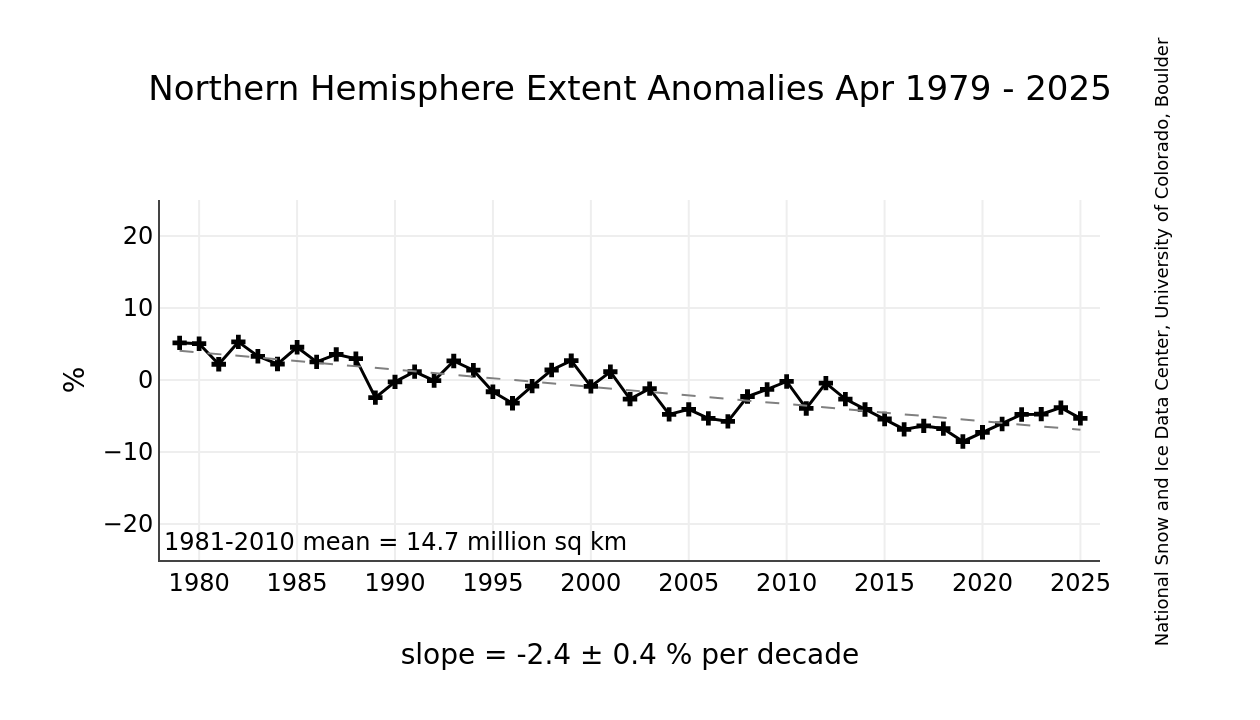
    Further signs of this warming trend can be seen in the Northern Hemisphere Sea Ice Extent from the National Snow and Ice Data Center. Figure 7.4 shows sea ice extent since 1953. For January 1953 through December 1979, data have been obtained from the UK Hadley Centre and are based on operational ice charts and other sources. For January 1979 through July 2009, data are derived from satellite. Figure 7.4a shows the most current sea ice extent from satellite measurements. Sea ice extent has been dramatically reduced since 1953.

    Sea Ice Extent Since 1953
    Figure 7.4: Northern Hemisphere sea ice extent since 1953
    Sea Ice Extent
    Figure 7.4a: Current Northern Hemisphere sea ice extent from satellite measurements

    Sea ice extent is just part of the picture. Sea ice thickness has also been measured by submarine and ICESat satellite measurement.

    Figure 7.5 (Rothrock, et al., 1999) shows sea ice thickness has substantially declined. Using data from submarine cruises, Rothrock and collaborators determined that the mean ice draft at the end of the melt season in the Arctic has decreased by about 1.3 meters between the 1950s and the 1990s.

    Sea Ice Draft
    Figure 7.5: Mean sea ice draft: Decrease in Arctic sea ice draft for 1958 to 1997.

    Since 2004 and there has been a dramatic decrease in thickness according to NASA’s press release, NASA Satellite Reveals Dramatic Arctic Ice Thinning dated July, 2009. Some excerpts:

      Using ICESat measurements, scientists found that overall Arctic sea ice thinned about 0.17 meters (7 inches) a year, for a total of 0.68 meters (2.2 feet) over four winters. The total area covered by the thicker, older “multi-year” ice that has survived one or more summers shrank by 42 percent. In recent years, the amount of ice replaced in the winter has not been sufficient to offset summer ice losses. The result is more open water in summer, which then absorbs more heat, warming the ocean and further melting the ice. Between 2004 and 2008, multi-year ice cover shrank 1.54 million square kilometers (595,000 square miles) — nearly the size of Alaska’s land area. During the study period, the relative contributions of the two ice types to the total volume of the Arctic’s ice cover were reversed. In 2003, 62 percent of the Arctic’s total ice volume was stored in multi-year ice, with 38 percent stored in first-year seasonal ice. By 2008, 68 percent of the total ice volume was first-year ice, with 32 percent multi-year ice.

    Figure 7.5a (NASA, 2009) shows that overall ice thickness and multi-year ice (MY) thickness are decreasing.

    Sea Ice Thickness
    Figure 7.5a: Northern Hemisphere sea ice thickness

    Sea Ice Thickness Composite
    Figure 7.5b: Northern Hemisphere sea ice thickness submarine & ICESAT combined

    Figure 7.5b (Kwock & Rothrock, 2009) shows the mean thicknesses of six Arctic regions for the three periods (1958– 1976, 1993–1997, 2003–2007). Thicknesses have been seasonally adjusted to September 15. According to the authors:

      “The overall mean winter thickness of 3.64 m in 1980 can be compared to a 1.89 m mean during the last winter of the ICESat record—an astonishing decrease of 1.75 m in thickness. Between 1975 and 2000, the steepest rate of decrease is 0.08 m/yr in 1990 compared to a slightly higher winter/summer rate of 0.10/0.20 m/yr in the five-year ICESat record (2003–2008). Prior to 1997, ice extent in the DRA was >90% during the summer minimum. This can be contrasted to the gradual decrease in the early 2000s followed by an abrupt drop to <55% during the record setting minimum in 2007. This combined analysis shows a long-term trend of sea ice thinning over submarine and ICESat records that span five decades.
    2009 Sea Ice Update Peter Sinclair’s Climate Crock of the Week: 2009 Sea Ice Update
    Watch this video to learn about the 2009 Arctic sea ice measurements.
    Ice Caps Peter Sinclair’s Climate Crock of the Week: Ice Area vs. Volume
    Watch this video to learn about the difference between ice area and ice volume and why volume is more critical.

    Velicogna (2009) used measurements from the GRACE (Gravity Recovery and Climate Experiment) satellite gravity mission to determine the ice mass-loss for the Greenland and Antarctic Ice Sheets during the period between April 2002 and February 2009. During this time period the mass loss of the ice sheets were accelerating with time implying that the ice sheets contribution to sea level becomes larger with time. In Greenland (Fig. 7.6), the mass loss increased from 137 Gt/yr in 2002–2003 to 286 Gt/yr in 2007–2009. In Antarctica (Fig. 7.7) the mass loss increased from 104 Gt/yr in 2002–2006 to 246 Gt/yr in 2006–2009.

    Greenland Ice Mass Loss
    Figure 7.6: Greenland Ice Mass Loss

    Antarctic Ice Mass Loss
    Figure 7.7: Antarctic Ice Mass Loss

    John Cook at Skeptical Science has several very good summaries of this research. See: An overview of Antarctic ice trends, An overview of Greenland ice trends, and Why is Greenland’s ice loss accelerating?.

    Glaciers also are used as a signature for climate change. Summer melting, called ablation, controls the mass and extent of glaciers. According to the World Glacier Monitoring Service (2009), preliminary mass balance values for the observation periods 2005/06 and 2006/07 have been reported from more than 100 and 80 glaciers worldwide, respectively. The mass balance data are calculated based on all reported values as well as on the data from the 30 reference glaciers in nine mountain ranges in North America and Europe with continuous observation series back to 1980.

    The average mass balance of the glaciers with available long-term observation series around the world continues to decrease, with tentative figures indicating a further thickness reduction of 1.3 and 0.7 metres water equivalent (m w.e.) during the hydrological years 2006 and 2007, respectively. The new data continues the global trend in accelerated ice loss over the past few decades and brings the cumulative average thickness loss of the reference glaciers since 1980 at almost 11.3 m w.e. (see Figures 7.8 and 7.9).

    Glacial Mass Loss Reference Glaciers
    Figure 7.8: Mean annual specific mass balance of reference glaciers

    Glacial Mass Loss Reported Glaciers
    Figure 7.9: Mean cumulative specific mass balance of all reported glaciers (black line) and the reference glaciers (red line)

    Glacial extent is also being monitored. Figure 7.10 (ibid) shows worldwide glacial extent measurements with red being a decrease and blue being an increase in the length of the glacier.

    Glacial Extent - Click for Larger Image
    Figure 7.10: Glacial extent – retreating (red) and advancing (blue)

    In 2005 there were 442 glaciers examined, 26 advancing, 18 stationary and 398 retreating. 90% of worldwide glaciers are retreating. In 2005, for the first time ever, no observed Swiss glaciers advanced. Of the 26 advancing glaciers, 15 were in New Zealand. Overall there has been a substantial volume loss of 11% of New Zealand glaciers from 1975-2005, but the number of advancing glacier is still significant. (ibid)

    Ocean Heat Content:

    Much of the heat that is delivered by the sun is stored in the Earth’s oceans while only a fraction of this heat is stored in the atmosphere. Therefore, a change in the heat stored in the ocean is a better indicator of climate change than changes in atmospheric heat. Figures 7.11 and 7.12 (Richardson et al., 2009) and 7.13 (NODC, 2009) clearly show that the oceans have warmed significantly in recent years and the trend is 50% greater than that reported by the IPCC in 2007.

    Energy content change of oceans
    Figure 7.11: Change in energy content in different components of the earth system for two periods: 1961-2003 (blue bars) and 1993-2003 (pink bars).

    Ocean Heat Content Trend
    Figure 7.12: Change in ocean heat content since 1951.

    Ocean Heat Content Trend
    Figure 7.13: Change in ocean heat content since 1955.

    There have been a few published articles by Loehle (2009), Pielke (2008), and Willis (2008) that suggest ocean heat content trend since 2003 has either been flat or slightly negative. Of course, a few years does not a trend make but these results appear to be in conflict with the current upward trend. von Shuckmann, Gaillard, and Le Traon (2009) address this apparent conflict in their article Global hydrographic variability patterns during 2003–2008. Their data extends to 2000 m of ocean depth in contrast to Loehle (2009), Pielke (2008), and Willis (2008) data that only extends to 700 m. von Shuckmann, Gaillard, and Le Traon (2009) show that the heat content of the upper 500 m of ocean are subject to strong seasonal and interannual variations primarily due to salinity changes. However, when considering the heat content of the upper 2000 m of ocean, global mean heat content and height changes are clearly associated with a positive trend during the 6 years of measurements. Figure 7.14 below shows this trend.

    Ocean Heat Content Trend Upper 2000 m
    Figure 7.14: Change in global heat content for the uppermost 2000 m of ocean between 2003 and 2008

    Murphy et al. (2009) examined the Earth’s energy balance since 1950 including ocean heat content, radiative forcing by long-lived trace gases, and radiative forcing from volcanic eruptions. They considered the emission of energy by a warming Earth by using correlations between surface temperature and satellite data and show that the heat gained since 1950 is already quite significant. Their findings are illustrated below. (Cook, 2009)

    Total Heat Content since 1950
    Figure 7.15: Total Earth Heat Content from 1950 (ibid)

    The oceans are taking in almost all of the excess heat since the 1970s which underscores the point that ocean heat content is a better indicator of global warming than atmospheric temperatures. Much of this ocean heat will be vented to the atmosphere in the future thus accelerating global warming.

    A superb discussion on this topic can be found at Skeptical Science’s How we know global warming is still happening.

    Precipitation Trends:

    Figure 7.16 (IPCC, 2007) shows the Palmer Drought Severity Index (PDSI). The PDSI is a prominent index of drought. Red and orange areas are drier (-PDSI) than average and blue and green areas are wetter (+PDSI) than average. The smooth black curve shows decadal variations. The PDSI curve reveals widespread increasing African drought, especially in the Sahel. Note also the wetter areas, especially in eastern North and South America and northern Eurasia.

    Palmer Drought Severity Index
    Figure 7.16: Palmer Drought Severity Index (PDSI)

    Zhang et al. (2007), IPCC (2007), and Held and Soden (2006) conclude that global warming due to human activities is increasing the severity of drought in areas that already have drought and causing more rainfall in areas that are already wet.

    Zhang et al. (2007) considered three groups of global climate model simulations and compared those simulations to the observed precipitation between 70o north and 40o south as shown in Figure 7.17 below.

    • ANT denoted simulations included estimates of historical ANThropogenic (human) forcing only which included greenhouse gases and sulfate aerosols.
    • NAT4 denoted simulations included just NATural external forcings only.
    • ALL denoted simulations include BOTH of the above – natural and human forcing.

    Observed Precipitation vs. Simulations
    Figure 7.17: Observed precipitation vs. various simulations

    This clearly shows that the ALL simulations (a and d) do a much better job of matching observed precipitation trends than either ANT (b and e) or NAT (c and f) alone. In fact, the correlations: ALL = 0.83, ANT = 0.69 and NAT4 = 0.02. It is for this reason that Zhang et al. (2007) conclude that changes in precipitation trends cannot be explained by natural forcing only and it certainly parallels what the IPCC WGI and WGII reports suggest.

    Precipitation Trends Accuracy
    Figure 7.18: Changes in observed vs. simulated precipitation anomalies (ibid)

    Figure 7.18 shows that the models do not predict the mid-latitude trends at all. Regional precipitation pattern predictions are NOT a strong suit of the models which modelers have stated. What this image does show however, is that areas of green and yellow show where the model trends match those of the observed trends and the models do a decent job of forecasting the correct trends in most regions.

    U.S. Climate Extremes Index (CEI):

    The U.S. CEI is the arithmetic average of the following five or six# indicators of the percentage of the conterminous U.S. area:

    1. The sum of (a) percentage of the United States with maximum temperatures much below normal and (b) percentage of the United States with maximum temperatures much above normal.
    2. The sum of (a) percentage of the United States with minimum temperatures much below normal and (b) percentage of the United States with minimum temperatures much above normal.
    3. The sum of (a) percentage of the United States in severe drought (equivalent to the lowest tenth percentile) based on the PDSI and (b) percentage of the United States with severe moisture surplus (equivalent to the highest tenth percentile) based on the PDSI.
    4. Twice the value of the percentage of the United States with a much greater than normal proportion of precipitation derived from extreme (equivalent to the highest tenth percentile) 1-day precipitation events.
    5. The sum of (a) percentage of the United States with a much greater than normal number of days with precipitation and (b) percentage of the United States with a much greater than normal number of days without precipitation.
    6. * The sum of squares of U.S. landfalling tropical storm and hurricane wind velocities scaled to the mean of the first five indicators.
      # The sixth indicator is experimental and is included in the experimental version of the CEI.
      * The sixth indicator is only utilized when the period of interest includes months with significant tropical activity. For practical purposes, the CEI does not include the sixth indicator for the cold season (Oct-Mar), winter (Dec-Feb) or spring (Mar-May). It also cannot be calculated independent of the first five indicators.
      (Gleason, 2009)

    Figure 7.19 (ibid) shows that in the United States, extremes in climate are on the increase since 1970.

    Unites States Climate Extremes Index
    Figure 7.19: United States Climate Extremes Index

    Are These Trends Unusual?:

    They are unprecedented in the modern record!

    • The concentration of CO2 has reached a record high relative to the past 15 million years and has done so at an exceptionally fast rate.
    • Most of the warming in the past 50 years is attributable to human activities.
    • CO2 concentrations are known accurately for the past 650,000 years. During that time, they varied between 180 ppm and 300 ppm. As of March 2009 CO2 is 385 ppm which took about 100 years to increase. For comparison, it took over 5,000 years for an 80 ppm rise after the last ice age.
    • Higher values than today have only occurred over many millions of years.
    • The last time CO2 levels were this high, sea level was 25 to 40 meters higher than present day.
    • Although large climate changes have occurred in the past, there is no evidence that they took place at a faster rate than the present warming.
    • If projections of a 5 oC warming in this century are realized, Earth will have experienced the same amount of global warming as it did at the end of the last glacial maximum.
    • There is no evidence that this rate is matched to a comparable global temperature increase over the last 50 million years!

    Sea-Level Rise:

    Sea-level rise due to global warming is a serious threat, especially to coastal communities in developing countries. Sea level gradually rose in the 20th century and is currently rising at an increased rate, after a period of little change between AD 0 and AD 1900. Sea level is predicted to rise at an even greater rate in this century, with 20th century estimates of 1.7 mm per year (IPCC, 2007). When climate warms, ice on land melts and flows back into the oceans raising sea levels. Also, when the oceans warm, the water expands (thermal expansion) which raises sea levels. Figure 7.20 (IPCC, 2007) shows the projected sea-level rise through AD 2100.

    Sea Level Rise
    Figure 7.20: Projected sea-level rise through AD 2100

    Figure 7.21 (Richardson et al., 2009) shows that IPCC 1990 projected sea level increases were too conservative. The latest observations show that sea levels have risen faster than previous projections.

    Sea Level Rise Newest Projection
    Figure 7.21: Observed sea-level rise between 1970 and 2008 compared to IPCC projections

    Figure 7.21a (Colorado Center for Astrodynamics Research) shows the current sea level change data using seasonally adjusted values from TOPEX and Jason.

    Sea  Level Rise
    Figure 7.21a: Current measured sea level change

    Mazria & Kirshner (2005) in Nation Under Siege: Sea Level Rise at Our Doorstep, a coastal impact study, show that beginning with just one meter of sea level rise, US cities would be physically under siege, with calamitous and destabilizing consequences. One can view the impact of sea level rise of various US cities at their interactive Website.

    Lemonick (2010) writes in the article The Secret of Sea Level Rise: It Will Vary Greatly by Region:

      As the world warms, sea levels could easily rise three to six feet this century. But increases will vary widely by region, with prevailing winds, powerful ocean currents, and even the gravitational pull of the polar ice sheets determining whether some coastal areas will be inundated while others stay dry.

    Climate Change and Hurricanes:

    A recent paper published by some of the top hurricane researchers in the field (Knutson, et al. 2010) concludes:

    …future projections based on theory and high-resolution dynamical models consistently indicate that greenhouse warming will cause the globally averaged intensity of tropical cyclones to shift towards stronger storms, with intensity increases of 2–11% by 2100. Existing modelling studies also consistently project decreases in the globally averaged frequency of tropical cyclones, by 6–34%. Balanced against this, higher resolution modelling studies typically project substantial increases in the frequency of the most intense cyclones, and increases of the order of 20% in the precipitation rate within 100 km of the storm centre.

    According to a review of the most recent literature, Vechi, Swanson, and Soden (2008) conclude that predicting the future of hurricane activity is at a crossroads. Vechi et al. compared the observed relation of the power dissipation index (PDI) vs. sea-surface temperatures (SST) in the main development region of Atlantic hurricanes. (PDI is the cube of the instantaneous tropical cyclone wind speed integrated over the life of all storms in a given season; more intense and frequent basinwide hurricane activity lead to higher PDI values.) There are two very different futures depending on whether absolute SST or relative SST controls PDI.

    Figure 7.22 (ibid) shows PDI anomalies based on absolute SST.

    PDI anomolies based on absolute SST
    Figure 7.22: PDI anomalies based on absolute SST

    By 2100, the lower end of the model projections shows a PDI comparable to that of 2005, when four major hurricanes (sustained winds of over 100 knots) struck the continental United States, causing more than $100 billion in damage. The upper end of the projections exceeds 2005 levels by more than a factor of two. Combined with rising sea levels, coastal communities face a bleak future if absolute SST determines hurricane activity and strength.

    Figure 7.23 (ibid) shows PDI anomalies based on “relative SST” which is the SST in the tropical Atlantic main development region relative to the tropical mean SST.

    PDI anomolies based on relative SST
    Figure 7.23: PDI anomalies based on relative SST

    A future where relative SST controls Atlantic hurricane activity is a future similar to the recent past, with periods of higher and lower hurricane activity relative to present-day conditions due to natural climate variability, but with little long-term trend. Even in this scenario, rising sea levels will still allow hurricanes to do more damage in the future than in present day.

    Because the correlation of PDI vs. absolute SST and PDI vs. relative SST are equivalent, Vechi et al. conclude that more research is needed in this area.

    IGBP Climate-Change Index:

    IGBP Climate Change Index
    Figure 7.24: IGBP Climate-Change Index (Click for larger image)

    The IGBP Climate-Change Index brings together key indicators of global change: atmospheric carbon dioxide, temperature, sea level and sea ice. It will be released annually. The index gives an annual snapshot of how the planet’s complex systems – the ice, the oceans, the land surface and the atmosphere – are responding to the changing climate. The index rises steadily from 1980 – the earliest date the index has been calculated. The change is unequivocal, it is global, and it is in one direction – up!

    Each parameter is normalized between -100 and +100. Zero is no annual change. One hundred is the maximum-recorded annual change since 1980. The normalised parameters are averaged. This gives the index for the year. The value for each year is added to that of the previous year to show the cumulative effect of annual change. (IGBP Climate-Change Index, 2010)

    With all of this evidence for global warming, it is quite difficult to understand why some people still claim that there is no global warming, or more absurdly, that the climate is currently cooling.

    For complete source information please see Works Cited.

    Mandia offers more climate change information at the links below:
    Global Warming: Man or Myth?
    Global Warming Blog
    “Global Warming Fact of the Day” Facebook Group

  • Is McConnell right about TBTF?

    Senate Republican leader Mitch McConnell charges that the Dodd financial reform bill supported by the WH fails to end Too Big To Fail. Is he correct. Well, this bit from Reuters highlights one problem area:

    Seeking a middle ground between bailout and bankruptcy, the Senate bill sets up a new process for “orderly liquidation” of large firms that get into trouble. Authorities could seize distressed firms and dismantle them. The Senate bill creates a $50 billion fund to finance such actions. Large firms with assets above $50 billion would pay into the fund. Republicans object to a part of the bill that would let the fund borrow additional money from the Treasury — that means taxpayers — if the liquidation fund runs short. This provision smells like “backdoor bailouts,” say Republicans. … The House bill, like the Senate’s, sets up a new liquidation process, but it would be simpler to invoke and and it would come with a higher price-tag. The House proposes a $200-billion fund. Firms with assets over $50 billion would pay up to $150 billion into the fund, which could borrow another $50 billion from the Treasury.

    Me: Then there is the issue of confidence in regulators and politicians to resist the temptation to bail/rescue in a crisis.

  • Novo Renault Logan

    Novo Renault Logan
    As mudanças no Novo Logan deixaram o sedã muito mais moderno, as linhas originais predominantemente angulares deram lugar a formas mais suaves e arredondadas, numa nítida evolução estética. O modelo ganhou 3,9 centímetros de comprimento, por conta dos novos pára-choques e agora mede 4,29 metros. No interior, um visível salto de qualidade, com melhorias de acabamento e adoção de novos materiais.

    Pára-choques, grade frontal, faróis, lanternas traseira, tampa do porta-malas e interior foram totalmente modificados. O Novo Logan, no entanto, manteve as linhas limpas. Não há excessos nem detalhes desnecessários em sua carroceria. O conjunto continua sugerindo robustez, que é uma das características marcantes do modelo.

    Mais harmonia nas linhas externas

    A dianteira do Novo Logan foi totalmente reformulada com a adoção de ampla grade frontal formada por filetes horizontais na cor cinza. Sobre a grade, chama a atenção um friso cromado, presente em todas as versões do modelo. Os faróis, de forma trapezoidal, ficaram maiores, englobando no mesmo conjunto óptico as luzes indicativas de direção. Na versão Expression, os faróis de neblina trazem moldura com acabamento preto.

    A traseira, por sua vez, ganhou nova tampa do porta-malas, com spoiler integrado. O pára-choque, que aloja a placa, foi redesenhado, assim como as lanternas, de formato predominantemente vertical. A versão Expression ainda apresenta um elegante friso cromado na extremidade da tampa do porta-malas como diferencial.

    Lateralmente, o Novo Logan mantém o visual imponente. A versão Expression agregou novos elementos visuais que remetem à sofisticação, como frisos laterais e maçanetas na cor da carroceria, assim como os retrovisores, quando estes forem elétricos. A chamada “coluna B” (entre as portas dianteiras e traseiras) tem acabamento adesivo em preto fosco. As portas preservam grande ângulo de abertura para facilitar o acesso e a saída dos passageiros.

    Sete opções de cores estarão disponíveis para o Novo Logan, das quais duas sólidas (Vermelho Vivo e Branco Glacier) e cinco metálicas (Preto Nacré, Cinza Acier, Bege Angorá, Azul Crepúsculo e Prata Etoile).

    Fonte: Renault

    Novo Renault LoganNovo Renault LoganNovo Renault LoganNovo Renault LoganNovo Renault LoganNovo Renault Logan


  • Michelin Challenge Bibendum: um salão para testar os veículos do futuro

    Michelin Challenge Bibendum
    Já pensou poder experimentar os veículos do futuro? Aproximadamente 4 mil pessoas terão essa oportunidade na próxima edição do Michelin Challenge Bibendum, que acontecerá no Rio de Janeiro, de 30 de maio a 2 de junho.

    Diferente de todos os Salões de Automóvel do mundo, nos quais o público apenas observa os veículos expostos, no maior evento mundial de sustentabilidade da indústria automobilística, os convidados poderão conhecer, debater e, principalmente, testar os protótipos automotivos criados para agredir menos o meio ambiente. Além do test-drive, todos os automóveis, com suas diferentes tecnologias voltadas para a mobilidade sustentável, participarão de um rali de regularidade para comprovar suas performances.

    Outra grande novidade da 10ª edição do Challenge Bibendum será a apresentação, pela primeira vez no Brasil, das maiores e ecologicamente corretas inovações do setor automotivo. O evento trará tecnologias para veículos que vão desde a bicicleta até caminhões e tratores, entre as quais soluções elétricas, híbridas, movidas a etanol, diesel e energia solar.

    O Challenge Bibendum é um evento mundial organizado pela Michelin, desde 1998, para que os atores do mundo dos transportes possam se encontrar e discutir sobre os desafios enfrentados na mobilidade urbana rodoviária. Debater sobre este tema significa conhecer as diferentes soluções apresentadas pelos técnicos e estudar a particularidade de cada região, para assim adaptar as melhores formas de tornar as cidades mais fluidas e limpas.

    A Michelin no Challenge Bibendum

    Diante da crescente taxa de urbanização, gerada pelo crescimento populacional, a expectativa é que a frota mundial dobre até 2030, segundo o World Business Council for Sustainable Development (WBCSD). Dessa forma, a Michelin se compromete a reduzir em 50% a resistência à rodagem dos pneus. Em 2030, quando a frota mundial dobrar, os pneus Michelin terão seu impacto no meio ambiente reduzido pela metade.

    Fonte: Printerpress

    Michelin Challenge Bibendum


  • Victoria Beckham Hiring Personal Assistant

    In the market for a new gig? Victoria Beckham is looking for a new personal assistant! How are you at fethcing dry cleaning and making coffee?

    Spywitnesses say the 35-year-old former Spice Girl is frantic after she lost the services of her treasured assistant late last year. Victoria, a mother of three, has been forced to manage her own life — The horror! — ever since her last helper returned to the UK several months ago. VB is now looking for a reliable replacement.

    “It’s the best job in the world – glamorous, exciting and varied but pretty full-on,” a source reveals to Britain’s The Mirror.

  • Zimbabwe government voids law restricting foreign ownership of companies

    [JURIST] Zimbabwe’s government on Wednesday declared void a law mandating that indigenous people have majority ownership in all businesses valued at over $500,000. The law took effect last month, but the country’s stock market has since fallen 10 percent, causing concern that the law would drive away potential investors. The majority of firms within Zimbabwe that meet the $500,000 threshold are banks and mining companies, and shares in mining companies have fallen 20 percent since the law’s enactment. The decrease in stock value is another obstacle for a country in dire economic straits, including an inflation rate that has been as high as 231,000,000 percent. A spokesperson for Prime Minister Morgan Tsvangirai indicated that the law, while void, will be reexamined as the government looks for the best way forward.
    Critics of the law have compared it to the land reform program passed under the Robert Mugabe administration in 2000, which resulted in the government seizure of farm land from white farmers. In March, white farmers displaced by Zimbabwe’s land reform program announced an intention to seize Zimbabwean government property in South Africa pursuant to the judgment of the Southern African Development Community Tribunal (SADC Tribunal). In January, the Zimbabwe High Court ruled that it is not bound by a decision of the SADC Tribunal that ordered the state to halt the land reform program for its discriminatory nature. Mugabe has faced harsh criticism for the program, which has sought to redistribute white-owned land among the nation’s indigenous farmers. In February 2006, the Zimbabwean land minister said that there are no white farmers operating legally in Zimbabwe. The government has appropriated some 4,000 farms through the program.

  • The ‘Boston’ on its way to Orange

    "boston"

    Well, what have we here? The device pictured above is what appears to be called The "Boston" and has it’s eyes set to Orange for the carrier. What started as a rumor was followed up with some rather official looking pictures, and some basic specs about the device as well. It appears as though this device will have a 320×480 screen that will be displaying Android 1.6 (*sigh*), along with a 5MP camera, and 256MB of RAM in the device. While yes this device appears to be on the lower end of the Android spectrum, what can you really expect from a device that is said to release with the price of just 1 Euro. [via Phandroid]

  • Mexico, Haiti trip defining Michelle Obama international image

    MEXICO CITY–First Lady Michelle Obama may well fill in some blanks to her image on her solo diplomatic swing to Haiti and Mexico. Her agenda here is designed to avoid the controversial aspects of the U.S.-Mexico relationship. My report on how this trip will help define her international image–beyond someone who loves clothes–is here.

  • Japanese industry blames conservation group for small catch

    Greenwire: Japan’s whaling industry is pointing to harassment by the anti-whaling marine conservation group Sea Shepherd as the reason for its small catch this year.

    The whaling fleet’s leading ship, the Nisshin Maru, returned to Tokyo harbor yesterday from its five-month hunt in the Southern Ocean with 507 whales — a little over half its target catch of 935, according to the fisheries agency.

    That haul represented a drop of 173 whales since last year’s five-month season. Whaling leader Shigetoshi Nishiwaki said he was “furious” with Sea Shepherd for preventing the fleet from reaching its target catch.

    The whalers said Sea Shepherd’s annual efforts to stop the hunt had sabotaged them, causing them to lose 31 days of the season.

    The whalers and the conservation group engage in a marine-based confrontation each year over the whalers’ operations. This year the whale wars led to the use of a water cannon and a sonic crowd control device to keep the anti-whalers at bay, while Sea Shepherd members responded by throwing rancid-butter bombs. The fight climaxed with the sinking of Sea Shephard’s high-tech powerboat after a collision with the Shonan Maru 2 harpoon boat.

    The controversial whale slaughters are allowed under a provision for “scientific research,” according to a clause in the International Whaling Commission’s 1986 moratorium on commercial whaling (Justin McCurry, London Guardian, April 13). – DFM

  • Debt bomb

    CALL me a fiscal conservative, but mounting federal and state debt scares the heck out of me. At the Kauffman economics bloggers forum, many participants claimed that they expect a sovereign debt crisis in America in the next few decades. Many states’ finances are even more dire than the federal government’s, but at least states and municipalities can default without triggering a sovereign debt crisis. It is credible that the federal government will not bail-out individual states. But the residents of many states probably face obscenely high taxes in the future. This expectation can undermine future growth because businesses and high earners can easily relocate to lower tax states.

    This is precisely why we should be very worried about the financial condition of state pension plans. Their projected short-falls don’t tell half the story. Unlike corporate pension plans, states can use their projected asset returns to discount their liabilities. A higher expected return yields a higher discount rate. This means a smaller projected liability. The average disocunt rate states use is about 8%. This is absurd. Liabilities should be discounted at the rate which reflects their chance of default. Pension benefits are guaranteed by the constitution in many states. This means even as states declare bankruptcy, and default on their municipal debt, tax payers must still meet pension obligations. This suggests the risk-free rate is the appropriate discount rate. When this rate is used, un-funded pension liabilities total more than three times the size of all outstanding municipal debt! Yet Felix Salmon is not so worried.

    The fact is that a defined-benefit pension scheme is always going to run the risk that it won’t be able to meet its liabilities as they come due. The California pension plans constitute an attempt to save hundreds of billions of dollars to pay for the pensions of the state’s workers; the attempt might succeed, or it might not.

    But right now there are clearly more important and urgent things to do with California’s tax revenues than throw them into a pension pot to support the retirees of the 2040s and beyond. CalPERS might not be perfect, but it’s a lot less dysfunctional than most of the rest of the state government. Let’s get our priorities straight here.

    Whether or not pension obligations (hopefully discounted properly) should be included in a nation’s or state’s outstanding debt is point of contention among pension policy wonks. But if pension obligations are guaranteed by the constitution, I think they should be included. When you add these obligations in, several states appear doomed.

    Though I agree with Mr Salmon that significantly upping contributions to the pension plan probably should not be California’s highest near-term priority. But that should not distract from how perilous the current situation is. What needs to be done now is to get tough with the state unions, stop incurring any new liabilities, and move to private accounts like Alaska has done. There’s not much that can be done about outstanding liabilities, and cuts to discretionary spending will probably impede recovery. But continuing to make such lavish promises (retiring at age 55 with almost full salary for life) at the expense of future tax-payers is shameful.

  • Michelle Obama on Haiti: “the attention of the world starts to wane a bit.”

    MEXICO CITY — Aiming to keep a spotlight on the plight of earthquake-ravaged Haiti, first lady Michelle Obama and second lady Jill Biden made a surprise visit to Port-au-Prince on Tuesday before landing in Mexico’s capital and motorcading downtown.

    “I think it was important for Jill and I to come now because we’re at the point where the relief efforts are under way, but the attention of the world starts to wane a bit,” Mrs. Obama said before she left Haiti. “And as we enter the rainy season and the hurricane season, you know, the issues are just going to become more compounded. And I think it was important for us to come and shed a light.”

    Mrs. Obama and Mrs. Biden spent just over five hours in Haiti, taking a helicopter tour of the flattened city, where hundreds of thousands are still homeless. The two women also met with Haiti President Rene Preval, and his wife, Elisabeth; toured a high school destroyed by the Jan. 12 earthquake and stopped at a children’s camp and talked to U.N. employees.

    Mrs. Obama offered her first impression of the ruins as she was speaking with Mrs. Preval. “It’s powerful. The devastation is definitely powerful,” she said.

    Mrs. Obama’s plane landed at the Benito Juarez Airport in Mexico City just after sunset in a visit designed to underscore the close relationship between the two nations. Mrs. Obama’s airport greeters included about 50 young Mexican girls, members of “Las Guias,” sort of like the Girl Scouts, and 37 boys and girls were Red Cross volunteers. Mrs. Obama was wearing a sleeveless blue dress and flowing print skirt.

    The Haiti trip was planned for weeks, but kept secret by the East Wing until Tuesday.

    Even knowing this, the East Wing billed Mrs. Obama’s Mexico visit, to run through Thursday morning, as her first solo official foreign trip.

  • Jaime Alguersuari nos desvela los secretos del GP de China 2010

    El piloto español Jaime Alguersuari nos desvela una vez más, los secretos del próximo Gran Premio de la Fórmula 1, esta vez, en el GP de China. Alguersuari nos narrará las mejores zonas de adelantamientos y otros datos como la velocidad máxima que se puede alcanzar en el circuito de Shangai.

    Todo esto gracias al simulador de Red Bull usado por su escudería Toro Rosso. Por otra parte, también cabe recordar que este circuito ha sido desarrollado por Hermann Tilke. También debemos mencionar que esta será la primera vez que el piloto español corra en este trazado por lo que promete ser una carrera muy interesante.

    A continuación os dejo con el vídeo:

    Related posts:

    1. GP de Malasia 2010, Jaime Alguersuari nos desvela los secretos del circuito de Sepang
    2. Jaime Alguersuari firma con Toro Rosso para 2010
    3. Jaime Alguersuari ha cumplido con los objetivos
  • John Krasinski Emily Blunt Wedding Next Month

    John Krasinski and Emily Blunt will wed in a private ceremony in London or Los Angeles next month, according to new reports.

    The Devil Wears Prada actress and The Office’s jovial new dad Jim are busy putting the finishing touches on their May nups, celebrity insiders revealed in a scoop to E! Online this week.

    “They’ll get married in about a month. She is planning the wedding right now and is down to the last-minute details. They picked up their wedding bands yesterday. It will be a big wedding. probably in London or Los Angeles.”

    The British-born Emily is still searching for her wedding dress and has tried on several designer gowns as she inches toward her big day.

    “She looked at Monique Lhuillier and Vera Wang. She is definitely considering Monique Lhuillier.”

    The pair, who began dating in November 2008, announced their engagement in August.

  • Scientists as “spiritual atheists” | Gene Expression

    Are Top Scientists Really So Atheistic? Look at the Data asks Chris Mooney. He’s referring to a new book, Science vs Religion: What Scientists Really Think by Elaine Howard Ecklund. Here’s the Amazon description:

    … In Science vs Religion, Elaine Howard Ecklund investigates this unexamined assumption in the first systematic study of what scientists actually think and feel about religion. Ecklund surveyed nearly 1700 scientists, interviewed 275 of them, and centers the book around vivid portraits of 10 representative men and women working in the physical and social sciences at top American research universities. She finds that most of what we believe about the faith lives of elite scientists is wrong. Nearly 50 percent of them are religious. Many others are what she calls “spiritual entrepreneurs,” seeking creative ways to work with the tensions between science and faith outside the constraints of traditional religion. Her respondents run the gamut from Margaret, a chemist who teaches a Sunday-school class, to Arik, a physicist who chose not to believe in God well before he decided to become a scientist. Only a small minority are actively hostile to religion….

    Some of Chris’ readers are rather agitated about this all, and he suggests that perhaps they should read the book to answer their questions. I haven’t read the book, but you can read much of it on Google Books or Amazon’s text search feature. Skimming a bit I encountered the term “spiritual atheist,” which many might find an oxymoron. Rather than present her interpretation, let me post some of the tables which have data in them.

    eklund1eklund2eklund3eklund4

    In reply to Chris’ question posed, my own interpretation is that yes, scientists are that atheistic! The reference point is the general population. In fact, 72% of scientists hold to a non-theistic position. On the other hand, most are not militant atheists in the mould of Richard Dawkins or Peter Atkins. Interestingly, if you assume that all of those with no religion are in the non-theist category (I think this is unlikely, but probably sufficient as a first approximation) then 40% of those who claim a religious affiliation among these scientists are non-theists. Also, I believe that Sam Harris, with his interest in meditation and Eastern mysticism more generally, would probably class as a spiritual atheist, so the categories New Atheist and spiritual atheist are not necessarily exclusive.

    I find table 3.1 intriguing. I suspect here scientists and the general public may be speaking somewhat about different truths, or more specifically, scientists are thinking of a narrower subset. For the general public religious truths are both descriptive and prescriptive. That is, they describe the world’s past, and its present, as a factual matter, and, they prescribe a set of actions and norms. I think most scientists are thinking in prescriptive terms here, not descriptive. In other words, the religions of the world have integrated within their belief systems basic core human morality and ethics. Fundamental moral truths. I would myself agree that there are basic truths in many religions.

    Note: I’ve seen most of this data in Ecklund’s papers, so I’m not spilling treasured secrets by presenting the tables.

    All tables from Science vs Religion: What Scientists Really Think

  • What’s in a Name? Announcing the Next Xconomy Forum: Healthcare in Transition

    Healthcare In Transition logo
    Ryan McBride wrote:

    When we came up with “Healthcare In Transition” as the title of our next Xconomy Forum, we were thinking of a way to crystallize in a few words the changes and progress being made in the digitization of healthcare for the benefit of humanity. (There were similar discussions here prior to the launch of our Health IT news channel.)

    Before coming up with the right name, we had recruited several of the country’s top healthcare entrepreneurs and practitioners to share their stories at the forum, including Paul Bleicher, Daniel Palestrant, and Roy Schoenberg. And Frank Moss, the director of the MIT Media Lab, had already stepped up to host the forum at his renowned research center on April 26 and speak to everyone in attendance about his efforts to develop technologies that empower patients.

    Still, we soon encountered the difficulty in putting into a few words what all these pioneers in their respective fields are doing. One could say that Schoenberg’s American Well, of Boston, is revolutionizing the way we think about how patients visit with doctors. The same could be said about how Palestrant and his team at Cambridge, MA-based Sermo are impacting the way physicians interact with each other and share their insights from the front lines of medicine. There are more than a dozen other speakers like them, each looking at healthcare from different angles.

    In large part due to the efforts of our speakers and their colleagues, it soon became clear at least to me that our conventional ideas or definitions of healthcare are in flux or transition. Our children may grow up picturing their doctor looking down on her iPhone to view medical information, the same way earlier generations might think about family physicians poring over paper records from overstuffed file folders. (And if American Well has its way, kids will think of their physicians as the people with whom they interact over the Internet when they get sick.) We also wanted to account for advances like we’re seeing at other of our speakers’ companies, such as Keas, SmartBeat, and Vitality, that are advancing technology-enabled products and services to promote wellness and keeping people healthier without having to be admitted to a hospital—or even visit their doctor. (Here’s a full list of our speakers on tap for the forum.)

    We’re expecting the talks and discussions among our presenters to provide our attendees with a clearer vision of the evolving healthcare landscape, far above and beyond what we’re seeing with the adoption of electronic health records. There are opportunities for all of us in this future, whether you’re an investor, entrepreneur, inventor, or a patient (we’re all patients, of course). We’re really happy to be able to help bring these efforts to the fore, and we’re hoping to see you on April 26th at the MIT Media Lab.

    UNDERWRITERS AND PARTNERS


  • Virginia Journal of International Law, Vol. 50-3: Online Symposium

    by The Editors of the Virginia Journal of International Law

    The Virginia Journal of International Law is delighted to continue its partnership with Opinio Juris this week in this online symposium featuring three Articles recently published by VJIL in Vol. 50:3, available here.

    Today, Christopher M. Bruner, Associate Professor, Washington and Lee University School of Law, will discuss his Article Power and Purpose in the “Anglo-American” Corporation. In his Article, Professor Bruner addresses the striking divergence between U.S. and U.K. corporate governance systems. Contrary to prevailing perceptions, Professor Bruner explains, shareholders in the United Kingdom are, in fact, far more powerful, and far more central to the aims of the public corporation, than are shareholders in the United States. Through an examination of political, social, and cultural forces at work in each country during critical historical periods in the development of their corporate governance systems, Professor Bruner argues that stronger stakeholder-oriented social welfare policies and legal structures have permitted the U.K. corporate governance system to focus more intently on shareholders without giving rise to political backlash—and, conversely, that weaker stakeholder-oriented social welfare policies and legal structures have inhibited the U.S. corporate governance system from doing the same. A particularly striking example Professor Bruner offers is the impact of employee health care on takeover regulation in the United States relative to the United Kingdom. Professor Bruner then concludes that the novel political theory he outlines in his Article holds important implications for comparative corporate governance, as well as for ongoing domestic policy debates regarding the future of corporate governance in the United States. More broadly, Professor Bruner argues that his analysis exposes substantial shortcomings in comparative theories predicting or advocating convergence on a shareholder-centric model, to the degree that they fail to address the political, social, and cultural factors conditioning the degree of shareholder-centrism in U.S. and U.K. corporate governance.

    Professor Brian Cheffins of the University of Cambridge Faculty of Law will serve as respondent.

    On Thursday, John F. Coyle, Climenko Fellow and Lecturer on Law, Harvard Law School, will discuss his Article Incorporative Statutes and the Borrowed Treaty Rule. In his Article, Professor Coyle examines how courts should interpret statutes that, by their terms, incorporate international law into the domestic law of the United States. Looking to a number of legal sources—including the structure of “incorporative” statutes, common law canons of construction, separation of powers principles, among others—Professor Coyle develops an interpretive framework for reading such statutes—termed the “borrowed treaty rule.” Under his proposed framework, courts should presume that a statute that incorporates language or concepts from a treaty should be read to conform to the treaty, regardless of whether the statute is ambiguous. This presumption, Professor Coyle argues, may be rebutted only by compelling evidence that Congress intended a different result. Professor Coyle then goes on to distinguish the borrowed treaty rule from the Charming Betsy canon of interpretation, which provides that courts should, whenever possible, construe ambiguous domestic statutes so as not to violate international law. Although a number of legal scholars have argued that U.S. courts should, per the Charming Betsy canon, construe all ambiguous statutes (not just those that are incorporative) to conform to international law, Professor Coyle argues that such an approach is misguided, because none of the rationales underlying the borrowed treaty rule provide support for using that same approach to interpret statutes that are not incorporative. It is necessary, therefore, Professor Coyle explains, to distinguish between the borrowed treaty rule, which should be used to construe incorporative statutes, and the Charming Betsy canon, which should be used to construe ambiguous statutes that are not incorporative. The former type should be read to conform to international law, whereas the latter need only be read so as not to conflict with it.

    Professor Ingrid Wuerth of Vanderbilt University Law School will serve as respondent.

    On Friday, Professor Robert C. Bird, Assistant Professor and Ackerman Scholar, University of Connecticut School of Business, and Professor Peggy E. Chaudhry, Associate Professor, Villanova University School of Business, will discuss their Article Pharmaceuticals and the European Union: Managing Gray Markets in an Uncertain Legal Environment. In their Article, Professors Bird and Chaudhry explore one of the most opaque and contradictory areas of law in the European Union (EU)—the regulation of parallel trade, and particularly, the ongoing legal battle over gray market sales of drugs, in the EU. Professors Bird and Chaudhry begin by unraveling the precedent that should guide European national courts in how they treat product repackaging by parallel importers. They attempt to clarify the law both through a disambiguation of the relevant cases and a series of exhibits designed to provide clear guidance on both the rules and exceptions. In doing so, Professors Bird and Chaudhry show that the European Court of Justice (ECJ) cases must be better understood, because they influence not only future ECJ precedent but also the precedent of every national court system in the EU. Professors Bird and Chaudhry move, then, to the task of presenting strategies for both parallel importers and drug manufacturers to best navigate the legal environment and protect their respective interests. These strategies, they argue, will enable importer and manufacturer alike to make more efficient decisions based upon a clearer understanding of the law. Further, greater clarity, they argue, should decrease conflict and litigation and may also encourage smaller firms to enter the market, thus increasing competition and reducing the likelihood of cartel-like behavior. Furthermore, less litigation and more competition, they note, ultimately results in more favorable prices paid by the consumer.

    Professor David Orozco of Michigan Technological University will serve as respondent.

    We encourage you to join in the discussion online this week. When the symposium concludes, we hope that you will keep in contact with us through our website to continue the conversation.