Blog

  • Proof I’m A Two Fisted Drinker

     Santanbrewing_beerandwater

    Just so ya’ll know that Miss Twitter Hydration Nudge here actually does practice what she preaches, here’s what I typically get with a cocktail or beer…a tall glass of water.

    So indeed, I am a two fisted drinker…beer in one hand and water in the other. It’s good to drink water when you’re cocktailing because the water will keep you hydrated and thus help to lower the chances of getting a hangover…that and not overdoing with the booze, moderation people. One major cause of a hangover is dehydration, so water up when you’re happy houring!

    The beer in the picture is the signature Devil’s Ale at San Tan Brewing in Chandler, AZ. If you want to see what we all at that day, here are the tasty pictures over at Noshtopia Phoenix. You can see what I ate on one of my guilt-free days 🙂


  • Palm Axes Ad Agency

    palm commercialFrom the better late than never department comes word that Palm has dumped its ad agency Modernista. The news comes from a article out now at AdAge.

    Modernista was partially responsible for the universally derided series of creepy ads the debuted around the Palm Pre launch and continued to run after an enormous amount of mostly negative backlash. An interesting comment in the adage article from an apparent insider sheds some light on the possible reasons why the spots weren’t pulled earlier.


  • Cricket picking up Kyocera Zio M6000

    Kyocera Zio M600 courtesy Phone Arena

    Welcome to the party, Cricket Wireless.  Phone Arena got their hands on a presentation brochure showcasing Cricket’s upcoming line-up for 2010, and it looks like it will be a good year for subscribers.  Along with some other interesting phones, the hot item looks to be the Kyocera Zio M6000.  We had some hands on time with the Zio at CTIA, and while it’s not a powerhouse, it appears to be a solid little device.  Unfortunately, the price ($299.99) is a bit higher than everyone thought, but still not too bad for an off-contract Android phone.  Look for the Kyocera Zio M6000 on Cricket some time in July. [Phone Arena]

  • Mischa Barton: “Don’t Hate On My Yellow Banana Pants!”


    Spotted@

    Mischa Barton is defending her right to channel her inner banana.

    Just a day after photos surfaced of the actress rocking a pair of high-waisted yellow jeans — that could you might find fashionable if it were 1989 — the actress defiantly stood by her questionable style choice. “That was my Easter outfit,” she told curtly as she manuevered her way out of a parking lot in Los Angeles Monday. “You guys shouldn’t be photographing me if you don’t like what I wear! Don’t hate on my yellow banana pants!” Mischa hollered before speeding off.


  • Who are the founders of PON?

    The Program on Negotiation (PON) is the world’s first teaching and research center dedicated to negotiation, and its founders are among the true pioneers in the field. On April 8, 2003, seven of these founders gathered to reflect on PON’s beginnings in the early 1980s, and on their own journeys as leaders in the field that they helped to create. This 30-minute video is an edited version of their two-hour discussion.

    Looking back twenty years were:

    Roger D. Fisher, Williston Professor of Law Emeritus at Harvard Law School, Director of the Harvard Negotiation Project, and the first Chair of PON’s Steering Committee;

    Bruce M. Patton, Deputy Director of the Harvard Negotiation Project and a founding partner of Vantage Partners LLC;

    Howard Raiffa, Frank P. Ramsey Professor Emeritus of Managerial Economics at Harvard Business School and the Kennedy School of Government, and Director Emeritus of the Negotiation Roundtable;

    Frank E. A. Sander, Bussey Professor of Law at Harvard Law School and co-Director of the Dispute Resolution Program;

    James K. Sebenius, Gordon Donaldson Professor of Business Administration at Havard Business School and Director of the Negotiation Roundtable;

    Lawrence E. Susskind, Ford Professor of Urban and Environmental Planning at MIT, founder and President of the Consensus Building Institute, and Director of the MIT-Harvard Public Disputes Program; and

    William L. Ury, independent consultant and Director of the Global Negotiation Project.

    To purchase a video of a conversation with the PON founders, click here.

  • Hey, Apple, Microsoft, mobile multitasking is a necessity

    By Joe Wilcox, Betanews

    Apple’s “Get a sneak peak into the future of iPhone OS” event, in two days, is reason enough to re-raise the thorny topic of multitasking on smartphones. Apple’s iPhone OS 3.x — on iPad, iPhone and iPod touch — limits running background applications. Microsoft is taking a similar approach with Windows Phone 7 (Thank God, the company dropped “Series” from the name).

    Here’s where I whack aside the head my former analyst colleague, Michael Gartenberg — or you can whack me (in comments) if you agree with him. Gartenberg and I are polarized on the topic of mobile multitasking. He thinks it’s unnecessary, I say it’s a necessity. In March 25 post “Windows Phone 7 Series imitates Apple’s iPhone in the worst ways,” I asserted: “People take multitasking for granted on the PC, which will make its absence more noticeable on the smartphone.” I’d argue that because of applications’ or features’ contextual appeal, running background applications will increase in appeal over time. There are reasons why Google, Nokia or Palm operating systems allow multitasking, and seem to do so without any major hit on battery life (I’ve tested Android, Maemo and Symbian devices, but not WebOS).

    “The idea of multitasking on mobile devices has been a hot topic for years,” Gartenberg explains in March 26 post “Mobile multitasking is mostly a myth.” He continues: “I think it’s a non-issue for the most part, and that Apple and Microsoft are doing the right thing for the mass market by limiting multitask use for third party apps… Multitasking is far more important on the personal computer — whose windowed UI and raw horsepower make it not just a luxury but a necessity — and one way the personal computer trumps the phone.”

    Well, I simply don’t agree, and I wonder about my former colleague’s real opinion (analysts do have clients they might not want to offend). While saying multitasking isn’t necessary, the Altimeter Group partner also longing writes about how much he wants more running background applications:

    There are two use cases that do matter. First are music apps such as Pandora and Rhapsody. I’d love both of those apps to work on the background of my device and using those apps on Android and WebOS phones is a big differentiator. Second, GPS and turn-by-turn direction programs both benefit from the ability to access GPS content while another app is running such as a navigation program. There’s arguments for apps like Twitter as well but I think most of those use cases could easily be handled through things like notifications services to let me know something has happened.

    I agree about streaming apps and turn-by-turn functions but disagree about Twitter. Social media is perhaps the most important case for why running background applications on smartphones is necessary. The core functionality of any handset is communications. Before 2007, communications generally meant telephony or texting. No longer. Google, HTC, Motorola, Nokia and Sony Ericsson incorporate real-time social networking features into their multitasking OS handsets for good reasons. Social sharing contextually extends the mobile phone’s core communications capabilities — as did texting and multimedia messaging earlier in the decade. Push-notifications aren’t enough. Sorry, Apple and Microsoft.

    “What I’d really like to see is Apple and Microsoft figure out some way to allow third parties to do multitasking and run in the background,” Gartenberg wishes. The question he should ask — and everyone else reading this post: Why makers of other smartphone operating systems — and their hardware partners — can allow third-party applications to run in the background? Perhaps more: What’s functionally flawed with Apple and Microsoft hardware/software/services that third-party applications must be prevented from running in the background?

    Gartenberg also asserts that mobile multitasking is not a “mass market case.” Really? Why then do all major US carriers offer a fairly broad selection of multitasking mobiles to consumers? Some of these handsets come with customized UIs, such as Motorola’s MotoBlur, for connecting to social networks in real time. Why also are Canadian and European carriers announcing plans to offer the hot, new Sony Ericsson Xperia X10 subsidized to consumers? The smartphone offers real-time social connections and, of course, allows third-party applications to run in the background.

    Context is key, particularly for Millennials accustomed to doing many things — blogging, gaming, homework, listening to music, social networking and watching videos — at once on PCs. Even more than the PC, the smartphone is highly contextual, with usage changing depending on circumstance and often demanding multiple functions or applications to be available nearly simultaneously. Gartenberg’s turn-by-turn example is a good one, if, say, the user is walking to a destination, streaming from Pandora, searching Google for the nearest coffee shop, using location services to see if any friends are nearby, but suddenly stopping to snap a photo of a llama in the street and then uploading it to Facebook and Twitter. Multitasking mobile operating systems make easier these kinds of rapidly changing contextual scenarios.

    Do you agree with Gartenberg or me — or perhaps neither? Please answer in comments.

    Copyright Betanews, Inc. 2010


    Add to digg
    Add to Google
    Add to Slashdot
    Add to Twitter
    Add to del.icio.us
    Add to Facebook
    Add to Technorati


  • First look: Rhapsody for Android (beta)

    By Tim Conneally, Betanews

    Since Rhapsody has spun off from RealNetworks and Viacom/MTV, the subscription music service has gone down in price from $14.99 to $9.99, and its first app for Android has been released.

    The service has thus far proven to be extremely popular on the iPhone/iPod touch, and has been downloaded more than 1.5 million times since debuting just about eight months ago. That application lets subscribers access Rhapsody’s 8 million song database for streaming over 3G or Wi-Fi connections, they can make their own playlists or listen to commercial-free Rhapsody Radio programming.

    The Rhapsody Android app is a welcome addition to the platform as there are still fewer music services for Android than there are for iPhone/iPod.

    Rhapsody Android and iPod/iPhone side by side
    Android’s new Rhapsody beta app side by side with iPhone/iPod version 1.4

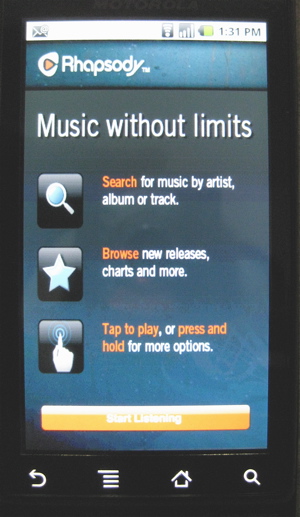
    Rhapsody Android welcome screen
    Rhapsody’s welcome screen on Android.

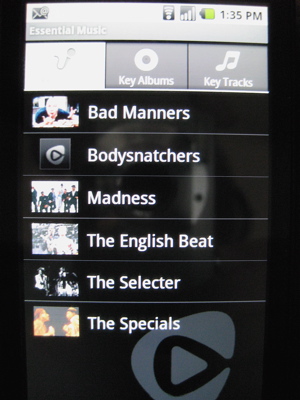
    Rhapsody Android Browse by genre screen
    Browsing by genre on Rhapsody for Android.

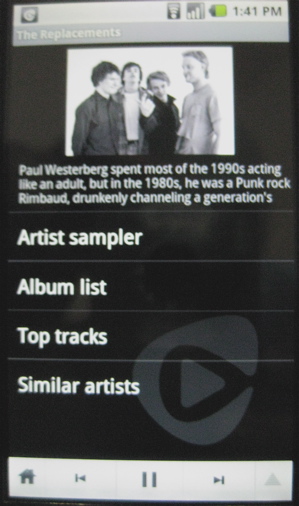
    Rhapsody Android artist info screen
    Artist information on Rhapsody for Android.

    Rhapsody Android Radio most popular
    Rhapsody Radio on Android

    Rhapsody Android "play" screen
    Rhapsody’s “play” screen on Android.

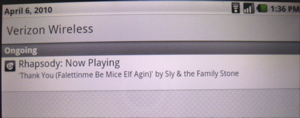
    Rhapsody Android alert
    The alert associated with Rhapsody playing in the background on Android.

    Rhapsody for Android is available now in the Android market or directly from Rhapsody here.

    Copyright Betanews, Inc. 2010


    Add to digg
    Add to Google
    Add to Slashdot
    Add to Twitter
    Add to del.icio.us
    Add to Facebook
    Add to Technorati


  • And After Trading Down All Day, Now The Market Is Heading Higher (Thanks Ben!)

    friends celebrate happy hug 4x3

    All day it looks as though the market might end down, but come on, we always knew that was impossible.

    Following the Fed’s announcement that the “extended period” language would remain, stocks are heading higher (still modestly).

    Giddy up!

    Join the conversation about this story »

  • Report: Last-ditch sale effort for Hummer post wind-down announcement fading

    Filed under: , , , ,

    It’s getting tough for even the most ardent supporters of the Hummer brand to continue to keep hope alive. Reports the aficionados at HummerGuy.net: While many of us were hoping for a last-minute miracle to save the Hummer brand, signs from Detroit are indicating that Hummer production will soon cease indefinitely.

    It appears as if General Motors has resigned itself to winding the brand down and letting it die a slow, agonizing death. The automaker says that it’s no longer considering offers for the brand and dedicated Hummer staff are reportedly be assigned to serve elsewhere.

    Oh, and about that “Save Hummer” summit that’s planned for April 11th near Chicago? GM, though it is aware of the rally, has no plans to send representation. That sound that you hear? That’s just the tolling of Hummer’s death knell. Thanks for the tip, Brian!

    [Source: HummerGuy.net]

    Report: Last-ditch sale effort for Hummer post wind-down announcement fading originally appeared on Autoblog on Tue, 06 Apr 2010 13:26:00 EST. Please see our terms for use of feeds.

    Read | Permalink | Email this | Comments

  • Introducing The Vegan Double Down!

    It had to happen eventually, but we are a bit surprised that it happened before KFC was even able to get their infamous Double Down (aka the bacon sandwich on fried chicken bread) to market — The folks over at Vegansaurus have put together this animal-friendly version of the Double Down.

    As vegans, we’re of course bound by blood oath to be outraged by meat surrounded by meat and drizzled in dairy, especially when mass-produced by a megacorp dedicated to poisoning as many people worldwide as possible. But sometimes something is just too ridiculous to hate, and like a game of culinary marry-fuck-kill, we saw the Double Down and chose “fuck.”

    The Vegansaurus crew have reverse engineered the Double Down and replaced everything — including the mysterious “Colonel’s Sauce” — with vegan analogs.

    You will eat about half of this before realizing what a mistake it’s been. But until that moment, it will taste like sweet, deep-fried heaven.

    Get the whole recipe and try it for yourself over at Vegansuarus.com

  • Bysiewicz Abruptly Withdraws Request To Seal Testimony

    Secretary of the State Susan Bysiewicz abruptly withdrew her request Tuesday afternoon for a judge to block disclosure of her deposition testimony in her lawsuit seeking a ruling that she is qualified to run for state attorney general.

    Her attorney, Wesley W. Horton, confronted with an opposition motion by a lawyer for The Courant, William S. Fish, Jr., told Judge Michael Sheldon in Hartford Superior Court: “After reviewing the law in this area about five minutes ago, I reached the conclusion that The Courant is correct.”

    Horton’s quick withdrawal of the request to seal the testimony — which he had filed Monday in the form of a motion seeking a “protective order” — clears the way for the release to news organizations of a video of more than five hours of unusual testimony by a high state official, Bysiewicz. She was questioned in the deposition by the state Republican Party’s lawyer, Eliot Gersten, who is challenging her claim that she has the statutorily required 10 years’ “active practice” of the law in Connecticut.

     The office of Attorney General Richard Blumenthal, which was given a copy of the video from the March 31 all-day deposition, said the video needs to be copied and will not be available until Wednesday. The Courant filed a Freedom of Information Act request with Blumenthal’s office last week, and since then the list of requesting news organizations has grown to at least 10.  The March 31 testimony takes up eight DVD discs, all of which need to be copied, a Blumenthal spokeswoman said. 

    Bysiewicz’s deposition continued Monday and Tuesday. The Courant, and presumably other news organizations, also have requested transcripts and videos of those deposition sessions, and it is unclear when those will be released.

    Bysiewicz, a Democrat, is suing in hopes that Sheldon will declare her qualified under a state statute that requires Connecticut’s attorney general to have accumulated 10 years in the “active practice” of law in the state.

    She wants the judge to say that her 11 years as secretary of the state, an office for which you don’t need to be a lawyer, count as the “active practice” of law — unless Sheldon declares the 10-year requirement unconstitutional, which she also wants him to do.

    She practiced private and corporate law here for six years before winning her current office.

    A deposition is a pretrial proceeding at which a witness — in this case Bysiewicz, who is also the plaintiff — is questioned under oath by a lawyer who is gathering information in preparation for an eventual trial. The deposition video or transcript does not become part of the court file unless it is entered into the record at trial.

    The trial had been scheduled to begin April 14, next week, but Gersten said in court Tuesday that he needs to take additional depositions and might want to put it off for a week.  Horton said he would oppose that, and Sheldon brought the lawyers behind closed doors to discuss it.  No decision on trial scheduling was announced by mid-afternoon.

    Bysiewicz is seeking the Democratic nomination to the office that Blumenthal is vacating to run for the U.S. Senate, the seat held by Sen. Christopher Dodd.  She has asked for, and been granted, expedited handling of her lawsuit because she wants a decision before the state Democratic nominating convention on May 21 and 22.  Other Democrats seeking the nomination are former state Senate majority leader George Jepsen and current state Rep. Cameron Staples of New Haven.

    The motion that Horton had filed Monday for the “protective order” contained only one paragraph. It asked Sheldon to direct all parties in the case “not to disclose publicly the transcript or videotape of any depositions in this case, except to the extent necessary to prosecute or defend any potential motion, unless and until they are unsealed” by order of the judge.

    But the Courant’s lawyers — Fish and Michael T. McCormack of the law firm Hinckley, Allen & Snyder in Hartford — filed a motion to intervene in the case Tuesday, saying Byseiwicz’s private interests did not override the state Freedom of Information Act’s requirement that the Courant’s FOI request be granted.

    “The necessity and value of the Courant’s intervention in this case is clear with respect to the Courant’s exercising its constiutional and statutory rights in publishing news of interest to the public,” the lawyers said in the motion.

    The Courant motion said that Bysiewicz could not establish “good cause” for an order to seal the testimony, “given the underlying issues in this case, all of which implicate the public interest.”

    “Simply stated, there is and can be no issue in this case that implicates the type of privacy concerns that might justify a protective order,” the Courant’s lawyers said in the motion. They added that Bysiewicz “has made no attempt to articulate what might constitute ‘good cause’ in this case to justify a protective order that would override the Courant’s and the Public’s rights” under the Freedom of Information Act.

    None of those arguments had to be made in open court, because by the time Sheldon came into the courtoom, Horton had read the Courant’s motion. As soon as the hearing opened, Horton withdrew his motion.

    “Well, that gives me nothing to rule on,” Sheldon replied, and then the lawyers went on to wrangle about scheduling the trial in the case. 

  • Substitute cities

    THE message in this Ed Glaeser post is one I wholeheartedly endorse—individuals expecting real home prices to rise are likely to be disappointed. But I’m not sure what I think about this:

    The cautious home buyer should reflect on the fact that few places have the two preconditions for booming prices: restricted supply and a durable anchor for robust demand. Moreover, even if supply is restricted in one area, the odds are that some other place has similar assets and a greater willingness to supply homes.

    Boston is a skilled metropolitan area and its restricted supply has led to high prices. But Atlanta is now a skilled metropolitan area as well, and its housing supply seems virtually unlimited. Why is it obvious that Boston can maintain a permanently higher price level than Atlanta?

    America is filled with empty land. We have a remarkable transportation network that enables people to commute vast distances. We have an efficient construction industry that, when unfettered, is capable of producing vast numbers of high quality, affordable units.

    The logic is pretty straightfoward. You have a collection of highly skilled workers in Boston, which makes it very attractive to be in Boston. Meanwhile, Atlanta also has some skilled workers, but not as many as Boston, and so Atlanta is somewhat less attractive. But housing supply in Boston is limited, and so rising demand for Boston leads to rising home prices, which encourages some subset of people to move to Atlanta, equilising the talent gap between the two metropolitan areas. And since housing supply in Atlanta is more flexible, the stable equilibrium is one in which Bostonians move to Atlanta until real housing prices in the two areas equilise (after controlling for other amenities and disamenities).

    The potential snag in this theory is one to which Mr Glaeser refers: the “superstar city” hypothesis. In this telling, rising home prices in Boston lead some Bostonians to exit, but the ones that choose to leave are those with the most modest income potential. That is, the ones who think they’re unlikely to earn enough to keep up with housing costs leave for cheaper pastures. But this should result in a filtering of the Boston population for the most talented workers, while less talented workers leave for other metropolitan areas. The filtering mechanism means that the density of talent in places like Boston increases, which further increases the return to being in Boston, which means that divergence in home prices is sustainable.

    I think there’s something to this, but Mr Glaeser seems to be arguing that if all you’ve got going for you is a pool of talented workers, rather than some other durable attraction, then ultimately, price increases will lead to convergence across cities. At some point, rising costs will filter out one too many skilled workers, the cheaper market’s talent pool becomes more attractive to all the workers in the pricey market, and the pricey market collapses.

    But what if there are actually two different kinds of skilled worker?

    Say that you have one kind of skilled worker who likes to live near other skilled workers for the mundane benefits of agglomeration: access to suppliers and clients and the advantages of a deep labour market. For this worker, any large, skilled market is an attractive place to be. Then there is another kind of skilled worker who enjoys those benefits of agglomeration but also the externality-oriented benefits: things like knowledge spillovers in specialised industries or Jacobs externalities, in which urban diversity breeds serendipitous opportunities. The first category of worker is happy to be in any collection of skilled workers. The second, on the other hand, needs to be among other externality-dependent skilled workers.

    Now imagine a metro area half full of each kind of worker in which home prices begin to rise. The workers who are filtered out by price increases are those whose skills are not externality-dependent. Their departure makes the cheaper market more attractive to the first class of worker. It also makes the pricier market more attractive for the second class of workers, since it eliminates the upward cost pressure provided by workers who aren’t increasing the size of the pool of externality-oriented workers. In this world, rising housing costs stabilise the structure of cities, effectively filtering not by talent but by type. Any externality-oriented worker leaving the pricey market would enjoy cheaper housing and a potential change in metropolitan skill level, just like the first type of worker, but they would also face a downgrade of their own skills, unlike the first type of worker.

    And while it might seem unlikely, it’s not impossible to imagine that attitudes toward housing supply could actually reflect these dynamics, such that cities with skills bases not particularly reliant on externalities support elastic housing supply while those home to externality-oriented industries favour tighter restrictions, the better to keep out free riders. In this world, the divergence in high and low cost markets could persist indefinitely, until a shock of some sort disrupted the value of the externalities holding high-cost cities together.

    As a model of housing cost dynamics and metropolitan skill sets, I don’t know if this actually holds up. It does seem to me, however, that if the superstar thesis is wrong for most cities, as Mr Glaeser suggests, then price differentials between high and low cost cities are already sufficiently large to generate absolute population decline in most pricey cities. And that’s not what we’re observing.

  • Sack, Entress, Liu, Patel, and Other Angel Investors Lure Twiistup to Seattle

    Twiistup
    Gregory T. Huang wrote:

    Tired of Seattle-area tech startup events? Well, get ready for a whole new one. It’s coming April 26, and it has been a closely guarded secret until now.

    The event is called Twiistup, and it was started in Los Angeles by AOL executive Mike Macadaan in 2007. Think of it as a tech conference with Hollywood flair—six-figure budgets, multi-day events, and massive parties—a bit like TED, with star speakers, albeit a heavier emphasis on entrepreneurial networking.

    I recently learned that last year, a group of prominent Seattle-area tech investors, including Andy Sack, Geoff Entress, Andy Liu, John Cunningham, Bob Senoff, David Niu, and Neil Patel, bought Twiistup for an undisclosed price. That means they acquired the brand, the website, and, crucially, the e-mail list of participants. Now they are bringing a lower-key version of the event to Seattle, called “startup sessions,” beginning on the evening of April 26 at the Olive 8 hotel. It will start out as a monthly event, aimed at tech entrepreneurs and investors.

    Patel, the Internet marketing whiz kid from Orange County, CA, is leading the effort. He has been living in Seattle for the past year, where he is involved in several startups, including BuddyTV, Cheezburger Network, WhitePages, and Liquid Planner. He’s also a limited partner in the seed-stage investment fund Founder’s Co-op, and has invested in about 10 companies overall (at the ripe age of 24).

    “Our goal is to really educate” entrepreneurs, Patel says of Twiistup in Seattle. “We want to help different types of companies grow.” He adds, “The goal is to start doing bigger events all around the U.S., where there are strong communities that don’t have enough local events” that emphasize the networking and educational aspects of starting and running tech companies. (The networking should also help potential investors, including the new Twiistup owners, find promising people and companies.)

    So far the group has backed two events in the LA area, and is also working on a New York event. I asked Patel what Twiistup can bring to Seattle, to go beyond what is already a crowded tech event field that includes the Northwest Entrepreneur Network, Washington Technology Industry Association, University of Washington, MIT Enterprise Forum, Seattle Tech Startups, Seattle 2.0, Lunch 2.0, nPost, and media organizations like TechFlash and Xconomy. (And add to that the new entrepreneur training sessions from Founder Institute and TechStars.)

    “Seattle needs something more educational,” Patel says.

    To that end, the April 26 event will feature Entress and Sack—two of the best-known tech investors in town—talking about the crucial steps in how to raise capital from angel investors. They will cover only the most important aspects—including how to get to know potential investors. (Patel says all the deals he has invested in have been either with people he already knew or through his friends.) Attendance is limited to about 90 people, and the event will have an hour-long networking reception with food and an open bar.


  • BikesideLA launches map to report, track bike collisions

    Bikes_600


    BikesideLA has launched a map to "submit, track, and study near misses, collisions, harassment and bike theft" in Los Angeles.

    The map is based in part on collision data provided by Los Angeles police, but also allows users to submit their own reports. Here’s an excerpt from the post:

    Remember that driver who cut you off in slow motion, you tapped the breaks and missed their bumper by inches, and then rode off into the sunset? The only difference in the world was that you knew you nearly bought it, and your heart leapt out of your chest for an instant.

    Some other interesting L.A.-area items around the Web:

    Easter parking in Long Beach: The Long Beach Press-Telegram is reporting the city has decided to void parking tickets from Easter Sunday:

    The void is only for vehicles that were parked at meters and does not include vehicles cited for safety reasons such as parking too close to a fire hydrant or driveway, said city spokesman Ed Kamlan.

    Echo Park parking: The Eastsider LA reports that parking rates in Echo Park have been lowered:

    Without much fanfare, the rates were recently dropped to 25 cents for 30 minutes; 10 hours of parking now costs $2.50 instead of $4 in all but one lot…

    — Anthony Pesce

    Have some news for Linking L.A.? Contact Times reporter Anthony Pesce.

    Photo: The LA Bike Map

  • Yahoo Mail Also Has OAuth Access

    The web is evolving at a fast pace, as always, and, at the moment, there are several big trends. One of them is the convergence of online identities and the need to allow various services and apps to work together. One way of enabling two services to securely share information is to implement the OAauth authentication protocol. Google made a very good impression… (read more)

  • The Original Energizer Bunny: Starting at $15,000 [Batteries]

    Own a piece of the fascinating battery spokesbunny saga, for a minimum of $15,000! “What fascinating battery spokesbunny saga?” you might ask. Well, have you ever heard of the Duracell bunny? More »


  • Google to pull all games from the Android Market in South Korea

    Are you from South Korea? Are you carrying an Android phone? Love gaming? Stop reading this. Go download every game you can from the Android market, and then come back. Don’t worry! We’ll wait!

    Now that you’re back, here’s why we had you do that: Google’s about to pull all games from the Android Market in South Korea.

    Now, now – don’t get too upset at Google. They’ve got nothing against South Koreans. Alas, South Korean local law prohibits games from being sold without first being run through the paces by a regulatory board — something which, due to the open and constantly updated nature of the Market, simply isn’t possible with Android.

    Apple had to do the same thing a few months back. Local authorities started coming down on them, and Apple eventually just killed off the games category in the region altogether. 15 seconds later 90% of South Koreans realized they could just set up a US iTunes account and get all the games they wanted that way, and these crazy regulations were circumvented.

    Google says the games should be pulled within the month.

    [TelecomsKorea via UnwiredView via Phandroid]


  • Fed’s Lacker: Dodd Bill Won’t Cure Too Big To Fail

    One of the major sticking points in the Senate’s financial reform bill involves the non-bank resolution authority. Its architect, Banking Committee Chairman Christopher Dodd (D-CT), wants to allow regulators sufficient authority to stabilize the financial market in times of turmoil. Republicans worry that this flexibility could result in more bailouts. Richmond Federal Reserve President Jeffrey Lacker articulated the latter view during an interview with CNBC’s Steve Liesman that aired this morning. Lacker thinks Dodd’s bill is too soft on forcing bankrupt firms to fail.

    Here’s a transcript of the relevant part of the discussion, though the whole video can be watched at the bottom of the post:

    Lacker: The issue of our time has to do with the government safety net for financial firms. And it’s grown tremendously, and containing that, establishing clear boundaries of that, is the number one priority. As I read the Dodd bill and the mechanism it sets up for the resolution authority, it doesn’t strike me that it’s likely to help us there. And in fact, it seems to me like a major danger is that there’s going to be more instability in financial markets instead of less.

    Liesman: The Dodd bill allows for a three-bankruptcy judge panel to declare insolvency. It allows losses to go to unsecured creditors; it allows management to be replaced and shareholders to be wiped out. How much clearer could the government be in this bill that there will be real losses to investors?

    Lacker: It allows those things, but it does not require them. Moreover, it provides tremendous discretion for the Treasury and FDIC to use that fund to buy assets from the failed firm, to guarantee liabilities of the failed firm, to buy liabilities of the failed firm. They can support creditors in the failed firm. They have a tremendous amount of discretion. And if they have the discretion, they are likely to be forced to use it in a crisis.

    Whether financial reform should be stricter on failing firms isn’t a simple question. For example, imagine a firm that should fail in its current form, but through restructuring its debt and equity could survive. Should it just be wound down and obliterated, or should a regulator work to restructure the firm (assuming no loss to taxpayers)? The harder line would call for wind down, but Dodd’s bill might allow for restructuring.

    Even though this question is a hard one, financial reform shouldn’t leave it unanswered. That’s why Lacker is right to call for more specificity in the powers of the resolution authority. What “costs” will be covered by the resolution fund? Under what circumstances can a firm be restructured? These sorts of issues should be specifically defined.

    For example, can the resolution authority perform a debt to equity conversation to enhance capital levels of a troubled firm to keep it afloat? If so, under what conditions? Those details should be explained so that creditors can understand how that might shake out. Will the resolution authority cover a part of a firm’s derivatives exposure and pay out counterparties? If so, how many cents on the dollar can a counterparty expect?

    Working out such details will serve to eliminate market uncertainty. It should also destroy the perception that systemically relevant firms would remain too big to fail. Instead, investors could just look at how the resolution process would work and figure out under what conditions a firm could survive a government resolution. (And survival shouldn’t be easy.) Of course, determining such specifics ahead of time would make for more accurate risk-based assessments paid into the resolution fund by firms as well.

    And although Lacker doesn’t mention it, the resolution authority’s rules should apply to all firms, not just large ones. That way, investors can evaluate all market participants on a level playing field. If only the big firms receive the potential advantages that a resolution authority provides — even if explicit bailout isn’t one of them — then smaller firms will experience a competitive disadvantage when trying to acquire funding.


    Email this Article
    Add to digg
    Add to Reddit
    Add to Twitter
    Add to del.icio.us
    Add to StumbleUpon
    Add to Facebook


  • Northbound U.S.-Mexico border in Calexico reopened after earthquake

    The U.S.-Mexico border was opened Tuesday to northbound vehicle traffic in Calexico, but the historic downtown district remained closed as inspectors checked for structural damage to buildings in the wake of the  magnitude 7.2 Easter Sunday earthquake in Mexicali, Mexico.

    Although the border crossing had been closed to northbound traffic as officials checked for damage to the federal building where agents examine vehicles, pedestrians continued to cross through the checkpoint from Mexicali in an effort to flee the aftershocks wracking northern Baja California.

    Many were headed to the Greyhound bus station, and taxis swarmed the area in the hopes of picking up passengers bound for points north and west.

    Mexicali resident Hilda Gonzales waited at the Calexico bus station with her three children.

    "I won’t feel safe until I can get to my sister’s house in Los Angeles." Gonzales said. "Then I will feel safe. Maybe I will never come back to Mexicali."

    The Salvation Army set up a storefront at the border in Calexico and handed out cookies, water and coffee to entering visitors.

    "It’s comfort food," said one of the Salvation Army workers, Laura Cintora.

    Although the U.S. Border Patrol resumed its regular routine, the Calexico Police Department remained on extra deployment downtown as yellow police tape kept people away from red-tagged buildings. Yet there were no signs of looting or problems associated with the refugees from Mexicali, Lt. J.J. Serrano said.

    "Everyone seems to be on their best manners," he said. "They know everybody is stressed out by this.”

    Looking around at the quiet, abandoned buildings, he said: "It looks like a movie set, doesn’t it? Maybe they’ll do a movie about Calexico."

    There have been more than 500 aftershocks from Sunday’s 7.2 Mexicali earthquake, and experts said residents in the region can expect many more.

    “People who live near [the epicenter] are getting no sleep,” said Kate Hutton, a Caltech seismologist.

    Most of the aftershocks have been minor — in the 3 magnitude or less. But there have been six aftershocks that registered more than 5.0, and dozens in the 4 range, according to the U.S. Geological Survey.

    There was a 4.6 temblor on the border early Tuesday morning. But the last magnitude 5 quake occurred Monday morning.

    Hutton said there’s about a 56% chance that another magnitude 5 aftershock will occur sometime Tuesday.

    She said that over the next week, there might be as many as 22 magnitude 4 aftershocks and maybe two magnitude 5 aftershocks.

    “The good news is that the aftershocks do become less frequent with time,” Hutton said. “After a week or two, it will only be an occasional jolt.”

    The aftershocks are being felt most acutely in Mexicali, El Centro, Calexico and other border towns hit hardest by the temblor.

    The death toll from the quake remained at two; more than 230 people were injured. The quake, centered about 30 miles south of the border, caused 45 buildings in Baja California to collapse or partly collapse, authorities said.

    — Tony Perry in Calexico, Calif., and Ching-Ching Ni in Pasadena

  • Sams Teach Yourself MySQL in 21 Days

    Sams Teach Yourself MySQL in 21 Days
    Sams Teach Yourself MySQL in 21 Days
    Sams | ISBN: 0672319144 | edition 2000 | PDF | 308 pages | 16,7 mb

    Sams Teach Yourself MySQL in 21 Days teaches you to design and implement your own open source database. Topics include: Designing and Creating your First Database, Normalizing your Data, Adding Tables, Columns, and Indexes, MySQL Data Types, Importing and Exporting Data, Locks and Keys, Building a MyODBC Interface, Building a Perl Interface, Letting MySQL Do the Work – Intrinsic Functions, MySQL Database Security, How MySQL Compares, Administering MySQL, Optimizing MySQL, and Troubleshooting MySQL.