Blog

  • The Age of Napoleon (Greenwood Guides to Historic Events 1500-1900)

    The Age of Napoleon (Greenwood Guides to Historic Events 1500-1900)
    The Age of Napoleon (Greenwood Guides to Historic Events 1500-1900)
    Greenwood | 2004 | ISBN: 0313320144 | 256 pages | PDF | 13,5 MB

    Hegel called him “an idea on horseback,” a description that suggests Napoleon Bonaparte’s complexity, as well as the extent to which he changed France, Europe, and the world. Napoleon has been called a visionary, a pragmatist, a cynical opportunist, an ogre, and a demigod. Here, he is described in his own words and the words of his contemporaries: from his clannishness to his knack for being at the right place at the right time, and from his genius to his obsession with detail.

  • Ocean Drive – April 2010

    Ocean Drive - April 2010
    Ocean Drive – April 2010
    English | 168 pages | PDF | 49.86 MB

    Ocean Drive is the quintessential luxury, fashion and lifestyle magazine in South Florida, delivering the latest trends in fashion, beauty, art, travel, real estate and entertainment. Each issue takes readers on a VIP journey inside the local social scene, with in-depth interviews with major fashion houses, fabulous restaurants and chefs and the newest “it” nightclubs from around the world.

  • Make Money Teaching Online: How to Land Your First Academic Job, Build Credibility, and Earn a Six-Figure Salary

    Make Money Teaching Online: How to Land Your First Academic Job, Build Credibility, and Earn a Six-Figure Salary
    Make Money Teaching Online: How to Land Your First Academic Job,
    Build Credibility, and Earn a Six-Figure Salary

    Publisher: Wiley | ISBN: 0470100877 | edition 2007 | PDF | 256 pages | 10,4 mb

    Did you know you could teach from home and earn a six-figure salary? Thousands of people make a great living teaching online courses from home, and the more classes they teach the more they earn! If you want into this exciting profession, this guide will show you how to get started, find great jobs, and earn more than you thought possible.

  • The Fundamentals of Piping Design: Drafting and Design Methods for Process Applications

    The Fundamentals of Piping Design: Drafting and Design Methods for Process Applications
    The Fundamentals of Piping Design:
    Drafting and Design Methods for Process Applications

    Gulf Publishing Company | 2007 | ISBN: 1933762047 | 240 pages | PDF | 11,5 MB

    Written for the piper and engineer in the field, this volume fills a huge void in piping literature since the “Rip Weaver” books of the 90s were taken out of print. Focussing not only on Auto CAD, but also on other computer-aided design programmes as well and manual techniques not found anywhere else, the book covers the entire spectrum of needs for the piping engineer. Covering general piping systems, this basic guide for the piping engineer offers standards in practices for covered in the original “Rip Weaver” series. It is the perfect introduction to the design of piping systems, various processes and the layout of pipe work connecting the major items of equipment for the new hire, the engineering student and the veteran engineer needing a reference.

  • Should conservatives have supported Hillary?

    My friend Bruce Bartlett over at the Capital Gains and Games blog asks whether conservatives should have supported Hillary Clinton in the 2008 presidential race:

    I wrote a couple of columns in 2007 telling conservatives that they really should consider lending some support to Clinton if they believed, as I did, that Obama was much more liberal than her and that whoever won the Democratic primary would probably win the general election (see here and here). … So would conservatives have been better off following my advice and helping Hillary Clinton to get the Democratic nomination, rather than futilely wasting their efforts on McCain, Mitt Romney and other Republican candidates who could not win and were considered far from ideal from a conservative point of view anyway? … I think the evidence suggests that Hillary Clinton could have won the Democratic nomination with just a little bit more support, and probably would be governing significantly more conservatively than Obama. For one thing, given her disastrous experience with health care reform in 1993-1994, it’s reasonable to assume that she would have stayed away from that issue at all costs.

    Me:  Bruce derives most of his evidence from the idea that Hillary’s centrism has seriously influenced the direction of Obama’s foreign policy. Now I certainly have no reason to believe Hillary wouldn’t have pushed hard on healthcare reform. She certainly spent a lot of time and resources creating a detailed plan during the campaign and then promoting it.

    As for economic policy more generally, you couldn’t produce a more centrist Democratic economic team than the one Obama has assembled: Summers, Romer, Goolsbee, Geithner. No actual Republicans (probably not) but no one that “progressives” have much fondness for either. As for actual policy, Hillary would likely have favored a big stimulus plan and major healthcare reform. Would she have been tougher on the banks? Coming out of the pro-Wall Street Clinton presidency and her time as NY senator, I doubt it.

  • Sugar Ray Frontman Mark McGrath & Girlfriend Expecting Twins

    Sugar Ray frontman and former Extra host Mark McGrath and his longtime fiancee Carin Kingsland are expecting twins. The couple tells PEOPLE Magazine that their son and daughter — conceived via in vitro fertilization — are due in May.

    Although McGrath is nervous about bringing the babies home, he says he “can’t wait to meet them.” “I love them already, but I need them to come out so I can really shower them with love,” he added.

    McGrath, 42 and Kingsland, 37, have been dating on and off for the past 16 years.


  • Government Announces Changes To Airport Screening Policies

    Government announces changes to airport screening policies The United States government has announced a new security screening system designed to improve on the controversial directive to conduct mandatory screening of travelers from 14 countries, which was implemented following the failed Christmas Day bombing in Detroit.

    The new system will rely on an intelligence-based approach to stop suspected terrorists from entering the country by airliners, and was announced after the completion of a three-month security review ordered by President Obama.

    Officials have said security screeners will now determine which passengers require a secondary screening based on traits of known terror suspects, including name, physical description and travel patterns, according to Voice of America (VOA).

    State Department spokesman P.J. Crowley was quoted by the news source as saying that airport screenings will also incorporate multiple random layers of security, such as explosives trace detection, advanced imaging technology, canine teams and pat downs.

    The new approach has received praise from many quarters, including the Council on American Islamic Relations (CAIR), whose national executive director Nihad Awad said that "we applaud the [new] policy because it does what security experts and civil libertarians have always asked for — it screens passengers based on actual suspicious behaviors or actions, not on national origin or religion." ADNFCR-1961-ID-19706449-ADNFCR

  • Scotty, We Need More Bandwidth!

    A slew of news out this morning — ranging from AT&T’s $1 billion expansion of its network to Cisco’s update of its unified computing system — highlights the continued need to invest in networking. We’re piling on compute power and boosting storage at a much faster pace than our networking infrastructure can handle — both inside the data center (GigaOM Pro sub req’d) and on the long haul networks running between (GigaOM Pro sub req’d)  them. There isn’t really a Moore’s law that pertains to networking.

    Which is why in some cases, it’s just a matter of plunking down more cash to add gear and perhaps undersea capacity, as AT&T said it plans to do for business networks. Cisco is taking a doubled-side approach to the networking bottleneck by providing servers that can deliver faster and easier networking inside virtualized data centers with an upgrade to its unified computing system, as well as building routers for long haul and edge networks that can handle a whole lotta terabytes. Last month Marvell upped the data center networking ante by announcing 40 gigabit Ethernet chips for when 10 won’t do.

    And back to the long haul networks, Cisco sold its massive ASR-9000 core network router to NTT Communications Corp. last week,and today, EETimes quotes NTT CTO Doug Junkins as explaining why isn’t pleased by the higher prices for advanced networking gear (the optics components are 10-30 times more expensive than for 10 GigE gear), but is ready to take the plunge because of customer demand:

    “We are a wholesale IP transit provider, and our highest growth is in 10G Ethernet ports for new customers,” said Junkins who is also vice president of IP development for NTT Communications’ business network unit. “We have customers today bundling more than ten 10G Ethernets from our backbone to their net, so the day 100G Ethernet is available, we will start provisioning for it,” he said.

    It’s not just consumers downloading video or the love of smartphones that’s causing bandwidth demand to skyrocket, but the need for access to software, platforms and infrastructure as a service by businesses and our increasing reliance on the network for improving productivity and seeding innovation.

  • EarthNews 2010-04-06 14:06:33

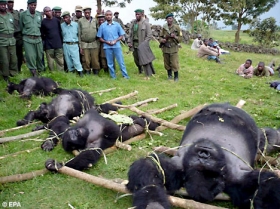
    Environmental News Network: Gorillas may disappear across much of the Congo Basin by the mid 2020s unless action is taken to protect against poaching and habitat destruction, warns a new report issued by United Nations and INTERPOL.

    The Last Stand of the Gorilla – Environmental Crime and Conflict in the Congo Basin — released at the CITES meeting in Doha, Qatar — lists a multitude of threats to gorillas, including the bushmeat trade, outbreaks of the ebola virus, illegal logging, mining, and charcoal production. The report warns that that militias in eastern Democratic Republic of Congo (DRC) are exacerbating the gorilla crisis through trafficking and involvement in other illicit activities. Gorilla bushmeat moves through the same smuggling channels as illegally extracted timber, diamonds, gold and coltan (a mineral used in cell phones). Further, insecurity in the region has driven hundreds of thousands of people into refugee camps, which has increased pressure on natural resources, including forest habitat for gorillas and the apes themselves.

    “With the current and accelerated rate of poaching for bushmeat and habitat loss, the gorillas of the Greater Congo Basin may now disappear from most of their present range within ten to fifteen years,” said UNEP’s Christian Nellemann, lead author of the report, in a statement. “We are observing a decline in wildlife across many parts of the region, and also side-effects on poaching outside the region and on poaching for ivory and rhino horn, often involving poachers and smugglers operating from the Congo Basin, Uganda, Burundi and Rwanda, to buyers in Asia and beyond.”

    “This is a tragedy for the great apes and one also for countless other species being impacted by this intensifying and all too often illegal trade,” Achim Steiner, UN Under-Secretary General and Executive Director of the UN Environment
    Program (UNEP), added in the statement.

    Article continues: http://news.mongabay.com/2010/0325-congo_gorillas.html

  • FAIR Report Cautions Against Democrats’ Amnesty Plans

    FAIR report cautions against Democrats' amnesty plans As the Democrats are turning their sights towards immigration reform, a prominent advocacy organization has warned that an amnesty for illegal immigrants would be detrimental to American workers’ prospects.

    According to the report from the Federation for American Immigration Reform (FAIR) entitled Amnesty and the American Worker, record levels of immigration during the 2000s have added new workers to the labor force faster than the economy has been able to create new jobs.

    That is why the organization has criticized the amnesty idea supported by many Democrats, saying that at a time when some 25 million Americans are either unemployed or involuntarily working part-time, amnesty would entitle the estimated 7.5 million illegal aliens to keep their current jobs, and compete with American workers for any new jobs.

    "It is unconscionable that at a time of devastatingly high unemployment, our nation’s leaders seem determined to forge ahead with legislation without even considering the harm it might cause," said Dan Stein, president of FAIR.

    He also disputed assertions that the move would boost the U.S. economy, saying the benefits would accrue almost entirely to the amnestied aliens and their direct employers.

    The latest figures from the Bureau of Labor Statistics suggest the unemployment rate in March remained unchanged at 9.7 percent. ADNFCR-1961-ID-19706445-ADNFCR

  • Report: Recent Violations ‘Quite Relevant’ to Mine Explosion

    Even while Massey Energy is touting “another record setting year for safety,” the Charleston Daily Mail today has a different story:

    Safety inspectors concluded as recently as last month that conditions at Massey Energy Co.’s Upper Big Branch mine posed substantial and significant risks to miner well-being before a Monday explosion killed 25 miners and trapped 4.

    In March alone, U.S. Mine Safety and Health Administration officials cited the mine, which is owned by Massey subsidiary Performance Coal Co., for failing to control dust; improperly planning to ventilate the mine of dust and the combustible gas methane; inadequate protection from roof falls; failing to maintain proper escapeways; and allowing the accumulation of combustible materials.

    In the past 15 years, there have been more than 3,000 violations cited at the Upper Big Branch mine, the Daily Mail reports.

    The violations appear “quite relevant” to Monday’s explosion, said Scott Simonton, a professor of environmental science and environmental engineering at Marshall University.

    Not much to add here, really. All businesses hate red tape and government meddling. But in high-risk industries like coal mining the safety regulations clearly serve a purpose — though the influence of industry means that such regulations usually arrive as a response to a disaster like Monday’s, instead of anticipating such an event.

    “It’s unfortunate, but every mine safety law we have on the books today was written in the blood of coal miners,” Rep. Nick Rahall (D-W.Va.) said today.

    The Daily Mail story seems to reveal that the problem is not about writing these laws, but enforcing them.

  • The Ending to Mariner Energy’s Cliffhanger…

    library booksCliffhangers are always fun, although personally we like them better in the context of thrilling new novels than in SEC filings.  Yet that’s what we discovered when we dug into the proxy that Mariner Energy, Inc. (ME) filed late last week.

    But first, here’s the set-up….

    We have to go back to October 27, 2009, when the company filed an 8-K to announce that John H. Karnes, Senior Vice President, Chief Financial Officer and Treasurer, had left the company the prior week. The press release that accompanied the filing explained that Karnes “is leaving the company to pursue other interests.” Scott Josey, Mariner’s Chairman/President/CEO, said at the time, “We thank John for his contributions to Mariner over the past three years and wish him well in his future endeavors.” (The company tapped Jesus Melendrez, its Senior Vice President and Chief Commercial Officer, to assume the additional roles of Acting Chief Financial Officer and Treasurer.)

    The 8-K also disclosed that Karnes “…will receive severance as provided in his Employment Agreement with Mariner, dated as of October 16, 2006, and restricted stock grants under Mariner’s Stock Incentive Plan, as amended and restated from time to time.”

    Thus, since last October you’ve probably been wondering anxiously, “How much did our protagonist get when he left Mariner Energy?”  You may have even researched his October, 2006 Employment Agreement in a frantic search for clues that would enable you to do the math yourself, although there are so many variables that calculating the final number isn’t possible.  (That’s because there’s no way to know whether Karnes would get raises after 2006, whether he’d get bonuses or RSUs, and so forth.)

    Well, patient readers, wait no longer. The answer to our cliffhanger was finally revealed in last week’s proxy: After three years at Mariner, Karnes left the company with an extra $3,198,152 in severance-related compensation. That’s a surprisingly high number, given the fact that in 2006 Karnes started with a base salary of $235,000.  By 2009, his base salary was $241,288 (although it had been higher in 2007 and 2008).

    But we know from the Summary Compensation Table’s footnotes that the approximately $3.2 million that Karnes left with consisted of $1,614,600 in Severance Pay, $1,553,091 from Accelerated Stock Vesting, and another $30,461 for “Health Benefits Continuation” (that was the company’s share; Karnes had to contribute, as well).

    That works out to nearly $1.07 million in extra compensation for each year that Karnes worked for Mariner Energy. For him – financially, at least – that seems like a pretty good ending.

    Image source: Jaap Steinvoorte via Flickr

  • Android-Based ICD Gemini is Most Feature-Complete Tablet Yet

    The title is a statement made by our friends over at Engadget and I totally agree. This thing is a monster. If you wasted your money on an iPad, that that crap back and wait on this. Besides being Android, this thing is awesome in every way.

    Let’s see if I have enough space to list all the features of this device. its capable of 1080p video, replaceable 40Wh battery, an SD card reader, FM radio, GPS, 802.11n Wi-Fi, Bluetooth, MicroUSB connectivity to PCs and USB peripherals, stereo speakers, and dual webcams — a 2 megapixel front-facing unit and a 5 megapixel auto focusing snapper on the back. That’s not all folks; it has a multi-touch screen, 3G, 1,366 x 768 resolution and is flash compatible. Did I mention how beautiful it is?

    [via engadget]

  • 18 Disastrous Invasive Species (That Happen To Be Delicious)

    Invasive species are a major problem the world over. They kill local plants and animals, clog streams, destroy habitats, and devastate anything natural in their path. Sometimes they were introduced for a purpose, sometimes they escaped into the wild — but they always cause trouble. However, there is sometimes one redeeming feature of the proliferation of an animal in a new environment — they can be crazy freaking delicious!

    18. Japanese Knotweed

    Japanese Knotweed has taken over large areas of the U.S.A. and Europe, mostly due to its strong interconnected root system and speed of growth. It can survive on almost any conditions, and the roots extend 3m into the soil, which makes it almost impossible to destroy. So what possible redeeming feature can this horrific weed actually have? Well, it can be used a source of nectar for honeybees, and anything that makes more honey is good in my books. Even more cool, the young stems taste like a mild rhubarb (without the whole toxic thing), and is a good source of resveratrol and emodin.

    17. Snakehead

    The Snakehead family of fish are particularly troublesome across the US and UK, due in part to their position at the top of the food chain — to put it bluntly, nothing eats them. Well, nothing but us. Snakehead can also survive out of water for up four days, assuming they stay damp, and can breath atmospheric oxygen. They’re known to travel up to a quarter-mile across land in order to colonize new bodies of water. They’re mean, hard to kill, and lucky for us, kinda tasty. Said to taste like chicken (but what doesn’t?), gut, skin and throw them on the grill, and you have a damn fine meal.

    16. Grey Squirrel

    Introduced from America to Europe, the larger and meaner gray squirrel swiftly out-muscled the local small red variant. While some call this “survival of the fittest”, others say it’s “damn yank bully-boys, at it again”. The UK now has very few of its native red squirrel population, and mainland Europe is now worried that the same might happen on their shores. However, grey squirrels have one undeniable advantage over the red variant — their greater bodyfat lets them survive winters better, and provides much tastier meat. You ever hear of marbling? A nice, fatty bit of squirrel makes for juicer, less gamey meat. Grab it right when its fattened up for hibernation, and straight into the stew it goes.

    15. Silver and Common Carp

    Silver carp were introduced to the USA in the 70s to try and control algae growth, and rapidly multiplied in their new environment, killing local species. They also have a habit of jumping out of the water, smacking unsuspecting water-goers in the face. Common carp breed fast, and survive by feeding through bottom sediment, which destroys local growth. This also severely alters populations further up the food chain that survive on these plants, as their food sources are diminished. Why should us gourmands be happy about carp? Look at that picture! You could feed a freaking African village on that fucking fish! Let em grow wild, and feed the world!

    14. Nile Perch

    Tastes like tilapia. Do we need to say more? Oh, I suppose. It’s African, and has a tendency to eat everything that moves — including its own species. Mature fish reach more than 120cm, and they’ve been introduced to a number of lakes around the continent. And they do eat anything! Insects, crustaceans, fish, probably you, if you’re not paying attention. Being at the top of the food chain does cause troubles, which is why we’re happy to make sure they never reach.

    13. Swan

    Oh, you don’t think we should eat swans? Yeah, well you weren’t kicking about in historic Europe, where they were the food of choice for the rich. Big, pretty, and chock full of meat, it was a staple of banquet halls across the continent. Eventually associated with Royalty, they weren’t allowed to be eaten by people who weren’t of royal blood or invitation. Now they’re protected in Europe, but in America they’re invasive. Due to their size and belligerent nature, they tend to force native fouls out of the area. They’re such badasses, they’ll kill ducks and geese they come across.

    12. Green Crabs

    People love eating crab. I’m not a huge fan, due to my blanket ban on eating anything with more than four limbs, but if you’re a fan of devouring sea bugs, then more power to you! Green crabs have been described as one of the 100 worst invasive species, as they’ve spread from their homes in the Atlantic to South Africa, Australia, South America and both coasts of North America. They catch rides on ships hulls, and manage to spread themselves pretty widely across the seas. They can live in almost any water conditions, and across a vast range of salinity levels. They females can lay 100,000s of eggs, and the animals will eat local small crustaceans and bivalves quite happily. Good thing they’re tasty!

    11. Mozambique Tilapia

    Ironically threatened in its native waters, the Mozambique tilapia is seen as a pest pretty much everywhere else on the planet. Being small, hardy and omnivorous makes it fairly easy for them to spread. They were brought to various parts of the world for sport fishing, they soon pulled Houdinis, and spread beyond control. The Mozambique tilapia is also well recognized for its potential for commercial fishing, due to its hardiness and ease of travel. They also account for around 4% of worldwide tilapia sales.

    10. Red Deer

    Venison. Venison, venison, delicious venison! Venison sausages, steaks and anything else. Native to Europe, and one of the largest deer species, red deer are a major problem in South America and New Zealand. They consume massive amounts of foliage, and often compete with local herbivores for tasty leaves and barks, or whatever they eat. I think we’re missing the point here — mammoth amounts of venison. Juicy, delicious, succulent venison. Hell, you can even sell their horn velvet to Asia as a traditional medicine. I know I’m just happier chomping through a venison burger.

    9. Chinese Mitten Crab

    Horribly invasive in Europe and the USA, it takes over rivers, destroying native crustaceans, blocking drainage, even moving in to swimming pools and pipes. Somehow they’ve been unable to establish themselves in the Great Lakes, despite having been introduced a number of times, they’ve overrun the Thames and Hudson worse than a Korean kid learning to play Zerg. Yet in their native China, they’re a delicacy, especially the roe. It’s chronically overfished (overcrabbed?) in the Yangtze, and a single crab from Lake Yangcheng can go for hundreds of Yuan (100 Yuan = $15) — and these things aren’t particularly large either, about the size of your palm. Huh, that sounds like a pretty good business proposal, seeing as you can charge a huge amount for a tiny, quickly breeding animal. Hell, I’m sure you could make a small fortune dredging the Hudson and selling them on to Chinatown.

    8. Largemouth Bass

    Darling of the sports fishing world, and highly prized for angling in the USA, the largemouth bass is a significant pest in UK, Europe, Russia, Middle East, North Africa, Continental US, Caribbean territories, South America, Asia, Southeast Asia, Hawai‘i, Mauritius, Madagascar, Fiji, Guam, New Caledonia and the US Virgin Islands. It’s been rated one of the worst 100 invasive species due to its distinctively predatory nature, as it’ll happily munch on smaller fishes (and even smaller largemouth bass) until the native populations are all but destroyed.

    7. Blue Mussel

    Originating in the Mediterranean, the blue mussel is now found pretty much anywhere with a temperate climate and salt water. They foul ship hulls, and outcompete just about every other mussel on the planet — because they can breed up to 200% faster. Especially a problem in South Africa, they also grow in such density that pipes and drains can get badly blocked, not to mention the issue of hulls. However, clean em and steam em with some white wine Julia Childs style? Honestly, one of the most delicious meals imaginable. It only takes about 15 minutes to cook too, and you’re left with succulent mussels and a white wine sauce. Throw in some crusty bread, a chilled bottle of white wine, and you’re set!

    6. Rainbow Trout

    Last of the fish, I promise. The utterly delicious rainbow trout is heavily farmed and fished in the USA, and is considered a protected species due to dwindling numbers. However, it’s also a threat to other species due to being a walking STI. It is able to hybridize with a number of other species, effectively destroying their gene pool, and brings in a number of nasty diseases when it does so — most notably whirling disease, which screws up the fish’s ability to orient itself, leading them to swim in spirals until their spines fuck up.

    5. Duck

    The mallard, or wild duck, is another one of those critters whose major ecological impact is its breeding abilities — namely it shags everything ducklike (including the dead), until it breeds out all the competition through hybridisation and just generally pumping out baby ducks. They also carry a rather nasty version of bird flu which is particularly bad for fowl, if not us — HAPIV. They also have explosive corkscrew penises. Ducks are screwed up, yo. But, for all that, I have three words for you: duck breast prosciutto. Apparently ludicrously easy to make at home, and mouth wateringly delicate, it’s a food of the gods.

    4. Feral Cows

    Wait, cows? Yup, it turns out they can go feral, and cause major problems. Primarily a problem in the Pacific Islands, but also Ecuador and the Caymans, these critters have a tendency to escape from ranchers, and start destroying native fauna. Due to their large appetites, they eat a huge amount of foliage, which many small islands just aren’t equipped to handle losing. They eat faster than plants can regrow, causing major issues with loss of habitat for other species, as well as killing off native bush. I’m sure by now, we can all imagine a handy way to deal with this problem. Steak, roast beef, prime ribs. Hell, just give me the entire beast and a large freezer, and I’ll figure out a way to get through it.

    3. Wild Boar

    If there’s one thing that a childhood of reading Asterix has taught me, it’s that wild boar must be the world’s most delicious animal. Generally called a Razorback in the USA, wild boars roamed Europe, Asia and North Africa prior to being introduced to the USA, Papua New Guinea and Australia. Because they root for food, they can cause significant ecological and property damage, destroying plants, property, seeds, and anything else that is in the ground. They destroy commercial crops and native species equally, and as omnivores, they’ve just about eaten to death tortoise and sea turtle populations in Ecuador. Time to go boar hunting, I think. If you’re a real man, you do it medieval styles, with just a giant fuckoff spear. If you’re Obelix level, do it barehanded.

    2. Rabbits

    The scourge of Australia and New Zealand, rabbits destroy native wildlife through excessive grazing and burrowing. You ever heard the term “fucking like rabbits”? That’s because these wee bastards breed at a prodigious rate, making them just about impossible to control. They’re present on every continent except Antarctica and Asia, and are major pests in some areas. Hell, in parts of NZ, they celebrate Easter by going bunny hunting. But, as Samwise Gamgee says, “there’s only one way to eat a brace of coneys”, and that’s rabbit stew. I’d have to disagree with Master Samwise there, as rabbit is amazing roasted, grilled, or just about anything else. I recently had a really good pulled rabbit sandwich!

    1. Goat

    Goats were left on islands throughout the seven seas, as food sources for colonists, sailors, and shipwrecks. They were ideal for this, because they’re extremely hardy, can survive on just about any terrain, and will eat just about any plant on the planet. Of course, when these islands were seeded, no one gave a crap about native flora and fauna, and the potential impact of these introduced species on the local ecosystem — they were more concerned with getting some food if they were ever shipwrecked. Said goats have nom-nom-nomed their way through many a native biosphere. However, their milk is delicious, feta is freaking amazing, and goat meat can be sublime. Seriously, go to a good Greek place, and just see what they can do with goat meat, and your mind will be blown. Throw in some North African cooking too, and some Middle Eastern? Hell, you can make an awesome curry from it to! Goat meat is flexible, and hell of a delicious. Frankly, I’d be happy to spend the rest of my days removing these pests from the world, via my digestive tract.


  • Federal Reserve March Minutes Announcement: No Change!

    ben bernanke

    Well, not much doing here.

    The Fed is keeping the “Extended Period” language in its minutes.

    No big shocker.

    The Fed’s Hoenig did want it changed somewhat.

    There is a little chatter about a recovery, but then also some “renewed concern” about housing.

    The market’s response is muted.

    The full announcement can be found here.

    Join the conversation about this story »

  • To cut emissions, Taiwan urges citizens to worship online

    Climatewire: In a move to protect the environment, Taiwan last week urged its citizens to honor the dead by going online rather than burning incense and ritual money.

    Ahead of yesterday’s Tomb Sweeping Festival, an ethnic Chinese holiday during which worshippers visit the graves of their ancestors to burn incense and paper gifts, the government called on its citizens to consider the environment.

    The practice of burning incense and paper gifts for ancestors comes from Taoism. Followers believe that burning paper products will keep their ancestors comfortable in the afterlife. But burning paper money releases significant amounts of carbon dioxide, as well as benzene, methylbenzene and ethylbenzene, which can cause cancer and other diseases.

    “We can now choose to pay homage to our ancestors in a modern and environmentally friendly way by worshipping online or donating the money meant for the offerings to charities,” said the Environmental Protection Administration in a statement.

    Environmental agencies have also offered to collect paper money from households and temples, then burn it in state incinerators that can cut emissions and clean the exhaust (AFP/London Independent, April 5). – JP

  • BBC iPad App Popular In U.S., But Brits May Be Denied


    BBC News iPad app

    The BBC may have postponed its planned mobile phone apps for regulatory scrutiny in its native UK – but, in the U.S., where the BBC operates commercially, its new iPad app is already a big hit.

    Released in time for the tablet’s U.S. launch last weekend, the personalisable BBC News app offers text news in English and other languages, social sharing, story videos, 60-second video bulletins, full-screen video, live radio, breaking news alerts and offline syncing.

    Already at #12 in iPad’s free apps chart, it rates 3.5/5 with users. Development was jointly funded by the UK BBC and by BBC Worldwide, which plans to sell ads on it outside Britain. Made by Mobile IQ, the same developer commissioned to make the iPhone apps, it offers a glimpse of the apps the BBC wants to launch in the UK – if only domestic authorities let it…

    Brit apps blocked

    At Mobile World Congress in February, the BBC announced three upcoming apps for iPhone, BlackBerry and Android. It had wanted to launch the BBC News app in April, the BBC Sport app in time for the soccer World Cup in June and the BBC iPlayer TV catch-up app later in the year…

    But the UK’s eight leading news publishers, through their Newspaper Publishers Association, kicked up a fuss, arguing the BBC is a roadblock to them profiting from the nascent apps space, which is much more fertile ground for charging. They won an order from the regulating BBC Trust that the BBC should delay launching the apps while it examines the idea.

    The BBC says it does not need Trust approval because the apps do not constitute a new service launch (they only repurpose content from its website). Indeed, the trust is not yet carrying out the full Public Value Test and Market Impact Assessment that would normally be applied to new service launches.

    Overseas loophole

    But, according to a BBC web page: “The U.S. iPad app is a commercial activity outside the UK and is not covered by the Trust review.” Hence, the upscaled tablet download was released in America before Britain. BBCWW also still plans to launch the iPhone apps overseas..

    If the BBC is blocked from launching apps at home in the UK, it will mean the perverse spectacle of the British Broadcasting Corporation offering free iPhone and iPad editions only outside of Britain, whilst protecting worried commercial publishers’ ambitions to sell similar products to UK licence payers.

    UK iPad plans…

    For now, it’s a moot point – the iPad won’t be on sale in the UK until late April some time.

    But iPad is caught up in the same scrutiny process as mobile, the Trust tells paidContent:UK: “We’ve asked the BBC to postpone the launch of all applications for smartphones etc in the UK, including the iPad, while we conduct our review.  It’s a little too early to say exactly what our review will cover, though we would expect it to cover UK apps for iPads to some extent.”

    The BBC’s embrace of iPad through the news app raises a tantalising probability – that the planned BBC iPlayer app for iPhone would also be converted for the tablet, bringing the popular VOD service’s full-screen catch-up TV to the new device in the same way ABC (NYSE: DIS) has done with its ABC Player.

    But the BBC is refraining from staking out its domestic iPad credentials whilst under the regulator’s spotlight. “While the BBC Trust are carrying out their assessment, we have nothing further to add than is already in the public domain,” a spokesperson said.

    It’s not clear whether the Trust will decide on the apps issue by the time iPad hits UK shelves. “We’re aiming to do so in a timely manner to provide clarity for everyone involved,” the Trust spokesperson says.

    “All costs associated with the international version have been fully funded by BBCWW,” the BBC spokesperson says. But the iPlayer app is unlikely to be released outside the UK, since it offers catch-up TV according to domestic rights restrictions only.


  • Court Tells FCC It Has No Mandate To Enforce Net Neutrality (And That’s A Good Thing)

    This should come as no surprise, given that the court indicated this a few months back, but it’s now official that the FCC has no power to mandate net neutrality or to punish Comcast (even with a gentle wrist slap) for its traffic shaping practices. Lots of people seem upset by this, but they should not be. This is the right decision. The FCC was clearly going beyond its mandate, as it has no mandate to regulate the internet in this manner. In fact, what amazed us throughout this whole discussion was that it was the same groups that insisted the FCC had no mandate over the broadcast flag, that suddenly insisted it did have a mandate over net neutrality. You can’t have it both ways (nor should you want to). Even if you believe net neutrality is important, allowing the FCC to overstep its defined boundaries is not the best way to deal with it. So for those of you upset by this ruling, look at it a little more closely, and be happy that the FCC has been held back from expanding its own mandate. Otherwise, the next time the FCC tried to do something like the broadcast flag or suddenly decided it could enforce “three strikes,” you’d have little argument.

    That doesn’t mean that Comcast should get off free for its actions. It should still be punished — but by the FTC, rather than the FCC — for misleading its customers about what type of service they were getting, and what the limitations were on those services. As for the FCC, if it really wants a more neutral net, it should focus on making sure that there’s real competition in the market, rather than just paying lip service to the idea in its broadband plan.

    Permalink | Comments | Email This Story


  • 12 Motorcycle helmets that will have motorists doing double takes.

    Double Head

    Riding motorcycles is not only a great hobby, but a wonderful way to get away from the trials and tribulations of everyday life. There is just something about coming home after a long days work, putting on that leather jacket and helmet and hitting the open road for a nice 50-60 mile blast. The beauty of riding is that for the most part you have almost 100% anonymity. Your body is protected by dead cow and if you’re smart and don’t wear those crappy brain bucket helmets, your head is encased in it’s own little crash zone. The following is an assortment of painted and modified helmets that will not only make you stand out, but will have motorists everywhere shooting you repeat glances at every stoplight.

    1. Mr. Mischief

    Mr. Mischief

    Yup’… I’m definitely up to no good.

    2. Boba Fett

    Boba Fett

    Ok fine, I’ll admit it’s a little nerdy but at the end of the day I have yet to meet one person who didn’t think the Fett was a bad ass.

    3. Orc Head

    Monster Head

    What we have here is someone who is either a die hard Lord of the Rings fan or a serial killer. There really is no in between with this one. No joke, this would scare the ever-lovin’ crap out of me if I saw this on the street. The Dude does have some talent though.

    4. Pac Man

    Pac Man

    AAAAH!! MY HEAD!!

    5. It’s just your friendly neighborhood Spiderman!

    Spiderman

    I really, really hope this guy has matching Spidey leathers to go along with this helmet. He could ride all morning and then do kids birthday parties in the afternoon. It’s a total no-brainer.

    6. Skull Head

    Skull Head

    She must be very proud.

    7. Lion King?

    Lion King

    I cannot imagine any self-respecting man wearing this thing, so lets just say that it belongs to the wife and be done with it. I don’t know why but this thing really creeps me out.

    8. For when the sleigh is in the shop.

    Santa

    You see, I knew Santa was cool. I can totally picture the fat man thundering down the street on a Harley Road King with a red sidecar attached. He’d have his sack of toys on the back and Rudolf riding shotgun.

    9. Iron Man

    Iron Man

    This helmet will only be cool twice. The first time was the day the Iron Man movie was released. The second time will be when the sequel comes out, then that is it, end of story.

    10. The Clown

    Clown Helmet

    Coulrophobia is defined as an abnormal or exaggerated fear of clowns. So, if you have this disorder and this guy comes up next to you on the freeway, basically you’d be f*cked.

    11. Optimus Prime

    Optimus Prime

    In reality, you could look like Brad Pitt, but put this thing on your head and you’d be almost guaranteed not to get laid… ever.


  • Comcast Wants Me To Cut Down Their Cable Myself

    We’re sure that with the snow and rain storms in recent months, service techs for all the cable companies have had their hands full with repairing service outages and reconnecting customers, but this is the first we’ve heard of a cable company just telling a customer to do their job for them.

    Consumerist reader Sparky writes in to share his tale of how Comcast tried to get him to do their dirty work:

    Several weeks ago snow falling from my roof managed to yank down the cable line coming into my house. Since them it has been hanging across my yard and blocking my driveway.

    After determining the cable belonged to Comcast (Verizon and BGE both confirmed it wasn’t one of their service lines) I called Comcast to schedule a technician to come to the house and “re-tack” the line. I am not a current Comcast customer.

    The individual I spoke with told be someone would be out to fix the line in 2-3 days. No one showed up.

    I called back today (two weeks after the initial call) to find out what was going on, and to see when someone might be coming out. The person I spoke with today told me the request was still in the system, but no one would be able to come out to fix the line. He recommended I cut the line myself and remove it.

    Really? Their response is to have a homeowner climb halfway up their house, cut a dangling utility cable and then – presumably – climb up a telephone poll to cut the cable free? While I am not currently a Comcast customer, this shoddy service all but guarantees I never will be.

    Has this happened to anyone else out there?

    Remember, you’ll have the chance to vote for Comcast when they face off against United Airlines in Consumerist’s Worst Company In America Sweet 16!