Homebrew coder miguel28 is back to release a new version of Super Smash Bros Crash!, a portable adaptation of the highly popular Super Smash Bros. game for the Nintendo DS. The latest update of the brew includes
Blog
-
HDI to reveal laser-driven HD 3D TV

With the TV heavyweights unleashing a torrent of 3D LCD and plasma TVs on us this year it would be easy to assume that those are the only technologies capable of providing 3D viewing in the home. A small Los Gatos, California-based startup called HDI is out blow such assumptions out of the water with what it says is a superior 3D alternative. By all reports the company’s laser-driven 100-inch 2D/3D Switchable Dynamic Video Projection Television delivers a stunning 3D picture, thanks in part to its boasting the highest refresh rate of any mass-produced television or projector.
..Tags: 3D TV,
High Definition,
LaserRelated Articles:
- LBO reveals miniature projection systems at CES
- Mitsubishi launches LaserTV and creates a new display category
- Miniaturized color MEMS scanning mirror-based Laser Projector
- Holographic laser projection technology to transform any surface into a touch screen
- The form factor of the future PC could be emerging
- Mitsubishi’s Laser TV now shipping in the US
-
Two unannounced Samsung Windows Mobile handsets revealed in Russian presentation
 A presentation by Samsung in Russia has revealed a number of unannounced devices, including two Windows Mobile handsets.
 The pair appears to include a full slate device like the Omnia 2 and a front-facing QWERTY device, likely aimed at the business market.
As of yet, no further details have been revealed, but as can be seen from the full slide after the break, Windows Mobile continue to be part of Samsung’s device strategy, at least in 2010.

Click for larger version.
Source:Allaboutphones.nl via TamsPPC.com
-
When David Frum …
… isn’t “conservative” enough for the GOP, the term has lost all meaning.
I guest-blogged at FrumForum (then New Majority) at the launch of the site and quickly figured out as a fiercely independent little “l” libertarian, I had essentially nothing to offer the conversation the GOP was getting into. Now it seems the same is happening to Frum himself. The American political term “conservative” has been stretched beyond belief to the point it either doesn’t mean what most people on the right think it does, or more likely it just doesn’t have any true meaning to speak of anymore.
The politics of Karl Rove are not conservative. The presidency of Bush 43 was not conservative in almost every aspect, and the rambling of Sarah Palin are absolutely not conservative. And these self-described “conservatives” on the right are further and further marginalizing themselves and the party. The GOP should see some gains this electoral cycle, and in a way that might be the worst possible thing for the long-term viability of the Republican brand. A tiny ray of political hope might keep the party from the dramatic re-imagining that needs to happen sooner, rather than later.

-
Comet Kazi
 Comet-kazi: Sun-observing spacecraft spots a comet’s demiseMarch 26, 2010The Solar and Heliospheric Observatory (SOHO), launched in 1995 by NASA and the European Space Agency to study the sun and its environs, has delivered an auxiliary benefit—discovering more comets than any other mission in history. Most of the more than 1,500 comets
On March 12, -
Using acoustic broadband to count fish in ‘high-def’

It will be like going from black-and-white television to high definition color TV – that’s how researchers at America’s Woods Hole Oceanographic Institution (WHOI) have envisioned an upcoming leap forward in undersea acoustic imaging. Tim Stanton and Andone Lavery have developed and tested two broadband acoustic systems that leave conventional single-frequency systems eating their dust… or water droplets, or whatever. Developed over 20 years, the new technology could revolutionize oceanography, and also has huge commercial and military potential…
Tags: Acoustic,
Broadband,
Fish,
Ocean,
Underwater,
WaterRelated Articles:
- New BioPulse lure system gives fishermen an unfair advantage
- The Fish-N-Flush Toilet
- More robotic fish spawned to monitor water quality
- Transgenic trout given body-builder physique with six-pack abs
- Fish TV – Designer Wall Mounted Aquariums
- MIT’s robo-fish swims like the real thing
-
Reflections on Cuba: ANC Executive Member Discusses the Revolution Today

African National Congress National Executive Committee member Bathabile Dlamini recently wrote an article in the ANC Today on a visit to Cuba. Dlamini is also the Deputy Minister of Social Development in the Republic of South Africa.
Originally uploaded by Pan-African News Wire File PhotosReflections on CUBA
Viewpoint by Bathabile Dlamini
Cuba is still one of the few countries which leave an indelible impression in the mind of any one who has visited her, despite the fact that she has been under the yoke of oppression for decades. Each time I visit Cuba, I find tremendous change. Of course, the people of Cuba have been adversely affected by the blockade and the collapse of the Eastern block, more particularly the Soviet Union which was its main trading partner. However, no one has dampened her spirit of internationalism. After all these years of repression by the Western powers, Cuba still remains a veritable symbol of the resilience of the human spirit.
Despite all the attempts to hinder her progress, no one has been able to destroy Cuba’s revolution. No one has been able to erase the memories of the struggle against fascism and imperialism and her fight for social justice. No one has been able to silence Cubans. Far from being docile, the repression has done the opposite and spurred the Cubans to chat their own course in every sphere of international relations.
The resilience that the people of Cuba have shown demonstrates that they have always had an understanding of what they wanted. Most of their programmes are well thought out. Both the leadership and the masses have a conviction to defend their revolution at a high level as well as at a community level. As a country that is trying to fashion a shared future from the ruins of the apartheid edifice there is a lot we can emulate from Cuba.
What we need to learn from Cuba is that communities play a critical role in defending the gains of the revolution. Despite the continuous pressure from the imperialist force, communities are the bedrock on which Cuba’s defence against the imperialists is founded.
The level of consciousness in Cuba is very high and it starts at a local level. Communities have a clear goal of defending their country. At a local level, they have committees dedicated towards defending the gains of the revolution. At all time, they have a clear understanding of what is happening. They are always vigilant.
Their first target is fighting crime, monitor if there is internal counter revolution so as to help the state to prepare for a counter offensive in advance. Some may see red if they see the word counter offensive. Counter offensive may include cracking down on drug trafficking.
We all know that drugs really need a counter offensive because they affect and destroy the development of a person. We are all witnesses to what is happening in our areas. Drugs have not only destroyed the social fibre of our communities, but they have also shattered the lives of young people who are the future of our country. In order to fight crime and drugs, our people and the state need to join hands because as citizens we have a responsibility to defend our country, protect our youth and our future.
The other lesson we need to learn from Cuba is that they protect the property of the state.
Ass far as vigilance is concerned in Cuba, communities are the first to know if there is a stranger in the area and what that person is doing in the country.
They ensure that all children go to school and if there are problems they help the children.
They screen people for social security so that no one can claim to qualify for social security when they don’t.
Communities form part of vaccination programmes for children as well as mosquito elimination programmes. Above all, local committees mobilise communities on all critical social issues. Members of the community engage the youth at a young age. They learn responsibility and mentor them. Children as young as 14 can start serving in these committees.
They receive training on how these committees work and people who serve in these committees are volunteers who have their full-time employment but they are still very committed to their work.
I am very proud of the serving NEC for trying to bring to the fore again the veterans of our struggle. At some stage, I felt we were pushing away the living legends and heroes and heroines of our struggle for our selfish interest. It is also energizing that the ANC has worked tirelessly for the formation of the Veterans League.
This is going to bring back the dignity of the ANC. Veterans are important because they are the walking institutional memory of the organisation. They are the custodians of the organisation. They have a responsibility of installing the culture and good practices of the ANC. What is also important about veterans is that they must strive to be neutral so that they can sustain the unity and cohesion of the movement. Right now we need experienced Veterans to give us direction on how they have kept the Alliance together and how we can co-exist and focus on a minimum platform of action.
As South Africans we need to be proud of our veterans who sacrificed everything and fought for the liberation of this country. There are also many unsung heroes and heroines of the struggle that we need to honour by making the ANC better. The ANC has always been a torchbearer and a trail blazer in the liberation of our people. Humility and selflessness are some of the values that have always been the compass of the ANC. That is why it was able to survive under difficult conditions.
Veterans are well respected, they have a very important role. They mentor the younger generation and their younger generation starts from 40 years. They practically impart the skills, knowledge and better leadership quantities. Leaders in Cuba have worked for everything they have, earned respect for laying a good and strong foundation for younger generations.
They are not seen as a threat by the younger generation. If the generation that is mentored presently like the Minister of Foreign Affairs does not lose this practice, the revolution of the people of Cuba is safe for generations to come.
That is why in Cuba you will never see leaders who do not grow organically within the structures of the party landing in very senior and sensitive positions without anyone being able to account about their background. This does not mean that people must not join the ANC but patience is very important because it helps you to understand the organisation and be able to respond to issues in a manner that benefits the ANC.
Yes, the ANC is a multi-class organization and as such anyone can be a member of the ANC as long as he/she is committed to its principles. In this regard, respecting the principles of the organisation is of paramount importance. However, joining the ANC for positions will kill its fabric and its paramount responsibility of transforming South Africa into a united, non- racial, non-sexist, democratic, and a prosperous country.
Other comrades that have created a huge gap in the ANC are those who are part time strugglers who come in and go as they like. Yes they participated fully when we were campaigning for the elections. Babezokhipha iANC emlonyeni wesilwane. When the counter-revolutionaries came together in their failed attempt to destroy the soul of the ANC, they rose in unison to defend our movement from the enemies of the people. But where are they now? Buyani bafowethu nodadewethu sizokwenza umsebenzi sonke.
I wonder what reasons will you give to Dube, Chief Albert Luthuli, Charlotte Maxeke, Lillian Ngoyi, Naicker, Helen Joseph, Chris Hani, Solomon Mahlangu, Dulcie September, Oliver Tambo and Walter Sisulu if you abandon the ANC. All these titans made the ultimate sacrifice under difficult conditions.
Cuban people continue to be generous, their situation and economic conditions have not turned them to be in a jungle where the mantra of the survival of the fittest reigns supreme, and where some animals are more equal than others as in George Orwell’s book Animal Farm says.
They continue to provide human resources to needy countries without huge expectations. Doctors and Professions of different fields are all over the world trying to help the world deal with the challenges they are facing such as illiteracy and diseases and other social ills: eg Cuba sent doctors to Haiti long ago, even before the latest disaster which has devastated the country. As we speak, there are more doctors from Cuba running hospitals on the ground in Haiti.
America has been using the Cuban route to Haiti for refueling since the natural disaster occurred because it is a shorter route, but no one is talking, about this. If Cuba was a selfish country, they would have put conditions for this, but because people’s lives are more important they will never put conditions. They are not opportunists.
As expected, American people choose not to talk about this. Instead of highlighting the Cubans’ contribution to the betterment of humanity, the media has become obsessed with stories about the so called abuses of human rights. They do not talk about Cuba’s spirit of internationalism which contributed to the liberation of the people of Africa. Even today there are many countries which have employed hundreds of doctors from Cuba because of their high level of education and their campaign on education. The standards of health in Cuba surprise many old democracies who are highly industrialised and do not face any blockade or oppression by imperialists.
In two years time, the ANC will celebrate its centenary. When this milestone event in the evolution of the ANC dawns, we will also be celebrating Cuba’s selfless contribution in our struggle. Some among us never made such contributions to our own liberation.
Unlike in South Africa, all Cubans celebrate their country’s milestone. They do not fold their arms and throw all manner of negative criticism as is the case with some sections of our society in South Africa.
They celebrate Jose Marti who is the father of the struggle because he developed the theoretical base of their struggle and died in the war. Marti was not only a man of words but also a man action. He only lived for 42 years but he was already a professor who contributed his intellectual capacity to a number of countries.
They also celebrate without fear the life of Che Guevara, and without any regret because he was also an internationalist. He left his country Argentina to fight the struggle of the people of Cuba through very difficult conditions. He was an asthmatic qualified doctor and fought in Sierra-Maestra and led the forces to Santa Clara. Che Guevara died at the age of 39 but had contributed a lot in the fight for human rights and a better world. In Havana, the Capital City of Cuba the Airport is named after Jose Marti and there is a big monument facing the department of communications with a big cartoon-like picture of Che Guevara where he started working as a Minister.
In villa Clara there is a huge statue of Che Guevara with an eternal light. He lives on there with other heroes of the struggle who died with him in Bolivia and only one woman died in Bolivia.
All districts of Cuba have statues and big billboards like pictures of the fallen Comrades who participated in the struggle for liberation of the people of Cuba. Their billboards are not full of advertisements that indoctrinate our children and our people with artificial and unrealistic lives. The billboards are the warehouse of the struggle for their liberation unlike in South Africa where the media undermines our people, spread jealousy, gossip, hatred of development of other African people, lack of focus, prioritization of things that are not important.
In Cuba they respect and honour the struggle of their martyrs. Unlike here they do not attach a prize to celebrating their historic events.
I have no doubt that if we can build some statues of our heroes in key places, there will be those who will be obsessed with counting amounts of money used for those. This obsession with the money that is spent either to build statues of our heroes and heroines or to celebrate historic events negates the fact that our people paid the ultimate price sacrifice for all of us to enjoy this freedom.
The Cuban people have never stopped fighting. The only thing we can do as South Africans is to pledge solidarity with the people of Cuba for their contribution in our struggle.
Lessons learnt from the people of Cuba are thus:
* Internationalism
* Resilience
* Dynamism
* Defence of the revolution
* Commitment to the drive for economic recovery.Lastly the ANC has always deployed Senior Members of the organisations as Ambassadors to Cuba, I thought that deploying a younger person will disadvantage us. Ambassador Justice Pitso is one of our few young leaders of the ANC that are serious about their work. I was impressed by the way his office staff is committed to the work of the Embassy. They have a good approach to the work they do and a strong relationship and partnership with the people of Cuba.
Bathabile Dlamini is an ANC NEC member and Deputy Minister of Social Development.
-
Two more key developers leave Infinity Ward
As expected, two more key developer’s of the Call of Duty franchise has left the studio, following the earlier departure of Infinity Ward bosses Vince Zampella and Jason West over allegations of “breaches of contract and insubordination”.
-
CAGJ Celebrates the International Day of Peasant Struggle – April 17th, 2010!
CAGJ is planning street theater to commemorate the International Day of Peasant Struggle on April 17th, in response to a call from La Via Campesina. Via Campesina encourages organizations around the world to take action and unite against corporate control of the global food system.
Through street theater, we will be educating the community about the links between the Gates Foundation, Monsanto and other agri-corporations, and the US government, and how these chains are being broken as we speak by small farmers in the US and around the world!
Join us in answering the international call to action on this important day!
When: Noon Saturday April 17th
Where: University District Farmer’s MarketWe need help with:
-actors on Sat. April 17
-work party, Mon. April 12
-media outreach
-filming/editing to post video to Via Campesina websiteRead on to learn more about La Via Campesina’s call to action:
17 April 2010 – Join the International Day of Peasant StruggleTo commemorate the International Day of Peasant Struggle on April 17th 2010, the international peasant movement La Via Campesina calls upon member organisations, allies and supporters to unite against transnational corporations (TNCs), which seek complete control over food and agriculture systems around the world.
On April 17th 1996, nineteen landless Brazilian peasants who were defending their right to produce food by demanding access to land were massacred by the military police. Since the massacre at El Dorado dos Carajás, every year on this date actions are organised around the world by farmers’ organisations, communities, student groups, non-governmental organizations and activists, in order to demand food sovereignty and peasants’ rights to produce food.
The year 2009 ended with three international summits: the Food and Agriculture Organization World Summit on Food Security in Rome, the World Trade Organisation Ministerial Conference in Geneva and the United Nations’ Climate Summit in Copenhagen. At each event, TNCs displayed their intention to control food and agriculture systems, markets, lands, seeds and water—indeed all of nature—worldwide. TNCs such as Monsanto Company, Cargill, Archer Daniels Midland and Nestlé deployed armies of lobbyists at these events to shape policies to their benefit.
For example, US-based Monsanto Company is lobbying to receive public subsidies for Roundup Ready soybeans, which are genetically-modified to resist glyphosate (sold by the corporation as Roundup), the most widely used herbicide in the world. Monsanto claims Roundup Ready soybeans reduce climate change because resistance to Roundup means the soybeans can be grown without ploughing the soil (which releases carbon dioxide), known as ‘no tillage’ or ‘conservation tillage’ agriculture. Monsanto argues that it should therefore be eligible for carbon credits from the Clean Development Mechanism of the United Nations Framework on Climate Change.
Yet the reality is that Monsanto and other TNCs are some of the primary contributers to climate change and other environmental crises, because they promote an unsustainable model of industrial agriculture.
Additionally, TNCs exacerbate poverty and economic recession, worldwide. As they consolidate their control over lands and agricultural markets, TNCs expel small farmers and peasants from their lands and reduce employment opportunities in rural areas, thereby swelling urban slums with even more desperate and unemployed families.
TNCs are making huge profits while hunger and poverty are on the rise. Thus, an offensive against TNCs is now a priority for La Via Campesina. Our movement envisions a world in which TNCs such as Monsanto, Cargill, Carrefour and Walmart, and their destruction of nature and humanity, will cease to exist. To replace them will be billions of peasants on small and medium-sized farms, producing healthy food for local and regional markets, preserving biodiversity, protecting water aquifers, sequestering carbon and revitalizing rural economies.
To mark the 17th of April 2010, La Via Campesina calls upon its members and allies to join forces and increase resistance against TNCs, and to amplify the voices and rights of peasants worldwide.
What can you do?
* To raise awareness about the destruction being caused by TNCs, and the benefits of peasant agriculture, organise an event or action in your community, school, city or organization. Possible events might be a protest, public debate, direct action, film screening, farmers’ market, heirloom seed exchange, song or picture contest;
* Subscribe to La Via Campesina’s 17th of April mailing list to stay informed about the actions being organised around the world, to receive our mobilisation kit, and to tell others about your plans. Subscribe here: http://viacampesina.net/mailman/listinfo/via.17april_viacampesina.net
* Tell us what you are planning as early as possible to be included in the activities’ list published on www.viacampesina.org
* Send us pictures, articles and videos after the event at [email protected] -
Another Reason for the ICC to Formally Investigate Afghanistan
by Kevin Jon Heller
So, it turns out that the US military was lying through its teeth when it claimed that the three Afghan women murdered during a “bungled” Special Operations attack in Afghanistan six weeks ago were not killed by NATO — read: American — forces:
NATO military officials had already admitted killing two innocent civilians — a district prosecutor and local police chief — during the raid, on a home near Gardez in southeastern Afghanistan. The two men were shot to death when they came out of their home, armed with Kalashnikov rifles, to investigate.
Three women also died that night at the same home: One was a pregnant mother of 10 and another was a pregnant mother of six. NATO military officials had suggested that the women were actually stabbed to death — or had died by some other means — hours before the raid, an explanation that implied that family members or others at the home might have killed them.
Survivors of the raid called that explanation a cover-up and insisted that American forces killed the women. Relatives and family friends said the bloody raid followed a party in honor of the birth of a grandson of the owner of the house.
On Sunday night the American-led military command in Kabul issued a statement admitting that “international forces” were responsible for the deaths of the women. Officials have previously stated that American Special Operations forces and Afghan forces conducted the operation.
[snip]
The admission was an abrupt about-face. In a statement soon after the raid, NATO had claimed that its raiding party had stumbled upon the “bodies of three women who had been tied up, gagged and killed” and hidden in a room in the house. Military officials had also said later that the bodies showed signs of puncture and slashing wounds from a knife, and that the women appeared to have been killed several hours before the raid.
And in what would be a scandalous turn to the investigation, The Times of London reported Sunday night that Afghan investigators also determined that American forces not only killed the women but had also “dug bullets out of their victims’ bodies in the bloody aftermath” and then “washed the wounds with alcohol before lying to their superiors about what happened.”
Not surprisingly, the US is denying The Times‘ claim about the bullets. Given its willingness to lie about who killed the women, though, that denial should be taken cum grano salis. Regardless, the incident provides yet another reason for the OTP to open a formal investigation into the situation in Afghanistan. I noted in my September post on the OTP’s preliminary investigation that it would be difficult for the ICC to prosecute US and NATO soldiers for crimes in Afghanistan, because most of the highest-profile acts involved attacks that caused significant collateral damage, which are almost impossible to prosecute as war crimes under Article 8(2)(b)(iv) of the Rome Statute. The same cannot be said, however, of the murder of the women. NATO claims that its investigators have concluded “that the women were accidentally killed as a result of the joint force firing at the men.” That self-serving claim, however, is belied by its own earlier claim that its forces had discovered “bodies of three women who had been tied up, gagged and killed.” Perhaps they were accidentally tied up and gagged, too? In any case, the murders may well qualify as the war crime of wilful killing, Article 8(2)(a)(i) of the Rome Statute. Removing the bullets could also arguably qualify as the war crime of “committing outrages upon personal dignity,” Article 8(2)(b)(xxi). Neither war crime is anywhere near as difficult to prove as the war crime of launching a disproportionate attack.
Let me be clear: I do not believe that the OTP should open a formal investigation into Afghanistan simply because of this one incident. Nor do I believe that US and NATO forces should be the focus of such an investigation. What I do believe is that an Afghanistan investigation should take a close look at the murder of the women, as well as at the numerous instances of torture at Bagram by US soldiers. The US would no doubt go into conniptions at the prospect of one of its soldiers being prosecuted, but that should not dissuade the OTP. The costs of losing the US’s desultory cooperation with the ICC would be far outweighed by the benefits of demonstrating once and for all that the Court is neither obsessed with Africa nor a tool of Western colonial powers.
-
African National Congress Denies Anti-White Hostility in South Africa
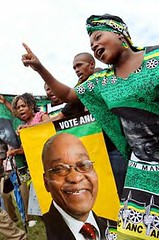
Winning ways while thousands of supporters attended the ANC’s rally at Coca-Cola Stadium. (Photograph: Paul Botes)
Originally uploaded by Pan-African News Wire File PhotosANC denies anti-white hostility in South Africa
Web posted at: 4/6/2010 2:25:59
AFPCAPE TOWN: South Africa’s ruling ANC dismissed yesterday claims of anti-white hostility in the country as tensions flared over a song linked by the far-right and opposition to the murder of a white supremacist. “Any claim that blacks intend to harm other race groups – particular our white compatriots – is baseless and devoid of all truth,” the African National Congress (ANC) said in a statement.
White supremacist Eugene Terre’Blanche was killed on Saturday by black workers on his farm in an alleged pay dispute.
His far-right Afrikaner Resistance Movement (AWB) has linked the killing to a song from the struggle to end apartheid that contains the slogan “kill the boer”, an Afrikaans word for a farmer that refers to white South Africans. The song was banned by two court rulings after the ANC’s controversial youth leader, Julius Malema, sang it in public in March. He sang it again in Harare at the weekend. Opposition groups claim it incites violence against whites.
The ANC statement said that linking the song to Terre’Blanche’s murder was “not only mischievous but also inciteful and meant to fuel racial polarisation in our country during a highly emotion-charged and sensitive moment”.
“Let us not add fuel to an already very sensitive atmosphere in the wake of Terre’Blanche’s death by making unfounded and dangerous speculative statements,” it said. The party has said it will challenge the ban on the song, arguing it is part of South Africa’s liberation history.
The murder of a white supremacist leader has presented Jacob Zuma with an acute test of his bridge-building skills as he tries to stop the biggest racial storm of South Africa’s raging out of control. Since becoming South Africa’s third elected black president less than a year ago, Zuma has engaged minorities, including Afrikaners, and vowed to keep the country on the path of reconciliation laid by former leader Nelson Mandela.
A day after Terre’Blanche’s death, Zuma appeared on state television, condemning the killing and calling for calm – as the extremist Afrikaner Resistance Movement (AWB) vowed to avenge his brutal killing. A political analyst at the Johannesburg’s Institute for Global Dialogue described the current situation as the most testing episode for Zuma’s leadership skills and the country since he took office.
Statement from the officials of the ANC
30 March 2010
In their normal weekly meeting, held yesterday, March 29, 2010, at the ANC Head Office in Luthuli House, the officials of the ANC did a detailed analysis of the current political environment, with particular reference to the emerging racial polarization of our society. In their analysis, the Officials came to the conclusion that the hot debate about the freedom struggle song is a manifestation of a society that has not come to terms with itself. We are dealing with a society that wants to wish its own history away by picking up on any petty issue that trigger disagreement and conflict. Irritation resulting from pronouncements made by the ANCYL President from time to time is elevated to defining how our society should be shaped. The debate about one of the many liberation songs is dealing with symptoms rather than the real issues that need our attention.
The officials of the ANC expressed concern about the determination by some interest groups use of courts over political issues and to seek to eradicate our proud history and heritage through unenforceable judgements such as declaring the struggle songs as unconstitutional.
The struggle for our freedom was declared as just by the entire world, it is apartheid that was declared evil against humanity. Going through the judgement by the South Gauteng High Court we were even more worried to find that the applicant and the respondent are belonging to the same organization, but differ on technicalities of the case. It appears to us that an artificial contestation was created to arrive at a pre-determined outcome.
In view of the above the ANC: –
* Will appeal the judgement and seek to get a more correct constitutional interpretation of the many liberation struggle songs which form a big and important part of our history.
* Will file an application to the equality court to test whether the publicly announced prosecute Malema campaign by the Freedom Front constitutes real hate speech or not.We also reminded ourselves that part of our ugly history is that when the rightwing groups started an aggressive propaganda about individual members of our movement in the past such members ended up being assassinated. We are hoping that there is no attempt to create such an environment around the young man, Malema, irrespective of the irritation we may be having with him.
* The announcement by the Pan African Congress Youth that Malema will be found either in hospital or in the mortuary is not just hate speech but a public declaration of the intention to kill. The ANC takes it very seriously and expect law enforcement agies to follow this threat through.
* Welcomes the appropriate approach used by a group of journalists who have directly approached the ANC with a complaint regarding the spokesperson of the ANCYL, and that complaint will be attended to immediately.We will participate in any initiatives aimed at preserving our history and heritage as a country and a nation. We must own our history and heritage whether good or bad. We must talk more about the genocide against the Khoi San, the wars of dispossession, and the concentration camps during the South African war. We must be more open about the longest struggle for freedom carried out by the oldest liberation movement in the continent and the various phases thereof.
We must accept that thirty years of this struggle had armed insurrection as one of the pillars. During this phase of the struggle songs that capture the mood and the moment were sung to mobilize our people to be part of determining their own future. These songs cannot be regarded as hate speech or unconstitutional. Any judgement that describes them as such is impractical and unimplementable.
We must all come together and discuss ways and means of preserving this history and heritage, cautious enough to avoid offending each other. In this process there must be no group that will project itself as having the monopoly of victimhood. We must strive to link the Freedom Park and the Voortrekkerhoogte monuments into a single precinct.
We must systematically own all our history and heritage and undo the appropriation of parts of our history and heritage to individual nationalities in the country. We are a single nation that must work together in building our country. Easy legal victories by any grouping in society will further polarize our society. All the institutions must make a positive contribution in this process rather than artificially using tensions in society to argue for “independence”.
We believe that all of us, as South Africans, including institutions created to uphold our democracy, can learn a lot from the thought that informed the crafting of our National Anthem.
Issued by:
Gwede Mantashe
ANC Secretary GeneralEnquiries:
Jackson Mthembu 0823708401
Ishmael Mnisi 0823335550 -
Huge RNAi Breakthroughs!
Once again, huge scientific news has disrupted my plans. Last week, I put off giving you additional news on the quest for an Alzheimer’s disease cure as well as some fascinating and related data on the health benefits of coffee. The reason, as you know, was that two companies in our portfolio announced truly historic breakthroughs in stem cell science.
Remarkably, the same basic thing has happened again. This last week, three major scientific developments were announced regarding progress in the field of RNA interference. Once again, some of the companies involved are in our portfolio. (I will refer to them as “Company X” and “Company Z.”)
As I’ve said many times, we know that RNA interference is one of the most important areas of scientific inquiry. The reason is that the RNAi mechanism offers us a means of controlling individual genes. This, in turn, offers the theoretical means of curing nearly every disease suffered by humans, animals or plants.
Though scientists were aware of some of the actions involved in RNAi, it was one article published in the critically important journal Nature that put all the pieces together. That was in 1998, and the article was titled, “Potent and Specific Genetic Interference by Double-stranded RNA in Caenorhabditis Elegans.” In 2006, two of the authors, Craig Mello and Andrew Fire, were awarded the Nobel Prize for that critical work.
This article rocked the scientific world. Allow me to characterize the big picture that emerged from that article.
Basically, the master genetic program in our cells, DNA, never willingly exposes itself to any outside influence. Rather, it operates behind biological fire walls that protect it from viruses and other invaders. It communicates, however, via messenger molecules. These are called messenger RNA or mRNA. The mRNA molecules, in turns, “encode” or synthesize proteins that actually spread the DNA’s commands.
RNA interference, as the name implies, is a natural means of disrupting that process. Our cells use a complex, but fascinating mechanism called RNA-induced silencing complex (RISC) for all kinds of natural functions. It can be thought of as part of the immune system, as it protects from viral invaders, but it is also part of our gene regulation system. It can also, however, be manipulated to accomplish other ends.
I find it useful to think of this process, simplistically of course, as a kind of computer virus-protection program. Computer programs such as Symantec’s Norton AntiVirus and Trend Micro’s PC-cillin have large databases of “evil code.” They scan your computer, incoming data and external drives looking for code sequences that are in the database of evil code. If it finds evil code, the security program attempts to block it from interacting with your computer.
Anti-virus software periodically updates by downloading new additions to its database of evil code. In a sense, RNAi offers scientists a way to hack those evil code updates and inject their own code sequences. It could be exploited to send RNA sequences that would provoke the body to block the operation of particular encoded proteins.
For example, there is a protein code that enables the capillary growth that causes blindness through wet macular degeneration or tumor growth. Scientists know what code sequence to add to the evil code database that will stop excess capillary growth. Eventually, I believe, we will know what code blocks Parkinson’s disease, glaucoma, kidney disease, autism and on and on and on. By introducing the right small RNA molecules, we can provoke the body to disrupt the chain of communication that results in those conditions. It is even possible to increase the production of proteins that increase health or reverse damage.
Hopefully, cell biologists in the audience will forgive my crude metaphors. Regardless, when that Nature article was published, scientists began the quest to figure out just how to use RNAi to cure diseases. Universally, they encountered one enormous obstacle. These small RNA sequences are exceptionally fragile. Under normal conditions, they are quickly destroyed by the immune system.
This is not dissimilar, by the way, to security and virus protection software. The ultimate goal of the “black hat” hacker is to penetrate and exploit the anti-virus security programs themselves. If a hacker could hijack the process by which these get information about new threats, the database updates, he would “own” the computer and could do anything he wanted. Consequently, your anti-virus program has a level of safeguards built into it that far exceeds those of normal programs.
Because the RNAi mechanism performs similar functions, such as scanning and blocking unwanted actions, that biological system offers similar controls over the system. It is, therefore, not only scientists who want to exploit the system. It is logical target of sophisticated microorganisms that evolve constantly in an effort to hijack your immune system. As a result, we have particularly strong defenses against interfering with the RNAi process.
It is extremely difficult to get small therapeutic RNA sequences past the immune system into the right cells to cure diseases. Some scientists believed that it might be possible to deliver RNA interfering sequences locally, by injection into a tumor, for example. The problems associated with developing a systemic delivery system that could be taken orally or injected but that would then act only on target cells seemed almost insurmountable. In fact, many scientists believed it was impossible in higher life-forms, particularly humans.
Last week, we learned definitively that it is not impossible. In a major scientific journal, “Company X’s” scientists presented peer-reviewed proof that they have done it.
Simply put, the anti-cancer drug that Company X tested is valuable. More valuable, however, is Company X’s proprietary platform that produced the successful RNAi delivery solution. With this successful test of a systemic RNAi cancer drug in humans, Company X’s ability to deliver other interfering sequences to target molecules will be attracting serious attention from Big Pharma.
Every big pharmaceutical company has an ongoing RNAi delivery research program. Merck has admitted that it has tested hundreds of methods unsuccessfully. Company X, however, was the first to prove it could make a systemic RNAi drug for humans. I would be astonished if Company X does not sign some sort of agreement with Big Pharma within the year.
While Company X has clearly scored a major coup, it is by no means alone in the quest for RNAi delivery methods. In fact, “Company Z” announced a successful delivery mechanism last week as well. Company Z tests involved local surgical delivery into the skin of rats, but the results indicate that it has found a way to beat the delivery problem. I spoke with the CEO of Company Z. He is clearly confident that further tests will show the systemic effect of this technology in humans.
I think that the events of the week emphasize several crucial aspects of the field of RNA interference. One, obviously, is that progress is being made very rapidly. After I interviewed Craig Mello a year and a half ago, I told you this. Still, it’s difficult even for insiders to keep up. This is the result partly of the fact that progress in so many related fields, such as human genomics, continues to accelerate.
Another characteristic of this field is that it appears there will be multiple winners. The delivery mechanisms used by Company X and Company Z are quite different, but both have demonstrated efficacy. It remains to be seen which will be more effective for which diseases. Personally, I believe there will be multiple winners.
In fact, as I was writing this column, two more important news stories broke concerning our other RNAi companies. Therefore, to say that developments are breaking quickly in RNA interference is an understatement. It is extremely meaningful that all this action on the RNAi front seems to be coming from aggressive small caps, not bureaucratic Big Pharma. Nobody knows, at this point, how everything will shake out in the next few years. The rational investment strategy, therefore, is to own a portfolio of the most promising of these entrepreneurial companies.
It’s possible that all these RNAi innovators in our portfolio will do well simply because the promise of RNA interference is so incredible. As one unnamed biotech CEO recently told me, “We’re not going to run out of sick people to treat. There is, unfortunately, no disease shortage.”
We now know with certainty, because of the week’s events, that RNAi can be delivered effectively. There are still details to be worked out, but this is truly great news.
Patrick Cox
for The Daily Reckoning AustraliaSimilar Posts:
-
We need birth control, not geoengineering
by Lisa Hymas
I’ve written about my
choice not to have children. What’s
all too easy to forget is that many women still don’t have any reasonable choice about their fertility.An estimated 200 million women around the world don’t have
access to family-planning tools. If they
did, 52 million unwanted pregnancies could be averted every year, according to the Guttmacher Institute [PDF].I’m not talking government mandates or coercion or
heavy-handed tactics—those approaches aren’t just ethically dubious, they’re
wholly unnecessary. We just need to give
every woman everywhere contraceptive options so she can have basic control over
how many children she has and how close together she has them—something that
we in the developed world take completely for granted. If we did so, many women would choose on
their own to have fewer children, or to space them further apart. Not only would there be fewer new
bodies on our already crowded planet, but the lives of women and the children
they do choose to have would be
improved.Most green groups don’t like to talk about all this—population
has become the third rail of the environmental community (more on that in a
future post).Technologists don’t like to either—they’d rather talk
about traveling-wave
nuclear reactors and CO2-sucking
machines and space
sunshades. We do need to explore and invest in cleantech options; climate change is serious enough that it requires all of our best efforts in all arenas.But it may be that many of the technologies with the most
potential for averting climate change already exist—the Pill, the condom,
the IUD. We just need to spread them far
and wide.GINK: green inclinations, no kidsBetter still, providing contraception to women who lack it
is one of the most cost-effective ways to curb greenhouse-gas emissions. Each $7 spent on basic family planning over
the next four decades would reduce global CO2 emissions by more than a metric
ton, while achieving that same reduction with the leading low-carbon technologies would
cost a minimum of $32, according to a recent study by
the London School of Economics [PDF], commissioned by the Optimum
Population Trust. And if you compare
contraception to the potential costs of geoengineering,
the potential savings are even more massive.As Laurie Mazur puts it in
the Bulletin of the Atomic Scientists,[T]he developed countries’ share of
the cost to provide reproductive health services for every woman on earth is
$20 billion—about what the bankers on Wall Street gave themselves in bonuses
[in 2008]. The U.S. share of the cost is
$1 billion, less than 2 percent of what the United States will spend on the war
in Afghanistan [in 2009]. In contrast,
the scheme to launch mirrors into space is estimated to cost a few trillion
dollars.When you look at those numbers, paying for condoms and IUDs
looks to be not just a huge bargain, but startlingly sane. It may not be as
sexy as space mirrors, but when’s the last time sexy solved a pressing global
problem?Related Links:
Debunking the “you’d be a great green parent” argument
Say it loud: I’m childfree and I’m proud
Population growth should be curbed, argues Jane Goodall
-
2 people killed, 1 injured in Compton tire store robbery
Two people were killed and a third was injured Monday night during a robbery at a Compton tire shop, authorities said.
Deputies from the Los Angeles County Sheriff’s Department responded shortly before 10 p.m.. to a burglary-in-progress call at Custom City Auto on North Long Beach Boulevard, said sheriff’s Sgt. Ulysses Cruz.
Officers found three people shot at the scene. Two were dead and the one survivor was taken to a hospital.
Three suspects were taken into custody shortly after the shooting and were being questioned, Cruz said.
No other details were immediately available.
— Joel Rubin
-
Beware The Seductive Power Of Surveillance
Jessie Hirsh has a great blog post about the seductive power of surveillance, covering how surveillance systems put in place with limitations and for the best of intentions almost always get abused, as it just becomes too tempting to use them to a much greater level. The example he discusses, of course, is the recent webcam scandal involving a school that used webcam images of a student at home in a disciplinary action. In that case, the “surveillance” was intended for recovering lost or stolen laptops only, but the mandate was allegedly “expanded” when an image taken (supposedly because a “loaner” laptop had been taken off campus) also showed the student eating candy that the school administrators thought were drugs.
Hirsh also points out that, beyond the temptation to just expand what’s monitored, being able to watch over someone just has it’s own (potentially dangerous) addictive quality as well — by noting “the intoxication people feel from being the watcher.” That also, I believe, is a part of the reason why law enforcement is always so keen on increasing surveillance efforts. It’s just incredibly powerful to be able to watch over others.
It’s definitely something that needs to be thought about carefully, as we become an increasingly watched society. But how do you deal with it? Hirsh brings up the idea — proposed many times before — of being able to watch the watchers or even to open up the surveillance process to the public to have them help out. This horrifies some people, but it’s at least something that people need to think about. Greater amounts of surveillance in society aren’t likely to go away any time soon — so recognizing the risks associated with it and coming up with unique and innovative solutions to deal with (or minimize) those risks makes sense.
Permalink | Comments | Email This Story
-
South African Farmworkers Are Suspects in the Killing of White Racist Eugene Terreblanche
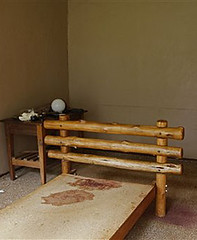
Scene of the murder: The bed upon which AWB leader Eugene Terre’Blanche was killed on his farm on the outskirts of Ventersdorp, is pictured on Monday.
Originally uploaded by Pan-African News Wire File PhotosMother tells how son killed Terre’Blanche
THOMAS PHAKANE AND MICHELLE FAUL | VENTERSDORP, SOUTH AFRICA – Apr 05 2010 15:27
The mother of a 15-year-old murder suspect said on Monday that her son struck Eugene Terre’Blanche with an iron rod after the farmer refused to pay him, a slaying that heightens racial tensions as South Africa prepares to host the Soccer World Cup.
“My son admitted that they did the killing,” the mother said in an exclusive interview with AP Television News conducted in Tswana from her two-room cement home in Tshing township on the outskirts of Ventersdorp.
She said she spoke to the teenager at Ventersdorp police station on Saturday after he turned himself in along with his alleged accomplice, a 28-year-old farm worker, following the slaying of Terre’Blanche.
Police have refused to identify either of the suspects by name.
Under South African law, a minor accused of any charge cannot be identified without permission from a judge.
Terre’Blanche (69) was leader of the far-right Afrikaner Weerstandsbeweging movement, which said it planned to march on Monday on the police station to demand the police bring out the two suspects. Police say the two have been charged with murder and were expected to appear in court on Tuesday.
Officials appear anxious to show they are swiftly handling the crime, which comes just 10 weeks before South Africa becomes the first African nation to host the Soccer World Cup.
Terre’Blanche’s slaying also comes at a time of heightened racial tension in the country.
‘Hit him with three blows’
The mother said her 15-year-old son told her that when he and his co-worker asked Terre’Blanche for their money, he told them first to bring in the cows. After they had brought in the cows they again asked for their money, which he then refused to give them.
“He said that the [labourer] man told him to wait while he went to the storeroom. He came back with an iron rod. He started hitting Terre’Blanche, with four blows to the head. Then my son says he took
the iron rod and hit him with three blows,” the mother said.“My son was a person who doesn’t like to be in trouble,” she said softly, appearing a bit bewildered and scared.
At the farm on Monday, a big grader was being used to dig a hole for Terre’Blanche in the family graveyard, where he is to be buried after a church service in Ventersdorp on Friday.
“This was such an unnecessary thing,” Terre’Blanche’s brother, Andries, said as he sat on a gray marble grave. “We are not racists, we just believe in purity of race.”
‘Declaration of war’
AWB’s members still seek to create an all-white republic within mostly black South Africa.
The group’s leaders have been using Terre’Blanche’s killing as a rallying point for their cause, with secretary general Andre Visagie claiming on Sunday that Terre’Blanche’s brutal death was “a declaration of war” by blacks against whites.
He also warned countries against sending their soccer teams without protection to “a land of murder”.
Visagie and other members of the group have blamed African National Congress Youth League leader Julius Malema, saying he spread hate speech that led to Terre’Blanche’s killing.
Malema incited controversy last month when he led college students in a song that includes the lyrics “kill the boer”.
The song sparked a legal battle in which the ruling ANC party challenged a high court that ruled the lyrics as unconstitutional.
The ANC insists the song Ayesaba Amagwala [The Cowards are Scared] is a valuable part of its cultural heritage and that the lyrics — which also refer to the farmers as thieves and rapists — are not intended literally and are therefore not hate speech.
Visagie said the 15-year-old suspect was a casual worker and that the 28-year-old man was a full-time employee who had been taking care of the garden of the family home in Ventersdorp.
Terre’Blanche had been spending most of his time there since he had heart surgery a few weeks ago.
Terre’Blanche had previously been convicted for a brutal attack on two black farm workers and was sentenced to six years in prison.
He re-emerged in 2004 as a born-again Christian with renewed vigour for his cause. The movement always has been on the fringes, estimated to have no more than 70 000 members at its height in the early 1990s out of a population of nearly 50-million.
‘The murderers kept on beating his body’
Police said Terre’Blanche was lying on his bed when he was attacked between 5pm and 6pm on Saturday.
The mother’s account that there was only one murder weapon — an iron rod — did not fit police reports that a machete and a knobkerrie were the murder instruments found at the scene.
Visagie said Terre’Blanche was bludgeoned so badly he was barely recognisable and described a gory murder scene indicative of great rage when he visited the farm on Sunday.
“There was blood all over the place, pools on the mattress, the pillow, the floor and splatters on the walls and ceiling,” he said.
“The deductions I make is that he was killed almost instantaneously but the murderers kept on beating his body and chopping his corpse with the panga.”
Terre’Blanche, who would appear at rallies astride a black horse, founded the movement that was to the right of South Africa’s apartheid government in the 1970s. Masked AWB “stormtroopers” in black or khaki uniforms terrorised black South Africans in the years leading up to majority rule. The AWB’s red, white and black insignia resembles a Nazi swastika, but with three prongs instead of four. – Sapa-AP
Source: Mail & Guardian Online
Web Address: http://www.mg.co.za/article/2010-04-05-mother-tells-how-son-killed-terreblancheTerre’Blanche killing: AWB vows revenge
Apr 05 2010 06:21
The Afrikaner Weerstandsbeweging (AWB) has vowed to exact revenge for the death of their leader as the country’s president, Jacob Zuma, sought to calm growing racial tensions.
Eugene Terre’Blanche, leader of the AWB movement, was found bludgeoned and hacked to death on Saturday at his farm in Ventersdorp. Two black farm workers involved in an apparent wage dispute were arrested at the scene.
The AWB has since ramped up the language of a race war. Its spokesperson, Andre Visagie, said: “The death of Mr Terre’Blanche is a declaration of war by the black community of South Africa to the white community that has been killed for 10 years on end.”
Land of murder
Visagie warned other countries to avoid sending their teams to the Soccer World Cup in June as they would be travelling “to a land of murder”. He added: “We will decide upon the action we are going to take to avenge Mr Terre’Blanche’s death.”
The AWB accused African National Congress Youth League leader Julius Malema of having blood on his hands. It blamed the killing on his recent singing of the apartheid-era protest song Ayesaba Amagwala [The Cowards are Scared].
Malema expressed fear that his life was at risk, citing a right-wing conspiracy. Last week the ANC said it was concerned about an SMS in circulation which appeared to offer a bounty for his death. The ANC has defended the song as no more than a way to remember a history of oppression, but a party spokesperson said it would now re-examine the issue in the light of recent criticism.
On Sunday at Ventersdorp, in the North West Province, AWB followers clad in paramilitary khaki laid flowers at the gate of Terre’Blanche’s farm.
The 69-year-old was killed by two farm workers who claimed that he refused to pay them their monthly salaries of R350 rand each. The workers, aged 21 and 15, reportedly smashed a window to enter Terre’Blanche’s home and killed him with a knobkerrie and a panga. A police source told the Sunday Times the pair alleged Terre’Blanche had threatened to kill them when they went to his farm for their money. “They claim they killed him in self defence,” the officer said.
The men, who were said to have waited for police to arrive and arrest them, are due to appear in court on Tuesday.
The killing sparked fierce debate on race relations in a country where white farmers have become increasingly vocal, claiming thousands of them have been murdered since the end of white minority rule in 1994.
Last month the former president F W De Klerk wrote to Zuma warning that Malema was creating an increasingly febrile mood. He said: “All this is beginning to create a volatile atmosphere in which any additional intemperate statement or action might spark an unfortunate incident.”
Explosive case
Frans Cronje, deputy director of the South African Institute of Race Relations, said: “It could be an explosive case, especially if the ANC don’t back down.”
Zuma appealed for calm following the “terrible deed”. In a statement he asked South Africans not to allow “agent provocateurs” to take advantage of the situation by “inciting or fuelling racial hatred”.
Political leaders in South Africa must “think” before they make statements, which could be “misunderstood”, Zuma said on South African Broadcasting Corporation radio on Saturday.
“This happening must indeed say to us as leaders we need to think before we make statements in public that might be misunderstood to be encouraging the opposite of what we are trying to do — to build our new nation — irrespective of what quarter they come from, so that no one could attempt to say that what we say is not helping the process of nation-building”
On Sunday night, Zuma said calm needed to prevail in South Africa.
“All leaders who lead this country, from different political formations and non-governmental organisations, should unite in the call for calm.
“I know for a fact that those who have been close to Mr Terre’Blanche, they must be feeling a pain, but it is this time that we take our leadership responsibility to make this country unite in calling for a stop of violence,” said Zuma. “Violent crime must be stopped and defeated by all of us.”
Zuma, who said Terre’Blanche’s murder was a “sad moment” for the country termed the act “cowardly”.
“I condemn this cowardly act and the murder of Mr Terre’Blanche. It’s not acceptable in our society. In due course we will know what is it that led to this terrible action.”
‘Has-been personality’
Jackson Mthembu, an ANC spokesperson, also denied any causal link between the protest song and the murder of Terre’Blanche. But he also appeared to shift the party’s position: “The ANC is prepared to look at whether it is appropriate to continue singing it in this manner. We will … look at what we can do.”
The opposition Democratic Alliance warned of a risk of polarisation with a dangerous outcome. Leader Helen Zille, said: “The murder of Eugene Terre’Blanche will inevitably polarise and inflame passions in South Africa at a time when tensions are already running high … This could have tragic consequences and it is essential that all leaders stand together now and call for calm.”
Terre’Blanche had threatened war on South Africa’s white minority government in the 1980s when it began to make what he considered dangerous concessions that endangered South Africa’s white race. Described yesterday as a bully and buffoon, his predictions of doom under a multiracial democracy proved hollow and his support dwindled to a tiny rump.
“He was a has-been personality,” said Allister Sparks, a veteran political analyst. “His influence is absolutely minimal. I regarded him as one of the most remarkably powerful orators I’ve ever heard. He spoke with a great passion and could really move people, but that was before 1994 when he was trying to mount his rather crazy resistance campaign.” –
Sapa, guardian.co.uk © Guardian News and Media 2010
Source: Mail & Guardian Online
Web Address: http://www.mg.co.za/article/2010-04-05-terreblanche-killing-awb-vows-revengeAWB warned to stay away from court
JOHANNESBURG, SOUTH AFRICA Apr 06 2010 07:37
North West public safety minister Howard Yawa on Monday warned the Afrikaner Weerstandsbeweging (AWB) against marching to the Ventersdorp Court on Tuesday.
A 21-year-old man and a 15-year-old boy have been arrested for allegedly killing AWB leader Eugene Terre’Blanche on his farm on Saturday. They were expected to appear in the Ventersdorp Magistrate’s Court on charges of murder on Tuesday.
Yawa warned that any person who participates in the illegal march would be arrested.
Yawa said the march had apparently been organised to demand the handover of the two suspects.
“Our constitutional democracy enjoins all of us to defend the rule of law at all costs” said Yawa in a statement.
Yawa welcomed the retraction of a threat to avenge Terre’Blanche’s death by the AWB.
AWB spokesperson Pieter Steyn retracted their threat to avenge their leader’s death on Monday after declaring war on Sunday.
Yawa described this decision as a “sensible and positive development”.
‘They did the killing’
The mother of a 15-year-old suspect said on Monday that her son struck Terre’Blanche with an iron rod after the farmer refused to pay him.
“My son admitted that they did the killing,” the mother said from her two-room cement home in Tshing township on the outskirts of Ventersdorp.
She said she spoke to the teenager at Ventersdorp police station on Saturday after he turned himself in along with his alleged accomplice.
The mother said her 15-year-old son told her that when he and his co-worker asked Terre’Blanche for their money, he told them first to bring in the cows. After they had brought in the cows they again asked for their money, which he then refused to give them.
“He said that the man told him to wait while he went to the storeroom. He came back with an iron rod. He started hitting Terre’Blanche, with four blows to the head. Then my son says he took the iron rod and hit him with three blows,” the mother said.
“My son was a person who doesn’t like to be in trouble,” she said softly, appearing a bit bewildered and scared.
Cool tensions
The African National Congress on Monday brushed off accusations of fuelling racial tension amid fears of a bloody backlash.
Anger over the death of the AWB founder has shifted to the singing of Ayesaba Amagwala [The Cowards are Scared], which is being blamed for triggering the leader’s death.
The provocative anti-apartheid song has been recently revived by ANC Youth League leader Julius Malema, who has sung it at public gatherings.
“Any claim that blacks intend to harm other race groups — [in] particular our white compatriots — is baseless and devoid of all truth,” the ANC said in a statement.
“Let us not add fuel to an already very sensitive atmosphere in the wake of Mr Terre’Blanche’s death by making unfounded and dangerous speculative statements,” the party said.
The youth leader has rejected the accusations which were carried on the front page of Monday’s Beeld newspaper with the headline, “The song is the culprit”.
“We have nothing to do with his death,” Malema told reporters in Harare on Tuesday while on a visit to Zimbabwe hosted by President Robert Mugabe’s Zanu-PF youth.
“I am not going to be terrorised by right-wingers in our country. I am not scared.”
The right-winger’s funeral on Friday is expected to draw hundreds of AWB supporters.
The extremist leader — found with a machete still embedded in his flesh — will be buried on his farm. – Sapa, AFP
Source: Mail & Guardian Online
Web Address: http://www.mg.co.za/article/2010-04-06-awb-warned-to-stay-away-from-court -
LifeSign QuitKey Smoking Cessation Computer

QuitKey alters your smoking routine and eases you off cigarettes gradually. QuitKey reminds you when to smoke and when not to smoke. Step by step. Hour by hour. One day at a time. The QuitKey approach to quit smoking culminates 20 years of research. It was developed and proven effective with grants from the National Institutes of Health and builds on the enormous success of LifeSign, a first generation smoking cessation computer that uses the same gradual reduction technology. QuitKey works in two stages. Stage 1 (7 days): You smoke at your normal rate and use the QuitKey smoke button to record every cigarette you smoke. QuitKey uses this information to form your personal quit plan. Stage 2 (14 to 34 days): QuitKey helps you follow your quit plan by prompting you when to smoke. Each day you smoke less and gradually reduce you nicotine dependence while preparing yourself to quit for good.
View LifeSign QuitKey Smoking Cessation Computer details
-
EGGGZ: It’s okay to put all your EGGGZ in one basket
Constantly seeking games to distract and lure my significant other into understanding my phone fetish, I downloaded EGGGZ Lite for free from the market. Developed by Smartpix Games, the developers of Jewellust, it puts you in the place of an understaffed farmer with a shack for a farm.
The game is actually a very simple tap-and-collect format, where you hustle to nab all the regular and golden eggs. Some golden eggs can provide bonuses to prevent egg breaks, add lives, and slow down the onslaught. Better still they are your currency to upgrade your farm’s size and even add animals to protect and distract against nuisances like overly fertile hens and thieving raccoons.
While the game play is simple, EGGGZ Lite is a great distraction and can become addicting. The game has two modes Campaign and World Championship. You start in campaign and once you’ve developed your farm enough can also play World Championship, where you compete for high score with the world.
Another benefit of EGGGZ Lite is that you hardly notice that it is not the full version. Playing the game I kept waiting to see limitations and was surprised to find none. I honestly had to stop and think before realizing that the only thing I’m missing is a profile. If you buy the game you will actually be able to have seven profiles and they’ll be secured online, but the only time you’ll need a profile is for World Championship mode. If you’re hooked until your farm is eligible to play World Championship, buy the game (support the developers!).
EGGGZ Lite is not a tool to convert anyone to ‘Team Android.’ My girlfriend in fact was mostly concerned with why the farmer had no overalls, and why was he a pilgrim. Nonetheless, at no charge EGGGZ Lite is definitely worth giving a shot when in need of a distraction. Its easy to learn game play and ‘Safe Start’ feature make it perfect game for a work break or short trip.
The Good
- Cute Graphics
- Provides most features of the game despite being ‘lite’ version
- ‘Safe Start’ Feature to avoid force close issue in previous versions
Needs Improvement
- Did experience lag periodically
- The ability to tap the raccoon and send him away would be helpful
- Farmer could look, well, more like a farmer
Final Verdict


Note: This review was submitted by Darius Bazemore as part of our app review contest.
Related Posts
-
Loving the Shutters
“With all this good news coming out, Mr. Bonner, don’t you think you should admit that the Great Correction is already over?” asks a dear reader.
No.
Any other questions?
“Too bad about their house,” said a neighbor in Maryland. “They built a house out of straw bales. Very pretty. Very energy efficient. But then it caught fire and burned to the ground.
“They should have used bricks…”
Back on the family farm, we’re able to see what 15 years did our handiwork. Fortunately, we were never tempted to build a house out of straw bales (we figured they were too vulnerable to leaks)…but we tried a number of other things.
For example, we were pioneers of passive solar heating. And ferro-cement. We built a ferro-cement workshop with insulated glass at a 45 degree angle, facing the sun. There were problems immediately. It was so hot in the summer that we had to roll out a blue awning…that made us feel like were underwater when we were inside.
Then, we got the bright idea of planting trees on either side. In the summer, their leaves would shield the shop from the sun. In the winter, the leaves would fall.
This worked very well. The trees are much bigger now. They do the job. The trouble is that something went wrong with the glass. It has clouded over and now needs to be replaced.
On one of the barn roofs, we used something called “Onduline” – or something like that – rather than tin. It came in sheets, but had the form of barrel tile. It was also cheap and easy to put on. Didn’t look bad. We can’t remember how long it was supposed to last, but less than 20 years later it is full of holes.
The tin roofs, on the other hand, are still in good shape. The oldest ones are covered with rust. But they can be repainted easily.
In the main house, we used poplar for the floors, from trees that we had cut on the farm. It was very pretty – still is. But it is soft. It has been scratched and dented in many places. Now, we have to refinish the floors.
But the biggest disappointment was the wood shutters. The main house has real, functional wood shutters. We love the shutters. You can use them to control the sunlight, so the heat of the summer sun doesn’t enter the house. And in the winter, when we’re not at home, we close the shutters to keep the carpets and drapes from fading.
In the old days, almost all houses had working shutters made of oak. The ones on our grandmother’s house are still there…and still in good shape after more than 100 years. But when we went to get wood shutters for our house in 1993, they no longer made them in oak. The new ones were made of pine or fir. Nevertheless, since they were protected from the weather by several layers of paint, and set back at least two feet inside the overhang and gutter, we didn’t expect any trouble with them. But here we are 17 years later and half of them are rotten and will need to be replaced.
Unfortunately, they are unusually large…and very expensive to make.
Regards,
Bill Bonner
for The Daily Reckoning AustraliaSimilar Posts:
-
Artist Zwelethu Methethwa to Launch Monograph This Month in South Africa
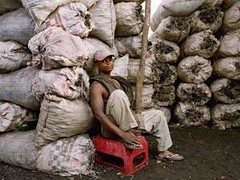
A coal miner in South Africa during 2003. This is a photo by Zwelethu Mthethwa.
Originally uploaded by Pan-African News Wire File PhotosMthethwa’s balancing act
LAUREN CLIFFORD-HOLMES | JOHANNESBURG, SOUTH AFRICA – Apr 01 2010 14:01
Artist Zwelethu Mthethwa’s long-awaited monograph will be launched this month. Simply titled Zwelethu Mthethwa, and published by the Aperture Foundation in New York, it provides an overview of Mthethwa’s photographic work to date and features the portraits that have brought him international acclaim.
In his essay, titled Photography after the End of Documentary Realism, Okwui Enwezor of the San Francisco Art Institute concludes that Mthethwa “challenges conventional ideas of the black subject as a ground-down, disposessed, disempowered and abject figure in need of social sympathy.
“His grand images present the emancipatory possibility of colour; its ability to infuse life into beleagured communities and to speak persuasively of the dignity of the subjects in the face of their entrapment.”
Why the decision to move from painting into photography in 1996 and what were your reasons for avoiding the black-and-white medium?
Well, I’ve never really moved from painting to photography. Photography has always been part of my life. When I was a kid — I think I was around six years old — I went to movies every Saturday. I think that’s where everything started. So I am very much influenced by cinema, by photography and growing up. The first books I think I read were comic books. Comic books are like still photographs.
When I was a teenager — maybe when I was around 13 — I got my first camera and I started taking photographs. I drew as well as a young kid, so I have always traded between photography and drawing and painting.
In Okwui Enwezor’s prologue to your book he starts by saying “South Africa’s often-told story is always framed by the experience of apartheid”. How do you respond to this statement?
I think that is very true, because when you look at the land issue, it covers almost everything — who has the right to own the land, who has the right to build a house, to own a plot, who has the right to own a field? We are framed by that. You know, when you move people from the cities back to the rural areas, when you deport people, these [experiences] are framed by the issues of land and ownership.
How do you reconcile framing black South Africans as dignified and defiant, even under the duress of social and economic hardship, which beautifies poverty?
There is a very thin line when I photograph black people who are poor and I make them public, or I show them in exhibitions, because I’m treading in very shallow waters here. It is so easy to make poverty beautiful. It is so easy to idealise things. But if you look at the history of how black people have been photographed, or how black people have been placed in our history, it’s a very interesting journey.
One must go back to the time when you had to have an identity document, which used to be called a “dompas”. If you look at those photographs, which were black and white but were highly underexposed, they used strong flash bulbs that deleted all the details that we have on our faces. You were just left with the nose, the eyes and the mouth. And most of the eyes would be shut because of the strong light.
So, those pictures were ethnographic in a sense because it was just a record that they used to say that you are in this zone; you have a permit. This was your passport to the city. And that was the basis of photography for black people.
If you look at my photographs, they are in colour. The resemblance is very close to what people look like. Now go back to the early 1980s or 1990s — the height of documentary photography in South Africa — and you had photographers who went into different communities, different neighbourhoods, and they took photographs that were black and white. But they didn’t spend a lot of time with the people they were photographing.
Now when you take a photograph in colour you tend to notice the colour of the shirt, or the blouse, you tend to notice the colour of the room, what is on the walls. You are not just looking at poverty, per se, poverty is not right in your eye. You’re looking at the textures. And colour has a history of emotions. In different cultures colour has got meaning.
Basically you deal with key issues: the crisis of dwelling and habitation, and the production of sovereignty, land and labour. Let’s talk about your interiors.
The photographs are a celebration of people who are living. It’s a celebration of life. They are not just used as mere documents for propaganda — it’s in their homes, they live there. They are as real as any other people in this world. They have a choice in the way that they have been photographed. It’s a celebration — they are living, they are human beings. What I choose to show is that people living in these not-very-good-looking conditions have the energy to turn that around and make their homes aesthetically pleasing. Because they make their homes with very little money and their homes are very warm.
Let’s talk about your landscape images, such as the sugarcane series, and the way you have portrayed the dynamic between the subject and the landscape. You have placed subjects to show both their autonomy and their entrapment (or even enslavement) by the land and the labour they perform.
The photographs focusing on sugar-cane cutters refer back to a very old history where man is battling with the field. You know, we try to conquer the Earth, and we exploit and abuse the Earth, but eventually we fail. The Earth will always conquer. And there has always been an interest in and balance between man and land.
Zwelethu Mthethwa: Photographs by Zwelethu Mthethwa will be launched at iArt Gallery, 71 Loop Street, Cape Town, on April 22. To coincide, mural-size photographs by the artist will be shown for the first time in South Africa. For more information visit www.iart.co.za
Source: Mail & Guardian Online
Web Address: http://www.mg.co.za/article/2010-04-01-mthethwas-balancing-act