Blog

  • Facebook phone images leak, likely to be called the HTC First

    htc-first

    Well, if Facebook was trying to hide their phone before the April 4th announcement, they’ve officially failed. We’re getting our first look at the fabled device that’s going to run Facebook’s unique software courtesy of @evleaks on Twitter, and it’s apparently going to be called the HTC First. It is neither HTC’s first phone, nor Facebook’s first attempt at a phone, so I don’t completely understand the naming scheme, but I’m no marketing expert, so maybe I’m just missing something here.

    Weird names aside, the First looks like a pretty slick, although generic, device. We can see a volume rocker on the side, a power button on the top, and three buttons along the bottom bezel, presumably a back, home, and menu button, in that order. The rumors say the phone will sport a 4.3 inch screen, and from this render, I’d say that looks pretty accurate. Either way, we only have a few days left before the official announcement. Anyone excited to see this phone in person?

    source: evleaks

    Come comment on this article: Facebook phone images leak, likely to be called the HTC First

  • 9 transportation devices that could make your commute far more fun

    Boosted-Board-2

    A TED2013 attendee takes a ride on a Boosted Board. Photo: Michael Brands

    When engineering grad students Sanjay Dastoor, John Ulmen and Matthew Tran met at Stanford University, they lamented the fact that there was no good way to get around campus. And so, they invented one: a longboard skateboard fashioned with an electric motor.

    Sanjay Dastoor: A skateboard, with a boostSanjay Dastoor: A skateboard, with a boostIn today’s talk, given at TED2013, the three give demo their Boosted Boards — which charge off a wall outlet, run for 1,000 kilometers on a dollar’s worth of electricity and are powerful enough to go up the famous hills of San Francisco at 10 miles per hour. They are small enough to be carried in hand and have a battery range of six miles.

    “That covers half of the car trips in U.S. alone,” explains Dastoor.

    It’s a fascinating concept — one that would make any skateboard-enthusiast a happy commuter. To see the boards in action, watch this high-energy talk. And below, see several more unusual vehicles that could someday greatly improve the morning commute.

    HirikoA car that folds
    Mentioned in Kent Larson’s TEDx Talk “Brilliant designs to fit more people in every city,” the Hiriko is a tiny two-person vehicle that folds in order to minimize its parking footprint. Three of these small vehicles can fit into one traditional parking space — which would greatly alleviate one of the biggest hassles of car ownership. As the Hiriko website explains, these vehicles are 100% electric and maneuver by spinning — which is just really cool.

    NCycleAn electric bike with handlebars that become a lock
    Several electric bicycles are already on the market, even though they aren’t legal in every city. However, the nCycle is a particularly stylish and smart approach to the concept, which design blog Core77 brought to our attention. Designed with its battery inside a space-age frame, it’s meant to be both sturdy and lightweight. It’s handlebars morph into a lock and it has speakers in the back headlights.

    UnicyclesA motorcycle meets a unicycle
    Another design created for urban commuters, the RYNO (left) is a singe-wheel scooter that looks like something a gang in a sci-fi film would ride. Expected to go into production this year, this vehicle runs on a battery that takes an hour and a half to charge, and lets riders go, go, go for about 20 miles, according to Discovery.com. This vehicle self-balances, but if you want the security of a second wheel — the BMW Halbo (right) may be the vehicle for you.

    A swing for the subway
    A group of Washington D.C. Metro riders caused quite a stir when they posted this video of their “Metro Swing” on Vimeo in 2011. The swing attaches to the metal bars of the Metro, and allows anyone to make their own seat and — if there’s room — to channel their inner 5-year-old by swinging. Though it appears to be farce, they should consider manufacturing it.

    Wheel-RiderA gyroscopic wheel for one
    The Yamaha Wheel Rider looks like it could be a flying saucer. Only instead of moving through the air on its flat face, it rolls along the road on its edge, a la a tire. As The New Ecologist shares, this concept vehicle was designed by Yuji Fujimura and the fin in the back contains its turn signals. An even more beautiful version of a similar idea — Sanu K R’s personal transport system, which the designer tells Gizmag drives via a joystick and stays upright thanks to gyroscopic sensors.

    JetLevThe personal jetpack
    It’s not at all a cheap option — it costs a reported $100,000. But in September of 2012, The Daily Mail told the tale of a British businessman who used a jetpack to travel 40 miles up the Thames to work. This man imported his jetpack from manufacturer JetLev. And this futuristic turn reminds us of Yves Rossy’s TED Talk, “Flying with the Jetman.”

    Boosted-Board-1

    And a Boosted Boards bonus shot: Jim Carrey tests out the board at TED2013. This shot was snapped by Tony Hawk who wrote on Instagram, “Came to #TED2013 for @amandapalmer, stayed to see Jim Carrey ride an electric skateboard (aka@boostedboards). My life is [still] weird.”

  • Nokia’s next-generation flagship Lumia 950 possibly revealed in leaked photo

    Nokia Lumia 950 Photos
    Nokia’s (NOK) next-generation flagship smartphone may have been revealed on Tuesday as the first alleged photo of the upcoming Lumia 950 Windows Phone was published online. Windows Phone Central published the image, though it made clear that it comes from a source it cannot vouch for. If authentic, the device’s styling strays from Nokia’s first two flagship Lumia phones and opts for a more traditional case design.

    Continue reading…

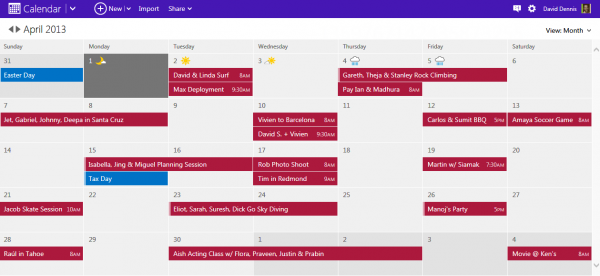
  • It’s about time! Microsoft’s consumer cloud calendar gets a new Outlook

    Windows Live Calendar (there’s supposed to officially be “Hotmail” in there) is dead — or soon will be. Today, Microsoft started rolling out the replacement for Outlook.com users. I’ve got the old one still, which is why the not-quite-lifeless-yet reference.

    There’s some kind of aspirational, Apple-like promotion going on here. “The Outlook.com calendar has been entirely redesigned with a modern, intuitive interface that puts you in control of your schedule”, David Dennis, Microsoft’s Outlook.com Calendar principal program manager lead, beams. Yeah, baby, put me in control. Gimme the mouse clicker.

    But there’s the disappointment of getting the old thing for some of us to contend with. “You can get started with any email address at Outlook.com Calendar as soon as your account is upgraded”, Dennis explains. Hey, that’s not me. You? This week, he promises everyone.

    Seriously, if Dennis really wrote this whole post — not PR Borg — someone should promote him to writing all promotional copy for Office 365 and Outlook on the web. I count 29 uses of “you” and 21 of “your” in his blog post introduction. But it’s more than numbers of “you” and “your” but how they’re expressed to make, well, you feel empowered.

    The subheads separating main text are great examples: “Across your modern smartphones and tablets”; “connected to what you care about”; and “you’re in control of sharing with friends and family”. The tone is clear: What the Outlook.com calendar will do for you. The best marketing convinces you that your life will be better for using product X, Y or Z.

    Perhaps it will be — as long as you aren’t using an Android device. Dennis asserts that “connecting your calendar to your mobile device is easy”. But is it satisfying?

    Google and Microsoft are in this scuffle over ActiveSync, which the search giant dropped. So at Google’s insistence, Microsoft agreed to adopt CalDAV, which Google then also dropped. As such, Android users wanting to sync Google and Outlook.com calendars are consigned to Hotmail Hell.

    Outlook.com for Android is some popular app. Out of 5,659 reviews, 2,642 are one-star. PU. iPhone and Windows Phone users, you can stop laughing now.

  • President Obama Meets with Prime Minister Lee of Singapore

    President Barack Obama delivers remarks with Prime Minister Lee Hsien Loong of the Republic of Singapore

    President Barack Obama delivers remarks with Prime Minister Lee Hsien Loong of the Republic of Singapore prior to a bilateral meeting in the Oval Office, April 2, 2013.

    (Official White House Photo by Lawrence Jackson)

    In a bilateral meeting today with Prime Minister Lee Hsien Loong of Singapore, President Obama reaffirmed America's commitment to a secure and prosperous Asia-Pacific region, and thanked Prime Minster Lee for being “an outstanding partner for us on the international stage.”

    In addition to close military cooperation between the two countries that allows the United States to maintain an effective presence the Pacific, Singapore is also a strong economic partner.

    “Over the last decade, since we signed our free trade agreement, we have seen a doubling of trade between our countries, and that creates jobs here in the United States as well as in Singapore,” the President said.

    read more

  • First Render Of HTC’s ‘Facebook Phone’ Reportedly Leaks Ahead Of Thursday Event

    facebook-phone

    The HTC hardware that’s being prepped as the delivery mechanism for Facebook Home, which has lots more potential than the device itself, supposedly leaked in the image above. The render, tweeted by Evleaks, a consistent source of pre-release Android hardware info, doesn’t look like much: it’s destined to be a mid-range device, after all, according to early leaks.

    The leak also suggests it’ll be called the HTC First, which sounds like a not-so-great play on the HTC One naming scheme. Previous info had it codenamed the HTC Myst, which at least brought to mind the popular point-and-click adventure game. The name ‘First’ at least evokes the idea that you’ll be the first of your friends to spot all the activity going down on Facebook, but again, don’t expect the hardware to account for any of the ‘wow’ factor of Thursday’s announcement at Facebook HQ.

    What we’ve heard about the phone itself so far indicates a modest but capable performer, with a Qualcomm Snapdragon S4 processor, 1GB of RAM, a 5 megapixel rear camera and a 4.3-inch display capable of 720p HD resolution. It’s so yawn-inducing that if Facebook spends more than two minutes on hardware and specs on Thursday, I might actually nod off. But it’s an example of what Facebook can offer other OEMs, regardless of device specs: the angle of ‘it’ll even run on your broadly aimed pre-paid handsets’ is a good one for FB’s purposes of establishing a much wider, more entrenched mobile platform.

    Even if the phone itself does look a little like a cheap iPhone knock-off.

  • For Facebook, it’s not about their phone; it’s about you and your phone

    On Thursday this week, Facebook is holding a press event focused on its mobile efforts. The “see our new Home on Android” tagline on the press invite is a not-so-subtle reference for what to expect, which should be two specific items: One focused on hardware and one on software. After months of Facebook phone rumors, some will focus on the actual hardware, but that’s not the big picture: Facebook’s software on other phones will have the larger impact.

    The only way I can see being proved wrong on that is if Facebook reserves some must-have, “killer feature” for a Facebook-branded phone. The chances of that, however, are somewhere between slim and none.

    Why? Because it really doesn’t benefit Facebook much to have a dedicated phone that offers a marginally better social networking experience; it won’t be enough to sell the phone. That’s why any phone unveiled at Thursday’s event is likely to be a showcase for the new software, much like Google’s Nexus phones show off the latest and greatest Android software.

    What will the hardware look like?

    Early leaks of the Facebook software illustrate this point. The build.prop file in a reported software dump of the Facebook phone yielded these hardware specifications when Android Police looked through the data.

    HTC FirstIt shows an HTC handset with what I’d call medium quality hardware components, not flagship-level parts: A dual-core chip — I’d expect a clock speed no higher than 1.5 GHz — with 1 GB of memory, 5 megapixel rear camera, 1.6 megapixel front camera, no expandable memory and a 4.3-inch display with 720p resolution. As for what the phone may look like, the relatively reliable @evleaks Twitter accounts shows this boring press render.

    In other words: A bland phone with cutting edge parts from around 6 months ago or more and one that few current smartphone owners will buy. People entering the smartphone market could be interested, but with so many other hardware choices, I don’t see a big seller here.

    Even with a killer feature, it would have to outweigh the phone’s limited hardware in people’s minds because hardware is a longer term investment; especially in the U.S. where most people keep the same phone for at least 18 to 24 months.

    Software is an easier way to expand reach

    That’s why software will be the star of the show on Thursday. It’s highly likely that whatever new Facebook software the company debuts — most likely in the form of a dedicated home screen or customized app launcher — will be available for most other recent Android phones as well as Facebook’s own handset.

    That’s where the opportunity is for Facebook: on the roughly 1.4 million Android devices activated each day; not on a custom smartphone that will likely be outsold by an order of magnitude by Samsung’s Galaxy S4, the new HTC One handset or possibly even Google’s own Nexus smartphones.

    Speaking of Google, there’s a very similar mobile strategy between it and Facebook, although the two are taking slightly different approaches. Google has pinned its mobile future on Android as an open source platform that anyone can use. But the major handset makers also license Google’s core apps and ecosystem: Think Gmail, Google Maps, Calendar and the Google Play store for media and applications. What does that give Google besides licensing revenues? Information about users, which can then be sold or used for targeted ads; the very same “currency” that Facebook is looking for in its own mobile strategy.

    Google vs Facebook: Two titans with the same mobile business model

    Facebook isn’t a complete operating system platform like Android is, however. Instead, it’s a set of core applications and functions that sit atop a mobile platform, or platforms as the case may be with iOS, Android, Windows Phone, BlackBerry and the web. The approach is different but the end result is the same: Facebook is gathering data for mobile ads and services that will make it money.

    At the end of the day, both companies are doing battle for user engagement. The longer you use Google services during the day, the more information Google learns about you. The same holds true for Facebook, which wants you logged in, launching its apps, interacting with friends, posting pictures, chatting and even making free voice calls. You are the product, not the customer, so while Facebook may be investing in a dedicated Facebook phone, the bigger investment is in you, regardless of which Android phone you use.

    Related research and analysis from GigaOM Pro:
    Subscriber content. Sign up for a free trial.

  • Google Launches Quickoffice For Android, iPhone

    Last June, Google acquired Quickoffice. In December, Google launched an iPad app. Google announced today that Quickoffice is now available for Android and iPhone.

    “One of the easiest ways to share old files and collaborate with others is to convert them to Google Docs, Sheets and Slides,” writes product manager Mark Beaton in a blog post. “However, not everyone you work with has gone Google yet. So to help, Google Apps for Business can already edit Microsoft Office files using Quickoffice on an iPad, and starting today they can do the same on iPhone and Android devices. From Word to Excel to Powerpoint, you can make quick edits at the airport or from the back of a taxi and save and share everything in Google Drive.”

    The app includes new “Shared With Me,” “Starred,” “Recent” and subfolders in a menu so you can easier find Drive files.

    Quickoffice Menu

    “And in case you didn’t know, iPad and iPhone users can open and edit Office files directly from the Drive app,” says Beaton. “Just open Drive and select the file, make edits using Quickoffice and save it back to Drive.”

    The new apps are available in Google Play and the App Store.

  • New CEO’s plan for About.com: same business model, more flash

    About.com announced on Tuesday that Neil Vogel, founder of the best-of-the-internet “Webby Awards,” will be the company’s new CEO. His immediate tasks will be to increase the site’s brand recognition and to persuade people to spend more time engaging with the content produced by About.com’s more than 900 expert “guides.”

    Vogel arrives eight months after the New York Times Company sold About.com to IAC, an internet conglomerate best known for the Ask.com brand. Prior to the sale, About.com — which depends heavily on search for its traffic — suffered a drop in business when Google downgraded its content in its search algorithm.

    In a phone interview, Vogel said the Google setback was overblown and About.com is humming along at a profitable pace on the basis of its traditional display and automated ad business. He also claimed that ad prices have stayed strong and that the existing “monetization model is very good.”

    Vogel said his immediate plans are to grow traffic and to make the site flashier along the lines of BuzzFeed or Pinterest. He also says the site has great content but low name recognition.

    “There’s clearly some design things to make this site more compelling,” he said, adding that there was a lot of potential on the “social side” but that the same social strategies don’t work for all content.

    Whatever strategy Vogel chooses, he has no shortage of content with which to work. It will be interesting to see what a CEO with a show business streak does to spice up a website that covers everything from bankruptcy to baseball to Buddhism.

    Related research and analysis from GigaOM Pro:
    Subscriber content. Sign up for a free trial.

  • Tesla to offer leasing option for Model S

    Electric car maker Tesla Motors announced on Tuesday that it will offer a leasing option to future Model S customers. Tesla is working with Wells Fargo and US Bank to provide financing for 10 percent of the cost of a Model S, and following monthly payments, after 3 years customers who choose this option can sell the car back to Tesla at a predetermined price.

    Tesla will guarantee the resale value of the three-year-old Model S (at the same price as a Mercedes S Class), and Tesla CEO Elon Musk said he will personally stand behind the guarantee. The monthly payment for the three-year term could be between $500 and $600 per month, and Tesla says the tax credit can cover the upfront cost in many markets. Already some are pointing out that it could be much higher than that.

    Musk has been talking about the potential for leases for awhile. In the company’s earnings call last month Musk said that in 2014, “leasing will be a big factor” in the U.S., and will be a moderate part of revenue in 2013 in Europe.

    Customers who accept the leasing deal can also decide to own the car after the three-year period. If customers want to keep the car after three years, they can continue to make the monthly payments and would own it around year five, Musk said on the call.

    The financing option is sort of a hybrid between leasing and ownership, and Tesla describes it as “a new kind of financing product that combines the surety and comfort of ownership with all the advantages of a traditional lease.”

    The leasing option is interesting because it could help more mainstream car buyers, and customers that don’t want to put down as much money upfront to purchase an electric car. Leasing deals have helped deliver solar panels on rooftops, and a third of the new solar panels installed in 2012 were owned by third parties.

    We’ll update this with more information from the company’s call this afternoon.

    Related research and analysis from GigaOM Pro:
    Subscriber content. Sign up for a free trial.

  • USGS Finds No Influence of Oil Platforms on Contaminant Levels in California Fishes

    Fishes residing near oil platforms in southern California have similar contaminant levels as fishes in nearby natural sites, according to two recent reports by the U.S. Geological Survey, which were conducted to assist the Bureau of Ocean Energy Management (BOEM) in understanding potential consequences of offshore energy development.

    Since the underwater portion of many offshore oil and gas platforms often provides habitat to a large number of fishes and invertebrates, some stakeholders have called for ocean managers to consider a “rigs-to-reefs” option during the decommissioning phase of a platform. This option would maintain some of the submerged structure to function as an artificial reef after oil and gas production has ended. The findings of this study address questions regarding how the industrial legacy of this kind of artificial reef may affect local fish populations.

    Scientists analyzed the amount of contaminants from crude oil exposure present in three species of fish residing at oil platforms within the Santa Barbara Channel and the San Pedro Basin in California.  The amount of contaminants present in fish tissue samples at seven platform sites was compared to samples at natural nearby sites. The brand new and recent USGS reports are available online.

    “As part of this study, we developed methods capable of detecting the extremely low levels of contaminants that we anticipated in these ocean fishes, especially since they avoid natural oil seeps,” said USGS scientist Robert Gale. “These results will assist decision-makers in helping to protect the environment off the coast of California.” 

    Some of the most important contaminants related to oil operations are polycyclic aromatic hydrocarbons (PAHs). Several PAHs are probable human carcinogens and many are toxic to fish and other aquatic life. Scientists were able to develop a new, more accurate method of sampling small traces of PAHs that may have been ingested and broken down within the fish. Samples were taken from species thought to be most sensitive to PAH contamination. These species, including Pacific sanddab, kelp rockfish, and kelp bass, also tend to be targeted by fishermen. PAH concentrations were either very low or undetectable in all fish sampled for this study.

    “These important results suggest two things,” said BOEM marine biologist Donna Schroeder. “First, existing offshore oil platforms provide food and shelter to local fishes without increasing their background contaminant loads. Second, since there is no detectable PAH signal from ongoing operations, we would expect that if the State of California wanted to implement a rigs-to-reefs program, there would likely be no change, pollution-wise, in the quality of the offshore environment, which appears to be pretty good.”

    Scientists also looked at industrial chemicals in the Pacific sanddab species, including polychlorinated biphenyls (PCBs), flame retardants (polybrominated diphenylethers, PBDEs), and pesticides (OCPs). These contaminants were also found at low levels in all fish sampled, with no observed pattern between natural and platform habitats.

    The Bureau of Ocean Energy Management promotes energy independence, environmental protection and economic development through responsible, science-based management of offshore conventional and renewable energy. While the agency is responsible for analyzing the potential environmental impacts of removing oil and gas platforms in federal waters, the Bureau of Safety and Environmental Enforcement approves applications for decommissioning and ensures that they are conducted safely and in compliance with federal regulations. For additional information on BOEM activities, visit http://www.boem.gov/.


  • Samsung Galaxy S 4 Might Ship Earlier Than Expected

    It was revealed last week that the Galaxy S 4 would be available for pre-order with AT&T on April 16. It was assumed that the launch would come sometime in May, but a new leak suggests that we could be seeing Samsung’s latest flagship device hit retail, at least in Europe, in late April.

    SamMobile received a leak that says Samsung will start shipping the 16GB Galaxy S 4 3G in two weeks. The leak says that the shipments will hit Eastern Europe, Russia and the Ukraine first.

    What’s disappointing is that it seems the 3G Galaxy S 4 will be released first with the LTE S 4 scheduled for the week of May 19. If that’s the case, we could see the 3G variant of the Galaxy S 4 released before the LTE variant in the U.S. as well.

    Beyond AT&T’s announcement, there’s been no other carriers announcing pre-order plans for Samsung’s latest flagship device. At T-Mobile’s Un-Carrier event, the carrier said that the S 4 would be available on its network in May. AT&T would most likely get it before T-Mobile so an early May release in the U.S. seems likely.

    We may still see the S 4 launching in the U.S. in late April, but FCC regulations may prevent us from seeing the S 4 before our friends in Europe get their hands on the device. Either way, it’s only a few more weeks until the Samsung faithful will be able to get their hands on the S 4.

  • Leaked image reveals ‘HTC First’ smartphone, rumored to showcase deep Facebook integration

    HTC FaceBook Phone Photo
    As Facebook’s (FB) upcoming press conference draws near, a render of one of the first smartphones expected to feature Facebook’s new enhanced Android software has leaked. “Evleaks,” who is known to publish authentic photos of unreleased handsets before they are announced, posted an image of the “HTC First” from his Twitter account on Tuesday afternoon with no additional details. The new HTC (2498) handset is expected to be unveiled during Facebook’s press conference on Thursday, where the company will showcase its new “Facebook Home” software that replaces several stock Android apps with new apps tied into Facebook’s services. Earlier reports suggest that the HTC First is a mid-range handset with a 4.3-inch 720p display, a dual-core Snapdragon processor, a 5-megapixel camera and Android 4.1.2 Jelly Bean. The leaked image can be seen below.

    Continue reading…

  • Finding Nemo Sequel Officially Announced

    Finding Nemo is generally regarded as one of Pixar‘s finest animated films. With that in mind, the question naturally arises: why Cars got a sequel before Nemo?

    That question is now irrelevant, as Pixar has officially announced the sequel to Finding Nemo, titled Finding Dory. The movie will focus on Dory, the clumsy Pacific regal blue tang sidekick in Finding Nemo. Finding Dory will be directed by Andrew Stanton, who directed Finding Nemo as well as Pixar’s WALL-E. According to the new Finding Dory Facebook page, the movie will be released in November 2015.

    Though the Nemo sequel has been rumored for some time, the official announcement came, fittingly, from the voice of Dory herself. Ellen DeGeneres made the announcement this week on The Ellen DeGeneres show.

  • Facebook Ads Manager Gets Some Tracking Updates

    Facebook announced some new updates to Ads Manager, which it says will make it easier for advertisers to see how they’re performing when it comes to specific goals and to calculate ROI.

    “We know that marketers on Facebook have various goals,” Facebook says in a blog post. “Some might care about app installs, some might want new fans for their Page, and some might want to increase people’s interactions with their posts. We are now helping marketers better identify what user actions drive their specific advertising goals. When advertisers create their ads in the ad create tool, they can choose from any of the following advertising goals. Now Ads Manager will display the actions they care about most more prominently in their campaign summary page.”

    “For example, if an advertiser says their advertising goal is ‘Get More Page Likes,’ the campaign summary page in Ads Manager will now show ‘Page Likes’ more prominently, and it will calculate ‘Cost per Page Like’ for your ads,” Facebook adds. “We’re giving advertisers the tools to more accurately track cost per action so they can better evaluate how their ads are performing against their goals and make appropriate optimization decisions.”

    On the ROI front, Facebook will now more prominently (and automatically) show advertisers, who are running conversion tracking, the resulting conversions from ads they’re running to drive people to their sites. Additionally, “Cost per Conversion” will be shown for each ad. If the advertiser assigns a value to each conversion from the tracking pixel, Facebook will show the total conversion value fo all conversions for the ad.

    Facebook ads manager

    The features are rolling out globally for all advertisers in the coming weeks.

  • Chancellor leads UCLA contingent to White House for announcement of BRAIN Initiative

    Chancellor Gene Block led a delegation to the White House for President Obama’s announcement today of a new federal effort to fund research to better understand the structure and function of the human brain.
      
    Also attending from UCLA were Vice Chancellor for Research James Economou; professor Kelsey Martin, chair of biological chemistry and head of a group that is encouraging collaboration among the campus’s neuroscience community; Paul Weiss, director of the California NanoSystems Institute at UCLA and a distinguished professor of chemistry and biochemistry and of materials science and engineering; and Anne Andrews, the Richard Metzner Endowed Chair in Clinical Neuropharmacology, and professor of psychiatry and biobehavioral sciences and of chemistry and biochemistry.
     
    They were among the invited guests for the president’s introduction of the BRAIN Initiative (Brain Research through Advancing Innovative Neurotechnologies), which is intended to help fund research on new ways to treat, cure and prevent brain disorders such as Alzheimer’s disease, epilepsy and traumatic brain injury. The president said his proposed 2013–14 budget would include $100 million for the program. (Read the White House’s blog post on BRAIN.)
     
    UCLA is well positioned to play a significant role in the effort and to secure federal funding because of its strength not only in neuroscience but in nanotechnology, psychology, psychiatry and other academic fields, and because the disciplines at UCLA work closely together.
     
    Even before President Obama’s announecment, UCLA was in the early stages of developing interdisciplinary teams to address the brain research initiative and other “Grand Challenges” introduced by the White House — national or global research initiatives that are intended to improve lives and spur economic development.
     
    President Obama announces the BRAIN Initiative:
     

  • Prince would Sue U 4 using Vine

    It seems that not everyone wants in on the Vine party — especially not legendary pop artist, Prince.

    Prince’s record label NPG records has filed a DMCA copyright complaint with Twitter over a series of videos containing Prince’s content that were posted to Vine, Twitter’s newest video platform, as The Next Web first reported.

    The complaint asks Twitter to remove the eight video clips from Vine that contain Prince’s material. Twitter has not yet responded with any comment.

    “These are unauthorized recordings and are unauthorized synchronizations. As such, I have a good faith belief that use of the copyrighted work described above is not authorized by the copyright owner (or by a third party who is legally entitled to do so on behalf of the copyright owner) and is not otherwise permitted by law. I hereby confirm that I believe the tracks identified in this email infringe my copyright.

    We hereby request that you immediately remove our content 8 video clips from the vine.co platform, as accessible via the above links, as well as all other occurrences on the vine.co platform.”

    While it’s unclear how much of an effect six-second videos might have on Prince’s music career, it’s somewhat of a validation for Twitter that serious musicians and celebrities would consider Vine a threat in terms of how media is distributed online. Twitter launched Vine back in January, allowing users to share short video clips and tweet them to the network, and you can now embed Vine videos on the web. It’s still uncertain how many users are sharing videos through Vine or how the startup will fit within Twitter’s ecosystem.

    But it’s fair to say that if Prince has concerns about Vine, the rest of us should keep an eye on it too.

    Related research and analysis from GigaOM Pro:
    Subscriber content. Sign up for a free trial.

  • Check Out The Red Band Trailer For The Last Of Us

    Red bands typically indicate that you’re about to watch something that’s intended for a “mature audience,” and the latest trailer for The Last of Us does not disappoint in that regard.

    The red band trailer for The Last of Us is an expanded version of the TV spot that aired during the season finale of The Walking Dead over the weekend. Expanded may be an understatement, however, as the new trailer is a full two minutes long compared to the original 30 second TV spot.

    As the red band moniker implies, The Last of Us is pretty mature as far as games goes. It’s also looking to be one of the best stories to grace the video game medium this year. Whether or not it can stand up to, or even surpass, the ridiculously high standards set by BioShock Infinite remain to be seen though.

  • Facebook COO Sheryl Sandberg to Host Reddit AMA Next Week

    According to reddit’s AMA schedule, Facebook COO Sheryl Sandberg will be hosting one of reddit’s popular Q&A sessions next week.

    Sandberg will begin to take questions at 2:30 pm, EST on April 10th. Presumably, one of the main focuses of the AMA session will be her new book Lean In, which was published last month. But knowing reddit AMAs, Sandberg is likely to receive plenty of questions outside of that scope.

    We’ll just have to wait and find out which ones she chooses to answer.

    Sandberg hasn’t yet made mention of the AMA on any of her social media channels – and she’s pretty active on Facebook. But reddit’s AMA schedule is usually pretty accurate in that the mods don’t officially add someone to it unless it’s been confirmed.

    Since “Lean In” hit the shelves, Sandberg has been all over the place promoting her message. She recently hosted a Q&A session on Facebook (which wound up working a lot like a reddit AMA thanks to Facebook’s new tiered commenting system).

    This should be an interesting AMA, and we’re looking forward to it for sure. Speaking of Facebook and reddit AMAs, product engineer Bob Baldwin has just wrapped up one of his own. You can check it out right now for some interesting tidbits on Facebook products, the “dislike” button, and more.

    I’ve reached out to confirm the AMA and will update when I hear back.

  • Blandin Broadband eNews April 2013

    BBC MapMinnesota Broadband Adoption up Six Percent; FTTH not as good

    Connect Minnesota surveys show that broadband adoption in Minnesota is increasing; 78 percent of households subscribe to broadband service, up from 72 percent in 2011. Six percent may not sound like a lot, but in a steady market and a demographic that many have suggested will be difficult to coerce into adopting, it’s a welcome trend.http://wp.me/p3if7-2aW In terms of high end access, research from Broadband Communities Magazine indicates that 2-3 percent of Minnesota has access to fiber. That compares with 10 percent in South Dakota, 22 percent in North Dakota and a national average of 8 percent. http://wp.me/p3if7-2ax

    Wired vs Wireless

    A recent survey by Connect Minnesota indicates that 51 percent of adults in Minnesota use the Internet on their cell phones or subscribe to mobile wireless service for a laptop or tablet computer; that percentage is up from 39 percent last year. http://wp.me/p3if7-2bJ A recent Pew Internet and American Life report promotes the growing use of smartphones by teens; 78 percent of teens now have a cell phone, and almost half of those own smartphones. That translates into 37 percent of all teens who have smartphones, up from just 23 percent in 2011. http://wp.me/p3if7-2aZ A recent survey in Telecompetitor indicates that broadband users in the UK would give up mobility and video before losing their wired connection. http://wp.me/p3if7-2bU Other recent examples indicate that mobile works well for consumer activity, but perhaps less well for more engaged activities.http://wp.me/p3if7-2aQ

    Telecommuting is Strong in Minnesota

    Last month, telecommuting took a hit when both Best Buy and Yahoo decided to rein in telecommuting in their own businesses. A host of Minnesota locals have come to defend telecommuting, including Minnesota Telecom Alliance http://wp.me/p3if7-2bG, the Minneapolis Star Tribune http://wp.me/p3if7-2b5 and Fergus Falls Journal.http://wp.me/p3if7-2be

    Libraries and Broadband

    On March 21st, Connect2Compete launched EveryoneOn, a 3-year national public service campaign to promote digital literacy. The key message of the campaign is to encourage limited or non-Internet users to learn how to do “one thing better online”. Libraries have jumped on the opportunity making programs and materials available to everyone.http://wp.me/p3if7-2bz Tangentially, a library in Providence has begun to offer mobile hotspots for check-out, so patrons can try broadband at home. http://wp.me/p3if7-2bq

    Broadband Means Better Economy in Rural Areas

    The National Agricultural & Rural Development Policy Center released a report that indicates that low levels of adoption, providers and broadband availability were associated with lower median household income, higher levels of poverty and decreased numbers of firms and total employment. http://wp.me/p3if7-2bj

    Update on Policy Broadband-Related Bills

    There have been some interesting broadband discussions at the state and national levels. The TISP Forum early in the month included a lively discussion on policy.http://wp.me/p3if7-2av On a national level, the USDA is looking at changing the definition of rural, which may have an impact on future broadband funding and incentives.http://wp.me/p3if7-2aE Several specific bills have come up as well:

    • Minnesota Telecommunications Regulations Bills (HF 985/SF 584) – The role of the state PUC is expected to diminish considerably by 2019 due to decisions made by the FCC; this bill sets out to transition to that change. http://wp.me/p3if7-2bQ The Minnesota Telecom Alliance recently hosted a conversation with FCC Commissioner Clyburn, which provided some insights into the FCC’s plans. http://wp.me/p3if7-2bO
    • Minnesota Office of Broadband Development Bills (HF1255 / SF1128) – The bill would establish and fund an Office of Broadband Development to help coordinate broadband efforts in the state and create tools to help providers anticipate opportunities through practices such as Dig Once. http://wp.me/p3if7-2b8
    • Minnesota E911 fee and the Telecommunication Access Minnesota fee (HF389/SF367) – The bill would extend the E911 fee and the Telecommunication Access Minnesota fee to prepaid wireless customers to establish a broadband development grant program.http://wp.me/p3if7-2aq
    • The US Senate approved a bipartisan amendment introduced by Senator Al Franken to promote investment in broadband infrastructure for rural areas. The amendment does not indicate action, but an interest in broadband. http://wp.me/p3if7-2bC
    • In March, Senator Amy Klobuchar said she would introduce a bill that would allow for cell phone unlocking. http://wp.me/p3if7-2ah

    Local Broadband News

    Eagan
    Following Comcast’s recent rate hikes, the mayor of Eagan, MN, writes lawmakers and regulators asking for the right to rein in what the city’s residents pay for cable.http://wp.me/p3if7-2aj

    Ely
    Ely bans social media. Timing is key on this story posted on April 1. http://wp.me/p3if7-2c1

    Itasca County
    Through MIRC funding, KOOTASCA Community Action brought computers and broadband connectivity to local Native American student families. They partnered with PCs for People and Paul Bunyan, the local broadband provider to make it happen. The free trial ended in January yet only 4 households have dropped their Internet service from Paul Bunyan Communications, which means an 84 percent retention rate. http://wp.me/p3if7-2b2

    Kanabec
    The Kanebec Times picks up the story on the five county (Pine, Kanabec, Mille Lacs, Carlton and Aitkin) initiative to promote and expand broadband in the area. http://wp.me/p3if7-2bF

    A frustrated customer in the same area expresses frustration with incumbent providers who aren’t interested in expanding or upgrading their networks: http://wp.me/p3if7-2bt

    Lac qui Parle County 
    LqP’s Computer Commuter is featured on KARE 11 as Minnesota’s only portal to the information highway that drives into town on one. http://wp.me/p3if7-2aH

    Lake County The Republican leaders of the House Energy and Commerce Committee request information regarding Lake County’s (ARRA) BIP program funding. http://wp.me/p3if7-2bb

    Minneapolis
    Minneapolis is making a concerted effort to promote digital literacy over the next year. Their efforts started with a series of events on March 21. http://wp.me/p3if7-2bw

    Minneapolis Good Samaritan finds smartphone is a key to accessing information and getting things done. http://wp.me/p3if7-2c7

    Google is reportedly testing a one-day product delivery service; Target is one of the merchants involved. http://wp.me/p3if7-2aK

    Minnesota
    Gov Tech announces their 2013 Top 25 Doers, Dreamers and Drivers list. Two Minnesotans on the list: Carolyn Parnell and Massoud Amin. http://wp.me/p3if7-2aN

    Northern Minnesota
    Mediacom Communications doubles the speeds of its broadband Internet service throughout its Northern Minnesota territory, including some communities in Carlton, Itasca, Lake, Pine and St Louis Counties. http://wp.me/p3if7-2bn

    Events

    April 10: Technology and Communications Conference (Minneapolis)http://tinyurl.com/7rawqvn

    April 11-13: NTEN: Nonprofit Technology Conference (Minneapolis)http://www.nten.org/ntc

    April 23: Minnesota Broadband Task Force (Twin Cities)http://tinyurl.com/7n2syt8

    April 30: MHTA Spring Conference (Minneapolis) http://tinyurl.com/7t6oner

    June 1-2: Civic Hack Day (various locations TBA) http://wp.me/p3if7-26t

    Looking for more events? Check out TechDotMN’s calendar http://tech.mn/events/. Many events are based in the Twin Cities but it is a comprehensive list. (If you have an upcoming event, consider submitting it.)

    Bill_ColemanStirring the Pot

    A regional broadband event, a draft feasibility report and an email from a newly satisfied broadband consumer have me thinking about the path to achieving the Minnesota broadband goal.

    Congratulations to the organizers of the East Central Broadband Summit.  With 80 attendees and the active participation of many broadband providers, it was an exciting day of active conversation.  The organizers are now following up on at least a couple of the priorities identified at the event and it will be interesting to see if the conversations begun at the Summit can lead to broadband solutions – wired, wireless or hybrid – in these five underserved communities.

    Redwood County is now reviewing the feasibility study partially funded through the Blandin Foundation Robust Broadband Networks Feasibility Fund program.  The study examines a couple of options for bringing Redwood County up to the state broadband standard.  The study is unique in its significant assumption about the role of the area incumbent providers.  Again, it will be interesting to see if study and discussion can lead to a broadband solution.

    The email that I received was from a health professional who had contacted me more than a year ago about her frustration with a lack of broadband at her home in northeastern Minnesota.  Thanks to the entrepreneurial folks at Laurentian Wireless, her situation has greatly improved.