Blog

  • Matt Cutts Answers A Good Question About Paid Link Penalties

    The latest Webmaster Help video is once again about the topic of paid links, but this time it’s about the effects of a paid link penalty on an innocent site that happened to be linked to by a site that was caught selling links.

    Matt Cutts responds to the following submitted question:

    If some site that is linking to my site gets penalized for purchasing links, will my site get affected by that penalty?

    “Normally what happens is when we find a site that’s selling links, we say, ‘Okay, this is a link seller,’” says Cutts. “It’s PageRank goes down by thirty percent, forty percent, fifty percent as a visible indicator that we’ve lost trust in that domain, and it typically loses its ability to send PageRank going forward.”

    “So for example, suppose we have a selling site that is selling links to a buying site, and the selling site also happens to link to you,” he continues. “The sort of situation that might happen is we find out that that’s a link seller, and as a result, we just don’t trust the outgoing links from that site. So the most likely scenario is if there is a link-selling site, and they get caught for selling links, and they just happen to be linking to you, the value of that link that the site was providing, it just goes away. So it’s the sort of thing where maybe you were benefiting – getting a little bit of PageRank from that site. Now, since we don’t trust that site, you wouldn’t be getting that benefit.”

    “So typically, it’s not the sort of thing where you get affected by that penalty in the sense that you get demoted or anything harsh like that,” says Cutts. “It’s just you no longer get the benefit of the link from that site because we don’t trust it anymore.”

    Here’s another recent video in which Cutts talks about paid links.

  • Apple could free itself from Samsung chips as early as June

    Apple Samsung Processor
    Apple (AAPL) has been trying to rapidly separate itself from longtime-partner-turned-nemesis Samsung (005930) and now Taiwan’s Economic Daily News reports that Apple could be free of its commitment to use Samsung as a chip supplier as soon as this June. Unnamed sources tell the site that Samsung’s exclusive agreement to produce Apple processors will expire in June and that Apple will be free to use other manufacturers to produce its next-generation A7 processor. This gels with earlier reports we heard last year that Apple stopped collaborating with Samsung while designing the A6 chipset as a precursor to ditching the company all together this year.

  • Tesla, Fisker, and what could have been: A tale of two electric car startups

    Watching the bifurcating trajectories of electric car makers Tesla Motors and Fisker Automotive is like witnessing two siblings grow up over the years, only one becomes Prom Queen and the other drops out of high school. Was it nature or nurture? How did these companies turn out so differently? I’ve been following both startups over the last six years, and have a few ideas as to why these two, who had so many things (including executives) in common, turned out so very differently.

    The state of affairs

    This week Tesla hit an all-time high of $46.68 per share, which is over two and a half times the company’s share price when it went public back in the summer of 2010. The stock boost follows Tesla’s announcement that it would be profitable (on both a GAAP and non-GAAP basis) for the first time ever for the first quarter of 2013, and would deliver 250 more of its Model S electric cars than expected.

    Tesla Model S

    While Tesla had already announced a solid fourth quarter and fiscal year last month, the raised guidance calmed some Tesla naysayers, and started to convince many that Tesla could actually morph into a more mainstream and full-fledged auto maker.

    Tesla’s CEO Elon Musk also plans to make an announcement on Tuesday afternoon that could send Tesla’s stock even higher. Some speculate that Musk could be buying up more shares and putting his money where his mouth is in a very major way (as he put it on Twitter last week).

    Fisker on the other hand, seems to be nearing the final sunset of its life. Last week media reports said that Fisker had hired a law firm to advise it on bankruptcy options. It owes a loan repayment to the Department of Energy this month, and is now cutting costs and furloughed its employees last week. The company hasn’t made a car since the summer of 2012.

    Ray Lane's Fisker Karma

    Fisker’s potential bankruptcy news followed reports that its attempts to make deals with Chinese auto makers had fallen through, which seemed like the company’s last chance to find a deep-pocketed partner of investors. Fisker also announced last month that its celeb designer founder Henrik Fisker had resigned over internal disagreements. Let’s face it, the writing has been on the wall for months.

    Cut from the same cloth

    While Tesla and Fisker were founded about four years apart (Tesla first), the companies had similar aims from the beginning. Both companies wanted to build a sexy electric sports car that would be coveted as an awesome performance car, and would also happen to be electric. Before Fisker’s Karma and Tesla’s Roadster, the majority of electric cars being built were slow so-called neighborhood vehicles that had tiny ranges, snail-like speeds, and boxy designs. These neighborhood cars were for a niche audience only and didn’t inspire much excitement about electric cars.

    Fisker and Tesla also had similar Silicon Valley DNA. Both companies were founded on the premise that a startup electric car maker, with backing from Valley venture capitalists, could use a cool car as a launching platform to become a more mainstream auto maker. Tesla was backed by Draper Fisher Jurvetson, DBL Investors, Elon Musk’s personal funds from his PayPal payout, Technology Partners, VantagePoint and others. Fisker was backed by Kleiner Perkins, NEA, Qatar Investment Authority, battery maker A123 Systems and then later thousands of wealthy individuals organized by now defunct broker Advanced Equities.

    Here Comes the Fluff: Tesla's Roadster 2.5!

    Tesla and Fisker also both received loans from the Department of Energy out of the exact same program. Tesla and Fisker were the only startups that received these loans, while the other funds went to large auto makers. Fisker wasn’t able to draw down on the majority of its loan, but it still received significant funds, while Tesla received its entire $465 million.

    Fisker and Tesla also directly shared some things, though some people might have forgotten their connected past. In 2006 and 2007, Tesla actually hired Henrik Fisker and Bernhard Koehler (who later went on to found Fisker Automotive) to do design work for the body of Tesla’s sedan, later named the Model S. Tesla alleged that after working on the designs for Tesla, Fisker and Koehler left with trade secrets and started a competing company, Fisker Automotive. Tesla sued Fisker in the spring of 2008 for breach of contract.

    The divergence

    So what led each company to the brink of success or the brink of failure? First off, Tesla had about four years of technology development and experimentation with car building, and auto supplier sourcing, before Fisker began working on its Karma car.

    Tesla Taps First Loan Funds, Shrinks Roadster Gap with Lotus Deal

    Tesla ran into a variety of problems with delays and recalls of its first car — the Roadster. In particular, it relied heavily on some suppliers which didn’t deliver parts on time or delivered faulty parts. Tesla used these experiences and issues to — many years later — perfect the sourcing, manufacturing and testing of its second car, the Model S. Tesla then used its Department of Energy loan to fund production of the Model S. Tesla was able to spend many years experimenting with its few thousand early adopter customers and the Roadster before it took on the DOE loans and gained international attention through that spotlight.

    Fisker encountered those same types of problems, with recalls and supplier issues, when it built its first Karma car. Developing a car as a startup is hard. But Fisker used part of the DOE loan to fund production of the Karma, and it emerged in the international spotlight before its car and car production were perfected. The company also had placed the cart well ahead of the horse, as it was often talking about its second car long before its first cars were functioning at an acceptable level. Fisker’s timing with the DOE loan was off from the beginning.

    Toyota and Tesla's RAV4 EV

    Tesla and Fisker also had very different approaches to technology development, which over the years made Tesla far more valuable than Fisker. Tesla spent a lot of money on developing the battery pack, battery management system, and power train. That core technology is what makes up the base of the Model S, and eventually the Model X.

    Over the years Tesla has made revenue from selling this core technology to big automakers like Toyota and Daimler for development projects. Toyota is using it in its RAV-4 EV, and Daimler is using it in its EV Mercedes. Tesla has made hundreds of millions of dollars off of its development deals and has used these funds to push forward production of its cars.

    Fisker, on the other hand, is a design firm first and foremost. Much of its core technology comes from other companies and suppliers. For the Karma, it had a long-term supply agreement deal with Quantum for the powertrain tech and software, and A123 Systems for the batteries. Fisker never had aims to sell its car tech to other companies.

    Fisker Surf

    The X-factor

    Finally, Tesla wouldn’t be the same car company without its charismatic tour de force Elon Musk. Musk used his personal funds to carry Tesla through its difficult years in 2008 (at one point it had $9 million in the bank and Musk had to borrow money to make ends meet). And he is now likely doubling down on investing in Tesla’s stock. Musk is a visionary of the same ilk as Steve Jobs.

    Fisker’s founder Henrik Fisker is a successful and well-known car designer, but didn’t have the same type of personal wealth that could single-handedly carry a company. He also clearly hit some hurdles moving from founder into management (which is very common in startups). Fisker stepped down as CEO a year ago, and resigned from the company last week over disagreements.

    Tesla CEO Elon Musk

    As you can see, it’s a few differences that seem to be minor details, but later in the life of the companies emerged as transformational characteristics. So what can other startups learn from this tale?

    Focus on your core technology. Understand that timing is everything. And recognize that it takes strong vision and leadership to make it to the finish line.

    Related research and analysis from GigaOM Pro:
    Subscriber content. Sign up for a free trial.

  • Google Now for Chrome not now but very soon, latest browser build reveals

    Back in March, which was not so long ago, we learned that the Android feature that is all the rage would likely come to Chrome the browser and operating system. François Beaufort uncovered code that seemed to confirm the coming inclusion of Google Now, as Beaufort seems to uncover everything — to the point where the search ginat recently threw up its proverbial hands in frustration and finally hired the man.

    That day has arrived…in a manner of speaking. The latest build of Chrome Canary, the developer channel version of the browser, has hit the streets and version 28 comes with the initial framework for Now integration.

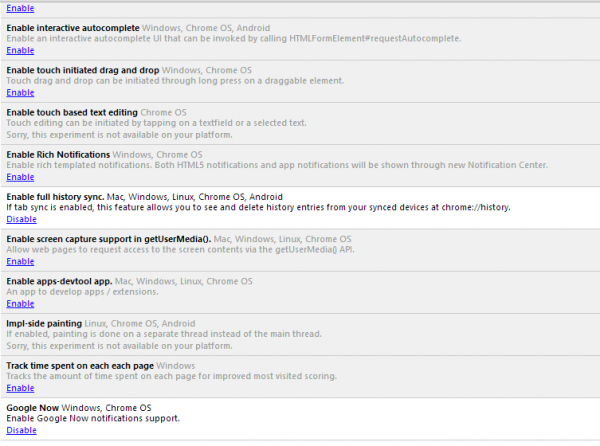
    The service is disabled by default, but you can remedy that by heading your browser to chrome://flags and scrolling all the way to the bottom of the page. Here you can flip the “enable” switch, but do not expect much. For the moment the service is more like “Not Now”. Google has not yet flipped the final switch to enable the server that will power it — or perhaps it has, but the URL is not yet known.

    Either way, the service does not yet actually work, but now we have even more confirmation that it is actually on the way. Though, Canary has been known to take away services after initial testing in the past. However, this one seems rather important and I doubt Google would simply scrap the plan. As my colleague Joe Wilcox said in his initial post on this — it has the power to change everything.

  • Helping Americans on the Autism Spectrum Reach Their Full Potential

    Today marks World Autism Awareness Day, and it was filled with events, meetings, and information campaigns here at the White House, across the Obama Administration, and across the country.

    It was fitting that President Obama unveiled a bold new research initiative designed to revolutionize our understanding of the human brain.  The BRAIN (Brain Research through Advancing Innovative Neurotechnologies) Initiative will be essential to advancing what we know about the complexities of autism. Originally referenced during the State of the Union, this ambitious new project was launched with approximately $100 million in the President’s Fiscal Year 2014 Budget, and ultimately aims to help researchers find new ways to treat, cure, and even prevent brain disorders, such as Alzheimer’s disease, epilepsy, and autism.

    As President Obama said today: “We’re still unable to cure diseases like Alzheimer’s or autism, or fully reverse the effects of a stroke. And the most powerful computer in the world isn’t nearly as intuitive as the one we’re born with. So there is this enormous mystery waiting to be unlocked, and the BRAIN Initiative will change that by giving scientists the tools they need to get a dynamic picture of the brain in action and better understand how we think and how we learn and how we remember. And that knowledge could be — will be — transformative.”

    read more

  • Pakistan’s Mobiilink Offers Free Tweeting to Its Customers

    Whenever a country that has a history of internet censorship gains better access to one of the internet’s most important tools, it’s big news.

    And that’s exactly what has happened today. Starting today, Pakistan’s largest provider of cellular services has announced that its prepaid customers can tweet away – for free.

    “Data charges for accessing Twitter have been made ZERO for all Mobilink prepaid subscribers. Subscribers don’t require to subscribe to this offer since it is available for all prepaid subscribers by default,” says Mobilink.

    That means that users can tweet and retweet all they want without incurring any data charges. This removes one of the impediments from Pakistani Twitter users, who have faced state censorship of Twitter in the past.

    Back in May of 2012, the Pakistan Telecommunication Authority shut off Twitter access for the entire country for approximately 8 hours following the circulation of content deemed blasphemous on the network. Some speculated that the move had less to do with the specific content and more to do with a simple test as to whether a state-wide blockage was feasible.

    As far as the rest of the internet goes, the Pakistani government has a history of censorship in the areas of so-called blasphemy and pornography. Recently, that censorship has moved to content that falls in the realm of political speech. In a country with this track record, free access to Twitter is a significant opportunity for its people – considering access remains open.

    There are some caveats to the deal. Mainly, tweets must be sent via mobile.twitter.com – not Twitter’s native apps.

    Also:

    “[G]oing on external links will result in data charging. Whenever a subscriber clicks on an external link, he will be shown a notification indicating that standard data charges apply to view the link. External link will be opened after subscriber’s consent only.”

    But for the purposes of simply communicating (being that all-important amateur reporter), this is a great thing for Pakistani tweeters.

  • Magic Johnson’s Son Spotted With Boyfriend in LA

    With politicians everywhere coming to grips with gay marriage and even Bill O’Reilly admitting that that gay marriage supporters have a “compelling argument,” there really has never been an easier time to come out of the closet in the U.S.

    This week, Magic Johnson’s son, Earvin Johnson III, was tacitly outed to the American public by the L.A. paparazzi. TMZ is reporting that the 20-year-old was spotted in L.A. with a man the publication states is his boyfriend. Johnson is reportedly a student at NYU.

    The Paparazzo who accosted Johnson questioned him on the Lakers, the Dodgers, and Dodger Stadium’s plumbing situation.

    TMZ quotes Magic Johnson as saying he and his wife are “very proud” of his son and that they “love EJ and support him in every way.”

  • Android Notebooks May Be Coming Later This Year [Rumor]

    In mid-March, Andy Rubin stepped down as head of Android to start a “new chapter” at Google. In his place, Google appointed Chrome OS head Sundar Pichai. This led to some thinking that the Android and Chrome OS would cross pollinate, but Google has said the two products will remain separate.

    The software behind Chrome OS and Android may remain separate, but a new report out of Digitimes suggests that Google may be launching Android notebooks in the third or fourth quarter of this year. Digitimes also speculates that Pichai is the one behind the move to bring Android to Notebooks.

    Even if this rumor is true, it wouldn’t be the first time that Android has made its way into Notebook computers. A quick search of online retailers will bring up a number of cheap Chinese-made Android Notebooks that were made possible by Google making Android open source. There’s also pseudo-Notebooks, like ASUS’ Transformer Prime, that blurs the line between Notebook and tablet.

    Like most of Digitime’s rumors, you should probably take this report with a massive grain of salt.Of course, there’s always the possibility that the next version of Android will introduce support for traditional computing environments, much like Android 3.0 introduced support for tablets. Still, it seems strange that Google would compete with its own Chromebook line by introducing Android notebooks.

    If there is an Android notebook on the horizon, we might hear something about it at May’s Google I/O. It’s already rumored that the company will reveal the next Nexus 7 at the event, and an Android notebook reveal would not be out of place at an event where Google’s co-founder introduces a new product with skydivers.

    [h/t: BGR]

  • Report: iPhone update authorizing T-Mobile’s LTE network arrives Friday

    Last week I wrote a post attempting to answer all of the lingering questions about whether current-generation iPhones would work on T-Mobile’s networks. There was only one answer I couldn’t get out of Apple, and that was when it would send out the iOS update officially activating support for T-Mobile’s brand new 4G network. Well, Apple remains mum, but TMoNews seems to have gotten the answer: April 5.

    An internal T-Mobile screenshot leaked to TMoNews states that the iOS update will not only authorize the T-Mobile network (T-Mo’s 2G and a portion of its HSPA+ networks are already supported), but will enable Apple’s visual voicemail and MMS features on the carrier as well. Here’s the text of document:

    “The T-Mobile Carrier Update is a minor iOS software update that enables official iPhone support by T-Mobile. When installed, the software update enables a handful of capabilities like Visual Voicemail, MMS Settings and Network/Device optimizations that customers do not have access to today. On April 5, the software update will begin being pushed via OTA to all iPhone devices on the T-Mobile network with iOS 6.1.x or higher.”

    I asked Apple and was told it isn’t commenting on a rumor, so I suppose we’ll have to wait until Friday to see if an iOS update shows up in iTunes.

    Keep in mind that only the North American GSM iPhone 5 model will work on T-Mobile’s LTE systems, which are now live in seven markets, and to connect to T-Mo you must have an unlocked device. All generations of iPhones will work in T-Mobile’s 2G footprint and on its HSPA+ networks in about 50 markets today. The carrier is expanding that HSPA+ support quickly as it undergoes a major network overhaul.

    Related research and analysis from GigaOM Pro:
    Subscriber content. Sign up for a free trial.

  • SF-Based Watchmaker Xetum Releases New Racing-Themed Line, The Kendrick

    Screen Shot 2013-04-02 at 3.30.11 PM

    Our favorite makers in the Bay area, Xetum, have just released their new line of Kendrick watches in time for racing season. The watches, designed in California and assembled in Switzerland, are fairly unique in the watch industry as Xetum is one of the few American watch brands – besides Bathys – to make it in a very competitive marketplace.

    I pared down the elements on the dial to just a minimum, but made each feature bolder, from the hands, to the markings on the dial, to the numerals,” said founder Jeff Kuo. “To stay within the ‘instrument-style’ vein, I looked to automotive dashboards for inspiration. Not any one particular car or brand, but rather looking at dashboard instruments that made a strong statement, but in a subtle and nuanced way.”

    Xetum traditionally sells watches with an embedded leather strap so these new Kendricks are a departure. The watches feature striped NATO nylon or solid rubber straps.

    Watches are obviously an aged technology but Kuo has tried to bring the industry into the 21st century by selling his work online. He is, however, beginning to partner with retail stores, a move that would seem a little backward to some. However, given the hoity-toity nature of many watch shoppers, it’s obvious that opening a few industry doors can help Kuo spread the Xetum message.

    “We have also realized that some of our customers want to see the product in person, and we have recently stepped up our efforts to selectively work with great retail partners to provide an in-store experience that is highly complementary with our online sales. Companies such as Warby Parker have done this through pop-up shops or in-store displays, and our approach has been instead to sell with a small number of like-minded retailers to offer a physical store presence,” he said.

    The watches are available now and come in white, black, and light blue. The model we looked at, in blue, has a certain “faded” look to it akin to old Kodachromes and the nylon straps are much more durable than the leather models. They are, as expected, a bit on the expensive side: $995 for the NATO model. However, for the price you get an increasingly rare ETA 2824-2 inside a solid, handsome, and locally designed 40mm automatic watch.

  • NVIDIA exec: Next-generation mobile graphics will outperform Xbox 360 and PS3

    NVIDIA Mobile Graphics
    The next generation of mobile graphics will be able to deliver better performance than the Xbox 360 and PlayStation 3, according to NVIDIA’s (NVDA) SVP of content and technology Tony Tamasi. Speaking to Bit-tech, the executive noted that current gaming systems are “barely more powerful” than mobile devices and he believes that upcoming smartphones and tablets powered by NVIDIA chipsets will finally begin to outperform traditional gaming consoles.

    Continue reading…

  • Prepare Your Brain for Change


    Margaret Moore, CEO of Wellcoaches Corporation, explains ways to de-stress and de-clutter your mind so you can perform at your cognitive and creative best.

  • Google Adds Janrain, Gigya As Google+ Sign-In Partners

    Google announced today that it is adding some new integration options to Google+ Sign-in.

    Google launched Google+ Sign-in in February as its latest answer to Facebook Connect and the Open Graph. Now, Google has added Janrain and Gigya to its roster of partners that are integrating Google+ Sign-in as part of their product suites.

    In a post on its Google+ Developers blog, Google says, “This means that their customers will be able to: Add trusted authentication to their apps and sites, allow web users to automatically download their Android app, customize their app experience using Google+ profile info, enable users to share interactive posts with friends, and write app activities that only appear when they’re relevant.”

    Janrain customer sites include: NPR, Universal Music Group sites (including LadyGaga.com, JustinBieberMusic.com, Eminem.com, etc.), and HSN. Gigya’s include American Idol and Food Network UK.

    Google’s initial launch partners included: Banjo, BeautyFish, Fancy, Fibit, Flixster, The Guardian, OpenTable, Shazam, TuneIn and USA Today.

  • A new iPhone may be on track to arrive this summer

    Apple is reportedly planning to start production on the next generation of the iPhone sometime in the second quarter of 2013, according to a report in the Wall Street Journal. That means production could start anytime from today through the end of June. Apple has made a new iPhone every year since 2007, so the start of production of a new model isn’t a surprise. However, the timing would suggest a launch of the latest iPhone some time this summer — less than a year after the iPhone 5 arrived.

    According to the report, Apple has two different phones in production, the follow-up to the iPhone 5 and the long-rumored low-cost iPhone:

    At the same time, Apple continues to work with its manufacturing partners in Asia on a less expensive iPhone that could be launched as soon as the second half of this year, these people said. The four-inch device will likely use a different casing from the higher-end iPhone. Apple has been working on different color shells for the phone but its plans remain unclear.

    Summer iPhone launches were tradition from the very first iPhone model launched in 2007 through the iPhone 4 in 2010. But for the past two releases Apple has launched its most important product in the fall, which has resulted in gigantic iPhone sales coinciding with the traditional holiday shopping period.

    Should this device does launch in the summer, it still won’t be clear for quite a while after if Apple is simply returning to its former annual mid-year release schedule for the iPhone, or if it’s moving toward a release pattern like what we saw with the iPad in 2012: a new iPad 3 model in March and a new iPad 4 in October.

    However, if two devices do arrive this year, we could be looking at a strategy that we haven’t seen yet from Apple: multiple new iPhones arriving during the same year period and in different price categories.

    Related research and analysis from GigaOM Pro:
    Subscriber content. Sign up for a free trial.

  • Senator Arrested in NYC Mayor Bribery Scandal

    New York state Senator Malcolm Smith was arrested today in connection with an alleged bribery scandal involving Smith gaining ballot listing for New York City’s Republican mayoral primary.

    According to the U.S. Attorney’s Office for the Southern District of New York, Smith and five other politicians were arrested on charges of bribery, extortion, and fraud. The other arrested individuals include New York City Council Member for Queens Dan Halloran; Queens County Republican Party Vice Chairman Vincent Tabone; Bronx Republican Party Chairman Joseph Savino; Spring Valley, New York Mayor Noramie Jasmin; and Spring Valley Deputy mayor Joseph Desmaret. Smith is a democrat and a state senator for New York’s 14th district, which covers parts of the Bronx and Queens.

    Smith and Halloran are accused of arranging $40,000 in bribes to have Smith’s name appear on the Republican primary ballot for the New York City mayoral race in 2013. Halloran is also accused of having received nearly $25,000 to steer city council discretionary funding to a company named by his briber, who was an undercover FBI agent.

    “Today’s charges demonstrate, once again, that a show-me-the-money culture seems to pervade every level of New York government,” said Preet Bharara, U.S. Attorney for Manhattan. “The complaint describes an unappetizing smorgasbord of graft and greed involving six officials who together built a corridor of corruption stretching from Queens and the Bronx to Rockland County and all the way up to Albany itself. As alleged, Senator Malcolm Smith tried to bribe his way to a shot at Gracie Mansion – Smith drew up the game plan and Councilman Halloran essentially quarterbacked that drive by finding party chairmen who were wide open to receiving bribes. After the string of public corruption scandals that we have brought to light, many may rightly resign themselves to the sad truth that perhaps the most powerful special interest in politics is self-interest. We will continue pursuing and punishing every corrupt official we find, but the public corruption crisis in New York is more than a prosecutor’s problem.”

  • Do Want: Bioshock, Portal, and Skyrim as Little Golden Books

    If there are two things that my future children will be acquainted with at an early age, its Little Golden Books and Bioshock.

    One artist has put the two together (along with Portal and Skyrim) to create some killer mashups.

    “As the sun sets on this current generation of video games, I’ve been thinking about some of the classic games that people will still (hopefully) point to years from now and hold them up as games that made a difference, and possibly, for some child out there, Portal or Skyrim will be a memory from their early childhood,” says the artist, Joey Spiotto.

    Right on. Hopefully, my kids will sleep with a Mr. Bubbles. Maybe even a Dovahkiin doll. Maybe, if I have a daughter, she can don the orange pants and white tank-top of our Portal heroine for Halloween. Those are the kinds of thoughts that occur to me while looking at these wonderful little prints. Bravo.

    You can purchase the 3-print set for $50 over on Etsy.

    [Joebot via Kotaku]

  • Jim Leech to Step Down as Ontario Teachers CEO – Report

    Jim Leech will step down as president and CEO of Ontario Teachers’ Pension Plan, a position he has held since 2007, according to a report by The Globe and Mail. Mr. Leech told reporters that he will retire by the end of 2013, and that a search process for finding his successor is already underway.  Mr. Leech joined Ontario Teachers in 2001 to lead the pension plan’s private equity investment arm Teachers’ Private Capital. Before joining Teachers, he was president and CEO of Canadian merchant bank Unicorp Canada Corp.

    Further information about Ontario Teachers Pension Plan can be obtained on the firm’s website.

    Photo courtesy of Ontario Teachers Pension Plan.

    The post Jim Leech to Step Down as Ontario Teachers CEO – Report appeared first on peHUB.

  • AT&T-Vodafone hookup may revolutionize roaming

    AT&T Vodafone Acquisition Analysis
    If the AT&T-Verizon takeover of Vodafone actually goes through, it might represent an earthquake in mobile roaming. AT&T’s (T) acquisition of Vodafone’s portfolio of carriers would mean that it would be able to offer American customers new roaming prices not only to major European tourist and business travel targets like the U.K., Germany and Italy, but also popular international destinations like Australia, Turkey, South Africa and Egypt. The old Vodafone-Verizon (VZ) alliance always had a major stumbling block that prevented effective roaming: The lack of a wide range of mobile phones that would have supported the different W-CDMA and CDMA2000 technologies the two carriers employed.

    Continue reading…

  • First Lady Michelle Obama Hosts a “42” Movie Workshop for Students

    First Lady Michelle Obama delivers remarks during the "42" film workshop, April 2, 2013

    First Lady Michelle Obama delivers remarks during the “42” film workshop in the State Dining Room of the White House, April 2, 2013. Workshop participants included, from left, Brian Helgeland, Chad Boseman, Harrison Ford, Rachel Robinson, and moderator Paulette Aniskoff.

    (Official White House Photo by Chuck Kennedy)

    First Lady Michelle Obama today hosted 80 high school and college students from across the country for a screening of "42," followed by an interactive workshop with the cast and crew of the movie. "42" tells the story of Jackie Robinson, the very first African American to play major league baseball. The panel was moderated by Paulette Aniskoff, Director of the White House Office of Public Engagement, and featured Harrison Ford, Chadwick Boseman and Brian Helgeland.

    The discussion focused on the inspirational themes from Robinson's life that students — who came from Thurgood Marshall Academy in Washington, DC; Watkins Mill High School in Gaithersburg, MD; TC Williams High School in Alexandria, VA and Amino Jackie Robinson Charter High School in Los Angeles, CA — can apply to their own.  

    Also joining the conversation was Rachel Robinson, Jackie Robinson's widow and his partner throughout his incredible life's journey. And as Mrs. Obama explained to the young crowd, Mrs. Robinson's example can be their guide. "Jackie and Rachel Robinson weren't destined for greatness — they prepared themselves for greatness, which meant that they could make a difference outside of baseball, as well. And that is the only thing that is important for you to understand. You can be great in your profession, you can earn a lot of money, you can be famous, but the question is what are you doing for others."

    read more

  • Seven Rules for Managing Creative People

    Moody, erratic, eccentric, and arrogant? Perhaps — but you can’t just get rid of them. In fact, unless you learn to get the best out of your creative employees, you will sooner or later end up filing for bankruptcy. Conversely, if you just hire and promote people who are friendly and easy to manage, your firm will be mediocre at best. Suppressed creativity is a malign organizational tumour. Although every organization claims to care about innovation, very few are willing to do what it takes to keep their creative people happy, or at least, productive. So what are the keys to engaging and retaining creative employees?

    1. Spoil them and let them fail: Like parents who celebrate their children’s mess: show your creatives unconditional support and encourage them to do the absurd and fail. Innovation comes from uncertainty, risk, and experimentation — if you know it will work, it isn’t creative. Creative people are the natural experimenters, so let them try and test and play. Of course, there are costs associated with experimentation — but these are lower than the cost of NOT innovating.

    2. Surround them by semi-boring people: The worst thing you can do to a creative employee is to force them to work with someone like them — they would compete for ideas, brainstorm eternally, or simply ignore each other. That said, you cannot surround creatives with really boring or conventional people — they would not understand them, and fall out. In line with this, recent research indicates that teams made up of diverse members who are open to taking each others’ perspective perform most creatively.

    The solution, then, is to support your creatives with colleagues who are too conventional to challenge their ideas, but unconventional enough to collaborate with them. These colleagues will need to pay attention to details, mundane executional processes, and do the dirty work: Messi needs Busquets and Puyol; Ronaldo needs Alonso and Ramos.

    3. Only involve them in meaningful work: Natural innovators tend to have more vision, research I’ve done indicates. They see the bigger picture and are able to understand why things matter (even if they cannot explain it). The downside to this is that they simply won’t engage in meaningless work. This all-or-nothing approach to work mirrors the bipolar temperament of creative artists, who perform well only when inspired — and inspiration is fueled by meaning. This rule can also be applied to other employees: everyone is more creative when driven by their genuine interests and a hungry mind.

    As novelist John Irving said, “the reason I can work so hard at my writing is that it’s not work for me”. At the same time, in any organization there will be employees who are less interested in, well, doing interesting work; they are satisfied with simply clocking in and out, and are incentivized by external rewards. Companies should ensure that trivial or meaningless work is assigned to these employees.

    4. Don’t pressure them: Creativity is usually enhanced by giving people more freedom and flexibility at work. If you like structure, order and predictability, you are probably not creative. However, we are all more likely to perform more creatively in spontaneous, unpredictable circumstances — because we cannot rely on our habits. Don’t constrain your creative employees; don’t force them to follow processes or structures. Let them work remotely and outside normal hours; don’t ask where they are, what they are doing or how they do it. This is the secret to managing Don Draper, and why he never went to work for a bigger competitor. This is also why so many top athletes fail to make the transition from a small to a big team, and why business founders are usually unhappy to remain in charge of their ventures once they are acquired by a bigger company.

    5. Pay them poorly: There is a longstanding debate about the relationship between intrinsic and extrinsic motivation. Over the past two decades, psychologists have provided compelling evidence for the so-called “over-justification” effect, namely the process whereby higher external rewards impair performance by depressing a person’s genuine or intrinsic interest. Most notably, two large-scale meta-analyses reported that, when tasks are inherently meaningful (and creative tasks are certainly in this condition), external rewards diminish engagement. This is true in both adults and children, especially when people are rewarded merely for performing a task. However, providing positive feedback (praises) does not harm intrinsic motivation, so long as the feedback is perceived as genuine.

    The moral of the story? The more you pay people to do what they love, the less they will love it. In the words of Czikszentmihalyi, “the most important quality, the one that is most consistently present in all creative individuals, is the ability to enjoy the process of creation for its own sake.” More importantly, people with a talent for innovation are not driven by money. Data from our research archive, which includes over 50,000 managers from 20 different countries, indicates quite clearly that the more imaginative and inquisitive people are, the more they are driven by recognition and sheer scientific curiosity rather than commercial needs.

    6. Surprise them: Few things are as aggravating to creatives as boredom. Indeed, creative people are prewired to seek constant change, even when it’s counterproductive. They take a different route to work every day, even if it gets them lost, and never repeat an order at a restaurant, even if they really liked it. Creativity is linked to higher tolerance of ambiguity. Creatives love complexity and enjoy making simple things complex rather than vice-versa. Instead of looking for the answer to a problem, they prefer to find a million answers or a million problems. It is therefore essential that you keep surprising your creative employees; failing that, you should at least let them create enough chaos to make their own lives less predictable.

    7. Make them feel important: As T.S. Eliot noted, “most of the trouble in this world is caused by people wanting to be important”. And the reason is that others fail to recognize them. Fairness is not treating everyone the same, but like they deserve. Every organization has high and low potential employees, but only competent managers can identify them. If you fail to recognize your employees’ creative potential, they will go somewhere where they feel more valued.

    A final caveat: even when you are able to manage your creative employees, it does not mean that you should let them manage others. In fact, natural innovators are rarely gifted with leadership skills. There is a profile for good leaders, and a profile for creative people — and they are rather different. Steve Jobs had better relationships with gadgets than people, and most Google engineers are utterly disinterested in management. One of the reasons for the rapid plateau of start-ups is that their founders tend to remain in charge. They should learn from Mark Zuckerberg who brought in Sheryl Sandberg to make up for his own leadership deficits. Research confirms the stereotypical view that corporate innovators — intrapreneurs — exhibit many of the psychopathic characteristics that prevent them from being effective leaders: they are rebellious, anti-social, self-centered and often too low in empathy to care about the welfare of others. But manage them well, and their inventions will delight us all.