Blog

  • Our ice is disappearing | Bad Astronomy

    If you are a normal person trying to figure out who is right and who is wrong on an issue, it can be pretty confusing. When it comes to things like global warming, there are folks out there who twist, distort, and spin the facts so grievously that it’s hard to tell the difference between what they are doing and outright lying. And when one of them does it, a slew of others pick it up, making the chorus of nonsense self-reinforcing, muddying the waters even more.

    We saw this happen with the CRU emails that were hacked — a situation which was nowhere near as important as so many trumped them up to be — and of course we will see it again and again.

    To help staunch that, there are two points about global warming I’ve recently come across that I want to make sure are very clear.

    1) Some global warming denialists obfuscate what’s going on with Antarctica, saying the ice there is actually growing, not melting. That is patently false. Where it really matters, Antarctic ice is melting.

    antarctic_iceloss

    As you can see by this NASA graphic from the linked page, Antarctica loses over 100 billion tons of ice per year, the equivalent of about a hundred cubic kilometers (more than 20 cubic miles) of ice. That number is hard to grasp, but it’s the equivalent to the volume of a mountain about 14,000 feet high — or, if you prefer, it’s like saying that one Colorado Rocky Mountain’s worth of ice disappears every year. Just in Antarctica alone.

    You may note that the line fitted to the points in that graph is changing its slope, getting steeper with time. I wouldn’t extrapolate that too much, but if true, it means the loss rate is accelerating.

    2) The IPCC report in 2007 was a landmark analysis of the current GW situation. It has been attacked repeatedly by denialists, of course. As it happens, in one part of the report they said that Himalayan glaciers may melt away completely by 2035. This turns out to have been based on a report that was not peer-reviewed, and most likely incorrect.

    However, this does not mean the entire report is wrong, and it certainly doesn’t even mean that Himalayan glaciers are fine! Quite the opposite, in fact. A new study of Himalayan ice using satellite data shows that the ice is disappearing, and from 2003 to 2009 shrank at a rate of 47 billion tons per year. I’ll be careful to note that the uncertainty in this measurement is about 25% (12 Gt/year) and has a short baseline in time, but even considering that, the loss of Himalayan ice is definitely large and almost certainly increasing — perhaps twice as rapidly now as it was in the past 40 years before the study.

    This is supported by a ground-based study of over 600 glaciers being monitored by Chinese scientists, which showed that between 1980 and 1995, 90% of those glaciers were retreating, and in the period of 1995 – 2005, 95% retreated. In other words, the vast majority of the glaciers studied were losing ice, and in more recent years the number of glaciers losing ice increased.

    This is all consistent with global loss rates of ice: it’s disappearing faster now than it was in previous decades.

    himalayan_glacier

    Get a good look at Himalayan glaciers while you still can.

    Expect to hear the antiglobal warming crowd crowing over this, and the media misreporting this to sow more doubt about global warming. But the important point to remember is this: the Himalayan ice really is shrinking, and the same thing is happening in Antarctica.

    Global warming is real. It’s also getting worse. You can shout, you can scream until you’re red in the face, and you can deny the facts all you want. But facts are pesky: they exist whether you believe in them or not.

    My thanks to expert glaciologists Drs. Lonnie Thompson and C. K . Shum for taking time to explain the Himalayan studies to me and for providing me with the numbers from the ground studies.

    Glacier image from mckaysavage’s Flickr stream licensed under creative comons.


  • [LR] Limite de velocidad a 40 en casco urbano

    ¿No os parece una pasada que seamos una de las pocas ciudades, por no decir la unica que tiene un limite de 40 km por hora? Ahora que hay una plataforma en Facebook que esta recopilando firmas para intentar imponer la velocidad a 140 en autovias pienso en que si consiguen ellos porque no lo intenta nadie en Logroño..

    -Haber si lo consiguen o no-

    ¿Que punto de vista teneis vosotros con este tema?

  • Symbian’s Dominance Erodes in Emerging Markets vs. the iPhone: AdMob

    The worldwide smartphone battle is a lesson in geography, according to figures released this morning by AdMob (PDF), which shows that Apple’s iPhone dominates in the Western world while Nokia’s Symbian operating system outpaces the rest of the field in Africa and Asia. But the iPhone operating system is picking up steam in some of those emerging markets, too.

    Symbian devices accounted for 69 percent of smartphone ad requests in Asia through AdMob’s network in the fourth quarter of 2009, down substantially from its share in the third quarter. Meanwhile, the iPhone nearly doubled its share of traffic from Asia quarter-over-quarter. And while Symbian maintained a dominant share among users in Africa, its lead was erased in Eastern Europe for the first time as the iPhone generated 51 percent of AdMob’s smartphone activity.

    The iPhone OS also accounted for an overwhelming majority of smartphone requests in Western Europe as Symbian activity fell to a mere 10 percent, and Apple gadgets maintained a substantial lead in North America. In the meantime, Android is beginning to emerge as a force, generating more than one-fourth of AdMob’s smartphone activity in North America and 8 percent in Western Europe. Android is beginning to find an audience in Eastern Europe, too, primarily at Symbian’s expense.

    Nokia’s strong traction in emerging markets is nothing new, of course, and the company has opted not to focus on North America with its ambitious Ovi service. While that may be a sound strategy, it will require the company to ramp up Symbian traffic on the mobile web and maintain the leads it’s built in the African and Asian markets that have become its focus. If AdMob’s figures are any indication, that simply isn’t happening.

    Image courtesy Flickr user Jeffrey Simms Photography.

  • George Monbiot of The Guardian get’s dirty about Christopher Booker from The Telegraph, and then goes for broke to help save the world from Climate Realists

    Article Tags: Comment

    The gloves have come off for the battle of the UK climate reporters.

    “Climate Alarmist” George Monbiot is openly seen to throw a few punches below the belt as he gets angry not with just our very own “Climate Realist” Christopher Booker but the entire Climate Realist industry.

    When people get this abusive you know they have lost, not just with the fight to promote the alarmists nonsense of “Man Made Climate Change” but they have also lost control of their senses.

    Many congrats to Christopher Booker (MUST READ: The Real Global warming Disaster) as outright “Climate Realist” champion, and to those of you who got the full wroth from “Disaster George” well done, we would have not gone this far without you.

    I can only say to the Editor of the Guardian, please jump ship before you drown, or simply remove the alarmist who is pulling you down.

    Click below link to read from a tragic man, NOTE: YOU MUST BE OVER 18 TO READ THIS!

    George Monbiot’s blog Winner of climate change denial’s premier award revealed

    Source: guardian.co.uk

    Read in full with comments »   


  • New (Possibly) Touchscreen BlackBerry Bold Spotted [BlackBerry]

    RIM has already been moving away from the trackball to the trackpad, but this new image of a yet to be released device shows neither. All signs point to the first touchscreen BlackBerry Bold.

    There’s not much more information available beyond the picture, but it’s certainly a relief to see an improvement over earlier touchscreen prototypes. And it’s even better to see RIM continuing to innovate, although it’s likely months before we see this—or the final version of it—in stores. With the BlackBerry Storm having had touchscreen capability for some time, it’s only natural to see that technology infiltrate other brands.

    But what do all you BlackBerry enthusiasts think? Is this sacrilege, or progress?

    UPDATE: Crackberry is reporting that this is almost definitely an early Magnum prototype, which sounds right to me. So expect to see a lot of these design elements sometime this year, though probably not this exact design. [Cell Guru via FoneFrenzy]


  • Cuba, China, Venezuela Send Immediate Assistance to Haiti

    Cuba, China, Venezuela send immediate assistance

    By Deirdre Griswold
    Published Jan 20, 2010 8:26 PM

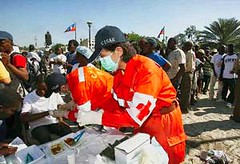
    As soon as the devastating earthquake struck Haiti on Jan. 12, Cuban doctors began saving lives.

    Years before this monumental disaster hit, Cuba had set up a medical mission in Haiti to provide health care in areas where there had been little or none; Cubans also were training Haitian medical workers in basic first aid. When the quake struck, these teams quickly went into emergency mode.

    A relief plane from Venezuela was among the first to land in the stricken country, where normal services had ground to a halt. Venezuelan and Brazilian doctors soon joined the Cuban teams, who were accustomed to working in spartan conditions and had their own generators to power surgical equipment.

    Other Cuban doctors who had been working in Haiti, but were in Cuba on vacation when the quake occurred, quickly returned. They were joined by additional Cuban surgeons experienced in working in difficult situations and Haitian doctors who had been training in Cuban medical schools in various specialties.

    Within less than 24 hours, Cuban medical personnel in Haiti had already assisted hundreds of patients — a figure that grew to thousands by the weekend.

    Fidel Castro used his newspaper column “Reflections” on Jan. 16 to relay to the Cuban people the gist of a report from the head of the Cuban medical brigade:

    “The ‘Delmas 33 Hospital’ is already operational. It has three operating rooms, its own power generation plants, doctors’ visits areas, etcetera, but is absolutely full.

    “Twelve Chilean doctors have joined in. One of them is an anesthesiologist. There are also eight Venezuelan doctors and nine Spanish nuns. It was expected that, at any moment, 18 Spaniards, to whom the U.N. and the Haitian Public Health authorities had handed over the control of the hospital, would come, but they lacked some emergency supplies that had not arrived, so they have decided to join us and start working immediately.

    “Thirty-two Haitian resident doctors were sent in; six of them were going straight to Carrefour, a place that was totally devastated. Traveling with them were also the three Cuban surgical teams that arrived here yesterday.

    “We are operating the following medical facilities at Port-au-Prince: ‘La Renaissance’ Hospital, the Social Insurance Hospital, and the Peace Hospital. Four Comprehensive Diagnostics Centers are already working.”

    At the same time that the Cuban government was coordinating relief for Haiti, it also, in less than an hour, evacuated 30,000 Cubans from low-lying towns on the coast opposite Haiti, until fears of a possible tsunami had subsided.

    Chinese search and rescue team

    At 2 a.m. on Jan. 14, about 32 hours after the quake, a plane landed in Port-au-Prince with a search and rescue team from China — which had its own earthquake catastrophe just two years ago. The plane had left China within hours of hearing of Haiti’s urgent need and flew halfway around the world.

    The China Earthquake Administration reported that the team worked for more than 60 hours pulling people out of collapsed buildings in the capital. According to China Daily, the team “started working with peacekeeping forces from Brazil and Nepal and rescue teams from the U.S. and France.

    “They had retrieved the bodies of some United Nations officials, including U.N. chief in Haiti Hedi Annabi and Luiz Da Costa, deputy special representative of the U.N. general secretary in Haiti, in addition to eight Chinese police officers.

    “The team also set up a medical station to offer treatment for patients pulled out of debris and medical support to medical and security personnel. The team will continue search and rescue work in other parts of Haiti in coordination with the U.N., the CEA said.”

    Hou Shike, chief doctor of the Chinese medical team, reported that the team had already treated more than 200 patients with severe trauma.

    Three days later, on Jan. 17, a Chinese transport plane arrived in Port-au-Prince with 90 tons of supplies, including medicines, tents, emergency lights, water purification supplies, food, drinking water and clothing.

    Also on Jan. 17, President Hugo Chávez of Venezuela pledged his country would provide as much fuel as Haiti needed to generate electricity and provide transport.

    U.S.-controlled airport a ‘bottleneck’

    Meanwhile, the Haitian government, now barely able to function, turned over control of its international airport to the U.S. Washington’s first priority was to rush in thousands of troops. This has already brought criticism from aid groups.

    Doctors Without Borders, based in Geneva, said the U.S.-controlled airport was a supply bottleneck and that there was “little sign of significant aid distribution.” (Telegraph [Britain], Jan. 18) The aid group said a flight carrying its own inflatable hospital was denied landing clearance and the material was being trucked overland from the Dominican Republic, delaying its arrival by 24 hours.

    “French, Brazilian and other officials had earlier complained about the airport’s refusal to allow their supply planes to land. A World Food Program official told The New York Times that the Americans’ priorities were out of sync, allowing too many U.S. military flights and too few aid deliveries.

    “Alain Joyandet, French cooperation minister, said he had protested to Washington about the U.S. military’s management of the airport, where he said a French medical aid flight had been turned away.” (Telegraph)

    China Daily on Jan. 18 in a report from Port-au-Prince said that aid distribution was in general “random, chaotic and minimal.” It described how crowds jostled for food and water “as U.S. military helicopters swooped down to throw out boxes of water bottles and rations. A reporter also saw foreign aid workers tossing packets of food to desperate Haitians.

    “’The distribution is totally disorganized. They are not identifying the people who need the water. The sick and the old have no chance,’ said Estime Pierre Deny, standing at the back of a crowd looking for water with his empty plastic container.”

    The Chinese paper added that “Dozens of countries have sent planes with rescue teams, doctors, tents, food, medicine and other supplies, but faced a bottleneck at Port-au-Prince’s small airport.”

    It is very difficult to find coverage in the U.S. corporate media of what socialist and progressive countries are doing to help Haiti. Perhaps it is because they don’t put a price tag on their sacrifice? We do hear a lot about the $100 million that the Obama administration is promising. But on the ground, when thousands are dying every day from lack of water, food and medicine, that promise of greenbacks down the line isn’t enough.

    E-mail: [email protected]
    ——————————————————————————–
    Articles copyright 1995-2010 Workers World. Verbatim copying and distribution of this entire article is permitted in any medium without royalty provided this notice is preserved.

    Workers World, 55 W. 17 St., NY, NY 10011
    Email: [email protected]
    Page printed from:
    http://www.workers.org/2010/world/cuba_china_venezuela_0128/

  • The Lexus LFA is Not Enough

    The long-awaited Lexus LFA has inspired journalists and public’s automotive dreams ever since it was displayed for the first time in October 2009. That is stating the obvious.

    A not-so-obvious piece of information is the fact that the $ 375,000 supercar‘s 500 units limited production isn’t enough to satisfy the demand registered by Lexus for the monster, as MotorAuthority reports.

    On paper that seemed impossible. The LFA is powered by a 4.8 liter V10’s 552 horses, paced by a 6 speed… (read more)

  • Prisons And Hair Dressers Latest To Push Back On Ridiculous Collection Society Demands

    We’ve noticed lately that music collection societies have been going overboard in demanding more and more money from pretty much anyone who listens to music, claiming “public performances” and assuming that they’re worth a lot more than they really are — almost everywhere you turn. mikez sent in two new stories about collection societies — both involving operations pushing back on the demands.

    The first involves prisons in the UK who are refusing to pay the licensing fees, and thus are telling prisoners (hey look, real thieves!) that they can’t listen to music any more in any area where multiple people might be (the kitchen, workshops, restrooms, etc.) since others might overhear it. Yes, listening to music in a prison apparently requires a separate performance license.

    The second story involves Spanish hairdressers who are similarly refusing to pay and, instead, are telling customers to bring their own MP3 players to listen to their own music, privately.

    The really ridiculous thing is that in both cases all this is really doing is harming musicians. When places play music, it actually acts as advertising for that music — and these collection societies are basically demanding to be paid for having people promote the music of various artists. So the artists get less promotion and don’t get money from places like the examples above refusing to pay. Everyone loses!

    Permalink | Comments | Email This Story


  • Will Obama’s Bank Plan End Moral Hazard?

    The financial Twitterverse has been abuzz this morning with speculation as to what the administration was going to propose?  Yes, yes . . . they’re going to sweat down Too Big to Fail banks.  But how?  Some commentators thought the gist would be HULK SMASH BANKS!!!  Others predicted it would be a minor tweak on the measures already proposed.

    Now we know.  The administration’s new proposal has two core pieces, both of which are at least somewhat novel.  First, banks that have access to the discount window will not be able to trade for their own account.  That means no prop trading desk.  No owning hedge funds or private equity funds.  No investments of any kind to make profits for your shareholders.  Financial institutions can make profits by servicing clients, or they can make profits by investing for their own book.  But they can’t do both.

    Senior administration officials I spoke to made it clear that this would not include market making activity, which the administration views as something you do for your clients.  But while that may partially reassure banks, that seems to mean that market makers–i.e. Goldman Sachs–are very definitely included.  That impression was reinforced by the way they spoke about the problem–emphasizing that this is aimed at disasters like Bear and Lehman.  If they pass this thing, they should probably call it the Hey Goldman Sachs! You’re Not Going to Be So Profitable Any More Act of 2010.

    The second proposal is to extend something like the caps that already prohibit banks from holding more than 10% of federally insured deposits, to other kinds of liabilities.  I asked, but got no clarity, on what exactly this means.  Are regulators going to swoop in whenever a diversified financial institution has too big a share of the total liabilities in all US debt markets?  Or are they going to intervene when a bank becomes dangerous to one particular debt market, the way Lehman turned out to be in commercial paper?

    One thing is clear, though:  the banks screwed up.  As I’ve been saying for months now, it was a simply gigantic mistake to seek huge profits and big bonus pools. Yes, I know that they were competing for talent with foreign banks.  Well, they kept the talent, and now it looks like they may well lose the profitable lines of business that they needed the talent for.  Last time I looked, Goldman’s proprietary investments made up something like 90% of its profits.  Do they give up their profits, or their implied government guarantee?  Either move is going to hurt, which is why, despite reporting record profits today, Goldman’s stock is down 4% at this writing.

    Now, as to the merits of the policy:  is it a good idea?  On first pass, I’m going to say tenatively yes.  The government is recognizing that banks “paying back” the funds they were given is essentially meaningless, because they’ve still got a very, very valuable implied government guarantee.  One could argue that they’ve had it since 1991 when the Federal Reserve got the power to loan money to investment banks in extremis.  But since last fall, it’s the next best thing to explicit.  That means the government needs to take steps to mitigate its own risk.

    The way you do that is to decouple the key operation the government insures–the funneling of credit from those with money to those who want to borrow it–from making bets on market outcomes that can go badly wrong.  And to ensure that no institution has enough liabilities to take down the system if it fails.

    That said, I’m not necessarily confident that this is going to work.  I’m not even sure that I understand how it will work at this point. I have only a hazy understanding of how the liability limits will be enforced, and after talking to administration officials, I’m not sure that they really know either; they seem to be waiting to see what the legislators and regulators say.  And while splitting off proprietary investment seems like it might mitigate systemic risk, it may be very hard to enforce.  Would “eating your own toxic waste” be prop trading, or client service, for example?  It’s possible that this thing will end up with loopholes you could drive a truck through, and if so, it will probably be worse than nothing.

    Too, I haven’t talked to any prop traders or investment banking executives this morning.  They might be able to offer a convincing reason we shouldn’t do this.

    But even if it’s not the best idea in the world, there are definitely many worse rules that we could think up.  And after a stunning defeat on health care, the administration needs to score big points against the bankers quickly.  If “Don’t just stand there, do something!” is the order of the day, there are clearly worse somethings we can do.

    If we do choose this “something”, Americans should probably be clear that this is going to deal a major setback to New York as a world financial capital.  Many of the rules that were undone in the last two decades were got rid of because they were making it too hard for American banks to cope with foreign competition.  If we do this, America’s financial sector will shrink, and our banks will lose a lot of business to foreign firms.  That means, among other things, that we are going to lose big chunks of tax revenue, because bankers are very disproportionate contributors to federal coffers.  It also means that New York’s renaissance will probably slack off–and the people who complain about the bankers will discover how many city services those banker salaries paid for.

    That doesn’t mean we shouldn’t do it.  I think finance has taken on an outsized role in our country, and as we’ve seen over the past year and a half, that hasn’t been a healthy state of affairs.  But this means a substantial change to the American financial system, and as with all change, we won’t like every single thing that follows.


    Email this Article
    Add to digg
    Add to Reddit
    Add to Twitter
    Add to del.icio.us
    Add to StumbleUpon
    Add to Facebook


  • Ron Paul on Competing Currencies

    By Matt Hawes

    In his special order speech on Wednesday, Dr. Paul talks about the need to legalize competing currencies and outlines the steps necessary to do so.

    http://www.youtube.com/watch?v=dBaQgZ5PfAg

  • GSK CEO on Big Deals: ‘Paying a Premium … to Fire People’

    WittyGlaxoSmithKline CEO Andrew Witty swung by Health Blog HQ this week. Given all the M&A action in the industry in the past year (Pfizer-Wyeth & Merck-Schering Plough, to name a few biggies), we asked him about GSK’s acquisition strategy.

    “We’re not in the market for traditional, large-scale, premium acquisitions,” he said.

    He didn’t focus on the pipeline drugs or growing franchises that acquirers often cite. Instead, he waded into the ramifications of making a big acquisition at a moment when many segments of the industry are contracting.

    “People are buying companies and taking costs down,” he said. “You’re paying a 30% or 35% premium to have the opportunity to fire people.”

    Instead, he’s looking for “bolt-on acquisitions” — under $5 billion — that add to growing businesses such as vaccines or consumer products, or to key emerging markets. And even those have to be at a the right price; the company walked away from a few deals in the second quarter of last year, because they were too expensive.

    Photo: Associated Press


  • An Airline Security Fee Increase Is Coming, But Who Should Pay?

    The Christmas underwear bomber made have faded from the headlines, but his near success remains in the minds of airlines and Washington. In response, Bloomberg reports that the Obama administration may call for an increase in the airline security fee. It hasn’t changed since it was initially created in 2001, in response to 9/11. Should they do it? And if so, who should pay?

    First, is the additional money here being put to good use? If it’s used for security theater, then I would say, probably not. More TSA representatives to frisk every passenger won’t prevent body cavity bombs on airplanes. I’m not an expert on security technology, but unless a full body scanner can do that, then I wouldn’t advocate wasting money on more of those either. If, however, the money will beef up homeland security in a meaningful way to monitor and catch terrorists before they get to the airport, then the additional fee might be a good idea. Unfortunately, according to the article, full body scanners are the likely target for the spending.

    So who should bear the cost — airlines or taxpayers? As you can probably guess, airlines think taxpayers should. Here’s why, via the Bloomberg article:

    Security costs should be borne by the government, said David Castelveter, spokesman for the Air Transport Association, whose members include Delta Air Lines Inc. and AMR Corp.’s American Airlines. “The airlines are not under attack; the country is under attack,” Castelveter said.

    That sort of could be true, but probably isn’t in this situation.

    If the money is used in the way I wish it would be — to detect terrorists before they get to the airport — then I completely agree with the airline lobby. In that case, taxpayers should bear the cost, because it’s non-airline specific homeland security. Terrorists would thereby be prevented from blowing up planes, buildings, bridges, etc. All Americans would benefit, so all Americans should pay.

    But if the money is spent to specifically beef up airline security with full body scanners, more TSA officers, etc., then it’s pretty clear that the airlines are specifically benefitting from the fee. In this case, they should pay. And after all, that cost would be passed on to consumers anyway. And that’s okay.

    Think about this from an economic perspective. There’s a security risk in commercial flying. In order to mitigate that risk, some security measures may help. But that prevention doesn’t come for free. As a result, the cost of flying should reflect that risk premium. Flyers should pay.

    Again, airlines object:

    U.S. airlines, with collective losses of about $60 billion since 2001, say they lack pricing power to pass fees on to fliers.

    And all I can say is: that’s too bad. If pricing hadn’t properly reflected the terrorism risk premium in the past, then that should be corrected. If that causes demand to decline, and fewer people to fly, then that’s a reasonable economic outcome. And if that causes fewer routes, or more airlines to go out of business, then again, that’s what the market dictates.

    Finally, pricey security measures would provide flying with a competitive advantage over other modes of transportation, like trains that lack as advanced security. That may drive travelers from trains to planes, if they feel safer traveling one way over another. If airlines are specifically benefitting from additional security measures, then taxpayers shouldn’t be paying for that benefit. Airlines, and consequently flyers, should pay for the additional safety the spending provides.


    Email this Article
    Add to digg
    Add to Reddit
    Add to Twitter
    Add to del.icio.us
    Add to StumbleUpon
    Add to Facebook


  • Create Your Own Faked iPhone 4.0 Screenshots [Photoshop Contest]

    People love trying to trick us with fake shots of unreleased Apple products. We recently received the shot above of the supposed iPhone 4.0 firmware, which we know for a fact is a fake. Can you do better?

    It’s really easy to fake a screenshot on the iPhone. Simply make what you want in Photoshop, load it onto your phone as a photo and take a photo of the phone with it on the screen. That’s clearly what the person who made the above shot did. The above shot is a jailbreak app, but you get the idea.

    So what do you hope to see in the iPhone 4.0 software? Go nuts! Send your best entries to me at [email protected] with iPhone Fakes in the subject line. Save your files as JPGs or GIFs under 800k in size, and use a FirstnameLastname.jpg naming convention using whatever name you want to be credited with. Send your work to me by next Tuesday morning, and I’ll pick three top winners and show off the rest of the best in our Gallery of Champions. Get to it!


  • Unconfirmed Rumor: Garmin to Debut Android Device at MWC

    As we near the Mobile World Congress next month, the rumored handsets and announcements are likely to start pouring in.  DigiTimes is reporting today that Garmin plans to unveil a handful of smartphones in Barcelona, one of which will be running Android.

    The Garmin-Asustek team plans to unveil its first Android-powered smartphone at the upcoming Mobile World Congress (MWC) trade fair, according to Benson Lin, president of Asustek’s handheld device business unit.

    We’ll just have to wait and see if this proves to be true.  There are no specs, pricing, or carrier details to report as of yet.  For comparison, they plan to debut a Windows Mobile phone with a 600MHz processor, a 3.5-inch WVGA resistive touch screen, 5-megapixel camera, and GPS of course.

    Other Great AndroidGuys Posts


  • Firefox 3.6 Released

    firefox_logo_150.jpgMozilla announced today that the final version of Firefox 3.6 is now available for download, and we’re told the new Firefox is 20% faster than the last version with several new features to boot.

    We’ve taken a look at all of the release candidates and now that the final version is here, we’re hoping it does everything Mozilla says it can.

    Sponsor

    One of the biggest features Mozilla has been talking about, aside from all of the developer stuff we discussed when we looked at Release Candidate 2, is the Personas system. Personas is a theming system made easy as point and click. Personas lets you change the look of your browser from over 35,000 different themes, although we found many of them may be targeted to the teenage girl.

    While you won’t see an automatic update for version 3.6 for a few weeks, the newest version is available for download.

    And for the reading impaired, here’s a quick overview of the features from Mozilla:

    Discuss


  • GD in Early Pregnancy

    Hi,

    My wife is in 9th of her pregnancy and following are numbers of OGTT:

    FBS – 121.6
    1 Hr post glucose – 181
    2 Hr post glucose – 160
    3 Hr post glucose – 88

    Urine sugar – Nil in all samples.

    I would like to how serious are above numbers and what kind care is need for rest of her pregnancy period.
    Also please let me what kind of is recommended to her.

    Note: She had GD in her first pregnancy in 7th month (28 weeks).

    Thanks,
    Ceenu

  • Nightmare in Haiti: Untreated Illness and Injury

    January 21, 2010

    Nightmare in Haiti: Untreated Illness and Injury

    By MARC LACEY
    New York Times

    PORT-AU-PRINCE, Haiti — A strong aftershock rattled Haiti once again on Wednesday, causing even more physical damage and further traumatizing the jittery population. But the authorities said the biggest dangers now facing survivors of last week’s major earthquake were untreated wounds and rising disease, not falling debris.

    Because of untreated injuries, infectious diseases and dismal sanitary conditions, health workers said that the natural disaster that struck Haiti more than a week ago remained a major medical crisis and that, unless quickly controlled, it would continue to take large numbers of lives in the days and weeks ahead.

    “There are still thousands of patients with major fractures, major wounds, that have not been treated yet,” said Dr. Eduardo de Marchena, a University of Miami cardiologist who oversaw a tent hospital near the airport where hundreds of severely injured people were being tended. “There are people, many people, who are going to die unless they’re treated.”

    For the seriously ill, the chances of surviving may depend on leaving Haiti entirely. On Wednesday morning, a paramedic rushed up to Dr. de Marchena with news of a newborn who had arrived at another clinic in dire condition. After hearing that the baby could barely breathe, Dr. de Marchena said, “Should I get him airlifted to the United States?”

    The paramedic hesitated for a moment, and the doctor said, “Do it.” The baby was soon boarded for medical care in Miami.

    In the squatter camps now scattered across this capital, there are still people writhing in pain, their injuries bound up by relatives but not yet seen by a doctor eight days after the quake struck. On top of that, the many bodies still in the wreckage increase the risk of diseases spreading, especially, experts say, if there is rain.

    Getting food and water to displaced people is also crucial to staving off more deaths, relief workers said. As of Wednesday, the World Food Program reported that it had distributed food to more than 200,000 people, but it acknowledged that it could take as long as a month for relief food to get to the two million or more people in need.

    At some of the hospitals and clinics now treating survivors, the conditions are as basic as can be, with vodka to sterilize instruments and health workers going to the market to buy hacksaws for amputations.

    At General Hospital in here Port-au-Prince, the water and power are both out, medical supplies are running low and fuel for generators is hard to come by, doctors reported. Other hospitals are even worse off, though, with patients moved outside into the open air.

    Still, health experts were arriving in Haiti from Israel, Cuba, Portugal and other countries, many with stocks of medicine and supplies as well as extensive experience in disaster conditions.

    And the United States Navy hospital ship Comfort pulled up off the Haitian coast to handle the worst-off patients. A helicopter landing pad was cleared near General Hospital to evacuate the critically injured there.

    But integrating all the health professionals into a coherent system will take time. “Nobody knows how many doctors, how many nurses have come to Haiti,” said Dr. Henriette Chamouillet, head of the World Health Organization in Haiti. “No one is providing the government with the data it needs.”

    Another grievance among some health professionals was that the American military was not giving enough of a priority to humanitarian aid. Doctors Without Borders has complained that more than one of its planes carrying vital medical equipment has been kept from landing at the airport here, costing lives.

    Despite all the incoming help, Partners in Health, an organization that has been providing health care in Haiti for two decades, estimated that 20,000 Haitians were dying daily from lack of surgery. But that figure was not backed up by other aid organizations in Haiti and appeared to be much higher than other estimates of the continuing death toll from injuries. The W.H.O. said it was just beginning to gather epidemiological data to assess how much the quake’s toll, which is still uncertain, might rise.

    One of the keys to bolstering the response, said Dr. Paul Farmer, a co-founder of Partners in Health and deputy United Nations envoy to Haiti, was to unify the disparate aid efforts. “Everyone’s doing their own thing, and we need to bring them together,” he said in an interview.

    The continued tremors were not helping the situation. The latest aftershock, which had a magnitude of 6.1, came around 6 a.m. on Wednesday and was centered on Gressier, a village west of Port-au-Prince. The most powerful tremor to hit Haiti since the initial earthquake on Jan. 12, it caused some additional damage to the ravaged capital and surrounding areas, although the United Nations said it was still assessing how much.

    At the tented hospital run by Miami doctors, patients were shrieking and trying to squirm out of their cots when the aftershock came. The situation was still more dire at University Hospital, where patients and staff members evacuated the building and many traumatized Haitians feared going back in.

    Squatting on the sidewalk in central Port-au-Prince, her thigh bandaged from an injury suffered during the main quake, Ange Toussaint, 55, smiled broadly. “I’m here,” she said. “It happened again, and I’m still here. Wow!”

    There were some early efforts to address the psychological toll of the earthquake.

    At the University of Haiti, which hardly showed any damage, Jean Robert Cheri, a professor of psychology, sent a team of student trauma counselors into the streets.

    “We are sending them out with basic instructions,” he said. “First, listen to people, let them verbalize their feelings. Second, don’t promise them any material aid, because you can’t deliver.”

    Mr. Cheri said that the students’ studies had been interrupted for the foreseeable future and that putting their lessons to work would help both them and the country.

    “Look, it’s not going to be easy because they’re traumatized themselves,” he said of his students. “I myself am a psychologist who needs therapy. When I go to sleep, I dream of houses falling down.”

    Deborah Sontag contributed reporting.

  • Mazda 5 presente en el Salón de Ginebra

    El fabricante nipón Mazda acaba de confirmar que presentará en el próximo Salón de Ginebra el nuevo Mazda 5, desarrollado en especialmente para el mercado europeo y que se pondrá a la venta en otoño.

    Mazda 5

    Hideki Matsuoka, responsable del nuevo Mazda 5, ha explicado que el principal objetivo de la empresa a la hora de lanzar este automóvil es la de buscar una mayor eficiencia medioambiental junto a un diseño y estilo elegante.

    En cuanto a la motorización, dispondrá de un motor DISI 2.0 litros de gasolina y contará con el sistema de arranque y parada del motor, i-stop, todo ello unido a una caja de cambios manual de seis velocidades.

    Related posts:

    1. Mazda presentará una nueva versión del MX-5 en el Salón de Frankfurt
    2. Mazda 2, primeras imágenes oficiales
    3. Mazda Kiyora Concept
  • Video: Marussia mashup metes out the musical mirth

    Filed under: , , , ,

    Marussia’s Ode to Joy – Click above to watch the video after the break

    We’ve been smiling for the past 30 minutes, watching this video over and over again. Y’all remember Marussia? We got a nice, upclose look at both the Russian made B1 and B2 at last year’s Frankfurt Motor Show. While they looked generally okay (minus some detailing on the B2, like hinge-dents in the sheet metal and lousy-looking reflectors), we were pretty much convinced that they’d never actually move under their own power. Imagine our surprise when we watched this here video showing a B2 supercar and no less than three B1 hybrids driving around a snowy track. They look real good.

    But that’s not why you should watch the video. Normally when we post car-themed videos, we do so with the following caveat: turn your speakers off. Not so here. In fact, blast this video. Blast it through a pair of McIntosh Mono Blocks hooked into some 15-inch Cerwin Vegas. Without giving too much away, you’re about to be treated to a whole host of classic classical music done DJ Z Trip-style.

    That’s cool, for certain, but the spice that holds it all together is the crazy budget Casio keyboard kick drum and hand clap patch that runs throughout the song. Seriously, it’s amazing. Here’s what head-cheese-in-chief John Neff had to say after just one listen, “OK, I’m finding this song online somewhere and adding it to my iPod. This is like the best driving song of all time.” Also, El Jefe Neff suggested it might be fun to list as many songs as possible that you can recognize in the comments. Or not. So, go ahead and jump to watch the video, but more importantly listen to it.

    [Source: YouTube via WebRidesTV]

    Continue reading Video: Marussia mashup metes out the musical mirth

    Video: Marussia mashup metes out the musical mirth originally appeared on Autoblog on Thu, 21 Jan 2010 12:31:00 EST. Please see our terms for use of feeds.

    Permalink | Email this | Comments

  • Archos Wheels Out Android 1.6 Update For Archos 5 Tablet Yet Again [Archos]

    After giving Archos 5 owners the Android 1.6 update and then taking it back again cruelly, Archos has rereleased Donut (with new Quick Search feature) for the masses. [Engadget]