Here we have a small preview of the Allure Magazine photoshoot. We have more coming soon, so keep an eye out!
Allure Magazine [MQ]


Here we have a small preview of the Allure Magazine photoshoot. We have more coming soon, so keep an eye out!
Allure Magazine [MQ]

Seguimos con las pruebas en Highmotor y esta vez nos vamos a una berlina diesel y premium, se trata del Mercedes Clase C equipado con el propulsor diesel 220 CDI de 170 CV de potencia y bajo la nueva denominación BlueEfficiency que reduce los consumos y emisiones de este conocido motor de la marca alemana sin mermar las prestaciones. Inicialmente estábamos interesados en el C200 CDI BlueEfficiency de 136 CV (para compararlo con la prueba que hicimos al BMW 318d) pero este modelo de acceso a la gama diesel del Clase C no tiene tanto éxito en ventas como su variante de 170 CV, que es sin duda uno de los motores más vendidos del Clase C.
Muchos al leer el motor y el modelo del coche, pensareis que no es un modelo nuevo, que lleva sus años en el mercado, pero la variante BlueEfficiency del motor 220 CDI de 170 CV es bastante actual y lleva en el mercado desde mediados de 2009. Esta gama BlueEfficiency de Mercedes es muy interesante en cuanto a prestaciones/consumos y las mejoras se basan en mejoras de aerodinámica, reducción de pesos en algunos componentes, además de modificaciones en el propio motor para conseguir los mejores consumos y sin renunciar a las buenas prestaciones de este motor.
Motor y prestaciones

Este Mercedes Clase C viene equipado con el motor de cuatro cilindros y 2.143 CC de cilindrada, inyección directa Common Rail de alta presión y doble turbo (a diferencia del 200 CDI BE que sólo lleva un turbo). Este motor 220 CDI BE de 170 CV está disponible con la variante de 204 CV, el 250 CDI BE. Os hablaba antes de que el motor es uno de los mejores en cuanto a prestaciones y consumos, puesto que es un motor que ofrece el par máximo desde las 1.400 r.p.m. (400 Nm) y eso se traduce en una buena respuesta desde bajas vueltas hasta casi las 4.000 r.p.m., empujando con fuerza en este rango.
Este par motor se hace latente cuando le pedimos al Clase C algo más de agilidad o una respuesta más inmediata, respondiendo con fuerza en cualquier situación. Nuestra unidad de pruebas venía equipada con el cambio automático de cinco velocidades (de serie equipa cambio manual de seis relaciones), con este cambio unido a este propulsor diesel conseguimos sacarle todo el partido al Clase C.
El cambio automático tiene un funcionamiento muy suave cambiando marchas siempre primando el confort y tres modos de funcionamiento: confort, sport y secuencial. El modo confort es el modo normal de funcionamiento, pero si queremos una respuesta más rápida del cambio sólo debemos pulsar un botón y cambiar al modo sport, donde el cambio, además de responder más rápido, también revoluciona más al Clase C para tener mayor fuerza cambiando de marcha a más revoluciones. Además pese a contar sólo con cinco relaciones, están muy bien escalonadas y las marchas más altas cuentan con unos desarrollos más largos, lo que mejora el consumo.

Para sacarle el máximo partido a este binomio de motor y caja de cambios, tenemos que acostumbrarnos al tacto del acelerador, puesto que según como nos comportemos pisándolo el motor y el cambio responderán en consecuencia, pero una vez que nos acostumbramos podemos conducir de la forma más suave posible o incluso realizar una conducción más ágil e incluso más deportiva (que conste que ese no es propósito del Clase C), puesto va a responder muy bien en ambos casos.
Otro apartado destacable del Mercedes Clase C es el confort interior. Las suspensiones están regladas para ofrecer la máxima comodidad interior e incluso en zonas complicadas con asfalto en mal estado, el Clase C no transmite las irregularidades a los ocupantes. Es un coche que invita a hacer una conducción tranquila, que te mima y además cuenta con una buena insonorización interior, por lo que el ruido del motor no es perceptible dentro (pese a que es algo ruidoso).
Pese a contar con unas suspensiones orientadas hacia el confort, el Clase C es un coche aplomado, con una sobresaliente estabilidad. No es un vehículo con carácter deportivo, no está orientado hacía esa función, pero sin embargo si es un coche ágil y que responde con contundencia cuando lo necesitamos. En el tráfico urbano se mueve con bastante soltura y el cambio automático ayuda a la hora de circular en zonas de tráfico.

La dirección es muy precisa, con un buen radio de giro y maniobrabilidad para el tamaño que tiene y para frenarlo con total tranquilidad equipa discos de frenos a las cuatro ruedas, siendo de mayor diámetro los delanteros que frenan al Clase C de forma eficaz.
Por último nos queda el apartado de consumos, un apartado donde el Clase C BlueEfficiency destaca positivamente. Cuenta con un consumo en autopista (a velocidad legal, 110-120 km/h) de 5,5 litros a los 100 km (durante un trayecto de 600 km). En cuanto al consumo en ciudad es muy complicado que supere los 9 litros, ni en el peor de los casos, y en recorrido por ciudad y carretera hemos obtenido una media de 7,6 litros a los 100 km (30% recorrido urbano y 70% carretera). El consumo oficial para este modelo es de 4,8 litros a los 100 km, consumo que nosotros no hemos obtenido pero que en carretera hemos llegado a rondar los 5 litros a los 100 km (a unos 60 km/h).
Por tanto estamos ante un vehículo que comparado con la competencia premium a igualdad de motores y prestaciones, gana en el apartado de consumos (hay que recordar que lo hemos probado con cambio automático), es perfecto para hacer kilómetros porque nos ofrece un consumo contenido y un gran confort interior. Su carácter no es deportivo, ni pretende serlo pero en caso de necesitar algo más de agilidad o un aporte extra de potencia el Clase C va a responder con contundencia.

En la segunda parte de la prueba os hablaremos del diseño exterior (que ha sufrido pequeños cambios actualmente) y del interior del Clase C, un interior que está a la altura del conjunto y cuenta con una buena habitabilidad.
Fotos | David Taboada
 Surveying the body of web-related news in the fourth quarter of 2010, our GigaOM Pro curator Ed Gubbins finds the most significant developments were the partnerships that NewNet companies struck between each other.
In the fourth quarter, the giants and the social supersites hooked up — Twitter scored paid deals to provide real-time tweets to Google and Microsoft, and Yahoo pre-announced plans to link up with Facebook Connect — while startups set the stage for the next waves of innovation — for instance OneRiot providing real-time ads to Digsby.
Meanwhile, Google repeatedly indicated that its pocketbooks are open for M&A — and while a Yelp deal didn’t come to fruition, a smaller buy of web collaboration startup AppJet did, not to mention larger purchases in other sectors like AdMob in mobile advertising. With the fourth quarter setting the stage, there are clearly more exits to come in 2010.
Gubbins sees big opportunities from application platforms getting more social, personalized and real time — with examples in social TV, music, smart metering and job search. However a major stumbling block for the sector, even as broadband download and upload speeds improve, is latency.
A more in-depth look at these trends and others is available in the latest Quarterly Wrap-ups in our five focus areas — NewNet, Mobile, Green IT, Connected Consumer, and Infrastructure. These quarterly reviews are available to GigaOM Pro subscribers, along with dozens of detailed research briefings and in-depth articles on specific topics in each of these areas. You can subscribe here.


Buy This Item: [Click here to buy this item]
Spin-buster extraordinaire Stephen Colbert of the Colbert Report hosted University of Maryland scientist Margaret Palmer, the author of a study that says wind, solar and other renewables will provide coal-dependent communities the sort of jobs that, over the long-term, will be good for their environment and their pocket books.
Her study concludes that “mining permits are being issued despite the preponderance of scientific evidence that impacts are pervasive and irreversible and that mitigation cannot compensate for losses.”
Watch:
| The Colbert Report | Mon – Thurs 11:30pm / 10:30c | |||
| Coal Comfort – Margaret Palmer | ||||
|
||||
 Location data is commonly used in the mobile and web industries as a way to provide context for services, and as an underlying platform for new applications. For example, cell phones and vehicle navigation systems use GPS location data to offer turn-by-turn driving directions, and websites like Foursquare have become popular for sharing manually-reported location data. In a similar way I think weather data could provide a platform for some very important next generation services and applications, particularly when it comes to energy efficiency.
We can thank communication technology — satellites, mapping databases, software and high-powered computing — for creating the ability to track and use real-time weather info. The National Weather Service, developed by the U.S. government’s National Oceanic and Atmospheric Administration, has been one of the key driving factors behind delivering this information in the U.S., and the organization provides “weather, hydrologic, and climate forecasts and warnings,” for “the protection of life and property and the enhancement of the national economy.”
Combine the National Weather Service data with Google and the open Internet ecosystem, and you have the makings of a platform for web 2.0 style services, not unlike how innovators are building applications off of mapping and location data. David Friedberg, the CEO of weather risk management company WeatherBill, which uses data from the NWS, explained to me in an interview last week that most of the private online weather data companies have built services on top of the National Weather Service’s XML feed and its API. There’s no doubt that the Internet has made real-time weather data more available, says Friedberg.
John Steinberg, CEO of smart thermostat software maker EcoFactor, which uses weather data to automatically adjust home owner’s connected thermostats, explained to me that in a pre-Internet world there would need to be one or more sensors on every home for EcoFactor get the type of weather data that it uses in its service. Steinberg says that EcoFactor works with a variety of weather data, but he didn’t want to disclose the sources for proprietary reasons.
Other infotech companies like IBM are building platforms leveraging NWS data and computing to develop prediction services specifically targeted at industries that rely heavily on weather data like travel, transportation, energy production, and agriculture. IBM sells a weather prediction service called Deep Thunder to municipalities, organizations and utilities, which use it to do things like tailor their services, change routes, or generate more or less power.
Weather data is moving down to the micro and personal level with better, more granular data, and the emergence of applications that can use weather data effectively. I Google my local weather on a daily basis, and objects like clock radios commonly that provide real-time weather forecasts. In a video on Deep Thunder, IBM research Lloyd Treinish explained it as: today we need super computers to deliver this type of prediction service, but someday this will be more widely available on a desktop and for individuals.
But as both Steinberg, Friedberg and IBM’s Director of Strategy for its Venture Capital Group Drew Clark all said to me, the really interesting part about weather data will be how it will be used automatically in systems. Whether it’s home and commercial building energy management systems that can automatically take weather data into account, or a large retail chain that could automatically starts stocking up on weather-related goods, weather data can make processes more streamlined, and importantly, making energy consumption more efficient.
Friedberg pointed out to me that there will likely be far less applications built upon weather, than say location and mapping data, because weather data is more used for direct consumption — it’s more like news (you ask what is the temperature or will it rain or not), and less like a real-time GPS location that has little meaning without its context. Weather forecasts are also less reliable — 75 percent chance of rain on Friday — so the applications would have to be less precise.
But I think in the context of energy generation and consumption in buildings, because heating and cooling and lighting are directly related to the weather outside of the home, there will be a wealth of applications that can be built on top of weather data and energy efficiency. EcoFactor is one of the first I’ve heard of that use this type of data directly and automatically linked to home energy consumption. It’s not coincidence that three-year-old EcoFactor was founded by Internet entrepreneurs (Steinberg, and SVP of Products Scott Hublou) looking to develop an energy efficiency product. In the course of a month EcoFactor says it can save 20-30 percent off of the heating and cooling costs on your bill and you won’t even notice.
Utilities already use weather data to try to predict and adjust to how much power generation they will need for the grid depending on micro local temperatures, storms, and wind factors. The difference in a forecast of a couple degrees equals a lot of investment — and a lot greater carbon emissions — in terms of unnecessary power generation for a utility. Georgia Power is using an application built off of Deep Thunder to adjust its energy generation swiftly to meet weather predictions. But ultimately weaving in automatic weather data into all aspects of energy generation and building consumption will require more robust utility networks, better weather forecasting data and smart systems that can better adjust to the real-time information. And that type of smart weather system could be a crucial part of the future of the smart grid.
Image courtesy of National Weather Service.


Buy This Item: [Click here to buy this item]
The idea is to have one thread per system (i.e. Guangzhou metro, Hong Kong MTR, etc.)
There are basically two options to organize this sub forum;
* close all but one thread
* merge all threads about the same subject
If we mass-close some threads, it would lead to a lot of closed threads, and possible cut-off discussions.
If we mass-merge threads, discussion could get messed up, because if two threads about the same subject were active at the same time, those posts will get merged based on date of posting. This could potentially mix up the thread.
As I am not a regular contributor to this section, I would like the input of the regulars of this sub forum (that is you). Post your comments here.
Yarmouth, Maine | Astounding Timepieces
Were you to drive on Maine’s Interstate 295 through Yarmouth, it would be next to impossible to miss Eartha.
Eartha, housed in a three-story glass gallery at DeLorme Headquarters, is the world’s largest rotating/revolving globe. Eartha was designed by CEO David DeLorme and successfully completed two years later in 1998. It won its Guinness Book record the next year, outshining the previous record holders in both Italy and Massachusetts.
Just over 41 feet in diameter, the enormous structure was designed as a scale model. With the scale of 1:1,000,000 or approximately one inch equaling 16 miles, California is a mere three and a half feet tall on Eartha.
Just like Earth, Eartha is tilted at 23.5 degrees. It’s rotation is powered by two electric-powered motors and takes about 18 minutes to complete a cycle.

Many people who write content for the web will advise that it is important to learn and understand how to use search engine optimization (SEO) effectively. While SEO is important, it is not the only thing that makes an article show up on the top page of search engine results. More and more frequently, search engines are using a technique called latent semantic indexing, or LSI, to help rank and index web content.

With SEO in mind, many content writers do extensive keyword research, carefully selecting the keywords and phrases that are likely to get their content to the top of the search engine results page. Then, they focus on using the right amount of those keywords in the article, hoping that the combination of research and keyword use will be enough to succeed.
But consumers are getting smarter with their searching, and search engines are competing more than ever to offer a more personalized and detailed search experience. Rather than just taking into effect the repeated use of certain keywords, search engines are now reading content to determine if the overall content is relevant to the keyword phrases. If the article is considered to be highly relevant, then it will appear higher in the search results than an article that is deemed to have little overall relevance to the keywords used.
For example, if an article about baseball features the keyword phrase “baseball glove,” the search engine is also going to scan the content for related keywords, such as “baseball bat,” “outfield,” and “baseball team.” In short, the search engine is checking the content to make sure that the entire article is relevant to baseball and provides value to the reader. In the end, the more relevant the content, the higher the content will rank within the search results.
An additional benefit to search engines using LSI is more precise results overall. Many words in the English language have more than one definition. By using LSI, a search engine can look at the overall body of content to determine which meaning is most applicable and index the content more specifically.
While SEO will continue to play an important part of effective online writing techniques, paying attention to LSI is growing increasingly important. Search engines adjust their parameters to be the most useful for those who are searching content, not those who create it. As a result, the online content writers who pay attention to the subtle changes in search engine function will see the best results over the long-term.
Related posts:
 Here’s what we know, from MacRumors: last July, Apple dummy corporation Slate Computing, LLC applied for a trademark for an “iPad.” Similar applications have since been filed in England, Australia and Hong Kong. Also: what a terrible name.
We’d heard rumors of the iPad starting way back in August, when it appeared on a mysterious Border’s survey. Since then, though, iSlate has been the frontrunner. But with some of the iPad applications being filed just this week, we may be looking at an awkwardly named tablet device indeed.
The first reactions here at Gizmodo HQ were that it sounded like anything from a feminine hygiene product to a terrible way to nickname your apartment, but it turns out MADtv beat us to the punch:
With all the lawsuits Apple’s already facing, can they really stand another from a defunct late-night sketch comedy show? Guess we’ll find out soon enough! [MacRumors]
Filed under: Car Buying, Podcasts, BMW, Bugatti, Chevrolet, Ford, GM, Ferrari, Design/Style

He won’t admit it, but Editor Paukert is fully addicted to joining us on the Podcast. He sat in again with Chris, Sam and Dan for Episode #162 of the Autoblog Podcast, and there was much rejoicing. First up, Ed Whitacre’s somewhat inscrutable claims about the Chevrolet Volt’s pricing and profitability. Staying with talk of prices, we move on to mooted pricing figures for the 2011 Ford Mustang. Staying in Dearborn, we touch on the likelihood that a version of the Ford F-150 will replace the severely aged Ford Ranger. Adding some spice, we head to the Mediterranean to discuss Ferrari 458 Italia pricing, and stay on the Continent to consider Bugatti Veyron operating costs. Updates round it out, with the updated-for-2011 BMW 3 Series and SMax/Galaxy tweaks bookending some talk of the just-unveiled 2011 Shelby GT350. We wrap it all up with some of your questions and tie a bow on it at an hour-and-a-half. See you next week!
Until then, fill in with Joystiq and Engadget. Let us know what you think of our podcast by dropping us an email at Podcast at Autoblog dot com, reviewing the show in iTunes, filling out our survey, or even leaving us a voicemail on our Google Voice line 734-288-8POD (734-288-8763). Thanks for listening!
Continue reading Autoblog Podcast #162 – Paukert Redux
Autoblog Podcast #162 – Paukert Redux originally appeared on Autoblog on Tue, 19 Jan 2010 13:17:00 EST. Please see our terms for use of feeds.
Read | Permalink | Email this | Comments


Buy This Item: [Click here to buy this item]
Filed under: Car Buying, Government/Legal, Japan

Curiously, there was actual outrage in Congress recently over the fact that American cars were left out of Japan’s version of a Cash-for-Clunkers program. We say curiously because Congress has been pretty copacetic for decades about Japan’s lopsided, unfair import policies. But, when our elected officials learned that the roughly $2,500 given to Japanese consumers for their old beaters could not be put toward the purchase of a new American car, our lawmakers sprang into action.
Michigan Democratic Senator Debbie Stabenow put together a bill that would have required near constant pressure on the Japanese until the program was opened up to U.S. cars. After all, during our recent Cash for Clunkers program, Japanese automakers were hugely beneficial, scoring nearly half of all Clunker-related sales (319,342 cars out of 677,000). Ultimately, it appears that Japan has caved to Stabenow’s squeezing and they opened their program up.
Happy happy, joy joy time for the Detroit Three, right? Not exactly.
As it turns out, only certain small-volume cars imported under a special handling program that also meet Japan’s 2010 emissions standards are eligible. Translated into English, only 700 new U.S. cars can theoretically be sold to Japanese consumers under this legislation, including the Ford Escape, Cadillac CTS and Chrysler Grand Voyager. But hey, at least Congress is happy. A symbolic victory is still a victory, no?
[Source: Automotive News – sub. req. | Image: Yoshikazu Tsuno/AFP/Getty]
Report: Japan opens Cash-for-Clunkers to U.S. brands originally appeared on Autoblog on Tue, 19 Jan 2010 13:02:00 EST. Please see our terms for use of feeds.
Permalink | Email this | Comments


Buy This Item: [Click here to buy this item]
Filed under: SUV, Reviews, Off-Road

“We’re not going to challenge the traditional big players with our volume,” says Icon’s owner and head designer Jonathan Ward as we’re admiring one of his company’s Toyota FJ recreations. “But we hope to challenge what they put into their products.” Depending on how highly you value quality, Mr. Ward might have just made the understatement of the year. In part, Icon’s mission is to “Revisit vehicles from our collective past in a modern context.” But as we discovered, going along with old-meets-new is a firm, unwavering, near-perplexing and possibly suicidal refusal to compromise any aspect of their vehicles in any way.
Take Icon’s latest model, the all new CJ3B. Based off the 1953 Willys CJ3B (Icon amazingly holds the rights to the name), Ward explains that the design ethos of the old Willys Jeeps was longevity, simplicity and utility. Not only does Ward appreciate these qualities, but he finds them “Sorely lacking from the current automotive industry.” You’ll get little argument here. However, doesn’t a modern Jeep Wrangler embody those three priorities, as well as providing near-goofy levels of straight off the showroom floor off-roadability? Not only that, but a Wrangler costs $21,460 with the (much) more capable Rubicon edition raising the Wrangler’s price to $29,565. Not cheap, but the Icon CJ3B will set you back a cool $79,000, prix fixe.
At this point we normally pose a question – something like, “Is the Icon CJ3B worth $50,000 more than a Jeep Wrangler Rubicon?” But here’s the thing, after a few hours of exposure to the CJ3B, it’s unquestionably worth the money. That’s right, we’re just going to start the review with the conclusion, then explain exactly why this little Icon is so darn special. And believe us, the CJ3B is exceptionally special.
Gallery: Review: ICON CJ3B


Photos by Drew Phillips / Copyright (C)2010 Weblogs, Inc.
Continue reading Review: Icon CJ3B more than the sum of its impressive parts
Review: Icon CJ3B more than the sum of its impressive parts originally appeared on Autoblog on Tue, 19 Jan 2010 12:30:00 EST. Please see our terms for use of feeds.
Permalink | Email this | Comments


Buy This Item: [Click here to buy this item]
Who doesn’t love finding great deals and coupons for things they often need? This round-up of pet product offers and coupon codes have several that expire soon, so if you’re going to be needing supplies over the next little while, take a look!

~ Petco is having a Pet Essentials Mega Event where you can save up to 50% on basic pet items like beds, treats, food, and toys. They’re also offering free shipping on orders of $60 or more.
~ Petsmart is offering $5.99 shipping on orders of $60 or more, and are having a “Stock Up & Save Sale” with savings of up to 20%.
~ Wrappables dog apparel is offering 20% off all apparel, collars and leashes with coupon code PETS20 at checkout. Expires 2-1-2010
~ OnlyNaturalPet.com — save 15% on your first order and free shipping on orders of $75 or more.
~ PetCareRX: Take 10% off any order until tomorrow, January 20, 2010.
Infographics by Hannah Nester for Circle of Blue.
As they span significant areas of Asia, Europe and the Americas, karst landscapes cover some 15 percent of the Earth’s land mass. Scientists estimate that these areas of porous bedrock are home to as many as 1.5 billion people, a quarter of the global population. See the full-size World Karst Regions Map.

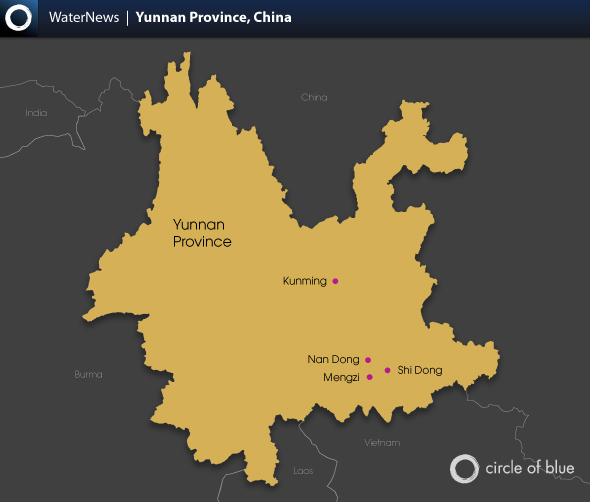 |
Yunnan Province Map: Comprising nearly 44 percent karst landscape, Yunnan Province is part of an extensive karst belt that stretches through eight provinces in southern China — from Guangxi and Hubei in the east to Guizhou, Sichuan, Yunnan and parts of Tibet in the west. To the millions living in the province, the erroding karst has caused water accessibility to be few and far between. See the Yunnan Province Map. |
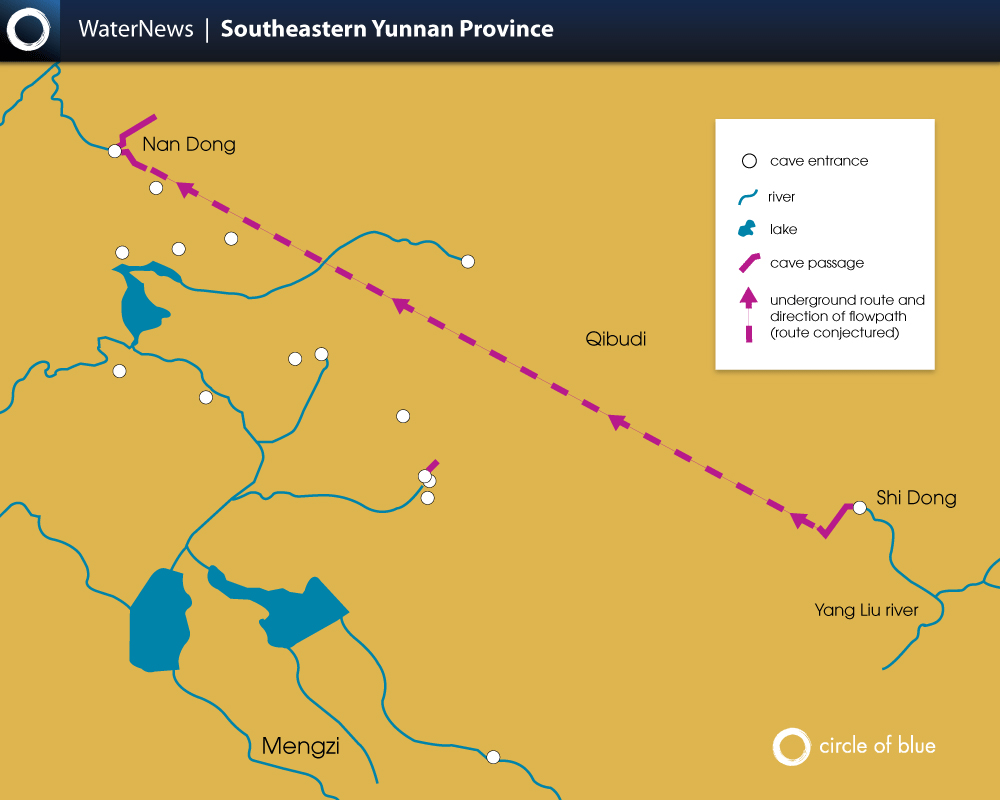 |
Close-up Yunnan China Map: The Yang Liu River disappears beneath the ground at Shi Dong, a rock cave in the southern part of China’s Yunnan Province, and emerges 20 miles farther north at the mouth of the Nan Dong cave. The Yang Liu is one of many waterways in Yunnan that carve their path underground through porous karst landscapes. The province in Southwest China contains almost 44 percent karst, causing water access problems to millions of people in the area. See the full-size Yunna, China Close-up Map. |
 |
China’s Karst Landscape: A great swath of karst covers much of Yunnan Province’s eastern half. Here in the the East Mountain Plateau – located between Shi Dong and Nan Dong — water runs through porous bedrock to seep into deep and hidden caverns and channels underground. The province is part of an extensive karst belt that stretches through eight provinces in southern China. The karst areas shown on the map occur where soluble rock, primarily limestone, is exposed during the monsoon rainy seasons. See the full-scale Karst Bedrock Map in China. |
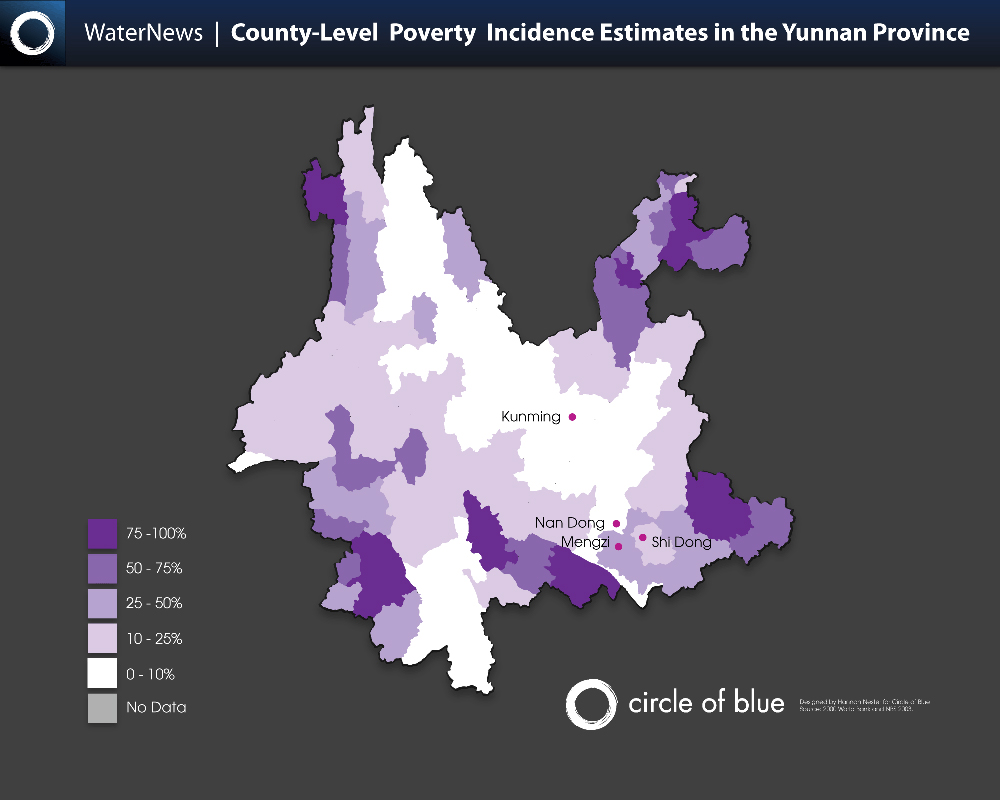 |
Yunnan Poverty Map Many of Yunnan’s poorest counties are located in the karst areas in the western and eastern parts of the province, although there are broad karst areas in east central Yunnan with little or no poverty. This is mainly due to the areas’ proximity to big cities such as Kunming and Yuxi, and to more economically developed tourist destinations like Shilin, Dali and Lijiang. In general, the counties with the highest density of poverty are in rural karst areas. See the Yunnan, China Poverty Map. |
 |
Yunnan Agriculture: Agricultural activities dominate most of Yunnan Province, including its karst areas. This is generally the case for much of Southwest China, though agricultural productivity in the region varies, especially during the winter dry season. Water access for irrigation is further limited in some of the region’s karst landscapes, where water runs through porous bedrock into deep and hidden channels underground. See the Yunnan, China Agriculture Map. |
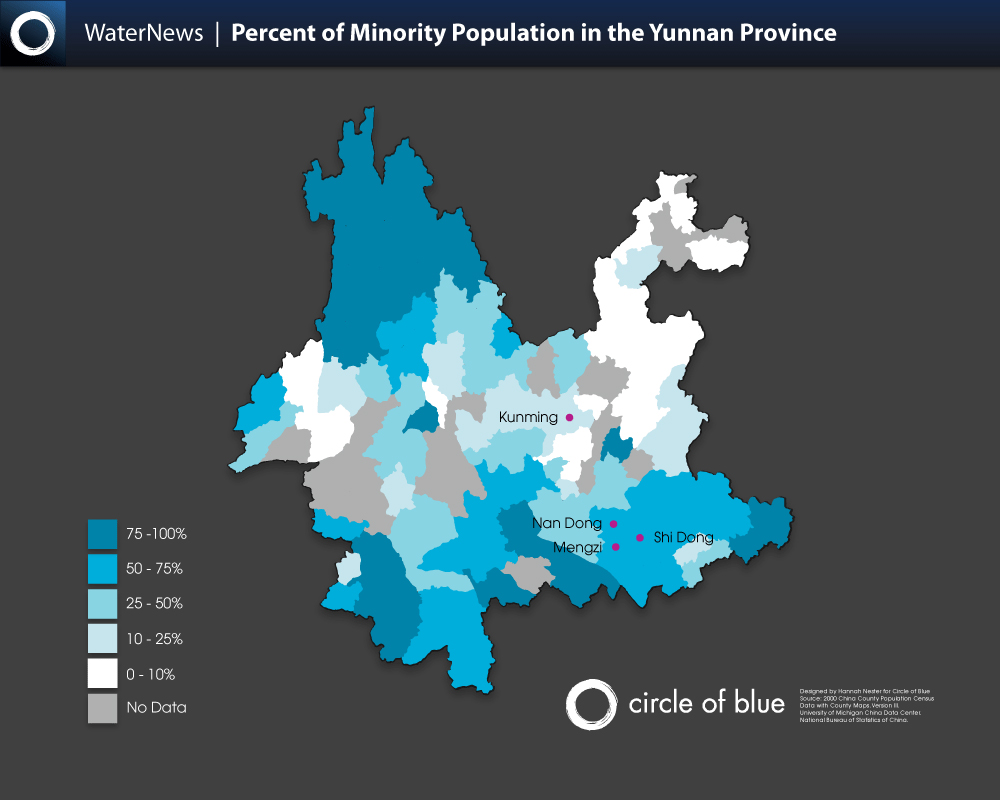 |
Yunnan Minority Map: With more than 20 ethnic minority nationalities represented, Yunnan is among China’s most ethnically diverse areas. While many of its rural karst regions are home to minorities, the overall distribution of ethnic groups in the province has also evolved in response to a long history of broader and more complex cultural and political interactions. See the Yunnan, China Minority Map. |

 Two Android-based handsets expected to be released this week have been put on ice for the time being. Thanks to the recent cyber attacks and a cold war between Google and China, these two phones have been postponed.
“The launch we have been working on with China Unicom has been postponed,” a Google spokesperson told the BBC.
The two phones slated for release tomorrow were from Motorola and Samsung. As of right now, there has been no other official word from Google, nor the two handset makers. For those of you not familiar with the situation, Google has accused China of a malicious cyber attack thought to target the e-mail accounts of human rights activists working in China.
Microsoft will eliminate all data collected on Bing users after six months. The software giant said it sent a letter to the Article 29 Data Protection Working Party, a collection of the EU’s top minds on data protection and privacy issues, today notifying it that the company would reduce the amount of time it stores IP addresses from searchers from 18 months to six months before deleting them.
Currently, Bing takes search data and separates the user’s account information (such as e-mail or phone number) from the non-personal information (such as what the query was) and only after 18 months does Microsoft take the additional step of deleting the IP address and any other cross session IDs associated with the query. The only difference with the new policy is that the IP address will be removed completely at six months to provide greater user privacy protection; the rest of the process will remain the same, since Microsoft says it needs the data to make search better for consumers.
The change will be implemented over the next 12 to 18 months. The aim is to satisfy the European advisory group, which has been critical of how search engines collect and retain data on individuals for advertising purposes. In April 2008, the group issued a major report in which it said search engines can only hang on to European user data for six months, must generally treat IP addresses as “personal information,” and must comply with the rules even if they are based outside the EU. The panel, which is comprised of national privacy regulators from each of the 27 countries, asked Google, Yahoo, and Microsoft to comply with these demands. After changes made last year, Google keeps data for nine months while Yahoo is at three months.
The Article 29 group is only an advisory body at the EU level, meaning its members are the national data protection regulators from each EU country, and while it holds the power to fine companies, it has not moved to impose sanctions over the search data retention. Microsoft’s announcement today tries to find the balance between studying trends in search queries to improve the quality of results and preserving consumer privacy and is likely to avert future problems in the EU.
Buy This Item: [Click here to buy this item]

It’s a wild world out there when it comes to multiplayer gaming, especially on the consoles. The PlayStation 3 exclusive MAG will bring up to 256 players together to fight in massive battles, with players leveling up and being given the ability to lead their own troops into battle. But still, won’t that simply devolve into madness as everyone goes off and does their own thing?
“We wanted to ensure we took every logical step to deter player griefing,” Ben Jones, a designer at Zipper Interactive, told Ars. “Features like protected spawn areas, vote-kick and auto-kick at a certain team kill threshold help to preserve the ideal gameplay experience. You’ll also receive negative experience points for TKing, and in a game where XP is vital to progressing your character, we feel that’s a solid deterrent.”

Buy This Item: [Click here to buy this item]

Our pals over at Boy Genius Report are saying they’ve received some inside information about the iPhone OS 4.0, which is heavily rumored to debut, and possibly even be released, at the Apple event on January 27th. Here’s what they are saying about iPhone OS 4.0:
As far as we’re concerned, we think that a graphical and UI interface refresh is definitely needed for the iPhone, which hasn’t really seen any major interface changes since it launched. Of course, we will be bringing you all the new on January 27th as it happens.
Tags:
adslice,
apple event,
apple rumors,
apple tablet,
cell phones,
cellphones,
ipad,
iphone,
iphone 4.0,
iphone firmware,
iphone firmware 4.0,
iphone os,
iphone os 4.0,
iphone rumors,
islate,
january 27,
mac rumors,
sidefeatured,
smartphones,

Walmarts next project is a massive seven-acre field of solar panels in Apple Valley that will provide power to the food distribution center there. This is just a part of their long term goal to power the Walmart stores with such renewable sources of energy. These panels in the Apple Valley are set to provide about 20-percent of energy demands made by the store which is around 1.3 million square foot distribution center.
[vvdailypress]
Un equipo de científicos estadounidyenses y ecuatorianos ha descubierto en la costa de Ecuador un nuevo y extraño ecosistema de gran valor por su diversidad biológica. La expedición fue llevada a cabo por la organización Reptile & Amphibian Ecology International.
Entre los animales que viven en este hábitat destacan una serpiente devora-babosas y 30 especies de ranas de lluvia.
El reptil forma parte de un reducido grupo de serpientes que come caracoles y babosas. Su familiar más cercano encontrado hasta ahora se encuentra en Perú. Otra serpiente de esta familia fue hallada recientemente en Panamá, y los investigadores creen que podría haber más especies de este tipo. La serpiente fue hallada por una voluntaria de 15 años que trabajaba con los científicos.
Las nuevas ranas tienen un ciclo vital extraordinario. En lugar de poner huevos en el agua que incuban renacuajos, los colocan en árboles.
Peligro de extinción
El ‘tesoro’ hallado durante esta expedición incluye una minúscula salamanquesa cuya cabeza es más pequeña que la goma de un lápiz, tres especies de salamandra sin pulmones respiran a través de la piel y una serpiente de cascabel muda, la vívora más grande. Este reptil aparece en muy pocas ocasiones ya que su caza incontrolada ha provocado que la especie se haya extinguido en muchos de los lugares que habita.
La mayor parte de los animales se localizaron en el Cerro Pata de Pájaro, una pequeña montaña situada a pocos minutos del Océano Pacífico rodeada por un bosque tropical y enclavada en un bosque tropical nuboso. En esta zona habitan entre 14 y 30 especies que no se dan en ningún otro lugar conocido. “Obviamente, estamos muy preocupados ante la posibilidad de que estas especies desaparezcan tan pronto como, o incluso antes, sean formalmente catalagodas por los científicos”, afirma el líder de la expedición, el Dr. Paul S. Hamilton.
Y es que esta zona está amenazada por múltiples fenómenos: desde la deforestación para que pueda pastar el ganado a la tala de árboles y la caza. Asimismo, los expertos en cambio climático predicen que muchos de estos bosques, junto con los animales que dependen de ellos, podrían desaparecer debido al calentamiento global si no se toman medidas para evitarlo. Las ranas de lluvia recién descubiertas son particularmente vulnerables al cambio climático pues depositan sus huevos en árboles y éstos podrían resultar afectados por el aumento de temperaturas.
“La buena noticia es que los animales aún están vivos por lo que todavía tenemos tiempo para salvarlos de la extinción”, afirma el Dr. Kerry Kriger, director de la organización de protección de ranas ‘Save the Frogs’: “Hay que pasar a la acción para evitar que ocurra”.
Fuente: Periódico La Hora
 With all the lawsuits Apple’s


