Blog

  • CEO Ken Myer to Leave WTIA

    Gregory T. Huang wrote:

    The Washington Technology Industry Association announced today that CEO and president Ken Myer is leaving his post at the end of March to return to the tech industry. Myer has headed the WTIA, one of the largest statewide associations of technology firms, for about three years, during which it made the transition from the Washington Software Alliance (WSA) to an organization that includes electronics, devices, and cleantech sectors as well. Executive search firm Herd Freed Hartz is conducting a search for Myer’s successor.


  • Credit Suisse: Sovereign Default Risks Aligning To Crush The Japanese Yen

    Credit Suisse sees far too many reasons to short the yen these days, in a global equity strategy report from January 11th. First of all, they find the Yen nearly 25% over-valued on purchasing-power-parity basis (PPP) vs. the U.S. dollar. Secondly, they point to Japan's even more rapidly deteriorating government debt situation. Thirdly, they highlight recent political pressures to weaken the yen in a bid to help exports. It would also be a 'stealth default' on government debt obligations.

    Then fourthly, they show the chart below. The credit default swap (CDS) market has lost a lot of confidence in Japan. Note how the credit default swap spread for Japanese sovereign debt has doubled since mid-2009, meaning the cost to insure Japanese government debt against potential default has soared.

    Chart

    Credit Suisse: The fiscal position is extremely poor: With gross government debt to GDP of 197% (net government debt is 105% of GDP) and real rates almost two percentage points above the trend real GDP growth rate (2.4% versus 0.5%), a primary budget surplus of about 3% of GDP is required in order for the country to avoid being on an explosive debt path. However, the government runs a cyclically-adjusted budget deficit of 5.4% of GDP. This implies that fiscal tightening of more than 8% of GDP is required to avoid being on an explosive debt path.

    (Via Credit Suisse, Global Equity Strategy, Currency and equity investment implications, 11 January 2010)

    Join the conversation about this story »

    See Also:

  • Boeing Begins A-10 Thunderbolt Wing Assembly for US Air Force

    The Boeing Company [NYSE: BA] today announced that it has begun assembling the first A-10 Thunderbolt replacement-wing set at its Macon facility.

    The U.S. Air Force awarded Boeing the contract, worth up to $2 billion, in June 2007 to provide as many as 242 A-10 replacement-wing sets through 2018.

    “This is a phenomenal accomplishment for this Boeing Macon team and a real tribute to the partnership between Boeing and the Air Force to keep these vital aircraft flying in support of U.S. military men and women,” said Dennis Muilenburg, Boeing Defense, Space & Security president and CEO.

    “We are honored to help extend the life of these storied planes as they serve our warfighters in their essential close-air support missions.

    This is also an important milestone in Boeing’s drive to offer our customers maintenance and modification support on a wide range of aircraft, regardless of the plane’s original manufacturer.”

    Boeing will deliver the replacement wing sets to Hill Air Force Base, Utah, in four parts: three wing sections and an installation kit. Air Force personnel will install the wings.

    Boeing is scheduled to deliver the first wing set in September and up to 50 wing sets a year at peak production.

    The A-10 Thunderbolt, also known as the Warthog, is a twin-engine jet aircraft designed for close-air support of ground forces. More than 350 aircraft are currently in the U.S. fleet participating in both Iraq and Afghanistan operations.

    About Boeing Defense, Space & Security

    A unit of The Boeing Company, Boeing Defense, Space & Security is one of the world’s largest defense, space and security businesses specializing in innovative and capabilities-driven customer solutions, and the world’s largest and most versatile manufacturer of military aircraft.

    Headquartered in St. Louis, Boeing Defense, Space & Security is a $32 billion business with 70,000 employees worldwide.

    MEDIA CONTACT:

    Deborah VanNierop, 210-932-6640
    Global Services & Support – San Antonio
    [email protected]


  • Apple Announces Jan. 27 Special Event: “Come See Our Latest Creation” [Digital Daily]

    Confirming a date first reported by Digital Daily, Apple (AAPL) this morning announced an invitation-only special event to be held at the Yerba Buena Center for the Arts Theater in San Francisco on January 27 — a Wednesday. “Come see our latest creation,” the invitation reads.

    Hmm. Wonder what that might be?

    top

    Buy This Item: [Click here to buy this item]

    Read Original Article

  • Climate change: a reality check – Canada.com

    Climate change: a reality check
    Canada.com
    Since the allowances and offsets are needed for compliance, they take on a value — and that is how the carbon price is set by the marketplace.

    and more »


  • It’s official: Apple holding event on January 27, showing ‘latest creation’

    Apple Event January 27th

    Okay, gang, has finally sent those press invitations out to an event they are holding on January 27th, and if there is one thing we can surmise from this one, it’s that we will be seeing the release of a new product. Whether you want to call it the , iPad, Apple Tablet, MacBook touch, or whatever else, we’re putting all our money on a brand new multitouch tablet device, with Apple aiming to change the world yet again. Oh, and updated MacBook Pros as well.

    The event starts at 10:00AM Pacific time and comes to you from the Yerba Buena Center for the Arts Theater in San Francisco. Join us then, because we’ll be hitting you with the news as it happens.


    Tags:
    ,
    ,
    ,
    ,
    ,
    ,
    ,
    ,
    ,
    ,
    ,
    ,
    ,

    It’s official: Apple holding event on January 27, showing ‘latest creation’ originally appeared on Gear Live on Mon, January 18, 2010 – 9:28:45


  • feature: OAuth and OAuth WRAP: defeating the password anti-pattern


    The developers behind the OAuth protocol have developed a new variant called OAuth WRAP that is simpler and easier to implement. It’s a stop-gap solution that will enable broader OAuth adoption while OAuth 2.0, the next generation of the specification, is devised by a working group that is collaborating through the Internet Engineering Task Force (IETF).

    Understanding the password anti-pattern

    Many popular Web applications allow third-party software to access their underlying services through open APIs. This enables the development of Web mashups and mobile and desktop client applications. Although these open APIs bring a lot of value to the Web and make it possible for various services to interoperate in important ways, it can be difficult to make this functionality available in a manner that safeguards the security of end users.

    Read the rest of this article...


    Buy This Item: [Click here to buy this item]

    Article

  • FDA to study what’s in cigarettes

    RICHMOND, Va. — The Food and Drug Administration is working to lift the smokescreen clouding the ingredients used in cigarettes and other tobacco products.

    In June, tobacco companies must tell the FDA their formulas for the first time, just as drugmakers have for decades. Manufacturers also will have to turn over any studies they’ve done on the effects of the ingredients.

    It’s an early step for an agency just starting to flex muscles granted by a new law that took effect last June that gives it broad power to regulate tobacco far beyond the warnings on packs, but short of banning it outright.

    Companies have long acknowledged using cocoa, coffee, menthol and other additives to make tobacco taste better. The new information will help the FDA determine which ingredients might also make tobacco more harmful or addictive.

    It will also use the data to develop standards for tobacco products and could ban some ingredients or combinations.

    “Tobacco products today are really the only human-consumed product that we don’t know what’s in them,” Lawrence R. Deyton, the director of the Food and Drug Administration’s new Center for Tobacco Products and a physician, told The Associated Press in a recent interview.

    While the FDA must keep much of the data confidential under trade-secret laws, it will publish a list of harmful and potentially harmful ingredients by June 2011. Under the law, it must be listed by quantity in each brand.

    Some tobacco companies have voluntarily listed product ingredients online in recent years but never with the specificity they must give the FDA, said Matt Myers, president of the Campaign for Tobacco-Free Kids.

    For example, Altria Group Inc., based in Richmond and the parent company of the nation’s largest tobacco maker, Philip Morris USA, has posted general ingredients on its Web site since at least 1999.

    Cigarette makers say their products include contain tobacco, water, sugar and flavorings, along with chemicals like diammonium phosphate, a chemical used to improve burn rate and taste, and ammonium hydroxide, used to improve the taste.

    Scientific studies suggest those chemicals also could make the body more easily absorb nicotine, the active and addictive component of tobacco.

    “Until now, the tobacco companies were free to manipulate their product in ways to maximize sales, no matter the impact on the number of people who died or became addicted,” Myers said.

    “The manner of disclosure previously made it impossible for the government to make any meaningful assessments.”

    About 46 million people, or 20.6 percent of U.S. adult smoke cigarettes, according to the Centers for Disease Control and Prevention, down from about 24 percent 10 years ago. It also estimates that about 443,000 people in the U.S. die each year from diseases linked to smoking.

    Tax increases, health concerns, smoking bans and social stigma continue to cut into the number of cigarettes sold, which were estimated to be down about 12.6 percent in the third quarter compared with the same period last year.

    Cigarettes and their smoke contain more than 4,000 chemicals; among them are more than 60 known carcinogens, according to the American Cancer Society. But scientists say they can’t yet tell all they’ll learn from the new data because so little is known about how the chemicals combine to affect people.

    “The reality is that we have known so little over time that it’s difficult to know with much accuracy what getting a good look is going to tell us about what we could do in the future,” said Dr. David Burns of the University of California- San Diego, scientific editor of several surgeon general reports on tobacco.

    The real test is whether the FDA acts on the information it receives, said David Sweanor, a Canadian law professor and tobacco expert. Canadian authorities are collecting similar data, but they haven’t taken much action based on it, which is critical, he said. The European Union also has similar submission requirements.

    Myers warned that a list of ingredients or an unexplained product label is “just as likely to mislead as it is to inform” if consumers don’t know about the relative effects of ingredients.

    Altria has supported what it has called “tough but fair regulation.”

    But its chief rivals — No. 2 Reynolds American Inc., parent company of R.J. Reynolds, and No. 3 Lorillard, both based in North Carolina — opposed the law. They said it would lock in Altria’s share of the market because its size gives it more resources to comply with regulations and future limits on marketing under the law.

    Altria’s brands include Marlboro, which held a 41.9 percent share of the U.S. cigarette market in the third quarter, according to Information Resources Inc.

    Read the original article from Tribune News Services.


  • 15 Greatest Celebrity Arrest Rants and Mugshots

    Celebrities are seen as role models to many children, and often adults place them on the same pedestal. Whether it be for fashion inspiration or just for entertainment, we look to celebs as personal friends — even though we will probably never meet them. Something we should all realize, it that they’re human too — and they get arrested like the rest of us. Though many celebs get away with a lot due to special treatment, some don’t; here are 15 of the greatest celebrity arrest rants and mugshots.

    Jane Fonda

    Image Source

    Academy Award-winning actress and fitness guru Jane Fonda was arrested in 1970 at an airport. Apparently, she had a large stash of pills in her baggage — which turned out to be vitamins. Resisting arrest, she kicked a police officer on the scene and was taken to a Cleveland jail. We love this mugshot because of her “f the man” attitude. The greatest part about this one was that she stuck to her guns.

    James Brown

    Image Source

    James Brown, Godfather of Soul, was arrested in January 2004. He was charged with domestic violence after allegedly pushing his wife, Tommie Rea Brown, to the floor during an argument at the couple’s South Carolina home. He looks like he was taken from his home before he could change out of that funky bath robe, then stuck in a wind tunnel for half an hour. This was by no means the only time he had been arrested, but the mugshot is certainly the most fun of the bunch.

    Nick Nolte

    Image Source

    The Prince of Tides star Nick Nolte was arrested in 2002 by the California Highway Patrol for driving under the influence. It was also found that he had traces of GHB — the date-rape drug — in his system. He later pleaded no contest to the charges of driving under the influence. We don’t know why GHB would be his drug of choice, but his mugshot is awesome.

    David Bowie

    Image Source

    Music legend David Bowie was arrested in March of 1976 on a felony pot possession charge. He was nabbed along with his friend Iggy Pop, along with a few others, and was placed in a Monroe County, NY jail for a few hours. The Thin White Duke was only 29 at the time, but his mugshot oozes utter badassery that we can’t ignore. Seriously, the guy looks better in jail than most of us can ever hope for.

    Rip Torn

    Image Source

    Actor Rip Torn was arrested in 2006 after being pulled over for drunk driving. His car collided with a tractor trailer and he refused to take a breathalyzer test at the scene. This mug shot was taken soon after, at a Westchester, New York police station. It’s dangerous to drink and drive, but it’s awesome to have a name like Rip Torn. Life balances out.

    Mel Gibson

    Image Source

    Film star Mel Gibson has, arguably, one of the greatest celebrity arrest rants in the history of celebrities. Period. If you missed it, in 2006, Gibson sped home from a Malibu bar while sloshed beyond all belief and sipping from an open tequila bottle. He resisted arrest by the highway patrol officer, dropped quite a few F-bombs and slurs, then launched into an anti-semite rant. The best part? He proceeded to call the female officer who booked him “sugar tits.” He got released on bail.

    Robert Downey Jr.

    Image Source

    The mugshot on the left of everyone’s favorite star Robert Downey Jr. was taken in 1999 — while he was already serving time on a drug conviction. The one on the right was taken a year later in 2000 after his arrest at the Merv Griffin Resort for drug possession. To say the least, he needed help. Although we love the face he’s making in the left shot — like he was proud of himself — we’re glad he got help and is now able to give us amazing movie experiences again.

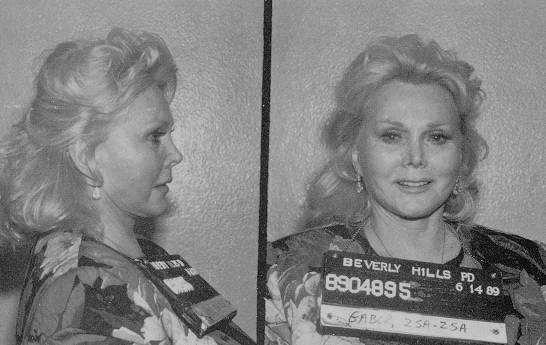
    Zsa Zsa Gabor

    Image Source

    A Hollywood actress more well-known for her string of husbands than body of work, Zsa Zsa Gabor was pulled over in Beverly Hills back in 1989 for an expired license and registration. Impatient for the officer to check records, Gabor up and drove away. When pulled over again, she was asked to step out of the car, and slapped the officer in the face. She was swiftly arrested and charged for battery, disobeying a police officer, driving without license and registration, and driving with an open container of alcohol. She apparently likes her flasks of bourbon.

    Matthew McConaughey

    Image Source

    Matthew McConaughey was arrested in 1999 after a neighbor called the police complaining about loud music blasting from the actor’s house. He was arrested for possession of marijuana and drug paraphernalia. See his smug grin? He’s probably thinking about how much fun he was having dancing around his house naked and playing the bongos when the cops stopped by.

    Glen Campbell

    Image Source

    Country singer Glen Campbell was arrested in 2003 on drunk driving and hit and run charges. The 67-year old plowed his BMW into another car in a Phoenix, AZ intersection and fled the scene. When the cops caught up to him at his house, it was apparent how smashed he was. After Campbell was booked, he kneed an officer in the thigh and was further charged with aggravated assault. It must be hard being a rhinestone cowboy.

    Mickey Rourke

    Image Source

    Mickey Rourke was arrested in 2007 while driving under the influence on a scooter. The star of such flicks as Sin City and 9 1/2 Weeks was booked at a Miami-Dade County Jail and was released on a $1,000 bond. Too bad he couldn’t pay us to ignore that douche-stache.

    Pee-wee Herman

    Image Source

    Pee-wee Herman, AKA Paul Rubens, has had quite a rocky career. He skyrocketed to popularity with his iconic character back in the 80’s, but after several arrests it’s taken him years to regain any traction. This mugshot was taken in 1991 when he was first arrested for jerking off in a porn theater. He got off (pun very much intended) with doing community service and paying a few fines, but he was arrested several times in connection with child pornography thereafter. You’re a loner, Pee-wee. A rebel.

    Daniel Baldwin

    Image Source

    American actor, producer and director Daniel Baldwin was arrested in 2006 for “borrowing” a friend’s SUV… without permission. And that was just what led to this mugshot. He looks pretty rough here, but we’re sure all of the cocaine didn’t help. He’d been arrested before for smashing his Thunderbird into several parked cars going 80 MPH, as well as other drug related charges.

    Paris Hilton

    Image Source

    Hollywood princess Paris Hilton was arrested in 2006 under suspicion of drunk driving. She was basically given a slap on the wrist, but she proceeded to violate her probation and was arrested again — even after she was informed that her license was suspended. She only served 23 days of her 45-day sentence, due to good behavior. We think it was really because of her awesome glamour mugshots.

    Foxy Brown

    Image Source

    Something about beauty treatments gets rapper Foxy Brown all fired up. She was arrested in 2007 after going nuts in a Florida beauty supply store. An employee caught her in the bathroom using store products, and she refused to leave. She threw hair glue and spat on the employee before 911 responded. After swinging at the cop, she was also charged for battery. Brown was previously arrested for attacking manicurists at a Manhattan salon. In taking a look at her mugshot, we’ve determined that since she can’t fit her hair in the frame, she should really quit hating on beauty products.


  • Haiti, when the present trumps the future, but possibly jolts it too

    To misquote Ecclesiastes (Kohelet): ‘For everything there is a season and a time for everything under the sun… a time to think about tomorrow, and a time to think about today.’

    Those of you who know this blog know that I try to keep it updated every 7-10 days with real content I have personally written. But this last week I have held back my posts. In the wake of the truly humbling loss of life and human calamity we have seen, somehow no futures posting seemed quite right.

    In a foresight community we are, I think, rightly vociferous in getting decision makers to see the benefits of taking a long-term view, despite the systemic short-termism of incentive cycles (annual reports, political elections, and – dare I say it – banking bonuses) that most organizations and human systems use as basis of reward. But at times like this, similar to post-Katrina, post-the 2004 tsunami, and previous epic-scale natural and human disasters, we should not bury our heads in the sand of tomorrow. For now it is the present that counts: focusing on what matters to save lives and give food, shelter, and a modicum of respect to those with shattered lives.

    The ’social’ side of disasters

    When the dust does finally settle, and there is time to draw some lessons, there are two future-anticipating principles that apply strongly in the Haiti disaster. The first is that fragile systems are always more likely to have ‘a collapse in their future.’ I’ve been reading Flirting with Disaster by Marc Gerstein, and one of its points (not new, but well described) is the role that human organization plays in facilitating or magnifying a ‘natural’ disaster. Yes, an earthquake can’t be controlled, or even forecast, but what its actual total impact is (the future we should have anticipated) has significantly to do with the efficacy of human organization, including preparedness, robustness, early-warning, and mitigation systems. Where these are in place and working well we should expect a different future.

    Put another way: since man has had any say over his domain there have been no purely ‘natural’ disasters, and there will not be any in the future. Every future disaster will likewise be the product of natural forces meeting social organization.

    Opportunity jolts

    The second principle is that change often happens by jolts, that is, via the application of a sudden and overwhelming force rather than via gradualism. Particularly, a shock from the outside can ‘free up’ a situation and be the catalysing event that sets off wider and ultimately fundamental change. This is (best case interpretation) what the toppling of Saddam was about. Freeing the system. ‘Black Swan –ing’ the system, perhaps.

    It the case of Haiti we have, by all accounts, a nation mired in poverty and corruption. What it is going to get from the events of the last week and the weeks to come, is like a punch in the jaw followed by a lot of world attention, solace, and aid. Add them together and it could be a system-busting event, a real opportunity to break out of existing governance cultures and existing global relations. History suggests Haiti won’t grasp the opportunity, but the window will be open for a while, and good foresight would keep this potential upside scenario in mind and even work to facilitate it.

    Post to Twitter Tweet This Post

  • Review: 2010 Nissan Sentra SE-R is a tall order

    Filed under: , , ,

    2010 Nissan Sentra SE-R – Click above for high-res image galleries

    The Nissan Sentra has long been the bridesmaid of America’s C-segment. Few consider it to be best-in-class, yet it would be a stretch to call Nissan’s second-smallest sedan the category’s cellar dweller. In the past, the Sentra hasn’t been the fastest, it hasn’t been the prettiest and it certainly hasn’t offered the best interior, but the affordable sedan has quietly continued to sell well enough to keep Nissan in the picture.

    Unlike some of its more popular competitors, the Sentra is offered exclusively as a sedan, while other automakers offer coupes or hatchbacks. Nissan makes up for this deficiency in part by offering six different variants of the Sentra, ranging from a base 2.0 model to the 200-horsepower SE-R Spec V. We had the chance to spend a week in the mildly refreshed 2010 SE-R model that slots in just below the Spec V, and with 177 horsepower on tap and quite a few high-end options, we wanted to find out if this upper-middle child could hold its own in what has fast become one of the most interesting and competitive segments in the market.

    Photos by Chris Shunk / Copyright (C)2010 Weblogs, Inc.

    Continue reading Review: 2010 Nissan Sentra SE-R is a tall order

    Review: 2010 Nissan Sentra SE-R is a tall order originally appeared on Autoblog on Mon, 18 Jan 2010 11:57:00 EST. Please see our terms for use of feeds.

    Permalink | Email this | Comments


    Buy This Item: [Click here to buy this item]

    Read Original Article

  • Square’s iPhone credit card swiping device in action

    Remember that awesome iPhone credit card processing device from Square that we told you about a few weeks ago? Well, Kevin Rose just put up a video showing the Square app and iPhone hardware in action. Give the video above a look, as it’s definitely pretty slick. However, we’d love to see them make that credit card dongle a bit more stable before launch. The product is still in beta, but we can’t wait to see this go mainstream.


    Tags:
    ,
    ,
    ,
    ,
    ,
    ,
    ,
    ,
    ,

    Square’s iPhone credit card swiping device in action originally appeared on Gear Live on Mon, January 18, 2010 – 9:24:17


  • Pics Aplenty: 2011 BMW 335i coupe & convertible go snap-happy

    Filed under: , , ,


    2011 BMW 335i coupe and convertible – Click above for high-res image gallery

    The BMW 3 Series coupe and convertible rank among the hottest sellers not only for BMW, but also in their respective segments. They’re the benchmark against which rivals compare themselves and the target for both driving dynamics and sales figures. So when Munich unveils an update for both, you can expect to see them in short order in every parking lot and on every street corner and stretch of highway. But since the veil was lifted on the updated two-door Threes just yesterday, we’re glad to oblige with one big gallery of images to hold you over in the meantime.

    For a quick refresher, BMW has given the 3 Series coupe and convertible a minor facelift for the new model year, comprised principally of a revised front end with new headlights and wider twin-kidney grilles, new taillights, refreshed side mirror housings and restyled bumpers front and rear. Inside the convertible gets a solar reflective leather treatment aimed at keeping surfaces cooler in direct sunlight, and for the first time ever, BMW will be offering its xDrive all-wheel-drive system on the coupe, dropping a coupe of milliseconds off the acceleration times.

    The big news, though, is the new N55 engine, a direct-injection, twin-scroll single-turbocharged inline-six that replaces the twin-turbo engine in the 335i with identical (but, crucially, more accessible) output figures. Check out the coupe, convertible and new engine in our high-res image gallery below.

    [Source: BMW]

    Pics Aplenty: 2011 BMW 335i coupe & convertible go snap-happy originally appeared on Autoblog on Mon, 18 Jan 2010 11:30:00 EST. Please see our terms for use of feeds.

    Permalink | Email this | Comments


    Buy This Item: [Click here to buy this item]

    Read Original Article

  • Foursquare, la nueva niña bonita de los geeks

    FourSquare

    Si el último año y medio el universo ha girado en torno a Twitter para los usuarios avanzados de internet y tecnología, este 2010 parece que los tiros apuntan hacia FourSquare. Y es que FourSquare está conjugando de forma brillante varios de los elementos clave a la hora de “asaltar” a este público objetivo: integración con Twitter y Facebook, aplicación para móviles Android / iPhone y un juego para incentivar la participación. La idea es que al final el usuario comparta su localización, aporte información sobre la misma (si está en un restaurante o un museo, consejos sobre ellos) y además se lo cuente a todos sus contactos en Twitter o Facebook.

    FourSquare no es el primero en buscar que los usuarios compartan donde están con sus contactos, de hecho hay un montón de compañías buscando lo mismo desde hace años: Plazes, Ipoki, Pocket Life, Google Latitude…. podríamos seguir un buen rato. Todos llegaron antes, incluido el muy interesante Brightkite, que podemos tomar como un precursor al que apenas le faltaba la variable “juego / sistema de reputación” para ser como Gowalla y FourSquare.

    Por mucho que nos pueda parecer una tontería, el convertir en un juego lo de compartir la localización es el gran hallazgo de Foursquare, el mecanismo que da el empujón final a un usuario que de entrada es reacio a declarar en la web “estoy aquí”, pero que ofrece menos resistencia si tiene la impresión de estar logrando algo como ser el primero en descubrir un sitio o añadir un buen consejo sobre el mismo. Tanto Gowalla como FourSquare – Gowalla es el principal competidor en esto de hacer lúdico el escribir sobre los sitios en que uno está desde el móvil – explotan lo que otros servicios como 11870 o Yelp llevan incorporando desde hace tiempo, el otorgar un nivel diferenciado a ciertos usuarios, “el que descubre un sitio”, “el major de un sitio” (quien más va), algo que se convierte un incentivo para todas las partes implicadas: para el usuario para lograr ese rol “único” y para el dueño del servicio a quien interesa que haya competencia, cada que el usuario declara haber estado allí se informa a sus contactos y se lanza en su Twitter. FourSquare se queda la mejor parte, que el usuario le declare donde está y a qué lugares va con frecuencia.

    FourSquare en común con Twitter

    La inherente dificultad de llegar al gran público a corto / medio plazo. Si Twitter es exigente desde el punto de vista de la atención, FourSquare tiene una barrera de entrada no menos complicada: es un servicio para ser utilizado en movilidad, lo que implica un terminal de última generación más tarifa de datos. Hoy por hoy el perfil de usuario es muy avanzado en internet y tecnología, aunque por temática el potencial a largo plazo es mucho mayor. ¿Podrá salir de este nicho? De momento aún tiene que sobrevivir: Yelp ha incluido el hacer “check-in” entre las funcionalidades de su versión móvil y en Estados Unidos es un actor muy asentado, más entre el usuario medio que entre los geeks que ahora abrazan FourSquare.

    Otro aspecto en común con Twitter es el hecho de que es un medio para mensajes cortos, por el hecho de estar orientado a su uso desde el móvil, lo que implica más dificultad para crear contenidos respecto al ordenador. En ese sentido el pedir “consejos” más que que “críticas” es un posicionamiento en el que, de nuevo, Foursquare acierta: críticas y análisis más extensos estarán en otro tipo de servicios… de momento. Si finalmente consiguen desplazar a los Yelp y compañía en lo que a repositorio de sitios de ocio se refiere, a largo plazo podrían finalmente hacerse también con estos contenidos “más reposados”.

    FourSquare diferente a Twitter

    La principal diferencia que encuentro es que desde el primer momento entiendo el negocio que va a hacer FourSquare, pero no entiendo todavía el negocio que va a hacer Twitter. De nuevo hablamos de ser interfaz en el internet móvil y la localización y el negocio de la publicidad para los establecimientos. De hecho es razonable que todo su sistema meritocrático se pueda traducir a medio plazo en ventajas dentro de un sistema global: el restaurante paga por un anuncio si logra traer a un cliente de Foursquare a través de un descuento, éste puede ser mayor cuanto mayor prestigio tenga el usuario en el sistema.

    También se distingue de lo que ha venido haciendo Google en el móvil y la localización. Responder a búsquedas va a serguir siendo el territorio donde Google es fuerte, pero otros contextos “sociales” siguen siendo una asignatura pendiente.

    ¿Llegará muy lejos FourSquare? Una vez pasado el hype quedará una competencia por un terreno muy peleado que sí que estoy convencido que permanecerá, los servicios basados en localización en el móvil. La cantidad de actores que están entrando hace muy complicado apostar por un caballo ganador, pero la ventaja de estar ganando el público geek, ese tan dado a evangelizar sobre la tecnología que utilizar, no es mal punto de partida.

    Mi usuario Antonello en FourSquare.

    Otros artículos interesantes: Etc, Uberbin con el hallazgo de “check-in” como término de moda en el 2010, GigaOM, Furilo


  • Mitsubishi Lancer Evolution Could Go Hybrid

    Think about all the cool cars in Mitsubishi’s lineup.

    Chances are, you could only think of one; the Lancer Evolution.

    Turbocharged, 300 horsepower, all-wheel drive; the perfect prescription for New England snowfall and the doldrums of conventional family sedans. It has worked for Mitsubishi for years now, and a cult of fanboys (and girls) has cropped up around this car. So why would Mitsubishi consider making it a hybrid?

    Read more of this story »


  • More Details on AT&T’s “Network Glitch” that Caused Compromised Facebook Security

    On Saturday, an exclusive AP report told a story of an AT&T network glitch which allowed some mobile users the ability to login to other people’s Facebook accounts. Although according to the story only a handful of people were affected by this glitch, the security flaw could have “far reaching implications for everyone on the Internet,” wrote the reporter.

    After reviewing the details of the incident, the “glitch” appears to be more of an issue with some misconfigured software at AT&T and less of an internet-wide security concern, as previously feared. That being said, the wireless company regarded the incident seriously and has taken measures to prevent similar issues from reoccurring in the future.

    Sponsor

    Users Logged into Wrong Facebook Accounts

    In the AP story, a mother and her two daughters, all of whom are AT&T subscribers, logged into the social networking site Facebook using their mobile phones and found themselves with full access to strangers’ Facebook accounts. This was apparently caused by a routing error on AT&T’s part notes the article. In this modern-day equivalent of “crossed wires,” it seemed the wireless company had lost track of which users were which and had sent back the incorrect web pages to the users’ phones. It turns out that the women were not alone in experiencing these issues – other AT&T customers were affected as well. However, AT&T won’t say how many, only that the problem occurred in “a limited number of instances.” 

    Over on the technology news website Slashdot, many speculated about the cause of incident, questioning whether it was a corrupted caching proxy at AT&T or a bug in the HTTP headers set by Facebook that instruct how a response should be cached, among other things. In other words, some weren’t taking it at face value that the problem was entirely AT&T’s fault, despite the fact that an AT&T spokesman claimed that the “network problem behind those episodes” was being fixed.

    Server Software Error to Blame

    A recent statement from AT&T now reveals a few more details about the problem and what they’re doing to address it. According to Michael Coe, the same AT&T spokesman cited in the AP article, the issue was caused by a “server software connectivity error” which impacted some wireless customers logging into Facebook using AT&T subscriber information. Facebook users who signed up for the service using their mobile phones are able to login to the site using the phone number and password created during the sign up process, Facebook states in a Q&A on their Help Site.

    Although Facebook would not comment on the original story, AT&T reports that they did work with the social network in determining the cause of the problem. As it turns out, those affected were logging into Facebook using their AT&T phone numbers as opposed to a username/password combination. Typically, when a username and password is used, a cookie is stored on the mobile device. This small file retains a user’s login credentials, allowing them to access Facebook without having to re-enter their sign in information. When a cookie is not available, the subscriber information is sent to Facebook.com automatically. This is what had taken place in the reported incidents.

    No More Logins Using Your Phone Number, Says AT&T

    AT&T reports that they’ve now put additional “security measures” in place to prevent a reoccurrence of this issue but won’t elaborate on what precisely those measures involve. In addition, the wireless company states they are working with Facebook to disable the use of subscriber information as a method for automatic login. That means going forward, AT&T users will no longer be able to use their phone numbers as login credentials to access Facebook from their mobile devices. Only a username and password combination will be allowed.

    Coe also notes that a similar incident occurred on a customer’s phone in Atlanta, referring to the incident involving the three women. In that case, a misdirected cookie was set on the phone. This is a slightly different issue from what’s described above as it does indeed hint at a routing problem where users are sent the wrong cookie. Although the problem is now resolved, AT&T has still not been able to determine what caused this particular issue. However, the possible routing issue behind this one incident (AT&T could only isolate the problem to one of the three women’s phones) does not appear to be the cause of the other problems. While still somewhat disturbing, especially since the cause is unknown, this singular occurrence does not merit worrying about any “far-reaching,” internet-wide consequences as implied by the original article.

    Discuss


  • Eastern Peripheral Expressway | Kundli-Ghaziabad-Palwal | 6/8 lanes

    Eastern Peripheral Expressway or Kundli-Ghaziabad-Palwal expressway is one of the two semicircular expressways which will form a third ring road around Delhi along with Western Peripheral Expressway (or KMP expressway) to decongest Delhi from traffic entering and bypassing the city through National highways.

    The complete peripheral road will connect following radial highways: NH-1, 2, 8, 10, 24, 58, 91, SH-57, Yamuna/Taj expressway, Ganga expressway, Hindon expressway among others.

    Fact file of Eastern Peripheral Expressway

    • Length – 135 km
    • Lanes – 6, expandable up to 8 in future
    • Areas covered – Sonepat, Faridabad (Haryana), Baghpat, Ghaziabad, Gautam Budh Nagar (UP)
    • Speed limit – Designed for 120 km/hr
    • Expected vehicular movement – 1,00,000 vehicles per day by 2021
    • Project cost – Rs. 3000 crores
    • Interchanges – On intersections with NH-1, NH-2, NH-24, NH-58, NH-91, SH-57, Hindon Expressway, Yamuna Expressway
    • Bridges and Underpasses – 3 river bridges (2 over Yamuna, 1 over Hindon), 43 other bridges, 59 underpasses
    • Toll Plazas – 2
    • Project duration – 3.5 years
    • Concession period – 25 years including construction period
    • Status – Yet to be awarded

  • Hispanic Groups Plunge Into Network Neutrality Debate

    photo

    By Erick Galindo
    Hispanic Link News Service (January 10, 2010)

    Washington, D.C. – High-stakes political maneuvering is dragging Hispanic advocacy groups here deeper into battle over the future of the Internet.

    As the Federal Communications Commission moves ahead with plans to create a set of rules designed to block online monopolies from forming, supportive consumer protection organizations are pressing ethnic advocacy and civil rights groups, including the Urban League, One Economy and National Council of La Raza, to speak out in support ofnetwork neutrality.

    Some, such as the NAACP, the League of United Latin American Citizens (LULAC) and the Hispanic Technology & Telecommunications Partnership, are following the lead of telecommunication giants Verizon, AT&T and Comcast. Others are avoiding taking a position opposing the trio. Still others, including the National Association of Hispanic Journalists and non-white media groups, are lining up with consumer protection groups and Web giant Google.

    On one point all agree: much is at stake for communities of color.

    Groups favoring network neutrality are led by the Center for Media Justice. Without it, they fear unequal access and eventual extra costs to poor and non-white communities. Its supporters came from throughout the country in December to try to sway traditional civil rights organizations to back their position.

    Meeting with several such groups and federal legislators, CMJ encountered minimal opposition to its arguments. “This was new information to us, that there were civil rights organizations that believed that network neutrality was an essential policy in protecting the rights and power of people of color online,” CMJ executive director Malkia Cyril told Hispanic Link. None outright opposed the idea, she said.

    Cyril, who spearheaded a series of meetings Dec. 8-10, added that one group’s representative called it “absurd” for any civil rights organization to be opposed to net neutrality.

    “They are taking a measured approach to the issue,” Cyril said. “To them, the issue is whether this should be on par with broadband adoption and other issues.”

    Cyril noted that the groups invited to the meetings were singled out because of their close partnerships with telecommunications companies and the fact that they had not yet taken a firm stance.

    Alex Nogales, president of the National Hispanic Media Coalition, told Hispanic Link that a lack of information is at the root of any rift between consumer protection and civil rights groups. “Many people of color do not have access to traditional outlets to share their work and have turned to the Internet for that purpose,” he elaborated.

    Cyril added, “The leaders of the groups thanked us for meeting with them face-to-face and not letting one of the telecommunications companies mediate. So far all the information they have been getting has been coming from the telecom companies. Organizations that have deep relationships in communities of color on the ground in regions and states are much more likely to take a pro-net neutrality stance because they understand the real impact.”

    LULAC executive director Brent Wilkes argues just the opposite is true.

    He told Hispanic Link that the average member of the Latino community is more concerned with hackers and viruses.

    LULAC’s only opposition to net neutrality is to the non-discrimination clause, which would prevent Internet service providers from favoring content or access.

    Wilkes noted that LULAC’s concern is with any adverse effect that legislation could have on broadband adoption. “What we don’t want net neutrality to do is drive up price. We know that our communities are price-sensitive,” he said, adding that forcing ISPs to provide the same access to other companies’ content would be unfair since ISPs have invested into building the infrastructure.

    “The only option these companies could redeem the costs of laying the pipe would be to charge more for the data itself.” Wilkes denied allegations that LULAC’s close relationship to AT&T had any influence on the matter. AT&T has donated more than a million dollars to help LULAC gain broadband access to underdeveloped communities and other philanthropic endeavors.

    “Obviously we have to raise money from a variety of sources, but we never shy away from standing up for what we believe is right,” he said. “That whole argument is really unfair, especially when it only seems to be levied against minority advocacy groups.”

    In this, Nogales agreed with Wilkes. “To say that these organizations are doing this for the money is way off,” Nogales said. “LULAC and these groups do a lot of great things and they have their reasons for opposing net neutrality.”

    Nogales and Cyril agreed that broadband prices would not go up under net neutrality. “Our numbers point to the opposite,” Nogales said.

    Cyril said it would be illegal to pass the cost on to consumers, adding she believes that the FCC will pass net neutrality and remains open to working with LULAC and others.

    “There are those all across the country committed to partnering with national civil rights groups in order to promote open networks because we know that’s what empowers communities that can vote, that can advocate for themselves online,” she concluded.

    Erick Galindo is editor of the national Hispanic Link Weekly Report. He can be reached at [email protected]

  • Illinois getting Purdue at a good time

    The Illini couldn’t be catching their next opponent, Purdue, at a better time. The Boilermakers dropped their third straight game yesterday, a 72-64 loss to Northwestern.

    Illinois will host Purdue Tuesday at 8 p.m. at Assembly Hall.

    The Illini had trouble combating Michigan State’s physical style of play, something he expects to see from Purdue on Tuesday.

    “You go home, you’re going to have to deal with a team that plays just as hard if not harder (than Michigan State) and maybe probably more physical…” Illinois coach Bruce Weber said.

    “It’s a test for our team to see how much progress we’ve made.”

    By Chris Hine

    Read the original article from Tribune News Services.


  • China Google Hack Shows Security Gaps… Or Issues In Online Surveillance Apps?

    Google’s decision to change how it deals with China was supposedly precipitated by a hack attack on its computer system that was apparently most likely instigated by the Chinese government. While many are discussing how this shows the level of computer-based espionage — corporate and national — going on these days, a more interesting take comes from Julian Sanchez, who notes that the real issue isn’t so much about hacking into computers, but about the official “surveillance” apps that companies now use to placate law enforcement. That’s because what was hacked at Google was its surveillance app that it uses to help deal with law enforcement requests. As Sanchez notes:


    The irony here is that, while we’re accustomed to talking about the tension between privacy and security–to the point where it sometimes seems like people think greater invasion of privacy ipso facto yields greater security–one of the most serious and least discussed problems with built-in surveillance is the security risk it creates.

    Indeed, we were just discussing how more surveillance can make us less safe by creating a bigger backlog, but Sanchez is pointing out that it’s even worse than that. More surveillance can make us less safe because it can more easily expose data that should have been deleted. Creating surveillance databases creates a huge opportunity for attack. Remember those telco databases we were talking about that make it easy for law enforcement officials (hopefully with a warrant) to track your location by GPS? You have to imagine those make a nice target for hacking as well… And that’s true of any such surveillance database. While they’re supposed to help keep us “safer,” they also put a ton of valuable info in a single place — which makes them attractive targets for those who wish to make us less safe.

    Permalink | Comments | Email This Story