
Blog

  • Reuters – AXA Private Equity Raises Infrastructure Fund

    The private equity arm of French insurance giant AXA has raised 1.75 billion euros ($2.3 billion) for investments in European infrastructure. The AXA Infrastructure Fund III, the group’s largest to date, closed with 1.45 billion euros while investors committed a further 300 million euros for investments outside the fund.

    Reuters – The private equity arm of French insurance giant AXA has raised 1.75 billion euros ($2.3 billion) for investments in European infrastructure, in a further sign of buoyant demand for road, rail and energy assets.

    The AXA Infrastructure Fund III, the group’s largest to date, closed with 1.45 billion euros while investors committed a further 300 million euros for investments outside the fund.

    Mathias Burghardt, Head of Infrastructure at AXA, told Reuters investors had bought into the fund because of the stable yields on offer from European infrastructure and the relative safety it offered from the region’s macroeconomic woes.

    “We see a lot of new investors looking for diversification. They want to be in an asset class that has low correlation with other asset classes and protects against inflation,” he said.

    “Sophisticated investors today understand that Europe provides the most attractive deal flow opportunities to build a core infrastructure portfolio.”

    German investors had become the largest backers of the latest fund, Burghardt said, while Asian clients had also provided more cash.

    The fund will look for deals in the gas and electricity grid and renewable energy sectors, as well as road and rail assets, but will steer clear of ports because they are too cyclical, Burghardt said.

    Investors are pouring money into infrastructure just as cash-strapped governments rush to privatize assets and corporations exit non-core businesses, boosting supply.

    According to data firm Preqin, infrastructure funds pulled in $25.3 billion last year, about $3 billion more than 2011 but down on 2010. Since 2008 investors have put $134.2 billion into unlisted infrastructure funds.

    Burghardt said “massive disposal programs” from European utilities like EON and RWE would aid dealflow further.

    “The supply-demand pattern is quite good, a lot better than it used to be,” he added.

    The AXA fund has already sealed four deals, including acquiring a stake in Luxembourg power generator, transmission group Enevos and Austrian group Verbund’s French wind farms.

    AXA was also in the running to buy the TIGF gas network business of France’s Total last year but lost out to Italian gas grid operator Snam .

    (Reporting by Tommy Wilkes; Editing by Helen Massy-Beresford)

    The post Reuters – AXA Private Equity Raises Infrastructure Fund appeared first on peHUB.

  • AccessData Secures Funding from Sorenson Capital

    AccessData Group has secured backing from Sorenson Capital Partners and Silicon Valley Bank. The funding allows AccessData to reduce outside ownership and add Sorenson as a long-term partner.

    PRESS RELEASE

    AccessData Group today announced a significant investment from Sorenson Capital Partners and Silicon Valley Bank. The funding allows AccessData to reduce outside ownership and add Sorenson as a strategic, long-term partner. “By consolidating our ownership and adding a strategic partner like Sorenson Capital, while strengthening our relationship with Silicon Valley Bank, AccessData is better positioning itself to take advantage of its unique place in the market,” said Tim Leehealey, CEO of AccessData.
    As the dominant player in digital investigations, AccessData has established itself as the leader in the eDiscovery, Incident Response, and Digital Forensics markets. With its unique technological approach, AccessData provides customers with a solution that comprehensively solves the complex challenges of these disparate markets in a way that creates significant cost savings and operational efficiencies. “What few companies in the market have realized is how technologically similar the spaces of eDiscovery, Forensics and Incident Response really are. By exploiting the similarities of these markets, instead of focusing on their differences, we are able to bring something truly unique and almost revolutionary to the market. Sorenson Capital is one of the few partners we have worked with that truly understands the power of that approach and its longer term potential,” said Tim Leehealey.
    “By combining AccessData’s strong market position with Sorenson Capital’s proven track record of taking companies to the next level, we believe we can accelerate growth at AccessData and deliver extensive value to shareholders and customers alike,” said Ron Mika, a co-founder and Managing Director of Sorenson Capital. “This is an exciting company and a compelling opportunity. We are anxious to see where the team can take it over the coming years.”
    ###
    About AccessData Group
    AccessData Group has pioneered digital investigations and litigation support for 25 years. Its family of stand-alone and enterprise-class solutions, including FTK, MPE+, Summation and the CIRT security framework, enable digital investigations of any kind, including computer forensics, incident response, eDiscovery, legal review and compliance auditing. More than 130,000 users in law enforcement, government agencies, corporations and law firms worldwide rely on AccessData software solutions and its premier digital investigation and hosted review services. AccessData is also a leading provider of digital forensics and litigation support training and certification.

    About Sorenson Capital
    Sorenson Capital is a private equity fund that makes small- to middle-market buyout and growth equity investments. Sorenson Capital has $650 million in capital under management and typically makes investments of $10 to $25 million in companies with unique strategic positions. Sorenson Capital is managed and controlled by West Rim Capital and is based in Salt Lake City, Utah

    About Silicon Valley Bank
    Silicon Valley Bank is the premier bank for technology, life science, cleantech, venture capital, private equity and premium wine businesses. SVB provides industry knowledge and connections, financing, treasury management, corporate investment and international banking services to its clients worldwide through 28 U.S. offices and six international operations.
    Silicon Valley Bank is the California bank subsidiary and the commercial banking operation of SVB Financial Group. Banking services are provided by Silicon Valley Bank, a member of the FDIC and the Federal Reserve System. SVB Financial Group is also a member of the Federal Reserve System.

    The post AccessData Secures Funding from Sorenson Capital appeared first on peHUB.

  • Dropbox Buys Email App startup MailBox

    Online storage firm Dropbox has acquired Mailbox. The business is an email app start-up.

    ANNOUNCEMENT

    Welcome Mailbox
    Today we’re really excited to welcome the Mailbox team to Dropbox.

    Like many of you, when we discovered Mailbox we fell in love—it was simple, delightful, and beautifully engineered. Many have promised to help us with our overflowing inboxes, but the Mailbox team actually delivered.

    After spending time with Gentry, Scott, and the team, it became clear that their calling was the same as ours at Dropbox—to solve life’s hidden problems and reimagine the things we do every day. We all quickly realized that together we could save millions of people a lot of pain.

    Dropbox doesn’t replace your folders or your hard drive: it makes them better. The same is true with Mailbox. It doesn’t replace your email: it makes it better. Whether it’s your Dropbox or your Mailbox, we want to find ways to simplify your life.

    We’re all looking forward to making Mailbox even better and getting it into as many people’s hands as possible. There’s so much to do and we’re excited to get started!

    The post Dropbox Buys Email App startup MailBox appeared first on peHUB.

  • Reuters – Silver Lake’s Dell Bid Started at $11.22 per Share

    Private equity firm Silver Lake Partners bid as low as $11.22 per share for Dell in mid 2012, when it first discussed a buyout with founder and CEO Michael Dell, writes Reuters. Since then Silver Lake and Michael Dell raised their bid to take the business private to $13.65 a share. At $24.4 billion, it would be the largest private equity-led buyout since the 2008 financial crisis, writes Reuters.

    Reuters – Private equity firm Silver Lake Partners bid as low as $11.22 per share for Dell Inc in mid 2012, when it first discussed a buyout with founder and CEO Michael Dell, according to a person familiar with the situation.

    Since then, on February 5 this year, Silver Lake and Michael Dell raised their bid to take the world’s No. 3 personal computer maker private to $13.65 a share. At $24.4 billion, it would be the largest private equity-led buyout since the 2008 financial crisis.

    When the bid was first announced, the price represented a 25 per cent premium over the stock price before news of the bid, but Dell’s share price closed at $14.31 on Friday.

    The computer maker has said repeatedly that the bid comes only after extensive review and negotiations, and has deemed it fair to shareholders and that view will likely be emphasized again in an upcoming proxy filing with the SEC.

    But some analysts say Michael Dell and Silver Lake may eventually raise their bid to try to appease investors in Dell like Southeastern who complain it undervalues the company.

    Michael Dell is trying to complete his company’s transition from a low-margin PC maker into a provider of computing services. The makeover has become more urgent as the PC market shrinks. Analysts say it might best be carried out if the company were taken private, away from public shareholder pressure and scrutiny.

    BID DISCUSSIONS GO BACK TO MID-2012

    CNBC first reported the opening bid and, according to the business television network, private equity house KKR & Co LP had also discussed a bid for Dell at $12 to $13 a share but dropped that offer in December last year.

    Several major shareholders voiced opposition to the bid including Southeastern Asset Management and T. Rowe Price.

    A second person familiar with the matter told Reuters that Southeastern, Dell’s largest independent shareholder, had itself broached the possibility of a leveraged buyout to Michael Dell in the summer of 2012, when it expressed interest in contributing its equity in Dell toward any deal.

    But two other sources familiar with Southeastern’s thinking told Reuters the firm had not touched on any sort of private equity-led buyout deal during talks with Michael Dell last summer.

    These sources said Southeastern proposed a transaction similar to one it outlined on February 8 in a letter to the board, when it outlined a so-called “Dutch auction” or tender offer to all shareholders, the two sources added.

    Southeastern’s objection to the current bid, like that of many other investors, is that the buyout as it stands severely undervalues the corporation.

    All sources asked not to be named because the matter is not public. Dell did not respond to requests for comment and Southeastern declined to comment.

    A clearer picture of the negotiations leading up to the deal is expected to emerge in the last week of March in a company proxy filing.

    (Reporting By Greg Roumeliotis, Soyoung Kim and Nadia Damouni in New York; editing by Clive McKeef)

    The post Reuters – Silver Lake’s Dell Bid Started at $11.22 per Share appeared first on peHUB.

  • Stout Risius Ross Appoints MD

    Stout Risius Ross, a global financial advisory firm specializing in investment banking, dispute advisory and forensic services, valuation and financial opinions has appointed Nick P. Jachim as a managing director in its Chicago office and as leader of the investment banking group.

    PRESS RELEASE

    Stout Risius Ross (SRR), a
    global financial advisory firm specializing in Investment Banking,
    Dispute Advisory & Forensic Services, Valuation & Financial Opinions,
    is proud to announce that Mr. Nick P. Jachim has joined the firm as a
    Managing Director in its Chicago office and as leader of the Investment
    Banking Group.

    Mr. Jachim has 25 years of experience providing advice on a wide range
    of topics including mergers and acquisitions, transaction structuring,
    strategic alternatives, deal negotiation and execution to public
    corporations, privately held companies, family businesses, and
    portfolio companies of private equity funds.

    “We are excited to welcome Nick to SRR as the head of our Investment
    Banking Group,” said Mike Kern, President and Chief Operating Officer.
    “He has a proven track record of building lasting relationships with
    clients across the globe and his vast experience with mergers &
    acquisitions and corporate restructuring will be an invaluable asset to
    SRR’s existing and future clients.”

    Prior to joining SRR, Mr. Jachim was a Managing Director in the Chicago
    office of KPMG Corporate Finance, where he most recently served as
    leader of the Consumer Markets group. His comprehensive industry
    experience includes food & beverage, consumer products, retail,
    agriculture, distribution, industrial markets, automotive, business
    services, healthcare, and financial services. In addition to his
    investment banking background, Mr. Jachim has performed numerous
    business valuation, fairness opinion, and restructuring projects for
    his clients.

    Mr. Jachim earned his M.B.A. in Finance & Accounting from the
    University Of Chicago and A.B. in Economics from Princeton University.

    Mr. Jachim is a FINRA registered representative and holds Series 7, 63,
    24, and 79 licenses.

    Mr. Jachim can be reached at +1.312.752.3396 or [email protected].

    About SRR

    SRR is a global financial advisory firm specializing in Investment
    Banking, Valuation & Financial Opinions, and Dispute Advisory &
    Forensic Services. We serve a range of clients from Fortune 500
    corporations to privately held companies in numerous industries around
    the world. Our clients and their advisors rely on our premier
    expertise, deep industry knowledge, and unparalleled responsiveness on
    complex financial matters. For more information, visit www.SRR.com.

    SRR is a trade name for Stout Risius Ross, Inc. and Stout Risius Ross
    Advisors, LLC, a FINRA registered broker-dealer and SIPC member firm.

    The post Stout Risius Ross Appoints MD appeared first on peHUB.

  • Falfurrias Capital Partners Forms North American T&D Group

    Falfurrias Capital Partners has formed North American T&D Group in partnership with Dave Pacyna, former CEO of Siemens’ North American Transmission & Distribution division. Pacyna will lead an investment strategy focused on acquiring and growing domestic companies that support mission-critical elements of the electric utility grid.

    PRESS RELEASE

    Falfurrias Capital Partners, a Charlotte-based private equity firm, today announced the formation of North American T&D Group in partnership with Dave Pacyna, former CEO of Siemens’ North American Transmission & Distribution division. Mr. Pacyna will lead an investment strategy focused on acquiring and growing domestic companies that support mission-critical elements of the electric utility grid.

    Falfurrias, founded by former Bank of America Chairman and CEO Hugh McColl Jr. and former Bank of America CFO Marc D. Oken, also announced that it has made an investment in Instrument Transformer Equipment Corporation (ITEC), a Charlotte‑based original equipment manufacturer of instrument transformer products used by electric utilities and industrial customers, to serve as a platform for its broader investment strategy.

    “I am excited to partner with Falfurrias to lead this investment strategy, and we look forward to building North American T&D Group into a leading T&D component manufacturing platform that will serve the North American energy infrastructure industry” said Mr. Pacyna. “Despite the increasing importance of our electricity infrastructure to our economic prosperity, many of the core elements of this system have been in operation for over sixty years and are in dire need of updating. We look forward to helping utilities upgrade the electrical grid to assure consistent, reliable power.”

    “ITEC has successfully built strong relationships in an industry that demands uncompromising quality, and we believe Dave will enable the Company to continue its impressive growth trajectory,” said Ed McMahan, Partner with Falfurrias Capital. “ITEC is the type of growth company in which we like to invest and represents an ideal platform for our broader investment strategy in the energy infrastructure market.”

    Since its founding in 1993, ITEC has established a strong reputation for providing high‑quality products and best-in-class customer service to electric utilities across the country, and the company has become one of the leading domestic suppliers of instrument transformers. John Cochran and Paul Millward, Chief Executive Officer and President of ITEC, respectively, will continue to be instrumental to the Company’s success and share the vision of supporting electric utilities with mission‑critical products and value-added expertise.

    “Partnering with Falfurrias will provide the capital and resources necessary to capitalize on the unique growth opportunities presented by our industry today,” said Mr. Cochran. “We believe that Falfurrias will become an important strategic advisor to the business due to their industry experience, operational expertise, and financial strength.”

    North American T&D Group and its principals continue to actively pursue investments in companies that support the U.S. electrical grid and T&D infrastructure through a strong local supply base that offers a greater level of flexibility to utilities. From 2007 to 2012, Falfurrias Capital successfully executed a series of three investments in the T&D industry, creating UC Synergetic, a provider of engineering services focused on transmission and distribution infrastructure for the electric utility and telecommunications industries. Falfurrias sold its investment in UC Synergetic to Pike Electric in 2012.

    About Instrument Transformer Equipment Corporation

    ITEC, founded in 1993 and based in Charlotte, N.C., manufactures mission-critical products for the electrical and electric utility industries in the United States and internationally. ITEC is an original equipment manufacturer of instrument transformer products for revenue metering and protective relaying. In each of these application areas, ITEC manufactures both current and voltage instrument transformers. ITEC’s customers include many of the nation’s largest investor-owned utilities as well as municipal, cooperative, and industrial clients, and the company’s products are used throughout the electrical generation, transmission and distribution systems, from instrument transformers on nuclear generators to instrument transformers connected to meters on small industrial facilities.

    About Falfurrias Capital Partners

    Falfurrias Capital Partners, founded by former Bank of America Chairman and CEO Hugh McColl Jr. and former Bank of America Chief Financial Officer Marc D. Oken, is a Charlotte-based private equity investment firm focused on acquiring or investing in a diverse portfolio of middle-market companies operating in the southeastern U.S. By leveraging the extensive strategic and operational experience and business relationships of the firm’s principals, Falfurrias Capital Partners is positioned to be a value-added partner for both its portfolio companies and its limited partners.

    The post Falfurrias Capital Partners Forms North American T&D Group appeared first on peHUB.

  • Texas bill to allow government hacks to trespass onto private property without warrant

    Legislation currently and quietly making its way through the Texas State Senate threatens to overtly trample the personal property rights of Lone Star State residents in the name of protecting public health. If passed, Senate Bill 186 would allow government officials…
  • Virginia government prosecutes homeowner with criminal charges for backyard chickens that produce organic eggs

    An ongoing debate over the rights of homeowners to raise and keep their own chickens may soon gain an audience in the Virgina Supreme Court. Attorneys at the Rutherford Institute have filed a Petition for Appeal on behalf of Virginia Beach resident Tracy Gugal-Okroy…
  • It’s not a ‘haircut’ – it’s THEFT when governments loot your private bank accounts

    This use of the term “haircut” to describe government theft of private banking accounts has got to stop. It’s not a haircut, it’s outright thievery. When a person breaks into your home with a gun and steals your jewelry or cash, do we call that a “haircut?” Of course…
  • Fungal chemicals kill cancer cells

    A family of chemicals naturally produced by fungi are phenomenally effective at killing human cancer cells, according to a study conducted by researchers from the Massachusetts Institute of Technology, the University of Illinois at Urbana-Champaign and published in the…
  • Purple Samsung Galaxy S III coming to Sprint by mid-April

    Sprint_Galaxy_S_III_Purple

    The buzz is all about the Samsung Galaxy S 4 right now, but the Galaxy S III isn’t going anywhere. In fact, a purple version will hit Sprint stores by mid-April. I would assume the Galaxy S III’s price will drop when the S 4 officially launches, and when you consider most of the new features that were announced last week will make its way to the SIII, it might be worth a look for those on a tighter budget.

    source: @evleaks

    Come comment on this article: Purple Samsung Galaxy S III coming to Sprint by mid-April

  • Purple Samsung Galaxy S 4 coming to Sprint by mid-April

    Sprint_Galaxy_S_4_Purple

    During last week’s Unpacked Event, Samsung mentioned just two colors regarding the Galaxy S 4. They were Black Mist and White Frost. One can only assume that it won’t stop there, and it looks like a purple version will hit Sprint by mid-April. Whether they will carry the Black Mist and the White Frost versions as well is anyone’s guess, but if you’re looking for something a little different, this one might do the trick.

    source: @evleaks

    Come comment on this article: Purple Samsung Galaxy S 4 coming to Sprint by mid-April

  • Upcoming Huawei MediaPad 7 Vogue Press Render and Specs Leaked

    vogue7

    It looks like the possible successor to the MediaPad Lite made its leaked debut earlier on Twitter thanks to DLNA and @evleaks. The new tablet from Huawei will come in two versions. The first one will sport a quad-core Cortex A9 processor running at 1.2 GHz, with the second one carrying a quad-core Cortex A9 processor running at 1.5 GHz. Both tablets will feature a 7-inch 1024×600 display with Wi-Fi, DLNA support, as well as HDMI output. They’ll come with Android 4.1 Jelly Bean. There’s no telling on when and where this tablet will arrive so keep it locked here.

    source: @evleaks

    Come comment on this article: Upcoming Huawei MediaPad 7 Vogue Press Render and Specs Leaked

  • Industry Perspectives Focus on Efficiency

    Efficiency in the data center was the common theme for this week’s Industry Perspectives columns. From increasing your efficiency through more effective storage, monitoring such as eBay’s new monitoring dashboard, selection of the right drives to be more compatible with compute and storage,  consolidation of the data center to the move to use water more efficiently, all the guest articles from industry experts can be used to guide you towards improving efficiency in these aspects of data center operation. Enjoy reading!

    Reducing the Storage Footprint & Power Use in Your Data Center – When space is tight and storage costs are mounting, deduplication is a method to squeeze more out of current data center space, according to Eric Bassier of Quantum.

    Why eBay’s Digital Service Efficiency Changes the Game – eBay has provided a role model, which is organized around common metric, to optimize the overall effectiveness of IT, and has openly disclosed the metrics and indicators used to do it. This is a step forward in transparency, writes Winston Saunders of Intel.

    Six Tips for Selecting HDD and SSD Drives – Today selecting the right drives can be a challenge, says Gary Watson of Nexsan. This article offers six tips for navigating through this complexity to help you pick the right solutions for your needs.

    Consolidation: Shrinking Our Way to Data Center 3.0 – Like everything in the IT industry, there is no magic solution to all situations. However, the trend toward shrinking, just-in-time, data center deployments is growing, and becoming a significant option in the arsenal of data center operators, writes Antonio Piraino of ScienceLogic.

    Do You Know the Hydro-Footprint Of Your Data Center? – The complex relationship between water and energy use in the data center is outlined in this column by Ron Voukum of JE Dunn and Harold Simmons of United Metal Products.


  • Uber, Data Darwinism and the future of work

    A year ago, I hosted a small conclave of fellow (early) explorers of the post-html Internet. And while we are not of the SnapChat generation, most of us grew up connected. There were some who helped build the gear that runs the post-1999 Internet, and some who built the space ships. A neuroscientists who studies mobile and online behaviors, a digital musican and a music enterprenuer; data nerds, visual designers and an infrastructure wizard  who streams happiness  one stream at a time. And then there was me, who starts the day connected and ends it connected.

    Connectendess — which is state of always being connected to the Internet and thus to people, things, life, work, commerce, love, hate and anger – is the single thought that dominates my mind, and it defines how I view everything, how I evaluate everything. It is my telescope and it us my microscope. I don’t see the world in silos called mobile, broadband, browser, app or television. Instead, it is all about being in the state of connectedness. I wanted to pick their brain about how the state of connectedness was going to change the future and redefine society itself.

    While there were dozens of takeaways from the day-long idea fest, here’s what has stayed front-and-center in my mind: the challenges of the connected future are less technical and more legislative, political and philsophical. The shift from a generation that started our un-connected to one that is growing up connected will result in conflicts, disruption and eventually the redrawing of our societal expectations. The human race has experienced these shifts before — just not at the speed and scale of this shift.

    The coming intellectual and societal upheaval brought on by the state of connectedness is aptly reflected in the recent fracas between Uber, a San Francisco-based personal transportation platform, and the freelance army of drivers who man its cars. They were protesting what they thought was unfair treatment by the company. ”They’re running a sweatshop with an app. They don’t have the balls to come down and talk to us,” Raj Alazzeh, a driver with SF Best Limo and a spokesperson for the drivers, told Liz Gannes. “Uber chooses to call us partners for their tax benefit. If they called us employees, they’d have to cover us all.”

    Follow-up stories including comments by Uber co-founder and CEO Travis Kalanick seem to indicate that the protesters are drivers whose accounts were deactivated because of passenger feedback.  It is easy to understand Travis’ standpoint – our customers don’t like these drivers, so we are cutting them out. And I can understand the drivers’ point of view: They have never been rated and discarded like this before, and are rightfully angry.

    Are we ready for a Quantified Society

    However, if you look at the story from the context of just Uber, then you will miss the real narrative. This isn’t the last time we will hear about it — there are more Uber-like companies with on-demand workforce. There have been incidents on AirBnB.

    That last comment by Alazzeh resonated with me because it encapsulates what work will be in the future and what the next evolution of labor unrest could be. And it also highlights a problem we have not thought about just yet: data-darwinism.

    In the industrial era, labor unrest came when the workers felt that the owners were profitting wrongfully from them. I wonder if in the connected age, we are going to see labor unrest when folks are unceremoniously dropped from the on-demand labor pool.

    What are the labor laws in a world where workforce is on demand? And an even bigger question is how are we as a society going to create rules, when data, feedback and, most importantly, reputation are part an always-shifting equation? (Reputation, by the way, is going to be the key metric of the future, Quora founder and Facebook CTO Adam D’Angelo told me in an interview.)

    At present we rank photos, rate restaurants, like or dislike brands, retweet things we love. But if this idea of collaborative consumption takes hold — and I have no reason to think it won’t — we will be building a quantified society. We will be ranking real humans. The freelance workers — like the Uber drivers and Postmates couriers — are getting quantified. The best ones will continue to do well, but what about the others, the victims of this data darwinism? Do they have any protection or any rights?

    I admit I don’t have any answers. And while I am as much of a techno-optimist as the next blogger, I don’t even know where to start. I do think it is important for us to start talking about what the etiquette of a connected and a quantified society will be.

    I will use myself as an example. I would say, on most days, that I live up to my idea of a normal online citizen — living online like I do offline. I try not to talk about my family. I am an active Uber user. And I take every opportunity to provide feedback.  But I don’t take the ratings system lightly, regardless of whether I’m giving someone one star or three stars or five stars.

    Just as I am not shy about awarding five stars for timeliness and quality of service, I am happy to chastise, too. And I do the same for every service I typically use — Postmates or TaskRabbit or AirBnB or Exec. What if I give someone a wrong ranking? Given how often we are likely to rank and rate in the future, will wrong ratings even bring about any sense of guilt?

    It is the 21st century. We are more narcissistic and more self-absorbed. Does human decency and sense of fair play shift to the online realm as well? It’s hard to know. I mean, we have seen some of the nicest people in real life turn into a baboon’s backside once they are online and are anonymous. Authenticity in a world where we are trying to play a role in a movie starring us takes on a entirely different hue.

    Related research and analysis from GigaOM Pro:
    Subscriber content. Sign up for a free trial.

  • Can we please stop saying “unstructured” data?

    Text. English. Chinese. Multi-structured. Language. Fuzzy. Logs. Hard-to-parse. Rich. Semi-structured. Whatever you want to call data that doesn’t fit neatly into tidy little rows and columns these days, can we please stop calling it “unstructured”? I feel a bit like Don Quixote in even pursuing this topic, but after 15-plus years of (mostly) working on search and text processing (including writing a book on the subject) I can’t help but feel that it’s time for the word “unstructured” to be retired and for us to find a better term to describe all of this stuff spewing from us and our computational creations.

    Structure:Data: Put data to work. 60+ big data experts speaking. March 20-21, 2013, New York City. Register now.Why all the (somewhat tongue-in-cheek) vitriol towards such a simple word? When I’m feeling cynical, I think that, in the early days of databases, someone coined “unstructured” as a derogatory term to mean “all the stuff a database isn’t good at working on.” If “structured” is good, then “un”-structured must be bad, right? The problem is that working with text is one of the defining computational challenges of our time. We need our best and brightest working on it; and not just so we can better target ads to consumers. It’s too full of promise to describe with such a diminutive word as “unstructured.” Numerical data? Child’s play! Text? Now there’s a real challenge.

    Text is easily one of the most highly structured data types we face, filled with misspellings, misdirection, flowery language, ambiguity and implicit knowledge. Text is so often misunderstood that researchers in the field even have a metric (inter-annotator agreement) that tracks how often two people examining the same piece of text agree on the answer to some question on the text. Authors like Faulkner and Joyce treat language as an art form, yet Joe Forum User can’t, for whatever reason, write a complete sentence. I hate them and love them all, all at the same time. How good do you think a computer can be at parsing a single sentence that spans multiple pages, much less try to make sense of a sentence that doesn’t even follow basic grammar rules?

    Sure, we’ve made great progress, especially in recent years, in dealing with rich data like text, and big data and deep learning techniques hold even more promise to unlocking some of the mystery. We can now detect the end of a sentence with a high degree of accuracy, find sentiment in tweets and locate the mentions of people on a page, just like your average fifth grader!

    Yet, despite all of these advances, we need at least an order of magnitude advance (if not two or more) in our ability to process rich data across a variety of domains for us to truly harness the opportunity this data presents in moving civilization forward. I hope you’ll forgive me if the word “unstructured” leaves me feeling a bit empty inside when I think about that opportunity and the lack of inspiration it provides to potential contributors. As for me, I’ll start by calling it “rich data” from here on out, windmills be damned.

    Grant Ingersoll, who will be speaking at Structure:Data on March 20-21, is the CTO and cofounder of LucidWorks. He also coauthored Taming Text, cofounded Apache Mahout and is a long-standing committer on the Apache Lucene and Solr open source projects. He’s engineered a variety of search, question-answering and natural-language processing applications. You can follow Grant on Twitter @gsingers.


    Related research and analysis from GigaOM Pro:
    Subscriber content. Sign up for a free trial.

  • White spaces networks are not “super” nor even Wi-Fi

    Recently there has been a push to make a significant amount of unlicensed white-space spectrum available in the 600 MHz band as part of the Broadcast Television Spectrum Incentive Auction Rulemaking. As reported in BNA, the FCC is considering making an additional 30 MHz of spectrum available for unlicensed use, augmenting existing white-space spectrum. Proponents of this unlicensed band are using the term “Super Wi-Fi” to describe the technology that would use this spectrum. The only problem is that it’s not super for multiple reasons, and it’s definitely not “Wi-Fi.”

    The term Wi-Fi refers to interoperability compliance with specific IEEE 802.11 standards, and is a designation controlled by the Wi-Fi Alliance, the organization that certifies Wi-Fi gear. The Wi-Fi Alliance is not happy about the term “Super Wi-Fi” had this to say in a press release last year, “The technology touted as “Super Wi-Fi” does not interoperate with the billions of Wi-Fi devices in use today.” In addition, they state, “Wi-Fi is a registered trademark of the Wi-Fi Alliance and the term ‘Super Wi-Fi’ is not an authorized extension of the brand.” So let’s just call it “white-space” network, which is the origin of this technology.

    Since it’s not Wi-Fi, it needs new radios

    wifi hotspotBecause super Wi-Fi isn’t a new band and has a new radio standard, existing Wi-Fi radios in phones, tablets, and laptops won’t work with these white-space networks. Any user wishing to connect over a future white-space network will need entirely new equipment, most likely a USB form-factor modem. Another possibility would be a wireless router that connects to the white-space network and provides Wi-Fi connections as a hot spot; however, that newly created Wi-Fi hotspot is then subject to all the congestion frailties we currently experience on Wi-Fi networks today.

    Another important issue is the radio standard itself. There are two different standards being developed for white-space spectrum, IEEE 802.11af and IEEE 802.22. IEEE 802.22 was just recently completed but IEEE 802.11af is still in development. It’s not at all clear which of these standards will prevail in the market, or whether something entirely new will come along. Dueling standards generally serve to confuse and delay markets.

    Now let’s try to understand the “super” part of this technology, since I don’t really see anything that “super” about it. First, it’s quite slow compared to existing Wi-Fi technologies, limited to a peak rate of 29 Mbps. In contrast the latest Wi-Fi standard, IEEE 802.11ac which is still under development but available in commercial product, can deliver throughput rates close to 1 Gbps (800 Mbps) in a base configuration, and over 6 Gbps in its most advanced configuration.

    Who will build the networks?

    Verizon LTE footprint March 2013Second, claims about its superiority are based on an assumption that as-yet-unidentified service providers will deploy networks to operate on this white space spectrum all over the country and offer wireless broadband service. Policymakers seem to hope that these new networks will somehow alleviate the mobile broadband capacity crunch that we are experiencing.

    This notion, however, is flawed. First, it is extremely unlikely that any entity will invest billions of dollars in massive amounts of network infrastructure to use unlicensed spectrum to support commercial wireless broadband services. The carrier’s inability to guarantee service quality, predict and manage capacity, and eliminate or prevent interference render unlicensed spectrum an inferior solution for providers who compete based on quality of service and ability to support bandwidth-hungry apps and devices.

    Add to this the possibility of different technologies using this band and it looks like an even less attractive basis for a significant capital expenditure which needs a return on the investment. For example, an IEEE article states that there is likely to be heavy degradation of 802.22 performance if it operates alongside an 802.11af network.

    One thing we have learned over the least twenty years of building wireless data networks is that large volumes of users, whether its consumers, business users, or even M2M applications, subscribe to a wireless network technology only if they can obtain really broad coverage. Wireless network technologies with limited coverage have achieved only limited commercial success, including technologies such as Cellular Digital Packet Data (CDPD), Metricom Ricochet, and most recently Sprint/Clearwire’s WiMAX network.

    The Google white spaces database in action.

    The Google white spaces database in action.

    White-space networks will be similarly limited in its coverage, but will further be complicated by being suited only for fixed operations. This is because the technologies currently envisioned to operate in the white space spectrum rely on the modem’s current location to query a database to learn what frequencies it is authorized to use.

    Is LTE a better bet for this spectrum?

    In contrast, wireless data technologies that have enjoyed wild success, such as EV-DO, HSPA, and LTE are technologies with extremely broad coverage, coverage achieved from tens of thousands of base stations covering almost all of the population. It may seem to be an apples to oranges comparison to compare a commercial LTE network with a white space network, yet it is exactly this comparison that needs to be made, because the spectrum being contemplated will end up being used for LTE networks or for white-space networks. There is no middle ground currently under discussion or development.

    I believe one effective basis for such a comparison is to consider the aggregate capacity the two different networks might provide. The math for this is straightforward. Simply consider the number of possible sites, multiplied by the amount of spectrum, and multiply that by the spectral efficiency.

    Cell Tower and OspreyAccording to CTIA, there are some 285,000 cell sites. Assuming the spectrum was auctioned, cellular operators would likely deploy the spectrum across most of these sites, but a conservative estimate would be half these – 142,000 sites, each with 3 sectors. Taking 30 MHz of spectrum under consideration and average LTE spectral efficiency of 1.4 bps as per my studies and writing on this topic, that amounts to 17,640 gigabits/second (Gbps) of additional national mobile data capacity.

    White-space networks could have comparable spectral efficiency and could also be deployed in 3 sector configurations. The only variable in question to determine the total capacity delivered by white-space networks using the same amount of spectrum is the number of sites (access points). Given my previous arguments of interference concerns, it’s inconceivable that anybody would build out white-space networks with density equivalent to cellular network.

    White spaces are for local networks, not national ones

    White spaces might be good for coffee shops?

    White spaces might be good for coffee shops?

    Usages are more likely to be adhoc and localized – just as with Wi-Fi. It might make sense to deploy a white space network on a campus, at an oil well, or in a town, but given the lack of control over the spectrum, it won’t make sense for any entity to deploy a national network. As a consequence, my expectation is that the total number of white space sites will be significantly lower than that of today’s cellular networks, and thus the aggregate national data capacity provided by the use of that spectrum will also be significantly lower. This lower data capacity represents a lost opportunity for the spectrum.

    It’s all well and good to create experimental networks and to foster innovation, but the 600 MHz band represents a precious resource at a time when providing sufficient capacity to foster the mobile broadband revolution is crucial, and a time when new sources of spectrum seem ever more challenging.

    I believe applying that spectrum to technologies that will use it the most fully will provide the greatest societal and economic benefit. Right now, those technologies include LTE and LTE-Advanced. We should continue to foster innovation and experimentation with white space spectrum and Wi-Fi, but not at the expense of also expanding the base and capabilities of our best-in-class, commercial wireless broadband networks that depend on licensed, exclusive use spectrum for their core operations.

    Peter Rysavy is President of Rysavy Research, a wireless network engineering firm.

    Related research and analysis from GigaOM Pro:
    Subscriber content. Sign up for a free trial.

  • Smartphones do too much: convergence is giving way to divergence

    For years, the holy grail of personal tech has been convergence. Now that we essentially have a version of that in the form of smartphones – which allow fairly sophisticated computing for most daily needs, from accomplishing work to playing music – ironically many of us are discovering the need to extract some of those functions and instead carry multiple devices, such as a smartphone, a tablet, and a smartwatch all at once.

    I call this trend divergence; let’s look at a few factors that are driving it.

    Increasing complexity

    Moore’s Law, which predicts that the number of components in integrated circuit chips doubles every 18 months, made it possible to drive more power from a small footprint of electronics. With Moore’s Law on their side and users demanding to carry more with less, entrepreneurs seized the opportunity, and began fitting more functions into a single device, thus paving the way to convergence.

    However, as newer functions get bundled into a single device, the interface often (but certainly not always) becomes more complex. Therefore a need arises to extract certain functions in a separate device in a form factor that makes more sense for that function.

    As an example, Google Glass is arguably a better form factor to capture a video while taking a roller coaster ride than trying to hold onto your phablet. And a Pebble Watch provides a simpler and easier interface to view and control music while on the go. Ironically, Moore’s Law is also playing a big role in divergence of devices: The ability to fit more power in limited space is crucial for these new form factors to work.

    Horizontal solutions

    Clayton Christensen explains in the Innovator’s Solution that when interfaces between components aren’t well-defined, vertically integrated products tend to do very well. For instance, the Mac did very well in the early years of personal computing in part because of the tight integration between its hardware and operating system.

    Similarly, when Apple introduced the iPhone six years ago, the smartphone industry was still in a relatively early phase. Apple was able to take advantage of a lack of well-defined interfaces by joining together computing, telephony, and music in a vertically integrated device. It would have been extremely hard for a small startup to come up with a converged device like an iPhone at that time: Apple not only had expertise in both software and hardware, it also benefited strongly from its partnerships (music labels, movie studios, app developers large and small) all along the value chain.

    Yet, coming on six years from when the first iPhone launched, I believe that the industry has now entered a stage where the tight coupling of mobile hardware and software, while beneficial, is not the only winning strategy. APIs and interfaces such as WiFi, Bluetooth and location platforms are well established, consistent and understood. Therefore smaller independent players such as Fitbit (disclosure: see below) and its many competitors, along with the many smart watches, credit card readers, security beacons coming out every day, can succeed by leveraging these popular interfaces and platforms to deliver new applications that function better on their own.

    There’s no doubt that vertically integrated players like Apple will still have some advantages – Apple’s rumored iWatch for one would presumably provide native iOS support to do many things that something like the Pebble Watch cannot do (for example, selectively turn on app notifications; similarly it can only preview emails from Gmail on an Android device).

    But thanks to these well-established platforms, we will have no shortage of newer companies venturing into the digital devices arena.

    Master of one

    Now that smartphones and tablets offer several functions quite satisfactorily, there is an emerging trend to solve very specific problems very well. As Nokia’s Marko Ahtisaari said in an interview with Slashgear, “there’ll be room for more and more dedicated devices that do a few things really well again.” Already Amazon’s Kindle Paperwhite remains  the device of choice for those who are hardcore e-book readers, especially those who read in sunlight. Users could easily opt to read the same Kindle book on their smartphone or tablet but choose the device that does this one task best.

    And I will not be shocked if specialized music players that only stream music from popular services, such as Spotify, Pandora, Rdio and the like start appearing in the market. Of course, feasibility of such devices will also require newer business models that can enable affordable data plans.

    While convergence will continue to move forward in certain areas – such as in the home entertainment space, where a single TV will compress several functions offered by separate set-top boxes into one device – newer form factors, horizontal solutions, specialization, and above all human ingenuity will ensure that we never run out of the need to carry multiple devices. At least not until advancements in materials science and technology enable a single device to take multiple forms.

    Disclosure: Fitbit is backed by True, a venture capital firm that is an investor in the parent company of this blog, Giga Omni Media. Om Malik, founder of Giga Omni Media, is also a venture partner at True.

    Saad Fazil writes about emerging trends in the high-tech industry, especially in the areas of social, location and mobile. He writes at itval.e. Follow him on Twitter @ sfrocks.

    Have an idea for a post you’d like to contribute to GigaOm? Click here for our guidelines and contact info.

    Related research and analysis from GigaOM Pro:
    Subscriber content. Sign up for a free trial.

  • Uh-oh, that spreadsheet was important after all? Pandora Recovery restores deleted files fast

    It doesn’t take much to accidentally delete a file. A brief lapse of concentration, a click in the wrong place, selecting “Yes” instead of “No”, and that’s it: your data has gone.

    As long as you’ve a good undelete tool to hand, though, this doesn’t have to be a disaster. And this doesn’t have to be expensive.Pandora Recovery comes with plenty of useful features and functionality, and it’s entirely free (for personal use, at least), with no adware or annoying restrictions.

    The program does its best to cater for all levels of user. On first launch, for instance, it fires up a Recovery Wizard which walks you through every step of the undelete process, even suggesting you check the Recycle Bin as a first step.

    But if you don’t need that level of hand holding, then you can dismiss the wizard forever and continue manually. It’s still not exactly difficult: click a drive, the program scans for deleted files, and presents them in an Explorer-type view. Just browse to the right folder and you can recover them in a couple of clicks.

    If you’re not sure where the files were located, or they were spread across your system (lots of JPEGs in multiple folders, say), then you’ll need Pandora Recovery’s search tool. This is quite powerful, allowing you to search by file name, size, even creation and last modified date, so for instance you could look for everything modified yesterday. A Preview option (text or image based) gives you the chance to check whatever the program finds, and again the files are easy to recover.

    And if these initial checks don’t locate your files, you can always turn to the surface scan. This can only recover a few file types — ZIP, BMP, DNG, GIF, JPG, PNG, PSD, TIF, DOC/ DOCX, PPT/ PPTX, XLS/ XLSX, OST, PST, MP3, MOV and PDF — and is much slower, but in our tests did a very good job of finding and restoring data.

    We did have some small issues with Pandora Recovery. The image preview option failed regularly, with the program reporting “no preview available”. And the first scans regularly failed to retrieve anything at all on our test FAT drives (USB keys). Running a surface scan successfully restored all our files, but if you’ve lost something the program doesn’t recognise then you won’t be so lucky.

    For the most part, though, Pandora Recovery performs very well. It’s easy to use, but also has some powerful features, and is one of the better free undelete tools around.

    Photo Credit: Pavel Ignatov/Shutterstock

  • Samsung Galaxy S 4 is better than you think

    I was wrong about the Galaxy S 4. Last week, I asserted that brand sentiments had changed enough here — given Samsung’s rising popularity, Apple’s image problems and high-profile iPhone-to-Android switchers — that the South Korean electronics giant could launch the S 4 in the United States. Nope. Reception among bloggers, journalists and the Technorati is largely ice cold. Most first-takes I see call the handset a S 3s and no better than iPhone 5. Idiots.

    If Steve Jobs was still alive and introduced a Star Trek-like universal translator for iPhone, there would be cries: “Apple does it again”. Tell me what’s not innovative about translation from, say, English to Chinese or Japanese to French. In real time. On your phone. Or text-to-speech and speech-to-text translation capabilities? Imagine Jobs demonstrating the “Eraser” feature by taking a photo and jokingly removing marketing executive Phil Schiller from the photo. He could demonstrate dual-mode video by initiating a call with Schiller that includes members of the audience, which I promise would roar and clap.

    There’s No Magic without a Magician

    But Jobs is no longer with us. Apple and not Samsung created these amazing software/cloud services features. The South Korean company doesn’t have a spokesman of Jobs’ caliber, while cultural etiqutette demands the stilted JK Shin, speaking in a foreign language, deliver the key intro. If Samsung marketers had any sense, Galaxy S IV would have introduced itself, by Shin speaking in Korean and the phone translating. Now that would have had impact.

    Still, Samsung did something amazingly right in S 4’s unveiling (live stream archive), which is unsurprisingly lost on the bloggers and journalists writing about the smartphone. The launch focused on benefits, rather than features, which was the whole point of the different scenarios acted live from Radio City Music Hall.

    Samsung rightly focused on what the phone can do for you rather than hardware features, something Apple often did under Jobs. Now iPhone launches focus too much on hardware specs and, doing so, look too much like competing devices. You don’t feel the innovation, something Samsung tried to convey about Galaxy S IV.

    Tech Elitists aren’t Smarter than You

    Based on the demos, Galaxy S IV is an amazing smartphone, jam-packed with lots of promising innovations — mostly software and supporting cloud services. Conveying S 4’s benefits, Samsung has three problems:

    1. Presentation. For all the pomp and pace of the launch event — hell, with actors and live orchestra performing — S 4’s special qualities didn’t come through enough. Samsung needed what Apple used to have — a masterful marketer standing on stage performing magic tricks, by making benefits come to life in the most aspirational way.

    People buy products that make them feel good, about themselves or their future. During the best product launches Jobs made the audience feel like their lives would be better for purchasing the new thing and, occasionally if in the zone, got those watching feeling their lives would be worse should they not buy.

    2. Pack mentality. Jobs’ magical touch is widely-known as the “reality-distortion field“. The afterglow of a keynote carried through in the stories written about new products — luster lost without him, based on cooler reception to more recent Apple product announcements.

    Make no mistake, there is peer influence among tech writers, which you can measure yourself by doing a few Google News searches. If the first stories praise, the ones that follow tend to have the same tone. Sadly, too many bloggers or journalists look to what others write and deliberately or subconsciously tailor tone accordingly. Haven’t you noticed how many stories about tech this or that are similar?

    Samsung’s “Unpacked” event had no Jobs-like after-glow, even though innovation and benefits are oh-so Apple-like — and even more. The first stories, coming from the U.S. market, where iPhone is the most popular smartphone, and widely-used by bloggers and reporters, set more of a negative tone. The majority that followed simply echoed criticisms. Too few writers broke from the mob, dared to stand apart, risked being wrong. They formed opinions based on that of others. Shameful. But commonplace.

    3. Unrealistic expectations. Strangely, Samsung is like Apple in another way, although twisted. Rumor and hype set expectations high, and that’s a problem Apple encountered many times, too. As such, many early blogs, news stories or product previews say the S 4 falls short, but based more on expectations set by rumors than any meaningful measure.

    Unsurprisingly, too many writers fixate on form factor (like Galaxy S III but larger) and hardware specs, while ignoring the stunning software and services benefits. Tech writers obsessed about speeds and feeds often don’t have the right priorities. They don’t use products like you do. They’re fussy and entitled. You’re smarter than they are. You’re who Samsung sells smartphones to. Tech elitists are gatekeepers to early information, because they have access and you don’t.

    “Life Companion” is a Development Philosophy

    The people who get Galaxy S IV, really do, by understanding the pervasive design philosophy. “The S 4 demonstrates extensive innovation by Samsung”, Ian Fogg, IHS Screen Digest principal analyst, opines. He focuses on something I also see, not just from this handset but its predecessor.

    Two characteristics define Samsung’s design philosophy, which sets it apart from every other handset manufacturer on the planet — and that includes Apple: Context and humanness. I’ll start with the latter, looking back to my analysis of Galaxy S III following its launch last year.

    Recapping, the original iPhone stood apart from all other mobiles, not just smart ones, for its humanness. Touch, and its intimacy, and the way the handset responded to your proximity gave it a human quality. Suddenly the phone wasn’t an inanimate object but more living thing. Apple extended humanness with each new model. Siri is best representation in iPhone 4S and 5.

    The S3 extends this responsiveness, by, for example: the front camera detecting whether you are looking at the phone and keeps the screen lit. How many times has your display gone dark while reading a website or ebook? The phone also can automatically turn on, if recognizing your face. Another example: You’re in the middle of texting someone and decide to call instead. Lifting the phone to your face places a call to the recipient.
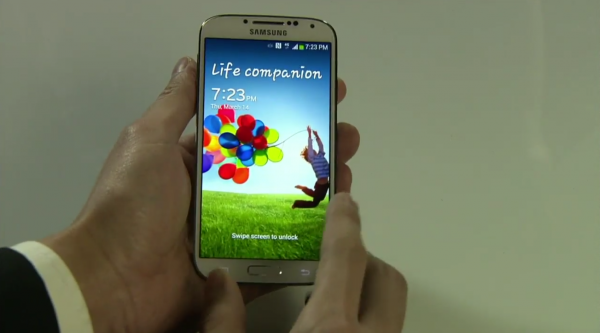
    Those are last model’s features and all designed to make the phone more responsive to you — more human-like. Samsung carries the design philosophy forward. Galaxy S 4 packs eight different sensors and uses them to make the phone highly responsive. Wearing gloves or have chocolate on your hands? Wave instead of touch. Watching a movie and turn your eyes away? Playback stops until you look at the screen again. But this responsiveness is much more.

    “The reason for Samsung’s choice of Galaxy S 4 tagline, ‘Life companion’ is because the word ‘mobile’ in mobile phone is highly misleading”, Fogg explains. “Smartphones are most importantly about personal experiences, not mobile ones. Many of the new features that Samsung is adding into the S 4 are about the immediate vicinity and even inside the home, and not focused on really mobile life”. Stated differently: The phone is highly contextual.

    I have repeatedly asserted that Jobs was wrong to call this the post-PC era. We live in the contextual cloud computing era, where software and connected services matter more than the devices. Samsung’s emphasis on “personal experiences” is dead-on right. The South Korean vendor is surprisingly focused on software and services, which I wouldn’t have expected from a hardware manufacturer. Galaxy S IV adapts based on context.

    Want to share the party with a distant friend? Use both cameras for the video call. Want to check your messages while driving? Let the S 4 read them to you. Snapped a great picture of your kids at the park and some guy in a trench coat in the background makes a face? Remove him immediately. You’re with school friends at the park and want to party but have no speakers? Connect each smartphone and use them as a single 5.1-speaker system.

    Context is about adaptability. At home, you want to play music on your fancy speakers. At the park, when you don’t have them, the multiple-S 4 speaker is good enough — in that context. At the office, you might read and respond to your messages on the PC. In the car, your hands need to be on the wheel, so you have the phone read them.

    Samsung’s software and services design approach is all about making the smartphone more human, more responsive, more contextually relevant and more like a personal assistant.

    Most every story written about Galaxy S IV so ignores these key benefits, which can change people’s lives. I’m appalled by the writers complaining about the lack of innovation here. Many of the most-obvious benefits are like science fiction, which ironically is what most stories slamming the S 4 are: fiction.
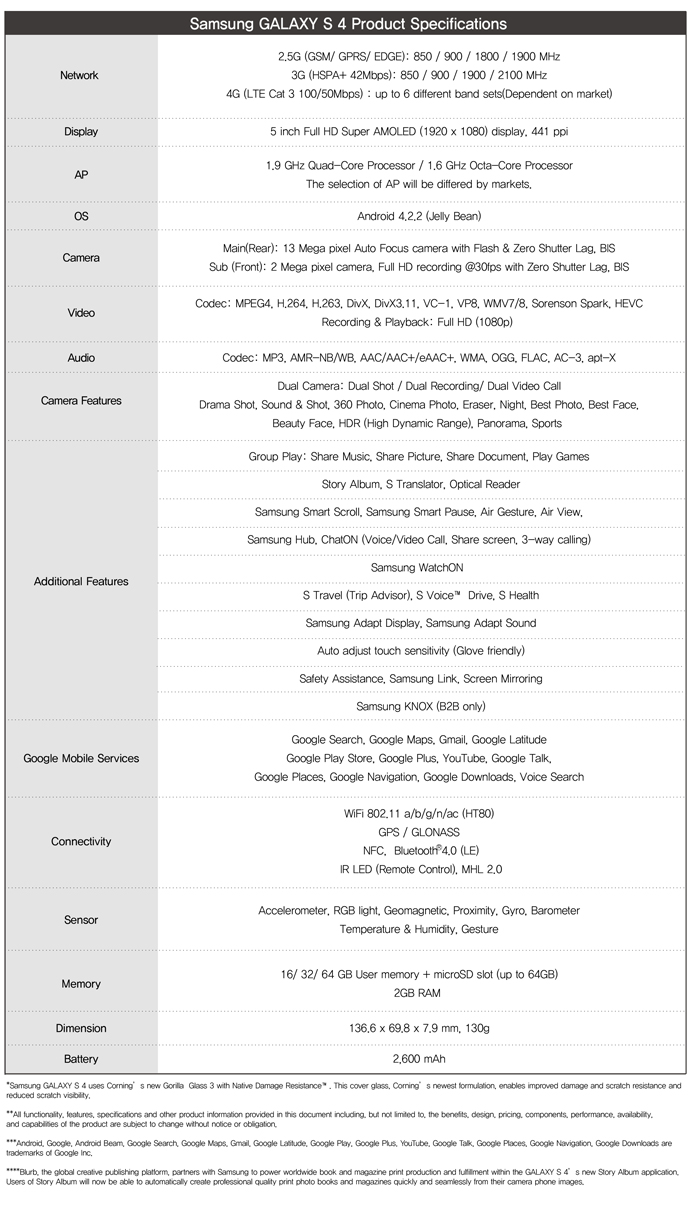
    Photo Credit: Samsung