Blog

  • Learn How To Use Stage3D In Flash 11

    Flash 11 introduced a new development architecture called Stage3D that allows developers to bring “stunning visuals across desktop browsers and iOS and Android apps enabling advanced 2D and 3D capabilities.” The technology allowed one creator to make some incredible interactive projects.

    Peter Shand cooperated with three organizations – RESN, Circul8 and Imagination – in 2012 to create various interactive video projects using Flash 11, Stage3D and other technologies. The results are exceptional:

    To pull this off, Shand worked with Flash 11′s Stage3D and its Away3D library. The Away3D library is a free resource for Flash developers, and it can be used to create rich and immersive interactive experiences like the ones you see above.

    Away3D is part of the Adobe Gaming SDK that was released last year, which includes Starling, Feathers and, of course, Away3D. To learn more about implementing Away3D, check out this tutorial from Away 3D co-founder Rob Bateman:

    Another integral tool is the Starling 2D framework that allows developers to create hardware accelerated content. To learn more about Starling, check out this tutorial series that goes into how Starling can be used to create a game from start to finish:

    If you want to get started on Adobe Flash development, especially for games, Adobe offers a free trial for its game developer tools on Creative Cloud.

  • Wikipedia Founder Jimmy Wales Says He’ll Probably Buy Google Glass

    We know that Google Glass is coming soon – by the end of this year, actually. A fully-polished version of Google’s smart eyewear will be ready for the average consumer some time in 2013 and will cost “less than $1,500.” At SXSW, Google just unveiled some of the first third-party apps that will be available on Google Glass. There’s nobody in the Brin household that will go anywhere without Google Glass on their eyes. Long story short, the Glass revolution is upon us.

    But will it be a revolution? Wikipedia founder and frequent Quora contributor Jimmy Wales has some thoughts on the new tech.

    Jimmy, will Google Glass succeed? Honestly, he says he doesn’t know.

    “This kind of technology is obvious and obviously coming. Will Google Glass succeed? Dunno. Even great companies like Google and Apple have failed product introductions. Remember Apple Newton? Remember Apple TV? But give it 10 years, or 20 years. Let the technology get small enough and come down in price enough that you can’t tell the difference between Google Glass (or Apple iEye, ha!) and and a normal traditional pair of glasses, and I think they’ll be popular enough.”

    Wales does think that Google Glass looks “extremely cool and fun,” though. And he says that he will probably be getting his own pair.

    “Will I be getting my own pair? Probably! Will I wear them around on a normal day with normal people? I don’t know. Depends on the tradeoffs between looking weird and having a cool interface to the world.”

    And what about the negative feedback that’s already emerging?

    “It’s interesting to see all the pushback it is getting before it’s even on the market, of course…the privacy implications are interesting, although of course it’s true that the ubiquity of cellphones and the social pressure not to stand around like a jerk filming people makes a difference.”

  • TED Radio Hour asks: “Do We Need Humans?”

    Radio-Hour-HumansToday, TED Radio Hour asks two questions many of us are scared to pose: will human beings have a purpose as robots become more adept at performing tasks and projecting emotions? And as technology gets more advanced, how does interaction between human beings change?

    Sherry Turkle: Connected, but alone?Sherry Turkle: Connected, but alone?In this episode — the third in season two — Sherry Turkle explores whether the fact that technology allows us more points of communication actually makes us all feel more alone. Cynthia Breazeal predicts the rise of personal robots. Andrew McAfee imagines the future of work as droids take our jobs. And Abraham Verghese wonders if human touch may not be the best medical tool.

    Check out your local NPR schedule to find out when the show airs today, or listen to it via NPR’s website »

    Or head to iTunes, where the podcast is available now »

  • Before Working with a Coach, Challenge Your Self-Assumptions

    Working with an executive coach can be a large investment of time and money; it seems a shame to waste either. If you’re considering coaching (or have, ahem, been asked to consider it), make sure you get the most out of the experience.

    People sign up for coaching for all sorts of reasons — perhaps it was their own idea, and they genuinely want to improve. But often, coaching is not something an individual chooses willingly; someone senior to them, maybe even on the board of directors, has suggested it.

    Someone in a position of authority may make it known that if the executive wants to be promoted, win a bonus, or even keep his job, he must change behaviors that hinder his performance, turn others way, or do not instill confidence in his abilities.

    And so the coach arrives — the outsider, hired to speak truth to power — and can’t make any headway, because the person being coached doesn’t really want to be there. Or the person being coached doesn’t have a specific goal in mind, and so coach and coachee meet a bunch of times before parting ways, neither really knowing what they tried to accomplish.

    As I was talking the other day with a colleague — Mark Goulston, M.D., author of Real Influence, which he co-authored with John Ullmen — it occurred to us that there were some things we wished executives knew about coaching before signing up for it.

    Effective coaching is often a matter of challenging assumptions, and the biggest assumptions often reside in the mind of the person being coached. Challenge your own assumptions about what you need to improve so that you can lead your people in ways the organization demands and they expect.

    Before you meet with your coach, ask yourself what specifically you want to get out of it. The need for coaching could be remedial, that is, you are doing something that bothers others — being too abrasive — or you are not doing enough — too much indecision. For example, the executive may admit that he is focusing too much on details and not enough on big picture challenges. Or the executive may recognize that her failure to make timely decisions is wasting time. Such admissions serve as points of recognition that can leader to greater self-knowledge. What issues are getting in the way of your ability to achieve your potential, or the potential of the organization?

    Even if you don’t want to work with a coach — but you have to, because your boss or the board has asked you to — you must enter the engagement willingly. Try to find some way of framing the challenge of improvement so that it feels more palatable. That might mean focusing on the outcome you want, like winning a promotion or avoiding being let go. Acknowledging that you need to improve in one area or another isn’t easy, but it is necessary to letting coaching be successful.

    Don’t let your coach ask all the questions. Ask them some questions. And ask yourself, “Why do I want this person to be coaching me?” Often a coach comes recommended by others. The coach’s track record and reputation may be outstanding, but that doesn’t mean he or she is right for you. The coach must be able to demonstrate an awareness of the issues you’re facing and a willingness to help you confront them. Yes, executive coaching is a journey of self-discovery — but the coach is your guide. Make sure you get someone you can connect with.

    Give yourself some early wins. What are you willing to change — right now? Coaching occurs over a period of time, but long-term growth must have a starting point. Why not today? For example, if the executive needs to loosen up his heavy-handed management style, a coach can ask what he is willing to give up. First steps may include speaking less and listening more, or learning to ask open-ended questions that are designed to elicit information, not intimidate. He can take those small steps right away and start making progress towards his big goal. That’s incredibly motivating.

    Truth be told, our self-assumptions protect our self-image. If we knew how often we irritated others, or failed to deliver on expectations, we might lose faith in our ability to do our jobs. We are human after all.

    But a coach’s responsibility is to encourage self-examination. Unexamined behaviors can cut us off from the very people we need to engage and inspire. You’ll get a lot more out of your coaching experience if you start the process by examining and challenging your own assumptions.

  • SwiftyKey’s prediction engine will power the Samsung Galaxy S 4 native keyboard

    SwiftKey-logo_large

    We had heard that SwiftyKey would be involved with the stock keyboard on the Galaxy S IV, but nothing was mentioned about it during the event. That is because it won’t be the SwiftKey keyboard exactly, but the the prediction engine itself. SwiftKey does have one of the top prediction engines, so this isn’t surprising.

    Dr. Ben Medlock, co-founder and CTO of SwiftKey, said from the New York launch: “Following our great success with the SwiftKey 4 launch last month, we are excited to confirm that Samsung has chosen SwiftKey’s innovative keyboard technology to be at the heart of its flagship smartphone, the Galaxy S4. This is fantastic progress for our vision of bringing the best touchscreen typing experience to as many people as possible.”

    As to why Samsung didn’t opt for the full experience, it’s because Samsung isn’t interested in “advertising” for any other brand but themselves. I say that in a good way because they are the top dog right now, so they don’t need those types of partnerships. If you’re a SwiftKey fan, you can still opt to download the keyboard and change it out. In fact, you can choose whatever keyboard you want if you so wish, which is what makes Android so special.


    Come comment on this article: SwiftyKey’s prediction engine will power the Samsung Galaxy S 4 native keyboard

  • Even The BBC Can Get Unnatural Link Warnings From Google

    This seems to be proof that Google does not favor big brands of major media outlets when it comes to obeying the quality guidelines. Even the BBC has been getting unnatural link warnings from Google.

    A representative from the organization posted in a Google Webmaster Help forum (as noticed by Search Engine Roundtable):

    My URL is: www.bbc.co.uk

    I am a representative of the BBC site and on Saturday we got a ‘notice of detected unnatural links’.

    Given the BBC site is so huge, with so many independently run sub sections, with literally thousands or agents and authors, can you give us a little clue as to where we might look for these ‘unnatural links’.

    Later in the thread, he adds:

    Yeah the problem is that the site is so big, and has so many agents, that something stupid might have been done, but without being given a clue to what or where, it is kind of hard to track the culprits down and ‘advise them to be a better web citizen’. I have certainly been involved previously is stopping people before they do something ‘unwise’ in relation to the site.

    Of course, I’m not saying someone connected with the site has done something naughty, just that it is a possibility.

    He says he sent a reconsideration request, and explained the situation to Google.

    At SMX West, earlier this week, Google’s Matt Cutts made a point of saying that big brands are penalized often. Of course, we recently saw UK flower site Interflora get penalized, though that didn’t last long.

  • Samsung to bring newer Galaxy S 4 features to the Galaxy S III

    Samsung_Galaxy_S_4_Dual_Shot

    Since most people that own a Galaxy S III are probably stuck in a contract with at least 1 year remaining, it’s good to know that Samsung plans on bringing most of the new Galaxy S 4 features to the Galaxy S III. I say “most” because some features such as anything regarding the IR blaster won’t make it since the GSIII lacks an IR blaster. So this means that features such as AirView, Smart Pause, Optical Reader, Group Play, Drama Shot, Photo Eraser, Sound and Shot, Cinema Photo, Dual Shot, Dual Recording, ChatON Video Chatting, ChatON Screen Sharing, S Translator, Adapt Display, and S Health will probably make it to your phone. I presume they will be part of the Android 4.2.2 update. As to when that will happen, no word, but you know how that goes with all the carrier testing. I wouldn’t expect carrier branded devices to approve the update until the end of the summer, but that’s just my opinion.

    So there really isn’t a need to worry about upgrading, but if you’re still on the fence, you can check out our hands on video as well as Samsung’s overview video on the Next Big Thing.

    source: PCMag

    Come comment on this article: Samsung to bring newer Galaxy S 4 features to the Galaxy S III

  • Google Translate Adds Phrasebook To Help You Remember What You Learned

    Google has introduced a new feature for Google Translate, which could go a long way in helping users remember the translations they learn from the tool. It’s called Phrasebook, and lets you save useful translated phrases to refer to later.

    To use it, simply click the star under the translated text in Google Translate, and it will save it to the Phrasebook feature. There is a new Phrasebook icon in the upper right-hand corner, where you can view the stuff you save.

    In addition to helping you retain knowledge, the feature should make it quicker and easier to get translations you might need more frequently.

    “With Google Translate, you can find the right thing to say, but you may not remember the translation at the right time,” says Google in a blog post. “You might find yourself performing the same translation again and again, until you finally commit the translation to memory.”

    “Phrasebook for Google Translate jumpstarts this slow learning process by allowing you to save the most useful phrases to you, for easy reference later on, exactly when you need them,” the company adds. “By revisiting the useful phrases in your Phrasebook from time to time, you can turn any brief translation into lasting knowledge.”

    Phrasebook includes controls to let you filter phrases by language pair, and lets you search for specific phrases within the feature. When you hover over the phrases, you find a clickable text-to-speech icon, so you can hear a phrase pronounced.

  • Dave Chappelle, Chris Rock Tease a Tour

    Almost one decade ago, comedian Dave Chappelle found wild success with his Comedy Central TV show Chappelle’s Show. However, the TV show, which spawned numerous memes, also changed Chappelle’s stand-up audiences, and eventually led to the star’s self-imposed hiatus from comedy.

    Now, it appears that Chappelle may have resurfaced on the New York comedy scene. The Los Angeles Times is reporting that the comedian was spotted at three different on-stage appearances at New York’s famed Comedy Cellar recently.

    Chappelle wasn’t alone, however. He was joined on-stage at some points by other famous comedians, including Marlon Wayans and Chris Rock. Surprisingly, Chappelle even joked with Rock about possibly doing a joint comedy tour. Reportedly, Rock took the joke seriously and the two began to work out their schedules, all on-stage. The Times report quotes Rock as saying, “By Halloween I could do dates” and quotes Chappelle as saying, “This could be the show: fireside chats with Chris Rock.”

    Of course, whether the elusive Chappelle was serious is still a valid question. Still, the prospect of the comedian making a comeback is an exciting one for his fans, who have presumably grown up enough to stop heckling Chappelle by shouting “I’m Rick James, bitch!” constantly.

    (Image via Davej1006/Wikimedia Commons)

  • Samsung gives us a 4 minute overview of the Galaxy S 4 [Video]

    Samsung_Galaxy_S_4_Life_Companion

    Samsung’s Galaxy S 4 isn’t about the specs folks. Sure it sports some of the best specs around, but Samsung wants you to know that their phone is a life companion full of features that you need. That’s why they only spend about 1 minute talking about the specs in this four minute video.  The rest of it is all about those new features including AirView, Smart Pause, WatchOn, Optical Reader, Group Play, Drama Shot, Photo Eraser, Sound and Shot, Cinema Photo, Dual Shot, Dual Recording, ChatON Video Chatting, ChatON Screen Sharing, S Translator, Adapt Display, and S Health. Hit the break for the full video and be sure to check out our hands on as well.

    Click here to view the embedded video.

    Come comment on this article: Samsung gives us a 4 minute overview of the Galaxy S 4 [Video]

  • Saints Row IV Emerges From THQ Bankruptcy, Launches August 20

    After THQ went bankrupt earlier this year, the Saints Row franchise found its way into the coffers of Deep Silver. The small European publisher is better known for European RPGs and the Dead Island franchise, but it’s ready to become a publishing powerhouse with its acquisition of Saints Row.

    Deep Silver and Volition announced today that Saints Row IV will be heading to current-gen consoles and PC on August 20. The game, originally envisioned as an expansion for Saints Row: The Third, has now been expanded into a full fledged game where players take on the role of the U.S. president who happens to have super powers.

    In the next open-world installment of Saints Row, Deep Silver Volition continues the story of the Third Street Saints by elevating their status to the highest level – the leaders of the free world. In Saints Row IV, the head honcho of the Saints has been elected to the Presidency of the United States. But the Saints are just getting started. Now the larger-than-life insanity of the Saints series gets a new twist with a catastrophic alien invasion, and the aliens have transported the Saints to a bizarro-Steelport simulation. Wield gargantuan superpowers and fight to free humanity from alien granddaddy Zinyak’s mental grasp. Escape the simulation that’s trapped the Saints crew, or die trying.

    Saints Row IV lets players delve into an arsenal of alien weaponry and technology that will turn each Saint into an ultimate entity of destruction. Utilize out-of-this-world superpowers to fight all the way to the top. With intensified action and enhanced customization, players can use their newfound superpowers and leap over buildings, outrun the fastest sports cars, or send enemies flying with telekinesis in the greatest, most insane installment of Saints Row yet.

    Save the world, Saints Style.

    Oh, and the publisher released a teaser trailer for the title. It looks like more Saints Row, and that’s always a good thing:

  • SEC Outsources to IO in $17.5M Contract

    io-nj-modules

    A row of data center modules inside an IO data center. The company has signed a $17 million deal with the SEC.

    IO Government Services, part of IO Data Centers, landed a $17.5 million contract to provide outsourced services to the U.S. Securities and Exchange Commission (SEC).

    This is a win for IO, and a positive move for overall government data center consolidation efforts, but it does threaten the standing of the SEC’s self-run Alexandria facility and its workers. Also, this approach is significant because of what that data center does–it runs Electronic Data Gathering and Retrieval (EDGAR) an online database of corporate filings. One might conclude that government agencies are getting more and more comfortable in outsourcing higher-level, sensitive functions.

    This contract makes the SEC less dependent on the General Green Way building that currently houses this infrastructure. The shift will save SEC millions, according to former SEC chairwoman Mary Schapiro, who wrote in a letter to Congress that outsourcing and eliminating the Alexandria facility from its portfolio of leased space would save $18 million.

    More government consolidation comes as no surprise, as it’s been a major ongoing initiative. The contract is for one-year with renewal options up to nine years and it’s the second contract for the outsourcing of the SEC’s staff-operated data center at 6432 General Green Way in Alexandria. The facility is leased from Cafferty Commercial Real Estate Services.

    According to the Washington Business Journal, Commission officials have floated several proposals over the past few years to shift the Alexandria workers to sites in downtown DC.

    It’s believed that the staff at the Alexandria facility would be moved to sites in downtown DC, including the SEC’s Station Place HQ. This is causing some real estate experts to question the figures Mary Shapiro stated in her letter to Congress, as the rent is higher ($61 vs. $35 per square foot) downtown compared to the Alexandria facility. However, they fail to see that rent per square foot isn’t the true expense; it’s running the actual data center that costs a significant amount. As the outsourcing initiative continues and savings are realized, bigger and bigger self-run data centers will be outsourced.

  • Reuters – Pinnacle Foods Will Raise Up to $667M in I.P.O.

    Packaged foods maker Pinnacle Foods Inc., backed by Blackstone Group LP, said it expects to raise as much as $667 million from its initial public offering, Reuters reported. The owner of the popular Bird Eye and Duncan Hines brands said in a regulatory filing with the U.S. Securities and Exchange Commission that it plans to sell 29 million shares at between $18 and $20 each. At the top end of the range, Pinnacle Foods would be valued at about $2.3 billion.

    (Reuters) – Packaged foods maker Pinnacle Foods Inc, backed by Blackstone Group LP, said it expects to raise as much as $667 million from its initial public offering.

    The owner of the popular Bird Eye and Duncan Hines brands said in a regulatory filing with the U.S. Securities and Exchange Commission that it plans to sell 29 million shares at between $18 and $20 each.

    At the top end of the range, Pinnacle Foods would be valued at about $2.3 billion.

    The company initially filed a placeholder amount of $100 million when it filed to go public last December. It boosted the size of its offering last week to as much as $632.5 million.

    The company, which was acquired by Blackstone in April 2007, manufactures branded food products in North America and had net sales of $2.5 billion in fiscal 2012.

    Funds affiliated with Blackstone would retain a 68 percent ownership stake in the company following the offering, assuming underwriters fully exercise their option to buy additional shares.

    Pinncale has been approved to list on the New York Stock Exchange under the symbol “PF.” Its shares would be priced on March 27 and trading would start the next day, underwriters told Reuters.

    With equity markets approaching record highs in the U.S., private equity firms are looking to cash out on their investments. TPG-backed Taylor Morrison Homes Corp is also being queued up to go public this month, according to sources familiar with the deal. It would be one of the largest listed homebuilders.

    Taylor Morrison, which is looking to take advantage of investor interest in the recovering U.S. housing market, doubled its planned IPO size last month to as much as $500 million.

    Barclays and BofA Merrill Lynch are lead underwriters for the offering, among a syndicate of book runners including Credit Suisse Securities, Goldman Sachs & Co and Morgan Stanley and UBS Investment Bank.

    The post Reuters – Pinnacle Foods Will Raise Up to $667M in I.P.O. appeared first on peHUB.

  • Overhauling a home network, part 4 — From an HTPC to Google TV

    Fourth in a series. Before I go any further I am anticipating the obvious question here — how can you replace a Windows Media Center HTPC with a box that has no DVR functionality? For many of you this may be impossible, but for me it is simple. We have DirecTV and the HR21 HD DVR for TV — I cannot live without my NFL Sunday Ticket. The HTPC is simply used for DVD rips, music and pictures, so we never used it to its full capability. That makes the move to the Vizio Co-Star an easy one.

    And, after last week’s disastrous start to the home theater portion of this endeavor, anything had to be a step up. With the Micca box safely returned to Amazon, it was time to make Google TV the one box to rule them all, replacing both HTPC and Netgear NeoTV 550.

    Getting Started

    Setting up the Co-Star is fairly painless. Simply plug your cable or satellite box into the Vizio via HDMI in and then use another cable to run from HDMI out to either your TV or A/V receiver. It takes 5-10 minutes to walk through the on-screen steps to get your picture to look perfect, pick up your cable or satellite content, control your TV power and volume and more. Unfortunately, as I run everything through the Yamaha receiver, I still need that second remote to control volume and power for that device.

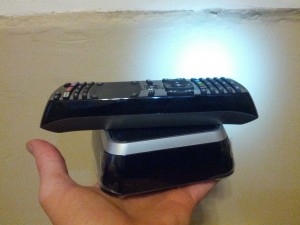
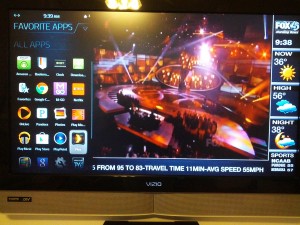
    The remote is a bit on the chunky side, but that is because of the full QWERTY keyboard on the back. All of the buttons are there to control your DVR — guide, list, menu and more. There is also a laptop-like touchpad for full mouse control and a large V button that launches the apps, including a number that are pre-installed, such as Amazon Prime, Netflix, Google Play, Chrome and several more.

    Getting your Computer Media

    By default, Google TV does not pull in video, music, movies and pictures from computers on your home network as others like the Roku can do.

    For this you can use Plex. You will first need to set up the Plex Media Server on one of your computers — preferably something that is always on, like a desktop PC. Setup is easy. Simply add media by category, like music, pictures, TV shows and movies. Browse to the folder where each is stored and add the folders.

    Now head to the Google Play store and grab the Plex app — there is one specifically for Google TV, but unlike the Media Server and Android apps, it is not free. However, it is only $0.99 so don’t panic.

    Other Apps

    There are a number of other apps that are made for Google TV like Pandora and Google Music, to name only two.  You will also find a number of video apps, but sadly some of the bigger ones like Crackle and Watch ESPN are not compatible.

    Conclusion

    After living with the Vizio Co-Star for almost a week it has truly become the only box we need in our home theater. All of the live and recorded TV is played and controlled through it and all of our music, pictures and recorded DVDs are easy to access from Plex. However, most of our movies are in ISO format, which doesn’t play, so I am slowly converting them to AVI using Freemake Video Converter.

  • Schneider Electric Sharpens Focus on Service Providers

    Energy management conglomerate Schneider Electric this week announced two new teams, one to focus on data center service providers and another to integrate Schneider’s acquisition of Lee Technologies into a software and services offering.

    The Data Center Service Provider Team will focus on the specific needs of colocation, hosting and cloud businesses. Its a multi-disciplinary team that brings together solution architects, global project management and execution, supply chain and account managers.

    “The market is moving this way,” said Chris Buckley. “It’s a very fast-growing segment of our business. This customer segment is unique. They’re doing things other customers aren’t doing.”

    Industry veteran Joe Reele will serve as Vice President, Data Center Solutions Architects for the new Schneider unit. Reele has more than 10 years and one million square feet of data center experience in helping organizations analyze requirements and develop cost-effective solutions.

    Schneider also announced the expansion of its IT Business with the launch of the Schneider Electric Mission Critical Services & Software division,and represents the full integration of Schneider Electric’s energy management services with Lee Technologies’ data center lifecycle methodology. The division will feature more than 7,000 trained specialists to work with data center clients.

    Jason Schafer, who is familiar to DCK readers from his tenure as an analyst at Tier 1/451 Research, has joined Schneider as Director, Technology & Operations Management for the Mission Critical Services and Software. Schafer will be responsible for the development and coordination of facility operations consultancy services. He has 18 years of experience in the mission-critical facilities field, including service in the Naval Nuclear Power Program and as a data center commissioning specialist and construction manager for Lee Technologies, where he managed data center projects for Fortune 100 enterprises and various government entities.

    “The launch of Schneider Electric’s Mission Critical Services & Software division and the Data Center Service Provider Team places Schneider Electric in a strategic position as the leader in end-to-end data center energy management,” said Rob McKernan, Senior Vice President, Americas, Schneider Electric IT Business. “We provide one-of-a-kind, holistic, and fully-comprehensive solutions that are unique and currently unavailable in today’s market, with energy management capabilities from planning, building and operations to energy procurement, lifecycle management and software, all from one company. This is further complemented by our team of consultative and technical experts that provide guidance every step of the way.”

  • Here’s the World’s Smoothest Nose Picker [VIDEO]

    What do you do if you get caught mining for gold at a nationally televised NBA game?

    You own it, that’s what.

    [via reddit]

  • Friday Funny: What’s the Best Caption?

    It’s Friday! You know what that means — it’s time for our Friday Funny caption contest. Take a moment to vote for the best caption for the Pot of Gold cartoon.

    Data Center Knowledge features a cartoon drawn by Diane Alber, our fav data center cartoonist, and our readers suggest funny captions. Please visit Diane’s website Kip and Gary for more of her data center humor.

    Our contest works like this: We provide the cartoon and you, our readers, submit the captions. We then choose finalists and the readers vote for their favorite funniest suggestion. Please vote below.

    For the previous cartoons on DCK, see our Humor Channel.

  • What the Marketing Agency of the Future Will Do Differently

    It’s a murky, unclear future for the marketing agency, but one thing is for certain: things are changing at an exponential pace. An agency used to act as the executional arm of the marketing department. An outsourced idea and creative team that could get the production done at a cost that was less than what it would cost the brand to have a permanent staff in place.

    Over time, this role has changed. The digital channels have definitely amplified the need for agencies to evolve and adapt. How people connect to traditional channels like TV, print, radio and out-of-home has changed from their intended purpose of interrupting consumers with a message during content consumption. Social media pushed this even further by forcing brands to engage with consumers — one-on-one — for the public to see, in a very human voice. Mobile, too, is offering ways to connect with consumers who now wield tremendous power in the palm of their hands. Everyone is curious about how big data is going to play out, what’s in store for wearable technology and just what, exactly, the screen of the future will look like — and how consumers will interact with it.

    Still, the role of the agency remains fairly simplistic (in philosophical terms): help a brand increase their sales and loyalty. Noting more. Nothing less. And that has not changed since agencies were first invented.

    So, now what? How do agencies ensure their future by being able to help brands sell more and build stronger loyalty in such a disrupted and disintermediated world, where every individual is consuming so much media from so many different channels? How does an agency stay ahead of the curve?

    For over twenty years, I have had a front row seat to this revolution in marketing. Watching businesses like Kodak crumble in the same month that Instagram gets acquired by Facebook for a billion dollars. Watching an unknown search engine with a cute name become one of the most powerful brands in the world. It is clear that agencies are still holding on to their sacred cows, but it is crystal clear that the dogma of the industry is being rewritten. Here are five new attributes that I think marketing agencies will need to develop to survive:

    1. Models of leanness. Eric Ries brought the concept of the Lean Startup into our zeitgeist. Marketing agencies of the future will need to focus on many of the strategies that the lean movement engenders. From how we initiate a project by establishing metrics and outcomes from the beginning, to being more agile in building programs that can bend, move and iterate as we learn from what the market is telling us (marketing optimization anyone?). Most marketing is still driven by quarterly planning or seasonal initiatives (aka marketers know best). While it may be hard to transition to a truly real-time way of operating (aka consumers know best), starting with models of leanness will force agencies to be more nimble, more sensitive to how the brand’s budget is allocated and force a spirit of partnership with the brands they represent. That partnership was somewhat lost in the past and agencies became more like vendors than trusted advisors. Models of leanness will bring partnership back to the table.

    2. Utility over content. If the past ten years were about developing content in the social channels (in order to provide value, humanize the brand, be present in search engines and more), the next five years will be about the brands that can actually create a level of utility for the consumer. Too many brands are confusing a utility with more robust marketing messaging. The two are not the same. Utility is something that consumers would use on their own accord because it adds value to their daily lives (something they might even pay for). Regardless of attribution to a brand. The bonus (and benefit) comes to the brand by creating something that consumers can’t live without and the appreciation and attachment that comes from it.

    3. Content as media. Content was used as chum for brands. Brands blog, podcast, tweet, post and more in hopes of drawing consumers over to their home base (which was — and still is — littered with marketing calls to action). As native advertising models continue to be introduced and the ability for brands to do something that will resonate with consumers gets more difficult due to the crowded social platforms, content becomes another form of media. Some agencies are helping brands to create their own, authentic newsrooms within an organization while other agencies are building their own newsrooms to help brands create more relevant and original pieces of content that don’t look, smell or act like a press release or advertorial. Content as media become a natural extension of an agencies’ ability to help tell a better and more connected brand narrative.

    4. R&D. Marketing agencies sell professional services. Not products. In the past, many marketing agencies have done their best to create, market and sell an actual product (be it digital or physical). Most have had limited success. Service-based companies selling products has not been a wildly successful endeavor for the majority of marketing agencies. Going forward, this will have to change. The ability for a marketing agency to provide a higher level of research and development in terms of product development and technological implementation will be core to success. Agencies must get much better at providing a deeper context of opportunity for brands to explore. While everyone is excited about the potential of “big data,” the idea of agencies bringing more R&D to brands could best be defined as “big research.” Pushing beyond the research, analytics and insights to deliver solutions that can’t just be relegated to a purchased media space. Helping brands create what they’re going to be selling next.

    5. Many big ideas. When people think of marketing agencies and the advertising output, they generally think about the big idea… and how it plays out across media. As we move towards the era of personalization, agencies must become the purveyors of personalization. This does not mean the death of the big idea, but rather a new dawn when agencies are bringing brands many big ideas that are either directly or loosely connected in a way that enables them to connect the brand through channels that transcend advertising (think content, wearable technology, screens that allow consumers to skip traditional messaging and more). Pushing that further, consumers are not the same when they’re watching television as they are when they’re on a smartphone. They’re not the same consumers when they’re reading consumer reviews as they are when they are in a physical retail location. Each scenario, each consumer, each moment of engagement continues to look very different than the output of marketing messages that agencies have been responsible for to date. The brands that can create these many big ideas and be accountable for these many new forms of creative are destined for success.

    Is the agency of the future just a back to the future moment?

    Sadly, most people think of “advertising” when they think of “marketing.” Marketing — as traditionally defined — is about the Four Ps (Product, Price, Place and Promotion). Marketing agencies have spent the bulk of their time focused on just the promotion part of those Four Ps. The world — because of technology and connectedness — is forcing marketing agencies back to the entire sphere that encompasses marketing. Now, more than ever, marketing agencies will be challenged to prove their results and mettle.

  • Google Fiber Android App Now Supports All Android 4.2 Devices

    One of the coolest things about Google Fiber is that the company throws in a free Nexus 7 tablet for those who subscribe to Google Fiber’s Internet and TV package. The tablet acts as a controller of sorts for the set top box allowing users to control all aspects of their television experience. Now the experience is moving to other Android devices.

    Google announced that the Google Fiber app for Android is now available on all devices sporting Android 4.2 or higher. That means that all of Google’s Nexus devices and the Asus Transformer Pad will now be supported. Of course, you may have installed a custom Android 4.2 ROM on your device, and that’s fine too.

    Oh, and before you ask, Google Fiber still isn’t expanding beyond Kansas City just yet. You can install the app though, and pretend that you live in Kansas City. That’s what the reviewers of the app are doing. Although, I’m pretty sure Google won’t be expediting the move of Fiber to other areas just because somebody from Michigan gave the app a five star review.

    You can grab the new Google Fiber app here. Install it on your Nexus device and dream of a day when you’re not being scammed by incumbent ISPs.

    [h/t: Engadget]

  • Sculpteo Shows Us What 3D Printing Is Really Good For: Creating Adapters For Old iPod Docks

    Screen Shot 2013-03-15 at 9.42.48 AM

    Sculpteo, a French 3D printing company, is now offering custom iPhone adapters for older iPod docks, allowing you to add connect to your old Bose, Sony, JBL, and other docks with the new Lightning connector. Obviously you need a Lightning adapter but the $17 pieces will make it much easier for you to connect your phone to these older docks.

    But the most interesting thing here is that this essentially creates a sort of interstitial hardware. Instead of buying a new dock (or a new baby gate or a new garden parasol) you can buy and print or download and print your own spare parts. This obviously won’t put your local hardware store out of business and 99% of the world won’t buy this Lightning adapter, but the fact that it’s available is very important.

    “This story and this adapter is opening a new field of 3D printed spare parts for a lot of different devices. Battery covers, clips, docks, handles … a lot of things can be lost, or become unusable because some other device changed or has been updated,” said Sculpteo founder Clement Moreau. “We really see 3D Printing here as a way to work smoothly in a moving environment, where big companies have really good reasons to change standards from time to time.”

    This is print-on-demand hardware, designed for a very specific purpose with a very specific audience. Because they don’t have to hold inventory, you can essentially offer customized dock adapters. This one is a one-size-fits-all but you could feasibly print new ones for oddly-shaped ports or even adapters for different phones. It makes no sense to make 50,000 of these at a factory in Asia but it makes perfect sense to dump out few hundred to those in need.

    This is hardly an earth-shattering announcement. Oddly enough, as a Makerbot owner I’d actually prefer to be able to download and print my own copy of this adapter rather than buy one for the ridiculous price of $20. I won’t, but still. This announcement does raise a lot of interesting points as to where the hardware business is headed. And when I can breathe new life into old docks with just a tiny piece of plastic I’m a much happier man. And, when someone inevitably creates a free copy of these things, we’ll have to begin asking ourselves what copyright really means in an era when we can print anything at any time, from iPhone dock adapters to guns.