Blog

  • Hulu Taps SVP of Content Andy Forssell to Replace Jason Kilar as CEO

    Back in January, Hulu CEO Jason Kilar announced that he would be stepping down at the end of Q1. And as that time fast approaches, Hulu has finally announced who will replace him when he leaves.

    According to Kilar, Andy Forssell will be tapped as acting CEO when he steps down at the end of March.

    Forssell is currently the Senior Vice President of Content at the company who signed on in 2007.

    “In his time at Hulu, Andy has accelerated the growth of the content business from just two content providers in 2007 to more than 410 today, and has led the expansion into original programming. Andy brought to Hulu more than a decade of experience at Siebel Systems and Oracle Corporation where he served in a number of leadership roles including product development, customer care, datacenter operations and supplier management for their hosted CRM software-as-a-service businesses,” says Hulu’s about page.

    Kilar sent this letter to the Hulu team, and it’s been cross-posted to the Hulu blog:

    Team –

    As you all know, I will be departing Hulu at the end of this quarter. I wanted to share the news that Andy Forssell will be stepping up to lead Hulu as acting CEO after I depart later this month. You know Andy well; he’s been a critical senior executive and has been here from the start of this great adventure. Andy exemplifies the Hulu culture and has been central to Hulu’s journey, helping to grow this company from 2 content partners and no revenue to over 450 content partners and approximately $700 million revenue in 2012. In his role, Andy has built strong relationships with many of our Board members. Andy has the Board’s strong support in leading the team during this important time.

    Disney and News Corporation are currently finalizing their forward-looking plans with Hulu, and the senior team has been working closely with them in that process. Once the plans are finalized, a permanent decision will be made regarding the CEO position.

    As I mentioned to you all at the beginning of this year, Hulu’s focus remains on delivering a fantastic 2013 for customers and shareholders. Hulu is well on its way, with new records being set in Q1 across both revenue and subscriber additions. The unwavering focus on delighting Hulu’s customers is clearly showing up in the outputs of the business.

    Jason

  • Do You Know the Hydro-Footprint Of Your Data Center?

    Ron Vokoun DBIA, LEED AP BD+C, leads the Mission Critical Market for JE Dunn Construction’s western region. Ron is a 25-year veteran of the construction industry with a focus on mission critical facilities and sustainability. Harold Simmons, Director of Strategy and Mission Critical Solutions for United Metal Products, co-authored this article. See more on Simmons below.

    Ron VokounRON VOKOUN
    JE Dunn Construction

    In my last column, Water Consciousness Continues in the Data Center, cooling technologies that are proven to reduce the consumption of water were discussed. I also outlined issues surrounding the availability and potential alternative sources of water for data center cooling. Clearly, there are ways to make data center water usage more sustainable. In this column, let’s discuss the complex relationship between water and energy use in the data center.

    WUE and PUE

    The Green Grid has been at the forefront of the data center energy efficiency movement and is again leading the way in monitoring the use of water in data centers. The Water Usage Effectiveness (WUE) established a Key Performance Indicator (KPI) metric to measure the amount of water used in a data center.

    Water Usage Effectiveness (WUE) is a new metric to evaluate water use.

    Water Usage Effectiveness (WUE) is a metric to evaluate water use and it is being promoted by the Green Grid.

    The complexity in the relationship between water and energy use can be illustrated by comparing WUE and PUE in a particular data center. If your focus is purely on reducing on-site water use, you can use air-cooled chillers and have a great WUE. However, there may be a premium paid in the form of higher energy usage compared to a technology such as evaporative cooling depending on your location, thereby elevating your PUE.

    An aspect of water use that is often ignored is the amount of water used in the production of the power that is used in the data center, which leads us to the discussion of hydro-footprint.

    Hydro-Footprint

    Depending on the location of your data center, the production of power can be quite water intensive. The National Renewable Energy Laboratory (NREL) performed a study titled Consumptive Water Use for U.S. Power Production (PDF) that analyzed the amount of water used in the production of power in each state. Illustrating the impact of water used in the production of power, let’s continue, using the data from my last column.

    According to the NREL study, power produced in the state of Arizona, on average, uses 7.85 gallons of water per kilowatt-hour. The table below illustrates the annual power use for a 36,000 CFM cooling unit using four different technologies. (Assumptions for both charts: DC located in Phoenix, based on ASHRAE recommended humidity range, based on inlet supply temperature to servers at 80-degrees F, water and power consumption is for 36,000 CFM unit, data is representative and does not apply to all brands, and data provided by United Metal Products.)

    AnnualizedPowerConsumption

    Click to enlarge graphic.

    The table below shows the amount of water used annually for cooling for the four different technologies, as well as the amount of water used in the production of the power used in their operation giving the total hydro-footprint of each unit.

    Click to enlarge graphic.

    Click to enlarge graphic.

    As you can see, although the air-cooled chiller uses the least amount of water in cooling operations, it’s higher power use yields a higher overall hydro-footprint than Options 1 & 2. This exercise highlights the need to look at water use more holistically and include the water used in the production of power.

    The Green Grid’s WUE metric also has the ability to take this into consideration by adding the water used during the production of the power used by the cooling equipment to the annual site water usage.

    WUE-source

    WUE Source calculation.

    Whichever metric you use, it will help you weigh the options for both power and water consumption and make an informed decision. By tracking your data centers’ efficiency in consuming water and energy, you take a huge step toward creating a more operationally sustainable data center environment.

    Harold-Simmons-thHAROLD SIMMONS
    United Metal Products

    Co-author Harold Simmons is Director of Strategy and Mission Critical Solutions for United Metal Products and Chil-Pak.

    Industry Perspectives is a content channel at Data Center Knowledge highlighting thought leadership in the data center arena. See our guidelines and submission process for information on participating. View previously published Industry Perspectives in our Knowledge Library.

  • The Samsung Galaxy S 4 And Its De-Googling Of Android Suggests We Might See A Split

    img_white_origin_08

    Samsung did something fairly surprising given that it included the most recent version of Android, 4.2.2, on its brand new Galaxy S 4 smartphone: it didn’t talk about that much at all last night at the special launch event. Maybe the company was too busy trying to cram as many song and dance numbers into the show as possible, but maybe that’s because Samsung will soon take what it needs from Android and go its own way.

    Which isn’t to say it would get rid of Android altogether – just that it might choose to follow Amazon’s example and build a version of Android that’s virtually unrecognizable on the surface from the Google mobile OS that will be running on the vast majority of other OEM handsets. The more control Samsung has over the OS running on its devices, the greater its take of revenue resulting from software and media use, and the better it can solidify its position at the top of the global smartphone market.

    More than any other Android device manufacturer, Samsung made a point with its latest generation of flagship device to outline software features that help it stand apart: Dual-Shot, Sound Shot, Drama Shot, Air Gesture, Air View, S-Travel, S-Health, S-Voice, S-Translator, S-Voice Drive Knox, Smart Scroll, Smart Pause, Group Play, etc. The list of features that were Samsung-specific was long, and many of those actually included services that can be considered alternatives to Google’s own offerings: S-Voice and S-Translator can do a lot of what Google’s own software offerings can provide, for example, and use Nuance tech, not Google’s, to get it done.

    Even leaving the major software service announcements aside, small things like the new Bluetooth controller and ability for S-Health to plug into third-party devices signal a desire to start attracting more content to Samsung’s own OEM-specific ecosystem.

    Samsung also offers its own Samsung Apps for delivering software specific to its devices, and has signed on Swiftkey to provide its software keyboard, another way to differentiate itself from those using stock or skinned Android input mechanisms. Samsung Apps itself isn’t new, but a key effort from the Korean company to attract more developers to that platform is aiming to make it more of a destination for developers and consumers. Samsung announced a campaign in February to sign on indie developers to Samsung Apps, offering 100 percent of all revenue from software sold there to developers.

    That’s a big incentive over the standard revenue split of 70/30 in the Google Play marketplace, and one made even more attractive by the fact that even if developers target only Samsung devices, at this point they’re still reaching the vast majority of Android smartphone users worldwide. Likewise, Samsung should be able to use its market advantage to add even more content to its own dedicated media marketplaces (including the music store powered by 7digital), which could get a boost in terms of consumer interest from the new Group Play collaborative media sharing feature introduced for the Galaxy S 4.

    Amazon had it backwards: it started off trying to stake out its own territory apart from Google’s own Android encampment. Samsung instead is taking what it needs from Android and slowly building up reserves to strike out on its own. It still has a ways to go before it gets there (Play is still just a far better ecosystem than Samsung’s own media and software stores), but eventually the chance to strike off on its own and own a more direct relationship with customers by forking Android development could be just too tempting the next time a new flagship update rolls around.

  • KMP, Teachers and Borealis Sell Interests in Express-Platte Pipeline

    Kinder Morgan Energy Partners (KMP) has sold its interest in the North American Express-Platte Pipeline System to US-based Spectra Energy Corp. for approximately US$380 million. KMP’s partners Ontario Teachers’ Pension Plan Board and Borealis Infrastructure, the infrastructure investment arm of Ontario Municipal Employees Retirement System, also sold their interests in the pipeline system. The entire transaction value was US$1.49 billion.

    PRESS RELEASE

    Kinder Morgan Energy Partners, L.P. (NYSE: KMP), today announced that it has closed its previously announced sale of its one-third interest in the Express-Platte Pipeline System to Spectra Energy Corp for approximately $380 million pre-tax. KMP’s joint venture partners in Canada (Ontario Teachers’ Pension Plan Board and Borealis Infrastructure, the infrastructure investment arm of the OMERS pension plan) also sold their interests in the pipeline system, as Spectra Energy Corp purchased 100 percent of Express-Platte—a 1,700-mile oil pipeline system connecting Canadian and U.S. producers to refineries in the Rocky Mountain and Midwest regions of the United States.

    Based on the structure of KMP’s investment with the Express-Platte Pipeline partners, KMP received approximately $15 million of cash flow on an annual basis from its investment, consisting primarily of debenture interest. KMP plans to redeploy the proceeds from the sale into various growth projects to further benefit its unitholders.

    Kinder Morgan Energy Partners, L.P. (NYSE: KMP) is a leading pipeline transportation and energy storage company and one of the largest publicly traded pipeline limited partnerships in America. It owns an interest in or operates more than 44,000 miles of pipelines and 180 terminals. The general partner of KMP is owned by Kinder Morgan, Inc. (NYSE: KMI). Kinder Morgan is the largest midstream and the third largest energy company in North America with a combined enterprise value of approximately $100 billion. It owns an interest in or operates more than 73,000 miles of pipelines and 180 terminals. Its pipelines transport natural gas, gasoline, crude oil, CO2 and other products, and its terminals store petroleum products and chemicals and handle such products as ethanol, coal, petroleum coke and steel. KMI owns the general partner interests of KMP and El Paso Pipeline Partners, L.P. (NYSE: EPB), along with limited partner interests in KMP, Kinder Morgan Management, LLC (NYSE: KMR) and EPB. For more information please visit www.kindermorgan.com.

    This news release includes forward-looking statements. These forward-looking statements are subject to risks and uncertainties and are based on the beliefs and assumptions of management, based on information currently available to them. Although Kinder Morgan believes that these forward-looking statements are based on reasonable assumptions, it can give no assurance that such assumptions will materialize. Important factors that could cause actual results to differ materially from those in the forward-looking statements herein include those enumerated in Kinder Morgan’s reports filed with the Securities and Exchange Commission. Forward-looking statements speak only as of the date they were made, and except to the extent required by law, Kinder Morgan undertakes no obligation to update or review any forward-looking statement because of new information, future events or other factors. Because of these uncertainties, readers should not place undue reliance on these forward-looking statements.

    Photo courtesy of Shutterstock.

    The post KMP, Teachers and Borealis Sell Interests in Express-Platte Pipeline appeared first on peHUB.

  • The Ideal Praise-to-Criticism Ratio

    Which is more effective in improving team performance: using positive feedback to let people know when they’re doing well, or offering constructive comments to help them when they’re off track?

    New research suggests that this is a trick question. The answer, as one might intuitively expect, is that both are important. But the real question is — in what proportion?

    A Little Criticism Goes a Long Way

    The research, conducted by academic Emily Heaphy and consultant Marcial Losada, examined the effectiveness of 60 strategic-business-unit leadership teams at a large information-processing company. “Effectiveness” was measured according to financial performance, customer satisfaction ratings, and 360-degree feedback ratings of the team members. The factor that made the greatest difference between the most and least successful teams, Heaphy and Losada found, was the ratio of positive comments (“I agree with that,” for instance, or “That’s a terrific idea”) to negative comments (“I don’t agree with you” “We shouldn’t even consider doing that”) that the participants made to one another. (Negative comments, we should point out, could go as far as sarcastic or disparaging remarks.) The average ratio for the highest-performing teams was 5.6 (that is, nearly six positive comments for every negative one). The medium-performance teams averaged 1.9 (almost twice as many positive comments than negative ones.) But the average for the low-performing teams, at 0.36 to 1, was almost three negative comments for every positive one.

    So, while a little negative feedback apparently goes a long way, it is an essential part of the mix. Why is that? First, because of its ability to grab someone’s attention. Think of it as a whack on the side of the head. Second, certainly, negative feedback guards against complacency and groupthink.

    And third, our own research shows, it helps leaders overcome serious weaknesses. The key word here is serious. Our firm provides 360-degree feedback to leaders. We have observed among the 50,000 or so leaders we have in our database that those who’ve received the most negative comments were the ones who, in absolute terms, improved the most. Specifically, our aggregate data show that three-fourths of those receiving the lowest leadership effectiveness scores who made an effort to improve, rose on average 33 percentile points in their rankings after a year. That is, they were able to move from the 23rd percentile (the middle of the worst) to the 56th percentile (or square in the middle of the pack).

    A few colleagues have raised their eyebrows when we’ve noted this because we’re strongly in the camp that proposes that leaders work on their strengths. How do we reconcile these seemingly contrary perspectives? Simple: the people who get the most negative feedback have the most room to grow. It’s far harder for someone at the 90th percentile already to improve so much.

    But clearly those benefits come with serious costs or the amount of negative feedback that leads to high performance would be higher. Negative feedback is important when we’re heading over a cliff to warn us that we’d really better stop doing something horrible or start doing something we’re not doing right away. But even the most well-intentioned criticism can rupture relationships and undermine self-confidence and initiative. It can change behavior, certainly, but it doesn’t cause people to put forth their best efforts.

    Only positive feedback can motivate people to continue doing what they’re doing well, and do it with more vigor, determination, and creativity. Perhaps that’s why we have found with the vast majority of the leaders in our database, who have no outstanding weaknesses, that positive feedback is what motivates them to continue improvement. In fact, for those in our database who started above average already (but are still below the 80th percentile), positive feedback works like negative feedback did for the bottom group. Focusing on their strengths enabled 62% of this group to improve a full 24 percentage points (to move from the 55th to the 79th percentile). The absolute gains are not as great as they are for the most-at-risk leaders, since they started so much further ahead. But the benefits to the organization of making average leaders into good ones is far greater, because it puts them on the road to becoming the exceptional leaders that every organization desperately needs.

    As an interesting aside, we find it noteworthy that Heaply and Losada’s research is echoed in an uncanny way by John Gottman’s analysis of wedded couples’ likelihood of getting divorced or remaining married Once again, the single biggest determinant is the ratio of positive to negative comments the partners make to one another. And the optimal ratio is amazingly similar — five positive comments for every negative one. (For those who ended up divorced, the ratio was 0.77 to 1 — or something like three positive comments for every four negative ones.)

    Clearly in work and life, both negative and positive feedback have their place and their time. If some inappropriate behavior needs to be stopped, or if someone is failing to do something they should be doing, that’s a good time for negative feedback. And certainly contrarian positions are useful in leadership team discussions, especially when it seems only one side of the argument has been heard. But the key even here is to keep the opposing viewpoint rational, objective, and calm — and above all not to engage in any personal attack (under the disingenuous guise of being “constructive”).

    We submit that all leaders should be aware of the ratio of positive and negative comments made by their colleagues in leadership team meetings, and endeavor to move the proportion closer to the ideal of 5.6 to 1 — by their own example.

  • Mark Zuckerberg ousts Tim Cook as top employee-approved tech CEO, according to Glassdoor

    Like his company’s stock, Tim Cook’s employee approval ratings are down this year, at least according to job hunting and review site Glassdoor.

    In 2012 Apple’s Cook was the highest-rated CEO on Glassdoor’s rankings, with his employees giving him a 97 percent job approval rating. In 2013, he didn’t register in the top 10 tech CEOs list, but he did come in at No. 18 in the more general Top 50 Highest-Rated CEOs list with an employee approval rating of 93 percent. While the change sent him down the list, it’s not a huge drop from last year, or from his predecessor’s ranking; Steve Jobs received a 95 percent approval rating by his employees, according to Glassdoor’s 2011 survey.

    timcookFor 2013, the new No. 1 CEO, both in tech and in business in general, is a very familiar face: Facebook CEO Mark Zuckerberg. He received a 99 percent job approval rating from Facebook employees on Glassdoor. SAP’s co-chief executives, Bill McDermott and Jim Hagemann Snabe, also received 99 percent ratings from their employees. Both lists are embedded below.

    Glassdoor’s CEO list is compiled from the average approval ratings of each chief executive from anonymous employees of his or her company between Feb. 25, 2012 and Feb. 24 this year.

    Cook’s rating drop is so slight that it’s more logical to interpret this list as other companies’ employees being more complimentary of their CEO’s job performance this year as opposed to a new current of disapproval among Apple’s employee ranks, although surely some will take that route. Google’s Larry Page, for example, has the same 95 percent rating in 2013 that he received in 2012, yet he dropped from No. 3 among tech CEOs to No. 6 this year.

    Cook’s lower rating could also indicate that after 18 months on the job, his honeymoon period with employees has come to an end. He has amped up the number of company perks Apple offers, like charitable contribution matching, better discounts on Apple products, sabbaticals and designated time for employees’ passion projects, and he has presided over some of the best quarterly earnings results in Apple — and all public corporations’ — history.

    But some employees could be ranking him by what they’re seeing in their stock portfolio: at $432.50 today, Apple’s stock is up more than 13 percent since Cook officially became CEO, but it’s down significantly from its high in September 2012 of more than $700.

    Glassdoor Top 10 tech CEOs 2013

    Glassdoor Top 50 2013

    Related research and analysis from GigaOM Pro:
    Subscriber content. Sign up for a free trial.

  • Project Great White – Featured Truck

    It isn’t that often we come across a truck that looks powerful and clean with just the right amount of modifications. Through in the fact it is owned by a woman in an admittedly male dominated truck market and we took a double-take. Simply put this truck, BLOWS US AWAY!

    Project Great White - Featured Truck

    A beautiful beach scene made better with this awesome 2010 Toyota Tundra.

    The truck has quite a following on Facebook (Check out facebook.com/ProjectGreatWhite or Instagram: @txtundrae) and we can see why. This beautiful 2010 Tundra has a myriad of modifications that left us drooling. Combine that with the “don’t tell my wife how attractive the owner is,” is really just icing on the cake. PLUS, add in the great promo piece that shows of the sponsors and well, this truck is in our top ten.

    Project Great White - Featured Truck Collage

    A collage of photos of Project Great White. You can see the passion she has for her truck.

    What is this machine? It is a 2010 Tundra 5.7L SR5 4X4 Double Cab that is currently sponsored by WESTIN Automotive, Bushwacker, and House of HID (houseofhid.com).

    From the Owner

    Snow White was purchased in November of 2011 brand-spankin new off the show room floor at my favorite Toyota dealership (Red McCombs San Antonio!!)

    Right after that she was shipped off to 4 Wheel Parts here in SA for her first lift – ProComp Stage 1 6″ Suspension with 20″ XD Hoss Wheels and 35″ Toyo M/Ts. I picked her up a week later, and the rest is all history :)

    Current Mods list:

    • 6” ProComp Suspension
    • 4” rear blocks
    • 35×12.50×20 Toyo Open Country M/Ts
    • 20 x 10” -44mm Fuel Hostage Wheels – black
    • Bull Bar
    • Volant CAI
    • Custom Exhaust – true dual – exit before rear axle
    • Dual Cherrybomb Vortex Mufflers
    • 3.5” Tubing
    • 2 RBP 5” tips black
    • Black Headlight Mod (painted housings)
    • Tail lights – Spec-D
    • Custom plastidipped front & rear bumpers
    • Custom painted – colormatch
    • Grille surround
    • Mirror caps
    • Door handles
    • Tailgate handle
    • Bilstein shocks/struts – 5100 series
    • Westin Sportsman Winch-mount Grille Guard
    • Westin T-max 8500lb Winch
    • Westin 6″ Offroad lights
    • Westin Gen-X steps
    • Bushwacker Pocket flares

    What do you think? Does this truck ROCK or not?

    Related Posts:

    Search terms people used to find this page:

    • 01 lifted toyota tundra
    • 2013 ram 1500 production delays
    • best hid headlight kit toyota tundra 2007

    The post Project Great White – Featured Truck appeared first on Tundra Headquarters Blog.

  • Reuters – Anschutz Takes AEG Off Market

    Billionaire Phil Anschutz took his Los Angeles-based sports, music and arena conglomerate off the market because he felt reinvigorated after back surgery and didn’t like “the noise” surrounding the sale, Reuters reported. Anschutz announced the end of the heavily watched sale process on Thursday despite multibillion-dollar offers that the 73-year-old Denver dealmaker said might have led to successful negotiations for the privately-held company, AEG. It had drawn second-round bids by Colony Capital, Guggenheim Partners and Los Angeles biotech billionaire Patrick Soon-Shiong, people familiar with the deal process told Reuters.

    (Reuters) – Billionaire Phil Anschutz took his Los Angeles-based sports, music and arena conglomerate off the market because he felt reinvigorated after back surgery and didn’t like “the noise” surrounding the sale, he said.

    Anschutz announced the end of the heavily watched sale process on Thursday despite multibillion-dollar offers that the 73-year-old Denver dealmaker said might have led to successful negotiations for the privately-held company.

    “I’m feeling energized and will be more active at AEG as chairman,” the press-shy owner said during a rare conference call with selected reporters. “There was too much noise in the process, a lot of people talking off the record, and most of it inaccurate.”

    The deal, which he said “from the beginning had less than 50-50 chance of happening,” drew non-biding bids of more than $1 billion less than the $8 billion people close to the process said Anschutz was seeking.

    The sale process, which the company acknowledged on Sept. 19, was closely watched for its world-class assets and lofty price tag. AEG’s portfolio includes 120 owned or operated arenas around the world, the Los Angeles Kings professional hockey team, a stake in the Los Angeles Lakers basketball team, and a concert business.

    It had drawn second-round bids by Colony Capital LLC, Guggenheim Partners LLC and Los Angeles biotech billionaire Patrick Soon-Shiong, people familiar with the deal process told Reuters.

    AEG hired Blackstone Group, which last year handled the sale of the Los Angeles Dodgers baseball team, to help find a buyer.

    Anschutz wouldn’t discuss the bids other than to say they were not so low that he couldn’t have negotiated and “got there” to sell the company.

    Rather, the dealmaker – who built companies in oil, railroads and telecommunications – said he worried that a potential buyer would rip apart what he called “the power of the model” that he built at AEG.

    “At its heart it’s a real estate model with some sexy things bolted onto it,” said Anschutz. “I just didn’t want someone changing what we had built.”

    Anschutz said he intends to put more capital into AEG and to search for new business opportunities. Among AEG’s existing priorities, he said, are a planned $1.2 billion football stadium in Los Angeles to lure a National Football League franchise, and an arena in Las Vegas the company intends to build with casino operator MGM Resorts International.

    After deciding to take AEG off the market, Anschutz named Dan Beckerman president and chief executive officer of AEG, replacing Tim Leiweke, who has been at the helm since 1996 and is leaving the company.

    Leiweke was the public face of many of the company’s project ventures and Anschutz said “it was a mutual decision” for him to leave.

    “We really like Tim and what he did for the company,” said Anschutz. “He was always focused on new deals. We need to get back to our business, and I think we can both do that and look for new opportunities.”

    A call to Leiweke’s office wasn’t returned and an AEG spokesman was unavailable to comment.

    The post Reuters – Anschutz Takes AEG Off Market appeared first on peHUB.

  • Skinny Mom Inks $100,000 Investment from CincyTech

    Skinny Mom, an online community aimed at mothers, has received a $100,000 investment from CincyTech. The investment is part of a planned $500,000 round for the company.

    PRESS RELEASE

    Skinny Mom, an online community where moms get the skinny on fitness, food, fashion and family, has received a $100,000 investment from CincyTech.

    The investment is part of a projected $500,000 seed-stage funding round led by CincyTech, which expects to add more to the round this year.

    Skinny Mom founder and CEO Brooke Griffin will use the investment to continue building the brand by delivering daily, weekly and monthly content to her readers. She and her team of mommy bloggers are creating up to 12 new stories each day, covering the topics of Food, Fitness, Fashion & Family. Within the upcoming months, Skinny Mom will be adding a Fitness Video Index, a virtual Recipe Index, city-specific & category-specific virtual mom groups, and personal profile pages for moms to customize and interact with other moms around the country.

    Griffin founded Skinny Mom in 2011 after gaining 68 pounds during her pregnancy and struggling to lose the weight. A former fitness professional and Cincinnati Bengals’ cheerleader, she was accustomed to being fit and felt depressed about the weight she had gained.

    “I went to the Internet looking for answers, and I didn’t find anything that helped me, so I started the Skinny Mom blog,” Griffin said. “I really wanted to create a resource that would help other moms connect with each other and live healthier lives. The first month we had 10,000 unique visitors, so I guess it was something other moms were looking for too.”

    Skinny Mom’s traffic has continued to skyrocket – in February 2013, she had 837,000 unique visitors, about 60 percent coming through Pinterest. She is the most popular “mommy blogger” featured on The Cincinnati Enquirer’s web site, www.Cincinnati.com, which began this week publishing a “Skinny Mom” column in the print newspaper as well.

    Rahul Bawa, director of digital and software for CincyTech, has been working with Griffin since spring of 2012.

    “We have been extremely impressed with the way Brooke has grown traffic as well as the amount of original content she and her team produce, which has helped her draw so many active, engaged users,” Bawa said. “Brooke knows the space and connects well with her audience, which is attracting brands that want to reach moms and is helping her to grow revenue.”

    About Skinny Mom
    Skinny Mom Inc. is a Cincinnati-based company that delivers the skinny on Fitness, Food, Fashion and Family to their online community of real moms around the country. Since 2011, Skinny Mom has been motivating and teaching moms to live healthier, happier and more fulfilling lives by sharing real mom stories, original healthy recipes, exercise videos for all fitness levels, reviews on the best products for their families, and more. For more information on Skinny Mom, visit http://www.skinnymom.com.

    About CincyTech
    CincyTech is a public-private seed-stage investor focused on technology-based startups in Southwest Ohio. From 2007 through 2012, it had invested $15 million in 43 startups in enterprise software, consumer Web and the life sciences and attracted another $170 million in private venture investment into those companies. It is an Entrepreneurial Signature Program of Ohio Third Frontier, a state initiative that is devoting $2.6 billion into research institution work and technology-based entrepreneurship.

    The post Skinny Mom Inks $100,000 Investment from CincyTech appeared first on peHUB.

  • Edison Ventures Backs Arkadium with $5M

    Edison Ventures has provided $5 million in growth capital financing to casual games developer Arkadium. The money will go toward expanding Arkadium’s proprietary distribution network, and toward game development. Arkadium is based in New York City, with offices in Canada and Ukraine.

    PRESS RELEASE
    Edison Ventures proudly announces a $5M growth capital financing in leading casual games developer, Arkadium. Edison’s investment is the first outside capital in Arkadium. The investment will expand the Company’s proprietary distribution network, accelerate product innovation and rapidly increase the number of cross platform game titles put into development.

    Arkadium develops best in class games across multiple platforms. Interactive experiences are created within mobile, Facebook, Microsoft Windows (desktop, tablet and phone) and the web. In partnership with Microsoft Studios, the Company developed many of the top titles on the new Windows 8 operating system, including Taptiles®, Microsoft Solitaire Collection, Microsoft Mahjong and Minesweeper. Arkadium’s unified Connect Platform and analytics power the development of original content titles while providing large brands and publishers worldwide with Games as a Service.

    “Our relentless focus on differentiated, capital efficient business models, company building initiatives and value-added network jelled with Arkadium’s team. Arkadium partnered with Edison with a goal to become the #1 casual games developer,” stated Ryan Ziegler, Edison Principal who led the investment. “This high-growth technology Company is uniquely positioned to leverage an exciting content strategy with its proprietary user network and powerful distribution relationships,” commented Tom Vander Schaaff, Partner who led diligence. “Based in New York and with an established development footprint internationally, now is the time to capitalize on the strong trends in interactive entertainment for mobile and social operating environments,” remarked David Nevas, Principal.

    “Arkadium had numerous funding options but we chose Edison Ventures due to their industry expertise, deep operational network and strategic focus. We’re excited to have Ryan Ziegler join the Board,” stated Kenny Rosenblatt, CEO. “We’ve been profitable since founding the business. The partnership with Edison brings a capital partner with the track record and resources to help rapidly and efficiently scale the business,” noted Jessica Rovello, President.

    Arkadium marks Edison’s 18th investment in New York. It is part of Edison’s growing interactive marketing and digital media portfolio. The Interactive Marketing and eCommerce industry segment includes investments in advertising and marketing technology, data services, digital media, consumer, eCommerce, mobile and the social media economy. Notable investments include ACT!, Dendrite, Fishbowl, Gain Capital, Liberty Tax, Lifebooker, Magnetic, MediaBrix, MotionSoft, Neat, NetProspex, Operative, PlumChoice, Snap One and Vocus.

    About Edison Ventures

    Established in 1986 Edison partners with entrepreneurs, service providers and other financing sources to build successful companies. Edison provides capital and value-added services to later stage ($5 to 20 million revenue), information technology businesses. Initial investments range from $5 to 10 million. Edison typically serves as sole or lead investor. In addition to providing expansion capital, Edison funds management buyouts, recapitalizations, spinouts and secondary stock purchases.

    Edison’s investment professionals are based in Lawrenceville, NJ, New York, NY, McLean, VA, Needham, MA, and Cleveland, OH. Industry specialties include Financial Technology, Healthcare IT, Interactive Marketing and eCommerce and Enterprise 2.0. Edison’s successes include Best Software, Cambridgesoft, Dendrite, Gain Capital, Liberty Tax, M5, Magnetic, Marcam, Mathsoft, MediaBrix, Neat, NetProspex, Octagon, PlumChoice, Tangoe, Virtual Edge, Visual Networks, Vocus and many other information technology leaders, which have a combined market value exceeding $5 billion. Edison Ventures currently manages over $700 million and actively making new investments. For more information on Edison Ventures, please visit www.edisonventures.com and follow us on Twitter @edisonventure.

    About Arkadium

    Arkadium, creators of the largest library of casual games in the world, has been a prominent game development studio for over 12 years. Whether it’s with cards, cubes or the occasional monkey, the company delivers entertaining and addictive gameplay for all demographics. Their easy-to-play, hard-to-quit games include the hits Taptiles®, Sparks, Trizzle, Mahjongg Dimensions and countless others. Over ten million consumers worldwide enjoy Arkadium’s games every month on the web, mobile devices, Facebook and Windows 8.

    Arkadium has also pioneered the launch of hundreds of games through its partnership network of brand and publisher sites including MSN, CNN, The Washington Post, AARP, Discovery and many more. The company is a comScore top 20 game distributor with its Arena product, a white-label casual game solution that can integrate seamlessly into any web or mobile property. Arkadium is headquartered in New York City, with offices in Canada and Ukraine.

    The post Edison Ventures Backs Arkadium with $5M appeared first on peHUB.

  • Kinderhook Industries Exits IAX Acquisition Corp.

    Kinderhook Industries has sold of IAX Acquisition Corporation, parent company of Absorption Corp., to buyer J. Rettenmaier & Söhne Group. Terms were not released, though Kinderhook said that the deal resulted in a return of approximately 2.4x for Kinderhook Capital Fund III.

    PRESS RELEASE
    Kinderhook Industries, LLC (“Kinderhook”) announced today the sale of IAX Acquisition Corporation, parent company of Absorption Corp (the “Company”), to an affiliate of international strategic buyer J. Rettenmaier & Söhne Group (“JRS”). Financial terms of the transaction were not disclosed. Absorption Corp was a portfolio company of Kinderhook since 2010 and the sale, including prior distributions [1] will result in a return on invested capital of approximately 2.4x for Kinderhook Capital Fund III. The sale of Absorption Corp is the first realization in this fund.

    Headquartered in Ferndale, WA, Absorption Corp is a manufacturer of sustainable organic fiber products primarily used for small-animal bedding and litter. The Company’s portfolio of premium brands includes CareFRESH®, Healthy Pet®, and CritterCare® and its products are sold at pet-specialty stores, mass merchandisers and grocery chains throughout North America, Europe and Australasia.

    JRS is a leading manufacturer of high-quality sustainable organic fibers, made from plant raw material, for use in a broad range of applications within the pet care, food, nutrition, pharmaceutical, chemicals and construction industries. JRS’ pet care offerings include pet litter and pet bedding products. Rettenmaier supplies products to customers globally from its 23 facilities in 20 countries throughout the world.

    “Absorption Corp is very pleased to be joining forces with J. Rettenmaier & Söhne as Absorption Corp enters its next phase of growth,” said Ted Mischaikov, CEO of Absorption Corp who will remain CEO of the Company post-acquisition. “The combination allows both companies to expand their geographic footprints, product offerings and distribution channels. Kinderhook’s guidance and support has been instrumental in getting Absorption Corp to this important day. Our partnership with Kinderhook has been tremendously beneficial to the Company and will continue to pay dividends for Absorption Corp for many years to come.”

    “Kinderhook is very proud of the accomplishments of the Company’s management team and hard-working employees over the past three years,” said Tom Tuttle, Managing Director at Kinderhook. “Ted and his team have successfully expanded Absorption Corp’s market-leading bedding products into new channels and geographies, and launched several new, innovative products for the small animal market. Additionally, they have concurrently improved both product quality and company profitability, which is truly exceptional. Absorption Corp has a bright future ahead of it, especially under its new strategic partnership with JRS.”

    Harris Williams & Company served as exclusive financial advisor. Kirkland & Ellis LLP served as legal counsel to Absorption Corp.

    About Kinderhook Industries
    Founded in 2003, Kinderhook Industries is a private equity firm with $770 million of committed capital and an investment philosophy based on combining senior management and operating experience in a variety of industries with the financial and investment know-how of private equity professionals. Kinderhook primarily makes control investments in companies with transaction values of $25-$100 million in which the firm can achieve significant financial, operational and growth improvements. The firm targets orphaned non-core subsidiaries of corporate parents, existing small capitalization public companies lacking institutional support and management-led recapitalizations of entrepreneur-owned companies. By providing access to capital, strategic advice and an extensive network of relationships, Kinderhook Industries has a history of successfully building privately held firms in partnership with management. For more information please visit: www.kinderhook.com

    About Absorption Corp
    Absorption Corp develops, manufactures and markets proprietary, cost-effective cellulose-based absorbent products for pets and industrial applications that are derived from sustainable reclaimed wood cellulose (pulp), a natural organic by-product of the pulp and paper manufacturing process. The Company’s proprietary, environmentally safe, non-toxic, lightweight products are utilized in a broad range of industrial, agricultural and consumer applications, including retail/commercial animal bedding, litter, oil and hazardous spill cleanup and control, oil/water filtration, and packaging. For more information please visit: www.absorptioncorp.com

    About J. Rettenmaier & Sohne Group
    JRS is a leading manufacturer of high-quality sustainable organic fibers, made from plant raw material, for use in a broad range of applications within the pet care, food, nutrition, pharmaceutical, chemicals and construction industries. JRS’ pet care offerings include pet litter and pet bedding products. The company supplies products to customers worldwide from its 23 facilities. JRS was founded in 1878 and is based in Rosenberg, Germany.

    The post Kinderhook Industries Exits IAX Acquisition Corp. appeared first on peHUB.

  • ABB Leads $12M Round for Scotrenewables Tidal Power

    Scotrenewables Tidal Power has closed a $12 million funding round let by power technology group ABB, investing via its ABB Technology Ventures. Scotrenewables is a provider of tidal turbine systems. Other investors in the round include Total New Energies, a unit of oil major Total.

    PRESS RELEASE

    ABB, the global power and automation technology group, has led a $12 million investment in Scotrenewables Tidal Power, a provider of tidal turbine systems, to support the rollout of a new hydrokinetic device and to expand ABB’s renewable energy assets.

    ABB’s participation was made through its venture capital unit, ABB Technology Ventures (ATV), which invests in early and growth stage companies with technologies of strategic importance to the industries it serves. The investment round included participation from existing strategic investors Total New Energies, a unit of oil major Total, and Fred. Olsen, the Norwegian maritime conglomerate, through its associated Bonheur and Ganger Rolf holding companies.

    The funding is being used specifically to roll out a larger and more advanced tidal energy conversion system known as the SR2000. The floating 2 megawatt turbine includes a number of innovations to deliver simplicity, low mass, rapid connection/disconnection and heightened survivability. Scheduled for completion next year, it will be the first of a number of commercial units installed in the Lashy Sound tidal demonstrator project in Orkney, where Scotrenewables is based.

    “ABB led a comprehensive review of tidal stream technology and concluded that Scotrenewables was well below its peers in capital outlay per megawatt and overall power delivery cost,” said Grant Allen, senior VP of ATV. “Scotrenewables has designed a remarkably robust hydrokinetic unit which, by nature of its easily accessible floating design bypasses many of the maintenance issues that confront other marine startups.”

    Aligning with Scotrenewables is a natural, strategic fit for ABB given the switchgear, transformers, cabling and other electrical gear being used in the containerized design. Through its UK operations, ABB engineers have already been working closely with the company on packaging and integration. The ATV investment complements current competencies in marine energy harvesting through ABB’s prior early-stage investment in Aquamarine, a leader in near-shore wave power development.

    Barry Johnson, CEO of Scotrenewables, remarked, “We are delighted to have concluded this major investment deal and to have secured funding for the next vital stage in the development of our innovative floating tidal technology. ABB’s involvement allows us to tackle complex cabling and grid connection challenges, thereby speeding the technology development process.”

    ATV (www.abb.com/ventures) is the corporate venture capital arm of ABB. Based in Zurich, with offices in Silicon Valley and Washington, DC, ATV invests in high potential energy technology companies that can benefit from ABB’s engineering resources and global market access. Investing since 2010, ATV has deployed nearly $150 million into sectors including cyber security, smart grid communications, renewable power generation and data center efficiency.

    ABB (www.abb.com) is a leader in power and automation technologies that enable utility and industry customers to improve performance while lowering environmental impact. The ABB Group of companies operates in around 100 countries and employs about 145,000 people.

    The post ABB Leads $12M Round for Scotrenewables Tidal Power appeared first on peHUB.

  • Turn off Windows 8’s most annoying features with Skip Metro Suite 3.0

    What are you doing, standing there tentatively at the edge of the pool? Come on in, the water’s lovely and warm. What, it’s not as lovely and warm as the last pool you were in? Someone says it’s as bad as the pool you were in before that? Poppycock. It’s nowhere near as rubbish as that. What’s that hulking great thing in the corner, you say? Ignore it, you don’t need it.

    All of this is a rather convoluted way of saying Windows 8 is not as bad as everyone is making out. But there is that one rather large elephant in the room in the form of the Modern UI, or whatever Microsoft’s calling it these days. But here’s the trick: you can ignore it all with the help of a free — and now portable — tool called Skip Metro Suite 3.0.

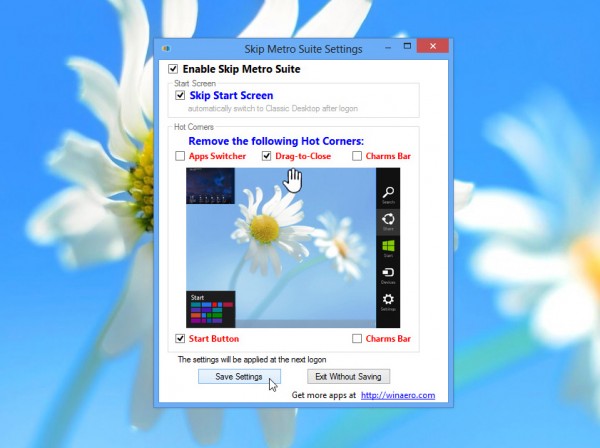
    Skip Metro Suite 3.0 allows you to do two principal things: first, you can bypass the Start screen entirely, so after Windows logs on you find yourself at the more familiar looking Windows 8 desktop. Sure, there are changes, but on the whole we like them. There are plenty of new features and improvements here to justify the update.

    Second, Skip Metro Suite 3.0 lets you selectively disable the hotspots at the edge of your screen, aimed at touchscreen users wanting quick access to the Charms bar, task switcher or Start menu. Disabling these means your mouse is free to roam at will into the corners of your screen without worrying about triggering something.

    And you can still access these elements by using their keyboard shortcuts: [Win] for the Start screen, [Win] + [Tab] for the task switcher and [Win] + [C] for the Charms bar. In short, the Modern UI is kept out of sight (and largely out of mind) – it’s there if you need it or want to explore it, but it won’t get in the way of your day-to-day.

    Everything’s achieved via a simple interface — just tick the options you want to disable, save your settings, reboot and they’re implemented. Better still, version 3.0 of this useful tool has been completely rewritten from the ground up, converting it into a tiny, standalone portable app with no third-party dependencies. Just fire it up each time you want to tweak (or reverse your changes).

    Version 3.0 also claims to have squashed all previous bugs and issues by being rewritten from scratch, and in lieu of an uninstaller utility comes with a new option for disabling the program entirely, so Windows 8 is free to perform as Microsoft envisaged.

    It’s all very useful, but it’s worth noting that you’re still left without the traditional Start menu (the [Win] + [X] menu is okay, but no real substitute). If you’re looking for all the features of Skip Metro Suite and the old Start menu, install the Classic Start portion of Classic Shell 3.6.5 instead.

    Skip Metro Suite 3.0 is available now as a freeware download for PCs running Windows 8.

  • Borealis Ventures Leads Series A for Avitide

    New Hampshire-based biotech startup Avitide Inc. has raised an undisclosed amount of Series A financing from Borealis Ventures, SV Life Sciences, Polaris Venture Partners, OrbiMed Advisors, and Angeli Parvi. Borealis led the round. Phil Ferneau of Borealis Ventures, and Michael Ross of SV Life Sciences, joined Avitide’s board. The company is focused on the development of “custom affinity purification solutions” for the biopharmaceutical industry.

    PRESS RELEASE
    Avitide, Inc., a biotech company dedicated to the discovery and development of custom affinity purification solutions for the biopharmaceutical industry, announced the closing of their Series A financing. The Avitide technology is designed to discover and develop affinity purification products that will improve the fundamental timeframes and economics of commercial bioprocessing.

    The financing was led by Borealis Ventures with participation from SV Life Sciences, Polaris Venture Partners, OrbiMed Advisors, and Angeli Parvi. Managing Partners Phil Ferneau (Borealis Ventures) and Michael Ross (SV Life Sciences) joined Avitide’s Board of Directors. The proceeds from this financing will enable the further development of Avitide’s custom affinity purification platform and continued commercial development of low cost and high capacity affinity resins for monoclonal antibodies, therapeutic proteins, and recombinant vaccines.

    “The Avitide team has pioneered an elegant and cost effective solution to a problem that bioprocess engineers have wrestled with for some time: ‘How does one selectively purify therapeutic proteins at scale without having to go through multiple chromatography steps and without requiring an affinity resin based on recombinant proteins?’ The Avitide technology enables rapid development of highly selective chromatography resins via chemical synthesis which are not based on costly recombinant proteins. This will have a large impact on commercial bioprocessing,” said Prof Tillman Gerngross, Co-founder of Avitide. “We can offer our partners a new standard in speed to delivery of customer-defined affinity purification products, allowing them to achieve unparalleled development timelines while obtaining a highly purified product in a single step,” added Kevin Isett, Avitide’s Co-founder and CEO.

    “The technology is based on one of those insights that is so fundamentally powerful it seems obvious now that someone has done it,” commented Mike Ross, Ph.D. (Managing Partner, SV Life Sciences). “The Avitide team just did an outstanding job of identifying a key bottleneck in bioprocessing and addressing it with a practical and cost effective solution.”

    Avitide is led by a team with substantial relevant expertise and a track record of success in bioprocessing and in commercializing innovation. Avitide’s founders include: Tillman Gerngross, Co-founder and CEO of Adimab, Co-founder and President of Arsanis, Co-founder and CSO of GlycoFi (a wholly-owned subsidiary of Merck & Co since 2006), and Professor of Engineering at Dartmouth College; Errik Anderson, Co-founder and COO of Adimab, and Co-founder and Board Member of Arsanis; Kevin Isett, Head of High-throughput Manufacturing at Adimab, and Sr. Biochemical Engineer at Merck Bioprocess R&D Warren Kett, Co-founder and CTO of Glycan Biosciences; and Jonathan Sheller, Director Finance & Operations for Arsanis, and Founder of Bedrock Ventures.

    “The combination of a high caliber team that knows how to deliver real value to biopharma customers, world-class science, and an innovative business model make this a compelling investment opportunity”, said Phil Ferneau from Borealis Ventures.

    Avitide will initiate operations in Lebanon, New Hampshire. “We evaluated several business locations in the northeast US, and it quickly became apparent that the growing entrepreneurial nexus near Dartmouth College offered an outstanding combination of talented engineers and scientists, a strong entrepreneurial network, and the financial and operational resources needed to be successful. We are very excited that Avitide will join this emerging biotech community,” stated Isett.

    ABOUT BOREALIS VENTURES

    Borealis Ventures partners closely with exceptional entrepreneurs from the earliest stages to build market-defining companies in the life sciences and information technology sectors. Borealis has been the most active venture investor in New Hampshire over the past decade, and its latest fund, the Borealis Granite Fund, is the first venture capital fund dedicated to NH-based opportunities.

    ABOUT SV LIFE SCIENCES

    SV Life Sciences is a leading international life sciences venture capital firm. The SVLS team manages five private venture capital funds with approximately $2 billion of capital under management. The firm employs a diversified strategy within life sciences in order to selectively capitalize on an expanding opportunity in biotech, medical devices and health-care services.

    ABOUT POLARIS VENTURE PARTNERS

    Polaris Venture Partners is a partnership of experienced private equity investors, operating executives and entrepreneurs. The firm’s mission is to identify, invest in and partner with seed, early stage, and middle market businesses with exceptional promise and help them grow into market-leading companies. The firm has over $3.5 billion under management, more than 20 investment professionals, and current investments in more than 100 companies.

    ABOUT ORBIMED ADVISORS

    OrbiMed is the world’s largest life sciences and healthcare-dedicated investment firm, with approximately $6 billion in assets under management. OrbiMed has successfully invested in over 140 companies across a wide range of therapeutic categories and stages of development. OrbiMed’s investment team includes approximately 60 experienced professionals with backgrounds in science, medicine, industry, finance and law. OrbiMed’s professionals work together using a collaborative, team-oriented approach to support our portfolio companies, which has earned OrbiMed a reputation as a capital provider of choice for life sciences companies of all stages.

    ABOUT AVITIDE, INC.

    Avitide develops customized biopharmaceutical affinity purification products. The Avitide platform reduces bioprocess development timelines, program risk, and cost of manufacture by providing turnkey, cost-effective, highly specific affinity purification solutions. Industry-leading affinity resin discovery timelines integrate seamlessly into process development cycles, providing improved line-of-sight, platform operations and equipment, and predictable scalability.

    The post Borealis Ventures Leads Series A for Avitide appeared first on peHUB.

  • Identify resource-hogging Firefox add-ons with about:addons-memory

    If Firefox seems to be using a lot of memory on your system then a resource-hogging add-on could be responsible, but finding out for sure can be a challenge. Entering about:memory in the address bar will provide lots of figures on RAM allocations, for instance, but they’re extremely technical, more about “heaps” and “compartments” than providing information which most people can actually use.
    About:addons-memory is a simple Firefox extension which takes a different approach. There’s no jargon, no unnecessary technical details, just install it (no restart required) and enter about:addons-memory in a new tab for an instant report on your extensions and their memory usage.

    The list is conveniently sorted by RAM requirements, so if you do have a problem extension then it’ll probably appear at or very close to the top.

    If you’re curious, though, just scroll down the list for details on every extension you’ve installed.

    And at the bottom of the report is a “Minimize memory usage” button which may help you free up some RAM, as well as a few notes on what the various figures actually mean.

    This all worked very well for us, but if you try the add-on yourself then you’ll need to be careful how you interpret the figures.


    Coming top of the list doesn’t necessarily mean an extension is poorly coded or inefficient, for instance — it all depends what it’s doing.

    And about:addons-memory may not be able to determine the full amount of RAM used by all your extensions, so you need to treat its memory allocations as a minimum: some add-ons could be using more. If you’re thinking this limits its usefulness, then you’re right, but about:addons-memory is still a handy way to start exploring Firefox’s memory usage, and well worth installing.

  • Finnish development firm offers to pay salaries partly in Bitcoins

    A Finnish developer outfit called SC5 has begun giving its employees the option of having part of their salaries paid in Bitcoins, the peer-to-peer virtual currency. This is not technically the first time this idea has been floated – the Internet Archive is planning to do the same from April – but it’s still a radical move at this early stage of the Bitcoin game.

    From SC5′s blogpost:

    “We are doing this just out of curiosity to try out new things. Bitcoin as such fits our vision of the world quite well. It allows for open source development, competition and innovation in the field of payments and Internet commerce. Based on cryptography, it is secure and deterministic as we require for digital services. As a comparison, credit cards rely on few enough physical cards getting stolen or copied and the centralized organizations covering fraud for billions of dollars each year.

    “For currency conversion we use the daily exchange rate of the payday. The euro amount to be converted into Bitcoins is deducted from the net salary on the employee’s paycheck. Bitcoins are sent to the address provided by the employee.”

    I’m not an economist, so I’m going to steer clear of commenting on the intelligence of opting to receive part of your salary in the currency (there are also many excellent explanations out there of how the currency is algorithmically generated and controlled). That said, Bitcoin has been doing very well recently – so well that many suspect we’re experiencing a Bitcoin bubble.

    SC5′s decision to experiment with Bitcoin-based salary payments is not entirely surprising. Last month a young developer by the name of Martti Malmi joined the company — Malmi, also known as Sirius, was one of the earliest developers involved in the Bitcoin project.

    Related research and analysis from GigaOM Pro:
    Subscriber content. Sign up for a free trial.

  • Morning Advantage: Viral Video Phenoms Shouldn’t Quit Their Day Jobs

    The Harlem Shake. Charlie Bit My Finger. These viral videos spread like wildfire, and there are plenty of others like them. But can the makers of viral sensations like these actually turn their insta-fame into financial gain? Brad Tuttle, in this Time piece, asks the same question, and his answer, except for a select few, isn’t promising.

    Let’s start with some good news. The creators of the Harlem Shake should see some cash in the near future because, as Tuttle points out, they’ll receive a portion of the ad revenue that’s been generated by their video on YouTube. Tuttle also cites as a success story the Charlie Bit My Finger video, a short clip of a baby biting his older brother’s finger. Doesn’t sound too extraordinary, does it? The video, no joke, has received over 515 million views. The family’s gain: $150,000. But let’s not confuse these exceptions for the rule. Most viral hit makers, Tuttle reminds us, don’t hit it big, or even close — in fact, they’re lucky if they make even a few hundred dollars from their 15 minutes of fame.

    MAYDAY! MAYDAY!

    Why It’s Extremely Difficult to Right a Company’s Ship (Kellogg Insight)

    This one may come across as common sense: Companies who are struggling financially have a tough time recruiting great talent. Professors Jennifer Brown and David A. Matsa calls this the Sinking Ship Effect. No one wants to be a crew member on a sinking ship, it seems. The kicker: companies can’t solve the problem by offering higher salaries. In fact, in most cases, companies don’t get a chance to do so. Why? The applicants studied, as Professor Brown is quoted as saying in the piece, “weren’t interested enough to create even the possibility of getting a job offer at a distressed firm. They just didn’t apply.”

    LISTEN UP

    It’s Time to Kill the Email Signoff (Slate)

    Slate writer Matthew J.X. Malady argues for a ban on email sign-offs — everything from the disingenuously warm (XOXO) to the inappropriately formal (Yours truly, Sincerely, Respectfully yours,). When you send and receive hundreds of emails a day, he says, just a name should suffice. As someone who once accidentally signed an email to a colleague Love, A, I’m tempted to adopt the policy. Though if Malady is aiming for brevity, perhaps he could drop one of the middle initials from his byline too. — Alison Beard

    BONUS BITS:

    The Tribe Mentality of Cute Babies

    Babies Display Schadenfreude Too (Popular Science)
    Is Stress an Overblown Phenomenon? (New Republic)
    Why Amazon Prime Could Soon Cost You Next to Nothing (Wired)

  • Google Translate now lets you build your own phrasebook

    Before you go abroad, or meet someone from another country who speaks a different language, it can be useful to come up with some handy phrases to use. Even if it’s just “how are you?” and “nice to meet you”.

    You can probably memorize the basics quite quickly, but for more involved phrases you may require a bit of help to recall them, which is where Phrasebook for Google Translate comes in.

    The new addition lets you save the most useful phrases for easy reference later on, hopefully also helping you commit them to memory. To use it, just translate something, then click the star icon under the translated text to add it to your phrasebook.

    You can view all of the stored translations by clicking the new Phrasebook icon. If you’re translating phrases into more than one language a drop down menu will let you filter your list by language pair (English > Spanish, English > French, French > English and so on).

    Hovering your mouse over a phrase will display a text-to-speech option and you’ll be able to listen to how a native speaker says it.

    Photo Credit: Lightspring/Shutterstock

  • Average broadband speed in UK homes now in double figures

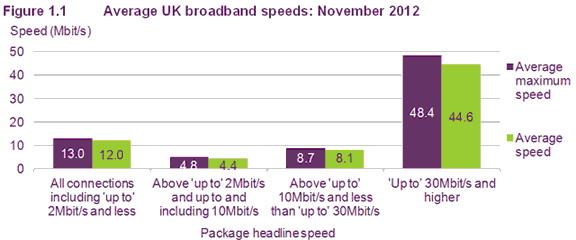
    Regulator Ofcom reports that in November 2012 the average speed of home broadband in the UK hit 12Mbps, up from 9Mbps in May of the same year. As someone with 100Mbps broadband, that still seems very slow to me, but of course there are various factors behind lower speeds — cost and location mainly, plus many people simply don’t need superfast connections (or think they don’t).

    In the report, Ofcom noted that UK broadband speeds have trebled in the past four years, a trend that is set to continue, and likely accelerate, as services offering 30Mbps or above reach more rural areas and become more affordable.

    Ofcom says that 13 percent of all broadband connections are now what it classes as “superfast”, up from 5 percent the year before. The average speed of those superfast connections is now 44.6Mbps, up from 35.8Mbps in May.

    The average upload speeds also increased considerably last year, rising from an 0.3Mbps average in May 2012, to 1.4Mbps in November.

    Ofcom’s chief executive Ed Richards said: “Our research shows that UK consumers are adopting faster broadband packages to cater for their increasing use of bandwidth-heavy services such as video streaming. The increase in the average number of connected devices in UK homes is also driving the need for speed”.

  • There’s high trust in clean power despite the negative headlines

    I just read a statistic that jolted me out of my cleantech hangover. Despite low cleantech VC funding, the limelight-hogging shale boom, and an avalanche of anti-cleantech advertising during the 2012 U.S. election, renewable energy enjoys a notable trust premium over other forms of energy.

    In new data provided by the Edelman Trust Barometer survey of 31,000 global respondents, 68 percent of respondents trust the “renewables” business to do the right thing, as compared with 58 percent for natural gas, 53 percent for utilities and 49 percent for oil (see image below).

    Trust in Renewables

    That’s a license to lead, folks. Despite significant perceptual headwinds, renewables emerge with a 10 point lead over its nearest energy competitor. As a marketer, I’m reminded of why I originally found this sector so energizing and inspiring during the cleantech boom of 2007-2008.

    Note the high trust in places like China and India. Not surprising, considering the clear messages sent by those governments about cleantech deployment, and the ability of those nations to leapfrog traditional energy systems to meet electricity demand for growing middle classes. Both countries boast cleantech leaders like Hanwha Solar, Suzlon and Tata.

    Note the low numbers for Japan (66 percent) and Germany (63 percent). These are consistent with both countries’ lower trust in business and energy.

    The German numbers shocked me the first time I saw them. But for this country, renewables have graduated to the “big energy” establishment, which I expect engenders less trust than the sheen of new technologies in emerging markets.

    For Japan, trust in the entire energy industry is lower than other countries post-Fukushima, but renewables are trusted most within the Japanese energy sector.

    Broadening focus to the entire energy industry, this data corroborates another trend: so-called “purpose-driven” energy innovators enjoy a trust premium over other energy professionals. This not just a cleantech thing, it’s an advanced energy thing. This is for two reasons:

    When asked to rank attributes that shape trust in a company, respondents ranked “purpose” – protecting the environment, partnering with NGOs – as most important, and being an “innovator of new products” close behind (see image below and note the orange and purple attributes that respondents rank as more important for the energy industry as compared with general business).

    Clearly, energy companies can earn more credibility by better communicating real global citizenship and helpful innovation.

    Trust Attributes

    On the flipside, communicating about the success of business “operations” (dark blue) was valued only as table stakes for being an energy company, not as a major trust-builder. I would argue this is true if we’re talking about large companies, but I think the opposite is true for advanced energy start-ups where the onus is much higher to prove operational success.

    The data also shows how technology is trusted more than energy. In my opinion, the marriage of technology and energy is a net gain for energy company trust building. See the image below, which depicts how much higher technology is trusted than energy (78 percent vs. 67 percent). I interpret this as further proof that innovation gives the energy industry license to lead.

    This is reflected in the strong Silver Spring IPO on Wednesday. Silver Spring is an innovative energy IT company, not just an energy company. Energy IT is a highly credible sector populated by other promising companies like OPOWER and FirstFuel, and a primary focus for venture capitalist still focused on cleantech. The public trust data corroborates the investor enthusiasm.

    Trust in Tech vs Energy

    Would you like more data on trust in the energy industry? Don’t hesitate to contact me.

    Joey Marquart is the global cleantech sector lead for Edelman, the PR firm. He is based in Silicon Valley and oversees communications programs for solar, bio, EV, materials and smart grid companies.

    Related research and analysis from GigaOM Pro:
    Subscriber content. Sign up for a free trial.