Blog

  • Soulland – Spring 2010 Lookbook

    Soulland-Lookbook-Spring-2010-1

    At the age of 23, designer Silas Adler has already made waves in the world of fashion having won numerous accolades for his contemporary men’s line. His youthful, energetic and modern lines have been received with great fervor at Copenhagen Fashion Week ever since the inception of his line at the ripe age of 17. He now has the honor of stockists carrying his line across the globe.

    Adler’s latest pieces featured in his Spring 2010 Lookbook are simply constructed with a bold color spectrum which includes kelly green blazers and shorts. A signature item, the elastic cuffed pants and denim are also present. These have been presented in seasons past, and it remains a mainstay in his collections. See the rest of the looks after the jump.

    Site: Soulland

    Continue reading for more images.


    Source: the Fashionisto


  • ARTICLE: CES Devices: LG GW990 Superphone

    CES 2010 Wrap-Up: Noah’s Top 5 Devices

    2. LG GW990 Intel-Based Superphone

    If Google’s calling their Snapdragon-based Nexus One a “superphone,” then LG has the right to call their Intel Atom-packing GW990 darn near anything they want. The GW990, with its 4.8″ widescreen display and Ultra Low Voltage Intel Moorestown processor, won’t hit the market until later this year, and isn’t, in its current incarnation, the most practical device for sticking in your pocket and using for a daily diet of calls and texts. But man, is it nifty.

    We got a back-room demo of the GW990 in action, and most of what we saw was meant to show off how much it can do, and how much it can do all at the same time. First we saw high-def video being played at full 1024 x 480 resolution. Then we saw the video shrunk into a half-sized window to make room for a newly-launched SMS window next to it. Then we saw both of those windows minimized a tad more to make way for the launching of a calendar app. Three apps running side by side by side without a hitch – nary an audiovisual stutter was to be seen or heard the whole way through.

    LG said the GW990 – or other devices like it – could run Android or another Linux-based platform when it launches later this year (if i understood them correctly, anyway). The demo we saw used LG’s own S-Class UI, which looked great but doesn’t quite have the marketability of, say, “The world’s fastest Android phone.” Snapdragons beware: ULV Atoms are coming to town. The jury’s still out on what mobile processor will wind up yielding the best combination of performance, portability and battery life, but in Vegas last week all eyes were on that Intel-based LG GW990.

    Previous: Lenovo LePhone

    Next: Palm Pre Plus


  • Competition for Positions Intensifies as Job Openings Decline

    As the ranks of the unemployed continue to swell, the competition for open positions is intesifying, according to new data from the Labor Department.

    The government’s Job Openings and Labor Turnover survey showed that there were nearly 6.4 unemployed workers, on average, for each available job at the end of November, up from 6.1 in October. Layoffs and discharges were down 3.5% from October at 2.1 million, but the number of job openings was also lower, falling 6.1% to 2.4 million.

    On Friday, the Labor Department reported that the economy added 4,000 jobs in November, the month that corresponds to the JOLTS report. Last week’s report also showed an 84,000 decline in jobs for December. The drop last month was larger than expected, but still represented a slowing pace of job cuts over the second half of 2009.

    The current recession was characterized by a large jump in layoffs, similar to downturns in the 1970s and 80s. That stands in contrast to more recent recessions when layoffs moved slightly higher but job openings stagnated, exacerbating the “jobless recovery” where hiring lags economic expansion. The similarities to earlier recessions had inspired some hope that when the economy begins to add jobs again, it could come at a faster pace.

    But if companies remain reluctant to hire, the labor market could face the worst of both worlds: massive layoffs and depressed levels of job openings.

    “While it is all but certain that firings are nearing or at an end, several indicators including today’s data suggest that the pace of hirings could be relatively benign,” said Dan Greenhaus at Miller Tabak. “This is not to say jobs will not be added and this is not to say the labor market is not improving. Just that persons looking for employment still face, as the data stands today, considerable hurdles.”


  • Akzo Nobel, Arnhem

    Gegevens
    Naam: Akzo-Nobel Center Gebouw Kernheim
    Hoogte: 70 meter
    Plaats: Arnhem
    Oplevering: 1966
    Functie: Kantoren
    Architect: ?
    __________________________________________________________


    Joris Talens


    Joris Talens


    SSC – Pazman.nl

  • You, Too, Can Launch Your Own Nail Fashion Business! [Ces2010]

    I’m going to tell you a tale, a tale of friendship that, with the help of a Chinese automatic nail printer, blossomed into a full-out, wet and sticky bromance.

    There Jason and I were, walking through the International Center at CES, our shoulders brushing casually in the intimate walkways. Then we spotted a machine unlike any we’d seen before. A wizened Chinese man beckoned us into this booth, and before we could raise any objections, he placed his finger our our lips, a tacit acknowledgment that this was our first time. Jason took a seat.
    Still confused and a bit disoriented, Jason smiled nervously as a camera photographed nothing less than the full earnestness his soul. Looking at the screen, Jason’s stomach dropped at the sheer amount of honesty that could be captured on a webcam and displayed on a touchscreen LCD.
    I pretended to ignore Jason’s powerful image as I grabbed a seat myself. The Chinese man took my hand—his touch was warm. He lightly stroked my thumb with a base coat while photographing me as well.
    How would Jason and I frame our faces? We joked that the heart cutout was the only way. And then our eyes locked and we realized that maybe, just maybe, we weren’t joking at all.
    The photos processed, I tentatively placed my thumb into the machine. It clamped down on my appendage, strongly, and it wouldn’t let go. At this moment, trapped and vulnerable, I could only let the machine finish. To this day, I don’t know if it’s the event’s repression speaking, but the process was quick, professional and I don’t recall the slightest bit of pain. In fact, I didn’t feel a thing.
    Jason, having bravely endured the same process, reveals the worthwhile aftermath in this photo. My face has been semi-permanently painted upon his fingernail. He blows on the finish to make sure it’s dry, his lips the closest they’d ever been to my face.
    “For better or worse, we’re together in this thing now,” I thought to myself. But just several days following this entire affair at CES, Jason and I have parted ways. Sometimes we IM one another, and there’s the occasional text. But even as the heart has chipped away from my nail, his smile remains.

    And if you’d like to duplicate the experience, the ArtPro Nail Printer runs about $1500, takes normal HP ink cartridges and breaks up to 6000 hearts between refills. The company is currently seeking US distribution.


  • World today – like watching bad Babylon 5 episode

    It’s actually quite amusing, you know. It really is starting to feel like living inside bad episode of Babylon 5, when reading and watching what is happening in the world right now. Obama, mr “Yes We Can”, is doing almost exactly same thing as president Clark in B5, ramping up the security and creating false flag attacks and similar to get the rights to do so… funny, but also scary as hell.

    If I’m correct, and this is coming from watching B5, in the very near future there is going to be another “terrorist” attack – most likely from nigerian or yemen individual, which then turns US into state of marshal law. Borders will be fully closed and “security checks” which in reality are nothing more than bullying and harrasment of people, they are going to be ramped up – most likely scenario (again, from B5 point of view) is that all people are going to be tagged, and if you don’t have a tag -> poof, you don’t exist in the system.

    If Earth Alliance is similar to US, then for the Russia there is only one equivalent, Centauri. All words and no action – unless you can hit the more feeble one with the dagger into poor bastard’s back.

    Hmm… this is quite amusing to think about – China, the third so-called superpower… Narn, no doubt about that. Fearless warriors and countless lives to expend.

    Then, let’s bring in the baddies from B5, the Shadows – US is trying to promote Al Qaida as Shadows, the death that lurks in the dark… somehow it’s not working, the thing with the Shadows in B5 was similar what is going on in US today – propaganda, TONS of propaganda – and censorship. If you are not with the goverment, you are The Enemy.

    Oh well… I could go on with this for ages, but instead I wholeheartly recommend that you watch Babylon 5 yourself, all of it – it’s refreshing experience to compare interstellar war to our current earthly situtation.

    In the mean time, sleep tight.

    Book Mark it-> del.icio.us | Reddit | Slashdot | Digg | Facebook | Technorati | Google | StumbleUpon | Window Live | Tailrank | Furl | Netscape | Yahoo | BlinkList

  • IT’S BACK: Russia Revives Plans For A Nuclear Rocket

    Russia is getting serious about traveling to Mars, committing $600 million to revive plans for a nuclear-powered rocket from 1970s. But one country’s money for space projects is never enough, so Russia is looking to collaborate with other states to make the rocket a reality.

    One of the preferred partners is the U.S., which accounts for 80% of space spending worldwide

    Join the conversation about this story »

    See Also:


  • The Clouds Are Gathering, Time To Be Fearful

    Yesterday, the following clouds gathered:

    1. renewed fears of populism as the administration considers launching a tax on financial institutions.
    2.  

    3. a disappointing Alcoa  earnings release;
    4.  

    5. China guided the one-year bill higher to curb lending and this morning raised bank reserve requirements; and
    6.  

    7. we experienced a different sort of market close.

    My responses?

    1. I remain fearful of the ramifications of populism in 2010-2011 on economic growth and on the market’s prospects.

    Read the rest of the post at TheStreet.com — >

    Join the conversation about this story »

    See Also:

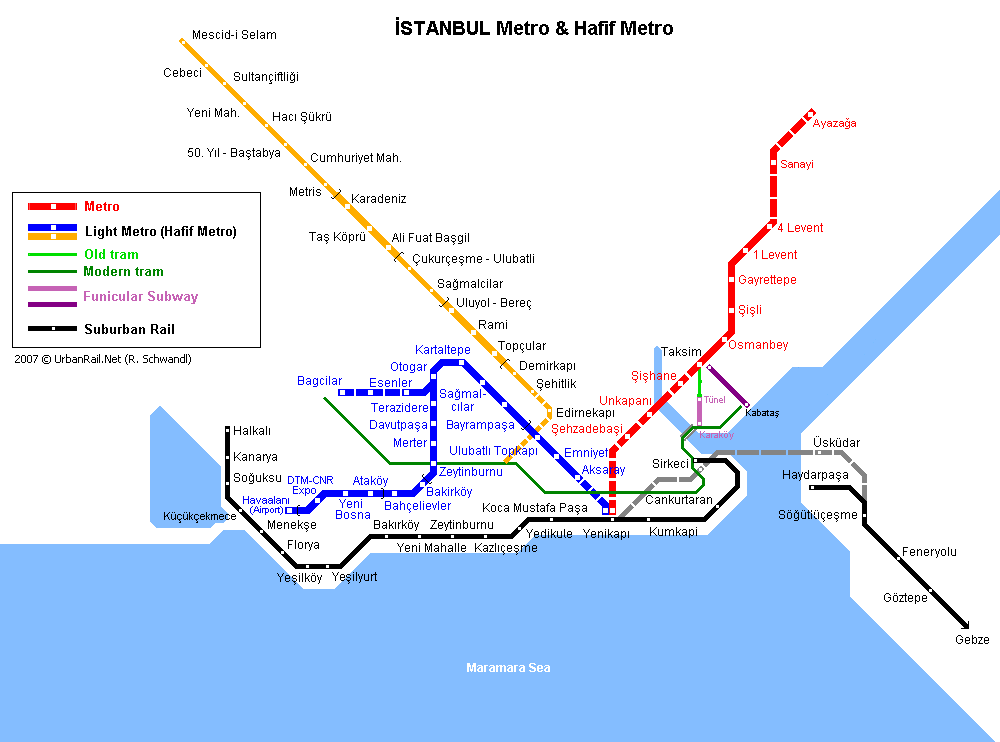
  • Türkiye’deki Raylı Sistemler

    [I]İstanbul

    Ankara

    İzmir

    Bursa

    Kayseri


    Eskişehir

    Antalya

    Konya

    Adana

    Gaziantep

    Eskişehir
  • Jobs versus health care

    No need to trash entire bill

    Editor, The Times:

    Let’s do a reality check here. As The Times continues to pound against the necessity of passing health-care-reform legislation this year [“Jobs first, then talk about health reform,” editorial, Opinion, Jan. 8], 45,000 Americans continue to die annually because of lack of access to health care.

    Since those deaths are insufficient to shame you into supporting reform, you bring back the argument that we cannot afford this. Let me remind you that we are currently spending 17 percent of our GNP — that’s $2.5 trillion per year — on health care, and without insurance regulations and other cost-saving measures, these numbers will rise to 20 percent of our GNP — or $4 trillion per year in 2015. Tell me how the businesses you are concerned about will be able to afford to hire new American employees under those circumstances.

    The bill that is being developed is far from perfect, but it’s a start. When you ask Congress to move onto other issues you consider more important, does it matter to you that our duly elected officials have spent the past six months focusing on the issue of health-care reform, fighting to at least start a process to give us universal access, and that all their effort will have been wasted if we do not pass a bill? You know full well further delay will mean another 16 to 20 years before we try again. That’s another million lives lost as the clocks tick on.

    So, instead you should argue appropriately against specific measures in the bill, such as taxing health-care benefits. Push for a tax on the wealthy, as proposed in the House version — this should not affect job creation. But don’t trash the entire bill and pretend you’re concerned with cost or unemployment.

    — Lisa C. Plymate, Washington State director of Doctors for America, Seattle

    Focus on job creation

    Without jobs we can’t pay for health care or pay the taxes that enables government-provided health care.

    Yet at a time when unemployment is near a 60-year high and the federal government is heaping ever more debt on our children, politicians are spending even more and loading even more disincentives on employers to create jobs in this country.

    I completely agree that we need to get our priorities in order. Jobs are the foundation for all other spending. Politicians should be focusing first on providing a healthy environment for job creation.

    — Chris Waldorf, Seattle

    Cessation of war could provide funding instead

    Regarding Friday’s editorial on health care, The Times was way off the mark. The current federal health-care legislation may be flawed but this critical issue has been placed on the back burner of American politics for far too long.

    As a result we have a convoluted, costly and — for many millions of our fellow citizens — an inaccessible system of care that is ineffective and grossly unfair. The Times suggested that our nation drop the subject of reforming health care. All of the bloated, venal institutions that profit from this ridiculous and wasteful arrangement couldn’t agree more with this misguided opinion.

    The Times was right to argue that the issue of jobs is an exigent one. But this urgent subject should not displace health-care legislation nor any other crying domestic need — like education, affordable housing for the poor and care for the elderly.

    Instead, the United States could begin addressing all of these matters in a concrete and comprehensive way if we got out of the war business. The lives lost, the profligate trillions spent and the resulting geopolitical chaos may suit the military and corporate masters of war, but it does not in any way suit the common citizenry.

    It is time to dismantle the permanent war economy. Then there will be abundant resources to truly reform health care, provide jobs and worker retraining for the reinvigoration of the American economy — as well as address other myriad needs.

    — Joe Martin, Seattle

    United doctors for reform

    I am appalled that in the same piece The Times editorial board claims to support health-care reform, but also asks Congress to “set the health-care bill aside” until the economy improves.

    I agree that the bill passed by the Senate creates inadequate competition to drive down costs and increase quality. However, setting aside an imperfect bill with the hope of passing a flawless one in the future is extremely unrealistic and leaves us with the economically unsustainable and simply immoral status quo.

    Opportunities to reform our health-care system have come along very rarely and each time have failed due to the same reasoning the editorial board is now endorsing. The passage of reform will mark a philosophical turn for our nation. Future congressional battles over improving health care will not be about whether every American deserves it, but rather over how to deliver it.

    As a physician, I am sad to note that divisions between doctors over how to fix our ailing health-care system have long stood in the way of progress. However, doctors are finally united in our support for health-care reform. I stand with over half a million doctors who implore Congress to pass reform now.

    — Rupin Thakkar, Seattle

  • Never Mind the Valley: Here’s Boston

    With tourists flocking to the Boston to walk the cobblestone streets of the Freedom Trail and visit various historical landmarks, Boston is often thought of for its ties to the American Revolution. But Boston is also the birthplace of a revolution of a different sort.

    In 1946, Georges Doriot, a professor at the Harvard Business School, founded the American Research and Development Corporation (ARDC) in Boston – one of the very first venture capital firms.
    In 1957, the ARDC invested $70,000 in Digital Equipment Corporation, a company founded by two former Massachusetts Institute of Technology engineers working on transistor-based computing. The ARDC was later able to turn around and sell their investment for $450 million, quite possibly the best return on an investment ever at that point.

    Sponsor

    RWW’s Never Mind the Valley series:

    Half a century later, Boston is a thriving and vibrant community not only for venture capital and startups, but also for large technology companies and research
    corporations. With nearly a hundred regional colleges and universities – like MIT and Harvard – and over a quarter of a million students, Boston has quickly become a breeding ground for innovation in the tech sector.

    “The thing that’s amazing is we don’t have to worry about attracting people into the Boston community,” said Jeffrey Bussgang of Flybridge Capital Partners in a speech at the Harvard Business School last October (see video embedded below). “The challenge is to retain people.”

    And retain them they will, thanks to a plethora of resources available to young entrepreneurs and startups in Boston. Monthly meet-ups like Mobile Monday and Tech Tuesday as well as other events like the biannual Mass Tech Leadership Council Unconference are just a few of the great ways startups can get their feet off the ground.

    Other organizations like TechStars and Stay in MA help Boston startups set up shop in Beantown with scholarships, funding, and mentorship. And why wouldn’t startups want to stay in Boston? Massachusetts boasts the highest per capita VC investment rate in the United States, eclipsing California and New York with $457 per person.

    Data released today from information and data-services company ChubbyBrain shows that while other Northeaster states are suffering from floundering VC investment, Massachusetts is alive and expanding. While New York and Pennsylvania fell to just $513 million and $254 million respectively in the second half of 2009, Boston’s home state soared to $1.2 billion. Figures like these have vaulted Massachusetts past New York into the number two spot behind California for VC investments.

    Bussgang says that reasons like these and the overall economic stability of the state have encouraged startups and entrepreneurs in Boston, despite being across the country from sunny Silicon Valley.

    “Yeah the winter sucks, but Massachusetts has delivered a budget on time and balanced the last couple years… unlike what’s going on in California,” he says. Bussgang also points out that California continually ranks last on Chief Executive Magazine’s list of Best and Worst States for Business, though Massachusetts is usually not too far away.

    The close-knit technology and innovation community of the greater Boston area has fostered spontaneous collaborations resulting in several successful companies across numerous industries. Cloud computing solutions like Carbonite and GlassHouse, robotics companies like Roomba-maker iRobot, online video providers like Brightcove, and e-commerce startups Vistaprint and Shoebuy are all examples of the firepower Boston’s potential can produce.

    Boston has even seen recent expansion from larger corporations, such as Google, Microsoft and Cisco Systems. Having these larger companies in the Boston area provides excellent opportunities for startups, says Bussgang.

    “Boston has become an outpost for a lot of these satellite R&D centers, and a place where the companies that we fund can find a home,” he says.

    To learn more about the Boston startup scene, check out Don Dodge’s extensive list of events, resources and people, as well as Larry Cheng’s Massachusetts VC Blog Directory, which you can import right into your RSS reader to stay on top of what VCs in Boston are talking about.

    Photo by Flickr user the-o.

    Discuss


  • Break with consumerism to save the world, Worldwatch report urges

    by Agence France-Presse

    WASHINGTON—The world faces environmental havoc unless people shift from a culture where success is measured by the accumulation of goods to one where people are admired for living sustainably, experts warned in a report published Tuesday.

    “It’s no longer enough to change our light bulbs; we must change our very cultures,” said Erik Assadourian, project director for State of the World 2010, released by the Worldwatch Institute, an independent research organization.

    The culture of consumerism “has taken root in culture upon culture over the past half-century … [and] become a powerful driver of the inexorable increase in demand for resources and production of waste that marks our age,” says the report. But consumer cultures are unsustainable and are driving the planet toward a “great collision between a finite planet and the seemingly infinite demands of human society,” the report warns.

    “More than 6.8 billion human beings are now demanding ever greater quantities of material resources, decimating the world’s richest ecosystems, and dumping billions of tons of heat-trapping gases into the atmosphere each year,” it says.

    American consumers have too many choices. Photo courtesy Orin Zebest via Flickr.The numbers will continue to rise, as people in developing nations aspire toward the same consumer lifestyles as their peers in the West, the report says, calling for a “wholesale transformation of dominant cultural patterns” to “prevent the collapse of human civilization.”

    “This transformation would reject consumerism—the cultural orientation that leads people to find meaning, contentment, and acceptance through what they consume—as taboo, and establish in its place a new cultural framework centered on sustainability,” the report says.

    In more human terms, the shift would mean that “machismo is not about the size of your car, but the fact that you don’t have one at all,” said Assadourian.

    To achieve the shift, everyone from religious leaders, governments, and educators to everyday citizens will have to play a role, the report said.

    “The good news is, this is not only possible, but already happening: from incorporating ‘earth rights’ into the constitution of Ecuador, to schools integrating ecologic awareness,” Assadourian said.

    Related Links:

    Scientists cautiously optimistic as Doomsday Clock reset

    Small cars make it big at Detroit Auto Show [slideshow]

    Grist exclusive: A fiery battle over land in Brazil’s Amazon rainforest


  • 1970 Ferrari 512 S Modulo Photographed by Benedict Redgrove

    modulo-ferrari-main

    It’s hard to mention a unique Ferrari without the name Pininfarina coming up. In 1970, the fabled coachmaker put forth a design study/concept car that we can still stare at in amazement even today. We’re sure the 1970 Geneva Motor Show was breathtaking in its own right, but there’s no doubt that the Modulo was the crown jewel of the show. According to legend, Ferrari (in direct competition with Porsche) created 25 iterations of the 512S in order to meet homologation rules. Surprisingly, Maranello did not end of selling nor racing all 25, leaving chassis number 1046 in Pinanfarina’s hands. The result, as you see here, is a timeless design that is simply stunning in its forward thinking and aesthetics. The 512S was never designed to be driven one inch, and it doesn’t have to move to for one to appreciate features like its covered wheels, sliding canopy roof, and 24-hole engine cover. Simply stunning, and we have photographer Benedict Redgrove to thank for these images.

    Continue reading to view more images.


    Source: Benedict Redgrove via WeHeart


  • lows with frosted flakes

    ok, so it’s true. i ate frosted flakes. and i don’t regret it 🙂

    two days ago i had a bowl of frosted flakes with unsweetened almond milk and it was DIVINE!

    at 1 hr pp, i was in my target range; at 2 hours pp i was at 2.1 mmol/l (37)!! so i treated, and figured i maybe took too much insulin by accident.

    today, again, i had a a bowl. again DIVINE.

    at 1 hr pp, i was at the top edge of my target range, at 2 hr pp i was at 2.5 (45).

    i’ve been using my normal breakfast I:C…so what gives…?

  • To Circumcise or Not To Circumcise?

    circumcision To Circumcise or Not To Circumcise?Once a proverbial given in this and a number of other countries, circumcision has become a hot button issue, intensely debated in both family and medical circles. For decades it was standard procedure for hospital births, but the numbers are quickly declining. Today, 56% of newborn boys are circumcised, although the rate varies considerably by geographic region in the U.S. In 1999, the American Pediatric Association revised their statement on circumcision to acknowledge the “potential medical benefits” of the procedure but concluded “these data are not sufficient to recommend routine neonatal circumcision.” Most of Canada has “de-listed” circumcision as a necessary (i.e. paid for) procedure.

    In truth, the decision to circumcise isn’t purely medical even as it becomes increasingly controversial. Intangible aspects play as much or more of a role in parents’ choice as scientific research. For some families, circumcision is an age-old rite celebrating religious covenant. For others, it’s a venerated custom that manifests cultural identity. Families who aren’t influenced by religious or cultural values might choose circumcision for social or aesthetic reasons in an effort to allow junior to look like the other boys at school or like the father. However, other families and experts argue that the practice is a painful, unnecessary procedure that violates the physical dignity and even legal rights of the child.

    The history of circumcision is imprecise, but the practice is thought to have its roots in the Middle East. Experts suggest a number of potential reasons behind the initial practice of circumcision, including figurative sacrifice, virility ritual, and cultural hygienic custom. In many tribal societies, circumcision was observed as a cultural rite of passage into manhood. Although circumcision predates religious directive, it eventually became a sacred practice in the early Jewish faith and for the followers of Islam. At various times in history, circumcision was also used to designate social status as well as religious identity. On an odder note, Western societies, particularly in the 19th and early 20th centuries, practiced circumcision to discourage masturbation. In these same centuries, the issue also became medicalized around tenets of basic hygiene. In the late 19th and 20th centuries, the rate of newborn circumcision increased as hospital births rose and the public accepted the medical argument for standard circumcision.

    For our part, let’s delve into the medical side.

    These days, one of the most commonly cited health reasons for routine circumcision is decreased STD risk. Numerous studies based in Africa show that circumcision reduces the risk of heterosexual HIV contraction by 50-60%. In response the assembled research, the World Health Organization/United Nations Joint Programme on HIV/AIDS issued their official recommendation of circumcision as one method to prevent the spread of HIV. Critics caution that the “context” of the African epidemic, which is as high as 25% of the population in some areas, is so different from the disease rate (as well as cultural and hygienic practices ) in the West that the protective factor of circumcision isn’t nearly as high in Western countries. Some experts estimate a 10% risk reduction in Western societies (PDF). Other Western-based research demonstrates reduced risk for other sexually transmitted disease like genital herpes and HPV as well as a decrease in bacterial vaginosis risk for female partners of circumcised men. Research exploring the impact of circumcision on infection reduction in homosexual men has been more limited but so far shows a mixed picture of protective influence. A review published this month indicates that circumcision appears to reduce risk in primarily “insertive” rather than receptive partners.

    The physiological logic behind circumcision’s reduced infection risk involves the bacterial ecology of the inner foreskin itself, which harbors anaerobic bacteria that appears to fuel inflammation and infection. The inner foreskin is home to the highest concentration of so-called Langerhans’ cells, which facilitate HIV transmission and replication.

    A less dangerous but more common problem for uncircumcised males, particularly boys, is recurrent urinary tract infection. Circumcision is considered a standard treatment option for those with recurring UTI or serious complications from an initial case of UTI. Some experts have questioned the usefulness and cost efficiency of routine circumcisions to prevent infections in a relatively small number of boys. According to a British study, 111 routine circumcisions must be performed to prevent a single UTI. However, other experts suggest that there’s more at stake than simple urinary infection risk. Another study found that 18% of young boys in the study who had UTI showed signs of kidney scarring. Follow-up circumcision in these boys substantially reduced subsequent UTI occurrence. As a research commentator noted (PDF) in light of this picture, “[I]f the circumcision had been done in the newborn period would the kidneys have been protected from damage in the first instance?”

    In response to these infection-related findings, critics of the procedure counter that diligent safe sex and hygienic measures more reliably protect both the man and his partner from infection. Opponents say that circumcision (or at least the public message about its lower infection risk) can give men an inflated sense of protection against life-threatening diseases and discourage use of condoms, testing and other safe sex methods. Nonetheless, many physicians and public health experts maintain that circumcision is a practical strategy for reducing disease in males and their respective partners.

    As for the other physical conditions circumcision is meant to prevent, many experts say that the evidence just doesn’t support the need for routine circumcision in every boy. The nonretractable foreskin in childhood is often a misdiagnosis, since separation of the glans happens over time (a protective feature) and may not even be noticeable until puberty. Common infections can be treated with a plethora of modern medications like antibiotics and steroid creams. As for penile cancer, the risk is so low (approximately 9-10 per million men) that circumcision choice shouldn’t be based on this concern.

    Then there are the medical complications. They can be everywhere from aesthetic-based to functionally impairing. Infection rates hover close to five percent. Significant narrowing of the urethra occurs in anywhere from 5-10% of circumcisions and must be addressed with follow up treatment. Injury to the urethra can occur. The least common but most dramatic complications include partial to full penile amputation or even the rare death from serious infection.

    On a considerably lighter note, critics also suggest that circumcision compromises sexual pleasure. They argue that the foreskin, as host to a dense network of nerves, is a functional erogenous zone in itself.

    Although it’s likely impossible to reach any definitive conclusions regarding the issue, self-report research on men who are circumcised in adulthood show mixed results. In one such study, the majority of men did not experience a decrease in libido or pleasure. Eighty-two percent reported the same (44%) or enhanced (38%) penile sensitivity. A smaller study (PDF), however, recorded patients’ written comments about the impact of the procedure on their sex life and calculated that nearly half of respondents experienced less penile sensitivity after circumcision.

    Now that we’ve laid out some of the arguments and medical research, we want to hear what you have to say. What is your thinking on the subject, and what factors have or would influence your choice to circumcise or not circumcise? Thanks for reading and contributing.

    Get Free Health Tips, Recipes and Workouts Delivered to Your Inbox

    Related posts:

    1. Vitamin D and RDA for Children
    2. The Power of the Placebo
    3. Relaxation Response

  • Topiary Tree

    Making a topiary tree puts me in the mood for spring. I know, it’s only been winter for less than a month but mood means a lot.  Anyway, using the bright beautiful colors for this topiary just make you feel good. This project is very simple to make and very economical, so give it a try.

    Kathy Zengolewicz

    Kathy Zengolewicz

    Here is what you will need to get started:

    • A hot glue gun
    • One 4 inch styrofoam ball
    • One 2 inch styrofoam ball
    • A 4 inch clay pot
    • A twig or wooden dowel (about 10 inches long)
    • Acrylic paint in brown, black and gray for the pot
    • Pink and purple ribbon (optional)
    • 2 dozen silk white and pink roses/buds (I got these at the dollar store)
    • Light gauge wire
    • Moss or greenery
    • Pebbles or marbles to weigh down the pot

    Prepare the clay pot by painting it in a black acrylic base paint and let it dry. With a small sponge, dab a little bit of gray paint in various spots on the pot and let it dry. When dry, take the brown paint a fine brush and paint some squiggly lines through the pot to make it look like granite.

    Now take the twig/dowel and hot glue the tip and stick into the 4 inch ball. Set this aside and let it cool. When cool, arrange the roses/buds around the ball, hot gluing to keep them in place. I used roses to cover most of the ball and some buds to fill in the spaces. You can also use the ribbon and wire here. Make bows out of the ribbon and use a piece of wire to twist around the center of the bow, then insert it into the ball.

    Now take the 2 inch ball and cut it in half. Glue the flat side in the bottom of the painted clay pot. Allow that to dry. When dry, put a dab of glue on the other end of the dowel and insert it into the half of the 2 inch ball that is glued into the pot.

    When that sets, add the pebbles or marbles to give the pot some weight. This will keep the pot and topiary from falling over. Add the moss or greenery to the bottom of the topiary to hide the pebbles or marbles and your done. Enjoy!

    Post from: Blisstree

    Topiary Tree

  • Green colleges

    Seattle Community Colleges are doing their part as well

    Regarding “Campuses push to go greener” [News, Jan. 2], higher education in Seattle also includes the Seattle Community Colleges — with 52,000 students at four campuses and four specialized training centers, along with the 2009 Green Washington Award (in the Academic and Health Care Institutions category) for innovations in our curriculum and on campuses.

    Our college district has taken a leadership role in green-jobs training and education with programs such as green real-estate and urban sustainable-agriculture, weatherization and sustainable building management. The state’s largest apprenticeship training-program, at the Georgetown Campus, is leading efforts to incorporate sustainability across the trades. The district’s culinary programs send materials to the Cedar Grove composting facility and we also host educational opportunities for students, teachers and residents at Thornton Creek watershed in North Seattle.

    The Seattle Community Colleges have established a baseline carbon footprint for our campus buildings and we will compare the data annually, going forward with the intent of further reducing our carbon impact. Each of our campuses has active recycling, commute trip reduction, alternative transportation, and additional energy-reduction programs under way.

    Importantly, students at all of our campuses are actively involved in sustainability initiatives through committees and clubs, and fund a sustainability coordinator at one of the campuses. We are also collaborating with other two-year and four-year campuses in our region, and beyond, on some of these important initiatives.

    We are committed to keeping our city vibrant. These green programs and activities are attracting both grant support and great numbers of students and they will benefit our region for years to come.

    — Jill Wakefield, chancellor of the Seattle Community Colleges, Seattle

  • Nigeria – USA: Country Oil Deals Threatened due to listing of Nigeria as a “terror nation” by USA

    U.S., Country Oil Deals Threatened

    Quote:

    11 January 2010

    The oil deals between Nigeria and the United States (U.S) are on under threat following the ongoing diplomatic tussle between the two countries over U.S. listing of Nigeria as a terror nation, Daily Independent gathered at the weekend.

    Nigeria, which exports over 1 million barrels out of its 1.7 million barrels daily oil production to the U.S. was placed on America’s terror list by the White House after a foiled terror attempt by 23-year old Nigerian, Farouk Abdul Mutallab on Christmas Day.

    The Africa’s biggest oil producer has, through its National Assembly, threatened a break of diplomatic ties with the US, if it did not, within one week, remove its name from the list.

    A highly dependable source in the Presidency told **Daily Independent** that the "issue about withholding oil to the US is on the cards".

    Although this action may, according to the source, "be the last resort, it cannot, however, be ruled out," he emphasised.

    Nigeria planned to export about 1.7 per cent more of its 14 biggest crude types per day to the United States in February compared with the previous monthed

    A preliminary loading schedule obtained by Daily Independent showed that the country, a favoured supplier of oil to the U.S. refiners will, according to the document, have shipments of "Nigeria’s 14 biggest crude grades averaging about 1.965 million barrels a day".

    This new data, according to the loading plans, is equivalent to 55 million barrels for the month; that include at least four cargoes of Forcados delayed from January, meaning 1.931 million barrels a day will load in that month.

    Nigerian crude is the light, sweet variety of oil favoured by U.S. refiners for the quantity of gasoline it produces. Production is rising as the country restores output shuttered by rebel attacks earlier last year. The schedules for Pennington, Okono, EA and Abo crude exports in February were not available.

    In January, exports of those grades are scheduled to average 203,226 barrels a day. Loading programmes are subject to change. Nigeria has an Organisation of Petroleum Exporting Countries’ (OPEC’s) production target of 1.673 million barrels a day.

    Meanwhile, China, whose oil demand has been soaring, has been positioning itself to take full advantage of the impending diplomatic disagreement between Nigeria and the United States.

    According to Platts, China’s apparent oil demand in November soared 18.7 per cent from a year ago as the country’s economic recovery picked up momentum. November’s surge in oil demand marked the third straight month that the world’s second largest oil consumer posted double-digit yearly growth in oil demand.

    Chinese oil demand was estimated to reach 33.67 million mt (8.22 million barrels per day) in November, versus 28.36 million mt a year ago, a Platts analysis of official data showed on December 21.

    November oil demand was slightly less than the 33.89 million metric tons (8.01 million b/d) seen in October.

    "China has pulled out all the stops this year to be sure that its economy has performed well throughout the global financial crisis. That has had a dramatic impact on oil demand in the country," said Dave Ernsberger, Platts senior editorial director for Asia. "Lifting demand for oil by double-digits month after month was not Beijing’s goal when it injected half a trillion dollars into its economy this year, but it was one of the most significant consequences."
    Relevant Links

    The Chinese government’s Yuan 4 trillion ($586 billion) stimulus programme to boost domestic spending and consumption has resulted in greater use of oil products from naphtha to jet fuel, prompting the International Energy Agency (IEA) to raise its forecast for China’s oil demand by about 80,000 b/d on average for both this year and 2010, the agency said in its December monthly report released earlier this month.

    Meanwhile, China seemed to be tapping into its inventory to feed the strong crude throughput appetite in November as the government reported a drop in both crude imports and production versus October.

    Chinese customs tallied 17.12 million mt (4.06 million b/d) of crude imports last month, down 11.4% from 19.33 million mt in October. Crude production also slipped 3.6 per cenrduring the comparison period to 15.67 million mt (3.7 million b/d).

    The amount of oil products imports last month, at 2.62 million mt, was at its lowest since November 2008, suggesting that the country was looking less to overseas markets to meet domestic oil products requirement.


  • Verizon: Where a Megabyte Costs Almost as Much as a Stamp

    Verizon Wireless next week will begin requiring a minimum $10 data plan with some new feature phones, according to information obtained by Boy Genius Report. The move not only appears to mark the carrier’s most expensive data plan yet, it could be a sign of things to come with LTE. Verizon declined to confirm the report to GigaOM.

    It appears that users who buy one of nine phones — dubbed “3G multimedia” handsets — will have to sign up for one of two data plans: 25MB a month for a whopping $10 (that’s 40 cents a MB) or an unlimited option that will reportedly replace the current 75MB plan for $30 (also 40 cents a MB). That’s right, Verizon thinks 1 MB is worth slightly less than a 44-cent postage stamp. The plans are substantially pricier than AT&T’s $15-a-month unlimited web add-on for feature phones  — which, of course, is optional — and follows  moves by both Verizon and AT&T to require data plans with all new smartphone purchases.

    More importantly, the requirement and suggested data plans may signal Verizon’s plans to raise data fees for users on the LTE network it will begin to deploy this year. Verizon last week said LTE users will incur a basic subscriber fee plus usage charges based on bandwidth consumption. If the rumored price hike is any indication of what it will cost to use the 4G network, the carrier may not ever have to deal with the kind of congestion issues that AT&T has suffered due to the iPhone simply because no one will be able to afford it.

    Image courtesy Flickr user abbyladybug.

  • State Public Health Director Warns H1N1 Flu Still Causing Illness, Hospitalizations and Deaths

    Federal, State and Local Public Health Officials Kick Off National Influenza Vaccination Week

    Recognizing National Influenza Vaccination Week, Illinois Department of Public Health Director Dr. Damon T. Arnold today was joined by U.S. Health and Human Services (HHS) and other public health officials to encourage Illinois residents to get their H1N1 vaccination.

    “The H1N1 flu continues to circulate throughout the state.  Last week, 67 additional hospitalizations and three deaths related to H1N1 flu were reported in Illinois.

    The amount of illness we are seeing is decreasing, but we are still seeing hospitalizations and deaths related to the H1N1 virus,” said Dr. Damon T. Arnold, Illinois Department of Public Health Director.

    “Illinoisans need to avoid becoming complacent.  The time to get vaccinated for H1N1 is now.”

    Federal, state, and local public health officials came together today to observe National Influenza Vaccination Week and remind Illinoisans of the importance of being vaccinated for the H1N1 flu virus.

    After seven consecutive weeks of decreasing influenza-like-illness in outpatients statewide, Illinois saw a slight increase in influenza-like-illness last week.

    Although the likelihood of a future wave of the H1N1 flu cannot be predicted, health officials know that vaccination is the most important step in protecting against influenza.

    “National Influenza Vaccination Week is an important opportunity to recognize that H1N1 flu is a serious disease, and while many cases are mild, some can be deadly.  There are still a lot of lives to be saved by getting ourselves and our families vaccinated,” said Cristal Thomas, MPP, Regional Director of the U.S. Department of Health and Human Services Region V.

    Since the H1N1 flu virus began to circulate in April, there have been 2,696 lab-confirmed hospitalizations and 86 deaths related to the H1N1 flu virus in Illinois.

    The U.S. Centers for Disease Control and Prevention (CDC) estimates that between mid-April and Nov. 14, 2009, 47 million people in the United States were infected with the 2009 H1N1 flu, more than 200,000 people were hospitalized, and over 9,800 people died.

    There is now a very good supply of the H1N1 vaccine available to all Illinois residents who want to be vaccinated.  H1N1 vaccine is now available to Illinois residents through local health departments, private physicians, and retail pharmacies.

    For a list of the nearest public vaccination sites in IL and to learn more about the H1N1 flu, visit ready.illinois.gov or flu.gov.

    Pharmacies may charge a fee for administering the vaccine, typically between $12 and $22.  This fee is covered by most health insurance.  People should bring their health insurance information with them to the pharmacy, and they may need to submit a receipt to their insurance company for reimbursement.

    Anyone may also receive an H1N1 influenza vaccination free of charge at all local health departments in Illinois.

    For questions about the H1N1 flu, call the Illinois Flu Hotline at 866- 848-2094 – translators are available.