The most recent issue of Fine Cooking has an excellent article by Deborah Madison on the mighty avocado. We immediately zeroed in on these two recipes for summer-y avocado salads, a sure cure for our winter woes!
The most recent issue of Fine Cooking has an excellent article by Deborah Madison on the mighty avocado. We immediately zeroed in on these two recipes for summer-y avocado salads, a sure cure for our winter woes!
 Q: I would like to find a kitchen soap dispenser that doesn’t involve pushing a button or using pressure from your hands or fingers to get the soap to come out. I have arthritis in my hands and the button types are too hard for me to use.
My previous one (Libman) was about 5″ tall, stood upright, soap came out of the brushhead, which unscrewed to put the soap in, and had a rubber gasket inside with slits that kept the soap from coming out too fast. It appears to have been discontinued now. If anyone knows of something similar that doesn’t require pressure from your fingers or hands, I would appreciate it.
Sent by Joan
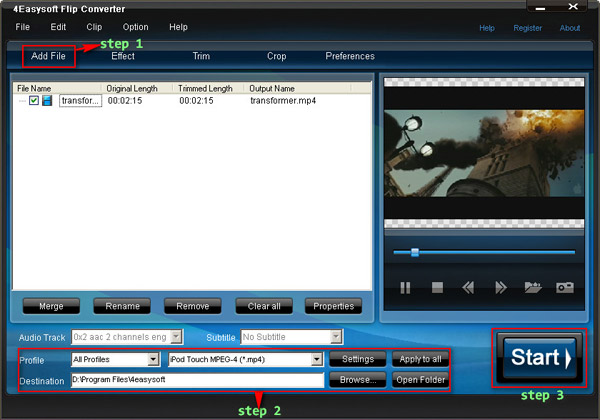
Preparation: Intall and run 4Easysoft Flip Converter
Step 1: Import files
Click “Add File” button, you are allowed to import versatile video/audio files.
Step 2: Select output settings.
New: Using 4Easysoft Flip Converter, you are available to convert Flip video to different formats simultaneously.
From the profile drop-down list, you can choose the output video formats.
You can set Encoder, Bitrate, Channels, Resolution and so on by clicking “Settings” button.
You can choose the output folder by clicking “Browse”, or the defalt folder is D:\My Documents\4Easysoft Studio\Output.
Step 3: Start conversion
Click “Start” button, you are allowed to start conversion. All the tasks of conversion will be finished at fast speed and high output quality.
Editting Tips:
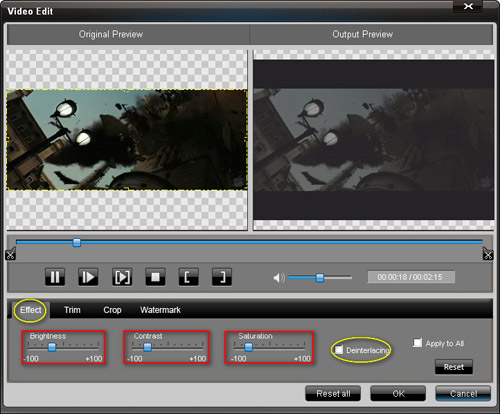
1. Adjust video effect
Click “Effect” button and a dialogue pops up, you can set the video Brightness, Contrast, Saturation and check the Deinterlacing which helps you to optimize the video effect.
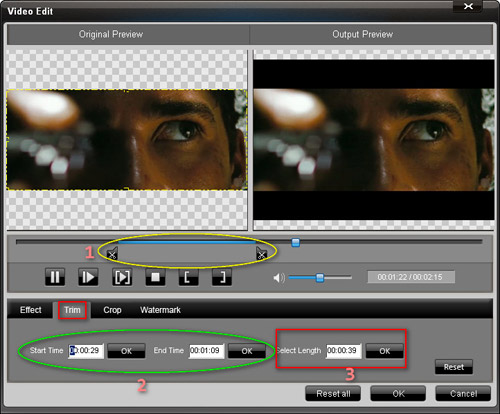
2. Trim video
Click “Trim” button, a dialogue will pops up. Then you can trim the videos by dragging the slider bar, click "Start Time" and "End Time" button, or setting the values
Giles Parkinson has an article on market troubles for the Australian cleantech industry – Cleantech Outfits Are Having A Rough Time.
Since outperforming both the benchmark S&P/ASX 200 and the S&P/ASX Small Ords indices in 2007, the 75 companies that make up the ACT Australian CleanTech Index (once valued at $16 billion but now worth $10bn) have seriously underperformed those broader indices in each of the 2008, 2009 and 2010 first-half financial years. Essentially, the index fell harder than the rest of the market and recovered less.
Now it’s falling again. Figures for December show the CleanTech Index down 6.2 per cent for the month, compared with 1.7 per cent gains in the broader index and a 3.8 per cent gain in the small caps. …
The index and its components are also vulnerable to the vagaries of government policy.
The December slump coincided with the defeat of the emissions trading legislation and disappointment in Copenhagen, which hit carbon offset stocks such as Carbon Conscious and CO2, and the allocation of renewable energy grants.
Those that missed out, including Carnegie Wave and Kuth Energy, were among the hardest hit. Solar PV installers such as Quantum Energy went on a roller-coaster ride that pretty much followed government policy.
Companies such as Jackgreen went into administration, while others, such as Geodynamics, slumped after nearly sending its board of directors into orbit with a blowout at its flagship well.
The best performer for the past month was solar cell innovator Dyesol. Biodegradable packing group Pro-Pac Packaging was the best performer for the latest quarter, while biodegradable nappies producer Eco Quest was the best performer for the half, trebling its share price, mostly in the first quarter.
It’s hard to read any trend in the various components of the cleantech index. Solar, which performed well in the 2007 fiscal year and last year, underperformed in 2008 and so far this year, while wind, which boomed in 2007 but fared poorly in 2008 and last year, has performed better so far this year, as have the energy efficiency, geothermal and environmental services sub-indices.
Perhaps they could be neatly plotted against a graph highlighting policy hope, policy promises, and policy delivery over the same period. O’Brien says the volatility highlights the relatively immaturity of listed stocks in the area.

Now, I’m not trying to be rude (no R. Kelly), but there are too many classes at Stanford. It is absolutely impossible to keep track of all these things. That is why I, your intrepid columnist, am here to review this quarter’s worst classes (and a few good ones). The findings here are, as always, scientific and not to be questioned.
ARTHIST 414–Italian Mannersim (Morten Hansen, 5 units)
Now, I don’t really know what this class is about, or really whether it will answer “questions of the bella maniera, anti-classicism, and center and periphery in mannerist art in light of developments in scholarship from the 70s to the present.” But the fact that it has a typo in its name (seriously — check anywhere) should disqualify it.
PWR 1–Post-Feminism, Post-Race: Gender in the Age of Obama (Dana Carluccio, 4 units)
Students: do not encourage this. If this class turns out to be popular, every other class will be “Organic Chemistry in the Age of Obama,” “Private Lives, Public Stories About Barack Obama: Autobiographies in Women’s History” and “Ancient Journeys, Modern Quests with Barack Obama.”
CHINLANG 11–Beginning Southern Min (Taiwanese) Conversation (Lin, 2 units)/TIBETLNG –First Year Tibetan (Clark, 3 units)
It really is time for these to be conquered by a Chinese language class.
SURG 230–Obesity in America (Woodard and Morton, 1 unit)
Should we be concerned that the solutions to “Obesity in America” lie in the Surgery department? The course description advertises, “Lunch provided.” If you are teaching a course about how fat everyone is, that takes one hour once a week, it shouldn’t have a lunch break.
SURG 69Q–It’s All in the Head: Understanding Diversity, Development, and Deformities of the Face (Helms & Brugman, 3-4 units)
This one wins the coveted “Least Appropriate Pun” award, dethroning last year’s winner, “Suck On This: An Oral History of Hard Candy in America.”
CEE 268–Groundwater Flow (Kitanidis, 3-4 units)
I’m still mad at these guys for stealing the name of my eco-conscious spoken word poetry collective.
COMPMED 103–Horse Medicine (Green, 2 units)
This is replacing the much less popular class offered last year entitled “Glue and Jell-o: How to Deal with an Unhealthy Horse Old Yeller-style.”
GSBGEN 315 — Strategic Communication (Schramm, 4 units)
When your class has a 300-word description concluding with the sentence “More details provided in the syllabus,” you are demonstrably unable to teach a class called “Strategic Communication.”
GSBGEN 34 –The Economics of Higher Education (Bettinger, 4 units)
There is only one session for this class. The professor arrives to class in a stretch limo, wearing a mink coat, coated in diamonds and platinum necklaces, walks up to the microphone, yells, “Suckas!” and leaves you with a newfound appreciation for the economics of higher education.
HISTORY 231S–Early Modern Things (Findlen, 4-5 units)
Part 2 of a two-part sequence with Late Antique Stuff.
HUMBIO 87Q–Women and Aging (Winograd, 5 units)
Proposed subtitle: “The Cougar Hunt.”
MUSIC 80T–Jewish Music in the Lands of Islam (Tchamni, 4 units)
Also known as “Shhh . . . keep that racket down, they’re going to hear us.”
PSYCH 146–Observation of Children (Lomangino & Hartman, 3-5 units)
Ladies and gentlemen, the creepiest class of the quarter.
PSYCH 266–Current Debates in Learning and Memory (Wagner, 1-3 units)
This would be a better class if the professor could remember any of the older debates in learning and memory.
PHYSICS 16–Cosmic Horizons (Romani, 3 units)
No Enchanted Broccoli Forest.
But that’s not all there is. In fact, there are a few worthwhile classes. Here is that list in its entirety:
ARTSTUDI 80–Color (Edmark, 3-4 units)
Feel the excitement.
FEMST 188N — Imagining Women: Writers in Print and in Person (Miner, 4 units)
Finally, a class in the feminist studies department where you are encouraged to have fantasies about women. Approve!
GEOPHYS 60N — Man versus Nature: Coping with Disasters Using Space Technology (Zebker, 4 units)
Screw coexisting! Enough with all this pro-environment bias in the curriculum — finally a class that has the balls to try to teach us how to defeat nature.
CLASSGEN 205B–The Semantics of Grammar (Devine, 2 units)
You’re probably thinking, “This sounds boring . . . grammar is boring — why should I care?” How about because the professor enters class on a zipline shouting, “Are you ready to learn about some grammar?!?!” into a megaphone, while the class mascot (that’s right, it has a mascot) the Conju-Gator fires off a T-shirt cannon? You will be excited by the passive voice.
Leia mais: http://www.patiinhu.com/2009/12/turi…#ixzz0cIkKihmL
 Q: Counter space is so coveted in our house and both my husband and I hate the look of a utensil caddy filled with all our tongs and spatulas and ladles. Are there any creative ways to store commonly used utensils without cramming them all in jars on the counter but still keep them handy and easily accessible?
Sent by Jessica
– Phòng Dorm: Gồm nhiều giường/phòng giống như ký túc xá, dành cho đoàn đi du lịch muốn ở trung phòng và nhất là tiết kiệm chi phí tối đa mà vẫn ở trong một khách sạn 2 sao có đầy đủ dịch vụ và trang thiết bị hiện đại. chi phí tính theo số giường quý khách sử dụng.
– Phòng Standard: 20$
– Phòng Superior: 25$
– Phòng Deluxe: 30$ (cửa sổ nhìn ra phố)
Xin liên hệ để được mức giá ưu đãi hơn nữa
————————————
Hanoi Youth Hotel
Add: 56 Ngo Huyen – Hoan Kiem – Hanoi – Vietnam
Tel: (84-4) 38260470 – Fax: (84-4) 38260471
Website: http://hanoiyouthhostel.com
Email: [email protected]
Mel Gibson, who split from his wife of 30 years last winter, is speaking out to offer words of encouragement to defamed golf star Tiger Woods.


The actor/director is now living with 39-year-old Russian singer Oksana Grigorieva – the mother of his 2-month-old eighth child, Lucia.
“Nobody is without sin,” Mel told The Daily Mail this week. “I did a pretty good hatchet job on my marriage,” he confessed.
His advice to Tiger: “You have to try to make amends if you can. You have to shut up and move on and not whine about it. And you have to deal with it like a man.”
Rust is a chemical reaction to the surfaces of iron and steel becoming damp. When iron and steel get wet, the surface reacts with oxygen in the air and the water (usually rainfall). An acid is then formed by dirt and dust mixing with the chemical reaction caused by dampness and this acid eats away at the steel and iron, thus creating rust.
The best way to get rid of rust is to try and stop it from forming in the first place. To prevent rust iron or steel should be painted as soon as it looks a little tired and faded. This should be done by removing any grease from the surface with white spirit, then applying a metal primer and finally a gloss paint or one designed for steel or iron.
If rust has formed then sand it down using sandpaper or a wire brush and then paint using the techniques indicated above. But prior to painting make sure all rust is removed.
 Following a 2009 when the German carmaker flooded the market with countless releases, 2010 promises to be even more action-packed for the Wolfsburg manufacturer. The year-opener for the carmaker was chosen to be the new compact coupe car which will be unveiled later today at the 2010 North American International Auto Show (NAIAS) in Detroit.
The New Compact Coupe (we hope this is just a provisional name) is a hybrid vehicle powered by a TSI gasoline-engine and an electric motor. … (read more)
 Q: Hi! My fiance and I just (mostly) finished a year long kitchen renovation, and are starting to cook again.
Now, here’s the thing: I want to make my own chicken stock, but neither of us really like white meat. Roasting a chicken is actually sort of a waste for us. Can you make chicken stock with just bones and shreds of meat from roasted drumsticks and thighs? Or does it totally botch the flavor? Do you really need a whole carcass?
Sent by Christine

Computers make our lives so much easier in so many ways, but there’s one important task they have not yet been able to do: make you coffee in the morning. Well, my lazy computer-addicted friends, that is about to change with the iMac CS.
A gentleman by the name of Klaus Diebel has taken it upon himself to create a computer that makes you coffee. Diebel used the shell of an old iMac and inserted a WMF1 single-cup coffee maker where the screen would be.
The Mac mod also includes a Mac Mini and a JBL Spot sound system so you can listen to beautiful music while sipping your morning joe.
The only downside is that the iMac CS has no monitor. But isn’t that a small price to pay for a fresh cup of coffee?
[via Technabob]
Related posts:
|
It was only just over a decade ago that Martin Edwards came close to selling the whole of Manchester United for £20m, and live televised football consisted of one game a week. Yet if there’s been one revolution in sport, we are now at the start of another. As with the last one, television and money will be key factors, but many experts believe the misuse of medical advances will be just as significant. Denis Campbell talked to the movers and shakers in the sports world and presents his predictions as to what we can expect in 2010 Tuesday 23 May 2000 Genetics and drugs Forget steroids, dietary supplements, stimulants, diuretics and everything else unscrupulous sportspeople take. By 2010, sport will be dominated by ultra-fast, super-strong, muscle-bound Frankenstein athletes whose record-breaking feats owe as much to genetic medicine as to the gymnasium. The science of ‘gene-doping’ will have replaced the culture of pills, injections and masking agents. Want to run faster? A gene injection will sort it out. Need to increase your stamina for the Tour de France, London Marathon or Olympic rowing final? Go and see a bio-chemist. Fancy bigger muscles to help you survive all those big ‘hits’ in the new rugby season? No problem; just show us where you want them – chest, arms, thighs – sit back and watch them grow. One of the men who knows most about the potential misuse of medical breakthroughs is Professor Geoffrey Goldspink, who leads a team of 15 scientists and surgeons at the Royal Free and University College Medical School in London. They are investigating how gene therapy and tissue engineering can help, for example, people who have either seen their muscles wither because of old age or confinement after an accident or who suffer from some sort of deformity. They hope to develop ways to rebuild muscle using artificial genes produced by manipulating DNA. The only tests they have done so far have been on mice, but the results have been startling. One injection produced 20% extra muscle within two weeks. If it gives mice bigger legs, it may do the same for people. Goldspink believes the effect on humans may be less dramatic, possibly only 10% growth inside a month. ‘But as only a 5% improvement in performance can turn a mediocre club athlete into an elite national athlete and potential gold medal winner, the temptation for athletes to abuse these breakthroughs is obvious’, says Goldspink. ‘If you can resculpture the whole shape and look of your body through one injection per muscle, then you could certainly change your physique very quickly and without the pain that goes with exercise’, he explains. ‘Anyone in sport who needs muscle bulk – American footballers, sprinters, shotputters, discus throwers – may want to try this.’ Similarly, sportspeople who need good stamina, such as cyclists and distance runners, will be watching closely for news of developments in EPO gene therapy. EPO, one of the most widely-abused drugs in sport, is the banned substance which boosts endurance by raising the red blood cell count to abnormal levels. Scientists are currently devising ways to introduce an EPO gene into the body to help counteract anaemia. If it works for anaemia sufferers many sportspeople are sure to risk exploiting the same therapy, despite the known risks of strokes, heart attacks and paralysis. Dick Pound, vice-president of the International Olympic Committee, is aghast at the possibilities opened up by gene-doping. ‘Are we going to create a generation of monsters, of made-to-order humans, a race of specialised people who only do sport? Are we going to breed bigger and meatier people, such as 380lb [27-stone] linemen to play American football, in the same way that we already breed cattle?’ says Pound. ‘The scientists, legislators and medical ethics people have to say, hey, wait a minute, and stop this happening.’ Pound recoils at the grotesque potential of gene manipulation. ‘This wouldn’t be two basketball players, for example, falling in love and producing children. It would be more like getting a catalogue and ordering up by mail-order the kind of physique that would lend itself to a particular sport. That would be a disaster in human and social terms, and for sport too.’ Disaster or not, genetically-modified sportsmen are the future. The IOC has already been warned that it is a question of when, not if, gene-doping starts happening. This bio-engineering of world champions has been made possible by the rapid recent advances in our knowledge of genetics, especially gene therapy, which is increasingly being used to treat serious medical conditions such as anaemia and muscular dystrophy. The same discoveries that will benefit the sick will also help sports cheats gain new forms of unfair advantage. Muscle-growing and blood-boosting for bona fide medical purposes are the two areas in which most gene therapy work has concentrated so far. But with gene-mapping continuing apace, and researchers from the Human Genome Project busy identifying all the body’s 1,500 different genes, it will not be long before scientists also discover the genes which make us run faster, dribble more mazily or strike a ball with more swerve. With gene-doping commonplace in professional sport by 2010, there will be little the governing bodies can do about it. Muscles and red blood cells occur naturally anyway, so there will be no way of telling whether a gold medallist’s astonishing performance owed more to natural ability or a syringe full of synthetic gene. Gene-doping may give us the sub-two hour marathon, the nine-second 100m and the three-minute mile. But who will believe it? Who will applaud? Is gene-doping in sport immoral? Certainly. Against what nature intended? Yes again. Illegal? No; there are no laws to deter or punish such experimentation. Global leagues Manchester United will play in a global league. Along with a lot of other teams A worldwide set-up of the biggest stars and most famous teams is a strong possibility in football and could also occur in basketball, rugby and ice hockey. The combination of mind-boggling financial rewards, rival broadcasters’ enthusiasm to screen games and the cachet to competitors of being able to call themselves ‘the best team in the world’ may prove irresistible. Kevin Roberts, editor of the highly-influential Sport Business magazine, believes world leagues are the logical outcome of several recent trends in sport. First, the big broadcasters who already televise sport – Rupert Murdoch, Ted Turner, NTL, Disney – have diversified into ownership of clubs. Murdoch’s Sky, for example, have bought stakes in five leading English football clubs while his empire also includes several sports teams in America. Second, broadcasters already exert a high level of influence – for instance over rugby league in Australia, which Murdoch virtually runs, and Premiership football in England. Third, crucially, some elite clubs are feeling ‘restricted’ by the leagues they currently belong to and believe their membership stops them realising their full commercial potential. An existing example is Rangers in the Scottish Premier League. Companies such as Murdoch’s Newscorp may capitalise on such discontent by setting up a global competition. ‘Major broadcasters are now so powerful that they could end up posing a threat to existing national leagues and associations,’ explains Roberts. ‘Add that to the fact that certain clubs are feeling trapped and stifled within their existing league and it’s easy to see how breakaway world leagues could be with us before long.’ Big-name teams, who would be offered huge sums to take part, would clean up financially with blockbuster sponsorship and merchandising deals. ‘If Vodafone is prepared to pay £30m to sponsor Manchester United from next season, someone like Nike or Coca-Cola would probably have to pay hundreds of millions to sponsor a world football league, for instance,’ says Roberts. Football, still the only truly global sport, is the ideal candidate for a worldwide competition. Regional tournaments, such as the European Champions league and Copa America, are hugely successful. More recently, last January’s inaugural World Club Championship in Brazil showed fans are interested in seeing their team take on the best from other continents. A cartel of leading clubs, called the G14 group, already exists in Europe and includes Manchester United, Liverpool, Barcelona and Juventus. They could invite teams from South America, north America, Asia and the Middle East to join them in a 20-club world league. Each game would be a highly lucrative TV event attracting hundreds of millions of people around the globe, rather than just the populations of two countries. Pay-per-view revenues could generate billions. The formation of such world leagues would pose fundamental questions about the way sport is organised, and who does the organising. Would teams in a world league still bother to compete domestically? Would a global league be a permanent self-preserving elite with no relegation or promotion or could others join the party? And would the world leagues spell the end for the established global governing bodies such as Fifa? Dick Pound, vice-president of the International Olympic Committee, believes the prospect of ‘parasitical commercial organisations’ especially broadcasters, bidding to set up money-making unofficial super leagues will be one of the biggest threats to sport in this decade. ‘The breakaway European football super league that was projected last year is a harbinger of things to come,’ Pound says. ‘Big organisations want to go around cherry-picking sport. They see an oppor- tunity to profit from sport without having to invest in its infrastructure. There’s certainly a danger in them luring players and teams away with big pay cheques.’ He cites basketball, ice hockey, volleyball and even individual sports such as athletics and boxing as the most likely targets. Pound predicts disaster if any world leagues are established. ‘They would end up being no different from certain leagues which exist already, such as the NFL, NBA and NHL, which are more entertainment than sport these days, are run totally for profit and in which doping controls are lax and violence is encouraged to help them compete with WWF wrestling and extreme sports.’ How will we watch sport (1) Technology By the year 2010 sports fans will be able to watch any sports event they want, at any time, from anywhere in the world – but at a price If you think the world is already saturated by sport, think again. Come 2010 far, far more of it will be available in many more forms than now and the whole experience will have become simultaneously both simpler and more complicated. The ongoing technological revolution will have left us able to enjoy sport on screen at our home or work, on a new generation of mobile phones and even in the car. Whatever you want – live action, highlights, goals packages, scores, information on players, interviews, delayed (‘as live’) transmission, updates on the teams or individuals you follow, or the chance to book match tickets – will be yours. All this will be possible thanks to a merger between television and the Internet, combining the old ‘lean back- wards’ technology with the newer ‘lean forward’ way of accessing pictures and information. Homes will no longer have a separate TV set and personal computer. A score-draw in this convergence process will see the traditional TV screen survive but now include tickers of information running on-screen, email messages and ability to save every goal, try, point or basket scored into a specially-created video-file to watch later or email to a friend. All major sports events will be interactive, allowing fans instant replays, a choice of camera angles and the ability to track a particular player, the way Sky now does in its football coverage on its digital channel. A second merger, involving those two plus mobile phones, will make sport even more accessible. Peter Sprogis, founder of sports content provider Worldzap, says that within 10 years the cellphones of today will have metamorphosed into sophisticated hand-held devices called personal digital assistants (PDAs) which relay news, action and interviews in 10-12 second video-clips. PDAs will boast a screen measuring four inches high by five inches wide and be connected to the worldwide web. ‘People should be able to access information while they’re at work, in the back of a taxi or on a train, the way you can with your PC at the moment. PDAs will combine what you get from TV, radio and your PC now into something much more portable,’ explains Sprogis. Andrew Croker of sports internet firm Sportal says that come 2010, the sports fan will not only have a huge choice of viewing, they also, ‘get completely personalised service as standard. For example if you’re interested in South- ampton FC, Tim Henman, Chinese food and heavy metal, the latest details about all of them will be offered to you via your TV screen. That might be the highlights of Saints’ game this afternoon or Henman’s match against Greg Rusedski in California which was starting as you went to bed last night.’ However all this choice will come at a price. Want to watch a West Ham reserve game while you’re on holiday in New York? Yes, it’ll be available, but you’ll pay for the privilege. How much? Charges should be reasonable as providers of all these services want to reach a mass rather than niche market. They presume that as people are already used to paying for mobile phones, specialist services such as Manchester United TV and access to particular TV channels, they will fork out a monthly fee for up-to-the-minute sports information or pay extra to watch an important match. How will we watch sport (2) Stadiums Every seat in every stadium will come with its own TV screen Did you miss that goal? Don’t worry. In the stadium of 2010 the airline-style video replay monitor in the armrest of your seat will show it to you again. Or tell you what percentage of David Beck- ham’s crosses this season have been on target. Or let you book two extra seats for the next game for your niece and nephew. Sounds fantastic? The recently-opened Colonial Stadium in Melbourne, Australia, boasts 1,500 such ‘smart seats’ among its 52,000 capacity. Medallion Club members who already pay £2,000 a season to watch the three resident Aussie Rules teams stump up an extra £1,300 for the video facility. The architects who designed the Colonial Stadium believe such seating will soon be standard-issue at sports grounds everywhere. In 2010, they say, nobody would consider buying a seat without it. Cinema-level comfort is promised. The installation of a moving roof and temperature control equipment mean that, on a cold day, the roof will be closed and the atmosphere warmed up using blow-heaters. As for the half-time Bovril, traditional catering outlets will either have decreased greatly or disappeared altogether and instead fans will be able to choose from a wide range of fresh food delivered instantly from a wall covered in machines. Fancy a vegeburger? Certainly, sir: GM-free or normal? And don’t worry about money. Your thumbprint on a sensor pad linked to a huge database will be enough. Specific examples (1) Rugby England to rule the rugby world England will be the champions of the whole world – but only by persuading the best players currently plying their trade in rugby league to transfer to the 15-a-side code. That is the view of rugby’s global governor, who claims it is a perfectly plausible scenario for England in 10 years time. Vernon Pugh, head of the International Rugby Board, the sport’s world governing body, told OSM that rugby union and rugby league could easily have come together by 2010. ‘There may well be a circumstance, within the next 10 to 15 years, that if rugby league ceases to be a global game, in England it might well be subsumed, certainly in a professional sense, by rugby union. ‘I don’t think there will be a [formal] coming together of the two codes, or that anyone will consciously create a hybrid and say, "This is rugby". But players will simply understand that if they want to earn their living from the sport, it’s got to be rugby union, not rugby league. If you look at the players switching codes now, they’re all from league to union because there’s more money in union and in one sense it’s a less demanding game. You can play for longer in union than you can in league, so your career is longer.’ Pugh, the former head of the Welsh Rugby Union, does not expect to see the two codes heal their historic divide by coming back together in any country. But he believes recent rule changes which have made the 15-man game more like the 13-a-side game, and the two codes’ contrasting financial fortunes could lead to union effectively taking over league in England. ‘If TV companies stop treating rugby union as a global game, then rugby league as a professional sport would clearly be at risk.’ And if that happened? ‘Then what will happen is that England will be world champions of rugby for the next 15 years because if they get the best players from league playing rugby union, there’s such fantastic talent there. There’s so many good quality players that play league at the moment who, if they started off life as union players, would provide England with the things which if anything they do lack, and that’s the footballers within the team.’ Specific examples (2) Boxing Boxing will be in even greater disarray than now and may have self-destructed By 2010 boxing may well have self-destructed as a result of its own corruption, and either been banned by the authorities or been taken over by a government authority. That is the view of Panos Eliades, the promoter of world heavyweight champion Lennox Lewis. Eliades fears the sport is now so disredited that it is in danger of collapsing in ruins. He points to the widespread suspicion that many fights are rigged, allegations of bribery, the influence of controversial American promoter Don King, laughable mismatches pitting genuine contenders against no-hopers and bickering between the bewildering ‘alphabet soup’ of rival governing bodies. Together, claims, Eliades, they could bring an end to boxing. The outcome of Lewis’s world title fight against Evander Holyfield in New York in March 1999 – the three judges sparked outrage by declaring it a draw, when most observers felt the British fighter had won – showed the sport at its worst. ‘If boxing chooses events like that to show that the judging is so bad, people will look at it and think, "We don’t really want to get involved in a sport like this," and boxing could self-destruct,’ Eliades. ‘You won’t get sponsors, you won’t get the television, you won’t get people coming to see it. They could actually ban boxing eventually. It may deteriorate to that extent.’ Specific examples (3) Tennis Tennis players will be bigger and so will the courts By 2010 most of the top male tennis players in the world will be at least 6ft 6in tall, prompting the game’s rulers to enlarge the court and raise the net. So says Mark Miles, chief executive of the ATP Tour, the governing body of the international men’s tennis circuit. He believes the trend towards bigger, taller players – such as Mark Philippoussis and Marat Safin, who are both 6ft 4in – will continue, as will the emphasis on power and pace in the the modern game. ‘Over a period of time athletes in all sports have been getting fitter, faster and stronger and it’s common sense that there will a time will come when all sports, tennis in particular, have to make some adjustments,’ Miles says. ‘If you are standing on the baseline, both the trajectory of the ball and the height of the net look very different to a player who’s 5ft 6in than they do to one who’s a foot taller. ‘As players’ size has grown, it’s as if the net has been lowered and the lines of the court have been brought closer together. That will eventually impact on both the way we play and the geometry of the court, because the dimensions of the court are getting smaller.’ Miles foresees two main changes: the height of the net will rise – ‘if players are six or 12 inches taller, maybe the net should be one inch higher’ – and the court, or certain parts of it, will become bigger. Eventually even the racket and balls may have to follow suit, he thinks. In addition, technological advances will soon revolutionise the experience of watching tennis. By 2010 there will be electronic sensors and high-speed cameras around every court which will be able to detect whether a shot is in or out. They will assess the speed and direction of the ball, combine that with wind and humidity readings, and instantly declare if a player has played a let, a net or an ‘out’. The equipment adapts technology developed to track missiles and means even John McEnroe’s spiritual successors will never feel the need to dispute a decision. |
If I may, I would like to propose a question for you to gnaw on: Who are you? Simple, terse, yet somehow strikingly elegant, these three words underscore the very foundation of student life and culture at Stanford. Allow me to clarify. I am not asking about your hometown, your ethnicity or your sexual preference, though these do tangentially play a role; what I want to know is your freshman dorm, your varsity or club team, your fraternity/sorority, what VSO you currently run and whether you prefer Stern to Lag Late Nite. In short, my inquiry is actually this: Here at the Farm, what is your identity–what set of masks do you wear for the campus to see?
So long as you have not spent the last several contiguous years living here without end, it is a bit difficult to miss the fact that Stanford exists as a bit, oh, how shall we say, disconnected, from the world at large. I am frankly of the opinion that the Stan feels more like some Zimbardian social experiment, whereby a coterie of twisted psych researchers concocted an alternate realm free of traditional social norms and replaced instead with Synergy, STS and the TOTOTTILSJUMB.
What this means for us pampered inmates is that our lives, the paths over which we tread within Campus Drive, are constructions we (the Stanford community, both past and present) have erected with our own hands. Being an ASSU hack has as little (though probably even less) relevance to society than if you are an Uj CTA or Dance Marathon VP of Development, though all three in some respect carry unique implications that we have invested them with here. I am not arguing that your activities and involvements on campus do not matter; rather, that it is easy to overlook the fact that we inhabit a place that exists very much unto itself and with very few parallels elsewhere.
The Stanford life is continually turned on “repeat.” It bears noting that, with a few notable exceptions, we are not special. In fact, we are marginal replications of archetypes that have passed through this place several times over. If you ever get a chance, go through your freshman year scavenger hunt pictures and then track down the albums of Stanford folks both a few years older and younger than you. When photos taken over a half decade apart look identical, the red flags start to arise.
I get the idea of traditions, really. I’m a history major. But we are not talking about traditions. Instead, those experiences and events that as wide-eyed frosh we are almost convinced are unique and special to just us take on a different light when placed beside the realization of their annual repetition for decades. My freshman year RA had a major impact upon my life and my understanding of Stanford, and currently in his old room is a friend of mine who is RA-ing for the same dorm, with frosh popping in for guidance and company and candy, not unlike what this old fool did two long years prior. Such a realization, while not detracting from my memories, certainly provides a new way of looking back at my time here.
Outside of the occasional presidential election, football upset or campus controversy, Stanford culture operates within an unspoken, albeit highly apparent and relatively predictable, set of norms. The arbiter of long-term success for any and all student organizations and activities hinges on the capacity to provide a sustainable model that can be replicated years down the line. I know that I sound like Waldorf and Statler here (if you know the reference, I’ll bring you to Bagel Day), but chances are that whatever wonderful and dynamic activities dictate your Stanford experience have been doing just that for others before you so many more times than any of us want to accept. We are not some massive state school that makes no claim to puffing up our individuality–here we are told that we are special. However, those grand NSO illusions lose their luster at some point.
My aim is to not depress the hell out of the campus or crush any naïve dreams. The winter gloom, our own respective demons, and the Biocore seem to accomplish that far better than I could ever manage. As the Dude would ask, then, “What’s your point Walter?” The acceptance of our own miniscule and ubiquitous roles at Stanford, I contend, is actually beneficial to succeeding and thriving here. When inane and superficial social demarcations are seen to be just that, unexpected characters and opportunities arise. Discarding prevalent campus tropes makes this strange and utterly bizarre place all the more fascinating. In short, it really ties it all together.
Big Green Purse believes the way to drive environmentally friendly products is to spend on them … and use dollars to vote in the marketplace.
" … we believe that the fastest, easiest, most direct route to a clean and healthy environment is to shift our spending to environmentally-safe, socially responsible products and services."
" … Big Green Purse … our focus on women because women spend $.85 of every dollar in the marketplace. That’s a lot of power packed in a purse…… used in a way that can’t be ignored. … encouraging A MILLION WOMEN to shift at least $1,000 of money they already spend for an initial $1 billion Big Green Purse impact. …"
" … saves you time. … found products that are really green (not just "green washed") at prices you can afford … pinpointed goods that are not only green but "fair trade," meaning people are paid a fair wage for their work and no child labor is involved."
Via: Big Green Purse LINK
Federal Reserve Board Chairman Ben Bernanke spent most of his speech to the American Economic Association on Jan. 3 responding to the critique that easy monetary policy during 2002-2005 contributed to the housing boom, to excessive risk taking, and thereby to the financial crisis.
Many have expressed the view that monetary policy was too easy during this period. They include editorial writers in this newspaper, former Fed policy makers such as Timothy Geithner (now the secretary of the Treasury), and academics such as business-cycle analyst Robert J. Gordon of Northwestern. But Mr. Bernanke focused most of his time on my research, especially on a well-known policy benchmark commonly known as the Taylor rule.
This rule calls for central banks to increase interest rates by a certain amount when price inflation rises and to decrease interest rates by a certain amount when the economy goes into a recession. My critique, which I presented at the annual Jackson Hole conference for central bankers in the summer of 2007, is based on the simple observation that the Fed’s target for the federal-funds interest rate was well below what the Taylor rule would call for in 2002-2005.
Join the conversation about this story »
See Also:
 Several ways to translate web sites, texts or documents online have emerged in the past few years, with Google Translate probably being the best-known tool. Google’s service is free and works for most quick and dirty translations, but when it comes to delivering truly accurate results, nothing can beat a human translator. In 2008, Google itself toyed with the idea of establishing the so-called Google Translation Center, a marketplace that was supposed to match translators with people who need texts translated.
The concept was shelved later, and now it’s a startup called MyGengo that tries to become the world’s Mechanical Turk for translations. MyGengo offers human translation services between English, Japanese, Chinese, Spanish, Italian and Russian. And it does work much like Amazon’s crowdsourced marketplace: The site’s 600 “certified” translators wait for a customer to upload a document or text and take care of those jobs they can deal with. Customers can choose between three quality and pricing levels and usually get the translations back within a few hours, saving up to 70% in costs when compared to professional translators.
MyGengo says their system makes it possible to accept just about any job size, including those usually denied by traditional translation agencies. Customers can have books, office documents, newspaper articles, blog posts or even tweets translated. (MyGengo itself translates selected English tweets from TechCrunch, Ashton Kutcher and others into Spanish to show how that looks like.)
The service offers two specific solutions for people who need to localize a website or an application: Starting March 2010, an API will speed up the process of requesting the translation of frequently updated content, for example blog posts or comments. Another solution dubbed String lets developers manage all language “strings” of a multilingual website through a dashboard during the localization process. This hosted service will link to the API, but using String by itself is completely free (more background).
Founded in Tokyo in 2008, the startup can count on the support of Silicon Valley-based investor Dave McClure in its efforts to conquer the American market for web-powered translations. McClure, who discovered MyGengo during the previous Geeks on a Plane trip to Japan, decided to make a personal (seed) investment in the company just last week and became an advisor, too.
MyGengo and their new investor are looking at a large market: The language service market as a whole is worth over $14 billion dollars already (MyGengo estimates web-based translations are worth around $3 billion), with some sources predicting it will balloon to $25 billions by 2013. (See this industry report for details).
Crunch Network: CrunchGear drool over the sexiest new gadgets and hardware.


Buy This Item: [Click here to buy this item]
So often I wonder if interfaith work can really have the voice I hear. I wonder if it can shed its pathetic refrain of vague, self-congratulatory liberal notions of tolerance. I wonder if, amid the noise and haste of talk-show evangelism and televised extremism, we can discern the more powerful alternative stories: of Mahatma Gandhi and Badshah Khan, of Martin Luther King, Jr. and Rabbi Abraham Joshua Heschel. I wonder if our silence, our inability to tell these stories as they affect us, cedes the terrain to agents of destruction, who would have only their group dominate and others suffocate.
In truth, I don’t know. Our public discourse on religion is too frequently filled with violence and virulence, endowing the so-called clash of civilizations with the sheen of inevitability. It’s this very uncertainty, however, that urges me to change the conversation from conflict to cooperation. So, I’d like to tell you how I spent the last days of my winter break. The Hindu community in which I was raised bought a new property some two years ago–an old church in the foothills of San Jose. The final day of our new year’s retreat involved a special Vedic fire ceremony to pray for, among other things, spiritual maturity and mutual cooperation with our neighbors: a Polish church that has been particularly warm and welcoming. I love these rarefied rituals: the smells of smoke and mystery and tradition, the joyful liturgical harmony of the priests, the deep sense of the height and glory of this sacrifice. But my favorite part of the day was to hear the following from several attendees, my mother included: “There’s something about this place, this church. People have really prayed here. It’s those blessings that are coming to us.”
For her, the dialogue of religious experience did not simply override cultural boxes; it drew on their deep wells and breathed their spirit across space and time. I don’t think we require some mystical assertion to recognize that, as Gwendolyn Brooks says: We are each other’s magnitude and bond. Like the faith heroes I mentioned, I believe my religious tradition calls me to build mutually enriching relationships with those different from me by working together to serve others. Religious particularity is not only about domination or persecution or political intransigence; it gives us the ability to interrogate ourselves, to take learning seriously, to be surprised and humbled by the fact of existence. I am not interested in apologetics, but in fellowship; not merely in hearing another’s story, but in writing a new chapter together.
This is what I hope Stanford F.A.I.T.H. will begin here: countering violence by confronting the triple threats of racism, economic exploitation and war; countering hatred by advocating for feminist and LGBT rights; countering mistrust by preventing deaths due to malaria. These are concerns that call on the best of our traditions–religious and secular alike–and require us to engage our deepest identities in common action. Please join our weekly meetings: Wednesdays at 7:30 p.m. in the Common Room in the CIRCLE (Third Floor, Old Union). Help us transform interfaith cooperation from an anomaly to a social norm. Every student is a potential interfaith leader. We need only have the words and the heart to act.
– Anand Venkatkrishnan
Co-founder, Faiths Acting in Togetherness and Hope (F.A.I.T.H.)
 We have slightly crazy cabinet doors in our old rental kitchen. The hinges must be busted somewhere inside, because as much as we fiddle with them, they never allow the doors to close completely. This drives us completely batty, and we’ve been thinking about a hinge-replacing spree. But hinges can be pricey, so we were glad to learn this alternate door-closing hack from This Old House.