And how does the body process sugar or carbohydrates ? If there is too much sugar or too liitle sugar can this be diabetes? How can you tell if you have too much sugar or not enough?
Blog
-
Clock of the Long Now: Prototype 1
Royal London Borough of Kensington and Chelsea, U.K. | Inspired Inventions
Sitting in the Science Museum of London, is the first prototype for the 10,000 year Clock, also known as the Clock of the Long Now, to be built in a a remote mountain site near Ely, Nevada.
Planned as an art/engineering work of heroic scale inside a Nevada mountain, the 10,000 year Clock is meant to embody and inspire long-term thinking. The first working prototype of this 10,000 year Clock was completed in 01999 and is currently on loan to the Science Museum of London, and can be seen as the final piece in the “Making of the Modern World” exhibit. The prototype began to tick on December 31, 01999 after an almost three year research and design effort.
Power for the Clock comes from the two helical weight drives on either side of the Clock. The timing for the Clock is generated both by a torsional pendulum, with a one minute period, and by a Solar Synchronizer that re-calibrates the Clock to solar noon on any sunny day. The display on the Clock is made of two elements; the Serial Bit Adders and the dials. The Adders convert the timing generated from the pendulum, using their binary mechanical system, to changes in the Clock’s dials. The six dials represent the year, century, horizons, sun position, lunar phase, and the stars of the night sky.
It was determined that the site for the monument sized Clock had to be remote enough to require some serious travel, and was a place that was itself mythic. The creators of the clock also wanted a site that would allow the Clock to be built underground, in solid rock, but still have amazing views. This site was found, in eastern Nevada, adjacent to the Great Basin National Park.
Since purchasing the site in 01999, the Long Now Foundation has made dozens of research trips to the site. The roughly 250 acres of private land stretches over a vertical mile from the valley floor at 6,000 feet, to the 11,600 foot peak of Mt. Washington. The Foundation is studying the site to determine the best way to design the experience of accessing it, and working with mining enginees and other experts, to determine how best to proceed with the underground work.
The 10,000 year Clock will be placed inside Mt. Washington, and while there is no date for completion set yet, you can follow the project at www.longnow.org and see the prototype at the Science Museum of London.
In conjunction with the Long Now Foundation. Modified from original text by Stewart Brand at the Long Now Blog.

-
BASF and MONSANTO link again to deliver new technology — with improved animal nutrition
BASF PLANT SCIENCE, MONSANTO ENTER INTO DEVELOPMENT AND COMMERCIALIZATION AGREEMENT FOR NUTRIDENSE®
Press Release
Nutritionally-Enhanced Corn Hybrids To Benefit Animal Producers And Corn Growers; Genuity™ VT Triple PRO™ and Roundup Ready® Expected To Launch in 2010; Genuity™ SmartStax™ Hybrids in 2011RESEARCH TRIANGLE PARK, NC, and ST. LOUIS, (Dec. 09, 2009) –BASF Plant Science and Monsanto today announced the signing of an agreement to develop and commercialize new corn hybrids with better nutrition for animal feed.
The new hybrids will contain BASF’s NutriDense® traits that are designed to enhance animal feed performance. NutriDense corn has higher levels of essential amino acids and energy, greater phosphorous availability and is more digestible.
BASF’s NutriDense traits will be combined with Monsanto’s Roundup Ready® Genuity™ VT Triple PRO™ and Genuity™ SmartStax™ corn. The new high quality hybrids are expected to deliver the best feed value and yields equivalent to elite conventional corn. Once launched, seed companies will market the new hybrids through licensing agreements.
“The addition of higher yielding NutriDense corn hybrids from Monsanto plus increased distribution through Monsanto regional brands and other partners will allow animal operations to contract the planting of the enhanced nutrition corn across a broad geography,” said Jonathan Bryant, managing director of BASF Plant Science LP.
Corn growers may benefit from the premium pricing opportunity on the product from animal feed operations.
“We believe this collaboration will produce new and high-value hybrids for farmers by enabling them to deliver a more nutritious source of corn for feed use to their customers,” said Cameron Ator, regional brand lead for Monsanto. “This is another example of Monsanto’s efforts to continue to provide innovative products that can help farmers maximize the yield and profit potential on their farms.”
Roughly 45 percent of the corn grown in the United States is used as animal feed, with the majority being fed specifically to swine or poultry. A better nutritional composition of the grain fed to the animal reduces costs and waste. This development and commercialization agreement will benefit animal producers by offering a greater number of high yielding, high nutritional quality hybrids specifically designed for the swine, poultry, and dairy segment.
“BASF Plant Science has a strong commitment to the feed industry and our work in corn enhancement and animal nutrition is delivering better corn for better feed,” Bryant added. “We are the only company investing in this manner and depth to provide solutions that improve animal performance and help producers increase their profitability.”About Monsanto Company
Monsanto Company is a leading global provider of technology-based solutions and agricultural products that improve farm productivity and food quality. Monsanto remains focused on enabling both small-holder and large-scale farmers to produce more from their land while conserving more of our world’s natural resources such as water and energy. To learn more about our business and our commitments, please visit: www.monsanto.com . Follow our business on Twitter at www.twitter.com/MonsantoCo on Facebook at www.facebook.com/MonsantoCo, or subscribe to our News Release RSS Feed .About BASF Plant Science
BASF consolidated its plant biotechnology activities in BASF Plant Science in 1998. Today, about 700 employees are working to optimize crops for more efficient agriculture, renewable raw materials and healthier nutrition for humans and animals. Projects include yield increase in staple crops, higher content of Omega-3s in oil crops for preventing cardiovascular diseases, nutritionally-enhanced corn for animal feed and potatoes with optimized starch composition for industrial use. To find out more
About BASF Plant Science, please see our internet web site at: http://www.basf.com/plantscience
About BASF
BASF is the world’s leading chemical company: The Chemical Company. Its portfolio ranges from chemicals, plastics and performance products to agricultural products, fine chemicals as well as oil and gas. As a reliable partner BASF helps its customers in virtually all industries to be more successful. With its high-value products and intelligent solutions, BASF plays an important role in finding answers to global challenges such as climate protection, energy efficiency, nutrition and mobility. BASF has approximately 97,000 employees and posted sales of more than €62 billion in 2008. BASF shares are traded on the stock exchanges in Frankfurt (BAS), London (BFA) and Zurich (AN). Further information on BASF is available on the Internet at www.basf.com . -
Christmas Ball Ornament
Who says you have to have a Christmas Tree? Just kidding! But I do have a great craft project for you today. When I first saw the newer, larger Christmas balls a few years ago I wasn’t quite sure if people were putting them on their trees. I don’t think I can put a ball this large on my tree, so I thought of another way to decorate the ball.

Kathy Zengolewicz
Here is what you will need to get started:
- A 5 or 6 inch Christmas ball (or whatever size you choose)
- An assortment of Christmas picks or florals
- A couple of berry picks
- A large bow made with wired ribbon or ribbon to make the bow yourself
- A hot glue gun
- A length of thin gold cord to hang the ball
- Alcohol
- seasonal stickers (optional)
Wipe the Christmas ball down with a little alcohol and let it dry. If you are using the stickers, place them in various places on the ball. You don’t have to use stickers, it looks just fine without them. I only mention them because I made these for a few friends and a couple of my close friends wanted stickers on theirs.
Place the picks or florals around the top of the ball right under the silver hook holder. You’ll need to put these on one at a time, glue them in place and hold them for a minute until the glue takes hold. Place the berry picks, one on each side and glue into place.
If you are making the bow yourself, make at least 6 or 7 loops. Take the bow and hot glue it to the top of the ball. Don’t cover the silver hook holder, loop your thin gold cord through the hook holder and tie.
You now have a beautiful decoration to hang anywhere. I have my ornament hanging in front of my kitchen window, over my sink. Everyone who visits and see this ornament wants one for their home. So, as you can imagine, I have made my fair share of Christmas ball decorations.
Enjoy!
Post from: Blisstree
-
Pomplamoose: Making A Living Without A CD Or A Label
A month or so ago, a friend started sending me the Pomplamoose videos on YouTube, and now I keep seeing them. It’s basically two people — Nataly Dawn and Jack Conte — covering famous songs by playing and singing all the parts themselves, and them cutting them together into very well done videos that, in some cases, have millions of views. Quentin Hartman writes in to let us know of a WSJ blog post about the band, noting that despite having been contacted by a bunch of major labels, they’re leaning towards staying independent, noting that “We’re making a living off our album sales and we don’t even have a physical CD.” And, yes, this is even though you can watch all the band’s music for free, such as their covers of Beyonce’s “Single Ladies” or Michael Jackson’s “Beat It:
Now, of course, there will be some who will insist that there is nothing creative in covering someone else’s songs, and those folks will never be convinced that this is incredibly creative, but for the rest of us, why not enjoy some incredibly creative song making — and the artists who are making a living even without going down the path of having to deal with fictional royalty statements from a major label.Permalink | Comments | Email This Story
-
Could this be Pre-Diabetes ?
When I go pee the urine is foamy and has bubbles like if you have a bath with bubbles:eek: it is more bubbles than foamy and I don’t know why.. Well it does brake down and if I go to the bathroom alot there seems to be less or hardly at all and I don’t know if it is drinking water or flushing out water ever is building up.I don’t have the diabetes of thirsty ,drinking lots ,frequent urination ,strong hunger ,fatigue ,loss of weight, slow-healing sores, dry and itchy skin, numbness or tingling in your feet ,headache ,back pain , sores .
In fact some days I drink 4 or 5 drinks in a 24 hour and go to the bathroom to pee 3 or 4 times in a 24 hour and eat 2 times in a 24 hour.
But I do not have diabetes the diabetes symptoms above but could this be pre-diabetes I have that lead to diabetes ?
I can’t do a urine test because foamy and bubbles brake down so by the time the doctor look at it it is all gone.I thought excess protein ,crystalline or infection like urinary tract infections do not brake down ?
-
Ward’s announces 10 Best Engines for 2010
Filed under: Technology
 Ward’s Ten Best Engines of 2010 – Click above for high-res image gallery
Just about every publication has an award to give away this time of year, and Wards Automotive is no different. But instead of picking the best car, truck or SUV, the industry wiz kids at Wards go right for the power supply to rank the Ten Best Engines for 2010. Over the years the list has contained a nice mix of engines from the U.S., Europe and Asia, but never before has the Ten Best been this fuel efficient. The list comprises of two hybrids, two diesels, one supercharger and three turbocharged gasoline mills.
To be eligible for Wards‘ 10 Best Engines competition the vehicle must cost less than $54,000 and the engine must be available as a standard production option by Q1 2010. Among the ten winning engines are the new 1.8-liter hybrid powerplant from the Toyota Prius, the 2.5-liter hybrid powering the Ford Fusion, and the diesels from the BMW 335d and the 2.0-liter Jetta TDI. Audi joins the ranks with its excellent 2.0T and 3.0T (well, supercharged) mills, while Ford scored a hit with its Ecoboost 3.5-liter engine. The most powerful engine to make the 10 Best Engines list is Hyundai’s 4.6L Tau V8, which gains ten hp for 2010.
The 10 Best Engines awards will be presented at the 2010 North American International Auto Show in Detroit on January 13. Hit the jump to read Wards’ press release and check the gallery below for a tour of this year’s winners.
Gallery: Ward’s 10 Best Engines of 2010


[Source: Wards Automotive]
Continue reading Ward’s announces 10 Best Engines for 2010
Ward’s announces 10 Best Engines for 2010 originally appeared on Autoblog on Wed, 09 Dec 2009 19:28:00 EST. Please see our terms for use of feeds.
Read | Permalink | Email this | Comments
-
A Cold War Over Warming

What happens if global efforts to set and abide by strong carbon emissions cuts fail?
The standard answer to a question like this is that “we all suffer.” While that’s probably true, it misses the point — we may all suffer, but we don’t all suffer equally. Some nations will be hit harder by storms or droughts than others; some nations will have the resources and technologies to adapt better than others. And therein lies the potential for what may end up as a nasty tool of international competition.
There is, I believe, a non-zero chance that an extended period of climate instability could induce a state that believes itself to be better able to adapt to global warming to slow its efforts to decarbonize in order to gain a lead over its more vulnerable rivals.
Hear me out.
We know that while carbon emissions may come from particular locations, the effects of carbon in the atmosphere are global. If only China, or only the US (or Europe, or Japan) cut carbon emissions to zero, the net result would be at best a delay of the onset of significant climate effects. This is one reason why climate negotiations are such a mess — we don’t just have to change our own systems, we have to make sure that (essentially) everybody else is changing their systems, too. No one nation can cut carbon emissions enough to stop global warming by itself. As a result, we could have a situation where we still get bad climate impacts — that is, climate agreements have effectively failed — even if some or most of the treaty signatories have met their commitments.
In such a scenario, there’s no doubt we’d see widespread calls to decarbonize as swiftly as possible — but “as swiftly as possible” may itself be problematic, if the effects of climate disaster hit the world’s economy hard (as it likely would).
This is the kind of scenario that would push some people to call for geoengineering, and while I do think that would end up being considered, it’s not the focus of this essay.
It’s very likely that one of the political impacts of climate problems would be to increase tensions between nations. This would come about due to people assigning blame (rightly or wrongly), competition over resources such as arable land, and just the defensiveness and hostility that seems to inevitably happen when a powerful state comes under significant pressure. Even countries that have had historically close relations (such as the US and western Europe, or the US and post-WWII Japan) could see wedges driven between them; countries that have had a more complicated history could see a level of hostility unmatched in recent years.
Just imagine, for a moment, how China would act if it had cause to believe that American or Russian intransigence over carbon reduction was a leading trigger of global warming-induced problems such as droughts and massive dust storms? Or how America would act if they felt they had cause to blame the Chinese or Russians? It’s unlikely that this would be enough to bring about a shooting war; at the very least, nuclear deterrence would still apply. But it would definitely lead to angry rivals trying to undermine each other.
In this scenario, the leadership of a powerful state might come to believe that:
- The effects of decarbonization would be slow and diffuse, but
- Said powerful state was well-suited to engage in adaptation projects, while
- The rival(s) of said powerful state were more vulnerable to the impacts of anthropogenic global warming, so that
- The rival(s) would be weakened relative to said powerful state if the effects of global warming persisted and said powerful state adapted.
In short, a powerful state believing itself better-able to adapt to or withstand the effects of global warming might see a persistent advantage to its rivals being hurt by global warming, and slow its decarbonization accordingly.
If all of that sounds ludicrous to you, you’ve probably forgotten about (or never lived through) the Cold War between the US and the Soviet Union. This kind of thinking wouldn’t be new. The US feared that a Soviet nuclear first strike would sufficiently degrade the potential US response that, in combination with widespread bomb shelters and other civil defense mechanisms, the Soviets could “ride out” retaliation (making the Soviets more willing to launch a first strike). This fear led the US to embrace a “launch on warning” posture, meaning that the US declared that it would launch an attack on the USSR upon receiving alerts that a Soviet attack was starting.
It doesn’t matter whether or not the fears were justified — simply recognizing the possibility resulted in altered behavior.
How, then, would the recognition of the possibility of the strategic use of differential climate adaptation change international behavior? What could we as citizens do to prevent this kind of action?
More troublingly, how could we tell if something like that was happening already?
The irony in all of this? Geoengineering may start to look like the less politically-fraught alternative.
-
Daily U-Turn: What you missed on 12.9.09


First Drive: 2010 Lexus GX 460 sticks to its trucky roots
The Lexus GX has always played second fiddle to the RX crossover, but what the body-on-frame ‘ute lacks in snob appeal, it makes up for with a rugged chassis and a top-notch interior.

VIDEO: Presenting the coolest Honda Civic Wagon film ever
It’s decidedly less sexy than other all-wheel drive rally machines, but one proud Civic Wagon owner created a video tribute to his bruised beater… and now we want one too.

EXCLUSIVE: First shots of the Hennessey Performance Venom GT
Hennessey has been working overtime on its Venom GT — a ZR1-powered Elise that’s taking aim at the world’s supercar elite. But before the VGT makes its debut, we can an exclusive glimpse of the coupe under construction.
Also of interest:
- Bertone Mantide goes from blush to pale, looks better for it
- Mitsubishi launches big incentives through Sam’s Club
- Dartz creates car to commemorate Russian SUV whale penis debacle
- GM, Ford to dramatically increase Q1 production versus year ago numbers
- Mini Coupe and Roadster could go on sale as early as 2011
Browse our archive of Daily U-Turn posts or subscribe to the RSS feed
Daily U-Turn: What you missed on 12.9.09 originally appeared on Autoblog on Wed, 09 Dec 2009 19:20:00 EST. Please see our terms for use of feeds.
-
Rachel Maddow vs. the Ex-Gay Charlatan
“Out of context?… I’m reading from your book, dude”
One forgets just how good a debater and interviewer Maddow is, until she shellacs an unwary charlatan.
-
Cold Case Ancestors and Spies
Another gem from Tom FIske:

It’s not that I have given up on Genealogy. It’s just that all the easy stuff has come to light. Now I am down to searching through Bavarian files from the 1800’s and early American files from the 1800’s. Not as much fun as it used to be. And the “oh, ho” remarks are sounding more and more like “oy,vey.” After all, I have been at it since I broke 100% of my legs about 1990. That’s about 20 years.
Yes, I know many of you readers have been at it much longer than twenty years, and I have taken advantage of the Internet during my twenty years. But you know what I mean: the easy data comes first and then you run out of easy data unless you hail from a series of large families (another of Fiske’s maxims is that large families produce more genealogists than small families, making research come much more easily).
As I sat back to write this year’s Christmas letter to friends (Evie insists on doing a letter for family members) I gave a thought to bragging points. It wasn’t long before I realized I was at an age when the length of a surgery scar was more important than the length of a holiday trip. But I could talk about my new book, Ploughshares into Swords, which was selling a few copies; I could mention my wild run-in with the CIA having to do with my tenth book; and there were two huge breakthroughs in my genealogy studies.
Nobody much cares about somebody else’s genealogy, though – unless it involves historical figures. And part of mine was historical, in a way. I had put away my folder on one of the members of the Lewis and Clark Expedition. This “cold case” was Sgt. Nathaniel Hale Pryor, who supposedly had a son, also named Nathaniel, born in Louisville, KY about 1806. (My mother was a Pryor, who was born near Louisville in 1902, so I always had an interest in this family.) Senior was definitely historical and Junior Pryor was instrumental in making sure California went to the United States when Mexico lost its hold, so I think he was also an historical figure.
This is the year (2009) in which I found that Junior was a son of Senior and that both Junior and Senior have descendants who are alive and kicking as this is being written. Some of Junior’s descendants are actually grateful for my work in proving their relation to Senior, but it doesn’t do much good. Actual proof of Senior’s ancestry goes back a generation or two in early Virginia. Then it seems to fade away, although I think I know where it goes after that.
The important thing to me is that those Pryors were Americans – not original settlers perhaps, but very early, anyway. Weren’t there already English people in Virginia when the Mayflower landed in Plymouth, MA, in 1620? I personally have seen Plymouth Rock and I am no more proud of it than I am those kinder shores in Virginia upstream from where George Washington’s family arrived years later.
Being American is what counts, regardless of the year of entry to our country.
I said there were two big breakthroughs this year. The Pryors were the first. What was the second? Well, my Bavarian great-grandfather Adam had two families. His wife died in the 1860’s in Louisville, leaving him with four small children. One of them died and he farmed out the rest. But I didn’t know that. All I knew was that the first set of kid disappeared from all records before 1870. I spent many years looking for those youngsters. Finding all of Adam’s second family had been a chore (and that’s my group), so I closed and put away the folder on his first family several years ago. They became another cold case.
Then, about September, a descendant of a kid in the first family sent me an email. Despite all I could do to discourage him, this young man proved he was indeed my cousin. We shared Adam as an ancestor, but not Adam’s wife. Cheerfully and gratefully, I shared what I knew about Adam. He came from Bavaria, he said, and that’s all I know about the guy. Oh, a good guess is that he lived in the Pfalz, but that really is all I know.
So I have learned three things in 2009. Two are specific items about my family members and the third is that there are no such things as truly cold cases.
One more thing—when I meet certain people in a restaurant to get background material for my next book, I am taking a camera. I hate being spied on.
-
VIDEO: Suzuki GSX-R self-assembles, can AI be far behind?
Filed under: Videos, Suzuki, Motorcycle
 Self-assembling Suzuki GSX-R – Click above to watch the video after the break
Fancy yourself mechanically inclined? Ever want to try your hand at building your own motorcycle? While some of us have rebuilt our fair share of cars over the years, we’ve never gone and tried the ground-up thing ourselves on a two-wheeled machine, and after watching the video embedded after the break, we think we’d rather be out riding.
A heck of a lot of work obviously went into producing this clip, which we’re told was completed by a father and son team (that’d be Noah and Noah’s Dad, we presume) in about 30 hours. Using a bunch of creativity and the tried-and-true stop/motion technique, the two were able to make it appear as if the Suzuki GSX-R assembles itself. Not only is it nice work, we particularly appreciate the soundtrack nod to Peter Gabriel’s Sledgehammer music video, itself another stop/motion classic.
[Source: YouTube via Hell For Leather]
Continue reading VIDEO: Suzuki GSX-R self-assembles, can AI be far behind?
VIDEO: Suzuki GSX-R self-assembles, can AI be far behind? originally appeared on Autoblog on Wed, 09 Dec 2009 19:01:00 EST. Please see our terms for use of feeds.
Read | Permalink | Email this | Comments
-
Zwick’s latest sheet metal testing machine…
… now has a higher punching and clamping force
The new BUP200 sheet metal testing machine was developed in response to new materials with higher strength properties and associated ductility behavior, together with increasing demands on component quality. The machine now provides punching and clamping forces up to 250 kN and, with its new and fresh design, the BUP200 completes the successful portfolio of sheet metal testing machines up to 1000 kN.
Zwick’s latest machine has a maximum drawing force of 200 kN and covers all commonly used standards for sheet metal testing (e.g. EN ISO 20482, and EN 1669). It can be used for determining material properties as required or for quality control in sheet-metal processing.
The control system is based on programmable logic control, with test parameters entered numerically via a display with direct input function. Clamping force and deep drawing speed are regulated through proportional control valves as specified by the operator. Measured values can be read off conveniently from the attractive color display. On request Zwick can also program customized test sequences such as clamping force or deep drawing speed as a function of ram stroke.
Typical uses for the BUP 200 include the determination of properties for deep drawing or stretch-forming to standard procedures, plus other important applications such as determination of forming limit curves and hole expansion tests. A further example of the machine’s wide range of application options is process monitoring during surface treatments, for example lubricant coating and application.
For detailed investigations of the forming process the ram force, clamping force and ram stroke can be read out via the testControl electronics and stored, processed and analysed via Zwick’s proprietary testXpert® II software.
Zwick’s new testXpert® Master Test Program Evaluation Software for BUP gives sheet-metal manufacturers and processors access to a software package which offers significant advantages in use, such as freely definable curve representation of analog or digital input signals, online display of actual measured values, start and stop of test and data logging via external signals, together with calculation of deep drawing speed and results displayed in freely configurable reports. The measured values are used for test control at machine level, for approaching defined force and travel values, for detecting incipient specimen failure and for controlled termination of the test.
The advantages of the new sheet metals testing machine lie in its flexibility, with fast, easy fixture changes for various tests and individually controllable functions such as holding down, punching, drawing and ejection.
Transport and maintenance are greatly simplified by the introduction of a closed and encapsulated oil circuit. Particular attention was paid to achieving low piston-cylinder friction, ensuring high reproducibility and accurate data acquisition.
Safety in operation is also a primary consideration; all functions have hydraulic and electrical fuses and conform to the latest safety standards. Two-handed operation is incorporated as standard for increased operator safety when closing the blank holder. This compact testing machine is easy to transport, clean and quiet in operation and robust enough to guarantee many years of continuous operation. -
NEW! Crompton Instruments Tegra 710 and 810 Digital Metering System
The Tegra 710 and 810 multi-function digital metering systems display and communicate major electrical parameters. To suit user requirements the range includes single-phase, three-phase three-wire and three-phase four-wire capabilities under low voltage with unbalanced loads.
Operation
The digital meters are available in 4 module DIN-rail or DIN 72 panel mounted enclosure and display up to 57 electrical parameters including the true rms values, selectable CT and VT ratios and monitor current, voltage, power factor, phase angle, active/reactive energy, and frequency values.The simple menu-driven interface offers three reading modes (phase parameters, system parameters and maximum parameter values).
Programmable Display
The interface programme buttons enable simple programming of CT and VT ratios settings, configuration of selected communication options and adjustment of operating parameters.System Input
Designed for all low and medium voltage switchgear and distribution systems, the Tegra 710 and 810 DMS offer programmable VT and CT ratio capability and direct connection up to 500V ac with 5A CT inputs.System Output
The standard version of Tegra 710 and Tegra 810 offers two independently programmable relay outputs (2A, 250V) that can be configured to produce either a pulsed output or can be individually programmed to be associated to the measured parameters. (Operating value, latching, alarm mode, relay operating mode, set-point value, differential value, relay activation delay).Digital Communications
Tegra 710 and Tegra 810 DMS offer optional RS485 communication port for direct connection to SCADA systems using the Modbus RTU protocol.Remote monitoring enables user to record system parameters in real time, using high resolution numbers.
-
Yogis Eat Cereal As Well As Tea
Yogi Tea is one of my favorite brands of tea because I delight in the little pearl of wisdom left on each tea bag like, “The beauty in you is in your spirit.” Ahhhh! Indeed this tea makes me feel soothed.
I’ve been on a whirlwind of writing working on getting my book ready for the first round of full editing. When I get on a writing spree like this I always crave cereal, so I went to Whole Foods to see what they had.
I was pleasantly surprised to see some new cereals from the folks who make Yogi Tea. Yeah! Who knew. So, instant sale. I picked the Walnut Spice Crunch flavor designed for digestive health. All the nutritional info is here. The other flavors include Cherry Almond Crunch and Goji Berry Flake & Cluster.
Pictured above is a bowl of the cereal with fresh bananas and rice milk. This cereal was awesome! Crunchy. Nutty. Fun in my mouth. In fact, it’s something I could just pour into a bowl and eat dry like popcorn. The other fun thing was to find two tea bags as the “prize.” It’s not like getting a super hero action figure, but Yogi tea is a splendid prize too.
The only thing I think they can improve on is to lower the sugar content a bit. The cereal comes in at 16g of sugars per 2/3 cup serving which to me is on the high side. But, sugar is usually the least of my worries.
Have you tried the Yogi cereals? What did you think?
-
Fewer Carbs, Less Insulin
I think I’m on information overload and need your help.Have any of you noticed that when you restrict your carbs that your glucose does not come down much?
But when you eat a lot of carbs in one meal the insulin kicks in and reduces the glucose.
Can anyone explain why?
Thanks.
-
Chevrolet Vice President Brent Dewar retires from GM
Filed under: Hirings/Firings/Layoffs, Chevrolet

In yet another “that didn’t take long” moment from General Motors, Chevrolet’s vice president, Brent Dewar, has retired after being appointed in July by recently-ousted CEO Fritz Henderson.
GM’s vice president of Sales, Service and Marketing, Susan Docherty, made the announcement late today, with Dewar being replaced by Jim Campbell, the General’s former Fleet and Commercial Operations manager, effective immediately.
Unlike the recent push to find an outsider to fill Fritz’ vacancy, Campbell, 45, has been with the automaker since 1988 — effectively making him another GM-lifer. Let’s hope Campbell serves a longer stint as vice president than his predecessor — a total of five months. Press release after the break.
Continue reading Chevrolet Vice President Brent Dewar retires from GM
Chevrolet Vice President Brent Dewar retires from GM originally appeared on Autoblog on Wed, 09 Dec 2009 18:47:00 EST. Please see our terms for use of feeds.
-
Motor4Toys charity car show attracts Leno and his Turbine
Filed under: Etc.
 6th Annual Motor4Toys charity car show – Click above for high-res image gallery
For the 6th year in a row, Dustin Troyan organized and hosted the Motor4Toys charity toy drive and car show in Southern California this past weekend. Every year this show continues to grow, gathering together several thousand car people and their exotic and collectible sports cars, race cars, muscle cars, tuner cars, and the like. All of them come to support the cause of making sure every child has a gift to unwrap during the holidays.
This show is unique in that it draws its participants entirely from the car community and since its inaugural year Motors4Toys has been the single largest donor of toys to any charitable toy donation program. Tens of thousands of toys have been collected by Motor4Toys and distributed to groups such as Toys for Tots and law enforcement charities, and while we’re always happy to be a part of such a worthy cause, we have to admit that half the fun is the huge gathering of sweet rides.
Imagine seeing hundreds of cars lined up by make or model. It’s like taking a peek inside the fence of your favorite manufacturer and seeing all of your dream cars lined up, ready to ship out for delivery. Whole rows of Lamborghini, Ferrari, Porsche, Corvette, Cobra, Mustang, Lotus, WRX, Evo, GTR, MINI, VW, Tesla, Camaro and Mazda greet the enthusiasts that come each year. And as if it needed any more cred, Jay Leno attends every year. This year Leno happened to drive over in his Chrysler Turbine car, which wowed the crowd. Click below to see our large gallery of pics from the event courtesy our friends at Speed and Motion.
[Photos: SpeedandMotion.com]
Motor4Toys charity car show attracts Leno and his Turbine originally appeared on Autoblog on Wed, 09 Dec 2009 18:26:00 EST. Please see our terms for use of feeds.
-
TNR Gold/International Lithium Reports Significant Tantalum Mineralization at the Rare Metals Mavis Lake Project, Ont TNR.v, CZX.v, ABX, NG.to, WLC.v,
 “The Electrification Roadmap presents a bold and specific vision: By 2040, 75 percent of light-duty vehicle miles traveled in the United States should be electric miles. As a result, oil consumption in the light-duty fleet would be reduced by more than 75 percent, and U.S. crude oil imports could effectively be reduced to zero.”
 TNR Gold reports another significant success of International Lithium Corp. exploration program on Mavis Lake, Ontario. Jay Taylor does his homework right and now we can see why he has suggested recently:Our main take out from the news:
“We are observing both high-grade well-evolved Lithium and Tantalum zonation as well as significant levels of Cesium and Rubidium on the Mavis Lake property,” states Gary Schellenberg, President and CEO of TNR Gold, and continues, “The project is clearly emerging as a premier multi-element rare metals project and warrants a major exploration program in 2010.”
Dr. Frederick Breaks, Special Advisor for TNR Gold, stated, “The peak tantalum values observed are amongst the highest reported in north western Ontario and when taken in conjunction with the strong widespread nature of the mineralization, this indicates significant exploration potential at the Mavis Lake property.”
Now we have a hint where will be exploration efforts of TNR Gold in 2010 in hard rock lithium part of its portfolio.
Mavis Lake Rare Metals project is growing from staking stage into significant exploration target. Hard rock lithium mining, as you remember, includes the crucial element of necessary credit from other metals and minerals, which could make the potential deposit economical even with recent level of prices for lithium.
These discoveries of high Tantalum values, presence of Cesium and Rubidium are making this property a valuable exploration target.
Values of lithium and tantalum and types of minerals found on the property are similar to two producing mines: Tanco mine and Wodgina mine.
Next step will be to confirm exploration model by drilling program on the property in order to find available tonnage of mineralised material and its grade, which will define economics of potential deposit.
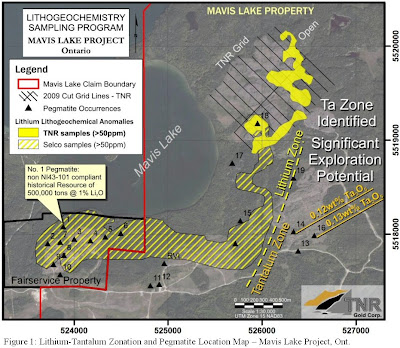
There is another significant indication of potential for Mavis Lake property: next to it on the left side on the map is located a historical resource with 500k tones of 1% Li2O in the same geological setting. Size of the property is not limiting exploration potential for economic tonnage to be discovered by further exploration. Tantalum enrichement zone defined by this exploration program is located to the right side of the property after known Lithium enrichment zone.
Mavis Lake project enjoys easy access and infrastracture availible for further development in the area.
We own shares of this company, biased and nothing should be taken as an investment advise on this blog as usual: just enjoy our travel notes “On the way to the Green Future.”TNR Gold/International Lithium Reports Significant Tantalum Mineralization at the Rare Metals Mavis Lake Project, Ont
Press ReleaseSource: TNR Gold Corp.
On 6:20 pm EST, Wednesday December 9, 2009
VANCOUVER, BRITISH COLUMBIA–(Marketwire – Dec. 9, 2009) – TNR Gold Corp. (TSX VENTURE:TNR – News; “TNR” or the “Company”) and wholly-owned International Lithium Corp. (“ILC”) are pleased to announce results of the 2009 fall field program demonstrating strong and widespread tantalum mineralization on its 100% owned Mavis Lake property located 15km northeast of Dryden in northwestern Ontario.Key Point Summary:
– 38% or 78 of 204 grab and channel samples returned assay values greater than 150 ppm Ta2O5;
– 1349 ppm and 1246 ppm Ta2O5 from 2 grab samples, amongst highest reported in NW Ontario;
– Highly evolved lithium-tantalum zonation identified similar to producing Tanco mine; and
– Underexplored tantalum zone is significant exploration target.“We are observing both high-grade well-evolved Lithium and Tantalum zonation as well as significant levels of Cesium and Rubidium on the Mavis Lake property,” states Gary Schellenberg, President and CEO of TNR Gold, and continues, “The project is clearly emerging as a premier multi-element rare metals project and warrants a major exploration program in 2010.“
2009 Sampling Programs
Two field programs were undertaken in 2009 to assess the lithium (Li), tantalum (Ta) and other rare metals potential of the Mavis Lake property. The initial field program consisted of reconnaissance prospecting and sampling. Samples collected from Pegmatite 18 returned strong results for both Ta and Li with peak assay values of 3.61 Wt% Li2O (lithium oxide) in a grab sample and 1.24 Wt% Li2O over 5.3 metres in a composite channel sample (Company News Release – October 5th 2009).
The follow-up program consisted of detailed mapping and sampling of the known pegmatite occurrences that returned high grade lithium values up to 2.1 wt% Li2O in grab sample and 1.4 wt% Li2O over a 4.7 metre composite channel sample. In addition, a lithogeochemical survey over a 1200m by 900m grid extended the lithium dispersion anomaly (greater than 50 ppm Li) by 1.1kms to 4.5kms in total length (Company News Release – November 19th, 2009). Of special note, 38% (78 of 204 samples) graded better than 150 ppm Ta2O5 (tantalum oxide) demonstrating strong and widespread highly anomalous Tantalum mineralization.
The highest tantalum values came from Pegmatites 13, 14 and 16 which occur within an area of 500 by 800 metres that represents the known southeastern exploration limit for rare metal mineralization on the property. This highly prospective area of elevated tantalum values is underexplored and completely open to the east and southeast and will be the major subject of field investigation in 2010. Samples from this area returned peak Ta2O5 values of 1349 ppm (0.135%) and 1246 ppm (0.125%) from the No.16 and No.14 pegmatites, respectively.
Dr. Frederick Breaks, Special Advisor for TNR Gold, stated, “The peak tantalum values observed are amongst the highest reported in north western Ontario and when taken in conjunction with the strong widespread nature of the mineralization, this indicates significant exploration potential at the Mavis Lake property.”
Other highlights include Ta2O5 values of 723 ppm, 614 ppm and 593 ppm from the No.13, No.17 and No.19 pegmatites, respectively (see Table 1).Samples with very high tantalum values tend to have low lithium values as is typical of sodic aplite and albitite-rock units that represent important host-rocks for tantalum mineralization as exemplified by the Tanco Mine in Manitoba and the Wodgina and Greenbushes Mines of Western Australia. However, there are samples with very high lithium values that also carry strongly anomalous tantalum. Examples of this strong multi-element signature can be found in both grab samples in Table 1 and channel samples of Table 2.
Tantalum mineralization occurs as fine-grained tantalite-columbite group minerals that are hosted primarily in sodic aplite and related albitite (greater than 8 wt% Na2O). Other tantalum-rich minerals may also be present as previous work confirmed wodginite associated with tantalite, columbite, lithium tourmaline and montebrasite at pegmatite 19 (Ontario Geological Survey, 2000 Miscellaneous Release Data 127).
Wodginite is the chief ore mineral for tantalum at the Tanco and Wodgina mines. The Tanco Mine had a historical reserve estimate of 1,879,000 tons grading 0.216% Ta2O5 and has proven to be a world class producer of tantalum, lithium, cesium and rubidium. The Wodgina mine has proven historical reserves of 0.4 million tonnes grading 0.128% Ta2O5. The high-tonnage low-grade Greenbushes mine contains proven and probable reserves of 88.6 million tonnes @ 0.022% Ta2O5.
To view Figure 1 please click on the following link: http://media3.marketwire.com/docs/tnr1209.jpg
Mavis Lake Property
The Mavis Lake property is located 15 km Northeast of Dryden, Ontario. It is easily accessed via the Trans-Canada Highway and a series of logging roads. The claim block comprises a total of 2,544 ha and covers several known rare metal pegmatites.
Regional pegmatite mineralization is directly associated with the strongly peraluminous Ghost Lake pluton and related pegmatitic granite dykes. Rare metal mineralization in the Mavis Lake area occurs in zoned pegmatites hosted by mafic metavolcanic rocks. Rare metal mineralization has been noted to occur in four zones: internal beryl zone within the parent of the Ghost Lake pluton that evolves into external zones of beryl-columbite, spodumene-beryl-tantalite and albite-type pegmatites.
The known pegmatite dykes on the Mavis Lake property comprise spodumene-beryl-tantalite, albite-type or a combination of both. The adjacent Fairservice property is dominated by east trending spodumene-beryl-tantalite-type pegmatites, considered to be part of the same dyke swarm as on the Mavis Lake claim block, and has a historical (non NI 43-101 compliant) resource of 500,000 tons at 1.0% Li2O.
Ike Osmani, P.Geo, is the company’s qualified person on the project as required under NI 43-101 and has reviewed the technical information contained in this press release. To help understand the technical aspects of Lithium and other Rare Metals please visit TNR’s website at www.tnrgoldcorp.com.TNR is a diversified metals exploration company focused on exploring existing properties and identifying new prospective projects globally. TNR has a total portfolio of 33 properties, of which 16 will be included in the proposed spin-off of International Lithium Corp.
It is anticipated that TNR shareholders of record will receive up to one share and one full tradable warrant of International Lithium Corp. for every 4 shares of TNR held as of the yet determined record date. This will result in TNR shareholders owning shares in both TNR and International Lithium. For further details of the spin-off please refer to TNR’s April 27, 2009 news release or visit http://www.internationallithium.com.
The recent acquisition of lithium, other rare metals and rare-earth elements projects in Argentina, Canada, USA and Ireland confirms the company’s commitment to generating projects , diversifying its markets, and building shareholder value.
On behalf of the board,
Gary Schellenberg, President” -
Patent Office Decides To Rush On Green Tech Patents, Rather Than Give Them Scrutiny They Deserve
Jaewon alerts us to the news that the US Patent Office has agreed to fast track “green tech” patents to get them through the process much faster. This is the opposite of what should be done. One of the biggest problems is that examiners don’t have nearly enough time to thoroughly examine a patent to make sure that it’s really patentworthy (i.e., that it’s both new and non-obvious to those skilled in the art). Speeding up the process seems like a recipe for a lot more bad patents — which doesn’t help the green technology space, it’ll cause significant harm. We’ll end up with more patent thickets, and a huge waste of money on legal battles, rather than actual innovation.
Yet, Commerce Secretary Gary Locke supported the plan by announcing:
“American competitiveness depends on innovation and innovation depends on creative Americans developing new technology,” Locke said in a statement. “Every day an important green tech innovation is hindered from coming to market is another day we harm our planet and another day lost in creating green businesses and green jobs.”
This statement makes a bunch of assumptions that simply are not supported by any evidence at all. First, innovation isn’t just about new technology, but about successfully bringing the technology to market. Second, over and over again, studies have shown no causal effect between more patents and greater innovation. It’s amazing that Locke can claim this as if it’s fact when there’s no evidence to support it. Third, there is no hindrance in job creation from a slower patent approval process. Companies can still bring their products to market and can still hire and grow whether or not they have the patent. There are plenty of “patent pending” products on the market. The idea that fast tracking green tech patents creates more jobs is pure fantasy. Apparently, when it comes to intellectual property, the policy of our federal government is entirely faith-based.
Permalink | Comments | Email This Story


