Blog

  • Let’s Move Anniversary News: Recipe Partnership Makes It Easy for Families to Eat Healthier at Home

    Michelle Obama Cooks with Robin Roberts on Good Morning America

    First Lady Michelle Obama joins Robin Roberts and Chef Marcus Samuelsson on Good Morning America.

    (by Good Morning America)

    Ed. note: this post was originally published on the official Let's Move website. You can read it here

    MyPlate is one of the easiest ways to learn about healthy eating. It's simple to look at the icon and recognize how to pile up your own plate. But can you cook with it? Mrs. Obama thinks so. Today, the First Lady joined Robin Roberts and Chef Marcus Samuelsson on Good Morning America to announce a new partnership that highlights healthier recipes that align with MyPlate. 

    Your favorite recipe sites — and Pinterest, an online tool millions use to find the inspiration for their lives– have teamed up with the Partnership for a Healthier America (PHA) to make it easier to find healthier recipes online. Each of the sites will indicate which of their recipes meet nutrition guidance from the US Department of Agriculture, meaning you can now find delicious MyPlate-inspired recipes on the sites you already visit for cooking inspiration. Thousands of recipes will also be featured on new Pinterest boards that launched today. This one-stop-shop for home cooks will give parents the information and tools they need to make healthy choices for their families.

    "As a mom, I know how challenging it can be to think of new meal ideas that your kids will like and that will be good for them,” said First Lady Michelle Obama. “This partnership takes the guess work out of finding healthier recipes and gives parents the information and the tools they need to make healthy choices for their families every day.”

    read more

  • Seattle-based Lighter Capital Adds Molly Gregg

    Lighter Capital has named Molly Gregg Otter as vice president. Otter was previously a vice president at AEA Investors. Lighter Capital is based in Seattle.

    PRESS RELEASE

    Lighter Capital, a pioneer of the revenue-based financing model, today announced the appointment of Molly Gregg Otter as Vice President.

    Prior to joining Lighter Capital, Otter was a Vice President at AEA Investors LP, one of the oldest private equity investment firms in the United States with more than $5 billion in assets under management, where she played a key role in closing the first mezzanine fund and worked to establish the organization’s four mezzanine and senior debt funds investing directly in middle market companies. She evaluated lending to hundreds of companies and was directly involved in over 25 portfolio investments while serving as a member of the team.

    Earlier in her career, Otter worked as an Associate at American Capital Strategies, a business development corporation. Prior to American Capital Strategies, she was at GSC Partners where she worked as a generalist, evaluating and making investments in their private equity, collateralized debt obligations, and distress debt funds.

    “Molly is a rare financial talent who will play a pivotal role in shaping the future of our lending practices,” said BJ Lackland, CEO of Lighter Capital. “She will have a strong influence on how we manage and scale our high volume, next-generation credit evaluation systems and processes. I’m looking forward to working closely with Molly to build upon our early success and to provide small businesses rapid access to the capital they need.”

    Lighter Capital and Revenue-Based Financing is intended for early-stage businesses that have established success and are primed for growth, but are cash-constrained and need access to capital with no loss of control and no fixed repayment schedule. Lighter Capital has developed a software platform to automate the investment application and evaluation process, accelerating the loan process for entrepreneurs, while also improving Lighter Capital’s scale and investment returns.

    “Lighter Capital is not only forging an alternative funding option for small businesses, but it’s also disrupting the traditional investment methodology by ushering in the Capital-as-a-Service approach,” Otter said. “I’m excited to be part of the Lighter Capital team and for the opportunity to introduce new technologies and much needed change to the small business financing industry.”

    About Lighter Capital

    At Lighter Capital, we’re breaking down the barriers to small business growth funding. Our revenue-based finance model exchanges growth capital for a fixed percentage of the company’s revenues. This structure is more flexible, easier, and faster than traditional lenders, making us “lighter” than the marble and mahogany of the antiquated banks. Since late 2010, Lighter Capital has funded a range of businesses – from goat-milk ice cream to Software-as-a-Service – all excellent businesses that have been overlooked by traditional banks and venture capitalists. Lighter Capital is a venture-backed, non-bank investor of its own funds, not a broker or intermediary.

    The post Seattle-based Lighter Capital Adds Molly Gregg appeared first on peHUB.

  • Brickell Biotech Raises $7M Series B

    Brickell Biotech Inc., a development-stage pharmaceutical company focused on treating skin diseases, has raised $7 million in Series B financing. The round was led by AMOREPACIFIC Ventures, part of the Korean cosmetic company AMOREPACIFIC. Other investors include Palisade Concentrated Equity Partnership II, L.P., a private equity fund managed by Palisade Capital Management.

    PRESS RELEASE
    Brickell Biotech, Inc. (“Brickell”), a development-stage pharmaceutical company focused on the development of innovative drug therapies for the treatment of skin diseases, today announced a $7 million Series B financing round. Brickell’s current pipeline includes new chemical entities in dermatology for indications including acne, atopic dermatitis, and hyperhidrosis.

    The Series B is led by a new strategic partner, AMOREPACIFIC Ventures of AMOREPACIFIC Group, the largest cosmetic and aesthetics company in Korea (“AMOREPACIFIC”). Also participating in this round are existing investors, including Palisade Concentrated Equity Partnership II, L.P., (“Palisade”) a private equity fund managed by Palisade Capital Management, L.L.C., and others. The funds from this financing round will be used to support the further development of novel compounds in Brickell’s pipeline from pre-clinical proof of concept through clinical testing. Under the terms of the agreement, AMOREPACIFIC will also obtain an option to first negotiate an exclusive license to market two of Brickell’s novel compounds in the Republic of Korea.

    “AMOREPACIFIC’s investment in Brickell is a validation of our efficient drug development model,” said Brickell President, Reginald Hardy. “We look forward to working with AMOREPACIFIC and our other investors and partners as we move forward with the development of these novel, first-in-class dermatology compounds, which hold great promise for the marketplace.”

    “We share Brickell’s view that there is a significant need for new therapeutics in the field of dermatology,” said Paul Kang, Managing Director, of AMOREPACIFIC Ventures. “We are impressed with Brickell’s leadership team and we are pleased to partner with them as they continue to develop a pipeline of innovative compounds.”

    Brickell Biotech was founded in 2009 by an executive team with a proven track record of success in drug development and in dermatology. In addition to Reginald Hardy, who has successfully built and sold a number of early stage development companies, including Concordia Pharmaceuticals (acquired by Kadmon Corporation) and Sano Corporation (acquired by Elan), the company is led by David Angulo, M.D., Vice President, Research and Development, formerly Head of Clinical Research at Glaxo/Stiefel; Andrew Sklawer, Vice President, Operations, formerly Head of Operations at Concordia Pharmaceuticals; and Charles Betlach, Ph.D., Vice President, New Products, formerly Head of Research at SANO Corporation.

    Brickell has a distinguished Board of Directors chaired by George Abercrombie, formerly President and CEO of Hoffmann-La Roche, as well as an active Advisory Board comprised of experienced dermatologists and drug development and regulatory advisors.

    “Most companies in the dermatology space have focused on reformulating available products, leaving a void of new, breakthrough technologies to treat many highly prevalent skin conditions,” said David Angulo, M.D., Vice President, Research & Development. “That’s where Brickell comes in. We are committed to – and experienced in – efficiently developing a portfolio of novel and viable treatment alternatives that will be welcomed in the marketplace.”

    Roberts Mitani served as advisor for AMOREPACIFIC Ventures.

    About Brickell Biotech

    Brickell Biotech, Inc. is a development-stage pharmaceutical company focused on the acquisition, development and commercialization of innovative drug therapies for the treatment of skin diseases.

    Founded in 2009 by a team of experienced pharmaceutical executives, Brickell’s development strategy includes rapidly and cost effectively developing product candidates; exploring strategic partnerships; maintaining a diversified product portfolio that addresses unmet medical needs; and leveraging professional relationships with thought leaders and contract research organizations in the pharmaceutical industry. For more information, visit www.brickellbio.com.

    About AMOREPACIFIC Ventures
    AMOREPACIFIC, based in Seoul, South Korea, is one of the leading cosmetic and aesthetics companies in Asia, with annual turnover of approximately $3 billion. AMOREPACIFIC Ventures, the corporate venture fund of AMOREPACIFIC, focuses on innovative technologies in beauty and aesthetic area. www.amorepacific.com.

    About Palisade Capital Management, L.L.C.
    Palisade Capital Management, L.L.C., founded in 1995, is an SEC-registered investment adviser with approximately $3.6 billion of assets under management. Palisade manages assets on behalf of institutional clients and high net worth individuals. The firm manages institutional investment strategies focused on small-cap core equities, small-, smid-, and mid-cap growth equities, long-only convertible securities, convertible arbitrage, long/short equities, and private equity. The firm also provides comprehensive investment management services for individuals. Palisade Concentrated Equity Partnership II, L.P. is one of four private equity funds managed by the firm. Palisade is located in Fort Lee, NJ and also maintains offices in Palm Beach, Florida and Del Mar, California.

    The post Brickell Biotech Raises $7M Series B appeared first on peHUB.

  • Google Subscription Music Service Coming In Third Quarter [Report]

    Rumors persisted throughout this past weekend that Google is working on a subscription music service that would take on Spotify, Pandora and the like.

    Bloomberg has since put out a report, citing two people with knowledge of the situation, that Google does indeed plan to do so, that negotiations are under way with major record labels, that the service will work with both Android and non-Android devices, and that the “worldwide service” is targeted for the third quarter. The report also says Google is discussing the renewal of deals for the use of songs in consumer-made YouTube videos.

    Obviously Google doesn’t comment on “rumor and speculation”.

    Such a service from Google would complement Google Play Music and YouTube quite nicely, basically eliminating the need for users to use Spotify or Pandora, provided that they prefer the Google experience. Of course, that will not necessarily be the case. People seem to be liking these services just fine, and Spotify’s heavy integration with Facebook seems to be a hit on the social level. Google still can’t really compete there (unless of course, they do tap into Facebook’s Open Graph).

    Either way, such an offering will give people more reason to turn to Google for their music needs, and it will be interesting to see how the competition shakes out. Those deals with labels will obviously be of vital importance.

    Meanwhile, it has been said that Spotify will try to negotiate with labels to make its free streaming service available on mobile devices, which would make the service all the more attractive of an option for users who aren’t willing to pay.

    Google’s Google Music offering recently got music matching capabilities.

  • Sofia Vergara: Illness Keeps Her Away From Oscars

    Sofia Vergara, one of the stars of “Modern Family”, was hit with a nasty bout of the flu over the weekend and had to skip all the Oscars excitement.

    The curvy star says she’s fine but is recovering at home and trying to keep away from anyone who might contract the illness. The flu has been particularly bad this season, with some states declaring emergencies after so many victims checked into the hospital at once that some had to be turned away. Many celebrities have been hit, including actor Burt Reynolds, who had to be briefly hospitalized with the illness.

    In fact, so many people fell victim to the flu this year that an ice cream maker decided to unleash a specialty item on the public: Influenza Sorbet. The orange-flavored treat is infused with honey, lemon, ginger, orange, cayenne pepper, and pectin, which is found in cough drops, and many swear by the food as a means to feeling better.

    Vergara has made several headlines already this year after she and fiance Nick Loeb were kicked out of a Miami club during an altercation on New Year’s Eve, but she seems in good spirits and tweeted about having to stay home this past weekend.

  • Can Advertising Change the World?

    Ask anyone in consumer goods why their industry is not more committed to sustainability and you’ll hear the same thing: because the marketplace doesn’t reward us for being so. Sadly, most “socially responsible” goods cost more to produce than alternatives that leave the world worse off, and those costs translate into higher prices. Regarding the merits of passing up the greater bargain for the greater good, most shoppers remain unpersuaded.

    But persuading people is what advertising is designed to do. So as marketers become more authentically committed to corporate responsibility goals, expect to see more for-profit companies investing in social marketing — that is, using their messaging powers to change consumer attitudes and behavior.

    This is what the British retailing giant Marks & Spencer is doing in its “shwopping” campaign. The term is a conflation of shopping and swapping, and the thing being pushed here is a suggestion: that, before you rush out to buy the latest fashion, you might visit your closet and decide what it will replace. Very likely, there’s an old article of clothing you could recycle — and your Marks & Spencer will make that easy for you through a partnership with Oxfam and helpfully located “shwop drops” in its stores. But chances are also that, now that you look at it, that old thing is perfectly fine to wear again. Perhaps you don’t need a new one.

    Andrew Winston, a frequent HBR blogger and author of Green to Gold, explains how the company got the project rolling:

    To get the word out, M&S covered a multi-story warehouse entirely with old clothing. The scale of the guerilla marketing effort was not random: the roughly 10,000 garments hanging on the building represented the amount of clothing sent to landfill in the UK every 5 minutes. As Adam Elman, head of Plan A, told me, “we wanted to bring the idea to life.” (“Plan A” is the name of M&S’s sustainability initiative, because “there is no plan B.”)

    The building got plenty of attention, but it was only the beginning of a multi-pronged effort to drive the initiative into the business and integrate it with all marketing. M&S is utilizing a range of the hottest marketing techniques, from running temporary “pop-up” Shwop shops, with garments donated by celebrities, to “gamification” efforts that give customers Facebook points and “badges” for donating. The company is also leveraging star power, putting its “Plan A Ambassador,” the actress Joanne Lumley (most famous abroad for co-starring in the sitcom Absolutely Fabulous), at the center of marketing efforts.

    Pause for a moment to appreciate all this. Here we have a for-profit company spending limited marketing funds not only to promote something other than the goods it has for sale — but even to some extent to suppress demand for them. It seems like madness until you realize that M&S is playing a longer game. As the UK’s biggest clothing retailer, it can’t afford to be irresponsible; its practices are under heavy scrutiny. And it can’t prosper by being responsible until its customers start to value that. But when its customers do learn to value sustainability, it stands to win big. CEO Marc Bolland is determined to get there: “We’re leading a change in the way we all shop for clothing, forever.” He hopes the movement will catch on to the point where all stores take back one garment for every one they sell. “For us that’s 350 million a year,” he says. “It is a big number, but with our customers’ help, we will do it.”

    This is the fifth in a series of posts from our March issue on the future of advertising. Stay tuned for more “Creative That Cracks the Code” over the coming weeks; topics include Variations on a Meme; Collaborating With the Crowd; The Ad as a Game; Just Enough Humor; Ads That “Go Native”; Apps as the New Ads; Personalized Products; and Ads in the Public Sphere.

    We also want to know which ad campaigns strike you as innovative; tell us below and we could analyze your pick as part of this series.

  • Video: Jay Adelson on the Early Days of Equinix

    “It was a crazy time.” That comment sums up the experience of Jay Adelson, co-founder of Equinix, describing the effort to build the first major colocation provider. Adelson, known to many for his role in creating the news portal Digg, founded Equinix in 1998 with the late Al Avery. Adelson and Avery had worked at Digital Equipment Corp., and saw the need for carrier-neutral facilities where companies could interconnect their networks. The attractiveness of that business model, along with its early-mover advantage, made Equinix a key player in the data center sector. In this video from the Equinix Interconnections blog, Adelson discusses the company’s history and progress. “Equinix is the most powerful Internet infrastructure company in the world,” said Adelson. “It’s a powerful position. But you can use that position of power to make a diffference, and to enable the Internet in places it’s never been before.” Adelson also cited the power of culture at Equinix, and the connections that resulted. ”At the time I left, there had been 17 marriages of people who met at Equinix,” he says. This video runs

    For additional background on the history of Equinix, see the Vision & History area of the company web site.

    For more news about Equinix, please see our Equinix Channel. For additional video, check out our DCK video archive and the Data Center Videos channel on YouTube.

  • Stay Current on Your Rivers with USGS WaterNow

    For the first time, anyone can find out the current conditions on thousands of rivers and streams across the country, right from their phone, using USGS’ latest system WaterNow. WaterNow makes the water conditions monitored by more than 16,000 streamgages and other sites across the country available via text or email. 

    Like its predecessor and companion program, WaterAlert, WaterNow seeks to make USGS gage information for streamflow, groundwater levels, springs, water quality, and lake levels more readily available to the general public. These data have been available for over 10 years at USGS Water Data for the Nation, which requires a web browser to access.

    “USGS is the world’s largest provider of hydrologic information, and our streamgages are a vital part of that water infrastructure,” said USGS Associate Director for Water Bill Werkheiser. “WaterNow brings that information straight from our streamgages to your smartphone, and keeps USGS data flowing at the cutting edge.”

    Knowing about current water conditions is important for a variety of purposes, from disaster planning and response to recreation. For example, water levels in streams can be checked during floods to guide evacuations or on a bright weekend morning to plan a day of paddling. 

    Land and resource managers can benefit from WaterNow too. Not only can water levels be obtained, but also water temperatures can be checked to determine when it is necessary to release water from a reservoir to protect downstream trout fisheries.

    WaterNow expands on the service provided by the USGS WaterAlert service. WaterAlert provides a notification only when conditions exceed a threshold set by a user, whereas WaterNow provides data anytime on demand.  These data are collected typically at 15 to 60-minute intervals, stored onsite, and then transmitted to USGS offices every hour.

    So how does it work? It’s easy! All you have to do is find the gage you are interested in using instructions found on the WaterNow page, and then send a message to [email protected] with the site number of the gage you would like to get updates from.

    You will receive a reply within a few minutes that includes the most recent values of water level and streamflow, if available for that site.  These data are by far the mostly frequently requested; therefore, they have been pre-set as defaults.  Data values are also available for other kinds of data-collection sites such as wells, springs, and lakes.

    For complete instructions and guides on what types of data might be useful to you or which streamgages might be of interest to you, visit the USGS WaterNow site!

  • Foursquare Partners with Visa, MasterCard for Amex-Like Offers

    In early 2011, Foursquare and American Express launched a partnership that allowed card-owners to score discounts and cashback by using Foursquare to check-in and spend at certain participating businesses around the country. The program made a big splash on Small Business Saturday (the shopping day after Black Friday) and featured offers like “spend $25 get $25 off.”

    Later, Foursquare and AMEX extended those deals, even launching them across the pond.

    Now, Foursquare is making a move to expand these offers to more types of plastic.

    The company will announce new partnerships with both Visa and MasterCard to provide similar check-in offers alongside participating businesses.

    The AMEX/Foursquare deal has morphed over time to start producing more revenue for Foursquare, and the company says that the new deals with Visa and MasterCard will earn them a fee for every offer redeemed. It’s unclear whether that will be a flat fee per offer claimed or some sort of percentage deal.

    “This is going to be a pretty core part of our revenue model going forward,” said Foursquare Product Manager Noah Weiss.

    According to AdAge, the first offer that should be available today involves $1 off for $10 spent at 8,000 participating Burger King locations.

    Since this is going to be a “core part of the revenue model,” it shouldn’t surprise you that Foursquare is also making these credit card deals more prominent within the app.

    All you’ll have to do is sync your Visa, MasterCard, or AMEX with your Foursquare account to start earning cashback on purchases made through the app.

  • Apple Patents Situational Awareness And Location Information Sharing For Mobile Devices

    Screen Shot 2013-02-26 at 8.42.40 AM

    Apple was issued a couple of interesting new patents today (spotted by AppleInsider), including one that could make an iPhone aware of changes in a user’s situation, and alter phone settings accordingly. That would make for a mobile phone that might be able to automatically switch to silent mode when in a movie theatre, for instance, or which could wake from sleep upon being pulled out of a pocket.

    The patent was originally designed to apply to iPod devices way back in the days of the click wheel controller, but it has been amended to account for wireless mobile devices like the iPhone. The whole point of the invention is to limit GUI requirements for certain functions, and to instead use a device’s sensors, combined with a “situational awareness module” to trigger changes to things like audio settings, music playback and more.

    It’s a tech that sounds like it could easily go wrong; you obviously wouldn’t want your iPhone screen locking when a set of conditions are met that, while similar to another situation, actually isn’t the same one. But you can also see the advantages: Already, Siri can be set to activate when you bring the iPhone to your head. Imagine if other functions, like composing an email, could be auto-triggered via similar functions, like gripping the phone with two hands horizontally as if to begin typing. And an auto-lock function when you slide your phone into a pocket would actually add a lot of convenience in the aggregate, even if it seems like a small thing at first.

    Another patent issued to Apple today by the USPTO describes a way for iPhones to share their location data with secondary, external devices, or vice versa. The system could be used in tandem with a standalone GPS module to help your Wi-Fi-only iPod touch become a fully functional navigation device when you get into a car, for instance. But the more interesting potential behind this patent lies in how it might be applied to an iWatch.

    The patent describes a method for two-way communication between a handset and an accessory, which is capable of transmitting location data from one to the other. In its most basic iteration, it beams GPS info from an iPhone, for example, to a larger display, which can output the map visuals based on data received. That could allow your iPhone to wirelessly (or via wired connection, as both methods are described) relay navigation info to an in-car entertainment system, for example.

    It could also be very useful in making an iWatch design location-aware even without building internal sensors into such a device. Apple doesn’t make mention of this type of implementation specifically in the patent granted today, which was granted in 2009, but it’s no great leap to imagine its benefit in that context. If an iWatch is already tethering to an iPhone for cellular data and other info, then it just makes sense to add in location information. Wrist-mounted maps for walking navigation sounds like it would be a very useful feature.

    Neither of these patents seem too far-fetched to rule out inclusion in future devices, and in fact I’d say it’s likely we’ll see something along the lines of Apple offering up location data to thin clients in external devices, because that really goes a long way towards unlocking the value of mobile devices and broadening the appeal of an iOS hardware ecosystem.

  • Piriform pushes out minor update for CCleaner, version 4 coming soon

    Piriform Software has released CCleaner 3.28 and CCleaner Portable 3.28, updated versions of its popular freeware Windows cleaning tool. Version 3.28 is a minor release, promising better performance and compatibility, plus support for cleaning up behind two new programs.

    Piriform has also announced that the release of CCleaner 3.28 will be the last of the 3.x branch, with CCleaner 4.0 the next release slated. It also hints that this is the first of a number of major updates to its product line planned over the coming months.

    Key changes in CCleaner 3.28 include the promise of improved compatibility with Windows 8 machines. Windows 7 users should also benefit from faster performance through enhanced memory usage, while version 3.28 also improves cleaning of the Windows log files.

    The new build adds cleaning options for Gadu-Gadu, a Polish instant messaging client, as well as Foxit Phantom PDF, while existing cleaning options for Adobe Flash Player and ConvertXToDVD have also been tweaked for a more thorough cleaning experience.

    Pro users will benefit from faster automatic updates, while the update is rounded off with the usual mixture of updated translations, minor interface improvements and bug fixes.

    Piriform has also announced that the next release of CCleaner will be version 4.0, which will add system monitoring tools and file-finding capabilities alongside a minor interface refresh and will also debut a brand new program icon. Piriform also claims to be finalizing details of other “exciting” releases. It appears these may be brand new tools to add to its stable, which currently include Recuva 1.45 and Defraggler 2.13 as well as CCleaner for Mac.

    CCleaner 3.28 and CCleaner Portable 3.28 are both available as free-for-personal-use downloads for PCs running Windows 2000 or later. Pro and Business Editions are also available.

    Photo Credit: Amy Walters /Shutterstock

  • With The Open, ZTE Aims To Get The Young And Adventurous Fired Up For Firefox OS

    zte-open2

    ZTE’s press conference yesterday didn’t really reveal anything we didn’t already know, but it at least gave us the opportunity to play with the Chinese OEM’s first Firefox OS-powered smartphone. The cost-conscious Open is apparently meant for “young people who are adventurers and want to try something new” (according to He Shiyou, head of ZTE’s Mobile Devices Division anyway), but how is it?

    The Open’s 3.5-inch display is something of a mixed blessing here — it responds nicely to swipes and touch inputs, but its small size means that actions that require precision (say, banging out a text message) can be problematic if you have anything but the daintiest fingers. Color reproduction isn’t great and viewing angles are actually quite bad, but that’s to be expected out of such a price-conscious device.

    On the plus side, the Open is actually rather pretty, in a pared-down minimalist sort of way. It’s a very round little thing, and the models on display here were swathed in a nice orange or blue soft-touch plastic (a not-so-subtle nod to Firefox’s emblem, methinks). A 3.2 megapixel fixed-focus camera rides high on the Open’s back, and image quality seemed to skew towards the underwhelming end of the quality spectrum.

    To be quite frank, there really isn’t much to say about the hardware — like HP’s new Slate 7, it’s cheap and it works. But honestly, what else could you expect from a phone like this? If the images alone didn’t make it clear enough, the Open is a device meant to bust into emerging markets — it’s going launch first in Europe and Latin America starting this summer thanks to some help from wireless carrier Telefonica. There’s still no official word on price, but Mozilla engineering program manager Michael Treese told me that the bill of materials for ZTE’s Open comes out to “less than $100″ so I wouldn’t worry about going broke after buying one.

    Click to view slideshow.

    And of course, there’s Firefox OS. I’ll preface this next little bit by mentioning that the build I played with isn’t final just yet — it hasn’t undergone the final cleaning that comes with carrier testing. Things start off charmingly enough with a cute Firefox boot screen, and it isn’t long at all before users wind up on a lockscreen that’s easily dispatched with a single tap.

    We’ve seen Firefox OS in action a few times over the past few months so the interface looks very familiar — a quick swipe on the homescreen brings up a slew of HTML5 apps, while a persistent set of icons for the phone dialer, messaging app, Firefox browser, and the camera. Poking around seemed fluid enough save for the occasional hiccup (which honestly may be more hardware than Firefox OS), and apps fired up without too much delay.

    Speaking of apps, FFOS users have a decent little section of them to choose from at this stage — there are optimized versions of Facebook and Twitter, as well as HTML5 apps for Pulse, AirBnB, Soundcloud, and more. Firefox Marketplace plays home to “thousands” of apps, though Mozilla is quick to note that it’s but only one place for users to find content for their devices. Since the phone is meant for folks in emerging economies, Mozilla also baked in a service that provides real-time network and data traffic monitoring to help those people better manage their usage (and, by extension, their money).

    All things considered, Firefox OS definitely has some potential. Does it still need some polish? A bit, yes. Does it have what it takes to give platforms like Android a run for its money in terms of functionality? In its current state, no, and that’s something Mozilla is quite candid about.

    “We know there’s a certain parity gap,” Treese said of Firefox OS’ feature set. “We’re looking to close it within about a year.” Having ZTE — a pro at cobbling together inexpensive phones — is a smart move considering the markets Mozilla is trying to impact. With any luck, final review units will be available sooner rather than later, but this little guy could make a big splash if priced and marketed correctly.

  • Creating An Effective Data Warehouse Strategy

    Alan McMahon works for Dell. He has worked for Dell for the last 13 years involved in enterprise solution design, across a range for products from servers, storage to virtualization, and is based in Ireland.

    alan-mcmahon-tnALAN McMAHON
    Dell

    Every company has a stockpile of data – loads and loads of data. That data may not be that useful however, if you are unable to even access it without dedicating copious amounts of time and effort to the endeavor. That’s where an effective data warehouse strategy comes in.

    Contrary to what some companies may still believe, effective data warehouse solutions do not have to be costly. Nor do they have to be complex or limited to a single size and scope.

    What No Longer Works

    In the so-called olden days, which in the high-tech world can be as recent as last year, data warehousing was attempted using two fairly common methods.

    One was relying on external resources to cobble together a system as the company went along. Such systems could contain any number and types of servers, storage arrays and software. When combined, companies hoped such a collection would work as an effective data warehousing solution, although that has become less and less likely of being the case. Disparate units thrown together can create an increasingly complex system that is difficult to monitor, track or manage in an effective manner.

    The do-it-yourself approach also runs into trouble for companies who have limited internal IT resources to dedicate to the creation and management of an effective warehousing system. IT resources may not be large enough or enjoy the availability to focus on implementing or managing a sprawling warehousing system.

    Another old-school method of data warehousing was going for a system based on proprietary technology. While this type of system may offer the capabilities and technology to meet the needs of many businesses, the cost was typically high. Outlay was costly, as were the ongoing contracts required to ensure the systems would be continuously optimized and maintained. Reaching for proprietary systems could also often result in over-provisioning for the small and medium business. Smaller businesses would not necessarily need such an extensive system but were forced to pay for it anyway, believing it was the only available option.

    The drawbacks of former data warehousing methods include high cost, low efficiency, and the simple inability to make any useful sense of the data being stored.

    What You Can Do with a System That is Much More Effective

    Instead of having vast amounts of unorganized and inaccessible data, an effective data warehouse strategy lets you access the data easily and rapidly for a number of uses. Reviewing various types of data allows you to track past and current trends, while predicting future trends and issue – resulting in meaningful business intelligence reports.

    Vast amounts of data stored in an inefficient manner can result in drastically reduced system performance. As data volume increases, so can the amount of time it takes for data to load for even the simplest routine operations. Throw a few queries in there for an attempt to locate a specific item, and the system can lag even further as the system  attempts to sift through or process existing data. These time lags not only affect the employees’ productivity, but they can also affect the company as a whole if downtime or bottle-necked traffic results.

    Extensive and ever-expanding data collections are a major challenge for today’s businesses. Internal and external source are constantly adding more data to the mix in a variety of formats and complexity levels. Duplications and redundant data are neither uncommon nor of any practical use.

    Online Analytical Processing, or OLAP, can be a very handy application for mining data from different data bases, but it places an extreme workload and pressure on a system that may not be designed to handle anything as complex or large.

    Effective data warehousing can also eliminate archaic data storage systems that have long outlived any useful purpose or free up other devices that are too stocked with data to perform additional functions.

    What to Look for in an Efficient Data Warehousing System

    Capacity and performance are the two big factors to review when choosing a data warehouse strategy. The framework should be capable of supporting and balancing the hardware and software comprising the system can contain important features that are vital to today’s enterprises. These include:

    • Ability to handle extensive sequential scans
    • Capabilities compatible with OLAP systems
    • Configurations that implement next-generation servers and storage arrays
    • Rapid installation with minimal impact on daily operations and operational systems
    • Scalability to meet business needs without over-provisioning
    • Ability to increase scale for business growth with cost-effective additions down the road
    • Cost-effectiveness to fit a variety of price points and budgets
    • Available upgrades and updates as technologies advance

    Size Matters

    The option to size availability is a must, to keep processing speeds high and cost low. Small, medium and large data warehousing options should be available to meet the specific needs of your business. Small and medium businesses, for instance, may do well with a 5 TerraByte (TB) platform consisting of a single server with internal storage. Slightly larger businesses may be able to create an effective strategy using a 10 TB platform with a larger server and internet storage array. The largest enterprises, by contrast, may want nothing less than a 20 TB platform based on a large server and fibre channel storage array that can handle the massive loads.

    Industry Perspectives is a content channel at Data Center Knowledge highlighting thought leadership in the data center arena. See our guidelines and submission process for information on participating. View previously published Industry Perspectives in our Knowledge Library.

  • Apple offers refunds to parents whose children have made in-app purchases without permission

    In-app purchases are a lucrative revenue stream for both Apple and the developers who embrace it. It provides a way to try a game and then unlock the full thing, or gain access to additional features. In Temple Run 2, for example, you can use real money to buy coins and gems to use on unlocking new characters and abilities.


    The problem is a lot of game makers offer this facility in their apps, and until Apple made a change to its purchasing system in iOS 4.3, it was possible for children to spend money on in-app purchases without their parents knowledge. This, inevitably, lead to a lawsuit against Apple, with the technology giant accused of failing to adequately publicize the existence of the feature in certain App Store games aimed at children.

    In response to the lawsuit — which was originally brought by a Californian man in 2011 after his daughter racked up $200 of charges without his permission — Apple is now proposing to pay compensation to parents who have lost money in this way.

    At the moment this offer only extends to US parents and guardians, and will need to be signed off by a judge on Friday before it can be actioned.

    If agreed, American App Store shoppers will receive an email offering them a minimum of $5 compensation in iTunes credit or cash, provided they can show they have had a child spend at least $30 on in-app purchases without permission (and assuming the parents haven’t already complained and been refunded of course). The key catch is the child will need to have spent the money in the fifteen minute window originally allowed by Apple for additional purchases made after the password was entered. If your child knows — and used — your password to go on their spending spree, it’s tough luck.

    It is thought Apple will need to contact around 23 million users, alerting them that they may be entitled to compensation. No word at the moment if or when this offer will be extended outside of the US.

    Photo Credit: Serhiy Kobyakov /Shutterstock

  • 2013 Porsche Cayman S – CHRIS HARRIS ON CARS

    2013 Porsche Cayman S

    Back when the Porsche Cayman was released back in 2005, most enthusiasts simply dismissed it as a Porsche Boxster with a roof. Those in the automotive know however knew the car was much, much more. A mid-engine coupe with a near perfect weight balance, the Porsche Cayman gain a loyal following as soon as the automotive press jumped behind the wheel. Chris Harris recently got a chance to sample the new 2013 Porsche Cayman S and found out what most of us already knew. It’s awesome!

    Source: Youtube.com/DRIVE

  • Great Leaders Know When to Forgive

    Leaders must be firm and foster accountability, but they also must know when to forgive past wrongs in the service of building a brighter future. One of the most courageous acts of leadership is to forgo the temptation to take revenge on those on the other side of an issue or those who opposed the leader’s rise to power.

    Instead of settling scores, great leaders make gestures of reconciliation that heal wounds and get on with business. This is essential for turnarounds or to prevent mergers from turning into rebellions against acquirers who act like conquering armies.

    Nelson Mandela famously forgave his oppressors. After the end of apartheid, which had fostered racial separation and kept blacks impoverished, Mandela became South Africa’s first democratically elected President. Some in his political party clamored for revenge against members of the previous regime or perhaps even all privileged white people. Instead, to avoid violence, stabilize and unite the nation, and attract investment in the economy, Mandela appointed a racially integrated cabinet, visited the widow of one of the top apartheid leaders, and created the Truth and Reconciliation Commission that would clear the air and permit moving forward.

    Forgiveness can be costly, like the massive amounts of debt forgiveness toward countries like Greece to help create a stable foundation for restoring growth to Europe. Forgiveness can sometimes mean investing in groups that have done something negative — a counterintuitive but often very effective strategy. A striking example, which I recount in my book SuperCorp, occurred in South Korea, not a country known for being kinder and gentler, and yet forgiveness and seeking harmony were at the heart of a major business success.

    Shinhan Bank, a fairly new entrepreneurial bank, was set to acquire Chohung Bank, a larger, much older establishment-oriented bank that had hit hard times, when Chohung employees staged an embarrassing action. To protest the takeover, 3,500 men shaved their heads and piled the hair in front of Shinhan’s headquarters in downtown Seoul. Shinhan signed an agreement with Chohung’s union that astonished some observers. Far from taking revenge for the protest (or walking away from the deal), Shinhan agreed to raise wages, promise no layoffs, have equal representation of both banks on key committees, and wait three years for full integration. These and other investments in the future generated a significant payoff. Within a year, shareholder value had increased (it decreases in a majority of mergers) and employees from both banks were informally integrating, with the union neutralized. Within three years, Shinhan Financial Group was outperforming not only the industry but the entire South Korean stock market.

    “Revenge is not justice,” says General Douglas MacArthur, as played by Tommy Lee Jones in Emperor, an engrossing new feature film about the surrender of the Japanese to American troops at the end of World War II. Like the hit movie Lincoln, the movie Emperor dramatizes a turning point in history replete with leadership lessons. (The movie will be released March 8; I saw an early screening thanks to producer Gary Foster, a personal friend.) The question requiring leadership judgment is whether to hang Japan’s Emperor Hirohito for war crimes. There’s pressure from Washington and his fellow officers to punish the emperor, but General MacArthur, seeing that Japan teeters on civil unrest and reveres its emperor, refuses to give in. He instead uses his power for reconciliation. The emperor remains in place, though stripped of his divinity. In a gesture of contrition, Hirohito leaves the palace to go to American headquarters for the first time. In the mesmerizing final scene, MacArthur and Hirohito pose side by side for a photograph. As we know from history, the rebuilding of war-torn Japan was an economic and social triumph.

    If revenge is not justice, it is not strategy either. The founder of a second-tier computer company was pushed out a few years after the company went public. I watched him gather investors and regain control with something to prove — that they were wrong to push him out. Once back at the helm, he had no clear alternative direction. The company foundered and was sold at a low valuation. Let’s hope that revenge against critics isn’t the motivation for Michael Dell to take Dell private or the founder of Best Buy to attempt a takeover.

    Anger and blame are unproductive emotions that tie up energy in destroying rather than creating. People who want to save a marriage, for example, must let go of the desire to hurt a partner the way they think the partner has hurt them and instead make a gesture of reconciliation.

    Those whose main motivation is to settle scores and get payback — to obstruct rather than construct — are on the wrong side of history. Their legacy is not rebuilding, but rubble. From (ahem) members of Congress to leaders in any turnaround situation, it’s a lesson worth remembering: Taking revenge can destroy countries, companies, and relationships. Forgiveness can rebuild them.

  • Microsoft rolling out updates today for various Windows platforms and IE

    Although it’s Tuesday, it’s not “Patch Tuesday”, which means we shouldn’t expect any updates from Microsoft, but the software giant is rolling out patches none-the-less. The updates are across a broad spectrum of platforms too — Windows 7, Windows 8, Windows Server, and even Windows RT are included in this update.

    Curiously, many of the Windows updates are listed as “non-security”. The company generally only pushes out-of-cycle updates when there is a major security flaw that cannot wait for the next month. In the case of today’s patches, many are listed as a fix for “issues in Windows”.

    There are also a few security patches as well. Both Windows Server 2012 and Server 2008 are receiving security patches, while .NET Framework 4 on XP, Server 2003, Vista, Windows 7, Windows Server 2008 R2, Windows Server 2008, Windows Vista, Windows Server 2003, and Windows XP also have security updates coming.

    There are also security-related fixes for Internet Explorer. According to Knowledge Base articles KB2792100 and KB2797052, “A security issue has been identified that could allow an unauthenticated remote attacker to compromise your system and gain control over it”. These updates cover Internet Explorer versions 6 through 10.

    The entire list of updates is quite long. Those with automatic updates turned on should receive the patches today without having to do anything. Otherwise you will need to install them manually via the Windows Update option in Control Panel.

    Photo Credit: zimmytws/Shutterstock

  • avast! Browser Cleanup disables unwanted browser addons

    If your browser has been taken over by an aggressive addon then you can try the standard routes to remove it (the “Manage Addons” dialog in IE, for instance). These can be confusing for beginners, though, and may not always work, so avast! has developed a custom Browser Cleanup tool as a simpler alternative.
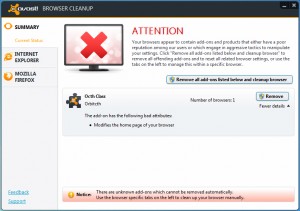
    The program is portable, a compact 1.75 MB download which runs on Windows XP, 7 and 8, so it’s generally convenient to use. It supports IE, Firefox and Chrome, and on launch checks each of these to evaluate your browser addons.

    If any of your extensions are particularly dubious then they’ll be highlighted on a Summary screen which is displayed first. On a test PC, for instance, one addon was reported as either “having a poor reputation” with avast! users, or engaging “in aggressive tactics to manipulate your settings”. If you also have something listed on this page then clicking its “More details” link explains why.

    If the extensions on the Summary page are unnecessary, then you can remove them all with a click. But if you don’t agree with avast! Browser Cleanup’s report then you also have the option to remove highlighted addons individually, or maybe do nothing about them at all.

    It’s quite possible you might have nothing listed on the Summary page, of course, and in that case you can just click one of the left-hand tabs to view the addons for a particular browser. As we’ve mentioned, this can be done from within the browser anyway, but the Cleanup tool does have a small advantage: by default it excludes add-ons with a “good” rating, so cutting the list down to size and helping you focus on any potential threats.

    Spot a potential problem here and clicking Disable will disable that addon completely. There’s no “Remove” option, unfortunately, but presumably avast! think it’s safer to do this from your browser (and if the addon is disabled then maybe the browser’s own uninstall tool will be more reliable).

    And if your browser’s home and search pages have been hijacked then there’s a “Reset browser settings” button to restore their default values.

    Avast! Browser Cleanup isn’t exactly the most powerful of aware removers, then. But PC novices will appreciate its ease of use, and the program’s “user rating” for extensions could be a helpful way to highlight any addons you need to check. If your regular extension management tools don’t work then this may be worth a try.

  • Data Center Jobs: Silver Linings Systems

    At the Data Center Jobs Board, we have a new job listing from Silver Linings Systems, which is seeking a Business Development Manager in Kenosha, Wisconsin.

    The Business Development Manager is responsible for developing and executing a tactical sales plan that will start moving Silver Linings into the number one position among modular data center providers. To view full details and apply, see job listing details.

    Are you hiring for your data center? You can list your company’s job openings on the Data Center Jobs Board, and also track new openings via our jobs RSS feed.

  • With $1M, Thiel-backed Thinkful builds a one-on-one tutoring business atop its online ed peers

    Want to learn how to build and design a website? Thanks to a boom in online education companies, from Codecademy and CodesSchool to LearnStreet and lynda.com, the Web is your oyster.

    But despite the plethora of options — or, rather, because of it — New York-based Thinkful believes it can still make a splash with its three-month-old online learning startup.

    Launched by Darrell Silver and Dan Friedman, one of the first recipients of the 20 Under 20 Thiel Fellowships, the startup combines education content already available online with one-on-one tutoring and mentorship. It opened its doors at the end of 2012 and on Tuesday said that it had raised $1 million in seed funding from Peter Thiel’s FF Angel, RRE Ventures, Quotidian Ventures and others. Thinkful also said it’s the first startup founded by a Thiel Fellow to receive funding from Peter Thiel.

    “We launched Thinkful because we saw that the skill sets we need to be productive workers are changing so quickly,” said Friedman. “I saw this in my peers — as they discovered what work they love, there’s this huge gap in the skills that they need to get these jobs and there aren’t great ways to fill those gaps.”

    For $750 for three months (or $250 a month, in case students want to move at a faster or slower pace), students on Thinkful get online access to instructional videos and other content, a cohort of students with similar goals and a personal mentor. To start, students complete a skills assessment, which helps Thinkful create a custom curriculum. Then, throughout the course, they meet with their mentor weekly, communicate with their peers and have the option to attend daily office hours, all online.

    Content is a commodity; the experience makes the difference

    But, interestingly, unlike most other online education companies, the startup doesn’t produce its own content. It pulls in mostly free content from across the web, from sources like Codecademy and others, but it is open to paying as well. For example, it has a partnership with CodeSchool to access the startup’s paid lessons. Instead of competing with other providers of instructional content, Freeman said his company is complementary.

    “There’s just a limitation to something that’s primarily about learning in the browser and watching videos,” he said. “We have a much more deep educational experience and we consider them potentially partners.”

    To Thinkful, he added, quality online content is a commodity and it’s more like the “textbook” for the course. Any given student will spend just 20 percent interacting with content (online videos, browser-based lessons or text) and the other 80 percent completing projects guided by trained Thinkful mentors, who are domain experts with field experience and, ideally, teaching or tutoring experience.

    I agree that there’s no need to reinvent the wheel if good content exists and that one-on-one instruction will likely lead to better course completion and engagement rates. But I wonder how the providers of the free content will react as the startup grows. For now, Thinkful is small and new — just 30 students have enrolled, with five completing a course so far. But as the startup adds users and increases profits, its relationship with companies that create the content could be tested.

    On one hand, Thinkful could say that given all the possible free content — from places like Khan Academy, Codecademy, LearnStreet and others — it is giving content providers exposure to new users. On the other hand, over time, content providers might feel entitled to a piece of the profit made from the use of their content (or something in-kind).  Friedman said they don’t know how the relationships will play out long-term but emphasized that it wouldn’t change their business. And he added that the CodeSchool partnership shows that they’re willing to pay for high-quality content. Even though Thinkful only focuses on web development for now, Friedman says it has plans to expand into other subjects.

    Related research and analysis from GigaOM Pro:
    Subscriber content. Sign up for a free trial.