Blog

  • Verizon Samsung Omnia 2 looking pretty hot

     samsungomnia21 samsungomnia22

    Click for larger versions

    PhoneArena has managed to grab some spy shots of the new Samsung Omnia 2 on Verizon.  The smartphone, which is set to reach the market on the 2nd December, will feature a racy red back which should compliment the extremely vibrant 3.7 inch AMOLED screen in front pretty well.

    Read more about the Windows Mobile 6.5 device at PhoneArena here.

    Via WMExperts.com

    Share/Bookmark

  • Air Guard leaders urged to tell their stories

    The leadership of more than 107,000 Air National Guard members from around the
    country were encouraged today to share their stories about how they add value to
    America….

  • FEMA: National Guard essential part of federal response team

    The National Guard is a vital partner in the federal response to natural or manmade
    disasters, the administrator of the Federal Emergency Management Agency said here
    today…

  • McKinley closes inaugural senior leadership conference

    Air Force Gen. Craig R. McKinley, chief of the National Guard Bureau, closed his
    first Joint Senior Leadership Conference here today by thanking the 2,400
    participants from around the country…

  • Watch The Country Get Fired: Unemployment By County 2007-2009

    An amazing time-lapse graphic by Latoya Egwuekwe showing the 2007-2009 plunge to 10% unemployment. 

    Nothing much happens in the early months.  But then late 2008 comes around and everything really gets going…

    Click through and press “play” >

    Join the conversation about this story »

    See Also:

  • New iPhone worm spreads further, creates mobile botnet

    iphoneworm

    The worm-ridden iPhone has just turned more rotten, with a new virus spreading from Australia and infecting iPhones in the Netherlands, Hungary, Portugal and Brazil, affecting thousands.

    "After the 5 euro idiot, Ikee with Rick Astley and Intego’s privacy, this worm is doing really bad things," said Scott McIntyre, Security Officer for XS4ALL Internet BV.

    The new worm can steal data, connects to its creators (apparently using a server in Lithuania) and gives them complete control over the phone.  The worm also searches the SMS database, possibly for bank codes and installs itself in the start-up script.  It then initiates a search for other vulnerable iPhones on the same network to spread itself further, often draining the iPhone battery in the process.

    While this worm takes advantage of the default password SSH vulnerability in jaibroken iPhones, the attacks have obviously increased significantly in sophistication, making it likely that it will not be long before hackers take advantage from other vulnerabilities in the OS.  The main saving grace is however that the iPhone OS, which was originally hackable simply by viewing an image in the browser, has been significantly hardened by Apple’s constant battle with the Jailbreaking community, a process which Apple has called illegal and which may ultimate rob iPhone users from being able to customize or multi-task on their devices.

    Read more at Security.nl here.

    Via Allaboutphones.nl

    Share/Bookmark

  • How The Democrats Bought A Key Healthcare Vote For $100 Million

    mary landrieu

    An epic overhaul of the nation’s healthcare system comes down to a single vote.

    POLITICO: Two Saturdays ago, Pelosi passed health reform on a squeaker of a House vote. Today, Reid can’t spare a single Democrat as the Senate decides whether to start debate. If not, President Barack Obama’s reform hopes suffer immeasurable harm.


    That said, things were looking good at daybreak, as Reid can be reasonably confident of 59 votes, with Sen. Ben Nelson (D-Neb.) a yes vote and Sen. Mary Landrieu (D-La.) leaning yes. The holdout: Sen. Blanche Lincoln (D-Ark.), who has been a fan of reform generally but faces a tough 2010 re-election fight.

    So it’s all down to Lincoln, but getting Landrieu (pictured) to comit to a “yes” is fascinating.

    Basically, the Senate bought her vote for $100 million.

    ABCNews: On page 432 of the Reid bill, there is a section increasing federal Medicaid subsidies for “certain states recovering from a major disaster.” 

    The section spends two pages defining which “states” would qualify, saying, among other things, that it would be states that “during the preceding 7 fiscal years” have been declared a “major disaster area.” 

    I am told the section applies to exactly one state:  Louisiana, the home of moderate Democrat Mary Landrieu, who has been playing hard to get on the health care bill.

    Read the whole thing >

    Join the conversation about this story »

    See Also:

  • Long-Term Thinking: “Cost to Own” mindset grabs hold?

    2011 Chevy Volt – Click above for high-res image gallery

    So many things are changing in the new automotive reality, it’s hard to know where to start. Everything from the kind of hose we connect to our cars (liquid filled? electric?) to the sounds the vehicles make is different now than it used to be. What else needs to change? How about how we think about the costs to own and operate a car.

    Naturally, it’s always been possible to estimate this cost, but NADAguides.com has just released a “Cost To Own” calculator for new cars, so you can factor in fuel prices in your region into the cost of the car. It’s entirely useful. For example, to own a 2010 Prius in Michigan for five years will cost an estimated $33,232. On top of the cost of the car, NADA tells us that the car’s depreciation will make up 39 percent of the ownership costs, while fuel equals just 12 percent. A pie chart of the cost breakdown is pictured at right.

    On a similar thread, Edmunds recommends a shift away from MPG and towards a cost-of-energy window sticker on a new car. With all of those electric plugs being added to cars, MPG is becoming less valuable and relevant to our understanding how much it costs to get around. Two quick examples: per month, Edmunds estimates it’ll cost $53.55 to drive the forthcoming Chevrolet Volt, but $66.78 to operate a Prius. Check out their chart here, and remember that according to a recent study, more efficient vehicles can (and often do) cost less.

    [Source: NADAguides.com, Edmunds]

    Continue reading Long-Term Thinking: “Cost to Own” mindset grabs hold?

    Long-Term Thinking: “Cost to Own” mindset grabs hold? originally appeared on Autoblog on Sat, 21 Nov 2009 10:51:00 EST. Please see our terms for use of feeds.

    Read | Permalink | Email this | Comments

  • Rumour: HTC HD2 to get official Windows Mobile 7 update?

    The rumour is unsourced, but MSMobiles claim to have received information which not just suggests but confirms that HTC will be releasing an official Windows Mobile 7 upgrade for the HTC HD2, which will apparently be announced as soon as Microsoft officially announces Windows Mobile 7, likely at Mobile World Congress in February 2010.

    While we know the HD2 matches the Chassis 1 specs rumoured to be the minimum spec for Windows Mobile 7, HTC’s refusal to release a Windows Mobile 6.5 update for the HTC Touch HD, which easily matches the Windows Mobile 6.5 specs, would, I am sure, significantly reduce our readers confidence in this possibility.

    On the other hand HTC may very well need to do this, if they intend to continue selling a Windows Mobile 6.5 device after Windows Mobile 7 is announced.

    Read more at MSMobiles here.

    Share/Bookmark

  • Heritage Turkey and Mashed Parsnips

    cookedturkey Heritage Turkey and Mashed ParsnipsThanksgiving is only a few days away and in the United States this means one thing: turkey. No other foods seems to dominate a holiday like this large bird and the mind-boggling demand (an estimated 45 million turkeys are eaten for Thanksgiving) has created some unsavory practices amongst turkey producers.

    Beginning in the 1960s grocery stores started selling a breed of bigger, plumper turkeys known as Broad-Breasted Whites. This turkey is bred for one main reason: it’s cheap to raise, primarily because it’s genetically modified to grow quickly. Turkey producers can maximize their profits and provide what they think consumers want: birds with more white meat. But the thing is, all that white meat makes a turkey cook and taste different. In fact, it is probably Broad-Breasted Whites (not your mother’s cooking skills) that are to blame for decades of dry, flavorless Thanksgiving turkeys. Even worse than dry meat, the genetic modifications to Broad-Breasted Whites leave them unable to fly or reproduce without artificial insemination.

    By far, the Broad-Breasted White is the dominant breed of turkey sold in grocery stores. In the 1990s, it almost put other breeds of turkey into extinction. Luckily, organizations and turkey producers dedicated to preserving culinary heritage and to fighting against industrialized food production have been diligently protecting natural breeds of turkeys that have been around since our forefathers. Collectively, these breeds of turkeys with colorful names like Bourbon Red, Standard Bronze and Narragansett are known as Heritage turkeys. In recent years, as consumers have become more interested in where and how their food is grown, Heritage turkeys are enjoying a surge in popularity.

    Heritage turkeys are more expensive to buy, ranging from $6.00-$12.00/pound, because they are more expensive to raise, taking up to 30 weeks to grow to close to 30 pounds while a Broad-Breasted White can reach that weight in just 18 weeks. Why splurge on a Heritage turkey? For starters, they are not genetically modified to maximize breast size and meat. Heritage turkeys have more fat and more dark meat, which helps keep the meat moist while cooking. The meat has a richer, heavier texture and more intense flavor, rich and robust and slightly gamey – what a “real” turkey is supposed to taste like.

    Heritage turkeys can be bought from some local butchers and from Whole Foods Markets. Mary’s Turkeys does not sell directly to consumers, but does provide a listing of where their Heritage turkeys are sold. Heritage Foods and Local Harvest ship directly to consumers, but their prices are higher than most retail stores.

    Buying a Heritage turkey is like casting a vote for humanely, naturally raised animals and for the farmers who are putting a premium on healthy, safe, natural food instead of profits. Pair your Heritage turkey with any number of our favorite Primal Thanksgiving sides and you’re guaranteed to have a very Happy Primal Thanksgiving.

    Ingredients: (based on a 12 pound turkey)

    ingredients 10 Heritage Turkey and Mashed Parsnips

    • Turkey. For a Heritage turkey, allow 2 pounds of uncooked turkey for every person. This will yield enough cooked meat for Thanksgiving dinner and leftovers the next day.
    • 4 tablespoons unsalted butter, melted
    • 1/2 teaspoon fennel seeds, crushed with a knife until powdery
    • 2 tablespoons finely chopped parsley, plus extra sprigs to stuff in turkey cavity
    • 1 teaspoon salt
    • 1/2 teaspoon pepper
    • 3 cups chicken broth

    Directions:

    Remove turkey from refrigeration 1/2 hour before cooking. Preheat oven to 350 and set the oven rack in a low position. Remove the innards (neck and giblets) from the cavity of the turkey and set aside.

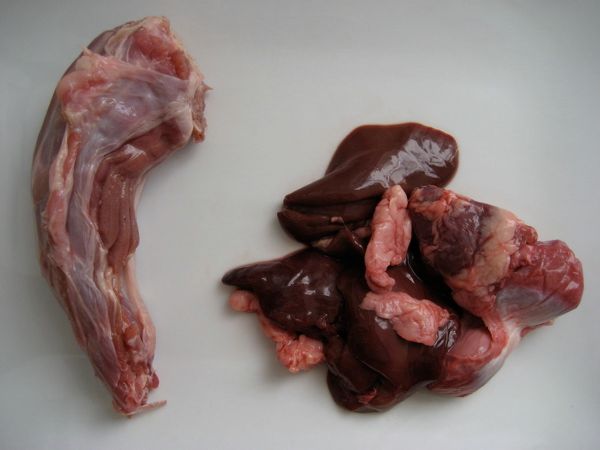
    neck and giblets Heritage Turkey and Mashed Parsnips

    The neck can be roasted next to the turkey or simmered in soup. The giblets (heart, liver, gizzard) can be sautéed in a little butter or oil and eaten as a separate meal or snack. Rinse the turkey inside and out with cool water and pat dry. Combine melted butter with fennel seeds, parsley, salt and pepper. You can also add minced garlic if you like. Drizzle the melted butter over the entire turkey. You can also loosen the skin, pull it up and rub some of the butter directly onto the meat.

    buttered turkey Heritage Turkey and Mashed Parsnips

    Add broth to roasting pan and set bird in the pan, preferably elevated on a rack, breast side up. Insert a meat thermometer straight down through the thickest part of the breast – if you have an instant read thermometer, do not leave it in the bird; insert it later to check the temperature. After an hour, check the bird.

    foil tent Heritage Turkey and Mashed Parsnips

    If the skin is getting too dark on top you can cover it with aluminum foil for the remainder of the cooking time. Roast until the meat registers at 160 –165 degrees, basting occasionally with pan drippings.

    As a general rule of thumb, a 12 pound turkey typically takes around 2 1/2 hours to cook. A 15-25 pound bird can take 2-3 hours and a 25-30 pound bird can take 3 – 3 1/2 hours.

    cookedturkey Heritage Turkey and Mashed Parsnips

    Once the thermometer hits 160, remove the bird from the oven and let rest with a loose covering of foil for 20-30 minutes before carving.

    sliced turkey Heritage Turkey and Mashed Parsnips

    Mashed parsnips are the perfect substitution for potatoes. The flavor of parsnips is earthy and slightly sweet. You can enhance the sweetness by adding cinnamon and nutmeg, or opt for just salt and butter for a more savory side.

    Ingredients:

    parsnips Heritage Turkey and Mashed Parsnips

    • 4 pounds parsnips, peeled and cut into small chunks
    • 2 cups chicken broth
    • 1/2 cup cream, optional
    • butter and salt to taste
    • optional: 1/4 teaspooon nutmeg and cinnamon

    Directions:

    In a deep saucepan, combine parsnips with chicken broth and 1 1/2 cup water. With a lid, simmer until very tender (about 20 minutes).

    parsnips in broth Heritage Turkey and Mashed Parsnips

    Drain off broth. Mash parsnips with a fork or potato masher. Add enough broth back to the parsnips, and cream if you’re using it, until desired consistency is reached. Add salt and butter taste.

    mashed parsnips Heritage Turkey and Mashed Parsnips

    Get Free Health Tips, Recipes and Workouts Delivered to Your Inbox

    Related posts:

    1. Turkey Time: Recipes for Thanksgiving Leftovers
    2. Turkey Meatballs with Broccoli-Carrot Mash
    3. Root Vegetable Hash

  • Marketing Handsets in the Superphone Era

    Apple’s iPhone has changed the game for smartphone manufacturers looking to stand out in an increasingly crowded field. Smartphones were once relegated to buttoned-down business types, but the superphone era has ushered in a host of high-tech, entertainment focused handsets, enabling device makers (ODMs) to market their products as voice-enabled mini-computers supported by countless entertainment, productivity and lifestyle apps. Apple’s impressive marketing savvy continues to boost iPhone sales, but other ODMs — who lack Apple’s brand cachet and deep pockets — must still walk a fine line as they approach consumers directly. To see how other phone makers are approaching the post-iPhone consumer market, read my latest weekly update over at GigaOM Pro (subscription required).


  • REPORT: SS badge to return to its roots at Chevy

    Filed under: ,

    When the SS badge returned to Chevrolet, we were pretty excited. But then the double letter #19 made its way onto the last generation Malibu, and we were immediately and nearly permanently turned off. General Motors later turned up the heat with the turbocharged Cobalt SS and HHR SS, and while we liked those models very much, they in no way conjured up thoughts of 1960’s and 1970’s Impala and Chevelle SS models. And with more stringent fuel economy standards and government-mandated CO2 reductions, it appears that the SS moniker could well be relegated to the new Camaro. Or maybe not.

    Mark Reuss, GM vice president of global engineering, recently told AutoWeek that the SS badge is alive and well. But instead of slapping it on anything and everything with elevated horsepower, the General will instead focus on a more selective process. In other words, we’re guessing the ill-conceived FWD Impala SS won’t happen again any time soon. Or at least we hope. And while Reuss doesn’t hold the glitzy profile of a big-time player like Bob Lutz, the global engineering VP does have plenty of street cred. He worked in Australia to build the RWD Zeta platform that currently underpins the Camaro here in the States, and Zeta is one platform we’re dying to see more of here.

    So if the SS badge is only going to be considered on a case by case basis, our big question is…. what’s next? Well, we have no idea which Chevy will next don the SS badge, but we’re hoping recent rumors of a Volt SS are just that: rumors. Perhaps Reuss will convince his fellow executives to marry the SS badge, the Chevy Bowtie and his pride and joy Zeta platform to make a four-door counterpart to the Camaro. That’s one way to get yourself Lutz-like notoriety.

    [Source: Automotive News subs req’d]

    REPORT: SS badge to return to its roots at Chevy originally appeared on Autoblog on Sat, 21 Nov 2009 09:20:00 EST. Please see our terms for use of feeds.

    Read | Permalink | Email this | Comments

  • Market Trading and Advice: Vortex, Fringe Math Predictor, Final Month, Robert Reich, Earnings Chart, Banking 2010, Bill Gross What To Do, Harvard Poker Player, Negative T-Bills, Dollar Rally

    Bill-Coppedge original content selection by MortgageNewsClips.com


    chris-whalen ira

    2 items worth reading – Loan Growth at Public Expense; Jack Sustman on the Vortex as Market Descriptor – Chris Whalen – The Institutional Risk Analyst 

    ————

    good-is-magazine

    The New Nostradamus – Posted by: Michael Lerner, Ethan Hill – Can a fringe branch of mathematics forecast the future? A special adviser to the CIA, Fortune 500 companies, and the U.S. Department of Defense certainly thinks so. – Good.is Magazine

    ————

    business-insider-money-game

    We’re In The Final Month Before Inflation Hits – Joe Weisenthal – Business Insider The Money Game

    ————

    robert-reich-blog

    The Great Disconnect Between Stocks and JobsRobert Reich’s Blog – … The (stock) market is up because corporate earnings are up. Corporate earnings are up because companies are cutting costs. And the biggest single cost they’re cutting is their payrolls. So they let people go and, presto, their balance sheets look better and their stock prices rise. … Where is this heading? No place good. Without a major shift in policy — both at the Fed and in the White House — the economics point to a big stock-market correction and a double dip.

    ————

    cotd cotd1

    Chart of the Day – … Today’s chart illustrates how earnings declined over 92% from its Q3 2007 peak to its Q3 2009 trough, which makes it easily the largest decline on record (the data goes back to 1936). On the positive side, S&P 500 earnings bottomed and are moving up sharply. …

    ————

    sense-on-cents

    2010 Outlook for Banking – Posted by Larry Doyle – … The American Banker is the banker’s bible when looking for cutting edge analysis and perspectives. Today, this fabulous journal brings us over the wall and into the minds of top rated banking analysts on Wall Street. Let’s navigate, 2010 Outlook : Red Tape, Housing Could Impede Banks’ Recovery: – has summarySense on Cents

    ————

    Bill-Gross pimco

    READ THIS – Bill Gross tells you what to do with your money – PIMCO’s December 2009 Investment Outlook, “Anything but .01%” by Bill Gross, is now available at PIMCO

    ————

    bloomberg

    Harvard Poker Pro Says Texas Hold ‘Em Can Teach Traders to Fold – By Mason Levinson – Brandon Adams, who teaches behavioral finance at Harvard University’s Department of Economics, says some of the best candidates for Wall Street trading jobs are the professional card players at FullTiltPoker.com and similar Web sites. – Bloomberg

    ————

    soberInverted t-bill curve sober-look

    The inverted T-bill curve – an anomaly or a signal for another downturn? – The 3-month T-bill yield has collapsed to new lows, yielding half a basis point. – more … – Sober Look Blog

    ————

    globe-and-mail-blog

    Negative T-bill yields – Simon Avery – … “This time around it appears there is simply too much money that wants to sit tight and look respectable come year-end. Which means that we shouldn’t read too much from the negative T-bill yield and this will eventually rebound back to at least 0 per cent, once the year-end regulatory dance comes to an end.” … – Globe and Mail Blogs

    ————

    sense-on-cents   

    The Message of the 2yr Treasury, Deflation, and Japan – Larry Doyle… Don’t think for a second that Bernanke and Geithner aren’t primarily concerned with the prospects of a deflationary cycle here in the United States and are trying to create inflation while risking the value of our greenback in the process. Idle factories? Limited demand to borrow? Yes, Japan has plenty of that – as does America.  This is the real message of the 2yr Treasury. … – Sense on Cents

    ————

    johnmauldin09 johnm-frontline

    Thoughts from the Frontline Weekly NewsletterWhere the Wild Things Are – by John Mauldin – John’s thoughts on a possible dollar rally.

  • 1:1 part 2

    Thanks to those who tried to guess what caused the patient to code!

    We’ll get to the answer in a bit.

    So, yesterday there was still no response at all. At noon, we began to rewarm him/her. Our rewarming target is 37 C. We are rewarming him/her over 12 hours, so around midnight, he/she should have reached it. It is a slow process because rewarming can be dangerous, as well. We do it at like .35 C per hour.

    Some of the side effects we tend to look for:
     -Of course shivering (just like when cooling), which he/she was on fentanyl and propofol for. He/She never did show any signs of shivering, goosebumps, etc so we did not have to use any drugs to paralyze him/her.

    -Also, rewarming can cause vasodilation and subsequently hypotension and even shock.

    – Obviously, we’re also watching his/her electrolytes, like potassium (K+) because it could increase (hyperkalemia) due to the shift of K into the extracellular compartments. For non medical people, we like to keep K+ tight control due to cardiac arrhythmias, etc.

    -Seizures.

    Unfortunately,  our patient has probably a <1% chance of recovery. He/She did not receive adequate blood flow (oxygen) to the brain for almost 2 hours (the duration of the code), and based on the neurological exam by us and the doctors, his/her prognosis is poor, to say the least.

    The worst part, perhaps, is his/her family. Most of them live in another state, but he/she has a son who lives here. He is probably in his 20’s and apparently, he just got out of jail (for drugs) and according to a cousin, has another warrant out for his arrest. That isn’t the worst part. The worst part is that he has a young child, probably 4-5 years old. And the patient was the one who had custody of the child.  Now social services is on the case to try to find eventual placement for the child since the father will more than likely be back in jail. I hope the kid doesn’t have to go to a foster home because that would be so incredibly sad.

    The son is quite uneducated and has no knowledge of medical stuff. The situation is confusing as it is, but when you have a basic intellect to begin with, it makes it almost impossible to explain the situation. The first day, he definitely was not grasping the severity of the situation. How could he? The patient went in for a routine thyroidectomy! At one point, another family member called and asked when she could come pick up the patient! At this point, we told the son that he needed to call family and inform them of the situation. We kept telling him that the patient is sick, he/she more than likely will not survive. But he still kept saying, “But he/she will wake up, right?”
    um, NO!! Believe me, we were explaining everything in the most basic form that we could!
    Eventually, he did get it and broke down, throwing himself on the floor sobbing.

    So, what caused his/her code and probably death?


    Some mentioned the Vasotec and they would be RIGHT! If you remember from nursing school (or medical, whatever), one of the adverse effects of Ace inhibitors is severe angioedema. In other words, severe swelling.  While in the PACU, he/she received the vasotec as a prn med due to some hypertension, which he/she has normally. It is a pretty popular and standard medication. Once he/she arrived to the floor, however, that is when the swelling began. And because everything was so swollen, they could not get the tube down his/her throat for intubation once in the unit (ie–get him/her on the breathing machine). And at this point, no one even suspected it was a drug reaction. Their initial thought was that it had to be bleeding/hematoma into the surgical site since he/she had his/her thyroid removed and that is in the neck area!

    Why wouldn’t they think that, right? Of course, when they reopened the surgical incisions at the bedside, everything looked good!

    It is quite sad and tragic. There is no way anyone would have known he/she would react to the vasotec in that manner.  Ace inhibitors is now listed as one of his/her allergies, but it will not really matter at this point, since he/she is not going to survive.

    Hopefully his/her kidneys or corneas will be used to help save someone else’s life.


  • The Fed Is Bailing Out Every Bank In The World

    The following is John Mauldin’s weekly e-letter. You can sign up to receive it each week here >

    Where the Wild Things Are is a beloved children’s book and now a beautiful movie. But in the investment world there are really scary wild things lurking about in the hidden recesses of the economic landscape. Today we look at one of the unintended consequences of the Federal Reserve’s low interest rate policy.

    For quite some time, I have been arguing that we are faced with no good choices, not just in the US but in the entire “developed” world. I see a low-growth, Muddle Through world over the next years (with a double-dip recession just to liven things up). However, that does not mean that we will lack for volatility. Things could get volatile rather quickly. Let’s quickly set the background.

    It Is Not Just Japan

    Let’s look at today’s interest rate picture. Yesterday, we had the bizarre occurrence of banks actually paying the government to hold their cash. Three-month treasuries yield a miniscule 0.01% in interest. If you opt to buy a one-year bill you get all of 0.26%. You can see the entire spectrum below.

    mauldin1.jpg

    Look at the graph of the yield curve below. It is as steep as we have seen it in a long time. But that is almost the point. Banks are essentially getting free money. If you are a banker and can’t make money in this environment, you need to quit and find meaningful employment.

    jm112009image002

    And that is part of the rationale that the Fed espouses with its low interest rate regime. Not only does it allow banks to repair their balance sheets, it also encourages investors to put money into riskier assets in order to get some return on their investments. Over $260 billion has gone into bond funds this year, and just $2.6 billion into stock funds. However, you have to balance that with the fact that some $400 billion has left money market funds paying less than 0.2%. So there is some movement to capture yield.

    But is it just banks that are getting cheap money? And is encouraging investors to find riskier assets a sound policy? Maybe not.

    The Euro-Yen Cross and the Dollar Carry Trade

    I wrote a great deal in the past few years about the strong correlation of the euro-yen cross to stock markets all over the world in general. (The euro-yen cross is the exchange rate of the euro and the Japanese yen.) This was a proxy for the Japanese carry trade. The stock markets of the world rose and fell in synchronization with the yen versus the euro.

    A currency carry trade is a strategy in which an investor sells a certain currency with a relatively low interest rate and uses the funds to purchase a different currency yielding a higher interest rate. A trader using this strategy attempts to capture the difference between the rates, which can often be substantial, depending on the amount of leverage used.

    The Japanese drove their rates down to essentially zero in the 1990s. By early 2007, it was estimated that the yen carry trade was over $1 trillion. But when the world credit crisis hit, the world wanted dollars. They paid back the yen and bought dollars, driving the yen higher and killing the yen carry trade. Who wants to borrow in a currency that continues to rise, even if the costs are low? And often, large leverage was used, so small movements in the currency could destroy outsized amounts of capital.

    But now, there are some who are beginning to ask whether there is a dollar carry trade. In the last nine months, the correlation between the dollar and the stock market has gone to about 90%. If the dollar rises, the stock markets and other risk assets tend to fall, and vice-versa. It would appear that investors and funds are borrowing cheap dollars on a short-term basis and investing in all sorts of risk assets. Not only have stock markets risen, but so have high-yield bonds, commodities, and so on.

    We have seen the steepest rise in US stock markets coming out of a recession since the end of the last world war. The market is “discounting” a 5% GDP next year and a profit rebound beyond anything in past experience. Depending on the quarter, operating earnings are expected to rise by anywhere from 30-40%. P/E ratios are back at 23, well above the 17 we saw in the summer of 2007 (I am using 4th quarter 2009 estimates so as to not have to take into account the disastrous 4th quarter of last year.)

    Worrying about a dollar carry trade is not just a preoccupation of my friends Nouriel Roubini or David Rosenberg or Frank Veneroso. Look as this story from Bloomberg:

    “China’s Liu Says U.S. Rates Cause Dollar Speculation

    “Nov. 15 (Bloomberg) — The decline of the dollar and decisions in the U.S. not to raise interest rates have caused “huge” speculation in foreign exchange trading and seriously affected global asset prices, said Liu Mingkang, chairman of the China Banking Regulatory Commission.”

    “The continuous depreciation in the dollar, and the U.S. government’s indication, that in order to resume growth and maintain public confidence, it basically won’t raise interest rates for the coming 12 to 18 months, has led to massive dollar arbitrage speculation,” he told reporters in Beijing today at the International Finance Forum.

    “Liu said this has ‘seriously affected global asset prices, fuelled speculation in stock and property markets, and created new, real and insurmountable risks to the recovery of the global economy, especially emerging-market economies.’

    “His view echoes that of Donald Tsang, the chief executive of Hong Kong, who said the Federal Reserve’s policy of keeping interest rates near zero is fueling a wave of speculative capital that may cause the next global crisis.”

    “‘I’m scared and leaders should look out,’ Tsang said in Singapore Nov. 13. ‘America is doing exactly what Japan did last time,’ he said, adding that Japan’s zero interest rate policy contributed to the 1997 Asian financial crisis and U.S. mortgage meltdown.”

    It is not just China. Brazil has moved to impose a tax (or tariff) on investment money coming into the country on a shorter-term basis, as they are worried about both a bubble in their markets and in their currency. Russia is openly considering similar policies.

    I have been doing a lot of speaking in the last month. In almost every speech, I warn of the significant imbalance in the dollar. I walk to the very end of the stage to help illustrate that the world now has on a massive ABD trade. By that I mean Anything But Dollars. Everyone is now on the same side of the boat. They have borrowed dollars to buy other risk assets, assuming that the dollar, like the yen in the glory days of the yen carry trade, will continue to fall. Dollar bears are everywhere.

    Explanations abound for why the dollar is a trash currency. It is Fed policy, or the Obama administration’s willingness to run massive deficits, or the trade deficit or our health-care policy or (pick any number of issues). But I wonder.

    Global trade collapsed last year and well into this year. Global trade was essentially done in dollars. If global trade is down 20% or more, then there is less need for companies in various countries to hold dollars and more need for local currency because of the crisis. Thus, after a rush to safety in the credit crisis, there is a rational selling of dollars by business.

    jm112009image003

    Look at the above chart. Notice that the dollar is roughly where it was 20 years ago. And notice the recent jump during the credit crisis. We are not even back to where we were before the crisis.

    What happens if world trade picks back up, as it appears to be doing? Admittedly, it is not a robust recovery as yet, but it is rising. That means more need for dollars. And dollars which are being borrowed (and probably leveraged!) on the assumption the dollar will continue to fall.

    And I agree that, over time, the case for the dollar is not as good as I would like. But in the meantime, we could have one very vicious dollar rally, which would take equity markets down worldwide, along with other risk assets. Why? Because it would be a major short squeeze.

    Barron’s just did a survey. It revealed that the bullish sentiment on stocks is quite high and almost everyone hates US treasuries (graph courtesy of David Rosenberg of Gluskin, Sheff)

    jm112009image004

    Whenever sentiment gets too strong in one way or the other, it is usually setting up the markets for a rally in the despised asset. Mr. Market like to do whatever he can to cause the most pain to the largest number of people.

    I am not predicting a near-term crash or imminent precipitous bear, although in this environment anything can happen. I am merely noting that there is an imbalance in the system. The longer this imbalance goes on, the more likely it is that it will end in tears. And the irony is that a recovering world economy could be the catalyst.

    The Wild Things? They may be hiding in a portfolio near you. Just food for thought. Stay nimble.

    New York, London, and Switzerland

    I am going to hit the send button on what may be the shortest e-letter I have ever done. The travel is catching up with me and I need some rest.

    I am looking forward to Thanksgiving next week. It may be my favorite holiday. Family, friends, food, and football. My usual pattern is to get up very early Thursday and start the prime slow-cooking, and then turn to the side dishes. It will be no different this year. My brother will bring the smoked turkeys, which he has down to an art form. And then there are the over-the-top wines I was so graciously given this past birthday by so many friends. I will bring a few of those bottles out.

    The next weekend I am in New York for Festivus with the crowd from Minyanville, and then I am home for over a month before I go to London and Switzerland in late January. Then not much is currently scheduled until April, although it always does seem to change. After the recent hectic schedule (15 cities and even more speeches in just a little over three weeks), I look forward to some home time.

    I wish those of you in the US the best of Thanksgivings, and the rest of you a great week. And thanks for all the very kind words of late about Tiffani. She seems to be doing better. She is due in a month, so she is still moving slowly, but you can sense the excitement in her and Ryan. I find it all very pleasant.

    Your “there’s no place like home” analyst,

    John Mauldin
    [email protected]


    John Mauldin, Best-Selling author and recognized financial expert, is also editor of the free Thoughts From the Frontline that goes to over 1 million readers each week. For more information on John or his FREE weekly economic letter go to: http://www.frontlinethoughts.com/learnmore

    To subscribe to John Mauldin’s E-Letter please click here:
    http://www.frontlinethoughts.com/subscribe.asp

    To change your email address please click here:
    http://www.frontlinethoughts.com/change.asp

    If you would ALSO like changes applied to the Accredited Investor E- Letter, please include your old and new email address along with a note requesting the change for both e-letters and send your request to [email protected]

    Join the conversation about this story »

    See Also:

  • HTC Leo Messaging

    The Leo has a lot of little things the HTC have changed, including the SMS UI, but one thing I’ve only just noticed is that deleting SMSs is a lot easier than it use to be.

    Delete SMS

    Now if only Outlook could get the same treatment!

    Share/Bookmark

  • Germany: The U.S. Is Blowing Another Gigantic Global Asset Bubble

    2012a.jpg

    Germany’s new finance minister has echoed Chinese warnings about the growing threat of fresh global asset price bubbles, fuelled by low US interest rates and a weak dollar…

    Speaking at a banking conference in Frankfurt on Friday, Mr Schäuble said it would be “naive” to assume the next asset price bubble would take the same guise as the last.

    He said: “More likely today is a scenario in which excess liquidity globally creates a new [sort of] asset market bubble.”

    He added: “That low interest rate currencies such as the US dollar are increasingly being used as a basis for currency carry trades should give pause for thought. If there was a sudden reversal in this business, markets would be threatened with enormous turbulence, including in foreign exchange markets.”

    Read the whole thing >

    Join the conversation about this story »

    See Also:

  • Do all HTC HD2 cameras have a camera hardware problem?

    pinkspodge

    There have been increasing complains about a certain pink cast to HTC HD2 camera pictures, especially in the centre of the picture.

    Some HTC HD2 owners have now received responses from HTC Support, indicating this is a hardware problem that can only be corrected by returning the device to suppliers:

    Dear valued HTC customer,

    Thank you for your enquiry about your handset. This is a hardware issue and you can contact your re-seller to exchange the device for another one or contact us and we will send this device to be repair. If these steps have not helped, please let me know by responding using the link provided and I will be happy to check again for you.

    HTC Global ContactUs System

    and…

    Hi Mike,
    Thats not a software problem, our apologies. I can now confirm we have established this being a hardware fault.

    Unfortunately at this stage it is too early to determine exactly where the fault lays but it most certainly is not a software related issue.

    If you can ask Clove to swap it, please do so, if not we will come and collect it for repair.
    You can arrange this by calling 08458900079.

    Best Regards
    Mike

    HTC Support

    Are you having a Pink Problem? Let us know us know in the comments.

    Via Mobiletechworld.com

    Share/Bookmark

  • YouTube to Add Support for IPv6

    The underlying technology powering the Internet is going through a major overhaul as IPv6 is slowly replacing the aging IPv4, the most widely used networking protocol. The adoption rate has been slow but more and more companies are implementing the new protocol. Google is already one of the biggest adopters and is now working on introducing support to its hugely popular video site YouTube.

    Implementing the new protocol isn’t a big technical hurdle, Google says, but YouTube is one of the biggest and most heavily trafficked websites, so the company isn’t setting any hard deadlines for the moment. “YouTube is the IPv6 team’s number one priority right now,” Erik Kline, IPv6 software engineer at Google, told NetworkWorld. “We haven’t said anything about the timeframe for that yet.”

    Google’s IPv6 team has already implemented the protocol for many of the company’s online proprieties like its search engine, Alerts, Docs, Finance, Gmail, Health, iGoogle, News, Reader, Picasa, Maps and Wave. However, it’s still pretty much a provisionary measure for now as few people access the sites through IPv6 at the moment largely due to the fact that the feature has been implemented by only a small number of ISPs.

    “It’s somewhere on the order of the 0.2% range of Google users have IPv6 access,” Lorenzo Colitti, network engineer a… (read more)

  • Windows Mobile 6.5 development continues – now Windows Mobile 6.5.3 Build 28002

    wm653

    Click for larger version

    Besides working on Windows Mobile 7, some portion of Microsoft’s mobile engineers are continuing to work on Windows Mobile 6.5, brining it up to date with technologies like capacitive screens and making the UI more palatable to this generation of smartphone users.

    The latest build is build 28002, which has been dubbed Windows Mobile 6.5.3 (yes, I don’t know what happened to 6.5.2 either).  Its not clear what has changed, but as usual the UI again shows some more polish, especially in the controls, as can be seen in the clock alarm setting screen.  It is also reported to be faster than before, which is always a welcome change.

    Read more about this build in this XDA-Developers thread, and some more information on the build numbering scheme at FuzeMobility here.

    Thanks DavidK for the tip.

    Share/Bookmark